

1. Introduction
The merism is a rhetorical device which consists of referring to a particular thing or notion by way of listing two or more of its contrasting parts or subcategories.Footnote 1 An example of a bipartite merism is the pair “great and small”, which modifies the totality of all things in the sentence “He prayeth best, who loveth best all things, both great and small” from The Rime of the Ancient Mariner by Samuel Taylor Coleridge. An instance of a multipartite merism occurs earlier in the same poem: “While each to his great Father bends, old men, and babes, and loving friends, and youths and maidens gay”. As the second example shows, the classification implied in multipartite merisms remains frequently not exhaustive.
Although the term merism does not appear to predate the Renaissance grammarians, the corresponding figure of speech had been in use much earlier. Its numerous instantiations are attested in cuneiform texts emanating from the Kingdom of Hattusa, also known as the Hittite kingdom. The core of this Bronze Age polity was situated in the central part of Asia Minor, but by the fourteenth century bce it encompassed most of Anatolia as well as northern Syria. A distinct feature of the Kingdom of Hattusa was an elaborate state pantheon, in theory incorporating the deities of all the subjugated and vassal states. The Prayer of Great King Muwattalli II to the Assembly of Gods (CTH 381) attempts to list all of them by name, but then provides an additional description involving merisms in an apparent endeavour not to forget anyone.
The relevant Hittite passage runs as follows (KUB 6.45 iii 4–12 and duplicate KUB 6.46 iii 41–51): [(DINGIR.LÚMEŠ)] DINGIR.MUNUSMEŠ ŠA LUGAL-RI U ŠA MUNUS.LUGAL-TI kuiēš daran[(te)š] kuiēš UL daranteš kuetaš ANA ÉMEŠ.DINGIRMEŠ LUGAL MUNUS.LUGAL peran EGIR-pa iyantari kuetaš=a[(t)] ANA ÉMEŠ.DINGIRMEŠ peran EGIR-pa UL iyantari n=aš LÚ.MEŠSANGA šippanzakanzi DINGIR.LÚMEŠ DINGIR.MUNUSMEŠ [A]N-aš GE6-iš KI-aš nepiš tekan alpuš IMHÁ-uš tethimaš wantewantemaš “Male (and) female deities of the king and of the queen, (those whose name has been) pronounced and (those whose name has) not (been) pronounced, (those) whose temples the king (and) the queen attend to and (those) whose temples they do not attend to – (but) šankunni-priests make sacrifices to them – male (and) female deities of heaven (and) the dark earth, heaven (and) earth, clouds (and) winds, thunder (and) lightenings” (Mouton Reference Mouton2016: 642–3). It is easy to see it mostly involves bipartite merisms, although a parenthetical reference to the šankunni-priests interrupts their chain.
More pertinent to the main topic of this paper are those Hittite passages where merisms are attempts to classify supernatural negative phenomena. In order to achieve efficiency in neutralizing the evil, it was necessary to identify all of its possible sources. The use of merisms in ritual contexts can be illustrated with the text of the so-called Ritual of the river attributed to Tunnawiya (CTH 409.1). In both Hittite passages cited below, idalu papratar “evil impurity” is followed by a list of its possible causes, such as bewitchment, āštayaratar, divine anger, etc., which the ritual is supposed to neutralize. In addition to these multipartite merisms, the first passage contains the verbal bipartite merism “made black, made green/yellow”, apparently referring to different “symptoms” of defilement.
It reads (KUB 7.53+ ii 30–39): kuieš=an dankunieškir hahlan[iešk]ir paprah- <h>er naššu=wa=an PĀNI DINGIRMEŠ kuiški paprahta našma=an aggandaš kuiški peran paprahta našma=an PĀNI DUMU.LÚ.U19.LU kuiški paprahta n=an kāša paprannaš SÍSKUR aniškemi § n=at=ši=kan arha daškemi IŠTU 12 UZUÚR=ŠU idalu papratar alwanzatar āštayaratar ŠA DINGIR-LIM karpin daškemi aggantaš=ši=kan hatugatar daškemi ŠA DUMU.LÚ.U19.LU=ma=(š)-ši=kan pangauwaš idalun EME-an daškemi “Those who made him black, made him green/yellow, defiled him, if someone defiled him in the presence of the gods or if someone defiled him in the presence of the dead or if someone defiled him in the presence of human(s), I am now performing (for) him the ritual of defilement. § I am removing it from him. I am removing from his twelve limbs evil impurity, bewitchment, āštayaratar, divine anger. I am removing from him the terror of the dead. I am removing from him the evil tongue of the group of human(s)”.
A second passage of the same composition states (KUB 7.53+ ii 56–60 and duplicate KBo 53.24:4’−6’): kāša paprannaš aniūr annieškemi nu [pa]prannaš GE6-in KIN-an harmi n=at arha tar[n]a idalu papratar alwazātar āštayaratar DINGIRMEŠ-aš karpin aggantaš hatugatar DUMU-lannaš huipayatan n=at arha tarna “I am performing the ritual of defilement. I am holding the black attire of [de]filement.Footnote 2 Let it go, (namely) evil impurity, bewitchment, āštayaratar, divine anger, the terror of the dead, the cruelty of the progeny. Let it go!”
Another language deployed for rituals in the Kingdom of Hattusa, in particular in the southeastern part of Anatolia in the regions known as Kizzuwatna and Lower Land, was Luwian.Footnote 3 This is a close linguistic relative of Hittite, but its grammar and lexicon are much less known because the relatively small corpus of available Luwian texts imposes serious limitations on translation. Nevertheless, one can state with confidence that merisms also occur in Luwian incantations. In particular, they are attested in the passage in (1), taken from a ritual against bewitchment.Footnote 4 The potentially harmful agents were listed in much detail by a female ritual practitioner, and then entrusted to a substitute, a common medium in Ancient Anatolian rituals (Mouton Reference Mouton2016: 43). The Luwian incantation under discussion is embedded into a Hittite narrative frame, as was generally the case for Luwian rituals preserved in cuneiform transmission. This is because Luwian, unlike Hittite, was not regarded as a literary language in the milieu of Hattusa cuneiform scribes, while the retention of powerful Luwian incantations in writing served the sole purpose of increasing the efficacy of the ritual (Yakubovich Reference Yakubovich2010: 280–81).
(1) KUB 35.43 + KBo 29.55 iii 29’−32’ and duplicate KUB 32.14 + KUB 34.62 iii 9’–13’, CTH 760.II.1.A (cf. Starke Reference Starke1985: 147)

“Let him take it (away) from him, (namely) manipulation (?), curse (or) perjury, internal (or) external, of the living (or) the dead, past (or) future, of mountain-dwellers (or) desert-dwellers, of individuals (or) groups.”Footnote 6
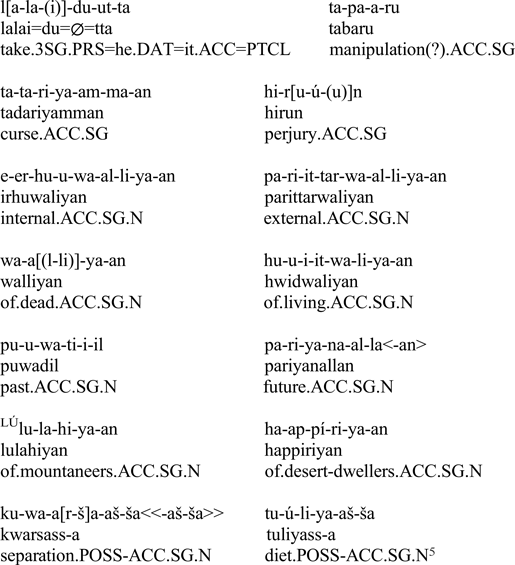
It is easy to see that products of evil intent are provided with epithets, which are arranged in symmetrical pairs. Some of them feature juxtaposed antonyms, e.g. /puwadil(i)-/ “past” and /pariyanall(a/i)-/ “future” or /walli(ya/i)-/ “of the dead” vs. /hwid(u)wali(ya/i)-/ “of the living”. In the instance of /lulahi(ya/i)-/ and /happiri(ya/i-)/ one is rather dealing with reference to two marginal social or ethnic groups. While not containing antonyms proper, the collocation LÚlu-la-hi-ya-an ha-ap-pí-ri-ya-an can be taken as an exhaustive description of a small closed set, similar to the merism AMA-ya-an ta-a-ti-ya-an “of mother (or) father”, which occurs in another incantation in the same ritual (see Section 4 below). The possessive adjectives /kwarsass(a/i)-/ and /tuliyass(a/i)-/ were understood as “of military division” and “of individuals (or) groups”.Footnote 7 Whichever solution one chooses, this pair fits well within the general pattern. Only the collocation e-er-hu-u-wa-al-li-ya-an pa-ri-it-tar-wa-al-li-ya-an remains without a plausible interpretation.Footnote 8
The same collocation is attested in KUB 35.24+ i 23’ [e-e]r-hu-wa-al-l[i-ya-an pa-ri-it-tar-wa-al-li-ya-an] and KUB 32.14+ iii 10’ e-er-wa-al-li-ya-an pa-ri-it-x-x, as well as probably KUB 60.36:9’ [e-er-hu]-u-wa-li-ya-an [pa-ri-it-tar-wa-al-li-ya-an] and KBo 29.15:5’ e-er-hu-wa-al-li-[ya-an pa-ri-it-tar-wa-al-li-ya-an], although the last two contexts are badly preserved.Footnote 9 Its variant in the instrumental case is found in KUB 35.48 iii 8’ ir-wa-li-ya-ti pa-ri-[t]ar-wa-[-al]-li-ya-ti with the duplicate KUB 35.45 iii 7 [ir-wa-li-ya-ti pa-ri-tar-wa-al-li-ya-t]i. The variants KBo 21.12 r. col. 13’–14’ ir-wa !-al-li-y[a-an] pa-ri-tar-wa-al-li-ya-an and ibid. 25’–26’ [ir-wa-al-li-ya-an pa-ri-tar-wa-al-li]-ya-an are of interest, because here the collocation is flanked by merisms translated into Hittite (ibid. 25’: [karuili]yatta kinuntar[riyal] “[pa]st (or) prese[nt]” and ibid. 26’: akkanta[š huišwandaš] “o[f] the dead (or) [the living]”). The fact that the collocation itself escaped translation probably indicates that the scribe was not aware of its Hittite equivalent. The nominative plural form KUB 35.15 iii 11’ [e-er-h]u-u-wa-li-ya-an-zi occurs in a very different fragmentary incantation, whose interpretation remains a challenge. Finally, the broader context of KBo 29.23:4’ pa-ri-tar-wa-al-li-[…] suggests that this fragment may belong to the ritual discussed immediately below.
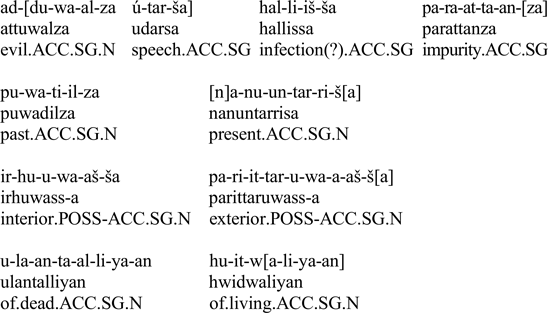
A better-preserved passage (see (2)) from the text of the Puriyanni ritual for the purification of a house (CTH 758) features the collocation /irhuwassa parittarwassa/. In addition, the form ir-wa-aš-š[a] is attested in KUB 35.52 (iii 12’), another copy of the same ritual. From the analysis of (2) one can see that ir-hu-u-wa-aš-ša pa-ri-it-tar-u-wa-a-aš-š[a] occurs between the familiar merisms “past (or) present” and “of the dead (or) the living”, although they modify a different set of nouns. Because of their association with “evil speech”, one may conclude that hal-li-iš-ša and pa-ra-at-ta-an-[za] refer here to negative conditions that were perceived as magically driven, rather than arising from natural causes.Footnote 10 Following Melchert (Reference Melchert and Orioles2012: 284), one may assume that the pair /irhuwassa parittarwassa/ features the archaic nom.-acc.n form of possessive adjective in *-assad > /-assa/ (cf. n. 4). This implies the existence of the nominal stems /irh(u)wa-/ and /parittarwa-/, which would thus have provided derivation bases for the adjectives /ir(hu)walli(ya/i)-/ and /parittarwalli(ya/i)-/ respectively.
(2) KUB 35.54 iii 1’−5’, CTH 758.1.C (cf. Starke Reference Starke1985: 68)
“… evil speech, infection(?) (or) impurity, past (or) present, of interior (or) exterior, of the dead (or) the living.”
In contrast to the morphology of the collocations under discussion, their semantics has remained without a plausible interpretation. Laroche (Reference Laroche1959: 36–7, 79) left the first adjective without translation, but translated the second as “of the prostrated”. This interpretation is supported in Melchert Reference Melchert1993: 168. A different approach characterized the work of Piero Meriggi and his student Onofrio Carruba, who repeatedly derived these adjectives from negative concepts. Thus, “illness” and “oppression” are invoked in connection with /irhuwassa parittarwassa/ in Carruba Reference Carruba and Neu1982: 3.
All the accounts listed above appear to be based primarily on etymological considerations. The crucial argument for Laroche and Melchert was the comparison with Hittite parā tarrū / tarrauwa, which was previously understood as “on one's belly, lying prone”. In the mean time, tarrū / tarrauwa received the new interpretation “firm, secure” in Melchert (Reference Melchert2018). Consequently Melchert has withdrawn his support for Laroche's hypothesis and endorsed the analysis of /ir(hu)walli(ya/i)-/ proposed in our paper. For Meriggi and Carruba, e-er-hu-u-wa-al-li-ya- was a cognate of Hitt. ērman- (n.) “illness”, while pa-ri-it-tar-wa-al-li-ya- was to be connected with Hitt. tarhu-zi “to overcome”. The former comparison is formally unsatisfactory, because it leaves without explanation the h-extension of e-er-hu-u-wa-al-li-ya- (cf. Starke Reference Starke1990: 200).
The speculative nature of all these suggestions is clear from the fact that they do not yield an adequate understanding of the passage involved. This is explicit in the attempts by Laroche and Melchert, while the remaining hypothesis implausibly introduces likely contents of curses where one should rather expect to find categories of miasma, as suggested by the semantics of other co-ordinated pairs. In contrast with all these approaches, we interpret the collocations under discussion in (1) and (2) in a way that will yield a merism “internal (or) external”, which is structurally similar to other figures occurring in its immediate context. Below, we will attempt to demonstrate that the etymological side of our proposal is also more straightforward than all the available alternatives. Sections 2 and 3 will be devoted to the discussion of /ir(hu)wa-/ and /parittarwa-/ respectively, while the concluding Section 4 will address the pragmatic function of the figure under discussion and the available typological parallels.
2. /ir(hu)wa-/ “interior”
One piece of support for /ir(hu)walli(ya/i)-/ and /irhuwass(a/i)-/ originally meaning “internal” comes from Hitt. GIŠerhui- (n.) and Luwian /irhuwid-/ (n.) “basket” (Starke Reference Starke1990: 199–200, cf. Friedrich and Kammenhuber Reference Kammenhuber and Friedrich†1988: 89–92).Footnote 11 The Luwian word clearly contains the productive suffix /-id-/, used, among other things, for the formation of nomina concreta (Starke Reference Starke1990: 190–224), and nothing contradicts the hypothesis that this suffix is attached to the familiar base /irhuwa-/. The situation with the Hittite noun is more complicated. Puhvel (Reference Puhvel1984: 284) compares the derivation of Hitt. erhu-i- from an earlier u-stem with the case of Hitt. parku-i- “pure, clean”. The addition of i-extension to the inherited u-stem adjectives is a well-known phenomenon, which is attested not only in Hittite but also in Latin, and whose Indo-European origins are vividly debated (for the bibliography see Zeilfelder Reference Zeilfelder2001: 216, n. 514). In contrast, the addition of a neuter nominal suffix -i- to an inherited noun in -u- would be unparalleled in Hittite.
The alternative solution is treating Hitt. GIŠerhui- (n.) “basket” as an early borrowing from Luw. /irhuwid-/ (n.) “id.” (thus, implicitly, Starke Reference Starke1990: 205). The formal relation between the two nouns would be the same as that between Old Hittite upati- “demesne” and its source, Luwian /ubadid-/ (Starke Reference Starke1990: 195–8). An intuitive objection against such a solution may come from the fact that the Hittite word contains the vowel /e/ in the oldest texts (Starke Reference Starke1990: 199). One must, however, compare the spellings of Luw. /ir(hu)walli-(ya/i)-/ listed in the previous paragraph, which likewise frequently begin with the E sign, although it is generally assumed that the phoneme /e/ is absent in Luwian. In all probability, we are dealing here with a dialectal(?) subphonemic change [i] > /[e] in the phonetic environment before /rh/.Footnote 12 Naturally, what was purely phonetic in Luwian could easily acquire the phonemic status in Hittite, which features the inherited phoneme /e/. Therefore, GIŠerhui- (n.) “basket” came to be perceived as a genuine Hittite word and the Luwian form may have been re-borrowed in the New Hittite period (Yakubovich Reference Yakubovich2010: 328). In fact, all the available attestations of Luw. /irhuwid-/ (n.) “basket” are embedded in thirteenth-century Hittite texts (Starke Reference Starke1990: 198–9) and can thus be taken as either Luwian foreign words or unassimilated loanwords.
Thus, the Hittite and Luwian nouns meaning “basket” are ultimately derived from the Luwian base /ir(hu)wa-/, which is assigned no translation in Melchert Reference Melchert1993: 92. We would like to suggest that it meant “inside, interior” on the assumption that the word for “basket” had the internal form “insider”, i.e. “implement for putting things inside”. As an approximate typological parallel for such a semantic derivation, one can compare e.g. Lithuanian iñdas “dish, vessel”, a transparent cognate of Lithuanian in-dė́ti “to put in” (Smoczyński Reference Smoczyński2007: 221). Naturally, this etymology alone would be merely suggestive, not probative, in establishing the meaning of /ir(hu)wa-/.
The direct attestations of the base under discussion help to place its analysis on firmer ground. The comparison of KUB 32.9+ obv 10 wa-aš-pa-an-ta-aš-[š]i-in-zi e-[er-hu-wa-an-zi], KUB 32.9+ obv 28 wa-aš-pa-an-ta-aš-ši-in-zi [e-er-hu-wa-an-zi], KUB 32.9+ rev 24’ [wa-aš-pa-an-ta-aš-ši-in-zi e-e]r-hu-wa-an-zi, KBo 29.7:5’ [wa-aš-pa-an-ta-aš]-ši-in-zi e-er-h[u-wa-an-zi], KUB 35.28 obv. 6’ [wa-aš-pa-an-ta-aš-ši-in-zi] ⌈e⌉-er-wa-an-zi, and KUB 35.29 obv. 3’ [wa-aš-pa-an-ta-aš-ši-in-zi e-er-hu]-wa-an-zi is conducive to reconstructing nom.pl /waspantassinzi irhuwanzi/. These are evil agents flanked by “evil year”, “evil month”, and “tongue of the multitude” in the “Great Ritual” of the hierodule Kuwattalla (CTH 761). The acc.pl forms KUB 35.50:6’ [wa-aš-pa-an-ta-aš-ši-in-za e-er]-hu-u-wa-an-za and KUB 35.64:5’ [wa-aš-pa-an-ta-aš-ši-in-za e-er]-hu-u-wa-an-⌈za⌉ occur in similar lists and therefore probably belong to the same ritual. These examples assure that /irhuwa-/ is a nominal stem, but its meaning has not been elucidated up to now.
Given the negative connotations implied by the context, one must follow Melchert (Reference Melchert1993: 265) in connecting /waspantassinzi/ with Hitt. wašpa- “shroud/clothing”.Footnote 13 The intermediate reconstruction of the Luwian adjective /waspant(i)-/ “wearing shrouds/clothes” seems, however, to be unnecessary, because the adjective is formed with the possessive suffix /-ass(a/i)-/. One should rather take /-ant-/ as a distributive plural marker of the sort described in Melchert Reference Melchert2000: 61. Such an analysis is in turn compatible with the interpretation of /waspantassinzi irhuwanzi/ as “the interiors of the shrouds”. These could be ordinary dead bodies, which represent a source of defilement if not properly disposed of (del Monte Reference Monte (del)1973). Elisabeth Rieken (personal communication) indicates an alternative possibility of “the interiors of the clothes” representing the source of a curse in the context of turning up the šeknu-garment, an offensive gesture among the Hittites (see Melchert Reference Melchert1983: 141–5 for details).
Thus, the combinatory method provides two independent cues for assigning the meaning “interior” to the stem /ir(hu)wa-/ (c.). Before we proceed any further, it is necessary to examine an additional form booked under this lemma in Melchert Reference Melchert1993: 92, namely acc.sg. e-er-wa-an occurring in the passage in (3) below.
(3) KBo 13.260 ii 30–33, CTH 765.4 (cf. Starke Reference Starke1985: 261)
“Let this human (child) regain his mother's intimacy! Let him be a child to his mother and oily (=gentle?) to his father!”
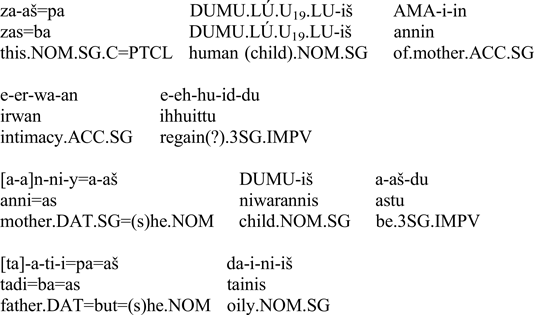
The sympathetic magic prescribed in the Hittite portions of KBo 13.260 is compatible with its analysis as a ritual for healing a sick child (Christiansen Reference Christiansen2006: 143 with ref.), but the purpose of Luwian incantations embedded in this text has not been identified thus far. We would like to suggest that their main function was to bring reconciliation between the child and his parents, which would seem to imply that the perceived illness consisted of tantrums or some other psychological/psychiatric issue. One piece of evidence in favour of such a hypothesis is the passage from the same Luwian incantation KBo 13.260 iii 9’ ha-at-ta-in-zi ha-at-ta a-da-an-du “Let the violent ones eat their violence” (Craig Melchert, personal communication). Since the purpose of a reconciliation ritual must have been restoring close relations within a family, the translation of e-er-wa-an as “intimacy” is contextually appropriate. Therefore, this form can be assigned to the lemma /ir(hu)wa-/ (c.) on the assumption of its basic meaning “being inside”.
An additional argument for the proposed meaning of /irh(uw)a-/ comes from its morphological analysis. Its structure suggests that it represents a synchronic derivative, and a connection with /irh(i)-/ (c.) “boundary” springs readily to mind. In fact, Puhvel (Reference Puhvel1984: 284) has already offered a link between Hitt. GIŠerhui- “basket” and Hitt. arha- “border” (a cognate of Luw. /irh(i)-/), but the lack of morphological detail prevented his etymology from being commonly accepted (cf. Kimball Reference Kimball1999: 166). Now one can propose that /ir(hu)wa-/ represents, etymologically, a substantivized adjective “central, internal”. The Proto-Indo-European suffix *-u̯ó- forming polar adjectives, such as, for example, “right” and “left”, was recently discussed in detail in Oettinger Reference Oettinger2017. The substantivization of this adjective within Luwian may have been accompanied by its transfer to the a-declension (for the pattern, cf. Sasseville Reference Sasseville2014–15), although alternatively this paradigm, as opposed to the mutation stem, may merely reflect the stress on the thematic vowel. Under either of the proposed hypotheses, forms like /ir(hu)walli(ya/i)-/ and /irhuwass(a/i)-/ represent secondary derivatives formed at the time when the /irh(uw)a-/ “inside, interior” had already become a substantive.
In order to appreciate the semantic side of the proposed etymology, it is important to keep in mind that Luw. /irh(i)-/ (c.) “boundary” and Hittite arha-, irha- “id.” must have had underlying conceptual representations as circles, not straight lines.Footnote 14 The most ostensive illustration of this connotation in Hittite is the denominative verb irhāi-zi, glossed in Puhvel (Reference Puhvel1984: 130) as “to go down the line, circulate, make the rounds; treat in succession, list, enumerate; round out, wind up, conclude, finish” (cf. Giusfredi et al. Reference Giusfredi, Kammenhuber † and Friedrich †2014: 80–85). It is obvious that the majority of these shades of meaning make an implicit reference to the shape of a circle (or something similar); no associated example, so far as we can see, invokes the notion of a straight line.
We would like to complement this observation with a piece of evidence from CTH 760.II, the same manuscript of the ritual as example (1) is taken from, naturally belonging to its Hittite prescriptive part. This is KUB 35.43+ ii 19–22: nu=(š)šan MUNUSŠU.GI UDU BABBAR ANA E[N SISKU]R [a]nda appānna 4=ŠU irhāizzi hantezzi p[alši Z]AG-az EGIR-anda GÙB-laz EGIR-anda UZUGABA-az EGIR-an[da] iškišaz “The Old Woman makes the rounds four times while holding the white ram up to the ritual's patron, first to the right, afterward to the left, afterward in front, afterward behind” (cf. Starke Reference Starke1985: 144). The white ram utilized in these movements functions as a ritual substitute.Footnote 15 The four circuits must have been meant to create a sort of protective circle around the patient, which would facilitate the subsequent transfer of miasma from the patient to the substitute.
Furthermore, one can cite evidence for the parallel use of irhāi-zi with wahnu-zi “to turn” in Hittite texts. The most transparent parallelism can be found in the passage KUB 2.3+ iii 25–32, belonging to the KI.LAM Festival (CTH 627): DDamnaššaruš=(š)a wahnuwanzi n=aš=kan IGIHÁ-wa LUGAL-i anda neyanzi § kuwapit kuwapit LUGAL-uš irhiškezzi DDamnaššaruš=(š)a QĀTAMMA=pat wahnuškanzi “They turn the Damnassara deities too. They turn their eyes toward the king. Wherever the king turns around, they turn the Damnassara deities in the same way” (cf. Singer Reference Singer1984: 67). In this context, the movements of the deities directly mimic those of the king. It would be completely unclear how irhiške-zi, the imperfective of irhāi-zi, could acquire the meaning “to turn”, if it were based on the concept of going along a straight line.
The prototypical circular shape associated with the notion of “boundary” in Hittite and Luwian helps to explain why the lexeme with such a denotation could have cognates meaning both “external” and “internal” in these languages. On the one hand, the Hittite etymological ablative arahza could literally mean “(away) from the intimate circle”, hence “outside”. It served as the derivation base for Hittite arahza-, arahziya- “alien” and arahzena- “external” (Puhvel Reference Puhvel1984: 133). On the other hand, a relational adjective *irhuw(i)- or *irhuwa- derived from Luw. /irh(i)-/ could acquire the semantics “belonging to the intimate circle”, hence “internal”. The adjectives /ir(hu)walli(ya/i)-/ and /irhuwass(a/i)-/ have ultimately inherited this meaning.
Summing up, the contexts featuring the noun /ir(hu)wa-/ are compatible with its translation as “interior”, while its position in the derivation chain between /irh(i)-/ “boundary” and /irhuid-/ “basket” corroborates this hypothesis. The final confirmation of its meaning comes from the analysis of the matching term /parittarwa-/.
3. /parittarwa-/ “exterior”
The key to understanding the meaning of Luwian /parittarwa-/ is the Lydian lexeme pλtarwo-, which occurs in two burial inscriptions, invariably in the form pλtarwod. The meaning and even the grammatical characteristics of this word have long remained unknown. Gusmani (Reference Gusmani1964: 84) analysed it as the substantivized adjective “belonging”, while Melchert (Reference Melchert and Disterheft1997: 136) saw here a denominative verb. Yet the very coexistence of the obviously cognate forms pλ-tar-wo- and ẽn-tar-f-λo-, duly noticed by Melchert, pleads for treating the first form as a synchronic noun and the second as a derived adjective. Leaping ahead somewhat, one may propose that Lyd. ẽn-tar-f-λo- historically contains the same suffix chain as Luw. /pari-ttar-wa-ll-i(ya/i)-/.
Since the contexts featuring pλtarwo- are all very similar, we will limit ourselves to the detailed analysis of just one of them, which belongs to the initial part of the Lydian and Aramaic bilingual LW 1 / LydBil.Footnote 16 It is easy to see that the list of various parts of the grave concludes with pλtarwo-.
(4) LW 1.2–4 (cf. Gusmani Reference Gusmani1964: 250)
“This stele, and this tomb, and woodwork and the precinct, and where the outer part of this tomb (is situated), it (all) belongs to Manes, son of Kumlis, the šiluka-.”
(5) LydBil 2–4 (cf. Buckler Reference Buckler1924: 2)
“This column and the tomb, wood(work), the precinct and forecourt, which is the forecourt to this monument, it (all) belongs to Manes, son of Kumlis, the šilukean.”

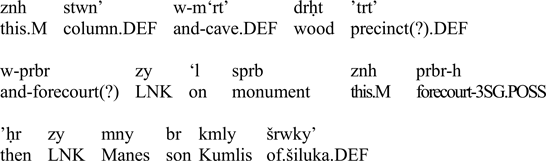
Before we turn to pλ-tarw-o-, brief comments on the other burial accoutrements appear to be in order. Lydian mru- “stele” and wãna- “tomb” belong to the earliest stratum of reliably established Lydian lexemes (Gusmani Reference Gusmani1964: 168, 222). The Lydian collective noun laqriša- corresponds to Aramaic drḥt, which is an Iranian loanword in origin (Hanson Reference Hanson1969: 8, n. 13). In Middle Persian, draxt means “tree”, and the meaning of Old Persian *draxta- was probably the same, but as a technical borrowing into the peripheral Official Aramaic, the Iranian word could easily acquire the meaning “wood”. On the other hand laqriša- may represent a cognate of Hitt. GIŠlahhura- “offering table, offering stand” (Nikolaev Reference Nikolaev and Jamison2010: 197, n. 27), a wooden implement, as suggested by the determinative. This motivates the proposed tentative translation “woodwork”.Footnote 17 Lydian qela- (n) corresponds to Aramaic ’trt’, a derivative of ’tr(’) “place” (Schwiderski Reference Schwiderski2004: 94–5). The comparison with Lycian qla- “precinct” supports a similar meaning for Lydian, while Palaic kuwalima- “(a pen for sacrificial animals)” functions as a tertium comparationis (Sasseville and Yakubovich, Reference Sasseville and Yakubovichforthcoming). All three nouns for enclosed spaces are apparently derived from the Anatolian verbal root *kwel “to turn”, which possibly had an additional meaning “to go around”. All in all, one is getting the impression of a logically organized list, which progresses from the core of a grave to its periphery.Footnote 18
Against such a background, one may now consider the Lydian phrase kud= k=it išt ešλ wãṇ[aλ] pλtarwod, which has the Aramaic correspondence w-prbr zy ‘l sprb znh prbrh. The noun prbr is yet another loanword of Iranian origin, which is reconstructed as *pari-bāra- (Hinz Reference Hinz1975: 179). The same Old Iranian noun is independently borrowed into Biblical Hebrew (1 Chr. 26: 18 prbr “forecourt”). The structural and genetic similarity between Iranian *paribāra- and Greek περιφέρεια “line around the circle, outer surface” is worth taking note of, although we are surely dealing here with historically independent formations from common inherited material. The precise meaning of prbr in the bilingual remains debated, but Schwiderski (Reference Schwiderski2004: 696) suggests “precinct, entrance corridor(?)”. Since the meaning “precinct” is probably to be reserved for ’trt’=qela-, something like “entrance corridor”, “forecourt”, “portico”, or simply “periphery”, emerges as a more likely referent for prbr, and therefore also for Lyd. pλtarwo-.Footnote 19
The match between Luw. /parittarwa-/ and Lyd. pλtarwo- is formally unproblematic. More than that, it confirms a correspondence, which was first implicitly postulated in Melchert Reference Melchert and Bombi2006, with the discovery of the Lydian 3sg. middle ending -tλ, cognate with Luw. /-ttari/ “id.”, but has remained without formal parallels thus far. It seems likely that Luw. /-ri/ regularly corresponds to Lyd. -λ, in word-final position, while pλ- in pλ-tarwo- is due to analogy with the free-standing local adverb *pλ, corresponding to Luwian /pari/ “forth”.Footnote 20 As for the semantic side of the comparison, one may suggest that pλtarwo-, whatever its precise definition, designates the external part of the tomb, which vindicates the proposed translation of /parittarwa-/ as “exterior”.
Furthermore, this translation is fully compatible with the internal structure of /parittarwa-/. Just as in the case of /ir(hu)wa-/, one can suggest that this is a substantivized adjective, originally endowed with the suffix *-u̯ó-. In this particular case, however, the suffix under discussion appears to be appended on top of *-tero-, likewise known to form polar adjectives in Proto-Indo-European (cf. the pair *deḱsiu̯ó- und *deḱsitero- “right”, Oettinger Reference Oettinger2017: 254). The suffix *-tero- is independently attested in Luwian through the adjective /annantarr(a/i)-/ “lower” derived from the local adverb /annan/ “under” (e.g. TELL AHMAR 5 §9, cf. Hawkins Reference Hawkins2000, I: 233); cf., further, Hittite kattera- “lower” vs. katta “down”. In our case, the reconstructed Luwian adjective *pari-tar-w(a/i)- or *pari-tar-wa- “external” is uncontroversially derived from the local adverb /pari/ “forth”. The renewed form /pari-ttar-wa-ll-i(ya/i)-/ contains no fewer than four adjectival suffixes, unsurprisingly featuring the more productive ones closer to the right edge. The same suffix structure can be reconstructed in the case of Lydian ẽn-tar-f-λo- “belonging” and ši-tar-f-λo-, of unknown meaning (Gusmani Reference Gusmani1964: 107, 196–7), with the only difference being that the two rightmost suffixes must have merged into -λo- by sound change.Footnote 21 The proposed analysis correlates with the confirmed presence of the preverbs ẽn- and ši- in Lydian; the former morpheme also occurs on its own as the postposition ẽn (Gusmani Reference Gusmani1964: 104–6, 195).
Summing up, the interpretation of /parittarwalli(ya/i)-/ as “external” is supported by three independent considerations. First, combinatory analysis shows that Lyd. pλtarwo-, a lexical cognate of Luw. /parittarwa-/, designates an external part of the grave. Second, the synchronic morphological analysis of /parittarwalli(ya/i)-/ yields its derivation from the centrifugal local adverb “forth” with a chain of adjectival suffixes. Third, its proposed new meaning perfectly fits that of /ir(hu)walli(ya/i)-/ within the context of other merisms attested in Luwian incantations (cf. Section 1).
4. Typology and pragmatics
The final section of this paper strives to place our linguistic findings in perspective. We intend to argue that the merism “internal (or) external” is both grounded in the Anatolian rhetorical tradition and compatible with the beliefs about potential sources of impurity that were current in Late Bronze Age Hattusa.
The most obvious parallel to the collocation under discussion comes from a Late Luwian passage (6), embedded in the protasis of a curse formula. While the adjectives used there are different from the pair /ir(hu)walli(ya/i)-/ and /parittarwalli(ya/i)-/, they have an identical meaning, as was already recognized in Hawkins Reference Hawkins2000.
(6) Babylon 1 §§11–12 (cf. Hawkins Reference Hawkins2000, II: 392)
“Whether he is an internal enemy or he is an external enemy.”Footnote 22
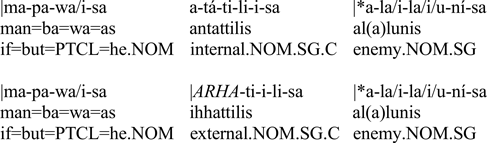
The difference between the terms deployed in the same stylistic figure in cuneiform Luwian vs. hieroglyphic Luwian requires a brief discussion. As argued in Yakubovich Reference Yakubovich2010: 68–73, the Luwian dialect of the Iron Age (Late Luwian) does not represent a genetic descendant of the Kizzuwatna/Lower Land dialect, but rather continues the Luwian dialect of Hattusa (Empire Luwian). The core area of the Empire of Hattusa was presumably the scene of intense interaction between Luwian and Hittite, although much more work has been done on the Empire Luwian influence on Late Hittite than on transfers in the opposite direction. Now, the Hittite language features the pair arahzena- “external” and anduriya- “internal”, which can also occur together in a merism, although its reliable attestations appear to be limited to secular texts (Puhvel Reference Puhvel1984: 84).Footnote 23 We have seen in Section 1 that the translation of /ir(hu)walli(ya/i)-/ and /parittarwalli-(ya/i)-/ into Hittite caused certain difficulties, perhaps because their Hittite functional equivalents were genetically unrelated and looked very different. On the other hand, the Late Luwian adjective /ihhattil(i)-/ “external” is cognate with Hitt. arahzena- “id.”, while its counterpart /antattil(i)-/ “internal” could easily be perceived as a cognate of Hitt. anduriya- “id.”. We suggest that the Late Luwian adjectives were calqued from their Hittite functional equivalents, and therefore represent innovations, vis-à-vis the more archaic situation attested in Kizzuwatna/Lower Land Luwian.Footnote 24 On the other hand, the merism “internal (or) external” (or in the reverse order) belonged as such to the stock of shared stylistic devices of Hittite and Luwian speakers.
The pragmatic interpretation of the idiom “internal (or) external” naturally could not be stable but depended on its specific applications. Our present enquiry does not go beyond addressing its use in Luwian incantations, exemplified by passages (1) and (2). The elaborate classification of impurities in these and similar Luwian incantations justifies a quest for the pragmatic prototypes of their “internal” and “external” varieties.
Another classification of impurities, belonging to the same ritual as example (1), may shed light upon this problem. In KUB 35.45 ii 1–4 we find the list: [ta-pa-ru ta-a-ta-(ri-ya-am-ma-an)] hi-i-ru-ú-un hi-i-ru-ú-un pu-ú-wa<-ti>-il pa-ri-ya-na-al-la-an AMA-ya-an ta-a-ti-ya-an ŠEŠ-ya-an NIN-ya-an ÌR-ya-an GÉME-ya-an LÚlu-u-la-hi-ya-an LÚha-pí-ri-ya-an kur-ša-aš-ša-an tu-ú-li-ya<-aš-ša>-an “[manipulation(?), curse] (or) perjury, past (or) present, of mother (or) father, of brother (or) sister, of manservant (or) maidservant, of mountain-dwellers (or) desert-dwellers, of individuals (or) groups” (CTH 760.II, cf. Starke Reference Starke1985: 151). While similar to the list in example (1) in a number of respects, this list dwells on the closest relatives as potential sources of witchcraft. In Late Bronze Age Anatolia, settling scores within the family with the help of witchcraft was more than a remote theoretical possibility: thus, Ziplantawiya, sister of Great King Tudhaliya I, was believed to utter “evil tongues” (a type of curse: see Mouton Reference Mouton2010: 112–4) against the King and his wife Nikkalmadi. Two Old Woman rituals, booked under CTH 443 and published in Kassian Reference Kassian2000, were specifically devoted to blocking the harmful effects of Ziplantawiya's ill intent. As clearly illustrated by the text of Maštigga's ritual against family quarrels (Mouton Reference Mouton2016: 374–419), curses issued by immediate family members were regarded as having a particular power. In that composition, the two ritual patrons are being treated for a curse that they uttered against one another. It seems possible, therefore, that the adjectives /ir(hu)walli(ya/i)-/ and /irhuwass(a/i)-/ describe witchcraft against the next of kin.
As for /parittarwalli(ya/i)-/ and /parittaruwass(a/i)-/, this group of adjectives may refer to the association with lulahi- and hapiru- groups. We have seen that the adjectives derived from these two nouns form merisms in example (1) and in the passage cited in the previous paragraph. The same two groups are also associated within the Hittite incantation KBo 39.104+ iv 8’–12’ and duplicate KUB 30.34+ iv 30–35: [(našš)]u LÚlulahiš našma LÚSA.[(GAZ kuišk)]i ēšta nu=(š)šan šarā ne[(p)išaš DI(NGIRMEŠ-n)]aš iyauwa halzāiš n=at ne[(piš)aš DIN(GIRMEŠ)] taknaš DINGIRMEŠ piandu n=at=kan [(k)attanda da-(nkuwa)]i taknī pēdadu [n=a(t arha harakdu)] “If it was a mountain-dweller or some desert-dweller and he uttered a wail up to the [g]ods of hea[ven], may the [god]s of heav[en] (and) the gods of the earth give it (away)! May they bring it d[ownward] into the [D]ark Earth! Let [i]t perish!” (Melzer and Görke Reference Melzer and Görke2017: §19’’’’). It seems likely that the nomadic or semi-nomadic lifestyle of mountaineer or other communities, whether or not they were identified with specific ethnic groups, triggered their association with “otherness” and “magic” in southeastern Anatolia, as also happened, for example, to many strangers in the Graeco-Roman world (Graf Reference Graf1994: 40 and 57). The association between impurity and foreigners, a fortiori enemies, is illustrated by the following extract of a Kizzuwatnian ritual of invocation (KUB 15.34+ ii 5 and duplicate KUB 13.29 l. col. 12): n=ašta IŠTU KUR LÚKÚR idālauwaz papran[naz (arha uwatten !)] “Come out (pl.) from the enemy land, from the evil impurit[y]!” (CHD P, 104).
The connection of /ir(hu)walli(ya/i)-/ and /parittarwalli(ya/i)-/ with close relatives and “foreign” ethnic/social groups, respectively, is not the only possibility. Alternatively and preferably, the use of the combination “internal (or) external” in the enumeration of various sources of evil could be explained by the various sorts of impurities the ritual deals with: “manipulation(s)” and “curses” are “external” evil sources, since they are two different forms of witchcraft. The potentially external character of impurity is attested by the beginning of the “ritual of the river” of Tunnawiya, which states (KUB 7.53+ i 1–8): mān=kan antuh- <šaš> naššu LÚ-LIM našma MUNUS-za papranni kuedanikki anda tianza našma=za=an=kan tamaiš kuiški papranni šer halzian harzi “If a person, either a man or a woman, (has been) placed in some impurity, or (if) someone else has called him for impurity (…)” (CHD P, 104). Note the two expressions “placed in some impurity” (papranni kuedanikki anda tiyant-) and “to call someone (else) for impurity” (papranni šer halzai-) which both denote external evil attacking the person.
Another ritual of Tunnawiya contains a more representative list of potential external perpetrators, including officials and priests, whose evil speech can affect the king and the queen. This is KUB 9.34 iv 7’–18’: maninkuwandan MU-an mutaiddu DINGIRMEŠ-aš karpin pangauwaš EME-an KI.MIN DUMU É.GAL EME mutaiddu ŠA GUDU12 EME-an KI.MIN ŠA LÚSANGA-aš EME-an KI.MIN ŠA MUNUSAMA.DINGIR-LIM EME-an KI.MIN ÉRIN.MEŠ KARAŠ-aš EME-an KI.MIN ŠA DINIM EME KI.MIN tuliyaš EME-an KI.MIN LÚ.MEŠauišiliyaš KI.MIN pangauwaš MÁŠHÁ EME-an KI.MIN LÚ.MEŠlulahiyaš LÚ.MEŠhapiriyaš KI.MIN GIDIM-aš TI-andaš KI.MIN adandaš akuwandaš EME-an KI.MIN tangarantaš EME-an KI.MIN [(LÚ.MEŠšarikuwa)]in EME-an mudaiddu hūmandaš [(UH7-naš)] EME-an KI.MIN “Let him uproot the short year, the anger of the gods, the tongue of the multitude, ditto, the tongue of the palace official, ditto, the tongue of the GUDU12-priest, ditto, the tongue of the šankunni-priest, ditto, the tongue of the šiwanzanna-priestess, ditto, the tongue of the army camp, ditto, the tongue of the law court, ditto, the tongue of the groups, ditto, the tongue of the auišiliya-officials, ditto, the tongue of the whole family, ditto, of the mountain-dwellers (or) desert-dwellers, ditto, of the dead (or) the living, ditto, the tongue of (that/those) eating (or) drinking, ditto, the tongue of (that/those) fasting, ditto, let him uproot the tongue of the šarikuwa-troops, the tongue of all witchcraft, ditto” (Hutter Reference Hutter1988: 40–2). One can easily see that this list also features merisms, which partially overlap with those treated above.
Conversely, “perjury” is an “internal” evil source; the evil is produced by the patient himself who broke his oath. Indeed, the consequence of perjury is a self-curse which is triggered when the person breaks his oath (Mouton Reference Mouton2010: 108). The fact that an oath is a phenomenon which, once broken, provokes an inner anomaly is illustrated by several texts, among which the following passage of a text describing a military oath-taking ritual (KBo 6.34+ iii 12–23; Oettinger Reference Oettinger1976: 12; Miller Reference Miller2006: 238; and Christiansen 2012: 368): n[u=šm]aš=kan AL-[AM GIŠ? Š]À=ŠU uidan <da> šū [INA] QĀTI=ŠUNU dāi nu kišan tezzi [k]āš=wa kuiš UL=wa linkišket [nu] DINGIRMEŠ-aš peran lin[ka]tta [n]amma=kan NĪŠ DINGIR-LIM šarradda n=an linkianteš ēppir n=aš=šan ŠÀ=ŠU šuttati nu=za šarhuwandan QĀTI=ŠU peran UGU-a karpan harzi n=ašta kuiš kūš NĪŠ DINGIR-LIM šarrezzi n=an kē NĪŠ DINGIRMEŠ appandu n=aš=šan ŠÀ=ŠU šuttaru andurza=ma=[(š)ši] = kan INA ŠÀ=ŠU DUMU DIšhāra kišantaru n=an karipandu “He places [in] their hands a figu[rine (made) of wood] (with) its [in]terior full of water and he says: ‘Who (is) [t]his? Did he not swear an oath? He did swear an oa[t]h in presence of the gods. (However), he broke (his) oath afterward, so that the oath(-deities) seized him. His interior is filled (with water). His hand has lifted his belly up in front. (Likewise), whoever breaks these oaths, may these oaths seize him. May his interior be filled (with water)! May the child(ren) of Išhara appear inside [him], in his interior, and may they devour him!’”
Viewing the expression “internal (or) external (evil)” as designating evil coming from within (self-curse triggered by perjury) vs. evil coming from without (witchcraft) has one main advantage: it has a partial parallel in Mesopotamia. Although the exact same expression does not seem to be attested outside our Luwian corpus, the Neo-Assyrian Šurpu and Maqlû series are closely associated by the ancient scholars for neutralizing the consequences of various types of offence perpetrated by the patient himself (including perjury; Šurpu) vs. bewitchment (Maqlû),Footnote 25 in other words “internal” vs. “external” evil. In the eyes of the ancient Mesopotamians as well as the Anatolians, both types of wrongdoings have triggered the deities’ anger, thus provoking a severe crisis in the world order.
The embarrassment of choice between the two proposed pragmatic interpretations of /ir(hu)walli(ya/i)-/ and /parittarwalli(ya/i)-/, which are both compatible with the translation of this pair as “internal” and “external”, supports rather than undermines the proposed translation. While primarily borne out by combinatory and etymological analysis, it also happens to be logical within the context of Late Bronze Age Anatolian culture. Both pragmatic interpretations illustrate the need, for the ancient Anatolians, to classify the various anomalies that require a ritual solution. Classifying is part of the intellectual – and typically human – means to deal with a particularly difficult issue. It is a way to put words on an unknown and, therefore, little-understood phenomenon.Footnote 26 Identifying such a phenomenon generates its partial resolution. The same intellectual process of classification of the evil also occurs in several Mesopotamian incantations in the Akkadian language. For example, a section of the Neo-Assyrian Šurpu ritual text states (Tablet III: 176–83; Reiner Reference Reiner1958: 24): nam.tag.ga ad ama nam.tag.ga a[b abi u] am[a] ama nam.tag.ga še[š u ni]n aran ibr[i] u [tappê] aran im.r[i.a] u salātu aran dirkati u tēniqi aran úš u ti : ar[an ḫabl]i u ḫabilti aran zu-u nu zu-u “the fault of the father (or) the mother, the fault of the gran[d-father or] the gran[d]-mother, the fault of the brothe[r or the sis]ter, the fault of the frien[d] or [the companion], the fault of the famil[y] or the in-laws, the fault of the descendants or the sucklings, the fault of the dead or the living, the fa[ult of the wronge]d man or the wronged woman, the fault which he knows or (that which) he does not know”.Footnote 27
As already briefly noted in Section 1, listing all possible sources of miasma within an incantation was also a way to embrace all the possible configurations in order to make the ritual more efficient. Such a strategy is common to most of the Anatolian ritual texts, since the latter are often supposed to neutralize anomalies whose origin is unknown, hence their frequent generic usage. The incipit of the text of the ritual of the river attributed to Tunnawiya was mentioned earlier, but it is appropriate to conclude this paper with the incipit of the text of Ammihatna's ritual (CTH 471) illustrating the same tendency (KBo 5.2 i 1–9; Strauß Reference Strauß2006: 220 and Mouton Reference Mouton2015: 50): UMMA IAmmihatna LÚSANGA ŠA DIšhāra LÚ URUKizzuwatna § mān antuwahhaš šuppi<š> nu=(š)ši NINDA-an maršan kuiški adanna pāi našma=(š)ši UZUÌ maršan adanna pāi našma=(š)ši NINDA-an UZUÌ alwanzahhan kuiški adanna pāi § našma=(š)ši ŠA É.NA4 NINDA-an UZUÌ kuiški adanna pāi našma=(š)ši ŠA MUNUS tuēkki=(š)ši ēšhar akuwanna pāi nu kī SÍSKUR šipandahhi “Thus (speaks) Ammihatna, šankunni-priest of the goddess Išhara, man from the city of Kizzuwatna. § If a person (is) consecrated (but) someone gives him some unconsecrated bread to eat, or gives him some unconsecrated grease to eat, or someone gives him some bewitched bread (or) grease to eat, § or someone gives him some bread or grease from the stone house, or again if he gives him some blood (coming from) the body of a woman to drink, I perform this sacrificial ritual”. We submit that the Luwian incantations constituting the main subject of our article represent one more example of a similar effort to envisage, and thus manage, all possible sources of disorder.


