1. Introduction
After World War II, the belief in the virtues of a cross-disciplinary social science was widespread at leading North American research universities such as the University of Chicago, Columbia University, Harvard University, the Massachusetts Institute of Technology, and the University of Michigan. In those places, inspired by the natural sciences, a number of eminent social scientists came to see the development of new approaches centered on transversal competences as an important step forward in the understanding and solution of practical problems such as family disorder, labor-management conflict, social maladjustment, and international tensions. One of those researchers was the English-born economist and occasional philosopher Kenneth Boulding (1910–1993) whose theory of the mental image, formulated at the Center for Advanced Study in the Behavioral Sciences (CASBS) in 1955, offered the possibility of integrating the social sciences, notably economics, political science, and sociology. In the context of increasingly integrated systems, the study of which could be hampered by academic specialization, this theory promised enhanced explanatory power and greater practical application.Footnote 1
In arguing for more cross-disciplinary work, Boulding was not alone, even amongst economists. His case, however, is especially interesting as most economists who were involved in such work believed the connections with the natural sciences to be more significant – a point that has received much attention in the work of historians of economics such as Philip Mirowski (see Mirowski Reference Mirowski1993). When these economists considered the connections between economics and the other social sciences, they typically took the view that other social sciences had something to learn from economics, but not necessarily the other way round. Though he did not overlook the connections between economics and the natural sciences, Boulding tilted the balance towards the social sciences and seriously considered their contribution to the reconstruction of economics even though he achieved few tangible results.
One achievement was the social triangle, a view that society is comprised of three main social organizers – exchange, threat, and love – combined in varying proportions. The problems of American society were viewed as expressing unbalance among these three organizers. The goal of integrated social scientific knowledge was therefore to help policy makers achieve the “right” proportions, which would in turn lead to social stabilization. Boulding used his theory of social organizers to illustrate the necessary complementarities between economics and other social sciences, and the benefits of exchanges at their borders. Yet, much to his disappointment, he found that disciplinary boundaries were often the locus of conflict and miscommunication. The story of Boulding's failure reveals that rather than building its identity in opposition or in isolation from the other social sciences, economics sought to achieve the status of queen of the social sciences, marginalizing in the process those voices that called for a mutually constructive relationship.Footnote 2
2. From Economics to General Social Science
Born of Methodist parents in 1910, Boulding, an only child, was brought up in Liverpool. At the age of 18, he won an Open Major Scholarship in Natural Sciences to New College, Oxford, but after a year reading chemistry, he opted to study humanities at the School of Philosophy, Politics and Economics. He joined the Society of Friends and obtained the top First in 1931 and spent a year in graduate school. The following year, he was elected to a Commonwealth Fellowship, and left to study at the University of Chicago in the department of economics. There he found a stimulating environment, among such highly respected figures as Frank Knight, Henry Schultz, and Jacob Viner, and spent a year studying mostly the application of statistical methods to economic subjects. In the fall of 1933, he studied at Harvard with the Austrian economist Joseph Schumpeter. In December, he returned to Chicago and after six months went back to Britain with a post as an assistant in economics at the University of Edinburgh. While attending a Friends World Conference in Philadelphia in 1937, he was informed that there was an opening at Colgate University where he eventually accepted a position.Footnote 3
Boulding enjoyed the congenial surroundings of Colgate University. He did not feel alienated from his colleagues and acquaintances, as he had in British academic circles.Footnote 4 For the first two years, social and professional life was fulfilling. But from September 1939, the invasion of Poland and his home country's declaration of war on Germany caused increasing emotional distress and strong feelings of hate against the Germans. His Quaker convictions were shaken until he had a mystical experience in May 1940 which restored his faith in pacifism.Footnote 5
While experiencing his spiritual crisis, Boulding wrote a textbook, Economic Analysis, which was published in 1941 and earned him respect in the economics profession. Boulding met Elise Bjorn-Hansen at a Quaker meeting in Syracuse and they married in a matter of weeks. As Quakers, the couple was dedicated to peace and after the Japanese bombed Pearl Harbor in December 1941, they took their first significant political stand and circulated a “Call to Disarm.” As a result Boulding was invited to resign from his post at the League of Nations Economic and Financial Section, where he had been working for almost a year. Following his resignation, Boulding was appointed professor at Fisk, an historically black university in Nashville, Tennessee. There he had the opportunity to meet sociologist Robert E. Park with whom “a half hour conversation . . . opened up the whole concept of ecology.”Footnote 6 Park also influenced Boulding with his metaphor of the social triangle – which Boulding later drew in the form of an equilateral triangle – to explain the problem of integration in society. Park wrote:
If I speak here and now of different levels of integration, that is merely a recognition of the fact that society, as we know it, is actually a hierarchy of relatively independent levels of association – economic, political, and religious. For each of these levels of association, there exist distinct and more or less independent social sciences. . .. It may not be so obvious that these different levels of societal integration represent a hierarchy in which the economic order, at the base of the social triangle, supports the political, which, in turn, supports the personal and moral, the order characteristic of familial and religious societies. (Park Reference Park1943, 730)
In July 1943 Boulding was appointed associate professor at Iowa State College at Ames. “There the economics department had pioneered in developing a multidisciplinary approach to agricultural problems, an approach which came to be called the ‘Ames School.’ Under the creative leadership of the department chair, Theodore Schultz, the Ames approach was being extended to other areas of economics” (Silk Reference Silk1976, 208). Schultz wanted a general economist who would spend a year learning labor economics. It was thus arranged that Boulding would receive a Rockefeller fellowship to travel and study the labor movement in the second half of the year and begin teaching in January. This assignment played a major role in turning the conventional economist with eclectic interests into a general social scientist with economic expertise.
The “undoing” of a pure economist, 1943–1949
At the Iowa State College Department of Economics and Sociology, Boulding experienced an intellectual revolution, which he later described as his “undoing as a pure economist” (Boulding Reference Boulding and Szenberg1992b, 75). Doing fieldwork, the author of Economic Analysis came to realize that significant aspects of reality could not be satisfactorily dealt with without the help of other social sciences. He thus studied the field of labor relations for some five months, reading some of its literature, such as Selig Perlman's 1928 well-known study, A Theory of the Labor Movement, attending the annual convention of the American Federation of Labor, and visiting Union headquarters, government offices, and universities in various places. While traveling through the United States, Boulding, who knew next to nothing about labor economics, wrote to one of his fellow economists at the National Bureau of Economic Research (NBER), “This labor stuff . . . is really more Sociology than Economics, but the economics of it hasn't been much developed and there are some very interesting questions to be asked, even if they can't be answered, about the nature and workings of the labor market.”
After his journey he wrote to Braddock Hickman on 1 October 1943:
In a day when the prime educational task is perhaps to develop responsible individuals who will create an integrated society too much specialization can defeat the very ends for which it is created. . .. As labor is a field almost more than any other where all the social sciences meet, it would be good to have a nucleus consisting of one representative from each discipline: an economist, a sociologist, a psychologist, a political scientist, a historian, a specialist in labor law and in workers education.Footnote 7
The labor movement experience was crucial: it presented Boulding with a plurality of opinions and representations coming from different sources, scientific and lay, when marginal analysis offered but one highly stylized view of labor realities. Within a few months in the early 1940s, Boulding, encouraged in his eclectic tastes, began to consider seriously the benefits of a multidisciplinary approach to human behavior. As is clear from The Economics of Peace, a book written in 1942–43 and revised in early 1944, the transformation was gradual although it was often expressed in the mode of provocation: “Economic problems,” he wrote, “have no sharp edges; they shade off imperceptibly into politics, sociology, and ethics. Indeed, it is hardly an exaggeration to say that the ultimate answer to every economic problem lies in some other field” (Boulding Reference Boulding1945; quoted in Silk Reference Silk1976, 208).
Still, his book dealt mostly with the economic difficulties attending reconstruction and made little use of other social sciences. It is worth noting, therefore, that Boulding added: “Economics is the skeleton of social science; the backbone and framework without which it degenerates into an amorphous jellyfish of casual observation and speculation. But skeletons need flesh and blood; and the flesh and blood of economic problems can only be found in the broader fields” (Boulding Reference Boulding1945, 252). He had had ample opportunity to observe this “flesh and blood” while “meeting these Union leaders, who,” as he explained to one of his old friends from Edinburgh, “are a study in sociology in themselves.” His knowledge of the other social sciences made it difficult, however, to explain how work in these “broader fields” could complement that in economics. Boulding simply thought of his incursions into other subjects as an enjoyable and lively supplement to the more arduous and abstract work of building economic models.Footnote 8
In considering his intellectual development in the first half of the 1940s, special notice should be taken of the war – “the form that conflict takes when it runs across the boundaries of independent nations” (ibid., 255).Footnote 9 Though he often drew parallels between international relations and the relations among the social science disciplines, the Quaker economist regarded the latter as much less conflictual than the former. He even believed that crossing the border between economics and other social sciences, in creating the conditions for a more balanced society, was a crucial step in the pacification of the world. So it is little surprise that, with the United States at war every decade from the 1940s, Boulding increasingly advocated border-crossing in social science.
Boulding's interest in social sciences other than economics should not be taken as a sign of his disinterest in the latter. Up to the early 1950s, he believed that the discipline needed reconstruction and the success of Economic Analysis played no minor role in convincing him that he could be one of the main actors in this process. To Friedrich von Hayek, the author of the much discussed The Road to Serfdom, Boulding wrote: “I am sending you at long last, under separate cover, my promised article for Economica, entitled ‘A Liquidity preference theory of prices.’. . . It is but the beginning of what I hope may lead to a fairly drastic revision of the form, if not the content, of much of the body of economic theory.” By this revision he meant above all to substitute the dichotomy between “price determining factors” and “quantity determining factors” for the demand and supply apparatus. This, he very much hoped to do and worked hard for it in the late 1940s, while several leading universities were trying to convince him to join their ranks.Footnote 10
Iowa State College was an improvement over Fisk. The interests of Boulding were broadening, “especially in the direction of sociology. It took me a long time to overcome my Oxfordian prejudices against the subject,” he wrote to labor economist Henry Phelps-Brown, his former professor at Oxford, “but I am now convinced that there is an important subject matter there, however sceptical I may still be of how much the sociologists know!” Boulding was not fully content, however. By the time he had arrived in Iowa, indeed, Theodore Schultz, whom Boulding much admired, had just left for Chicago.Footnote 11 Boulding felt that the administration at Ames did not want to keep him as much as that and he decided he would go to McGill University for a year. The appointment involved administrative responsibility, but the possibility of working on “the integration of the major social sciences around particular problems, such as labor relations, international relations, comparative cultures, etc.” turned the scale in favor of Canada.Footnote 12
Upon arriving at McGill, in July 1946, Boulding had great expectations. He wrote to Bill Murray: “It is fun being in a department of Ec. And Pol. Sci. – just as I learned a lot of Sociology at Ames, and really acquired an appreciation for it, so I am now getting a certain sense for what the Political Scientists have to offer. It is a great pity they are on the other side of the campus at Ames. Elise is studying Sociology full time this year and likes it very much.”Footnote 13 The interest in sociology and political science was motivated mostly by what Boulding believed they could bring into the analysis of economic subjects and more generally social issues. Fragmentary and idiosyncratic as it was, Boulding's sociological and political scientific knowledge together with his economic expertise produced an original perspective on the working of society, and later inspired a view of the latter as consisting of three interrelated social organizers – threat, integrative systems, and exchange.
By January 1947, however, the Bouldings had already decided to go back to Ames. As he described it to Paul Homan: “[T]he odd thing is that a few months in Canada have revealed to me that my nine years in the States have made me much more of an American than my previous upbringing in England had made me British!”Footnote 14 Logically, he declined an offer by Hayek, one of Maynard Keynes's leading opponents, to take a chair of economics of labor at the London School of Economics, which was eventually taken up by Phelps-Brown. Boulding had other ambitions: “I want to spend a few years in probing as deeply as I can into the foundations of economics, with such help as I can get from sociology and political science: I am particularly concerned with the theory of distribution.”Footnote 15
A decade earlier, Keynes had set the agenda: “For if orthodox economics is at fault, the error is to be found not in the superstructure, which has been erected with great care for logical consistency, but in a lack of clearness and of generality in the premises. Thus I cannot achieve my object of persuading economists to re-examine critically certain of their basic assumptions except by a highly abstract argument and also by much controversy” (Keynes [Reference Keynes1936] 1939, v). The publication of his General Theory in 1936 subjected the discipline to intense introspection and produced contrasted reactions among prominent economists such as James Meade, A. C. Pigou, Dennis Robertson, and Joan Robinson in the United Kingdom, and Knight, Schumpeter, and Viner in the United States. Given that by 1947 economists had just begun to digest Keynes’ challenging call to reconsider the subject's basic assumptions, Boulding's conviction that “a fresh inquiry into basic principles needs to be undertaken” could easily provoke reluctance.Footnote 16
After he returned to Ames in September 1947, Boulding reviewed Lorie Tarshis’ The Elements of Economics, the first textbook integrating the revolutionary message of the Keynesian doctrine, for the American Economic Review. He wrote:
It seems evident that the Keynesian Revolution, while it has achieved respectability, is still very far from complete. The analytical defects of the system have not been eradicated. Keynes, like Adam Smith, was a fertile rather than logical writer. It may well be that we await a Keynesian Ricardo who will build upon the Keynesian foundations a truly logical and self-subsistent theory. (Boulding Reference Boulding1948a, 102)
Boulding's stature as an economic theorist made him especially fit for such a task. However, no less than Paul Samuelson had just put to paper his own reflections on the foundations of economics, relying on mathematics and statistics, not on sociology and political science. The direction economics would take owed much to Samuelson's Foundations, published in 1947. Boulding was aware that Samuelson's orientation diverged from those he had in mind for his own project, and he dismissively wrote:
There is an elusive flavor of John Stuart Mill about the Foundations which makes it seem less like a foundation than a coping stone, finishing an edifice which does not have much further to go. It may well be that the slovenly literary borderland between economics and sociology will be the most fruitful building ground during the years to come and that mathematical economics will remain too flawless in its perfection to be very fruitful. (Boulding Reference Boulding1948b, 199)
Accordingly, Boulding devoted the next two-and-a-half years to writing A Reconstruction of Economics. In addition to correcting what he saw as the most significant weaknesses of Keynesian macroeconomics, Boulding used the concept of the balance sheet to remedy the deficiencies of the theory of the firm, putting special emphasis on assets when most economists endorsed the profit-maximization view of the firm and accordingly concentrated on income. Though he deplored the failure of economics to integrate itself into the other social sciences, he did not actually do more than offer leads. Despite its original approach, the book, much to his despair, did not have much impact on the profession, which encouraged him to shift away from economics to cultivate other social sciences after 1950.
As we have seen, Boulding regarded the reconstruction of economics to be a form of cooperative effort involving at least two other social science disciplines. This view of cross-disciplinary relations was a direct translation of his aversion to war into the realm of social science, the latter being injected with a dose of Quakerism in the process. With postwar difficulties amplifying in the late 1940s, he felt the urge to react to what he regarded as the militarization of American society. Following the introduction of bill H.R. 2286 by Representative James I. Dolliver, Republican of Iowa and Methodist, which confirmed the government's doctrine on the issue of the naturalization of alien residents who refused to fight for the United States, Boulding denounced it as a “backward step, away from that toleration of differences and liberty of conscience from which America has been justly famed, towards a militarised, intolerant, inflexible state like so many in the Old World” and he asked the question of “whether a nation . . . shall tolerate as citizens those ‘experimenters’ who are seeking for a better way of resolving conflicts and of living together with other peoples than the way of war?” Convinced that the way the United States should operate in international relations was partly by “love” and partly by “fear,” the Quaker economist saw the one-way orientation of the bill towards the latter as ill conceived.Footnote 17
As 1948 approached, with his case coming under examination by the naturalization authorities, Boulding felt increasingly frustrated, trying to reconcile various perspectives in his new book on the reconstruction of economics, complaining about the counterproductive effects associated with the partition of his department at Iowa State College and deploring the political situation in America, especially the Truman Doctrine. At various levels, he could see the unhappy effects of lack of cooperation and divisiveness. Accordingly, in a paper presented at a symposium on Sciences of Society in Washington in September 1948, three months before his naturalization and with the specter of war always in the background, the English-born economist saw himself as a go-between, working at pacifying sciences:
I see the great empire of human knowledge, not as a conglomeration of independent and perhaps even warring kingdoms, each cultivating its own little field of subject matter by its own methods and each living wholly on its own produce, but as a great Republic of the mind, comprised, it is true, of subdivisions such as Physics, Chemistry, Economics, Botany, and the like, the boundaries of which are, like the boundaries of political states, partly the result of historic accident and partly the result of the lay of the land, but all uniting and cooperating in a common task of producing and exchanging the most precious commodities, and, indeed, exchanging not only the result of their labors, but exchanging also the tools which the special requirements of each field have perfected. (Boulding Reference Boulding1949, 8)Footnote 18
On 13 December 1948, following the unexpected election of Harry Truman, Boulding became an American citizen. In view of later developments, his appreciation of the decision was ironic: “I am extremely happy about it, as there was some fear that my Quaker scruples in regard to war might prove an obstacle. However, this country is wonderfully kind to heretics, and I was apparently able to convince the judge that at least I was not a dangerous heretic. It was, I think, one of the happiest and proudest moments in my life, and I hope I can prove worthy of the trust implied.” Within a month or so, the Bouldings decided to leave Ames, having a “clear leading” to go to Ann Arbor, Michigan. Perhaps momentarily blinded by his unexpected naturalization, the Quaker economist set aside the close military connections of leading social scientists there to stress instead “the unparalleled opportunities for creative work with the Survey Research [Center] and other centers,” which he noted, “have convinced me that great developments in the Social Sciences are in store at the University of Michigan.”Footnote 19
At this time, the University of Michigan was on the verge of becoming one of the most significant centers for research in American social science. Like Chicago, Columbia, Harvard, and MIT, it placed special emphasis upon cross-disciplinary ventures. Since the close of the war, thanks to researchers such as Robert C. Angell, editor of the American Sociological Review from 1946 to 1948; Donald G. Marquis, a significant figure in debates over social science policy and formerly director of the wartime Office of Psychological Personnel; social psychologist Theodore M. Newcomb, who had worked at the Morale Division of the U.S. Strategic Bombing Survey, and others, social scientific research at the University of Michigan had been remarkably innovative and prolific, laying the foundations for cross-disciplinary work. Understandably, the Survey Research Center (SRC), established in 1946, strongly appealed to Boulding. The culmination of various efforts to create a center that would deal with the most important societal issues of the time, SRC meant anything but disciplinary specialism. Under Rensis Likert, who had headed the Morale Division during the war, and with the help of Angus Campbell, George Katona, and a few others who had explored the intersections between economics, sociology, and psychology, SRC applied the sample survey methodology to a variety of human behaviors, from economic to organizational and political.Footnote 20
Of the other research units alluded to above by Boulding, the Research Center for Group Dynamics (RCGD) was probably the most famous. Founded at MIT by experimental psychologist and German émigré Kurt Lewin in 1945, it was directed at solving societal problems, but its approach, field theory, and its research area, small groups dynamics, were different from SRC. Lewin was aware that the emphasis on the social determinants of human behavior in his research meant much to sociology (Lewin [Reference Lewin and Cartwright1939] 1951, 131). Michigan, with its strong sociology department and interest in psychology, followed Likert's suggestion that RCGD join SRC in July 1948, with the two centers forming the Institute for Social Research one year later. With its “regions,” “psychological positions,” “social fields,” “quasi-stationary equilibria,” and “boundaries,” the field approach struck a chord with Boulding. Used to representing individual choices among various options as the locomotion of agents between different positions on a three-dimensional space, the economist was well equipped to capture the conceptual implications of Lewin's topological analysis of human behavior. He could likewise easily connect with Lewin's visual thinking. Furthermore, Lewin and his followers at Michigan were fervent supporters of the integration of social science.Footnote 21
Boulding had many reasons then to join Michigan, from September 1949, when he was granted an opportunity to conduct a faculty seminar on the integration of the social sciences. That much of what he admired was in some ways the outcome of the participation of social scientists in the war effort did not defer him. A few years earlier, Boulding had gone to Ames to explore an emerging field of economics; in the process, he found that answering real-world problems, especially those of the labor movement, required a multidisciplinary approach and that the latter could hardly materialize without greater communication between the various sciences. He came to Ann Arbor knowing that he would find a large and receptive audience for his work at the intersection of economics and other social sciences, and he hoped that he could push it even further with the help of colleagues outside the economics department. Ironically, at the end of that year, he was selected to receive the John Bates Clark Medal, the American Economic Association's prestigious award, after it had been awarded to Samuelson two years earlier.Footnote 22
The making of a “general social scientist,” 1949–1956
Shortly after he arrived in Michigan, Boulding circulated a memorandum to various departments at the University presenting his integration seminar. Probably because he wished to avoid comparison with Parsons's enterprise at Harvard, he explained that his intention was not “to develop a grandiose system of social science which will cover all fields and all problems.” Instead, he said that the time had come “for each of the disciplines to reach out towards the others and to explore those interstitial spaces which lie between, or are shared by the various disciplines” so as to determine what they can each contribute to the understanding of specific problems. Viewed in the context of President Truman's disclosure, in late September, that the United States was no longer the sole possessor of the atomic bomb, Boulding's advocacy of integration by symbiosis between the various social sciences rather than by edification of a superdiscipline encompassing others could be taken as offering a different model for international relations: an integrated world, like an integrated social science, required collaboration, not subjugation. Interestingly, for the inaugural seminar, Boulding proposed to discuss theories of competition and cooperation by examining first the contribution of biologists and then that of sociologists in the field of ecology. In his memorandum he listed the cultural anthropologist, the economist, the psychologist, the psychiatrist, the social psychologist, the physiologist and the bacteriologist as prospective contributors. And when he considered the potential contribution of the political scientist, he remarked: “the theory of War is clearly part of the general problem.”Footnote 23
The seminar used the same format in its subsequent editions on the theory of the individual (1951), the theory of growth (1953), the theory of communication and information (1954), and the theory of conflict (1956).Footnote 24 Judging from the seminar's attendance, it is clear that there was widespread interest in the integration of social science at Michigan. To a large measure, the action of the Ford Foundation in the postwar era encouraged this long-standing orientation. In December 1949, in the wake of the “Report of the Study for the Ford Foundation on Policy and Program” and its recommendation of five so-called “program areas,” Boulding, together with social psychologist Dorwin Cartwright, sociologist Amos Hawley, political scientist John Lederle, and Donald Marquis, was appointed to the Planning Committee of the Social Science Division. Nine months later, in a memorandum, the Planning Committee underscored the “unusual amount of interest in the problems of integration and cross-fertilization in the social sciences,” and gave the examples of “well-established” interdepartmental seminars as well as two others in the “experimental stage”: the seminar in mathematics for social scientists conducted by mathematical psychologist Clyde Coombs and algebraist Robert Thrall, as well as Boulding's.Footnote 25
In 1950, the University of Michigan received a $300,000 grant from the Ford Foundation for the support of research on “Individual Behavior and Human Relations” – Program V. The memorandum from Ford describing the purposes of the grant read: “On the domestic scene, in order to preserve democracy, people must have a greater understanding of themselves and of their neighbors. In the international scene there is no less need of such knowledge; with it we will be better equipped to deal with either peace or war.” Once again, the planning committee was asked to produce a report. The report, delivered in January 1951, suggested a plan for the development of the behavioral sciences, stressing the necessity of “integrated programs.” Boulding could easily recognize himself in the goals of the Foundation and the recommendations of the Planning Committee owed much to his own experience with the integration seminar.Footnote 26
Meanwhile at the Ford Foundation, Gaither, Marquis, and Speier were pondering the best way to coordinate Program V with the other Program Areas (see Thackray Reference Thackray1984, 62, 64–5). Their effort resulted in the decision by Gaither and Bernard Berelson, who had been hired a year earlier to strengthen Program V, to form an “advisory group,” in May 1952, to discuss the possibility of “more fruitful relationships between economics and the behavioral sciences in order to expand and deepen the intellectual maturity of both fields and to solve important public problems.” Essentially, the idea was to exploit the potential synergy between Program V and Program III (“The Strengthening of the Economy”). In its preliminary conclusions, the group stressed the need for collaborative work, noted many obstacles to work in the “border zone” between economics and the behavioral sciences – some of which, such as semantic problems, Boulding had personally experienced in his seminar – and made a few suggestions for improvement. Among these were the encouragement of work dealing with common problems from different disciplinary perspectives, the creation of a special journal for this field, and the “establishment of an institute for advanced study as the best way to provide integration, synthesis, and leadership in the field, and as a positive alternative to the limited and uncoordinated types of integration currently practiced.” Finally, it was suggested that a statement be prepared for circulation to a group of leading economists for advice.Footnote 27
Boulding agreed with these recommendations with the following reservations:
It is surprising to find no reference to the problem of war or international disarmament. This area is so closely in line with other interests of the Ford Foundation that I would think it deserves a high priority. Practically no serious research is being conducted at the moment for instance into the problem of disarmament even in the State Department. . .. Much of the impasse in which we find ourself [sic] in international relations seems to me to be the result of the deplorable absence of any theory in this field, no doubt as a consequence of its appropriation by the political scientists.Footnote 28
That was a difficult time for the U.S. both on the international scene and in the domestic arena. The country had been at war in Korea for more than two years and, with the “loss of China,” there was little prospect of an easy solution to the conflict. At the same time, Truman came to realize that Moscow's ambitions had to be contained not only in Western Europe but also in East Asia; he gradually endorsed the view that the best way to do it was through military means. In the context of Soviet expansionism, the perceived erosion of U.S. power in international relations translated to the national level, with the idea of a Communist conspiracy increasingly taking hold of the American opinion. And by the time Dwight D. Eisenhower put an end to 20 years of Democrat rule, in November 1952, following a campaign centered on corruption, war, and communism, there was little doubt that Senator Joseph McCarthy, Republican of Wisconsin, who had made a profession of hounding alleged communists, would continue his crusade.Footnote 29
McCarthyism crystallized inarticulate anxieties at a time of strong uncertainties in American society. Throughout campuses, the attacks against “Communists” had intensified. As Schrecker pointed out, even at the height of the McCarthy era, in early 1953, “there was no agreed-upon definition of academic freedom” (Schrecker Reference Schrecker1986, 13) but, at university, those who had found ways to survive less virulent and organized forms of anticommunism, knew well that they would not enjoy the same degree of liberty now that it had become something of an official pretext for disciplining recalcitrant, or perhaps principled, people. Many universities were under fire of anticommunist attacks, but the way academic administrators handled, sometimes anticipated, the demands of the House Un-American Activities Committee (HUAC) was well exemplified in Michigan. After the university came under investigation in 1953, Harlan Hatcher, Michigan's president since late 1951, did not show support to suspected faculty, especially when they considered cooperation with administration and HUAC critically or found it simply unthinkable on principle. With his suggestion that its senate approve the Association of American Universities anticommunist statement of March 1953, his May 1954 decision to suspend three faculty for refusing to cooperate with a congressional subcommittee and his firing two of them, Chandler Davis and Mark Nickerson, in late 1954, Hatcher provoked the ire of the faculty (including Boulding), who thought his decisions threatened academic freedom. Undoubtedly, while enduring the hardship of McCarthyism between 1953 and 1954, Boulding had ample opportunity to recall his recommendation to Russel A. Dodge, a professor in the Department of Engineering and Mechanics, who had sounded him out about the appointment of a new president for the University in late 1950: “The new president should be a man able to withstand attacks on the integrity of the academic community which are almost certain to be made in the next few years, without alienating the more sober conservatives.”Footnote 30
Boulding was neither radical nor communist, but his pacifism and non-conformism at a time when war in Korea and anticommunism at home encouraged caution, made his outspokenness suspect. He had strong views about HUAC. Attempting a definition, Boulding argued that Communists were “subversive” in American society because they wanted to “change its basic values, and . . . work through methods of secret manipulation rather than open discussion.” That being said, he could more easily condemn the methods of HUAC, which he thought inappropriate and ineffective in dealing with the problem of subversion. The real threat to democracy, he felt, was the use of methods that denied the basic values of American society.
He wrote ironically:
The remedy for subversion, therefore, is not more self-subversion, but “superversion” – the bringing of the challenge out into the open, and answering it openly. I am myself, I hope, a superversive. There are many aspects, even basic values, of current American society which I seek to change – our racial discrimination, our faith in violence, our lack of confidence in the basic principles of our own revolution and constitution.
In opposition to the passion and sterility of McCarthyism, Boulding proposed a scientific and constructive approach based on the quest for truth: HUAC “has not thrown light on the sources of communism, or on what it is in the experience of an individual that makes him a communist. This, however, is the real question. It needs careful scientific study.”Footnote 31 In denouncing the excesses of McCarthyism, Boulding wrote to President Eisenhower in February 1953 that the “execution of the Rosenbergs would not only be unwise as a matter of expediency, but would be a dark spot on the record of American justice.” He appealed to the president's religious feelings: “You are . . . a man to whom prayer is meaningful. May I urge you once again . . . to bring your duty in this matter to the footstool of Him whose name is Love, Whose pleasure is Mercy, and Who desireth not the death of a sinner, and before Whom you yourself will one day be judged.”Footnote 32
The border between the work of Boulding as a social scientist and his views as a Quaker pacifist was permeable, if only because the search for truth holds a central place in these two ways of embracing the world. More importantly, as suggested by Boulding's letter, despite the ongoing de-Christianization of academic life, there was nothing degrading about invoking religious beliefs to back up one's arguments for a social scientist in the U.S. of the 1950s. To a certain extent, it was likewise acceptable to bring forward the teachings of social science to illuminate issues deemed relevant by religious authorities. It is not surprising, therefore, that Boulding participated in the endeavor of the National Council of the Churches of Christ in the United States of America to encourage reflection on the ethical issues involved in economic life.
His collaboration resulted in The Organizational Revolution, published in 1953, with a commentary by the theologian Reinhold Niebuhr, a key figure in the debates on the place of religion in American society at the time. Boulding described society in terms of three main organizers: “love,” “fear,” and “exchange.” In this book “exchange” was used metaphorically to describe the relationship between love and fear: “The Problem is one of substituting competition in ‘love’ for competition in ‘fear’; that is, of creating a moral and organizational environment in which those organizations which are not meeting the needs of man, and which are not serving to right wrongs, will not survive in competition with those organizations which are meeting the needs of man” (Boulding Reference Boulding1953, 217). Remarkably, Niebuhr grasped the essence of Boulding's view of the working of society and accordingly titled his commentary “Coercion, Self-Interest, and Love.” In a way, Niebuhr's commentary was indicative of the gap between Boulding's own perception of his estrangement from economics and a noneconomist's appreciation of a description of society that recognized exchange as one of the main social organizers. In reproaching Boulding for his undue reliance on the harmonizing effects of economic exchange, Niebuhr expressed a common feeling in social science at the time that a society of economic men would hardly be a paradise. It is unclear whether such a criticism applied specifically to Boulding, but to some extent it revealed his difficulty in accepting coercion (and therefore fear) as legitimate means of social organization in the context of McCarthyism and increasing militarization of American society.Footnote 33
Following the publication of The Organizational Revolution, Boulding returned to the question of growth in his integration seminar between February and May 1953. After a blank year, he had a number of natural and social scientists reflect on the subject. Dealing with the theory of the individual, the 1951 edition had pointed to the significance of homeostasis and servomechanism, and revealed the potential of the concept of the biological organism for the study of society.Footnote 34 Given the centrality of growth in biology, it is hardly surprising that the 1953 edition showed similar orientations. In the “Notes” he circulated to potential participants for discussion at the first meeting, Boulding observed: “There is no sense in looking for a single unified ‘theory of growth’ which will cover everything from the growth of a crystal to the growth of an empire. Nevertheless many growth phenomena may be expected to have something in common, and insights which are developed in one field of study may have applications in others.” More specifically, he noted that “[p]erhaps the most critical problem in the theory of growth . . . is the mutual relationship of growth and form.” At one meeting, Marston Bates, a Michigan naturalist of some fame, gave an outline of D'Arcy Thompson's 1917 classic study on the same subject. A wide-ranging book by a great polymath, On Growth and Form illustrated the power of an approach looking for common (in this case mathematical) principles behind various forms of life.Footnote 35
In the wake of the growth seminar, Boulding presented a paper at the annual meeting of the Canadian Political Science Association. It was later published as “Toward a General Theory of Growth” – an extension of the “Notes” with which he had opened the integration seminar. At about the same time an article, “Philosophy of Science in Scientific Education” by the biologist and philosopher Ludwig von Bertalanffy, appeared in Scientific Monthly, which advocated “a new basic discipline called General System Theory (GST)” (Bertalanffy Reference Bertalanffy1953, 237; for a biography of Bertalanffy, see Davidson Reference Davidson1983). Boulding could easily identify with this enterprise, especially as it was not limited to the natural sciences. Accordingly, he wrote to Bertalanffy to ask about creating a society to promote GST – which they, together with the neurophysiologist Ralph Gerard and the mathematical biologist Anatol Rapoport, eventually did at the annual meeting of the American Association for the Advancement of Science (AAAS) in December 1954. In response to some of Boulding's queries about similar endeavors, Bertalanffy mentioned “cybernetics, information theory, operations research, the Foundation for integrated education . . . Dr. Grinker's group of Unified Theory of Human Behavior.” Boulding often acknowledged the endeavors by Norbert Wiener, Claude E. Shannon, and Warren Weaver to be central to his own thinking and crucial to the advancement of social science. He was likewise receptive to the interdisciplinarity of operations research (OR).
Boulding was unaware of the activities of Roy Grinker's multidisciplinary group at Chicago; however, Grinker's group was not alone in exploring the intersections between the natural and social sciences there. It paralleled the Committee on the Behavioral Sciences headed by psychiatrist James G. Miller. This cross-disciplinary group explored the idea of a theoretical integration of the natural and social sciences – an idea first suggested to Miller by Alfred North Whitehead, the Harvard logician and philosopher. More specifically, the Committee considered the possibility of developing empirically general testable theories of behavior, an orientation most evidently associated with the work of Bertalanffy at the time, even if its materialization, marked by reductionism, departed from his own views. The Committee began to operate in the early 1950s and continued its activities well into 1955 when some of its leading members, among whom Gerard, Miller, and Rapoport, moved to the University of Michigan after unsuccessful attempts to establish a behavioral-science institute at Berkeley and Chicago.Footnote 36
Boulding met some of the people associated with the efforts to integrate the social sciences at CASBS at Stanford, California, where he was a founding fellow from the summer of 1954. He thus became acquainted with the leading members of the Committee on the Behavioral Sciences there. Gerard and Rapoport were founding fellows, too, and Miller occasionally visited them to discuss the projected establishment of the Mental Health Research Institute (MHRI) at Ann Arbor.Footnote 37 Bertalanffy, whom Boulding, Miller, Gerard, and Rapoport regarded as the father of GST was there, too, and so was Clyde Kluckhohn, the Harvard anthropologist, whom Boulding described as “the man at the Center who had the greatest impact on me.” In addition to the GST group, Boulding participated in a study group comprised of Rapoport, social psychologist Herbert C. Kelman, anthropologist Raoul S. Naroll, and political scientists Christian Bay, Robert E. Agger, and Frank A. Pinner. With them, he held a seminar on the question of how to encourage work on peace research in the social sciences. Thanks to Stephen Richardson who was at the Center, they discovered Arms and Insecurity and Statistics of Deadly Quarrels, two unpublished book-length manuscripts by his father Lewis, the British meteorologist, who proposed a mathematical treatment of international conflict centered on an arms race model. Feeling that “war and peace were the major problem of the age and that nobody was really working on it much,” they subsequently decided to start the Journal of Conflict Resolution (JCR), actually a successor to the Bulletin of the Research Exchange on the Prevention of War, which had been published since 1952.Footnote 38
In the days preceding his departure from Stanford, in August 1955, Boulding dictated The Image: Knowledge in Life and Society, which he often presented as an attack on behavioral psychology, but which was above all an interdisciplinary and inspiring attempt to produce a general theory of behavior on the basis of the concept of the message-image relationship. He then went back to Ann Arbor, more convinced than ever that understanding the “empirical world” required integration of the different sciences, notably the social sciences. He was confident that his theory of the mental image provided the basis for such integration (Boulding [Reference Boulding1956] 1961).
3. From The Image to a general theory of human behavior
By the integration of the (social) sciences, Boulding meant that in apprehending and explaining phenomena associated with their own subject matter, scientists had to be aware of the general principles developed in other disciplines as much as they had to be conscious of the general principles characteristic of their own discipline when studying phenomena outside its purview. This approach resulted in building various theoretical systems spreading over related fields and specific phenomena such as competition, cooperation, growth, communication, information, conflict, and love.
The Image was published in 1956, the same year Economy and Society: A Study in the Integration of Economic and Social Theory by Talcott Parsons and Neil Smelser was published.Footnote 39 With the concept of the mental image, it introduced an element of focus into the general-principle framework, bringing to the fore the connections between various apparently unrelated social science works but also sketching out a general theory of human and non-human behavior. Behavior, Boulding argued, depends on mental images which are formed and revised through the various messages reaching individuals. In other words, what one sees, hears, or reads shapes and possibly changes one's image of the world, affecting one's behavior accordingly.Footnote 40 By 1956, therefore, Boulding's own part in the integration of the social sciences was displaying unambiguous features. In practice, he used some general principles derived primarily from economics and secondarily from other social sciences to construct a general theory of some phenomenon, with the concept of the message-image relationship giving content to the resulting theory. Depending on his promised audience, Boulding used more or less sophisticated visual representations together with prose and mathematical language. In the process, he bore in mind that solving practical problems implied acting upon mental images, private and public, through the improvement of knowledge of society. Among the practical problems of the day, war and its more general form, conflict, were highly important.
Conflict
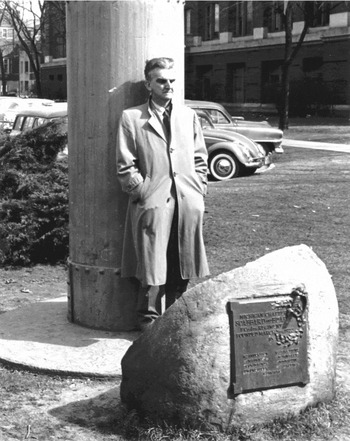
The end of the Korean War in 1953 was a success for the Eisenhower administration, but it did not mean less international tension, especially as Secretary of State John Foster Dulles, a noted Cold War supporter (and with him the President), took a strong stance towards the Soviet Union and Communist China. Nuclear weapons were at the center of American foreign policy and they remained so after the reelection of Eisenhower in November 1956. With the intensification of nuclear tests in the mid-1950s and the launch of Sputnik I during the International Geophysical Year of 1957–1958, the threat of nuclear war was made more credible in the eyes of many including Boulding who frequently protested against the militarization of American society (see fig. 1). Participation in the study group on peace at CASBS had turned the Quaker pacifist into a peace researcher. With Kelman, Rapoport, and a few others, he criticized the tendency of international relations to regard war as the only solution to international tensions and denounced the scant attention paid to peace as a viable alternative. As a result of their interactions, the members of the study group resolved to make all the necessary arrangements for the creation of the Journal of Conflict Resolution, which was launched in March 1957.Footnote 41
Boulding standing by the flagpole on the University of Michigan campus in a protest vigil against nuclear tests, 4 April 1958 (Folder “KEB and Elise B. Peace Activities,” Box 47, KEBUM Papers).

Not long after he returned to Ann Arbor, Boulding decided to hold the 1955–56 integration seminar on the resolution of conflict. To this end he circulated a prospectus in which he stressed the urgent need for a theory of conflict and once again pointed to the potential contributions of various social sciences including economics, political science (though he had the work of Richardson more that that of political scientists in mind), sociology, psychology, and social psychology. The meetings opened in February with a discussion of “Towards a General Theory of Conflict,” a paper by Boulding, in which he considered the application of the theory of interacting populations to the arms race. Throughout the second semester, there followed a series of meetings, with Rapoport speaking on Richardson, Gerard on “Cooperation and Conflict as Modes of Integration,” and social psychologist George Levinger on conflict in Lewin. In keeping with the tradition of the seminar, Boulding wished to promote “the construction of general analytical models applicable to many different areas of conflict” though his main preoccupation was with conflict on the “international scene.” In the process, he identified avoidance, domination, and convergence of ends as three distinct ways towards conflict resolution, but hastened to add that war presented characteristics not covered in other forms of conflict.Footnote 42
Although his project of a general theory of conflict and its resolution could be taken as an illustration of the need for economists to tap resources outside their own subject, it should be remembered that in studying society Boulding continued to attribute much explanatory power to economics. In The Skills of the Economist, published in 1958, he made it clear that the discipline was “a guidepost to problems even beyond its conventional boundaries” (Boulding Reference Boulding1958b, vi). The contribution of economics to conflict analysis was twofold: on the one hand, it distinguished between movements that leave both parties better off (trading) and movements where at least one party would be worse off than before (conflict); on the other hand, it included a theory of oligopoly which, unlike the analysis of market interactions in perfect competition (with many agents), considers the behavior of a small number of agents – two of them in the case of duopoly – and underscores the interdependence of decisions. More specifically, marginal analysis, thanks to the distinction between opportunity and preference functions, helped explain why
[a]t one moment . . . the Communist is all for war, the next for peace; at one moment all for united fronts and the next, all for knifing the Social Democrats. . .. The Communist is not alone in this. Every nation, in the single-minded pursuit of its own security and power, is at one moment an angel feeding the hungry and healing the sick, educating the ignorant and protecting the home; at the next moment a fiend of hell dropping bombs on defenseless people, destroying homes, roasting children, spreading disease, cheating, lying and indulging in every form of wickedness known to man. (Ibid., 172–3)
Seen against the backdrop of the then common depiction of Nikita Khrushchev – first secretary of the Communist party of the Soviet Union from September 1953 and its premier from March 1958 – as an unpredictable man vacillating between hostility and concession, the effort to lump together “the Communist” and other nations illustrated Boulding's determination to use economic knowledge to go beyond merely demonizing the other in the study of international relations.Footnote 43
While international tensions hardened from November 1958 following Khrushchev's proposal to place Berlin under the control of East Germany, Boulding worked to create the Center for Research on Conflict Resolution, an interdepartmental and cross-disciplinary venture destined to provide institutional support to conflict studies at the University of Michigan. Ironically, the Center began its activities in July 1959, preceding a period of appeasement which saw Vice President Richard Nixon discuss the merits of capitalism versus communism with Premier Khrushchev during a visit to Russia and the latter eventually endorse the status quo over Berlin in talks with Eisenhower at Camp David, Maryland, in September. At about the same time, Boulding left for the University of the West Indies in Jamaica for the academic year. While discovering the effervescent Caribbean societies in Kingston, the “ideal ‘fruit flies’ for the social sciences in that they are small enough to be understood and large enough to have all the essential problems,” he produced the final version of Conflict and Defense, a book that concerned mainly international relations and attempted to build a general theory of conflict (Boulding to Frank Young, 7 Apr. 1969, Folder “WILKINSON-ZUCKERMAN,” Box 79, KEBCU Papers).
By the time Conflict and Defense was published in early 1962 the activities of Boulding, Rapoport, and a few others around the Center for Research on Conflict Resolution had acquired greater visibility if only because of the antagonism they nurtured among a number of prominent academics at Michigan, most notably the former chairman of the department of political science, James Pollock, and in various circles where conflict resolution was seen as implying subjugation. The theoretical and practical impact of conflict studies as conducted by Boulding and others at Michigan should not be overemphasized, however, and did not in any way compare with that of the analysis of defense problems at the RAND Corporation. Though economically informed and cross-disciplinary oriented, Boulding's view of conflict diverged from that of most economists at RAND. Essentially, it rested on a notion of rationality enriched with the idea of empathetic understanding, with the “falseness” or “rightness” of the agent's image determining the irrationality or rationality of human behavior, while most economists, including game theorists, relied on rationalization of conflict with the studied agents being endowed with interchangeable qualities (rationality postulates). Boulding believed it of the utmost importance to pursue Rapoport's idea of empathetic understanding (Rapoport Reference Rapoport1960, 247) “as a recognition that practically every conviction has a certain ‘domain of validity’,” which in turn prevented him from limiting evilness to either side to the conflict. Given the impact of the military on game theory and its interpretation of conflict (see Mirowski Reference Mirowski and Goodwin1991, 243–4), it is little surprise that in the closing sentences of the chapter analyzing the contribution of game theory to the construction of a general theory of conflict, Boulding wrote: “For a true understanding of conflict, we also have to examine love, affection, empathy, and community of feeling. These are concepts alien to the theory of games” (Boulding Reference Boulding1962a, 57).
Love
The election of November 1960 marked the end of the Eisenhower era, an era of peace in a rather bellicose age. A close vote brought victory to Senator John F. Kennedy. It did not take long before the new president experienced first-hand the political pitfalls of the age. The failed invasion of Cuba in April 1961 provoked an angry reaction from Khrushchev. When he met the Soviet premier in Vienna in June, Kennedy might have had hope for furthering common interests, notably in stopping the momentum of the arms race, but his expectations soon vanished before Khrushchev's resoluteness in making no concessions over Berlin. In the following months tensions escalated between the two leaders, making the risk of nuclear war palpable. Such events considerably undermined the prospect of a peaceful solution to international tensions. They helped convince peace researchers, including Boulding, that much had to be done not only to gain better understanding of conflict but also to make peace a viable alternative to conflict.
For Boulding, part of the problem was undue reliance on the self-interest model in the analysis of human affairs. Economists were not well versed in unselfish behavior in the early 1960s.Footnote 44 A Quaker since the late 1920s, Boulding had ample opportunity to reflect on “the greatest of the Christian virtues” (Boulding [Reference Boulding1954] 1968, 212). As a social scientist interested in the possible influence of religious concerns on scientific integrity and in the possible contributions of economics to the study of religion (Boulding [Reference Boulding1957b] 1968, 219–26), he regarded the prevalence of the selfishness assumption in his own subject with some unease. This assumption said something about the “professional economist” and the “danger which threatens him – that of becoming so engrossed in the refinements of scientific abstractions – and in the substantial rewards, which in these days often accompany proficiency in such abstractions – that he forgets the ills of society and becomes deaf to the cry of the hungry and blind to the misery of the oppressed” (Boulding [Reference Boulding1950b] 1968, 191). From the 1950s, Boulding had emphasized the significance of love in human affairs, but, in the early 1960s, this orientation, which he associated with the “heroic ethic,” began to translate into an effort to build a general theory of behavior, in which special attention was given to the study of unilateral transfer as opposed to exchange.
In June 1961, Boulding contributed a paper to a conference on philanthropy held in Long Island. Boulding often saw the most stimulating topics as lying at the boundaries of existing disciplines and his “Notes on a Theory of Philanthropy” characteristically expressed the need for economists to be aware of certain concepts developed in other social sciences. His paper likewise illustrated the relevance of economics for a topic that fell outside its purview. The structure of the article itself betrayed Boulding's twofold ambition. In the main text, Boulding developed a theory of philanthropic donations, which went beyond the ordinary quid pro quo of economic theory:
It is this sense of community [with the object of the donation] which is the essence of what I regard as genuine philanthropy. The name of philanthropy, itself, which means of course, the love of man, is a clue to the essential nature of the genuine article. When we make a true gift, it is because we identify ourselves with the recipient. . .. It is this capacity for empathy – for putting oneself in another's place, for feeling the joys and the sorrows of another as one's own – which is the source of the genuine gift. (Boulding Reference Boulding and Dickinson1962b, 61)
An avid reader of George Mead's Mind, Self and Society, in which Adam Smith's notion of place-switching was given the support of social psychology, Boulding was keen to explain how a concept derived from one of these “many-parented” disciplines could supplement the economic analysis of philanthropy in terms of utility interdependence. Shedding light on the motivation for genuinely unilateral transfers, the notion of empathy helped make the theory of philanthropic behavior more general, but it did not displace utility theory.
In the five-page Appendix, “Altruism and Utility,” Boulding showed the relevance of the theory of bilateral monopoly for the analysis of unselfishness. He presented a visual theory of human behavior, using the so-called Edgeworth box to demonstrate the applicability of the analysis of equilibrium allocation for two exchangers and two commodities to the case with utility interdependence, where the level of satisfaction of one exchanger depends not only on his possessions but also on the other's. Examining different positions in the Edgeworth box and the moves of the two agents between them, Boulding could identify several regions representing various combinations of selfishness and unselfishness. Once again, Boulding's argument hinged upon the question of the position of agents in relation to each other in a “field of choice” and its consequences in terms of economic behavior. The study of integrative systems in general and love in particular was interesting in itself but it could likewise shed light on conflict analysis, since “the resolution [of conflict] may come eventually through change in the character of the parties or through the growth of a sense of community between them, but it cannot come through the absorption or destruction of one party” (Boulding Reference Boulding1962a, 59).Footnote 45
4. The Social Triangle
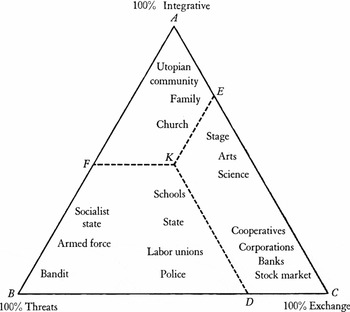
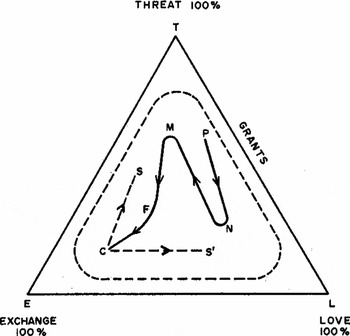
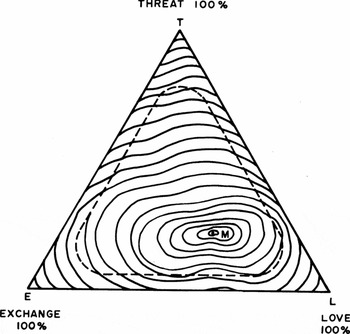
His general theory of human behavior was part of a broader view of society, centered on three social organizers, at which Boulding eventually arrived in early 1962. As Kerman points out, he formulated this view “between December, 1961, when he presented the paper ‘The Relations of Economic, Political, and Social Systems’ . . . and March, 1962, when he gave the lecture ‘Ethics and Business: An Economist's View'” (Kerman Reference Kerman1974, 13). In the latter, he described the exchange, the threat and the integrative system as the three main organizers of society. “All social systems and subsystems,” he wrote, “are based on mixtures of these three major elements, in varying proportions” (Boulding [Reference Boulding1962c] 1968, 233). More importantly, he noted that “[a] system which tries to rely too much on any single one of them is likely to be unstable” (ibid.). Accordingly, “The problem of society . . . is a problem of finding the right proportions. Disproportionate emphasis on either the coercive systems, the market system, or the integrative system is likely to result in the corruption of the moral life and the eventual disintegration of the society” (ibid., 236–7). In saving society from the dangers of economism, communitarianism, and warmongering, the integration of economics, sociology, and political science constituted an important stage in social stabilization.
Once his theory of social organizers stabilized, Boulding persistently used it to illustrate the necessary complementarities between economics and the other social sciences. In “Towards a Pure Theory of the Threat System,” which he read to his fellow economists at the annual convention of the AEA in December 1962, Boulding complained that Milton Friedman and the “Chicago School” had “an unrealistic appraisal of the way in which the dynamics of most societies operate. Exchange is by no means the only human relationship which is capable of producing differentiation, division of labor, role structure, communication patterns, and all the other marks of organizational development.” He added: “It is tempting . . . to try to assign the threat systems to the political scientist and integrative systems to the sociologist, as we assign exchange to the economist, though this division is too neat to correspond to the untidy facts of academic specialization” (Boulding Reference Boulding1963, 424–5). Threat and love were at least as important as exchange and there was no more reason for economists to abandon them to noneconomists than for the latter to set aside those social organizers not conventionally seen as the province of their own disciplines. Only a handful of economists shared Boulding's breadth of interest, however. And, only a minority of noneconomists actually explored economic phenomena.Footnote 46
Following the publication of Boulding's article in May 1963, President Kennedy delivered two notable speeches: one on world peace at the American University's commencement ceremonies on 10 June 1963 and the other on civil rights the day after on television. The rhetoric of political discourse aside, it is difficult to deny that the commencement address on world peace in Washington, D.C., had points of similarity with the views of peace researchers – and those within the national-security establishment who promoted dialogue with the Soviets – if only because it argued for empathetic understanding between America and the Soviet Union, encouraged Americans to think of peace as a feasible prospect and proposed a comprehensive ban on nuclear testing. In speaking of “peace . . . as the necessary rational end of rational men,” Kennedy shifted emphasis away from defining war as the logical outcome of rational agent's interactions. The following day, in his civil rights speech, he astutely linked the struggle for freedom at the international level with that on the domestic scene and appealed to his fellow citizens’ moral responsibility to combat racial injustice as a factor of social divisiveness. These two speeches were testimony to the President's awareness of strong disintegrative forces – international and domestic – in American society; by their proximity in time and tone, they prefigured an era in which international crisis and social crisis fed each other.Footnote 47
Boulding left Ann Arbor in the summer of 1963 to spend the academic year at the International Christian University in Tokyo in a politically divided Japan where anti-Americanism and pacifism played no minor role. There, stimulated by his students, many of whom were Marxists, he refined his analysis of social organizers, putting special emphasis on the evolution of social systems and considering the dialectical and non-dialectical elements in them. The experience in Japan as well as the reading of economist Alfred Kuhn's The Study of Society: A Unified Approach (Reference Kuhn1963) confirmed Boulding's initial impression that the integrative system was crucial to the social system.Footnote 48 And, when Boulding returned to a fragile America in the summer of 1964, there were practical reasons for him to wonder whether society was not taking a wrong turn. The assassination of Kennedy played a major role in crystallizing the anxieties of the age, but his public pronouncements and initiatives, in giving voice to long-buried frustrations, had not necessarily encouraged the stability they originally looked for. Social stability was threatened, to say the least. The relative and temporary appeasement in the international arena offered little comfort to those who had to deal with racism and poverty in an otherwise enlightened and prosperous country.
To Boulding those problems and others, such as the inadequacies of the educational system, inconsistencies in public housing policy, and the distortions in America's image of the world, encouraged the work of disintegrative forces in society; their solution made it necessary to adopt an integrated view of society in which consideration would be given not only to the analysis of the economy, the polity, and the integrative system, but above all to their mutual interdependence. So, after Kennedy's successor came to the University of Michigan, in May 1964, to speak about the future of the country and to propose the Great Society program, Boulding and many others could legitimately think that Lyndon B. Johnson shared their hopes for a well-proportioned society. If the newly elected president's antecedents as a New Dealer promised continuity with Kennedy's agenda, his Ann Arbor speech revealed ambitions to build a harmonious, rather than simply “rich” and “powerful” society. As such it brought reassurance to those who, like Boulding, saw exclusive concentration on either exchange or threat as the most important obstacle to the understanding of society and its reformation. Great Society programs notwithstanding, Johnson gradually turned his attention to foreign affairs and in so doing took directions that contrasted sharply with the integrative orientations of his domestic policy.
From 1965, Boulding, the Democrat, grew increasingly sour over the Johnson administration, notably its foreign policy. In May, after Johnson had ordered bombing against North Vietnamese targets and sent American troops into South Vietnam, Boulding came back to his theory of the three social organizers in a paper delivered as part of a dialogue with Friedman – who had served as economic adviser of Senator Barry Goldwater of Arizona during the presidential campaign – at a conference in Chicago. Once again, he felt the need to stress the role of the integrative system and defined it as “a necessary matrix of the other two.” Without its support, the exchange system and the threat system had little legitimacy and were ineffective as social organizers. Thus, exchange required “an atmosphere of trust, confidence, respect and, indeed, equality.” Likewise, the effectiveness of threat depended on a form of submission: “this is why we are so ineffective in Viet Nam, where we have an enormous amount of threat with practically no legitimacy” (Boulding [Reference Boulding1965a] 1968, 44). For Boulding, the war in Vietnam brought back to the surface the painful feelings associated with World War II, adding to them, the unpleasant impression of having deluded himself about American society.
In November, overcome by discouragement, he wrote back to UC Berkeley economist Carl Landauer who was looking for an instructor for a course in integrated social science: “I seem to have been fighting a quite unsuccessful battle against an increasing narrowness and specialization, not only in my own department but in the whole discipline, and it is very hard to think of a person who would fill the very important role which you envision.” Tellingly, in the same letter, Boulding discussed the protests against the war and noted: “What has happened, I think, is that the Air Force has captured the President. If one wants to read the MEIN KAMPF of the present situation, one can find it in the frightening book by General Thomas S. Power called DESIGN OF SURVIVAL.” The following month, when it became clear that the war had reached a turning point, The Washington Post published “Great Society, or Grandiose,” in which Boulding expressed growing impatience with, if not hostility towards, the Johnson administration. In arguing for a “Moderately Great Society,” he singled out three orientations: “Operate in the international system as a moderate power”; “learn to listen to the sociologists, the anthropologists, the psychologists, even the political scientists and international relations men”; and “[i]n our economic policy, conduct an agonizing reappraisal of the growth of the grants economy versus the exchange economy” (Boulding Reference Boulding1965b, E3).Footnote 49
As an economist Boulding could not be unaware of the increasing role of his peers in Washington. His knowledge of the other social sciences likewise made him conscious of their pervasive influence on Johnson's speeches, if not deeds. With the Americanization of the war in Vietnam in the second half of the 1960s, however, he was led to pay even greater attention to the role of social science knowledge in the organization of society and he began to feel frustrated with what he saw as the insufficient impact of social science on foreign policy making.Footnote 50 At the end of March 1966, Boulding gave a series of lectures at the University of Puget Sound, which he later arranged for publication. He then distinguished between three modes of acquisition of human knowledge: “the ‘folk knowledge’ process . . . by which we acquire knowledge in the ordinary business of life and ordinary relationships”; “the literary knowledge process, involving the use of writing or other forms of recording knowledge including the use of maps”; and “the scientific knowledge process . . . which involves the constant revision of images of the world under the impact of refined observation and testing” (Boulding Reference Boulding1966, 7–10). Boulding subsequently recognized the superiority of scientific knowledge in handling highly complex systems such as the integrative system. Unfortunately, he found that “the images of the international system on which the decisions of its decision-makers are based are derived mainly from a mixture of folk and literary knowledge processes. They do not usually involve the careful sampling, the theoretical models checked by constant feedback and testing, which are characteristic of the scientific process” (ibid., 62). The problem was misallocation of intellectual resources: the integrative systems received too little attention. In the closing paragraph of The Impact of the Social Sciences, Boulding wrote: “Once a problem has been perceived, the arts of rhetoric ought to be called into play to make it salient. To these arts of rhetoric I recommend my fellow social scientists, however distasteful this may be to them” (ibid., 114).
Boulding himself cultivated rhetoric. A poet and talented orator with a strong interest in the theory of communication, he was aware of the impact of rhetorical devices on audiences. To the extent that his thinking had a strong visual dimension, it is not surprising that it often was expressed in a visual language. Boulding, the economist, was versed in all sorts of graphic representations. As far as the influence of other social sciences was concerned, however, his visual proficiency placed him in the tradition of Lewin's field theory and its visual creatures. Logically, his visual rhetoric conveyed integrative intentions. It betrayed an effort to draw together theoretical constructs, notably threat, exchange, and the integrative system, which belonged to distinct disciplinary worlds.
In keeping with his lamentations that the integrative system aroused insufficient interest, there was a clear orientation against dialectical philosophy in general and Marxism in particular in A Primer on Social Dynamics, a belated outcome of his experience in Japan in 1963–64. By “dialectical philosophy,” Boulding meant “all those ideologies which regard conflict as the essential process in development and therefore tend to put a high intrinsic value on conflict, struggle, war, and revolution” (Boulding Reference Boulding1970, vi). The way he viewed the role of dialectical elements in social evolution simply reflected his emphasis on the integrative system: “It is in societies where the prevailing ideologies are nondialectical – stressing community, agreement, orderliness, courtesy, and love, rather than conflict, turbulence, confrontation, envy, and hate – that the dialectical processes themselves are likely to be most fruitful” (ibid.). Once again, Boulding emphasized that the three social organizers complemented one another. Perhaps because he wanted to emphasize that point, Boulding resorted to visual representation in the form of a “social triangle” (see fig. 2). To signal the integrative relationship from threat and exchange, he placed it at the top of the pyramid with the two other social organizers at its base. The position of the 100 per cent integrative relationship justified its significance in the social system; it triggered the ordinary associations attending pyramidal representations of social systems, with the institutions in the higher part of the pyramid representing the noble elements in society – here, utopian community, family, church, theater, and the arts. The advantage of using an equilateral triangle rather than any other geometrical figure was that points on the area within the triangle expressed the various combinations of the three social organizers economically. For example, on figure 2, point K “represents a division of the proportions between the three elements,” “with a proportion KD of integrative relationship, KE of threats, and KF of exchange” (ibid. 28–9).
The social triangle with connectives (adapted from Boulding Reference Boulding1970, 31).

When A Primer on Social Dynamics came out in 1970, Boulding had already been at the University of Colorado at Boulder for three years. The two years preceding his departure from Ann Arbor were not especially happy. Increasingly disgusted at the conduct of the American administration in Vietnam, he withdrew from the Democratic Party before joining the University of Colorado.Footnote 51 Boulding, then president-elect of the AEA, was hired by the economics department, but his interests were not those of the average economist, as illustrated by the publication of his collection of essays, Beyond Economics, in 1968, the very year the regents, by a split vote, confirmed his appointment. A Primer on Social Dynamics was not Boulding's only book published in 1970. Appearing the same year, Economics as a Science considered economics from various perspectives and suggested problems with some of its foundations. In one chapter, “Economics as a Moral Science,” a slightly adapted version of Boulding's AEA presidential address of December 1968, in particular, Boulding went as far as to say that “no science of any kind can be divorced from ethical considerations,” a statement which most of his fellow economists were likely to find highly uncongenial (Boulding Reference Boulding1969, 2). Likewise, he situated economics in relation to the three social organizers:
Economics clearly occupies the middle one [the exchange system] of these three. It edges over towards the integrative system insofar as it has some jurisdiction over the study of the system of one-way transfers of exchangeables, which I have called the “grants economy”. . .. On the other side, economics edges towards an area between the threat system and the exchange system which might be described as the study of strategy or bargaining.
To complete the circle there is also an area, between the threat system and the integrative system, of legitimated threat which is the principal organizer of political activity and the main subject matter of political science. (Ibid., 4)
Boulding thought of the relationships between the three social organizers visually – in terms of set theory. The three sets representing the integrative, exchange and threat system intersected with each other and thus formed new areas of study containing the elements falling within the province of two or more disciplines. Intersecting sets gave a visual translation of Boulding's conception of the integration of the social sciences; they represented areas – the grants economy was one of these – where social scientific disciplines exchanged results, tools and methods.Footnote 52
Yet, visual representations worked not only as illustrations of visual thinking. In The Economy of Love and Fear, Boulding, who had long regarded the grants economy as an important aspect of the integrative system with ramifications in the exchange system, now noted that there were “two kinds of grants: one, gifts, arising out of ‘love’; and the other, tribute, arising out of ‘fear’. . .. Further, the grants economy is an important link between economics and the other social sciences. At the integrative level, it moves toward sociology; at the threat level, it moves toward political science” (Boulding Reference Boulding1973, viii). “Grants economy” was a clear indication that while intersection sets helped visualize the phenomena falling under the province of two disciplines (in this case, economics and sociology) they could also suggest new forms of disciplinary cooperation (between sociology and political science, for example), which would in turn give rise to new visual representations.
Not only did the social triangle represent society in terms of various proportions of social organizers at a certain point in time, it also described its changing nature throughout time (see fig. 3a). The various points along the historical line PNMFC signaled different stages from the Paleolithic Period to Capitalism. Meandering through the area delimited by the dotted line, the historical line helped visualize with great economy of expression the pattern of human history, showing a centuries-old evolution from threat to exchange. More importantly, at a time of extreme turbulence and uncertainty in American society, it pointed to two possible futures; both leading toward a notable diminution of the role of exchange: “The one toward S is the movement toward totalitarianism, whether of the right or of the left – that is, toward an increase of threats and the substitution of threats for exchange. The one to S’ would be toward a more democratic socialism, with exchange being replaced by integrative grants, arising out of a sense of community and identity with all members of the community” (ibid., 108).
The social triangle with the historical line (Boulding Reference Boulding1973, 108).

It is easy to determine which orientation Boulding favored (see fig. 3b). There, postulating a set of contours representing indifference curves, which he had already drawn more than 30 years earlier in Economic Analysis, Boulding associated the points of the social triangle with various levels of utility for the evaluator and defined M, “being the top of the hill,” as “the optimum point in the whole field” (ibid., 109). Taken together, these contours formed a topographical table and as such triggered the image of a hill culminating at M. This mental image in turn suggested that certain moves, notably those going downhill, were easier than others – those going uphill. That such associations could influence Boulding's reading of human history is clear from his remark that “movements motivated toward S’ often seem to end at S (S perhaps stand for Stalin)” (ibid., 110).
The social triangle with the optimum point (Boulding Reference Boulding1973, 109).

Clearly, the social triangle did not offer a panacea for all problems, but it did show that a possible solution was to find the proper proportions between the three social organizers. This task, as Boulding suggested in closing The Economy of Love and Fear, called for “a major intellectual effort . . . in the physical sciences, in engineering, in biology, in the social sciences, and in philosophical, political, and religious thought” (ibid., 112).
Throughout the 1970s, Boulding did his best to foster the integration of the social sciences. His dissatisfaction with economics derived partly from its lack of integration with the other social sciences and partly from its emphasis on the behavior of commodities rather than the behavior of people. Unlike economics, where he found very few zealots of the theory of the image – Hayek being one of them – several social sciences were partly iconic and accordingly put emphasis on the concept of the image as field of potential behavior. In his advocacy of the integration of the social sciences, Boulding manifested an attempt not only to draw economists’ attention to those efforts by other social scientists that prefigured “eiconics,” but also to persuade these social scientists that a reconstructed economics had something to contribute to the new science. It is debatable whether he succeeded at either task, but his work at the intersection of economics and the other social sciences attracted enough attention to make him a serious candidate to the presidency of the AAAS. The election was held in the fall of 1977 and Boulding became president-elect in February 1978, some ten years after being one of the twenty vice-presidents of the AAAS and the Chairman of its Section K comprised of sociologists, economists, and political scientists. As president-elect, Boulding immediately pointed to the “extraordinary deficiency in the membership of economists” and ventured the opinion that “it might be desirable to break Section K into three, or even four, other sections, or at least to have subsections for economics, sociology, political science, and international studies. . .. If this were done, however, there would be something to be said for grouping the social science sections.” Coming from a staunch defender of the integration of the social sciences, such a suggestion may sound paradoxical, but it should be remembered that Boulding's intention had never been to amalgamate the social sciences but rather to promote work at their intersections. Without sets to begin with, no intersections were possible. So, the setting up of an Economics Section, in increasing the participation of economists in the AAAS, had the merit of opening up avenues for cross-fertilization. Yet, while writing to Gardner Ackley, the president-elect of the AEA, in August 1980, Boulding could not but confess his failure at “moving either the AAAS or the economists towards participation of the economics profession.”Footnote 53
Boulding officially retired in July 1980, but remained active until his death in March 1993. The difficulty of integrating the social sciences shed some light on his recourse to visual language. By the latter, he hoped to reconcile on paper what often appeared irreconcilable in practice – scientific disciplines, of course, but also capitalism and socialism, the two Great Powers, dialectical and non-dialectical processes. By making improbable visual associations – his doodles accompanied with verse were exemplary in that respect – Boulding wanted his readers to visualize the unthinkable so as to revise their mental images of the world and accordingly change their behavior. His visual images suggested peaceful coexistence when conflict seemed a priori the only option. To a world that considered its entities to be separate and where boundaries played mostly a negative role, Boulding opposed a world of exchange, with intersecting sets as its loci. Whereas boundaries were partly the result of historical accident, intersections resulted from the deliberate effort to construct a “republic of the mind.”
5. Conclusion
Boulding's career illustrates the tensions existing in postwar American society and social science. In the early 1930s he came to the United States to complete his economic training. The Great Depression notwithstanding, his stay at Chicago and Harvard gave Boulding a sense of opportunity he had never experienced in Britain. So taken was he with the country that he returned to it for good in the late 1930s. The first disillusion came after Pearl Harbor and the realization of the strong skepticism toward pacifism in American society. Later, while immersing himself in the complexities of the labor movement, Boulding became aware of the explanatory limitations of economics and accordingly advocated a cross-disciplinary approach. The latter hoped to combine economics, sociology, and political science; it was regarded as especially suitable in view of the need for an integrated society. Boulding's shift away from being a pure economist arose primarily from suspicion towards the idea that human affairs are driven by self-interest and, associated with that, the idea that social harmony is achieved through the invisible hand of the market. Society was not an economic machine; consequently, devising solutions to its problems and helping it cohere necessitated more than just removing impediments to exchange. With his naturalization in 1948 and the award of the prestigious Clark Medal a year later, Boulding's identification with American society and the world of economists reached its height.
The conjunction between Boulding's breadth of mind and the widespread development of cross-disciplinary social scientific work during and after the Second World War played no minor role in turning the eminent economist of the 1940s into the esteemed general social scientist of the 1960s. While his interdisciplinary ambitions looked perfectly at home in the immediate postwar social sciences, they conflicted with economics’ drawing further away from its scientific neighbors. Even in those subjects that Boulding hoped to integrate, various initiatives impeded his goals. In sociology, Parsons, the most influential figure in the 1950s and 1960s, advocated a form of integration that was at odds with Boulding's. Following its “behavioral revolution” in the 1950s, political science remained fragmented, making it an unreliable base for the integration of the social sciences. Finally, from the late 1950s, the isolated attempts by economists Gary S. Becker, Anthony Downs, James Buchanan, and Gordon Tullock to apply microeconomic analysis to “noneconomic” behavior were consistent with some of Boulding's goals, though not all: economic concepts were used to shed light on social and political phenomena, but concepts from other social sciences were largely ignored.
The integration advocated by economists from the early 1960s rested on the application of maximization theory – the limitations of which Boulding pointed out in his own work – to a variety of subjects including discrimination, crime, politics, fertility, and, more generally, social interactions. The fact that a number of social scientists labeled it “economics imperialism” or felt the need to define economic sociology as a counterforce against economists trespassing into the “social” shows the sense of invasiveness that was felt towards the “economic approach” to human behavior and public policy. With the social crisis that gained momentum from the mid-1960s, however, the shortcomings of a purely economic approach to social ills became more visible to policy makers and the Great Society program was an expression of this realization. Yet, longstanding Quaker convictions made it difficult for Boulding to praise the integrative effects of the War on Poverty without, at the same time, lamenting the disintegrative effects of increasing involvement in the war in Vietnam. From then on, the war succeeded in blunting his initial enthusiasm for American society and in estranging him from the Democratic Party. He wrote in December 1965, “It is, of course, our image of ourselves not only as a great power but as the great power, that is the root of all our grandiosity” (Boulding Reference Boulding1965b, E3).
By the late 1960s, Boulding thought society was dangerously off balance, with the threat system growing out of proportion to the other two social organizers and therefore causing a problem of legitimacy, of which some in the Johnson administration, including Secretary of Defense Robert S. McNamara, were aware. After Richard M. Nixon became president, Boulding, who despaired at the war-mongering attitude of the Democratic administration, might have had hopes that, with a conservative Quaker in charge, the country would take a different course in foreign policy. It probably did, but in a way that made the use of threat in South-East Asia even more illegitimate and strengthened the anti-war movement. Eventually, American society entered an era of turbulence.
Boulding's continuous insistence that integrating the social sciences would enable policy makers to find the right proportions between the three social organizers, suggests that increasing academic specialization may have played a role in the instability of society. In fact, the story is more complicated than that. The movement towards greater disciplinary autonomy since World War II has actually strengthened the policy ambitions of the social sciences, but it has not necessarily encouraged cross-disciplinary communication that would be conducive to their practical relevance. Ironically, many of the accomplishments of the social sciences from the 1950s would not have seen the light of day without the cross-disciplinary engagements during the war and immediate postwar years. Yet, most social scientists pursued their work unaware of their theoretical debt to the dialogues and debates that were ongoing at the frontiers in their fields. In the process they often contrasted cross-disciplinarity and specialism, forgetting that these need not be mutually exclusive and that the former may feed the latter without threatening disciplinary boundaries. The fact that Boulding and a few other theorists repeatedly linked the risk of social dislocation with the insufficient integration of the social sciences when the majority of their peers did not reveals not only that there is no one approach to the question of what holds a society together, but also that with increased disciplinary autonomy the main answers to this question have privileged the working of one segment of society rather than the whole society.
Acknowledgments
This article was presented at the “Knowledge and Society” Seminar at Imperial College, London, May 2004, and at the UK History of Economic Thought Conference, Edinburgh, September 2008. I am grateful to participants there and to Roger Backhouse, Leo Corry, Paul Dudenhefer, Francesco Guala, Alexandre Métraux, Laurence Moss, and two anonymous referees of this journal for their comments and suggestions. For their kindness in answering various queries, I thank Elise Boulding, David Engerman, Craufurd Goodwin, Cynthia Kerman, Robert Leonard, Jack Powelson, Anatol Rapoport, Cristel de Rouvray, Ellen Schrecker, Arthur L. Stinchcombe, Gilbert F. White, and Vivian L. Wilson. My thanks go as well to David M. Hays from the Archives Division at the University of Colorado at Boulder, and Karen Jania, Kathy Marquis, and William Wallach from the Bentley Historical Library at the University of Michigan. Financial support was provided by the Agence nationale de la recherche (ANR) and the Bentley Historical Library through the award of a Mark C. Stevens Researcher Travel Fellowship.