Introduction
The Western Antarctic Peninsula (WAP) has suffered the largest warming trend in the world over the last 20 years (IPCC 2007 see http://www.ipcc.ch/), with an increase in atmospheric temperature of ∼1.0°C (Turner et al. Reference Turner, Colwell, Marshall, Lachlan-Cope, Carleton, Jones, Lagun, Reid and Lagovkina2005). There has also been a marked summer increase in salinity of WAP shelf waters, caused by mixed-layer processes driven by reduced sea ice formation (Meredith & King Reference Meredith and King2005). Although the precise role of the ocean in the regional climate change of the Antarctic Peninsula (AP) remains unclear, there is strong evidence for linkage between oceanic processes, sea ice and atmospheric cyclonic activity (Harangozo Reference Harangozo2006) with a teleconnection to the Pacific (Yuan Reference Yuan2004). The AP is therefore considered one of the most sensitive areas to climatic change, and its marine bottom sediments are considered important archives for the investigation of past climatic variability.
Historically, it has been difficult to apply traditional palaeoenvironmental proxies in Antarctica because of problems that include insufficient dating of recovered sequences, complexities introduced by glacial activity (i.e. glacial erosion), sea ice cover and poor calcium carbonate preservation (Andrews et al. Reference Andrews, Domack, Cunningham, Leventer, Licht, Jull, DeMaster and Jennings1999). Despite these difficulties, some palaeoenvironmental records have been obtained so far from both marine (Domack et al. Reference Domack, Leventer, Root, Ring, Williams, Carlson, Hirshorn, Wright, Gilbert and Burr2003) and continental environments (for a review see Ingólfsson et al. Reference Ingólfsson, Hjort, Berkman, Björck, Colhoun, Goodwin, Hall, Hirakawa, Melles, Möller and Prentice1998). As diatoms are abundant in Antarctic waters, many studies have focused on the diatom composition in present day waters and on their fossilized remains in marine sediments (Pike et al. Reference Pike, Allen, Leventer, Stickley and Pudsey2008).
Diatoms of the genus Proboscia have been widely identified and are relatively abundant in Antarctic waters and as fossils in sediments. Jordan et al. (Reference Jordan, Ligowski, Nöthig and Priddle1991) reported the presence of three Proboscia species in Antarctic waters: P. truncata (Karsten) Nöthig & Ligowski, P. alata (Brightwell) Sundström and P. inermis (Castracane) Jordan & Ligowski. Proboscia truncata is endemic (Jordan et al. Reference Jordan, Ligowski, Nöthig and Priddle1991), P. alata is a common component of the diatom assemblage (i.e. Barcena et al. Reference Barcena, Isla, Plaza, Flores, Sierro, Masque, Sanchez-Cabeza and Palanques2002) and P. inermis forms a key component of the autumn assemblage in the Bellingshausen Sea (Brichta & Nöthig Reference Brichta and Nöthig2003). The presence of Proboscia diatoms in other coastal ecosystems has been related to upwelling and these diatoms seem to be well adapted to the high nutrient, turbulent conditions that are typical of these coastal regions (Lassiter et al. Reference Lassiter, Wilkerson, Dugdale and Hogue2006). Kemp et al. (Reference Kemp, Pike, Pearce and Lange2000) found evidence from laminated sediments and sediment traps both in the Gulf of California and the eastern Mediterranean that Proboscia diatoms are adapted to exploit a deep nutrient supply in a stratified water column by either adjusting their buoyancy and benefiting from the formation of a strong seasonal thermocline and nutricline or resting at depth and growing slowly in low light conditions. The mass sinking of those diatoms (the “fall dump”) (Kemp et al. Reference Kemp, Pike, Pearce and Lange2000), is triggered by the breakdown of the water column stratification, which often represents the transition from summer to autumn. On the other hand, Stickley et al. (Reference Stickley, Pike, Leventer, Dunbar, Domack, Brachfeld, Manley and McClennan2005) connected the occurrence of Proboscia diatoms in Iceberg Alley, East Antarctica with an open ocean provenance, and thus an increasing influence of offshore waters in this area. Unfortunately, sedimentary records of Proboscia diatoms are constrained by the fact that they have weakly silicified frustules and that their skeletons are very prone to dissolution (Dixit et al. Reference Dixit, Van Cappellen and Van Bennekom2001).
An alternative approach is to use specific Proboscia lipid biomarkers, i.e. long-chain 1,14-diols, which are well preserved in sediments. Sinninghe Damsté et al. (Reference Sinninghe Damsté, Rampen, Rijpstra, Abbas, Muyzer and Schouten2003) and Rampen et al. (Reference Rampen, Schouten, Wakeham and Damsté2007) showed that diatoms of the genus Proboscia biosynthesize C28 and C30 1,14-diols and, therefore, constitute a probable source for these ubiquitous marine natural products. In addition, it was shown that high fluxes of specific Proboscia diols almost exclusively occurred during periods of upwelling in the south-west monsoon in the Arabian Sea, indicating that these lipids can be used as proxies for high nutrient conditions. Indeed, Rampen et al. (Reference Rampen, Schouten, Koning, Brummer and Damsté2008) showed that the relative ratio of long-chain 1,14-diols versus long-chain 1,15-diols, compounds derived from other algae, can be used to track past intensities of upwelling in the Arabian Sea.
In this study we investigated the use of Proboscia diols as a proxy for Proboscia diatom productivity during the Holocene in shelf waters of the WAP by analysing specific organic compounds in a sediment core from the semi-enclosed Western Bransfield Basin (WBB) in the Pacific margin of the AP. Its specific location together with its high sedimentation rate (Willmott et al. Reference Willmott, Domack, Canals and Brachfeld2006) makes this area very suitable for obtaining Holocene palaeoenvironmental records.
Setting
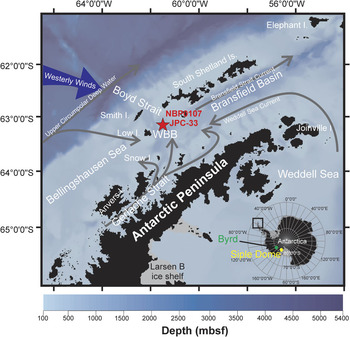
The WBB is one of the three sub-basins that constitute the north-east oriented Bransfield Basin (BB) (Fig. 1). The BB is connected to the Bellingshausen Sea to the west through the passages between Snow and Low islands and the Gerlache Strait, and to the Drake Passage to the north via the Boyd Strait. Sediment accumulation rates in the area range between 0.02 and 0.5 cm yr-1 and total organic carbon (TOC) content between 0.25 and 0.75% (Isla et al. Reference Isla, Masque, Palanques, Guillen, Puig and Sanchez-Cabeza2004). The upper 100 m of water (i.e. the surface mixed layer) of the WAP continental shelf is variable over an annual cycle (∼2°C in summer and -1.5°C in winter), while the deeper water maintains a relatively constant, oceanic character that derives from the Antarctic Circumpolar Current (ACC). The relatively warm (1–2°C), saline (34.6–34.7 psu) and nutrient-rich Upper Circumpolar Deep Water (UCDW), which is carried north-eastward along the shelf break by the ACC, episodically spills onto the shelf (Smith & Klinck Reference Smith and Klinck2002), moderating the ice cover through heat flux and providing a relatively warm subsurface environment and nutrients which stimulate primary production (Prézelin et al. Reference Prézelin, Hofmann, Mengelt and Klinck2000). UCDW intrusions are known to be episodic but persistent, and occur at specific locations due to bottom topography control (Dinniman & Klinck Reference Dinniman and Klinck2004). Although the sediment core JPC-33 investigated here is located near the convergence of the northern branch of the Gerlache Strait Current (Zhou et al. Reference Zhou, Niiler and Hu2002) with the Bellingshausen Sea Superficial Water (Sievers & Helmut Reference Sievers and Helmut1982), the main fraction of the biogenic material settling on this area is locally produced (Isla et al. Reference Isla, Masque, Palanques, Guillen, Puig and Sanchez-Cabeza2004).
Location map of jumbo piston core NBP0107 JPC-33 in the Western Bransfield Basin (WBB), northern Antarctic Peninsula. Grey arrows indicate oceanic currents. Modified from Hofmann et al. (Reference Hofmann, Klinck, Lascara and Smith1996) and Ishman & Sperling (Reference Ishman and Sperling2002).

The WAP is in the heart of the region showing Earth’s largest extratropical surface response to ENSO events (Yuan Reference Yuan2004). Stammerjohn et al. (Reference Stammerjohn, Martinson, Smith, Yuan and Rind2008b) suggested that the rapid atmospheric warming in the WAP region may be driven, in part, by changes in the upper atmospheric circulation. Rind et al. (Reference Rind, Chandler, Lerner, Martinson and Yuan2001) showed that El Niño events enhance the subtropical jet over the polar jet in the Pacific sector, leading to a reduction of atmospheric polar lows impacting the WAP. In contrast, La Niña events provide a more consistent forcing with strong atmospheric polar low forcing, leading to an increase in atmospheric cyclonic activity at the WAP. WAP climate is also influenced by the state of the Southern Annual Mode (SAM), where a positive bias in SAM leads to WAP response similar to that of La Niña (Stammerjohn et al. Reference Stammerjohn, Martinson, Smith, Yuan and Rind2008b) and it has been suggested that SAM may be amplifying the high-latitude response to ENSO events in general (Fogt & Bromwich Reference Fogt and Bromwich2006) and La Niña events in particular (Stammerjohn et al. Reference Stammerjohn, Martinson, Smith, Yuan and Rind2008b). A positive bias in SAM also causes changes in atmospheric circulation that probably contributes to increased UCDW intrusions and shorter sea-ice seasons, both of which feedback positively on each other, thus amplifying regional atmospheric warming from shelf waters (Stammerjohn et al. Reference Stammerjohn, Martinson, Smith and Iannuzzi2008a). Martinson et al. (Reference Martinson, Stammerjohn, Iannuzzi, Smith and Vernet2008) showed that enhanced upwelling is particularly evident in years when the atmospheric cyclones are stronger than usual, suggesting surface divergence and UCDW water inflow onto the shelf during periods of atmospheric cyclonic forcing.
Materials and methods
Core sampling and stratigraphy
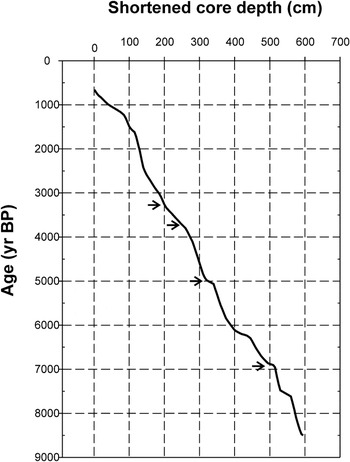
A jumbo piston corer (JPC) was used to recover long sediment cores in the WBB during the summer of 2001–2002, on board the RV Nathaniel B. Palmer. Core JPC-33 (9 m long, recovered at 63°08.120′ latitude and 61°29.457′ longitude, at 704 m water depth) consists of an olive grey, homogeneous, silt-bearing, bioturbated mud, interrupted by four volcaniclastic sand-sized ash layers characterized by sharp basal contacts, loading structures, and normal grading (Willmott et al. Reference Willmott, Domack, Canals and Brachfeld2006). Ash provenance probably was the nearby volcanic Deception Island (Keller et al., personal communication 2003). The lowest 270 cm of the sediment core were disturbed during core recovery and therefore excluded from our analyses. Ash layers were removed from the stratigraphy and core depth was transformed to “shortened core depth”. The age model was constructed by tuning the relative palaeomagnetic intensity record to other well known relative and absolute intensity curves as described by Willmott et al. (Reference Willmott, Domack, Canals and Brachfeld2006), thus providing a high resolution, continuous age model that comprises the last 8800 yr. A linear interpolation was applied to avoid artefacts produced by tie points (Fig. 2). The sediment core was sampled every 5 cm for sedimentological analysis and then subsampled for organic geochemistry analyses following the age model at intervals of ∼150 yr. TOC percentages were determined with an accuracy of ± 0.01% by combustion of the dried and powdered sediment in a LECO induction furnace at Hamilton College, NY. TOC mass accumulation rate (MARTOC) (mgC·cm-2·yr-1) was calculated for each sample as MARTOC = (TOC%/100 x MARbulk) where MARbulk is the mass accumulation rate of bulk sediment in mg·cm-2·yr-1 derived from the calculated ages of individual samples and their measured dry bulk densities.
Age model for NBP0107 JPC33. Arrows indicate the position of the four ash layers found in this core.

Lipid analysis
Freeze-dried sediment samples of c. 1.5 g were extracted using an Accelerated Solvent Extractor (ASE 200, DIONEX) with a mixture of dichloromethane (DCM) and methanol (MeOH) (9:1; vol:vol) at 100°C and 7.6·106 Pa. The total extract was fractionated into an apolar and a polar fraction, using a glass pipette column filled with activated alumina, eluting with hexane/DCM (9:1; vol:vol) and DCM/MeOH (1:1; vol:vol), respectively. Prior to the gas chromatography/mass spectrometry (GC/MS) analysis, polar fractions were silylated by adding BSTFA and pyridine and heating the mixture at 60°C for 20 min.
GC/MS analyses were performed using a Thermofinnigan TRACE gas chromatograph equipped with a fused silica capillary column (25 m x 0.32 mm) coated with CP Sil-5 (film thickness 0.12 μm) and helium as the carrier gas. The gas chromatograph was coupled to a Thermofinnigan DSQ quadrupole mass spectrometer with an ionization energy of 70 eV using GC conditions as described by Rampen et al. (Reference Rampen, Schouten, Koning, Brummer and Damsté2008). The different diol isomers were quantified using selected ion monitoring (SIM) of the masses m/z 299, 313, 327, 341 and 355, which represent the fragments of the different diol isomers (Versteegh et al. Reference Versteegh, Bosch and De Leeuw1997).
Results
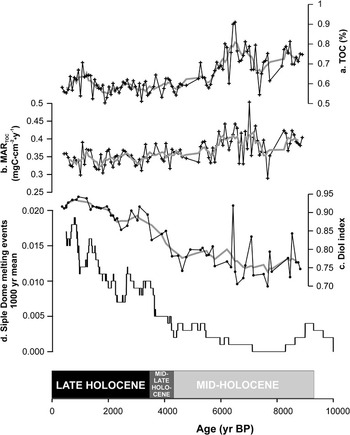
The TOC contents of the JPC-33 sediments vary from 0.5 to 0.9%. The largest TOC variation occurs within the interval from 8800–5200 yr bp with the highest TOC content (0.9%) at 6500 yr bp. From 5000 yr bp to the core top, the record is characterized by lower and relativity uniform TOC values (∼0.6%), only interrupted by an increase from 1300 to 600 yr bp, where TOC reaches 0.7% (Fig. 3a). The TOC record of JPC-33 is consistent with previously published TOC records from the same area (Isla et al. Reference Isla, Masque, Palanques, Guillen, Puig and Sanchez-Cabeza2004, Heroy et al. Reference Heroy, Sjunneskog and Anderson2008).
Antarctic climate records of a. TOC content of JPC-33 core, and b. Mass accumulation rates of TOC (MARTOC) reflecting general productivity. c. Long-chain diol index of JPC-33 core reflecting Proboscia diatom productivity. d. Melt frequency observed at Siple Dome ice core (after Das & Alley Reference Das and Alley2008). Dark grey lines in a, b, and c represent running average with a 10% smoothing window.

The TOC mass accumulation rate (MARTOC) varies between 0.27 and 0.5 mgC·cm-2·yr-1 (Fig. 3b). From 8800–5200 yr bp MARTOC shows relatively high TOC accumulation reaching 0.5 mgC·cm-2·yr-1 at 7000 yr bp. From 5200 to the core top 3800 yr bp MARTOC is lower, oscillating between 0.2 and 0.4 mgC·cm-2·yr-1.
GC/MS analysis showed the presence of C28 and C30 1,14- and 1,13-diols and, to a lesser extent, 1,12-diols. While C28 and C30 1,14-diols have been reported to be biosynthesized by Proboscia diatoms (Sinninghe Damsté et al. Reference Sinninghe Damsté, Rampen, Rijpstra, Abbas, Muyzer and Schouten2003), the exact origin of other diols including C28 and C30 1,15-, 1,13- and 1,12-diols in marine environments is unknown, although C28 and C30 1,15- and 1,13-diols have been identified in eustigmatophyte algae (Volkman et al. Reference Volkman, Barrett and Blackburn1999, Méjanelle et al. Reference Méjanelle, Sanchez-Gargallo, Bentaleb and Grimalt2003). To establish the relative importance of Proboscia diatoms we calculated the ratio between “Proboscia diols” relative to other diols (Rampen et al. Reference Rampen, Schouten, Koning, Brummer and Damsté2008).

Since the index is based on chemically similar components rather than absolute concentrations diagenetic effects are minimized, as all selected lipids are likely to have similar degradation properties (Rampen et al. Reference Rampen, Schouten, Koning, Brummer and Damsté2008). Replicate analysis of samples showed relative standard deviation of the diol index of 0.02 or better.
The diol index shows a distinct pattern (Fig. 3c). From 8800–4600 yr bp the record is characterized by generally lower diol index values, oscillating between 0.70 and 0.83, interrupted by a single high diol index value of 0.92 at 6400 yr bp which correlates with the highest TOC content (0.9%) and relatively high MARTOC (0.4 mgC·cm-2·yr-1) observed in our record. From 4600 to the core top there is a progressive increase in the relative amount of Proboscia diols. This rise is interrupted from 2600–2400 yr bp, resuming again from 2400–800 yr bp reaching values of 0.94 at 900 yr bp. An increase in the diol index is observed from 1300–500 yr bp, which correlates with an increase in TOC and MARTOC.
Discussion
Our TOC record shows a characteristic pattern previously observed in other records along the WAP (Shevenell et al. Reference Shevenell, Domack and Kernan1996, Domack et al. Reference Domack, Leventer, Root, Ring, Williams, Carlson, Hirshorn, Wright, Gilbert and Burr2003), which seems to reflect a common primary productivity pattern in this area assuming that the relative preservation of organic carbon remained constant over time. Indeed, JPC-33 does not show substantial changes in lithology or sedimentary facies during its deposition. The diol index record differs from that of TOC probably because Proboscia diatoms alone do not determine the general primary productivity. A similar observation was also made for the Arabian Sea (Rampen et al. Reference Rampen, Schouten, Koning, Brummer and Damsté2008).
Primary productivity in Antarctic waters is influenced by light levels, the extent of sea ice cover, water column stability and nutrient levels in the water column (Mitchell et al. Reference Mitchell, Brady, Holm-Hansen, McClain and Bishop1991, Maddison et al. Reference Maddison, Pike, Leventer, Dunbar, Brachfeld, Domack, Manley and McClennen2006), parameters which in turn are controlled by sea and air temperature, storminess, distance from the ice margin, glacier melting intensity and the intrusion of nutrient-rich waters into the shelf. In shelf waters of the WAP, with abundant macro- and micronutrients (Martin et al. Reference Martin, Gordon and Fitzwater1990b), water-column stability has been suggested as the main factor controlling primary production (Mitchell & Holm-Hansen Reference Mitchell and Holm-Hansen1991). Freshwater input from sea ice (or glacial) meltwater is recognized as the principal factor in stabilizing the upper water column by forming a shallow summer mixed layer over winter water (Smith et al. Reference Smith, Hofmann, Klinck and Lascara1999, Martinson et al. Reference Martinson, Stammerjohn, Iannuzzi, Smith and Vernet2008). In contrast, oceanic waters are believed to be limited mainly by light and micronutrients such as Fe (i.e. Martin et al. Reference Martin, Fitzwater and Gordon1990a) and episodic blooms in this region might be associated with upwelling at the shelf break (i.e. Prézelin et al. Reference Prézelin, Hofmann, Mengelt and Klinck2000). Proboscia diatoms have been identified in coastal ecosystems as part of the upwelling diatom community and seem to be well adapted to the high-nutrient, turbulent conditions that are typical of these areas (Lassiter et al. Reference Lassiter, Wilkerson, Dugdale and Hogue2006).
The combination of our diol index record together with the TOC content allows the examination of the primary productivity record in detail and suggests three distinct intervals of oceanographic change in the WBB, i.e. during the mid Holocene, the mid–late Holocene and the late Holocene periods.
The mid Holocene
During the mid Holocene our records indicate relatively high primary productivity, due to the high TOC content and MARTOC. In the WAP, a period of enhanced productivity (the Holocene Climatic Optimum) has been previously identified during the mid Holocene in several long marine sedimentary sequences from 9000–3700 yr bp (i.e. Domack et al. Reference Domack, Leventer, Dunbar, Taylor, Brachfeld and Sjunneskog2001) based on sedimentological parameters and diatom assemblages. Some records show discrepancies in the exact timing of the Holocene Climatic Optimum in different areas of the Peninsula, with onsets ranging from 9500 (Bentley et al. Reference Bentley, Hodgson, Sudgen, Roberts, Smith, Leng and Bryant2005) to 6000 yr bp (Yoon et al. Reference Yoon, Park, Kim and Kang2002) and terminations from 5900 (Heroy et al. Reference Heroy, Sjunneskog and Anderson2008) to 2500 yr bp (Yoon et al. Reference Yoon, Park, Kim and Kang2002). Some of those discrepancies may be related to regional climate variations and/or regional persistence of oceanographic conditions (Willmott et al. Reference Willmott, Domack, Padman and Canals2007). Our records suggest that the high productivity conditions that marked the mid Holocene must have initiated at least at 8800 yr bp and persisted until 4600 yr bp in the northern WBB (Fig. 3a & b). Remarkably, however, this period is also characterized by relatively lower values of the diol index (Fig. 3c) suggesting that Proboscia diatom productivity was relatively lower than present day. This apparent discrepancy might be explained by the fact that Proboscia diatom blooms seem to be enhanced by upwelling conditions, whereas general primary productivity benefits from water stratification induced by ice melting in springtime (Garibotti et al. Reference Garibotti, Vernet, Smith and Ferrario2005). Thus, the mid Holocene shelf waters in this area may have been dominated by strong and shallow water stratification in spring and summer and/or little UCDW intrusions, as suggested by Ishman & Sperling (Reference Ishman and Sperling2002). An unusual productivity event may have taken place at 7000 yr bp that affected both general algal productivity and Proboscia diatom productivity as suggested by high TOC% (0.94%), MARTOC (2.7 mgC·cm-2·yr-1) and diol index (0.92) (Fig. 3a–c). This event is probably related to the persistence of a stable and shallow water stratification during springtime combined with enhanced upwelling conditions at the end of the summer.
Mid to late Holocene
The transition to the late Holocene conditions lasted 1100 yr, from 4600–3500 yr bp and it is characterized by slightly higher MARTOC values (Fig. 3b) and a progressive increase in the diol index (Fig. 3c). A shift in sedimentological parameters including fabric, lithology and magnetic susceptibility around 4200 yr bp has been observed in nearby sediment records from the Gerlache Strait (Willmott et al. 2007), which seems to have been triggered by a decrease in water stability and deeper mixing of water masses. These changes have probably led to a fundamental change in the diatom community structure and abundance as observed in several cores along the WAP (i.e. Leventer et al. Reference Leventer, Domack, Ishman, Brachfeld, McClennen and Manley1996) leading to an overall decrease in algal productivity but relatively more favourable growth conditions for Proboscia diatoms.
Late Holocene
The late Holocene period is characterized by a relatively low TOC content and MARTOC (Fig. 3a & b), suggesting lower primary productivity, as also evidenced in other marine sedimentary records from the AP (i.e. Heroy et al. Reference Heroy, Sjunneskog and Anderson2008, Willmott et al. 2007). The late Holocene period is marked by a relative rise in Proboscia diatom productivity, as shown by the diol index (Fig. 3c). The presence of Proboscia diatoms during the late Holocene was also reported by Heroy et al. (Reference Heroy, Sjunneskog and Anderson2008) based on diatom frustules analysis on a sediment core from the same sub-basin. The periods of increased Proboscia productivity observed in the late Holocene record probably reflect periods of enhanced past UCDW intrusions on this area. On the WAP, there is evidence of present (Smith et al. Reference Smith, Hofmann, Klinck and Lascara1999) and past intrusions of the UCDW on the continental shelf. Ishman & Sperling (Reference Ishman and Sperling2002), based on the record of benthic foraminiferal data from ODP 1098 in Palmer Deep (Fig. 1), WAP, concluded that the mid Holocene Climatic Optimum was characterized by high saline shelf water production and/or weakened circumpolar deep water production, whereas the late Holocene in the Palmer Deep was characterized by alternating dominance of circumpolar deep water (CDW) and saline shelf water. The δ18O record from core ODP 1098b also shows high-amplitude shifts between c. 3.5 and 0.7 ka that are suggested to be related to the upwelling of UCDW onto the western AP (Shevenell & Kennett Reference Shevenell and Kennett2002).
The periods of increased Proboscia diatoms productivity are coincident with increased melt layer frequency observed in Siple Dome ice core, in the southern end of the WAP (Das & Alley Reference Das and Alley2008) (see Fig. 1 for location and Fig. 3d). This increase in melt frequency is primarily interpreted as changes in mean summer temperature linked to an increasing marine influence and atmospheric cyclonic activity on West Antarctica (Das & Domack, personal communication 2004), which would be consistent with a parallel increase in upwelling intensity along the WAP.
Conclusions
Our diol record shows that the productivity of Proboscia diatoms was relatively higher during the late Holocene period than during the mid Holocene Climatic Optimum. Since Proboscia productivity seems to be enhanced during upwelling conditions, the diol index in the WBB suggests that the input of warm and nutrient rich waters from the UCDW was higher during the late Holocene than during the mid Holocene. The UCDW episodic spills onto the shelf are ultimately controlled by atmospheric forcing, governed by the interaction between ENSO and SAM. The diol index, then, could be useful to track the past effect of those climate modes on the WBB, although future studies on the ecology of Proboscia species in this area are needed to further validate the suitability of this proxy.
Acknowledgements
We cordially thank the crew of RV Nathaniel B. Palmer, Raytheon Polar Services technicians, and the science staff of cruise NBP01-07, and Antarctic Marine Geology Research Facility staff members for their help in sampling, description and core logging of the sediment cores. Sediment cores were recovered with the support of a US National Science Foundation grant (OPP-000306 and -0338142) to Hamilton College. This study was supported by a VICI-grant to SS from the Earth and Life Sciences Division of the Netherlands Organization for Scientific Research (NWO-ALW). This is a GRC Geociències Marines (ref. 2005SGR00152) contribution to the Spanish CONSOLIDER-INGENIO 2010 (CSD2007-00067) project.