Improving environmental cleaning and disinfection can reduce hospital infections by preventing transmission of pathogens. Reference Boyce1,Reference Donskey2 High-touch surfaces including personnel attire, communication devices, and wearable items (ie, identification badges, pens, stethoscopes, etc) have demonstrated considerable risk of colonization and thus may play a role in transmission of nosocomial infections. Reference Haun, Hooper-Lane and Safdar3,Reference Ulger, Dilek, Esen, Sunbul and Leblebicioglu4 However, no clear guidance exists for the routine disinfection of most of these items.
Ultraviolet (UV-C) irradiation has demonstrated both microbiological Reference Muzslay, Yui, Ali and Wilson5,Reference Zeber, Coppin and Villamaria6 and clinical efficacy. Reference Miller, Simmons, Dale, Stachowiak and Stibich7,Reference Weber, Kanamori and Rutala8 However, the study of rapid UV-C devices for noncritical medical surfaces has been limited to immediate efficacy, which does not account for real-world recontamination or illuminate usage patterns and associated hygienic behaviors. We aimed to provide a longitudinal assessment of behavioral outcomes among nursing staff before and after implementation of a rapid UV-C disinfection device, including compliance with daily-use directives, hand hygiene, infection prevention competence, and overall cleaning frequency.
Methods
Study design
This observational study was conducted on a medical oncology ward (unit 1), a general surgery ward (unit 2), and an ortho-neuro-vascular surgery ward (unit 3) in a military hospital. Nursing staff included registered nurses (RNs), licensed practical nurses (LPNs), and medics (civilian and military). The study was conducted between September 2019 and March 2020. As a convenience sample, 20 volunteers were recruited per unit. Exclusion criteria included (1) nonnursing staff and (2) anticipated departure from the unit.
The study protocol was determined to be exempt human research; thus, participants were briefed on study goals and procedures and verbal consent was obtained prior to any data collection. A numeric identifier was assigned to each individual for all data collected. Only the research coordinator retained access to a list of participant names.
Survey instruments
The preintervention survey provided an 8-question assessment of conceptual infection prevention competencies: hand hygiene, chain of infection, and environmental hygiene. Questions were asked in either a true–false or multiple-choice format, and percent correct was used to compare outcomes. Questions about cleaning frequency and preferred cleaning methods were asked for 4 high-touch surfaces: stethoscope, hospital ID badge, Common Access card, and personal electronic device. Frequency was collected in Likert-type scale ranging from ‘never’ to ‘>1× per day.’ Multiple choice options were used to assess cleaning methods.
The postintervention survey was similarly structured, with the addition of a section requesting challenges related to device use and a yes-or-no question asking whether the ultraviolet C (UV-C) tool contributed to a cleaner environment.
Intervention
After recruitment and the baseline survey were completed, a CleanSlate UV benchtop device (CleanSlate UV, Buffalo, NY) was installed near the main nursing station. This device allows the automated disinfection of high-touch items at rates as high as 99.99% (for methicillin-resistant Staphylococcus aureus) in only 20 seconds. User guides and demonstrations were deployed during installation. Device operation included (1) precleaning of organic debris or soil with a dry wipe or disinfecting wipe, (2) careful placement of item(s) in the quartz holding bay to prevent shadowing, bending, and obstruction of the UV-C light path, (3) closure of the lid, and (4) hygienic retrieval of the items.
We assigned daily use targets on 2 units, leaving unit 1 to voluntary use. Unit 2 was directed to twice daily use (beginning and end of shift). Unit 3 was directed to daily use at 4 times: beginning and end of shift and before and after lunch. UV-C technology, operation, frequent use, and infection prevention principles were reiterated during weekly in-service education sessions (<5 minutes) at the change of shift. All units received the same educational program. Due to limited research staff, recruitment and presurvey work (3 weeks per unit), intervention implementation (4 weeks), and postsurvey work (3 weeks) were staggered such that one unit was completed before recruitment on the next began.
The postintervention survey was administered 1 month after implementation of the UV-C device. This lapse was designed to minimize novelty bias related to the new tool. Although all staff were trained and encouraged to use the device, only recruited participants were surveyed.
Data analysis
A paired design was used to reduce behavioral variability. Participant attrition was as high as 25% on some units. Only complete before-and-after data were used in the final analysis. An overall cleaning score was generated for each participant by transforming the frequency response (ie, never/rarely, weekly, monthly, daily, >1× per day) into a rating of 0–4 per item. The sum of the scores for the 4 items of interest was recorded as the final score (range, 0–16).
Wilcoxon signed-rank tests were used to evaluate differences in outcomes between data collected before and after the intervention. A significance level of <.05 was used for all analyses. All analyses were conducted using SAS statistical version 9.4 software (SAS Institute, Cary, NC).
Results
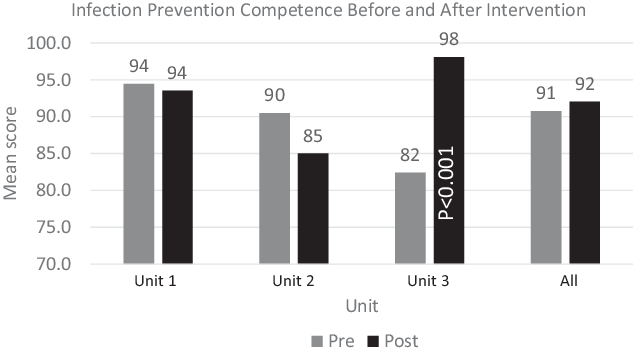
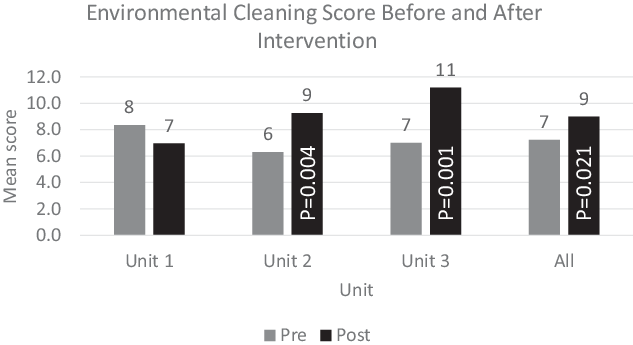
Participants on unit 2 averaged daily use of only 1.3 times (50% complied with daily use at least twice for 1 item or more), and participants on unit 3 averaged daily use of only 1.9 times (12% complied with daily use 4 times for at least 1 item). Infection prevention competencies reflected no intervention-related changes and remained high overall (>80% correct); however, the unit with the lowest baseline competency (unit 3) demonstrated a significant increase after the intervention (from 82% to 98%; P > .001) (Fig. 1). Although not statistically significant, unit 2 did observe a 5% decline in conceptual competence. Significant increases in the cleaning scores of all participants were noted (7.2 vs 9.0; P = .02). Although the scores for each unit increased, the upward trend was statistically significant only for unit 2 (P = .004) and unit 3 (P = .001) (Fig. 2). Finally, 92% of respondents (n = 53) answered that having a UV-C device increased their perception of a cleaner work environment.
Infection prevention competency before and after intervention. Mean scores of percent-correct responses from participants before and after intervention (paired analysis). Unit 3 presented a significant increase: P < .001.

Environmental cleaning score before and after intervention. Cleaning score was calculated as a summary of cleaning frequencies of 6 high-touch surfaces in the clinical environment. Mean scores are presented; P < .05 was considered significant.

Discussion
We report that compliance with daily UV-C frequency targets was ˜50% in our population, a previously unstudied outcome. Why rapid UV-C is not utilized more frequently remains unclear; a future study should investigate the drivers and deterrents of UV-C use. One possibility is the absence of institutionalized guidelines for routine disinfection of 3 of the items of interest and the prevailing practice of stethoscope disinfection with alcohol wipes.
In this study, we observed that infection prevention competency was high overall (>80% correct answers), and the only benefit of intervention was observed in the unit with the lowest baseline competency. Other studies have reported that nursing skills and competencies can be improved after a series of educational in-service training or programs, but these changes were measured immediately following the intervention. Reference Koo, McNamara and Lansing9 Thus, it is plausible that the lack of overall increases may be due to differences in study design or high baseline competence.
Finally, the significant increase in cleaning scores likely reflects access to a new disinfection method and enhanced awareness of infection prevention communicated through weekly education. Although beneficial, it does not pinpoint factors related to increases in cleaning frequency and thus cannot be optimized.
This study had several limitations. The recruitment of volunteers may introduce participation bias, and the self-reported nature of the data collected makes it susceptible to reporting bias. Higher attrition on units 2 and 3 should also be considered given the relatively small effects noted.
Although unanticipated, these findings point to important feasibility limitations that may require organizational consideration prior to deployment of UV-C for noncritical surfaces. As UV-C becomes more available, we recommend an operationalized approach to practice with typical use monitoring as needed.
Acknowledgments
The views expressed are those of the author(s) and do not reflect the official policy of the Department of the Army, the Department of Defense or the US government.
Financial support
We thank the TriService Nursing Research Program for funding this research project.
Conflicts of interest
All authors report no conflicts of interest relevant to this article.