Cloud forests exist in mountains (500 m to 3000 m asl) around the world (Grubb Reference GRUBB1977). Whereas cloud forests may be disturbed by a variety of natural processes, such as tree-fall, landslides (Myster & Sarmiento Reference MYSTER and SARMIENTO1998) and high-wind events, the cutting down of wooded areas for agriculture and pasture is its major cause of deforestation (Muniz-Castro et al. Reference MUNIZ-CASTRO, WILLIAMS-LINERA and BENITEZ-MALVIDO2015). Consequently comparisons between undisturbed primary cloud forest and secondary cloud forest recovering from agriculture are critical to understanding current and future cloud forests. Therefore I expanded on past recruitment studies done in cloud forests (see review in Myster Reference MYSTER2004a) by examining three main sources of variation in the workings of the seed recruitment processes of predation, pathogenic attack and germination (1) between closed-canopy primary cloud forest and its naturally occurring tree-fall gaps; (2) among recovering banana fields, recovering sugarcane fields, and seeded pastures no longer being grazed in secondary cloud forest; and (3) among tree genera or species commonly found in both forests.
The study site was the Maquipucuna Reserve, Ecuador (0°05'N, 78°37'W; www.maqui.org; Rhoades & Coleman Reference RHOADES and Coleman1999, Rhoades et al. Reference RHOADES, ECKERT and COLEMAN1998, Sarmiento Reference SARMIENTO1997) which lies between 1200 and 1800 m asl. The Reserve is a patchwork of primary cloud forest (Edmisten Reference EDMISTEN, Odum and Pigeon1970) and secondary cloud forest recovering from human impacts, mainly cultivation of sugarcane and banana, and pasture seeded with the grass Setaria sphacelata which is native to Africa (Sarmiento Reference SARMIENTO1997) but no longer being grazed. Primary cloud forest was used in the experiment and new data from replicated field plots, set up in 1997 in secondary cloud forest with the same protocol (Myster Reference MYSTER2004b, Reference MYSTER2012) are also related here. Ten primary cloud forest areas were randomly selected in May 2014, five of which had recent, average-sized (all between 100–300 m2 in area: Brokaw Reference BROKAW1982) tree-fall gaps in them. Ripe fruits were first hand-collected (using gloves) locally from one individual of one common early-successional tree (Cecropia sp., bat/bird dispersed), and from four common mid-successional/subcanopy trees (Ardisia websteri, Prestoea acuminata, Ficus sp., Otoba gordoniifolia, all bird dispersed) with obviously damaged and/or empty seeds discarded in the field. Seeds were then hand-sorted (again using gloves) in the laboratory, visually inspected for damage under a dissecting microscope, and then floated to further exclude non-viable seeds. Finally 10 seeds of each of the five test species were placed separately in sets of five plastic 9-cm diameter Petri dishes spaced 30 cm apart in the centre of each closed-canopy forest area and each tree-fall-gap area, for a total of 50 dishes and 500 seeds. Heavy plastic seed mimics were also placed in each dish to determine whether or not seeds were removed by a biotic agent (e.g. insects, mammals) or an abiotic agent (e.g. wind, rain).
After 2 wk in the field seed loss was scored in each dish, which was assumed to be due to action by an animal – not wind or splashing rain – because (1) evidence of animals was observed while collecting these data (e.g. chewed seeds and husks, small-mammal faeces) and (2) duplicate plastic seed mimics were not lost. In addition the assumption was made that seeds carried away were eaten, and/or rendered non-viable in some other way associated with the action of an animal agent (Notman & Gorchov Reference NOTMAN and GORCHOV2001), and so did not germinate later after being removed by an animal. This assumption has been discussed in the literature for several years (Myster Reference MYSTER2007, Reference MYSTER2014) but to date no study has produced statistically significant results to question its validity. Indeed attempts to track seeds in the field after animals take them – using, for example, fishing line glued to seeds or tagging seeds using radioactive isotopes, magnets and fluorescent dyes – may lead to experimental side effects of their own, which has not been discounted (Forget et al. Reference FORGET, KITAJIMA and FOSTER1999). Only when recruitment after seed removal by animals has been shown to a significant part of a plant's recruitment and a seed-following methodology has been proved to be non-invasive, should this assumption be reexamined.
The remaining seeds (not removed) were collected for incubation, with any empty seed hulls discarded, and incubated in a Maquipucuna shadehouse on moist paper in sealed plastic Petri dishes. After 3 wk, seeds that germinated, seeds that did not germinate and had extensive fungal infection (lost to pathogenic attack where contact with the soil is not necessary for infection: Myster Reference MYSTER2004b), and other seeds were scored after viewing under a dissecting microscope. Two-way analysis of variance (ANOVA: SAS 1985) was performed separately for all seed processes (closed-canopy forest vs. tree-fall, among species). In all tests if significance was found, means tests were conducted with the Tukey procedure (SAS 1985). Prior to statistical analysis, all data were examined and found to be normally distributed. Results need to be viewed with the understanding that the primary cloud forest study and the secondary cloud forest study were done in different years and only have one genus in common among the seeds used in the experiments.
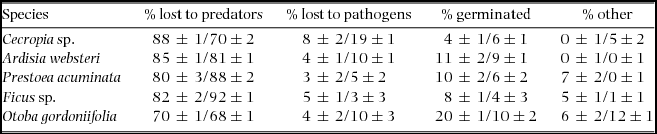
Seed predation took more seeds than either seed pathogenic disease or germination for all tree seed species and in both primary cloud forest (Table 1) and secondary cloud forest (Table 2). The level of seed loss to predation was greatest in the closed-canopy primary forest (mean loss = 81%) and second largest in the tree-fall gaps found in closed-canopy primary forest (80%). Losses due to predation in secondary forest were less than those in primary forest, with recovering banana fields showing the largest losses (67%), followed by sugarcane (65%) and then pasture (61%). For pathogens, losses in the closed-canopy primary forest were smaller (5%) than in the tree-fall gaps (9%). Seed losses to pathogens in secondary forest were greater than those in primary forest: banana fields (19%), sugarcane fields (19%) and pastures (19%). Finally germinated seeds in the closed-canopy primary forest were greater (10%) then in the tree-fall gaps (7%) and germination in secondary forest was greater than in primary forest: banana fields (11%), sugarcane fields (10%) and pastures (11%).
The fate of seeds expressed as a percentage (mean ± SE) of the total seeds put out in closed-canopy forest/in tree-fall gaps. The experiment was performed in primary cloud forest, Maquipucuna reserve, Ecuador.
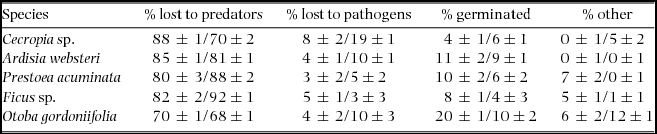
The fate of seeds expressed as a percentage (mean ± SE) of the total seeds put out in fields recovering from banana cultivation/in fields recovering from sugarcane cultivation/in fields recovering after use as planted pasture. The experiment was performed in secondary cloud forest, Maquipucuna reserve, Ecuador.

Analysis of variance showed that in the primary cloud forest seed predation was significantly different between closed-canopy and tree-fall gap (F = 5.2, P = 0.005), among the test species (F = 3.1, P = 0.04) and in the interaction between these two main effects (F = 4.2, P = 0.02). For seeds lost to pathogens and germinated seeds, however, only pathogenic seed losses were significant and then only among seed test species (F = 3.7, P = 0.03). In the secondary cloud forests, ANOVA showed that seed predation was again significantly different for both main effects (banana vs. sugarcane vs. pasture F = 6.6, P = 0.003, among the test species F = 2.8, P = 0.04) and for the interaction term (F = 3.2, P = 0.03). The significant interaction terms (seed predation for both primary and secondary forests) are most revealing for the ANOVAs (SAS 1985) and therefore were explored further. Cecropia sp. seeds in the tree-fall gaps and Otoba gordoniifolia seeds in both closed-canopy forest and tree-fall gap, were the most significantly different among all treatments (Cecropia sp. had 70% loss, Otoba gordoniifolia had 70% loss and 68% loss, respectively). Solanum ovalifolium seeds in banana fields (had the highest loss 77%) and Piper aduncum in all fields (had the lowest loss 50% in banana fields, 50% in sugarcane fields, 49% in seeded pastures) were the most significantly different among all treatments.
Predation was, once again, the major seed mechanism of forest recruitment (see reviews in Myster Reference MYSTER2004a, Reference MYSTER2007) across both primary (closed-canopy, tree-fall gap) and secondary (banana, sugarcane, pasture) forests. After predation, results show that pathogens could play an important role in recruitment and that most remaining seeds germinated (Myster Reference MYSTER2003, Myster & Everham Reference MYSTER and EVERHAM1999). Taken together, results suggest that it is the variation in how seed predation works (e.g. among species, under litter, at different times of the year; Myster Reference MYSTER2004b) that is a key to understanding recruitment and regeneration in cloud forest. When we compare the results to other secondary Neotropical forests we find much in common: (1) over 75% loss of seed to predators (more by insects in mature Peru forest and more by mammals in old fields; Notman & Gorchov Reference NOTMAN and GORCHOV2001); (2) the same trends (seed loss due to predation > that due to pathogens > seeds that germinated) in Puerto Rico pasture, banana, sugarcane fields (Myster Reference MYSTER2004a), and in Puerto Rico coffee fields and pasture (50–75% predation, 20–45% pathogens, germination 15–35% depending on species; Myster Reference MYSTER2003); and (3) after clear-cutting for logging in Peru several tree species had a reduction of seed predation from the forest into the clear-cut (50–90% losses; Notman et al. Reference NOTMAN, GORCHOV and CORNEJO1996).
Other Neotropic forest studies suggest further complexity and future experiments by showing that (1) larger seeds get taken by pathogens more than smaller seeds, germination was approximately 43% and pathogen loss was up to 75% depending on species (Pringle et al. Reference PRINGLE, ALVAREZ-LOAYZU and TERBORGH2007); (2) secondary dispersal is low (Culot et al. Reference CULOT, HUYNEN, GERARD and HEYMANN2009, Parolin et al. Reference PAROLIN, DESIMOBNE, HAASE, WALDHIOFF, ROTTENBERGER, KUHN, KESSELMEIER, KLEISS, SCHMIDT, PIEDADE and JUNK2004); (3) seed predation was reduced under litter, especially under thick litter (Cintra Reference CINTRA1997); and (4) after bat defecation seed were eaten at a rate of 8% wk−1 with possible satiation (Romo et al. Reference ROMO, TUOMISTO and LOISELLE2004). My own results in other Neotropic forests (Myster Reference MYSTER2014, author, unpubl. data) suggest that (1) seed predation may be reduced to similar levels more by loss of soil fertility (i.e. in palm forest) than by increased flooding (i.e. in igapó forests); (2) for pathogens, standing water in palm forest leads to the greatest losses, but increased flooding in igapó forests can also lead to increasing loss of seeds to pathogens; and (3) most seeds germinated if they could escape predators and pathogens (Myster & Everham Reference MYSTER and EVERHAM1999). The fact that more seeds survived in the secondary forest, compared with other treatments, may be because predators avoid open spaces (Myster Reference MYSTER2004b) and suggests that human disturbance (after agriculture) may accelerate the natural regeneration processes (after tree-fall) in this forest making it more dynamic.
ACKNOWLEDGEMENTS
I thank Arcenio Barras, Bernardo Castro, Jorge Reascos, Rebeca Justicia and the staff of Maquipucuna Reserve for their help in executing this research. I also thank E. Bruna and M. Zobel for commenting on an earlier version of the manuscript.