Introduction
Mood and psychotic disorders, including major depressive disorder, bipolar disorder, and schizophrenia are often chronic and recurrent (Judd et al., Reference Judd, Akiskal, Maser, Zeller, Endicott, Coryell, Paulus, Kunovac, Leon, Mueller, Rice and Keller1998; Olesen and Mortensen, Reference Olesen and Mortensen2002; Uher et al., Reference Uher, Pallaskorpi, Suominen, Mantere, Pavlova and Isometsä2019). People typically develop mood and psychotic disorders in late adolescence or early adulthood (Kessler et al., Reference Kessler, Amminger, Aguilar-Gaxiola, Alonso, Lee and Üstün2007) and experience significant functional impairment as a result of their illness (Harvey, Reference Harvey2011). Consequently, the cost of these disorders to society is higher than the cost of all types of cancer combined (Ratnasingham et al., Reference Ratnasingham, Cairney, Rehm, Manson and Kurdyak2012). Hence, prevention of mood and psychotic disorders is essential to reduce the burden of illness on affected individuals and society.
Children of parents with mood and psychotic disorders are at an elevated risk for behavioral and emotional problems in childhood and the later development of severe mental illness (Rasic et al., Reference Rasic, Hajek, Alda and Uher2014; van Santvoort et al., Reference Van Santvoort, Hosman, Janssens, Van Doesum, Reupert and Van Loon2015). While there is evidence that the offspring's risk to develop the same disorder as their parent is most increased compared to controls, the familial risk also extends beyond the specific disorder that affects the parent (Birmaher et al., Reference Birmaher, Axelson, Monk, Kalas, Goldstein, Hickey, Obreja, Ehmann, Iyengar, Shamseddeen, Kupfer and Brent2009; Rasic et al., Reference Rasic, Hajek, Alda and Uher2014). Hence, some of the early risk factors for mood and psychotic disorders may be shared by children of parents with different disorders. One antecedent of these disorders is early psychopathology as youth who display externalizing problems, anxiety, and psychotic symptoms are at an increased risk for developing mood and psychotic disorders (Scott et al., Reference Scott, Martin, Welham, Bor, Najman, O'Callaghan, William, Aird and McGrath2009; Nurnberger et al., Reference Nurnberger, McInnis, Reich, Kastelic, Wilcox, Glowinski, Mitchell, Fisher, Erpe, Gershon, Berrettini, Laite, Schweitzer, Rhoadarmer, Coleman, Cai, Azzouz, Liu, Kamali, Brucksch and Monahan2011).
However, information about these early problems usually relies on parent- or self-report. For younger children, parent-report is often the only source of information. While parent-report provides valuable data, the report of parents with mood and psychotic disorders may be biased by their own experience with mental illness and their mental state (Najman et al., Reference Najman, Williams, Nikles, Spence, Bor, O'Callaghan, Le Brocque and Andersen2000; Maoz et al., Reference Maoz, Goldstein, Goldstein, Axelson, Fan, Hickey, Monk, Sakolsky, Diler, Brent, Kupfer and Birmaher2014). The use of self-report also introduces bias because people may over- or underestimate their symptom severity (Huang et al., Reference Huang, Liao and Chang1998). Both parent- and self-report depend on memory and recall may be influenced by a variety of factors. Measures rated by an independent observer offer an opportunity to capture children's psychopathology, independent of the biases of parent- and self-report in a way that does not depend on the accuracy and completeness of recall. A previous study has shown that observed behaviors such as effortful control, difficulty sustaining attention, and wariness in early childhood predict internalizing and externalizing disorders in later childhood and early adolescence (Caspi et al., Reference Caspi, Henry, McGee, Moffitt and Silva1995). However, measures of observed behavior may be more suited to assess certain forms of psychopathology, such as externalizing behaviors compared to other forms of psychopathology like depressive and anxious symptoms.
Previous comparisons of observed psychopathology between children of parents with and without mood and psychotic disorders are limited to the offspring of parents with schizophrenia and bipolar disorder (Ellersgaard et al., Reference Ellersgaard, Plessen, Jepsen, Spang, Hemager, Burton, Christiani, Gregersen, Søndergaard, Uddin, Poulsen, Greve, Gantriis, Mors, Nordentoft and Thorup2018). Observed psychopathology in offspring of parents with major depressive disorder has yet to be explored.
The aim of this study was to compare observed psychopathology across different domains in children of parents with major depressive disorder, bipolar disorder, or schizophrenia and children of parents with no history of mood or psychotic disorders using an independent rater blind to parent diagnoses.
Methods
Participants
Participants in this study were the offspring of parents with major depressive disorder, bipolar disorder, or schizophrenia and offspring of parents with no history of mood and psychotic disorders (controls) who were part of the Families Overcoming Risks and Building Opportunities for Wellbeing project (FORBOW; Uher et al., Reference Uher, Cumby, MacKenzie, Morash-Conway, Glover, Aylott, Propper, Abidi, Bagnell, Pavlova, Hajek, Lovas, Pajer, Gardner, Levy and Alda2014). FORBOW is an ongoing longitudinal cohort study which annually assesses factors related to healthy development. Youth in the current study had completed a median of three assessments.
Children and youth were eligible for the current study if they were between 4 and 24 years of age and were fluent in English or French. Offspring were excluded if they had an intelligence quotient (IQ) score lower than 70, or autism spectrum disorder. Observations from children were also excluded after they developed a lifetime diagnosis of bipolar disorder, schizophrenia, schizoaffective disorder or had experienced a major depressive episode within 12 months prior to the assessment, as we wanted to examine behavior before the development of a full blown psychiatric disorder.
The study was approved by the Research Ethics Board of the Nova Scotia Health Authority. Participants gave written informed consent. Children who were not able to make an informed decision gave assent and their parent or guardian provided written consent.
Procedure
Parent assessment
Parent assessors interviewed biological parents using the Schedule for Affective Disorders and Schizophrenia (SADS-IV; Endicott and Spitzer, Reference Endicott and Spitzer1979) and the Structured Clinical Interview for DSM 5 Disorders (SCID-5; First et al., Reference First, Williams, Karg and Spitzer2015). Parent diagnoses were confirmed in consensus meetings with psychiatrists who were blind to child psychopathology.
Every year, parents also completed a self- and partner-report of current symptoms of anxiety and depression using the Everyday Feelings Questionnaire (EFQ; Uher and Goodman, Reference Uher and Goodman2010). Both reports consist of 10 items focused on the respondent's or their co-parent's symptoms. Each item is rated on a 5-point Likert scale from 1 (none of the time) to 5 (all of the time). The EFQ has good internal consistency, convergent validity, and test-retest reliability (Uher and Goodman, Reference Uher and Goodman2010).
Offspring assessment
The youth assessors were blind to parent diagnoses. One youth assessor carried out diagnostic interviews, including the Kiddie Schedule for Affective Disorders and Schizophrenia, Present and Lifetime Versions (K-SADS; Kaufman et al., Reference Kaufman, Birmaher, Brent, Rao, Flynn, Moreci, Williamson and Ryan1997) and, for offspring aged 18 and older, the SCID-5 (First et al., Reference First, Williams, Karg and Spitzer2015). All diagnoses were confirmed in consensus meetings with a child and adolescent psychiatrist who was blind to parent psychopathology.
A second youth assessor, not involved in diagnostic interviewing, carried out the cognitive testing and observer rating of psychopathology. The cognitive assessment varied by participant age and involved measures of general cognitive ability, memory and executive functions. It generally lasted 120 min. Following the cognitive assessment, the assessor rated observed psychopathology using the Test Observation Form (TOF; McConaughy and Achenbach, Reference McConaughy and Achenbach2004). The TOF consists of 125 items, which are based on observer report only and are scored on a 4-point Likert scale from 0 (no occurrence) to 3 (definite occurrence with severe intensity, high frequency, or 3 or more minutes total duration). The TOF has five syndrome-based subscales: attention problems, oppositional, anxious, withdrawn/depressed, and language/thought problems. The attention problem subscale assesses inattention, hyperactivity and impulsivity, including difficulty paying attention, fidgeting and being easily distracted. The oppositional subscale reflects uncooperative behaviors like arguing, temper tantrums, and attempts to cheat. The anxious subscale consists of items such as overly anxious to please, tense, and expresses worry. The withdrawn/depressed subscale measures behaviors associated with depression, for example, flat affect and limited conversation. Finally, the language/thought problems subscale includes items such as disjointed conversation, and problems remembering details.
Data analysis
We tested the effect of parent diagnosis on offspring's observed psychopathology score on each of the five TOF subscales (attention problems, oppositional, anxious, withdrawn/depressed, and language/thought problems), using multiple mixed effects linear regressions in STATA 15 (StataCorp, 2017). Parental diagnoses were classified into four groups: (1) no history of mood or psychotic disorder, (2) lifetime diagnosis of major depressive disorder, (3) lifetime diagnosis of bipolar disorder or (4) lifetime diagnosis of schizophrenia. We standardized the scores on each measure by dividing the mean by the standard deviation, to allow for comparison across subscales. We controlled for age and sex as potential confounders. We accounted for the non-independence of related individuals within families and multiple observations within individuals with hierarchical random effects of family and individual identifiers. We report the effect size of comparisons as standardized regression coefficients (β) with 95% confidence intervals (CI). For our main analysis, we made five comparisons of observed psychopathology domains for each high-risk group against the control group. Since we expected that the family high-risk groups would differ from the control group across multiple domains, we reported all results with p < 0.05 as significant. We also report significance corrected for the number of tests (fifteen tests, corrected p value < 0.0033).
We carried out sensitivity analyses to explore the impact of controlling for IQ and limiting the sample to children and adolescents (aged 3 to 18) on the difference in observed psychopathology between the offspring of parents with mood and psychotic disorders and controls. In secondary analyses, we also compared observed psychopathology domains between familial high-risk groups and explored the effect of parents' current symptoms of depression and anxiety on observed psychopathology domains.
Results
Sample characteristics
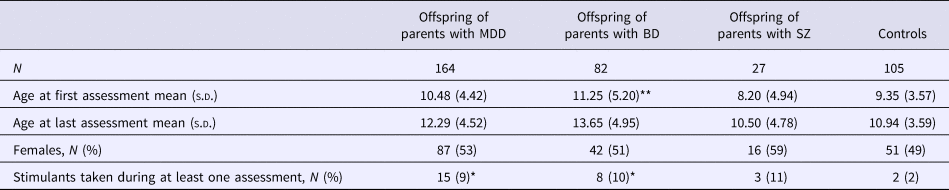
The final sample was composed of 378 youth from 219 families. Of these, 105 were offspring of control parents, 164 were offspring of parents with major depressive disorder, 82 were offspring of parents with bipolar disorder (50 with bipolar I disorder and 32 with bipolar II disorder) and 27 were offspring of parents with schizophrenia. A total of 94 parents experienced psychotic symptoms in their lifetime; one from the control group, 23 from the depression group, 43 from the bipolar disorder group, and 27 from the schizophrenia group. We included a similar number of males (n = 182; 48%) and females (n = 196, 52%). The total number of observations was 1056 with a median of three annual TOF observations per participant. The mean age of the offspring was 11.01 years (s.d. = 4.40). Table 1 shows the characteristics of the sample, for each family history group.
Sample characteristics for each family history group

MDD, major depressive disorder; BD, bipolar disorder; SZ, schizophrenia; s.d., standard deviation.
Significantly different from the control group at *p < 0.05, **p < 0.01.
Primary analysis – parent diagnosis and observed psychopathology in offspring
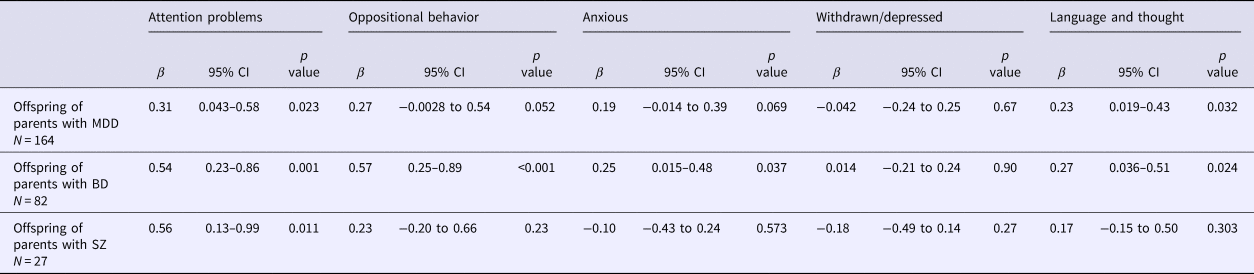
Compared to controls, offspring of parents with major depressive disorder showed more attentional difficulties (β = 0.31, 95% CI 0.043–0.58, p = 0.023) and language/thought problems (β = 0.23, 95% CI 0.019–0.43, p = 0.032) in addition to non-significant trends for increased anxiety (β = 0.19, 95% CI −0.014 to 0.39, p = 0.069) and oppositional behavior (β = 0.27, 95% CI −0.0028 to 0.54, p = 0.052).
Offspring of parents with bipolar disorder displayed more attentional difficulties (β = 0.54, 95% CI 0.23–0.86, p = 0.001), anxiety (β = 0.25, 95% CI 0.015–0.48, p = 0.037), language/thought problems (β = 0.27, 95% CI 0.036–0.51, p = 0.024) and oppositional behavior (β = 0.57, 95% CI 0.25–0.89, p < 0.001) than controls. The increased attentional difficulties and oppositional behavior in offspring of parents with bipolar disorder when compared to control offspring remained significant after controlling for multiple testing.
Offspring of parents with schizophrenia showed increased attentional difficulties (β = 0.56, 95% CI 0.13–0.99, p = 0.011) compared to controls.
There was no difference between control offspring and any of the high-risk groups on the withdrawn/depressed subscale. Results are shown in Table 2 and Fig. 1.
The estimate of differences in observed psychopathology domains in familial high-risk groups compared to offspring of parents without mood or psychotic disorders
MDD, major depressive disorder; BD, bipolar disorder; SZ, schizophrenia, CI, confidence interval.
Observed psychopathology in offspring of parents with major depressive disorder, bipolar disorder, schizophrenia, and controls; the Y axis shows scores adjusted for age and sex. Error bars represent one standard error of the mean. All scales are measures of psychopathology and higher values reflect more psychopathology (i.e. for “attention” higher values mean more problems with attention and for “language” higher values mean more language disturbance).

Secondary analyses
Offspring of parents with schizophrenia displayed less anxious behavior than offspring of parents with bipolar disorder (β = −0.40, 95% CI −0.75 to −0.036, p = 0.031). Offspring of parents with bipolar disorder displayed more oppositional behavior than offspring of parents with major depressive disorder (β = 0.32, 95% CI 0.01–0.64, p = 0.043). No other comparisons between high-risk groups were significant (see online Supplementary Table S1).
Parents' current symptoms of depression and anxiety were significantly associated with attention problems (β = 0.17, 95% CI 0.07–0.28, p = 0.001), oppositional behavior (β = 0.16, 95% CI 0.046–0.27, p = 0.005), anxious behavior (β = 0.12, 95% CI 0.036–0.20, p = 0.005), and language/thought problems (β = 0.13, 95% CI 0.049–0.21, p = 0.002) in offspring. The association between parents' current symptoms and depressed/withdrawn behavior in offspring was not statistically significant (β = 0.07, 95% CI −0.015 to 0.15, p = 0.113).
Sensitivity analyses
Sensitivity analysis controlling for IQ as a covariate resulted in similar albeit lower effect sizes (effect sizes ranging from −0.05 to 0.40; see online Supplementary Table S2). Analysis limited to participants aged 3–18 produced very similar effect sizes to primary analysis (effect sizes ranging between −0.13 and 0.58; see online Supplementary Table S3).
Discussion
Offspring of parents with major depressive disorder, bipolar disorder, and schizophrenia show greater observed psychopathology than controls in most domains.
We found more attentional difficulties in offspring of parents with mood and psychotic disorders compared to offspring of control parents. In addition, offspring of parents with mood disorders displayed elevated language/thought problems, and oppositional behavior compared to controls. Language/thought problems and oppositional behavior were also numerically elevated in offspring of parents with schizophrenia, but the difference from controls did not reach statistical significance likely due to limited power.
Externalizing disorders and cognitive impairment are also more common in individuals with major depressive disorder, bipolar disorder and schizophrenia (Raymond Lake, Reference Raymond Lake2008; Harmancı et al., Reference Harmancı, Çam Çelikel and Etikan2016; Arican et al., Reference Arican, Bass, Neelam, Wolfe, McQuillin and Giaroli2019). In line with previous findings (Maziade et al., Reference Maziade, Gingras, Rouleau, Poulin, Jomphe, Paradis, Merette and Roy2008; Ellersgaard et al., Reference Ellersgaard, Plessen, Jepsen, Spang, Hemager, Burton, Christiani, Gregersen, Søndergaard, Uddin, Poulsen, Greve, Gantriis, Mors, Nordentoft and Thorup2018; Mackenzie et al., Reference MacKenzie, Uher and Pavlova2019), our results suggest that attentional difficulties, oppositional behavior, and language/thought problems are elevated in youth at risk for mood and psychotic disorders even before the onset of these disorders and can be observed by an independent assessor without using a parent- or self-report.
Externalizing disorders, major depressive disorder, bipolar disorder, and schizophrenia may have common genetic vulnerability (Brainstorm Consortium, 2018). In addition, shared genetic factors across major depressive disorder, bipolar disorder, and schizophrenia are correlated with cognitive performance (Trampush et al., Reference Trampush, Yang, Yu, Knowles, Davies, Liewald, Starr, Djurovic, Melle, Sundet, Christoforou, Reinvang, DeRosse, Lundervold, Steen, Espeseth, Räikkönen, Widen, Palotie, Eriksson, Giegling, Konte, Roussos, Giakoumaki, Burdick, Payton, Ollier, Horan, Chiba-Falek, Attix, Need, Cirulli, Voineskos, Stefanis, Avramopoulos, Hatzimanolis, Arking, Smyrnis, Bilder, Freimer, Cannon, London, Poldrack, Sabb, Congdon, Conley, Scult, Dickinson, Straub, Donohoe, Morris, Corvin, Gill, Hariri, Weinberger, Pendleton, Bitsios, Rujescu, Lahti, Le Hellard, Keller, Andreassen, Deary, Glahn, Malhotra and Lencz2017; Brainstorm Consortium, 2018). We found that parents' current symptoms of psychopathology were associated with greater attentional difficulties, oppositional behavior, and language/thought problems. Thus, environmental influences associated with exposure to parents' current psychopathology including higher life stress (Kim and Ge, Reference Kim and Ge2000; Langrock et al., Reference Langrock, Compas, Keller, Merchant and Copeland2002) may contribute to the externalizing behavior (Çöp et al., Reference Çöp, Çengel Kültür and Şenses Dınç2017; Rodriguez et al., Reference Rodriguez, Donenberg, Emerson, Wilson, Brown and Houck2014) and language/thought problems (Pechtel and Pizzagalli, Reference Pechtel and Pizzagalli2011) in offspring. This finding highlights the importance of effectively treating symptoms of mood and psychotic disorders, including residual symptoms, in parents in order to give their children the best possible chance to grow up healthy.
We found that elevated anxious behavior was limited to offspring of parents with major depressive disorder and bipolar disorder. This is consistent with a meta-analysis that found elevated risk for anxiety disorders among offspring of parents with major depressive disorder and bipolar disorder, but not offspring of parents with schizophrenia (Rasic et al., Reference Rasic, Hajek, Alda and Uher2014). In addition, anxiety disorders are more prevalent in adults with mood disorders (Fava et al., Reference Fava, Rankin, Wright, Alpert, Nierenberg, Pava and Rosenbaum2000; Pavlova et al., Reference Pavlova, Perlis, Alda and Uher2015, Reference Pavlova, Perlis, Mantere, Sellgren, Isometsä, Mitchell, Alda and Uher2017) than in those with schizophrenia (Achim et al., Reference Achim, Maziade, Raymond, Olivier, Mérette and Roy2011). Hence, anxiety may represent an antecedent associated specifically with mood disorders.
We did not find any difference between offspring of parents with mood and psychotic disorders and controls on the withdrawn/depressed subscale of the TOF. It is possible that depression is less easily observed during a structured interaction like cognitive assessment. However, a previous investigation (Ellersgaard et al., Reference Ellersgaard, Plessen, Jepsen, Spang, Hemager, Burton, Christiani, Gregersen, Søndergaard, Uddin, Poulsen, Greve, Gantriis, Mors, Nordentoft and Thorup2018) found that children of parents with schizophrenia displayed elevation on the withdrawn/depressed subscale of the TOF. This discrepancy may be attributed to different sample characteristics such as different degrees of parental illness severity between the two samples.
After controlling for IQ, all effect sizes were reduced. It is possible that attentional, oppositional, cognitive or anxiety problems lead to the youth not performing up to their potential, thus leading to lower scores on IQ tests (Jepsen et al., Reference Jepsen, Fagerlund and Mortensen2009). Lower IQ may also make cognitive assessment more challenging for the youth and thus they may be more likely to display behaviors suggestive of attentional, oppositional or anxiety problems. Notwithstanding the direction of causality in the association between IQ and observed inattention, observation of increased attention difficulties in offspring of parents with bipolar disorder remains significant even after controlling for IQ.
Our study has several implications for identification and possible interventions for youth at risk for mood and psychotic disorders. Our findings suggest that observer-report may contribute to the early identification of risk for psychiatric disorders. Thus, structured observations may be employed to identify emotional, behavioral and learning problems in children at familial high risk for mood and psychotic disorders. Externalizing psychopathology and language/thought problems may need to be monitored across all offspring of parents with mood and psychotic disorders. Meanwhile, children of parents with mood disorders may especially benefit from close monitoring of observed anxiety. Additionally, if these problems are shown to predict mood and psychotic disorders, early interventions aimed at addressing externalizing behavior, language/thought problems and anxiety may help prevent the onset of major depressive disorder, bipolar disorder and schizophrenia in children of parents with mood and psychotic disorders.
To the best of our knowledge, this study is the first to compare observed psychopathology between offspring of parents with major depressive disorder, bipolar disorder, or schizophrenia and offspring of control parents. Our study benefits from the use of an observer rating of psychopathology, which enabled us to assess offspring's behavior independent of parental bias. However, our study was not without limitations. First, as the group of offspring of parents with schizophrenia was small, we had limited statistical power to detect group differences and all findings regarding offspring of parents with schizophrenia should be interpreted with caution. Second, the TOF assesses psychopathology during cognitive testing only, therefore it is unclear if our results generalize to other settings. In addition, the TOF does not assess the full range of psychopathology. Specifically, manic and psychotic symptoms are not assessed. Third, compared to control offspring, a greater proportion of offspring of parents with mood and psychotic disorder were taking prescribed stimulant medication during at least one assessment. It is possible this medication masked even larger differences between high-risk offspring and controls. Fourth, we cannot yet conclude whether the symptoms we observed in our study will precede the development of mood and psychotic disorders in offspring. Longitudinal studies that establish whether observed psychopathology predicts the development of psychiatric disorders are needed.
In conclusion, the elevated psychopathology in children of parents with mood and psychotic disorders compared to children of control parents can be observed by an independent assessor. While it is not clear whether observed psychopathology predicts the development of mood and psychotic disorders, it is evident that children of parents with major depressive disorder, bipolar disorder and schizophrenia are more likely to experience observed behavioral and emotional problems. Targeting these difficulties with effective intervention strategies may help to prevent mental illness in youth at risk.
Author ORCIDs
A. Sandstrom, 0000-0002-4049-7141
Supplementary material
The supplementary material for this article can be found at https://doi.org/10.1017/S0033291719001089.
Financial support
Research leading to this report was funded by the Canada Research Chairs Program (award number 231397), the Canadian Institutes of Health Research (Grant reference numbers 124976, 142738 and 148394), the Brain & Behavior Research Foundation (NARSAD) Independent Investigator Grant 24684, Nova Scotia Health Research Foundation (grants 275319, 1716 and 353892) and the Dalhousie Medical Research Foundation. The funders had no role in the study design, data collection, data analysis, data interpretation, preparation of the manuscript or the decision to submit the manuscript for publication.
Conflict of interest
The authors report no conflicts of interest.
Ethical standards
The authors assert that all procedures contributing to this work comply with the ethical standards of the relevant national and institutional committees on human experimentation and with the Helsinki Declaration of 1975, as revised in 2008.