Introduction
Dementia has been recognized as a public health priority globally (WHO, 2012) and also within Australia (Department of Health, 2013). As such, there is a strong need for continuous professional development and growth of the healthcare workforce involved in clinical geriatric practice, as well as the identification of competencies for professional practice in dementia care. The KASA tool outlines the areas of knowledge and skills required for Behaviour Consultants working in the DBMAS, with a potential to be adapted for use in dementia care for roles comparable to DBMAS consultants in other countries. The need for support of people with dementia and their carers is widely acknowledged; however, there are only a few examples of roles comparable to DBMAS consultants worldwide that would provide case management in the form of an advisory (rather than an intervention) service. In the Netherlands, the case management of people with dementia, is provided by roles such as “dementia consultant,” “case manager,” and “case process workers,” which all differ in terms of implementation and service delivery, with some providing short-term crisis response and others offering a more long-term support (Ministry of Health, Welfare, and Sport, 2009). In Scotland, the role somewhat comparable to the advisory role of the DBMAS consultant is the “dementia nurse consultant,” established in 2011 with the aim to support people with dementia, their families, and carers within the hospital settings, and assist in the transition process between hospital and community setting (Stevenson, 2014). None of these roles, however does not focus on providing advisory services to improve outcomes specifically for people with dementia who exhibit dementia-related behaviors, as it is the nature of the DBMAS.
DBMAS supports people with dementia and their carers in a range of settings including community, residential aged care, and acute and primary hospital settings across all states in Australia, including altogether 88 DBMAS Behaviour Consultants. The role of a DBMAS Behaviour Consultant consists primarily in assisting carers of people with dementia to better understand and manage a range of behavioral and psychological symptoms of dementia (BPSD). Carers can enlist the help of Behaviour Consultants by making formal referrals to the service, calling the national dementia helpline for any enquiries, or submitting requests for education.
The role of DBMAS is often of great value to carers of people with dementia, given that BPSD have been found to impose the greatest burden on caregivers, even more so than cognitive dysfunction per se, physical dependence and/or functional impairment (International Psychogeriatric Association, 2012). Providing assistance to carers is essential as BPSD are highly prevalent in people with dementia (Tampi et al., Reference Tampi2011). In fact, BPSD have been found to occur in up to 60% of people with dementia in the community (Cohen et al., Reference Cohen, McKenzie, Rahmani, Singh and Prospere2012) and up to 90% of people with dementia living in residential aged care (Cerejeira et al., Reference Cerejeira, Lagarto and Mukaetova-Ladinska2012).
As such, DBMAS aims to: improve the quality of life and care for people with dementia, their carers, and their families; up-skill, assist, and support aged care providers in improving care for people with dementia; and ensure care services for people with dementia are responsive to individual's needs and circumstances (DBMAS, 2014).
Several characteristics of the service require time and experience for a Behaviour Consultant to adjust to, and contribute to the uniqueness of the DBMAS program. For example, DBMAS employs Behaviour Consultants from several disciplines, including nursing, psychology, occupational therapy, social work, music therapy, physiotherapy, and diversional therapy. These consultants combine their individual discipline skills in order to provide the aforementioned services in an interdisciplinary, holistic manner. Furthermore, DBMAS is an advisory service rather than a direct service provider. Therefore, a shift is required in how the service goals are achieved. The DBMAS service goals are accomplished via capacity building, and providing consultation and short-term support services to care providers in various settings. Thus, the ability to work with care providers in the community as well as within institutions is vital to successful outcomes within DBMAS. Finally, because DBMAS is itself an interdisciplinary service, and consults also with geriatric medicine and psychiatry services, the ability to work as an interdisciplinary team is an important attribute of its consultants.
To date, however, the unique knowledge and skills required of DBMAS Behaviour Consultants have not been fully identified or described and currently, no overall service-wide tool exists that enables Behaviour Consultants and Team Leaders to identify their personal and group areas of strengths and limitations. A skills and knowledge framework is therefore needed not only because of the unique value of the DBMAS Behaviour Consultant to external service providers, but also within the service itself, to identify training needs, support peer mentoring and set clear aims for professional development.
The aim of this paper, therefore, is to introduce and describe the development and use of the KASA for both DBMAS teams nationwide and also possible future development and use more broadly. The self-assessment tool was developed with specific aims:
-
1. To be multidisciplinary and applicable for DBMAS Behaviour Consultants at all levels of experience and knowledge;
-
2. To provide DBMAS Behaviour Consultants with a comprehensive and structured tool to self-assess and self-reflect about clinical competencies with respect to the provision of DBMAS services;
-
3. To guide both DBMAS Behaviour Consultants and DBMAS Team Leaders in areas where further up-skilling is required or desired based on their personal aspirations, or (for Team Leaders) based on the needs of the DBMAS team around the various areas of competencies; and,
-
4. To be used as part of a consultant's professional development, in conjunction with an annual performance appraisal and/or clinical supervision and support from service leaders.
Research aims and questions
In the following sections we aim to: (1) Outline the development of the KASA; (2) Present the process of using the KASA in practice (See Supplementary Appendix A1); and, (3) Present the results of the KASA ratings following a pilot study of the utility of the measure with DBMAS Behaviour Consultants. A final goal of this paper is to describe the process of development and initial testing of this self-assessment tool, so that other similar dementia service providers might be able to develop similar tools relevant for their services. Research questions that we will answer in this paper are: (1) What is the process of development of the KASA; (2) How can KASA be used in practice; and, (3) What is the initial utility of the KASA?
Method
The study was conducted between August 2014 and January 2015, with the final tool being piloted in Queensland, Australia between October and December 2014. Approval for the study was obtained from the University of Queensland Behavioural & Social Sciences Ethical Review Committee.
Design
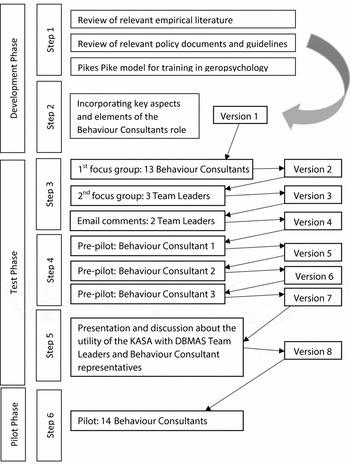
The literature reviews, user (Behaviour Consults and Team Leaders) consultation, and iterative step-by-step process of development and testing of the tool were employed. A more detailed overview of the methodological steps undertaken is provided in Figure 1.
Process of the KASA development and initial testing.

Setting and participants
DBMAS Behaviour Consultants from services in each State and Territory in Australia were invited to participate in development, initial testing, and trialing of the tool. Fifteen consultants responded to the invitation to trial the tool, representing 17% of all DBMAS Behaviour Consultants. Of these, one participant completed less than half of all items in the KASA and was therefore excluded from the sample. The total sample included 14 Behaviour Consultants, including 12 females. We used maximum variation sampling (Patton, Reference Patton2002), to reflect the heterogeneity of Behaviour Consultants in the DBMAS program. We sought to ensure that participants ranged in professional background, and aimed to sample at least one Behaviour Consultant from all eight states and territories in Australia (which was achieved).
Procedures
The study comprised of three phases (i.e. Development Phase, Test Phase, and Pilot Phase), including altogether six steps (see Figure 1). Step One involved extensive search of the relevant literature on competencies in the areas of mental health, aged care, and dementia care. In addition to some key documents (Department of Health, 2006; Michigan Dementia Coalition, 2006; Knight et al., Reference Knight, Karel, Hinrichsen, Qualls and Duffy2009; Karel et al., Reference Karel, Emery and Molinari2010; Skills for Care and Skills for Health, 2011; King et al., Reference King2012), the DBMAS Operational Guidelines & Dementia Collaborative Research Centres Behaviour Management Guide (DBMAS, 2014) were also reviewed and incorporated into the tool where appropriate.
Step Two involved developing a draft of the tool (Version 1) incorporating key aspects and elements of the Behaviour Consultant role. For example, we addressed the multidisciplinary nature of the consultants, the need for skills with specific sub-populations relevant for the Australian context (e.g. Aboriginal and Torres Strait Islanders [ATSI]), and also the consultation and advisory nature of the DBMAS Behaviour Consultant role.
Step Three involved a series of reviews of the first two drafts of the KASA. Version 1 of the tool was sent to 18 Behaviour Consultants to review, and two focus groups, mediated by members of the research team, were organized to discuss their feedback. In the first focus group, 13 Behaviour Consultants participated in the discussions about KASA (one attended the group in person and 11 through teleconference). One Behaviour Consultant sent their feedback to the team via email. This round of feedback was then implemented in the second draft (Version 2) of the tool, which was sent further to a Working Group of six DBMAS Team Leaders for their appraisal. Members of the Working Group discussed their feedback in a separate focus group, consisting of three Team Leaders (one attended in person and two joined through a teleconference). The feedback from the Team Leaders was discussed and improvements were incorporated into a third draft (Version 3) of the tool. Given the low attendance of Working Group members in the focus group, Version 3 was distributed through email to the remaining Team Leaders for any final comments. Two more Team Leaders provided comprehensive feedback, which was considered in preparation of the pilot version of the tool (Version 4).
Step Four involved a pre-pilot review of the KASA by three DBMAS Behaviour Consultants who completed the assessment tool and provided written feedback on their experience, which was then addressed in a face-to-face interview with one of the researchers. We chose consultants with various professional backgrounds (i.e. Psychologist, Registered Nurse, and Diversional Therapist), to ensure that the diversity of the professionals working in the DBMAS program was reflected in the tool. The pre-pilot review was implemented in a step-wise process. As such, each of the Behaviour Consultants’ feedback was implemented prior to the next Behaviour Consultant's review of the tool. Thus, the first Behaviour Consultant completed Version 4 of the KASA, the second completed Version 5, and the third Behaviour Consultant completed Version 6 of the KASA. This process resulted in the feedback from the last Behaviour Consultant being implemented in the final draft of the tool, Version 7.
Step Five involved a brief presentation of the tool at a national face-to-face meeting involving all DBMAS Team Leaders and some Behaviour Consultant representatives. Following the presentation, a discussion involving their perceptions and ideas of tool as well as potential barriers to its implementation ensued. This step also served to assess content validity of the tool, as it was expected that the discussions with Team Leaders and Behaviour Consultant representatives would provide a good indication whether the presented version of the KASA reflected accurately the knowledge and skills areas that are required for a high-quality and person-centered care of people with dementia.
Step Six involved trialing the final version of the KASA in a small pilot study with 15 DBMAS Behaviour Consultants from a range of services across the country. The aim of the pilot study was to see how the KASA would work in practice by having the consultants self-reflect on the knowledge and skills areas included in the tool. A sub-aim was also to obtain an indication of construct validity of the KASA by comparing the ratings on the KASA between Behaviour Consultants who worked in the DBMAS service for longer time from those who worked in the service for a shorter time. Since the tool was intended to measure knowledge and skills required for the role of Behaviour Consultant, we expected that individuals working in the service for longer time would have higher ratings than those working in the service for shorter time. For the process of using the KASA in practice see Supplementary Appendix A1.
Measurements
Version 8 of the KASA was used to pilot the tool with Behaviour Consultants. This version included 6 themes within the knowledge areas and 15 themes within the skills areas. Each of the themes included items that were self-assessed on a scale from 1 to 4, representing Level 1, Level 2, Level 3, and Level 4 of knowledge and skills, respectively.
Statistical analysis
The ratings obtained on the items across all knowledge and skills areas were recoded into a 7-point scale. As such, the anchor points (i.e. Levels 1, 2, 3, and 4), were recoded into 1, 3, 5, and 7, respectively, while the ratings that fell in between the anchor points were recoded into 2 (for ratings between Levels 1 and 2), 4 (for ratings between Levels 2 and 3), and 6 (for ratings between Levels 3 and 4). Two members of the research team independently rated each item, and inconsistencies (which accounted for 3.5% of all ratings) were resolved in discussion with an independent third person.
Data were analyzed with Microsoft Excel, using descriptive statistics. Missing values were replaced with the average score for the relevant knowledge or skill area. The average score was not calculated if there was 25% or more missing ratings in the area. The total sample was further divided into two groups by the time of working at DBMAS: from 0 to 18 months, and more than 18 months. This was chosen as a grouping strategy because this resulted in two roughly equal groups. A two sample t-test was conducted to compare the mean ratings between the two groups.
Results
Step 1
By means of the literature review, we identified the Pikes Peak model for training and professional geropsychology (Knight et al., Reference Knight, Karel, Hinrichsen, Qualls and Duffy2009; Karel et al., Reference Karel, Emery and Molinari2010) as the most comprehensive model of competencies in this area. The KASA, therefore, was based in part on the knowledge and skill areas included in the Pikes Peak model.
Step 2
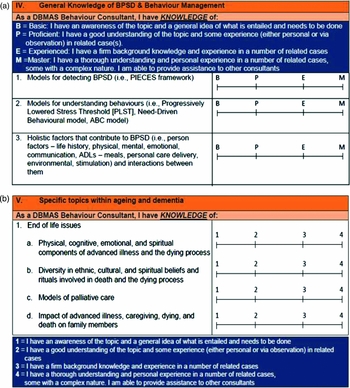
Building on the Pikes Peak model, in Step 2, we developed Version 1 of the KASA while considering the specific knowledge and skills required for the role of the Behaviour Consultants working in the DBMAS service, as outlined in DBMAS operational guidelines. This initial draft of the tool had a number of specific characteristics that remained fairly constant throughout the different versions (see Figure 2a):
(a) An example of the first draft of the KASA. (b) An Example of the pilot study draft of the KASA.

-
1. Seven general categories of skills and knowledge areas were identified, and further sub-divided into 6 areas of knowledge and 12 areas of practical skills;
-
2. Acknowledging that clinical knowledge is constantly evolving, it was considered appropriate that the level of skills and knowledge would be rated along a continuum, divided into the four main anchor points;
-
3. The four anchor points were defined as Basic, Proficient, Experienced, and Master level of skills and knowledge; and,
-
4. A Plan of Action was included at the end of the tool, to enable Behaviour Consultants to make a personalized plan on how to best improve, develop, or update specific skills and knowledge areas of their choice.
Step 3
Most of the feedback from 13 Behaviour Consultants and 5 Team Managers was incorporated in the KASA, which included:
-
1. Changes to the introduction, including adding a section emphasizing the philosophy behind DBMAS, additional guidance on how to best self-reflect on level of skills and knowledge, and adding a visual flow-chart on the process to aid clarity;
-
2. Incorporating a third-person rating system to encourage objectivity, defining who would be best considered a third person (i.e. peer or mentor), and outlining the benefits of reviewing the ratings with a third person;
-
3. A clearer outline of the goals and potential uses for the tool;
-
4. A change of the anchor points (i.e. Basic, Proficient, Experienced, Master), to numbers only (i.e. Level 1, Level 2, Level 3, Level 4);
-
5. Additional sub-areas of skills and knowledge that were initially missed, and/or removing areas which were repetitive; and,
-
6. Incorporating a less prescriptive Plan of Action at the end of the tool.
Step 4
The feedback obtained from the pre-pilot review with three Behaviour Consultants referred to specific items within the draft KASA, which were perceived as too broad or Behaviour Consultants thought an aspect within some areas was missing. Three items were consequently broken down in sub-items for more clarity, and six items were added to expand the knowledge and skill areas relevant to the DBMAS Consultant role. One item was considered as duplicating another item and was, therefore, omitted. This feedback was incorporated in Version 7 of the KASA.
Step 5
Feedback from the discussion about the KASA with DBMAS Team Leaders and Behaviour Consultant representatives included a focus on the self-reporting and self-reflective aspects of the tool, among other formative feedback on presentation style. These ideas were incorporated into the KASA, and served to validate whether KASA reflected accurately the knowledge and skills needed for the role of a DBMAS Behaviour Consultant. The discussions provided a support for KASA's content validity; overall, DBMAS Team Leaders and Behaviour Consultant representatives were in agreement and satisfied that the specific knowledge and skill areas included in the tool represent a valid representation of the knowledge and skills needed for working in the DBMAS service.
Step 6
Step 6 involved trialing the final version of the KASA tool (see Figure 2b) by piloting it by 14 Behaviour Consultants, whose characteristics and results are presented below.
Sample characteristics
Participants’ ages ranged from 26 to 62 years (M = 45.7 years). All participants were Caucasian. Eleven participants were employed at DBMAS full-time at the time of completing the KASA and three were employed on a part-time basis. The length of time working at DBMAS ranged from 8 months to nearly 8 years (M = 37 months), while the length of time working in any aged-care setting ranged from 8 months to 32 years (M = 13.1 years). The KASA was sent to three Behaviour Consultants in each state and territory (24 in total). Responses were obtained from 14 Behaviour Consultants, including 5 registered nurses, 4 occupational therapists, 3 psychologists, 1 diversional therapist, and 1 educational administrator.
Ratings
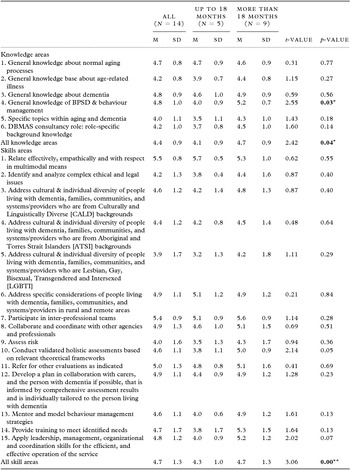
Table 1 presents average Behaviour Consultants’ ratings across specific knowledge and skills areas. On average, Behaviour Consultants rated their overall DBMAS-related knowledge between Levels 2 and 3 (M = 4.4). Within specific knowledge areas, the highest rated were the “General knowledge about dementia” and “General knowledge of BPSD & behaviour management” areas (M = 4.8 for both).The lowest rated area was the “Specific topics within ageing and dementia” (M = 4.0). For overall practical skills, Behaviour Consultants rated themselves between Levels 2 and 3 (M = 4.7). The highest rated skill areas were “Relate effectively, empathically, and with respect in multimodal means” (M = 5.5) and “Participate in inter-professional teams” (M = 5.4). As such, Behaviour Consultants rated themselves between Levels 3 and 4 in these domains. The lowest rated skills areas were “Address cultural & individual diversity of people living with dementia, families, communities, and systems/providers who are Lesbian, Gay, Bisexual, Transgendered, and Intersexed [LGBTI]” (M = 3.9) and “Assess risk” (M = 4.0).
Two sample t-test for comparison of DBMAS Behaviour Consultants’ ratings across knowledge and skills areas by time of working at DBMAS

**p = 0.05; *p = 0.01.
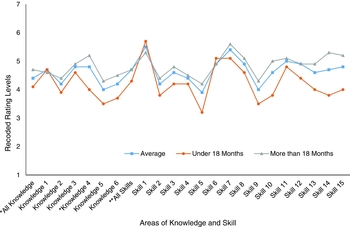
The results based on the comparison between rating of Behaviour Consultants who worked up to 18 months and of those who worked more than 18 months at DBMAS provided an indication of construct validity of KASA (see Figure 3). Compared to less experienced Behaviour Consultants, more experienced Behaviour Consultants rated themselves higher on average across all knowledge areas (M = 4.7 and 4.1, respectively, p < 0.05) and all skills areas (M = 5.2 and 4.0, respectively, p < 0.01). Within specific knowledge areas, longer-serving Behaviour Consultants had higher ratings than shorter-serving Behaviour Consultants in the “General knowledge of BPSD & behaviour management” area (M = 4.7 and 4.1, respectively, p < 0.05). Additionally, within specific skills areas, the two groups differed in the “Conduct validated holistic assessments based on relevant theoretical frameworks” (M = 5.0 and 3.8, respectively, p = 0.05) and “Apply leadership, management, organisational and coordination skills for the efficient and effective operation of the service” areas (M = 5.2 and 4.0, respectively, p = 0.07).
Mean ratings for all DBMAS behaviour consultants by areas of knowledge and skill, and by the length of time working at DBMAS (up to 18 months & over 18 months).

Discussion
The KASA was developed to guide DBMAS Behaviour Consultants to self-reflect and further develop their clinical knowledge and skills. By including four levels of competency in dementia care, across a range of general and specific knowledge and skills areas, the KASA can serve DBMAS professionals at all levels of experience and expertise. It can be used as a guide in professional development, clinical supervision, and/or annual appraisal/review.
Strengths and benefits
The step-by-step iterative process of development of the KASA resulted in progressive improvement of the tool, by building upon Behaviour Consultants’ and Team Leaders’ feedback. For example, the Plan of Action was added to address the Behaviour Consultants’ feedback that the tool would also help them to improve the knowledge and skills areas where they would rate themselves as less skilled. Adding a Plan of Action is in line with the Experiential Learning Theory (Kolb et al., Reference Kolb, Boyatzis and Mainemelis2001), which proposes that the process of knowledge creation occurs through transformation of previous experience.
Also in line with Experiential Learning Theory, Behaviour Consultants appear to go through a four-stage learning cycle. Through their work at DBMAS, a Behaviour Consultant first acquires concrete experience around dementia care. This forms the basis for their self-assessment and reflections (as they complete the KASA), which is then further assimilated into abstract concepts (i.e. identification of areas where further development might be required). Finally, these concepts (areas of knowledge and skills) can be actively tested and guide consultants in their professional development and further learning about the selected areas. Understanding the process of knowledge creation and improvement is important because educating health professionals improves professional practice and healthcare outcomes for patients (Forsetlund et al., Reference Forsetlund2009). Therefore, the use of the KASA by professional care staff working in geriatric practice might potentially improve professional knowledge and skills in dementia care as a whole.
Further, Behaviour Consultants’ concerns about using the tool for performance review were addressed so that the personal ownership and non-judgmental nature of the tool (opposed to a more evaluative nature) was reflected wherever possible. For instance, “Managers” were excluded as a possible third person that could assist the consultant in reflecting upon their ratings and Plan of Action, to avoid the fear of being negatively appraised. Strengthening the sense of ownership and self-reflectiveness as the primary approach with the KASA (while reflection on one's knowledge and skills with a third person is only proposed after self-assessment) fits within the agentic perspective of Bandura's Social Cognitive Theory (Reference Bandura2001). According to the human agency aspect of SCT, people set personal goals and motivate themselves by exercising self-direction and self-regulatory capacities which enable them to self-develop and adapt in their chosen direction. By ensuring the KASA is perceived as a non-judgmental, self-reflective, and self-reactive tool, it is hoped that completion of the KASA will result in more effective outcomes (in line with the person’ Plan of Action).
The KASA is unique among existing assessment tools in dementia care (Knight et al., Reference Knight, Karel, Hinrichsen, Qualls and Duffy2009) in that it is aimed at self-appraisal of dementia care practitioner's knowledge and skills, to support their work so that they are able to provide high-quality person-centered care. While the existing literature reports several tools for evaluating the provision of person-centered care (see Edvardsson and Innes, Reference Edvardsson and Innes2010 for an overview of published tools), the tools to support professionals of different disciplines are practically absent. Specifically, the KASA includes an assessment of both, knowledge and practical skills required for working in DBMAS service, while in other similar tools that include scales measuring staff attitudes and knowledge (e.g. the Tool for Understanding Residents’ Needs as Individual Persons; Edvardsson et al., Reference Edvardsson, Fetherstonhaugh and Nay2011), a measure of specifically staff skills is absent. Thus, the KASA adds to the tools that dementia care staff can use to comprehensively self-asses both knowledge and skills, and, therefore, support and guide their professional development with respect to provision of care to people with dementia.
In addition, while existing tools are typically focused on a specific professional discipline (e.g. nurses or psychologists; Karel et al., Reference Karel, Emery and Molinari2010), and on implementation of clinical interventions (e.g. Edvardsson et al., Reference Edvardsson, Fetherstonhaugh and Nay2011), the KASA is tailored to the multidisciplinary and advisory role of DBMAS consultants. The capacity for multidisciplinary work in dementia care is important because strategies to improve well-being and care for people with dementia are often multifaceted and require knowledge from various disciplines. Ultimately, given that the care of persons with dementia is enhanced strongly via capacity building of care providers in various settings, the ability to advise to and work with care providers in the community as well as within institutions from a range of disciplines is likely to impact the outcomes regarding quality of life for the person with dementia.
Utility
Appraisal of the KASA by DBMAS Team Leaders and Behaviour Consultant representatives provided satisfactory content validity of the tool. They considered it relevant and appropriate for assessment of knowledge and skills required for working in DBMAS service. In addition, the KASA pilot showed that the tool was positively accepted by Behaviour Consultants and was able to be completed, with no assistance from the research team, in a reasonable amount of time, despite having a comprehensive list of knowledge and skill areas. Each participant was asked to report the exact time of completing the KASA, which ranged from 1.5 hours to 5 hours (M = 159 min, SD = 71.6 min, 3 participants did not provide this information). The pilot also showed a variability of ratings across different knowledge and skill areas, implying that the KASA was able to distinguish between consultants with different levels of experience and knowledge. The differences in ratings between participants who worked at DBMAS service up to 18 months and those who worked at the service for more than 18 months support the value of experience in self-assessment of knowledge and skill areas, and, therefore, provide an indication of the construct validity of KASA
Furthermore, the results indicated the areas in which Behaviour Consultants were the least confident, including dealing with people who are LGBTI and assessing risk in people with dementia. By examining the lowest rated areas by the care professionals of a specific care team, the KASA has the potential to serve as an indicator of the teams’ training needs, and to further develop and improve these areas.
Limitations and need for future work
A few limitations need to be considered. First, the KASA does not provide an objective measure of one's knowledge and skill areas in dementia care. Rather, it is a self-report measure that assesses subjective evaluation of one's competencies. However, person's subjective assessment of their professional competencies can influence the person's interactions with a person with dementia, as well as their satisfaction in the role.
Second, the sample of Behaviour Consultants in the pilot study was very diverse, and included consultants from a range of professional backgrounds and length of experience working in the DBMAS service and aged-care overall. Due to the small sample size, comparison of the ratings across different professionals was not possible. Therefore, it would be useful for future research to collect ratings on areas included in the KASA on a larger sample, to examine the potential influence of professional background and other relevant variable (i.e. attendance at aged-care training programs) on the validity of the tool, to assure that it is equally effective across disciplines.
In addition, due to the small sample size, the current pilot study does not allow for calculation of the psychometric characteristics of the measure. Although the observed differences in the ratings between Behaviour Consultants who differed in the length of working in DBMAS service imply the ability of KASA to detect differences in the level of knowledge and skills, and by that an indication of construct validity, further studies are needed to examine the criterion related validity (e.g. by comparing KASA with other measures used in dementia care), and also the reliability of the tool (e.g. by examining internal consistency of the items on a larger sample).
Future directions
Throughout the development of KASA, it was hoped that the tool could potentially be used by other clinical services that provide support to people with dementia and their carers. It was also anticipated that the current version would be further developed over time, following its implementation and after incorporating feedback from the DBMAS consultants who use it, as well as other professionals working in dementia care. While the KASA offers an example to other similar services to develop their own “KASAs,” the version presented in the current paper was designed specifically to be tailored to the unique role of Behaviour Consultants working in the DBMAS program. It is anticipated, though, that KASA will be adopted for use in other roles comparable to DBMAS consultants, professional teams, and clinical services in Australia and also more internationally in the future.
Recently, the KASA has been converted into an online tool to increase its user-friendliness and also enable collection of data across time to monitor individuals’ and/or teams’ progress. Case vignettes for each specific level of knowledge and skills were added to the online tool, to enable Behaviour Consultants applying their knowledge and skills in hypothetical scenarios and reflect on their responses. Collection of data from a larger number of Behaviour Consultants (from various states and territories in Australia), and also from other comparable professional roles (outside of Australia) over time will enable the exploration of potential differences in knowledge and skills across different disciplines, and identify areas for future development, and areas of strength within teams.
Understanding the professional needs of Behaviour Consultants has the potential to inform the development of educational and training programs in dementia care overall. The unique value of KASA is that while the current version is tailored to the role of DBMAS Behaviour Consultants, the tool can equally be adjusted to any other role or professionals working in dementia care, by selecting and adjusting the items within knowledge and skill areas that are relevant to the specific characteristics of the targeted position or role. This can apply to staff working in services both within the Australian context and also internationally. By supporting care staff in their professional development, we are ensuring that these professionals are well equipped to support the needs of people with dementia and their carers.
Conclusion
The KASA will assist Behaviour Consultants, their Supervisors, and Team Leaders by providing them with a self-assessment tool of knowledge and skills needed to operate effectively as a Behaviour Consultant in the service. The feedback obtained from Behaviour Consultants from completion of the online version of the KASA will provide valuable information for further development of the tool and inform professional development and training needs. The KASA is an evolving tool and has a potential to be adopted for use in other services and for roles comparable to DBMAS consultants in dementia care.
Conflict of interest
None.
Description of authors’ roles
All authors were involved in preliminary outlines of the nature and purposes of the KASA tool; U.A. and S.R. coordinated data collection, analyzed the data and wrote the first draft of the manuscript; N.P. and J.J. commented on subsequent drafts of the manuscript.
Acknowledgments
The authors would like to thank the participating Behaviour Consultants and the DBMAS team leader, Heather Campbell. This tool is the result of their commitment to dementia care and work supported by the Alzheimer's Australia Queensland, as part of the Competency Framework Initiative.
Supplementary Material
To view supplementary material for this article, please visit http://dx.doi.org/10.1017/S1041610215002070