Introduction
Until recently Dutch historiography of the Second World War focused on subjects typical for this period: repression, resistance, the Hunger Winter of 1944–5 and, above all, the Holocaust. If anything was written about the economy, it was about exploitation resulting in impoverishment and hunger.Footnote 1 Industrial companies were closed, raw material and machinery were taken, labourers were forced to work in Germany, and from what was produced there was barely enough left over to survive. The Germans left an impoverished country, a starving population and a smashed economy; in 1945 a Dutch official reported in the New York Times: ‘If I had to describe Holland as it is today in a phrase, I would say that it is empty. There is almost nothing left.’Footnote 2
However, new calculations of macroeconomic statistics for the period 1938–48 indicate that industrial production did not in fact decline until after the end of 1941, and that the first one and a half years of the occupation were the best in a decade.Footnote 3 Between 1938 and 1941, in industry alone 131,000 new full-time jobs (i.e. working 48 hours a week, 50 weeks of the year) were created. When including employment growth in the agriculture and services industry, and the recovery of cross-border work, dependent employment grew by 24 per cent, from 1,614,000 to 1,997,000 full-time jobs.Footnote 4 In December 1940 Arthur Seyss-Inquart, Reich Commissioner for the Occupied Netherlands, boasted in the Völkischer Beobachter (the most prominent newspaper of Nazi Germany) that he had achieved within a few months what the pre-war Dutch government had not managed to achieve since the late 1920s – that is, he had solved the unemployment problem.Footnote 5 After the war the remarks of Seyss-Inquart were soon forgotten. Historians probably considered them to be propaganda, especially because in 1947 the CBS (the Dutch National Statistical Office) reported that the Germans had ‘solved’ the unemployment problem by deporting labour.Footnote 6 In fact, of the 393,000 new jobs realised between 1938 and 1941 only 126,000 (one third) were located in Germany, and half of them were in normal cross-border labour. In 1931, two years before Hitler came to power, the Reichsmark (RM) became inconvertible, and wages earned in Germany could no longer be converted into guilders. As a result, cross-border work disappeared. However, in May 1940, when the monetary problems were resolved at the expense of the Dutch treasury, 60,000 Dutch workers living near the German border accepted jobs in that country again. It was not even necessary to use pressure; there were vacancies in Germany and, moreover, legal border crossing made it possible to participate in lucrative smuggling transactions. Nevertheless, jobs were probably the most important motivation, because in 1940 as well as in 1941 another 60,000 labourers from all over the Netherlands settled in Germany. Although some pressure was used, in this period most of them went of their own free will.
This article addresses the central question of how the Dutch economy, and especially industry, developed during the German occupation of 1940–5, especially during the first years of the occupation. The development of employment suggests that economic decline and exploitation is not the only story to be told about the economy in those years. Nevertheless, in Dutch popular publications, and in international literature, the opinion still persists that during the occupation the economies of occupied western Europe slumped. For instance, Adam Tooze recently wrote in his already famous The Wages of Destruction that in ‘Belgium, the Netherlands and above all France, . . . economic activity collapsed in 1940, never to recover’, while Götz Aly thought that everything had been said when he wrote about what was taken from these countries.Footnote 7 Another problem is, therefore, how to explain the positive elements in economic development in that period, and how it is possible that in popular memory and historiography it took more than fifty years before the traditional depiction of decline and exploitation as the sole elements of wartime economic development were even questioned. We start by addressing the last question.
Historiography
In 1945, when a Dutch official stated that ‘there is almost nothing left’, he was not alone with that impression.Footnote 8 People all over Europe had this impression and the post-war situation is still remembered as being so, even in the western part of the continent where this was simply not the case. In the period immediately after the liberation, when everybody was still traumatised by the suffering they had survived and refused to recognise any positive developments during the German years of war and occupation, Dutch war damage was estimated to be somewhere between 2.5 and 4.2 times the pre-war gross domestic product (GDP).Footnote 9 Clearly it was not only feelings that gave rise to this impression. All over Europe individuals, companies and governments had good reason to draw attention to the losses and to conceal the profitable business done in the preceding years. In 1945 European governments, confronted with almost unsolvable problems, showed the outside world a destroyed country, a ruined economy and starving people in the hope of compassion and US aid, or at least compensation from Germany. For instance, the Dutch government considered that the pictures in the Allied press of healthy Dutch girls celebrating VE day with American and British soldiers gave a wrong signal, and released photographs of starving children and elderly people, showing them in the most terrible circumstances.Footnote 10 Even in 1948, when new statistics showed that the situation was not as bad as feared, the minister of economics prohibited the publication of these macroeconomic data, lest it undermine his position in the ongoing negotiations for Marshall Aid.Footnote 11
The public also exaggerated the situation. To gain compensation, to evade capital gains tax or other taxation introduced after 1945 all over Europe and for reasons of prestige, people presented themselves as victims, overstating their material losses, while profits – even when legitimately acquired – were hidden. Even in 2003, when I explained in a popular history magazine that for farmers the war years were financially not too bad, and that the Hunger Winter of 1944 was for many even a highly profitable time, I received a furious letter from a farmer's daughter. Even though I had made it clear that the fact that all the farmers together had earned good money did not mean that every individual farmer was a profiteer, she still thought I had calumnied her father.Footnote 12 Twenty years earlier, when Dr Gerard M. T. Trienekens (a Utrecht historian) demonstrated that the food situation in the occupied country was relatively good until September 1944, those of the war generation quickly rounded on him: ‘A man of his age cannot know anything about the war,’ was one of the more generous responses. Others placed this scrupulous historian in a similar category to Holocaust deniers, and the house of his cousin (who had exactly the same name) was plastered with swastikas and SS symbols.Footnote 13
In former occupied countries (and nowadays even in Germany in view of the publications on the suffering caused by the Allied bombing and by Soviet soldiers who raped indiscriminately, as well as the misery of post-war refugeesFootnote 14), the public expects that historians writing about the war will emphasise that they were victims. The fact is that most people (even most of the Germans) were victims, but the demand that this should be emphasised is not entirely unselfish. Although it is possible that a person can be guilty and a victim at the same time, there is a widespread misunderstanding that victims are not guilty. Therefore, self-victimisation is a way of dealing with feelings of guilt towards the real victims – in the first place the Jewish population – by a majority that simply tried to survive with a minimum of personal harm. Nevertheless, most people were victims and it is useless to accuse them for what they did or did not do. Heroism is an individual virtue.
In addition to self-victimisation is the phenomenon that everyone who was not a victim (for instance because he earned good money) is accused of collaboration and is thus at least morally condemned. Someone must be guilty, and the public is eager to point a finger at anyone whose wartime behaviour is ambiguous. Professional historians, giving way to these public demands and making moral verdicts, often take the easy way out. By checking how one behaved at critical moments, what relation one had to the resistance, how long one clung to an honourable – although in wartime ambivalent – pre-war position as an official, burgomaster or director, or what money one made, the verdict is clear. The case can be closed. Analysing and understanding one's behaviour no longer seems important.Footnote 15
Although in the first years after the war some attempts were made to realise a Europe-wide history of war and occupation, or at least to compare national histories, in most countries the history of the Second World War became a field for a national, patriotic history and disintegrated into a number of stories about great patriotic wars. Comparison with neighbouring countries which had similar experiences is rare.Footnote 16 A comparison of the developments during the occupation period between, for instance, the Netherlands and Belgium would seem obvious but has never been written. A first attempt to compare some aspects of Dutch occupation history with that of Denmark has only recently been published.Footnote 17 Apart from that, in all former occupied countries the occupation is seen as a special period, demanding a special historiography. In the Netherlands, one historian, Dr L. de Jong, dominated this historiography, at least until the mid-1980s. He described the occupation as an isolated part of Dutch history, almost as a German (i.e. at least an un-Dutch) period on Dutch territory. The questions he and many others asked about these years were more moralistic than any professional historian would ever ask about any other period. A central issue was whether the persons involved were ‘good’ or ‘bad’. Even more important, however, was that De Jong gave in to the semi-conscious need of the public to be recognised as victims and, by moralising about burgomasters and managers and so on, to their need to blame someone else. His books became very popular because he wrote what everybody wanted to hear about the war! Consequently, the historiography of the occupation focused on aspects in which this period differed from any other period– that is, on suppression, resistance, treason, the persecution of Jews, slave labour, going into hiding, plundering and warfare.Footnote 18 In fact, most people got on with their lives, carried on with their business, married, had children, went to school, to church, to the cinema and on holiday; they ate, drank, made love, quarrelled, were ill and in due course died, most of the time in bed just as in any other period.Footnote 19 The fact that most people continued with their normal life is not documented in traditional historiography. Consequently, the economic history of the war has always been the story of how Germany invaded a well-organised, wealthy country, plundered and destroyed it, and left it empty, half flooded and with a starving population.Footnote 20 Just over fifteen years ago a highly regarded, well-informed Anglo-Dutch economic historian wrote:
German war aims in the Netherlands had started by encouraging a social revolution directed at the eventual assimilation of the racially superior Dutch into the Third Reich and had ended in a food blockade aimed against the major part of the population and the widespread pillage of industrial plant, transport equipment and stocks of consumer goods. In the process, levels of economic activity declined, living standards plummeted and there was a considerable net disinvestment of capital.Footnote 21
This impression was formed directly after the war, and during the occupation it could also be found in the underground press or on the British radio. The traditional picture of the economy during the occupation not only matched with the idea that most people were victims, but also with the Allied propaganda. Just as during the war, when the London radio and illegal press were thought to be the only sources of reliable information, many people (even historians) even now implicitly think that Allied propaganda or illegal newspapers were more reliable than German propaganda or official papers. In any case, no one is interested in debunking stories told by parents and grandparents, especially when this could undermine their moral position.Footnote 22 Until recently, writing a scientific, less than patriotic, history of the war resulted in unfriendly, sometimes even aggressive, reactions. Nevertheless, in the 1980s some Dutch historians started to focus on other aspects of those years. The first to formulate critical remarks on traditional historiography, Hans Blom, wanted to place the occupation in the continuity of Dutch history. He wanted a less moralistic historiography and more attention paid to the 80 or 90 per cent of the people who were not persecuted and were not traitors or resistance fighters, but went on with their normal life. He considered that new questions should be asked, which were in fact the same, normal questions as asked about any other period, including those about economic growth, industrial development, innovation, welfare and so on.Footnote 23 In that same decade Trienekens published his history on food distribution,Footnote 24 but it was only in the 1990s and the first years of the twenty-first century that the economic history of the occupation was entirely revised.Footnote 25 A new generation reconsidered the impression of destruction that had been given over and over again. In 1999 one of them wrote that much of what was always told was ‘a myth, a carefully cherished story’,Footnote 26 not a misinterpretation. Even those who knew that it was not true felt at home with this; it created a moral way out.
Dutch industrial production
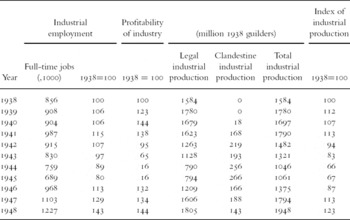
By June 1940 all the continental enemies of Germany had been defeated, while Britain was saved because of poor German preparation. Nonetheless, it seemed impossible that Britain's armies could ever re-enter the continent on their own.Footnote 27 Hitler had won the war, and the most prominent Dutch politician of the inter-war period, the five-times prime minister Dr H. Colijn, rightly stated that every Dutchman should realise that Germany would decide the fate of the Dutch.Footnote 28 This situation only changed when Hitler and his allies (without any co-ordination) started new wars against the major powers of the world – the Soviet Union and the United States. In June 1940 nobody in western Europe could foresee that Hitler would thus undermine his previous victories. According to some modern historians, even after these ill-fated initiatives, it took another two years before it became obvious that the Allies would win. Others think that from US entry into the war in December 1941, the economic strength of the Allies was so superior that Germany's fate was as good as sealed.Footnote 29 Nonetheless, in summer 1940 the future of continental Europe seemed to be in the hands of the Reich. Under these circumstances it was not too difficult to find adventurous young men in the occupied countries who were ready to ‘back the German horse’ and accept employment in that country. In fact, when unemployment rose again in June 1940 (after a decade of economic depression and a lost war), the unemployed began queuing for jobs in Germany.Footnote 30 The misery resulting from unemployment was still only too familiar. In the end, however, the economic situation in 1940 proved not to be as depressing as people had assumed. Before August, industrial employment grew again to reach an all-time peak in 1941 (15 per cent above the 1938 level), while industrial profitability peaked in 1940 as it had not done since the late 1920s, at 44 per cent above the level of 1938 (see Table 1). Notwithstanding military defeat, in 1940 many companies paid higher dividends to their shareholders.Footnote 31 In 1941 profits were slightly down, but were still much higher than at any time since 1929, and were 38 per cent above the 1938 level.
Dutch industrial development, 1938–1948

Source: Hein A. M. Klemann, Nederland 1938–1948. Economie en samenleving in jaren van oorlog en bezetting (Amsterdam: Boom, 2002).
Once it had become obvious that there was something wrong with Dutch wartime macroeconomic statistics, they had to be recalculated; moreover, there are reasons to believe that the same applies to all of western Europe.Footnote 32 During the occupation the public did not trust government organisations and only reluctantly gave information to institutes such as the CBS. Even before the liberation the Dutch economic department concluded that the CBS lacked adequate information to produce reliable statistics.Footnote 33 Therefore the analysis of the wartime industrial development in the present paper is based on these newly calculated statistics, reconstructed without using any wartime CBS data. The new calculations are based on the fact that production equals the sum of labour and capital incomes before taxation. Social security statistics provided information about the number of employees and the sum of wages paid in each of the thirteen sectors of Dutch industry. Consequently the calculations can be slightly too low, but can only be too high if employers paid more in social security than they were obliged to. Furthermore, the profitability of each industrial sector was reconstructed from profits, reserves and depreciations from the annual reports of several hundred companies spread over all branches of industry. For each company the data were standardised and, from the outcomes, average profitability per sector was calculated. As the Netherlands had no taxation on profits before the war, Dutch companies had no reason to hide them. Therefore it is unlikely that pre-war data about profitability are too low, but it is possible that from 1940 onwards, when such taxes were introduced, companies tried to conceal some returns to avoid paying taxes. Consequently the estimate is also more likely to be too low than too high. To link the series of the development of capital and wage incomes, pre-war CBS data on the 1938 share of wages and capital incomes in each industrial sector were used, and real production was computed with a newly calculated Paasche price index.Footnote 34
However, all these calculations could not resolve the problem that official statistics (whether from the CBS, from social security or from annual reports) never included black-market transactions, while production for that particular market was of increasing importance. Even if all data had been reliable, the macroeconomic figures of that period would be too low because they did not include clandestine production, and the indicated decline would also be too dramatic because it included the transfer of production to black markets, while post-war growth would appear too high because official statistics after the war reflected a mix of real growth and the registration of (up until recent years) unregistered production. This is not a typically Dutch problem, but was replicated all over Europe. During the war in France, Belgium or Denmark, and just after the war in Germany, black markets flourished. In fact, until 1944 black-market production was probably relatively limited in the Netherlands. Black marketing more or less slowly disappeared only after 1945, or in Germany after 1948.Footnote 35 When Eichengreen called German economic growth in 1948 after the introduction of the Deutschmark ‘nothing short of miraculous’ (according to official statistics, industrial production grew by 50 per cent in six months), it is clear that, apart from some growth, these series reflect the recovery of normality and the legalisation of previously clandestine production.Footnote 36 Consequently, official production figures without taking account of black-market production give the false impression that the economy slumped even more dramatically than it actually did during wartime, and grew miraculously after the liberation, especially after liberation from wartime regulations. This false impression can be found all over Europe.
To make a cautious, and therefore probably too conservative, estimate of Dutch clandestine industrial production, information was gathered from diverse sources for each sector around 1942 and 1943. These years were selected because they came after the first unsteady years of the occupation and before the Third Reich fell apart and crushed in its fall organised society all over continental Europe. As a cautious guess, in branches using locally produced raw materials (mining, food processing, shoemaking, some parts of textiles and wood processing) at least 15 per cent of the total production was for the black market. In branches processing raw materials from elsewhere (where it was easier to control production) 10 per cent seems to be a cautious estimate. Before the war there was no reason for any clandestine production; with the exception of the alcohol and cigar industries there was no taxation or regulation to make that interesting. The way in which black markets developed in general during the war could be reconstructed in agriculture, where a system existed before the war that allowed the calculation, at least of important parts of production, independently in two different ways.Footnote 37 Thus, by taking into account the way in which the black market developed in general, the level of the market in each industrial sector in 1942 and 1943, and the fluctuation between the sectors, it is possible to make a reasonable estimate of the development of clandestine industrial production and to reconstruct a more reliable, but probably rather low, index of industrial production (and even of the GDP) including black market production.Footnote 38 The outcome gives a different impression from that derived from economic development based on the old CBS series. Production did not collapse but initially even boomed, and it only started to give way from the last months of 1941 onwards. The economic decline during the whole occupation period – that is, the decline in national income (according to the CBS almost 50 per cent in 1944 and 1945) – was according to these later calculations less than 20 per cent, while the decline in industrial production (according to the CBS 64 per cent in 1944 and 73 per cent in 1945) was in fact only 34 per cent.Footnote 39 Inevitably, this conclusion raises the question: what is the explanation for this relatively positive industrial development?
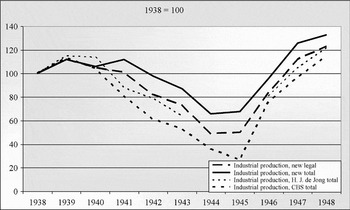
Although in 1940 industrial employment and profitability grew, production declined as a result of uncertainty and the dismantling of production for the Dutch army directly after the May 1940 invasion.Footnote 40 Before the end of 1940, however, business recovered, but during this year an increasing part of production was already being kept out of the books. New regulations and taxation, resulting in the freezing of prices, the limitation of transactions and – for the first time in Dutch history – taxation of profits were reasons to sell an increasing part on the black market. That these regulatory measures were often seen as inimical interference with Dutch society gave black marketing a moral justification or, as the daughter of a black-market trader wrote in her diary, ‘Illegal butchering, that is in fact sabotage. You are keeping meat out of the hands of the Wehrmacht.’ After this she explained how profitable it was and it becomes clear that this was the real source of her motivation.Footnote 41Figure 1 shows that the peak in legal industrial production occurred in 1939, but that until 1941 the decline was limited, in fact so limited that production for the black market compensated for it completely. Total industrial production only peaked in 1941. From then on a discrepancy developed between legal and total industrial production, only to disappear slowly after the war. This took so much time because it was not the ‘military liberation’, but the liberation of markets from wartime regulations that made black marketeering less interesting. That such clandestine activities continued after the liberation shows that one should be sceptical about patriotic arguments for it; most of the time profits were the real motive.
Industrial production in 1938 guilders (million), 1938–1948.

In Figure 2 the newly calculated industrial production series is compared with the CBS index calculated in 1947 (completed for post-war years from later CBS statistics) and the 1999 series of H. J. de Jong.Footnote 42 According to this series (based on never previously used CBS production statistics for an important number of industrial branches), the production level is comparable to the new index of legal industrial production.Footnote 43 It shows that the new calculations give a good indication of legal production, but as the de Jong series does not include the black market his results are lower than the newly calculated total production series. De Jong could not include clandestine production because his data came from official sources. Therefore, from 1941 on, total production is higher. Although the de Jong series (like the newly calculated legal production series or the old 1947 CBS series) does not include clandestine production, the 1947 index is far below the new ones and the differences are too large for normal statistical inaccuracy. De Jong proved that the CBS had better information than it used in 1947. This raises the unanswerable question as to whether the construction of these statistics was politically motivated. As it is unknown how the 1947 CBS statistics were calculated, the answer seems to be lost in time. It is, however, a fact that the same source suggested that the disappearance of unemployment resulted from the deportation of labour. It gives the impression that, just after the war, the CBS did everything it could to prove how severely the Dutch suffered from German exploitation. The extreme decline in industrial production – according to the CBS series, industrial production was at its lowest point in 1945, at 27 (1938=100) – gives the same impression. According to the new calculations the lowest point was 50, and including clandestine production it was 66 (1938=100).Footnote 44
Industrial production, 1938–1948 (excluding mining and building).

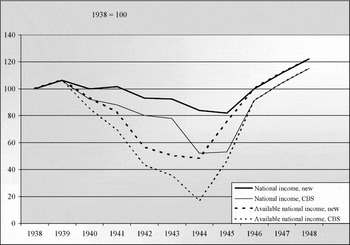
In Figure 3 the solid bold line represents the newly calculated national income, and the bold broken line the available national income after the occupier had taken his share of production without paying for it. This clearly shows that after 1943, even according to the new calculations and including clandestine production, the country survived on less than 50 per cent of what it was used to before the war. When the same calculations are made with the 1947 CBS national income series (based on the same sources as the industrial production series) – the thinner lines – in 1944 the available national income (the thin broken line) is only 17 per cent of the 1938 level. This cannot be the case. Most of the Dutch survived the war; the population actually grew. Although the calculations show that from 1942 onwards there is an undeniable economic decline, it is also clear that only to a limited extent did poverty result from declining production. Compared with 1938, total production (GDP) fell by a maximum of 14 per cent and national income by 18 per cent. This does not imply that the situation was not bad. National income was still around 80 per cent of the 1938 level even in 1944 and 1945, but more than 40 per cent of production was taken by the occupier. Extractions paid for by the Dutch treasury or by inflating the money supply were the main source of poverty. Apart from emotional and political reasons for keeping the story of wartime poverty alive, these extractions of goods and services produced by the Dutch explain the discrepancy between the high level of production and the experience of extreme poverty. That the same story can apply to, for instance, France, becomes clear from Tooze's book. According to him (and he got his information from Milward's earlier book on the French economy) until the end of 1943 the Germans took the equivalent of 30.4 billion RM out of France, while in the last year the ‘progressive disintegration of the French economy’ resulted in a decline in production by a third since 1938.Footnote 45 Actually, according to official statistics, industrial production declined by 60 per cent, while during the whole occupation period the occupier took from France the equivalent of 35.1 billion RM in goods and services, as far as these were paid for from French sources.Footnote 46 Again, this seems impossible. It would mean that the French survived on less than a third of their pre-war consumption levels. According to the specialist on French black marketeering, however, such markets developed in that country from the first day of the occupation.Footnote 47 The fact that in the Netherlands industrial production declined by only a third, and not by two thirds (and even grew in the second half of 1940 and in 1941) nevertheless needs some explanation.
National income and available national income, 1938–1948.

Industrial development 1940–1941
According to German army plans, the military would rule Belgium, the Netherlands and Luxembourg. Only after the queen fled did Hitler send a civilian, the high-ranking Nazi Arthur Seyss-Inquart, to The Hague. By then the decision to rule by Aufsichtsverwaltung, a controlling administration, had already been taken. Local officials were controlled by Germans and ordered to keep things going. In 1937 the Dutch government had decreed that in the case of an occupation, burgomasters and officials should stay at their posts in the best interests of the population. Thus the meetings of the secretaries-general – the highest civil servants of the ministries – de facto became a technocratic cabinet under Seyss-Inquart's supervision.Footnote 48 The official structure was clear. Dutch officials ruling the country were controlled by Seyss-Inquart and his staff. Officially, Hitler was Seyss-Inquart's direct superior, and the only Berlin authority who could give him orders; however, as soon as he arrived Seyss-Inquart found his authority disputed. The Wehrmacht was not happy when, three days after the Dutch capitulation, Hitler decided to send a civilian. General Alexander Freiherr von Falkenhausen (an aristocratic Prussian officer who was not a Nazi) had already received orders to rule this part of Europe. Now a party fanatic was sent, known by the Wehrmacht's economic office as a troublemaker. In Poland, where he was second in command, Governor-General Frank ruled the country as though it was a private domain. General Georg Thomas, head of the economic office of the Wehrmacht, feared that Seyss would do the same, making it impossible to exploit the highly developed Dutch economy. Therefore he sent an officer to The Hague to press Dutch industry into accepting German military orders. To strengthen his position, Thomas involved his enemy, Hermann Göring.
Göring was interested in the Netherlands – and not only for buying seventeenth-century paintings from shady sources. Therefore he made sure that he gained the right to give Seyss-Inquart instructions in economic matters.Footnote 49 Being used to the ongoing struggles in Hitler's entourage, he knew that this would result in conflict and therefore accepted Thomas’ invitation to participate in his project in The Hague. Thus, before Seyss-Inquart even arrived in the country, Thomas's officer founded a Rüstungsinspektion (armaments office) in The Hague.Footnote 50 When the Reich commissioner arrived, he found his opponents already holding office in the heart of his realm. If he accepted this situation, the economic policy would be a matter of the authorities in Berlin plundering the country that Seyss was ordered to win over for a German future. In any case Seyss-Inquart had to establish that he was number one in the Netherlands, otherwise the Reich Marshal, who had a direct line to Adolf Hitler, would walk all over him.Footnote 51
Apart from Göring's policy and the need to defend his position, Seyss-Inquart was motivated to start an economic policy of his own due to the unemployment problem. Although Hitler had already asked Göring to prepare the exploitation of occupied western Europe as early as November 1939,Footnote 52 little planning had taken place before summer 1940. Just before the capitulation of France Göring made up for his earlier inactivity by ordering the removal of all raw materials from the newly occupied countries. Göring, who was a genius with regard to power politics, knew little about economics and saw the occupied countries merely as a source of loot.Footnote 53 In June Walther Funk, de facto Göring's man, even ordered the removal of machinery from France.Footnote 54 Seyss-Inquart could not of course accept that Göring would plunder the country that he planned to lead into a Germanic Reich. Therefore, assisted by Dutch officials, he formulated arguments to defend Dutch stocks. It would not be the last time that the Dutch and Germans in The Hague co-operated to withstand demands from Berlin. Earlier, the policy adopted by Napoleon's brother Louis, King of Holland, has shown that the interests of the occupier as interpreted by the authorities in an occupied country could grow far apart from those as seen by the authorities in the victorious country. Consequently, only a few weeks after Berlin had sent Seyss-Inquart to The Hague, he was defending Dutch interests against the Reich capital. Nevertheless, in the end Dutch companies had to sell all stocks of raw materials in excess of those required for six months’ normal production.Footnote 55 The Germans paid good prices, with money taken from the Dutch treasury, but it was impossible for these stocks to be replenished.
After the first clash with Göring, the Reich Commissioner feared new and hard-to-withstand demands from Berlin if he did not find a way to make the Dutch useful for the German war effort. In The Hague, the Dutch as well as the Germans feared that Berlin would consider the level of unemployment, which grew higher than ever, to be unacceptable. As long as this remained unresolved, The Hague had no answer for Berlin's imminent demand for workers, even though Seyss knew only too well that coercing Dutch labourers to work in Germany would effectively bring his mission to an end. Because it was in his interests to create jobs, he encouraged German companies to divert orders with which they could not cope (the German economy was already overcharged) to Dutch companies with enough capacity and raw materials. Although the German historian Hans Umbreit wrote that the Nazis (after occupying western Europe) had the choice of slaughtering the cow or milking her (i.e. the occupier could plunder and destroy the economies or make the production capacity of these countries serve its war efforts), in the work of Tooze plunder and destruction appear to be the only option.Footnote 56 In fact, Seyss-Inquart made sure that at least in the Netherlands German demands, although creating monetary disaster in the long run, resulted in growth in the short term.
In August 1940 a new institute, later named the Zentralauftragstelle (ZAST – Central Office of Orders), was founded to systemise such verlagerte Aufträge, that is, transferred orders. By that time, orders worth 375 million guilders had already been transferred.Footnote 57 This showed that Seyss-Inquart had won his battle with Göring, mainly because his policy was effective. In 1940 alone, through the agency of the ZAST, orders worth 14 per cent of Dutch GDP were placed, creating the jobs of which Seyss-Inquart was so proud.Footnote 58 When in July 1940 Hitler decided to attack the USSR the following spring, Göring was forced to recognise that plundering western Europe no longer served any useful purpose. He therefore needed a method to involve the economies of western Europe in the German war effort. Seyss’ method seemed to be the most appropriate way of achieve this, since it did not require the incorporation of the economies into German economic planning; because German economic planning was far from efficient,Footnote 59 it seemed impossible to incorporate them within it. However, Verlagerte Aufträge created the opportunity of incorporating these economies without a central planning system. Göring therefore founded Zentralauftragstellen in Paris and Brussels, while Seyss's organisation became a joint venture of the two high-ranking Nazis condemned to work with each other.
An occupier can use an occupied country either by plundering its means of production and destroying its economy or by making that country's production capacity available for its own ends. By implementing the policy of transferred orders, Göring has decided to follow the second policy. Thus Seyss-Inquart could concentrate on winning the Dutch for a German future. Consequently, until the end of 1941, German exploitation of the Dutch economy was intensive but not destructive. Huge orders were given to Dutch companies and paid for from the Dutch treasury or by expanding the money supply. The resulting financial problems were transferred to the post-war future by a rationing system and price control. The German purchases, in 1940 and 1941 worth 7 and 19 per cent respectively of Dutch national income,Footnote 60 had the effect of stimulating fiscal policy and solving the problems of unemployment and pre-war poverty, but at the same time creating an unstable monetary situation.
Investments in the first years of war
In 1940 and especially 1941, growth resulted in investments. After the war, however, everybody was obsessed with damage, calculated at 4.2 times pre-war GDP.Footnote 61 New research shows, however, that at least some of these figures are unreliable. For a long time it was commonly assumed that in the last months of the occupation Germany confiscated 50,000 industrial machines and installations. Until recently these figures, published in 1947 by the Ministry of Economics, were seen as an indication of the dramatic plundering of industrial capital. Nobody realised that extent of the loss of these machines, which included such items as typewriters (2,018), sewing machines (2,375) and electric motors of unknown size (18,098),Footnote 62 although apparently impressive, was of little importance in comparison with the size of the economy.Footnote 63 For instance, the machine industry lost thirty complete factory installations, but there were 8,500 Dutch machine factories and there is no indication that those lost were the more important ones. That 0.5 per cent lost their plant while a further 2 per cent lost parts of them (although it is unclear which parts) could hardly be disastrous.
That confiscations were accentuated in the historiography is partly a consequence of the Hunger Winter of 1944–5, although one finds the same emphasis elsewhere in Europe. In September 1944 Dutch Rail went on strike in support of the British attack on Arnhem. Operation Market Garden was planned to secure a series of bridges over the key waterways, including the Rhine, but resulted in the last great Allied military disaster of the war. The failure of Operation Market Garden left large sections of the Netherlands under German occupation and from that moment onwards not only rail transport but also water traffic became almost impossible. Following the rail strike the Germans took revenge by prohibiting navigation, and boats were confiscated by the German navy. In addition there was a lack of coal and fear of air attacks, and several weeks' heavy frost resulted in the urbanised western part of the country being cut off from almost every type of supply for a period of nine months. People were starving and cold, factories closed due to lack of fuel and raw materials, and electricity, gas and water supplies broke down. Because normal society broke down, rumours became the only source of information. When the rumours circulated that the (now deeply hated) Germans were plundering the factories that were badly needed for post-war recovery, this was exactly what most people thought the enemy would do and therefore were ready to believe. And, indeed, the Hoek machine factory, a company with a 1944 balance sheet total of 4 million guilders, lost machinery and inventory worth 1.2 million guilders. It seemed to prove that ‘the Germans were taking away everything’. In fact, Hoek was simply unlucky.Footnote 64 German confiscations were limited, and were focused on those branches with high wartime investments. After the war, when the government ordered an inventory of the confiscations, Germany's wartime investment in the Dutch industry was overlooked.
While destruction was documented in every history book, investments (probably not unimportant in western Europe) were forgotten. Because of the Dutch boom of 1940–1 (a period when private companies could still buy machinery or build factories), investments were probably more important than elsewhere in occupied Europe, but the first wartime investments had little to do with orders or booming business. Just as in the First World War, the Allied blockade of Germany stimulated the production of import substitutes. One of the first Dutch investments, only a month after the German invasion, was by Gembo, a factory producing writing ink that started to produce printing ink, previously imported from Britain. In that same period the collapse of jute imports for bag-making led to investments in a paper-bag factory, while for substitution reasons the production of artificial silk and synthetic wool, chemical products based on salt (especially fertilisers), synthetic rubber, lignite, peak and earthenware were all either initiated or increased. Further, there were investments in tinned food production (imports of which were lost), and directly after the bombardment of Rotterdam the increased demand for furniture stimulated investments in this sector. Throughout the war the demand for furniture remained high in Germany on account of the destruction wrought by the Allied bombing. In the first years of the occupation Dutch industry already exported hundreds of thousands of cots and cradles; this was caused by the removal of monetary restrictions and the opening of the German market. The fact that, as a result, relations with non-occupied countries were hindered for monetary reasons (and trade with, for instance, Sweden waned) resulted in even more investments, such as in the production of matches. Further, in 1940 or 1941 the production of toothpaste, farm machinery and their spare parts, synthetic paint, carbide, beer, milk chocolate, earthenware and so on were either begun or increased in order to replace imports.
In the clothing industry investments were motivated not only by the need for import substitution but also by a rise in German orders. This was particularly the case with machine production, although the home market was also buoyant during the first years of the occupation. As in the chemical and metal industries, the growth of shipyards was almost completely driven by German military orders. From 1941 onwards German orders became the only reason for legal investments. Building, or the production of machinery, was only allowed when necessary for war production.
The Speer era
According to Adam Tooze, the character of the transformation at the top of the German war economy was different from what many historians have assumed until now. He makes it clear that it was not Albert Speer alone who was responsible for the changes. His predecessor as Reich minister of munitions, Fritz Todt, or the Reichswerke director Paul Pleiger prepared the changes that Speer later claimed as his own, while the actual policy after 1942 was for an important part at least to be carried out by men such as Air Force Marshall Milch or Gauleiter Fritz Sauckel, who was responsible for finding labour.Footnote 65 Nevertheless, when Albert Speer took over control of the German war economy in 1942 and together with Milch and others organised a Zentrale Planung (a central plan), this resulted in a new situation for the Netherlands and other occupied countries. In Germany the new policy managed to increase factory productivity and to stimulate industry to use raw materials more efficiently, although probably not as spectacularly as was thought until recently; in the occupied territories it systemised exploitation. The reason for the German change in policy was that, although the Axis powers had so far won every battle, its enemies’ potential was growing.Footnote 66 Not only had Britain refused to be cowed into submission, but in the winter of 1941–2 the Red Army (by now written off) proved capable of mounting counter-attacks and Japan's attack on Pearl Harbor had brought the United States (already the arsenal of democracy) fully into the war. From now on the economic power of the Allies was much greater than that of the Axis. It was therefore clear that Germany would have to mobilise all its resources to win the war.Footnote 67 Speer was given the responsibility of implementing economic reorganisation, elementary standardisation and efficiency programmes.Footnote 68 Speer's planning went together with a ham-fisted attempt by Sauckel to mobilise the labour capacity of the continent, now that Germany's own population was increasingly required at the front. Although Speer deprecated this policy, he had to accept Sauckel as a concession to the party. Consequently, from 1942 the western occupied countries were exploited in an increasingly destructive fashion. While the occupier was before this date satisfied with more or less substantial parts of national output without real payment (in 1941 in the Netherlands, 19 per cent), from 1942 confiscations from the declining level of production increased to 40 per cent; this decline was caused by the occupier no longer being satisfied with taking output and also laying claim to the means of production. Starting in 1942, Berlin press-ganged labour for work in Germany and applied force whenever the victims refused to co-operate.Footnote 69 In the Netherlands the Germans tried to collect several hundred thousand men. In 1942 and 1943 about 120,000 workers a year actually left for Germany.Footnote 70 Because around that time about 550,000 (25 per cent of the labour force) can no longer be found in the labour statistics, it must be assumed that another 300,000 went into hiding. In an attempt to find enough labourers to man the remaining productive sector of the economy in 1943, working hours were increased from an average of 48 hours per week to 53 hours per week. The result was a dramatic decline in productivity.Footnote 71 Apart from this destructive labour policy, the Reich took control of raw materials – and reserved most of these for military use – while throughout Europe it prohibited investments and civilian construction. In reaction to this destructive policy and the resulting impoverishment, but primarily because of the threat to almost every family posed by this labour policy, resistance grew in importance.Footnote 72 During this period many Dutch companies (especially small ones) were closed and economic activities that were deemed unnecessary were prohibited. Moreover, German committees started to check on efficiency to establish whether companies could transfer workers to Germany. In 1942 the ZAST even ordered the closure of companies that were not working for at least 50 per cent for the German war effort.Footnote 73 Now all companies were required to present a production plan which was to correspond with German industrial requirements.Footnote 74 German officials increasingly intervened in the Dutch economy. Dutch officials responded with appeals to the Reichskommissariat,Footnote 75 where they were met with sympathy by German officials who were being side-tracked themselves. Nevertheless, even during these years investments did not stop.
Investments in the later years of the war
In 1942 and 1943 about 300,000 teenage boys and young men went into hiding.Footnote 76 To help them earn some money and to prevent them from behaving irresponsibly because of boredom (putting themselves and others in danger), the resistance tried to organise work for them. This resulted in an illegal labour market.Footnote 77 Most work was found in agriculture, but all kinds of illegal shops and small factories were also started. The majority were hardly of economic relevance (hand-spinning, making tiles with Orangist texts, or sandals from straw), but some developed into a serious business. A good example was a village blacksmith working somewhere between Haarlem and Leiden who, when he could get no spare parts for American farm machinery, started to produce them himself. He solved technical problems by asking local resistance leaders to send him labourers from Amsterdam machine factories who were hiding out in the countryside. With their technical expertise this smithy developed into a farm machinery factory that still exists today.Footnote 78
From September 1943 Speer changed his policy. He was aware that in the western part of the continent the policy of enforced labour was counterproductive. It increased animosity and resulted in enormous losses of labour for the local economy, of which only a minority went to Germany. In France, with over a million people in hiding, Speer was forced to compromise and in an agreement with the Vichy-French minister Jean Bichelonne, he agreed to stop hunting workers down and instead to transfer military production back to Germany, concentrating civilian production in occupied France.Footnote 79 The Speer–Bichelonne agreement of September 1943 was also implemented in Belgium and the Netherlands, thus ending the Arbeitseinsatz in western Europe. From September 1943 onwards the Germans in the western occupied countries tried to make labour useful by placing civil orders with local industry, despite the fact that in Germany civilian production remained prohibited.Footnote 80 Objections from German businessmen that this would harm their post-war competitive strength were ignored. Consequently, in the occupied countries civil production was stimulated, resulting in new investments. In the Netherlands production started of mortar, agricultural lime, rock wool, slag wool, benzyl, dentures, wall-board, carbon paper, toys, picture frames, tools, combs, medical instruments, vitamins, cellophane and batteries.Footnote 81
Investments in wartime
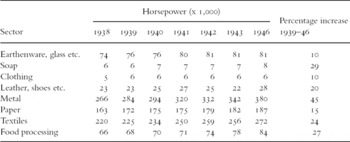
Of all the occupied west European countries, it is only possible for the Netherlands to prove that (notwithstanding destruction and confiscations) between 1939 and 1946 industrial capacity grew. Table 2 shows the machine capacity in every sector for which information is available. Capacity grew in every sector, with the exception of shoe production. As that sector did not use imported materials, clandestine production was probably extremely high. There was an important black market in skins and leather, resulting from the half a million cows and three million pigs illegally butchered between 1940 and 1945,Footnote 82 and as the sector had small economies of scale and high black-market prices it was possible for a shoemaker to increase his income by leaving the strictly controlled factories and going underground by starting an illegal workshop. Important parts of production were transferred to such shops.Footnote 83 Consequently, investments were made in them that never found their way into the statistical data.
Machine capacity in Dutch industry, 1938–1946

Sources: CBS, Jaarcijfers voor Nederland 1943–1946 (Utrecht: 1948), 166 ff.; J. L. van Zanden and R. T. Griffiths, Economische geschiedenis van Nederland in de 20e eeuw (Utrecht: Het Spectrum, 1989).
Comparing 1939 and 1946 (Table 2) gives the best impression of wartime investments. Growing mistrust in the CBS resulted in incomplete information for 1943, but it is clear that between 1943 and 1945 regulation prevented investments. Therefore after 1943 industrial capacity can hardly have grown. There was also little investment after the liberation. Machine production was limited, and the small amount of hard currency available was used to buy food and raw materials. Consequently, between 1939 and 1943 industrial machine capacity grew by about 29 per cent. Of course, investments were not limited to horsepower, but it is the only indication there is of the size of investments in any occupied country during the war.Footnote 84 The greatest increase in horsepower – 43 per cent – is found in metals, suggesting that most investments resulted from the adaptation of industry to German needs. After the war this was a good reason to forget about it as quickly as possible.
In western Europe the damage caused to the economy by the German occupation remained limited, and in the Netherlands industrial investment was the more important development during the wartime period. Of course some companies did suffer severely, but in most cases war damage was limited to delays in repairs and replacements, and the complete loss of stocks of raw materials. That the Netherlands was not unique in this respect becomes clear from a French example. In that country, where very little quantitative economic historical research about this period has been done, and where black markets were extensive, it is difficult to establish how severe the situation really was. Nevertheless, as early as January 1946 it became clear that the economic damage caused by the Germans was not as great as was originally thought, when bankers and industrial leaders said that ‘the French industry [was] about 80 per cent intact, despite war damage, bombing, and confiscation of machinery by the Germans’.Footnote 85 The Dutch case shows that it is important to ask which 80 per cent of which industry remained intact – the 1939 or the early 1944 industry – and, critically, what level of investment was made in between. That it will be difficult to find the answers is clear from the fact that in France (according to recent research) as much as 15 per cent of German purchases were made on the black markets.Footnote 86 Major parts of wartime production were never registered. Nevertheless, a year after the liberation it was clear that in the largest occupied west European country, the material damage to industry was much smaller than had been thought directly after the liberation, and that lack of fuels and raw materials were the main problems encountered by French businesses. When a Dutch official said the country was ‘empty’, he was right in that it lacked fuel and raw materials, the population was cold and hungry and industrial production had broken down, but industry and agriculture were not severely damaged.Footnote 87
In 1945 the war damage in western Europe was not primarily physical. Industrial capacity was still there, and all over western Europe industry could start production again when the raw materials became available. However, in order to obtain these and to restart production, two enormous problems needed to be solved. First, there was the currency problem: to get raw materials these countries needed hard currency, and this they could only acquire through export sales. However, countries that could pay in hard currency were not interested in their products, while neighbouring countries that did need the goods had no hard currency to hand. The second problem was Germany: Europe was liberated, but for the central economy of the continent and its most important industrialised country (the country where all transport lines came together) there began a period of occupation. Germany was split into occupation zones and, for political reasons, was almost completely isolated from the rest of Europe. Western Europe could only really recover when these problems were solved.
Conclusion
After the war the picture emerged of the terrible fate that had befallen the Netherlands during the German occupation. Plunder and destruction, limited only by its isolation, had reduced the country to poverty and hunger. The research presented here shows that this picture is in need of substantial revision. A terrible situation did develop in the western parts of the country, which remained occupied during the last few months of the war, but even here industry (and agriculture) was not destroyed. For the country as a whole the picture of general destruction is wide of the mark. On the contrary, in 1945 industrial capacity was larger than in 1940. The fact that already in 1947 Dutch industrial production outstripped the 1939 figures was a result of investments made during the early war years. In 1940 and 1941 Dutch industry had its first good economic years since the start of the Depression. Growth was mainly caused by two developments. Firstly, immediately after occupying the Netherlands the Germans placed huge orders with Dutch industries which the Dutch (businesses as well as officials) were only too pleased to accept. Consequently, in these years and throughout much of 1942 industrial investment was significant. The fact that Dutch industry received so many orders was mainly due to the fact that Göring knew little about how to exploit the country and that Seyss-Inquart had as his first priority the task of resolving the social plague of unemployment, a view shared by his Dutch collaborators. In June 1940 Dutch public servants (whose ministers had gone into exile) were confronted with rates of unemployment that were unprecedented, even by the standards of the Depression years. The fear that the unemployed would be sent to Germany gave top priority to solving this problem. The remarkable result was that in 1940 and 1941, Dutch industry actually grew.
From 1942 on the changing situation in Germany resulted in a more systematic exploitation. Dutch industry had to come to terms with Speer and his planning. Decisions about the economy were transferred from The Hague to Berlin. The new policy resulted in a doubling of that part of production taken by the Germans, as well as a fall in industrial production to below pre-war levels. This was primarily a consequence of the hunt for labour and strict regulation of the use of raw materials. Although the Dutch were now forced into poverty, during 1940 and 1941 the Dutch economy seemed better off than it had been for years.