Introduction
Gastrointestinal nematodes (GIN) cause serious economic losses and are the most important factor limiting sheep production worldwide (Kaplan, Reference Kaplan2004; Menkir et al., Reference Menkir, Uggla and Waller2006; Abebe et al., Reference Abebe, Gebreyohannes, Mekuria, Abunna and Regassa2010). Haemonchus contortus is one of the most important nematode parasites of both sheep and goats as adult worms suck blood, causing loss of plasma and protein in the host. Synthetic anthelmintics are currently being used to control GIN (Pomroy et al., Reference Pomroy, Hart and Min2002). However, the evolution of resistance in GIN species to anthelmintic drugs has been reported in all sheep-producing countries, including South Africa (Van Wyk et al., Reference Van Wyk, Stenson, Vander Merwe, Vorster and Viljoen1999).
For this reason, effective alternatives against GIN are needed. Plant extracts with anthelmintic properties are considered one of the most promising alternatives for the control of GIN (Waller et al., Reference Waller, Knox and Faedo2001; Gillian et al., Reference Gillian, Behnke, Buttle and Duce2004). Previous studies have shown that many plants and forage crops have anthelmintic effects and, in most cases, they could be considered as an aid to control GIN in both human and livestock species (Athanasiadou et al., Reference Athanasiadou, Kyriazakis, Jackson and Coop2001; Gillian et al., Reference Gillian, Behnke, Buttle and Duce2004; Singh et al., Reference Singh, Kumar, Tandan and Mishra2009; Maphosa et al., Reference Maphosa, Masika, Bizimenyera and Eloff2010). However, the biological effects of most of these plants have not been clearly defined.
The objectives of the present study were to screen a number of plant extracts for their anthelmintic activity, and to evaluate the effect of different concentrations of these plants on infective larval stages of H. contortus from sheep grazing contaminated pastures.
Materials and methods
Collection of plants and preparation of extracts
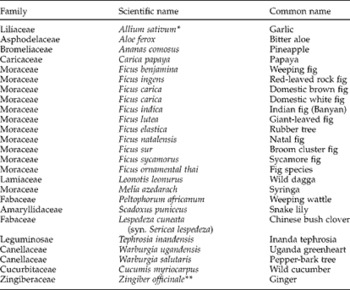
A total of 25 plants (table 1) that are used traditionally to treat helminth infections were selected from the available literature (Hördegen et al., Reference Hördegen, Hertzberg, Heilmann, Langhans and Maurer2003; Min & Hart, Reference Min and Hart2003; Fennell et al., Reference Fennell, Lindsey, McGaw, Sparg, Stafford, Elgorashi, Grace and van Staden2004; Min et al., Reference Min, Pomroy, Hart and Sahlu2004; Lange et al., Reference Lange, Olcott, Miller, Mosjidis, Terrill, Burke and Kearney2006; Stepek et al., Reference Stepek, Lowe, Buttle, Duce and Behnke2006; Mohanlall & Odhav, Reference Mohanlall and Odhav2009; Maphosa et al., Reference Maphosa, Masika, Bizimenyera and Eloff2010). Plant material of these species was collected from the University of KwaZulu-Natal (UKZN) Botanical Garden, Pietermaritzburg campus, UKZN Research Farm (Ukulinga). Samples of Ficus spp. were from a private garden (Pietermaritzburg) and garlic and ginger samples were purchased from a commercial supermarket. Voucher specimens of plants were deposited at the UKZN Herbarium, Pietermaritzburg.
Leaves, bulbs (*) and rhizomes (**) of plant species evaluated for their anthelmintic activity.

Fresh plant material was washed and then cut into small pieces. All plant material was air-dried followed by drying in an oven (Model 5SOE1B, Labcon, Maraisburg, South Africa) at 50°C for 2–5 days. Each plant was then pulverized into a powder using an electric grinder (Retsch, Haan, Germany) until it was fine enough to pass through a 1-mm diameter sieve. Powdered samples were preserved in airtight plastic containers under dark conditions at room temperature.
Ten-gram samples of ground material from each plant were boiled for 24 h in 100 ml of each of three solvents, ethanol, dichloromethane and water in a Soxhlet's apparatus. The resulting extracts were transferred to 50-ml test tubes and placed in a water bath (Model 101, Labotec, South Africa) at 50°C. Extracts were condensed by evaporation of the solvent to a final volume of 30 ml. Condensed extracts were then preserved in airtight glass bottles and stored at 10°C until required for screening. Two experiments were undertaken to screen plant extracts, one experiment using ethanol extracts of 25 plants followed by a second experiment using five of the most potent plants, based on the results of the ethanol extracts.
In-vitro screening of plant extracts
Faecal samples were collected from 35 randomly selected sheep grazing on a contaminated Kikuyu pasture (Pennisetum clandestinum) at Ukulinga Research Farm. Rectal faecal samples were taken from sheep by hand and stored in plastic bags. Faeces were pooled and mixed. Sub-samples (5 g) were placed in trays and incubated (Memmert, Schwabach, Germany) for 12 days at 27°C. Samples were kept damp by daily watering at 10.00 hours during the period of incubation. On day 10, ethanol extracts were applied at 10, 20 and 30% concentrations. Each concentration was used to treat four trays and there were four controls where only ethanol was used. Both controls and treated trays were incubated for a further 48 h.
The Baermann technique was used to count H. contortus larvae, as described by Hansen & Perry (Reference Hansen and Perry1994). Each faecal culture was placed in a double-layer of cheesecloth which was tied using a rubber band. Each faecal culture was placed in a funnel (supported by a funnel stand), which was then filled with lukewarm water until water covered the faecal material. The apparatus was left for 24 h; then 15 ml of fluid was taken from the stem of the funnel and placed into a test tube which was left to stand for 30 min. The supernatant was removed with a Pasteur pipette and a drop of aliquot was transferred to a microscope slide using a Pasteur pipette. A drop of iodine was added and the slide was covered with a cover-slip. Samples were examined and larvae were counted using 100 × magnification.
In the second experiment, five plants with the highest efficacy at two concentrations were selected for further in vitro screening using three solvent extracts at concentrations 2.5, 5, 10 and 20%. Each concentration was used to treat four trays and there were four controls for each solvent. Both controls and treated trays were incubated for a further 48 h.
Data analysis
Nematode mortality was calculated using Abbott's formula (Abbott, Reference Abbott1925), as follows:
 $$\begin{eqnarray} Corrected\,\% = \left (1 - \frac { n \,in\,T\,after\,treatment}{ n \,in\,Co\,after\,treatment}\right )\times 100 \end{eqnarray}$$
where n= number of larvae, T = treated and Co = control.
Nematode larval counts were analysed using the General Linear Model procedure of SAS (2000). In the first experiment, the following statistical model was used to analyse larval mortality at specific concentrations:
 $$\begin{eqnarray} Y _{ij} = \mu + S _{i} + e _{ij}; \end{eqnarray}$$
where Y ij= individual observation; μ = overall mean; S i= effect of plant species; e ij= the error term. In the second experiment, effect of plant species and concentration on nematode larvae was determined by following model:
 $$\begin{eqnarray} Y _{ijk} = \mu + S _{i} + C j + ( S \times C )_{ij} + e _{ijk}; \end{eqnarray}$$
where, Y ijk= individual observation; μ = overall mean; S i= effect of plant species; Cj = effect of concentration; (S × C)ij= interaction between plant species and concentration; e ijk= the error term. Regression analyses were performed between: (1) the efficacy of 10% ethanol extracts (x-axis) and the efficacy of 20 and 30% ethanol extracts (y-axis); and (2) the efficacy of water extracts (x-axis) and the efficacy of dichloromethane and ethanol extracts (y-axis); using Excel (Microsoft).
Results
Experiment one: screening of ethanol extracts for anthelmintic activity
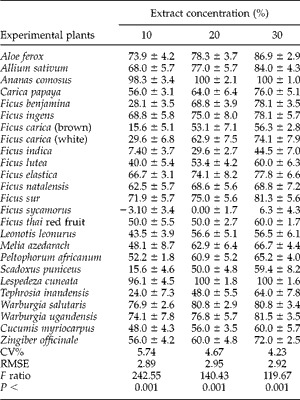
Ethanol extracts from plant species had varied (P< 0.001) effects on H. contortus larvae from sheep at 10, 20 and 30% concentrations (table 2). Increasing the concentration of plant extracts caused stronger larvicidal effects on H. contortus larvae (fig. 1). Ananas comosus extracts at various concentrations (10, 20 and 30%) had the highest larval mortality (98.3–100%), followed by Lespedeza cuneata (96.1–100%), Aloe ferox (73.9–86.9%), Allium sativum (68.0–84.0%) and Warburgia salutaris (76.9–80.8%). Ficus sycamorus and Ficus indica extracts had the lowest larval mortality ( − 3.1 to 6.3%) and (7.4–44.5%), respectively. Other plant species showed a range of larval mortality between 15.6 and 81.5% (table 2).
In vitro efficacy of ethanol extracts of 25 medicinal plants against Haemonchus contortus from sheep.

CV%, coefficient of variance; RMSE, the root mean square error.
In vitro efficacy of different concentrations of 25 medicinal plants against Haemonchus contortus from sheep: 20% versus 10%: y= 0.6971x+28.058, R 2= 0.7976; 30% versus 10%: y= 0.6067x+39.148, R 2= 0.7148. Triangles, 10%; circles, 20%; squares, 30%.

Experiment two: screening of different extracts of five plant species for anthelmintic activity
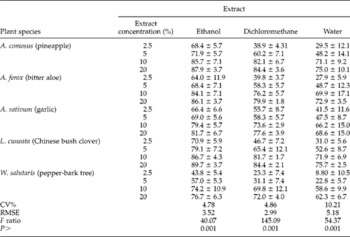
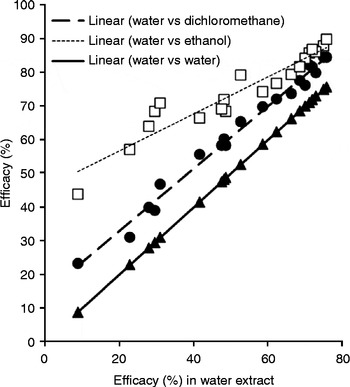
The efficacy of ethanol, dichloromethane and water extracts of five plants (A. comosus, A. ferox, A. sativum, L. cuneata and W. salutaris) against H. contortus larvae from sheep were studied in vitro at different concentrations (table 3, fig. 2). The ethanol, dichloromethane and water extracts killed 75%, 70% and 60% of larvae, respectively, at a concentration of 20%. Lespedeza cuneata had the highest efficacy, causing a mortality of 89.7% with 20% ethanol extract, while W. salutaris had the lowest efficacy of 76.7%.
In vitro efficacy of five medicinal plants against Haemonchus contortus of sheep using three different solvents.

CV%, coefficient of variance; RMSE, the root mean square error.
In vitro efficacy of different extracts of five medicinal plants against Haemonchus contortus from sheep: water versus dichloromethane: y= 0.9265x+14.295, R 2= 0.9879; water versus ethanol: y= 0.5495x+45.687, R 2= 0.8994. Triangles, water; circles, dichloromethane; squares, ethanol.

Discussion
The family and plant organ used for each plant species tested are shown in table 1. A total of 12 families were selected. In the Fabaceae and Canellaceae, two species were investigated, while for Moraceae, 12 species were available for investigation. The in vitro screening demonstrated larvicidal effects of ethanol extracts of 25 plants. Maphosa et al. (Reference Maphosa, Masika, Bizimenyera and Eloff2010) reported that no compound with antheminthic properties has yet been identified from plants. However, each plant contains secondary compounds with biological activity that could be responsible for the anthelmintic effects shown. For example, cysteine proteinase enzymes in A. comosus (Gillian et al., Reference Gillian, Behnke, Buttle and Duce2004), amino acids, saponins and sterols in A. ferox (Mabusela et al., 1990), and tannins in L. cuneata (Min et al., Reference Min, Pomroy, Hart and Sahlu2004) and Melia azedarach (Nakanishi et al., Reference Nakanishi, Takayama and Yasuda2011) have anthelmintic properties. In addition, fig trees might have unidentified, yet active, compounds, such as the enzyme ficin (Gillian et al., Reference Gillian, Behnke, Buttle and Duce2004), which may be responsible for various levels of larval mortality (table 2). Several compounds, such as ajoene in A. sativum (Ferri et al., Reference Ferri, Yokoyama, Sadilek, Paoletti, Apitz-Castro, Gelb and Corsini2003), proteolytic enzyme papain of papaya (Gillian et al., Reference Gillian, Behnke, Buttle and Duce2004) and alkaloids, saponins and tannins in Leonotis leonurus (Bienvenu et al., Reference Bienvenu, Amabeoku and Eagles2002) would cause larval mortality. The compound muzigadial in species of Warburgia possesses antifeedant activity against parasites (Fennell et al., Reference Fennell, Lindsey, McGaw, Sparg, Stafford, Elgorashi, Grace and van Staden2004; Mohanlall & Odhav, Reference Mohanlall and Odhav2009), whereas polyphenolic compounds are found in Peltophorum africanum (Bizimenyera et al., Reference Bizimenyera, Githiori, Eloff and Swan2006).
Ethanol extracts of five plant species demonstrated strong larvicidal effects against H. contortus. Ananas comosus and L. cuneata showed good larvicidal inhibition even at a concentration of 10%. This agrees with similar work in which a 10% ethanolic extract of A. comosus had an efficacy of 100% against nematode larvae of goats (Sujon et al., Reference Sujon, Mostofa, Jahan, Das and Rob2008). The enzyme bromelain from the stem of A. comosus was effective in reducing H. contortus larvae by 93% relative to pyrantel tartrate (Hördegen et al., Reference Hördegen, Cabaret, Hertzberh, Langhans and Maurer2006). Bromelain enzyme is known to damage nematode cuticles (Stepek et al., Reference Stepek, Lowe, Buttle, Duce and Behnke2006). The effect of L. cuneata as a natural anthelmintic has also been reported in small ruminants, drastically reducing nematode levels (Hördegen et al., Reference Hördegen, Hertzberg, Heilmann, Langhans and Maurer2003; Min & Hart, Reference Min and Hart2003; Min et al., Reference Min, Pomroy, Hart and Sahlu2004; Lange et al., Reference Lange, Olcott, Miller, Mosjidis, Terrill, Burke and Kearney2006). This effect may be due to tannins forming complexes with proteins on the surface of nematodes, thereby disturbing their metabolism (Ahmed, Reference Ahmed2010) and/or tannins binding and disturbing the integrity and growth of nematodes (Niezen et al., Reference Niezen, Waghorn, Charleston and Waghorn1995).
Aqueous extracts of A. ferox, A. sativum and W. salutaris inhibited the larval development assay of H. contortus. In another study, Maphosa et al. (Reference Maphosa, Masika, Bizimenyera and Eloff2010) reported larvicidal effects of aqueous extracts of A. ferox on H. contortus from goats. Similar results have been found with an aqueous bulb extract of A. sativum for killing H. contortus from sheep (Iqbal et al., Reference Iqbal, Nadeem, Khan, Akhtar and Waraich2001). Warburgia salutaris is a traditional medicinal plant used as an anthelmintic in South African traditional medicine (Fennell et al., Reference Fennell, Lindsey, McGaw, Sparg, Stafford, Elgorashi, Grace and van Staden2004; Mohanlall & Odhav, Reference Mohanlall and Odhav2009). Efficacy of these plant extracts at low concentrations shows that the plants have good anthelmintic activity. However, the active compound is yet to be clearly identified.
In order to enhance extraction of all biologically active substances in plant material, solvents of differing polarity were used. Water is the main solvent used for plant preparation in traditional medicine (Sparg et al., Reference Sparg, Van Staden and Jager2002). Ethanol and dichloromethane solvents have been used regularly to extract potentially bioactive compounds (McGaw & Eloff, Reference McGaw and Eloff2008). The ethanol extracts were consistently more active than dichloromethane and water extracts (fig. 2). Ethanol extracts of the five plants investigated in the second part of the study, at 20%, were highly active, causing over 75% larval mortality. The other crude extracts displayed moderate to weak larvicidal activity. These findings support those of Le Dang et al. (Reference Le Dang, Lee, Choi, Choi, Jang, Park, Soh, Han, Lim and Kim2010) who tested several organic solvent extracts of Chenopodium ficifolium for insecticidal activity against melon and cotton aphid, Aphis gossypii, on cucumber plants. Methanol and ethanol extracts were active (causing more than 80% mortality), while other extracts, such as acetone, ethyl acetate and dichloromethane, had a lower range, between 16 and 69% (Le Dang et al., Reference Le Dang, Lee, Choi, Choi, Jang, Park, Soh, Han, Lim and Kim2010).
It can be concluded that ethanol extracts of five plants (A. comosus, A. ferox, A. sativum, L. cuneata and W. salutaris) killed larval stages of H. contortus from sheep, in vitro. Future research needs to focus on application of the in vitro results to an in vivo situation, although in vivo efficacy maybe influenced by the physiological status of the host (Githiori et al., Reference Githiori, Hoglund and Waller2005).
Acknowledgements
This research was funded by the National Research Foundation, South Africa.