Contemporary development studies highlight the quality of economic institutions as the root of modern prosperity.Footnote 1 This argument has captivated the economics profession, partly because empirical studies yield a strong correlation between property rights institutions and economic growth.Footnote 2 The main objection to this new conventional wisdom is that institutional quality may be endogenous to the development process; richer countries are presumably better able to afford stronger property rights, and these property rights may, therefore, have no independent effect on growth.Footnote 3
Two studies by Acemoglu, Johnson and Robinson (AJR hereafter) have become hugely influential, largely because they directly confront this endogeneity issue.Footnote 4 AJR argue that European colonial powers engineered a global ‘reversal of fortune’, bringing property rights to relatively uninhabited colonies while imposing inefficient institutions on locales with less potential for settlement. By arguing that institutions persist, they potentially explain how variation in colonial settlement strategies might account for current institutional differences and the huge discrepancies in contemporary income.
In this article, we revisit the theoretical literature that informs AJR’s thesis and argue that the authors overreached by generalizing from the cases of North America and Australasia. We then replicate their empirical findings and demonstrate that while colonialism did radically shape these four colonies, leading to stunning economic success, there is no evidence of a more general relationship between European colonialism, property rights institutions and economic development. Therefore, we conclude that development studies must look elsewhere to explain the ‘modern world income distribution’.Footnote 5
Colonialism and the ‘reversal of fortune’
AJR’s research has become the new conventional wisdom in development studies. As partial evidence, AJR (2001) has already been cited by 657 published articles and their argument dominates contemporary discourse on colonialism, institutions and development.Footnote 6 While their argument has faced occasional criticism regarding the specific data they employ – for instance, the lengthy debate between Albouy and these authorsFootnote 7 – a host of subsequent studies support AJR’s argument that colonialism shaped institutions and accounts for the world income distribution.Footnote 8
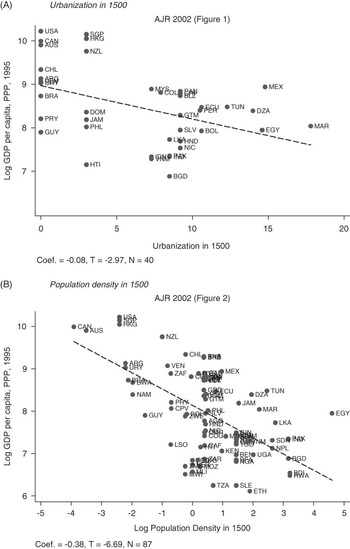
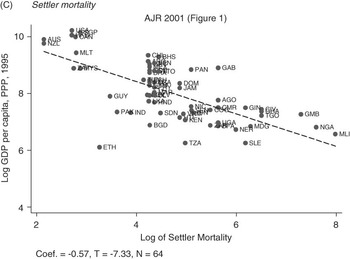
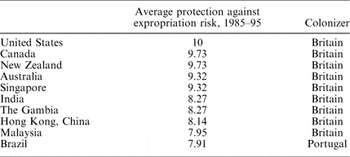
Much of AJR’s appeal lies in their compelling visual evidence that factors affecting the feasibility of colonial settlement are strongly associated with modern economic prosperity. In Figure 1 below, we replicate AJR’s (2001, 2002) central figures that lead to this conclusion. Following AJR, we measure economic development with the log GDP per capita in 1995 and measure the feasibility of colonial settlement with the level of urbanization in 1500 (panel A), the log of population density in 1500 (panel B), and the log of settler mortality (panel C).Footnote 9
AJR’s figures on settlement potential and economic development Note: The three figures displayed here and in Figure 2 are derived from data in Appendix A, and reflect graphs presented in Daron Acemoglu, Simon Johnson and James A. Robinson, ‘Reversal of Fortune: Geography and Institutions in the Making of the Modern World Income Distribution’, Quarterly Journal of Economics, 117 (2002), 1231–94, at p. 1233, Fig. 1 for (a); and at p. 1234, Fig. 2 for (b); and in Daron Acemoglu, Simon Johnson and James A. Robinson, ‘The Colonial Origins of Comparative Development: An Empirical Investigation’, American Economic Review, 91 (2001), 1369–401, p. 1371, Fig. 1 for (c). Permission to use them has been granted by the MIT Press and the American Economic Review, respectively, and is gratefully acknowledged.

(Continued)

The sharply negative slopes in all three graphs suggest that modern prosperity can be understood in terms of the conditions European colonialists encountered in past centuries. But this correlation is not the core contribution of AJR’s work. Instead, their goal is to identify the intervening process. More specifically, AJR use colonial conditions as a source of exogenous variation in current property rights institutions. This, in turn, allows them to ‘estimate the impact of institutions on economic performance’ (2001, p. 1370), as opposed to the effect of geography, human capital or any other number of potential explanations of long-run development that may be correlated with colonial conditions.Footnote 10
AJR’s understanding of this two-stage logic is as follows: First, they evaluate the settlement potential of a colony by examining pre-colonial population statistics and disease climates. If conditions were favourable for settlement, Europeans would immigrate in large numbers and create strong property rights institutions; otherwise, colonists would design inefficient institutions to maximize extraction. In the second stage of their logic, these institutions persist and influence subsequent economic prosperity.
AJR most clearly draw upon this causal logic in their work on the ‘reversal of fortune’ (AJR 2002). This argument begins by noting how the prosperous regions of the world several centuries ago are now significantly poorer, while those regions with little economic potential centuries ago are now among the most prosperous.Footnote 11 According to AJR (2002, p. 1235), this turnaround reflects an institutional reversal instigated by the colonies’ settlement potential:
European colonialism led to the development of institutions of private property in previously poor areas, while introducing extractive institutions or maintaining existing extractive institutions in previously prosperous places. The main reason for the institutional reversal is that relatively poor regions were sparsely populated, and this enabled or induced Europeans to settle in large numbers and develop institutions encouraging investment. In contrast, a large population and relative prosperity made extractive institutions more profitable for the colonizers.
We agree that the above passage contains substantial truth when applied to four well-known historical instances of success, namely the United States, Canada, Australia and New Zealand. Indeed, as AJR (2001, p. 1374) note, this point has been well documented by a wide range of economic historians. The novelty and value of AJR’s analysis was to draw upon this existing conventional wisdom and extend it to a global sample.
It is this contribution that we evaluate. We argue that these four colonies are unique, being the world’s only four British clones, and do not shed any light on global development studies more generally. Our critique is primarily empirical but we begin by revisiting the historical and cross-national literature that informs AJR’s theory of European colonialism and institutional reversals. We make three distinct points. First, we argue that AJR’s extraction thesis does not provide an adequate basis for explaining variations in institutional quality outside of North America and Australasia. Secondly, while AJR view European settlement generally as a positive force for property rights, we argue that it is primarily British settlement which facilitates development. Finally, whereas AJR view settlement as a continuous variable, we note that British settlement is primarily a dichotomous variable, in which only massive immigration leads to high property rights. In total, we radically narrow the scope of AJR’s argument and find that the revised theory applies only to the four British clones which economic historians had previously identified.
Settlement or Extraction?
AJR’s argument is largely motivated by the compelling story of the four British clones, where extensive settlement created private property rights. Equally important, however, is their second mechanism – the development of extractive institutions when Europeans were unable to settle. While AJR cite numerous economic historians who have previously described the transfer of property rights institutions to settler colonies like Australia and New Zealand (2001, p. 1374), we find the extraction thesis to be much less developed, both empirically and theoretically.
Empirically, AJR present a homogeneous vision of European extraction beyond the four British clones. They argue that extraction characterized ‘Latin America during the seventeenth and eighteenth centuries, and in Asia and Africa during the nineteenth and early twentieth centuries’ (AJR 2001, p. 1375). By lumping these regions together, the authors suggest that colonial extraction was ubiquitous throughout the developing world. This may well be, but if there is no reason to believe that extraction varies outside of the four British clones, then the extraction thesis cannot explain variations in property rights outside those four countries.Footnote 12
More importantly, theoretically, we question AJR’s presumption that settlement is linearly related to property rights. We accept AJR’s argument that in the four British clones the overwhelming extent of European settlement inhibited extractive institutions because there were so few natives to exploit. AJR never explain, however, why zero settlement (as was the case in most African countries) will be worse for property rights than low settlement (as was the case in most Latin American countries).Footnote 13 We suggest, by contrast, that it is equally plausible to assume that a sparsely settled colony would have worse institutions than a colony with zero settlement. In the former, European settlers constitute an interest group in favour of extractive policies and provide the social and political infrastructure for such extraction.
Sokoloff and Engerman, for instance, describe how European settlement in Latin America caused extractive policies and inefficient property rights institutions.Footnote 14 The sizeable and powerful Spanish and Portuguese elite introduced laws and institutions that protected their privilege at the expense of the majority of the population, resulting in a low level of property rights and inefficient institutions more generally. As the authors conclude, ‘where there existed elites who were sharply differentiated from the rest of the population on the basis of wealth, human capital, and political influence, they seemed to have used their standing to restrict competition’.Footnote 15
Sokoloff and Engerman particularly emphasize the perverse effects of economic inequality, in which European elites’ privileged position motivated them to adopt extractive and exclusive economic and political institutions. Latin America is the archetype for this model, in which a sizeable population of European descent lives beside a larger population of native descent or slave descent, resulting in the world’s most extreme inequality. If the authors are correct that such inequality breeds ineffective institutions, then Latin America’s low levels of settlement should result in worse institutions than Africa’s zero levels of settlement, where there was no sizeable European elite and where inequality has been lower.Footnote 16
European Colonialism or British Colonialism?
AJR’s settlement thesis rests on much firmer ground, with many scholars having argued that in a select few colonies ‘Europeans settled in large numbers’ and that ‘there was something undeniably capitalist in the structure of these colonies’ (AJR, 2001, p. 1374).Footnote 17 While AJR have stressed ‘European-like institutions’ (2001, p. 1374), we argue that they are closer to the truth when they write that good institutions in Australia and New Zealand occurred because settlers ‘wanted institutions and political rights like those prevailing in England at the time’ (AJR, 2001, p. 1374, emphasis added).
Indeed, prior research strongly suggests that it is British colonialism that leads to property rights, not European settlement in general. Economic historians have demonstrated that compared to rival European powers, Britain had a particularly strong tradition of private property rights, partially due to the ways in which Parliament constrained the Monarchy.Footnote 18 British settlers, therefore, brought a stronger commitment to property rights than other colonists, and the literature demonstrates that British colonies enjoyed superior development institutions, higher levels of human capital and faster rates of economic growth.Footnote 19 Non-British colonialism may even have left a negative legacy on colonies. Lange, Mahoney and vom Hau, for instance, demonstrate that while British colonialism reflected the archetype of a liberal economic model, Spanish colonization transferred mercantilist practices which actually led to significantly worse developmental outcomes, contradicting AJR’s emphasis on the positive effects of European settlement more generally.Footnote 20
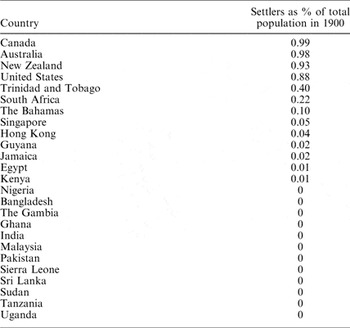
Certainly, British colonialism was not sufficient in itself for strong property rights to be instigated and development to occur – note, for example, the sharp divergence between the British colonized territories that would become the United States and Nigeria. Moreover, as discussed in the conclusion, it may be that even in the four British clones it was not property rights which led to success but rather human capital. Nevertheless, to the extent to which Europeans had any positive effect at all on property rights, the theoretical and historical literature suggests that this was primarily a British phenomenon. Table 1 empirically confirms this uniquely British advantage: of the ten countries with the strongest property rights in AJR’s (2001) analysis, nine are former British colonies.Footnote 21
Ten Highest Property Rights in AJR’s (2001) Sample

British Settlement: A Dichotomous Variable
We further narrow the scope of AJR’s argument by noting that British settlement is essentially a dichotomous variable.Footnote 22 As evidence of this claim, Table 2 reports AJR’s settlement variable, namely the ratio of settlers to total population in 1900, for the twenty-five British colonies in their sample. In four of these colonies, the proportion of settlers varies from 88 to 99 per cent – an overwhelming portion of the colonial population. In eighteen of the remaining twenty-one colonies, by sharp contrast, settlers comprised merely 5 per cent or less of the population. The distribution is almost entirely dichotomous, with every single colony but one exhibiting relatively extreme values, either 0.88 or above or 0.22 or below.
Settlement in British Colonies

Source: Data taken from AJR (2000) data appendix.
As a concrete matter, then, when one discusses British settlement, one is overwhelmingly restricted to the four ‘settler colonies’ of the United States, Canada, Australia and New Zealand. So similar were these four nations’ colonial experience that they are conventionally referred to as ‘Neo-Europes’, although we note that they are more accurately described as ‘Neo-Britains’.Footnote 23
AJR argued that European settlement in general determined property rights, and it is indeed striking that settlement explains nearly one-third of the variation in property rights in AJR’s (2001) sample (R 2 = 0.31, N = 63). We argue, by contrast, that it is only in British colonies that settlement had a positive effect, and that this positive effect was restricted to merely four countries. As an initial empirical illustration of this argument, we note that outside of these four British clones there is almost no remaining relationship between European settlement and property rights (R 2 = 0.04, N = 59).Footnote 24
Do the Four British Clones Inform Development Studies?
We now sum up by explicitly noting the implications of our theoretical arguments for the empirical analyses that follow. AJR’s starting point was the conventional wisdom that British settlers transformed North America and Australasia. Their contribution was to extend this insight into a more general theory of development, arguing that variations in settlement and extraction around the globe explain variations in property rights and subsequent prosperity. We formally test this extension by replicating the primary AJR analyses and evaluating their explanatory power beyond the four British clones. As we demonstrate below, the AJR hypotheses do not fare well.
Some readers might believe that this is an unfair test, since we are ‘robbing’ AJR of four confirming cases. We provide two responses. First, knowledge is a cumulative process, and given that AJR sought to extend economic historians’ insights beyond the four British clones, it is important to assess whether this extension is warranted. If there is no evidence that the theory provides insight into the global sample, then the extension is unwarranted, and the academic community should once again restrict its claims to the four British clones.Footnote 25
Secondly, it is vital to keep in mind that for most scholars the domain of development studies is the global sample of developing countries in Africa, Asia and Latin America. Few such scholars examine the United States, Canada, Australia and New Zealand, given that these are advanced industrial societies which caught up with Europe around a hundred years ago. For AJR’s huge impact on development studies to be warranted, their argument must have some explanatory power in the sample of developing countries.
A Nuance: City-States
Before turning to our analyses, we wish to address a nuance, namely AJR’s inclusion of the world’s only two city-states, Hong Kong and Singapore. Methodologically, we suggest that the two city-states should be excluded from the analysis. King, Keohane and Verba argue that one should not generalize across units when the causal processes differ (i.e., there is no unit homogeneity).Footnote 26 The very designation ‘city-state’ implies that dynamics within city-states differ fundamentally from those of ‘normal’ states. To provide just one especially pertinent example, Maddison argues that cities typically experience more rapid economic growth than rural areas, and therefore analysts studying long-run growth should compare city-states with other cities, such as São Paulo or Mexico City, rather than with normal countries, which will typically experience lower growth rates than city-states.Footnote 27
Does it matter if we exclude these two sui generis city-states? As we demonstrate below, this nuance is irrelevant to AJR (2002), which provides no explanatory power in developing countries regardless of how one treats the city-states. AJR (2001) is also disconfirmed regardless of the city-states’ inclusion in the sample, although when we retain the city-states AJR (2001) retains some (statistically insignificant) explanatory power. Our subsequent analyses found that this weak effect is primarily due to the role of the two city-states. We conclude two points from this finding. First, in so far as one is willing to accept insignificant results as believable, which is suspect in itself, it is imperative to keep in mind that what little explanatory power AJR (2001) has in developing countries is dependent on two sui generis city-states.
Secondly, the fact that the city-states do conform to AJR’s general story suggests the need for more attention to these historical oddities. Roughly speaking, these two city-states did indeed experience a colonially-induced institutional reversal, albeit in a very different manner to that of the Neo-Britains. In essence, the British seized some sparsely populated rocks and transformed them into global trading ports. When the British reached Hong Kong in the 1830s, the island ‘was little more than a barren rock, speckled with a few tiny fishing villages’.Footnote 28 Singapore was equally insignificant; when the first British officials came to the island, they merely found ‘some 120 Malays and thirty Chinese – mostly fisherman and pirates’.Footnote 29
British colonialists then radically transformed these two barren locales into world-class trading ports by creating British legal and regulatory institutions, capitalist-style administrative frameworks and systems of private property rights.Footnote 30 Britain was wildly successful in accomplishing its goal. Hong Kong and Singapore, for instance, boast total trade volume around 350 per cent of gross domestic product (GDP), vastly higher than any other place in the world. This trade volume even dwarfs the East Asia average (75.7 per cent of GDP), which itself is the highest amongst all regions classified by the World Bank.Footnote 31 Although these numbers attest to Britain’s success, they also dramatically underscore the sui generis nature of the world’s only two city-states.
Analysis
Our empirical analysis unfolds in three stages. First, we visually examine whether AJR’s variables explain property rights universally or, conversely, explain only the four Neo-Britains. Secondly, we replicate AJR’s (2002) regression analysis and test whether they are correct to extend the logic of the four Neo-Britains to other colonies. Thirdly, we re-evaluate AJR’s (2001) argument that European settler mortality rates shaped property rights, which in turn shaped contemporary income levels. The data for these exercises are available from a variety of sources, including the appendices provided in AJR (2000, 2001 and 2002) and La Porta et al.Footnote 32
We begin by visually examining the relationship between the feasibility of colonial settlement and the strength of current property rights institutions. AJR use three variables to measure the feasibility of settlement: urbanization in 1500, log of population density in 1500 and log of settler mortality. For the authors, colonies with lower urbanization, lower population density and lower mortality rates were more attractive locations for settlement and the subsequent creation of property rights institutions. Following AJR, we measure current property rights institutions as the average protection from expropriation risk 1985–95 (‘expropriation risk’ hereafter), where higher scores indicate less risk and thus stronger property rights.Footnote 33 If European colonialism engineered a universal institutional reversal, we would expect a strong negative relationship between each of these feasibility indicators and current property rights.
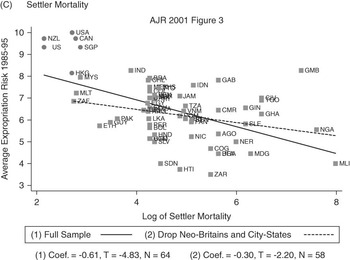
Figure 2 presents three separate panels, each depicting the relationship between an indicator of settlement potential and property rights. Only the relationship in Panel C, using log of settler mortality, was reported by AJR in their original work (2001, p. 1384).Footnote 34 We additionally report the figures in Panels A and B because these relationships directly assess their institutional reversal thesis in exactly the same fashion as Panel C. Each panel plots two least squares regression lines: a solid line for the full sample, and a dashed line for the sample excluding the four Neo-Britains and city-states. The slope of each line, along with the associated t-statistic and sample size, is listed below the horizontal axis.
(Re-)evaluating the institutional reversal Note: Concerning sources and copyright permission, see footnote to Figure 1.

(Continued)

The critical importance of the Neo-Britains – all clustered in the upper-left quadrant of each panel – is plainly evident. While the solid lines representing the relationships in the full sample are sharply negative and have statistically significant coefficients in all three panels, the dashed lines are completely flat in Panels A and B and only half the magnitude in Panel C. The urbanization (A) and population density (B) results are particularly striking, demonstrating that AJR’s thesis has zero explanatory power in the developing country sample. Outside of the four British clones and the world’s only two city-states, the relationships are about as close to zero statistical significance as one can get (p = 0.71 in Panel A, p = 0.91 in Panel B). Nor is this conclusion dependent upon excluding the city-states. Leaving the city-states in the analysis still yields entirely insignificant findings outside of the four British clones (p = 0.38 and p = 0.26 for urbanization and population density, respectively).
These results are extremely sobering. If the results were marginally significant, one might conclude that the AJR argument contains some truth, but that it is simply more effective in the four Neo-Britains. Instead, Panels A and B show that once one moves beyond these well-known instances of British-induced success, there is simply no pattern whatsoever between prior levels of urbanization and population density and subsequent property rights.
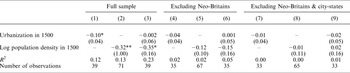
We now test AJR’s (2002) institutional reversal thesis more formally by replicating their previously published empirical results (p. 1267). Table 3 reports a series of ordinary least squares (OLS) regression models regressing current property rights institutions (expropriation risk) on the instruments of urbanization and population density. This specification directly tests whether an institutional reversal occurred. The models reported in columns 1 through 3 are close replications of AJR’s (2002, Table 7) original work.Footnote 35 Each model suggests that in the full sample, better quality pre-colonial institutions are associated with lower quality current institutions. These relationships are highly significant and AJR (2002) interpret these OLS results as strong evidence of an institutional reversal that caused the reversal of relative incomes.
(Re-)evaluating the Institutional Reversal – Regression Analysis

Notes: Dependent variable is Average Protection Against Expropriation Risk, 1985–95. Unstandardized coefficients, standard errors in parentheses. Constants estimated but not reported. Neo-Britains: United States, Canada, Australia and New Zealand. City-states: Hong Kong and Singapore.
*Significant at 0.05; **Significant at 0.01.
AJR (2002, p. 1245) document that the correlations between colonial initial conditions (urbanization, population density) and per capita income exist after excluding the four British clones. However, they do not examine the sensitivity of the intervening process to the exclusion of the four British clones. Therefore, we examine in columns 4 through 6 whether colonial conditions correlate with property rights outside of the four Neo-Britains. These results clearly illustrate that there is no institutional reversal. None of the estimated coefficients in these models are even close to statistically significant.
For comparison, Models 7 through 9 further exclude the two sui generis city-states. Urbanization and population density have zero explanatory power, and in model 9, population density even has the wrong sign. These findings are stunning, suggesting that AJR’s attempt to generalize from the four Neo-Britains to a global sample not only fails to achieve significant confirmation but – even more – is devoid of any explanatory power whatsoever for the developing world.
The complete collapse of the models in columns 4 through 6 highlights how four unique colonies underpinned AJR’s (2002) empirical analyses and conclusions regarding the importance of institutional reversals in the making of the modern world income distribution. It is hard to overstate the importance of these findings. AJR (2002) suggest that contemporary levels of economic development around the globe are fundamentally caused by an institutional reversal resulting from European colonialism. Figure 2 and the OLS results in Table 3 show that there is absolutely no sign of an institutional reversal outside of the four Neo-Britains previously described by economic historians.
Settler Mortality and Economic Development
We now turn to AJR’s other prominent argument, namely that settler mortality rates influenced European settlement patterns, which in turn influenced property rights institutions, which in turn influence economic development (AJR, 2001). AJR employ two-stage least-squares (2SLS) to model expropriation risk as a function of the instrumental variable settler mortality, and then demonstrate that this predicted expropriation risk value has a significant and positive association with current income levels. These 2SLS analyses resolve the endogeneity problem between property rights institutions and current income, and equally important, provide an explanation of the origin of these institutions.
Bardhan argues that while this process circumvents endogeneity, the mortality variable explains only a small part of the observed variation in institutional quality and hence does not capture ‘the major historical forces that affect the social and economic structures of a former colony’.Footnote 36 We agree with this point, but go further in demonstrating below that the mortality variable explains so little variation in property rights outside of the four Neo-Britains that it does not meet the minimal requirements of a good instrument, and hence cannot even resolve endogeneity concerns.
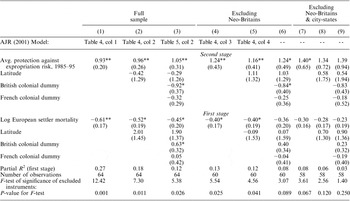
AJR’s (2001) original analysis contains nearly fifty 2SLS regression models; space constraints make it impossible to test each of these outside of the four Neo-Britains, so we focus on AJR’s baseline models in Tables 4 and 5 (pp. 1386, 1389). AJR’s Table 4, column 1, provides the simplest analysis, using settler mortality as an instrument for expropriation risk. AJR’s Table 4, column 2, adds latitude as a control variable, while their Table 5, column 1, adds two additional control variables, namely French and British colonial dummy variables.
2SLS Regressions, dependent variable is log GDP per capita (PPP) in 1995

Notes: Unstandardized coefficients, standard errors in parentheses (clustered on mortality rates). Constants estimated but not reported. Neo-Britains: US, Canada, Australia and New Zealand. City-States: Hong Kong and Singapore. *Significant at 0.05; **significant at 0.01.
Wald and Anderson–Rubin Confidence Intervals for Instrumented Expropriation Risk CoefficientFootnote *

* Confidence Intervals for Instrumented Expropriation Risk coefficient (see Table 4, second stage).
We replicate AJR’s regression coefficients for these three models in our Table 4, columns 1–3.Footnote 37 Our standard errors for these coefficients, however, differ from AJR (2001) in that we have corrected all standard errors in Table 4 for clustering.Footnote 38 We do so following Albouy, who notes that two or more countries in AJR’s (2001) original analysis often share a single estimate of settler mortality, which violates the assumption of independent errors.Footnote 39
The second-stage results presented at the top of Table 4 provide an estimate of property rights’ impact on income, but it is critical to keep in mind that the interpretation of these results depends on the first-stage relationship between the instruments and expropriation risk. This is because 2SLS techniques only circumvent endogeneity through the correlation between the instruments and the endogenous regressor. Without a convincing first-stage correlation, an instrument is considered ‘weak’, resulting in second-stage coefficients biased in the direction of the original OLS coefficients and standard errors that are too small.Footnote 40
Gujarati explains at an intuitive level why we want a strong first-stage correlation between our instrument and the endogenous explanatory variable; if ‘the R 2’s in the first-stage regressions are very low, the 2SLS estimates will be practically meaningless because we shall be replacing the original Y’s in the second-stage regression by the estimated  ’s from the first-stage regressions which will essentially represent the disturbances in the first-stage regressions’.Footnote 41
When evaluating instrument weakness, a minimal condition is that it be ‘relevant’, meaning that the instrument must be significantly correlated with the endogenous variable.Footnote 42 Unfortunately, it is now known that ‘a “weak instrument” problem can arise even when the first-stage tests are significant at conventional levels (5% or 1%)’, and as such a widely accepted rule of thumb is that the F-statistic testing the joint significance of the excluded instruments in the first-stage should be at least 10.Footnote 43 An even more recent development is the use of Anderson–Rubin (AR) statistics, which are said to provide valid confidence intervals for second-stage coefficients even in the face of potentially weak instruments (for example, with F < 10).Footnote 44
Columns 1–3 of Table 4 pass the minimalist test, in that the coefficient for settler mortality is significant in all three models and the square of the partial correlation between settler mortality and expropriation risk ranges from 0.27 to 0.12. Only Model 1 passes the F > 10 rule of thumb, but since the confidence intervals constructed from the Anderson–Rubin statistics (columns 1–3 of Table 5) exclude zero, we continue to accept the instrument.
AJR (2001, p. 1387) emphasize that their results are not dependent upon the four Neo-Britains. Columns 4 and 5 of Table 4 further evaluate this claim. We find that the F-statistics are well below 10 in both models. The confidence intervals based on the AR statistics, however, do continue to exclude zero. Note that column 4 replicates Albouy, who demonstrated that after clustering and excluding the Neo-Britains, the mortality instrument weakens and the second-stage confidence intervals widen (see column 4, Table 5).Footnote 45
Importantly, however, AJR note that the previous literature provides ample reason to suspect that latitude and colonial dummy variables are important controls, but neither AJR nor Albouy evaluate whether such a model (our Table 4 column 3) is sensitive to the four Neo-Britains. Table 4 column 6 presents the pertinent results. We find that not only is the F-statistic well under 10, but the model does not even pass a minimalist test for instrument relevance, given that settler mortality is not significantly correlated with expropriation risk.Footnote 46 As such, the second-stage coefficient and t-statistic are not believable. Moreover, the AR confidence intervals now become disjoint (column 5 in Table 5), reflecting that fact that without a significant first-stage correlation, the second-stage confidence intervals widen to include an infinite range of potential betas. Without a valid instrument, in short, we cannot accept AJR’s property rights thesis for the developing world.
Settler mortality is clearly too weak an instrument to warrant confidence, but it nonetheless retains a weak (insignificant) correlation with expropriation risk (p = 0.09; partial R 2 = 0.08). We now demonstrate that the majority of this already weak correlation is driven by the two city-states. In all three models, the first-stage mortality coefficient is not significant (columns 7–9 in Table 4) and the AR confidence intervals are disjoint (columns 7–9 in Table 5). Note that in the fully specified model (column 9 Table 4), partial R 2 falls by more than half, confirming that the city-states account for more than half of settler mortality’s explanatory power. Moreover, settler mortality is now not even marginally significant (p = 0.25). When evaluated without the sui generis city-states, AJR’s articles provide little empirical insight into the political economy of property rights in the developing world.
Implications
AJR revolutionized contemporary development theory by arguing that the well-known story of North America and Australasia tells us something general about global development. Indeed, their analytical framework is a towering achievement. They construct new empirical measures of colonialism (settlement and mortality) and creatively employ these measures to circumvent the single biggest obstacle to the property right perspective (endogeneity). Furthermore, AJR evaluate their argument using a rich set of statistical techniques, and equally impressive, theoretically ground this analysis in a deep historical understanding of the development process. AJR rightly deserve the attention that they have received.
Despite our respect for AJR’s work, we ultimately do not believe that the experience of North America and Australasia tells us much about the contemporary developing world, and our argument has two important implications for development studies. First, it is noteworthy that the six nations underpinning AJR’s analyses are precisely those with the least implications for the contemporary developing world. North America and Australasia are usually ignored in development studies, given that they are well-known instances of nations that caught up with Europe around a century ago. Nor do city-states hold lessons for other nations; fascinating though they may be, the two city-states are clearly unique on the world stage.
Contemporary development studies correctly focus on more fundamental questions. Why has Africa done so poorly in recent decades? Why has Latin America had mixed success? What explains the success of the Asian miracle? This last point is particularly notable given that the AJR analysis says nothing about Japan, China, Taiwan, South Korea and Thailand – the world’s most stunning successes in recent decades, and yet outside the AJR analysis because they avoided European colonization. In short, the central questions in development studies address the set of countries beyond North America and Australasia, and we have demonstrated that AJR have little to say about this universe.
Secondly, our findings cast considerable doubt on the idea that institutions are the basis for long-run prosperity. Given the strong theoretical reasons to suspect endogeneity, AJR’s contribution was to use 2SLS to show that some exogenous component of property rights explains long-run development. As such, their research is the lynchpin of the current consensus that ‘institutions rule’, meaning that property rights are the foundation of economic success.Footnote 47 As we have shown, this conventional wisdom crumbles outside of the four Neo-Britains. As such, we must once again confront the uncomfortable likelihood that observed correlations between property rights and growth simply reflect reverse causation.
If instrumental variable regression provides no support for the idea that institutions rule, what of Granger causality tests, which constitute a second common way of thinking about causality? Chong and Calderón conduct such tests and find strong evidence of reverse causality. Lagged growth has a highly significant effect on institutions, across different specifications, whereas lagged institutions have only a weak effect on growth, and is only significant in some models.Footnote 48 Even more strikingly, given that policy makers frequently identify stronger property rights as a way for poor countries to develop, Chong and Calderón found that in a sample restricted to developing countries, none of the models yield a significant effect from institutions to growth, whereas the reverse effect, from growth to institutions, was always significant.
Moreover, Glaeser et al. informally examine the time-series dimension of these property rights data and make the striking point that almost all countries have recently moved towards the maximum of the scale. By 1997, ‘the average score on expropriation risk in the sample rises from 5 in 1982 to 9 (with the median of 9.5).’Footnote 49 These values are higher than the world’s star economies of Taiwan and South Korea in 1982, suggesting that most countries should now be growing even more rapidly than East Asia. In reality, however, global growth actually slowed substantially after 1980, which suggests that the dramatic increase in property rights in almost all countries was associated with lower economic growth.Footnote 50
Not only is there scant evidence of an exogenous causal effect on income, but Glaeser et al. additionally note that observed correlations between colonial conditions and subsequent growth may have nothing to do with institutions. They argue at length that ‘the Europeans who settled in the New World may have brought with them not so much their institutions, but themselves, that is, their human capital’.Footnote 51 The authors replicate AJR’s instrumental variable approach and find that human capital is a more significant intervening process than property rights, and as they note, this means that property rights are correlated with the error term, violating a key assumption in AJR’s approach. Taking this point seriously, we may be mistaken to accept AJR’s thesis even for the four British clones, which arguably succeeded due to a massive influx of human capital rather than strong property rights.
Property rights do not explain the modern world income distribution. We wish to conclude, however, by noting that AJR were correct to draw attention to colonialism more generally. By the end of the twentieth century, the literature was dominated by non-historical explanations of development, and AJR’s popularization of the four British clones helped bring historical events and colonialism back into the picture.Footnote 52 Moreover, while we find no support for property rights as an intervening variable in the developing world, Figure 1 does suggest that such historical events matter. The R 2 in panel B, for instance, is 0.34, suggesting that fully one-third of the variation in contemporary income is related to population density five hundred years ago.Footnote 53
A wide range of recent quantitative studies attests to ‘The Importance of History in Economic Development’, with particular emphasis on colonial legacies.Footnote 54 Comparative-historical political science similarly emphasizes colonialism’s transformative capacity. Kohli, for example, argues that differences in colonial state-building explain why Nigeria, India, Brazil and South Korea experienced such different growth outcomes, while Mahoney argues that the nature of institutions within colonial powers helps to explain variations in long-run development within contemporary Latin America.Footnote 55 Krieckhaus synthesizes the quantitative and qualitative literatures, arguing that the most important ‘independent’ variables in cross-national growth regressions are more properly conceptualized as intervening variables, being heavily rooted in colonial legacies and international political economy more generally.Footnote 56 Future scholarship should continue to explore how and why colonialism shaped long-run development.