Introduction
A recent large cross-national study reported that elderly suicide rates have declined in several European countries over the latest ten-year period for available data (Shah et al., Reference Shah, Bhat, MacKenzie and Koen2008). Suicide rates in both sexes in the 65–74 and 75+ year age-bands were observed to decline between1979 and 2002 in the whole of the U.K. (Shah, Reference Shah2007; Shah et al., Reference Shah, Bhat, MacKenzie and Koen2008; Shah and Coupe, Reference Shah and Coupe2009). Elderly suicide rates in both sexes were observed to decline in studies covering varying periods between 1960 and 2002 in England and Wales (McClure, Reference McClure2000; Hoxey and Shah, Reference Hoxey and Shah2000; Shah et al., Reference Shah, Elanchanny and Collinge2001; Pritchard and Hansen, Reference Pritchard and Hansen2005; Shah and Coupe, Reference Shah and Coupe2009), particularly among the “young-old” (65–84 years) (Shah et al., Reference Shah, Elanchanny and Collinge2001). Suicide rates in both sexes in the age-bands 65–74 and 75+ years were observed to decline in Scotland between 1979 and 2002 (Shah and Coupe, Reference Shah and Coupe2009), but another study demonstrated a decline only in females between 1971 and 2000 in Scotland (Stark et al., Reference Stark, Hopkins, Gibbs, Rapson, Belbin and Hay2004). Suicide rates were observed to decline only in females in the age-band 65–74 years between 1979 and 2002 in Northern Ireland (Shah and Coupe, Reference Shah and Coupe2009).
The decline in elderly suicide rates in England and Wales was suggested to be due to several recent public health initiatives designed to facilitate: prevention of mental illness and suicide, early identification and treatment of mental illness and those at risk of suicide, adequate provision of comprehensive mental health services, and systematic follow-up of those who are recovering or have recovered from mental illness (Hoxey and Shah, Reference Hoxey and Shah2000; Shah et al., Reference Shah, Elanchanny and Collinge2001; Pritchard and Hansen, Reference Pritchard and Hansen2005; Shah, Reference Shah2007; National Institute for Mental Health England (NIMHE), 2007). These initiatives included: legislation encouraging general practitioners to offer annual physical and mental examination to those over the age of 75 years; the “Defeat Depression Campaign” organized by the Royal Colleges of Psychiatrists and General Practitioners; the governmental “Health of the Nation” and “Our Healthier Nation” suicide reduction targets; the National Confidential Inquiry into Suicides and Homicides for England and Wales; the National Service Frameworks for Mental Health and for Older People; and, the National Suicide Prevention Strategy for England (Hoxey and Shah, Reference Hoxey and Shah2000; Shah et al., Reference Shah, Elanchanny and Collinge2001; Pritchard and Hansen, Reference Pritchard and Hansen2005; Shah, Reference Shah2007; NIMHE, 2007).
Almost all elderly suicide victims have mental illness, and up to 90% have depression (Shah and De, Reference Shah and De1998). A significant number of elderly suicide victims in England consult their general practitioner or psychiatrist or contact mental health services between one week and six months prior to the suicide (Catell, Reference Cattell1988; Conwell et al., Reference Conwell, Rotenberg and Caine1990; Reference Conwell, Olsen, Caine and Flannery1991; Vassilas and Morgan, Reference Vassilas and Morgan1993; Reference Vassilas and Morgan1994; Catell and Jolley, Reference Cattell and Jolley1995). This offers opportunity for the identification and treatment of the mental illness. Thus, the availability of appropriate healthcare services may be an important factor contributing to elderly suicide rates. High suicide rates in rural China and Hong Kong have been attributed, in part, to a lack of mental health services and poorly developed social welfare and benefit systems (Yip and Tan, Reference Yip and Tan1998; Jianlin, Reference Jianlin2000; Yip et al., Reference Yip, Callanan and Yuen2000; Yip, Reference Yip2001). Reduction in elderly suicide rates in Singapore and urban China have been attributed to improved healthcare and welfare services for the elderly (Kua et al., Reference Kua, Ko and Ng2003; Yip et al., Reference Yip, Liu, Hu and Song2005). Decline in elderly suicide rates in England and Wales was associated with measures of improved healthcare for the elderly (Gunnell et al., Reference Gunnell, Middleston, Whitley, Dorling and Frankel2003; Lodhi and Shah, Reference Lodhi and Shah2005) including an increase in the number of general practitioners, hospital medical staff, outpatient appointments for mental illness, field social workers and day-center staff (Lodhi and Shah, Reference Lodhi and Shah2005). Additionally, a decline in elderly suicide rates in England and Wales was associated with an increase in the prescription of antidepressants (Gunnell et al., Reference Gunnell, Middleston, Whitley, Dorling and Frankel2003; Lodhi and Shah, Reference Lodhi and Shah2004), particularly selective serotonin reuptake inhibitors (Lodhi and Shah, Reference Lodhi and Shah2004). These changes may have been a direct result of the various public health initiatives described above.
The availability of healthcare services may reduce suicide rates through several mechanisms: (i) by facilitating the implementation of national policies on mental health and suicide prevention; (ii) by allowing identification and treatment of mental illness and those at risk of suicide; (iii) by allowing systematic follow-up of those recovering or having recovered from mental illness; (iv) by allowing prompt treatment of risk factors for elderly suicides, including pain and physical illness; and, (v) by allowing prompt and successful medical resuscitation of those who attempt suicide (Shah and Bhat, Reference Shah and Bhat2008a; Reference Shah and Bhat2008b; Reference Shah and Bhat2008c). The independent effect of these five factors in the context of age, period and cohort effects on the decline in elderly suicide rates has not been examined (Stark et al., Reference Stark, Stockton and Henderson2008). If prompt and successful medical resuscitation of those who attempt suicide makes a contribution to the observed decline in suicide rates then there would be an increase in the rates of hospital admissions for medical resuscitation of those who attempt suicide and a negative correlation between rates of attempted suicide and suicide. Therefore, these two unidirectional hypotheses for the elderly in England were examined in this study.
Methods
Data on attempted suicides
Data on the total number of admissions for intentional self-harm (ICD-10 codes X60-X84) and self-harm of undetermined intent (ICD-10 codes Y10-Y34) for both sexes combined for the age-bands 60–74 years and 75+ for England were obtained from nationally collected data (Hospital Episode Statistics: www.hesonline.nhs.uk/Ease/servlet/ContentServer?siteID=1937andcategoryID=210).
These national data are gathered centrally via the patient administration systems in nearly 400 hospitals in England. Data were obtained for the nine financial years (1 April to 31 March) 1998/1999 to 2006/2007; data were not available for other years prior to 1998/1999 and subsequent to 2006/2007.
Data on suicides
Data on the total number of suicides (ICD-10 codes X60-X84) and open verdicts (pertaining to deaths from injury and poisoning with ICD-10 codes Y10-Y34) for both sexes combined for the age-bands 60–74 years and 75+ for England and Wales were obtained from the Office of National Statistics (http://www.statistics.gov.uk/statbase/Product.asp?vlnk=618) for the eight calendar years (1 January to 31 December) 1999 to 2006. Data on suicides for England only were not available and so data for England and Wales were obtained.
Definitions of suicide and attempted suicide
In England and Wales, the coroner can only return a verdict of suicide if it can be proved beyond a reasonable doubt. Therefore, some genuine suicides may be misclassified under an open verdict when suicide cannot be proved conclusively. Thus, the definitions of suicide considered in this study included “pure suicide” (ICD-10 codes X60–X84), and “probable suicide” where deaths due to “pure suicides” (ICD-10 X6–X84) and open verdicts (ICD-10 codes Y10–Y34) were combined (O'Donnell and Farmer, Reference O'Donnell and Farmer1995; Hoxey and Shah, Reference Hoxey and Shah2000; Shah et al., Reference Shah, Elanchanny and Collinge2001; Brock and Griffiths, Reference Brock and Griffiths2003).
Essentially, the same definitions were used for attempted suicide and they will be referred to as “pure attempted suicide” and “probable attempted suicide”. “Pure attempted suicide” was defined as intentional self-harm (ICD10 codes X60–X84). “Probable attempted suicide” was defined as a combination of “pure attempted suicide” (ICD10 codes X60–X84) and self-harm of undetermined intent (ICD10 codes Y10–Y34).
Demographic data
Data on the number of people in the general population aged 60–74 years and 75+ years for both sexes combined in England and England and Wales for the nine calendar years 1998 to 2006 were obtained from the Office of National Statistics (http://www.statistics.gov.uk/statbase/Product.asp?vlnk=618).
Data analysis
Age-specific rates for both suicides and attempted suicides, using both definitions, for the age-bands 60–74 years and 75+ years were calculated for each of the study years. The numerator was the total number of suicides in England and Wales or attempted suicide in England and the denominator was the number of people in the general population for the relevant elderly age-band, year of study and country (England and Wales combined or England only). Age-specific rates were calculated for both the definitions of attempted suicide and suicide.
The relationship between study years and the rates of attempted suicide and suicide, for both definitions, in both the elderly age-bands was examined with Spearman's correlation coefficient. This allowed examination of trends in rates of attempted suicide and suicide over time. This method has been successfully used before for examining elderly suicide rates (Hoxey and Shah, Reference Hoxey and Shah2000; Shah et al., Reference Shah, Elanchanny and Collinge2001; Shah, Reference Shah2007; Shah et al., Reference Shah, Bhat, MacKenzie and Koen2008; Shah and Coupe, Reference Shah and Coupe2009). The relationship between rates for attempted suicide for England and suicide rates for England and Wales, for both definitions, in both elderly age-bands was examined using Spearman's correlation coefficient.
Results
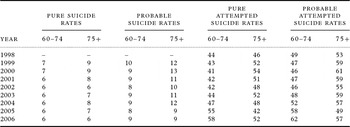
Table 1 illustrates the rates of the two categories of suicide and attempted suicide for each study year. There was no significant change in “pure suicide” rates over the nine-year study period in the age-band 60–74 and 75+ (ρ = −0.67, P = 0.071) years. There was a significant decline in “probable suicide” rates over the study period in the 75+ (ρ = −0.81, P = 0.015) years and this relationship approached statistical significance in the age-bands 60–74 (ρ = −0.69, P = 0.058).
Rates of suicide and attempted suicide using both definitions (per 100,000 population)

There was a significant increase in the rates of “pure attempted suicide” (ρ = +0.73, P = 0.025) and “probable attempted suicide” (ρ = +0.67, P = 0.05) over the nine-year study period in the age-band 60–74 years. There was no significant change in the rates of “pure attempted suicide” and “probable attempted suicide” over the nine-year study period in the age-band 75+ years. The median (range) for the ratio of “pure attempted suicide” rates to “probable attempted suicide” rates across the nine study years in the age-bands 60–74 and 75+ years were 0.69 (0.67–0.7) and 0.88 (0.84–0.91) respectively.
There was no significant correlation between: rates of “pure attempted suicide” and “pure suicide” and “probable attempted suicide” and “probable suicide” in the age-band 60–74 years; and, rates of “pure attempted suicide” and “pure suicide” in the age-band 75+ years. There was a positive correlation between rates of “probable attempted suicide” and “probable suicide” in the age-band 75+ years (ρ = +0.83, P = 0.01).
Discussion
Before discussing the results, some methodological issues require consideration. The accuracy of the nationally collected hospital episode statistics is unclear because the data are collected via the patient administration systems in nearly 400 hospitals and data collected from such a large number of hospitals may be of variable quality. The hospital episode statistic does not include those individuals with attempted suicide who would have been medically resuscitated by their general practitioner or in the accident and emergency unit and who would not have been admitted into hospital. There were only nine data points in terms of study years and this small number may lead to type 1 or type 2 statistical errors; small numbers may lead to a genuine association that is missed (type 1) or may falsely demonstrate an association when one is absent (type 2). However, the absence of an association does not necessarily indicate that there is no trend over time. Data on admission for medical resuscitation for attempted suicide were only available for a nine-year period, but suicide rates in the elderly in England and Wales have been observed to decline for a longer time period (Hoxey and Shah, Reference Hoxey and Shah2000; Shah et al., Reference Shah, Elanchanny and Collinge2001; Shah and Coupe, Reference Shah and Coupe2009). Data on attempted suicides were available for both sexes combined and only for the broad age-bands 60–74 years and 75+ years. Thus, more refined impact of gender and narrower age-bands was not examined. As data on suicides for England only were not available, data on suicides for England and Wales were used; however, as the elderly population of England is significantly higher than that of Wales, elderly suicide rates in England are likely to have made a significant contribution to the elderly suicide rate for England and Wales (Lodhi and Shah, Reference Lodhi and Shah2004; Reference Lodhi and Shah2005; Shah and Coupe, Reference Shah and Coupe2009). Some deaths with an open verdict may not be suicides (Dennis et al., Reference Dennis, Read, Andrews, Wakefield, Zafar and Kavi2001). Hospital admission for attempted suicide was used as a proxy for prompt and successful resuscitation of those who attempted suicide. This is likely to be reasonably accurate because if the individuals with attempted suicide were not resuscitated then they were likely to have died and so would not be classified in the two categories of attempted suicide and would have been classified in the two categories of suicide. Moreover, other studies of attempted suicide generally use referral or presentation of attempted suicides in general hospital as their sampling frame (Hawton and Fagg, Reference Hawton and Fagg1990). Nevertheless, the best and latest available national data were used.
The observed decline over the nine-year study period in the “probable suicide” rates in both the elderly age-bands and a trend towards decline in the “pure suicide” rate in the 75+ years age-band are consistent with previous reports from the U.K. (Shah, Reference Shah2007; Shah et al., Reference Shah, Bhat, MacKenzie and Koen2008; Shah and Coupe, Reference Shah and Coupe2009) and England and Wales (McClure, Reference McClure2000; Hoxey and Shah, Reference Hoxey and Shah2000; Shah et al., Reference Shah, Elanchanny and Collinge2001; Pritchard and Hansen, Reference Pritchard and Hansen2005; Shah and Coupe, Reference Shah and Coupe2009). The observed absence of a significant decline over the study period in the “pure suicide” rates in both the elderly age-bands may have been an artifact of the methodological issues described above and because the strict definition of “pure suicide” may have excluded genuine suicides, which would have been classified under open verdicts (Dennis et al., Reference Dennis, Read, Andrews, Wakefield, Zafar and Kavi2001).
There was an increase over the nine-year study period in the rates of both “pure attempted suicide” and “probable attempted suicide” in the age-band 60–74 years. This confirmed the first unidirectional study hypothesis for this age-band and thus may be genuine. However, the absence of a significant correlation between rates of both definitions of attempted suicides and both definitions of suicides in the age-band 60–74 years did not confirm the second unidirectional study hypothesis. This inconsistency in the findings may have been an artifact of methodological issues described above.
The absence of any significant change over the study period in the rates of “pure attempted suicide” and “probable attempted suicide” in the age-band 75+ years failed to confirm the first unidirectional study hypothesis for this age-band. This may have been an artifact of the methodological issues described above. Alternatively, this finding may be genuine. The latter assertion is supported by the rejection of the second unidirectional study hypothesis for the age-band 75+ where there was a positive correlation between rates of “probable attempted suicide” and “probable suicide”. Although this observation may also have been an artifact of the methodological issues described above, other potential explanations require consideration. First, other factors may have simultaneously influenced rates of attempted suicide and suicide in the same direction. For example, the various public health initiatives described in the Introduction may have contributed to simultaneous reduction in both rates of attempted suicide and suicide. Second, rates of attempted suicide may influence suicide rates in different directions in different age-bands and gender; there was a decline in rates of attempted suicide in the younger age-band of 60–74 years, but the influence of gender was not examined as data were available for both sexes combined.
The findings of this study were unable to confirm conclusively that prompt and successful medical resuscitation of those who attempt suicide makes a contribution to the decline in elderly suicide rates. This may have been an artifact of methodological issues described earlier. However, there is a need to further investigate this both nationally and locally in well-defined geographical health areas. This is important because reduction in elderly suicide rates should primarily result from improvement in the prevention of mental illness and suicidal behavior, early identification and treatment of those with mental illness and those at risk of suicide, and systematic follow-up of those recovering and recovered from mental illness rather than be the result of better and prompt medical resuscitation of those who attempt suicide. Although the latter is important, all suicide prevention public health initiatives should aim not only to reduce suicide rates but also to reduce rates of attempted suicide; otherwise they are failing in the prevention of mental illness and suicidal behavior, early identification and treatment of those with mental illness and those at risk of suicide, and systematic follow-up of those recovering and recovered from mental illness – all of which lead to both attempted suicide and suicide. This is particularly important as it has been argued that elderly suicide attempters often have high intent to commit suicide but have fortuitously survived (Shah and De, Reference Shah and De1998).
Conflict of interest
None.