

INTRODUCTION
In the Philippines, which lies within the world centre of coral reef and marine biodiversity (Carpenter & Springer Reference Carpenter and Springer2005) and is the most anthropogenically threatened marine region (Roberts et al. Reference Roberts, McClean, Veron, Hawkins, Allen, McAllister, Mittermeier, Schueler, Spalding, Wells, Vynne and Werner2002), coral reefs support around 20% of total marine fisheries production (Alcala & Russ Reference Alcala and Russ2002). Fish provide 67% of the protein requirements of Filipinos and the livelihood basis for 5–6 million Filipinos (Barut et al. Reference Barut, Mijares, Subade, Armada, Garces, Silvestre, Garces, Stobutzki, Ahmed, Valmonte Santos, Luna, Lachica-Alino, Munro, Christensen and Pauly2003). With more than one million municipal fishers (vessels ≤ 3 gross tonnes [GT]) overexploiting and degrading the habitat of shallow marine waters, the potential annual fishery production of Philippine coral reefs of 350 000 tonnes (t) was reduced to 177 500 t by the 1990s (Alcala & Russ Reference Alcala and Russ2002; Barut et al. Reference Barut, Santos and Garces2004). The coral reef fishery footprint of the Philippines is among the highest of any island nation (Newton et al. Reference Newton, Cote, Pilling, Jennings and Dulvy2007).
Many fisheries of developing island nations are already overexploited (Newton et al. Reference Newton, Cote, Pilling, Jennings and Dulvy2007), and have little resilience to climate change (Munday et al. Reference Munday, Jones, Pratchett and Williams2008); 133 local, regional and global extinctions of marine populations have occurred, mostly owing to overexploitation and habitat loss (Dulvy et al. Reference Dulvy, Sadovy and Reynolds2003). About 50 coral reef fishes are listed as threatened, and these make up 60% of all marine fish species assessed according to the World Conservation Union criteria (Sadovy Reference Sadovy2005). In the Philippines, particularly in Manila Bay, turbots and lactarids disappeared from trawl surveys between 1947 and 1993, and there were substantial declines in the abundance of large commercially-valuable species like snappers, sea catfish and Spanish mackerels (Armada Reference Armada2004). Yet no study has focused on local disappearances of finfish species from Philippine island reef fisheries over long periods of time (Maypa et al. Reference Maypa, Russ, Alcala and Calumpong2002; Haggan et al. Reference Haggan, Neis and Baird2007).
Detecting biodiversity changes is problematic since long time series data are scarce (Polunin et al. Reference Polunin, Gopal, Graham, Hall, Ittekkot, Muhlig-Hofmann and Polunin2008). Whatever the scale, the average reported date of extinctions has lagged 53 years behind the last sighting of an organism (Dulvy et al. Reference Dulvy, Sadovy and Reynolds2003). Most disappearances were detected using indirect historical comparative methods; marine extinctions may have been underestimated because of low-detection power (Dulvy et al. Reference Dulvy, Sadovy and Reynolds2003). The threat status especially of reef fishes has not been comprehensively surveyed owing mainly to the magnitude of the task (Dulvy et al. Reference Dulvy, Jennings, Rogers and Maxwell2006), including the multigear and multispecies nature and landings typically scattered across many landing sites (Russ Reference Russ and Sale1991; Sadovy Reference Sadovy2005).
There is an urgent need to fill the information gap in data-poor situations. Alternative information sources such as fishers’ knowledge may provide data on temporal catch trends (Johannes Reference Johannes1998; Neis et al. Reference Neis, Schneider, Felt, Haedrich, Fischer and Hutchings1999; Camirand et al. 2001). Such ‘traditional ecological knowledge’ has in combination with other data demonstrated the declining status of the Chinese bahaba (Bahaba taipingensis; Sadovy & Cheung Reference Sadovy and Cheung2003), revealed the local disappearance in Fiji of giant bumphead parrotfish (Bolbometopon muricatum; Dulvy & Polunin Reference Dulvy and Polunin2004) and led to the conservation status of Gulf grouper (Mycteroperca jordani) being reassessed in the Gulf of California (Saenz-Arroyo et al. Reference Saenz-Arroyo, Roberts, Torre, Carino-Olvera and Enriquez-Andrade2005). Fishers’ perceptions of recent changes in the eastern English Channel agree well with fishery and bottom-trawl survey data (Rochet et al. Reference Rochet, Prigent, Bertrand, Carpenter, Coppin, Delpech, Fontenelle, Foucher, Mahe, Rostiaux and Trenkel2008). Long-term records are embedded within traditional ecological knowledge accumulated throughout fishing careers (Dulvy & Polunin Reference Dulvy and Polunin2004; Rochet et al. Reference Rochet, Prigent, Bertrand, Carpenter, Coppin, Delpech, Fontenelle, Foucher, Mahe, Rostiaux and Trenkel2008) and across generations (Berkes & Turner Reference Berkes and Turner2006; Haggan et al. Reference Haggan, Neis and Baird2007).
A framework and context for validation (Bernard et al. Reference Bernard, Killworth, Kronenfeld and Sailer1984) and further interpretation of traditional ecological knowledge may be offered by finfish life history characteristics and their correlates, particularly maximum body size (Lmax), in view of their close relationship with vulnerability to depletion. Theoretical and empirical analyses show that large-bodied, slow-growing and late-maturing species are more vulnerable to depletion than smaller species (Jennings et al. Reference Jennings, Reynolds and Mills1998, Reference Jennings, Greenstreet and Reynolds1999a, Reference Jennings, Reynolds and Poluninb; Reynolds et al. Reference Reynolds, Jennings, Dulvy, Reynolds, Mace, Redford and Robinson2001, Reference Reynolds, Dulvy, Goodwin and Hutchings2005). Life history and ecological traits may be used to determine the threat status of fish species (Cheung et al. Reference Cheung, Pitcher and Pauly2005, Reference Cheung, Watson, Morato, Pitcher and Pauly2007).
This paper is an analysis of Philippine reef-associated and pelagic species that disappeared from catches over the period 1950–2007. Specifically, this paper aims to examine species that disappeared from the catch (1950–2007) and their qualitative relationships with Lmax, growth (k), age at first maturity (Tmat), ecology, behaviour and type of fisheries involved.
METHODS
Study sites
Pamilacan Island is a low (50 m) coralline island of 135 ha, located approximately 10 km south of the town of Baclayon on southern Bohol Island (Philippines). The island's fringing coral reef (1.80 km2 to the 20 m isobath) is mostly flat and gradually sloping (Walmsley & White Reference Walmsley and White2003). There are 242 households on the island, with a total human population of 1258, including 152 motorized and 73 non-motorized fishers (MAO [Municipal Agriculture Office], unpublished data 2007). Whale shark (Rhincodon typus) and manta ray (Manta birostris) fisheries were the main source of income until 1999, when a national law was introduced to ban such exploitation (DA-BFAR [Department of Agriculture, Bureau of Fisheries and Aquatic Resources] 1998). Reef fishing and gleaning remain a primary source of food and livelihoods (Christie et al. Reference Christie, White and Deguit2002).
Balicasag Island is a 22 ha low coralline island, with a fringing reef area of about 0.3 km2 to the 25 m isobath (Walmsley & White Reference Walmsley and White2003). The island is under the jurisdiction of the village of Poblacion, town of Panglao and south of Bohol island in Central Philippines, and has a total population of 1095 (Health Center, unpublished data 2007). Tourism and fishing are the main sources of income on Balicasag (Walmsley & White Reference Walmsley and White2003).
Interview protocol
We prepared a protocol for semi-structured interviews adapted from ideas put forward by Neis et al. (Reference Neis, Schneider, Felt, Haedrich, Fischer and Hutchings1999) and Rochet et al. (Reference Rochet, Prigent, Bertrand, Carpenter, Coppin, Delpech, Fontenelle, Foucher, Mahe, Rostiaux and Trenkel2008). Questions related to the fisheries context and specifically to disappearances of finfish species from the catch. In this study, a finfish species was considered to have disappeared when all those fishers targeting a particular species in the study area consistently reported zero catches. The major questions after those relating to demography first placed the reef fisheries in context and then covered species that disappeared from the catch. To place reef fisheries in context, we asked (1) Which is your main fishing gear, the one you are most familiar with and use the most? (2) Which types of fish were you hoping to catch using this fishing gear (target species)? (3) Which types of fish were you able to catch in at least two out of four fishing trips? (4) Has there been change in the kind of gear that you use since you started fishing? When was the gear change? What was the gear change? Why did the gear change occur? (5) What is the minimum number of kilograms of fish per day you would fish that is not worth you going fishing, and you would go and do something else instead? To discover which species had disappeared we asked (1) What are the types of fishes that were previously common but are no longer caught? (2) When did you start to have zero catches of these species in the following decades: 1950s; 1960s, 1970s; 1980s; 1990s; 2000; 2007? (3) When (1950s; 1960s; 1970s; 1980s; 1990s; 2000s; 2007) and how great were the previous catches in kilograms per day of these species?
Fisher interviews
Two hundred and fifty-two fishers were interviewed at Pamilacan in April and May 2007, and 152 fishers in May and June 2007 at Balicasag. Every household was approached and every fisher in the household interviewed, guided by a population census list obtained from the municipal local government. In Pamilacan, a total of 236 respondents were included in the analysis. Sixteen respondents were excluded, either because they were catching only manta and sting rays or shellfish, or were using bubo (a type of fish pot), or were doing other full-time jobs (such as resort crew staff, whaleshark and dolphin spotters/boat operators, livestock raisers) or were full-time students who had little history of fishing. Similarly, at Balicasag, a total of 140 respondents were included in the analysis and 12 were excluded because they were doing other full-time jobs (such as resort crew staff, tourist guides or dive masters) or were full-time students. There were 74 fishers at Pamilacan and 12 at Balicasag who were able to answer questions about species disappearing in the catch. Interviewees from both communities were usually middle aged (34–53 years) and older (≥ 54 years) fishers. The rest of the interviewees (162 at Pamilacan and 128 at Balicasag) were unable to pinpoint these species as disappearing because the species that disappeared in the catch mentioned by other fishers and described in this paper were not their target species and thus they did not perceive that any species had disappeared from their catches. Moreover, those that did not perceive any species disappearance in the catch were mostly young fishers (between 15 and 33 years old; 60% in Pamilacan and 45% in Balicasag), who have relatively fewer years of experience of fishing compared to those fishers that identified disappeared species in the catch (fishers between 34 and 72 years old). We used photographs from a field guide (Allen et al. Reference Allen, Strenl, Humann and Delrach2003) to establish fishers’ local finfish names with the corresponding taxonomic names at family, genus and/or species levels. We asked all the interviewees who targeted these species to identify the disappearing species in the field guide. The interviewees included in the analysis were using either hook-and-line or gill nets or both as their fishing gear(s).
Statistical analysis
Catch per unit effort trends for species that disappeared from the catch
We analysed the daily trends (1950–2007) of catch per unit effort (CPUE) for finfish species disappearing from the catch based on fisher interviews using generalized least squares following model selection by ANOVA and Akaike Information Criteria (AIC). AIC and ANOVA tests were used to select models with and without random effect and auto-autocorrelation. Model selection favoured generalized least squares without auto-correlation. Significance at α = 0.05 and homogeneity by graphical model validation were adopted as the criteria for terms to be kept in the minimal model (Zuur et al. Reference Zuur, Ieno and Smith2007, Reference Zuur, Ieno, Walker, Saveliev and Smith2009).
Qualitative assessment of finfish species that disappeared in the catch
We made a qualitative assessment of species that disappeared from the catch by comparing among species using life history traits such as Lmax, k, Tmat, habitat preferences and ecological behaviour based on Fishbase (Froese & Pauly Reference Froese and Pauly2008). We compared life history traits of disappeared species and other target species with regular catches. In this paper, finfish species in the regular catch are those caught in at least two out of four fishing trips by > 50% of the fishers.
Lmax is observed maximum body size in a population. The rate of growth is derived from the von Bertalanffy growth equation,  , where Lt is the length at age t and t o is the time at which length is zero on the modelled growth trajectory, k is the instantaneous growth coefficient and L∞ is the theoretical asymptotic size. Growth is routinely modelled using length data. Age at first maturity (Tmat) is usually assumed to be the age at which 50% of individuals in the population attain maturity, and is calculated from the length at first maturity using the inverse of the von Bertalanffy growth function: Tmat = t0 − ln(1 − Lm/Linf)/k (Appeldoorn Reference Appeldoorn, Polunin and Roberts1996; Jennings et al. Reference Jennings, Kaiser and Reynolds2001; Froese & Pauly Reference Froese and Pauly2008).
RESULTS
Reef fisheries in context
Fishing gears
At Pamilacan, 137 (58.1%) fishers considered hook-and-line, 57 (24.2%) considered gill net and 16 (6.8%) considered spears as the fishing gear with which they were most familiar and which they used the most; the remaining 26 (11%) were undecided, often using both hook-and-line and gill net equally. There were only five fishers who indicated they had changed fishing gears owing to loss of boat, high cost of fuel, no money to replace gill nets and physical exhaustion from spearing.
At Balicasag, 77 fishers (55%) considered hook-and-line, 33 (23.6%) gill nets and 23 (16.4%) spears their main gear, and the remaining 7 (5%) were undecided, often using both hook-and-line and gillnet equally. There were only five fishers who indicated they had changed fishing gears owing to loss of other gears, more profitability other gears and physical exhaustion from spearing.
Target fishes
At Pamilacan and Balicasag, all fishers considered reef finfish (for example acanthurids) their primary target fish. Sixty-three (35%) of the fishers at Pamilacan and 81 (58%) at Balicasag also caught commercially non-target finfish (such as pomacentrids). Pelagics (for example tuna and mackerel) werealso targeted by 113 (48%) Pamilacan fishers and 43 (31%) Balicasag fishers. Respondents thus targeted combinations of target reef finfish, non-target reef finfish and pelagics, or caught target reef finfish only.
Importance of reef fisheries in subsistence
When asked to assess the level of catch that meant it was not worth going fishing and more worthwhile to do an alternative activity, 100 (42.9%) of the 233 Pamilican respondents indicated 0 kg (mean 1.29 kg, mode 0), while, at Balicasag, 91 (65%) of the 140 respondents indicated 0 kg (mean 1.2 kg, mode 0). Thus, fishers would still try again even if there were no catch in the previous fishing trips, primarily because they still required fish for their own consumption.
Finfish species that had disappeared from the catch
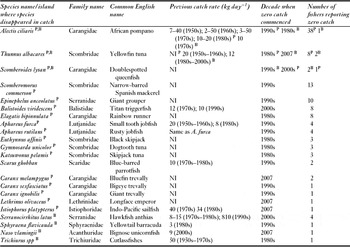
At least one of five finfish species (Thunnus albacares [n = 8], Elagatis bipinnulata [n = 8], Euthynnus affinis [n = 3], Gymnosarda unicolor [n = 3] and Katsuwonus pelamis [n = 3]) were mentioned by 25 fishers as missing from catches since the 1980s at Pamilacan (Table 1). Sixty-three fishers reported not having caught at least one of seven finfish species (Alectis ciliaris [n = 38], Scomberomorus commerson [n = 13], Aphareus furca [n = 4], Aphareus rutilans [n = 4], Scarus ghobban [n = 2], Caranx sexfasciatus [n = 1] and Caranx ignobilis [n = 1]) since the 1990s. Some fishers had not caught Alectis ciliaris (n = 17) since the 1960s–1980s, Scarus ghobban (n = 2) since the 1970s–1980s and Aphareus furca (n = 1) and Aphareus rutilans (n = 1) since the 1980s at Pamilacan (Table 1).
Species missing from catch identified by family and common English names, previous catch rates, decade when zero catches commenced and the number of fishers who reported zero catches, based on fisher interviews (n = 74) at Pamilacan (P) and Balicasag (B). Fishers may be counted more than once; NI = not indicated.
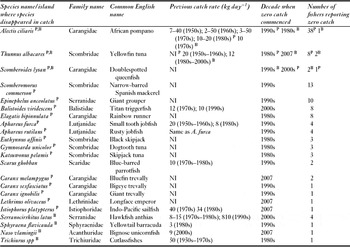
At least one of two finfish species at Pamilacan (Balistoides viridescens [n = 8] and Scomberoides lysan [n = 1]) were mentioned by fishers as being missing from catches since the 2000s while Lethrinus olivaceus (n = 1), Istiophorus platypterus (n = 1) and Caranx melampygus (n = 2) were indicated by fishers as not having been caught since 2007 (Table 1).
For Balicasag, Alectis ciliaris was rarely caught in the 1970s (n = 1) and missing from catches since the 1980s (n = 1). Trichiurus spp were abundant 1950s–1970s (n = 1) but were missing from the catches by the 1980s (n = 1). Sphyraena flavicauda (n = 1) and Scomberoides lysan (n = 2) were mentioned as missing from catches since the 1990s, Serranocirrhitus latus since the 2000s (n = 4) and Naso vlamingii (n = 1) and Thunnus albacares since 2007. S. latus had been rarely caught since the 1990s (n = 4), Thunnus albacares rarely caught since the 1980s (n = 2) and Sphyraena flavicauda since the 1980s (n = 1), while Naso vlamingii had been abundant until 2000 (n = 1) (Table 1).
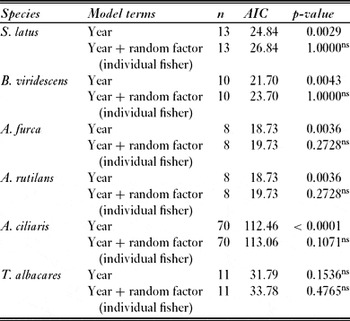
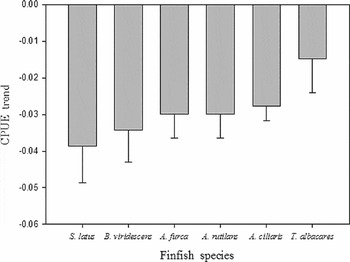
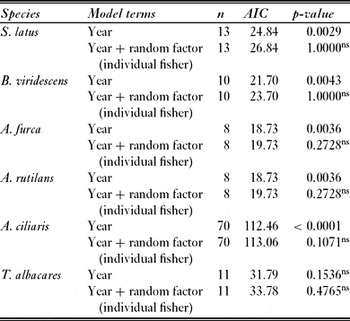
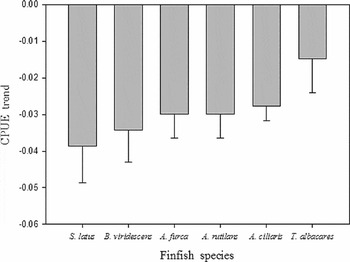
We incompletely documented previous catches of species that had disappeared from the catch, as interview questions on previous catches were not present in the original questionnaire and only included during the second week of data gathering at Pamilacan, except for A. ciliaris and Aphareus spp. Only three Pamilacan and three Balicasag species provided sufficient data to statistically test temporal trends. ANOVA and AIC tests showed that GLS models were better than those with random effect (individual fisher) (Table 2). At Balicasag, S. latus showed the most negative CPUE trend and therefore the steepest decline, followed by B. viridescens at Pamilacan (Fig. 1).
Comparison of candidate models (generalized least squares and linear mixed models) for some species that disappeared from the catch; n = number of observations; AIC = Akaike information criterion; ns = not significant.
Histogram of catch per unit effort (CPUE) trend (mean change between 1950 and 2007 ± SE) of six finfish species that disappeared from the catch based on fisher interviews at Pamilacan and Balicasag.
The Carangidae family had the most disappeared species (n = 6) followed by Scombridae (n = 5). Serranidae and Lutjanidae each had two disappeared species, while the rest of the families (Balistidae, Scaridae, Lethrinidae, Istiophoridae, Sphyraenidae and Acanthuridae) each had one (Table 1). Disappeared species had a range of habitat preferences, including reef-associated and site-attached (n = 7), reef-associated and roving (n = 9) and pelagic (n = 5) (Table 3).
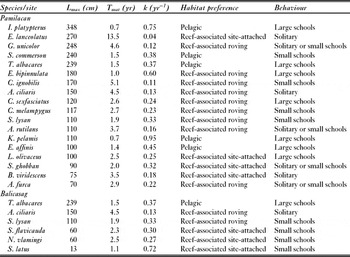
Life history traits, habitat preferences and behaviour (Froese & Pauly Reference Froese and Pauly2008) of fishes that disappeared from the catch, based on fisher interviews at Pamilacan and Balicasag.
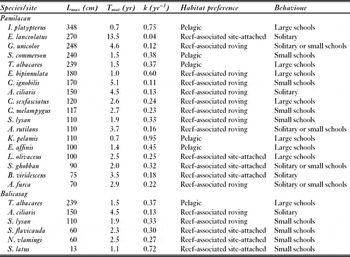
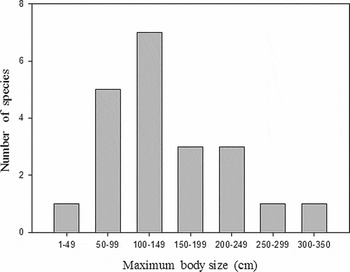
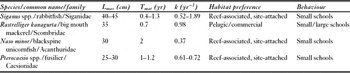
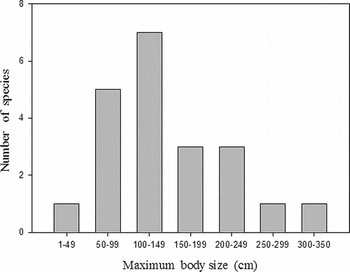
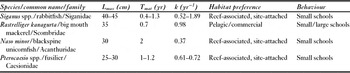
Twelve of the species no longer caught at Pamilacan and Balicasag had a Lmax range of 110–348 cm total length (TL), while seven had an Lmax range of 60–100 cm TL, the only exception being the aquarium species S. latus (Table 3). The Lmax range of those species in the regular catch was 30–45 cm (Table 4). The maximum body size range 100–149 cm has the highest number of disappeared species (n = 7) followed by the range 50–99 cm (n = 5 disappeared species) (Fig. 2). Fifteen of the reef-associated species that had disappeared in the catch had a Tmat range of 1–13.5 years compared with 0.7–1 year in the five pelagic species and 0.4–2 years in the regular catch (Table 4). Reef-associated species that had disappeared in the catch had a k range of 0.04–0.06 yr−1, with the exception of S. latus (0.72 yr−1; Table 3). Species in the regular catch had a k range of 0.37–1.89 yr−1 (Table 4).
Histogram of numbers of species that disappeared from the fish catch at Pamilacan and Balicasag against maximum body size interval.
Life history traits, habitat preferences and behaviour (Froese & Pauly Reference Froese and Pauly2008) of species in the regular catch at Pamilacan and Balicasag.
Fourteen of the disappeared species form large (n = 7) or small (n = 7) schools, while four were either solitary or form small schools. Only three species were solitary in nature (Table 3).
It should be noted with caution that eight of 21 species that disappeared in the catch were identified by only one fisher for each of the species. Other species were identified as disappearing by 2–38 fishers targeting these species.
Twenty-four fishers from Pamilacan and 11 fishers from Balicasag identified tulingan as missing from catches since the 1990s and 2000s, respectively. Tulingan is a generic local term for tuna and tuna-like fishes, such as, but not limited to, Thunnus albacares, Euthynnus affinis and Katsuwonus pelamis.
There were 10 fish that Pamilican fishers reported as missing from the catch by their local names, but were unable to match to field guide photographs, so their scientific names or common English names remain unknown. Fishers identified these 10 fish (with the corresponding numbers of fishers considering them as missing from catches in parenthesis), as: buwan (5), bakay (5), kutob (2), panapsapan (1), lambo (1), gaungon (1), tabugok (1), bagsawan (1), abakay (1) and tamarong (1).
DISCUSSION
This is the first inventory of finfish species that have disappeared from the catch based on traditional ecological knowledge in a small densely-populated island reef fishery setting, and interpreted within the framework of finfish life history, ecology, behaviour and exploitation vulnerability (Russ & Alcala Reference Russ and Alcala1998; Maypa et al. Reference Maypa, Russ, Alcala and Calumpong2002; Haggan et al. Reference Haggan, Neis and Baird2007).
Among the species that had disappeared, Alectis ciliaris merits more attention because it was found to be no longer caught by 51% of the Pamilacan fishers; it has a strong negative CPUE trend of -0.02774 for 1950–1990 with zero catch for all fishers in Pamilacan beginning in the 1990s and a distinctive set of life history traits indicating inherent vulnerability to depletion, including large size. It also has one of the lowest growth coefficients and one of the greatest ages of maturation among those species no longer caught (Table 3). A. ciliaris shares ‘very high’ intrinsic vulnerability only with E. bipinnulata and G. unicolor, yet it was not evaluated under the IUCN (World Conservation Union) Red List system (Froese & Pauly Reference Froese and Pauly2008). The IUCN Red List (IUCN 2007) has not created a group of assessors or evaluators for carangids, yet there were six carangids among the 21 species that disappeared from the catch at Pamilacan and Balicasag (Table 3).
Another species of concern is Epinephelus lanceolatus, which 10 fishers identified as being missing from catches since the 1990s. This is the largest reef-dwelling finfish in the world (Gomon et al. Reference Gomon, Glover and Kuiter1994), it is rare even in unfished areas (Randall & Heemstra Reference Randall and Heemstra1991) and has nearly been extirpated in heavily fished areas (Lieske & Myers Reference Lieske and Myers1994). At Pamilacan, depletions may be a consequence of focused local fishing activity by some fishers, especially prior to 2000. E. lanceolatus is among the grouper species most targeted for the live reef fish food trade (LRFFT) focused on South-east Asia, especially by China and Chinese communities overseas (Sadovy et al. Reference Sadovy, Donaldson, Graham, McGilvray, Muldoon, Phillips, Rimmer, Smith and Yeeting2003). E. lanceolatus has very slow growth and is particularly vulnerable to depletion (Musick Reference Musick1999; Shuk Man & Ng Wai Chuen Reference Shuk Man and Chuen2006), and there is little chance of giant individuals reappearing in unprotected areas (Myers Reference Myers1999).
It is worth noting that a reef finfish species may also be depleted by focused fishing regardless of life history, as in the case of the aquarium species Serranocirrhitus latus, identified by four fishers as missing from catches since the 2000s. It has the steepest CPUE decline of all the species.
The urgency of addressing species missing from catches was highlighted by the failure to identify the 10 fish local names considered as no longer caught in the finfish field guide; the corresponding scientific and common English names remain unknown. This may be because these fishes were omitted from the field guide or had not yet been described or otherwise identified scientifically before their disappearance, except by local fishers. Finding and identifying these species is a vital task, and there may be many more such ‘unknown’ disappearing species embedded in traditional ecological knowledge in other island fisheries for which scientific information is currently unavailable.
Further, with 24 fishers from Pamilacan and 11 fishers from Balicasag identifying tuna and tuna-like fishes (tulingan) as no longer caught, further monitoring of these species may be necessary.
In general, life history traits, particularly maximum body size, seem to be good indicators of vulnerability to population declines (Jennings et al. Reference Jennings, Reynolds and Mills1998, Reference Jennings, Greenstreet and Reynolds1999a, Reference Jennings, Reynolds and Poluninb; Russ & Alcala Reference Russ and Alcala1998; Musick Reference Musick1999; Reynolds et al. Reference Reynolds, Jennings, Dulvy, Reynolds, Mace, Redford and Robinson2001, Reference Reynolds, Dulvy, Goodwin and Hutchings2005; Denney et al. Reference Denney, Jennings and Reynolds2002; Dulvy et al. Reference Dulvy, Sadovy and Reynolds2003, Reference Dulvy, Ellis, Goodwin, Grant, Reynolds and Jennings2004; Cheung et al. Reference Cheung, Pitcher and Pauly2005, Reference Cheung, Watson, Morato, Pitcher and Pauly2007). Of species that disappeared in the catch (1950–2007), 15 out of 21 are large to very large bodied (Lmax 100–348 cm TL), five out of 21 are medium sized (Lmax 50–99 cm TL), six out of 21 are slow growing (0.04–0.18 yr−1) and four out of 21 late maturing (4.5–13.5 years). The empirical evidence is that the large body size and late maturity are the best predictors of vulnerability to fishing, regardless of whether differences among taxa in fishing mortality are controlled; there is no evidence that high fecundity confers increased resilience (Reynolds et al. Reference Reynolds, Dulvy, Goodwin and Hutchings2005) This is not only because large-bodied fishes are usually targeted most heavily due to their high value and catchability (Jennings et al. Reference Jennings, Kaiser and Reynolds2001), but also because large bodied fishes tend to have advanced ages at maturity, and hence their populations have low values of r (Myers et al. Reference Myers, Mertz and Powlow1997; Denney et al. Reference Denney, Jennings and Reynolds2002; Reynolds et al. Reference Reynolds, Dulvy, Goodwin and Hutchings2005). Further, meta-analysis of 54 stock-recruitment time series showed that large late-maturing fishes had strong density-dependence at low abundance but high maximum recruitment when unexploited (Goodwin et al. Reference Goodwin, Grant, Perry, Dulvy and Reynolds2006).
The importance of life history traits and its correlates, particularly Lmax, is highlighted when body sizes are compared between species that disappeared from the catch and those species in the regular catch; in the former range body size is 60–348 cm TL, while in the latter group body size is 25–45 cm TL.
Ecology and behaviour constitute another important link to fish population decline. For example, the tendency to gather into large easily-fished spawning aggregations results in greater risk of population depletions (Reynolds & Jennings Reference Gosling and Sutherland2000; Sadovy & Vincent Reference Sadovy, Vincent and Sale2002; Sadovy et al. Reference Sadovy, Donaldson, Graham, McGilvray, Muldoon, Phillips, Rimmer, Smith and Yeeting2003). Further, those species that have low dispersal capability and a small range are most impacted when faced with a reduction in carrying capacity owing to habitat loss (Reynolds et al. Reference Reynolds, Dulvy, Goodwin and Hutchings2005; Morris et al. Reference Morris, Callum and Hawkins2000). Of the species that disappeared from the catch, seven out of 21 are reef-associated and site attached, while 14 out of 21 form either large or small schools. However, a range of lifestyles and ecologies were shown by other species that disappeared from the catch; nine out of 21 are reef-associated and roving, while five out of 21 are pelagic and oceanodromous. This may be linked to the type of fisheries where most of these species belong. Reef-associated and roving (for example C. ignobilis) and pelagic (for example K. pelamis) species that form easily-targeted schools are usually targeted not only by municipal fishers (with vessels ≤ 3 GT), but intensely fished by commercial fishers (with vessels ≥ 3 GT). In fact, National Stock Assessment Programme (NSAP) data (BFAR, unpublished data 2002) show municipal and commercial fishers targeted 13 out of 21 species that disappeared from the catch.
While this study focuses on the role of life history and its correlates, particularly maximum body size and ecology and behaviour as indicators of vulnerability of reef finfish species to depletion, fishing pressure was an extrinsic factor in depletion. Continued growth in the fisher population in the fishing village side of Pamilacan was putting increasing pressure on the fisheries of Pamilacan, exacerbated by the relative importance of fisheries in subsistence and household income. That 100 out of 233 fishers at Pamilacan still continued to fish for food even if there were zero catches in previous fishing trips, highlights the dependence of the population on fisheries for subsistence. In the Philippines, as in many fisheries, there is almost no economic constraint on effort. The fishing gears are simple and inexpensive, and the opportunity cost of a fisher's labour is close to zero. The possibility of a decent catch, however remote, is sufficient incentive for unremitting exploitation of the resources (Munro Reference Munro, Polunin and Roberts1996; McManus Reference McManus1997).
Balicasag differed from Pamilacan in various ways: there were 65 registered fishers compared to the 225 at Pamilacan, 29% dependence on fishing compared to 39% at Pamilacan and historically the reefs at Balicasag are better than at Pamilcacan (White et al. Reference White, Stockwell, Meneses, Ovenden, Tesch, Apurado and White2003, Reference White, Stockwell, Meneses, Ovenden, Tesch, Apurado and White2007; FPE [Foundation for Philippine Environment] 2004). These differences may explain why Balicasag had fewer species that disappeared from the catch. Further, with the establishment of a resort by the Philippine Tourism Authority at Balicasag in 1992, fishers began to shift from fishing to tourism for livelihoods (M. N. Lavides, D.G. Tabaranza, M.T. Comeros and J.R. Dongallo, unpublished data 2007). In contrast to Pamilacan, where more young fishers were entering the fishery than leaving (Pido et al. Reference Pido, Valentine and Fenton2001), at Balicasag, more young people depended on tourism (for example becoming tourist guides or mask boys) for their income.
Species may no longer be caught, not because they disappeared, but because fisher preferences and fishing practices have changed. However, interviews showed that fishers at Pamilacan and Balicasag did not change target species through time until they consistently obtained zero catches. Change of gear was unlikely to be the cause of species not being caught, because only five fishers indicated such change through the years, without necessarily losing the potential of the gear to catch the same target species.
Coral cover changes are also an unlikely reason for species disappearances. Balicasag coral cover increased from 1985 to 2007 while Pamilacan coral cover remained stable (White et al. Reference White, Stockwell, Meneses, Ovenden, Tesch, Apurado and White2003, Reference White, Stockwell, Meneses, Ovenden, Tesch, Apurado and White2007). Balicasag's current total mean coral cover is 70% in the sanctuary and 41.9% in non-sanctuary areas, and in Pamilacan it is 36.8% in sanctuary and 15.1% in non-sanctuary areas (White et al. Reference White, Stockwell, Meneses, Ovenden, Tesch, Apurado and White2003, Reference White, Stockwell, Meneses, Ovenden, Tesch, Apurado and White2007). However, it is possible that habitat degradation occurred before the monitoring period started, as reefs in the area, particularly in Pamilacan, showed evidence of historical destruction (SU-MDCP [Silliman University Marine Conservation and Development Programme] 1985; Green et al. Reference Green, White, Flores, Carreon III and Sia2003).
An understanding of the pattern and process of vulnerability of reef-associated fisheries to depletion can contribute to the prioritization of species for fisheries and conservation assessments (Reynolds et al. Reference Reynolds, Dulvy, Goodwin and Hutchings2005). In the Philippines, despite the glaring overexploitation and habitat destruction, excepting seahorses (Project Seahorse, see URL http://www.seahorse.fisheries.ubc.ca), none of the 915 reef fish species (Licuanan & Gomez 2002) have been assessed nationally or locally as to their conservation status. Though there are conventional species-specific fisheries assessments of a few major pelagic commercial species (Armada Reference Armada2004; BFAR, unpublished data 2002) conservation and fishery restrictions are only afforded to marine mammals and reptiles and, to a certain extent, seahorses (Alava & Cantos Reference Alava and Cantos2004), but not to reef-associated finfish species. Section 11 of the Philippine Fisheries Code of 1998 (Fish Code, RA 8550) stipulates the protection of rare, threatened and endangered species (DA-BFAR 1998). Using multidisciplinary approaches, including the use of data and analysis from traditional ecological knowledge, can make fishery managers’ and biologists’ reasoning defensible and thus help improve the accuracy of conservation action and fishery assessment in the Philippines and elsewhere.
At the local level, particularly at Pamilacan, results and methods used in this study may complement the implementation of Fishery Ordinance of the Municipality of Baclayon, Bohol (Municipal Ordinance No. 3-2007), stipulating the collection and analysis of fish catches in the area. Traditional ecological knowledge provides additional information which is otherwise unavailable from conventional fisheries methods (such as port sampling). A focused monitoring of the species that disappeared from the catch could help refine the results and might eventually inform particular fisheries management measures or conservation actions at the local government unit (LGU) level.
Since this study was at island fisheries level, the results could not be extrapolated to larger scales. Nevertheless, the study has highlighted an alternative approach which may be refined for use in other data-poor tropical reef-associated fisheries settings. Further, the outcomes of this study can serve as additional information for bodies such as the IUCN in assigning threat status to species, particularly as this study indicates a national scale study is warranted to capture the status of depletion of Philippine reef-associated fisheries. To date, the IUCN has evaluated almost none of the species disappearing from catch.
Fisheries data collected by human recall may help elucidate long-term changes in reef fisheries and can provide a springboard for studying historical declines and local extinctions at the species level that may otherwise be inaccessible to scientific methods (Johannes & Neis Reference Johannes, Neis, Haggan, Neis B and Baird2007). Such data may assist in the development of a range of new monitoring, assessment and management methods, in combination with other sources of information such as scientific fieldwork, to inform prioritization of species for fisheries assessment and conservation action.
ACKNOWLEDGEMENTS
We thank the fishers and residents of Pamilacan and Balicasag who took part in this study for patience and support, and the Ford Foundation International Fellowship Program and Rufford Small Grant for funding. Anabelle Plantilla and Cristi Marie Nozawa served as referees for the Rufford Small Grant and gave access to human resource and other logistics, Mean Tercero provided access to Bohol Marine Triangle Project data, and Resti Tejido and her Padayon staff supported access to the Pamilacan and Balicasag communities.