INTRODUCTION
The significance of our study speaks to the quality-of-life (QoL) domains identified by palliative patients living in South Africa. According to Selman et al. (Reference Selman, Siegert and Higginson2011a), the need to identify the domains applicable to QoL in specifically African palliative patients has been identified but seems still to be lacking. Our study addresses this knowledge gap by providing guidance in terms of the QoL domains identified by palliative patients living in a resource-restricted community in South Africa and by giving direction in terms of the measurement of QoL in such patients.
Sub-Saharan Africa is faced with a high burden of progressive life-limiting diseases (Selman et al., Reference Selman, Higginson and Agupio2011b). According to the Joint United Nations Programme on HIV/AIDS (UNAIDS) (UNAIDS, 2012), Sub-Saharan Africa in 2011 hosted an estimated 23.5 million people living with HIV, 69% of the global burden. In addition, Parkin et al. (Reference Parkin, Sitas and Chirenje2008) stated that one in five deaths in Sub-Saharan Africa is related to cancer, and estimated that by 2050 cancer would lead to the death of some 2.2 million people living in the region. The burden of other progressive diseases necessitating palliative care is not known (Selman et al., Reference Selman, Higginson and Agupio2011b).
Not exempt from progressive life-limiting diseases, it is estimated that 6.1 million people in South Africa are infected with HIV (UNAIDS, 2013), while one in six men and one in seven women will develop cancer during their lifetime (Health24, 2013). Although cancer has become a curable disease, various studies suggest that many people living in South Africa do not present when their cancer is at an early stage (Moodley et al., Reference Moodley, Moodley and Kleinschmidt2001; Vorobiof et al., Reference Vorobiof, Sitas and Vorobiof2001; Segal et al., Reference Segal, Cooke and Hamilton1981), thus limiting the success of conventional cancer treatments (Halldórsdóttir & Hamrin, Reference Halldórsdóttir and Hamrin1996). However, cancer and HIV are not the only life-limiting conditions in our nation; others include advanced heart failure, chronic obstructive pulmonary disease, chronic kidney disease, and motor neuron disease (Kuebler et al., Reference Kuebler, Davis and Dea Moore2005).
Palliative care is an essential part of caring for people who are suffering from life-limiting diseases. In terms of cancer care, there is no clear distinction between supportive and palliative care, and the time when one ends and the other begins has long been the subject of debate (Aapro, Reference Aapro2012). Supportive care begins at the time of diagnosis and supports communication with patients about their disease and prognosis, and continues across the continuum of the cancer experience. Supportive care focuses on prevention and management of the adverse effects of cancer and its treatments, which includes physical and psychological symptoms and side effects, and both end-of-life care and care for cancer survivors (Whelan et al., Reference Whelan, Mohide and Willan1997; Cherny et al., Reference Cherny, Catane and Kosmidis2003; Aapro, Reference Aapro2012). Quality of life is not a simple concept. Ferrans (Reference Ferrans1990), when debating conceptual issues, described QoL as a complex concept without a universally agreed-upon definition or standard measurement. It seems as if this is still the case, as Theofilou (Reference Theofilou2012) is of the opinion that there is a lack of consensus on the definition of quality of life, and presents a simple definition of his own: “satisfaction or happiness with life in the view of the domain the person considers important.” Bennett and Closs (Reference Bennett, Closs and Payne2008) define QoL as a broad, complex, and highly individualized concept and the total assessment of all aspects of daily life. Diehr et al. (Reference Diehr, Lafferty and Patrick2007) proposed that people's QoL is influenced by their perceptions of their position in life in terms of their culture, value systems, personal goals, and expectations. Zeng et al. (Reference Zeng, Ching and Loke2010) stated that QoL is embedded in cultural beliefs based on what is considered to be normal and what is considered to be healthy.
Quality of life is multidimensional and subjective. Ferrans (Reference Ferrans1990) found that the multidimensionality of QoL is described in terms of an ability to lead a normal life, happiness and satisfaction, achievement of personal goals, social utility, and natural capacity. They determined that QoL has four dimensions: health and physical functioning, psychological/spiritual, social and economic, and family. Cella (see Mitchell, Reference Mitchell, Kinghorn and Gamlin2001) agreed on their being four domains but defined them as functional well-being, physical well-being, emotional well-being, and social well-being, and found spirituality to be important to some and not important to others. Subjectivity refers to the fact that the individual is the only person who can properly make judgments about his or her quality of life, as QoL resides within the experience of life, within the person living that life—the only one who can truly evaluate that experience (Ferrans, Reference Ferrans1990). Cohen and Leis (Reference Cohen and Leis2002) concurred, stating that a patient's QoL rating depends on his/her subjective valuation of the positive and negative aspects of life, and does not depend on the presence or absence of problems. Patients in the same situation and stage of the illness trajectory can rate their QoL as good or poor. Therefore, QoL should not be regarded as equivalent to health status, but rather to subjective well-being.
According to Granda-Cameron et al. (Reference Granda-Cameron, Viola and Lynch2008), outcome measurements in palliative care are essential to evaluating quality of care, as they increase our knowledge about experiences with cancer and cancer therapies, and assess the efficiency of interventions aimed at improving symptoms and QoL in clinical care and research. Byock and Merriman (Reference Byock and Merriman1998) concurred, stating that QoL assessment has become an important aspect of care for the palliative patient, as it can guide the planning of clinical care, aid in improving palliative care programs, and enhance research. Further, Selman et al. (Reference Selman, Higginson and Agupio2011b) found that QoL assessment has become increasingly important in understanding how healthcare interventions influence the lives of patients compared to only an understanding of the physical outcomes of such interventions.
The goals of palliative care—including such dimensions as quality of life, symptom relief, loss and grief, spirituality, coping, and family involvement (Kaasa & Loge, Reference Kaasa and Loge2003)—highlight the complexity of what should be included in an ideal QoL measure. According to Kaasa and Loge (Reference Kaasa and Loge2003), many QoL assessment instruments have been criticized for not being multidimensional and only including the physical, psychological, and social aspects. According to Byock and Merriman (Reference Byock and Merriman1998), QoL measures should be multidimensional and assess significant domains of personhood, ones that include health and function as well as the psychological, emotional, and spiritual dimensions. Mitchell (Reference Mitchell, Kinghorn and Gamlin2001) questioned the validity of current QoL measures as most do not consider QoL from the patient's perspective and measure the presence or absence of side effects of treatment. It is indeed true that the presence of unpleasant side effects will have a negative influence on QoL; however, not experiencing side effects does not mean that the patient will perceive his QoL as good.
Kaasa and Loge (Reference Kaasa and Loge2003) divided QoL instruments into generic, disease-specific, and domain-specific ones. Generic instruments are not specific to any disease or population. They are suitable for people suffering from more than one condition, allowing comparisons across populations and conditions. Disease-specific measures are developed for specific groups of patients and include cancer-specific, cancer site–specific (Zeng et al., Reference Zeng, Ching and Loke2010), and palliative measures. Disease-specific QoL measures most commonly include various aspects of functioning—physical and social functioning, subjective evaluation of symptoms and well-being, and role fulfillment—with the most recently developed measures assessing various aspects of good health and well-being and not only the absence of problems (Kaasa & Loge, Reference Kaasa and Loge2003). Domain-specific measures assess the specifics that comprise overall QoL—for example, pain, fatigue, and psychological distress.
According to Selman et al. (Reference Selman, Higginson and Agupio2011b), QoL assessment has become increasingly important in the developed world, supporting the following statement by McKinsey (Higginson et al., Reference Higginson, Simon and Benalia2012): “If you can measure it, you can manage it.” This drive to measure QoL is motivated by healthcare providers' attempts to understand how healthcare interventions influence the lives of patients rather than merely their physical outcomes. Unfortunately, this is not the case in Africa and other developing countries, as there is limited evidence of the outcomes of care given to palliative patients (Harding et al., Reference Harding, Selman and Agupio2010). To argue that developed countries could inform Africa might not be valid, as Africa faces unique challenges in terms of poverty, HIV stigma, and multiple AIDS deaths in the same family, all of which influence QoL and change the domains in which patients need specific support (Selman et al., Reference Selman, Higginson and Agupio2011b).
RESEARCH PROBLEM AND QUESTION
The research problem of our study speaks to the QoL domains identified by palliative patients living in a resource-restricted community in South Africa and the domains assessed by multidimensional QoL instruments used in African palliative care. Jansen van Rensburg (Reference Jansen van Rensburg2011), in a qualitative study exploring QoL from the perspective of underprivileged palliative patients living in Tshwane, South Africa, found that various factors in addition to symptom control influence quality: poverty, employment and ability to work, social support, religion, receiving a government pension, isolation, rejection, and stigmatization. These findings support the finding of Selman et al. (Reference Selman, Higginson and Agupio2011b) that the unique challenges faced by Africa influence the nature of QoL domains. To address the research problem, we formulated the following research questions:
Which multidimensional QoL instruments have been used in African palliative care, which domains do these instruments assess, and do these instruments measure the domains identified by palliative patients living in a resource-restricted community in South Africa?
PURPOSE AND AIMS OF THE STUDY
The purpose of our study was to explore whether the multidimensional QoL instruments utilized in an African setting include the domains that influence the quality of life for palliative patients living in a resource-restricted community within South Africa. We aimed to
• identify and describe the multidimensional QoL instruments used in African palliative care patients with various primary diagnoses,
• identify the QoL domains assessed by these instruments,
• identify the domains influencing QoL for palliative patients living in a resource-restricted community in South Africa, and
• compare the patient-identified QoL domains with the QoL domains of the identified instruments.
METHOD
We employed a multi-method approach. A literature review was conducted in order to identify the QoL instruments used in African palliative care and the domains assessed by these instruments. According to Brink (Reference Brink2006), a literature review allows researchers to obtain information about existing data collection instruments and compare the findings of existing studies with the current study. We used a systematic approach to identify relevant literature and used the keywords palliative care and quality of life in combination with either QoL measures, QoL assessment instruments, and QoL assessment tools with or without Africa to explore the databases PubMed, SA e-publications, Scopus, Web of Science, CINAHL, and PsychInfo. The search was restricted to English-language articles published between 2000 and May of 2014.
The lists of publications obtained from the databases were first reviewed to exclude editorials, letters to the editor, literature reviews, clinical reports, dissertations, works published in unaccredited journals, discussion papers, comments of published research, gray literature, and studies investigating the QoL of persons with a specific primary disease. Only the output of published research was captured. Abstracts of all papers not excluded were obtained to determine whether a QoL instrument was involved and if the study setting was African. The titles were first reviewed, followed by the abstract, when the title did not provide a clear answer. Full-text papers were utilized to review the study population and to ascertain whether the QoL instrument was multidimensional.
We employed a secondary analysis design to identify the domains that influence the QoL of palliative patients living in a resource-restricted community within South Africa. According to Grove et al. (Reference Grove, Bruns and Gray2013), a secondary analysis design involves the study of data collected in another study using subsets, variables, and statistical analyses different from those used in the original study. As applicable to our study, this design enabled us to investigate dimensions previously unexplored and make comparisons with data from other studies (Grove et al., Reference Grove, Bruns and Gray2013). The data used in the secondary analysis were originally gathered to describe QoL from the perspective of the palliative patients living in a resource-poor community in Tshwane (Jansen van Rensburg, Reference Jansen van Rensburg2011; Reference Jansen van Rensburg, Maree and Van Belkum2013). This consisted of qualitative data gathered from 10 participants who were between the ages 30 and 79, and who had a variety of primary diagnosis (e.g., confirmed and suspected AIDS, cancer, cerebrovascular incidents, arthritis, and tuberculosis). A total of 12 semistructured interviews were conducted, where two opening questions were asked: “Please tell me what makes life good for you” and “Please tell me what makes life bad for you.”
Open coding as described by Patton (Reference Patton2002) was employed to analyze the data. We read the verbatim transcripts of the interviews more than once and made comments in the margins. The comments were then arranged into topics by deciding what was important and then describing it. During a new reading of the transcripts, we color-coded the concepts. Topics that fit together were sorted into categories and themes. The process continued until no new categories emerged and all sources of information were exhausted. Both authors were engaged in data analysis, and once categories were finalized, we discussed them with a colleague who specializes in mental health nursing, who assisted us with finalization of themes.
RESULTS
A total of 211 articles for potential inclusion were identified, and we excluded 208 as those either because they did not meet the inclusion criteria or were duplicative. Three papers (see Appendix 1) were included in the review. Two QoL instruments were employed: the Missoula–Vitas Quality of Life Index (MVQoLI) was used in two of the three papers, and the Functional Assessments of Chronic Illness Therapy–Palliative Care (FACIT–Pal) was featured in the third.
The Missoula–Vitas Quality of Life Index (MWQoLI)
Developed in 1995 by Ira Byock, Melanie Merriman, and Barry Kinzbrunner (see Byock, Reference Byock2014), the MWQoLI, measures adaptation to and integration of physical and functional decline as well as achievement of QoL tasks and life closure in patients with advanced disease (Selman et al., Reference Selman, Higginson and Agupio2011b). This instrument gathers patient-reported information meaningful to both patients and clinicians regarding QoL during the terminal phase of any underlying disease. This instrument can be employed to guide the design of care plans and interventions (Byock & Merriman, Reference Byock and Merriman1998) and has been used in various care settings: hospices, home care, and palliative outpatient care. The MVQoLI has been validated for its use in African palliative care (Selman et al., Reference Selman, Siegert and Higginson2011a; Namisango et al., Reference Namisango, Katabira and Karamagi2007) and measures personal experience in five domains:
• symptoms in terms of “the experience of the physical discomfort associated with progressive illness; perceived level of physical distress,”
• function in terms of the “perceived ability to perform accustomed functions and activities of daily living, experienced in relation to expectations,”
• interpersonal, referring to the “degree of investment in personal relationships and the perceived quality of one's relations with family and friends,”
• well-being in terms of “self-assessment of an internal condition; subjective sense of emotional ‘wellness’ or ‘dis-ease’; contentment or lack of contentment with self,” and
• transcendence referring to the “experienced degree of connection with an enduring construct; degree of experienced meaning or purpose in life.” (Byock, Reference Byock2014)
According to Selman et al. (Reference Selman, Higginson and Agupio2011b), the “Symptoms” and “Functional” subscales relate to the physical domain, while the “Interpersonal” subscale measures the social domain of the patient's illness experience. The “Well-Being” subscale corresponds to the psychological domain and “Transcendence” to the spiritual domain. However, the “Well-Being” subscale includes items related to peace, a spiritual construct, and therefore can be considered to be psychospiritual in nature.
There are two versions of the MVQoLI. The original version, which we included in this study, contains 25 items. A 15-item version was developed after clinicians reported that the tool was too long for some patients to complete. The language and item formats of the newer versions were also revised to make it simpler for patients and healthcare practitioners to use (Byock, Reference Byock2014).
The Functional Assessments of Chronic Illness Therapy-Palliative Care (FACIT–Pal)
The FACIT–Pal Scale is part of the FACIT (Functional Assessment of Chronic Illness Therapy) Measurement System, which provides psychometrically sound instruments for measurement of health-related quality of life in various chronic and incurable conditions. This instrument originated from the Functional Assessment of Cancer Therapy–General (FACT–G) instrument (Siegert et al., Reference Siegert, Selman and Higginson2014), developed by Dr. David Cella, and under development since 1987. The FACT–G is a generic core measure consisting of 27 items divided into four QoL domains—physical well-being, social/family well-being, emotional well-being, and functional well-being—and can be used for people suffering from any form of cancer (Cella, Reference Cella1997). However, the FACT–G has also been used and validated for use in other chronic conditions, including HIV and AIDS (FACIT.org, 2010; Siegert et al., Reference Siegert, Selman and Higginson2014). The FACIT–Pal Scale includes the 27 FACT–G questions, with an additional 19 palliative care items (Siegert et al., Reference Siegert, Selman and Higginson2014) added as subscale. The palliative care items include symptoms experienced during advanced illness, relationships with family and friends, issues pertaining to life closure, decision making, and communication issues (Lyons et al., Reference Lyons, Bakitas and Hegel2009).
Patient-Identified QoL Domains
We identified various domains, which we grouped into four themes: physical concerns, psychosocial issues, financial restraints, and existential issues.
Theme 1: Physical Concerns
This theme was dominated by three domains; pain, other symptoms, and function. Not experiencing symptoms added to the quality of life of participants. Pain was the symptom experienced by most and was related to insomnia. Pain was described as follows:
The pain started behind ten years or so . . . when I started to fall . . . if I fall and try to get up, I cannot get up. (participant 6)
The pain, this pain, he comes, like now . . . He stands and stabs only in my ear . . . The pain, he has me . . . This pain is the only pain that bothers me; the rest is not pains I can press on [pinpoint] . . . It is just here where I have the doek [head scarf].” (participant 10)
My life is not alright . . . If I feel the pain I cannot sleep. Now I do not live alright. (participant 8)
Participants also experienced diarrhea, itching, weight loss, weakness, and depression. Participant 2 described her experience of suffering from diarrhea, itching, and weight loss as follows:
Before I drink the ARVs [antiretroviral drugs], me, myself, if I feel like going to the toilet, to the toilet now, and before I get to the toilet, I was shitting in my panty . . . I have to wash my legs . . . my life was terrible.
I used to scratch my body . . . I used to take my panty, scratch with my panty, ‘cause I could not use my nails . . . I used to scratch my body with the panty and my palm as well.
I was so skinny, I, you couldn't look at me . . . I was only the bones and my soul that was left to me.
Participants who suffered from weakness and depression expressed their experience of these symptoms:
Physically I was weak . . . I felt like my life was like a feather. (participant 3)
Being sick changed my life . . . I feel . . . I sit . . . It sometimes make me very depressed. (participant 10)
Being able to work played a major role in QoL for most participants. Being “healthy” and strong allowed participants to work and “care for myself,” while experiencing symptoms made it impossible for some to do any kind of work:
Work makes life worth living . . . Whenever I wake up in the morning and I work I feel good . . . When I am not working, I feel stressed . . . depressed. (participant 4)
Before I became ill, life was alright . . . I was working . . . Life was good. (participant 3)
Before I became ill, life was good . . . A lot, not a little bit . . . I worked. It was my work . . . This disease if he pains, even half a pain, he sits on my heart . . . It does not look as if I can be healthy. (participant 9)
Theme 2: Psychosocial Issues
This theme consisted of four domains: the need to be nurtured, to have friends and companionship, to be treated with human dignity and respect, and role fulfillment. Participants were of the opinion that their lives were better if they were nurtured by their family and friends, community members, nurses, and doctors:
What makes that my life is good is when I saw the doctor and received my tablets. Then I continue nicely with my life. (participant 1)
At this moment in which I am now, life, is it worthwhile, because I am with the man [husband], and he tries and comfort me, and he does what he can to make me strong. (participant 10)
I live with other people, very nice. There is nobody who makes me unhappy . . . You see, they are good to me if I go to them . . . They are not people who are funny with me . . . Then I am satisfied. (participant 5)
To have friends and companionship was explained as
My friends come and visit . . . It is nice . . . We chat, we talk . . . I feel alright. They encourage me and say I am not the first one to get sick . . . I am not the only one. (participant 3)
When I am with friends, I am happy . . . If not, I am unhappy. (participant 1)
Some participants were not treated with respect and human dignity and were often rejected, scolded, and judged. To be treated humanely was important to participants and enhanced their quality of life:
This sickness, it changed my life . . . because now there is not anybody but my families who wants to live with me . . . They don't treat me as they did before . . . Other people do not talk nicely to me—they scold me. (participant 1)
They used to say, “She has AIDS, she must die” . . . They used to throw stones at me . . . But you [interviewer], I like the way you make me comfort . . . You are so beautiful, and your heart is so beautiful . . . You have been treated me on this bed . . . I do not like this love to be finished to me. (participant 2)
Being able to fulfill their roles as partners and parents was important to participants and improved their QoL. Participant 9 explained how his life became better after his sick wife was discharged from the hospital, allowing him to take care of her:
I am very happy now that my wife is back . . . Lots, not little . . . I still hear those pains . . . Those pains go and my heart becomes better . . . I get up early. I stand at the stove. I make him [wife] some tea. I slice bread. I give him a little water that he can wash his hands. Then he drinks the tea . . . We help each other . . . We are both sick.
Participant 7 added,
What makes me happy is because now I have my own place with my childrens . . . I can get some mealies [corn] to cook and give them.
Theme 3: Financial Restraints
Financial restraints played an important role in the QoL of participants and consisted of two domains: food and other basic commodities. Having some form of an income—be it an old-age pension, disability grant, child grant, or money earned by means of a “piece job” (casual employment)—allowed participants to buy food, basic commodities like soap, clothes, items for the house, and even care for a pet. They talked about the availability of money and QoL:
Life will make me good if I can perhaps get a little piece job so that I get something, money, to buy something to eat. (participant 5)
If I can call that one who is going to school, even the shoes, he have no shoes . . . he have no trousers for school. (participant 7)
I like my life to be alright . . . I do not like to see myself go knock at the next door [and say], “please give me some soap, give me some food.” (participant 2)
The other lady, like now, she gave me a doggy, but I told I will take the doggy to Lena [a friend] . . . because now I cannot buy dog food anymore for my little pet. (participant 2)
I have everything—the food, a little pension, the money of the pension . . . I live a little bit better, I am alright. (participant 6)
Theme 4: Existential Issues
This theme consisted of two domains: religion and hope. God played a central role in the QoL of participants, and prayer, going to church, reading the Bible, and merely conversing with God enhanced their QoL. As participant 1 explained,
I talk a lot about God; therefore, I become so strong . . . I talk to God . . . I go to church.
Other participants reported,
When I go to the church, if I come back I feel a bit better . . . Each night I sleep tonight, I pray. I pray every day . . . Sometimes I do not sleep in the night, but if I can pray, I feel better and I sleep. I sleep nicely . . . I can see He helps me a lot. (participant 8)
It is only the Bible that makes me happy . . . when I read the Bible, I get a bit happy. (participant 9)
What makes my life good is when I come from the church, maybe I heard some scriptures that will motivate me. Then I feel happy, and my life seems much simpler. (participant 3)
Hope played an important role in participant QoL and was focused primarily on cure, better health, being able to work, and being reunited with family members:
If I can get better, I can work . . . I can buy things again . . . If I can get better, maybe one day to go to your [interviewer] place . . . and then to sweep and then to run with your children, happy. (participant 2)
If I can perhaps get a little piece job. (participant 7)
I pray every day that I can get healthy. I take treatment so that I can become healthy . . . I will be cured . . . I am sure. (participant 9)
The road ahead? . . . think nothing. I know nothing. I am only looking . . . If I can only find those children . . . the last born of mine . . . If he comes and sit here, I will sit nicely . . . My life will be alright. (participant 6)
I want to contact my family, but there is no number . . . There is so much to think about that I do not know which one to tell you . . . The one that comes to me is my family and my children. (participant 10)
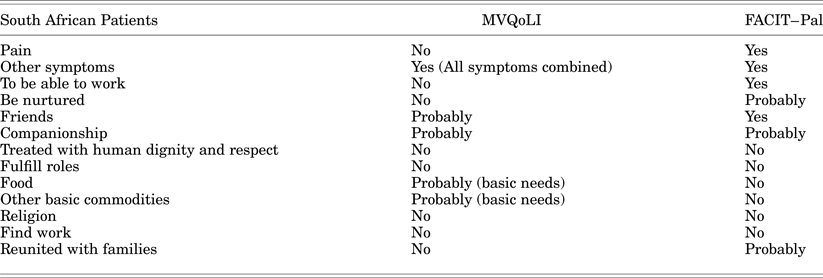
A comparison of the domains identified by the participants and those included in the MVQoLI and FACIT–Pal are presented in Table 1.
Comparison of the domains identified by South African patients with the MVQoLI and FACIT–Pal

DISCUSSION
It was interesting to find that only two non-disease-specific QoL measures—the MVQoLI and FACIT–Pal—were applied in African palliative care. This cannot be related to a dearth of available instruments, as there is a great variety now being used internationally. For instance, in a systematic review of instruments used as outcomes measures in palliative and hospice care, Stiel et al. (Reference Stiel, Pastrana and Balzer2012) found that 316 of the 725 publications included in their study reported on QoL using 24 instruments. The QoL measure most commonly applied (in 69 of 316 publications) was the EORTC QLQ–30, a questionnaire developed to assess QoL in cancer patients (EORTC, 2014). The most commonly used QoL scales applicable to palliative care patients with a variety of primary diagnoses were visual/numeric rating scales (in 41 of 316 publications), the McGill Quality of Life Questionnaire (MQoL), and the Short Form Health Survey (SF–36) (both in 26 of 316 publications). The MVQoLI was used in 9 of the 316 studies. Other instruments included in the review were the Quality of Life at the End of Life Measure (QUAL–E), the World Health Organization Quality of Life (WHOQoL–100), and the McMaster Quality of Life Scale (MQLS). The FACIT–F and FACIT–Sp (measuring fatigue and spiritual well-being, respectively) and the disease-specific FACIT–M (melanoma) scales were included in the review, while no mention was made of the FACIT–Pal Scale. In a systematic review evaluating measures used in the palliative population assessing at least one domain of QoL, Albers et al. (Reference Albers, Echteld and de Ve2010) identified 29 instruments in the 36 studies included in their review. Both the MVQoLI and FACIT–Pal were included along with other instruments—like the McMaster Quality of Life Index (MQoL), the Cambridge Palliative Assessment Schedule (CAMPAS–R), and the Problems and Needs in Palliative Care Questionnaire (PNPC–sv). Similarly, in a systematic review focusing on measures of end-of-life care and its outcomes, Mularski et al. (Reference Mularski, Dy and Shugarman2007) referred to 14 QoL measures, including the MVQoLI and others, like the Palliative Care Quality of Life Instrument (PQLI) and the QUAL–E.
Quality-of-life measures do not seem new to Africa, as Higginson et al. (Reference Higginson, Simon and Benalia2012), in a study exploring the views of clinicians across Europe and Africa on their use of outcome measures in palliative care, found 18 instruments, including 9 QoL instruments, that are used in clinical care and research. The QUAL–E was highest on the list (8th of 18), used by 7.1% of the 434 respondents in clinical care and 2.8% in research. The other non-disease-specific QoL instruments found to be used were the MQoL, the Evaluation of Individual Quality of Life (SEIQoL), the Hospice Quality of Life Index (HQLI), the FACT–G, the MQLS, and the MVQoLI, which was used in clinical care by 0.5% and for research by 1.4% of respondents. Unfortunately, the differences between the use of these instruments in Africa and Europe was not indicated.
Finding that symptoms and function play an important role in the quality of life of participants is well known, as according to Kaasa and Loge (Reference Kaasa and Loge2003) most researchers and clinicians would agree that symptoms, functioning, psychological, and social well-being are related to QoL. The socioeconomic status of many South Africans is poor, and it should therefore come as no surprise that the financial domain plays an important role in their quality of life. Despite the fact that the poverty levels in South Africa have decreased over the period from 2006 to 2011, the unemployment rate was 24% in the fourth quarter of 2011 and about 23 million South Africans (45.5% of the population) were living below the upper-bound of the poverty line; 20.2% were living below the food poverty line during the same year. Females were more impoverished than males, and 13% of the population reported that they go hungry (Statistics South Africa, 2014). Considering the high unemployment rate, it would be highly unlikely for people suffering from the consequences of an end-of-life disease to find any form of employment.
Being treated with human dignity and respect originated from the rejection and stigmatization AIDS patients commonly experience in Sub-Saharan Africa. Selman et al. (Reference Selman, Simms and Penfold2013) found a similar trend in a study conducted in Kenya and Uganda, supporting this idea of stigma (see also Campbell et al., Reference Campbell, Foulis and Maimane2005). In addition, being verbally and physically abused and neglected is a reality for people living with HIV and AIDS, certainly a manifestation of this stigma (Dlamini et al., Reference Dlamini, KohI and Uys2007).
The finding that nurturing plays a major role in the quality of life seems to be unique, as no literature reflecting a similar trend could be found. It is quite possible that our participants needed to be nurtured according to the ancient African worldview of “Ubuntu.” Described by Matolino and Kwindingwi (Reference Matolino and Kwindingwi2013) as an “authentic mode of being African,” it rests on the idea that a person depends on others to be a person and is based on certain core values such as humaneness, caring, respect, and compassion, thus allowing African families to accept that they are safely embedded within a community (Engelbrecht & Kasiram, Reference Engelbrecht and Kasiram2012). Similar to the fate of families living with mental illness in some communities (Engelbrecht & Kasiram, Reference Engelbrecht and Kasiram2012), it does not seem that the theory of this philosophy is part of the practical reality in everyday life.
It was interesting to find that their hope was focused primarily on issues pertaining to their immediate needs, like being able to work and earn an income, being cured or being reunited with their family, and that issues pertinent to life closure were not discussed. The reason for this might possibly relate to the phase of their disease and the fact that death was not so imminent. In addition, the symptoms and poverty participants experienced resulted in their daily lives being one long struggle to just try to meet basic needs. Selman et al. (Reference Selman, Simms and Penfold2013) found a similar trend and concurred that poverty and stigma become characteristic of these patients' daily lives as they are preoccupied with worries about such basic needs as food and employment. Having to face such a reality might deprive participants of the opportunity to consider end-of-life issues.
When the QoL domains identified in our study and the domains assessed by means of the MVQoLI and FACIT–Pal are compared, it becomes clear that not all of the domains are assessed by these instruments. Carr & Higginson (Reference Carr and Higginson2001) reported a similar finding when comparing three QoL instruments with domains important to their three patient groups. Our findings support their opinion that the challenge of measuring quality of life lies in the uniqueness of individuals, and the extent to which the outcomes represent the quality of life of individuals and groups of patients. In addition, the risk of using non-patient-centered measures results in measuring something different from the quality of life of individual patients. Individualized measures of QoL (e.g., the SEIQoL and the Patient-Generated Index) might be more appropriate for measuring QoL in an African palliative care context. However, the complexity and possibility that some patients might not reveal issues important to them (Carr & Higginson, Reference Carr and Higginson2001) might hinder the use of such instruments.
LIMITATIONS OF THE STUDY
The data used for the secondary analysis were not originally intended for our study and could have led to bias in presentation of the data. Information important to this study could also not have been revealed during data collection. In addition, the data were collected in a specific resource-poor community and can therefore not represent all palliative patients. Nevertheless, despite these limitations, we believe that the study highlights the domains that influence the quality of life for palliative patients living in resource-restricted communities.
CONCLUSION
We found that two multidimensional quality-of-life instruments, the MVQoLI and the FACIT–Pal, have been utilized in the African palliative care setting. It does not seem as if these instruments could provide an accurate representation of QoL for palliative patients living in South Africa, as the domains identified by patients living in a resource-restricted community differ from those assessed by these instruments. This highlights the complexity of QoL and QoL assessment. A more accurate representation of the quality of life of palliative patients living in resource-restricted communities might be obtained by using individualized measures or exploring what QoL means to these patients, and selecting the QoL instruments accordingly.
ACKNOWLEDGMENTS
The Atlantic Philanthropies through the University-Based Nursing Education in South Africa (UNEDSA) project supported this study. The authors would like to thank Ms. Agnes Huiskamp for assisting us in grouping the domains into themes.
Appendix 1
Papers Published Between 2000 and May 2014 Included in Our Study