Introduction
Tonsillectomy is a widely performed surgical procedure worldwide due to its positive impact on patients’ quality of life, despite significant morbidities such as pain, infection and haemorrhage. Secondary tonsillectomy haemorrhage, which occurs after 24 hours post-surgery, has an incidence of 3–5 per cent, often requiring hospitalisation and creating a distressing situation for both the surgeon and the patient’s family.Reference Douglas, Lang, Whitmer, Wilson and Mackenzie1, Reference Windfuhr and Seehafer2
In the literature, significant findings have been reported regarding potential risk factors such as patient age, gender, smoking history, recurrent tonsillitis (infection), sleep disorders and surgical technique. However, despite the available data, the incidence of secondary post-tonsillectomy haemorrhage and the factors influencing it are not yet fully understood.Reference Windfuhr and Seehafer2–Reference Gumussoy and Cukurova6 Nevertheless, the prevailing consensus suggests that secondary haemorrhage may be associated with fibrinolysis due to the dissolution of clots in previously coagulated areas, possibly linked to surgical wound infections along with other risk factors. Although researchers have emphasised the relationship between infection and haemorrhage, definitive evidence remains insufficient. Additionally, relatively few studies have investigated objective infection indicators, such as elevated inflammatory markers, fever and positive microbiological cultures, to support this hypothesis.Reference Windfuhr and Seehafer2, Reference Windfuhr, Chen and Remmert3, Reference Williamson, Coleman and Douglas7
In recent years, various prognostic markers have been developed to assess immune system inflammatory responses. The Systemic Immune-Inflammation Index (SII), calculated as platelet count × neutrophil count/lymphocyte count (10⁹/L), is a novel marker that reflects patients’ inflammatory and immune status and can be easily derived from routine blood tests. Recent studies have found SII levels to be associated with various cancersReference Zhong, Huang and Chen8, Reference Greten and Grivennikov9 and have proposed it as a prognostic marker for cardiovascular mortality,Reference Xia, Xia, Wu, Li, Li and Zhang10 ischemic strokeReference Trifan and Testai11 and inflammatory conditions. SII is increasingly recognised as a valuable indicator in predicting the course of immune and inflammatory diseases.
In the literature, SII appears to be a promising tool for predicting similar complications and morbidities. This study aims to evaluate the relationship between SII and secondary tonsillectomy haemorrhage. If SII values are found to be significantly associated with secondary haemorrhage, it could serve as a potential tool to assess the risk of secondary haemorrhage, enabling the implementation of preventive strategies to reduce these risks.
Materials and methods
Stages of data collection
The Otorhinolaryngology Clinic is a tertiary reference center providing care for pediatric otolaryngological patients. The clinical and histopathological medical records used in this study were obtained from the database of this clinic.
Design of the study
In this retrospective study, pediatric patients aged 0–18 years who underwent cold knife tonsillectomy performed by three otorhinolaryngologists at a single center between September 2022 and January 2024 were analysed.
The study included two groups comprising a total of 120 patients: First group (haemorrhage group): Consisted of 60 patients who presented to our clinic with secondary post-tonsillectomy haemorrhage and required surgical intervention under general anesthesia. Second group (non-haemorrhage group): Included 60 patients who presented with suspected post-tonsillectomy bleeding but were not found to have any active haemorrhage upon physical examination and laboratory evaluation.
For the haemorrhage group, laboratory parameters obtained on the day of tonsillectomy and the day of haemorrhage intervention were recorded. In the non-haemorrhage group, laboratory data were collected from the day of surgery and from routine control blood tests performed at the time of presentation, which occurred between 24 hours and 30 days post-operatively.
The parameters used in the study were: demographic data, including age, gender and the post-operative day on which bleeding occurred were recorded from patient files; routine blood values including neutrophil, lymphocyte and platelet counts were documented; and the Systemic Immune-Inflammation Index (SII) was calculated for each patient.
The post-operative control blood laboratory values of the non-haemorrhage group were randomly selected from patients who had routine blood test results within a similar time frame as the bleeding days in the haemorrhage group (between 24 hours and 30 days after surgery).
Inclusion criteria were that both groups consisted of patients without bleeding or coagulation disorders, autoimmune diseases and those not using antibiotics or steroids.
Statistical analysis
Statistical analyses were performed using IBM SPSS Statistics Version 27. The Mann–Whitney U-test was used to compare differences between the haemorrhage and non-haemorrhage groups. Cutoff values for statistically significant parameters were determined using receiver operating characteristic (ROC) analysis. Changes between tonsillectomy laboratory values and haemorrhage-day laboratory values in the bleeding group were analysed using the Wilcoxon signed-rank test. A p-value of less than 0.05 was considered statistically significant.
Ethical considerations
This study was conducted in accordance with the Declaration of Helsinki. Ethical approval was obtained for the study (Ethics Committee approval number: 2024/17). The study was designed and conducted in compliance with this approval. Institutional guidelines for retrospective studies, as accepted by the institutional review board, were followed throughout the study.
Results
Between September 2022 and January 2024, a total of 1927 patients underwent tonsillectomy, among whom 60 patients (3.11 per cent) experienced post-operative haemorrhage.
A total of 120 pediatric patients were included in the study: Sixty patients who experienced post-operative haemorrhage following tonsillectomy and required intervention under general anesthesia due to bleeding. Sixty control patients who presented post-operatively with suspected haemorrhage but were found to have no clinical or laboratory evidence of active bleeding. These patients were selected retrospectively and matched with the haemorrhage group based on post-operative timing. Their laboratory data were obtained from routine control blood tests performed during clinical evaluation between 24 hours and 30 days post-operatively. None of the patients had any additional diseases, bleeding disorders, autoimmune diseases or a history of antibiotic or steroid use. Medical records showed no signs of infection during post-operative follow-ups or on the day of bleeding in patients with haemorrhage.
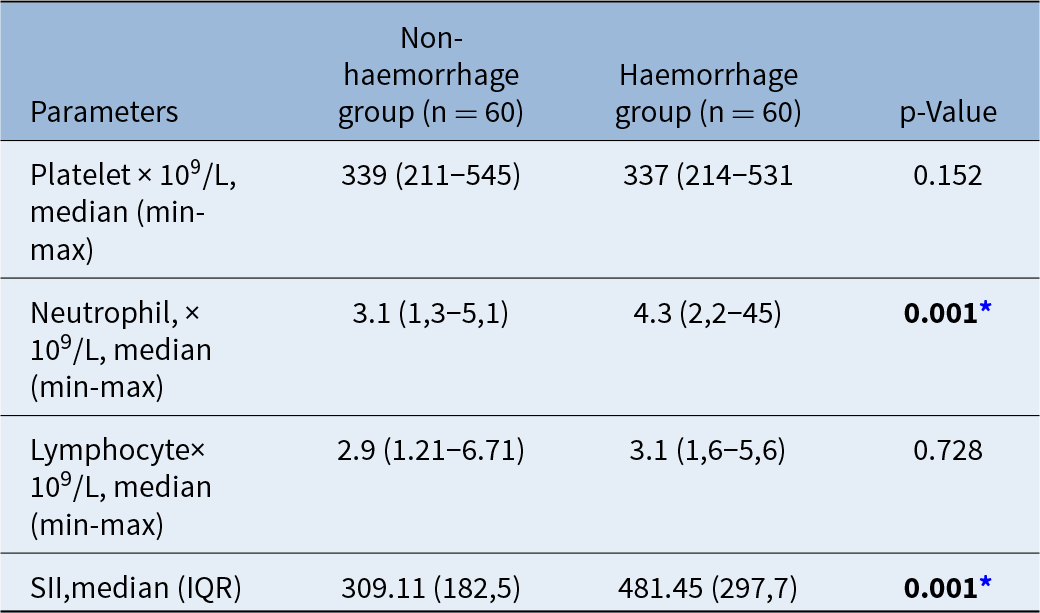
Comparison of parameters between the haemorrhage group and the non-haemorrhage group on the day of tonsillectomy

Abbreviations: IQR, inter-quartile range; SII, Systemic Immune-Inflammation Index.
* Mann-Whitney U-test, p < 0.005= statistical significance level.
Age and gender distribution
Comparison of blood laboratory parameters on the day of tonsillectomy and the day of bleeding in the haemorrhage group

Abbreviations: IQR, inter-quartile range; SII, Systemic Immune-Inflammation Index.
* Wilcoxon signed rank test, p less than 0.005 = statistical significance level.
In the haemorrhage group (n = 60), the mean age of the patients was 8.85 ± 3.07 years, with 39 males (65 per cent) and 21 females (35 per cent). The mean time to haemorrhage was 8.63 ± 2.32 days post-operatively, with the earliest haemorrhage occurring at 72 hours post-surgery and the latest on day 21. In the non-haemorrhage group (n = 60), the mean age was 8.57 ± 2.93 years, with 40 males (67 per cent) and 20 females (33 per cent). There was no statistically significant difference between the two groups in terms of age and gender.
The distribution of bleeding days in the haemorrhage group and the days on which control blood samples were obtained in the non-haemorrhage group were randomly selected from patients meeting similar day and count inclusion criteria. Statistical analysis demonstrated no significant difference between these distributions.
Laboratory parameters
Comparison of blood laboratory values on the day of tonsillectomy (haemorrhage vs. non-haemorrhage group): The neutrophil count (p < 0.001) and SII values (p < 0.001) on the day of tonsillectomy were significantly higher in the haemorrhage group compared to the non-haemorrhage group (Table 1). Using ROC analysis, the cutoff values were determined as follows: neutrophils: 3,87 units; SII: 428,73 units.
Comparison of blood laboratory values on the day of tonsillectomy vs. day of haemorrhage (haemorrhage group only): significant increases were observed in platelet, neutrophil and SII values on the day of haemorrhage compared to the day of tonsillectomy (p < 0.001). Significant decreases were observed in lymphocyte values (p < 0.001) (Table 2).
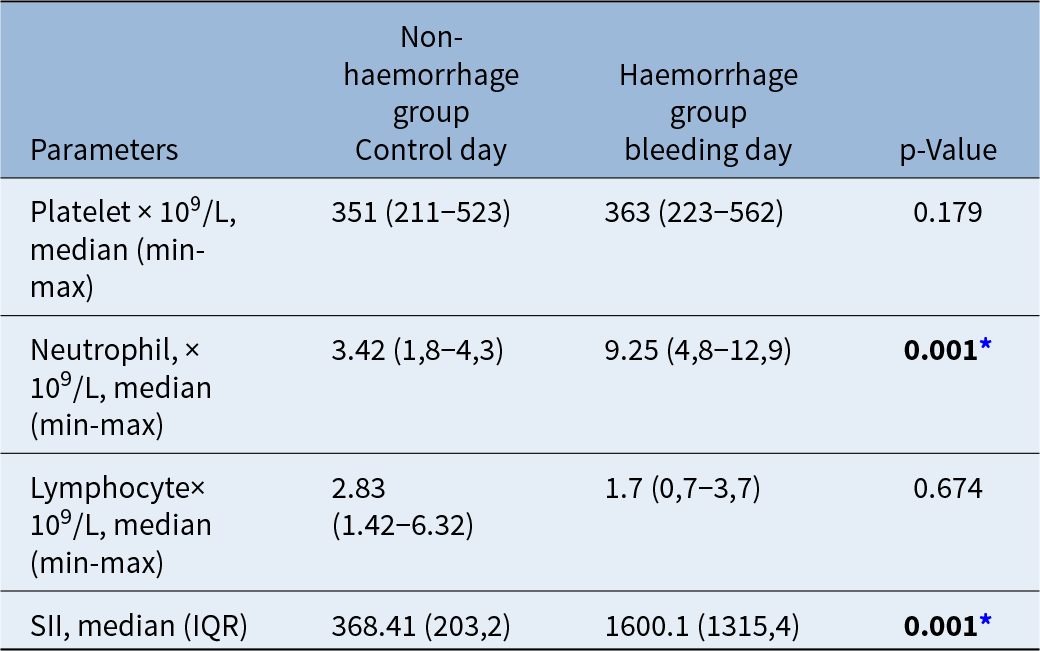
Comparison of blood laboratory values on the day of haemorrhage (haemorrhage group vs. non-haemorrhage group): on the day of haemorrhage, the neutrophil count (p < 0.001) and SII values (p < 0.001) in the haemorrhage group were significantly higher compared to the control group (Table 3).
Comparison of blood laboratory parameters on the bleeding day of the haemorrhage group and the non-haemorrhage group

Abbreviations: IQR, inter-quartile range; SII, systemic immune-inflammation index
* Mann–Whitney U-test, p less than 0.005 = statistical significance level.
Discussion
Between September 2022 and January 2024, a total of 1927 patients underwent tonsillectomy, of whom 60 (3.11 per cent) experienced post-operative haemorrhage. When the laboratory parameters of 60 patients with post-tonsillectomy haemorrhage were compared with those of 60 patients without haemorrhage, it was found that the preoperative neutrophil and SII values in the haemorrhage group were significantly higher at the time of tonsillectomy. Using ROC analysis, cutoff values were calculated as 3,87 units for neutrophils and 428,73 units for SII. This finding suggests that there may be underlying inflammatory activity in pediatric patients who experienced bleeding before the cold knife tonsillectomy procedure, especially given that these patients were known not to have used antibiotics or steroids. However, while it is unclear whether these inflammation parameters indicate a pre-existing inflammatory condition before surgery, it remains thought-provoking.
When the laboratory parameters of the group with observed tonsil haemorrhage were compared between the time of tonsillectomy and the day the haemorrhage occurred, significant increases in platelet, neutrophil and SII values (p < 0.001 for each) and a significant decrease in lymphocyte values (p < 0.001) were observed, indicating a pronounced inflammatory response in patients with haemorrhage.
Secondary haemorrhage after tonsillectomy has long been considered to potentially result from infection or inflammation, yet it remains unproven and not fully understood whether infection truly causes haemorrhage.Reference Windfuhr and Seehafer2, Reference Windfuhr, Chen and Remmert3, Reference Amir, Belloso, Broomfield and Morar5, Reference Williamson, Coleman and Douglas7 Given that infection or inflammation could be a potential risk factor for post-tonsillectomy haemorrhage, the high SII values obtained in our study support the presence of inflammation. In a study investigating the significance of infection in patients with secondary haemorrhage after tonsillectomy, only 32 per cent of patients showed a high white cell count; however, this finding was not consistently supported by other indicators of infection, such as fever and C-reactive protein (CRP) levels. Although some elevations in CRP values were recorded, this suggests post-operative inflammation and an inflammatory response rather than infection. Based on these results, infection cannot be conclusively confirmed as a common cause in patients with secondary haemorrhage.Reference Ahsan, Rashid, Eng, Bennett and Ah-See12
Neutrophils, an important component of the immune system, are commonly elevated after surgery.Reference Fanning, Porter, Shorten, Kirwan, Bouchier-Hayes and Cotter13, Reference El-Maallem and Fletcher14 Following surgical trauma, neutrophils rapidly increase, peaking on the second day, and then gradually return to normal levels.Reference Shijo, Iwabuchi, Hosoda, Watanabe, Nagaoka and Sakakibara15 In non-infectious cases, neutrophil counts generally normalise by the fifth day. However, in our study, neutrophilia was observed in 50 patients at the time of post-operative haemorrhage, with the average day of haemorrhage occurring at 8.63 days post-operatively. This finding indicates that the duration of neutrophilia following surgical stress was extended by 3 to 4 days beyond the typical timeframe. Bostock et al.Reference Bostock, Zhou, Antonoff, Murphy, Lin and Maru16 reported that prolonged neutrophilia after esophagectomy was associated with poor prognosis and an increased tendency for complications. We also believe that this finding is an indication of a continuing inflammatory response and that these patients may be more prone to complications.
During the post-operative period, platelet counts can generally be low between the first and fourth days due to hemodilution, inflammation and hemostasis.Reference Warkentin, Hoffman, Benz and Silberstein17 Thrombopoietin, which is activated in the bone marrow and kidneys, restores platelet levels to normal by the 14th day.Reference Skeith, Baumann Kreuziger, Crowther and Warkentin18 Additionally, the activation of neutrophils triggered by activated platelets could be an indicator of the increased inflammatory response observed in our study, as evidenced by the significant increase in neutrophils.Reference Klinger and Jelkmann19
Lymphocyte counts can begin to decrease as early as 2 hours post-surgery and may continue to decrease until the second day. Lymphocytes, a major component of the immune system, leave patients more susceptible to infections if lymphopenia develops post-operatively.Reference Skeith, Baumann Kreuziger, Crowther and Warkentin18, Reference Klinger and Jelkmann19 Lymphocyte count is an important prognostic marker in conditions such as malignancy prognosis, post-operative expectations and sepsis.Reference Torrance, Pearse and O’Dwyer20 In our study, a significant decrease in lymphocyte counts was observed in 56 patients, and lymphopenia was detected during haemorrhage in 8 patients. These findings are consistent with other studies in the literature, which highlight the link between lymphopenia and the tendency towards complications and poor prognosis.
In the literature, findings suggest that inflammation can increase the bleeding tendency in surgical sites, even in the absence of infection. Specifically, inflammation is considered a potential independent risk factor for secondary haemorrhage, potentially due to the pressure and increased vascular permeability it creates in the surgical area. Based on this, elevated neutrophil and platelet counts following tonsillectomy may support the idea that inflammation heightens the tendency for bleeding at the surgical site. Excessive neutrophil elevation can cause microvascular damage in the area, triggering an increased risk of bleeding. Free radicals and enzymes released from neutrophils contribute to tissue damage, complicating the healing process and further increasing the risk of haemorrhage.Reference Windfuhr and Seehafer2, Reference Windfuhr, Chen and Remmert3, Reference Williamson, Coleman and Douglas7, Reference Xia, Xia, Wu, Li, Li and Zhang10–Reference Ahsan, Rashid, Eng, Bennett and Ah-See12, Reference Bostock, Zhou, Antonoff, Murphy, Lin and Maru16–Reference Torrance, Pearse and O’Dwyer20
The presence of increased neutrophils and platelets indicates that inflammation exerts a prolonged effect on the surgical site. The disruption of hemostatic balance in the surgical area due to these inflammatory cells underscores their potential role in post-tonsillectomy haemorrhage. Considering that patients with a high post-operative inflammatory response are at an increased risk of secondary haemorrhage, monitoring these parameters pre- and post-operatively could provide a strategic approach to reducing complication risks. This insight suggests that managing inflammation post-tonsillectomy may play a crucial role in reducing haemorrhage risk.Reference Xia, Xia, Wu, Li, Li and Zhang10, Reference Trifan and Testai11, Reference Klinger and Jelkmann19–Reference Heffernan, Thakkar, Monaghan, Ravindran, Adams and Kozloff21
In recent years, various prognostic markers have been developed to assess immune system inflammatory responses. SII is a new marker that reflects patients’ inflammatory and immune status and can be easily calculated from routine blood tests. SII is increasingly recognised as a valuable indicator in predicting the course of immune and inflammatory diseases. In our study, a significant increase in SII values was observed in all cases compared to preoperative levels (p < 0.001). The role of inflammation in post-tonsillectomy haemorrhage is significant, and controlling inflammation may help mitigate the risk of bleeding. Various findings in the literature indicate that tissue damage triggers inflammatory mechanisms, which can be measured using biomarkers such as the SII. Assessing inflammation biomarkers pre- and post-operatively may be clinically beneficial in identifying high-risk patients and ensuring closer follow-up for these individuals.
What is already known on the subject:
• Secondary post-tonsillectomy haemorrhage occurs in approximately 3–5 per cent of cases, and its underlying mechanisms remain unclear.
• Although inflammation is suspected to play a role, objective inflammatory markers have not been thoroughly investigated.
What this study adds to our understanding:
• SII levels are significantly higher in patients who develop haemorrhage, both preoperatively and at the time of bleeding.
• Increased neutrophil and platelet counts and decreased lymphocyte counts indicate a strong inflammatory response.
• SII may serve as a predictive marker for secondary haemorrhage, enabling early identification and closer monitoring of high-risk patients.
Conclusion
In our study, we found a correlation between the SII and an increased risk of haemorrhage after tonsillectomy. Our findings aim to provide a foundation for understanding the potential effects of inflammation on post-operative haemorrhage risk. SII is a simple and low-cost calculation, and its application in otolaryngology practice may prove beneficial. However, we do not claim that this finding establishes a cause-and-effect relationship. SII is a biomarker that reflects overall inflammation levels, and the impact of inflammation on haemorrhage risk is likely multifactorial.
This association may indicate the presence of an underlying inflammatory condition, the persistence of an inflammatory process or an abnormal inflammatory response to surgery. These findings highlight the importance of inflammation management. In particular, the use of anti-inflammatory treatments in the perioperative period and protective measures against infection at the surgical site may help reduce haemorrhage risk.
Therefore, routinely assessing SII values before tonsillectomy could contribute to the early identification of patients at higher risk of haemorrhage. Additionally, closer and more prolonged monitoring of patients with high SII values during the post-operative period, with increased attention to potential complications, may be an effective strategy for reducing post-operative complications.
To better distinguish between normal surgical stress responses and underlying inflammation, further prospective studies with long-term monitoring of biomarkers are needed.
Limitations of our study include the restricted evaluation criteria for excluding infection in patients who experienced haemorrhage. Future larger-scale studies will more clearly establish the definitive role of SII in predicting post-operative complications.
Funding statement
This manuscript has not been published elsewhere and that it has not been submitted simultaneously for publication elsewhere. No outside funding or grants received in this study.
Competing interests
The authors have no conflicts of interest to disclose.
Authors’ contributions
Gumussoy, Murat: Conceptualisation, Data curation, Formal analysis, Funding acquisition, Investigation Methodology, Project administration, Resources, Software, Validation, Visualisation, Writing – original draft, Writing – review & editing. Agayarov, Yagiz Ozlem: Conceptualisation, Formal analysis. Investigation Methodology, Software, Validation, Visualisation, Writing – original draft. Cukurova, Ibrahim: Data curation, Funding acquisition, Supervision, Validation.