Introduction
Cancer is one of the leading causes of death in our country and around the world (Bray et al., Reference Bray, Ferlay and Soerjomataram2018). Both the disease and its treatment may lead to adverse effects on physical, emotional, or cognitive health (Stein et al., Reference Stein, Syrjala and Andrykowsk2008). Cancer patients may experience anxiety, depression, and cognitive changes in addition to the physical effects of chemotherapy (Cheung et al., Reference Cheung, Shwe and Chui2012). These psychosocial factors have negative effects on patients’ quality of life and their daily functions. Patients receiving chemotherapy experience a decrease in their cognitive abilities, as their cancer-related fatigue overwhelms them and their mood fluctuates. This decrease is observed through deficits in attention, memory, decision-making, language use, and learning new functions (Redeker et al., Reference Redeker, Lev and Ruggiero2000; Tchen et al., Reference Tchen, Juffs and Downie2003; Chen et al., Reference Chen, Miaskowski and Liu2012).
To evaluate differences in cognitive function, researchers employ neurophysiological tests, neuroimaging tests, and questionnaires (Vardy et al., Reference Vardy, Wong and Yi2006). Neurophysiological tests often use standardized test batteries, which evaluate attention, memory, language, visuospatial skills, psychomotor rates, and executive functions. Neuroimaging methods include functional magnetic resonance imaging and positron emission tomography that visualize the brain functionally and structure (McDonald et al., Reference McDonald, Conroy and Ahles2012; Conroy et al., Reference Conroy, McDonald and Smith2013). Questionnaires are based on patient self-report of symptoms, such as pain, fatigue, and other issues that affect the quality of life (Henneghan, Reference Henneghan2016). Assessment methods where patients represent their cognitive changes by self-report are just as valuable as neurophysiological or neuroimaging tests. In fact, sometimes neurophysiological tests may be less sensitive than self-report in specifying cognitive changes experienced by patients (Vardy et al., Reference Vardy, Wong and Yi2006). Although patient descriptions are by nature subjective, self-report is an important factor to determine the scope of these changes (Vardy et al., Reference Vardy, Rourke and Tannock2007). In cancer patients, it is necessary to understand not only objective but also subjective differences in the quality of life (Pullens et al., Reference Pullens, De Vries and Roukema2010).
The Functional Assessment of Cancer Therapy—Cognitive Function (FACT-Cog), Version 3, is a questionnaire based on self-report that is used to evaluate the effects of cancer therapy on the quality of life and cognitive functions (Wagner et al., Reference Wagner, Butt and Lai2009). The FACT-Cog is the first questionnaire that patients fill out because it assesses functional cognitive changes (Wagner et al., Reference Wagner, Butt and Lai2009; Joly et al., Reference Joly, Lange and Rigal2012; Cheung and Chan, Reference Cheung and Chan2013). As well as being easy to complete and simple to use, the questionnaire also takes into account different socioeconomic levels and age groups (Wagner et al., Reference Wagner, Butt and Lai2009). Besides the clinical assessment of cancer patients, it is important to evaluate the effects of cancer treatment (Vardy et al., Reference Vardy, Wong and Yi2006).
Despite its usefulness, there is no Turkish validation of the FACT-Cog questionnaire to assess functional cognitive changes in cancer patients. It is obvious that there is a need for a cognitive assessment questionnaire, one that is culturally adapted, reliable, and valid. The aim of this study is to investigate the reliability and validity of a FACT-Cog adapted for the Turkish language and, as such, contributes such a questionnaire for other researchers and clinicians to use to assess the cognitive situation of cancer patients.
Methods
This study was performed at both the Hacettepe University Faculty of Health Sciences Department of Physiotherapy and Rehabilitation the Oncological Rehabilitation Unit and Hacettepe University Oncology Hospital. Physicians referred the patients who met the study criteria. The patients included in the study were informed about its details in advance and volunteered to participate in it. Ethical approval was obtained from the Hacettepe University Ethical Committee (No. GO-14/380). The study protocol was conducted in strict accordance with the Declaration of Helsinki.
Patients
Inclusion criteria were as follows: participants were between 18 and 65 years old, able to read and understand Turkish, diagnosed with cancer at least 6 months prior, receiving or completed cancer treatment, and scored 24/30 or higher on the Mini-Mental State Examination (MMSE). Exclusion criteria were: no diagnosis of a major psychiatric disease, dementia, brain tumors, and drug or alcohol addiction when checked from hospital records, or being hospitalized to receive cancer treatment.
Instruments
The demographic characteristics and clinical situations of the participants were reported. The MMSE was applied and recorded. Then the FACT-Cog, Version 3, and the European Organization for Research and Treatment of Cancer Quality of Life Questionnaire Core 30 (EORTC QLQ-C30) were applied and recorded.
The FACT-Cog, Version 3, is a reliable and valid questionnaire consisting of 37 items that measure how patients perceive differences in their cognitive situation (r = 0.70–0.93) (Wagner et al., Reference Wagner, Butt and Lai2009; Joly et al., Reference Joly, Lange and Rigal2012). This questionnaire is comprised of four subscales: CogOth represents the judgments of others, CogPCA represents the perceived cognitive ability, CogPCI represents the perceived cognitive impairments, and CogQOL represents the impact of cognitive changes on the quality of life. The participants scored their cognitive situations from the previous week between 0 and 4 (0: never, 4: several times in a day) on a Likert scale, and the scores were summed.
There are English, French, and Chinese versions of the FACT-Cog available (Vardy et al., Reference Vardy, Wong and Yi2006; Joly et al., Reference Joly, Lange and Rigal2012; Cheung and Chan, Reference Cheung and Chan2013). Its developers granted permission to the researchers to prepare a Turkish version. The translation process was planned and conducted according to the standards of the Functional Assessment of Chronic Illness Therapy (FACIT) and International Pharmacoeconomics and Research Results. The final translated product was obtained through the following steps: first, two translators working independently each provided a translation from English into Turkish. Then, a third Turkish-speaking translator reconciled the above-mentioned versions either by choosing the best one, combining them, or suggesting a different translation. The resulting version was then back-translated into English by a fourth, native English-speaking translator who did not see the original source. The translation coordinator compared the original to the back-translation before it was sent back to the translation team to agree on the final version (Bonomi et al., Reference Bonomi, Cella and Hahn1996; Lent et al., Reference Lent, Hahn and Eremenco1999; Wild et al., Reference Wild, Grove and Martin2005).
The EORTC QLQ-C30 is a questionnaire used to assess the quality of life related to health status (Aaronson et al., Reference Aaronson, Ahmedzai and Bergman1993). It includes 30 items grouped into five functional domains (physical, role, cognitive, emotional, and social), three symptom domains (fatigue, pain, and nausea/vomiting), a global quality of life domain, and six individual items (dyspnea, insomnia, anorexia, diarrhea, constipation, and financial stability). Each of the items, with the exception of the global quality of life domain, is rated on a four-point Likert scale, ranging from 1 (“not at all”) to 4 (“very much”), and the scores are summed. The global quality of life domain is rated on a seven-point Likert scale, ranging from 1 (“very poor”) to 7 (“excellent”). The Turkish version of the EORTC QLQ-C30 was reported as reliable and valid (r = 0.70) (Aaronson et al., Reference Aaronson, Ahmedzai and Bergman1993; Guzelant et al., Reference Guzelant, Goksel and Ozkok2004; Demirci et al., Reference Demirci, Eser and Ozsaran2011).
Cognitive debriefing
After the team reached a consensus on the translation, the final version was formatted into the test version and given to 10 patients who were experiencing chemotherapy-induced cognitive issues. One week later, the patients filled out the questionnaire again. To identify discrepancies, which could indicate a problem with the Turkish translation, the patients were asked to report any difficulties in understanding the questions. This step was a preliminary assessment of the harmonization between the two languages, designed to ensure the semantic equivalence of the translated version. The fact that participants understood the items of the scale without trouble demonstrated that further cultural adaptation was not needed. As such, the final Turkish version of the FACT-Cog was obtained.
Statistics
The number of participants was determined by the calculation of power analysis with G* power, where 0.05 was the α and 80% power value for 140 cancer patients. The study was completed using SPSS Statistics 17.0 to analyze the data. Demographic features were taken and the reliability and validity of the Turkish version of the FACT-Cog were examined. Differences were assessed as significant with an α value of 0.05, and the test–retest reliability of the FACT-Cog total and subscale scores were assessed using the intraclass correlation coefficient (ICC). A ceiling or floor effect was accepted as 15% (or more) of individuals in a sample achieving the best or the worst level of the score (McHorney, Reference McHorney1995). The skewness and kurtosis variables of the FACT-Cog total and subscale scores were analyzed, and values between −2 and +2 were acceptable (George, Reference George2010). Internal consistency was examined using Cronbach's α coefficient. Pearson's correlations were used to examine relationships between the FACT-Cog and the EORTC QLQ C-30 and between the FACT-Cog and the MMSE. Confirmatory factor analysis (CFA) was used to assess construct validity. The χ 2/degrees of freedom was calculated to assess the model fit. If this value was under 2, the model fit was accepted as good. In addition, the root-mean-square error of approximation (RMSEA), and the comparative fit index (CFI), the normed fit index (NFI), and the non-normed fit index (NNFI) were calculated, and these values were accepted as good if the scores were under 0.05–0.8 for RMSEA and higher than 0.95 for fit indices, respectively (Schreiber et al., Reference Schreiber, Stage and Barlow2010).
Results
Psychometric analyses
Distribution properties
The majority of the participants were female who had different cancer diagnoses in the present study. The demographic and medical characteristics of the participants are presented in Table 1.
Demographic and clinical characteristics of the participants (n = 140)

a Having at least two medical problems.
When analyzing the ceiling and floor effects of the FACT-Cog, we found that under 15% of the individuals were at the best or the worst level both for the total and subscale scores, with the exception of the CogOth subscale. The skewness and kurtosis variables of the FACT-Cog were acceptable for the total and subscale scores, with the exception of the CogOth and CogPCA subscales.
Reliability analyses
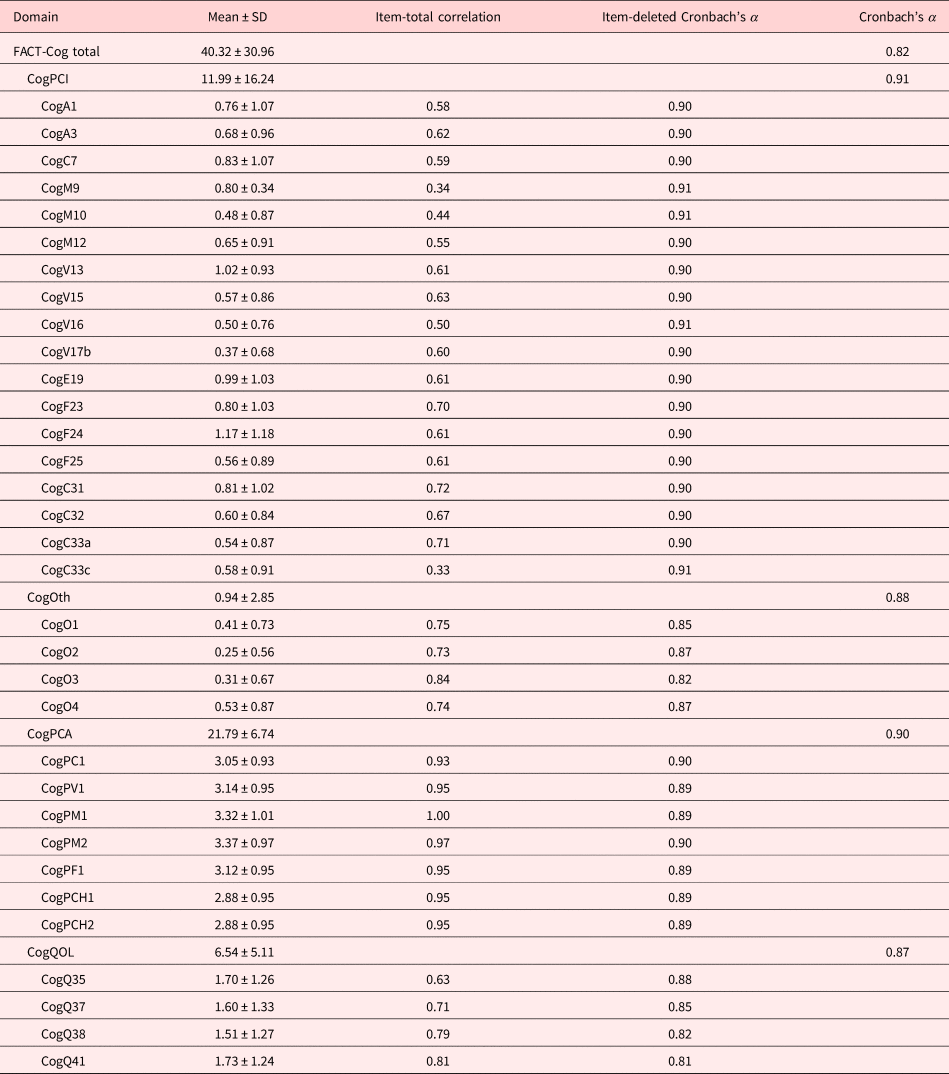
Cronbach's α coefficient for the Turkish version of the FACT-Cog was 0.82. Internal consistency was high for all four subscales (CogPCI = 0.91, CogOth = 0.88, CogPCA = 0.90, CogQOL = 0.87). The correlation coefficients at all items were greater than 0.30 in the item-total correlation analysis (Table 2).
Internal consistency (item-total correlations and Cronbach's α coefficients) of the Turkish version of the FACT-Cog

CogOth represents the ability or comments from others. CogPCA represents the perceived cognitive ability. CogPCI represents the perceived cognitive impairments. CogQOL represents the impact of cognitive changes on the quality of life.
FACT-Cog, Functional Assessment of Cancer Therapy—Cognitive Function.
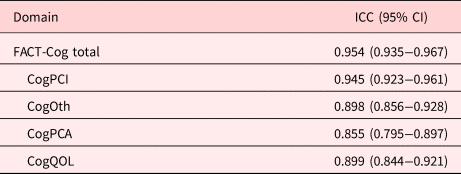
Internal consistencies for the Turkish version of the FACT-Cog scores are presented in Table 3. For the entire sample, the test–retest ICC values of the FACT-Cog scores varied from 0.855 to 0.954.
Test–retest correlations of the FACT-Cog

CogOth represents the ability or comments from others. CogPCA represents the perceived cognitive ability. CogPCI represents the perceived cognitive impairments. CogQOL represents the impact of cognitive changes on the quality of life.
FACT-Cog, Functional Assessment of Cancer Therapy—Cognitive Function; ICC, intraclass correlation; CI, confidence interval.
Validity analyses
Validity analyses were performed by using construct validity analyses such as CFA and convergent–divergent validity analysis.
Confirmatory factor analysis
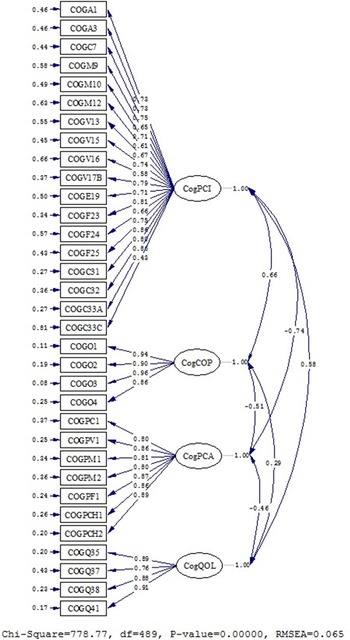
The construct validity of the Turkish version of the FAC-Cog was tested with CFA. The model had a good fit (χ 2/df = 1.59, NFI = 0.95, NNFI = 0.98, CFI = 0.98, and RMSEA= 0.065). In this CFA model, items relating to a particular scale were grouped together within a single factor and supported by a four-factor structure, reflecting the CogPCI, CogOth, CogPCA, and CogQOL subscales of the Turkish version of the FACT-Cog.
Factor loading was significant with a range from 0.43 to 0.96. The correlations of all factors in the FACT-Cog are shown in Figure 1. There were positive correlations between the subscales of the FACT-Cog and their items (Figure 1).
CFA results of the FACT-Cog.

Convergent–divergent validity
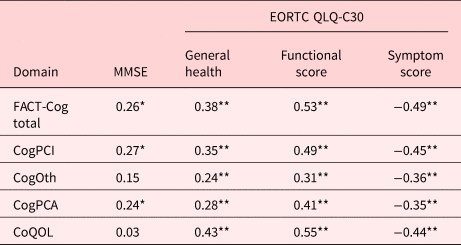
The Turkish version of the FACT-Cog and the MMSE had significant correlations (Table 4). According to the Pearson correlation coefficients test, there were low correlations between the total score of the FACT-Cog and the MMSE (r = 0.26, p < 0.05). The CogPCI and CogPCA subscales were correlated with the MMSE (r = 0.27, r = 0.24, respectively, p < 0.05). However, there were no relationships between the MMSE and the other subscales (p > 0.05). Moderate correlations were found between the EORTC QLQ-C30 subscale and all of the subscales of the FACT-Cog (r = −0.43 to −0.36, p < 0.05).
Convergent–divergent validity of the Turkish version of the FACT-Cog and mini-mental test domains

CogOth represents the ability or comments from others. CogPCA represents the perceived cognitive ability. CogPCI represents the perceived cognitive impairments. CogQOL represents the impact of cognitive changes on the quality of life.
FACT-Cog, Functional Assessment of Cancer Therapy—Cognitive Function; MMSE, Mini-Mental State Examination; EORTC QLQ-C30, European Organization for Research and Treatment of Cancer Quality of Life Questionnaire Core 30.
* p < 0.05.
** p < 0.001.
Discussion
Cancer patients may have cognitive difficulties for several reasons. It is important to determine and treat these problems early on. As a result of this study, the Turkish version of the FACT-Cog questionnaire proved reliable and valid. The major discrepancy of this study was including patients with different types of cancer and going through different stages of treatment. Nonetheless, other researchers will find that the adaptation of the FACT-Cog questionnaire into Turkish will be beneficial for monitoring not only the effects of treatment but also the cognitive situation of the patients.
The MMSE is a clinically proven cognitive ability test. It was selected to determine the eligibility of patients for the study. Because the MMSE is a tool for the detection of cognitive problems in a clinical setting, we suggest that it is also acceptable for selecting patients in the present study (Arevalo-Rodriguez et al., Reference Arevalo-Rodriguez, Roqué and Figuls2015; Creavin et al., Reference Creavin, Wisniewski and Noel Storr2016). In the present study, two people left their primary education. However, they read and understood the questionnaires and took up to 24 points of the MMSE. Therefore, they met criteria and participated in the present study.
The steps for translating the FACT-Cog into Turkish were guided by the FACIT translation team. Generally, the participants reported that the questionnaire could be understood easily, so there was no need to perform any further cultural adaptation. Furthermore, most patients declared that they did not need to remember “phone numbers” anymore due to their routine use of mobile and smartphones; a similar result was found in a study of the Korean version, where the authors argued that this item needed to be revised for relevance in today's society (Park et al., Reference Park, Bae and Jung2015). According to mobile phone usage in Turkey, we are of the same opinion as Park et al. (Reference Park, Bae and Jung2015). However, we thought that this item needed to be modified or Cog revised due to the fact that having mobile phones is not obligatory. Moreover, some cancer patients hesitate to use mobile phones, out of fear of their harmful effects.
According to the ceiling effects, the subscale of the FACT-Cog named CogOth was problematic. Individuals may have responded to these items with exaggeration. The reliability of the Turkish version of the FACT-Cog was compared with studies of other versions, such as the French. In their study of 63 patients who underwent chemotherapy for different cancer diagnoses, Joly et al. (Reference Joly, Lange and Rigal2012) established the following internal consistency values for the questionnaire subscales: CogPCI was 0.93, CogQOL was 0.85, CogOth was 0.70, and CogPCA was 0.89. In the Korean version, Park et al. (Reference Park, Bae and Jung2015) included 250 patients with breast cancer in their study and obtained internal consistency values for the same subscales at 0.95, 0.84, 0.92, and 0.87, respectively. In the present study, the internal consistency values were also high across all four subscales (CogPCI = 0.91, CogOth = 0.88, CogPCA = 0.90, CogQOL = 0.87). These results mean that both the total and subscale scores for the Turkish version of the FACT-Cog were acceptable. In the French and Korean versions of the questionnaire, Cronbach's α coefficient scores were 0.70 (Joly et al., Reference Joly, Lange and Rigal2012) and 0.94 (Park et al., Reference Park, Bae and Jung2015), respectively, while this score was 0.82 in the Turkish version. The reliability of the Turkish FACT-Cog, therefore, is similar to that of the French and Korean versions.
According to the validation scores, the Turkish version also showed similar results as the Korean (Park et al., Reference Park, Bae and Jung2015). Both versions had moderate and significant correlations between the FACT-Cog and the EORTC QLQ-C30. This correlation was explained, as the questionnaire was valid. The total score of the Turkish version of the FACT-Cog and of the MMSE had low correlations, similar to the French version (Joly et al., Reference Joly, Lange and Rigal2012). In both studies, the participants had no cognitive problems, owing to the exclusion of patients with low MMSE scores, as in the French study. The difference between evaluation methods may be the reason for this low correlation. The FACT-Cog and the EORTC QLQ-C30 both use subjective self-report questionnaires, while the MMSE uses a different scoring system (Olson et al., Reference Olson, Hewit and Slater2016). Nevertheless, Olson et al. (Reference Olson, Hewit and Slater2016) accepted both forms of cognitive measurement as beneficial for the study of cancer patients. For construct validity, the present study detected positive relationships between the subscales of the Turkish and the Korean versions of the FACT-Cog, providing further evidence for the factorial construct validity of the FACT-Cog (Park et al., Reference Park, Bae and Jung2015). In the French version, the sample size was too small to conduct a more advanced analysis, such as using CFA or the Rasch model (Joly et al., Reference Joly, Lange and Rigal2012). Furthermore, CFA supported a four-factor structure of the Turkish version of the FACT-Cog with a good model fit in our study. According to these results, the Turkish version of the FACT-Cog was found to be valid, and the factor analysis supported this result.
It may be a limitation of the study that assessments were performed at only one university hospital. However, participating patients came from different cities across the country, so it may also have been an advantage. In future research, the Turkish version of the FACT-Cog will be used to evaluate the effectiveness of cognitive therapies and rehabilitation in long-term cancer patients.
In conclusion, the present study has shown the reliability and validity of the Turkish version of the FACT-Cog to monitor changes in the cognitive situation of patients through self-report. The Turkish version of the FACT-Cog will be useful to determine the efficacy of therapy and to guide rehabilitation.
Acknowledgments
We thank Dr. Evren Ozdemir for supporting this study and the participants for their contribution. This manuscript was edited by a professional editing service.
Funding
The research received no specific grant from any funding agency, commercial, or not-for-profit sectors.
Conflict of interest
There are no conflicts of interest.