As land-based finance becomes increasingly constrained, how does the Chinese state construct its next engine of growth? Over the past decades, local governments in China have relied heavily on land as a key development asset. Land was parcelled, leased and financialized to fund infrastructure construction and attract investment. Yet with mounting debt burdens and tightening regulations on government budgets, this model no longer works. As land finance approaches its limit, Chinese policymakers have turned to data as a new factor of productionFootnote 1 and a financing instrument for national development and industrial upgrading.Footnote 2
This turn from land to public data presents a political and economic puzzle. Unlike land, data lacks clear territorial boundaries and cannot replicate China’s decentralized growth model of regional competition. The value of data derives from aggregation instead of division, and ownership remains legally ambiguous and politically sensitive due to security concerns. This paper focuses on a specific category of data, public data, which we define broadly as (1) government administrative data generated through public service provision, regulatory activities and citizen interactions; and (2) data held by state-owned enterprises (SOEs) and public institutions engaged in public service delivery. This includes data from domains such as transportation, healthcare, education, social security and urban management. We use the term “public data” to distinguish this category from privately generated commercial data.
Although labelled as “public,” the ownership of data, as well as the legitimacy and authority to govern and profit from it, raises difficult questions. How can public data be mobilized when clearly defined property rights are absent? What enables governments to collect, integrate, manage and deploy public data? This paper responds to these questions by examining the emergence of Local Digital Platform Vehicles (LDPVs), which are hybrid corporations primarily owned by local governments and sometimes co-invested with various types of digital technology firms. Since the early 2010s, LDPVs have rapidly proliferated across Chinese cities and provinces. Their business operations include building digital infrastructure, integrating public data, coordinating data governance and joining the data market. While LDPVs are frequently seen as technical solutions for digital governance, we argue that they carry deeper political and economic implications beyond the technical aspects.
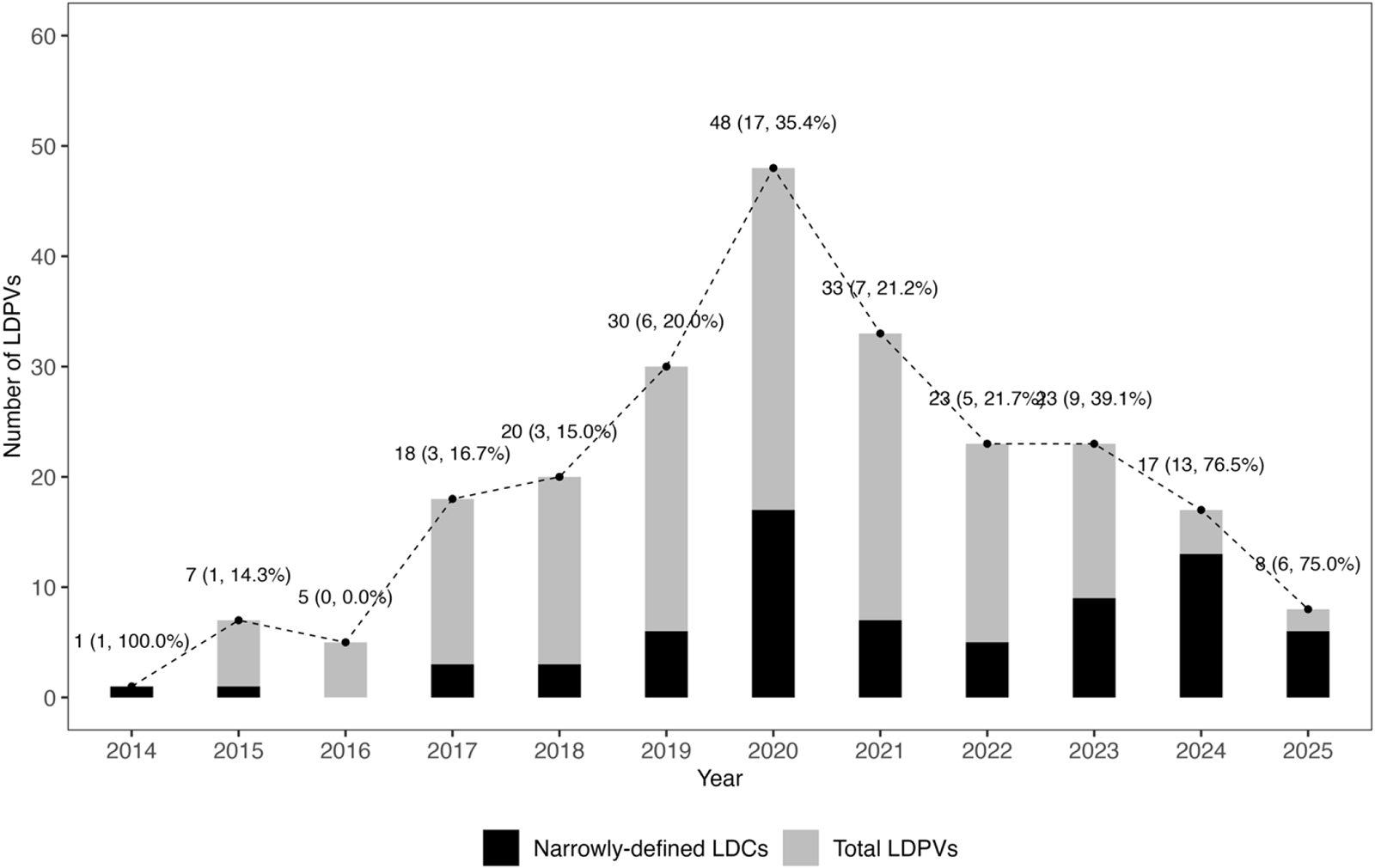
At the end of 2025, we identified 233 LDPVs at the municipal and provincial levels. Of these, 71 are local digital corporations (LDCs), which perform more comprehensive and integrated functions within their jurisdictions (Figure 1). LDCs are commonly referred to as “big data companies” (dashuju gongsi 大数据公司) or “big data groups” (dashuju jituan 大数据集团). Compared to other types of LDPVs, LDCs have a more versatile role in the local data regime. In short, they represent a narrower but more powerful subgroup of LDPVs, concentrating multiple governance and commercialization functions of public data within a single organization.
Narrowly-defined Local Digital Corporations and Local Digital Platform Vehicles

Figure 1 Long description
A stacked bar graph titled Narrowly-defined Local Digital Corporations and Local Digital Platform Vehicles presents annual counts of LDPVs from 2014 to 2025. The horizontal axis lists the years, and the vertical axis represents the number of LDPVs. Each vertical bar is divided into two segments. The lower dark segment represents narrowly defined local digital corporations, while the upper light segment represents the remaining portion of total LDPVs. The bars are accompanied by a line connecting the tops of the columns, emphasizing changes in the overall totals over time. The graph shows relatively low values in the initial years, followed by a period of sustained growth that reaches its highest point around the middle of the timeline. After the peak, the total number of LDPVs declines gradually during the subsequent years. The contribution of narrowly defined local digital corporations changes across the years and constitutes a larger proportion of the total during the final part of the period.
LDPVs make it possible for local states to exercise “control without ownership” over public data. Rather than clarifying property rights, the local state sets up these corporatized entities and holds dominant shareholding and organizational control. The LDPVs then have de facto authority over data access, integration and trading, enabling the local state to advance its administrative, developmental and security objectives while avoiding the conflicts that formal ownership claims may trigger.
This paper joins broader theoretical debates on China’s political economy in three ways. First, it shows how the local developmental state adapts to new forms of strategic resources beyond land, capital and labour. Unlike these traditional inputs, public data is non-rival, relational and politically sensitive, making it ill-suited to the existing developmental institutions of monopoly control and one-off appropriation. LDPVs show that the state has not abandoned its developmental ambitions but has instead reorganized its coordination instruments to control and extract value from public data.
Second, the paper re-examines the role of state-owned and state-controlled enterprises in the digital economy. The current literature treats the state as a relatively unified actor, focusing on ownership structure or profit incentives. This study shows how data-oriented, state-controlled enterprises function as a developmental instrument under mixed ownership. LDPVs are designed to internalize coordination problems, manage political risks and reconcile competing objectives. Concrete mechanisms include shareholding, task-based mandates, personnel arrangements and partnership selection.
Finally, the paper documents the nationwide diffusion of LDPVs and traces how their organizational forms and business models have co-evolved over time. By creating LDPVs, local governments seek to centralize data accumulation and internalize these profit opportunities through corporate control. Yet when attempts at direct monetization and data financialization encounter organizational constraints under ambiguous ownership, LDPVs resort to a platform model to facilitate public data exchanges. This co-evolution reveals how organizational innovation reshapes state–business relations in China’s digital era.
The paper proceeds as follows. The following section situates LDPVs within the literature on China’s developmentalism. It also explains why existing accounts cannot fully capture this new institution and introduces the analytical framework of “control without ownership.” This is followed by a description of the data sources and research design. The paper then examines how local states exercise internal control over public data before turning to the external dynamics of LDPVs, showing how business models and organizational arrangements co-evolve. The conclusion discusses the theoretical implications and potential challenges of China’s emerging public data regime.
Literature Review and Theoretical Framework
China’s state-led digital developmentalism has undergone several stages. An initial top-level designFootnote 3 was followed by selective pilot programmes, such as “smart city initiatives,” “big data experimental zones,” and the construction of social credit systems.Footnote 4 Institutional and organizational changes followed at both the local and central levels, including the establishment of big data bureaus. The most recent stage involves comprehensive policymaking and legislative progress at the central level. This trajectory raises a core question: what does this “digital” developmentalism mean for China’s political economy, and how should it be theorized?
Evolution of the local developmental state: industrialization, urbanization, digitization
China’s long-standing local developmentalism stems from interconnected institutional features that shape how the state interacts with the market.Footnote 5 First, the growth-focused cadre evaluation system aligns officials’ career incentives with jurisdictional economic performance, although the specific metrics shift over time.Footnote 6 Second, fiscal decentralization and tax reform make it structurally necessary for the local state to generate its own revenue. Local governments must mobilize resources to finance public goods provision, so “market-preserving federalism” becomes politically imperative.Footnote 7 Chenggang Xu, however, argues that decentralization in China is not a political arrangement but a layered governance structure, where the central government retains control over personnel while subnational governments “run the bulk of the economy.”Footnote 8 Li-An Zhou identifies mutual embeddedness between a bureaucratic market and an economic market.Footnote 9 These accounts show that institutional configurations remain comparatively similar across different developmental phases and regional contexts.Footnote 10
While the institutional foundations remain stable, local governments’ specific development goals shift as conditions change. China’s local developmental state has moved through three successive phases. The first phase was industrialization. Jean Oi describes rural China’s industrialization model as “local state corporatism.”Footnote 11 Local governments directly managed township and village enterprises (TVEs) and pooled community resources to promote industrialization.Footnote 12 Such firm-like behaviour was not purely developmental but also entrepreneurial, as it allowed local governments to extract profits.Footnote 13 Privatization played only a secondary role in this phase.
The next developmental stage was SOE reform and urbanization. The state’s role gradually shifted from direct business management to asset management.Footnote 14 With the expansion of mixed-ownership reform, SOEs started to treat profit-making as a core objective. Although socialist characteristics were more or less marginalized by capitalist features, state control was not diminishing; the state still retained a monopoly, or quasi-monopoly, over the most strategic sectors, only permitting private and foreign capitals to operate in less sensitive areas.Footnote 15
Running alongside the SOE reform was rapid urbanization, which spurred land-based development. Local governments moved away from directly managing enterprise production (for example, TVEs) towards a more indirect governing role by monopolizing scarce production factors, specifically urban land.Footnote 16 Their legal monopoly over urban land ownership allowed local governments to manipulate prices by allocating land supply.Footnote 17 Beyond covertly participating in transactions, local governments used expected land revenues to obtain financing through local government financing vehicles (LGFVs). In this way, land became not only a production factor but also an instrument for credit expansion. Over time, this has resulted in mounting local debt risks.Footnote 18
Digitization as the new developmental engine
As China’s land finance leads to a debt crisis, a critical question arises: what should come next to sustain development? The central government’s answer is explicit: data. Data has been designated as the fifth factor of production, a shift reinforced by major initiatives such as the Digital Economy Planning (2021). In this sense, data has been formally positioned as the successor to land in China’s development toolkit. But how much of the data can the government actually mobilize for developmental purposes?
Before turning to the potential of data-driven development, we should first ask a more fundamental question: does “development” still matter in today’s China? Some argue that China’s political economy has shifted from growth-oriented state capitalism towards security-centred “Party-state capitalism.” In this transition, political stability and geopolitical security have increasingly taken priority over developmental goals.Footnote 19 One strand of thought adopts an international political economy perspective, viewing China’s digital strategy as a mechanism to bolster its geopolitical influence in AsiaFootnote 20 and compete more effectively with the United States.Footnote 21
Another strand turns inward. For instance, the “techno-developmental state” argument suggests that the state may be building a “cage” for itself.Footnote 22 Advanced digital technologies can simultaneously create new domestic vulnerabilities, such as uncontrollable tech giants and the massive substitution of labour. In addition, while the deepening entanglement between the public and private sectors in co-constructing security apparatuses can strengthen state control,Footnote 23 it could also trigger an international backlash and create a “deep versus broad” tension.Footnote 24
These macro-level analyses treat the state as a unitary actor responding to top-level directives, which obscures the institutional innovation and strategic variation at the subnational level. The bottom-up emergence of LDPVs across Chinese localities cannot be explained by national imperatives alone. Local governments continue to pursue growth-oriented strategies, but they now channel these efforts through new institutions that specifically deal with public data.
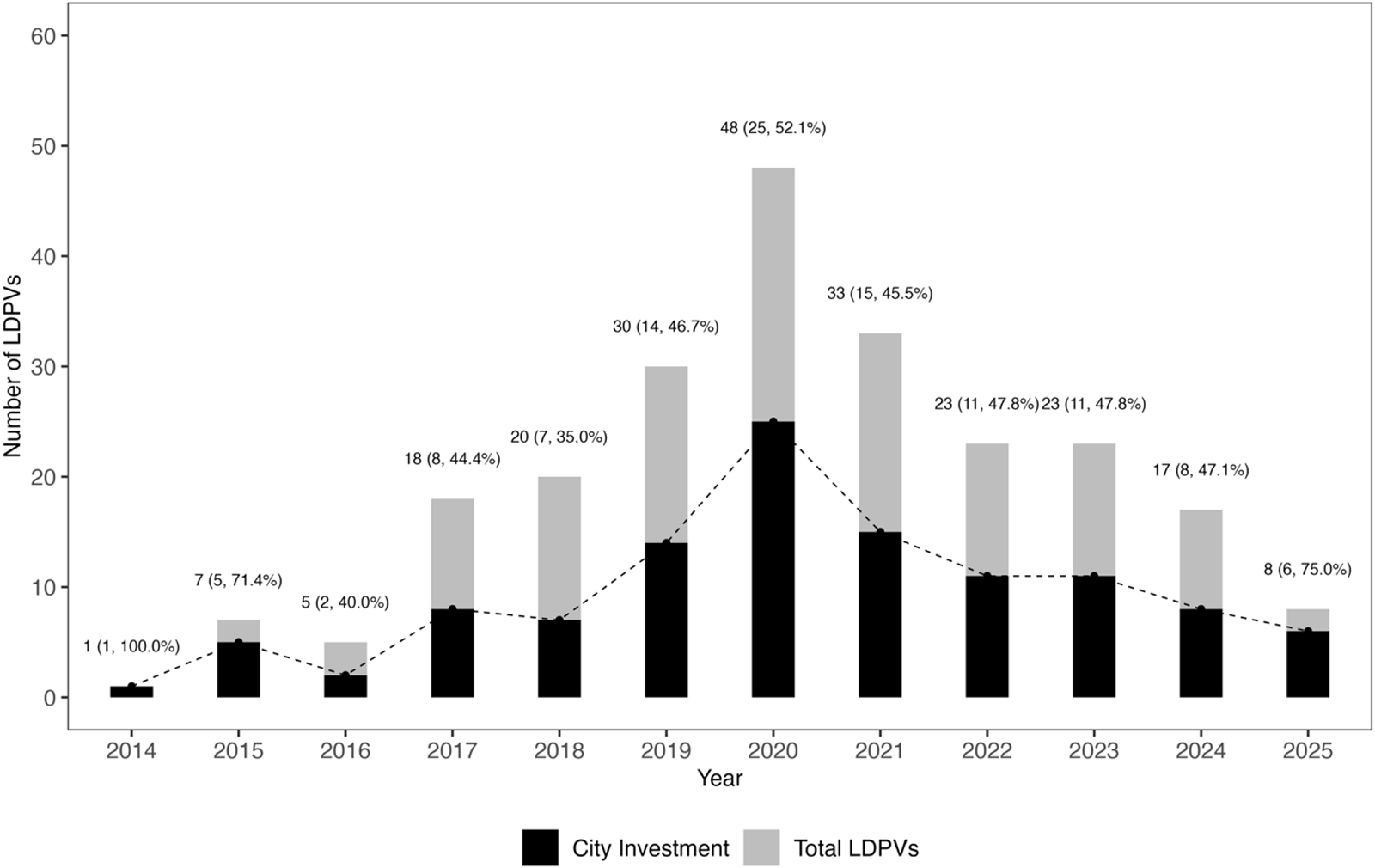
The turn to public data-driven development reflects both a continuity with and a departure from the land model. Just like land, public data was adopted as a strategic resource for developmental purposes. The organizational path dependence is striking: almost half of the newly established LDPVs or digital corporations have city investment corporations (chengtou 城投) or industrial investment corporations (chantou 产投) as shareholders, both of which were once land financing vehicles for the secondary and tertiary sectors (see Figure 2). Hence, the two local development regimes are institutionally linked, revealing a coherent and continuous pursuit of developmentalism.
LDPVs with City Investment as Shareholders

Figure 2 Long description
A bar graph titled LDPVs with City Investment as Shareholders illustrates annual trends in local digital platform vehicles from 2014 to 2025. The horizontal axis displays the years, and the vertical axis shows the number of LDPVs. Two series are presented: light-colored bars indicate the total number of LDPVs, while dark bars indicate those with city investment participation. The graph demonstrates a gradual increase in the overall number of LDPVs during the early years of the study period, followed by a pronounced rise that reaches its maximum around the middle of the timeline. Thereafter, the total count decreases progressively toward the final years. City-invested LDPVs are represented throughout the entire period and exhibit fluctuations in their relative share of the total. The dark bars remain consistently smaller than the total bars but generally follow the same pattern of increase and subsequent decline, indicating that city investment continued to play a role in LDPV development despite changing levels of activity over time.
Public data, nonetheless, differs fundamentally from public land in several key aspects. First, while land derives its value from exclusion and scarcity, the value of public data comes from aggregation and flow. Second, urban land ownership is, in general, legally clear, whereas public data ownership remains contested among individuals, market actors and public institutions. Third, while land governance raises more fiscal and efficiency concerns, data governance primarily involves national security issues that territorial resources do not carry. Finally, while land is monopolized within clearly defined jurisdictional boundaries, public data flows across administrative borders, thereby triggering coordination challenges that the land-based model is unlikely to encounter. In light of these key differences, public data-based strategies cannot simply replicate land-based institutional arrangements. Thus, a new framework is needed to illustrate these new institutions.
Existing explanations on public data institutions and their limitations
Scholarship on public data governance has expanded rapidly across public administration and digital government studies. This perspective, however, largely overlooks the developmental dimension, as local governments pursue digitization not only to enhance administrative performance but also to promote their own state capacity to use and mobilize public data.Footnote 25 Consequently, the political economy facet of public data as a growth instrument remains underdeveloped.
Local governments themselves lack the technologies and fiscal resources to build digital capacity independently. These challenges resemble those encountered in earlier state capacity-building phases (for example, highways and railways), when the state often chose collaborators to finance such projects. Typical solutions can include outsourcing through procurement with cost-effective suppliers, public–private partnerships (PPPs) for projects, and general framework agreements (kuangjia xieyi 框架协议). However, unlike traditional infrastructure projects, building digital infrastructure often involves long-term, subscription-based engagement, calling for a stable relationship between the state and technology suppliers. Yet, the necessity of a long-term relationship alone does not explain the bounded and corporatized form of LDPVs that indicates shared benefits and losses.
In addition, LDPVs are not primarily designed to address administrative fragmentationFootnote 26 or the functional mismatch of digital governance within the state.Footnote 27 Solutions such as “leading small groups” and “coordination working groups,” with the Party secretary or mayor in the chair, can overcome routine bureaucratic barriers.Footnote 28 But if the challenge is simply coordinating fragmented authorities, why bother creating new entities, given the government’s limited organizational familiarity with corporate forms? The security issue further complicates this puzzle.Footnote 29 Why do local governments transition into hybrid corporate entities that introduce market incentives and non-state participation under intensified security constraints?
Last but not least, although the PPP literature is often used to interpret state–business interactions, its core assumptions of privatization and liberalization do not hold in the LDPV case.Footnote 30 PPP represents the marketization reform of public goods provision legitimized by the increase in efficiency, so it sometimes bears a political rationale that aligns with a liberal order.Footnote 31 In other words, PPP treats collaboration as a progressive dilution of state control by empowering private and social actors. But is China today truly on a path to embracing privatization and liberalization? In fact, the emergence of LDPVs inverts this logic, as local states use corporate structures to extend their control over assets they currently cannot legally own and to absorb market actors.
Control without ownership: a corporate governance framework for LDPVs
Public data-based development presents a challenge absent in earlier development phases: how to mobilize a strategic resource when ownership cannot be legally or politically resolved? Unlike urban land entitled to the state or central SOEs, where equity defines ownership, public data bears overlapping claims by multiple actors. Since resolution of these claims is not yet feasible via legal means, how can the local government exercise control over public data?
To address this question, this paper draws on classical insights from the field of corporate governance, which distinguishes ownership rights from control rights. Apart from treating ownership as a unitary concept, corporate governance approaches conceptualize the firm’s ownership as a “bundle of rights,” including control, income and transfer, which can be divided up and allocated.Footnote 32 The right of residual control is most important. This is “the right to decide how assets are to be used except to the extent that particular usages have been specified in an initial contract,” which determines who exercises authority when contingencies arise, and when contracts are incomplete.Footnote 33 Such conditions also apply to public data.
This distinction helps to analyse LDPVs as hybrid governance organizations rather than pure market actors. Even in the absence of clearly defined data ownership, local governments can acquire residual control rights by owning and governing the organizational infrastructure and processes through which data is collected, integrated, standardized and authorized for use. Just as an official pointed out, “the key is to leave ownership aside and directly jump into administrative power and use the rights of data.”Footnote 34 In other words, control without ownership becomes a strategy of governance: control is exercised over data governance processes rather than over data as a legally defined asset. Internally, the allocation of control rights within the LDPVs through shareholding structures, supervisory arrangements and personnel management determines how authority is distributed among stakeholders. Externally, the market-facing activities of LDPVs, such as pricing, service provision, profit-making and sharing, shape how value is extracted.
Viewing LDPVs through corporate governance also clarifies how these new entities differ from earlier organizational forms. Land financing vehicles derive their bargaining power from the state’s clear ownership of land. By contrast, the ambiguous property status of public data requires more intensive organizational coordination to centralize authority. LDPVs also differ from traditional SOEs, which typically serve national strategic priorities and operate within vertically integrated hierarchies. LDPVs, by contrast, embed control at the local level. They allow local governments to localize authority over data governance to pursue place-specific developmental objectives. In this sense, LDPVs function more as extensions of the local state’s governing reach, compensating for the government’s inability to extract value by itself.
The hybridity of LDPVs raises a central puzzle: how can strong local state control coexist with pressures for market participation and commercialization when ownership of public data remains unresolved? We put forward three interrelated empirical questions. First, why and how can local governments exercise effective control over data governance without any formal ownership of public data? Second, how do local governments select and manage external partners, allowing flexible market actors to participate while maintaining control? Third, how do LDPVs pursue external value extraction without settled property rights, and to what extent do these strategies prove viable in practice?
Data and Methodologies
This study draws on two complementary sources of data to examine the emergence and operation of LDPVs: a self-collected, novel dataset covering all LDPVs from 2014 to 2025, and semi-structured interviews conducted between 2022 and 2025. This mixed-method approach enables us to map the national landscape of LDPVs and also reveals the mechanisms through which local governments achieve control without ownership and pursue value extraction from public data.
Constructing the LDPV dataset
We compiled a comprehensive dataset of LDPVs through a multi-step process. First, based on preliminary fieldwork conducted since 2022, we developed a keyword search strategy to identify the potentially relevant entities. The search combined municipal or provincial names with terms including “big data industrial development” (dashuju chanye fazhan 大数据产业发展), “digital city lab” (shuzi chengshi shiyanshi 数字城市实验室), “digital technology operation” (shuzi jishu yunying 数字技术运营), “city brain” (chengshi danao 城市大脑), “smart city” (zhihui chengshi 智慧城市), “data group” (shuju jituan 数据集团) and “data corporation” (shuju gongsi 数据公司).
To distinguish substantive operations from potential shell companies, we scrutinized procurement records to determine whether they had previously been involved in smart city projects or other digital government or public data management services. For those newly established LDPVs without procurement records, we conducted supplementary verification through official government websites, WeChat public accounts and local media reports to confirm whether these entities appeared in government department organizational charts or were substantively mentioned in official announcements and media coverage. This multi-source verification approach allowed us to differentiate between operationally active LDPVs and those serving as placeholders. In addition, we also tracked organizational changes over time. For instance, when companies underwent name changes (such as when the “Karamay Petrol City Data Company” became the “Digital Silk Road Xinjiang Industry Investment Group Co., Ltd.”), we consulted business registration histories to record the timing and nature of their shift to public data activities.
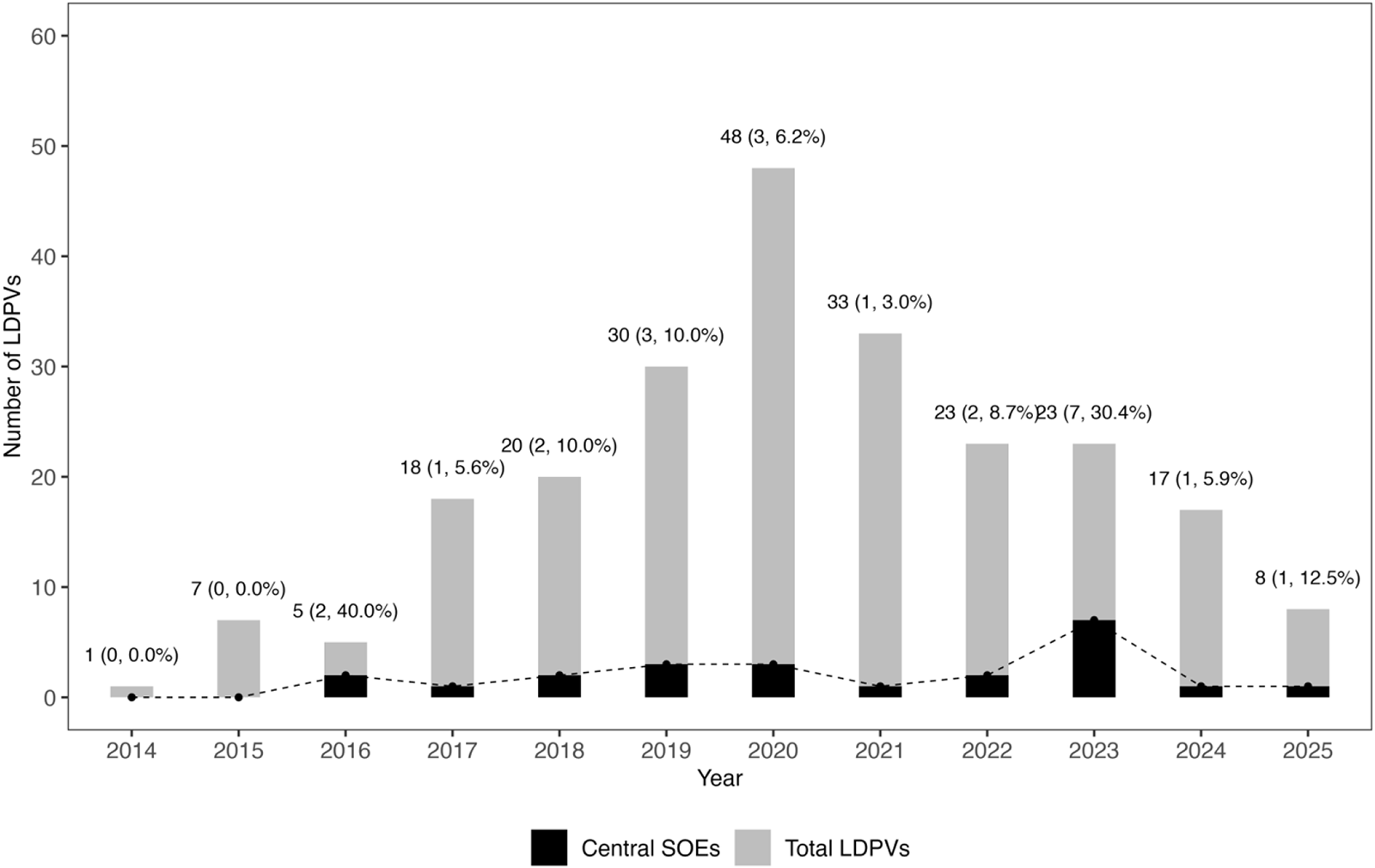
After collecting a comprehensive list of companies, we conducted a systematic search on Tianyancha 天眼查 and Qichacha 企查查, two major business information platforms in China providing standardized company registration data. We gathered information on firms’ founding dates, registered capital, shareholding structures, ownership percentages, business scope and organizational affiliations. Based on equity penetration analysis, we traced the ultimate controlling shareholders and identified three categories of key shareholders: 1) the local SOEs, including city investment corporations and industrial investment corporations sponsored by local fiscal agencies or local SASACs; 2) private digital technology firms, such as Alibaba, Baidu and Huawei, etc.; and 3) central SOEs, particularly major telecommunications firms, such as China Unicom, China Mobile and China Telecom, as well as large digital technology-oriented SOEs such as China Electronics Technology Group Corporation.
Fieldwork and interviews
Between 2022 and 2025, we conducted semi-structured interviews with key stakeholders involved in the establishment and operation of LDPVs in nine cities across eight provinces. We designed the interview sample to cover variation in city scale and geographical coverage. Interviewees were selected from across China’s major regions (north, east, south-west, south) and administrative levels, from megacities (population > 10 million), supercities (population 5–10 million), large cities (population 1–5 million), to medium and small cities (population < 1 million). In addition, our interviewees included stakeholders who participated in the entire public data development chain, from upstream regulators and planners (data bureaus, economic and informatization commissions), to midstream operators (LDPV employees, local bureaus or SOEs that were asked to upload their data to LDPVs or to sponsor their development) and downstream consumers or users (technology firms). This sampling strategy allowed us to examine how control without ownership operates across different institutional positions and local contexts. Several key informants were interviewed repeatedly to track institutional changes. Interviews were conducted in person or via phone.
The following sections present our empirical findings on the two key dimensions of LDPV operations mentioned in the analytical framework: power-sharing and profit-making. We examine the internal governance of LDPVs to show how local governments secure control over public data through a careful design of corporate governance structures and strategic partner selection. We then turn to external market behaviour, analysing how LDPVs attempt to extract value from public data despite unresolved ownership questions.
Securing Control: Shareholding, Supervision and Strategic Partnerships
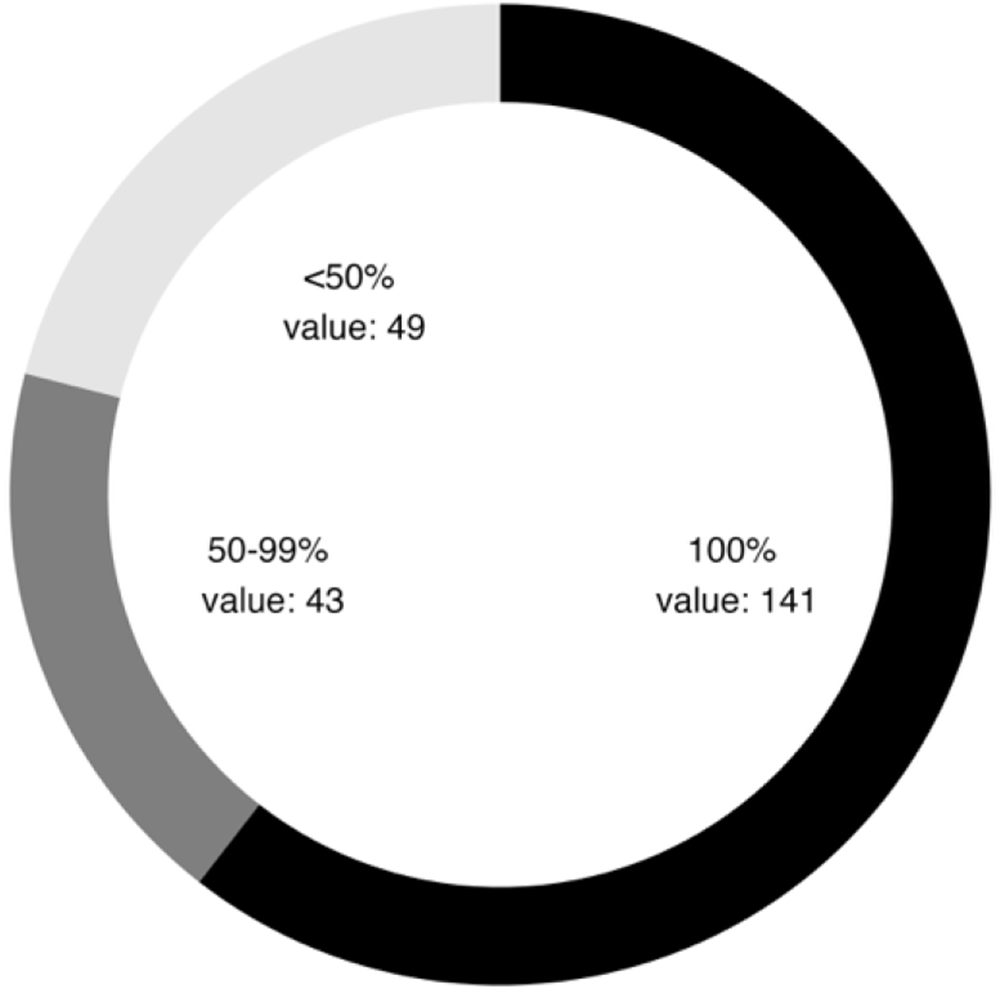
LDPVs constitute a unique category of local SOEs. About 80 per cent (184/233) of the LDPVs in our dataset have achieved absolute financial control over the shareholding structure, with a shareholding exceeding 50 per cent (Figure 3). They fall under the joint guidance of two functional departments: the local State-owned Assets Supervision and Administration Commission (SASAC) and a specialized department – either the local data bureau, the industry and information technology department or Economic and Information Technology Commission (prior to the prevalent establishment of the data bureau).Footnote 35 The local SASAC oversees the use of funds, adhering to the principle of maintaining and appreciating the value of state-owned properties. The local data bureaus play a substantial supervising role by “guiding the businesses” (yewu zhidao 业务指导) of the LDPVs, representing the de facto right to monitor the data process.Footnote 36
Financial Control: Local State’s Overall Shareholding Percentage in LDPVs

Figure 3 Long description
The pie chart displays shareholding percentages in LDPVs with three segments: under 50 percent with a value of 49, 50 to 99 percent with a value of 43 and 100 percent with a value of 141. The segments are distinguished by grayscale shades. The largest segment is 100 percent, representing approximately 61 percent of the total 233. The smallest segment is 50 to 99 percent, representing approximately 18 percent. The chart labels are directly on the slices and there is no legend.machine-generated.
Unlike conventional local SOEs, which operate at arm’s length from the local government, LDPVs operate as an extension of the local state’s administrative reach, directly accessing, coordinating and mobilizing public data resources across departmental boundaries. This reach is consolidated not only through shareholding but also through additional task approval, the setting of key performance indicators (KPI) and personnel arrangements (Figure 4).
Task Approval and Personnel Embeddedness in LDPVs

Figure 4 Long description
The flowchart illustrates the structure of control and promotion for LDPVs by the General Office of Municipal People's Government. At the top, the General Office leads and jointly promotes through two main branches: the Local Big Data Bureau and other functional departments. The Local Big Data Bureau is responsible for operational control, which includes the examination and approval authority of digital procurement. Other functional departments set specialized positions, such as Chief Data Officer and are involved in personnel control. This includes the ‘revolving door’ policy, relocation of employees and career moves of managers. External tech corporations are also part of the personnel control structure. At the bottom, LDPVs are influenced by these controls and promotions.machine-generated.
The local state sets overarching goals through annual planning documents but delegates specific inspection and incentive-provision rights to the local data bureau. This “loose-coupling mode” is achieved by assigning responsibility to the data bureau for approving digital government procurement projects and setting KPIs for digital upgrading across functional departments.Footnote 37 Approval of projects is a gatekeeping action, while KPI-setting facilitates data sharing between fragmented administrations and the local government platform. These state-backed coordinating and coercing instruments compensate for the LDPVs’ limited administrative authority to compel data integration and unification of data standards.
The personnel control mechanism further reinforces this embeddedness. Although interviewees from local state bureaus denied exercising direct personnel control over LDPVs,Footnote 38 many core LDPV employees are recruited from functional departments where they previously handled information technology tasks. Their relocation brings both technical expertise and informal networks within the bureaucracy.Footnote 39 Simultaneously, a small-scale revolving-door phenomenon is on the rise, wherein a few professional managers are hired from private technology giants (for example, Alibaba) to provide technical guidance.Footnote 40 This dual recruitment pattern enables LDPVs to achieve embedded autonomy. Hence, these state-invested market actors also serve as organizational instruments to help the local state expand its reach into data flows it cannot otherwise access.
The local state’s success in extending its reach raises a question: how does the central state view this accumulation of local data capacity? In the era of land finance, central and local interests were more closely aligned. The central government actively offered policy incentives that enabled local developmental initiatives,Footnote 41 and tacitly allowed “back door finance” through LGFVs.Footnote 42 Therefore, although land-based development generated systemic debt risks,Footnote 43 it did not fundamentally threaten the central state’s relative power to monitor and discipline local governments.
Public data, however, creates very different central–local dynamics. While central policies explicitly encouraged local governments to develop data as a productive resource, the central state’s interests do not fully align with the consolidation of local digital capacity. Hence, a local government that effectively integrates and controls public data will be confronted with a dilemma: while building an all-in-one data infrastructure enhances the local state’s capacity, the same infrastructure may, in turn, become a conduit for top-down oversight.
This tension also influences the local state’s choice of external institutional partners. While financial, operational and personnel controls jointly establish the local state’s internal control over LDPVs, control alone does not resolve the fact that local governments lack the technological expertise and fiscal capacity to build and operate sophisticated digital infrastructure. They bridge this resource gap by including external partners in the corporate structure. Not all local governments pursue such partnerships, as many LDPVs remain fully owned by local state entities, reflecting the principle of maximizing control and security at the cost of technical capacity. In these localities, self-reliance avoids both the horizontal risks of private-sector capture and the vertical risks of top-down supervision. Yet, for many others, technological and capital assistance remains necessary, requiring collaboration with actors whose interests do not fully align with those of the local state – the “frenemies.”
Managing “frenemies”: strategic partner selection in data governance
“Frenemy” type I: private giants as local insiders
Almost all participating digital tech shareholders are domestic “big names” – for example, Alibaba, Tencent, China Electronics Technology Group Corporation, and so on. Successful government–business partnerships emerge when “the partners bring complementary resources to the table and have overlapping interests and incentives.”Footnote 44 However, it would be wrong and misleading to view technological enterprises as a monolithic whole. Private big-tech firms and central state-owned technology enterprises, while both providing technological support in similar shareholding structures, are selected as partners for distinctly different reasons.
The relationship between private big-tech firms and the Chinese state has undergone dynamic stages.Footnote 45 When an enterprise’s market expansion aligns with the party-state’s goals (for example, development via economic and revenue growth), the state adopts a nightwatchman’s stance, allowing the business to expand freely. However, when an enterprise’s market power becomes overly concentrated, the government seeks to curb it through data security warnings and antimonopoly measures. Meanwhile, tech giants have become adept at handling government affairs and maintaining good relationships with the public sector. For instance, many platform enterprises have established dedicated government affairs offices to address increasing regulatory uncertainties (for example, the expanding scope and arbitrariness of administrative behaviour).Footnote 46
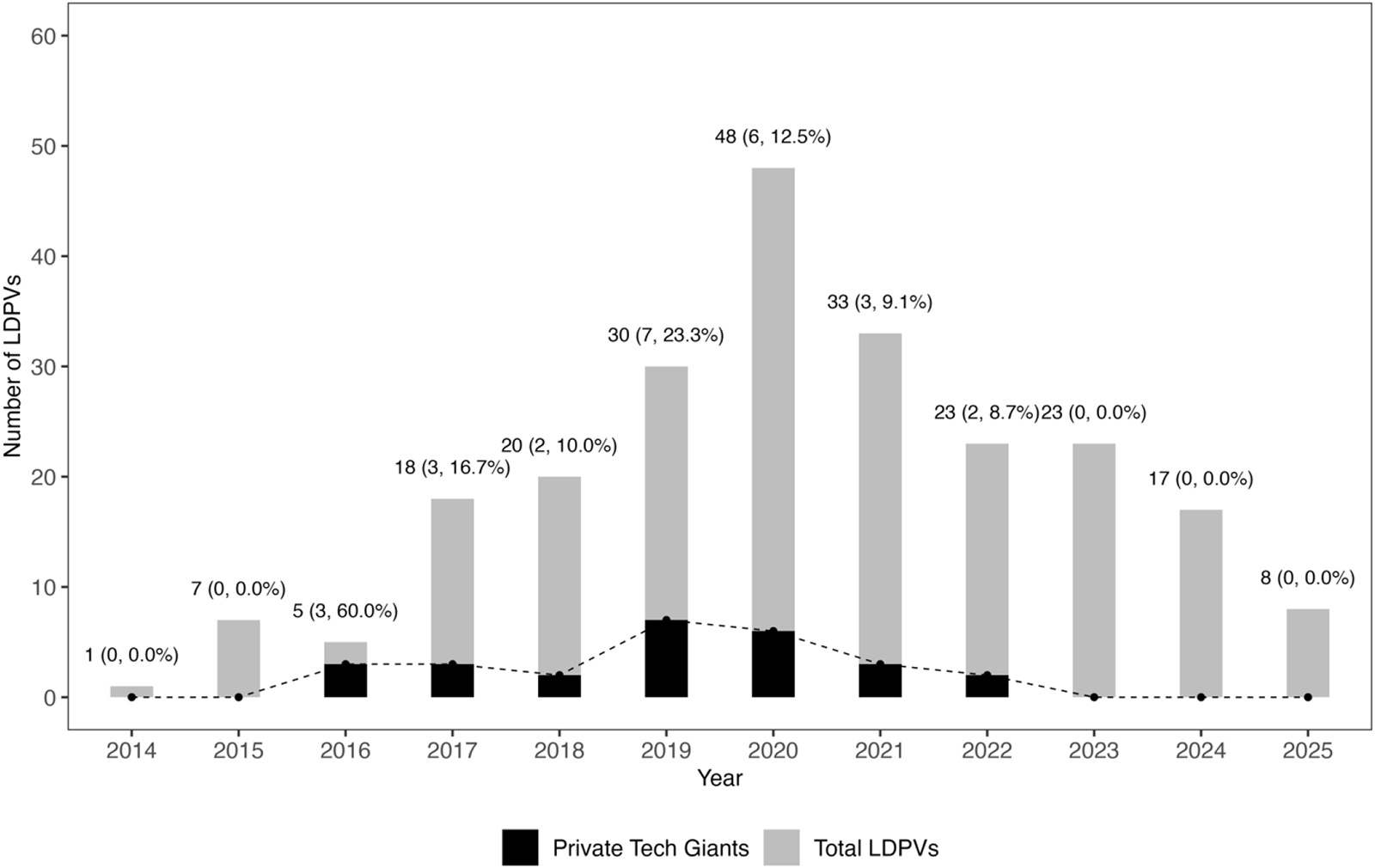
In the case of LDPVs, we observed instances when tech giants participated in local digital government projects not only as subcontractors but also as shareholders. A noticeable drop in collaborations with private giants occurred in 2021, the inaugural year of the antimonopoly campaign in China, which inevitably compelled the local state to cut ties with the digital giants (see Figure 5). This significant shift prompts us to explore the fundamental question of why local governments were willing to take the risks associated with forming joint ventures with these powerful tech giants in the first place, rather than simply procuring services from them? The answer lies in the unique constraints and goals of local governments.
Shareholding with Private Tech Giants

Figure 5 Long description
A combined bar and line graph titled Shareholding with Private Tech Giants presents yearly trends in local digital platform vehicles between 2014 and 2025. The horizontal axis represents the years, and the vertical axis indicates the number of LDPVs. Light-colored vertical bars depict the total number of LDPVs, while a dark dotted line with markers represents LDPVs involving private technology giants as shareholders. The total number of LDPVs remains relatively low at the beginning of the timeline and then increases steadily before reaching its highest level around the middle of the study period. Following this peak, the bars decline gradually in the later years. The line representing private technology giant participation remains below the heights of the total bars throughout the period and exhibits year-to-year variation. The line rises and falls over time, indicating changes in the extent of participation by private technology firms. Overall, the figure suggests that although private technology giants contributed to LDPV ownership during the study period, their involvement represented only a portion of the total number of LDPVs.
Local governments are constrained by their technological and fiscal capacities. The government lacks the expertise and technical capabilities to deliver these technologically advanced projects independently. To understand the source of the fiscal constraint, it is first necessary to examine funding sources. Before the national digital transformation was launched, during the “informatization” era, necessary equipment was procured through fiscally sponsored special funds from the Bureau of Economic and Information Technology. Alternatively, funds could be sourced from the local Development and Reform Commission’s fixed asset allocation; however, this option was more difficult due to competition from other construction projects, such as other large-scale infrastructure.
In the early stages, fiscal constraints were less stringent. For instance, in one of the cities we studied, the initial budget for upgrading the information system was 2 million yuan, whereas the cost for simple outsourcing projects was just 1 million yuan, yielding significant profits for both institutions and individuals participating in the procurement process.Footnote 47 As digital governance became more complex, the government found itself in need of more sophisticated systems to keep pace with its well-digitized counterparts. However, it was increasingly difficult to raise the budget to fulfil the upgraded task amid growing technological and coordination costs. In response, the government transitioned from working with partners who could follow orders to partnering with tech giants capable of producing standardized, modular products at reduced costs through economies of scale, such as Alibaba and Tencent.Footnote 48
Alignment at the product level with technology enterprises is instrumentally important but insufficient. These enterprises, mostly private, face a structurally disadvantaged position vis-à-vis the state apparatus under an incomplete ownership configuration. More importantly, there is an inherent tension between the state and the enterprises in balancing the simultaneous pursuit of public and private interests.Footnote 49 It is, therefore, crucial to keep the interests of both parties closely aligned around shared goals for a longer period, ensuring they take on the risks and responsibilities together. One key mechanism to promote mutual benefit is a new form of investment promotion, particularly for late-developing regions in the digital economy.Footnote 50 Despite their increasing bargaining power, these digital technology companies are expected to become substantial sources of local tax revenue. Although platform enterprises originally engaged in commercialized online businesses, they are reliable supporters of local industrial digitization, where productivity across sectors can be enhanced by data as a potential production factor. These “head of production chain” enterprises (lianzhu qiye 链主企业) or “dragon-head” pilot enterprises (longtou qiye 龙头企业) are deeply supportive of the “digitization of the city” and strengthen local comparative advantage in the new arena of regional competition.Footnote 51 In this way, advanced digital technologies have become a key component of the local government toolkit, preparing for future inter-regional competition in data-driven industrial growth.
In this way, privatization and increased state control go hand-in-hand.Footnote 52 Through co-investment, tax contributions and alignment with local industrial goals, private tech giants become jurisdictional insiders whose interests are linked to the local state’s goals. The sharp decline in partnerships after 2021 is more a reflection of the vulnerability of the local state–business relationship to central regulatory intervention rather than a loss of confidence in private firms per se.
“Frenemy” type II: central SOEs as jurisdictional outsiders
Some local governments turn to central SOEs for support in building digital government projects. In particular, they form co-shareholding relationships with the centrally owned telecommunications operators (for instance, China Unicom, China Mobile and China Telecom) that control the key network infrastructure, as well as with central SOEs that specialize in digital technologies (for instance, China Electronics Technology Group Corporation). These central SOEs are chosen as shareholders for three main reasons.
Technology is the primary reason, as partnering with central SOEs offers additional distinctive benefits compared to partnerships with private tech giants, which typically focus on purely technological complementarity and a higher level of “cost-effectiveness.” Central SOEs can provide the necessary infrastructural and technological support, as they have long served as the cornerstone of China’s economic and industrial transformation and as principal repositories of China’s industrial knowledge and experiences.Footnote 53 More importantly, however, central SOEs are deeply integrated into local development and have accumulated experience nationwide. This enables the local state to align with the technological standards and digital governance practices adopted in other jurisdictions.
The second reason is rooted in the local government’s careful calculation of accountability. Although collaborating with private national champions is cost-effective, it comes with risks. Our interview data indicated that procurement serves as a mechanism to monitor official corruption.Footnote 54 Consequently, officials often need to justify choosing a partner that may not be the most economical and will take associated risks if the partner is an institutional outsider, such as a private company. Therefore, after weighing the advantages and disadvantages, officials typically favour partnering with central SOEs, which is the most politically defensible choice. However, this preference does not imply complete trust.
If there were complete trust, then why would local governments not simply cooperate with existing local branches of central SOEs that have long been operating? The answer lies in data security and restrictions on data flow. Central SOEs, after all, are not local entities. Their local branches are administratively controlled by their headquarters and are required to report business details to their parent companies. An LDPV, as a specialized local SOE involved in the overall local public data ecology, facilitates the localization of public data. Hence, some local governments consider establishing secondary subsidiaries under these vehicles.Footnote 55 While these subsidiaries may not have full access to raw data, they can use masked data for other tasks if permission is given. Since 2022, there has been an increase in the selection of central SOEs as shareholding partners (Figure 6), indicating a shift towards prioritizing security concerns in handling data, which corresponds to the national regulatory trend of strengthening data security.
Shareholding with Central SOEs

Figure 6 Long description
A combined bar and line graph titled Shareholding with Central SOEs displays annual patterns in local digital platform vehicles from 2014 to 2025. The horizontal axis lists the years, and the vertical axis shows the number of LDPVs. Light-colored vertical bars represent the total number of LDPVs, while a dark line with square markers indicates those involving central state-owned enterprises as shareholders. The figure shows relatively low numbers in the initial years, followed by a sustained increase that culminates in the highest level near the middle of the timeline. After reaching this peak, the total number of LDPVs decreases gradually during the remaining years. The line representing central SOE participation remains lower than the total bars throughout the graph and displays fluctuations from year to year. Although the level of participation changes over time, the figure indicates that central SOEs maintained a continuing presence within the LDPV landscape. The overall pattern highlights both the expansion and subsequent contraction of LDPVs and illustrates how central SOE involvement varied alongside these broader trends.
The logic governing partner selection thus reveals that the key divide in local data governance is not between public and private actors but between jurisdictional insiders and outsiders. Private technology firms can serve as trusted insiders when their actions advance local developmental objectives, even though this trust remains vulnerable to central–state intervention. Central SOEs, on the other hand, sometimes operate as outsiders whose administrative ties to central ministries limit the extent to which local governments can fully incorporate them into data localization. In both cases, the key question is not merely about the partner’s type of ownership but whether interests are aligned.
To conclude, this section’s analysis explains how local governments secure control over data governance processes through shareholding and strategic partner selection. However, control alone does not automatically translate into developmental targets. If the local state only wants control, a 51 per cent stake suffices; if it wishes to take all the profit, 100 per cent ownership will be favoured. This logic then raises a critical question: how do LDPVs pursue profit when data ownership remains unresolved? The growing involvement of city investment as a shareholder and the rising number of fully state-owned LDPVs in recent years suggest that local governments bet on value capture, not just control. The following section examines how this profit-seeking ambition has evolved, the obstacles it has encountered and the strategies LDPVs adopt to extract value from public data.
Ambitions and Frictions of Profiting from Public Data
We have shown how local governments extend control over public data via internal corporate governance, but mere control without profit-making offers limited returns in terms of the local developmental agenda. If ownership of data remains unsettled, where does profit come from, and who claims it? Here, we outline three phases in the evolution of public data monetization strategies, each driven by specific obstacles encountered under the “control without ownership” model. The first involves decentralized, grey-area practices that existed before LDPVs became widespread nationwide. Public data was already monetized through hidden contracts, and LDPVs were partly created to bring these profit-seeking activities under government control. The second phase highlights the direct and indirect extraction strategies used by LDPVs. We draw parallels with land-based financing vehicles while noting the structural limits arising from the differences between land and data. The third phase describes the recent shift towards a platform model, when direct monetization meets resistance from data generators and caution from higher-level regulators.
“Grey-area” value extraction attempts in the pre-LDPV era
While the emergence of LDPVs is a relatively new phenomenon, profit-seeking behaviour involving public data – whether legal or illegal – is not new. Before LDPVs became widespread, public data monetization operated in decentralized “grey areas” and benefited digital contractors rather than the state. In an interview, a consultant explained the shared concerns of previous public sector clients.Footnote 56 Functional departments found it difficult to monitor their business partners, whether under the PPP arrangement or via contract-based outsourcing. For instance, a local IT enterprise supplied the technology and devices to build data-collecting sensors for a city’s storm warning system. Data access was de facto co-managed by the state and the subcontractor. However, unnoticed by the government at first, the subcontractor transmitted real-time data, with precise sensor locations, to insurance companies, so that the latter could re-evaluate the quotes and coverage of businesses and individuals in the nearby neighbourhood.
Another data-based business model is to offer value-added services on top of the digital infrastructure. A symbolic example is the smart parking project. In this case, parking fees were previously shared between the local state and the management companies. As smart parking project systems emerged, it became possible for the local administrative agency to collect fees directly via digital payments and to supervise parking lots online. However, it was necessary to negotiate a fee-sharing arrangement between the administrative agencies and the technological subcontractors.Footnote 57
These examples show that public data already had monetization value before LDPVs existed, but that value was captured by contractors operating at arm’s length. As LDPVs proliferate, the local state gains the capacity to control the data accumulation process and decide on its usage through administrative, political and corporate means. The key mechanism is internalization through co-shareholding. Rather than negotiating with external contractors over data access and revenue-sharing terms, LDPVs now bring technology partners into the corporate structure as minority shareholders. With the local state holding a majority share, bargaining over profit distribution shifts from external contracts to internal governance, where the state sets the terms. Nevertheless, these earlier experimental business models have disappeared. Instead, they have been absorbed into these new data institutions. However, centralizing control still does not resolve the deeper problem: without clear ownership, how can the state legitimately claim profits from data?
LDPVs’ attempts and limits in financializing public data
The most ambitious approach is financialization, that is, treating public data as an asset that can be priced, registered and used as collateral for loans. This strategy draws directly on the land finance model that the local governments once used to borrow against expected land revenues via financing vehicles. Does the same logic work for public data as well? This section shows that LDPVs can experiment with land-style financialization, but such efforts face structural limits that prevent scaling.
To be sure, data development and data capitalization are still in a nascent stage, with only a few licensed data exchanges operating in the emerging data market.Footnote 58 Recently, however, we have witnessed a regulatory loosening on the financialization of data, along with the issue of “Opinions of the CPC Central Committee and the State Council on establishing a data base system to maximize a better role of data elements” (also known as the 20 Measures, shuju ershi tiao 数据二十条). The aim is to fully leverage China’s data resources through building new data exchange and governance systems. In August 2023, the Ministry of Finance issued its “Interim provisions on accounting treatment of enterprise data resources” (Interim Provisions hereafter), which specify the recognition criteria for assets on the balance sheet.Footnote 59
In January 2024, after the Interim Provisions had formally taken effect, the Henan Data Group launched a pilot programme by listing “corporate land use rights” data on the Zhengzhou Data Exchange Centre, marking a significant step towards leveraging public data as an asset for capitalization.Footnote 60 With data generated from the state, corporate and individual users, the Henan Data Group secured an 8 million-yuan credit line from a financial institution. Note that this credit exchange was based solely on the perceived value of the data and did not require any additional physical collateral. Recovered credits can be reinvested in a wide range of local industries to drive revenue growth. Such transactions reflect the local state’s ambition to reach the economic potential of public data as a standalone asset for financialization, and to replicate the logic of land-based financialization in the digital domain (see Table 1).
Comparison Between Local Government Financing Vehicles and Local Digital Platform Vehicles

Table 1 Long description
The table compares local government financing vehicles and local digital platform vehicles across resource base, monopoly status, ownership, institutional setup, profit pathways, and overall purpose. Financing vehicles are built on land, typically with monopoly control and clear state ownership with local operational rights. Digital platform vehicles are built on public data, where only public data is controlled by the state, monopoly is limited, and ownership is described as unclear while local governments gain de facto control. Institutionally, land is locally decentralized but managed through a central hierarchical land system, while data resources are unified at the local state and described as decentralized at the local state at the central level. Direct profits differ: land transfer fees for land vehicles versus data use fees through data vendoring for digital platforms. Indirect profits also differ: land supports development revenue and serves as a financing tool, while data supports productivity gains that can raise revenues such as value-added tax and parking fees and can also be used as a financing instrument. The stated goal shifts from off-budget financing for local growth under central–local fiscal constraints to boosting local productivity and helping close fiscal deficits. Interpretations depend on the table’s qualitative categories, especially the characterization of data ownership and control..
Notes: *Rithmire Reference Rithmire2013; Reference Rithmire2017.
Source: Authors.
Yet this financialization attempt encounters structural limits because the conditions that once made land financialization feasible do not fully apply to public data. Urban land ownership is legally clear and is monopolized by the state, providing a stable foundation for collateral and credit expansion. Even when the state controls public data flows through infrastructure and administrative authority, it cannot credibly claim exclusive property rights in the way it did for land. This weakens the legitimacy and security of data-based collateral, making both valuation and enforcement uncertain.
Additionally, land finance depends on granting exclusive and transferable use rights under relatively stable valuation benchmarks. Data is fundamentally different, for it is non-rivalrous and easily replicated, which makes exclusive control difficult to guarantee and reduces the value of “asset transfer” as a revenue strategy. Data valuation thus becomes more political than market-driven, as transaction prices often reflect negotiation, branding pressures and regulatory signals rather than open competition.Footnote 61 Public data may generate value, but it constitutes only a limited share of overall data resources, which limits its ability to leverage large-scale credit activities as land once did. These features mean that data financialization may work, but it is hard to scale into a fiscal engine.
These limits push the local state to transition from a landlord to a gatekeeper. When ownership is unclear and exclusivity is hard to guarantee, revenue cannot come mainly from selling data as a commodity. Instead, it comes from controlling access and setting transaction rules. Under these constraints, many LDPVs have started to move away from direct financialization towards a platform model. Rather than profiting mainly by selling data or using it as collateral, they increasingly position themselves as platforms that facilitate transactions among actors. This allows them to earn rents by charging for access permissions, interfaces, compliance review and infrastructure services. In this sense, platformization becomes a scalable strategy for monetization under the conditions of control without ownership.
From extractor to intermediary: the nascent platform model
The structural limits of data financialization have become increasingly evident. As reported, some data groups have successfully secured financing for data assets. However, the transaction amounts are quite modest: Fujian and Guangxi each secured 10 million yuan in credit, while Henan secured 8 million yuan.Footnote 62 Informed insiders shared candidly that the LDPV projects were not delivering the profits originally promised.Footnote 63 This is in stark contrast to land finance, which mobilized trillions of yuan through over 10,000 LGFVs. Public data, in short, cannot function as robust collateral at scale.
At the municipal and provincial levels, many LDPVs have recently adopted a different model to facilitate public data transactions. This move is evident in the recent push to build “trustworthy data spaces” (kexin shuju kongjian 可信数据空间), platform infrastructure that enables government agencies and enterprises to upload, exchange, analyse and transact data in accordance with uniform protocols. As one manager in an SOE specializing in the ageing industry explained: “They used to try to get involved in everything – every sector, every application. Now they’ve realized it’s better to let each industry and department build their own systems first and then aggregate everything onto their platform.”Footnote 64 The business model resembles e-commerce platforms: data providers open “shops” and the platform operators collect channel fees or commissions. The local data bureau negotiates revenue-sharing arrangements to bring data holders onto the platform.
The platform model still faces a few challenges. In the first place, departments or firms with valuable data often resist uploading, since they recognize that once data enters the platform, their bargaining position diminishes. The same SOE manager informed us that while his company shares basic information that is readily available in the market, “data involving engineering projects, or anything more valuable, needs more negotiation.”Footnote 65 In this way, the platform’s success depends on gaining sufficient participation from both data providers and consumers, which becomes the classic chicken-and-egg problem similar to the platform economy.
More fundamentally, the platform does not resolve the underlying ownership question but merely sidesteps it. By positioning themselves as neutral intermediaries rather than data owners, LDPVs try to avoid the political sensitivities of claiming property rights over public data. However, revenue-sharing negotiations still rely on implicit claims about entitlement. As the platform offers data providers a share of the transaction fees, it also assumes the authority to allocate those fees. As transaction volumes grow and stakes rise, disputes over who owns what will inevitably re-emerge. Hence, the platform aggregates ambiguity rather than overcoming it.
In this sense, the new platform model appears to be a strategic retreat rather than a final solution. It enables LDPVs to generate revenue from public data circulation without directly addressing the ownership question. However, this also ties their fiscal sustainability to transaction volume in a nascent market under loose regulation. Whether these jurisdiction-bounded platforms, bound to a single city or province, will release network effects or not remains questionable.
Conclusion
China has bet on its transformation into a data regime. Using original data and interviews across multiple regions to examine newly emerging LDPVs, we show how local states have tied their recent developmental agendas to the revenue-generating potential of public data. We offer three contributions to the current literature on China’s political economy in the digital era.
First, we introduce “control without ownership” as a theoretical framework for understanding how local developmental states adapt when the property rights of public data cannot be resolved. Ambiguous ownership is not new in the Chinese political economy. Township and village enterprises, as well as mixed-ownership SOEs, have long been subject to vague property arrangements. What makes the data regime unique is that this ambiguity is durable. Public data ownership involves overlapping claims, and these claims confront fundamental tensions over privacy, security and profit distribution. Moreover, public data differs from earlier development resources, such as state-owned land. It is non-territorial and non-rival, and its value depends more on circulation and sharing than exclusion. Hence, local governments step away from making ownership claims and instead focus on governing the overall circulation process. That is why, although LDPVs adopt market mechanisms and incorporate market actors, they ultimately function to strengthen, not dilute, state control.
Second, we specify the mechanisms through which local states exercise control in the absence of any clear-cut ownership. Control is achieved through interconnected channels: majority shareholding, task approval that sets operational priorities, and personnel arrangements that link bureaucracies, tech providers and data holders. Beyond internal governance, we also identify a logic of partner selection based on the alignment of interests within the jurisdiction. The key difference is not between public and private but between insider and outsider. Private technology firms may function as “local insiders,” as long as business interests bind them to municipal objectives. Central SOEs, on the other hand, sometimes become “jurisdictional outsiders,” as they directly report to the State Council.
Third, we trace the co-evolution of business models and institutional change under “control without ownership.” Initial monetization took place through decentralized and grey-area practices through which contractors captured value from government digitization projects. As local states sought to internalize these gains, they developed LDPVs to financialize data through valuation and collateralization. However, financialization proved difficult to scale due to weak ownership foundations. This constraint gradually propelled LDPVs towards a platform model. Over time, LDPVs have transformed into infrastructure providers that enable controlled data circulation rather than data product vendors. Hence, each phase represents not merely a business model shift but rather an institutional response to constraints arising from unresolved ownership.
These findings also raise important questions about the future of China’s digital developmentalism. First, while this paper focuses on the local model, recent calls for establishing a national data group suggest a potential change in central–local dynamics.Footnote 66 Throughout the land finance era, central and local interests were roughly aligned, but public data governance could generate stronger vertical tensions. The ideal of a national data group to break interjurisdictional data barriers implies the effort to reassert central control over increasingly powerful local data infrastructures. Whether centralization will succeed or lead to new bargaining equilibriums remains an open question.
Additionally, the platform model creates a tension between platformization and local developmentalism. The success of a platform model depends on scale, user numbers and cross-boundary flows. Yet, in LDPVs, local governments treat data as a territorial resource and a competitive advantage. These two logics conflict with each other. If the local state opens its data infrastructure to broader regional integration, it may undermine the logic of control that initially motivated the creation of LDPVs. Whether LDPVs can reconcile the scale demands of platformization with the territorial incentives of local developmentalism will shape the long-term sustainability of data-driven growth.
Last but not least, this new regime raises public interest questions. Chinese developmentalism has long drawn its legitimacy from its performance in promoting growth while alleviating poverty. But if local governments profit from public data, how are citizens’ rights protected? Do citizens gain anything from contributing their data to the public digital infrastructure? As local states retreat from direct data trading and assume more gatekeeper roles, accountability becomes harder to assign. When a problem occurs, who should be held accountable for it? These questions are central to the legitimacy of pursuing developmentalism with public data.
Data availability statement
The data used in this study are available from the corresponding author upon reasonable request.
Acknowledgements
Earlier versions of this article were presented at the third “Emerging research on Chinese politics” workshop at Sun Yat-sen University, the fourth Shanghai forum on “Chinese political economy research” at Shanghai Jiao Tong University, the 17th graduate seminar on “Modern and contemporary China” at The Chinese University of Hong Kong, and the Ye Chenghai research forum at Renmin University of China. The authors are grateful to the participants of these workshops and forums for their valuable feedback. We also wish to thank all the interviewees who so generously shared their experiences with us.
Funding information
This research was supported by the Major Project of National Social Science Fund of China (Grant No. 25&ZD217) and Beijing Young Elite Scientist Sponsorship Program (Grant No. JWZQ20240202003).
Competing interests
None.
Wenjia SONG is an assistant professor at the Institute for Global Public Policy, Fudan University. Her research interests are in comparative political economy, innovation policy and AI governance.
Tianguang MENG is a professor in the department of political science, Tsinghua University. His research interests include politics of information, digital governance, political economy and computational social science.