1 Introduction
One of the fundamental objects in harmonic analysis is the operator of the form
 $$ \begin{align} T_Kf(x)=\int_{{\Bbb R}^d} K(x,y) f(y) dy, \end{align} $$
where
 $K: {\Bbb R}^d \times {\Bbb R}^d \to {\Bbb R}$
is a suitable kernel and f is a locally integrable function. See [Reference Stein16] and the references contained therein for a variety of manifestations of operators of this type and their bounds.
The purpose of this paper is to study operators from (1.1) in the context of vector spaces over finite fields. Let
 ${\Bbb F}_q$
denote the finite field with q elements, and let
 ${\Bbb F}_q^d$
be the d-dimensional vector space over this field. Let
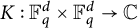 $K: {\Bbb F}_q^d \times {\Bbb F}_q^d \to {\Bbb C}$
be a suitable kernel, and define
 $$ \begin{align*}T_Kf(x)=\sum_{y \in {\Bbb F}_q^d} K(x,y) f(y).\end{align*} $$
Operators of this type have been studied before [Reference Carbery, Stones and Wright4, Reference Koh and Lee11–Reference Koh, Shen and Shparlinski13]. In particular, the operator
 $T_K$
with
 $K(x,y)=S_t(x-y)$
, where
 $S_t$
is the indicator function of the sphere
 $$ \begin{align*}S_t=\{x \in {\Bbb F}_q^d: ||x||=t \},\end{align*} $$
 $||x||=x_1^2+x_2^2+\dots +x_d^2$
, comes up naturally in the study of the Erdős–Falconer distance problem in vector spaces over finite fields, namely the question of how large a subset
 $E \subset {\Bbb F}_q^d$
needs to be to ensure that if
 $$ \begin{align*}\Delta(E)=\{||x-y||: x,y \in E\},\end{align*} $$
then
 $|\Delta (E)| \ge \frac {q}{2}$
. Here and throughout,
 $|S|$
, with S a finite set, denotes the number of elements in this set. See, for example, [Reference Bennett, Hart, Iosevich, Pakianathan and Rudnev3, Reference Chapman, Erdog̃an, Hart, Iosevich and Koh5, Reference Hanson, Lund and Roche-Newton8, Reference Iosevich and Rudnev10, Reference Murphy, Petridis, Pham, Rudnev and Stevenson15].
If one is interested in studying more complicated geometric objects than distances, an interesting modification of the spherical averaging operator needs to be made. Indeed, let
 $E \subset {\Bbb F}_q^d$
, and suppose that we want to know how many equilateral triangles of side-length
 $1$
it determines. The quantity that counts such triangles is given by
 $$ \begin{align} \sum_{x,y,z \in {\Bbb F}_q^d} K(x,y)K(x,z)K(y,z)E(x)E(y)E(z),\end{align} $$
where
 $K(x,y)=S_1(x-y)$
.
Let us interpret the quantity (1.2) in the following way. Let us view
 $x,y,z$
as vertices, and let us view the presence of
 $K(x,y)$
as determining the edge connecting x and y, and so on. In this way, the quantity (1.2) is associated with the graph
 $K_3$
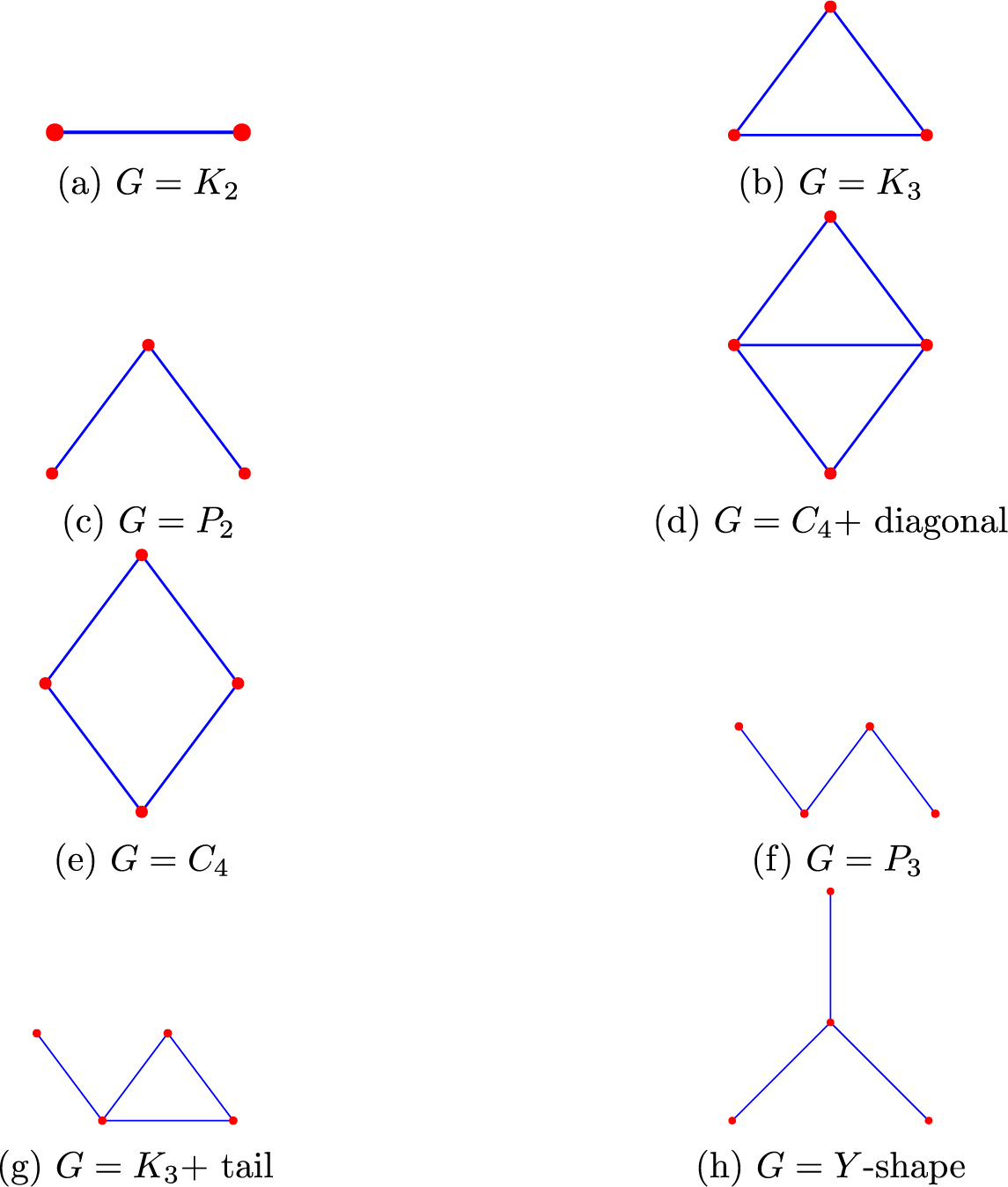
, the complete graph on three vertices (Figure 1b).
Another natural example is the following. Let
 $K(x,y)=S_1(x-y)$
, and consider the quantity that counts rhombi of side-length
 $1$
, i.e.,
 $$ \begin{align} \sum_{x,y,z,w\in {\Bbb F}_q^d} K(x,y)K(y,z)K(z,w)K(w,x)E(x)E(y)E(z)E(w). \end{align} $$
Arguing as above, we associate this form with the graph
 $C_4$
, the cycle on four vertices (Figure 1e).
In general, let K be a kernel function, and let G be a connected ordered graph on n vertices. Define
 $$ \begin{align} \Lambda_G(f_1, f_2, \dots, f_n)=\frac{1}{\mathcal{N}(G)}\sum_{x^1, \dots, x^n \in {\Bbb F}_q^d} \ \prod_{(i,j) \in {\mathcal E}(G)} K(x^i,x^j) \prod_{l=1}^n f_l(x^l), \end{align} $$
where
 ${\mathcal E}(G)$
is the edge set of G and
 $\mathcal {N}(G)$
is the normalizing factor defined as the number of distinct embeddings of G in
 $\mathbb {F}_q^d$
. Notice that
 $\mathcal {N}(G)$
is the number of tuples
 $(x^1, \ldots , x^n) \in (\mathbb F_q^d)^n$
such that
 $ \prod _{(i,j) \in {\mathcal E}(G)} K(x^i,x^j) =1.$
We will call the operator
 $\Lambda _{G}$
as the G form on
 $\mathbb F_q^d.$
Figure 1:

We note in passing that the paradigm we just introduced extends readily to the setting of hypergraphs. If we replace our basic object, the linear operator
 $T_K$
, by an m-linear operator
 $M_K$
, the problem transforms to the setting where the edges dictated by the kernel K are replaced by hyperedges induced by the multi-linear kernel
 $K(x^1, \dots , x^{m+1})$
. We shall address this formulation of the problem in the sequel.
The norm
 $||f||_p, 1\le p< \infty ,$
is defined to be associated with normalizing counting measure on
 $\mathbb F_q^d.$
More precisely, given a function f on
 $\mathbb F_q^d,$
we define
 $$ \begin{align*}{||f||}_p:={\left(q^{-d}\sum_{x \in {\Bbb F}_q^d} {|f(x)|}^p \right)}^{\frac{1}{p}}~~ (1\le p<\infty), \quad\mbox{and}\quad ||f||_\infty:=\max_{x\in \mathbb F_q^d} |f(x)|.\end{align*} $$
Definition 1.1 Let n and d be nonnegative integers. For each finite field
 $\mathbb F_q,$
we consider a connected ordered graph G on n vertices in
 $\mathbb F_q^d.$
For any numbers
 $1\le p_i\le \infty $
,
 $i=1,\ldots , n,$
we define
 $\Lambda _G(p_1, \ldots , p_n)$
as the smallest number such that the following inequality
 $$ \begin{align} \Lambda_G(f_1, \dots, f_n) \leq \Lambda_G(p_1, \ldots, p_n) \prod_{i=1}^n {||f_i||}_{p_i} \end{align} $$
holds for all nonnegative real-valued functions
 $f_i$
,
 $1\le i\le n$
, on
 $\mathbb {F}_q^d$
.
Notice that the graph G in the above definition is chosen based on the underlying finite field
 $\mathbb F_q$
. Hence, the operator norm
 $\Lambda _G(p_1, \ldots , p_n)$
may depend on q, the size of the underlying finite field
 $\mathbb F_q$
so that it can grow with
 $q.$
However, if there exists a constant C, independent of q, such that
 $\Lambda _G(p_1, \ldots , p_n)\le C$
, then we will denote
 $\Lambda _G(p_1, \ldots , p_n) \lesssim 1.$
The main purpose of this paper is to determine all numbers
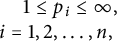 $1\le p_i\le \infty , i=1,2, \ldots , n,$
such that the operator norm
 $\Lambda _G(p_1, \ldots , p_n)$
is not allowed to grow with q, that is,
 $\Lambda _G(p_1, \ldots , p_n)\lesssim 1.$
We will refer to this problem as the boundedness problem for the operator
 $\Lambda _G$
on
 $\mathbb F_q^d.$
For the remainder of this paper, the kernel function
 $K(x, y)$
is assumed to be
 $S_t(x-y)$
with
 $t\ne 0.$
In addition, when the dimension d is 2, we assume that the number
 $3$
in
 $ \mathbb F_q$
is a square number so that we can exclude the trivial case in which the shape of an equilateral triangle in
 $\mathbb F_q^2$
does not occur.
We shall mainly confine ourselves to the following connected graphs G with at most four vertices:
 $K_2$
(the graph with two vertices and one edge),
 $K_3$
(the cycle with three vertices and three edges),
 $K_3$
+ tail (a kite),
 $P_2$
(the path of length
 $2$
),
 $P_3$
(the path of length
 $3$
),
 $C_4$
(the cycle with four vertices and four edges),
 $C_4$
+ diagonal, Y-shape (a space station). In particular, we have avoided the
 $K_4$
(the complete graph with four vertices) since there is no
 $K_4$
distance graph on
 $\mathbb F_q^2.$
However, it would be interesting to investigate the case when the graph G is a
 $K_4$
in higher dimensions, a graph with more than four vertices, or a disconnected graph. Despite the difficulties posed by this case, we anticipate that experts in this field will address advanced results in the near future.
When the graph G is the
 $K_2,$
the complete answer to the boundedness problem will be given in all dimensions. To deduce the result, we will invoke the spherical averaging estimates over finite fields (see Theorem 3.3).
When the number of the vertices of the graph G is
 $3$
or
 $4,$
we will obtain reasonably good boundedness results in two dimensions. In particular, in the case when the degree of each vertex is at least 2 (
 $K_3, C_4+$
a diagonal, and
 $C_4$
), we shall prove sharp results (up to the endpoints) for the operators on
 $\mathbb F_q^2$
(see Theorems 4.7, 6.5, and 7.5). While the proofs for the graphs
 $K_2$
and
 $K_3$
use standard results in the literature, in other cases, a new approach will be introduced. We also note that there are several papers in the literature studying the distribution of the graphs
 $P_2, P_3$
, and Y-shape in a large set (see [Reference Bennett, Chapman, Covert, Hart, Iosevich and Pakianathan2, Reference Iosevich, Jardine and McDonald9] for example); however, the techniques in those papers are not helpful for the question raised in this paper. For three and higher dimensions, the boundedness problem is not simple and we will address partial results.
It is very natural to ask whether or not one can prove a general theorem that addresses all connected graphs on n vertices. Unfortunately, such a result is beyond the scope of this paper. The main difficulties arise when the maximal degree is large or the edge set is dense, or if the graph contains a cycle or not. All of these issues will be illustrated in the proofs of our results.
We also study the boundedness relation between the operators associated with a graph G and its subgraph
 $G'$
with n-vertices. Throughout the paper, we always assume that the graph G and its subgraph
 $G'$
are connected ordered graphs with
 $|G|=|G'|$
in
 $\mathbb F_q^d,$
and two vertices
 $x,y$
in G is connected if
 $||x-y||=t\ne 0.$
In Theorem 5.5, we will see that any exponents
 $1\le p_1, p_2, p_3 \le \infty $
with
 $\Lambda _{K_3}(p_1, p_2, p_3)\lesssim 1$
satisfy that
 $\Lambda _{P_2}(p_1, p_2, p_3) \lesssim 1$
. Notice that
 $P_2$
can be considered as a subgraph of
 $K_3,$
and the operators
 $\Lambda _{P_2}$
and
 $\Lambda _{K_3}$
are related to the graphs
 $P_2$
and
 $K_3,$
respectively. Hence, in view of Theorem 5.5, one may have a question that, “Compared to a graph G, does the operator associated with its subgraph yield less restricted mapping exponents?” More precisely, one may pose the following question.
Question 1.2 Suppose that
 $G'$
is a subgraph of the graph G with n vertices in
 $\mathbb F_q^d.$
Let
 $1\le p_i\le \infty , 1\le i\le n.$
If
 $\Lambda _G(p_1, \ldots , p_n)\lesssim 1,$
is it true that
 $\Lambda _{G'}(p_1, \ldots , p_n) \lesssim 1?$
Somewhat surprisingly, the answer turns out to be no! When
 $G=K_3$
and
 $G'=P_2,$
the answer to Question 1.2 is positive as Theorem 5.5 shows. However, it turns out that there exist a graph G and its subgraph
 $G'$
yielding a negative answer, although the answers are positive for the most graphs which we consider in this paper. For example, the answer to Question 1.2 is negative when G is the
 $C_4$
+ diagonal and
 $G'$
is the
 $C_4$
(see Proposition 7.6).
Since the general answer to Question 1.2 is not always positive, we pose the following natural question.
Problem 1.3 Find general properties of the graph G and its subgraph
 $G'$
which yield a positive answer to Question 1.2.
The main goal of this paper is to address a conjecture on this problem and to confirm it in two dimensions. To precisely state our conjecture on the problem, let us review the standard definition and notation for the minimal degree of a graph.
Definition 1.4 The Minimum Degree of a graph G, denoted by
 $\delta (G)$
, is defined as the degree of the vertex with the least number of edges incident to it.
We propose the following conjecture which can be a solution of Problem 1.3.
Conjecture 1.5 Let
 $G'$
be a subgraph of the graph G in
 $\mathbb F_q^d, d\ge 2,$
with n vertices, and let
 $1\le p_i\le \infty , 1\le i\le n.$
In addition, assume that
 $$ \begin{align} \min\left\{\delta(G), d\right\}> \delta(G').\end{align} $$
Then, if
 $\Lambda _G(p_1, \ldots , p_n)\lesssim 1$
, we have
 $\Lambda _{G'}(p_1, \ldots , p_n)\lesssim 1.$
Note that the condition (1.6) in Conjecture 1.5 is equivalent to the following:
 $$ \begin{align} (i)~ \delta(G)>\delta(G') \quad \mbox{and} \quad (ii) ~d> \delta(G'). \end{align} $$
We have some comments and further questions below, regarding the above conjecture and our main theorems which we will state and prove in the body of this paper.
-
• Our results in this paper confirm Conjecture 1.5, possibly up to endpoints, for all graphs G and their subgraphs
 $G'$
on
$n=3, 4$
vertices in
$\mathbb F_q^2$
(see Theorem 10.7). Also note that when
$d=2$
and
$n=3, 4$
, the condition (1.6) is equivalent to the first condition
$(i)$
in (1.7) since
$\delta (G)\le 2$
(see the figures above).
-
• It will be shown that the conclusion of Conjecture 1.5 cannot be reversed at least for
$n=3, 4$
in two dimensions (see Remark 5.6 for
$n=3$
, and see Remarks 8.9, 8.12, 9.11, and 10.5 for
$n=4$
.)


It is worth investigating whether the key hypothesis (1.6) of Conjecture 1.5 can be relaxed.
-
• The conclusion of Conjecture 1.5 does not hold in general if the
$>$
in the assumption (1.6) is replaced by
$\ge $
. To see this, consider
$G=C_4+$
diagonal and
$G'=C_4$
on 4 vertices in
$\mathbb F_q^d,$
with
$d=2.$
It is obvious that
$G'$
is a subgraph of G and
$\min \{\delta (G), d\}=\delta (G')=2.$
However, Proposition 7.6(ii) implies that the conclusion of Conjecture 1.5 is not true. -
• We are not sure what can we say about the conclusion of Conjecture 1.5 if the main hypothesis (1.6) of Conjecture 1.5 is relaxed by the second one of the conditions (1.7). To be precise, when (1.6) is replaced by the second statement of (1.7), that is,
$d> \delta (G'),$
we do not have a definitive answer even for
$n=4$
in
$\mathbb F_q^2.$
For instance, let
$G=Y$
-shape and
$G'=K_3+$
a tail on
$\mathbb F_q^2.$
Then it is clear that
$d=2> \delta (G')=1$
and
$1=\delta (G)=\delta (G')$
and so this provides an example that does not satisfy the assumption (1.6) of Conjecture 1.5 but satisfy the second statement of (1.7). Unfortunately, in this paper, we have not found any inclusive boundedness relations between the operators corresponding to such graphs. In order to exclude this uncertain case, both conditions in (1.7) were taken as the hypothesis for Conjecture 1.5, namely the condition (1.6).






Notation:
-
• We denote
$\Lambda _G(p_1, \ldots , p_n)\lessapprox 1$
if the inequality (1.5) holds true for all characteristic functions on
$\mathbb F_q^d.$
-
• By
$\mathbb {F}_q^*$
, we mean the set of all nonzero elements in
$\mathbb {F}_q$
. -
• For
$t\in \mathbb F_q^*$
, we denote by
$S_t^{n-1}$
the sphere of radius t centered at the origin in
$\mathbb F_q^n:$
Unless otherwise specified in this paper, d represents the general dimension of
$$ \begin{align*}S_t^{n-1}:=\{x\in \mathbb F_q^n: ||x||=t\}.\end{align*} $$
$\mathbb F_q^d, d\ge 2.$
When
$n=d$
, we write
$S_t$
instead of
$S_t^{d-1}$
for simplicity.
-
• We identify the set
$S_t$
with its indicator function
$1_{S_t}$
, namely,
$S_t(x)=1_{S_t}(x)$
. -
• We write
$\delta _0$
for the indicator function of the set of the zero vector in
$\mathbb F_q^d.$
-
• For positive numbers
$A, B>0,$
we write
$A\lesssim B$
if
$A\le C B$
for some constant
$C>0$
independent of q, the size of the underlying finite field
$\mathbb F_q.$
The notation
$A\sim B$
means that
$A\lesssim B$
and
$B\lesssim A.$






The rest of this paper is organized as follows: In Section 2, we recall known results on the spherical averaging operator, which functions as a fundamental tool to prove our theorems. Sections 3–10 are devoted to the presentation and proofs of our main results associated with the graphs mentioned above. The Appendix contains some technical lemmas on the number of intersection points of two spheres in
 $\mathbb {F}_q^d$
.
2 The spherical averaging problem
In the finite field setting, Carbery, Stones, and Wright [Reference Carbery, Stones and Wright4] initially formulated and studied the averaging problem over the varieties defined by vector-valued polynomials. This problem for general varieties was studied by Chun-Yen Shen and the third-listed author [Reference Koh and Shen12]. Here, we introduce the standard results on the averaging problem over the spheres. We adopt the notation in [Reference Koh and Shen12].
Let
 $dx$
be the normalizing counting measure on
 $\mathbb F_q^d.$
For each nonzero t, we endow the sphere
 $S_t$
with the normalizing surface measure
 $d\sigma _t.$
We recall that
 $$ \begin{align*}d\sigma_t(x)= \frac{q^d}{|S_t|} 1_{S_t}(x) dx\end{align*} $$
so that we can identify the measure
 $d\sigma _t$
with the function
 $\frac {q^d}{|S_t|} 1_{S_t}$
on
 $\mathbb F_q^d.$
The spherical averaging operator
 $A_{S_t}$
is defined by
 $$ \begin{align} A_{S_t}f(x)=f\ast d\sigma_t(x)=\int_{S_t} f(x-y) d\sigma_t(y) =\frac{1}{|S_t|} \sum_{y\in S_t} f(x-y),\end{align} $$
where f is a function on
 $\mathbb F_q^d.$
By a change of variables, we also have
 $$ \begin{align} A_{S_t}f(x)=\frac{1}{|S_t|} \sum_{y\in \mathbb F_q^d} S_t(x-y) f(y). \end{align} $$
For
 $1\le p, r\le \infty ,$
we define
 $A_{S_t}(p\to r)$
to be the smallest number such that the averaging estimate
 $$ \begin{align} ||f\ast d\sigma_t||_{L^r(\mathbb F_q^d, dx)} \le A_{S_t}(p\to r) ||f||_{L^p(\mathbb F_q^d, dx)}\end{align} $$
holds for all functions f on
 $\mathbb F_q^d.$
Problem 2.1 (Spherical averaging problem)
Determine all exponents
 $1\le p, r\le \infty $
such that
 $$ \begin{align*}A_{S_t}(p\to r)\lesssim 1.\end{align*} $$
Notation 2.2 From now on, we simply write A for the spherical averaging operator
 $A_{S_t}.$
By testing (2.3) with
 $f=\delta _0$
and by using the duality of the averaging operator, it is not hard to notice that the necessary conditions for the boundedness of
 $A(p\to r)$
are as follows:
 $ (1/p, 1/r)$
is contained in the convex hull of points
 $(0,0), (0, 1), (1,1), $
and
 $(\frac {d}{d+1}, \frac {1}{d+1} ).$
Using the Fourier decay estimate on
 $S_t$
and its cardinality, it can be shown that these necessary conditions are sufficient. For the reader’s convenience, we give a detail proof although the argument is standard, as is well known in the literature such as [Reference Carbery, Stones and Wright4, Reference Koh and Shen12].
Theorem 2.3 Let
 $ 1\le p, r\le \infty $
be numbers such that
 $(1/p, 1/r)$
lies on the convex hull of points
 $(0,0), (0, 1), (1,1), $
and
 $(\frac {d}{d+1}, \frac {1}{d+1} ).$
Then we have
 $ A(p\to r) \lesssim 1.$
Proof Since both
 $d\sigma _t$
and
 $dx$
have total mass
 $1,$
it follows from Young’s inequality for convolution functions that if
 $1\leq r \leq p\leq \infty ,$
then
 $$ \begin{align} \|f\ast d\sigma_t\|_{L^r({\mathbb F_{q}^d, dx})} \leq \|f\|_{L^p({\mathbb F_{q}^d, dx})}.\end{align} $$
We notice that these results do not hold for the Euclidean Averaging problem.
By the interpolation and the duality, we only need to establish the following critical estimate:
 $$ \begin{align*}A\left(\frac{d+1}{d}\to d+1\right)\lesssim 1.\end{align*} $$
It is well known that for nonzero t,
 $$ \begin{align*}|(d\sigma_t)^\vee(m)|:=\left|\frac{1}{|S_t|} \sum_{x\in S_t} \chi(m\cdot x)\right|\lesssim q^{-\frac{(d-1)}{2}}\quad \mbox{for all}~~ m\neq (0,\dots,0),\end{align*} $$
where
 $\chi $
denotes a nontrivial additive character of
 $\mathbb F_q$
(see the proof of Lemma 2.2 in [Reference Iosevich and Rudnev10]).
Since
 $|S_t|\sim q^{d-1},$
we complete the proof by combining this Fourier decay estimate with the following well-known lemma (see Lemma 6.1 in [Reference Koh and Shen12]).
Lemma 2.4 Let
 $d\sigma $
be the normalized surface measure on an variety S in
 $\mathbb F_q^d$
with
 $|S|\sim q^{d-1}.$
If
 $|(d\sigma )^\vee (m)|\lesssim q^{-\frac {k}{2}}$
for all
 $m\in {\mathbb F_q^d}\setminus (0,\dots ,0)$
and for some
 $k>0,$
then we have
 $$ \begin{align*}A\left(\frac{k+2}{k+1}\to k+2\right)\lesssim 1.\\[-41pt] \end{align*} $$
The boundary points of the convex hull play an important role in the application of Theorem 2.3. More precisely, we will apply the following result, which is a direct consequence of Theorem 2.3.
Lemma 2.5 Let
 $1\le p, r\le \infty $
, and let A denote the averaging operator over the sphere
 $S_t, t\ne 0,$
in
 $\mathbb F_q^d, d\ge 2.$
-
(i) If
$1\le \frac {1}{p} \le \frac {d}{d+1}$
and
$ \frac {1}{r}= \frac {1}{dp}$
, then
$A(p\to r)\lesssim 1.$
-
(ii) If
$ \frac {d}{d+1} \le \frac {1}{p} \le 1$
and
$ \frac {1}{r}=\frac {d}{p}-d+1$
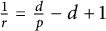
, then
$A(p\to r)\lesssim 1.$





3 Sharp mapping properties for the
$K_2$
form

In this section, we provide the sharp mapping properties of the operator associated with the graph
 $K_2.$
To this end, as described below, we relate the problem to the spherical averaging problem.
As usual, the inner product of the nonnegative real-valued functions
 $f, g$
on
 $\mathbb F_q^d$
is defined as
 $$ \begin{align*}<f, g>:=||f g||_1=\frac{1}{q^d} \sum_{x\in \mathbb F_q^d} f(x) g(x).\end{align*} $$
Let
 $t\in \mathbb F_q^*$
, and let
 $f_1,f_2$
be nonnegative real-valued functions on
 $\mathbb F_q^d, d\ge 2.$
Then the
 $K_2$
form
 $\Lambda _{K_2}$
on
 $\mathbb F_q^d$
is defined by
 $$ \begin{align} \Lambda_{K_2}(f_1,f_2)= \frac{1}{q^d|S_t|} \sum_{x^1, x^2\in \mathbb F_q^d} S_t(x^1-x^2) f_1(x^1) f_2(x^2).\end{align} $$
Here, the quantity
 $q^d|S_t|$
represents the normalizing factor
 $\mathcal {N}(G)$
in (1.4) when the graph G is
 $K_2.$
In other words,
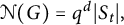 $\mathcal {N}(G) = q^d|S_t|,$
which is the number of the pair
 $(x^1, x^2) \in \mathbb F_q^d \times \mathbb F_q^d$
such that
 $S_t(x^1-x^2)=1.$
By a change of variables, we can write
 $$ \begin{align} \Lambda_{K_2}(f_1,f_2) = \frac{1}{q^d} \sum_{x^1\in \mathbb F_q^d} f_1(x^1) \left( \frac{1}{|S_t|} \sum_{x^2\in\mathbb F_q^d} f_2(x^1-x^2) S_t(x^2)\right)=<f_1, Af_2>,\end{align} $$
where A denotes the averaging operator related to the sphere
 $S_t.$
Likewise, we also obtain that
 $ \Lambda _{K_2}(f_1, f_2) = < Af_1, f_2>.$
The main goal of this section is to address all numbers
 $1\le p_1, p_2\le \infty $
satisfying
 $\Lambda _{K_2}(p_1, p_2)\lesssim 1.$
We begin with the necessary conditions for the boundedness of the
 $K_2$
form
 $\Lambda _{K_2}$
on
 $\mathbb F_q^d.$
Proposition 3.1 Let
 $1\le p_1, p_2\le \infty .$
Suppose that
 $ \Lambda _{K_2}(p_1, p_2) \lesssim 1$
. Then we have
 $$ \begin{align*}\frac{1}{p_1} + \frac{d}{p_2}\le d \quad \mbox{and}\quad \frac{d}{p_1} + \frac{1}{p_2}\le d .\end{align*} $$
Proof By symmetry, it is clear that
 $ \Lambda _{K_2}(p_1, p_2)\lesssim 1 \iff \Lambda _{K_2}(p_2, p_1)\lesssim 1.$
Hence, it suffices to prove the first listed conclusion that
 $\frac {1}{p_1} + \frac {d}{p_2}\le d.$
From (3.2) and our assumption that
 $ \Lambda _{K_2}(p_1, p_2) \lesssim 1,$
we must have
 $$ \begin{align*}\Lambda_{K_2}(f_1,f_2) \lesssim ||f_1||_{p_1} ||f_2||_{p_2}.\end{align*} $$
We test this inequality with
 $f_1=1_{S_t}$
and
 $f_2=\delta _0.$
Then
 $$ \begin{align*}\Lambda_{K_2}(f_1, f_2)= \frac{1}{q^d} \sum_{x^1\in S_t} \frac{1}{|S_t|} =q^{-d},\end{align*} $$
and
 $$ \begin{align*}||f_1||_{p_1} ||f_2||_{p_2} \sim (q^{-d} |S_t|)^{1/p_1}(q^{-d} )^{1/p_2} \sim q^{-\frac{1}{p_1}-\frac{d}{p_2}}.\end{align*} $$
By a direct comparison, we get the desired result.
Remark 3.2 For
 $1\le p_1, p_2\le \infty , $
one can note that
 $\frac {1}{p_1} + \frac {d}{p_2}\le d$
and
 $\frac {d}{p_1} + \frac {1}{p_2}\le d $
if and only if
 $(1/p_1, 1/p_2)\in [0, 1]\times [0, 1]$
lies on the convex hull of points
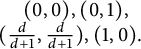 $(0, 0), (0, 1), (\frac {d}{d+1}, \frac {d}{d+1}), (1,0).$
Let us move to the sufficient conditions on the exponents
 $1\le p_1, p_2\le \infty $
such that
 $\Lambda _{K_2}(p_1, p_2) \lesssim 1.$
We now show that the necessary conditions are in fact sufficient conditions for
 $\Lambda _{K_2}(p_1, p_2) \lesssim 1.$
Theorem 3.3 (Sharp boundedness result for the
$K_2$
form on
$\mathbb F_q^d$
)


Let
 $1\le p_1, p_2\le \infty .$
Then we have
 $$ \begin{align*}\Lambda_{K_2}(p_1, p_2)\lesssim 1 \quad \mbox{if and only if}\quad \frac{1}{p_1} + \frac{d}{p_2}\le d, \quad \frac{d}{p_1} + \frac{1}{p_2}\le d .\end{align*} $$
Proof By Proposition 3.1, it will be enough to prove that
 $\Lambda _{K_2}(p_1, p_2)\lesssim 1$
for all
 $1\le p_1, p_2\le \infty $
satisfying
 $$ \begin{align*}\frac{1}{p_1} + \frac{d}{p_2}\le d, \quad \frac{d}{p_1} + \frac{1}{p_2}\le d .\end{align*} $$
By the interpolation theorem and the nesting property of the norm, it suffices to establish the estimates on the critical endpoints
 $(1/p_1, 1/p_2) \in [0, 1]\times [0,1]$
, which are
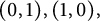 $ (0,1), (1,0),$
and
 $(d/(d+1), d/(d+1)).$
In other words, it remains to prove the following estimates:
 $$ \begin{align*}\Lambda_{K_2}(\infty, 1)\lesssim 1, ~\Lambda_{K_2}(1, \infty)\lesssim 1, ~\Lambda_{K_2}\left(\frac{d+1}{d}, ~\frac{d+1}{d}\right)\lesssim 1.\end{align*} $$
Since
 $\Lambda _{K_2}(f_1, f_2) = <f_1, Af_2>,$
it follows by Hölder’s inequality that if
 $A(p_2 \to p_1')\lesssim 1$
with
 $1\le p_1, p_2 \le \infty ,$
then
 $\Lambda _{K_2}(p_1, p_2) \lesssim 1.$
Thus, matters are reduced to establishing the following averaging estimates:
 $$ \begin{align*}A(1\to 1)\lesssim 1, ~~A(\infty\to \infty)\lesssim 1, ~~ A\left(\frac{d+1}{d} \to d+1\right)\lesssim 1.\end{align*} $$
However, these averaging estimates are clearly valid by Theorem 2.3, and thus the proof is complete.
The following result is a special case of Theorem 3.3, but it is very useful in practice.
Corollary 3.4 For any dimensions
 $d\ge 2, $
we have
 $ \Lambda _{K_2}\left ( \frac {d+1}{d}, \frac {d+1}{d}\right ) \lesssim 1.$
Proof Notice that if
 $p_1=p_2=\frac {d+1}{d}$
, then it satisfies that
 $\frac {1}{p_1} + \frac {d}{p_2}\le d$
and
 $ \frac {d}{p_1} + \frac {1}{p_2}\le d.$
Hence, the statement follows immediately from Theorem 3.3.
4 Boundedness problem for the
$K_3$
form

Let
 $t\in \mathbb F_q^*.$
The
 $K_3$
form
 $\Lambda _{K_3}$
on
 $\mathbb F_q^d$
can be defined as
 $$ \begin{align} \Lambda_{K_3}(f_1, f_2, f_3){\kern-1pt}={\kern-1pt} \frac{1}{q^d} \frac{1}{|S_t| |S_t^{d-2}|} \sum_{x^1, x^2, x^3\in \mathbb F_q^d} S_t(x^1-x^2) S_t(x^2-x^3) S_t(x^3-x^1){\kern-1pt} \prod_{i=1}^3 f_i(x^i) ,\end{align} $$
where each
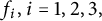 $f_i, i=1,2,3,$
is a nonnegative real-valued function on
 $\mathbb F_q^d,$
and the quantity
 $q^d|S_t| |S_t^{d-2}|$
stands for the normalizing factor
 $\mathcal {N}(G)$
in (1.4) when
 $G=K_3.$
More precisely,
 $\mathcal {N}(G) $
is the number of
 $(x^1, x^2, x^3)\in (\mathbb F_q^d)^3$
such that
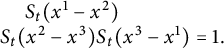 $S_t(x^1-x^2) S_t(x^2-x^3) S_t(x^3-x^1) =1.$
The purpose of this section is to find the numbers
 $1\le p_1, p_2, p_3\le \infty $
such that
 $\Lambda _{K_3}(p_1, p_2, p_3)\lesssim 1.$
When the dimension d is 2, we will settle this problem up to the endpoint estimate. To this end, we relate our problem to the estimate of the Bilinear Averaging Operator (see (4.3)) for which we establish the sharp bound.
On the other hand, as we shall see, in three and higher dimensions
 $d\ge 3,$
it is not easy to deduce the sharp results. However, when one of the exponents
 $p_1, p_2, p_3$
is
 $\infty $
, we will be able to obtain the optimal results. This will be done by applying Theorem 3.3, the boundedness result for the
 $K_2$
form
 $\Lambda _{K_2}$
on
 $\mathbb F_q^d.$
We begin by deducing necessary conditions for our problem in
 $\mathbb F_q^d, d\ge 2.$
Recall that for
 $d=2,$
we pose an additional restriction that
 $3\in \mathbb F_q$
is a square number.
Proposition 4.1 (Necessary conditions for the boundedness of
$\Lambda _{K_3}$
)

Let
 $1\le p_1, p_2, p_3\le \infty .$
Suppose that
 $ \Lambda _{K_3}(p_1, p_2, p_3) \lesssim 1$
. Then we have
 $$ \begin{align*}\frac{d}{p_1} + \frac{1}{p_2}+ \frac{1}{p_3}\le d, ~~\frac{1}{p_1} + \frac{d}{p_2}+ \frac{1}{p_3}\le d,~~\frac{1}{p_1} + \frac{1}{p_2}+ \frac{d}{p_3}\le d.\end{align*} $$
In particular, when
 $d = 2,$
it can be shown by PolymakeFootnote
1
[Reference Assarf, Gawrilow, Herr, Joswig, Lorenz, Paffenholz and Rehn1, Reference Gawrilow and Joswig6] that
 $(1/p_1, 1/p_2, 1/p_3)$
is contained in the convex hull of the points:
 $(0,0,1), (0,1,0), (2/3,2/3,0), (1/2,1/2,1/2), (2/3,0,2/3), (1,0,0), (0,0,0), (0,2/3,2/3).$
Proof We only prove the first inequality in the conclusion since we can establish other inequalities by symmetric property of
 $\Lambda _{K_3}f_1,f_2, f_3.$
We will use the simple fact that
 $x\in S_t$
if and only if
 $-x\in S_t.$
In the definition (4.1), taking
 $f_1=\delta _0, f_2=1_{S_{t}},$
and
 $f_3=1_{S_{t}},$
we see that
 $$ \begin{align*}||f_1||_{p_1} ||f_2||_{p_2} |||f_3||_{p_3} \sim q^{-\frac{d}{p_1}} q^{-\frac{1}{p_2}} q^{-\frac{1}{p_3}},\end{align*} $$
 $$ \begin{align*}\Lambda_{K_3}(f_1,f_2,f_3) = \frac{1}{q^d} \frac{1}{|S_{t}||S_t^{d-2}|} \left(\sum_{x^2, x^3\in S_{t}: ||x^2-x^3||=t} 1\right)\sim q^{-d},\end{align*} $$
where the last similarity above follows from Corollary A.4 in the Appendix with our assumption that
 $3\in \mathbb F_q$
is a square number for
 $d=2.$
By the direct comparison of these estimates, we obtain the required necessary condition.
Remark 4.2 In order to prove that the necessary conditions in Proposition 4.1 are sufficient conditions for
 $d=2,$
we only need to establish the following critical endpoint estimates:
 $\Lambda _{K_3}( 2, 2, 2)\lesssim 1, \Lambda _{K_3}(\infty , \infty , \infty )\lesssim 1, \Lambda _{K_3}1, \infty , \infty )\lesssim 1, \Lambda _{K_3}(\infty , 1, \infty )\lesssim 1, \Lambda _{K_3}(\infty , \infty , 1)\lesssim 1, \Lambda _{K_3}\left ( \frac {3}{2}, \frac {3}{2}, \infty \right )\lesssim 1, \Lambda _{K_3}\left ( \frac {3}{2}, \infty , \frac {3}{2} \right )\lesssim 1, \Lambda _{K_3}\left ( \infty , \frac {3}{2}, \frac {3}{2}\right )\lesssim 1.$
In fact, this claim follows by interpolating the critical points given in the second part of Proposition 4.1.
4.1 Boundedness results for
$\Lambda _{K_3}$
on
$\mathbb F_q^d$


The graph
 $K_2$
can be obtained by removing any one of three vertices in the graph
 $K_3.$
Therefore, the boundedness of
 $\Lambda _{K_2}(p_1, p_2)$
can determine the boundedness of
 $\Lambda _{K_3}(p_1, p_2, \infty ).$
Using this observation, in the case when one of
 $p_1, p_2, p_3$
is
 $\infty $
, we are able to obtain sharp boundedness results for
 $\Lambda _{K_3}(p_1, p_2, p_3).$
Theorem 4.3 Let
 $1\le a, b\le \infty $
satisfy that
 $\frac {1}{a} + \frac {d}{b}\le d$
and
 $\frac {d}{a} + \frac {1}{b}\le d.$
Then we have
 $\Lambda _{K_3}(a, b, \infty )\lesssim 1, \Lambda _{K_3}(a, \infty , b)\lesssim 1$
, and
 $\Lambda _{K_3}(\infty , a, b)\lesssim 1.$
Proof The statement of the theorem follows immediately by combining Theorem 3.3 and the following claim: If
 $\Lambda _{K_2}(a, b)\lesssim 1,$
then
 $$ \begin{align*}\Lambda_{K_3}(a, b, \infty)\lesssim 1, ~~ \Lambda_{K_3}(a, \infty, b)\lesssim 1,~~ \mbox{and}\quad \Lambda_{K_3}(\infty, a, b)\lesssim 1.\end{align*} $$
It suffices by symmetry to prove that if
 $\Lambda _{K_2}(a, b)\lesssim 1,$
then
 $\Lambda _{K_3}(a,b, \infty )\lesssim 1.$
Since
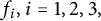 $f_i, i=1,2,3,$
are nonnegative real-number functions on
 $\mathbb F_q^d,$
it follows that
 $$ \begin{align*}\Lambda_{K_3}(f_1,f_2, f_3) \le \frac{1}{|S_t^{d-2}|}\left(\max_{ ||x^1-x^2||=t} \sum_{x^3\in \mathbb F_q^d: ||x^2-x^3||=t =||x^3-x^1||} f_3(x^3)\right) \Lambda_{K_2}(f_1, f_2).\end{align*} $$
Since
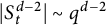 $|S_t^{d-2}|\sim q^{d-2}$
and
 $ \Lambda _{K_2}(f_1,f_2)\lesssim ||f_1||_{a} ||f_2||_b$
, it suffices to prove that the maximum value in the above parenthesis is
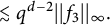 $\lesssim q^{d-2} ||f_3||_\infty .$
Let us denote by I the maximum above.
By a change of variables,
 $x=x^1, y=x^1-x^2,$
we see that
 $$ \begin{align*}I\le \left(\max_{x\in \mathbb F_q^d, y\in S_t} \sum_{x^3\in \mathbb F_q^d: ||x-y-x^3||=t=||x^3-x||} 1 \right) ||f_3||_\infty.\end{align*} $$
By another change of variables by putting
 $z=x-x^3$
, we get
 $$ \begin{align*}I\le\left( \max_{x\in \mathbb F_q^d, y\in S_t} \sum_{z\in S_t: ||z-y||=t} 1\right) ||f_3||_\infty = \left( \max_{ y\in S_t} \sum_{z\in S_t: ||z-y||=t} 1\right) ||f_3||_\infty.\end{align*} $$
Now, applying Corollary A.4 in the Appendix, we conclude that
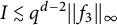 $I\lesssim q^{d-2} ||f_3||_\infty $
as required.
It is not hard to see from Proposition 4.1 that Theorem 4.3 cannot be improved in the case when one of the exponents
 $p_1, p_2, p_3$
is
 $\infty .$
In particular, the following critical endpoint estimates follows immediately from Theorem 4.3:
 $$ \begin{align} &\Lambda_{K_3}\left(\frac{d+1}{d}, \frac{d+1}{d}, \infty\right) \lesssim 1, ~~\Lambda_{K_3}\left(\frac{d+1}{d}, \infty ,\frac{d+1}{d} \right) \lesssim 1,~~ \Lambda_{K_3}\left(\infty, \frac{d+1}{d}, \frac{d+1}{d}\right) \lesssim 1 , \nonumber\\&\Lambda_{K_3}(\infty, \infty, \infty)\lesssim 1,~~\Lambda_{K_3}(1, \infty, \infty)\lesssim 1,~~\Lambda_{K_3}(\infty, 1, \infty)\lesssim 1,~~\Lambda_{K_3}(\infty, \infty, 1)\lesssim 1.\nonumber\\ \end{align} $$
Remark 4.4 From (4.2) and Remark 4.2, we see that to completely solve the problem on the boundedness of
 $\Lambda _{K_3}(p_1, p_2, p_3)$
for
 $d=2,$
we only need to establish the following critical endpoint estimate
 $$ \begin{align*}\Lambda_{K_3}\left( \frac{d+2}{d}, \frac{d+2}{d}, \frac{d+2}{d}\right)=\Lambda_{K_3}(2,2,2)\lesssim 1.\end{align*} $$
4.2 Sharp restricted strong-type estimates in two dimensions
Although Theorem 4.3 is valid for all dimensions
 $d\ge 2,$
it is not sharp, compared to the necessary conditions given in Proposition 4.1. In this subsection, we will deduce the sharp boundedness results up to the endpoints for
 $\Lambda _{K_3}(p_1, p_2, p_3)$
in two dimensions. To this end, we need the following theorem, which can be proven by modifying the Euclidean argument introduced in Section 7 of [Reference Greenleaf, Iosevich, Krause and Liu7].
Theorem 4.5 Let
 $\Lambda _{K_3}$
be the
 $K_3$
form on
 $\mathbb F_q^2.$
Then, for all subsets
 $E, F, H $
of
 $\mathbb F_q^2,$
the following estimate holds:
 $\Lambda _{K_3}(E, F, H) \lesssim ||E||_2 ||F||_2 ||H||_2.$
For
 $1\le p_1, p_2, p_3\le \infty $
, we say that the restricted strong-type
 $\Lambda _{K_3}(p_1, p_2, p_3)$
estimate holds if the estimate
 $$ \begin{align*}\Lambda_{K_3}(E, F, H) \lesssim ||E||_{p_1} ||F||_{p_2} ||H||_{p_3}\end{align*} $$
is valid for all subsets
 $E, F, H$
of
 $\mathbb F_q^2.$
In this case, we write
 $ \Lambda _{K_3}(p_1, p_2, p_3) \lessapprox 1.$
Proof The proof proceeds with some reduction. When
 $d=2$
, by a change of variables by letting
 $x=x^3, y=x^3-x^1, z=x^3-x^2,$
(4.1) becomes
 $$ \begin{align*} \Lambda_{K_3}(f_1, f_2, f_3)= \frac{1}{q^2} \sum_{x\in \mathbb F_q^2} f_3(x) \left[ \frac{1}{|S_t|} \sum_{y, z\in \mathbb F_q^2} S_t(z-y) S_t(z) S_t(y) f_1(x-y) f_2(x-z) \right]. \end{align*} $$
We define
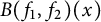 $B(f_1, f_2)(x)$
as the value in the bracket above, namely,
 $$ \begin{align}B(f_1, f_2)(x):=\frac{1}{|S_t|} \sum_{y, z\in S_t: ||z-y||=t} f_1(x-y) f_2(x-z) .\end{align} $$
We refer to this operator B as “the bilinear averaging operator.” It is clear that
 $$ \begin{align*}\Lambda_{K_3}(f_1,f_2,f_3)= \frac{1}{q^2} \sum_{x\in \mathbb F_q^2} B(f_1, f_2)(x) f_3(x)=< B(f_1, f_2),~ f_3>.\end{align*} $$
By Hölder’s inequality, we have
 $$ \begin{align*}\Lambda_{K_3}(f_1,f_2,f_3) \le ||B(f_1, f_2)||_2 ||f_3||_{2}.\end{align*} $$
Thus, Theorem 4.5 follows immediately from the reduction lemma below
Lemma 4.6 Let
 $B(f_1, f_2)$
be the bilinear averaging operator defined as in (4.3). Then, for all subsets
 $E, F$
of
 $\mathbb F_q^2,$
we have
 $$ \begin{align*}||B(E, F)||_2 \lesssim ||E||_2 ||F||_2.\end{align*} $$
Proof We begin by representing the bilinear averaging operator
 $B(f_1,f_2).$
From (4.3), note that
 $$ \begin{align*}B(f_1, f_2)(x) = \frac{1}{|S_{t}|} \sum_{y\in S_{t}} f_1(x-y)\left( \sum_{z\in S_{t}: ||z-y||=t} f_2(x-z)\right).\end{align*} $$
For each
 $y\in S_{t}$
, let
 $ \Theta (y):= \{z\in S_t: ||z-y||=t\}.$
With this notation, the bilinear averaging operator is written as
 $$ \begin{align*} B(f_1, f_2)(x) =\frac{1}{|S_{t}|} \sum_{y\in S_{t}}f_1(x-y) \left( \sum_{z\in \Theta(y)} f_2(x-z)\right).\end{align*} $$
Let
 $\eta $
denote the quadratic character of
 $\mathbb F_q^*.$
Recall that
 $\eta (s)=1$
for a square number s in
 $\mathbb F_q^*$
, and
 $\eta (s)=-1$
otherwise. Notice from Corollary A.4 in the Appendix that
 $\Theta (y)$
is the empty set for all
 $y\in S_t$
if
 $d=2$
and
 $\eta (3)=-1.$
In this case, the problem is trivial since
 $B(f_1, f_2)(x)=0$
for all
 $x\in \mathbb F_q^2.$
Therefore, when
 $d=2$
, we always assume that
 $\eta (3)=1.$
Notice that
 $|\Theta (y)|=2$
for all
 $y\in S_t,$
which follows from the last statement of Corollary A.4 in the Appendix. More precisely, for each
 $y\in S_t,$
we can write
 $$ \begin{align*}\Theta(y)=\{ \theta y, ~ \theta^{-1} y\},\end{align*} $$
where
 $\theta y$
denotes the rotation of y by “60 degrees,” and
 $||y-\theta y||=t =||y-\theta ^{-1} y||.$
From these observations, the bilinear averaging operator
 $B(f_1, f_2)$
can be represented as follows:
 $$ \begin{align} B(f_1, f_2)(x) =B_\theta(f_1, f_2)(x) + B_{\theta^{-1}}(f_1, f_2)(x).\end{align} $$
Here, we define
 $$ \begin{align} B_\theta(f_1, f_2)(x):= \frac{1}{|S_{t}|} \sum_{y\in S_{t}}f_1(x-y) f_2(x- \theta y),\end{align} $$
and
 $$ \begin{align*}B_{\theta^{-1}}(f_1, f_2):= \frac{1}{|S_{t}|} \sum_{y\in S_{t}}f_1(x-y) f_2(x- \theta^{-1} y).\end{align*} $$
In order to complete the proof of the lemma, it suffices to establish the following two estimates: for all subsets
 $E, F$
of
 $\mathbb F_q^d,$
 $$ \begin{align} ||B_\theta(E, F)||_2 \lesssim ||E||_2 ||F||_2, \end{align} $$
and
 $$ \begin{align} ||B_{\theta^{-1}}(E, F)||_2 \lesssim ||E||_2 ||F||_2. \end{align} $$
We will only provide the proof of the estimate (4.6) since the proof of (4.7) is the same.
Now we start proving the estimate (4.6). Since
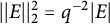 $||E||_2^2=q^{-2}|E|$
and
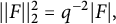 $ ||F||_2^2=q^{-2} |F|,$
it is enough to prove that
 $$ \begin{align} || B_\theta (E, F)||_2^2 \lesssim q^{-4} |E||F|.\end{align} $$
Without loss of generality, we may assume that
 $|E|\le |F|.$
By the definition, it follows that
 $$ \begin{align*}|| B_\theta (E, F)||_2^2 =q^{-2} |S_t|^{-2} \sum_{x\in \mathbb F_q^2} \sum_{y, y'\in S_t} E(x-y)E(x-y') F(x-\theta y) F(x-\theta y') = I + II,\end{align*} $$
where the first term I is the value corresponding to the case where
 $y=y'$
, whereas the second term
 $II$
is corresponding to the case where
 $y\ne y'.$
We have
 $$ \begin{align*}I= q^{-2} |S_t|^{-2} \sum_{y\in S_t}\sum_{x\in \mathbb F_q^2} E(x-y)F(x-\theta y) .\end{align*} $$
Applying a change of variables by replacing x with
 $x+y$
, we see that
 $$ \begin{align*}I=q^{-2} |S_t|^{-2} \sum_{y\in S_t}\sum_{x\in \mathbb F_q^2} E(x)F(x+ y-\theta y) = q^{-2} |S_t|^{-2} \sum_{x\in E} \left( \sum_{y\in S_t} F(x+ y-\theta y)\right).\end{align*} $$
Observe that
 $y-\theta y \ne y'-\theta y'$
for all
 $y, y'$
in
 $S_t$
with
 $y\ne y'.$
Then we see that the value in the parentheses above is bounded above by
 $|S_t\cap F|\le |F|.$
Therefore, we obtain the desired estimate:
 $$ \begin{align*}I \le q^{-2} |S_t|^{-2} |E||F|\sim q^{-4} |E||F|.\end{align*} $$
Next, it remains to show that
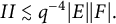 $ II \lesssim q^{-4} |E||F|.$
Since we have assumed that
 $|E| \le |F|,$
it suffices to show that
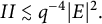 $ II\lesssim q^{-4} |E|^2.$
By the definition of
 $II$
, it follows that
 $$ \begin{align*}II= q^{-2} |S_t|^{-2} \sum_{x\in \mathbb F_q^2} \sum_{y, y'\in S_t: y\ne y'} E(x-y) E(x-y') F(x-\theta y) F(x-\theta y').\end{align*} $$
It is obvious that
 $$ \begin{align*}II \le q^{-2} |S_t|^{-2} \sum_{y, y'\in S_t: y\ne y'} \sum_{x\in \mathbb F_q^2} E(x-y) E(x-y').\end{align*} $$
We use a change of variables by replacing x with
 $x+y.$
Then we have
 $$ \begin{align*} II &\le q^{-2} |S_t|^{-2} \sum_{x\in \mathbb F_q^2} E(x) \left( \sum_{y, y'\in S_t: y\ne y'} E(x+y-y')\right) \\ &= q^{-2} |S_t|^{-2} \sum_{x\in \mathbb F_q^2} E(x) \left( \sum_{\mathbf{0} \ne u\in \mathbb F_q^2} E(x+u) W(u)\right),\end{align*} $$
where
 $W(u)$
denotes the number of pairs
 $(y, y') \in S_t \times S_t$
such that
 $u=y-y'$
and
 $y\ne y'.$
It is not hard to see that for any nonzero vector
 $u \in \mathbb F_q^2$
, we have
 $W(u)\le 2.$
So we obtain that
 $$ \begin{align*}II \lesssim q^{-2} |S_t|^{-2} \sum_{x\in \mathbb F_q^2} E(x) \left( \sum_{\mathbf{0} \ne u\in \mathbb F_q^2} E(x+u) \right) \lesssim q^{-4} |E|^2 ,\end{align*} $$
as required.
In two dimensions, we are able to obtain the optimal boundedness of
 $\Lambda _{K_3}(p_1, p_2, p_3)$
except for one endpoint. Indeed, we have the following result.
Theorem 4.7 Let
 $1\le p_1, p_2, p_3\le \infty $
, and let
 $\Lambda _{K_3}$
be the
 $K_3$
form on
 $\mathbb F_q^2.$
-
(i) If
$\Lambda _{K_3}(p_1, p_2, p_3) \lesssim 1$
, then (4.9)
$$ \begin{align}\frac{2}{p_1} + \frac{1}{p_2}+ \frac{1}{p_3}\le 2, ~~\frac{1}{p_1} + \frac{2}{p_2}+ \frac{1}{p_3}\le 2,~~\frac{1}{p_1} + \frac{1}{p_2}+ \frac{2}{p_3}\le 2.\end{align} $$
-
(ii) Conversely, if
$(p_1, p_2, p_3)$
satisfies all three inequalities (4.9), then
$\Lambda _{K_3}(p_1, p_2, p_3) \lesssim 1 $
for
$(p_1, p_2, p_3)\ne (2,2,2),$
and we have
$\Lambda _{K_3}(2,2,2)\lessapprox 1.$





Proof The first part of the theorem is the special case of Proposition 4.1 with
 $d=2.$
Now we prove the second part. As stated in Proposition 4.1, one can notice by using Polymake [Reference Assarf, Gawrilow, Herr, Joswig, Lorenz, Paffenholz and Rehn1, Reference Gawrilow and Joswig6] that all the points
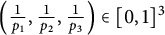 $\left (\frac {1}{p_1}, \frac {1}{p_2}, \frac {1}{p_3}\right )\in [0, 1]^3$
satisfying all three inequalities (4.9) are contained in the convex hull of the critical points
 $$ \begin{align*}(1/2,1/ 2, 1/ 2), ~ (0, 0, 0),~ (1, 0, 0), ~ (0, 1,0),{\kern-1.5pt} ~(0, 0, 1), \left( \frac{2}{3}, \frac{2}{3}, 0\right),{\kern-1.5pt}~ \left( \frac{2}{3}, 0, \frac{2}{3} \right),{\kern-1.5pt} ~ \left( 0, \frac{2}{3}, \frac{2}{3}\right).\end{align*} $$
Notice from Theorem 4.5 with
 $d=2$
that the restricted strong-type estimate for the operator
 $\Lambda _{K_3}$
holds for the point
 $(1/p_1, 1/p_2, 1/p_3)=(1/2, 1/2, 1/2).$
In addition, notice from the estimates (4.2) with
 $d=2$
that
 $\Lambda _{K_3}(p_1, p_2, p_3)\lesssim 1$
for the above critical points
 $(1/p_1, 1/p_2, 1/p_3)$
except for
 $(1/2, 1/2, 1/2).$
Hence, the statement of the second part follows immediately by invoking the interpolation theorem.
5 Boundedness results for the
$P_2$
form

For
 $t\in \mathbb F_q^*$
and functions
 $f_i, i=1,2,3,$
on
 $\mathbb F_q^d,$
the
 $P_2$
form
 $\Lambda _{P_2}$
on
 $\mathbb F_q^d$
is defined by
 $$ \begin{align}\Lambda_{P_2}(f_1,f_2,f_3)= \frac{1}{q^d|S_t|^2} \sum_{x^1, x^2, x^3\in \mathbb F_q^d} S_t(x^1-x^2) S_t(x^2-x^3) f_1(x^1) f_2(x^2)f_3(x^3),\end{align} $$
where the quantity
 $q^d|S_t|^2$
stands for the normalizing factor
 $\mathcal {N}(G)$
in (1.4) when
 $G=P_2$
. Note that this can be written as
 $$ \begin{align} \Lambda_{P_2}(f_1,f_2,f_3)= <f_2,~ Af_1 \cdot Af_3>.\end{align} $$
In this section, we study the problem determining all numbers
 $1\le p_1, p_2, p_3\le \infty $
satisfying
 $\Lambda _{P_2}(p_1, p_2, p_3)\lesssim 1.$
Compared to the
 $K_3$
form
 $\Lambda _{K_3}$
, this problem is much hard to find the optimal answers. Based on the formula (5.2) with the averaging estimates in Lemma 2.5, we are able to address partial results on this problem (see Theorem 5.3).
Proposition 5.1 (Necessary conditions for the boundedness of
$\Lambda _{P_2}$
)

Let
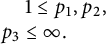 $1\le p_1, p_2, p_3\le \infty .$
Suppose that
 $ \Lambda _{P_2}(p_1, p_2, p_3) \lesssim 1$
. Then we have
 $$ \begin{align*}\frac{1}{p_1} + \frac{d}{p_2}+ \frac{1}{p_3}\le d, \quad \frac{d}{p_1} + \frac{1}{p_2}\le d, \quad \frac{1}{p_2} + \frac{d}{p_3}\le d, \quad \frac{d}{p_1} + \frac{1}{p_2}+ \frac{d}{p_3}\le 2d-1.\end{align*} $$
Also, under this assumption when
 $d = 2$
, it can be shown by Polymake [Reference Assarf, Gawrilow, Herr, Joswig, Lorenz, Paffenholz and Rehn1, Reference Gawrilow and Joswig6] that
 $(1/p_1, 1/p_2, 1/p_3)$
is contained in the convex hull of points:
 $(0,1,0), (1/2,0,1), (1,0,1/2), (1,0,0), (5/6,1/3,1/2), (1/2,1/3,5/6), (2/3,2/3,0), (0,2/3,2/3), (0,0,0), (0,0,1).$
Proof Suppose that
 $\Lambda _{P_2}(p_1, p_2, p_3) \lesssim 1.$
Then, for all functions
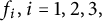 $f_i, i=1,2,3,$
on
 $\mathbb F_q^d,$
we have
 $$ \begin{align*}\Lambda_{P_2}(f_1,f_2,f_3)&= \frac{1}{q^d|S_t|^2} \sum_{x^1, x^2, x^3\in \mathbb F_q^d} S_t(x^1-x^2) S_t(x^2-x^3) f_1(x^1) f_2(x^2)f_3(x^3)\\& \lesssim ||f_1||_{p_1}||f_2||_{p_2} ||f_3||_{p_3}.\end{align*} $$
We test the above inequality with
 $f_2=\delta _0, f_1=f_3=1_{S_t}.$
It is plain to note that
 $$ \begin{align*}||f_1||_{p_1}||f_2||_{p_2} ||f_3||_{p_3} = (q^{-d} |S_t|)^{\frac{1}{p_1}} q^{-\frac{d}{p_2}} (q^{-d} |S_t|)^{\frac{1}{p_3}} \sim q^{-\frac{1}{p_1}-\frac{d}{p_2} -\frac{1}{p_3}},\end{align*} $$
and
 $$ \begin{align*}\Lambda_{P_2}(f_1, f_2, f_3) = q^{-d}.\end{align*} $$
Therefore, we obtain that
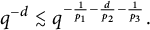 $q^{-d}\lesssim q^{-\frac {1}{p_1}-\frac {d}{p_2} -\frac {1}{p_3}}.$
This implies the first inequality in the conclusion that
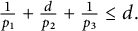 $ \frac {1}{p_1} + \frac {d}{p_2}+ \frac {1}{p_3}\le d.$
To obtain the second inequality in the conclusion, we choose
 $f_1=\delta _0, f_2=1_{S_t},$
and
 $f_3=1_{\mathbb F_q^d}.$
Then it is easy to check that
 $$ \begin{align*} ||f_1||_{p_1}||f_2||_{p_2} ||f_3||_{p_3} \sim q^{-\frac{d}{p_1}-\frac{1}{p_2} },\end{align*} $$
and
 $$ \begin{align*}\Lambda_{P_2}(f_1, f_2, f_3) = \frac{1}{q^d |S_t|^2} \sum_{x^2\in S_t} \sum_{x^3\in \mathbb F_q^d} S_t(x^2-x^3) =q^{-d}.\end{align*} $$
Comparing these estimates gives the second inequality in the conclusion.
The third inequality in the conclusion can be easily obtained by switching the roles of
 $f_1$
and
 $f_3$
in the proof of the second one.
To deduce the last inequality in the conclusion, we take
 $f_1=f_3=\delta _0$
and
 $f_2=1_{S_t}.$
Then
 $$ \begin{align*}||f_1||_{p_1}||f_2||_{p_2} ||f_3||_{p_3}\sim q^{-\frac{d}{p_1}-\frac{1}{p_2} -\frac{d}{p_3}},\end{align*} $$
and
 $$ \begin{align*}\Lambda_{P_2}(f_1, f_2, f_3) = \frac{1}{q^d|S_t|}\sim q^{-2d+1}.\end{align*} $$
From these, we have the required result that
 $ \frac {d}{p_1} + \frac {1}{p_2}+ \frac {d}{p_3}\le 2d-1.$
By symmetry, it is not hard to note that
 $ \Lambda _{P_2}(p_1, p_2, p_3){\kern-1pt}\lesssim{\kern-1pt} 1 {\kern-2pt}\iff{\kern-2pt} \Lambda _{P_2}(p_3, p_2, p_1)\lesssim 1.$
In the following lemma, we prove that the boundedness question for the
 $P_2$
form
 $\Lambda $
is closely related to the spherical averaging problem over finite fields.
Lemma 5.2 Suppose that
 $\frac {1}{r_1}+ \frac {1}{p_2}+\frac {1}{r_3}=1, A(p_1 \to r_1)\lesssim 1,$
and
 $A(p_3 \to r_3)\lesssim 1$
for some
 $1\le p_1, p_2, p_3, r_1, r_3 \le \infty .$
Then we have
 $ \Lambda _{P_2}(p_1, p_2, p_3) \lesssim 1.$
Proof Since
 $ \Lambda _{P_2}(f_1,f_2,f_3)= <f_2, ~ Af_1 \cdot Af_3>,$
we obtain by Hölder’s inequality with the first assumption that
 $$ \begin{align*}\Lambda_{P_2}(f_1, f_2, f_3) \le ||Af_1||_{r_1} ||f_2||_{p_2} ||Af_3||_{r_3} \lesssim ||f_1||_{p_1} ||f_2||_{p_2} ||f_3||_{p_3},\end{align*} $$
where the averaging assumption was used for the last inequality. Hence,
 $\Lambda _{P_2}(p_1, p_2, p_3) \lesssim 1,$
as required.
Now we state and prove our boundedness results of
 $\Lambda _{P_2}(p_1, p_2, p_3)$
on
 $\mathbb F_q^d.$
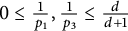
Theorem 5.3 Let
 $1\le p_1, p_2, p_3\le \infty .$
Then, for the
 $P_2$
form
 $\Lambda _{P_2}$
on
 $\mathbb F_q^d,$
the following four statements hold:
-
(i) If
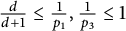
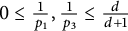
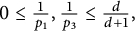
$0\le \frac {1}{p_1}, \frac {1}{p_3} \le \frac {d}{d+1}$
and
$ \frac {1}{p_1}+\frac {d}{p_2}+ \frac {1}{p_3} \le d$
, then
$\Lambda _{P_2}(p_1, p_2, p_3)\lesssim 1. $
-
(ii) If
$0\le \frac {1}{p_1} \le \frac {d}{d+1} \le \frac {1}{p_3} \le 1$
and
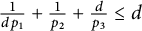
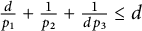
$ \frac {1}{dp_1}+\frac {1}{p_2}+ \frac {d}{p_3} \le d$
, then
$\Lambda _{P_2}(p_1, p_2, p_3)\lesssim 1. $
-
(iii) If
$0\le \frac {1}{p_3} \le \frac {d}{d+1} \le \frac {1}{p_1} \le 1$
and
$ \frac {d}{p_1}+\frac {1}{p_2}+ \frac {1}{dp_3} \le d$
, then
$\Lambda _{P_2}(p_1, p_2, p_3)\lesssim 1. $
-
(iv) If
$\frac {d}{d+1}\le \frac {1}{p_1}, \frac {1}{p_3} \le 1$
and
$ \frac {d}{p_1}+\frac {1}{p_2}+ \frac {d}{p_3} \le 2d-1$
, then
$\Lambda _{P_2}(p_1, p_2, p_3)\lesssim 1. $








Proof We proceed as follows.
-
(i) By the nesting property of the norm, it suffices to prove it in the case when
$0\le \frac {1}{p_1}, \frac {1}{p_3} \le \frac {d}{d+1}$
and
$ \frac {1}{p_1}+\frac {d}{p_2}+ \frac {1}{p_3} =d.$
This equation can be rewritten as
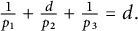
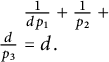
$ \frac {1}{dp_1} + \frac {1}{p_2}+ \frac {1}{dp_3}=1.$
Since
$0\le \frac {1}{p_1}, \frac {1}{p_3}\le \frac {d}{d+1},$
we see from Lemma 2.5 (i) that letting
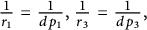
$ \frac {1}{r_1}=\frac {1}{dp_1}, \frac {1}{r_3}=\frac {1}{dp_3},$
we have
$A(p_1\to r_1)\lesssim 1$
and
$A(p_3\to r_3)\lesssim 1.$
Since
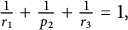
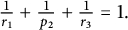
$\frac {1}{r_1} +\frac {1}{p_2}+\frac {1}{r_3}=1, $
applying Lemma 5.2 gives the required result. -
(ii) As in the proof of the first part of the theorem, it will be enough to prove
$\Lambda (p_1, p_2, p_3)\lesssim 1$
in the case when
$0\le \frac {1}{p_1} \le \frac {d}{d+1} \le \frac {1}{p_3} \le 1$
and
$ \frac {1}{dp_1}+\frac {1}{p_2}+ \frac {d}{p_3} =d.$
Let
$ \frac {1}{r_1}= \frac {1}{dp_1}$
and
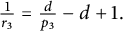
$\frac {1}{r_3}= \frac {d}{p_3}-d+1.$
Then, by Lemma 2.5, it follows that
$A(p_1\to r_1)\lesssim 1$
and
$A(p_3\to r_3)\lesssim 1.$
Also, notice that
$ \frac {1}{r_1}+ \frac {1}{p_2} + \frac {1}{r_3}=1.$
Hence, Theorem 5.3(ii) follows from Lemma 5.2. -
(iii) Switching the roles of
$p_1, p_2$
, the proof is exactly the same as that of the second part of this theorem. -
(iv) As before, it suffices to prove the case when
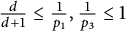
$\frac {d}{d+1}\le \frac {1}{p_1}, \frac {1}{p_3} \le 1$
and
$ \frac {d}{p_1}+\frac {1}{p_2}+ \frac {d}{p_3} = 2d-1.$
Put
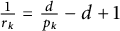
$\frac {1}{r_k}=\frac {d}{p_k}-d+1$
for
$k=1, 3.$
Then we see from Lemma 2.5(ii) that
$A(p_k\to r_k)\lesssim 1$
for
$k=1, 3.$
Notice that
$\frac {1}{r_1}+ \frac {1}{p_2} + \frac {1}{r_3}=1.$
Therefore, using Lemma 5.2, we finish the proof.














As a special case of Theorem 5.3, we obtain the following.
Corollary 5.4 For any dimensions
 $d\ge 2, $
we have
 $\Lambda _{P_2}\left (\frac {d+1}{d}, \frac {d+1}{d-1}, \frac {d+1}{d}\right ) \lesssim 1.$
Proof This clearly follows from Theorem 5.3 by taking
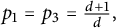 $p_1=p_3=\frac {d+1}{d},$
and
 $ p_2= \frac {d+1}{d-1}.$
When
 $d=2,$
Theorem 5.3 does not cover some points such as
 $(1,0,1/2)$
from the convex hull in the necessary conditions by Proposition 5.1. However, it cannot be concluded that Theorem 5.3 is not sharp because the necessary conditions can be improved. While we do not know whether Theorem 5.3 is optimal or not, the result will play a crucial role in proving the following theorem which implies that Conjecture 1.5 is true for the graph
 $K_3$
and its subgraph
 $P_2$
in all dimensions
 $d\ge 2$
(see Corollary 5.7 below).
Theorem 5.5 Let
 $\Lambda _{K_3}$
and
 $\Lambda _{P_2}$
be the operators associated with
 $K_3$
and
 $P_2$
, respectively, on
 $\mathbb F_q^d.$
Then, if
 $\Lambda _{K_3}(p_1, p_2, p_3)\lesssim 1$
for
 $1\le p_1, p_2, p_3\le \infty ,$
we have
 $\Lambda _{P_2}(p_1, p_2, p_3)\lesssim 1.$
Proof Suppose that
 $\Lambda _{K_3}(p_1, p_2, p_3)\lesssim 1$
for
 $1\le p_1, p_2, p_3\le \infty .$
Then, by Proposition 4.1, the exponents
 $p_1, p_2, p_3$
satisfy the following three inequalities:
 $$ \begin{align}\frac{d}{p_1} + \frac{1}{p_2}+ \frac{1}{p_3}\le d, ~~\frac{1}{p_1} + \frac{d}{p_2}+ \frac{1}{p_3}\le d,~~\frac{1}{p_1} + \frac{1}{p_2}+ \frac{d}{p_3}\le d.\end{align} $$
To complete the proof, it remains to show that
 $\Lambda _{P_2}(p_1, p_2, p_3)\lesssim 1.$
We will prove this by considering the four cases depending on the sizes of
 $p_1$
and
 $p_3.$
Case 1: Suppose that
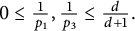 $0\le \frac {1}{p_1}, \frac {1}{p_3} \le \frac {d}{d+1}.$
The condition (5.3) clearly implies that
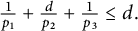 $\frac {1}{p_1}+\frac {d}{p_2}+ \frac {1}{p_3} \le d.$
Thus, by Theorem 5.3(i), we obtain the required conclusion that
 $\Lambda _{P_2}(p_1, p_2, p_3)\lesssim 1.$
Case 2: Suppose that
 $0\le \frac {1}{p_1} \le \frac {d}{d+1} \le \frac {1}{p_3} \le 1.$
By Theorem 5.3(ii), to prove that
 $\Lambda _{P_2}(p_1, p_2, p_3)\lesssim 1,$
it will be enough to show that
 $$ \begin{align*}\frac{1}{dp_1}+\frac{1}{p_2}+ \frac{d}{p_3} \le d.\end{align*} $$
However, this inequality clearly follows from the third inequality in (5.3) since
 $d\ge 2.$
Case 3: Suppose that
 $0\le \frac {1}{p_3} \le \frac {d}{d+1} \le \frac {1}{p_1} \le 1.$
By Theorem 5.3(iii), it suffices to show that
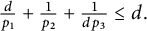 $\frac {d}{p_1}+\frac {1}{p_2}+ \frac {1}{dp_3} \le d.$
However, this inequality can be easily obtained from the first inequality in (5.3).
Case 4: Suppose that
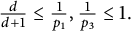 $\frac {d}{d+1}\le \frac {1}{p_1}, \frac {1}{p_3} \le 1.$
By Theorem 5.3(iv), to show that
 $\Lambda _{P_2}(p_1, p_2, p_3)\lesssim 1$
, we only need to prove that
 $$ \begin{align*}\frac{d}{p_1}+\frac{1}{p_2}+ \frac{d}{p_3} \le 2d-1.\end{align*} $$
However, this inequality can be easily proven as follows:
 $$ \begin{align*}\frac{d}{p_1}+\frac{1}{p_2}+ \frac{d}{p_3} = \left(\frac{d}{p_1}+\frac{1}{p_2}+ \frac{1}{p_3}\right) + \frac{d-1}{p_3} \le d + \frac{d-1}{p_3} \le 2d-1,\end{align*} $$
where the first inequality follows from the first inequality in (5.3), and the last inequality follows from a simple fact that
 $1\le p_3\le \infty .$
Remark 5.6 The reverse statement of Theorem 5.5 cannot be true. Indeed, we know by Corollary 5.4 that
 $\Lambda _{P_2}\left (\frac {d+1}{d}, \frac {d+1}{d-1}, \frac {d+1}{d}\right ) \lesssim 1.$
However,
 $\Lambda _{K_3}\left (\frac {d+1}{d}, \frac {d+1}{d-1}, \frac {d+1}{d}\right )$
cannot be bounded, which can be easily shown by considering Proposition 4.1, namely, the necessary conditions for the boundedness of
 $\Lambda _{K_3}(p_1,p_2, p_3).$
We invoke Theorem 5.5 to deduce the following result.
Corollary 5.7 Conjecture 1.5 is true for the graph
 $K_3$
and its subgraph
 $P_2$
in
 $\mathbb F_q^d$
,
 $d\ge 2.$
Proof It is clear that
 $P_2$
is a subgraph of
 $K_3$
in
 $\mathbb F_q^d.$
Sine
 $\delta (K_3)=2$
,
 $d\ge 2$
, and
 $\delta (P_2)=1,$
we have
 $\min \{\delta (K_3), d\} =2> \delta (P_2)=1.$
Hence, all assumptions of Conjecture 1.5 are satisfied for
 $K_3$
and
 $P_2.$
Then the statement of the corollary follows immediately from Theorem 5.5.
6 Mapping properties for the
$(C_4+t)$
form

We investigate the mapping properties of the operator associated with the graph
 $C_4$
+ diagonal. Throughout the remaining sections, we assume that t is a nonzero element in
 $\mathbb F_q^*.$
Let
 $f_i, 1\le i\le 4,$
be nonnegative real-valued functions on
 $\mathbb F_q^d.$
The operator
 $\Lambda _{{\diamondsuit }_t}$
is associated with the graph
 $C_4$
+ diagonal t (Figure 1d), and we define
 $\Lambda _{{\diamondsuit }_t}(f_1,f_2,f_3, f_4)$
as the quantity
 $$ \begin{align} \frac{1}{q^d|S_{t}||S_t^{d-2}|^2} \sum_{x^1, x^2, x^3, x^4\in \mathbb F_q^d} S_t(x^1-x^2) S_t(x^2-x^3) S_t(x^3-x^4) S_t(x^4-x^1) S_t(x^1-x^3) \prod_{i=1}^4 f_i(x^i).\nonumber \\ \end{align} $$
The operator
 $\Lambda _{{\diamondsuit }_t}$
is referred to as the
 $(C_4+t)$
form on
 $\mathbb F_q^d.$
Here, notice that we take the quantity
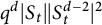 $q^d|S_{t}||S_t^{d-2}|^2$
as the normalizing factor
 $\mathcal {N}(G)$
in (1.4).
Applying a change of variables by letting
 $x=x^1, u=x^1-x^2, v=x^1-x^3, w=x^1-x^4,$
we see that
 $$ \begin{align}\Lambda_{{\diamondsuit}_t}(f_1, f_2, f_3, f_4)=\frac{1}{q^d} \sum_{x\in \mathbb F_q^d} f_1(x) T(f_2,f_3,f_4)(x)=< f_1,~ T(f_2, f_3, f_4)>,\end{align} $$
where the operator
 $T(f_2, f_3, f_4)$
is defined by
 $$ \begin{align} T(f_2, f_3, f_4)(x):= \frac{1}{|S_t||S_t^{d-2}|^2} \sum_{u,v, w\in S_t} S_t(v-u) S_t(w-v) f_2(x-u) f_3(x-v)f_4(x-w).\nonumber\\ \end{align} $$
We are asked to find
 $1\le p_1, p_2, p_3, p_4\le \infty $
such that
 $$ \begin{align} \Lambda_{{\diamondsuit}_t}(f_1, f_2, f_3, f_4) \lesssim ||f_1||_{p_1} ||f_2||_{p_2} ||f_3||_{p_3} ||f_4||_{p_4}\end{align} $$
holds for all nonnegative real-valued functions
 $f_i,1\le i\le 4,$
on
 $\mathbb F_q^d.$
In other words, our main problem is to determine all numbers
 $1\le p_1, p_2, p_3, p_4 \le \infty $
such that
 $ \Lambda _{{\diamondsuit }_t}(p_1, p_2, p_3, p_4) \lesssim 1.$
Lemma 6.1 (Necessary conditions for the boundedness of
$\Lambda _{{\diamondsuit }_t}(p_1, p_2, p_3, p_4)$
)

Let
 $\Lambda _{{\diamondsuit }_t}$
be the
 $(C_4+t)$
form on
 $\mathbb F_q^d.$
If
 $\Lambda _{{\diamondsuit }_t}(p_1, p_2, p_3, p_4) \lesssim 1$
, then we have
 $$ \begin{align*}\frac{1}{p_1} +\frac{1}{p_2}+\frac{d}{p_3}+\frac{1}{p_4} \le d, \quad\frac{d}{p_1} +\frac{1}{p_2}+\frac{1}{p_3}+\frac{1}{p_4}\le d,\quad\mbox{and}\quad \frac{1}{p_1} +\frac{d}{p_2}+\frac{1}{p_3}+\frac{d}{p_4}\le 2d-2.\end{align*} $$
Also, under this assumption when
 $d = 2,$
it can be shown by Polymake [Reference Assarf, Gawrilow, Herr, Joswig, Lorenz, Paffenholz and Rehn1, Reference Gawrilow and Joswig6] that
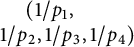 $(1/p_1, 1/p_2, 1/p_3, 1/p_4)$
is contained in the convex hull of the points
 $(0,0,1,0), (0,1,0,0), (0,0,0,1),{\kern-1pt} (1/2,0,1/2,1/2),{\kern-1pt} (2/3,2/3,0,0),{\kern-1pt} (1,0,0,0),{\kern-1pt} (2/3,0,2/3,{\kern-1pt}0),{\kern-1pt} (1/2,1/2,1/2,{\kern-1pt}0), (2/3,0,0,2/3), (0,2/3,2/3,0), (0,0,0,0), (0,0,2/3,2/3).$
Proof Taking
 $f_1=f_2=f_4=1_{S_t},$
and
 $f_3=\delta _0$
in (6.4), we obtain the first conclusion
 $$ \begin{align}\frac{1}{p_1} +\frac{1}{p_2}+\frac{d}{p_3}+\frac{1}{p_4} \le d.\end{align} $$
The second conclusion follows by symmetry from the first conclusion. Finally, one can easily prove the third conclusion, that is,
 $\frac {1}{p_1} +\frac {d}{p_2}+\frac {1}{p_3}+\frac {d}{p_4}\le 2d-2,$
by testing the inequality (6.4) with
 $f_1=f_3=1_{S_t}$
and
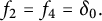 $ f_2=f_4=\delta _0.$
6.1 Boundedness results for
$\Lambda _{{\diamondsuit }_t}$
on
$\mathbb F_q^d$


Given a rhombus with a fixed diagonal (the graph
 $C_4$
+ diagonal), we will show that by removing the vertex
 $x^2$
or the vertex
 $x^4,$
 $$ \begin{align*}\Lambda_{{\diamondsuit}_t}(f_1,f_2,f_3, f_4) \lesssim ||f_2||_\infty \Lambda_{K_3}(f_1, f_3, f_4)\quad \!\mbox{and}\! \quad \Lambda_{{\diamondsuit}_t}(f_1,f_2,f_3, f_4) \lesssim ||f_4||_\infty \Lambda_{K_3}(f_1, f_2, f_3).\end{align*} $$
Hence, upper bounds of
 $\Lambda _{{\diamondsuit }_t}(p_1, \infty , p_3, p_4)$
and
 $\Lambda _{{\diamondsuit }_t}(p_1, p_2, p_3, \infty )$
can be controlled by upper bounds of the
 $\Lambda _{K_3}(p_1, p_3, p_4)$
and
 $\Lambda _{K_3}(p_1, p_2, p_3),$
respectively. More precisely, we have the following relation.
Proposition 6.2 Suppose that
 $\Lambda _{K_3}(p, s, r) \lesssim 1 $
for
 $1\le p, s, r\le \infty .$
Then we have
 $$ \begin{align*}\Lambda_{{\diamondsuit}_t}(p, \infty, s, r)\lesssim 1 \quad \mbox{and}\quad \Lambda_{{\diamondsuit}_t}(p, s, r, \infty)\lesssim 1.\end{align*} $$
Proof Since
 $\Lambda _{K_3}(p, s, r) \lesssim 1 $
for
 $1\le p, s, r\le \infty ,$
we see that for all nonnegative functions
 $ f, g, h$
on
 $\mathbb F_q^d,$
 $ \Lambda _{K_3}(f, g, h) \lesssim ||f||_p ||g||_s ||h||_r.$
Thus, to complete the proof, it will be enough to establish the following estimates: For all nonnegative functions
 $f_i, i=1,2,3, 4,$
 $$ \begin{align} \Lambda_{{\diamondsuit}_t}(f_1,f_2,f_3, f_4) \lesssim ||f_2||_\infty \Lambda_{K_3}(f_1, f_3, f_4) \end{align} $$
and
 $$ \begin{align} \Lambda_{{\diamondsuit}_t}(f_1,f_2,f_3, f_4) \lesssim ||f_4||_\infty \Lambda_{K_3}(f_1, f_2, f_3). \end{align} $$
Since the proofs of both (6.6) and (6.7) are the same, we only provide the proof of the estimate (6.7). Notice by the definition of
 $\Lambda _{{\diamondsuit }_t}(f_1,f_2,f_3, f_4)$
in (6.1) that
 $\Lambda _{{\diamondsuit }_t}(f_1,f_2,f_3,f_4)$
can be written as the form
 $$ \begin{align*}\frac{1}{q^d|S_{t}||S_t^{d-2}|}\! \sum_{\substack{x^1, x^2, x^3\in \mathbb F_q^d\\ : ||x^1-x^2||=||x^2-x^3||= ||x^1-x^3||=t}}\! \left( \prod_{i=1}^3 f_i(x^i)\right) \left[\frac{1}{|S_t^{d-2}|}\sum_{x^4\in \mathbb F_q^d}S_t(x^3-x^4) S_t(x^4-x^1) f_4(x^4)\right].\end{align*} $$
For each
 $x^1, x^3 \in \mathbb F_q^d$
with
 $||x^1-x^3||=t,$
we define
 $M(x^1, x^3)$
as the value in the above bracket. Then, recalling the definition of
 $\Lambda _{K_3}(f_1,f_2,f_3) $
given in (4.1), we see that
 $$ \begin{align*}\Lambda_{{\diamondsuit}_t}(f_1,f_2,f_3,f_4) \le \left(\max_{\substack{x^1, x^3\in \mathbb F_q^d\\ :||x^1-x^3||=t}} M(x^1, x^3) \right) \Lambda_{K_3}(f_1,f_2,f_3).\end{align*} $$
Hence, the estimate (6.7) follows immediately by proving the following claim:
 $$ \begin{align} M:=\max_{\substack{x^1, x^3\in \mathbb F_q^d\\ :||x^1-x^3||=t}} \frac{1}{|S_t^{d-2}|}\sum_{x^4\in \mathbb F_q^d}S_t(x^3-x^4) S_t(x^4-x^1) \lesssim 1. \end{align} $$
To prove this claim, we first apply a change of variables by letting
 $x=x^1, y=x^1-x^3.$
Then it follows that
 $$ \begin{align*}M=\max_{x\in \mathbb F_q^d, y\in S_t} \frac{1}{|S_t^{d-2}|}\sum_{x^4\in \mathbb F_q^d}S_t(x-y-x^4) S_t(x^4-x) .\end{align*} $$
Letting
 $z=x-x^4,$
we have
 $$ \begin{align*}M=\max_{x\in \mathbb F_q^d, y\in S_t} \frac{1}{|S_t^{d-2}|} \sum_{z\in S_t: ||z-y||=t} 1 \sim \frac{1}{q^{d-2}}\max_{y\in S_t} \sum_{z\in S_t: ||z-y||=t} 1.\end{align*} $$
By Corollary A.4 in the Appendix, we conclude that
 $M\lesssim 1,$
as required.
In arbitrary dimensions
 $d\ge 2,$
we have the following consequences.
Theorem 6.3 Suppose that
 $1\le a, b\le \infty $
satisfy that
 $$ \begin{align}\frac{1}{a} + \frac{d}{b}\le d \quad \mbox{and} \quad \frac{d}{a} + \frac{1}{b}\le d.\end{align} $$
Namely, let
 $(1/a, 1/b)$
be contained in the convex hull of points
 $(0,0), (0,1), (d/(d+1), d/(d+1)), (1,0).$
Then we have
 $\Lambda _{{\diamondsuit }_t}(a, \infty , b, \infty )\lesssim 1, \Lambda _{{\diamondsuit }_t}(a, b,\infty , \infty )\lesssim 1 , \Lambda _{{\diamondsuit }_t}(a, \infty , \infty , b)\lesssim 1, \Lambda _{{\diamondsuit }_t}(\infty , \infty , a, b)\lesssim 1, \Lambda _{{\diamondsuit }_t}(\infty , a, b, \infty )\lesssim 1 .$


6.2 Sharp boundedness results up to endpoints for
$\Lambda _{{\diamondsuit }_t}$
on
$\mathbb F_q^2$


In this subsection, we collect our boundedness results for the operator
 $\Lambda _{{\diamondsuit }_t}$
in two dimensions.
Theorem 6.4 Let
 $\Lambda _{{\diamondsuit }_t}$
be the
 $(C_4+t)$
form on
 $\mathbb F_q^2.$
Let
 $1\le p_1, p_2, p_3\le \infty .$
-
(i) Suppose that
$(p_1, p_2, p_3)\ne (2,2,2)$
satisfies the following equations: Then we have
$$ \begin{align*}\frac{2}{p_1} + \frac{1}{p_2}+ \frac{1}{p_3}\le 2, ~~\frac{1}{p_1} + \frac{2}{p_2}+ \frac{1}{p_3}\le 2,~~\frac{1}{p_1} + \frac{1}{p_2}+ \frac{2}{p_3}\le 2.\end{align*} $$
$ \Lambda _{{\diamondsuit }_t}(p_1, \infty , p_2, p_3)\lesssim 1$
and
$ \Lambda _{{\diamondsuit }_t}(p_1, p_2, p_3, \infty )\lesssim 1.$
-
(ii) In addition, we have
$\Lambda _{{\diamondsuit }_t}(2, \infty , 2,2)\lessapprox 1$
and
$\Lambda _{{\diamondsuit }_t}(2,2,2, \infty )\lessapprox 1,$
where
$\lessapprox $
is used to denote that the boundedness of
$\diamondsuit _t$
holds for all indicator test functions.







Proof Notice that Proposition 6.2 still holds after replacing
 $\lesssim $
by
 $\lessapprox .$
Hence, the statement of the theorem is directly obtained by combining Proposition 6.2 and Theorem 4.7(ii).
Theorem 6.4 guarantees the sharp boundedness for the operator
 $\diamond _t$
up to endpoints. Indeed, we have the following result.
Theorem 6.5 Let
 $\diamondsuit _t$
be the
 $(C_4+t)$
form on
 $\mathbb F_q^2.$
The necessary conditions for
 $\diamondsuit _t(p_1, p_2, p_3, p_4)\lesssim 1$
given in Lemma 6.1 are sufficient except for the two points
 $(p_1, p_2, p_3, p_4)= (2,2,2, \infty ), (2, \infty , 2,2).$
In addition, we have
 $$ \begin{align} \diamondsuit_t(2, \infty, 2,2)\lessapprox 1 \quad\mbox{and} \quad \diamondsuit_t(2,2,2, \infty)\lessapprox 1 .\end{align} $$
Proof The statement (6.10) was already proven in Theorem 6.4(ii). Hence, using the interpolation theorem and the second part of Lemma 6.1, the matter is reducing to proving
 $\diamondsuit _t(p_1, p_2, p_3, p_4) \lesssim 1$
for the critical endpoints
 $ (1/p_1, 1/p_2, 1/p_3, 1/p_4)$
including all the following points:
 $(0,0,0,0), (1,0,0,0), (0,1,0,0), (0,0,1,0), (0,0,0,1), (2/3,2/3,0,0), (2/3,0,2/3,0), (2/3,0,0,2/3), (0,2/3,2/3,0), (0,0,2/3,2/3).$
In other words, the proof will be complete by proving the following estimates:
 $\diamondsuit _t(\infty , \infty , \infty , \infty ) \lesssim 1,$
 $\diamondsuit _t(1, \infty , \infty , \infty ) \lesssim 1,$
 $\diamondsuit _t(\infty , 1, \infty , \infty ) \lesssim 1,$
 $\diamondsuit _t(\infty , \infty , 1, \infty ) \lesssim 1,$
 $\diamondsuit _t(\infty , \infty , \infty , 1) \lesssim 1,$
 $\diamondsuit _t(3/2, 3/2, \infty , \infty ) \lesssim 1,$
 $\diamondsuit _t(3/2, \infty , 3/2, \infty ) \lesssim 1,$
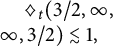 $\diamondsuit _t(3/2, \infty , \infty , 3/2) \lesssim 1,$
 $\diamondsuit _t(\infty , 3/2, 3/2, \infty ) \lesssim 1,$
 $\diamondsuit _t(\infty , \infty , 3/2, 3/2) \lesssim 1.$
However, by a direct computation, these estimates follow immediately from Theorem 6.4(i).
7 Boundedness problem for the
$C_4$
form

Let
 $t\in \mathbb F_q^*.$
Given nonnegative real-valued functions
 $f_i, 1\le i\le 4$
, on
 $\mathbb F_q^d,$
we define
 $\Lambda _{C_4}(f_1,f_2, f_3, f_4)$
to be the following value:
 $$ \begin{align} \frac{1}{q^d |S_t|^2 |S_t^{d-2}|} \sum_{x^1, x^2, x^3, x^4\in \mathbb F_q^d} S_t(x^1-x^2) S_t(x^2-x^3) S_t(x^3-x^4) S_t(x^4-x^1) \prod_{i=1}^4 f_i(x^i), \end{align} $$
where the quantity
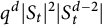 $q^d |S_t|^2 |S_t^{d-2}|$
stands for the normalizing factor
 $\mathcal {N}(G)$
in (1.4) when
 $G=C_4.$
Main problem is to find all exponents
 $1\le p_1, p_2, p_3, p_4\le \infty $
such that the inequality
 $$ \begin{align} \Lambda_{C_4}(f_1, f_2, f_3, f_4) \lesssim ||f_1||_{p_1} ||f_2||_{p_2} ||f_3||_{p_3} ||f_4||_{p_4}\end{align} $$
holds for all nonnegative real-valued functions
 $f_i, 1\le i\le 4,$
on
 $\mathbb F_q^d.$
In other words, our main problem is to determine all numbers
 $1\le p_1, p_2, p_3, p_4 \le \infty $
such that
 $ \Lambda _{C_4}(p_1, p_2, p_3, p_4) \lesssim 1.$
Lemma 7.1 (Necessary conditions for the boundedness of
$\Lambda _{C_4}(p_1, p_2, p_3, p_4)$
)

Suppose that (7.2) holds, namely
 $\Lambda _{C_4}(p_1, p_2, p_3, p_4) \lesssim 1.$
Then we have
 $$ \begin{align*}\frac{1}{p_1} +\frac{1}{p_2}+\frac{1}{p_3}+\frac{d}{p_4} \le d+1, \!\quad\frac{1}{p_1} +\frac{1}{p_2}+\frac{d}{p_3}+\frac{1}{p_4} \le d+1, \!\quad\frac{1}{p_1} +\frac{d}{p_2}+\frac{1}{p_3}+\frac{1}{p_4} \le d+1,\end{align*} $$
 $$ \begin{align*}\frac{d}{p_1} +\frac{1}{p_2}+\frac{1}{p_3}+\frac{1}{p_4} \le d+1, \!\quad \frac{d}{p_1} +\frac{1}{p_2}+\frac{d}{p_3}+\frac{1}{p_4} \le 2d-2, \!\!\quad\mbox{and}\quad\! \frac{1}{p_1} +\frac{d}{p_2}+\frac{1}{p_3}+\frac{d}{p_4} \le 2d-2.\end{align*} $$
In particular, when
 $d = 2,$
it can be shown by Polymake [Reference Assarf, Gawrilow, Herr, Joswig, Lorenz, Paffenholz and Rehn1, Reference Gawrilow and Joswig6] that
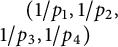 $(1/p_1, 1/p_2, 1/p_3, 1/p_4)$
is contained in the convex hull of the points
 $(0,0,1,0), (0,0,0,1), (0,1,0,0), (2/3,0,0,2/3), (2/3,2/3,0,0), (1,0,0,0), (0,0,0,0),\kern-1pt (0,2/3,2/3,0),\kern-1pt (0,0, 2/3,2/3).$
Remark 7.2 When
 $d=2, 3$
, the first four inequalities in the conclusion are not necessary. We only need the last two.
Proof The six inequalities in the conclusion can be easily deduced by testing the inequality (7.2) with the following specific functions, respectively: We leave the proofs to the readers.

7.1 Boundedness results for
$\Lambda _{C_4}$
on
$\mathbb F_q^d$


In this subsection, we provide some exponents
 $1\le p_i \le \infty , 1\le i\le 4,$
such that
 $\Lambda _{C_4}(p_1, p_2, p_3, p_4)\lesssim 1$
in the specific case when one of
 $p_i$
is
 $\infty $
, but it is valid for all dimensions
 $d\ge 2.$
In general, it is very hard to deduce nontrivial boundedness results for the
 $C_4$
form on
 $\mathbb F_q^d.$
We begin by observing that an upper bound of
 $\Lambda _{C_4}(f_1,f_2,f_3,f_4)$
can be controlled by estimating for both the
 $K_2$
form and the
 $P_2$
form.
Lemma 7.3 For all nonnegative functions
 $f_i, i=1,2,3,4,$
on
 $\mathbb F_q^d, d\ge 2,$
we have
 $$ \begin{align*}\Lambda_{C_4}(f_1, f_2, f_3, f_4) \lesssim \left\{\kern-12pt\begin{array}{ll} &\left(\frac{1}{|S_t^{d-2}|} L(f_1f_3,~ f_2) + \Lambda(f_1, f_2, f_3) \right) ||f_4||_\infty,\\[2pt] &\left(\frac{1}{|S_t^{d-2}|} L(f_2f_4,~ f_1) + \Lambda(f_4, f_1, f_2)\right) ||f_3||_\infty,\\[2pt] &\left(\frac{1}{|S_t^{d-2}|} L(f_1f_3,~ f_4) + \Lambda(f_3, f_4, f_1)\right) ||f_2||_\infty,\\[2pt] &\left(\frac{1}{|S_t^{d-2}|} L(f_2f_4,~ f_3) + \Lambda(f_2, f_3, f_4)\right) ||f_1||_\infty.\\ \end{array} \right.\end{align*} $$
Proof We only provide the proof of the first inequality,
 $$ \begin{align} \Lambda_{C_4}(f_1, f_2, f_3, f_4) \lesssim \frac{1}{|S_t^{d-2}|} \Lambda_{K_2}(f_1f_3,~ f_2) ||f_4||_\infty + \Lambda_{P_2}(f_1, f_2, f_3) ||f_4||_\infty,\end{align} $$
since other inequalities can be easily proven in the same way by replacing the role of
 $f_4$
with
 $f_3, f_2, f_1,$
respectively. By definition, the value of
 $\Lambda _{C_4}(f_1,f_2,f_3,f_4)$
is equal to
 $$ \begin{align*}&\frac{1}{q^d |S_t|^2 |S_t^{d-2}|} \sum_{x^1, x^2, x^3\in \mathbb F_q^d} S_t(x^1-x^2) S_t(x^2-x^3) \left(\prod_{i=1}^3 f_i(x^i)\right)\\& \quad \times \left(\sum_{x^4\in \mathbb F_q^d} S_t(x^3-x^4) S_t(x^4-x^1) f_4(x^4)\right).\end{align*} $$
For fixed
 $x^1, x^3 \in \mathbb F_q^d,$
the sum in the above bracket can be estimated as follows:
 $$ \begin{align*}\sum_{x^4\in \mathbb F_q^d} S_t(x^3-x^4) S_t(x^4-x^1) f_4(x^4) \lesssim \left\{\begin{array}{ll} |S_t| ||f_4||_\infty,\quad &\mbox{if} \quad x^1=x^3,\\ q^{d-2} ||f_4||_\infty, \quad &\mbox{if}\quad x^1\ne x^3. \end{array} \right.\end{align*} $$
Notice that this estimates are easily obtained by invoking Corollary A.4 in the Appendix after using a change of variables.
Let
 $\Lambda _{C_4}(f_1,f_2,f_3,f_4) =:\Diamond _1 + \Diamond _2,$
where
 $\Diamond _1$
denotes the contribution to
 $\Lambda _{C_4}(f_1, f_2, f_3, f_4)$
when
 $x^1=x^3,$
and
 $\Diamond _2$
does it when
 $x^1\ne x^3.$
Then it follows that
 $$ \begin{align*}\Diamond_1 \lesssim \frac{||f_4||_\infty}{q^d |S_t| |S_t^{d-2}|} \sum_{x^1, x^2\in \mathbb F_q^d} S_t(x^1-x^2) (f_1f_3)(x^1) f_2(x^2) =\frac{1}{|S_t^{d-2}|} \Lambda_{K_2}(f_1f_3,~ f_2) ||f_4||_\infty,\end{align*} $$
 $$ \begin{align*}\Diamond_2 \lesssim \frac{||f_4||_\infty}{q^d|S_t|^2 } \sum_{x^1, x^2, x^3\in \mathbb F_q^d:x^1\ne x^3} S_t(x^1-x^2) S_t(x^2-x^3) f_1(x^1) f_2(x^2) f_3(x^3)\lesssim \Lambda_{P_2}(f_1, f_2, f_3) ||f_4||_\infty.\end{align*} $$
Hence, we obtain the required estimate (7.3).
In Lemma 7.3, we obtained four different kinds of the upper bounds of the
 $\Lambda _{C_4}(f_1, f_2, f_3, f_4).$
Using each of them, we are able to deduce exponents
 $p_1, p_2, p_3, p_4$
with
 $ \Lambda _{C_4}(p_1, p_2, p_3, p_4)\lesssim 1,$
where at least one of
 $p_j, j=1,2,3, 4,$
takes
 $\infty .$
The following result can be proven by applying the first upper bound of
 $\Lambda _{C_4}(f_1, f_2,f_3, f_4)$
in Lemma 7.3 together with Theorems 3.3 and 5.3.
Proposition 7.4 Let
 $1\le p_1, p_2, p_3\le \infty .$
For the
 $C_4$
form
 $\Lambda _{C_4}$
on
 $\mathbb F_q^d, d\ge 2,$
the following statements are true.
-
(i) If
$\frac {1}{p_1}+\frac {d}{p_2}+ \frac {1}{p_3} \le d$
and
$ \frac {d}{p_1}+\frac {1}{p_2}+ \frac {d}{p_3} \le d$
, then
$\Lambda _{C_4}(p_1, p_2, p_3, \infty )\lesssim 1. $
-
(ii) If
$ \frac {d}{p_1}+\frac {1}{p_2}+ \frac {1}{p_4} \le d$
and
$\frac {1}{p_1}+\frac {d}{p_2}+ \frac {d}{p_4} \le d$
, then
$\Lambda _{C_4}(p_1, p_2, \infty , p_4)\lesssim 1. $
-
(iii) If
$\frac {1}{p_1}+\frac {1}{p_3}+ \frac {d}{p_4} \le d$
and
$ \frac {d}{p_1}+\frac {d}{p_3}+ \frac {1}{p_4} \le d$
, then
$\Lambda _{C_4}(p_1, \infty , p_3, p_4)\lesssim 1. $
-
(iv) If
$\frac {1}{p_2}+\frac {d}{p_3}+ \frac {1}{p_4} \le d$
and
$ \frac {d}{p_2}+\frac {1}{p_3}+ \frac {d}{p_4} \le d$
, then
$\Lambda _{C_4}(\infty , p_2, p_3, p_4)\lesssim 1. $
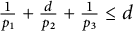
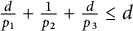


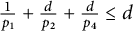

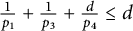
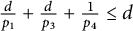

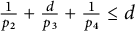
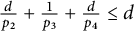

Proof We will only provide the proof of the first part of the theorem since the proofs of other parts are the same in the sense that the proof of the first part uses the first upper bound of Lemma 7.3 and the proofs of other parts can also use their corresponding upper bounds of Lemma 7.3 to complete the proofs.
Let us start proving the first part of the theorem. To complete the proof, we aim to show that for all nonnegative functions
 $f_i, i=1,2,3,4,$
on
 $\mathbb F_q^d,$
 $$ \begin{align*}\Lambda_{C_4}(f_1, f_2, f_3, f_4) \lesssim ||f_1||_{p_1} ||f_2||_{p_2} ||f_3||_{p_3}||f_4||_\infty,\end{align*} $$
whenever the exponents
 $1\le p_1, p_2, p_3\le \infty $
satisfy the following conditions:
 $$ \begin{align} \frac{1}{p_1}+\frac{d}{p_2}+ \frac{1}{p_3} \le d \quad\mbox{and}\quad \frac{d}{p_1}+\frac{1}{p_2}+ \frac{d}{p_3} \le d. \end{align} $$
By the first part of Lemma 7.3, it follows that
 $$ \begin{align*}\Lambda_{C_4}(f_1, f_2, f_3, f_4) \lesssim \left(\frac{1}{|S_t^{d-2}|} L(f_1f_3,~ f_2) + \Lambda(f_1, f_2, f_3)\right) ||f_4||_\infty.\end{align*} $$
Therefore, under the assumptions (7.4), our problem is reducing to establishing the following two estimates:
 $$ \begin{align} \Lambda_{K_2}(f_1f_3,~ f_2) \lesssim ||f_1||_{p_1} ||f_2||_{p_2} ||f_3||_{p_3},\end{align} $$
 $$ \begin{align} \Lambda_{P_2}(f_1, f_2, f_3)\lesssim ||f_1||_{p_1} ||f_2||_{p_2} ||f_3||_{p_3}.\end{align} $$
For
 $1\le p_1, p_3\le \infty , $
let
 $1/r= 1/p_{1} + 1/p_{3}.$
Then the conditions (7.4) are the same as
 $$ \begin{align*}\frac{1}{r} +\frac{d}{p_2} \le d \quad \mbox{and} \quad \frac{d}{r} + \frac{1}{p_2}\le d.\end{align*} $$
So these conditions enable us to invoke Theorem 3.3 so that we obtain the estimate (7.5) as follows:
 $$ \begin{align*}\Lambda_{K_2}(f_1f_3,~ f_2) \lesssim ||f_1f_3||_r ||f_2||_{p_2} \le ||f_1|||_{p_1} ||f_2||_{p_2} ||f_3||_{p_3},\end{align*} $$
where we used Hölder’s inequality in the last inequality.
It remains to prove the estimate (7.6) under the assumptions (7.4). To do this, we shall use Theorem 5.3, which gives sufficient conditions for
 $\Lambda _{P_2}(p_1, p_2, p_3)\lesssim 1.$
We directly compare the conditions (7.4) with the assumptions of Theorem 5.3. Then it is not hard to observe the following statements.
-
• (Case 1) In the case when
$0\le \frac {1}{p_1}, \frac {1}{p_3} \le \frac {d}{d+1}$
, the conditions (7.4) imply the hypothesis of the first part of Theorem 5.3. -
• (Case 2) In the case when
$0\le \frac {1}{p_1} \le \frac {d}{d+1} \le \frac {1}{p_3} \le 1,$
the conditions (7.4) imply the hypothesis of the second part of Theorem 5.3. To see this, notice that if
$d/p_1+ 1/p_2+ d/p_3\le d$
, then
$ 1/(dp_1)+ 1/p_2+ d/p_3\le d.$
-
• (Case 3) In the case when
$0\le \frac {1}{p_3} \le \frac {d}{d+1} \le \frac {1}{p_1} \le 1,$
the conditions (7.4) imply the hypothesis of the third part of Theorem 5.3. -
• (Case 4) In the case when
$\frac {d}{d+1}\le \frac {1}{p_1}, \frac {1}{p_3} \le 1,$
the conditions (7.4) imply the hypothesis of the fourth part of Theorem 5.3.
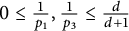




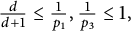
Hence, we conclude from Theorem 5.3 that
 $\Lambda _{P_2}(p_1, p_2, p_3)\lesssim 1$
under the assumptions (7.4), as desired.
7.2 Sharp boundedness results for
$\Lambda _{C_4}$
on
$\mathbb F_q^2$


Recall that Proposition 7.4 provides sufficient conditions for
 $\Lambda _{C_4}(p_1, p_2, p_2, p_4)\lesssim 1$
in any dimensions
 $d\ge 2.$
In this section, we show that Proposition 7.4 is sharp in two dimensions. More precisely, using Proposition 7.4, we will prove the following optimal result.
Theorem 7.5 Let
 $\Lambda _{C_4}$
be the
 $C_4$
form on
 $\mathbb F_q^2.$
For
 $1\le p_i\le \infty , 1\le i\le 4,$
we have
 $$ \begin{align*}\Lambda_{C_4}(p_1, p_2, p_3, p_4)\lesssim 1 ~~\mbox{if and only if}\quad \frac{2}{p_1} +\frac{1}{p_2}+\frac{2}{p_3}+\frac{1}{p_4} \le 2, ~~\mbox{and}\quad \frac{1}{p_1} +\frac{2}{p_2}+\frac{1}{p_3}+\frac{2}{p_4} \le 2.\end{align*} $$
Proof The necessary conditions for
 $\Lambda _{C_4}(p_1, p_2,p_3, p_4)\lesssim 1$
follow immediately from Lemma 7.1 for
 $d=2$
(see Remark 7.2).
Conversely, suppose that
 $1\le p_1, p_2, p_3, p_4\le \infty $
satisfy the following two inequalities:
 $$ \begin{align} \frac{2}{p_1} +\frac{1}{p_2}+\frac{2}{p_3}+\frac{1}{p_4} \le 2, ~~\mbox{and}\quad \frac{1}{p_1} +\frac{2}{p_2}+\frac{1}{p_3}+\frac{2}{p_4} \le 2. \end{align} $$
Then, as mentioned in Lemma 7.1, it can be shown by Polymake [Reference Assarf, Gawrilow, Herr, Joswig, Lorenz, Paffenholz and Rehn1, Reference Gawrilow and Joswig6] that
 $(1/p_1, 1/p_2, 1/p_3, 1/p_4)$
is contained in the convex hull of the points
 $(0,0,1,0), (0,0,0,1),\kern1pt (0,1,0,0),\kern1pt (2/3,0,0,2/3),\kern1pt (2/3,2/3,0,0),\kern1pt (1,0,0,0),\kern1pt (0,0,0,0),\kern1pt (0,2/3, 2/3,0), (0,0,2/3,2/3).$
By interpolating the above nine critical points, to prove
 $\Lambda _{C_4}(p_1, p_2, p_3, p_4)\lesssim 1 $
for all
 $p_i, 1\le i\le 4$
satisfying the inequalities in (7.7), it will be enough to prove it for the nine critical points
 $(1/p_1, 1/p_2, 1/p_3, 1/p_4).$
This can be easily proven by using Proposition 7.4. For example, for the point
 $(1/p_1, 1/p_2, 1/p_3, 1/p_4)=(2/3,0,0,2/3),$
a direct computation shows that the assumptions in Proposition 7.4(ii) are satisfied and thus
 $\Lambda _{C_4}(p_1, p_2, p_3, p_4)=\Lambda _{C_4}(3/2, \infty , \infty , 3/2) \lesssim 1.$
For other critical points, we can easily prove them in the same way so that we omit the detail proofs.
Notice that the graph
 $C_4$
is a subgraph of the graph
 $C_4$
+ diagonal, and they are associated with the operators
 $\Lambda _{C_4}$
and
 $\Lambda _{\diamondsuit _t},$
respectively. Hence, the following proposition shows that the answer to Question 1.2 is negative when G is the
 $C_4$
+ diagonal, and
 $G'$
is the
 $C_4.$
However, this does not mean that Conjecture 1.5 is not true since the
 $C_4$
and the
 $C_4$
+ diagonal do not satisfy the main hypothesis (1.6) of Conjecture 1.5.
Proposition 7.6 Let
 $\Lambda _{\diamondsuit _t}, \Lambda _{C_4}$
be the
 $(C_4+t)$
form and the
 $C_4$
form on
 $\mathbb F_q^2,$
respectively. Let
 $1\le p_1, p_2, p_3, p_4\le \infty .$
Then the following statements hold.
-
(i) If
$\Lambda _{C_4}(p_1, p_2, p_3, p_4)\lesssim 1$
, then
$\Lambda _{\diamondsuit _t}(p_1, p_2, p_3, p_4)\lesssim 1.$
-
(ii) Moreover, there exist exponents
$1\le a, b,c, d\le \infty $
such that
$\Lambda _{\diamondsuit _t}(a, b, c, d)\lesssim 1$
but
$\Lambda _{C_4}(a, b, c, d)$
is not bounded.





Proof First, let us prove the statement (ii) in the conclusion. To prove this, we choose
 $(a, b, c, d)=(3/2, \infty , 3/2, \infty ).$
From Theorem 6.4(i), we can easily note that
 $\Lambda _{\diamondsuit _t}(3/2, \infty , 3/2, \infty ) \lesssim 1.$
However, it is impossible that
 $\Lambda _{C_4}(3/2, \infty , 3/2, \infty ) \lesssim 1,$
which can be shown from Theorem 7.5.
Next, let us prove the first conclusion of the theorem. Suppose that
 $\Lambda _{C_4}(p_1, p_2, p_3, p_4)\lesssim 1$
for
 $1\le p_i\le \infty , 1\le i\le 4.$
Then, as mentioned in the second conclusion of Lemma 7.1, the point
 $(1/p_1, 1/p_2, 1/p_3, 1/p_4)$
lies on the convex body with the critical endpoints:
 $(0,0,1,0), (0,0,0,1), (0,1,0,0), (2/3,0,0,2/3), (2/3,2/3,0,0), (1,0,0,0), (0,0,0,0), (0,2/3,2/3,0), (0,0,2/3,2/3).$
Invoking the interpolation theorem, to prove the conclusion that
 $\Lambda _{\diamondsuit _t}(p_1, p_2, p_3, p_4)\lesssim 1,$
it will be enough to establish the boundedness only for those nine critical points
 $(1/p_1, 1/p_2, 1/p_3, 1/p_4).$
More precisely, it remains to establish the following estimates:
 $ \Lambda _{\diamondsuit _t}(\infty , \infty , \infty , \infty )\lesssim 1,$
 $ \Lambda _{\diamondsuit _t}(1, \infty , \infty , \infty )\lesssim 1,$
 $\Lambda _{\diamondsuit _t}(\infty , 1, \infty , \infty )\lesssim 1,$
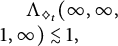 $\Lambda _{\diamondsuit _t}(\infty , \infty , 1, \infty )\lesssim 1,$
 $\Lambda _{\diamondsuit _t}(\infty , \infty , \infty , 1)\lesssim 1,$
 $\Lambda _{\diamondsuit _t}(3/2, 3/2,\infty , \infty )\lesssim 1,$
 $\Lambda _{\diamondsuit _t}(3/2, \infty , \infty , 3/2)\lesssim 1,$
 $\Lambda _{\diamondsuit _t}(\infty , 3/2, 3/2, \infty )\lesssim 1,$
 $\Lambda _{\diamondsuit _t}(\infty , \infty , 3/2, 3/2)\lesssim 1.$
However, these estimates follow by applying Theorem 6.4(i).
8 Boundedness problem for the
$P_3$
form

For
 $t\in \mathbb F_q^*$
and nonnegative real-valued functions
 $f_i, i=1,2,3, 4,$
on
 $\mathbb F_q^d,$
we define
 $\Lambda _{P_3}(f_1,f_2, f_3, f_4)$
as the following value:
 $$ \begin{align} \frac{1}{q^d|S_t|^3} \sum_{x^1, x^2, x^3, x^4\in \mathbb F_q^d} S_t(x^1-x^2) S_t(x^2-x^3) S_t(x^3-x^4) \prod_{i=1}^4 f_i(x^i). \end{align} $$
This operator
 $\Lambda _{P_3}$
will be named the
 $P_3$
form on
 $\mathbb F_q^d$
since it is related to the graph
 $P_3$
with vertices in
 $\mathbb F_q^d, d\ge 2.$
Note that in the definition of
 $\Lambda _{P_3}(f_1,f_2, f_3, f_4)$
, we take the normalizing fact
 $q^d|S_t|^3$
, which is corresponding to
 $\mathcal {N}(G)$
in (1.4) when G is the
 $P_3.$
We want to determine
 $1\le p_1, p_2, p_3, p_4\le \infty $
such that
 $$ \begin{align} \Lambda_{P_3}(f_1, f_2, f_3, f_4) \lesssim ||f_1||_{p_1} ||f_2||_{p_2} ||f_3||_{p_3} ||f_4||_{p_4}\end{align} $$
holds for all nonnegative real-valued functions
 $f_i, i=1,2,3,4,$
on
 $\mathbb F_q^d.$
In other words, our main problem is to find all numbers
 $1\le p_1, p_2, p_3, p_4 \le \infty $
such that
 $ \Lambda _{P_3}(p_1, p_2, p_3, p_4) \lesssim 1.$
Lemma 8.1 (Necessary conditions for
$\Lambda _{P_3}(p_1, p_2, p_3, p_4)\lesssim 1$
)

Suppose that
 $\Lambda _{P_3}(p_1, p_2, p_3, p_4) \lesssim 1.$
Then we have
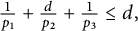 $\frac {1}{p_1} +\frac {d}{p_2}+\frac {1}{p_3} \le d,$
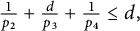 $\frac {1}{p_2}+\frac {d}{p_3}+\frac {1}{p_4} \le d,$
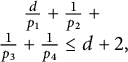 $\frac {d}{p_1} +\frac {1}{p_2}+ \frac {1}{p_3}+\frac {1}{p_4} \le d+2,$
 $\frac {1}{p_1} +\frac {1}{p_2}+\frac {1}{p_3}+\frac {d}{p_4} \le d+2,$
 $\frac {1}{p_1} +\frac {d}{p_2}+\frac {1}{p_3}+\frac {d}{p_4} \le 2d-1,$
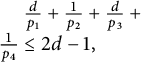 $\frac {d}{p_1} +\frac {1}{p_2}+\frac {d}{p_3}+ \frac {1}{p_4} \le 2d-1,$
and
 $\frac {d}{p_1} +\frac {1}{p_2}+\frac {1}{p_3}+\frac {d}{p_4} \le 2d $
In particular, when
 $d = 2$
, by using Polymake [Reference Assarf, Gawrilow, Herr, Joswig, Lorenz, Paffenholz and Rehn1, Reference Gawrilow and Joswig6], it can be shown that
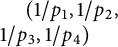 $(1/p_1, 1/p_2, 1/p_3, 1/p_4)$
is contained in the convex hull of the points:
 $(0,1,0,1/2), (0,1,0,0), (1/2,0,1/2,1),\kern1pt (1/2,0,1,0),\kern1pt (1,1/2,0,0),\kern1pt (1,0,0,0),\kern1pt (1,1/3,1/3,0),\kern1pt (1,0,1/2,0),\kern1pt (1/2, 1/3,5/6,0),\kern1pt (1,0,0,1),\kern1pt (1/2,1/2,1/2,1/2),\kern1pt (1,1/2,0,1/2),\kern1pt (0,5/6,1/3,1/2),\kern1pt (0,0,0,1), (0,1/2,0,1), (0,2/3,2/3,0), (0,1/3,1/3,1), (0,0,1/2,1), (0,0,1,0), (0,0,0,0).$
Remark 8.2 When
 $d=2$
, the third, fourth, and seventh inequalities above are not necessary. When
 $d=3$
, the third and fourth inequalities above are not necessary.
Proof As in the proofs of Propositions 3.1, 4.1, and 5.1, the conclusions of the statement follow by testing the inequality (8.2) with the following specific functions, respectively:

8.1 Boundedness results for
$\Lambda _{P_3}$
on
$\mathbb F_q^d$


We begin by observing that an upper bound of
 $\Lambda _{P_3}(f_1, f_2, f_3, f_4)$
can be controlled by the value
 $\Lambda _{P_2}(f_1, f_2, f_3).$
Proposition 8.3 Let
 $1\le a, b,c \le \infty .$
If
 $\Lambda _{P_2}(a,b,c)\lesssim 1$
, then
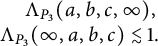 $\Lambda _{P_3}(a,b, c, \infty ), \Lambda _{P_3}(\infty , a,b, c)\lesssim 1.$
Proof For all nonnegative functions
 $f_i, i=1,2,3,4,$
on
 $\mathbb F_q^d,$
our task is to prove the following inequalities:
 $$ \begin{align} \Lambda_{P_3}(f_1, f_2,f _3, f_4) \lesssim \left\{\kern-12pt\begin{array}{ll} & \Lambda_{P_2}(f_1,f_2, f_3) ~||f_4||_\infty, \\ & ||f_1||_\infty ~\Lambda(f_2, f_3, f_4).\end{array} \right.\end{align} $$
We will only prove the first inequality, that is,
 $$ \begin{align} \Lambda_{P_3}(f_1, f_2,f _3, f_4) \lesssim \Lambda_{P_2}(f_1,f_2, f_3) ~||f_4||.\end{align} $$
By symmetry, the second inequality can be easily proven in the same way. By definition in (8.1), we can write
 $ \Lambda _{P_3}(f_1, f_2,f _3, f_4) $
as
 $$ \begin{align*}\frac{1}{q^d |S_t|^2} \sum_{x^1, x^2, x^3\in \mathbb F_q^d} S_t(x^1-x^2) S_t(x^2-x^3) \left(\prod_{i=1}^3 f_i(x^i)\!\right) \left(\!\frac{1}{|S_t|} \sum_{x^4\in \mathbb F_q^d} f_4(x^4) S_t(x^3-x^4)\!\!\right).\end{align*} $$
Since the value in the above bracket is
 $ Af_4(x^3)$
, which is clearly dominated by
 $||Af_4||_\infty $
, the required estimate (8.4) follows immediately from the definition of
 $\Lambda _{P_2}(f_1,f_2, f_3)$
in (5.1).
The following lemma can be deduced from Proposition 8.3 and Theorem 5.3.
Lemma 8.4 Consider the
 $P_3$
form
 $\Lambda _{P_3}$
on
 $\mathbb F_q^d.$
Suppose that the exponents
 $1\le a, b, c\le \infty $
satisfy one of the following conditions:
-
(i)
$0\le \frac {1}{a}, \frac {1}{c} \le \frac {d}{d+1}$
and
$ \frac {1}{a}+\frac {d}{b}+ \frac {1}{c} \le d$
, -
(ii)
$0\le \frac {1}{a} \le \frac {d}{d+1} \le \frac {1}{c} \le 1,$
and
$ \frac {1}{da}+\frac {1}{b}+ \frac {d}{c} \le d$
, -
(iii)
$0\le \frac {1}{c} \le \frac {d}{d+1} \le \frac {1}{a} \le 1,$
and
$ \frac {d}{a}+\frac {1}{b}+ \frac {1}{dc} \le d$
, -
(iv)
$\frac {d}{d+1}\le \frac {1}{a}, \frac {1}{c} \le 1$
and
$ \frac {d}{a}+\frac {1}{b}+ \frac {d}{c} \le 2d-1.$
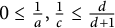
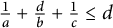

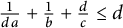

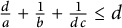
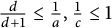

Then we have
 $\Lambda _{P_3}(a,b, c, \infty )\lesssim 1$
and
 $\Lambda _{P_3}(\infty , a,b, c)\lesssim 1.$
Proof Using Theorem 5.3 with
 $p_1=a, ~p_2=b,~ p_3=c$
, it is clear that
 $\Lambda _{P_2}(a,b, c)\lesssim 1$
for all exponents
 $a, b, c$
in our assumption. Hence, the statement follows immediately from Proposition 8.3.
Now we prove that the value
 $\Lambda _{P_3}(f_1,f_2,f_3, f_4)$
can be expressed in terms of the averaging operator over spheres. For functions
 $f, g, h$
on
 $\mathbb F_q^d$
, let us denote
 $$ \begin{align*}<f, g, h>:=||fgh||_1=\frac{1}{q^d} \sum_{x\in \mathbb F_q^d} f(x) g(x) h(x).\end{align*} $$
Proposition 8.5 Let
 $f_i, i=1,2,3, 4,$
be nonnegative real-valued functions on
 $\mathbb F_q^d.$
Then we have
 $$ \begin{align*}\Lambda_{P_3}(f_1, f_2, f_3, f_4)=<Af_1,~ f_2, ~ A(f_3\cdot Af_4)>= <A( f_2\cdot Af_1), ~f_3,~ Af_4>.\end{align*} $$
Proof By symmetry, to complete the proof, it suffices to prove the first equality, that is,
 $$ \begin{align*}\Lambda_{P_3}(f_1, f_2, f_3, f_4)=<Af_1,~ f_2, ~ A(f_3\cdot Af_4)>.\end{align*} $$
Combining the definition in (8.1) and the definition of the spherical averaging operator A, it follows that
 $$ \begin{align*}\Lambda_{P_3}(f_1, f_2, f_3, f_4) &= \frac{1}{q^d} \sum_{x^2\in \mathbb F_q^d} f_2(x^2) Af_1(x^2) \left[ \frac{1}{|S_t|} \sum_{x^3\in \mathbb F_q^d} f_3(x^3) S_t(x^2-x^3) Af_4(x^3) \right]\\ &=\frac{1}{q^d} \sum_{x^2\in \mathbb F_q^d} f_2(x^2) Af_1(x^2) A( f_3\cdot Af_4)(x^2).\end{align*} $$
This gives the required estimate.
Combining Proposition 8.5 and the averaging estimate over spheres, we are able to deduce sufficient conditions for the boundedness of the
 $P_3$
form
 $\Lambda _{P_3}$
on
 $\mathbb F_q^d.$
Lemma 8.6 Let
 $1\le p_1,p_2, p_3, p_4\le \infty $
be exponents satisfying one of the following conditions:
-
(i)
$0\le \frac {1}{p_1}, \frac {1}{p_4}, ~\frac {1}{p_3}+\frac {1}{dp_4}\le \frac {d}{d+1},$
and
$ \frac {1}{dp_1}+\frac {1}{p_2}+\frac {1}{dp_3}+\frac {1}{d^2p_4} \le 1.$
-
(ii)
$0\le \frac {1}{p_1}, \frac {1}{p_4} \le \frac {d}{d+1} \le \frac {1}{p_3}+\frac {1}{dp_4}\le 1,$
and
$ \frac {1}{dp_1}+\frac {1}{p_2}+\frac {d}{p_3}+\frac {1}{p_4} \le d.$
-
(iii)
$0\le \frac {1}{p_1}, ~\frac {1}{p_3}+\frac {d}{p_4} -d+1\le \frac {d}{d+1} \le \frac {1}{p_4}\le 1,$
and
$ \frac {1}{p_1}+\frac {d}{p_2}+\frac {1}{p_3}+\frac {d}{p_4} \le 2d-1.$
-
(iv)
$0\le \frac {1}{p_1} \le \frac {d}{d+1} \le \frac {1}{p_4},~\frac {1}{p_3}+\frac {d}{p_4}-d+1\le 1,$
and
$ \frac {1}{dp_1}+\frac {1}{p_2}+\frac {d}{p_3}+\frac {d^2}{p_4} \le d^2.$
-
(v)
$0\le \frac {1}{p_4},~\frac {1}{p_3}+\frac {1}{dp_4}\le \frac {d}{d+1} \le \frac {1}{p_1}\le 1,$
and
$ \frac {d}{p_1}+\frac {1}{p_2}+\frac {1}{dp_3}+\frac {1}{d^2p_4} \le d.$
-
(vi)
$0\le \frac {1}{p_4}\le \frac {d}{d+1} \le \frac {1}{p_1},~\frac {1}{p_3}+\frac {1}{dp_4}\le 1,$
and
$ \frac {d}{p_1}+\frac {1}{p_2}+\frac {d}{p_3}+\frac {1}{p_4} \le 2d-1.$
-
(vii)
$0\le \frac {1}{p_3}+\frac {d}{p_4}-d+1\le \frac {d}{d+1}\le \frac {1}{p_1}, \frac {1}{p_4} \le 1,$
and
$ \frac {d^2}{p_1}+\frac {d}{p_2}+\frac {1}{p_3}+\frac {d}{p_4} \le d^2+d-1.$
-
(viii)
$\frac {d}{d+1}\le \frac {1}{p_1}, \frac {1}{p_4}, \frac {1}{p_3}+\frac {d}{p_4}-d+1\le 1,$
and
$ \frac {d}{p_1}+\frac {1}{p_2}+\frac {d}{p_3}+\frac {d^2}{p_4} \le d^2+d-1.$
















Then we have
 $\Lambda _{P_3}(p_1,p_2, p_3, p_4)\lesssim 1$
and
 $\Lambda _{P_3}(p_4,p_3, p_2, p_1)\lesssim 1.$
Proof By symmetry, it will be enough to prove the first part of conclusions, that is,
 $ \Lambda _{P_3}(p_1, p_2, p_3, p_4) \lesssim 1.$
To complete the proof, we will first find the general conditions that guarantee this conclusion. Next, we will demonstrate that each of the hypotheses in the theorem satisfies the general conditions.
To derive the first general condition, we assume that
 $1\le r_1, p_2, r\le \infty $
satisfy that
 $$ \begin{align} \frac{1}{r_1}+ \frac{1}{p_2}+ \frac{1}{r}\le1.\end{align} $$
Then, by Proposition 8.5 and Hölder’s inequality,
 $$ \begin{align*}\Lambda_{P_3}(f_1,f_2,f_3, f_4) \le ||Af_1||_{r_1} ||f_2||_{p_2} ||A(f_3 \cdot Af_4)||_r,\end{align*} $$
where we also used the nesting property of norms associated with the normalizing counting measure. Assume that
 $1\le p_1, s \le \infty $
satisfy the following averaging estimates over spheres:
 $$ \begin{align} A(p_1 \to r_1) \lesssim 1 \quad \mbox{and}\quad A(s \to r)\lesssim 1.\end{align} $$
It follows that
 $\Lambda _{P_3}(f_1, f_2, f_3, f_4) \lesssim ||f_1||_{p_1} ||f_2||_{p_2} ||f_3 \cdot Af_4||_s.$
Now we assume that
 $1\le p_3, t\le \infty $
satisfy that
 $$ \begin{align} \frac{1}{s}=\frac{1}{p_3}+\frac{1}{t}.\end{align} $$
Then, by Hölder’s inequality, we see that
 $$ \begin{align*}\Lambda_{P_3}(f_1, f_2, f_3, f_4) \lesssim ||f_1||_{p_1} ||f_2||_{p_2} ||f_3||_{p_3} ||Af_4||_t.\end{align*} $$
Finally, if we assume that
 $1\le p_4\le \infty $
satisfies the following averaging estimate
 $$ \begin{align} A(p_4 \to t)\lesssim 1,\end{align} $$
then we obtain that
 $ \Lambda _{P_3}(f_1, f_2, f_3, f_4) \lesssim ||f_1||_{p_1} ||f_2||_{p_2} ||f_3||_{p_3} ||f_4||_{p_4}.$
In summary, we see that
 $\Lambda _{P_3}(p_1, p_2, p_3, p_4) \lesssim 1$
provided that the numbers
 $1\le p_i\le \infty , i=1,2,3, 4,$
satisfy all the conditions (8.5)–(8.8). Thus, to finish the proof, we will show that each of the eight hypotheses in the theorem satisfies all these conditions.
Given
 $1\le p_1, p_4\le \infty ,$
by Lemma 2.5, we can chose
 $1\le r_1, t\le \infty $
such that the first averaging estimate in (8.6) and the averaging estimate (8.8) hold, respectively. More precisely, we can select
 $0\le 1/r_1,~1/ t\le 1$
as follows:
-
• If
$0\le \frac {1}{p_1} \le \frac {d}{d+1}, $
then we take
$ 1/r_1= 1/(dp_1). $
-
• If
$0\le \frac {1}{p_4} \le \frac {d}{d+1},$
then we take
$ 1/t=1/(dp_4). $
-
• If
$\frac {d}{d+1}\le \frac {1}{p_1} \le 1,$
then we choose
$1/r_1= {d}/{p_1}-d+1.$
-
• If
$\frac {d}{d+1}\le \frac {1}{p_4} \le 1, $
then we choose
$ 1/t={d}/{p_4}-d+1.$
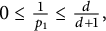

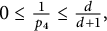

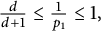

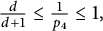

In the next step, we determine
 $1\le r\le \infty $
by using the condition (8.7) and the second averaging estimate in (8.6). Since two kinds of t values can be chosen as above, the condition (8.7) becomes
 $$ \begin{align*}\frac{1}{s}= \frac{1}{p_3}+ \frac{1}{dp_4} \quad \mbox{or}\quad \frac{1}{s}=\frac{1}{p_3}+\frac{d}{p_4}-d+1.\end{align*} $$
Combining these s values with the second averaging estimate in (8.6), the application of Lemma 2.5 enables us to choose
 $1/r$
values as follows:
-
• If
$0\le \frac {1}{s}=\frac {1}{p_3}+ \frac {1}{dp_4} \le \frac {d}{d+1}$
, then we take
$ \frac {1}{r}=\frac {1}{dp_3}+ \frac {1}{d^2p_4}.$
-
• If
$\frac {d}{d+1} \le \frac {1}{s}=\frac {1}{p_3}+ \frac {1}{dp_4} \le 1,$
then we take
$ \frac {1}{r}=\frac {d}{p_3}+ \frac {1}{p_4}-d+1.$
-
• If
$0\le \frac {1}{s}=\frac {1}{p_3}+ \frac {d}{p_4}-d+1 \le \frac {d}{d+1}$
, then we take
$ \frac {1}{r}=\frac {1}{dp_3}+ \frac {1}{p_4}-1+\frac {1}{d}.$
-
• If
$\frac {d}{d+1} \le \frac {1}{s}=\frac {1}{p_3}+ \frac {d}{p_4}-d+1 \le 1,$
then we take
$ \frac {1}{r}=\frac {d}{p_3}+ \frac {d^2}{p_4}-d^2+1.$








Finally, use the condition (8.5) together with previously selected two values for
 $r_1$
and four values for r. Then we obtain the required remaining conditions.
Remark 8.7 Notice that Lemma 8.4 is a special case of Lemma 8.6. However, the proof of Lemma 8.4 is much simpler than that of Lemma 8.6.
We do not know if the consequences from Lemmas 8.4 and 8.6 imply the sharp boundedness results for the
 $P_3$
form
 $\Lambda _{P_3}$
on
 $\mathbb F_q^d.$
However, they play an important role in proving the proposition below, which states that the exponents for
 $\Lambda _{P_3}(p_1, p_2, p_3, p_4)\lesssim 1$
are less restricted than those for
 $\Lambda _{{\diamondsuit }_t}(p_1, p_2, p_3, p_4)\lesssim 1.$
The precise statement is as follows.
Theorem 8.8 Let
 $\Lambda _{{\diamondsuit }_t}$
and
 $\Lambda _{P_3}$
be the operators acting on the functions on
 $\mathbb F_q^2.$
If
 $\Lambda _{{\diamondsuit }_t}(p_1, p_2, p_3, p_4)\lesssim 1$
for
 $1\le p_1, p_2, p_3, p_4\le \infty ,$
then
 $\Lambda _{P_3}(p_1, p_2, p_3, p_4)\lesssim 1.$
Proof Assume that
 $\Lambda _{{\diamondsuit }_t}(p_1, p_2, p_3, p_4)\lesssim 1$
for
 $1\le p_1, p_2, p_3, p_4\le \infty .$
Then, by Lemma 6.1, the point
 $(1/p_1, 1/p_2, 1/p_3, 1/p_4)$
is contained in the convex hull of the following points:
 $(0,0,1,0), (0,1,0,0), (0,0,0,1), (1/2,0,1/2,1/2), (2/3,2/3,0,0), (1,0,0,0), (2/3,0,2/3,0), (1/2,1/2,1/2,0), (2/3,0,0,2/3),\kern-1pt (0,2/3,2/3,0),\kern-1pt (0,0,0,0), (0,0,2/3,2/3).$
To complete the proof, by the interpolation theorem, it suffices to show that for each of the above critical points
 $(1/p_1, 1/p_2, 1/p_3, 1/p_4),$
we have
 $$ \begin{align*}\Lambda_{P_3}(p_1, p_2, p_3, p_4)\lesssim 1.\end{align*} $$
To prove this, we will use Lemma 8.6 and Lemma 8.4. By Lemma 8.6 with the hypothesis (i), one can notice that
 $\Lambda _{P_3}(3/2, \infty , \infty , 3/2)\lesssim 1,$
which is corresponding to the point
 $(1/p_1, 1/p_2, 1/p_3, 1/p_4)=(2/3, 0,0,2/3).$
Similarly, Lemma 8.6 with the hypothesis (ii) can be used for the point
 $(1/2,0,1/2,1/2)$
, namely,
 $\Lambda _{P_3}(2, \infty , 2, 2)\lesssim 1.$
For any other points, we can invoke Lemma 8.4. More precisely, we can apply Lemma 8.4 with the hypothesis (i) for the points
 $(0,1,0,0), (2/3,2/3,0,0), (2/3, 0, 2/3, 0), (1/2, 1/2, 1/2,0), (0,2/3, 2/3, 0), (0,0,0,0), (0, 0, 2/3, 2/3).$
The points
 $(0,0,1,0), (0,0,0, 1)$
can be obtained by Lemma 8.4 with the hypothesis (ii). Finally, for the point
 $(1, 0, 0, 0)$
, we can prove that
 $\Lambda _{P_3}(1, \infty , \infty , \infty )\lesssim 1$
by using Lemma 8.4 with the hypothesis (iii). This completes the proof.
Remark 8.9 The reverse statement of Theorem 8.8 is not true in general. As a counterexample, we can take
 $p_1=3/2,~ p_2=3,~ p_3=3/2, p_4=\infty .$
Indeed, the assumption (i) of Lemma 8.4 with
 $d=2$
implies that
 $\Lambda _{P_3}(3/2, 3, 3/2, \infty ) \lesssim 1.$
However,
 $\Lambda _{{\diamondsuit _t}}(3/2, 3, 3/2, \infty )$
cannot be bounded, which follows from Lemma 6.1.
We obtain the following consequence of Theorem 8.8.
Corollary 8.10 Conjecture 1.5 is valid for the graph
 $C_4$
+ diagonal and its subgraph
 $P_3$
in
 $\mathbb F_q^2.$
Proof It is obvious that the
 $P_3$
is a subgraph of
 $C_4$
+ diagonal in
 $\mathbb F_q^2.$
For
 $d=2,$
it is plain to notice that
 $\min \{\delta (C_4 + diagonal), d\} =2> \delta (P_3)=1.$
Thus, the graph
 $C_4$
+ diagonal and its subgraph
 $P_3$
satisfy all assumptions of Conjecture 1.5. Then the statement of the corollary follows immediately from Theorem 8.8 since the operators
 ${\diamondsuit }_t$
and
 $\Lambda _{P_3}$
are related to the
 $C_4$
+ diagonal and its subgraph
 $P_3$
, respectively.
The following theorem provides a concrete example for a positive answer to Question 1.2 since the operators
 $\Diamond $
and
 $\Lambda _{P_3}$
are related to the graph
 $C_4$
and its subgraph
 $P_3,$
respectively. Furthermore, the graphs also satisfy Conjecture 1.5 (see Corollary 8.13 below).
Theorem 8.11 Let
 $\Lambda _{C_4}$
and
 $\Lambda _{P_3}$
be the operators acting on the functions on
 $\mathbb F_q^2.$
If
 $\Lambda _{C_4}(p_1, p_2, p_3, p_4)\lesssim 1, 1\le p_1, p_2, p_3, p_4\le \infty ,$
then
 $\Lambda _{P_3}(p_1, p_2, p_3, p_4)\lesssim 1.$
Proof By Proposition 7.6(i), if
 $\Lambda _{C_4}(p_1, p_2, p_3, p_4)\lesssim 1$
, then
 $\Lambda _{\diamondsuit _t}(p_1, p_2, p_3, p_4)\lesssim 1.$
By Theorem 8.8, if
 $\Lambda _{\diamondsuit _t}(p_1, p_2, p_3, p_4)\lesssim 1,$
then
 $\Lambda _{P_3}(p_1, p_2, p_3, p_4)\lesssim 1.$
Hence, the statement follows.
Remark 8.12 The reverse statement of Theorem 8.11 cannot hold. As in Remark 8.9, if we can take
 $p_1=3/2, p_2=3, p_3=3/2, p_4=\infty ,$
then
 $\Lambda _{P_3}(3/2, 3, 3/2, \infty ) \lesssim 1.$
However,
 $\Lambda _{C_4}(3/2, 3, 3/2, \infty )$
cannot be bounded, which follows from Theorem 7.5.
Corollary 8.13 Conjecture 1.5 holds true for the graph
 $C_4$
and its subgraph
 $P_3$
on
 $\mathbb F_q^2.$
Proof The main hypothesis (1.6) of Conjecture 1.5 is satisfied for the graph
 $C_4$
and its subgraph
 $P_3$
on
 $\mathbb F_q^2:$
 $$ \begin{align*}\min\{\delta(C_4), 2\}=2>1= \delta(P_3).\end{align*} $$
Since the operators
 $\Lambda _{C_4}$
and
 $\Lambda _{P_3}$
are associated with the graph
 $C_4$
and its subgraph
 $P_3,$
respectively, the statement of the corollary follows from Theorem 8.11.
9 Operators associated with the graph
$K_3$
+ tail (a kite)

Given
 $t\in \mathbb F_q^*$
and functions
 $f_i, i=1,2,3, 4,$
on
 $\mathbb F_q^d,$
we define
 $ \Lambda _{\unlhd }(f_1, f_2,f_3, f_4)$
as the following value:
 $$ \begin{align*}\frac{1}{q^d |S_t|^2 |S_t^{d-2}|} \sum_{x^1, x^2, x^3, x^4\in \mathbb F_q^d} S_t(x^1-x^2) S_t(x^2-x^3) S_t(x^3-x^4) S_t(x^3-x^1) \prod_{i=1}^4 f_i(x^i).\end{align*} $$
Note that this operator
 $ \Lambda _{\unlhd }$
is related to the graph
 $K_3$
+ tail (Figure 1g), and so the normalizing factor
 $\mathcal {N}(G)$
in (1.4) can be taken as the quantity
 $q^d |S_t|^2 |S_t^{d-2}|.$
Here, our main problem is to determine all exponents
 $1\le p_1, p_2, p_3, p_4\le \infty $
such that
 $$ \begin{align} \Lambda_{\unlhd}(f_1, f_2, f_3, f_4) \lesssim ||f_1||_{p_1} ||f_2||_{p_2} ||f_3||_{p_3} ||f_4||_{p_4}\end{align} $$
holds for all nonnegative real-valued functions
 $f_i, i=1,2,3,4,$
on
 $\mathbb F_q^d.$
In other words, we are asked to determine all numbers
 $1\le p_1, p_2, p_3, p_4 \le \infty $
such that
 $ \Lambda _{\unlhd }(p_1, p_2, p_3, p_4) \lesssim 1.$
Recall that when
 $d=2$
, we assume that
 $3\in \mathbb F_q$
is a square number.
Lemma 9.1 (Necessary conditions for the boundedness of
$\Lambda _{\unlhd }(p_1, p_2, p_3, p_4)$
)

Suppose that (9.1) holds, namely
 $\Lambda _{\unlhd }(p_1, p_2, p_3, p_4) \lesssim 1.$
Then we have
 $$ \begin{align*}\frac{1}{p_1} +\frac{1}{p_2}+\frac{d}{p_3}+\frac{1}{p_4} \le d, \quad\frac{1}{p_1} +\frac{d}{p_2}+\frac{1}{p_3}\le d, \quad\frac{d}{p_1} +\frac{1}{p_2}+\frac{1}{p_3}\le d,\end{align*} $$
 $$ \begin{align*}\frac{1}{p_1} +\frac{d}{p_2}+\frac{1}{p_3}+\frac{d}{p_4} \le 2d-1, \quad\mbox{and}\quad \frac{d}{p_1} +\frac{1}{p_2}+\frac{1}{p_3}+\frac{d}{p_4}\le 2d-1.\end{align*} $$
In particular, if
 $d=2$
, then it can be shown by Polymake [Reference Assarf, Gawrilow, Herr, Joswig, Lorenz, Paffenholz and Rehn1, Reference Gawrilow and Joswig6] that
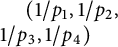 $(1/p_1, 1/p_2, 1/p_3, 1/p_4)$
is contained in the convex hull of the points:
 $(0,0,1,0), (0,1,0,0), (0,1,0,1/2),\ \ (2/3,0,2/3,0),\ \ (1/2,1/2,1/2,0),\ \ (5/6,0,1/3,1/2),\ \ (1,0,0,0),\ \ (1/3,0, 1/3,1), (5/8,5/8,1/8,1/2), (1/2,0,0,1),$
 $(1/4,1/4,1/4,1),$
 $(1/3,1/3,0,1), (1,0,0,1/2), (2/3,2/3,0,1/2),\ \ (2/3,2/3,0,0),\ \ (0,1/2,0,1),$
 $(0,1/3,1/3,1),\ \ (0,0,0,1),\ \ (0,5/6, 1/3,1/2), (0,0,1/2,1), (0,0,0,0), (0,2/3,2/3,0).$
Proof To deduce the first inequality, we test (9.1) with
 $f_1=f_2=f_4= 1_{S_t}$
and
 $f_3=\delta _0.$
To obtain the second one, we test (9.1) with
 $f_1=f_3=1_{S_t}, f_2=\delta _0, $
and
 $f_4=1_{\mathbb F_q^d}.$
To get the third one, we test (9.1) with
 $f_1=\delta _0, f_2=f_3=1_{S_t}, $
and
 $f_4=1_{\mathbb F_q^d}.$
To prove the fourth one, we test (9.1) with
 $f_1=f_3=1_{S_t}$
and
 $ f_2=f_4=\delta _0.$
Finally, to obtain the fifth inequality, we test (9.1) with
 $f_1=f_4=\delta _0$
and
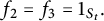 $f_2=f_3=1_{S_t}.$
9.1 Sufficient conditions for the boundedness of
$\Lambda _{\unlhd }$
on
$\mathbb F_q^d$


When one of exponents
 $p_1, p_2, p_4$
is
 $\infty $
, the boundedness problem of
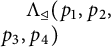 $\Lambda _{\unlhd }(p_1, p_2, p_3, p_4)$
can be reduced to that for the
 $K_3$
form
 $\Lambda _{K_3}$
or the
 $P_2$
form
 $\Lambda _{P_2}.$
Proposition 9.2 Let
 $1\le a, b,c \le \infty .$
-
(i) If
$\Lambda _{K_3}(a,b,c)\lesssim 1$
, then
$\Lambda _{\unlhd }(a,b, c, \infty )\lesssim 1.$
-
(ii) If
$\Lambda _{P_2}(a,b,c)\lesssim 1$
, then
$\Lambda _{\unlhd }(\infty , a, b,c) \lesssim 1$
and
$\Lambda _{\unlhd }(a, \infty , b,c)\lesssim 1.$





Proof For all nonnegative functions
 $f_i, i=1,2,3,4,$
on
 $\mathbb F_q^d.$
we aim to prove the following inequalities:
 $$ \begin{align} \Lambda_{\unlhd}(f_1, f_2,f _3, f_4) \lesssim \left\{\kern-12pt\begin{array}{ll} & \Lambda_{K_3}(f_1,f_2, f_3) ~||f_4||_\infty, \\ & ||f_1||_\infty ~\Lambda_{P_2}(f_2 ,f_3, f_4),\\ & ||f_2||_\infty ~\Lambda_{P_2}(f_1, f_3, f_4).\end{array} \right.\end{align} $$
By the definition,
 $\Lambda _{\unlhd }(f_1, f_2,f _3, f_4)$
can be expressed as
 $$ \begin{align*}&\frac{1}{q^d |S_t||S_t^{d-2}|} \sum_{x^1, x^2, x^3\in \mathbb F_q^d} S_t(x^1-x^2) S_t(x^2-x^3) S_t(x^3-x^1) \left(\prod_{i=1}^3 f_i(x^i)\right)\\& \quad \times \left( \frac{1}{|S_t|} \sum_{x_4\in \mathbb F_q^d} S_t(x^3-x^4) f_4(x^4)\right).\end{align*} $$
The sum in the above bracket is clearly dominated by
 $||f_4||_\infty $
for all
 $x^3\in \mathbb F_q^d.$
Hence, recalling the definition of
 $\Lambda _{K_3}(f_1,f_2,f_3)$
in (4.1), we get the first inequality in (9.2):
 $$ \begin{align*}\Lambda_{\unlhd}(f_1, f_2,f _3, f_4) \le \Lambda_{K_3}(f_1,f_2,f_3) ||f_4||_\infty.\end{align*} $$
Now we prove the second and third inequalities in (9.2). We will only provide the proof of the second inequality, that is,
 $$ \begin{align}\Lambda_{\unlhd}(f_1, f_2,f _3, f_4) \le ||f_1||_\infty ~\Lambda_{P_2}(f_2 ,f_3, f_4).\end{align} $$
The third inequality can be similarly proved by switching the roles of variables
 $x^1, x^2.$
We write
 $\Lambda _{\unlhd }(f_1, f_2, f_3, f_4)$
as follows:
 $$ \begin{align*}&\frac{1}{q^d |S_t|^2} \sum_{x^2, x^3, x^4\in \mathbb F_q^d} S_t(x^2-x^3) S_t(x^3-x^4) \left(\prod_{i=2}^4f_i(x^i)\right)\\& \quad \times \left( \frac{1}{|S_t^{d-2}|} \sum_{x^1\in \mathbb F_q^d} S_t(x^1-x^2) S_t(x^3-x^1) f_1(x^1)\right).\end{align*} $$
Recall the definition of
 $\Lambda _{P_2}(f_2, f_3, f_4)$
in (5.1). Then, to prove the inequality (9.3), it will be enough to show that for all
 $x^2, x^3 \in \mathbb F_q^d$
with
 $||x^2-x^3||=t\ne 0,$
the value in the above bracket is
 $\lesssim ||f_1||_\infty .$
Now, by a simple change of variables, the value in the above bracket is the same as
 $$ \begin{align*}\frac{1}{|S_t^{d-2}|} \sum_{x^1\in S_t} S_t( (x^3-x^2)-x^1) f_1(x^1+x^2).\end{align*} $$
This is clearly dominated by
 $$ \begin{align*}\frac{1}{|S_t^{d-2}|} \sum_{x^1\in S_t} S_t( (x^3-x^2)-x^1) ||f_1||_\infty.\end{align*} $$
Since
 $||x^3-x^2||=t\ne 0, $
applying Corollary A.4 in the Appendix gives us the desirable estimate.
We address sufficient conditions for the boundedness of
 $\Lambda _{\unlhd }$
on
 $\mathbb F_q^d.$
The following result can be obtained from Proposition 9.2(i).
Lemma 9.3 Let
 $\Lambda _{\unlhd }$
be defined on the functions on
 $\mathbb F_q^d, d\ge 2.$
Suppose that
 $1\le a, b\le \infty $
satisfies the following equations:
 $$ \begin{align*}\frac{1}{a} + \frac{d}{b}\le d \quad \mbox{and} \quad \frac{d}{a} + \frac{1}{b}\le d.\end{align*} $$
Then we have
 $ \Lambda _{\unlhd }(a, b, \infty , \infty ) \lesssim 1, ~ \Lambda _{\unlhd }(a, \infty , b, \infty ) \lesssim 1,~ \Lambda _{\unlhd }(\infty , a, b, \infty )\lesssim 1.$
Proposition 9.2(ii) can be used to deduce the following result.
Lemma 9.4 Let
 $\Lambda _{\unlhd }$
be defined on the functions on
 $\mathbb F_q^d, d\ge 2.$
Suppose that
 $1\le a, b, c\le \infty $
satisfies one of the following conditions:
-
(i)
$0\le \frac {1}{a}, \frac {1}{c} \le \frac {d}{d+1}$
and
$ \frac {1}{a}+\frac {d}{b}+ \frac {1}{c} \le d,$
-
(ii)
$0\le \frac {1}{a} \le \frac {d}{d+1} \le \frac {1}{c} \le 1,$
and
$ \frac {1}{da}+\frac {1}{b}+ \frac {d}{c} \le d,$
-
(iii)
$0\le \frac {1}{c} \le \frac {d}{d+1} \le \frac {1}{a} \le 1,$
and
$ \frac {d}{a}+\frac {1}{b}+ \frac {1}{dc} \le d,$
-
(iv)
$\frac {d}{d+1}\le \frac {1}{a}, \frac {1}{c} \le 1$
and
$ \frac {d}{a}+\frac {1}{b}+ \frac {d}{c} \le 2d-1.$

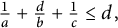

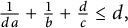



Then we have
 $\Lambda _{\unlhd }(\infty , a, b, c)\lesssim 1~~ \mbox {and}\quad \Lambda _{\unlhd }(a, \infty , b, c)\lesssim 1.$


9.2 Boundedness of
$\Lambda _{\unlhd }$
in two dimensions

Lemmas 9.3 and 9.4 provide nontrivial results available in higher dimensions. In this section, we will show that further improvements can be made in two dimensions. Before we state and prove the improvements, we collect the results in two dimensions, which can be direct consequences of Lemmas 9.3 and 9.4.
To deduce the following result, we will apply Lemma 9.3 with
 $d=2.$
Corollary 9.5 Let
 $\Lambda _{\unlhd }$
be defined on functions on
 $\mathbb F_q^2.$
Then we have
 $ \Lambda _{\unlhd }(p_1, p_2, p_3, p_4) \lesssim 1 $
provided that
 $(p_1, p_2, p_3, p_4)$
is one of the following points:
 $(\infty , \infty , \infty , \infty ),{\kern-1pt} (1, \infty , \infty , \infty ),{\kern-1pt} (\infty , 1, \infty , \infty ),{\kern-1pt} (\infty , \infty , 1, \infty ),$
 $(3/2, 3/2, \infty , \infty ),{\kern-1pt} (3/2, \infty , 3/2, \infty ), (\infty , 3/2, 3/2, \infty ).$
Proof Using the first conclusion of Lemma 9.3 with
 $d=2$
, we see that
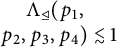 $\Lambda _{\unlhd }(p_1, p_2, p_3, p_4) \lesssim 1 $
whenever
 $(p_1, p_2, p_3, p_4)$
takes the following points:
 $(\infty , \infty , \infty , \infty ), (1, \infty , \infty , \infty ), (\infty , 1, \infty , \infty ), (3/2, 3/2, \infty , \infty ).$
Next, the second conclusion of Lemma 9.3 with
 $d=2$
implies that
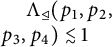 $\Lambda _{\unlhd }(p_1, p_2, p_3, p_4) \lesssim 1 $
for the points
 $(p_1, p_2, p_3, p_4)=(\infty , \infty , 1, \infty ), (3/2, \infty , 3/2, \infty ).$
Finally, it follows from the third conclusion of Lemma 9.3 with
 $d=2$
that
 $\Lambda _{\unlhd }(p_1, p_2, p_3, p_4) \lesssim 1 $
for
 $(p_1, p_2, p_3, p_4)= (\infty , 3/2, 3/2, \infty ).$
Hence, the proof is complete.
The following theorem will be proven by applying Lemma 9.4 with
 $d=2.$
Corollary 9.6 Let
 $\Lambda _{\unlhd }$
be defined on the functions on
 $\mathbb F_q^2.$
Suppose that
 $(p_1, p_2, p_3, p_4)$
is one of the following points:
 $ (\infty , \infty , \infty , 1), (2, \infty , 2, 2), (3/2, \infty , \infty , 3/2), (\infty , \infty , 3/2, 3/2).$
Then we have
 $\Lambda _{\unlhd }(p_1, p_2, p_3, p_4) \lesssim 1. $
Proof We get that
 $\Lambda _{\unlhd }(\infty , \infty , \infty , 1) \lesssim 1$
by using the assumption (ii) and the first conclusion of Lemma 9.4. Invoking the assumption (i) and the second conclusion of Lemma 9.4, one can directly note that
 $\Lambda _{\unlhd }(2, \infty , 2, 2)\lesssim 1$
and
 $\Lambda _{\unlhd }(3/2, \infty , \infty , 3/2)\lesssim 1.$
Finally, to prove that
 $\Lambda _{\unlhd } (\infty , \infty , 3/2, 3/2)\lesssim 1,$
one can use the assumption (i) and the first conclusion of Lemma 9.4.
We now introduce the connection between
 $\Lambda _{\unlhd }(f_1,f_2, f_3, f_4)$
and the bilinear averaging operator.
Proposition 9.7 Let B be the bilinear operator defined as in (4.3). Then, for any nonnegative real-valued functions
 $f_i, i=1,2,3,4,$
on
 $\mathbb F_q^2,$
we have
 $$ \begin{align*}\Lambda_{\unlhd}(f_1,f_2,f_3,f_4) = ||B(f_1, f_2)\cdot f_3 \cdot Af_4 ||_1,\end{align*} $$
where A denotes the averaging operator over the circle in
 $\mathbb F_q^2.$
Proof In two dimensions,
 $\Lambda _{\unlhd }(f_1,f_2,f_3,f_4)$
can be rewritten as the following form:
 $$ \begin{align*}\frac{1}{q^2 |S_t|^2 } \sum_{x^1, x^2, x^3, x^4\in \mathbb F_q^2} S_t(x^1-x^2) S_t(x^3-x^2) S_t(x^3-x^4) S_t(x^3-x^1) \prod_{i=1}^4 f_i(x^i).\end{align*} $$
By the change of variables by putting
 $y^1{\kern-1pt}={\kern-1pt}x^3{\kern-1pt}-{\kern-1pt}x^1, ~y^2{\kern-1pt}={\kern-1pt}x^3{\kern-1pt}-{\kern-1pt}x^2, ~ y^3{\kern-1pt}={\kern-1pt}x^3,~ y^4{\kern-1pt}={\kern-1pt}x^3-x^4,$
the value
 $\Lambda _{\unlhd }(f_1, f_2,f _3, f_4)$
becomes
 $$ \begin{align*}\frac{1}{q^2 |S_t|^2} \sum_{y^1,y^2,y^3, y^4\in \mathbb F_q^2} S_t(y^2-y^1) S_t(y^2) S_t(y^4) S_t(y^1) f_1(y^3-y^1) f_2(y^3-y^2) f_3(y^3) f_4(y^3-y^4).\end{align*} $$
This can be expressed as follows:
 $$ \begin{align*}\frac{1}{q^2} \sum_{y^3\in \mathbb F_q^2} f_3(y^3) \left(\!\frac{1}{|S_t|} \sum_{y^4\in S_t} f_4(y^3-y^4)\!\right) \left(\frac{1}{|S_t|} \sum_{y^1, y^2\in S_t: ||y^2-y^1||=t} f_1(y^3-y^1) f_2(y^3-y^2)\!\right).\end{align*} $$
Recalling the definitions of the averaging operator in (2.1) and the bilinear averaging operator in (4.3), it follows that
 $$ \begin{align*}\Lambda_{\unlhd}(f_1,f_2,f_3,f_4) = \frac{1}{q^2} \sum_{y^3\in \mathbb F_q^2} f_3(y^3) Af_4(y^3) B(f_1, f_2)(y^3).\end{align*} $$
By the definition of the normalized norm
 $||~~||_1$
, the statement follows.
For
 $1\le p_1, p_2, p_3, p_4\le \infty $
, recall that the notation
 $\Lambda _{\unlhd }(p_1, p_2, p_3, p_4) \lessapprox 1$
is used if the following estimate holds for all subsets
 $E, F, G, H$
of
 $\mathbb F_q^2$
:
 $$ \begin{align*}\Lambda_{\unlhd}(E,F,G,H) \lesssim ||E||_{p_1} ||F||_{p_2} ||G||_{p_3} ||H||_{p_4},\end{align*} $$
and this estimate is referred to as the restricted strong-type
 $\Lambda _{\unlhd }(p_1, p_2, p_3, p_4)$
estimate.
The following theorem is our main result in two dimensions, which gives a new restricted strong-type estimate for the boundedness on the operator
 $\Lambda _{\unlhd }$
.
Theorem 9.8 Let
 $\Lambda _{\unlhd }$
be defined on functions on
 $\mathbb F_q^2.$
Let
 $1\le p_3, p_4\le \infty .$
Then the following statements are valid for all subsets
 $E, F$
of
 $\mathbb F_q^2$
and all nonnegative functions
 $f_3, f_4$
on
 $\mathbb F_q^2.$
-
(i) If
$2\le p_3\le \infty , ~ 3/2 \le p_4 \le \infty ,$
and
$\frac {1}{p_3}+\frac {1}{2p_4}\le \frac {1}{2},$
then we have
$$ \begin{align*}\Lambda_{\unlhd}(E, F, f_3, f_4)\lesssim ||E||_2||F||_2 ||f_3||_{p_3} ||f_4||_{p_4}.\end{align*} $$
-
(ii) If
$2\le p_3\le \infty , ~ 4/3 \le p_4 \le 3/2,$
and
$\frac {1}{p_3}+\frac {2}{p_4}\le \frac {3}{2},$
then we have
$$ \begin{align*}\Lambda_{\unlhd}(E, F, f_3, f_4)\lesssim ||E||_2||F||_2 ||f_3||_{p_3} ||f_4||_{p_4}.\end{align*} $$






Proof Let
 $E, F$
be subsets of
 $\mathbb F_q^2$
and
 $f, g$
be nonnegative real-valued functions on
 $\mathbb F_q^2.$
By Proposition 9.7 and Hölder’s inequality, it follows that for
 $2\le p_3\le \infty ,$
 $$ \begin{align*}\Lambda_{\unlhd}(E, F, f_3, f_4) \le || B(E, F)||_2 ||f_3||_{p_3} ||Af_4||_{\frac{2p_3}{p_3-2}}.\end{align*} $$
Here, we also notice that
 $2\le \frac {2p_3}{p_3-2}\le \infty .$
Since
 $||B(E, F)||_2 \lesssim ||E||_2 ||F||_2$
by Lemma 4.6, we see that
 $$ \begin{align*}\Lambda_{\unlhd}(E, F, f_3, f_4) \le ||E||_2 ||F||_2 ||f_3||_{p_3} ||Af_4||_{\frac{2p_3}{p_3-2}}.\end{align*} $$
Hence, to complete the proof, it suffices to show that for all exponents
 $p_3, p_4$
satisfying the assumptions of the theorem, we have
 $$ \begin{align} A\left(p_4 \to \frac{2p_3}{p_3-2}\right) \lesssim 1.\end{align} $$
To prove this, we first recall from Theorem 2.3 with
 $d=2$
that
 $ A(p\to r) \lesssim 1$
for any numbers
 $1\le p, r\le \infty $
such that
 $(1/p, 1/r)$
lies on the convex hull of points
 $(0,0), (0, 1), (1,1), $
and
 $(\frac {2}{3}, \frac {1}{3} ).$
Also, invoke Lemma 2.5 to find the equations indicating the endpoint estimates for
 $A(p\to r)\lesssim 1.$
Using those averaging estimates with
 $p=p_4, r= \frac {2p_3}{p_3-2}$
, the inequality (9.4) can be obtained by a direct computation, where we also use the fact that
 $2\le r=\frac {2p_3}{p_3-2}\le \infty .$
The following corollary is a direct consequence of Theorem 9.8.
Corollary 9.9 Let
 $\Lambda _{\unlhd }$
be defined on functions on
 $\mathbb F_q^2.$
Then we have
 $ \Lambda _{\unlhd }(2,2, 2, \infty )\lessapprox 1.$
Proof The statement follows by a direct application of Theorem 9.8(i).
The lemma below shows that the exponents for
 $\Lambda _{\diamondsuit _t}(p_1, p_2, p_3, p_4)\lesssim 1$
are more restricted than those for
 $\Lambda _{\unlhd }(p_1, p_2, p_3, p_4)\lesssim 1$
up to the endpoints. This also provides a positive answer to Question 1.2 since the graph
 $K_3$
+ tail is a subgraph of the graph
 $C_4$
+ diagonal.
Lemma 9.10 Let
 $\Lambda _{\diamondsuit _t}$
and
 $\Lambda _{\unlhd }$
be the operators acting on the functions on
 $\mathbb F_q^2.$
Suppose that
 $\Lambda _{\diamondsuit _t}(p_1, p_2, p_3, p_4)\lesssim 1$
for
 $1\le p_1, p_2, p_3, p_4\le \infty .$
Then we have
 $\Lambda _{\unlhd }(p_1, p_2, p_3, p_4)\lesssim 1$
except for the point
 $(2,2,2, \infty ).$
In addition, we have
 $\Lambda _{\unlhd }(2,2, 2, \infty )\lessapprox 1.$
Proof Assume that
 $\Lambda _{\diamondsuit _t}(p_1, p_2, p_3, p_4)\lesssim 1$
for
 $1\le p_1, p_2, p_3, p_4\le \infty .$
Then, by Lemma 6.1, the point
 $(1/p_1, 1/p_2, 1/p_3, 1/p_4)$
is contained in the convex hull of the following points:
 $(0,0,1,0), (0,1,0,0), (0,0,0,1), (1/2,0,1/2,1/2), (2/3,2/3,0,0), (1,0,0,0),$
 $(2/3,0,2/3,0),{\kern-1pt} (1/2,1/2,1/2,0),{\kern-1pt} (2/3,0,0,2/3),{\kern-1pt} (0,2/3,2/3,0),{\kern-1pt} (0,0,0,0), (0,0,2/3,2/3).$
By Corollaries 9.5 and 9.6, the strong-type estimate
 $\Lambda _{\unlhd }(p_1, p_2, p_3, p_4)\lesssim 1$
holds for all the above points
 $(1/p_1, 1/p_2, 1/p_3, 1/p_4)$
except for
 $(1/2, 1/2,1/2, 0).$
Moreover, we know from Corollary 9.9 that
 $\Lambda _{\unlhd }(2,2,2, \infty )\lessapprox 1.$
Hence, the statement follows by interpolating those points.
Remark 9.11 The reverse statement of Lemma 9.10 is not true. To see this, observe from Theorem 9.8(ii) that
 $\Lambda _{\unlhd }(2,2, 6, 3/2)\lessapprox 1.$
In addition, by Lemma 6.1, notice that
 $\Lambda _{\diamondsuit _t}(2,2, 6, 3/2)$
cannot be bounded.
Corollary 9.12 Conjecture 1.5 holds up to endpoints for the graph
 $C_4$
+ diagonal and its subgraph
 $K_3$
+ tail in
 $\mathbb F_q^2.$
Proof The operators
 $\Lambda _{\diamondsuit _t}$
and
 $\Lambda _{\unlhd }$
are associated with the
 $C_4$
+ diagonal and its subgraph
 $K_3$
+ tail in
 $\mathbb F_q^2,$
respectively. Hence, invoking Lemma 9.10, the proof is reduced to showing that the
 $C_4$
+ diagonal and its subgraph
 $K_3$
+ tail satisfy the main hypothesis (1.6) of Conjecture 1.5. However, it is clear that
 $$ \begin{align*}\min\{\delta(C_4 + \mathrm{diagonal}), 2\}=2> 1=\delta(K_3 + \mathrm{tail}).\end{align*} $$
Thus, the proof is complete.
The following result shows that there exists an inclusive relation between boundedness exponents for the operators corresponding to the graphs
 $C_4$
and
 $K_3$
+ tail, although they are not subgraphs of each other.
Lemma 9.13 Let
 $\Lambda _{C_4}$
and
 $\Lambda _{\unlhd }$
be defined on functions on
 $\mathbb F_q^2$
and let
 $1\le p_1, p_2, p_3, p_4\le \infty .$
Then if
 $\Lambda _{C_4}(p_1, p_2, p_3, p_4) \lesssim 1$
, we have
 $\Lambda _{\unlhd }(p_1, p_2, p_3, p_4)\lesssim 1.$
Proof First, by Theorem 7.5, note that
 $\Lambda _{C_4}(2,2,2, \infty )$
cannot be bounded. Now suppose that
 $\Lambda _{C_4}(p_1, p_2, p_3, p_4)\lesssim 1.$
Then
 $(p_1, p_2, p_3, p_4)\ne (2,2,2,\infty ).$
Using Proposition 7.6, we get
 $\Lambda _{\diamondsuit _t}(p_1, p_2, p_3, p_4)\lesssim 1.$
Then the statement follows immediately from Lemma 9.10.
By combining Remark 9.11 and Proposition 7.6, it is clear that the reverse of Lemma 9.13 does not hold. Notice that Lemma 9.13 provides an example to satisfy Conjecture 1.5 without the hypothesis that
 $G'$
is a subgraph of the graph
 $G.$
10 Boundedness problems for the Y-shaped graph
In this section, we study the boundedness of the operator for the Y-shaped graph in Figure 1h. For
 $t\in \mathbb F_q^*,$
the Y-shaped form
 $\Lambda _{Y}$
is defined by
 $$ \begin{align} \Lambda_{Y}(f_1, f_2, f_3, f_4)= \frac{1}{q^d |S_t|^3}\sum_{x^1, x^2, x^3, x^4\in \mathbb F_q^d} S_t(x^3-x^1) S_t(x^3-x^2) S_t(x^3-x^4) \prod_{i=1}^4 f_i(x^i),\end{align} $$
where functions
 $f_i, i=1,2,3, 4,$
are defined on
 $\mathbb F_q^d.$
Note that this operator
 $\Lambda _{Y}$
is related to the Y-shaped graph, and so the normalizing factor
 $\mathcal {N}(G)$
in (1.4) can be taken as
 $q^d |S_t|^3.$
We aim to find all numbers
 $1\le p_1, p_2, p_3, p_4 \le \infty $
such that
 $ \Lambda _{Y}(p_1, p_2, p_3, p_4) \lesssim 1.$
Lemma 10.1 (Necessary conditions for the boundedness of
$\Lambda _{Y}(p_1, p_2, p_3, p_4)$
)

Let
 $1\le p_i \le \infty , 1\le i\le 4.$
Suppose that
 $\Lambda _{Y}(p_1, p_2, p_3, p_4) \lesssim 1.$
Then all the following inequalities are satisfied:
 $ \frac {1}{p_1} +\frac {1}{p_2}+\frac {d}{p_3}+\frac {1}{p_4} \le d,$
 $ \frac {d}{p_1} +\frac {d}{p_2}+\frac {1}{p_3}+\frac {d}{p_4} \le 3d-2,$
 $\frac {d}{p_1} +\frac {d}{p_2}+\frac {1}{p_3}\le 2d-1,$
 $\frac {d}{p_1} +\frac {1}{p_3}+\frac {d}{p_4}\le 2d-1,$
 $\frac {d}{p_2} +\frac {1}{p_3}+\frac {d}{p_4}\le 2d-1,$
 $\frac {d}{p_1} +\frac {1}{p_3}\le d,$
 $\frac {d}{p_2} +\frac {1}{p_3}\le d, $
 $\frac {1}{p_3} +\frac {d}{p_4}\le d.$
In particular, if
 $d=2$
, then it can be shown by Polymake [Reference Assarf, Gawrilow, Herr, Joswig, Lorenz, Paffenholz and Rehn1, Reference Gawrilow and Joswig6] that
 $(1/p_1, 1/p_2, 1/p_3, 1/p_4)$
is contained in the convex hull of the points:
 $(0,0,1,0), (1,0,0,1/2), (1, 0, 1/2, 0),\ \ (1/2, 1, 0, 1/2),\ \ (1, 1/2, 0, 1/2),\ \ (1/2, 1/2, 0, 1),\ \ (1, 0, 1/3, 1/3), (1/2, 5/6, 1/3, 0), (1,1/2, 0, 0), (1/2, 0, 1/3, 5/6),$
 $(1/2,1,0,0),\ \ (1, 1/3, 1/3,0),\ \ (1/2, 0,0,1),\ \ (1,0, 0,0), (0,0,0,0), (0, 0, 0, 1), (0, 1, 0, 0), (0, 0, 2/3, 2/3), (0, 5/6, 1/3, 1/2), (0, 1, 0, 1/2), (0,1/2, 1/3, 5/6), (0, 1/2, 0, 1), (0,2/3,2/3,0).$
Proof By a direct computation, the conclusions of the lemma easily follow by testing the inequality
 $$ \begin{align*}\Lambda_{Y}(f_1,f_2, f_3, f_4) \le \Lambda_{Y}(p_1, p_2, p_3, p_4) ||f_1||_{p_1} ||f_2||_{p_2} ||f_3||_{p_3} ||f_4||_{p_4},\end{align*} $$
with the following specific functions, respectively:

10.1 Sufficient conditions for the boundedness of
$\Lambda _{Y}$
on
$\mathbb F_q^d$


It is not hard to observe that the boundedness problem for the Y-shaped form can be reduced to the spherical averaging estimate. Indeed, the value
 $\Lambda _{Y}(f_1,f_2, f_3, f_4)$
in (10.1) can be written by
 $$ \begin{align*}\Lambda_{Y}(f_1,f_2, f_3, f_4)=\frac{1}{q^d} \sum_{x^3\in \mathbb F_q^d} f_3(x^3) \prod_{i=1,2, 4}\left(\frac{1}{|S_t|} \sum_{x^i\in \mathbb F_q^d} S_t(x^3-x^i) f_i(x^i)\right).\end{align*} $$
Invoking the definition of the averaging operator
 $A=A_{S_t}$
in (2.2), we get
 $$ \begin{align*}\Lambda_{Y}(f_1, f_2, f_3, f_4)= \frac{1}{q^d} \sum_{x^3\in \mathbb F_q^d} f_3(x^3) Af_1 (x^3) Af_2(x^3) Af_4(x^4) =|| Af_1 \cdot Af_2 \cdot f_3\cdot Af_4||_1.\end{align*} $$
By Hőlder’s inequality and the nesting property of the norm
 $||\cdot ||_p,$
we get
 $$ \begin{align} \Lambda_{Y}(f_1, f_2, f_3, f_4) \le ||Af_1||_{r_1} ||Af_2||_{r_2} ||f||_{p_3} ||Af_4||_{r_4} \quad\mbox{if}\quad \frac{1}{r_1}+\frac{1}{r_2} + \frac{1}{p_3}+ \frac{1}{r_4} \le 1. \end{align} $$
Proposition 10.2 Let
 $1\le p_1, p_2, p_3, p_4, r_1, r_2, r_4 \le \infty $
be extended real numbers which satisfy the following assumptions:
 $\frac {1}{r_1}+\frac {1}{r_2} + \frac {1}{p_3}+ \frac {1}{r_4} \le 1$
and
 $A(p_i\to r_i)\lesssim 1 $
for all
 $i=1,2, 4.$
Then we have
 $$ \begin{align*}\Lambda_{Y}(p_1, p_2, p_3, p_4)\lesssim 1.\end{align*} $$
Proof By combining the inequality (10.2) with our assumptions on the averaging estimates, it follows that for all functions
 $f_i, i=1,2,3, 4,$
on
 $\mathbb F_q^d,$
 $$ \begin{align*}\Lambda_{Y}(f_1,f_2,f_3, f_4) \lesssim ||f_1||_{p_1} ||f_2||_{p_2} ||f_3||_{p_3} ||f_4||_{p_4}.\end{align*} $$
This completes the proof.
The following result provides lots of sufficient conditions for the boundedness of the Y-shaped form.
Proposition 10.3 Let
 $1\le p_1,p_2, p_3, p_4\le \infty ,$
and let
 $\Lambda _{Y}$
be the Y-shaped form on
 $\mathbb F_q^d.$
Then
 $\Lambda _{Y}(p_1, p_2, p_3, p_4)\lesssim 1$
provided that one of the following conditions is satisfied:
-
(i)
$0\le \frac {1}{p_1}, \frac {1}{p_2}, \frac {1}{p_4}\le \frac {d}{d+1}$
and
$ \frac {1}{p_1}+\frac {1}{p_2}+\frac {d}{p_3}+\frac {1}{p_4} \le d.$
-
(ii)
$0\le \frac {1}{p_1}, \frac {1}{p_2} \le \frac {d}{d+1} \le \frac {1}{p_4}$
and
$ \frac {1}{dp_1}+\frac {1}{dp_2}+\frac {1}{p_3}+\frac {d}{p_4} \le d.$
-
(iii)
$0\le \frac {1}{p_1}, \frac {1}{p_4}\le \frac {d}{d+1} \le \frac {1}{p_2}\le 1$
and
$ \frac {1}{dp_1}+\frac {d}{p_2}+\frac {1}{p_3}+\frac {1}{dp_4} \le d.$
-
(iv)
$0\le \frac {1}{p_2}, \frac {1}{p_4} \le \frac {d}{d+1} \le \frac {1}{p_1} \le 1$
and
$ \frac {d}{p_1}+\frac {1}{dp_2}+\frac {1}{p_3}+\frac {1}{dp_4} \le d.$
-
(v)
$0\le \frac {1}{p_1}\le \frac {d}{d+1} \le \frac {1}{p_2}, \frac {1}{p_4}\le 1$
and
$\frac {1}{dp_1}+\frac {d}{p_2}+\frac {1}{p_3}+\frac {d}{p_4} \le 2d-1.$
-
(vi)
$0\le \frac {1}{p_2}\le \frac {d}{d+1} \le \frac {1}{p_1},\frac {1}{p_4}\le 1$
and
$ \frac {d}{p_1}+\frac {1}{dp_2}+\frac {1}{p_3}+\frac {d}{p_4} \le 2d-1.$
-
(vii)
$0\le \frac {1}{p_4}\le \frac {d}{d+1}\le \frac {1}{p_1}, \frac {1}{p_2} \le 1$
and
$ \frac {d}{p_1}+\frac {d}{p_2}+\frac {1}{p_3}+\frac {1}{dp_4} \le 2d-1.$
-
(viii)
$\frac {d}{d+1}\le \frac {1}{p_1}, \frac {1}{p_2}, \frac {1}{p_4}\le 1$
and
$ \frac {d}{p_1}+\frac {d}{p_2}+\frac {1}{p_3}+\frac {d}{p_4} \le 3d-2.$













Proof The proof uses Proposition 10.2 and the sharp averaging estimates in Lemma 2.5. The proof of this theorem is similar to that of Theorem 5.3. Therefore, we leave the detail of the proof to readers.
Conjecture 1.5 is also supported by the following theorem.
Theorem 10.4 Let
 $\Lambda _{{\diamondsuit }_t}$
and
 $\Lambda _{Y}$
be the operators acting on the functions on
 $\mathbb F_q^2.$
If
 $\Lambda _{{\diamondsuit }_t}(p_1, p_2, p_3, p_4)\lesssim 1$
with
 $1\le p_1, p_2, p_3, p_4\le \infty ,$
then
 $\Lambda _{Y}(p_1, p_2, p_3, p_4)\lesssim 1.$
Proof Assume that
 $\Lambda _{{\diamondsuit }_t}(p_1, p_2, p_3, p_4)\lesssim 1.$
Then, by Lemma 6.1,
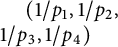 $(1/p_1, 1/p_2, 1/p_3, 1/p_4)$
is contained in the convex hull of the points
 $(0,0,1,0), (0,1,0,0), (0,0,0,1),\ \ (1/2,0,1/2,1/2),\ \ (2/3,2/3,0,0),\ \ (1,0,0,0),\ \ (2/3,0,2/3,0),\ \ (1/2,1/2, 1/2,0), (2/3,0,0,2/3), (0,2/3,2/3,0), (0,0,0,0), (0,0,2/3,2/3).$
By interpolating those critical points, it suffices to check that each critical point above satisfies one of the eight hypotheses of Proposition 10.3 with
 $d=2$
. However, this can be easily shown by a direct computation. For example, for the critical point
 $(1/p_1, 1/p_2, 1/p_3, 1/p_4)=(1/2,1/2,1/2,0)$
, we can invoke the hypothesis (i) of Proposition 10.3 with
 $d=2$
and obtain that
 $\Lambda _{Y}(2,2,2,\infty )\lesssim 1.$
In the same way, it can be easily proven for other critical points.
Remark 10.5 The reverse statement of Theorem 10.4 is not true. To find a counterexample, we can take
 $p_1=p_3=\infty $
,
 $p_2=p_4=3/2.$
Indeed, by the hypothesis (5) of Proposition 10.3 with
 $d=2$
, we see that
 $\Lambda _{Y}(\infty , 3/2,\infty , 3/2) \lesssim 1.$
However,
 $\Lambda _{{\diamondsuit }_t}(\infty , 3/2,\infty , 3/2)$
is not bounded, which follows from Lemma 6.1 with
 $d=2.$
The following corollary proposes some possibility that the assumption of the subgraph in Conjecture 1.5 can be dropped.
Corollary 10.6 Let
 $\Lambda _{C_4}$
and
 $\Lambda _{Y}$
be the operators acting on the functions on
 $\mathbb F_q^2.$
If
 $\Lambda _{C_4}(p_1, p_2, p_3, p_4)\lesssim 1$
with
 $1\le p_1, p_2, p_3, p_4\le \infty ,$
then
 $\Lambda _{Y}(p_1, p_2, p_3, p_4)\lesssim 1.$
Proof The statement of the corollary follows immediately by combining Proposition 7.6 and Theorem 10.4.
Combining all the results obtained so far, we get the following theorem:
Theorem 10.7 When
 $d=2$
and
 $n=3, 4$
, Conjecture 1.5 is true, where we accept boundedness results up to endpoints in the case when G is the
 $C_4$
+ diagonal and its subgraph
 $G'$
is the
 $K_3 + tail.$
Proof By Corollary 5.7 for
 $n=3,$
and by Corollaries 8.10, 8.13, 9.12, and 10.6 for
 $n=4,$
we have proven that for
 $d=2$
and
 $n = 3,4,$
there is the required inclusive boundedness relationship between any two operators corresponding to arbitrary connected ordered graph G and its subgraph
 $G'$
except for the following three cases:
-
(I)
$G=C_4$
+ diagonal and
$G'=C_4.$
-
(II)
$K_3$
+ tail and
$G'=Y$
-shape. -
(III)
$G=K_3$
+ tail and
$G'=P_3.$


However, since
 $\delta (G)=\delta (G')$
for each case of (I), (II), and (III), they do not satisfy the main hypothesis (1.6) of Conjecture 1.5. Hence, they cannot be counterexamples contradicting Conjecture 1.5 and so there is no counterexample against Conjecture 1.5, as required.
Acknowledgments
A. Iosevich, D. Koh, and T. Pham would like to thank the VIASM for the hospitality and for the excellent working conditions.
A Appendix
In this appendix, we introduce the number of intersection points of two spheres in
 $\mathbb F_q^d.$
Let
 $\eta $
denote the quadratic character of
 $\mathbb F_q^*$
, namely,
 $\eta (s)=1$
for a square number s in
 $\mathbb F_q^*$
, and
 $\eta (s)=-1$
otherwise.
Definition A.1 Given a nonzero vector m in
 $\mathbb F_q^d, $
and
 $t, b\in \mathbb F_q,$
we define
 $N(m,t,b)$
to be the number of common solutions
 $x\in \mathbb F_q^d$
of the following equations:
 $||x||=t, ~~ m\cdot x=b.$
Notice that the value of
 $N(m,t,b)$
is the number of all intersection points between the sphere
 $S_t$
and the plane
 $\{x\in \mathbb F_q^d: m\cdot x=b\}.$
The explicit value of it is well known as follows.
Lemma A.2 Let
 $b, t\in \mathbb F_q,$
and let m be a nonzero element in
 $\mathbb F_q^d, d\ge 2.$
Then the following statements hold:
-
(i) If
$||m||\ne 0$
and
$ b^2-t||m||=0,$
then
$$ \begin{align*}N(m, t,b)= \left\{\begin{array}{ll} q^{d-2}, \quad &\mbox{if} ~~ d~\mbox{is even,}\\ q^{d-2}+ q^{\frac{d-3}{2}} (q-1) \eta\left((-1)^{\frac{d-1}{2}} ||m||\right), &\mbox{if} ~~ d~\mbox{is odd}.\end{array} \right.\end{align*} $$
-
(ii) If
$||m||\ne 0$
and
$ b^2-t||m||\ne 0,$
then
$$ \begin{align*}N(m, t,b)= \left\{\begin{array}{ll} q^{d-2}+q^{\frac{d-2}{2}}\eta\left((-1)^{\frac{d}{2}} (b^2-t||m||)\right), \quad &\mbox{if} ~~ d~\mbox{is even,}\\ q^{d-2}- q^{\frac{d-3}{2}} \eta\left((-1)^{\frac{d-1}{2}} ||m||\right), &\mbox{if} ~~ d~\mbox{is odd}.\end{array} \right.\end{align*} $$
-
(iii) If
$||m||=0= b^2-t||m||,$
then where
$$ \begin{align*}N(m, t,b)= \left\{\begin{array}{ll} q^{d-2}+ \nu(t) q^{\frac{d-2}{2}}\eta\left((-1)^{\frac{d}{2}})\right), \quad &\mbox{if} ~~ d~\mbox{is even,}\\ q^{d-2}- q^{\frac{d-1}{2}} \eta\left((-1)^{\frac{d-1}{2}} t\right), &\mbox{if} ~~ d~\mbox{is odd},\end{array} \right.\end{align*} $$
$\nu (t)=-1$
if
$t\in \mathbb F_q^*$
and
$\nu (0)=q-1.$
-
(iv) If
$||m||= 0$
and
$ b^2-t||m||\ne 0,$
then
$ N(m, t,b)= q^{d-2}.$


Proof See Exercises 6.31–6.34 in [Reference Lidl and Niederreiter14], or one can prove it by using the discrete Fourier analysis with the explicit value of the Gauss sum.
By a direct application of Lemma A.2, one can find the explicit number of the intersections of two spheres over finite fields. Precisely, we have the following result.
Theorem A.3 Given a nonzero vector
 $m\in \mathbb F_q^d$
and
 $ t, j\in \mathbb F_q,$
let
 $$ \begin{align*}\Theta(m, t, j):=\{x\in S_t: ||x-m||=j\}|.\end{align*} $$
If
 $m\in S_\ell , $
then
 $|\Theta (m, t, j)|=N\left (m, t, \frac {t+\ell -j}{2}\right ).$
Proof Since
 $||x-m||=t+\ell -2m\cdot x$
for
 $x\in S_t, m\in S_\ell ,$
it is clear that
 $\Theta (m, t, j)$
is the number of common solutions x of the following equations:
 $$ \begin{align*}||x||=t, \quad m\cdot x=\frac{t+\ell-j}{2}.\end{align*} $$
Hence, by the definition of N, we obtain the required conclusion.
Corollary A.4 Let
 $t\in \mathbb F_q^*$
and
 $ \ell \in \mathbb F_q.$
Then, for every nonzero vector
 $m\in S_\ell ,$
we have
 $$ \begin{align*}\sum_{x\in S_t: ||x-m||=t} 1 \sim q^{d-2}\end{align*} $$
excepting for the following three cases:

For each of those three cases, the value in the above sum takes zero. On the other hand, if
 $d=2, \ell \ne 0, $
and
 $\eta (t\ell -\ell ^2/4)=1$
, the value in the above sum is exactly two.