INTRODUCTION
Within the scientific literature and popular culture, there is a belief that a person’s hand preference is related to a range of psychological attributes including cognitive ability and personality (for an extensive review, see, McManus, Reference McManus2002). How hand preference interacts with cognitive ability is the subject of current debate (e.g., Corballis, Hattie, & Fletcher, Reference Corballis, Hattie and Fletcher2008). One possibility is that left- or mixed-hand preference reflects a shift in the normal pattern of left hemisphere dominance for language (Duffau, Leroy, & Gatignol, Reference Duffau, Leroy and Gatignol2008) and hand control (Jung, Baumgärtner, Magerl, & Treede, Reference Jung, Baumgärtner, Magerl and Treede2008). The change in functional localization for these activities has a knock-on effect whereby the localization and interaction between other activities is affected. This re-organization could have beneficial effects, which encourage a unique interplay between brain regions and cognitive functions – leading to enhanced brain function (Benbow, Reference Benbow1986). Alternatively, the effects could be deleterious. In this case, the movement of cognitive functions may cause them to compete for the same neural space – leading to “cognitive crowding” and reduced cognitive ability (Lidzba, Staudt, Wilke, & Krägeloh-Mann, Reference Lidzba, Staudt, Wilke and Krägeloh-Mann2006).
Research linking handedness and cognitive function has returned mixed results. One line of research proposes that at least some left-handers have a cognitive advantage over right-handers. Benbow (Reference Benbow1986) reported an excess of left-handers among gifted children. Similarly, Halpern, Haviland, and Killian (Reference Halpern, Havilland and Killian1998) examined the medical college admission scores for approximately 150,000 adults. They found that left-handers were over-represented among the upper tail on cognitive ability tests, such as verbal reasoning. In contrast, Piro (Reference Piro1998) found no difference in the proportion of left- and right-handers between 657 gifted and nongifted children. It is possible that giftedness may relate to some quite specific abilities – particularly spatial abilities lateralized to the right cerebral hemisphere. Thus, there are frequent reports that left-handers are over-represented among creative artists (Preti & Vellante, Reference Preti and Vellante2007), architects (Peterson & Lansky, Reference Peterson and Lansky1977), and mathematicians (Annett & Kilshaw, Reference Annett and Kilshaw1982). Once again, however, the evidence for this proposition is mixed and some researchers have reported that left-handers do no better on tests of spatial ability (McKeever, Reference McKeever1986; Snyder & Harris, Reference Snyder and Harris1993) and that left-handers are not overrepresented among architects (Wood & Aggleton, Reference Wood and Aggleton1991) or gifted mathematicians (Peters, Reference Peters1991).
If left-handers, or a sub-group of them, are at a cognitive advantage relative to right-handers, it may provide an insight into how and why left-handers exist. McManus (Reference McManus1985) has proposed that handedness is determined by one gene with two alleles. The allele “D” specifies dextrality and “C” specifies chance. Individuals who are homozygous for the C allele are more likely to be left-handed, whereas individuals homozygous for the D allele are more likely to be right-handed (see Corballis, Reference Corballis1997, for a review of genetic theories of handedness). In order for the C allele to persist, and for left-handers to continue as a minority, McManus (Reference McManus2002) argues that at least some left-handers must be at a cognitive advantage compared with individuals with a right- or mixed-hand preference.
Another line of research suggests that left-handedness is maintained in the population because of a heterozygous advantage. Early versions of Annett’s (Reference Annett1983) model propose that hand preference is controlled by one gene with two alleles. One is dominant (RS+) and selects for right-handedness. The other allele is recessive (RS−) and allows for handedness to be selected according to chance (i.e., producing an equal number of left and right handers). More recent versions of the model (Annett, Reference Annett1985) propose that the RS gene operates additively rather than in a dominant-recessive manner. As a result, even though an individual may inherit the RS+ allele, it is still possible that they will be left-handed (see Corballis, Reference Corballis1997 for a review).
Annett argues that the RS− allele persists because it bestows a heterozygous advantage. Thus, individuals who inherit both RS+ and RS− alleles will be moderately right-handed in most cases (Li, Zhu, & Nuttall, Reference Li, Zhu and Nuttall2003) and have a normal pattern of cerebral lateralization and general cognitive profile (Annett, Reference Annett1985). In contrast, individuals who are homozygous for the RS− allele (50% left-handed, 50% right-handed) or the RS+ allele (strongly right-handed in most cases) will be at a cognitive disadvantage. While heterozygotes are thought to have a normal cognitive profile, the disadvantage for individuals homozygous for RS+ and RS− may be specific to spatial and language abilities, respectively. These specific disadvantages are thought to stem from an altered pattern of hemispheric dominance, which causes cognitive functions to localize to sub-optimal regions of the brain (Lidzba et al., Reference Lidzba, Staudt, Wilke and Krägeloh-Mann2006).
To test the heterozygous advantage model, Annett (Reference Annett1992) gave the paper folding and Rey-Osterreith tests of spatial ability to two groups of students (n = 459 & n = 428, respectively). From the data, Annett concluded there was a cognitive advantage for individuals who were moderately right-handed (though see Cerone & McKeever, Reference Cerone and McKeever1999, for a discussion of the problems of categorization of hand preference and interpretation of the results). McManus, Shergill, and Bryden (Reference McManus, Shergill and Bryden1993), however, failed to support Annett’s model. They screened 431 medical students and tested 45 students with differing degrees of right-handedness, measured using the Tapley and Bryden (Reference Tapley and Bryden1985) pencil tapping test. By avoiding what they considered to be arbitrary distinctions between hand performance categories, they found no evidence of a heterozygous advantage for a broad range of cognitive abilities. Similarly, Cerone and McKeever (Reference Cerone and McKeever1999) measured handedness using the Annett Handedness Inventory (Annett, Reference Annett1970) and the peg-board task. Using 259 dextrals, no association was observed between the strength of dextrality and performance on tests of spatial and verbal ability. Negative results have also been reported by Palmer and Corballis (Reference Palmer and Corballis1996) for a group of 345 school children and by Resch, Haffner, Parzer, Pfueller, Strethlow, and Zerahn-Hartung (Reference Resch, Haffner, Parzer, Pfueller, Strehlow and Zerahn-Hartung1997) for 545 young adults.
Another model suggests that left-handedness is associated with a general deficit in cognitive ability. One possible cause of this decline is that left-handedness is acquired due to brain damage—particularly to the left cerebral hemisphere pre- or peri-natally (Satz, Orsini, Saslow, & Henry, Reference Satz, Orsini, Saslow and Henry1985). Thus, both left-handedness and reduced cognitive ability are the result of some form of brain insult. This brain damage is unlikely to account for all left-handers, though it may afflict some proportion. In support of the pathological model, an elevated incidence of left-handedness has been reported in people who suffered severe bacterial meningitis early in life (Ramadhani, Koomen, Grobbee, van Donselaar, van Furth, & Uiterwaal, Reference Ramadhani, Koomen, Grobbee, van Donselaar, van Furth and Uiterwaal2006) or females with early brain insult (Miller, Jayadev, Dodrill, & Ojemann, Reference Miller, Jayadev, Dodrill and Ojemann2005). Using a group of 545 young adults, lower levels of cognitive achievement have been reported by Resch et al. (Reference Resch, Haffner, Parzer, Pfueller, Strehlow and Zerahn-Hartung1997) for left-handers whereby their spelling, educational success and nonverbal intelligence scores were lower compared with their non–left-handed counterparts. Lower levels of achievement for left-handers has also been reported by Johnston, Nicholls, Shah, and Shields (Reference Johnston, Nicholls, Shah and Shields2009) for a sample of 4942 Australian children aged between 4 and 5 years. Left-handed children were found to perform worse on a broad range of tests measuring vocabulary, reading, writing, social development and gross and fine motor skills. The differences between left- and right-handers could not be attributed to differences between the groups in any of the social/economic measures that were also taken.
So far, all of the theories relating handedness to cognitive ability have focused on differences between left- and right-handedness. Another class of theory focuses on the strength of handedness, rather than the direction. While the idea that weak lateralization is associated with learning difficulties has a long history (Orton, Reference Orton1937), the theory has received more recent support. Crow, Crow, Done, and Leask (Reference Crow, Crow, Done and Leask1998) used a sample of 12,770 people from the National Child Development Study in the UK. A measure of relative hand performance was gained using a square-checking task in which participants checked as many squares as possible within one minute with their left and right hands. A broad range of academic abilities was measured including verbal ability, nonverbal ability, reading comprehension and mathematical ability. Crow et al. (Reference Crow, Crow, Done and Leask1998) observed a modest drop in academic ability for people with extreme left- or right-hand performance asymmetries, which is line with the Annett hypothesis (1992). A more pronounced decrement across a broad range of academic abilities was observed, however, for individuals with symmetrical hand performance scores. In light of this result, Crow et al. (Reference Crow, Crow, Done and Leask1998) went on to argue that hand preference, and by implication hemispheric dominance, were the key foundation for the evolution of language and higher cognitive functions in humans. Individuals without lateralization are, therefore, likely to suffer from “hemispheric indecision,” which reduces academic ability and renders the individual more prone to psychotic disorders.
While some researchers have failed to find reduced levels of cognitive ability for mixed-handers (Heinz & Heinz, Reference Heinz and Heinz2002), several large scale studies have reported an effect. As part of a television program, Corballis et al. (Reference Corballis, Hattie and Fletcher2008) recorded the hand preference and IQ for 1355 individuals. Participants indicated whether they wrote with their left, right, or either hand. Individuals who indicated that they wrote with either hand performed worse than left- and right-handers on a range of tests, including arithmetic, memory, and reasoning. The study by Johnston et al. (Reference Johnston, Nicholls, Shah and Shields2009) reported that left-handed children performed worse on a range of academic achievement tests compared with their right-handed counterparts. In addition to this finding, they also found that children who had no preference for writing hand performed worse on tests of academic ability that both the left- and right-handed children. A final large-scale study by Peters, Reimers, and Manning (Reference Peters, Reimers and Manning2006) collected data from 255,100 individuals via the Internet. Individuals were asked which hand they used to write and responded along a 5-point scale (left, mostly left, either hand, mostly right, and right). Individuals who responded “either hand” had significantly lower spatial ability, a higher prevalence of dyslexia, hyperactivity and asthma than individuals with a strong hand preference to either the left or right.
The current study will investigate the relationship between cognitive ability and handedness using data contained in the Brain Resource International Database (Gordon, Reference Gordon2003; Gordon, Cooper, Rennie, Hermens, & Williams, Reference Gordon, Cooper, Rennie, Hermens and Williams2005). This database gives us access to data collected from approximately 1000 individuals and, therefore, follows the precedent set by other recent large studies (e.g., Corballis et al., Reference Corballis, Hattie and Fletcher2008; Johnston et al., Reference Johnston, Nicholls, Shah and Shields2009; Peters et al., Reference Peters, Reimers and Manning2006). The size of the database will provide the power to analyze differences in hand preference without the need to categorize individuals as left-, right-, or mixed-handed. While these categories increase the statistical power of an experiment, the sometimes arbitrary nature of the categories has been identified as a problem with previous research (Cerone & McKeever, Reference Cerone and McKeever1999; McManus et al., Reference McManus, Shergill and Bryden1993). In addition to its size, the database has several unique features, which will allow us to investigate the link between handedness and cognitive ability more thoroughly. First, many recent large-scale studies (e.g., Corballis et al., Reference Corballis, Hattie and Fletcher2008; Johnston et al., Reference Johnston, Nicholls, Shah and Shields2009; Peters et al., Reference Peters, Reimers and Manning2006) have assessed hand preference by simply asking about writing hand, without assessing hand preference for other activities (but cf Crow et al., Reference Crow, Crow, Done and Leask1998). In addition, hand preference is often categorical (left, either, or right) or is rated along a 5-point scale. The current study measured hand preference with the Annett Handedness Questionnaire (Annett, Reference Annett1970). This scale assesses a range of activities and provides a score, which ranges from −12 (very left-handed) to +12 (very right-handed). Data from the Annett Questionnaire will permit a more fine-grained analysis of the effect of hand preference on cognitive ability, allowing us to investigate differences between individuals with no hand preference compared with individuals with moderate and strong hand preferences.
In addition to hand preference, asymmetries in hand performance were also assessed. Unlike tests of hand preference, which are bimodally distributed, hand performance measures often show a right-shifted unimodal distribution – particularly for motor tapping tasks (Peters & Durding, Reference Peters and Durding1978). While asymmetries in hand performance, such as motor tapping, are related to asymmetries in preference (r = .469; Peters & Durding, Reference Peters and Durding1978), they also provide an important additional insight into handedness. Thus, although a large number of people may respond ‘right to all 12 questions in the Annett Questionnaire, they may vary considerably in the degree of right-hand advantage they show for tapping. For this reason, hand performance has been used before in tests of Annett’s (Reference Annett1992) theory (Cerone & McKeever; Reference Cerone and McKeever1999; McManus et al., Reference McManus, Shergill and Bryden1993) and is thought to provide a particularly important test of the theory (Annett, Reference Annett1992). In the present study, hand performance asymmetries were assessed by measuring the number of taps produced by the left or right hand in a 30-s period.
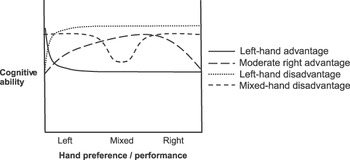
Cognitive ability was assessed using the Brain Resource Cognition battery, which assesses a broad range of cognitive skills (see the Method section for details) and which provides an index of cognitive intelligence (Kemp, Cooper, Hermens, Gordon, Bryant, & Williams, Reference Kemp, Cooper, Hermens, Gordon, Bryant and Williams2005). While some studies have focused on specific cognitive abilities, such a spatial or verbal ability, the current study will concentrate on general cognitive performance. All of the theories, which relate cognitive ability to hand preference, make predictions in relation to general cognitive ability (GCA). An impression of the predictions made by these theories is shown in Figure 1. For the left-hand advantage model, advantages have been reported for spatial-type skills (e.g., Benbow, Reference Benbow1986) and for verbal reasoning (Halpern et al., Reference Halpern, Havilland and Killian1998). If this is correct, GCA scores should be enhanced for left-handers (continuous line in Figure 1). The heterozygous advantage model proposed by Annett (Reference Annett1985) suggests that general cognitive performance will be highest for individuals with a moderate degree of right-handedness relative to individuals with strong left- or right-handedness (long dashes in Figure 1). The left-hand disadvantage observed by Johnston et al. (Reference Johnston, Nicholls, Shah and Shields2009) and others is represented by the dotted line showing a decline in performance at the left-hand extreme. Finally, the model of hemispheric indecision proposed by Crow et al. (Reference Crow, Crow, Done and Leask1998) is represented by the short dashes showing a dip in cognitive ability for individuals with a mixed hand preference. It is important to note that the models are not mutually exclusive and that more than one might be in operation. To analyze the relationship between handedness and cognitive ability, regression, and curve-fitting techniques were used while controlling for effects of age and sex.
Graph representing the relative cognitive advantages and disadvantages for left- and right-handers predicted by the different models.

METHOD
Participants
The sample used in the current study was drawn from the Brain Resource International Database (Gordon, Reference Gordon2003; Gordon et al., Reference Gordon, Cooper, Rennie, Hermens and Williams2005). The research was carried out with ethical approval from the Human Research Ethics Committee at the University of Technology, Sydney. The database contains a census-matched representative sample of healthy individuals drawn from a broad cross-section of the community. Exclusion criteria include head injury, history of psychiatric illness, neurological disorders, and a history of substance abuse.
The sub-sample used in the current study was selected according to two criteria. First, to reduce the effect of large age-range effects on measures of cognitive ability, the sample only included individuals aged between 17 and 50 years, with a mean age of 29.7 years. Because the GCA scores are comprised of a set of tests, and are standardized, some scores can be very low (see below for more details). To remove the effect of very low scores, individuals with scores below 50 were removed from the sample. This left 895 individuals (f = 450; m = 445) with a mean age of 29.5 years. The exclusion of individuals with very low scores did not affect the general pattern of results.
Hand Preference & Performance
Hand preference was assessed using the Annett Handedness Questionnaire (Annett, Reference Annett1970). The inventory contains 12 questions, which ask about hand preference for a range of everyday activities. Scores range from −12 (completely left-handed) to +12 (completely right-handed) in increments of one unit. Hand performance was measured by requiring participants to tap a circle on a touch-screen with their index finger as fast as possible for 30 seconds using either their left or right hands. Hand performance asymmetry was calculated with the index (R − L/R + L), which yields values that potentially vary between −1 and +1.
General Cognitive Ability
The “Brain Resource Cognition” battery comprises several components, including Sensory motor skills (motor tapping and choice reaction time), attention (digit span, continuous performance task, span of visual memory, and trail making), executive function (verbal interference, switching of attention, and maze tasks), language ability (letter and animal fluency), and memory (verbal list learning). For more details about the cognitive battery, including the testing regime, norms, reliability, and validity, see Gordon (Reference Gordon2003), Gordon et al. (Reference Gordon, Cooper, Rennie, Hermens and Williams2005), Kemp, Hatch, and Williams (Reference Kemp, Hatch and Williams2009), and Williams, Simms, Clark, Paul, Rowe, and Gordon (Reference Williams, Simms, Clark, Paul, Rowe and Gordon2005). The individual test scores of the battery were reduced for each participant into a single measure “g,” or CGA. This measure was obtained by using a principle component analysis procedure using the first un-rotated component. For a detailed description of the principle component analysis and the factor structure of the GCA measure obtained from the Brain Resources Cognition Battery, see Rowe, Cooper, Liddel, Clark, Gordon, and Williams (Reference Rowe, Cooper, Liddell, Clark, Gordon and Williams2007). The mean and SD of GCA was adjusted so that it roughly approximates the distribution of IQ. The measure of CGA correlates .785 with the full scale WAIS-R (Brain Resource International Database, personal communication) and is thus thought to provide a useful approximation of cognitive intelligence (Kemp et al., Reference Kemp, Cooper, Hermens, Gordon, Bryant and Williams2005).
RESULTS
An initial exploration of the variables of interest revealed some participants with extreme scores on the hand performance measure. The actual observed range was −.90 to +.91. Values of +.90 indicate that a participant made 9 times more taps with one hand than the other. Because such an asymmetrical rate seems likely to reflect a problem with the testing procedure, or some physiological impairment, individuals with tapping asymmetry scores that were more than 3 SD from the mean were eliminated as outliers. This eliminated 70 individuals. These individuals had a similar handedness distribution to the rest of the sample.
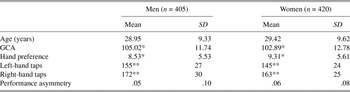
Age, sex, hand preference, hand performance, and GCA scores were tabulated for the remaining 825 participants, and are presented in Table 1. Sex differences were observed in some variables, with men having higher GCA, t(823) = 2.487; p = .013, and a less rightward hand preference, t(823) = 1.99, p = .046, than women. Men also made more taps with both the left, t(823) = 5.499; p < .001, and right hands, t(823) = 5.053; p < .001, but men and women did not differ in hand performance asymmetry. Examination of zero-order correlations among variables (see Table 2) indicated that age was highly correlated with GCA. Therefore, the relationship between handedness and GCA was assessed using multiple regression procedures. Age and sex (dummy coded) were entered in the first step, to control for their predictive relationship with GCA. In the second step, the handedness measure and the square of the handedness measure were entered simultaneously, to assess both linear and quadratic contributions to the prediction of GCA. Separate regressions were calculated for hand preference and hand performance.
Demographic and performance measures for men and women

Note
Sex differences are marked: *p < .05, **p < .001. GCA = general cognitive ability.
Zero-order correlations among predictor and outcome variables

Note
*p < .05, **p < .01. GCA = general cognitive ability.
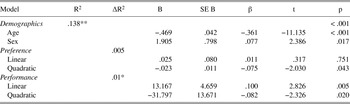
The first step showed that age and sex together predicted 13.8% of the variance in GCA, F(2,822) = 65.545; p < .001. The addition of hand preference did not significantly improve the model, ΔR 2 = .005; F(2,820) = 2.276; p = .103. However, examination of the regression coefficients indicated that the squared preference measure was a significant predictor of GCA, β = −.075; t = −2.030; p = .043. The addition of hand performance measures did account for a significant proportion of the variance over and above that accounted for by age and sex, ΔR 2 = .01; F(2,820) = 4.809; p = .008. Examination of the regression coefficients revealed that both performance and squared performance were significant predictors of GCA, β = .10, t = 2.826, p < .005, and β = −.082, t = −2.326, p = .02, respectively. Complete regression parameters are presented in Table 3.
Regression statistics for the prediction of GCA

Note
The Demographic model was always included as the first step, followed by either the Preference or Performance models in separate regressions. For values of R and ΔR, *p < .05, **p < .001.
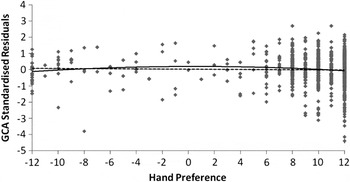
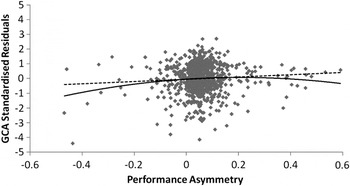
To visualize better the relationship between handedness and GCA, curve fitting procedures were used. Standardized residuals from the first step of the regressions (with age and sex as predictors) were used as the outcome variable. Positive values of the residuals indicate that an individual’s GCA is high for their age and sex, and negative values indicate that the GCA is low. For the preference measures, neither the linear nor the quadratic equations were significant. However, the quadratic equation approached significance, F(2,822) = 2.191; p = .112, and the quadratic term itself was a significant predictor, β = −.077, t = −1.988, p = .04. The equation was GCA = .196 + .002 (Preference) − .002 (Preference)2, and reflects a curvilinear relationship between hand preference and GCA with a peak in the predicted value of GCA observed at a hand preference score of +0.5 (see Figure 2). For the performance asymmetry measure, both linear and quadratic equations were significant. The linear component accounted for .5% of the variance, F(1,823) = 4.167; p = .042, and was represented by the equation GCA(residual) = −.042 + .755 (Performance Asymmetry). Overall, greater rightward asymmetry was associated with higher GCA. The quadratic component accounted for 1.2% of the variance, F(2,822) = 4.783; p = .009, and was represented by the equation GCA(residual) = −.030 + 1.139 (Performance Asymmetry) −2.756 (Performance Asymmetry)2. This equation reflects a curvilinear relationship between performance asymmetry and GCA, with a peak in the predicted value of GCA observed at an asymmetry index of +.21 (see Figure 3).
Linear (dotted line) and quadratic (continuous line) relationships between hand preference and the standardized residuals reflecting general cognitive ability (GCA) while controlling for age and gender.

Linear (dotted line) and quadratic (continuous line) relationships between hand performance and the standardized residuals reflecting general cognitive ability (GCA) while controlling for age and gender.

DISCUSSION
Analysis of the hand preference data revealed a barely significant relationship between hand preference and GCA scores. The regression analysis showed a quadratic relationship between hand preference and GCA, which just reached statistical significance. Similarly, curve fitting produced a barely significant quadratic relationship whereby GCA scores were lower for individuals with a strong left- or right-hand preference and a peak GCA score for individuals with a hand preference of +.5. The weakness of the relationship observed between hand preference and GCA makes it difficult to draw any definitive conclusions from these data.
The hand performance data revealed a much clearer picture. Regression analyses produced a significant linear and quadratic relationship between hand performance and GCA. In support of this, curve fitting showed a significant linear relationship whereby GCA scores were lower for left- compared with right-handers. On top of this, curve fitting showed a quadratic relationship where GCA scores were depressed for individuals with an extreme left- or right-hand asymmetry. The quadratic curve showed a peak level of GCA at a hand performance score of + .21.
The hand performance data support Annett’s model of handedness. People with a strong bias for either their left or right hand were at a disadvantage compared with individuals with moderate right handedness. The hand preference data also showed a tendency for GCA scores to decline for individuals with a strong left- or right-hand preference. Because of the weakness of the association, however, it was difficult to determine which hand preference scores were associated with the peak level of GCA. The data are similar to those collected by Crow et al. (Reference Crow, Crow, Done and Leask1998), which showed a modest effect whereby extreme performance asymmetries were associated with lower levels of academic achievement. Although the data are in accord with the conclusions drawn by Annett (Reference Annett1992), they stand in contrast to a body of contradictory research (Cerone & McKeever, Reference Cerone and McKeever1999; McManus et al., Reference McManus, Shergill and Bryden1993; Palmer & Corballis, Reference Palmer and Corballis1996). The size of the sample tested in the current study is larger than the sample used by any of the other studies. It is, therefore, possible that this study had the statistical power to reveal an effect of moderate right-handedness, whereas the other studies did not. Furthermore, it should be stressed that the magnitude of the effect observed by the regression is small and that smaller studies may not produce an effect.
In addition to the disadvantage observed for individuals with a strong performance asymmetry, the data also showed that left-handers had lower GCA scores than right-handers. The effect was evident for the hand performance data, but not the hand preference data. The data, therefore, provide support for research showing that left-handers have lower levels of cognitive achievement across a broad range of skills (Johnston et al., Reference Johnston, Nicholls, Shah and Shields2009), but contradict research showing an advantage for left-handers (Halpern et al., Reference Halpern, Havilland and Killian1998). It is possible, however, that the cognitive advantage shown by left-handers could relate to very specific skills (see Benbow, Reference Benbow1986), which were not tested here.
Perhaps one of the most surprising results is that a disadvantage for GCA was not observed for individuals who were mixed-handed. Recent large scales have shown that mixed-handers perform worse on a range of cognitive ability tests (Corballis et al., Reference Corballis, Hattie and Fletcher2008; Crow et al., Reference Crow, Crow, Done and Leask1998; Johnston et al., Reference Johnston, Nicholls, Shah and Shields2009; Peters et al., Reference Peters, Reimers and Manning2006). Many of these studies (Corballis et al., Reference Corballis, Hattie and Fletcher2008; Johnston et al., Reference Johnston, Nicholls, Shah and Shields2009; Peters et al., Reference Peters, Reimers and Manning2006) have either simply assessed whether participants are left-, right-, or mixed handed for writing (Corballis, et al., Reference Corballis, Hattie and Fletcher2008; Johnston et al., Reference Johnston, Nicholls, Shah and Shields2009) or have asked participants to indicate their writing hand along a 5-point scale (Peters et al., Reference Peters, Reimers and Manning2006). It is, therefore, possible their results apply quite specifically to mixed handedness for writing. This distinction, however, does not so easily explain the results obtained by Crow et al. (Reference Crow, Crow, Done and Leask1998) who used a square-checking task. Like the present study, the square-checking task measures asymmetries in a hand performance. One possible explanation for this discrepancy is that square-checking task used by Crow et al. (Reference Crow, Crow, Done and Leask1998) requires the use of a pen – and in this regard, might reflect mixed handedness for writing skills. It may also be relevant that the sample used by Crow and colleagues consisted of 11-year-old children, some of whom may not have developed a strong preference for one hand.
The study demonstrated an association for the hand performance data, but this association was negligible for the hand preference data. Whereas some studies have used hand performance to examine the relation between handedness and cognitive ability (e.g., Cerone and McKeever, Reference Cerone and McKeever1999; Crow et al., Reference Crow, Crow, Done and Leask1998; McManus et al., Reference McManus, Shergill and Bryden1993), this method has not been widely used – especially in large scale studies (but cf Crow et al., Reference Crow, Crow, Done and Leask1998). The results of the current study suggests that measures of hand performance, such as tapping, may be a particularly sensitive measure of handedness as it relates to other cognitive functions. Indeed, it is possible that the bimodal distribution associated with measures of hand preference, where individuals are clustered toward the left and right extremes, may make it difficult to detect an association.
By combining continuous measures of hand preference with a comprehensive test of GCA in a large-scale population, we have been able to provide a thorough test of the competing models, which relate handedness to cognitive ability. The data demonstrate that GCA is affected by handedness. The pattern of results support Annett’s (Reference Annett1992) proposition that extreme left- or right-handers will have reduced levels of cognitive ability. In line with the results collected by Johnston et al. (Reference Johnston, Nicholls, Shah and Shields2009), the data also demonstrate that left-handers have lower levels of cognitive ability. It would, therefore, appear that two of the models outlined in the introduction are in operation. While these effects are statistically significant, it should be noted that the effect sizes are modest. Thus, while the differences are detected in large-scale studies, they may not be apparent in smaller samples. Whether the small cognitive advantage enjoyed by moderate right-handers is sufficient to bestow an evolutionary advantage for heterozygous individuals, as Annett (Reference Annett1985) suggests, is a matter for further debate. In addition, whether Annett’s model provides an accurate indication of how the genes operate is not certain. Indeed, recent work focusing on gene LRRTM1 on chromosome 2p12 (Francks et al., Reference Francks, Maegawa, Laurén, Abrahams, Velayos-Baeza and Medland2007) and the subsequent debate (see Crow, Close, Dagnall, & Priddle, Reference Crow, Close, Dagnall and Priddle2009; Francks, Reference Francks2009) suggest a more complicated model is required.
ACKNOWLEDGMENTS
The authors thank the Brain Resource International Database and Kylie Barnett for supplying the data. The project was not directly maintained by any source of financial support. No conflicts of interest exist.