INTRODUCTION
Tropical savannas are mainly characterized by a distinct change between a wet and a dry season. The amount of rain and the rainfall pattern may change considerably within and between years (Bourlière & Hadley Reference BOURLIÈRE, HADLEY and Bourlière1983). However, rainfall determines important aspects of animal and plant life histories. The most important life-history trait of a species is its reproductive strategy. In unpredictable systems, the ability to modify this strategy in response to environmental factors should be advantageous compared to temporally and spatially fixed responses (Satake et al. Reference SATAKE, SASAKI and IWASA2001, Shine & Brown Reference SHINE and BROWN2008). Variation in reproductive traits due to differences in rainfall pattern was reported for various taxa including different vertebrates (e.g. snakes: Madsen & Shine Reference MADSEN and SHINE2000, Madsen et al. Reference MADSEN, UJVARI, SHINE and OLSSON2006; birds: Hau Reference HAU2001; mammals: Grindal et al. Reference GRINDAL, COLLARD, BRIGHAM and BARCLAY1992, Williams & Newsome Reference WILLIAMS, NEWSOME, Haynes, Ridpath and Williams1991).
The group of terrestrial vertebrates which is probably most sensitive to water availability is amphibians. In sub-Saharan Africa a large number of anuran species live in different savanna types, where they mainly breed in temporary waters (Channing & Howell Reference CHANNING and HOWELL2005, Rödel Reference RÖDEL2000). The persistence of these breeding sites is directly influenced by the amount and temporal pattern of rainfall (Lampert & Linsenmair Reference LAMPERT and LINSENMAIR2001, Spieler & Linsenmair Reference SPIELER and LINSENMAIR1997). Mechanisms used by anurans to adapt their reproductive strategy to the unpredictable availability of water are manifold. For instance some species have an extremely fast larval development to minimize the risk of desiccation (Forge & Barbault Reference FORGE and BARBAULT1977, Linsenmair Reference LINSENMAIR, Newbery, Brown and Prins1998, Newman Reference NEWMAN1989).
Precipitation has been repeatedly reported as an important factor initiating breeding behaviour in anurans (Balinsky Reference BALINSKY1969, Donnelly & Crump Reference DONNELLY and CRUMP1998, Lamotte Reference LAMOTTE and Boulière1983, Lips Reference LIPS2001, Rudolf & Rödel Reference RUDOLF and RÖDEL2005). However, not every rainfall event may be equally suitable for triggering spawning activities. Thus various amphibians seem to breed only during particular parts of the rainy season, for example, the core rainy season when numerous preceding rains guarantee long enough pond persistence (Rödel et al. Reference RÖDEL, LAMPERT and LINSENMAIR2006); or only after the heaviest rainfall of the season (Schlüter & Salas Reference SCHLÜTER and SALAS1991).
In addition to choose an appropriate breeding time and site, the number of eggs oviposited may be adjusted to maximize the reproductive output. Different clutch sizes may be a response to varying ecological conditions, in particular the mortality risk due to predation or desiccation (Rabb Reference RABB and Vial1973, Ritke et al. Reference RITKE, BABB and RITKE1992, Sheridan Reference SHERIDAN2009, Spieler & Linsenmair Reference SPIELER and LINSENMAIR1997).
The frog Phrynomantis microps Peters, 1875 inhabits different savanna types. The duration of the rainy season within its range varies between 3 and 9 mo, the annual precipitation ranges from 500–1650 mm (Adeba et al. Reference ADEBA, KOUASSI and RÖDEL2010, this study). P. microps larvae need about 6 wk to reach metamorphosis and larval survival was observed to be below 0.1% (Rödel Reference RÖDEL1998, Reference RÖDEL2000). We therefore hypothesize that this species should be able to adjust its reproductive behaviour, i.e. the timing of reproduction, selection of oviposition sites and sizes of clutches, in order to maximize the survival probabilities of the offspring.
MATERIALS AND METHODS
Study species
Phrynomantis microps (Anura: Microhylidae) is a medium-sized frog (40–60 mm), distributed from Senegal to the Central African Republic. Only after rains, do males start calling in the dusk from their daily hiding places, such as burrows or termite mounds. Pairs deposit floating clutches of white to yellowish eggs. The aquatic, suspension-feeding, schooling larvae hatch after 1.5–2 d and finish metamorphosis after about 40 d (Rödel Reference RÖDEL2000, Rödel & Linsenmair Reference RÖDEL and LINSENMAIR1997).
Study site
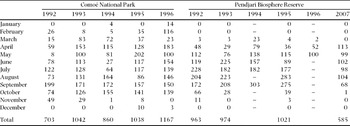
The study was conducted in the Comoé National Park, north-eastern Ivory Coast (CNP; 8°30′–9°37′N, 3°07′–4°26′W) and in the Pendjari Biosphere Reserve, north-western Benin (PBR; 10°30′–11°30′N, 0°50′–2°00′W). Data were collected in five rainy seasons in CNP (April–September 1992, April–June 1993, August–September 1994, March–June 1995, May–September 1996) and in the rainy season of 2007 in PBR (July–September). Our study sites in CNP were situated in the northern part of the humid Guinea savanna. Most of the annual precipitation falls from March/April to October/November (Rödel Reference RÖDEL2000). Usually there is a period of less rainfall in July and/or August. From 1992–1996 (our study period in CNP) the annual rainfall close to our study sites ranged from 703–1167 mm (mean ± SD: 962 ± 181 mm, n = 5; Table 1). When taking into account data from 1992–2000 the annual rainfall in CNP ranged from 703–1248 mm (1012 ± 179 mm, n = 8). The annual number of months with more than 100 mm varied from two to eight (5.3 ± 1.9, n = 8), illustrating the huge variation in the total amount of rainfall and rainfall pattern. PBR is situated in the Sudan savanna. The data were collected in close proximity to the village Batia. Whereas the annual rainfall is comparable to CNP (PBR: 1992–1996 and 2007; range: 586–1021, mean ± SD: 886 ± 201 mm, n = 4; Table 1); the rainy season is shorter (months with more than 100 mm rainfall: 4.0 ± 0.8, n = 4), usually setting in at the end of June and lasting until the end of September or the beginning of October. Annual precipitation was quantified by weather stations installed near the respective field stations (CNP all years; PBR in 2007) and a weather station in Tanguieta, 40 km from Batia (data from 1992–1996; FAOCLIM2, world-wide agroclimatic data base, http://freegeographytools.com/2007/fao-world-climate-data).
Monthly rainfall (mm) in the Comoé National Park and the Pendjari Biosphere Reserve.

Field methods
In both areas P. microps uses savanna ponds of a range of sizes for reproduction (Nago et al. Reference NAGO, GRELL, SINSIN and RÖDEL2006, Rödel Reference RÖDEL1998). All these breeding sites usually dry up completely during the dry season, and partly as well during drier periods within the rainy season. An exception was the dry season from 1995 to 1996 when large ponds remained filled in CNP. Most data in the CNP originated from the Hyperolius pond (surface area = 750 m2, max. depth 1 m; see Rödel Reference RÖDEL1998 for details). The main study pond in PBR was T3 (area = 182 m2, max. depth 0.4 m). These ponds were checked after every rainfall event during the respective study periods. A further seven ponds in CNP and nine ponds in PBR (pond sizes: 6–600 m2) were monitored for P. microps spawn whenever possible, e.g. dirt road conditions allowing access. Daily rainfall was quantified close to these ponds with rain gauges. Each spawning event was assigned to the last preceding rain. As rain gauges were repeatedly stolen by poachers not every rain event could be measured. The particular spawning events were excluded from the analyses. In May 1995, 51 additional ponds were checked for P. microps spawn in CNP (pond sizes: 10–600 m2; large ponds defined as >100 m2, 184 ± 131 m2, n = 14; small ponds: <100 m2, 30 ± 20 m2, n = 37) at the beginning and the end of the month.
As we never recorded breeding activities without previous precipitation and breeding never lasted for more than three consecutive days, ponds were investigated for spawn only 1–3 d after rainfall. Clutches of P. microps always float on the water surface and are easily visible due to the whitish eggs. We thus assume that we recorded clutches almost completely. The age of clutches is easily determined by the stage of the embryos. Hence, double counting of clutches during subsequent visits of a pond was avoided. Each clutch, its size and the spawning site (water depth, distance to pond bank, vegetation density) were noted.
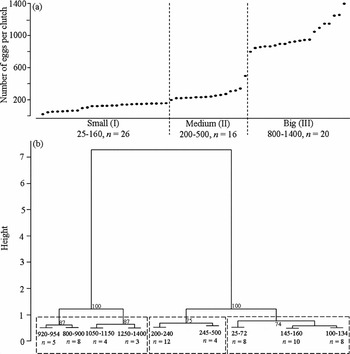
We randomly collected 62 clutches from ponds in CNP and counted their exact egg numbers (Figure 1a). Based on these counts and observations on the frogs’ behaviour and anatomy, three clutch size categories were defined which allowed a reliable assignment of each clutch. Definition of clutch size categories was necessary as (1) clutch sizes showed a huge variation (14–1400 eggs) and as (2) the large number of clutches made an exact egg count of each clutch impossible. We established our clutch categories using a hierarchical clustering based on the counted clutches following Laliberté et al. (Reference LALIBERTÉ, WELLS, DECLERCK, METCALFE, CATTERALL, QUEIROZ, AUBIN, BONSER, DING, FRATERRIGO, MCNAMARA, MORGAN, SÁNCHEZ MERLOS, VESK and MAYFIELD2010). We applied the Ward's minimum variance clustering, which defines groups in order to minimize the within-group sum of squares. The clusters produced tend to be hyperspherical and, if properties are evenly distributed, to contain almost the same number of objects (Legendre & Legendre Reference LEGENDRE and LEGENDRE1998). As this method should not be adapted on raw data, we used the Euclidean distance to calculate the required dissimilarity matrix (Legendre & Legendre Reference LEGENDRE and LEGENDRE1998). To assess the uncertainty of the applied clustering we computed bootstrap probability values using a multiscale bootstrap resampling (number of bootstraps = 1000). We asked to cut the dendrogram in that way to produce three distinct clusters (Figure 1b). Although four classes were appropriate according to the clustering results, we merged the two sub-clusters with large egg counts (on the left side of the dendrogram), since this division mirrors anatomical properties of female's ovaries. In the field the assignment of a clutch to a particular category followed a rule of thumb: clutch size category I had a diameter of less than 10 cm, category II of approximately 15 cm and category III clutches exceeded 20 cm diameter. The few clutches which showed intermediate diameters were assigned to the category which was closest.
Clutch sizes of Phrynomantis microps and definition of clutch size categories. Egg numbers per clutch of 62 randomly chosen clutches (black points) from Comoé National Park (a), stippled lines indicate the three clutch size classes from the Ward's clustering, computed on the bases of these egg counts, given are the ranges of eggs for the respective size classes and the sample size (b): Ward's minimum variance clustering of Euclidean dissimilarity matrix, the three clutch clades used to count clutches in the field are highlighted within stippled rectangles; bootstrap probability values computed by multiscale bootstrap resampling (number of bootstraps = 1000) are given in the graph, numbers at branch end give the minimum and maximum number of eggs per clutch and the sample size.

We analysed the data with regard to clutch numbers and sizes in relation to rainfall, season and pond size. We define a clutch as a single distinct egg batch, irrespective of the total number of eggs laid by a female during a particular mating event or within one breeding season. This was done because it was only possible in a very few cases to observe females during spawning. Only in PBR we directly recorded the reproductive behaviour of five P. microps couples. We recorded their arrival at the spawning site, measured the time periods and swimming distances between single spawning events, the sizes of the egg batches (clutches) as well as the respective oviposition sites.
A few voucher specimens from CNP and PBR were anaesthetized in a chlorbutanol solution and preserved in 75% ethanol. These frogs are stored in the Staatliches Museum für Naturkunde, Stuttgart and the Museum für Naturkunde, Berlin (SMNS 8964.1-5, 7; ZMB 71456-71459). Statistical analyses were conducted with R 2.4.1 (http://www.r-project.org). Values in the descriptive statistics are given as mean and standard deviation.
RESULTS
Rainfall and reproduction
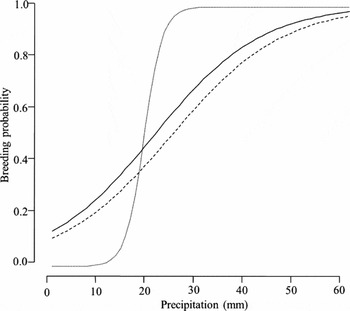
The start of the rainy seasons in CNP varied from February to June (Table 1). The years 1992 and 1994 were below the long-term annual precipitation; whereas annual precipitation in 1993, 1995 and 1996 was about or above average (Table 1). Spawning activity in CNP started in mid- or late-April and stopped at the latest in August/September. In 2007 the rainy season in PBR started in July and amounted to only 586 mm, thus being far below the long-term annual mean. Phrynomantis microps started spawning in PBR in 2007 in mid-July and stopped reproduction in early September. Precipitation apparently triggered reproduction activity, i.e. calling males and clutches were only observed after rains. From 1992–1996 we recorded 193 rainfall events in CNP (rain per day and pond: 16.6 ± 14.1 mm, range: 1–61 mm). In PBR we investigated 149 rainfall events for subsequent spawning (rain per day and pond: 15.6 ± 9.0 mm, range: 1–40 mm). In both regions, spawning occurred more often after heavier rainfall. When pooling all data for a region, we recorded reproduction of P. microps in CNP after rainfall greater than 2 mm, whereas reproduction in PBR was only observed after rainfall greater than 9 mm. However, the spawning pattern in CNP varied between years. In 1992–1994 a minimum amount of about 16 mm rainfall was needed to induce spawning by P. microps. With the exception of rainfall events at the very end of the rainy season, 16 mm or more of rain always triggered reproduction. In contrast P. microps started spawning in 1995 and 1996 after daily precipitation of 2 mm. Thus, the probability of breeding increased with the amount of rainfall in both savanna types (Figure 2). This association, however, differed with regard to region and time with the most intense increase in 1992–1994 in CNP. Overall the linkage between precipitation and region/year is significant (binomial generalized linear model: breeding versus non-breeding as a function of rainfall amounts and scenario (region and years); model with and without interaction between scenario and precipitation were compared by χ2-test: Deviance = −34.7, df = 2, P < 0.0001).
Breeding probability of Phrynomantis microps with regard to daily rainfall. Given are the binominal generalized linear models of breeding events as a function of precipitation amount in Comoé National Park 1992–1994 (dotted line), Comoé National Park 1995 and 1996 (continuous line) and in Pendjari Biosphere Reserve 2007 (dashed line).

Spawning behaviour and clutch sizes
We observed spawning behaviour of five P. microps couples in the PBR. In three couples we recorded a complete sequence from arriving at a pond until the end of spawning. The reproductive behaviour of all couples followed the same pattern and took place in the early morning hours (01h00–05h00). The spawning itself lasted 20–34 min (26 ± 7 min, n = 3). During that period the couples swam through the pond and deposited several clutches (range: 3–6), differing in egg numbers (107 ± 87.4, range: 30–300, n = 12), at various sites within the pond. Each clutch resulted from one to nine spawning bouts (bouts per clutch: 5 ± 2.5, n = 10). The three females that we observed for the complete spawning period deposited a total of 240, 455 and 614 eggs, respectively. Two other females, that most likely started spawning before they were discovered, deposited one clutch each (110 and 190 eggs). These PBR females had snout-vent lengths (SVL) ranging from 4.4–5.8 cm (5.1 ± 0.6 cm, n = 5). We counted all eggs in the strongly meandering oviducts of four dissected females, three from CNP and one from northern Ghana. The ovaries of these females were arranged in loops. Per ovary we counted 4–6 such loops; females had a total of 8–13 loops. The total number of ripe eggs ranged from 595–1635 (1006 ± 488, n = 4). Per ovary we counted 241–835 eggs (503 ± 231, n = 8). One loop comprised 23–260 eggs (98 ± 52, n = 40).
Thus the egg counts of the dissected females reflected the three computed clutch size classes (Figure 1), i.e. the smallest clutch classes (I) roughly comprise the egg numbers of one and two loops, respectively. The second class comprises the egg numbers of one ovary (or all eggs in the two females with few eggs, which may have already reproduced before being collected) and the largest clutch class (III) mirrors the whole reproductive investment of the two females with many eggs.
The size of female P. microps differed between the two regions (Mann–Whitney U-test: Z = 2.36, P = 0.0183, n = 23), PBR females being slightly bigger (CNP: SVL = 4.5 ± 0.3 cm, range: 4.1–5.3 cm, n = 13; PBR: SVL = 4.9 ± 0.4, range: 4.4–5.8 cm; n = 10).
Variability of clutch sizes
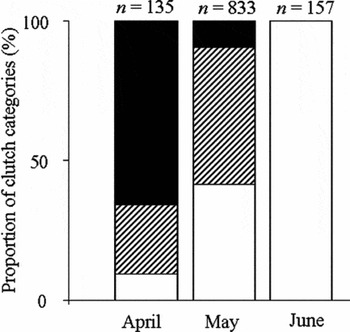
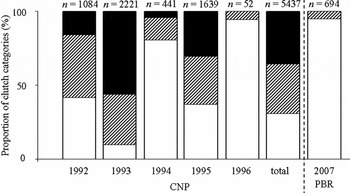
In total, we recorded 5437 clutches of P. microps in CNP and 694 clutches in PBR. Clutch size varied between 30 and 1400 eggs. In 1992 and 1993, most of the clutches in CNP were deposited in April (1992: 135 clutches, 1993: 1320 clutches) and May (1992: 883 clutches, 1993: 102 clutches). In June 157 (1992) and 66 (1993) clutches were counted, respectively. For CNP we had uninterrupted clutch records for the complete rainy season available only in 1992. In this year we detected seven clutches in July and four in August. The relative proportion of clutch size classes differed considerably between months (only CNP data from April to June 1992, χ2-test: χ2 = 514, df = 4, P < 0.001, n = 1175; Figure 3). In April most clutches belonged to size class III, whereas in May only 10% of the clutches contained more than 800 eggs. In June we recorded exclusively class-I clutches. Proportion of clutch size categories varied also strongly between years in CNP (χ2-test: χ2 = 1411, df = 8, P < 0.001, n = 5437; Figure 4). In 1993 most clutches belonged to size class III, whereas this class was less common (1994) or even absent (1996) in other years.
Spawning behaviour of Phrynomantis microps. Relative proportion of clutch sizes in different months during the rainy season 1992 in the Comoé National Park. Size classes: I = white, II = black lines, III = black (see Figure 1 for definition). Clutch category proportion in July (I: 4, II: 2, III: 1) and August (I: 0, II: 4, III: 0) are not shown in the figure because of their small sample size (nJuly = 7, nAugust = 4), sample sizes of former months are given in the graph.

Clutch sizes of Phrynomantis microps in different savanna regions and years. CNP: humid Guinea savanna in the Comoé National Park; PBR: dry Sudan savanna in the Pendjari Biosphere Reserve; size classes: I = white, II = black lines, III = black (see Figure 1 for definition).

The proportion of clutches of the three defined clutch categories differed between years and study regions. Roughly one third of the clutches in CNP belonged to size classes III, whereas the PBR clutches almost exclusively consisted of class I clutches (Figure 4; χ2-test: χ2 = 1083; df = 2, P < 0.001; n = 6131). However, distribution of clutch sizes in one year (1996) was almost equal to that in PBR. Although females were slightly larger in PBR most clutches (60%) contained fewer than 100 eggs, and size class III was completely absent.
Within PBR, clutch sizes were not evenly distributed over the 10 ponds investigated (Kruskal–Wallis one-way analysis of variance: χ2 = 87.9, P < 0.001, n = 10). The largest clutches were found in T1 and T3, both characterized by sparse vegetation and being among the three largest study ponds in PBR. In CNP we tested for differences in selection of pond sizes at 51 different-sized CNP ponds in early and late May 1995. Spawning activity (number of clutches) did not differ between the two dates (χ2-test: χ2 = 0.99, df = 1, P = 0.32). In early May P. microps almost exclusively chose larger ponds (>100 m2) for reproduction (χ2 = 8.54, df = 1, P < 0.01). In late May we predominantly found P. microps clutches in smaller ponds (<100 m2) (χ2 = 7.99, df = 1, P < 0.01, nlarge ponds = 14, nsmall ponds = 37).
DISCUSSION
In West African savannas ponds usually fill up with the onset of the rainy season. The filling and duration of a pond depends on the frequency and quantity of rains, as well as on soil properties. It is not unusual that ponds dry up even within the rainy season (Rödel Reference RÖDEL1998), resulting in the death of remaining tadpoles. Some West African savanna frogs have tadpoles which complete metamorphosis within less than 2 wk (Forge & Barbault Reference FORGE and BARBAULT1977, Rödel Reference RÖDEL2000) and reproduce after almost every rainfall. In contrast P. microps tadpoles start metamorphosis after about 40 d (Rödel Reference RÖDEL2000) and adults thus should choose ponds that persist long enough for a successful larval development. It is known that some anuran species, breeding in temporary waters of unpredictable persistence, are able to judge the water-holding capacity of potential breeding sites. They seem to monitor potential sites and thus are familiar with their characteristics (Rudolf & Rödel Reference RUDOLF and RÖDEL2005, Spieler & Linsenmair Reference SPIELER and LINSENMAIR1997). In contrast to the species examined by these authors, P. microps for most of the year lives further from water (Rödel Reference RÖDEL2000, own unpubl. data). It thus seems unlikely that P. microps repeatedly checks breeding ponds. Another option could be that P. microps uses the amount of rainfall and pond size to judge the potential water persistence.
Many studies have demonstrated the impact of precipitation on spawning activity in tropical anurans (Aichinger Reference AICHINGER1987, Donnelly & Crump Reference DONNELLY and CRUMP1998, Gottsberger & Gruber Reference GOTTSBERGER and GRUBER2004, Hoogmoed & Gorzula Reference HOOGMOED and GORZULA1979, Lee Reference LEE1967, Rabb Reference RABB and Vial1973). However, only a few authors have quantified the amount of precipitation that triggers spawning. Schlüter & Salas (Reference SCHLÜTER and SALAS1991) report several Peruvian microhylid species which reproduce only after the heaviest rainfalls (>60 mm). The amount of rainfall was also detected to be of importance for triggering spawning in Spea spp. (Bragg Reference BRAGG1945) and Pleurodema diplolistris (Hödl Reference HÖDL1992). Kluge (Reference KLUGE1981) found that precipitation which accumulated to more than 250 mm induced spawning in Hypsiboas rosenbergi. The reproductive activity of P. microps was likewise triggered by rain. In both study regions precipitation on days with spawning was higher than on rainy days without spawning.
It was much more interesting however, that the threshold triggering reproduction differed between rainy seasons and regions. This variation likely reflects the trade-off between the necessity to reproduce and the attempt to minimize the mortality risk for the offspring. In CNP where the rainy season usually is long enough for the frogs to assure annual reproduction, the variation in this threshold was huge. In years with a late start to the rains (1992, 1993 and 1994), and hence dry soils and high desiccation risk, the threshold was high (>16 mm). In contrast, during 1996, a year with an early start of the rainy season and a presumed low desiccation risk (large ponds not dried up during preceding dry season), spawning activity of P. microps was observed after almost every rain, some being as low as 2 mm. However, we have no explanation why the frogs likewise spawned after almost every rain in 1995, where the onset of the rains was comparable to the previous years and ponds had to fill anew. Although annual rainfall is almost equal to CNP, the rainy season is usually considerably shorter in PBR. Nevertheless the breeding probability with regard to amount of rainfall was nearly equal to CNP conditions in the years 1995 and 1996. This may indicate that the trade-off between reproduction and risk mitigation, to prevent losing all reproductive investment, is more pronounced in PBR. In other words: because the rainy season is shorter (and larval development not faster than in CNP) P. microps may need to accept less rainfall in PBR, in order to not miss the chance to reproduce within a given year.
We observed variation in the reproductive behaviour of P. microps not only with regard to the amount of precipitation but also in a wide spectrum of clutch sizes. The number of eggs per clutch was correlated to pond size, time in season (early/late rainy season) and regional climate (short/long rainy seasons). First of all, the proportion of particular clutch size classes varied during the rainy season. In May most clutches in CNP belonged to the biggest size class, whereas this class was less common in following months. This might indicate repeated spawning events of females within one rainy season. It is known that some tropical anurans may produce more than one clutch per season (summarized in Wells Reference WELLS2007). Subsequent clutches then might become smaller (Grafe Reference GRAFE1988). This is usually explained by limited energetic resources females may allocate to subsequent reproductive events (Howard Reference HOWARD1978). In contrast, Telford & Dyson (Reference TELFORD and DYSON1990) did not observe decreasing clutch sizes in Hyperolius marmoratus females that repeatedly produced clutches. We observed particular P. microps males several times at breeding sites within one season (own unpubl. data). For females however, we have no such data.
In most studies, variation in clutch size is attributed to variation in female body size, larger females producing more eggs (Barbault & Trefaut Rodrigues Reference BARBAULT and TREFAUT RODRIGUES1979, Kuramoto Reference KURAMOTO1978, Lampert & Linsenmair Reference LAMPERT and LINSENMAIR2001, Morrison & Hero Reference MORRISON and HERO2003). As adult amphibians continue growing, several studies have shown that clutch sizes increases with age (Banks & Beebee Reference BANKS and BEEBEE1986, Tejedo Reference TEJEDO1992). Thus, the observed decrease of clutch sizes might be likewise due to young females just reaching maturity in the later rainy season, whereas older females would be able to already reproduce with the earlier rains. As indicated by the largest clutches and the dissected females, P. microps females seem to produce up to 1600 eggs per season. Here we show that P. microps couples in PBR are able to deposit several smaller clutches within a pond, a behaviour already once reported by Rödel (Reference RÖDEL2000) for this species in the CNP. The spreading of spawn within a pond may minimize the predation risk, i.e. not to lose the complete reproductive investment to predators, like turtles or lungfish, which likely devour a whole clutch. Spreading of spawn within one or between several ponds (Channing Reference CHANNING1976, Rabb Reference RABB and Vial1973, Rabb & Rabb Reference RABB and RABB1963, Salthe & Mecham Reference SALTHE, MECHAM and Lofts1974, Spieler & Linsenmair Reference SPIELER and LINSENMAIR1997) or portioning of spawn temporally (Bragg Reference BRAGG1945, Rödel et al. Reference RÖDEL, SPIELER, GRABOW and BÖCKHELER1995) is known from some tropical anurans. We did not observe couples to move between ponds. However, the small number of eggs deposited in one night by the couples observed in PBR was below half of what a female may produce annually. This implies that P. microps females in addition to spreading spawn within one pond may apply geographic (visiting several ponds) and/or temporal risk-spreading, the latter possibility better fitting our observations.
Generally, various ponds, differing in size, depth and vegetation cover, as well as all different microhabitats within one pond were used for clutch deposition. Clutch sizes however, varied with regard to pond size and time within season. The largest clutch sizes were detected in the largest ponds of CNP and only during the beginning of the rainy season. In PBR, the larger clutch sizes were likewise found in larger ponds. The allocation of particular clutch sizes to particular parts of the season and pond sizes, as the portioning of spawn, might be regarded as a risk-spreading behaviour. At least in CNP frogs at the beginning of the rains used large ponds for spawning and only later accepted small ones as well. As desiccation risk of ponds decreases with continuing rain, it probably pays off to switch from larger to smaller ponds, which may dry up rapidly at the beginning of the wet season. Furthermore smaller ponds usually have fewer tadpole predators compared to large ponds, as predator populations may build during much longer periods in the larger water bodies (Rödel Reference RÖDEL1998).
In summary P. microps has evolved a wide spectrum of behavioural answers to deal in different environments with a range of different abiotic and biotic constraints such as unpredictable and changing precipitation, or the temporally changing risk of desiccation and predation. It may thus be better adapted to the predicted change in climate and water availability (de Wit & Stankiewicz Reference DE WIT and STANKIEWICZ2006) than species that are less flexible in adjusting their reproductive strategies.
ACKNOWLEDGEMENTS
The field work of MOR in CNP was supported by scholarships from the German Academic Exchange Service (DAAD); the work of MH in PBR was supported by a travel grant of the Arthur von Gwinner Foundation. M. Mohneke was of invaluable help during field work in PBR. The research camp in the Comoé National Park was directed by K. E. Linsenmair and built with funds from the Volkswagen Foundation (AZ I/ 64 102). Research permission in Ivory Coast was kindly provided by the Ministère de l'Enseignement Supérieur et de la Recherche Scientifique and the Ministère de la Construction et de l'Environnement, Republic of Ivory Coast. In Benin our thanks go to the Centre National de Gestion des Réserves de Faune, in particular to the director of the Pendjari National Park D.A. Tiomoko, as well as to U. Lange, A. Tehou and B. Sinsin for their support, including access to the park's infrastructure and for arranging research permits. This manuscript profited by the comments of two anonymous reviewers. This study is part of the BIOLOG-program of the German Ministry of Education and Science (BMB+F; Project BIOTA-West III, amphibian projects, 01LC0617 J).