I. INTRODUCTION
Excellent corrosion resistance, significant biocompatibility, and low Young’s modulus have made CP-Ti as one of the most appropriate materials for biomedical applications.Reference Mora-Sanchez, Sabirov, Monclus, Matykina and Molina-Aldareguia1 Although the mechanical properties of CP-Ti is relatively low when compared with its alloyed counterparts such as Ti–6Al–4V, which has also been proven to be toxic to human body,Reference Sedarat, Harmand, Naji and Nowzari2–Reference Latysh, Krallics, Alexandrov and Fodor4 but it has been demonstrated that this deficiency can be overcome through grain refinement by severe plastic deformation (SPD).Reference Serra, Morais, Elias, Semenova, Valiev, Salimgareeva, Pithon and Lacerda5–Reference Dimić, Cvijović-Alagić, Völker, Hohenwarter, Pippan, Veljović, Rakin and Bugarski7 Considering various SPD methods, ECAP has been known specifically viable since large samples can be readily processed to produce ultrafine-grained (UFG) bulk materials.Reference Valiev and Langdon8
Earlier investigations reported that grain refinement of CP-Ti via ECAP not only enhances the strength but also increases corrosion resistance,Reference Balyanov, Kutnyakova, Amirkhanova, Stolyarov, Valiev, Liao, Zhao, Jiang, Xu, Lowe and Zhu9 decreases wear rate,Reference La, Ma, Zhu, Yang, Liu, Xue and Valiev10 elevates fatigue behavior,Reference Figueiredo, Barbosa, Zhao, Yang, Liu, Cetlin and Langdon11,Reference Vinogradov, Stolyarov, Hashimoto and Valiev12 and improves its biocompatibility.Reference Kim, Balakrishnan, Lee, Kim, Smetana, Park and Panigrahi13–Reference An, Li, Diao, Xin, Zhang, Jia, Wu, Li and Guo15 However, this material is classified as hard-to-deform materials due to hcp crystal structure and restricted slip systems, which affect the capability of its processing by ECAP at room temperature.Reference Semiatin and DeLo16 As a result, ECAP processing of CP-Ti is conducted at elevated temperaturesReference Stolyarov, Zhu, Lowe and Valiev17–Reference Kang and Kim19 or implemented by dies with internal channel angles, φ, of higher than 90° at room temperature.Reference Zhao, Yang, Liu, Wang and Langdon20,Reference Zhang, Figueiredo, Alhajeri, Wang, Gao and Langdon21 ECAP processing at elevated temperatures has been proven to be less effective in grain refinementReference Yamashita, Yamaguchi, Horita and Langdon22 and more deformation passes are required to obtain the desired equiaxed grain-refined structure by dies with higher than 90° internal channel angle.Reference Nakashima, Horita, Nemoto and Langdon23 Thus, it is favorable to process CP-Ti at room temperature using a die with an internal channel angle of 90°. Although a sole study have reported the processing of grade 1 CP-Ti at the latter condition with no additional apparatus or special approach,Reference Zhao, Yang, Liu, Wang, Huang and Langdon24 there are a few studies in which CP-Ti have been processed at the mentioned condition, but by means of imposing back pressure during deformation to prevent crack formation.Reference Derakhshandeh, Nili-Ahmadabadi, Khajezade and Shahmir25–Reference Podolskiy, Ng, Psaruk, Tabachnikova and Lapovok27 It has been shown that applying back pressure during deformation changes the deformation stress stateReference Figueiredo, Cetlin and Langdon28 and prevents damage accumulation.Reference Lapovok29 The most common way of imposing back pressure has been employing an extra plunger in the second channel of ECAP die, which induces a constant force in the opposite direction of pressing.Reference Valiev and Langdon8 Nevertheless, it is important to note that applying such a back pressure technique imposes some difficulties during ECAP processing.
Recently, a new core–sheath billet configuration which consists of inserting a metal as core into a ductile metal (Fe) as sheath was introduced and successfully processed the NiTi shape memory alloy as a hard-to-deform material through one passReference Shahmir, Nili-Ahmadabadi, Razzaghi, Mohammadi, Wang, Jung, Kim and Langdon30 and two passesReference Shahmir, Nili-Ahmadabadi, Mansouri-Arani, Khajezade and Langdon31–Reference Shahmir, Nili-Ahmadabadi, Mansouri-Arani and Langdon33 of ECAP at room temperature using a die with an internal channel angle of 90°. As Ti has hcp crystal structure and is known as hard-to-deform metal that could lead to segmentation during conventional ECAP processing at room temperature,Reference Semiatin and DeLo16 core–sheath billet configuration was considered for room temperature ECAP processing of CP-Ti. Experiments showed a success to process the metal for one pass. Moreover, finite element modeling (FEM) and analytical calculations revealed the effect of this billet configuration on flow behavior of metal during ECAP processing. The results indicated that the back pressure, which is induced by the sheath due to the friction force between the sheath and internal surface of exit channel, prevents crack formation. Sheath metal strength, coefficient of friction between the sheath and inner surface of exit channel, initial distance between tip of the core and sheath, and diameter of the core are the four factors which play the main roles in the core–sheath billet configuration approach.Reference Derakhshandeh, Nili-Ahmadabadi, Khajezade and Shahmir25 It is worth to note that a similar experiment has been carried out by Li et al. but at 300 °C and using copper as sheath (called encapsulation by authors).Reference Li, Pang Ng, Do Jung, Kim and Estrin34
Based on the initial achievement and previous investigations on the ECAP processing of CP-Ti using core–sheath billet configuration for one pass,Reference Derakhshandeh, Nili-Ahmadabadi, Khajezade and Shahmir25 the present investigation was initiated to study the effect of sheath metal strength on the induced back pressure and capability of ECAP processing of CP-Ti up to more (four) passes at room temperature. In addition, special attention was paid to the effect of four ECAP passes on the microstructural evaluation and mechanical properties of the processed material.
II. EXPERIMENTAL MATERIALS AND PROCEDURES
The experiments were conducted on a core–sheath billet using grade 1 CP-Ti (Ti) and AISI 1015 steel (1015) as the core and the sheath, respectively. The as-received Ti consisted of an equiaxed microstructure with an average grain size of ∼30 µm. To provide cores with a diameter of 5 mm and a length of 40 mm, Ti bars were cut by using an electrodischarge machine (EDM). The core–sheath billet configuration was prepared by inserting the Ti core in the 1015 rod with 20 mm diameter, where the length of sheath was 90 mm.
ECAP processing was performed at room temperature employing a hydraulic press of 50 ton capacity and a solid die with an internal channel angle, φ, of 90° and an outer arc of curvature, ψ, of 20°. This configuration results in subjecting an imposed strain of ∼1.05 after each pass (calculated by the well-known equation represented in Ref. Reference Iwahashi, Wang, Horita, Nemoto and Langdon35). The billets were processed through selected number of one to four passes using route Bc in which the billet is rotated by 90° in the same direction after passage of the sample through the die.Reference Furukawa, Iwahashi, Horita, Nemoto and Langdon36 The pressings were conducted at constant ram speed of 1 mm/s and molybdenum disulfide (MoS2) was used as a lubricant.
Flow behavior of the Ti core within 1015 sheath through the second and the third passes was simulated to investigate the effect of number of passes through route Bc on the value and homogeneity of the imposed strain. ABAQUS commercial software (Dassault Systèmes, Providence, Rhode Island) was used for this simulation through the three-dimensional finite element method. An isotropic hardening material model associated with plastic data point from the uniform tensile data of Ti and 1015 steel (not shown in the paper) was applied for simulation. The die and punch, which were used in the experiments, were made of high strength steel and their rigidity was significantly higher than billet materials. For this reason, the punch and die were modeled as discrete rigid planes in simulations. Tresca friction with a shear factor of 0.1 was considered as the interfacial model between the inner surface of die and the outer surface of the sheath. The pressing speed was set at 1 mm/s and any temperature rise due to friction and deformation was ignored. Thereby the process was assumed isothermal in simulations. The core and sheath volumes were meshed with eight-node linear brick elements with sizes of 0.5 and 1 mm, respectively.
Microstructural characterizations were carried out using optical microscopy (OM), filed-emission scanning electron microscopy (FE-SEM), and transmission electron microscopy (TEM) on the samples processed through four passes. The sample preparation for microstructural observation was conducted on the vertical longitudinal plane of the processed billet which was cut from the middle of the cross section, denoted as Y plane.Reference Furukawa, Iwahashi, Horita, Nemoto and Langdon36 In addition, the microstructure of the sample before ECAP processing (initial condition) was investigated by OM. Specimens for OM and FE-SEM observation were prepared by mechanical polishing and etched with Kroll’s reagent (88% H2O, 10% H2NO3, 2% HF). Disks for TEM were cut by EDM with a diameter of 3 mm and a thickness of 500 µm. The disks were ground and polished to a thickness of ∼30 µm and finally thinned by ion milling. A Philips CM20 (Philips, Amsterdam, The Netherlands) with an accelerating voltage of 200 kV was used for TEM characterization. To determine the grain size, linear intercept was applied. Approximately 400 grains were counted in TEM images for grain size measurement.
Vickers microhardness (Hv) measurements of billets were conducted on a vertical longitudinal plane of processed billets through two to four passes which were cut from the middle of the cross section (Y plane) by EDM. Measurements were taken by applying a load of 100 g for 10 s at seven points in the center of Y plane and the average of them were reported after excluding the highest and lowest values.
Tensile specimens with gauge dimensions of 1 × 1.5 × 4 mm3 were prepared by slicing the billets via EDM parallel to the Y plane with gauge lengths lying in the pressing direction. The AISI 1015 tensile test specimens were cut from sheared area between the tip of the core and the billet. The tensile tests were executed at room temperature using a Santam universal testing machine (Santam, Tehran, Iran) with a load cell of 2 kN capacity and a constant cross-head displacement rate of 0.24 mm/s which is equivalent to the strain rate of 1.0 × 10⁻³ 1/s. At least two samples were tested for each condition to study the mechanical properties of ECAP-processed samples.
III. EXPERIMENTAL RESULTS
A. ECAP processing
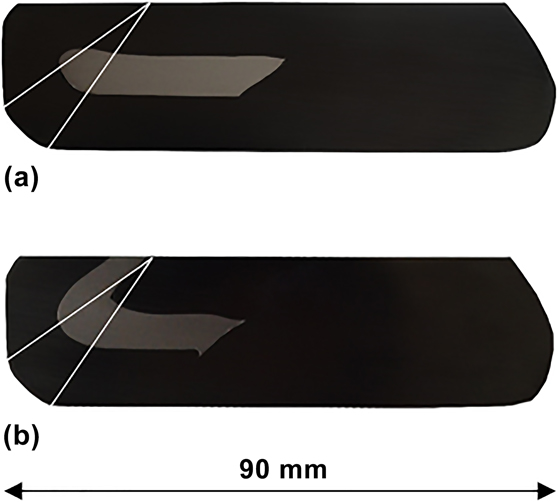
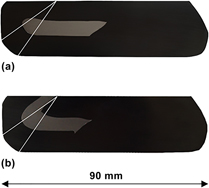
Figure 1 illustrates the central longitudinal plane of billets with Ti cores of 5 mm diameter embedded in 1015 sheaths after two and four passes of ECAP using route Bc. This figure clearly shows the successful ECAP processing of Ti through two and four passes at room temperature using a conventional die design with φ = 90° and ψ = 20°, where no crack was observed in the Ti core. The final appearance of sectioned billets shows that identical to the first pass,Reference Derakhshandeh, Nili-Ahmadabadi, Khajezade and Shahmir25 the core and sheath are deformed as an integrated billet during multiple passes of ECAP processing as well.
Longitudinal section of (a) two-pass and (b) four-pass ECAP-processed the core sheath billet with 5 mm Ti cores within 1015 sheaths through a die with an internal channel angle of 90° at room temperature. The MDZs are delineated by white lines.

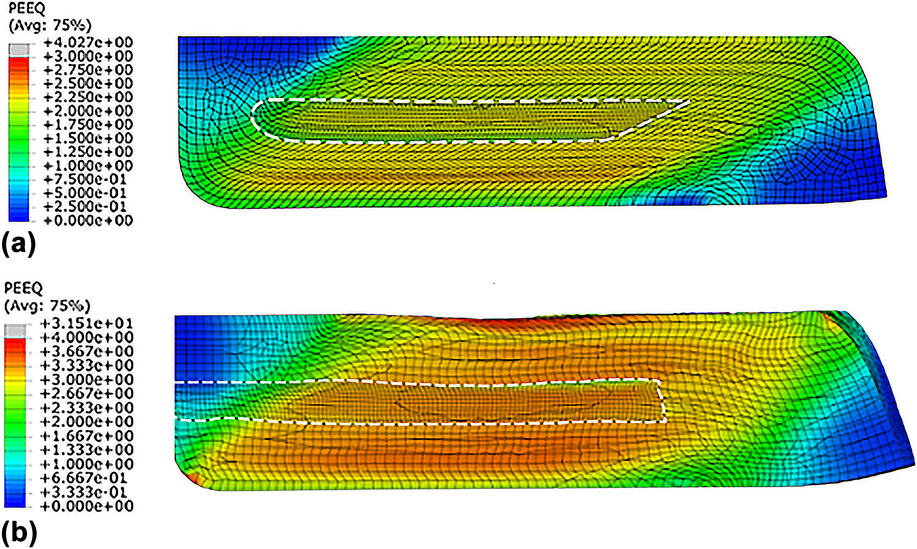
Effective (von mises) strain distribution along the central Y-plane of a 5 mm Ti core within a 20 mm diameter 1015 steel sheaths after two and three passes of ECAP processing simulated by FEM is shown in Fig. 2. Close investigation of Figs. 2(a) and 2(b) reveals a high level of strain distribution homogeneity with an imposed strain of more than 2 and 3 in the cores processed through the second and the third passes, respectively. Moreover, the simulation result represented in Fig. 2(a) clearly shows the sheared lattice in the core which is consistent with our previous results.Reference Derakhshandeh, Nili-Ahmadabadi, Khajezade and Shahmir25
ABAQUS simulation of effective plastic strain distribution of core–sheath billets processed through route Bc after the (a) second and (b) third passes of ECAP processing. The Ti cores are delineated by white dashed lines.

B. Microstructures before and after ECAP
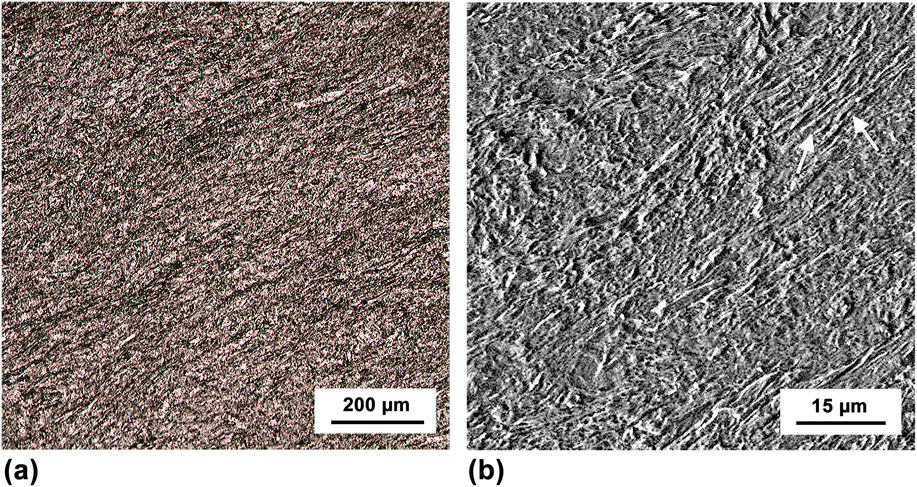
The microstructures of Ti after four passes of ECAP processing are represented in Fig. 3(a) (OM micrograph) and Fig. 3(b) (FE-SEM micrograph). The results demonstrate [Fig. 3(b)] a severely deformed homogeneous structure and some regions with banded structure pattern with a few and several micrometers in width and length, respectively (a region with banded structure is shown by arrows).
(a) OM and (b) FE-SEM observations of the ECAP-processed Ti after four passes. A region including banded structure is shown by arrows in (b).

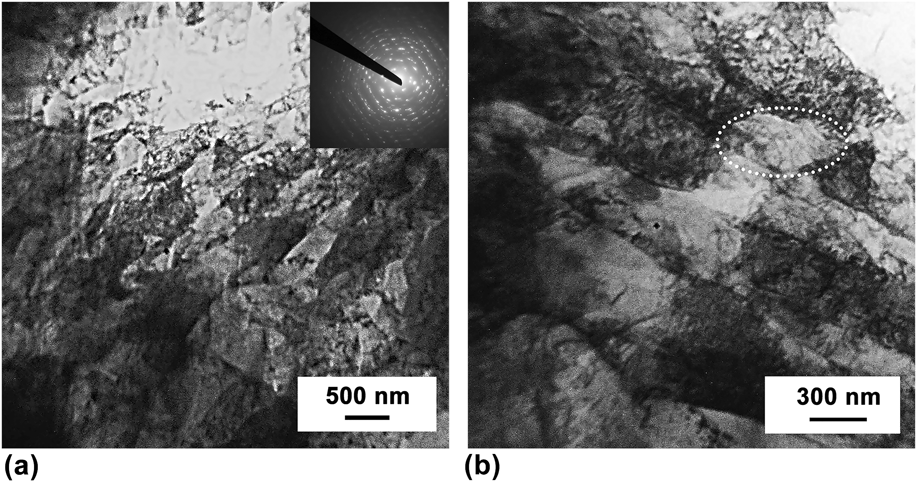
TEM micrographs of the ECAP-processed Ti through four passes are shown in Fig. 4 together with a representative selected area electron diffraction (SAED) pattern in the inset of Fig. 4(a). Observations indicate that the microstructure is highly strained with nonuniform contrasts because of the presence of high densities of lattice defects in the severely deformed state. The grains mainly have irregular shapes and are surrounded by boundaries that are not well delineated [Fig. 4(b)]. Thorough inspection of various microstructural images revealed an estimated average grain size of ∼250 nm. The diffraction pattern in Fig. 4(a) corresponds to the hcp phase with streaking of the diffraction spots representing the presence of elastic distortions and high internal stresses within the crystal lattice. These observations are typical of multipass ECAP-processed metals and demonstrate the presence of a large volume of high-energy nonequilibrium grain boundaries.Reference Stolyarov, Theodore Zhu, Alexandrov, Lowe and Valiev18
TEM micrographs of Ti processed through four passes of ECAP at room temperature at low (a) and higher magnification (b). A representative SAED pattern is shown in (a). The grain including subgrains is delineated by dotted line in (b).

C. Mechanical properties
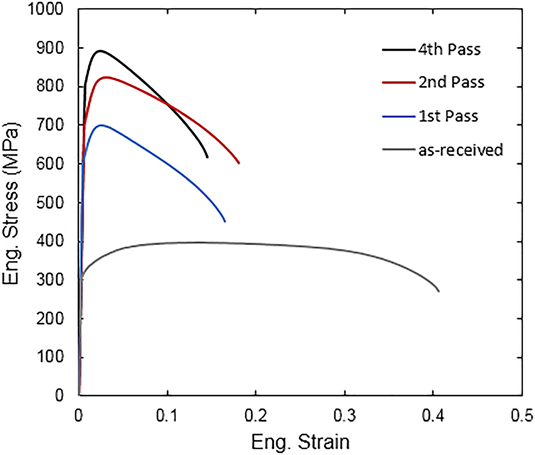
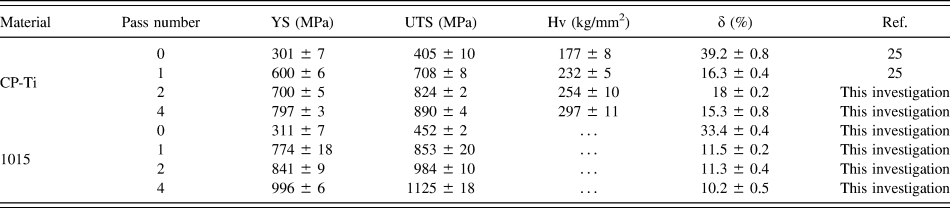
Representative plots of engineering stress against engineering strain of CP-Ti before ECAP processing (as-received) and after ECAP processing through one, two, and four passes using an initial strain rate of 1.0 × 10⁻³ 1/s are shown in Fig. 5. Table I summarizes all of the mechanical properties data derived from the samples shown in Fig. 5 and mechanical properties of sheath metal, 1015, before and after ECAP processing. The results confirm that there is a considerable increase in microhardness (Hv), yield stress (YS), and ultimate tensile strength (UTS) of Ti from 177 kg/mm2, 301, and 405 MPa at the as-received condition to 297 kg/mm2, 797, and 890 MPa after four passes of ECAP processing. This strength increment is associated with a reasonable decrease of elongation to failure (δ) from 39.2 to 15.3%. A similar trend can be observed for mechanical properties of 1015, where the yield stress and tensile strength are enhanced to 996 and 1125 MPa, respectively, while the elongation to failure is diminished to 10.2% through four passes of ECAP processing.
Engineering stress–engineering strain curves of Ti at different processing conditions.

Yield stress (YS), UTS, Vickers microhardness (Hv), and elongation to failure (δ) of Ti and 1015 at various conditions.

IV. DISCUSSION
A. Effect of core–sheath configuration and the role of back pressure
The obtained results directly demonstrate the effectiveness of core–sheath method in successful ECAP processing of a CP-Ti as a hard-to-deform metal through four passes using a conventional die with an internal channel angle of 90° at room temperature (Fig. 1). It was reported earlier that the natural back pressure presented with the core–sheath billet configuration leads to transformation of tensile stress modes in the main deformation zone (MDZ) to fully compressive stress states. It has been shown that the friction force between the sheath and inner surface of die is the source of back pressure (P) on the core which can be calculated using the following equationReference Derakhshandeh, Nili-Ahmadabadi, Khajezade and Shahmir25:
 $$P = \left( {{{2m{\sigma _{\rm{Y}}}} / {r{3^{1{\rm{/}}2}}}}} \right)l\quad ,$$
where m, the shear factor between the core and sheath, is 0.1. σY is the yield stress of the sheath after ECAP processing at each pass (reported in Table I). In this equation, r and l are billet radius and the longitudinal length from the end point of the core to the tip of the billet. It is apparent that the sheath acts nearly analogous to a die with sliding floorReference Semiatin, Delo and Sell37; however, the value of back pressure in the core–sheath method is not constant and varies linearly with respect to the distance to the tip of the billet.Reference Derakhshandeh, Nili-Ahmadabadi, Khajezade and Shahmir25 According to Eq. (1) and by considering initial l of 40 mm, r of 10 mm and considering the obtained mechanical properties of 1015 reported in Table I, the values of imposed back pressure at the tip of the core (the minimum value of imposed back pressure on the core) after the first, the second, and the fourth passes, can be calculated as ∼402, 436, and 517 MPa, respectively. It is apparent that the ductility of metals decreases after processing through one pass of ECAP. This manner especially becomes crucial in the processing of a hard-to-deform metal such as Ti which is severely prone to segmentation. Therefore, in comparison with the first pass of ECAP processing, imposing a higher magnitude of back pressure during further number of passes is inevitable. Taking advantage of 1015 as sheath metal not only provides adequate back pressure during first pass but also leads to successful processing through higher passes due to its work hardening at each pass. Thus, alongside core–sheath billet dimensional parameters and the yield stress of the sheath, the work hardening of sheath metal must be deem in multiple-pass ECAP processing CP-Ti.
In addition to experimental results and analytical calculations, the results of simulations (Fig. 2) clearly show that during deformation at higher pass numbers, the core and the sheath behave as a single solid billet and approximately undergo the same amount of shear strain. Furthermore, the simulation results exhibited equivalent strains of more than 2 and 3 after the second and third passes of ECAP processing, respectively. According to the well-known equation,Reference Furukawa, Iwahashi, Horita, Nemoto and Langdon36 an equivalent strain of ∼1.05 can be obtained practically in each pass. Therefore, the accordance of calculated cumulative equivalent strain with simulation results (Fig. 2) clearly reveals that the core experiences shear strain and an equivalent strain of more than ∼4 after four passes as it is supported by high increment of hardness and UTS.
B. Interpretation of the microstructure
Microstructural evaluation of the processed-Ti through four passes of ECAP at room temperature using the core–sheath billet configuration (Figs. 3 and 4) reveals mixed elongated and equiaxed grains with an average size of ∼250 nm. Grain interiors predominantly contain high dislocation densities with relatively small features which can be ascribed to a cell structure including dislocation cells and crystallites.Reference Podolskiy, Ng, Psaruk, Tabachnikova and Lapovok27 The measurements reveled an average size of ∼100 nm for dislocation cells; while, the size of crystallites lies below this magnitude. Moreover, a few number of grains which consist of subgrains with an estimated size of ∼100 nm could be observed in the microstructure as well [shown by dotted line in Fig. 4(b)]. The subgrains could have probably formed due to partial dynamic recovery within the mentioned grains. In comparison to processing at elevated temperatures where the grains are mainly free of dislocations due to extensive dynamic recovery,Reference Podolskiy, Ng, Psaruk, Tabachnikova and Lapovok27 processing at room temperature by taking advantage of the core–sheath method has led to a microstructure with significantly high dislocation density. This low processing temperature has limited activation of softening mechanisms which are characteristics of high temperature processing.
It is well known that back pressure reduces the outer corner angle of the work-piece at the MDZ during ECAP processing, which enhances the imposed strain and also its uniformity throughout the sample.Reference Son, Lee and Im38 In addition, it has been revealed that applying back pressure can activate additional nonbasal slip 〈c + a〉 that results in an enhancement of grain refinement in magnesium alloys.Reference Kang, Liu, Wang and Zhao39 It has also been demonstrated that applying back pressure would result in enhancement of dislocation density in both cell walls and cell interiors.Reference Mckenzie, Lapovok and Estrin40 The high density of dislocation in the microstructure confirms significant dislocation slip during deformation [Fig. 4(b)]. Basically, owing to the hcp structure of α-CP-Ti and limited number of dislocation slip systems, twinning plays a significant role in accommodation of strain in the first pass of ECAP processing at room temperatureReference Chen, Li, Xu, Hjelen and Roven41 and initial two passes of ECAP processing at a relatively low temperature where critical resolved shear stress for twinning is lower than dislocation slip.Reference Gu, Ma, Jiang, Yuan and Li42 Thus, one of the main features of the microstructural evolution of CP-Ti during ECAP processing at low temperatures is intensive deformation twinning and these twin boundaries may have a significant influence on the evolution and/or the refinement of the microstructure during further straining following the saturation of twinning.Reference Zherebtsov, Dyakonov, Salem, Sokolenko, Salishchev and Semiatin43
C. Improvement of mechanical properties
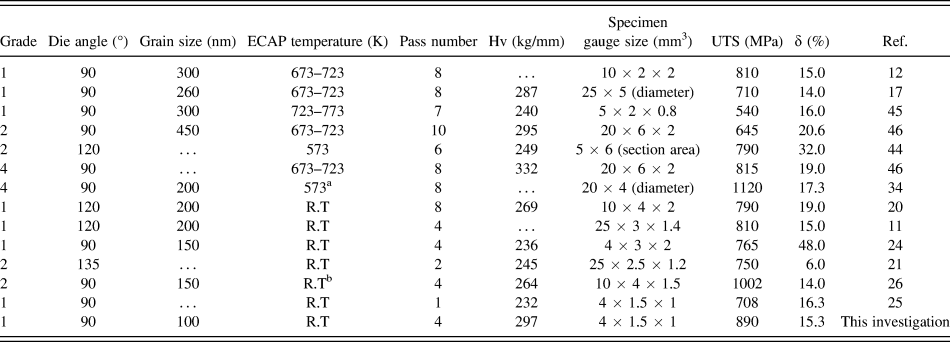
According to Table I, a remarkable increase of more than 100%, 150%, and nearly 70% in UTS, yield stress, and microhardness were, respectively, achieved in the present investigation after ECAP processing through four passes. To compare the obtained results with earlier studies, a summary of mechanical properties of CP-Ti processed through ECAP at various processing conditions is summarized in Table II. Inspection of Table II clearly demonstrates the significant mechanical properties improvement in this investigation compared to ECAP-processed samples at elevated temperaturesReference Vinogradov, Stolyarov, Hashimoto and Valiev12,Reference Stolyarov, Theodore Zhu, Alexandrov, Lowe and Valiev18,Reference Sordi, Ferrante, Kawasaki and Langdon44–Reference Stolyarov, Zeipper, Mingler and Zehetbauer46 or room temperature with dies of internal channel angle of 90°Reference Serra, Morais, Elias, Semenova, Valiev, Salimgareeva, Pithon and Lacerda5,Reference Derakhshandeh, Nili-Ahmadabadi, Khajezade and Shahmir25,Reference Jäger, Gärtnerova and Tesař26 or higher.Reference Valiev, Semenova, Latysh, Shcherbakov and Yakushina6,Reference Figueiredo, Barbosa, Zhao, Yang, Liu, Cetlin and Langdon11,Reference Zhao, Yang, Liu, Wang and Langdon20,Reference Zhang, Figueiredo, Alhajeri, Wang, Gao and Langdon21
Experimental parameters of ECAP processing and mechanical properties of ECAP-processed CP-Ti in different investigations. All tensile tests have been conducted at room temperature and an initial strain rate of 1.0 × 10⁻³ 1/s.

a Processed by encapsulation-aided ECAP.
b ECAP-processed by applying back pressure using second plunger equipment in the exit channel.
Room temperature ECAP processing of metals suppresses dynamic recovery and recrystallization which results in a notably nonequilibrium character with relatively smaller grain sizes and higher strength levels.Reference Podolskiy, Ng, Psaruk, Tabachnikova and Lapovok27 However, in contrast to Ref. Reference Zhao, Yang, Liu, Wang, Huang and Langdon24 in which the CP-Ti of grade 1 has been ECAP processed at room temperature via a die with an internal channel angle of 90°, the results of the present investigation shows a significant improvement in the strength level. The activation of nonbasal slip, enhancement of the imposed strain, and increase in dislocation density when the back pressure is present during deformation can lead to an increase in accumulation of internal defects.Reference Kang, Liu, Wang and Zhao39,Reference Mckenzie, Lapovok and Estrin40 The defects are effective barriers for dislocation motions and increase the strength level. Consequently, despite smaller reported average grain size in Ref. Reference Zhao, Yang, Liu, Wang, Huang and Langdon24, the higher strength level in the present study can be attributed to the higher level of internal defects. Therefore, the enhanced strength of grade 1 CP-Ti in this investigation that lies within the strength level of CP-Ti of higher than grade 1 is justified by ECAP processing via the core–sheath method. It is worth noting that room temperature ECAP processing of the CP-Ti used in this investigation results in segmentation of the work-piece when the core–sheath billet configuration had not been applied.Reference Derakhshandeh, Nili-Ahmadabadi, Khajezade and Shahmir25
Inasmuch as the core–sheath method eliminates the necessity of extra plunger, which has been almost mainly used for the imposition of backpressure, or heating facilities to increase the deformation temperature, it can be deemed as an easy and viable procedure. In addition, it is apparent that by decreasing the outer channel angleReference Jäger, Gärtnerova and Tesař26 which leads to larger cumulative equivalent strain and/or increasing the grade of CP-Ti,Reference Jäger, Gärtnerova and Tesař26,Reference Li, Pang Ng, Do Jung, Kim and Estrin34 higher strength levels can be achieved by taking advantage of this method.
Another considerable feature in Table I is the decrease in ductility after multipass ECAP processing. This decrease in ductility is reasonable and could be due to diminish in the stain hardening of metals after SPD processes.Reference Ma47 ECAP-processed CP-Ti through four passes exhibits a 15% elongation to failure which is significantly lower in comparison with the as-received condition, but it is approximately at the same level of elongation after one pass of processing (Table I). The elongation to failure in the tensile test severely depends on the dimensions of gauge.Reference Zhao, Guo, Wei, Dangelewicz, Xu, Zhu, Langdon, Zhou and Lavernia48,Reference Zhao, Guo, Wei, Topping, Dangelewicz, Zhu, Langdon and Lavernia49 As it is conventional in the literature,Reference Vinogradov, Stolyarov, Hashimoto and Valiev12,Reference Zhao, Yang, Liu, Wang and Langdon20,Reference Zhao, Yang, Liu, Wang, Huang and Langdon24–Reference Jäger, Gärtnerova and Tesař26,Reference Stolyarov, Zhu, Lowe, Islamgaliev and Valiev45 very small tensile specimens have also been prepared for the present investigation due to the limited size of the produced material. Therefore, comparing the elongation to failure of different samples reported in Table II with different gauge dimensions is not reasonable.
It is well-known that short-term post-deformation annealing at appropriate temperatures leads to remarkable improvement in elongation to failure associated with increase in strength.Reference Valiev, Sergueeva and Mukherjee50,Reference Semenova, Salimgareeva, Da Costa, Lefebvre and Valiev51 Therefore, it can be anticipated that ECAP processing of CP-Ti via the core–sheath method and following post deformation annealing could lead to a higher strength bio-compatible material associated with good ductility for biomedical applications.
V. CONCLUSION
(1) Hard-to-deform grade 1 CP-Ti was successfully processed up to four passes by ECAP at room temperature via the core–sheath billet configuration and using a die with 90° internal channel angle. The FEM simulations also revealed that the core–sheath billet deforms as a solid billet together with a high extent of strain homogeneity within the core through higher number of passes.
(2) It was demonstrated that induced back pressure on the core can be enhanced by using a high strength material such as AISI 1015 steel as a sheath. Moreover, due to work hardening of the sheath metal at each pass and following increase in value of back pressure, it is feasible to process hard-to-deform metals such as CP-Ti for numerous deformation passes.
(3) High magnitude of imposed back pressure and processing at room temperature contributed to the formation of an UFG microstructure associated with significantly high density of dislocation.
(4) ECAP-processed CP-Ti after four passes showed an outstanding enhancement of UTS up to 890 MPa associated with reasonable elongation to failure of 15.3%. The significant increase in UTS (more than 100%) after processing by ECAP using the core–sheath billet configuration was justified by higher density of dislocation and ultrafine structure, which clearly shows the efficiency of this method in developing the mechanical properties of CP-Ti.
ACKNOWLEDGMENT
The authors gratefully acknowledge Mr. Ali Khajezade for useful discussions of simulations.