The term shen-ti wen-hua (身體文化), which can be translated as ‘culture of the body’, was first used by theatre critic Wang Mo-lin in the second half of the 1980s in his writings on the experimental performances taking place in Taiwan during the incendiary years before and after the lifting of martial law in 1987. In an article entitled ‘Taiwan's Rebels of the Flesh’, he commented on the various street performances popping up in Taipei in 1986, which challenged state-imposed taboos on public gathering, the use of public space and nudity. He observed, ‘During the year of 1986, the series of events involving the “revolt of the flesh” made us aware of the burgeoning new culture of the body’.Footnote 1 In another article, ‘Exploring the Culture of the Body’ (1989), he began by stating,
We all think of our bodies as ‘my body’, meaning a subjective entity not belonging to any objective material conditions. But seen through the relationship constructed between individuals and society, ‘my body’ has already been transferred from the domain of ‘mine’ to become a ‘national’, ‘social’ and ‘cultural’ apparatus. So-called ‘body language’ is the material presentation of a ‘national institution’, ‘social regulation’ and ‘cultural meaning’ through corporeality.Footnote 2
The focus on the body as a provocative site of contestation, revolt and innovation in the late 1980s testified to its having been an object of heavy ideological investment in Taiwan from the beginning of the twentieth century. At the same time, Wang's remarks also hinted at the fact that the body, though intensely inscribed, was a taboo subject in the public domain under martial law. Hence, by joining ‘the body’ (shen-ti) and ‘culture’ (wen-hua) to formulate a public discourse, the concept of shen-ti wen-hua expressed a desire, on the one hand, to reflect upon the historical construction of Taiwanese people's bodies, and, on the other, to create alternative perspectives and new cultural traditions through rethinking and (re-)presenting those bodies.
It should be pointed out that shen-ti wen-hua, as illustrated in Wang's writings, denotes two layers of meaning. First, it underscores the original concept of the Chinese term shen-ti, where shen (身) means the whole being of a person, including the mental and physical aspects of one's existence, while ti (體) signifies the corporeal entity that contains the acts of shen. This understanding of a Chinese concept of shen-ti that already implies a relationship between the mind and the body had been lost due to the instrumentalization of the body, initially as a result of the project of modernity imposed on Taiwan by Japanese colonial rule (1895–1945), and then by the pro-US capitalist policies adopted by the nationalist Kuomintang (KMT) government during the Cold War. Second, Wang attempts to draw attention to a Foucauldian analysis of the body by highlighting the active role of the state and capitalist sociocultural apparatus in moulding the corporeal–psychological landscape of the Taiwanese people. Wang's discussions on the politics of the body with a clear awareness of power relations structured within a larger political–historical framework were quite exceptional in 1980s Taiwan; at the same time, they captured succinctly the underlying inquiries that many of the performance practices interrogated yet without explicitly stating them at the time.
This article will explore historically and theoretically the phenomenon of shen-ti wen-hua in the context of experimental performance during that period. By highlighting the different corporeal discourses in various sociopolitical contexts across time, I will address such critical issues as the relation between the individual and the collective in the history of Taiwanese modernity, the quests for identity in art and culture, the transformation of the role of the avant-garde in terms of aesthetic and political pursuits, and the ultimate question of the relationship between art and society from the colonial era to a contemporary world dominated by consumer culture and global capitalism. The body, with its innate existential materiality and rich semiotic possibilities, has at certain historical moments served as a potent metaphor for questioning the sociopolitical status quo and envisioning new identities and alternative power relations in Taiwanese society: the period under consideration here was one of those moments.
The politics of the body in the modern history of Taiwan
A prominent phenomenon of modernity in East Asia in the nineteenth and twentieth centuries was the ‘nationalization’ of individual bodies through physically strengthening the people and spiritually uniting the nation to resist the invasion of Western colonial powers. Japan, the first nation to enter the process of modernization in Asia, was also a pioneer in institutionalizing the bodies of its subjects through modern infrastructure such as civic education, medical science, administrative organization and police systems. The goal was to make bodies that were civilized and obedient, strong and hygienic, and hence productive. As a colony of the Japanese Empire from 1895 to 1945, Taiwan was inevitably conscripted into the imperial project of modernizing/nationalizing bodies, a development which was acutely intensified and militarized after 1937 as Japan ignited the second Sino-Japanese War (1937–45) and eventually brought Asia into the Second World War. The conscripted bodies of the Taiwanese, as soldiers, comfort women, military labourers and even performers on comfort tours, bore the deep imprint of the island's colonial history and early modernity.Footnote 3
After Japan was defeated in 1945, Taiwan was retroceded to China, then known as the Republic of China (ROC), led by the KMT. Since the mid-nineteenth century, China had been subjected to threatened and actual invasions by various colonial powers. In the many subsequent nation-strengthening programmes initiated by political authorities and intellectuals of the Qing court and the various governments that followed the establishment of the ROC in 1912, the reformation of the Chinese people was thought foundational, to be carried out on both mental–spiritual and physical levels. As a result, body reformation, through movements like banning foot binding for women, promoting physical education and military training for citizens, and implementing eugenic policies for marriage and reproduction, became central to national salvation and rejuvenation projects. Sociologist Huang Ching-lin observes that the defeat of China by Japan in the first Sino-Japanese War (1894–5) led many Chinese elites to believe that improving the individual bodies of citizens (shen-ti) and reforming the collective body of the nation (kuo-ti) were one and the same thing: ‘The discourse about the oneness of the two bodies [i.e. shen-ti and kuo-ti] resulted in giving over the value of individual bodies’ existence to the survival of national sovereignty’.Footnote 4 Because of the perennial threat from foreign forces as well as the endless wars plaguing China, individual bodies were constantly called upon to serve and sacrifice for the collective fate of the Chinese nation.
Imprinted by the imperial nationalism of the Japanese Empire on the one hand, and inheriting a Chinese nationalism fostered by a century of humiliating colonial invasions on the other, the bodies of the Taiwanese in the postwar era were deeply entrenched in the ideology of the collective.Footnote 5 On 28 February 1947, heavy-handed treatment by KMT agents of a woman selling cigarettes on the black market triggered a series of social uprisings against the government, whose violent response marked a brutal period of bodily persecution, including random killings and public executions.Footnote 6 In 1949, the KMT lost its anti-communist war on the mainland and, in October, was ousted by the Chinese Communists. Several months earlier, in May, martial law had been declared in Taiwan in preparation for Chiang Kai-shek and his troops’ final withdrawal to the island. The era known as ‘White Terror’ (1949–91) saw wide-ranging political oppression and innumerable cases of persecution carried out in the name of national security and anti-communism.Footnote 7 Meanwhile, Taiwan was made a military bastion for retaking the mainland, and a mini-China for representing the ‘authentic’ Chinese state in the global political arena.
Under martial law, restrictions on freedom of speech and thought were effectively exercised at the level of the body, and ranged from the ultimate deprivation of bodily freedom by death sentence or extended prison term, to prohibitions on public gathering and denial of the right to travel abroad, right down to strict regulation of the hairstyle, uniform and physical appearance of school students, along semi-military lines. At the same time, ideological indoctrination in anti-communism, Chinese nationalism and loyalty to the KMT and its leader was also enacted bodily. Military training was compulsory for all high-school and university students. Chinese national dance (min-zu wu-dao), an important means of re-sinicizing the Taiwanese, was promulgated nationally through state-sponsored competitions with the goal of moulding the bodies and minds of young students.Footnote 8 The most important effect of all these measures was the instrumentalization of bodies by the state, which encouraged their pragmatic functions in serving the collective goals prescribed by political authorities while discouraging sensuous awareness and individual exploration of the corporeal reality and its sociopolitical genealogy.
Awakening through the body: constructing discourses and identities
In a profound sense, the intensely circumscribed and inscribed body was the most poignant signifier from the era of martial law, whose layers of encoding awaited critical excavation and reflective interrogation. Not surprisingly, it was also the site where revolt erupted most violently and provocatively in the 1980s. According to the political commentator Nan Fang Shuo, political agitation began to take off in Taiwan between 1984 and 1986 just before the lifting of martial law. The unrest intensified in 1986 and 1987, and reached a climax in 1988 and 1989.Footnote 9 Street protests and mass demonstrations on issues including political reforms, environmental pollution, the plight of labourers and farmers, women's rights and housing problems took place almost daily in Taipei and other major cities. In Nan Fang Shuo's words, ‘When all rational arguments, analyses and communications were doomed to fail, only riots on the streets could make new things happen’.Footnote 10 After three decades of airtight control over freedom of expression, it seemed to many Taiwanese that only through the physical action of bodily conflict with the authorities could the massive institution of rule by martial law and the authoritarian KMT regime behind it be shaken and shattered.
Because of the heavily inscribed history of the body, every new inscription revealed meanings pointing toward layers of significance beyond the surface of the here and now. At a time when political dissidents were using their bodies to tear down political taboos imposed by martial law, artists also began to excavate the hidden history of the body and started constructing discourses that challenged the status quo. An early example is the street performance conducted by artist Chen Chieh-jen entitled Loss of Function, No. 3 (1983).Footnote 11 Five young men, each with his head wrapped in a red hood and wearing a black strip of cloth over the eye area, walked down a street in a file amidst the hustle and bustle of the Hsi-men district, a busy shopping area in downtown Taipei. The scene mimicked the parade of criminals on their way to execution in ancient times, a sight that would attract excited crowds. Surrounded by curious bystanders, the men suddenly began to scream towards the sky at the top of their lungs, or drop to the floor in dismay. Ostensibly, the doubly blindfolded faces, along with medical gauze wrapped around the feet, signalled a physical state of not functioning properly, hence the aimless screaming. But seen against the backdrop of a society under martial law, the image also suggested the victims of political persecution during the February 28th Incident or the White Terror era, two highly sensitive subjects in 1980s Taiwan. Chen's interest in reading and presenting the body as a locus of historical narration on power structures would be further developed through digital photographic images and video creations from the 1990s onward.
One of the most significant features of the burgeoning performance scene at that time was the focus not just on the non-verbal language of the body but also on the material existence and metaphorical potential of the corporeal entity. An event that produced a long-lasting impact in performing-arts circles was the first performance of Japanese butoh, by the company Byakko-sha, in March 1986. Taipei's conservative media attacked their performance of Skylark and Lying Buddha for its use of nudity, obscene provocations and chaotic spectacles. Yet at the same time it stirred up enthusiastic responses from young people enthralled by its aesthetics of disorder and irrationality.Footnote 12 Reminiscing about the event many years later, Wang Mo-lin, the first person to write about butoh in Taiwan, summarized the significance of Byakko-sha's performance for Taiwan at that time. It presented an existence for the body that was not defined by the collectivity of the nation state. The performance went beyond attending to movement vocabulary or technique but instead conceived of the body as a pathway to the spiritual world.Footnote 13 In the historical context of the time, people like Wang perceived in Byakko-sha's physical–spiritual imagery an awareness of revolt that deviated from and defied the overly rational and pragmatic formulation of the body prescribed by the official ideology of (state) collectivism.
In the domain of theatre, the target of revolt was the realist theatre, known as hua-chu (spoken drama), inherited from the May Fourth Movement and promoted by the KMT as a cultural instrument for enacting official propaganda. Analysing the heritage of realism in modern Chinese art, art critic Li Xianting argued that behind the advocacy for realist aesthetics in early twentieth-century China was an urgent call for the spirit of social involvement (ju-shi ching-shen) due to the historical context of colonial invasions at the time. Realism, with its functionalist concerns and mimetic tendency, was believed to be the most effective artistic vehicle for awakening the masses to the crisis of the nation.Footnote 14 This rhetoric about the close ties between the function of art and the fate of the nation was adopted by the Chinese Communists and the KMT alike. Hence realist art dominated both sides of the Taiwan Strait in the postwar era and became the favoured instrument of state dogmatism for both regimes. This resulted in the suppression of other styles of artistic expression. Clearly, by contrast with the bourgeois individualism of Western realist theatre, against which Euro-American avant-gardists revolted, realist theatre in post-war Taiwan was closely bound up with the consciousness of national collectivism.
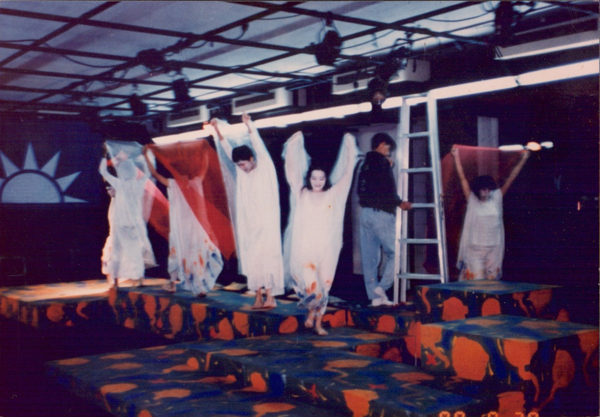
To counteract hua-chu, experimental performances in the 1980s upheld the body as a more powerful medium than verbal language for addressing fundamental issues shaping the mental history and collective (sub)consciousness of the society. The theatre group that most effectively explored the subversive as well as creative power of the body was perhaps the Critical Point Theatre (Lin-chieh-tien Chu-hsian-lu) founded in 1988 by director Tian Chi-yuan (1964–96). An openly gay man, Tian launched his company with the blasphemous Mao-shi (1988). Literally meaning ‘Mao's corpse’, the title was translated into English as Love Homosexual in Chinese in bold letters on the poster.Footnote 15 Tian used the taboo subject of homosexuality to attack the interlocking structures of Confucian moralism and the KMT state, which together contrived an ideological network controlling the bodies, thoughts and sexualities of the people. Citations from ancient Chinese poetry were adapted to insinuate homosexual desire or to comment on familiar KMT propaganda, such as the many nationalistic slogans that turned Confucius’ moral teachings into patriotic beliefs. The actors, wearing white facial make-up and flowing white gowns, presented comic impersonations of Chinese ghosts in order to stage a satirical elegy on orthodox Confucianism, which had been the foundation of political power and state legitimacy in Chinese culture for nearly two millennia. At the end, an actor posed the questions, ‘Didn't Confucius fart? … Are you sure that Confucius never farted? If Confucius ate, he must have farted’. This blasphemous exclamation brought the play to a climactic ending, in which the actors danced hilariously all over a stage surrounded by the audience to the blaring melody of Beethoven's exuberant Ninth Symphony.
(Colour online) The actors dance across the stage in a rehearsal of Mao-shi. On the backdrop hangs the symbol of the KMT cut in half. Image used with permission from the Special Collection of National Tsing Hua University Library.

While Mao-shi attempted to restore the raw reality of flesh and desire to the disembodied and thus dehumanized tradition of orthodox Chinese culture, another work by Tian, Pai-shui (White Snake) (1993) further interrogated the subversive power of the queer body, whose gender ambiguity created a liminal corporeal space where regulations and conventions about love, desire and humanity were suspended. Tian ingeniously integrated the actors’ bodily movement with the rhythmic citation of poetic text appropriated from the traditional Chinese opera script Madam White Snake.Footnote 16 This popular legend about the taboo love between a man and a snake, who transforms herself into a beautiful young woman, was cleverly converted into a highly suggestive tale about gay love onstage since all the roles were played by men. The most potent aspects of the play, in addition to the poetic language full of rhymes and musicality, were the body images based on a highly gendered semiosis, and a stylistic movement vocabulary. For instance, the actor who played White Snake, Wen Chi-hsing, wore feminine make-up adopted from traditional Chinese theatre, but bared his torso, which featured a white serpentine shape painted on his chest. In contrast, the actor who played Hsu Hsian, White Snake's human husband, was dressed in traditional female costume, but failed to assume enough feminine characteristics to turn him into a ‘woman’. The movement leitmotif of wavy bodily gestures, which were performed by all actors, suggested the slithering motion of serpents and hinted at a feminine bodily quality. But since all actors spoke in their original male voices, gender identities became extremely ambiguous in the play. The effect was of unsettled gender signifiers floating in the language, movement and bodily appearance of the actors, where affection and erotic desire were played out amidst multiple and troubled combinations of genders, thus provocatively subverting the heterosexual morality still dominating Taiwanese society.
One unique thing about Tian was his ability to integrate the corporeal interrogation of individual existence with the excavation of Taiwan's sensitive political history. The actors’ bodily performances became visceral narrations of (collective) memories about Taiwan's dark past. The most telling example was the performance of the actor Ah-chung (Cheng Chi-chung), a disabled man whose legs were seriously deformed due to infantile polio. Tian drew upon the physical strength and metaphorical power of Ah-chung's bodily performance in Ah-nu, White Marguerite (1994).Footnote 17 In the scene symbolically enacting Japan's colonization of Taiwan, Ah-chung, with his back to the audience, stood on his shoulders with limp legs crossed in mid-air. Behind him, one after another, appeared a sumo wrestler wearing a G-string with the Japanese imperial sun flag painted on it, a samurai with a sword, and a Japanese ghost, who rose slowly into the sight of the audience. Ah-chung began to crawl downstage. As the three symbolic Japanese figures sat down in a row and started to laugh and scream hysterically with their bodies shaking, Ah-chung, his neck fettered with an iron chain leading upstage, wriggled and twirled his torso on the floor violently as if in great pain and then waved his deformed legs in the air like a dying insect struggling for life.
Ah-chung's ‘disfigured’ body created an alien image of ‘the other’. Tian's intention lay not only in materializing the colonized subject of Taiwan through the corporeal reality of the actor, but also in drawing the audience's attention to the existential condition of Ah-chung's differently formed body. Explaining the intensity of Tian's work, Ah-chung commented,
You [the audience] almost felt like watching a person being tied up on stage and having his chest torn open by an iron hook. His heart was taken out and eaten. Because Tian confronted death directly, he knew the pain of being prejudiced against or being dictated to by someone.Footnote 18
Having been diagnosed as HIV-positive, Tian looked into the darkness of life with extreme candour and bravery.Footnote 19 Ah-chung's body became a potent metaphor to him for the pain and incompleteness of life. Yet at the same time, he saw in it an authentic existence that one could only discover by penetrating the superficial surface of things. Likewise to Tian, in the years immediately following 1987, the revelation and construction of an authentic contemporary Taiwanese identity could only be realized by stripping away all political–social–moral taboos and gazing into the dark corners and suppressed memories of diverse histories.
Cultural-studies scholar Chen Kuan-hsing argues that during a process of decolonization, identity politics must go beyond the creation of indigenous myths and heroes and adopt the ethical principle of ‘becoming others’, through identifying with the deprived and the underprivileged.Footnote 20 If the lifting of martial law in 1987 could be seen as a belated first step towards decolonization in Taiwan, Tian, through his subversive acts questioning the moral–political status quo in the works analysed above, created authentic subjectivities for hitherto marginalized subjects. The intertextuality between the larger history of Taiwan and the existential conditions of individuals embodied through the actors’ corporeal presence gave Tian's theatre a sense of tension, a feeling of being always on the edge of things, which was one of the core meanings defining the spirit of avant-gardism in the 1980s and early 1990s.
The turning of the avant-garde
Chien-wei (前衛), the Chinese term most often used to translate the concept of the avant-garde in Taiwan, was first adopted by critics and historians to describe an anti-academic art movement initiated by young painters in the 1950s. According to art historian Hsiao Chung-jui, the chien-wei fine-arts movement in post-war Taiwan was in fact a re-emergence and continuation of the unresolved modernization project in fine arts in pre-war China.Footnote 21 The post-war revolt in Taiwan was primarily about aesthetic conflicts between innovation and conservatism, modernism and traditionalism.Footnote 22 Significantly, the form the young rebels found most attractive was abstraction. In addition to the influence of post-war art trends from the West, especially abstract expressionism from the US, abstract art appealed to them for several reasons. First, it departed fundamentally from the academic mainstream at the time, which favoured figurative art. Second, its non-representative ambiguity provided a more unrestrictive space for self-exploration, which was especially important to the post-war generation in view of the highly oppressive political ambience in the era of White Terror. Third, as these young artists, having emulated the styles and techniques of Western modern schools, began looking into Chinese art heritage for expressive languages that would endow their works with cultural uniqueness, they found a high degree of congruence between modern abstract art and the emphasis on the expressive power of line and ink shades in Chinese calligraphy and water ink painting (shui-mo-hua). Eventually, two intertwined themes emerged: upholding individual expression on the one hand and modernizing Chinese art through reinterpreting tradition on the other.
There is no denying that the ambiguous meaning of abstract art provided a protective shield for these young radicals; yet at the same time, it also prevented them from commenting on the sociopolitical reality of post-war Taiwan. As most of the chien-wei artists migrated to Western countries in the 1960s in pursuit of a better art environment and more freedom in creation, the post-war avant-garde movement subsided.
The term chien-wei re-emerged in the 1980s to describe the many performance experiments taking place before and after the lifting of martial law, which have been alternatively called the ‘Little Theatre Movement’. In comparison to the ‘purely’ aesthetic revolution attempted in the post-war chien-wei, the 1980s avant-garde aimed at more direct engagement with Taiwan society. In the combustible social atmosphere around 1987, chien-wei was first of all about dramatizing and confronting the sociopolitical status quo under martial law as well as the many urgent issues surfacing at the time. As a result, theatre performances were as much social movements as art events; conversely, sociopolitical campaigns were often conducted by means of theatrical strategies. In both contexts, the most important mediums were the bodies marching, protesting, or caught in conflicts with law enforcement. In the climactic years from 1988 to 1990, many theatre groups or individual artists were involved directly in social movements and political activities. The year 1988 saw, amongst other things, a protest against nuclear waste storage on Orchid Island, which was inhabited by the indigenous Dawu tribe, as well as a demonstration against the unregulated exploitation of Taiwan's forest resources. In 1989, some artists even participated in the national election campaigns of candidates nominated by the newly established opposition party, the Democratic Progressive Party (the DPP), for the Legislative Yuan. In March 1990, less than one year after the Tiananmen Square incident in China, student activists gathered on the square of the Chiang Kai-shek Memorial Park in Taipei. They demanded that those National Assembly representatives who had been elected forty years ago in mainland China should retire, and that direct presidential elections be held. Theatre groups like U-Theatre and others joined the demonstration and led the students in performing a symbolic funeral procession for the wan-nien kuo-tai (ten-thousand-year-term representatives), as they were satirically called.Footnote 23
However, as theatre researchers and practitioners alike have noted, this first wave of avant-garde performance in postwar Taiwan, the period of political theatre, receded rapidly after 1990.Footnote 24 Theatre director Li Huan-hsiung, one of the key figures in the avant-garde theatre movement, recalled,
We suddenly cooled down because we found that the social and political activists had learned all the strategies and forms [we had brought to their movements]. They no longer needed us to wave the banners for them. So we started to think about what belonged to theatre and what to politics – after the passion of the movements receded, what was left that truly belonged to theatre?Footnote 25
Li's observation points out the very different nature of the chien-wei movement in 1980s Taiwan, compared to the avant-gardism that originated in Europe. Peter Bürger, one of the most influential theorists of the European avant-garde movement, defines the avant-garde as the self-criticism of art in bourgeois society. According to Bürger, as bourgeois society developed, the economic and political systems became detached from the cultural one, and the traditional function of the arts, their ritual usage in religion, was replaced by the ideology of fair exchange. As a consequence, art became a separate sphere detached from the praxis of life – the so-called ‘autonomy of art’, or aestheticism, which was realized in the second half of the nineteenth century.Footnote 26 Hence the historical avant-garde of the early twentieth century criticized art as an institution and attempted to reintegrate art into the praxis of life.Footnote 27
The KMT's political regulation of cultural production in post-war Taiwan resulted in the alienation of art from people's lives. For the same reason, art never acquired the status of autonomy under martial law since it was strictly censored and often endowed with a dogmatic, edifying function. The performative avant-garde in the 1980s fought to integrate art into the praxis of life partly because people craved the autonomous expressive power of art free from political interference, only to find out that it was not possible without first liberating the society. In a sense, to some participants of the chien-wei theatre movement, art was politicized in order to free art from politics. Yet as indicated by Li's words above, after the constraints were relieved, the fundamental question remained: what is contemporary Taiwanese theatre (or dance, or fine arts …)?
In The Tension of Art: Taiwanese Fine Arts and the Politics of Culture, art historian Liao Hsin-tien poses the provocative question, ‘Who needs subjectivity [chu-ti-hsing]?’ He argues that an entity that senses or fears the loss of subjectivity tends to pay special attention to the issue. The marginal and passive role that Taiwan was traditionally allotted in history means that the crisis of subjectivity has always been embedded in the process of pursuing it.Footnote 28 To Liao, the construction of the subjectivity of fine arts in Taiwan has been closely intertwined with the formation of a consciousness of Taiwanese subjectivity due to the island's colonial past.Footnote 29 In other words, the aesthetic question of ‘what the art is’ has been inseparable from the cultural–political question of ‘who we are’.
In retrospect, the emergence of shen-ti wen-hua at the critical juncture of the 1980s, in addition to highlighting the corporeal revolt in socially and politically engaged avant-garde performances, pointed towards a desire to rediscover and reconstruct cultural identity through the body in performance. Reflecting upon the development of U-Theatre (founded in 1988) around 1990, the company's founder and artistic director Liu Ching-min (later known as Liu Juo-yu) said,
After going abroad and then coming back … I often told my company members that I wanted to grow up again in the environment of Taiwan. Why? It seemed to me that I had grown up before, but in that process there had been something unbalanced or lost. I felt that there was something I needed to understand again. Because I wanted to understand, so I had to [grow up] all over again.Footnote 30
This sense of loss or uncertainty about ‘who I am/we are’ vividly captured the burning issue of a quest for identity in Taiwan at the time.
A major in Chinese theatre (mainly jingju) in college, Liu was shocked when she heard Jerzy Grotowski describe her as a ‘westernized Chinese’ while attending the latter's Objective Drama project at UC–Irvine from 1984 to 1985.Footnote 31 After returning to Taiwan in 1985, she participated in several theatre productions and conducted workshops using Grotowski's methods before establishing U-Theatre in 1988. The goal, according to the founding statement, was to ‘make the performers own a Chinese body’, which was believed to have been lost due to the process of modernization/westernization.Footnote 32 The task was carried out in the Retracing Project (Su-chi-hua) from 1989 to 1992. Deeply influenced by Grotowski's concept and practice of Objective Drama, the Retracing Project looked towards traditional Chinese body–mind training systems like tai-chi tao-yin and chi-kung, Taiwanese folk performances che-ku and pa-chia-chiang, and religious rituals such as the on-foot pilgrimage of the Taoist deity Ma-tsu, as the ‘sourcing techniques’.Footnote 33 According to Grotowski, the purpose of Objective Drama was to ‘evoke a very ancient form of art where ritual and artistic creation were seamless’.Footnote 34 In yoga, the whirling dervishes, Zen-inspired martial arts and other non-Western body–mind cultivation methods, he identified traces of ‘pre-differentiation art’, what he called the ‘sourcing techniques’. These were utilized in Objective Drama as tools for retracing modern man's connection to the cosmos or source of life. While Grotowski aimed at reaching the transcultural roots of human existence, Liu's interpretation was highly culturally specific. In a 1989 interview, she said, ‘When I started doing the Retracing Project, I felt … it must be a cultural movement. So I stated specifically at the time that I wanted to search for the “Chinese body”.’Footnote 35
Though briefly involved in political theatre, Liu's interest lay in establishing a modern Chinese/Taiwanese theatre, in which the culturally rooted body served as the primary medium of communication. To Liu, the ‘sourcing techniques’ were not only employed for training the performers’ body and mind, but more importantly were transformed into materials for creating the body language and dramatic forms of her theatre. From 1989 to the end of 1992, the Retracing Project produced a series of theatrical productions culminating in works like Lao-hu Chin-shi (The Tiger Chin-shi), which was based on a fictional story from the Tang Dynasty (AD 618–907), and Mo, Shui-ching-chi (Desert, the Tale of Water Mirror), adapted from the story of a heroine from the Han Dynasty (206 BC–AD 219). In both performances, the ancient tales, in addition to signifying connection to Chinese cultural roots, provided narratives of human struggles over self-identity. Lao-hu Chin-shi was about a disenchanted scholar-officer who turned into a man-devouring tiger in self-exile and was torn between the identities of being a human being and a beast. Mo, Shui-ching-chi told the story of Tsai Wen-chi, a noblewoman caught in the conflict between her homeland and the land where her children were born following an arranged political marriage.
The most distinctive features of these two performances were the bodily images and movement styles of the actors. In both plays, the costumes were adapted from Taiwanese hand puppetry. A stick was placed horizontally under the fabric at the place of the shoulders to create a puppet-like bodily image. The stick and the heavy costume not only enlarged the actors’ bodily shapes but also influenced the way they moved. Masks were also used. In Lao-hu Chin-shi, they were handheld, while in Mo, Shui-ching-chi they were worn on the face. Besides imitating the movement style of hand puppets, some male actors also incorporated the body language of pa-chia-chiang, thus giving the characters an otherworldly presence. The mystic and ancient ambience conjured up by these theatrical elements was further enhanced by the outdoor environment of U-Theatre's home base, which is located on a hillside in the suburbs of Taipei, where the two plays premiered.
It seems ironic in retrospect that U-Theatre's search for an authentic Taiwanese/Chinese/Eastern body resulted in the actors’ bodies being covered with heavy costumes except for their heads and hands. Though Liu pointed out that in order to overcome the restriction imposed by the costumes, the actors needed to summon inner energy from their whole bodies and thus created physical tension distinguished from everyday movement, she also explained that the choice was made because of the iconic images and colours derived from the costumes of hand puppets, which conveyed the identity of Taiwanese folk culture.Footnote 36 Commenting on the theatre productions of the Retracing Project, theatre scholar Chung Mingder wrote in 1992,
Has not U-Theatre, in its pursuit of performance belonging to the Chinese, presumed certain preverbal impulses, certain archetypes before the ‘pollution’ of modern life? The costumes, movements and environment presented in Shan-yüeh-chi and Lao-hu Chin-shi were all very impressive. They were obviously the results of long-term immersion in Taiwanese folk performance. However, the insistence on ‘archetypes’ and ‘impulses’ … might have alienated [the company's] artistic practice from the ‘reality’ of contemporary Taiwan.Footnote 37
Chung's warning questioned the relationship between the second-phase performance experimentation, as exemplified by U-Theatre's Retracing Project, and the social reality of 1990s Taiwan. The reorientation of experimental theatre from social engagement towards the interior interrogation of cultural aestheticism and the creation of artistic languages embodying Taiwanese culture reflected the changing milieu of the society at large. It was a time when the loosening of political control by the state, as well as the opening up of mass media for commercial competition, seemed to provide the space for civic participation in a sociopolitical agenda. At the same time, the pursuit of cultural aestheticism was encouraged by the official policy of cultural diplomacy initiated in the 1990s, which complicated the concept of shen-ti wen-hua within the context of globalization.
Returning to Shen-ti Wen-hua
Liu and U-Theatre's Retracing Project exemplified the dual task of retracing personal and collective cultural roots as well as constructing a theatrical aesthetics unique to Taiwan. It illustrated one of the primary ways of constructing a contemporary cultural identity for post-martial law Taiwan through rediscovering and reinterpreting the past, with the aim of redefining the present. The goal was to create an ‘alternative present’ distinguished from the linear development of modernization defined by capitalist logic and enlightenment ideology, whose influence was acutely intensified as a result of escalating globalization from the 1980s onwards. Amidst the political and social upheavals, transnational capitalist corporations and consumer culture arrived in Taiwan and began quietly changing the urban landscape and daily life of people. The most salient example was the appearance of international chain stores and fast-food restaurants, such as 7-Eleven, McDonald's, KFC and SOGO department stores, among many others, on the main streets of major cities. Before long, capitalist and commercial forces replaced political power in shaping the minds and deeds of the Taiwanese.
In his study of Euro-American avant-garde theatre, Christopher Innes writes, ‘The identifying signature of avant-garde art … has been an unremitting hostility to contemporary civilization’.Footnote 38 As a consequence, he points out, primitivism was a key feature defining avant-garde art in Euro-American culture, leading to two productive forms. One was the transformation of theatre into a laboratory for exploring fundamental questions about the nature of performance. The other was the exploitation of irrationality and dream states as well as the mining of ancient dramatic models, mythological material or tribal rituals.
In a similar spirit, many artists in the second-phase performance experimentation in 1990s Taiwan inquired into the nature of theatre by borrowing from indigenous religious rituals or traditional theatrical forms. An important trend was to create spiritual efficacy in theatre or dance that was able to transform individual participants, both performers and spectators alike, and thereby to transform society as a whole. In this form of theatrical exploration, spiritual transformation was to be achieved through the immersion of the individual in a larger existence, which could be a religious belief, a spiritual community, nature, or the cosmos. Anti-individualistic empathy was believed to be an antidote to the individualistic materialism plaguing contemporary society. This was apparent in an emerging trend for ‘Eastern body aesthetic dance’, alternatively called ‘body–mind–spirit dance’ (shen-hsin-ling wu-dao).Footnote 39 Deliberately rejecting Western dance techniques, such as ballet and modern dance, the ‘body–mind–spirit dance’ was inspired by butoh and sought the possibility of innovation in ancient body–mind cultivation practices such as yoga, tai-chi and chi. Dance groups associating themselves with this tendency included Tai-gu Tales Dance Theatre, Taipei Dance Circle, and Multi-Dimensional Dance Theatre, which were among the most active dance companies in 1990s Taiwan.Footnote 40
The above phenomena, while echoing Innes's analysis of the proclivity towards ‘primitivism’ in avant-garde art, were deeply entwined with the identity quest of the Taiwanese people and culture in the post-martial law era. This brings us back to one of the central issues of modernity: tensions between the individual and the collective. It is important to point out that one of the most important contributions of modernity to Taiwan and to Chinese culture at large is the reflective and interrogative consciousness associated with individual subjectivity, which counteracts the coercive tendency of collectivism. If the avant-garde is a heightened expression of modernity as defined by Călinescu, it ought to dramatize the precarious and complex relation between the individual and the collective.Footnote 41 In other words, avant-garde artists must always retain the ability and willingness to create a crisis in that relationship. This is especially crucial in a place like Taiwan, where the fear of the loss of collective identity, as a state or as a cultural entity, has for decades loomed large due to the island's unique history. As a consequence, the aesthetic question of ‘what art is’ has been too easily interlocked with the identity question of ‘who we are’.
The too-easy conflation of individual artistic exploration and collective cultural identification resulted in what I called earlier ‘cultural aestheticism’, which led to the codification of performance experimentation in the 1990s. The development was further reinforced by the government's policy of cultural diplomacy in that decade. The opening of China to the world in the 1980s led to the suppression of Taiwan's diplomatic activity in the international political arena. In response, the Council for Cultural Affairs (CCA; now the Ministry of Culture) implemented a strategy for increasing Taiwan's international visibility through art and culture. In both theatre and dance, it was works upholding the aesthetics of the ‘Taiwanese/Chinese/Eastern body’ that were most often sponsored and promoted by the CCA on international stages. But as the body turned into a cultural icon representing an emblematic Taiwanese/Chinese/Eastern essence, the opposite of the West or westernized modernity, it rapidly lost the capacity to bear witness to its own genealogy and to interact effectively with the history of the society.
In retrospect, it seems inevitable that post-martial law performance experimentation turned from political engagement to aesthetic exploration in order to inquire into fundamental questions about theatre and dance. This is a task that had, from the early twentieth century, been overshadowed by the edifying function of art. At the same time, experimental practices succumbed too readily to a collective anxiety about the quest for identity sweeping through Taiwan society in the 1990s. As a result, the reflective and interrogative energy associated with individual subjectivity became too easily subsumed within a larger metaphysical calling. If the concept and practice of shen-ti wen-hua is about a revolutionary thinking body, what Wang Mo-lin described in 1987 is still valid today: the body ‘should be a non-fictional semiotic entity capable of expressing its own genealogy, historicity and sociality. It is a body capable of being related to social history’.Footnote 42 In the new millennium, histories of political persecution in pre-war and post-war Taiwan are no longer taboo, and are even actively exploited as political capital by politicians in elections, while oppression of the bodies persists in problems that did not dissipate with political democratization. In view of the new circumstances, a new politics of the body must be developed by tracing a different genealogy, a history that has yet to be interrogated in the context of the most urgent issue facing the world today, the (neo)colonial economic structure prolonged and sustained by neo-liberal capitalism and the politics of globalization.
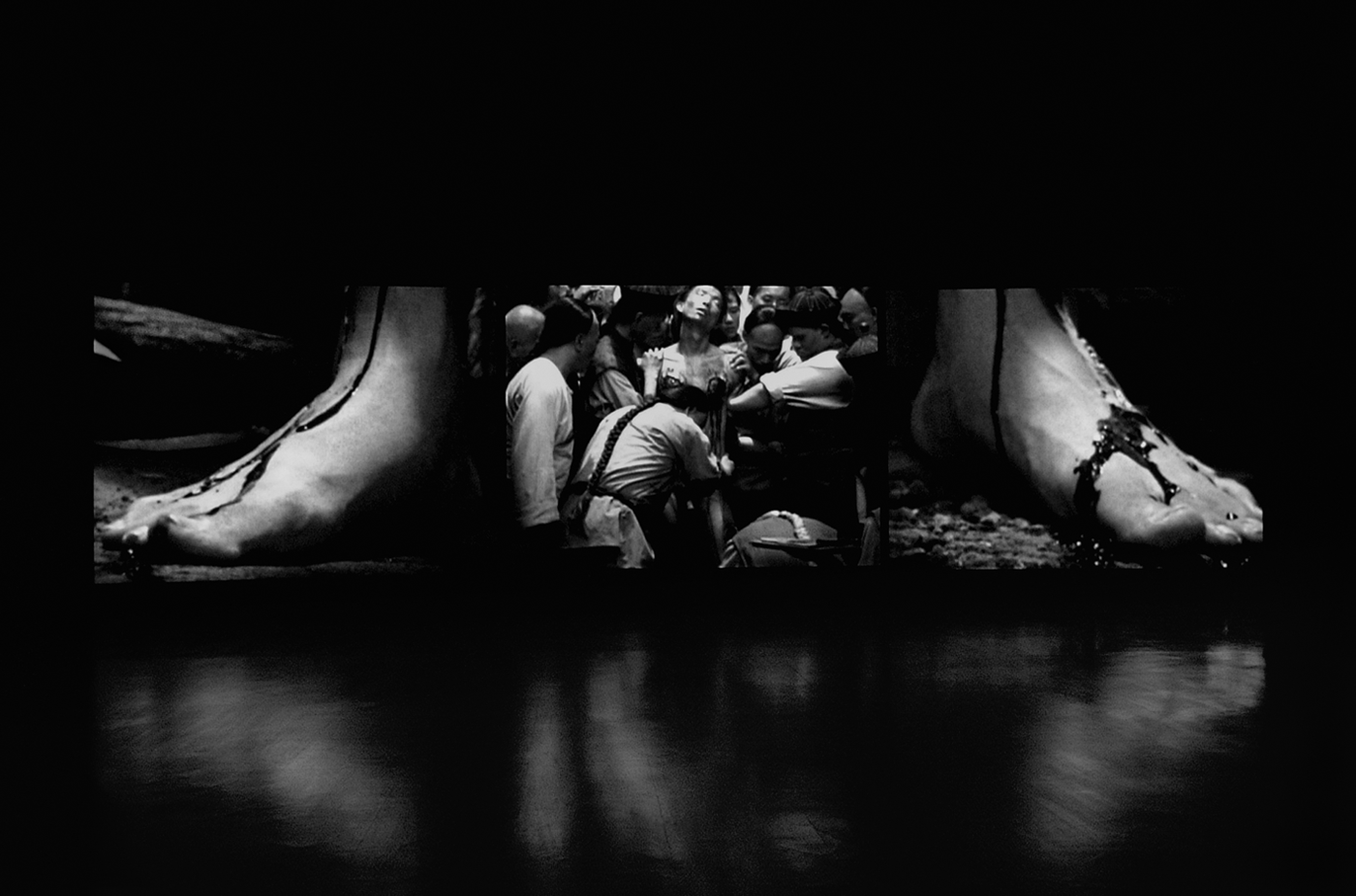
It may be no coincidence that, in 2002, Chen Chieh-jen premiered his video installation Lingchi: Echoes of a Historical Photograph, which took on the task of repoliticizing the body through gazing intently at history and pondering on its deferred impact on the present circumstances of Taiwan society.Footnote 43 The black-and-white video is based on a photograph taken by a French soldier in China around 1905, and centres on the body of a naked young man being progressively ‘cut’ by the knives of an executioner. Because of the effect of an opium drink taken before the torture, the man appears to be in a semi-conscious state between pain and delirium. The image of the original photograph, in which the lynched man gazes at the sky and has two large bleeding wounds on his chest, was distributed in Europe as a spectacle of oriental brutality and uncivilized primitivism. Chen, however, reads the wounds as a pair of eyes gazing back at us from a century ago, and as openings leading us into history, especially, as Chen put it, ‘the “history” outside history that has been excluded in the name of legitimacy’.Footnote 44
Lingchi: Echoes of a Historical Photograph, when on full display, is projected on three adjacent screens, which sometimes synchronize with and sometimes diverge from each other to create multiple narrative lines. Image used with permission from Chen Chieh-jen.

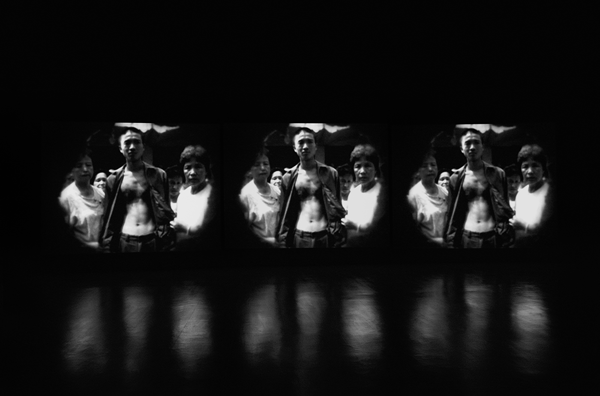
The slow pace at which the video is played and the many close-up shots that zoom in on the man's face and body parts frame the visual narrative in an empathetic flow as well as an interrogative mode. At one point, the camera gazes at the wounds on the man's chest; then there is a brief darkness on the screen, out of which emerge the images of five ruins which mark the scars of the bloody history of Chinese/Taiwanese modernity. The last three are particularly poignant to Taiwanese viewers: the notorious prison for keeping political prisoners on Green Island during the White Terror era; a heavily polluted factory left behind by the American RCA Company in northern Taiwan after it ceased two decades of operations there in 1992; and the deserted dormitory of a closed-down textile factory, whose owner moved his business abroad and left behind many unemployed and unpaid women labourers. Then the camera pans across the same darkness until a hole appears, through which we see the antique camera of the French soldier gazing at us, and then another hole appears, which shows the same young man surrounded by the now-aged women textile labourers, who reveal his lynched wounds under a shirt. The darkness represents the inside of the lynched man's body, which becomes a symbolic pathway where the imperial gaze of the French soldier, the gaze of the underdogs of neocolonial capitalism in the age of globalization and the gaze of the viewers encounter each other.
The audience sees through the hole in the lynched man's body the same young man surrounded by the unemployed women textile labourers, who reveal his lynched wounds under a shirt. Image used with permission from Chen Chieh-jen.

Lingchi and Chen's other subsequent video installations give voice to those silent and silenced presences in history. The body (or bodies) becomes a powerful means to re-examine the untold ‘“history” outside history’, the stories of the marginalized ‘others’ from the colonial period to the neocolonial present, especially the transnational conditions of labourers. Rather than essentializing the past, Chen interrogates incisively the power structure responsible for the development of history, and insists on revealing the presence of the oppressed. In his video narratives, the bodies, often in intense stillness or engaged in slow concentrated motion in real historic sites of predatory modernity, are themselves powerful testimony to the effects of globalized colonial history, which still structure the world we live in today.
To revisit the concept of shen-ti wen-hua in the twenty-first century, it is necessary to repoliticize and rehistoricize the overly essentialized body that was created as a response to the identity crisis of post-martial law Taiwan. Three decades after the lifting of martial law, Taiwan is facing ever more severe and complex challenges: the sacrifice of the rights of workers under the managerial logic of global capitalism, the stalled development of a truly civic society due to economic pressure on individuals as well as on the whole country, escalating social injustice resulting from the interlocking relations between political institutions and powerful private-interest groups, and so on. In an era when the body is enmeshed ever more tightly in capitalist commercial networks encompassing the daily life of ordinary people, including political operations, a body politic capable of challenging and interrogating the status quo, as well as creating alternative values in art and culture, is still in high demand. This article, by looking back at the discourses of the body at critical moments of Taiwan's history, advocates such a stance and bears witness to its artistic practices.