

INTRODUCTION
In the 1970s, lesbian, gay, bisexual, and transgender (LGBT) students placed themselves at the center of national debates about constitutional rights.Footnote 1 At a critical juncture in the history of higher education, student activism, and constitutional law, hundreds of LGBT students and allies at fourteen public colleges and universities took their institutions to court after newly established gay student groups were denied official recognition.Footnote 2 While the students suffered defeats along the way, by the end of the decade they had won the war for recognition, securing important victories for themselves, student rights, and LGBT movements.
Advocates for gay student group recognition won most of their legal battles by making effective arguments about First and Fourteenth Amendment rights and by responding to the strongest argument of their opponents: that institutional recognition would be tantamount to aiding, abetting, and inciting criminal sexual activities. This argument was based on state laws that criminalized anal, oral, nonmarital, and same-sex sex. Such laws were rarely enforced, but had far-reaching effects, as was demonstrated when opponents of recognition referenced these statutes to justify their actions. LGBT advocates won most of these cases not by challenging the criminalization of consensual sex and not by convincing the courts with equal protection arguments about the state’s differential treatment of homosexuality and heterosexuality. They won by pursuing strategies of desexualization, which required that they deny that gay student groups encouraged or facilitated same-sex sex. These strategies avoided principled defenses of sexual freedom and equality, but they were effective. In fact, there are strong reasons to believe that LGBT students would not have won if they had used more sexually affirmative arguments. Once recognition was achieved, gay student groups were more strongly positioned to pursue other goals, including sexual freedom and equality, but the new legal environments they had helped to create were not necessarily supportive of sexual liberation.
The fourteen cases discussed in this article have received limited attention by recent scholars, despite the fact that they generated hundreds of media stories, dozens of legal rulings, and significant political effects. Several scholars have presented broad historical studies of LGBT student organizing, but these do not focus on legal struggles in the 1970s (Dilley Reference Dilley2002; Coley Reference Coley2018; Dilley Reference Dilley2019). There are multiple case studies of LGBT student organizing in the 1960s and 1970s, but some do not focus on legal struggles (Reichard Reference Reichard2012; Reichard Reference Reichard2016) and others only address individual institutions (see below); this is the first study to provide a broad overview of all fourteen cases. Scholars in legal and educational studies have paid more attention to the litigation, but most have characterized it as centrally concerned with First Amendment rights of expression and assembly, not the criminalization of consensual sex and the sexual policing of LGBT people (Wilson and Shannon Reference Wilson and Shannon1979; Rivera Reference Rivera1979; Rivera Reference Rivera1980–81; Solomon Reference Solomon1980; Stanley Reference Stanley1983–84; Rullman Reference Rullman1991; Mallory Reference Mallory1997; Ball Reference Ball2017). More generally, campus struggles for gay student group recognition have rarely been identified as important episodes in LGBT history, the history of student activism, or the history of the 1970s.
There are multiple reasons, beyond anti-LGBT bias, that scholars have ignored these struggles. One reason is that they did not culminate in a ruling by the US Supreme Court, which avoided LGBT rights appeals from the late 1960s to the mid-1980s; instead, they were resolved by federal circuit courts, federal district courts, and state courts. These cases also have not received significant attention because dominant historical narratives tend to see student movements as losing strength and purpose after the end of the Vietnam War. Most scholars who study the 1960s and 1970s recognize the importance of Students for a Democratic Society, the Free Speech Movement, the Student Nonviolent Coordinating Committee, and Young Americans for Freedom (Carson Reference Carson1981; Gitlin Reference Gitlin1987; Miller Reference Miller1987; Andrew Reference Andrew1996). Many highlight student participation in antiwar activism and women’s liberation (Evans Reference Evans1979). Some address the participation of students in struggles for black studies, ethnic studies, and women’s studies (Rojas Reference Rojas2010; Biondi Reference Biondi2012; Kendi Reference Kendi2012). Dominant scholarly narratives, however, tend to see the student movement as dissipating and dividing in the mid-1970s, just when LGBT, feminist, Asian American, Latinx, and Native American student movements were gaining strength and vitality (Echols Reference Echols1992; Hunt Reference Hunt1999; Gosse Reference Gosse2005). Such narratives perpetuate queer marginalization by turning their attention elsewhere, just when LGBT students were gaining power and visibility.
This article provides a broad national overview of these cases, highlights their political and legal significance, and argues that we cannot understand the struggle for gay student group recognition in the 1970s without considering its relationship to the state regulation of sex. After a brief section on queering the history of higher education and a short introduction to early LGBT student organizing in the 1960s, the article turns to the litigation for gay student group recognition in the 1970s. This section analyzes the key arguments in several early cases and then offers a more in-depth exploration of Gay Alliance of Students v. Matthews, a 1976 Fourth Circuit Court decision that focused on Virginia Commonwealth University (VCU). As the article shows, this ruling is especially revealing because the federal courts in Virginia confronted three distinct cases about sexual rights in 1976: one about the recognition of VCU’s Gay Alliance, one about the criminalization of same-sex sex, and one about the application of the state’s sodomy law to an interracial threesome. The divergent outcomes—victories for LGBT students but defeats for sexual freedom in the other rulings—help us understand the reasons that legal advocates adopted desexualization strategies in the student cases. Looked at in isolation, the recognition rulings might seem like they culminated in straightforward successes for LGBT rights, but when juxtaposed with contemporaneous defeats in homosexual and heterosexual sodomy cases, they can be reassessed as strategically effective but politically compromised.
QUEERING the History of Higher Education
LGBT student movements in the 1970s were influenced by earlier developments in LGBT history, the history of higher education, and the history of student activism. Over the last several decades, many LGBT scholars have been based at colleges and universities, but few have emphasized that much of their work presents postsecondary educational institutions as major generators of historical developments. Collectively this scholarship demonstrates that colleges and universities have been important sites of sexual desires, acts, and identities and key locations for LGBT political repression, knowledge production, scientific research, creative expression, community building, and collective resistance (for the post-1940 era, see Schnur Reference Schnur and Howard1997; Minton Reference Minton2002; Shand-Tucci Reference Shand-Tucci2003; Irvine Reference Irvine2005; Weiler Reference Weiler2007; Graves Reference Graves2009; Meyerowitz Reference Meyerowitz2009; Syrett Reference Syrett2009; Braukman Reference Braukman2012; Nash and Silverman Reference Nash and Silverman2015; Graves Reference Graves and Michael2018; Kunzel Reference Kunzel2019).
When students began organizing “homophile” campus groups in the 1960s, they did so in the context of major transformations in higher education and student activism. In the post–World War era, college and university enrollments expanded, government funding for higher education increased, the admission of women to formerly all-male institutions accelerated, and the number of people of color admitted to formerly all-white institutions rose as well (Thelin Reference Thelin2019). In the midst of these changes, students began to play major roles in multiple political movements, forming groups such as the Student Nonviolent Coordinating Committee, Students for a Democratic Society, and Young Americans for Freedom. These and other groups encouraged young people to get involved in struggles for African American civil rights, campaigns against the Vietnam War, mobilizations for conservative causes, and efforts to transform colleges and universities themselves. Students also were active in campus and community groups that fought for women’s rights, reproductive justice, and sexual liberation; the latter included several sexual freedom leagues. LGBT students participated in all of these struggles, with varying degrees of openness about their gender and sexual identities (Allyn Reference Allyn2000; Suran Reference Suran2001; Lekus Reference Lekus2004; Leighton Reference Leighton2019). In the mid-1960s, inspired by the rise in student activism, the successes of the civil rights movement, and the growing visibility of homophile organizing, LGBT students began to form gay organizations on college and university campuses.
LGBT Student Organizing
Historians have thus far established that the first of these formally organized groups, the Student Homophile League (SHL), began meeting at Columbia University in 1966, though it was not formally recognized until 1967 (Martin Reference Martin, Dynes and Donaldson1992). As historian David Eisenbach (Reference Eisenbach2006) has explained, the reason for the delay was a policy requiring student groups that wanted university recognition to supply the names of their officers. While the SHL’s bisexual founder, Stephen Donaldson, was willing to supply his name, other LGBT students were not, a problem only resolved when Donaldson convinced several campus student leaders, presumably straight, to serve as officers. Two weeks after the league was recognized, the New York Times published a front-page story about the new group (Schumach Reference Schumach1967a; Schumach Reference Schumach1967b). This triggered a large number of media stories and a flood of letters to Columbia, including expressions of concern about the possible effects on sexually insecure and vulnerable young men. In the midst of the controversy, Columbia President Grayson Kirk consulted with a lawyer to determine whether New York’s state sodomy law could be invoked as a reason to reverse the earlier decision to recognize the league. Donaldson reported in a homophile newsletter that “the University’s legal arm has been instructed by unknown sources to investigate the organization to see if SHL/CU had violated laws against sodomy and corruption of minors” (Donaldson Reference Donaldson1967). Having anticipated these arguments, the group’s statement of purpose emphasized its educational, service, and civil liberties goals; another early SHL statement declared that “it is not the purpose of this society to act as a social group or agency of personal introductions.”Footnote 3
Kirk’s legal advisor ultimately told the president that there was no evidence that SHL members were breaking state laws against sodomy, solicitation, or indecency. In a 1967 letter to the Los Angeles Daily Journal, Kirk stated that “if the group had been organized for a social purpose, such purpose would not be allowed” (as cited in Allyn Reference Allyn2000, 153). Strategies of desexualization thus helped ensure the league’s survival. Initially it found ways to circumvent the restrictions placed on its sponsorship of social activities, principally by having individual students organize parties and dances to which SHL members were invited. This gave the organization plausible deniability on the question of whether it was encouraging illegal sex. Soon, however, the group began to radicalize and by 1968 it was more forcefully linking gay rights to sexual liberation and more openly avowing that it would sponsor social functions and organize political demonstrations. In 1971 and 1972, Gay People at Columbia (a successor to SHL) waged a successful battle to win official recognition for a gay student lounge, notwithstanding the conclusion of a university lawyer that recognition could be denied because the lounge might facilitate illegal sex acts (Eisenbach Reference Eisenbach2006).
Inspired by the founding of SHL at Columbia, students at other colleges and universities began to form similar groups. The best documented efforts before the summer of 1969 occurred at Cornell (Beemyn Reference Beemyn2003), New York University (Teal Reference Teal1971), and Stanford (Koskovich Reference Koskovich1993), where SHL chapters were established; the City University of New York, whose group was called Homosexuals Intransigent! (Albertario Reference Albertario2019); and the University of Minnesota, where students founded FREE—Fight Repression of Erotic Expression (Johansen Reference Johansen2019). In some cases, there were echoes of the dynamics first seen at Columbia. As historian Gerard Koskovich has noted, for example, Stanford SHL leaders emphasized that the group would focus on community education and civil rights; it would “not be a social organization for introductions” (Reference Koskovich1993, 38) and it was open to heterosexuals and homosexuals. At Cornell, according to historian Genny Beemyn, several founding officers and members were straight, and the league emphasized in its official pronouncements that it was a civil liberties and educational group. Cornell’s SHL also denied that it would serve as “an agency for personal introductions,” function as a “social organization,” or encourage homosexual acts (Reference Beemyn2003, 213). As was the case at Columbia, SHL members at Cornell hosted parties and organized outings to gay bars, but at first they did not do so under the official auspices of SHL. In the first half of 1969, however, the organization began to sponsor dances and more openly acknowledge its social goals.
After New York City’s Stonewall Riots of 1969, when thousands of street protesters battled the police after a raid on a gay bar (Stein Reference Stein2019), students at many colleges and universities formed gay groups (Lublin Reference Lublin1971; “Drive to Gain” 1972). Most of these included people who later would likely have referred to themselves as bisexual, gay, lesbian, nonbinary, queer, or trans. In 1971, a front-page story in the New York Times was headlined “Campus Homosexuals Organize to Win Community Acceptance” (Reinhold Reference Reinhold1971). According to one estimate, by 1972 there were more than 150 gay student groups at US colleges and universities (Blumenfeld Reference Blumenfeld1972a); by 1974, there were 200–250 (Peterson Reference Peterson1974). In 1971, the National Student Association (NSA) established the National Gay Student Center (NGSC), which was proposed and staffed initially by Warren Blumenfeld; it operated out of the NSA’s offices in Washington, DC (Larsson Reference Larsson1971; “National Student Congress Bows” 1971; “National Student Congress Slates” 1971). The NGSC, which published three issues of a magazine titled InterChange in 1972 and 1973, worked to facilitate communication across the growing network of organizations (Aiken Reference Aiken1972; Blumenfeld Reference Blumenfeld1972a; Blumenfeld Reference Blumenfeld1972b; Laurence Reference Laurence1972; Blumenfeld Reference Blumenfeld2012; Blumenfeld, pers. comm 2020).Footnote 4 Meanwhile, many postsecondary institutions began to offer their first gay and lesbian studies courses; several created centers and offices to serve the needs of LGBT students; countless campus protests targeted anti-LGBT speakers and researchers; and a significant number of colleges and universities ended their policies of suspending or expelling LGBT students and firing LGBT faculty and staff. Beyond individual campuses, many disciplinary associations established gay and lesbian caucuses and gay academic unions formed in several cities (Stein Reference Stein2012).
The gay student groups that formed in the 1960s and early 1970s had demographic characteristics that influenced their strategies and goals. Most participants were part of a distinct generational cohort—baby boomers born in the 1940s and 1950s—and most were in their late teens or early twenties. Many of the early groups were predominantly white and male, sometimes overwhelmingly so, but women, people of color, and trans people played important roles as well (“Texas GLFer” 1971; Fortune Reference Fortune1973; Nichols and Kafka-Hozschlag Reference Nichols and Kafka-Hozschlag1989; Reichard Reference Reichard2010; Clawson Reference Clawson2013; Clawson Reference Clawson2014; Faulkenbury and Hayworth Reference Evan and Hayworth2016; Dilley Reference Dilley2019; Stein Reference Stein2021). For example, women were among the founders and early leaders of gay student groups at Cornell, Florida State, Michigan State, NYU, Ohio State, Rutgers, San Jose State, San Francisco State, Southern Illinois, Virginia Commonwealth, and the Universities of Indiana, Iowa, Kansas, Maryland, Minnesota, and Texas. One early leader at Cornell “felt stuck in a female body” (as cited in Beemyn Reference Beemyn2003, 211). African Americans were among the founders and leaders of groups at Rutgers and the Universities of Florida and Georgia; Latinx people at Florida State, Sacramento State, and San Jose State; and Asian Americans at the University of Michigan. In the mid-1970s, the director of the National Gay Student Center, J. Lee Lehman, was a woman (Lehman Reference Lehman1977).
In part, the predominance of white men in the early groups reflected college and university demographics in this era, but there were other factors at play. Many LGBT people of color and many lesbians were drawn to organizations that prioritized race and gender issues; some of these groups might have created alternative opportunities for addressing LGBT topics. There were also the social dynamics of gay organizations in which male predominance reproduced itself as men came to see these groups as sites for meeting other men. In addition, these organizations often prioritized the agendas and concerns of white men, focusing, for example, on employment discrimination and military service rather than reproductive justice and sexual violence. The racism and sexism of many white gay men also discouraged participation by others (Blumenfeld Reference Blumenfeld1972a). Beginning in 1969, for example, the founder of Homosexuals Intransigent! at CUNY opposed the inclusion of women, disparaged bisexuals, and attacked lesbians in explicitly sexist terms (Albertario Reference Albertario2019). In 1970, the lesbian cochair of San Francisco State’s Gay Liberation Front described the group’s male majority as “condescending and chauvinistic”; the gay male cochair agreed (as cited in Stein Reference Stein2021, 13). In 1972, after discussing her work with the SHL at NYU, lesbian novelist Rita Mae Brown noted that she left the gay movement because it was “male-dominated” and gay men “don’t give a damn about the needs of women” (Brown Reference Brown1972). Beginning in 1970, students at many colleges and universities formed autonomous lesbian groups (Dilley Reference Dilley2019), though many women continued to participate in mixed-sex organizations as well. Lesbian groups apparently did not go to court to win institutional recognition, perhaps because their radical politics led them to reject the notion of institutional recognition, they identified themselves as women’s groups, or they were administratively linked with (and funded by) women’s organizations. Autonomous lesbian groups also may have been more likely to win institutional recognition because they did not raise the same concerns that gay groups did about promoting illegal sex acts.
While racism and sexism limited the reach and work of gay student groups in the 1960s and 1970s, the organizations played important roles in the lives of many. In key ways, they functioned as support groups and counseling centers, helping students address the problems they were experiencing on and off campus. They also served consciousness-raising purposes, teaching students about new and alternative ways of thinking about gender and sexuality. Some organized educational programs, social activities, cultural events, community outings, and political protests. Dances were distinctly popular. Many supported the development of LGBT studies courses and the improved treatment of LGBT topics across the curriculum. At their best, gay campus groups helped students overcome isolation, invisibility, and marginalization; provided social support and political solidarity; shared information and knowledge about LGBT life; established connections with other student groups; and challenged gender biases and sexual prejudices. They facilitated sexual partnerships, intimate relationships, and affectionate friendships; encouraged leadership, mentorship, and collaboration; and provided bases for challenging the ideologies and practices of heteronormative supremacy, which were ubiquitous in college and university classrooms, campuses, and communities.
Litigation for Gay Student Group Recognition
This, then, brings us to the litigation for gay student group recognition in the 1970s. Formal recognition was important for symbolic and material reasons. Symbolically, institutional recognition implied that the groups served important goals and deserved the same rights and respect as other student organizations. Materially, recognition allowed them to request institutional financial support, use college and university facilities, and sponsor campus events. Most of the key court cases in the 1970s concerned state colleges and universities. The primary reason for this is that the US Constitution, as interpreted by the courts after the Reconstruction Amendments, more powerfully protects individuals against state, as opposed to private, denials of their rights. Students at private institutions confronted distinct problems and possibilities. As the examples of Columbia, Cornell, and Stanford suggest, some private colleges and universities, more protected from public opposition and less vulnerable to state policy makers, recognized gay student groups without much trouble. Other private schools, including many affiliated with conservative Christian denominations, refused to do so.Footnote 5
In fourteen cases in the 1970s, gay student groups and their allies filed lawsuits to challenge denials of official recognition or the use of campus facilities at public colleges and universities (see Table 1). The earliest case began at Sacramento State in 1970 and was resolved by a California Superior Court decision in favor of the students in 1971. Later cases occurred in every region of the country, though most took place in the South. This reflected the political and sexual conservatism of southern states, though the five cases in California, Kansas, New Hampshire, and Pennsylvania make it clear that the struggle was national in scope. The students lost in seven out of thirteen initial rounds (the fourteenth was settled out of court in terms favoring the students), but ultimately won eleven out of fourteen, including the final five.Footnote 6
Court Cases on Gay Student Group Recognition at Public Colleges and Universities
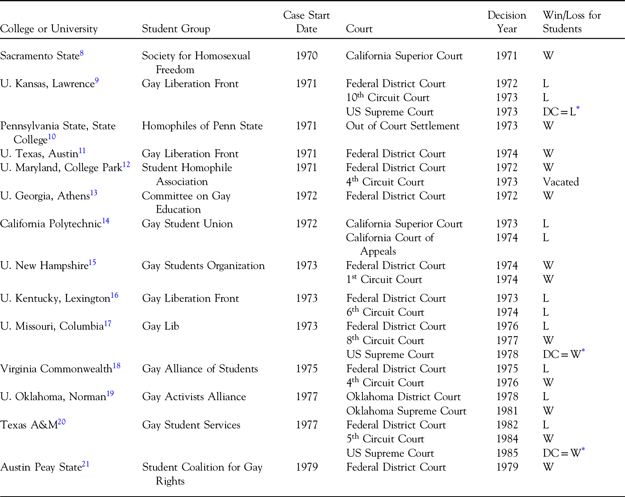
* DC = denied certiorari (the Supreme Court declined to review the lower court’s decision).
Significantly, the US Supreme Court did not issue a substantive decision in any of these cases, though the justices often step in to resolve conflicts among the circuits, as occurred here when the students lost in the Sixth and Tenth but won in the First, Fourth, Fifth, and Eighth. This was part of a larger pattern: the justices denied certiorari in virtually all LGBT rights cases from the late 1960s to the mid-1980s (Stein Reference Stein2010). When they denied cert in three of the cases examined here, the results were negative for the students in 1973 but positive in 1978 and 1985.Footnote 7 Perhaps some of the justices concluded that the circuit courts had worked out their disagreements after 1974, but they may have wanted to avoid having to reconcile their support for the First Amendment and their opposition to gay rights. They also may have wanted to see whether sodomy law reform, which affected nearly half the states in the 1970s, might settle these disputes through alternative means. In any event, there was more litigation in the 1980s, and some private schools continue to deny recognition in the twenty-first century, but by the end of the 1970s LGBT students at public colleges and universities had won the war for recognition.
The fourteen cases highlighted here address a fraction of the institutions where gay student groups encountered difficulties in gaining formal recognition; most struggles did not result in litigation.Footnote 22 The situation in Florida was particularly challenging after the Board of Regents adopted a prohibition on gay student group recognition at state colleges and universities in 1970 (Terl Reference Terl2000). According to a 1974 survey of gay student groups by the National Gay Student Center, 29 percent had been denied recognition or experienced problems in obtaining recognition; 20 percent had resorted to litigation. This led the NGSC to conclude that “campus gay groups are currently the most persecuted type of student organization in the United States” (Lehman Reference Lehman1977). Seven years later, after most of the litigation addressed in this article had concluded, a Chronicle of Higher Education survey of 150 four-year colleges and universities found that 26 percent had recognized gay student groups, but 80 percent of public universities had done so (Middleton and Roark Reference Middleton and Roark1981).
In their efforts to win recognition, LGBT students gained the support of many straight students, faculty, and administrators. Student government leaders and student newspaper allies played particularly significant roles. When litigation ensued, community-based lawyers developed the strategies, crafted the arguments, wrote the briefs, and represented their clients in court, often with minimal compensation. Many were affiliated with the American Civil Liberties Union (ACLU). The ACLU had long championed First Amendment rights and in the 1960s and 1970s defended many students and many LGBT people (Cain Reference Cain2000; Stein Reference Stein2010; Wheeler Reference Wheeler2012). While the NGSC, LGBT press, and LGBT legal organizations shared news and information about recognition struggles, ACLU-affiliated lawyers shared arguments and strategies.
The litigation in the recognition cases addressed multiple issues, but the core constitutional conflicts centered on the question of whether public colleges and universities, which were state institutions, had sufficiently compelling reasons to justify their interference with the First Amendment rights of students, which were protected against state action by the Fourteenth Amendment. (The First Amendment originally protected individuals from violations of their rights by the federal government; the Fourteenth protected individuals from violations of their rights by states.) The Supreme Court established this framework in Healy v. James, a 1972 decision that addressed Central Connecticut State College’s refusal to recognize a Students for a Democratic Society chapter. In Healy, the Court reaffirmed its conclusion in Tinker v. Des Moines Independent School District (1969), a case that concerned students suspended from school for wearing antiwar armbands, that neither students nor teachers “shed their constitutional rights to freedom of speech or expression at the schoolhouse gate” (Tinker v. Des Moines Independent School District 1969, 506). The ruling in Healy, which was covered by the LGBT press (“Key Ruling” 1972; Koehler Reference Koehler1998), emphasized that “the critical line for First Amendment purposes must be drawn between advocacy, which is entitled to full protection, and action, which is not” (Healy v. James 1972, 192). Relying on this distinction, the justices remanded Healy so that lower courts could determine whether the university’s decision was based on the SDS chapter’s advocacy of ideas or its actions. With respect to the latter, the Court instructed the lower courts to consider whether the students were “willing to abide by reasonable campus rules and regulations” (194). If not, the denial of recognition was constitutional.
The distinction between advocacy and action was similarly key in the gay student group cases. Healy seemed to suggest that if the purposes of the groups were purely associational, educational, expressive, or informational, they could not be denied recognition. If instead the groups planned to engage in activities or encourage students to engage in activities that would violate reasonable institutional rules or constitutional state laws, colleges and universities could deny recognition. This is one of the reasons that many of the protagonists in the gay student group cases addressed the question of whether institutional recognition would encourage students to break state sex laws. In fact, several of the lawyers and judges used the language of First Amendment case law to ask whether recognition presented a “clear and present danger” by encouraging or inciting students to violate sodomy laws.
In 1970, for example, when Sacramento State President Otto Butz explained his reasons for denying recognition to the Society for Homosexual Freedom, he noted that “the effect of recognition … could conceivably be to seem to endorse or to promote homosexual behavior,” which “California and most American jurisdictions today hold … to be a crime.” In court, Butz claimed that “young students … might view college recognition as college sanction of homosexual practices,” which could lead to “illegal homosexual acts.” The lawyer for the Society responded that the students simply wished to “engage in constitutionally protected assembly and speech,” not “use State facilities to engage in unlawful acts.”Footnote 23 In the end, Judge William Gallagher agreed that the key question was whether the president could deny recognition based on the increased “risk that students would engage in illegal homosexual behavior,” but denied that there was evidence that recognition presented a “clear and present danger” of inciting illegal acts. Criminal sex could be prosecuted, the judge emphasized, but the evidence submitted in support of the claim that recognition would lead to an increase in such activities was “woefully weak” (Associated Students of Sacramento State College v. Butz 1971, 5).
Similar arguments were made in the Kansas case. When Chancellor E. Laurence Chalmers denied recognition to the Lawrence GLF in 1970, his press release stated, “Since we are not persuaded that student activity funds should be allocated either to support or to oppose the sexual proclivities of students, particularly when they might lead to violation of state law, the University of Kansas declines to formally recognize the Lawrence Gay Liberation Front.”Footnote 24 Historian Beth Bailey points out that at times during the course of the litigation the Kansas students were “disingenuous” in suggesting that homosexuality had no connection to sex (Bailey Reference Bailey1999, 181); this later became clear when the GLF more openly declared, “Inseparable from the freedom to be homosexual is the freedom to participate in homosexual activities …. To recognize our right to exist is to recognize our right to engage in homosexual acts.”Footnote 25 In the end, District Court Judge George Templar, after refusing to allow renowned defense attorney William Kunstler to represent the GLF, stated in his decision that homosexuality was “forbidden by Kansas law” (Lawrence Gay Liberation Front v. University of Kansas 1972, 10) and accepted the chancellor’s decision.
Students won the next four cases, in part by denying that their groups would promote illegal sex. At Penn State, for instance, the university defended its investigation of Homophile of Penn State by claiming that it was “concerned with making sure HOPS activities were not in violation of state laws banning homosexual acts” (“Penn State Suspends” 1971). A lawyer for the students responded that “HOPS had not broken any state laws nor advocated breaking any (including the sodomy laws)” (Shaffer Reference Shaffer1972). In the Georgia case, which addressed a request by a registered gay student group for use of campus facilities to host a conference and dance, a university official initially rejected the request because the institution could be held liable for “condoning, aiding, and abetting illegal acts of sodomy” (“Georgia Students” 1972). The lawyer for the students responded that this was not “tenable,” in part because sodomy “could be committed by heterosexual couples.” In addition, there was no evidence showing that “the sex urges of homosexuals are greater than those of heterosexuals,” and while “the only sex crime possible between members of the same sex is sodomy,” heterosexuals could commit sodomy, rape, seduction, incest, bigamy, adultery, and fornication, meaning that “the chances of sex crime being committed between heterosexuals is seven times greater than between homosexuals.”Footnote 26 In the end, the federal district court relied on the fact that the university “stipulated that it had no evidence that the meeting for which facilities had been requested by the Committee would result in any activity which in itself would be illegal” (Wood v. Davison 1972, 545). In these circumstances, the university’s denial was an unconstitutional “prior restraint” (548) on First Amendment rights.
Sex was also at the center of the Cal Poly case. In explaining his decision to deny recognition to the Gay Student Union, Dean Everett Chandler noted that it would not be appropriate to recognize “an organization which may cast students into situations in which they become violators of existing laws.” In court, the university’s lawyers argued that recognition would grant “official sanction to a group whose active and voting members were organizing to promote felonious conduct.”Footnote 27 The students’ lawyer, Richard Carsel, responded by repeating the claim made in the Sacramento State case that this was “not a situation where a group of homosexuals seek to use State facilities to engage in unlawful acts.” He also called attention to the university’s double standard. Asked by the opposing counsel if “the sexual activities of homosexuals include the act of copulating the mouth of one person with the sexual organ of another, as that sexual act is referred to in section 288a of the Penal Code,” Carsel responded that there were rumors to this effect, but “it has also been rumored that the sexual activities of heterosexuals include the same practices.” When Carsel subsequently questioned university officials and expert witnesses, he repeatedly asked whether heterosexuals practiced anal and oral sex, whether the college recognized student organizations that sponsored dances involving physical contact between males and females, and whether such contact might lead to heterosexual sex. In his closing brief, Carsel noted that if the university’s arguments were accepted, the institution could “deny recognition to a coed group which was organized for the purpose of promoting an appreciation of social dancing, with particular emphasis on the waltz.”Footnote 28
In his decision in the Cal Poly case, Superior Court Judge Richard Harris did not follow the Sacramento State precedent, primarily because the GSU limited membership to homosexuals and bisexuals. The California Court of Appeal agreed, but added that “the fundamental interest the organization seeks to protect is their life-style, which necessarily includes sexual conduct that is inherently illegal” (Associated Students of California Polytechnic State University v. Kennedy 1974, 11). This meant the group was “engaged not in mere advocacy or expression of beliefs, but in fostering, encouraging, promoting, and … pressuring their participation in sexual activities made criminal by state law” (12). In January 1976, however, Cal Poly President Robert E. Kennedy reversed himself, partly because the GSU had agreed to revise its membership restrictions, but also because the state had amended its sex laws. According to Kennedy, a new legal opinion from the state attorney general’s office “makes it quite clear that as a result of recent changes in state law, as well as changes made in the bylaws … I no longer have any legally sustainable basis for nonrecognition” (as cited in “Gay Student Union” 1976). The president was referring to California’s 1975 repeal of its sodomy law, which took effect on January 1, 1976, just days before his announcement. This was a strikingly clear illustration of the far-reaching implications of sodomy law repeal.
In the New Hampshire case, the Gay Students Organization was recognized and allowed to sponsor a dance in 1973, but after complaints by the state governor, state legislators, and the board of trustees, the university granted the GSO’s request to sponsor a play (historian Jonathan Ned Katz’s Coming Out!) but denied it permission to hold “social functions,” including dances. At the play, copies of the Boston-based newspapers Gay Community News and Fag Rag were distributed, but there was conflicting testimony about whether GSO was responsible for this. A few days later, the governor threatened to veto all state funding for the university if it did not take steps to rid the campus of “indecency” and “immoral filth.” The university president then threatened to suspend GSO if it repeated its “offending behavior” (Gay Students Organization of the University of New Hampshire v. Bonner 1974a, 1092). In federal district court, Judge Hugh Bownes asked whether the university had compelling reasons to violate the students’ First Amendment rights and whether the regulation was narrowly tailored to meet the university’s objective. On these questions, the key issue was whether the group or its members had violated the law at GSO events. According to the university, “GSO social functions are tantamount to criminal solicitation of deviate sexual relations”; “GSO members have distributed obscene material”; and “GSO functions promote conduct which is obscene” (1100). The judge, however, ruled that there was no evidence that sodomy or solicitation laws had been violated at GSO functions. When the First Circuit Court considered the case, it focused on whether the social activities of political groups were protected by the First Amendment, which it answered affirmatively, but it also agreed that there was no evidence that illegal sexual activities, including “‘deviate’ sex acts, ‘lascivious carriage’, and breach of the peace,” had taken place at GSO events. The First Circuit added that universities could “proscribe advocacy of illegal activities falling short of conduct, or conduct in itself noncriminal, if such advocacy or conduct is directed at producing or is likely to incite imminent lawless action,” but “speculation that individuals might at some time engage in illegal activity is insufficient to justify regulation by the state” (Gay Students Organization of the University of New Hampshire v. Bonner 1974b).
The third major defeat for LGBT students (after Kansas and Cal Poly) occurred in the University of Kentucky case. In explaining his decision to deny recognition, the dean of students noted that “the promotion and recruitment potential inherent in a sanctioned homosexual group can only have the effect of interfering with meaningful rehabilitation of the homosexual while legitimizing an illegal practice” (as cited in “Kentucky Campus Group” 1973). In court, the lawyers for the university argued, with the support of an expert psychiatrist and Kentucky’s Attorney General, that recognition might encourage students to engage in illegal sex acts. The lawyer for the students responded that the university could adopt rules and regulations to prohibit illegal sexual activities, and “these rules could be invoked against heterosexual as well as homosexual offenders.” He pointed out, however, that “the formation of any group,” including a fraternity or a sorority, “could conceivably lead to acts of sodomy,” and “there exists no reasonable basis for apprehension that recognition of this group would lead to the commission of illegal acts.”Footnote 29 Notwithstanding these arguments, the federal district court ultimately ruled that university officials had the authority to deny recognition because homosexual practices were illegal in the state (Singletary v. Gay Liberation Front of the University of Kentucky 1973; “U. of Kentucky Denial” 1973). The Sixth Circuit upheld the lower court decision in 1974 and the university did not recognize a gay student group until 1983.
Another federal district court defeat for students occurred in the University of Missouri case, though the Eighth Circuit reversed and the US Supreme Court denied cert. In justifying its decision against Gay Lib, the university’s board of curators noted that recognition would “expand homosexual behavior” and thus “cause increased violations” of the state’s sodomy law (Gay Lib v. University of Missouri 1976, 1358). In explaining its ruling, the district court quoted the testimony of Dr. Charles Socarides, who had claimed that “wherever you have a convocation of homosexuals … you are going to have increased homosexual activities, which, of course, includes sodomy.” Socarides added that he knew from listening to his patients that at homosexual gatherings, there is “a great deal of cruising and a great deal of picking up of partners” (1369). When the case reached the Eighth Circuit, Lawrence Kaplan, the students’ lawyer, challenged the notion that recognition would lead to increased homosexual behaviors in general or increased illegal homosexual behaviors in particular. He also asked how the situation could be “distinguished from a meeting of young adult heterosexuals, where the chance of their pairing off, dating and engaging in some form of sodomy is greater than a similar meeting of older adult heterosexuals?”Footnote 30 The Eighth Circuit did not address the latter argument, but rejected the district court ruling, concluding that the university had failed to prove that recognition would likely lead to “imminent lawless” acts (Gay Lib v. University of Missouri 1977, 855).
As for the Supreme Court’s decision in the Missouri case, it declined to accept the appeal for review in 1978, but three justices (one short of the number required for full review) dissented from the denial of cert. While Chief Justice Warren Burger did not provide his reasons, William Rehnquist, in an opinion joined by Harry Blackmun, emphasized that the university had concluded that recognition was likely to lead to increased violations of the state’s sodomy law. He then likened homosexuality to measles, asking “whether those suffering from measles have a constitutional right, in violation of quarantine regulations, to associate together and with others who do not presently have measles, in order to urge repeal of a state law providing that measle[s] sufferers be quarantined.” In both cases, “the very act of assemblage … undercuts a significant interest of the State” (Ratchford v. Gay Lib 1978, 1084). Rehnquist also cited previous decisions to emphasize that “some speech that has a propensity to induce action prohibited by the criminal laws may itself be prohibited” (1085). This left little doubt as to how two of the justices would have voted if the case had been accepted for review, but the majority was content to let the circuit courts decide, even if this meant divergent results in different regions of the country.
Virginia Is for Lovers
Without clear direction from the US Supreme Court, lower courts struggled to resolve the issues raised by the gay student group recognition cases in the 1970s. As they did so, they invariably had to address the question of whether recognition would incite illegal sex. Virginia proved to be an important battleground for addressing this question because in 1976 the courts there were called upon to decide a gay student group recognition case at Virginia Commonwealth University (VCU), a challenge to the state’s sodomy law by a gay man, and another challenge to the sodomy law by a married couple who had participated in an interracial threesome. The divergent outcomes in these cases demonstrate that we cannot understand the history of the conflicts about gay student group recognition without exploring the history of sodomy laws.
In the 1970s, the status of state sodomy laws was in flux thanks to the combined influences of the sexual revolution, LGBT activism, and the politics of sexual liberalism. The history of these laws is filled with twists, turns, exceptions, and anomalies, but some generalizations can be made. In the nineteenth century, sodomy and buggery (or “crimes against nature”) statutes generally were understood to apply to anal intercourse, but in the twentieth they were revised or reinterpreted to apply to anal and oral sex. The statutes could be enforced against same-sex and cross-sex acts, but were disproportionately applied to same-sex sex, sex with minors, and nonconsensual sex (Eskridge Reference Eskridge1999; Eskridge Reference Eskridge2008; Robertson Reference Robertson2010). Illinois was the first state to repeal its sodomy law, doing so in 1961–62. Connecticut was next, in 1969–70, and then the pace of reform quickened. By the end of 1975, nine more states—Colorado, Delaware, Hawaii, Massachusetts, New Hampshire, New Mexico, North Dakota, Ohio, and Oregon—had joined Illinois and Connecticut. Interestingly, New Hampshire repealed its sodomy law just one year after the First Circuit ruled in favor of the gay student group there. In 1976, five more states—California, Indiana, Maine, Washington, and West Virginia—repealed their sodomy laws. As noted above, California’s repeal helped convince Cal Poly to recognize its gay student group. In fact, all fourteen cases addressed in this article occurred in states that criminalized sodomy during the years of the relevant litigation.
By the end of 1976, sixteen states had repealed their sodomy laws, but this was not the only way that the laws were in flux. In 1969, Kansas led the way in decriminalizing heterosexual, but not homosexual, oral and anal sex. In the early 1970s, Texas, Montana, and Kentucky joined Kansas, and Pennsylvania decriminalized oral and anal sex within legal marriage, which was only available to cross-sex couples (Eskridge Reference Eskridge2008). Meanwhile, the constitutional status of sodomy laws was in doubt in the 1970s. As I have argued elsewhere, many Americans believed that Supreme Court decisions on abortion, birth control, interracial marriage, and obscenity had recognized a constitutional right of sexual privacy; some were convinced that this soon would be used to invalidate various laws against homosexual, heterosexual, and nonmarital sex. Several lower courts did so in the late 1960s and early 1970s, despite the fact that most of the justices in this era never affirmatively referred to sexual privacy in their opinions, and most suggested in dicta that they would uphold laws against adultery, cohabitation, fornication, and sodomy (Stein Reference Stein2010).
In the early 1970s, the Supreme Court declined to invalidate sodomy laws in a trio of decisions. In a 1972 case involving a man accused of forcing a male minor to engage in oral sex, the Supreme Court dismissed an appeal of a lower court decision holding that Missouri’s crimes against nature law applied to anal sex, oral sex, and bestiality (Missouri v. Crawford 1972; Crawford v. Missouri 1972). In a 1973 case involving two men accused of forcing other men to have sex with them in prison, the justices ruled that Florida’s crimes against nature law was not unconstitutionally vague (Wainwright v. Stone 1973). In 1975 the Supreme Court upheld the constitutionality of Tennessee’s crimes against nature law in a case involving a man who had forced a woman to submit to cunnilingus (Rose v. Locke 1975). These decisions did not resolve the question of whether sodomy laws were constitutional when applied to adult, private, and consensual acts, but in 1976 federal courts addressed this issue in two Virginia cases.
Virginia’s criminalization of sodomy began in the colonial era, when it was a capital offense. The law was rarely enforced, but in 1625 Richard Cornish was hanged for sodomy. In 1792, Virginia reaffirmed the death penalty for sodomy (generally interpreted to mean anal intercourse) and made it clear that the law applied to men and women. In 1800, Virginia reduced the penalty for sodomy to one-to-ten years in prison for free people. The maximum penalty was reduced to one-to-five years for free people in 1848 and enslaved people in 1860 (Painter Reference Painter1991–2002).
Over the next century, Virginia moved in two directions in its legal treatment of sodomy. On the one hand, the state legislature strengthened the law’s penalties and broadened its coverage. An 1878 law raised the minimum penalty to two years. In 1916, the state amended its law to cover same-sex oral sex. Eight years later, the penalty was reduced to one-to-three years, but the law was redefined to cover cross-sex oral sex. In 1975, the state increased its maximum penalty to five years. On the other hand, the Virginia Supreme Court limited the reach of these laws. In 1895, it overturned the conviction of a twelve-year-old boy based on his age. In 1923, it reversed the conviction of a man who had engaged in oral sex with a woman. In 1925, the state supreme court overturned the conviction of a man found with another man’s penis in his hand; in 1951, it overturned a conviction because it was based on the unreliable testimony of a three-year-old boy; in 1968, it overturned a conviction based on evidence that a man had placed his mouth on, but had not had his mouth penetrated by, another man’s penis. Virginia, however, had other laws that criminalized consensual sex, and in 1968 the state’s attorney general encouraged local prosecutors to charge men who solicited other men for sex (Painter Reference Painter1991–2002).
The constitutionality of Virginia’s sodomy law was challenged in two major cases in the 1970s. In 1973, the federal district court in Richmond decided Lovisi v. Slayton, which concerned a Virginia Beach married couple, Aldo and Margaret Lovisi, and a second man, Earl Romeo Dunn of Washington, DC. The Lovisis had met Dunn through an advertisement in a magazine called Swinger’s Life. In 1969, after photographs of the threesome came to the attention of officials at the school attended by Margaret’s daughters (ages eleven and thirteen), the police executed a warrant to search the Lovisi home. In 1971, Aldo was convicted of engaging in oral sex with his wife and Margaret of engaging in oral sex with her husband and Dunn. Aldo and Margaret were sentenced to two years in prison for the sex they had with each other; Margaret was sentenced to three additional years for the sex she had with Dunn. After exhausting other potential remedies, the Lovisis challenged the application of the sodomy statute to the sex they had with each other, which they argued was entitled to special protection because they were married. In 1973, however, the district court ruled that while “the right to privacy inherent in the federal constitution may well extend to heterosexual relations involving oral-genital contact between consenting adults,” the Lovisis had “relinquished the privacy that would normally have surrounded their acts” (Lovisi v. Slayton 1973, 624). This was not because they had invited Dunn to join them and not because of testimony about the presence of Margaret’s daughters in the room, but rather because their sex acts were photographed and the Lovisis failed to maintain control of the pictures. According to the court, “In order for their sexual relations to be constitutionally protected, the Lovisis had the responsibility of ensuring that the seclusion surrounding their acts was preserved …. By electing to photograph their sexual relations, thus creating the possibility that the intimacy of their acts would be destroyed by future viewing by others, the Lovisis took upon themselves an especially heavy burden to protect their privacy. They did not meet that burden … because of their failure to deny other persons access to the photographs” (627).Footnote 31
Three years later, in May 1976, the Fourth Circuit affirmed the lower court’s decision by a five-to-three margin, but on different grounds. According to the majority opinion by Chief Judge Clement Haynsworth (whose nomination to the US Supreme Court had been rejected by the US Senate in 1969), the Constitution protects the sexual rights of married couples in their bedroom, but “once a married couple admits strangers as onlookers, federal protection of privacy dissolves.” According to the court, “If the couple performs sexual acts for the excitation or gratification of welcome onlookers, they cannot selectively claim that the state is an intruder.” The key issue was that “the married couple has welcomed a stranger to the marital bedchamber, and what they do is no longer in the privacy of their marriage.” For the Fourth Circuit majority, once the married couple relinquished their rights of privacy by admitting a “stranger” to their bedroom, there was a virtual open door through which the state could enter (Lovisi v. Slayton 1976, 351).Footnote 32
The Fourth Circuit Lovisi decision includes a significant footnote that has received minimal scholarly attention. According to the note, “Dunn testified for the prosecution. His participation in the incident, however, resulted in his deportation to his native Jamaica” (Lovisi v. Slayton 1976, 350). This might help explain why Dunn was not prosecuted: the case file suggests that the state offered him deportation instead of imprisonment if he testified against the Lovisis. The reference to Jamaica, a majority-black island nation, is also noteworthy. The rulings in this case did not indicate that Dunn was black, perhaps because of the rise of ideas about “color-blind” law, but case file affidavits make it clear that he was and that the Lovisis were white. In this context, it is possible that the police, prosecutors, and judges were influenced by attitudes about interracial sex. They also may have been influenced by the fact that the threesome included two men; threesomes with two women were more commonly seen as pleasurably titillating by straight men. Case file documents also show that Dunn was not a “stranger” to the Lovisis; he visited their home three times and traveled with them to New York. In any event, in November 1976 the US Supreme Court denied cert and the convictions were thus upheld.Footnote 33
This was the second time in 1976 that the US Supreme Court was asked to decide on the constitutionality of Virginia’s sodomy law. In 1975, “John Doe,” whose real name was Bill Bland (Murdoch and Price Reference Murdoch and Price2001, 180–85), had challenged the state sodomy law in federal district court. Bland, the partner of National Gay Task Force founder Bruce Voeller, had not been arrested, but claimed that he was vulnerable to prosecution for engaging in adult, consensual, and private homosexual acts. Citing Griswold v. Connecticut (1965), Eisenstadt v. Baird (1972), and other decisions, he argued that Virginia’s law violated his constitutional rights to freedom of expression, sexual privacy, due process, and equal protection. In a two-to-one decision, however, the district court quoted Griswold and other decisions to show that the justices had distinguished between marital, reproductive, and familial rights, on the one hand, and crimes such as adultery, fornication, homosexuality, and incest, on the other. According to the court in Doe, homosexuality was “no portion of marriage, home or family life” (Doe v. Commonwealth’s Attorney 1975, 1202) and therefore not entitled to constitutional protection. Bland appealed, but the US Supreme Court affirmed the lower court ruling without comment in March 1976. This prompted the Fourth Circuit to add an addendum to its decision in Lovisi, taking note of the Doe decision and asserting, “In upholding the statute as applied to homosexual acts between two consenting adults in private places, the Supreme Court necessarily confined the constitutionally protected right of privacy to heterosexual conduct, probably even that only within the marital relationship. At least it reinforces our conclusion that the oral sexual activity of the Lovisis in the presence of Dunn and a camera was not within the area of the constitution’s protection” (Lovisi v. Zahradnick 1976, 352).
Seven months after the US Supreme Court denied cert in Doe and five months after the Fourth Circuit Court announced its ruling in Lovisi, the Fourth Circuit Court decided Gay Alliance of Students v. Matthews (1976). In another significant connection, Richard Crouch (affiliated with the ACLU of Virginia) represented both Aldo Lovisi and the Gay Alliance. Given the prevailing politics of sexual respectability in the 1970s, Virginia Commonwealth’s LGBT students were well positioned in comparison to a gay man who wanted to engage in sodomy and a straight couple who had participated in an interracial threesome. The students and their advocates, who described the Gay Alliance of Students (GAS) as having homosexual, bisexual, and heterosexual participants, presented themselves as primarily oriented to education and service and downplayed their social, sexual, and political goals. On the core legal issues, they emphasized their First and Fourteenth Amendment rights and denied that recognition would encourage or promote homosexuality, homosexual acts, or illegal sexual activities. In one brief, for example, John McCarthy and Richard Crouch argued that there was “no evidence that GAS intends to encourage the perpetration of illegal acts,” a notion they likened to the idea that predominantly straight student groups encouraged the perpetration of illegal heterosexual acts. After criticizing VCU for treating the Gay Alliance as “a haven for those wishing to engage in homosexual activity,” the lawyers observed, “One could with as good logic and the same lack of taste refer to any heterosexually dominated co-ed student organization as a ‘haven for fornication.’” Reminding the court that state law prohibited “certain sexual activity between partners regardless of the sex of either partner,” the lawyers also noted that “Virginia’s statutory scheme does not prohibit all sexual activity between members of the same sex.” This allusion to kissing, touching, and mutual masturbation was as close as the lawyers got to defending sexual rights. More generally, they adopted desexualization strategies and avoided principled defenses of sexual freedom.Footnote 34
In contrast, VCU and its supporters described GAS as an exclusively or predominantly gay group, presented GAS as primarily oriented to social, sexual, and political activities, and downplayed the organization’s educational and service goals. They also argued repeatedly that recognition would encourage and promote homosexuality, homosexual acts, and illegal sexual activities. In particular, VCU’s Board of Visitors, its governing body, asserted that recognition of GAS would “increase the opportunity for homosexual contacts,” “encourage some students to join the organization who otherwise might not join,” and “attract other homosexuals to VCU” (Gay Alliance of Students v. Matthews 1975, 3).
When the federal district court announced its 1975 decision in Gay Alliance, it ruled that VCU could deny recognition and funding for GAS, but not block the group from using campus facilities and campus media to exercise its First Amendment rights. According to the court, the decision of VCU’s board “reflected society’s centuries old abhorrence of homosexual conduct,” which “still finds considerable expression in contemporary laws” (Gay Alliance of Students v. Matthews 1975, 3). While the university could not stop GAS members from exercising their First Amendment rights, it could regulate conduct “deemed antithetical to the social interest in order and morality” (19). Drawing on the testimony of Medical College of Virginia psychiatrist James Mathis, VCU’s board had concluded that recognition would “contribute to the growth of homosexuality on the VCU campus” and “encourage sexually confused students to adopt the homosexual lifestyle” (20). Notwithstanding the claims of GAS’s lawyers that Mathis had denied that recognition would have these effects, the district court concluded that denial of recognition was “a rational, though perhaps feeble, means of protecting the campus environment” (21).
When the Fourth Circuit announced its three-to-zero decision in October 1976, it sided more fully with the students. As was the case with the district court, the Fourth Circuit addressed multiple issues, but the question of whether recognition would encourage illegal sex was central. According to the court, “there is neither claim nor evidence that GAS as such engages in unlawful activities” and “it is, at most a ‘pro-homosexual’ political organization advocating a liberalization of legal restrictions against the practice of homosexuality and one seeking, by the educational and informational process, to generate understanding and acceptance” (Gay Alliance of Students v. Matthews 1976, 164). Given these purposes, VCU had violated GAS’s First Amendment rights, but were there constitutional justifications for doing so? The university claimed that recognition would “increase the opportunity for homosexual contacts” and thus there was a constitutional basis for its actions. The Fourth Circuit responded that it was “not entirely clear” what the university meant by “homosexual contacts.” According to the court, “if the University is attempting to prevent homosexuals from meeting one another to discuss their common problems and possible solutions to those problems, then its purpose is clearly inimical to basic first amendment values.” If instead the purpose was to prevent “a possible rise in the incidence of actual homosexual conduct,” there were different problems. After citing the Supreme Court’s recent 1976 decision in Doe v. Commonwealth’s Attorney to emphasize that VCU “could constitutionally regulate such conduct,” the Fourth Circuit observed that there was “no evidence” that GAS was “devoted to carrying out illegal, specifically proscribed sexual practices.” The judges explained, “While Virginia law proscribes the practice of certain forms of homosexuality … Virginia law does not make it a crime to be a homosexual.” While recognition might “increase the opportunity for homosexual contacts,” the university’s actions unconstitutionally interfered with the associational rights of students. Distinguishing between advocacy and action, the judges concluded that the university could sanction students who broke state laws against homosexual acts and students whose homosexual conduct was disruptive, but “the suppression of associational rights because the opportunity for homosexual contacts is increased constitutes prohibited overbreadth” (166).Footnote 35
The Fourth Circuit’s decision in Gay Alliance of Students essentially settled the question of whether public colleges and universities could deny official recognition to gay student groups. While there had been conflicting court decisions from 1971 to 1975, no federal circuit court or state supreme court ruled against recognition after the Fourth Circuit decided in favor of GAS in 1976. Lower court rulings against gay students at the University of Missouri in 1976 (Gay Lib v. University of Missouri 1976), the University of Oklahoma in 1978 (Gay Activists Alliance v. Board of Regents of University of Oklahoma 1978; “Students Sue” 1979), and Texas A&M in 1982 (Gay Student Services v. Texas 1982) were reversed by higher courts in 1977, 1981, and 1984; all cited the VCU decision as precedent. In the last case initiated in the 1970s, a federal district court ruled in favor of gay students at Austin Peay State University in 1979 (Student Coalition for Gay Rights v. Austin Peay State University 1979; Baier Reference Baier1985). While LGBT students occasionally encountered challenges in gaining recognition at public colleges and universities in subsequent decades, the law was clearly on their side after 1976. Even the Universities of Kansas and Kentucky belatedly recognized LGBT student groups in the 1980s. So did various Florida colleges and universities after a state supreme court ruling in 1982 (Department of Education v. Lewis 1982). The story was and is different at private colleges and universities, and especially at religiously affiliated institutions, but in a period marked by many courtroom defeats for gay and lesbian rights, LGBT students educated the nation’s educators about constitutional law and social justice.
Conclusions
The struggles of gay student groups for institutional recognition at public colleges and universities in the 1970s were historically, legally, and politically significant. They had personal significance for thousands of LGBT students in that decade and hundreds of thousands in subsequent years. They also were significant for the many straight allies who supported LGBT students. In 1977, National Gay Student Center leader J. Lee Lehman noted that “while students have been split in their reactions to the issue of homosexuality,” student governments “consistently” supported recognition and student media coverage was “generally sympathetic” (Lehman Reference Lehman1977, 1). This was the first generation of college and university students to read extensively about gay rights in campus newspapers; much of the coverage supported the recognition struggles of gay student groups. The same can be said about this generation of law students, whose scholarly journals published more than a dozen articles on this topic (early examples include “Lawrence Gay” 1972; “Bovello v. Kaplan” 1972; Fishbein Reference Fishbein1973; “Gay Students Organization” 1974). The effects of this on public support for LGBT rights cannot be measured, but a 1981 Chronicle of Higher Education survey revealed “a more tolerant attitude toward homosexuals” at approximately 47 percent of colleges and universities and “less tolerance” at approximately 5 percent (Middleton and Roark Reference Middleton and Roark1982, 3).
More generally, recognition advocates made meaningful contributions to student activism, social movements, and political reform. Scholars have tended to argue that the strong student movements of the 1960s and early 1970s collapsed and fragmented after the end of the Vietnam War, but the activism and advocacy examined in this article suggest otherwise. As the New York Times noted in 1974, “in a period of generally declining student activism, homosexualism seems to be one issue that can still bring interested students to the fore” (Peterson Reference Peterson1974, 1). Yet LGBT student activism in the 1970s and 1980s has not been acknowledged as historically significant. While gay student groups won institutional recognition as a result of their political activism and courtroom victories, they have not won historical recognition as important agents of legal reform, educational transformation, and social change.
Beyond making a case for the historical significance of LGBT student activism in the 1970s, this article has demonstrated that the struggles of gay student groups for institutional recognition were intertwined with the history of sodomy law reform. Opponents of recognition repeatedly invoked the illegal status of same-sex sex. Supporters repeatedly responded by denying that gay student groups served social or sexual purposes. When the courts resolved these cases, they asked whether public universities could constitutionally violate the First Amendment rights of students in order to discourage illegal sex. They ultimately answered no in most of the cases, but we cannot understand their reasoning without considering the criminalization of consensual sex. For those who argue that sodomy law repeal was not terribly important because few people were ever arrested for sodomy, these cases expose some of the broader implications of criminalizing consensual sex (Eskridge Reference Eskridge2008).
The ongoing criminalization of same-sex sex led the lawyers who defended LGBT students to develop desexualization strategies, which denied that gay student group recognition would encourage, facilitate, or generate same-sex sex. We need not accept these denials as accurate or truthful in order to recognize their legal utility. Gay student groups served many nonsexual purposes, but they also provided LGBT students with opportunities to make sexual connections. In some of the examples discussed in this article, gay student groups more openly affirmed their social and sexual purposes after they achieved official recognition. While this may have reflected changing goals and priorities, it underscores Beth Bailey’s point that gay liberationists were disingenuous when they denied that homosexuality had anything to do with sex. Many students found sexual partners in recognized LGBT college and university groups in and beyond the 1970s. As the New York Times noted in a broad overview of campus gay organizations in 1971, “in their parties they seek to provide, quite candidly, the kind of relaxed setting for ‘dating’ and sexual contact that heterosexual students enjoy” (Reinhold Reference Reinhold1971, 47). The Wall Street Journal began a similar overview with a description of a gay dance sponsored by San Francisco State University’s GLF in 1971: “Lights in the … gymnasium are turned low. Entwined in each other’s arms, couples kiss passionately in the dimmer corner of the gym. Others stare as scantily clad performers parade about the stage, singing off-color ballads” (Lublin Reference Lublin1971, 22). Warren Blumenfeld, who recalls meeting several sexual partners through his involvement with the gay student group at San Jose State and during his time as leader of the NGSC, argues that when gay-friendly lawyers denied that gay student group recognition would lead to an increase in same-sex sex, their “strategic” arguments were “lies” that functioned as “counter-propaganda” (Blumenfeld pers. comm 2020).
The notion that desexualization arguments were strategically necessary is supported when we consider the divergent outcomes in the three 1976 Virginia decisions—conservative in Lovisi and Doe and liberal in Gay Alliance of Students. This is consistent with dynamics that played out in LGBT rights cases before and after 1976. In general, courts were more likely to side with LGBT advocates when rights denials could be framed as unconstitutional violations of First Amendment rights of association, expression, and speech. We see this in cases addressing gay bars, antigay censorship, and gay student group recognition in the 1950s, 1960s, and 1970s. In 1980–81, at the end of her comprehensive review of gay and lesbian rights cases, Rhonda Rivera declared that “in no other legal area have victories for gay civil rights been as clearcut and longstanding as in the area of student first amendment rights” (Rivera Reference Rivera1980–81, 336). In contrast, the courts generally rejected LGBT rights claims when rights denials could be framed as constitutional means of policing illegal sex. We see this most clearly in sodomy cases, but the same logic was at play in gay bar and gay obscenity cases when the courts distinguished between constitutionally protected forms of association, expression, and speech and constitutionally unprotected forms of criminal sexual activity. In making these distinctions, the courts denied that sex itself was a form of expression, just as they denied that obscenity was a form of speech. Together these cases show that as long as consensual sex was criminalized in the United States, First Amendment rights in relation to sexual speech and sexual expression could never be fully secure. These cases also were harbingers of the future, when LGBT legal advocates frequently were successful—and just as frequently were criticized by sex radicals—when using desexualization strategies in cases related to marriage, parenting, and other LGBT issues. Paradoxically, desexualization strategies even helped win the day when the Supreme Court invalidated state sodomy laws in Lawrence v. Texas, a 2003 ruling that emphasized intimacy and dignity rather than sex and lust (Warner Reference Warner1999; Franke Reference Franke2004; Skinner-Thompson Reference Skinner-Thompson2018).
The LGBT rights compromises forged by the courts in the 1970s—where rights of association, expression, and speech were recognized but rights to engage in consensual sex were not—were part of a larger set of compromises forged in the 1970s and early 1980s in the transition from the Warren Court of the 1950s and 1960s to the Rehnquist Court of the late 1980s and 1990s. In the 1970s and early 1980s, for example, the Burger Court recognized abortion rights (Roe v. Wade 1973), but upheld state and federal restrictions on the use of government funds for abortions (Beal v. Doe 1977; Maher v. Roe 1977; Harris v. McRae 1980). The justices upheld the constitutionality of affirmative action, but imposed significant restrictions on its use (University of California Regents v. Bakke 1978). The Court upheld busing plans to support racial integration within school districts (Swann v. Charlotte-Mecklenburg Board of Education 1971), but rejected desegregation plans that crossed district boundaries (Milliken v. Bradley 1974). The justices rejected bans on public education for undocumented students (Plyler v. Doe 1982), but also rejected lawsuits that challenged large disparities in funding for public education (San Antonio Independent School District v. Rodriguez 1973). In the gay rights realm, the Supreme Court avoided LGBT rights appeals from the late 1960s to the mid-1980s, which led to another set of compromises: lower courts generally ruled that LGBT people had constitutional rights to assemble in bars, speak in the gay press, and associate in gay student groups, but generally did not see the right to engage in consensual sex as one of the liberties protected by the US Constitution.
The courts of this period also were not generally persuaded by arguments about sexual equality and the differential treatment of heterosexuality and homosexuality. In the 1970s, many states continued to criminalize anal, oral, and nonmarital sex, whether heterosexual or homosexual, and most students were unmarried. Yet colleges and universities did not deny recognition to fraternities, sororities, or other student organizations that encouraged, facilitated, and generated illegal heterosexual activities. As we have seen, some of the lawyers for the gay student groups called attention to the double standards at play in college and university policies: gay student groups were denied recognition based on the notion that they would promote illegal homosexual activities, but other student organizations were not denied recognition for promoting illegal heterosexual activities. Colleges and universities generally ignored or deflected these arguments, as did judges who ruled for or against recognition, thus condoning the differential legal treatment of homosexuality and heterosexuality. In and beyond the 1970s, it was easier to criticize overt discrimination against LGBT people than it was to acknowledge, recognize, and challenge the special rights and privileges that heterosexuality and heterosexuals enjoyed in US society. This recognition struggle—the struggle to recognize heteronormative supremacy—is ongoing and unfinished.



