I. INTRODUCTION
Since the report on the discovery of the icosahedral phase (I-phase),Reference Shechtman, Blech, Gratias and Cahn1 many efforts have been devoted to investigate the formation mechanism of the I-phase, aiming to understand the structure correlation between the pre- and post-transition phases of a supercooled liquid.Reference Chen and Spaepen2,Reference Saida, Matsushita, Zhang, Inoue, Chen and Sakurai3 However, the required cooling rates of supercooled liquids for precipitation of the I-phase are too high to provide an experimentally accessible time window for investigating the nucleation and growth behaviors of the I-phase.Reference Lee, Gangopadhyay and Kelton4 It has been suggested that the icosahedral short-range order prevails in metallic glasses (MGs).Reference Luo, Sheng, Alamgir, Bai, He and Ma5–Reference Zhao, Lin, Chen, Liu and Hui8 The interfacial free energy between the I-phase and the glassy matrix of MGs is as low as 0.01 J/m2,Reference Shen, Kim, Gangopadhyay and Kelton7 indicating that the I-phase preferentially precipitates as a metastable phase during heating of MGs, which has been demonstrated by experimental facts.Reference Chen, Zhang, Inoue, Sakai and Sakurai9–Reference Wang, Ketov, Chen, Shen, Ikuhara, Tsarkov, Louzguine-Luzgin and Perepezko12 Furthermore, the precipitated I-phase in MGs shows substantially high thermal stability against decomposition into more stable phases,Reference Wang, Ketov, Chen, Shen, Ikuhara, Tsarkov, Louzguine-Luzgin and Perepezko12 which provides experimentally accessible time and temperature windows to investigate the amorphous-to-icosahedral (A–I) phase transition.
It has been found that the precipitation of the I-phase depends strongly on the compositions of MGs,Reference Chen, Zhang, Inoue, Sakai and Sakurai9–Reference Wang, Ketov, Chen, Shen, Ikuhara, Tsarkov, Louzguine-Luzgin and Perepezko12 and the compositions for I-phase formation in an alloy system are usually marginal.Reference Kühn, Eymann, Mattern, Eckert, Gebert, Bartusch and Schultz13,Reference Lee, Gangopadhyay and Kelton14 Alloying plays a critical role for tuning the atomic configuration of a MG that is the structural fundament for nucleation and growth of quasicrystals.Reference Saida, Yamada, Kozikowski, Imafuku, Sato and Ohnuma15 Furthermore, the relaxation state of MGs has a marked effect on the nucleation and grain growth of quasicrystals.Reference Saida, Setyawan and Matsubara16 It is well known that shear bands appear as the carrier of deformation during inhomogeneous plastic deformation of MGs below their glass transition temperatures (T g). The atomic configurations in the shear bands considerably change due to stress effects, resulting in introduction of more free volume.Reference Yan, Song, Hu, Dai, Chu and Eckert17 The influence of the atomic configurations of MGs on the A–I phase transition is of academic interest to be systematically investigated. Here, the atomic defects of MGs are tuned by alloying and plastic deformation (cold rolling and milling).
Positron annihilation spectroscopy (PAS) has been proven to be a powerful technique for the investigation of atomic configurations, including point defects and other open volume regions in MGs.Reference Hori, Ishii, Ishiyama, Iwase, Yokoyama and Konno18–Reference Filipečka, Pawlik and Filipečki23 Positrons are repelled by positively charged atomic nuclei and therefore preferentially occupy the open volume sites in the materials. Upon annihilation with an electron from the surrounding atoms, two γ-rays with a characteristic energy of 511 keV are emitted. The momentum transfer from the electron–positron pair to the γ-ray in the direction of propagation results in a Doppler-broadened energy spectrum that describes the electron momentum distribution in the material. Differential scanning calorimetry (DSC) is another useful method to investigate the relative difference of free volume in MGs.Reference Slipenyuk and Eckert24,Reference Xu, Fang, Gleiter, Hahn and Li25 The accumulated free volume in a MG is proportional to the energy released prior to the glass transition in the DSC curve at a constant heating rate. Here, PAS and DSC were both used to evaluate the free volume in MGs. Subsequently, the influences of atomic configurations in Zr-based MGs on the A–I phase transition due to heating are investigated.
II. EXPERIMENTAL PROCEDURE
A. Sample preparation
Alloy ingots with nominal compositions of Zr60Al15Ni25, Zr65Al7.5Ni10Cu17.5, and Zr65Al7.5Ni10Cu12.5Ag5 (all in atomic percent) were prepared by arc melting mixtures of the pure metals (with purity better than 99.9 wt%) in a water-cooled copper crucible under a titanium-gettered argon atmosphere. The alloy ingots were repeatedly arc-melted to guarantee compositional homogeneity. Bulk specimens of Zr60Al15Ni25, Zr65Al7.5Ni10Cu17.5, and Zr65Al7.5Ni10Cu12.5Ag5 with a cross section of 1 × 10 mm2 and a length of ∼50 mm were prepared by suction casting in a copper mold under high-purity argon atmosphere. Zr65Al7.5Ni10Cu12.5Ag5 ribbons, approximately 4 mm wide and 40 μm thick, were prepared by single roller melt-spinning under a linear velocity of 2500 m/s. The amorphous state of the as-cast and as-spun specimens was identified by X-ray diffraction (XRD) using monochromatic Cu Kα radiation.
B. Cold rolling tests
The as-cast Zr65Al7.5Ni10Cu12.5Ag5 bulk specimens were cut into bars with a cross-section of 1 × 2 mm and a length of 10 mm for subsequent cold rolling. The strain rates during cold rolling were controlled to be 10−3 to 10−4 s−1. The deformation degree was evaluated by the reduction in thickness, i.e., ε = (h 0 − h)/h 0, where h 0 and h are the sample thickness before and after rolling, respectively.
C. Ball milling tests
The as-spun Zr65Al7.5Ni10Cu12.5Ag5 ribbons were milled for different times using a vibratory ball mill. Hardened steel vials (inner diameter 9.3 cm) and balls were used. Milling was performed under argon atmosphere at a ball-to-ribbon mass ratio of 25:1 with a frequency and amplitude of vibrations of 50 Hz and 1.5 mm, respectively.
D. Structure observation of deformed MGs
The structures of as-rolled and as-milled Zr65Al7.5Ni10Cu12.5Ag5 specimens were investigated by XRD and high-resolution transmission electron microscopy (HRTEM) under an accelerating voltage of 200 kV (JEOL Tokyo, Japan, JEM-2100 F). The TEM thin foils were electrolytically thinned using a twin-jet thinning electropolisher in a solution of 5 vol% perchloric acid and 95% ethanol at 243 K.
E. Characterization of free volume by PAS and DSC
The free volume in the MGs was characterized by PAS and DSC. The PAS measurements were performed in a 22Na slow positron beam line using one high-purity Ge detector. Slow positrons with an energy of 20 keV were implanted into the samples at room temperature. Each spectrum was collected with total counts of ∼5 × 10⁵ and characterized by the parameters S and W. Parameter S was defined as the ratio of the counts in the central region of the annihilation peak (510.56–511.44 keV) to the total counts in the annihilation line. The parameter W was obtained by dividing the summed counts in the high momentum regions (505.05–508.50 keV and 513.50–516.95 keV) by the total counts in the annihilation peak. The free volume is a critical factor for evaluating the structure of a MG. However, it is difficult to measure the absolute free volume content in a MG quantitatively. The relative comparison of the free volume accumulated in the specimens was evaluated by the released heat (E r) due to structure relaxation before the glass transition in DSC curves at a constant scanning rate.Reference Slipenyuk and Eckert24,Reference Xu, Fang, Gleiter, Hahn and Li25 A larger value of E r indicates more excess free volume. The DSC measurements were performed in a differential scanning calorimeter (PerkinElmer, Waltham, Massachusetts, Pyris Diamond) at a scanning rate of 20 K/min under a flow of purified argon. The temperature and heat flow were calibrated by measuring the melting temperatures and the melting enthalpies of pure In, Sn, and Zn.
III. RESULTS
A. Influences of alloying and deformation on the atomic configurations
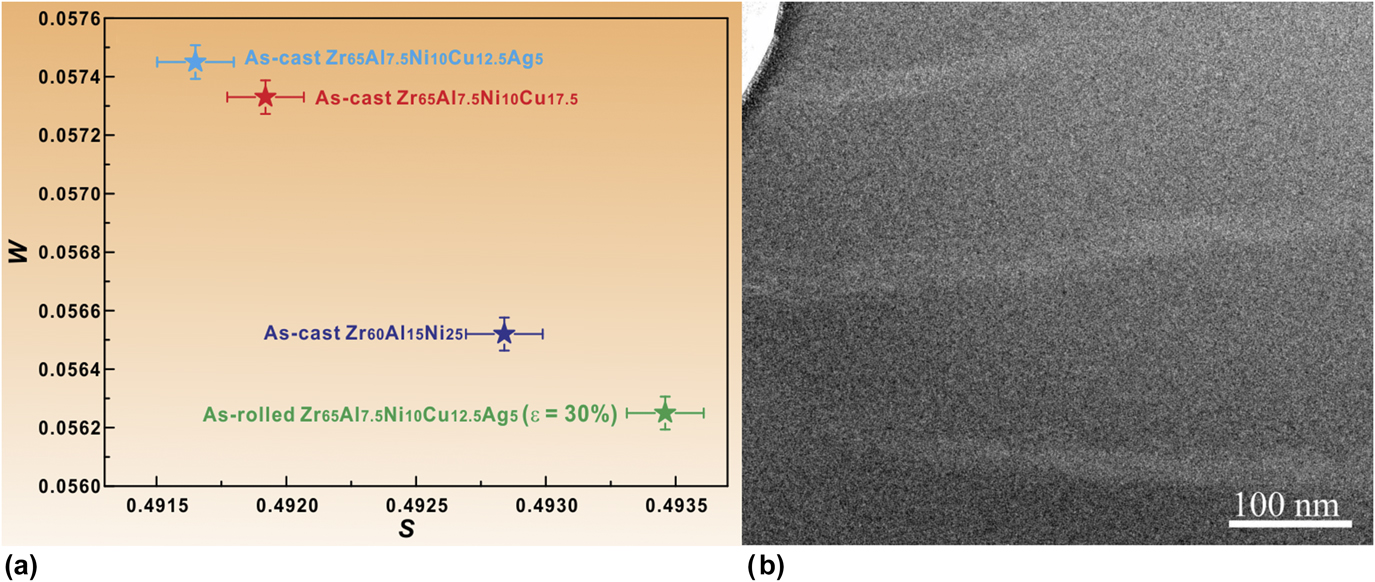
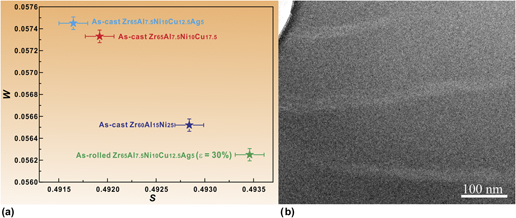
The XRD patterns (not shown here) verified the amorphous nature of the as-cast Zr60Al15Ni25, Zr65Al7.5Ni10Cu17.5, and Zr65Al7.5Ni10Cu12.5Ag5 bulk specimens and the as-spun Zr65Al7.5Ni10Cu12.5Ag5 ribbons. Figure 1(a) shows the PAS Doppler broadening results of the as-cast Zr60Al15Ni25, Zr65Al7.5Ni10Cu17.5, and Zr65Al7.5Ni10Cu12.5Ag5 MGs, in which the fraction of positrons annihilating with high momentum electrons (W) is plotted versus the fraction of positrons annihilating with low momentum electrons (S). The decrease of the value of S, or the increase of W, indicates less volume defects. It is obvious that the S values of the Zr60Al15Ni25, Zr65Al7.5Ni10Cu17.5, and Zr65Al7.5Ni10Cu12.5Ag5 MGs substantially decline in sequence, and the W values vary inversely. These results indicate that much less volume defects are present in the Zr65Al7.5Ni10Cu17.5 MG than in Zr60Al15Ni25 MG. Partial substitution of Cu by Ag in the Zr65Al7.5Ni10Cu12.5Ag5 MG further results in annihilation of volume defects.
PAS Doppler broadening results of some as-cast Zr-based MGs and a rolled (ε = 30%) Zr65Al7.5Ni10Cu12.5Ag5 MG specimen, in which the parameter W is plotted versus the parameter S (a), and a TEM image of the rolled Zr65Al7.5Ni10Cu12.5Ag5 MG (b), showing the formation of shear bands.

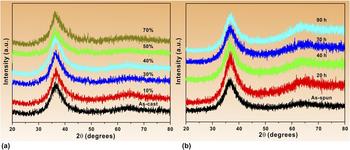
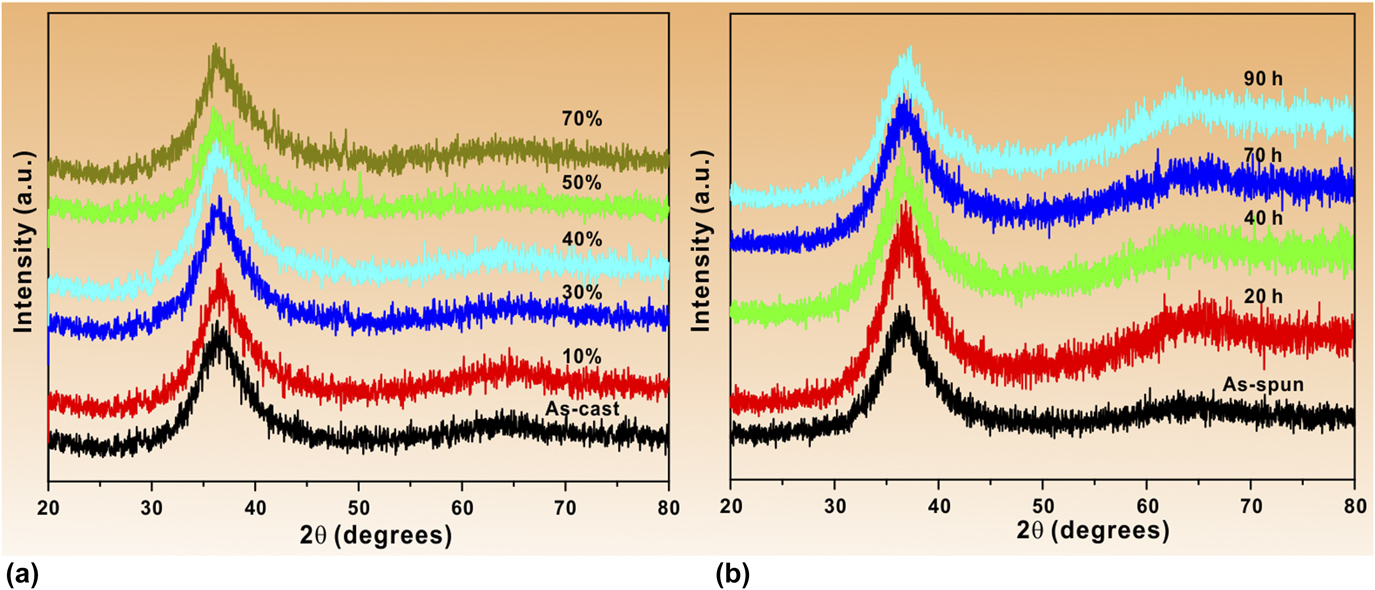
The XRD patterns (Fig. 2) show that the as-rolled (for different deformation degrees) and the as-milled (for different times) Zr65Al7.5Ni10Cu12.5Ag5 specimens remain amorphous, which indicates that no crystallization occurs in the Zr65Al7.5Ni10Cu12.5Ag5 MG upon cold rolling or milling. Although the rolled and milled samples are still amorphous according to the XRD patterns, the atomic configurations of the MGs considerably change due to alloying and plastic deformation. The PAS Doppler broadening results show that the atomic configuration of the Zr65Al7.5Ni10Cu12.5Ag5 MG considerably changes due to rolling. As an example, the S value of the Zr65Al7.5Ni10Cu12.5Ag5 MG increases due to rolling [e.g., ε = 30%, Fig. 1(a)], implying that more atomic defects are introduced, which is consistent with our previous result for the Zr60Al15Ni25 MG.Reference Yan, Yan, Tuo, Hu and Deng26 This is attributed to the formation of shear bands upon rolling, which is verified by the HRTEM imaging [Fig. 1(b)]. The shear bands appear as the bright bands in the HRTEM image due to less resistance to chemical attack during electrolytic thinning, resulting from more introduced atomic defects due to viscous flow.
XRD patterns of as-cast Zr65Al7.5Ni10Cu12.5Ag5 MG and some rolled specimens with different deformation degrees (a) and XRD patterns of as-spun Zr65Al7.5Ni10Cu12.5Ag5 MG and some specimens milled for different times (b).
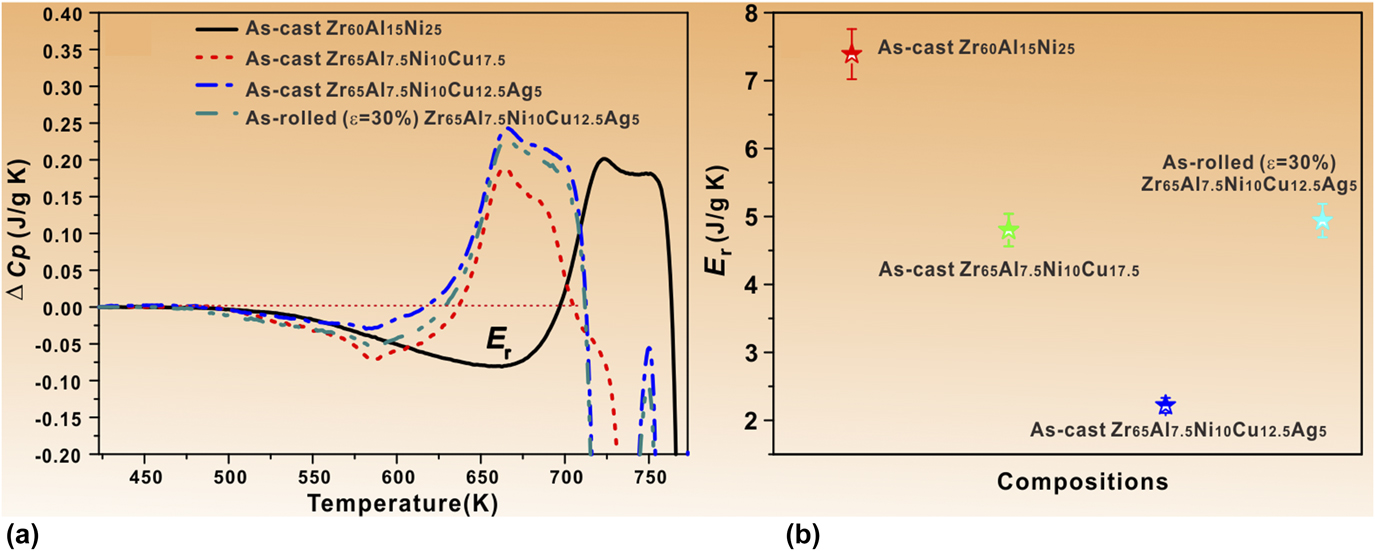
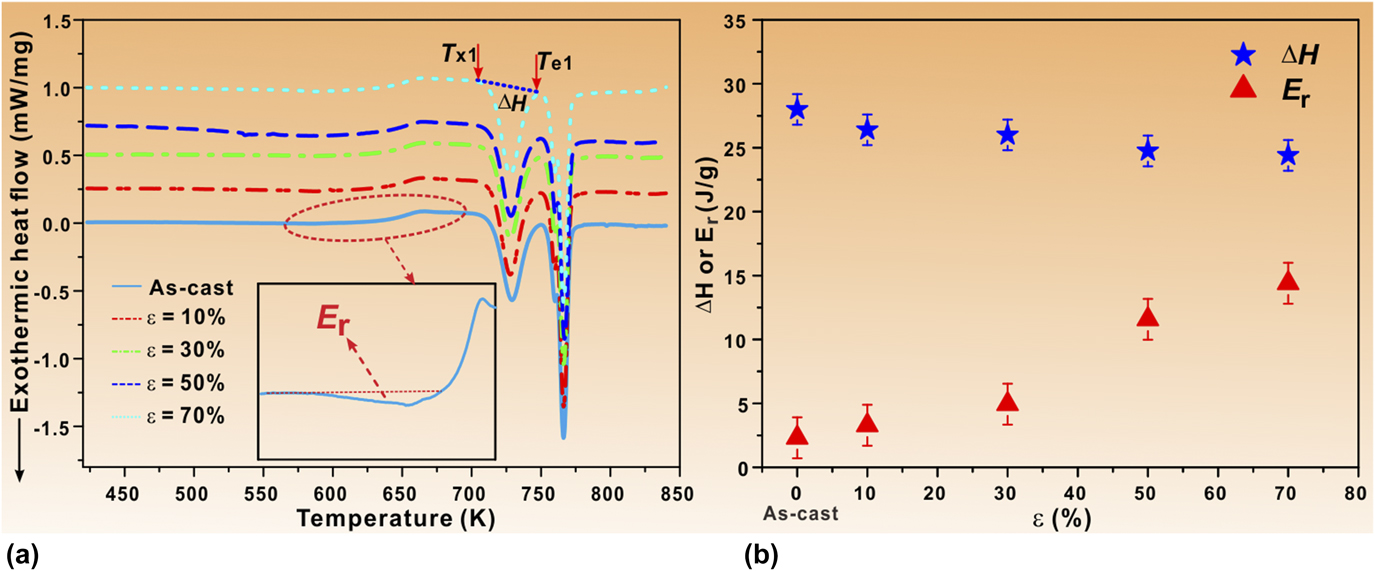
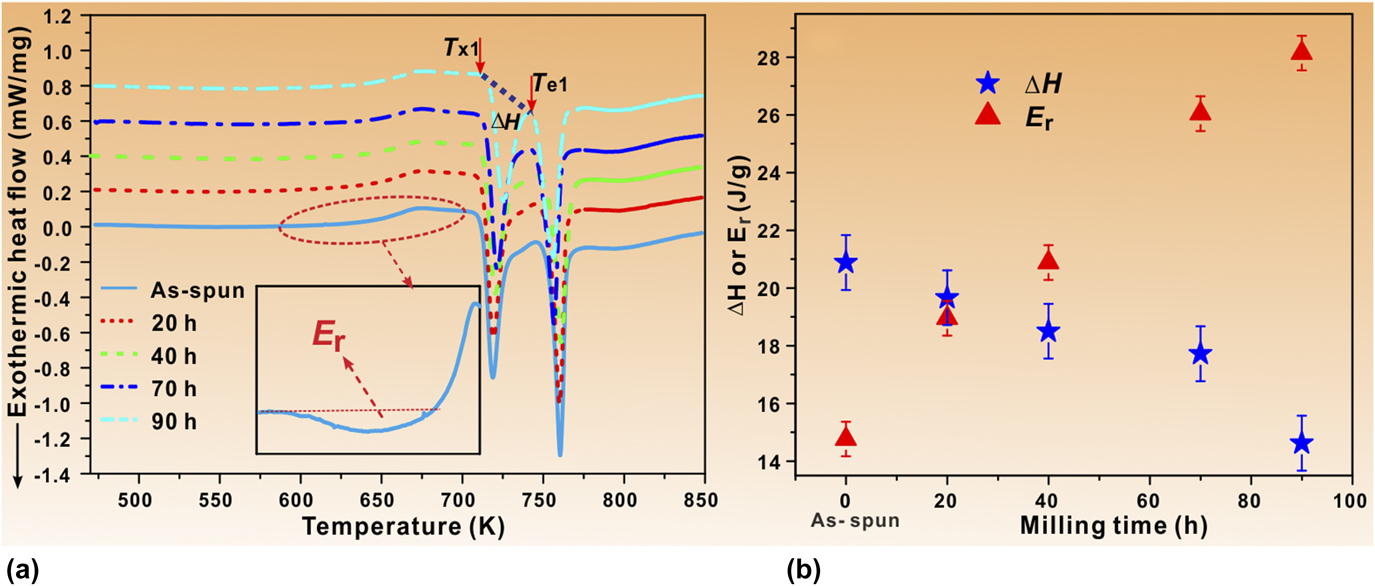
The DSC data further confirm changes of the atomic configurations of the MGs due to plastic deformation. Figure 3(a) shows the DSC curves of the as-cast Zr-based MGs and an as-rolled Zr65Al7.5Ni10Cu12.5Ag5 MG (ε = 30%), expressed in the relative change of the apparent specific heat ∆C p = C P (T) − C P (323 K), where C P (323 K) and C P (T) are the apparent specific heat at the temperatures of 323 K and T, respectively. The released heats E r per unit mass of the MGs due to structural relaxation before T g are presented in Fig. 3(b). Apparently, the E r values of the Zr60Al15Ni25, Zr65Al7.5Ni10Cu17.5, and Zr65Al7.5Ni10Cu12.5Ag5 MGs decline sequentially, and the E r value of the as-rolled Zr65Al7.5Ni10Cu12.5Ag5 MG (ε = 30%) is much higher than in the as-cast state. The results show that the frozen-in free volume in the Zr60Al15Ni25, Zr65Al7.5Ni10Cu17.5, and Zr65Al7.5Ni10Cu12.5Ag5 MGs substantially decreases in sequence and that more free volume is introduced due to cold rolling. These results agree well with the Doppler broadening results [Fig. 1(a)]. Figures 4(a) and 5(a) display the DSC curves recorded at a scanning rate of 20 K/min for the as-cast and some rolled Zr65Al7.5Ni10Cu12.5Ag5 specimens with different deformation degrees, and the as-spun and some Zr65Al7.5Ni10Cu12.5Ag5 specimens milled for different times, respectively. It is obvious that the E r values of the rolled specimens increase with increasing degree of deformation [Fig. 4(a)], and the E r values of the milled specimens increase with increasing milling time [Fig. 5(b)]. This clearly shows that more atomic defects are introduced upon plastic deformation.
Apparent specific heat data, ∆C p, of some as-cast MGs and a rolled (ε = 30%) Zr65Al7.5Ni10Cu12.5Ag5 MG (a) and their released energies, E r, per unit mass before the glass transition (b). The applied heating rate was 20 K/min.

DSC curves at a heating rate of 20 K/min for the as-cast Zr65Al7.5Ni10Cu12.5Ag5 MG and some rolled specimens with different deformation degrees (a) and their exothermal enthalpies (ΔH) for A–I phase transition and released energies (E r) per unit mass before the glass transition (b).

DSC curves at a heating rate of 20 K/min for the as-spun Zr65Al7.5Ni10Cu12.5Ag5 MG and some specimens milled for different times (a) and their exothermal enthalpies (ΔH) for A–I phase transition and released energies (E r) per unit mass before the glass transition (b).

B. Influences of atomic configuration changes on the A–I phase transition
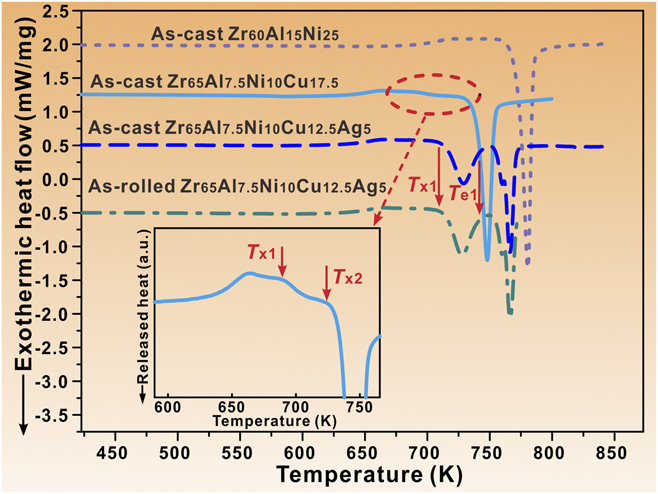
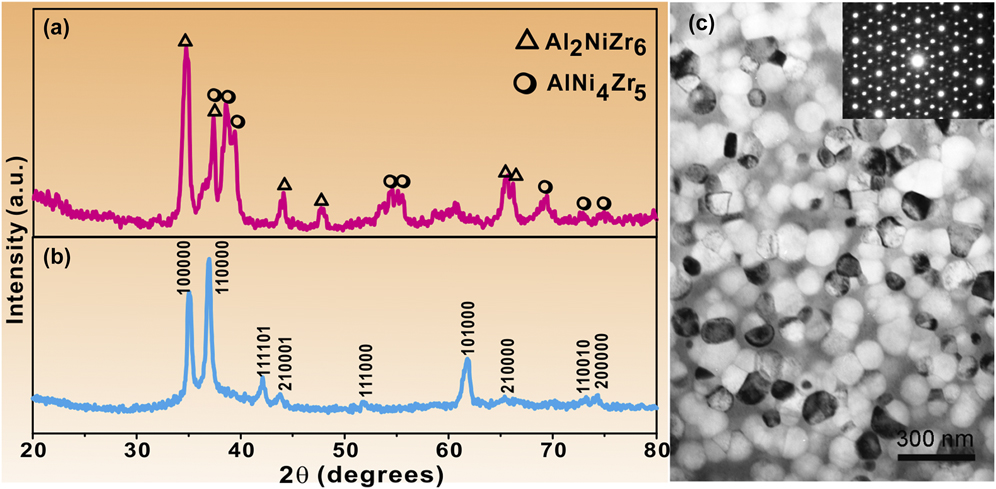
Figure 6 shows the DSC curves of the as-cast Zr-based MGs under a heating rate of 20 K/min, indicating that the crystallization behavior of the MGs evidently changes due to alloying. The crystallization of the Zr60Al15Ni25 MG is a single exothermic process, during which Al2NiZr6 and AlNi4Zr5 compounds precipitate [Fig. 7(a)]. Due to the addition of Cu to the Zr–Al–Ni system, the DSC curve of the Zr65Al7.5Ni10Cu17.5 MG shows two exothermic peaks. The first weak exothermic event (its onset temperature T x1 is shown in the inset of Fig. 6) corresponds to the formation of a small amount of quasicrystals,Reference Köster, Meinhardt, Roos and Liebertz27 indicating a very narrow stoichiometry for quasicrystal precipitation. The DSC curve of the Zr65Al7.5Ni10Cu12.5Ag5 MG shows three strong exothermic processes. The first exothermic event is confirmed to be the precipitation of the I-phase by the XRD pattern [Fig. 7(b)] and the selected area diffraction pattern [inset in Fig. 7(c)], indicating that partial substitution of Cu by Ag in the Zr–Al–Ni–Cu system substantially enhances the nucleation and growth of quasicrystals. These results suggest that alloying considerably plays a critical role in the A–I phase transition of MGs, which, in fact, is closely related to the changes of atomic configurations.
DSC curves of some Zr-based MGs at a heating rate of 20 K/min. The inset displays a magnified part of the DSC curve of the Zr65Al7.5Ni10Cu7.5 MG, revealing the first weak exothermic peak.

XRD pattern of Zr60Al15Ni25 MG isothermally annealed at 760 K for 30 min (a), XRD pattern of Zr65Al7.5Ni10Cu12.5Ag5 MG isothermally annealed at 673 K for 60 min (b), and the corresponding TEM image (c). The inset in (c) shows a selected area diffraction pattern of the precipitated phase, verifying its 5-fold symmetry.

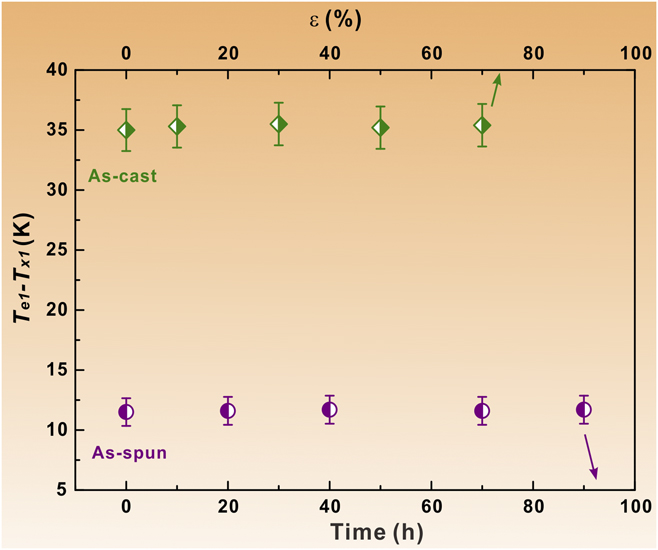
The changes of atomic defects due to plastic deformation considerably influence the A–I phase transition during heating of the Zr65Al7.5Ni10Cu12.5Ag5 MG. The exothermic enthalpies (ΔH) within the temperature window for A–I phase transition, (T e1 − T x1) (where T x1 is the onset temperature of I-phase formation and T e1 is the end temperature of I-phase formation), decrease after cold rolling and milling [Figs. 4(b) and 5(b)], indicating that the amount of precipitated quasicrystals decreases. It is worth noting that the E r value of the as-spun Zr65Al7.5Ni10Cu12.5Ag5 MG is much larger than that of the as-cast MG [Figs. 4(b) and 5(b)], and the value of ΔH of the as-spun MG is considerably smaller than that of the as-cast MG. This further suggests that the nucleation and growth behaviors of quasicrystals and the amount of quaiscrystals in a MG are closely related to its cooling rate during preparation, i.e., the atomic configuration. Moreover, the value of (T e1 − T x1) of the as-cast Zr65Al7.5Ni10Cu12.5Ag5 MG is much larger than that of the as-spun MG (Fig. 8), which indicates that the quasicrystals precipitated in the as-cast MG are more stable than those in the as-spun one. However, for the as-cast or as-spun Zr65Al7.5Ni10Cu12.5Ag5 MG, the window for A–I phase transition, (T e1 − T x1), remains nearly unchanged after plastic deformation although the amount of quasicrystals slightly decreases (Fig. 8).
Temperature window for A–I phase transition, (T e1 − T x1), of the as-cast Zr65Al7.5Ni10Cu12.5Ag5 MG and some rolled specimens with different deformation degrees, and the as-spun Zr65Al7.5Ni10Cu12.5Ag5 MG and some specimens milled for different times.

IV. DISCUSSION
Unlike the well-defined long-range order that characterizes crystalline materials, MGs exhibit no translational and rotational symmetry down to the subnanoscale because of their disordered atomic arrangement. In this sense, understanding the atomic structure of disordered systems is the structural fundament to analyze the nucleation and growth of quasicrystals in MGs. Despite intense research activities on the structure models of MGs, the details of how the atoms are packed in them are generally far less understood than in the case of network-forming glasses. However, it can be safely concluded that short-range order and medium-range order are the intrinsic characteristics of the atomic configurations in MGs.Reference Sheng, Luo, Alamgir, Bai and Ma28–Reference Fang, Wang, Hao, Kramer, Yao, Mendelev, Ding, Napolitano and Ho30
The widely cited dense random packing of hard spheres (DRPHS) model likens the atomic arrangement of a MG to a structure obtained by the DRPHS, as it was proposed by Bernal to explain the structure of monoatomic liquids.Reference Bernal31 This ideal case scenario has been extended by others who linked the structure of metal–metalloid binary glasses to the DRPHS in which the metal and metalloid atoms are represented by differently sized spheres.Reference Boudreaux and Frost32 A tetrahedron has the highest packing density because each atom is in contact with all the other three atoms. An icosahedral structure appears if sufficient atoms are placed into a tetrahedral symmetry. As a result, an icosahedron has the lowest energy per atom of all clusters if atomic interactions according to a Lennard-Jones potential are assumed.Reference Frank33 Thus, tetrahedral packing is a favorable atomic arrangement in a disordered system. However, it is impossible to fill the 3-dimensional space with a packing of tetrahedra, and other kinds of structures with lower packing densities must exist in a finite disordered system.Reference Sadoc34 As a result, the dense random packing of atoms in a disordered system results in 5 Bernal structures, i.e., tetrahedron, octahedron, tetragonal dodecahedron, trigonal prism capped with three half octahedron, and Archimedean antiprism capped with two half octahedron,Reference Cheng and Ma35 namely, Bernal structures, which are the basic packing topological structures in a MG. Compared with a tetrahedron, the other polyhedral structures have larger volume holes with lower packing efficiency. Therefore, it can be reasonably suggested that the icosahedral short-range order prevails in MGs, which has been confirmed by simulation and experimental results.Reference Luo, Sheng, Alamgir, Bai, He and Ma5,Reference Liu, Chen, Hui, Liu and Lu6,Reference Fujita, Konno, Zhang, Kumar, Matsuura, Inoue, Sakurai and Chen36,Reference Hirata, Kang, Fujita, Klumov, Matsue, Kotani, Yavari and Chen37
Based on the discussion above, Bernal holes are the fundamental volume defects in MGs, including those where chemical short-range order is pronounced. In this sense, Bernal holes with more randomness are the intrinsic defects in MGs that are the origin of the so-called free volume, which is confirmed by XRD.Reference Yavari, Le Moulec, Inoue, Nishiyama, Lupu, Matsubara, Botta, Vaughan, Di Michiel and Kvick38 These Bernal holes (volume defects) are thermodynamically unstable. When heating a MG to the glass transition temperature (T g), the redistribution of atoms with more randomness results in annihilation of excess free volume, which is an exothermic process as indicated by the exothermic reactions before T g in the DSC curves of MGs [Figs. 3(a), 4(a), and 5(a)].
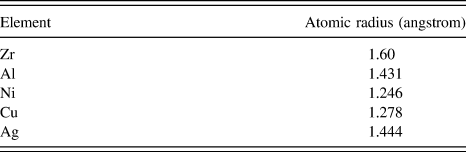
The packing of elements with considerable difference in size enhances the stabilization of the icosahedral structure in a MG.Reference Nelson39 It has been found that the local icosahedral atomic configuration of Zr70Cu29Pd1 MG is more rigid compared to that of Zr70Cu30 MG though only 1 at.% of Pd is introduced.Reference Saksl, Franz, Jóvári, Klementiev, Welter, Ehnes, Saida, Inoue and Jiang40 Based on the radii of elements (Table I), the atomic size ratios of Zr/Cu, Zr/Ag, Al/Cu are 1.25, 1.11, and 1.12, respectively. Appropriate addition of Cu and Ag (with smaller radii) to Zr–Al–Ni alloys enhances the packing density and causes substantial annihilation of volume defects [Figs. 1(a) and 3], which considerably weakens the space-frustration of the icosahedral structure. As a result, the icosahedral short-range order with 5-fold symmetry is predominant in the MG, which is favorable for the nucleation and growth of quasicrystals upon heating (Fig. 6). Based on the discussion above, it is natural that the precipitation of quasicrystals during heating of Zr–Al–Ni–Cu–Ag MG is much easier than for Zr–Al–Cu–Ni and Zr–Al–Ni MGs.
Radii of the elements used in this work.

For a MG, its atomic configuration shows a close relation to the cooling conditions applied during its preparation. With the increasing cooling rate, more excess free volume is frozen in a MG. As a result, there is more free volume in the as-spun Zr65Al7.5Ni10Cu12.5Ag5 MG ribbon than in its as-cast counterpart, which is consistent with the fact that the value of E r for the as-spun MG ribbon is much larger than for the as-cast bulk specimen [Figs. 4(b) and 5(b)]. The larger number of atomic defects in the as-spun MG means that more atoms are located in regions with smaller packing density and more randomness. As a result, the larger icosahedral structures are destructed into smaller distorted ones. Under the same heating conditions, the nucleation of quasicrystals in the as-spun MG requires redistribution of more atoms, resulting in sluggish nucleation and growth behaviors in the as-spun MG. Compared with the as-cast MG, the precipitated quasicrystals in the as-spun MG are thermodynamically less stable due to introduction of more excess free volume, which is confirmed by the fact that the value of (T e1 − T x1) in the DSC curve of the as-spun MG is much smaller than that of the as-cast one (Fig. 8). The more sluggish nucleation and growth and the smaller reaction window of (T e1 − T x1) for the as-spun MG lead to a smaller amount of precipitated quasicrystals in the as-spun ribbon upon heating, which is manifested by the fact that the exothermic enthalpy for precipitation of quasicrystals (∆H) of the as-spun MG is smaller than that of the as-cast one [Figs. 4(b) and 5(b)].
The cold rolling of the Zr65Al7.5Ni10Cu12.5Ag5 MG results in formation of shear bands [Fig. 1(b)], in which considerable atomic configuration changes occur.Reference Yan, Song, Hu, Dai, Chu and Eckert17,Reference Ritter and Albe41 It has been confirmed that considerable atomic configuration changes occur in a MG even under the elastic deformation.Reference Zhang, Mattern and Eckert42 Based on the discussion above, it can be safely concluded that more atomic defects are introduced in the Zr65Al7.5Ni10Cu12.5Ag5 MG due to cold rolling [Figs. 1(a) and 4(b)], which results in formation of structures with smaller densities in the deformed regions. During the subsequent heating of the rolled Zr65Al7.5Ni10Cu12.5Ag5 MG, nucleation and growth of the I-phase are substantially suppressed in the deformed regions. As a result, the amount of the precipitated quasicrystals slightly decreases [Fig. 4(b)]. Although the deformation of materials during milling is more complex than rolling, the atomic configuration changes in the milled Zr65Al7.5Ni10Cu12.5Ag5 MG are similar to that in the rolled MG, namely, more free volume are introduced in the deformed regions. Furthermore, the amount of accumulated volume defects increases with increasing milling time [Fig. 5(b)]. Similar to the rolled MG, the amount of the precipitated quasicrystals in the milled MG slightly decreases compared with the as-spun MG [Fig. 5(b)].
It is worth noting that, for the as-cast or the as-spun Zr65Al7.5Ni10Cu12.5Ag5 MG, the window for the A–I phase transition, (T e1 − T x1), remains nearly unchanged after plastic deformation although there is a difference in the amount of quasicrystals (Fig. 8). It is suggested that the temperature window for the nucleation and growth of quasicrystals, (T e1 − T x1), in a MG are dominated by the atomic configurations of the undeformed amorphous matrix. The introduction of more localized free volume in the deformed regions generated by plastic deformation suppresses nucleation and growth of the I-phase, which results in the decrease of the amount of quasicrystals, i.e., the decrease of the value of ∆H [Figs. 4(b) and 5(b)].
V. CONCLUSIONS
In summary, the influences of alloying and plastic deformation on the atomic configurations of Zr-based MGs were evaluated by PAS and DSC, and the correlation between the atomic configuration and the A–I phase transition in a MG was investigated. The results show that the free volume considerably decreases upon the addition of Cu to Zr–Al–Ni and Ag to Zr–Al–Ni–Cu MGs, which results in annihilation of volume defects by a denser packing of atoms with considerable size differences. The decrease of the volume defects considerably lowers the space-frustration of the icosahedral short-range order, which enhances the nucleation and growth of quasicrystals during the A–I phase transition of the MG upon heating. Creating more localized volume defects in the deformed regions of MGs via plastic deformation results in the formation of structures with lower densities, which considerably suppresses the nucleation and growth of quasicrystals due to heating. The present work further provides direct evidence that icosahedral short-range order prevails in MGs.
ACKNOWLEDGMENTS
This work was financially supported by the National Natural Science Foundation of China (Grant Nos. 51561001, 51441004, and 51204118), the Program for Excellent Talents of Shanxi Province, China (2010), the Fund Program for the Scientific Activities of Selected Returned Overseas Professionals in Shanxi Province (2014), the Research Project of the Shanxi Scholarship Council of China (2015-87), and the “131” Leading Talent Project of Universities in Shanxi Province (2015). Additional support by the German Science Foundation under the Leibniz Program (Grant No. EC 111/26-1) and the ERC Advanced Grant “INTELHYB – Next Generation of Complex Metallic Materials in Intelligent Hybrid Structures” (Grant No. ERC-2013-ADG-340025) is gratefully acknowledged. Z.Y. would like to express appreciation to Dr. X.P. Hao and B.Y. Wang (Key Laboratory of Nuclear Analysis Techniques, Institute of High Energy Physics, Chinese Academy of Science) for their kind help with the PAS measurements.