1. Introduction
East Asia and Latin America have followed significantly different paths of development. Immediately following World War II, the standard of living in much of Latin America was significantly higher than that of East Asia (Taiwan and South Korea). However, since then East Asia has significantly outperformed Latin America such that by the late 1970s the former had surpassed the latter in terms of average per capita GDP (Rozenwurcel, Reference Rozenwurcel2006). Both regions began the postwar period by attempting to follow import substitution strategies for industrialization (ISI). This approach generally involved the use of tariffs and quotas to protect domestic industry. Multiple exchange rate regimes were often used to allow for the cheap purchase of intermediate goods and capital while at the same time penalizing the purchase of luxury, non-essential goods. The justification for such a strategy was often made through an appeal to the infant industry argument. In an imperfect world, new industries established in developing countries could not be expected to compete against the already well-established industries in the developed world (especially if capital markets did not function properly in developing countries).
However, in the 1970s, East Asia altered its strategy by attempting to integrate itself into the world economic system via the promotion of exports. This was not a free trade strategy; tariffs and quotas were not eliminated. However, the extent of protectionism was reduced and incentives for production for export were greatly enhanced. Exports of labor-intensive manufactured goods grew rapidly and, through time, much of East Asia began to move up the technological ladder, exporting increasingly complex manufactured goods.
Latin America, however, failed to make this transition from inward to outward development and continued to follow an import substitution strategy. The development paths for these two regions sharply diverged. Why did this divergence occur? There have been a number of papers written on this topic. Cole, Ohanian, Riascos, and Schmitz (Reference Cole, Ohanian, Riascos and Schmitz2005) argue that the continued inward-oriented development outlined above created an economic environment in Latin America which kept total factor productivity in Latin America low and this low total factor productivity accounts for the inability of Latin America to catch up. The barriers to competition, both internal and external, characteristic of Latin American economic policy resulted in low total factor productivity. The difficulty with this analysis is that it fails to explain why such barriers were maintained in Latin America if they had such a negative economic impact. One can appeal to the political power which certain groups may use to persuade ruling elites to provide protection from competition. Thus rent-seeking behavior seems to explain the persistence of such a strategy. Of course, one must wonder why East Asia was not subject to the same sort of influences.
Mahon (Reference Mahon1992) argued that it was unlikely that Latin America could have followed the sort of strategy that East Asia committed itself to. Latin America was a relatively land-abundant, labor-scarce region, characterized by an abundance of natural resources. Thus the relative productivity of labor was high and relative wages were high. A switch to an outward-oriented strategy, based upon the export of labor-intensive manufactured goods, would have required devaluations so extreme as to be politically impossible. Thus a switch from an inward-oriented, import-substitution strategy to an outward-oriented, export-based approach would have been very costly.
The above argument is similar to the notion of a resource curse. That is, countries having an abundance of natural resources find it very difficult to switch from the production and export of natural resource-intensive goods to technologically simple manufactured goods. However, Thailand and Malaysia represent two counter examples to this argument. Both have been able to shift to the export of manufactured goods. The resource curse was, evidently, not an insurmountable problem.
Kay (Reference Kay2001) seeks to try to explain how it is that East Asia was able to carry out a successful strategy of long-run economic development. He argues that East Asia succeeded as a result of three interconnected factors. First, the states in East Asia had greater capacity to carry out effective policy. They were not so constrained by the rent-seeking activities of powerful groups within society. This was, to some extent, the result of the second factor, East Asia achieved significant agrarian reform prior to the rapid growth in the postwar period. This reform eliminated the landlord class as a political group and gave the state or ruling elite the independence necessary to carry out good policy. In addition, the reform significantly reduced the degree of inequality in the rural areas of East Asia. The third factor explaining East Asian success was the rapid growth of the agricultural sector. This rapid growth provided the basis of a market for non-agricultural goods as well as a source for resources for the expansion of the non-agricultural sector.
Latin America's failure to grow rapidly is, according to Kay, intertwined with problems in agriculture. Specifically, no broad-based land reform took place (except in Cuba) and agricultural productivity growth was sluggish at best. Thus Latin America's agricultural sector failed to provide the resources for industrialization and the extreme inequality in land ownership prevented the accumulation of human and physical capital necessary for rapid long-run economic growth.
Engerman and Sokoloff (Reference Engerman and Sokoloff2002) compare and contrast the process of economic development in Latin America relative to North America (United States and Canada), instead of East Asia. However, their analysis is complementary to the ideas presented above concerning agriculture and inequality. They argue that institutional differences explain the difference in development paths between the two regions. The natural endowments of the two regions were quite different. The endowment of Latin America led to the development of two types of colonies. The first type of colony was well suited to the production of plantation crops, which were characterized by the concentration of land ownership and the use of slave labor. The second type of colony utilized extensive native populations as laborers, but was based on a highly unequal distribution of land ownership, fostered by the Spanish. The common theme is the extreme degree of inequality in the rural areas. This extreme inequality allowed elites to use their power to influence the development of both economic and political institutions. These economic and political rules excluded the bulk of the population and perpetuated the wealth and power of the elite. Thus poor institutions explain the poor economic performance of Latin America and the poor quality institutions are in turn the result of extreme inequality within the rural sector.
Alternatively, the initial factor conditions in North America favored the development of an agricultural sector based on small family farms operating under very limited economies of scale. Thus the distribution of land ownership was much more equal. This greater equality resulted in the development of economic and political institutions that allowed for greater political participation, more widespread human capital accumulation and greater access to economic opportunities. Thus better institutions fostered more rapid growth.
The analysis above suggests that Latin American difficulties with achieving rapid growth are related to its inability to effectively engage in outward-oriented growth. The existing institutional structure would seem to be the key factor in explaining this inability and this institutional weakness seems to be related to the degree of inequality in the rural, agricultural sector.
This paper will construct models of long-run development, in which the structure of land use in agriculture is the key factor in distinguishing two paths of long-run growth. Institutional quality, especially that related to state effectiveness, depends on the extent to which the ruling elite earn their revenue. In those regions characterized by a unimodal structure of agricultural production, the state and ruling elite are more likely to have to earn their revenue and institutional quality will improve through time. Alternatively, those regions characterized by a bimodal agricultural sector are less likely to have ruling elites that have to earn their revenue. Thus institutions (particularly those connected with the state) are likely to remain of poor quality. The former (unimodal) are more likely to be capable of making the transition to outward-oriented growth, while the latter (bimodal) are less capable of doing so. Sections 2 and 3 of this paper will develop these ideas in some detail. Section 4 will illustrate the theoretical analysis with reference to the experiences of East Asia and Latin America. The last section of the paper will provide a summary of the ideas and discuss implications and conclusions.
2. Earned and unearned income
It is now commonly accepted among development specialists that the state is crucial to long-run economic development and growth. It is not a matter of shrinking or expanding the state, but instead it is the effectiveness of the state's institutions which are crucial.
But what does it mean to have an effective state? It would seem that such a state should be able to clearly set goals which are of benefit to the collective, to society in general. Such a state must be able to conceptualize and apply a set of policies aimed to achieve these goals. In this context the state must be quite pragmatic, prepared to jettison policies that fail and adopt new approaches that appear to offer greater effectiveness. Finally, such a state must not be susceptible to extensive rent-seeking activities which often result in significant corruption.
Outlining what constitutes an effective state is fairly easy to do. The important question concerns how such a state comes into being. There is a significant degree of empirical evidence supporting the notion that effective states promote long-run economic growth. The institutional effectiveness data utilized generally measures the extent to which law and order prevails, the degree of bureaucratic quality, the extent of corruption, the risk of expropriation by the government, and the risk of government contract repudiation. Countries are usually ranked on scales and the data have been collected and developed by the International Country risk Guide (ICRG). The empirical tests have generally utilized regression analysis by putting some measure of economic performance on the left-hand side and the measures of institutional quality and other control variables on the right-hand side. For example, Knack and Keefer (Reference Knack and Keefer1995) used this approach and found a very strong positive relationship between the various measures of state institutional quality and economic performance.
The problem with the sort of analysis discussed above is that it is not clear in which direction causality runs. In order to deal with this issue, a number of scholars have used instrumental variables (see Acemoglu, Johnson, and Robinson, Reference Acemoglu, Johnson and Robinson2001). Most of this work again finds a strong causal relationship from the quality of state institutions to economic performance.
Thus the institutional quality of the state is important. However, how does one get a state that constructs and fairly protects property rights and provides law and order and has a high quality bureaucracy and provides an environment where the levels of corruption are low, etc.? It is just not a matter of having a strong state, since as Weingast (Reference Weingast1995) says, ‘A government strong enough to protect property rights and enforce contracts is also strong enough to confiscate the wealth of its citizens. Thriving markets require not only an appropriate system of property rights and a law of contracts, but also a secure political foundation that limits the ability of the state to confiscate wealth’ (p. 1).
The result of the above discussion would seem to be that economic and political development are intertwined. Political development seems to be an evolutionary process by which the state attains the ability to set goals favoring the collective interests and to carry out policies to achieve such goals with a minimum of corruption and rent seeking. This involves interaction between the state and society with the political structure emerging out of this interaction. Moore (Reference Moore2001) defines political underdevelopment as a regime that is both ineffective, unable to rule many nominal citizens or to pursue any collective interest, and is arbitrary and unaccountable.
The ruling elite of any society generally makes policy with the objective being to maximize their own welfare. Since they are a minority of the population of any society, policies that maximize their welfare are not likely to be policies that maximize welfare for society. Thus very often the ruling elite act as predators on society. Political development would seem to be the process by which the pursuit of wealth maximization by the elite comes to correspond with wealth maximization for society at large. In other words, political development is the process by which a ruling elite moves from killing the goose that lays the golden egg, to nurturing it.
It would seem that this is more likely to occur if the probability of survival of the ruling elite becomes increasingly tied up with the well being of the bulk of its society. Thus political development occurs when the ruling elite become dependent on society in general for their political survival. Moore (Reference Moore, Robinson and White1998) provides a clear way to think about these issues by referring to a tradition in pubic policy known as fiscal sociology. He argues that one can make a distinction in the ways the ruling elite generate the resources it needs to survive. The distinction that he makes is between earned and unearned state income. The earned characteristic of income refers to the extent to which the state (and therefore the ruling elite) has to put in effort to work with its citizens in order to get its revenue.
The effort that Moore refers to is of two types. The first is organizational effort. That is, the extent to which the state has to construct a bureaucratic structure to penetrate society so as to collect revenue from its citizens. The second is the extent of reciprocity between citizens and the state. In other words, the extent to which ruling elite provide services in return for revenue.
Unearned income is the reverse of the above. It requires little organizational effort to collect and little interaction between the ruling elite and the bulk of society. An extreme example would be a ruling elite which is supported by revenue flows from outside the nation or region. Often income earned from oil, minerals, and foreign aid are used as examples of the sources of unearned income. A broader view would include dependence on timber, diamonds, and narcotics. These sources of income do not require an effective bureaucracy that can deeply penetrate society nor do they require any form of reciprocal relationship between the ruling elite and the bulk of the population.
This distinction between earned and unearned income would seem to be an important one. A ruling elite that earns its income must, in a sense, strike a bargain with society in order to ensure a revenue flow. It is through this bargain that the ruling elite get the revenue they need. But to get the revenue, the ruling elite must provide services to the group or groups from which it extracts revenues. These services generally involve the provision of social infrastructure and education, but also the rules supporting market exchange such as property rights protection, rule enforcement, etc.
If the ruling elite depend upon a narrow segment of society, then general provision of public goods and market supporting institutions will not occur. Instead, these will be made readily available only to a narrow segment of society. As a result, growth may occur, but it will be limited by the limited provision of infrastructure and quality institutions. Alternatively, if the ruling elite are dependent upon a broad section of society, the bargain which evolves will likely result in a broad provision of infrastructure and institutional support for market exchange. This is likely to result in higher long-term economic growth.
One can, to some extent, translate the above analysis of earned and unearned income into an evaluation of types of tax. Taxes on income or land, in particular for rural-based economies, can be thought of as earned. These kinds of taxes require a significant organizational structure which must penetrate society in order to collect the information necessary to collect the revenue. Because of the nature of these taxes, it is obvious to producers that income is being extracted and thus producers are likely to significantly resist such extraction. This resistance may be direct, in the form of riots, protests, etc. or the resistance may be indirect or hidden involving hiding income or the switch to the informal economy. In order to weaken such resistance the ruling elite must provide services in return. It is impossible to rely completely on threats or punishment to effectively reduce such resistance; reciprocity becomes necessary.
Types of taxation that are less earned would be more indirect in nature such as sales, turnover, value added taxes, and, most importantly, trade taxes (taxes on imports and/or exports). These taxes do require an organizational capacity to collect information and penetrate society, but to a lesser extent than income and land taxes. These kinds of taxes are levied at points of commercial exchange. A broadly based sales or value added tax may involve as much organizational effort as direct taxes. But the narrower the focus of the tax, the less organizational structure is required. For example, taxes levied on trade only require organizational structures at major ports or other points of entry. In addition, the incidence of such taxes are particularly difficult to determine since they generally influence the relative prices of the commodities taxed. Because of this, the impact of the tax is hidden and thus it is much more difficult for those affected to form groups with the purpose of resisting such taxes or increases in such tax rates. Compare this to an income or land tax: here the incidence is obvious and thus more easily becomes a focal point for resistance. Thus indirect taxes are less likely to result in reciprocity between the state and the citizens.
In summary, the way a ruling elite raises revenue influences how state institutions evolve through time. One can arrange revenue sources along a spectrum or scale from earned to unearned. At the earned end, revenue is generally raised from broad-based taxes where the incidence is very clear. These are taxes and fees that are generally more direct in nature, such as income and wealth/land taxes. At the other extreme, one has revenues flowing from foreign aid, which, under current conditions, often require little organization and reciprocity. Indirect taxes are somewhere in between. The more broadly based they are, the more likely that effort must be exerted to extract the revenue. More narrowly based indirect taxes, such as those on trade, are closer to the unearned extreme of the spectrum. The hypothesis examined above can be simply stated. The more reliant a ruling elite is on broadly based taxes on income and land, the more likely state institutions will be developmentally oriented, i.e. aiming at enhancing the welfare of the society in general. Alternatively, the more reliant a ruling elite is on narrowly based, indirect taxes, the less likely state institutions will be developmentally oriented, i.e. the more likely the state will be predatory.
Since most developing nations begin as predominately agrarian/rural-based economies, the structure of such economies is likely to be linked to the types of revenue sources available. One can make a distinction between agrarian structures that are bimodal and those that are unimodal (Johnston and Kilby, Reference Johnston and Kilby1975). A unimodal agricultural sector is one in which the operational size of farms is fairly uniform in nature, although actual land ownership may be unequal. One can think of agricultural sectors made up of small farms operated mainly by households. This type of agriculture generally utilizes labor-intensive technologies. Technological innovation and productivity growth often involve biochemical innovations aimed at raising the productivity of land. Although, small-scale mechanical innovations may also be important. Productivity growth is likely to be broad based when it occurs. A society predominated by this sort of agricultural structure will provide potential revenue for a ruling elite, however taxing this revenue source is not likely to be easy.
If the bulk of the production from such a sector is exported, revenue can be more easily extracted via trade taxes, either on the exports of the good itself (export tax) or on the imports that are purchased with the export revenue (import tax) or both. However, the coordination and organization necessary to market export products from a large number of small, household exporters is likely to be substantial. If the bulk of production is for the domestic market, then substantial organizational structures for penetrating the countryside will be very important for gathering the information necessary for collecting revenue. The point is that direct taxation is likely to be the main mechanism for raising revenue, through taxes on wealth, land, and/or income. Trade taxes may also play a role, but the organizational effort to collect the revenue will require significant effort upon the part of the state. In order to collect the revenue, services will have to be provided and they will have to be made available to all of the producers in a unimodal system. In other words, to assure tax compliance, general property rights protection would have to be provided.
In contrast, consider a bimodal agrarian structure. This would be a structure in which the bulk of commercial production occurs on large estates owned by a small proportion of the population. The operational size in this context would be quite large. The bulk of the rural population engages in subsistence-oriented farming, where the operational size of the farm is quite small. The technology utilized on the large commercial farms is likely to be capital intensive and land extensive. Productivity growth is likely to involve mechanization. The main potential source of revenue for the ruling elite will be from extracting revenue from the large, commercial-oriented farms.
Extracting revenue from this set of rural elite producers is likely to be very difficult from a political perspective. However, if the commodities produced are destined for the export market, then trade taxes would seem to be the mechanism by which revenue can be extracted. First, because the producers are few in number, coordination and marketing need not fall upon the state. Large producers will likely find it easier to market their own production through producer associations. Second, the incidence of these taxes is difficult to determine. If the country involved is large it can, via its market power, pass part of the cost of the tax to foreign consumers. If the country is small, that is not possible (no influence on the terms of trade). Because the tax incidence in unclear, there is likely to be less resistance to taxation.
Income extracted in this way by the governing elite is likely to have more of an unearned character. It will not require significant organizational penetration of society. Most importantly, although the state will have to provide services in return for the revenue, these services (infrastructure, market support, etc.) will likely be made available only to the small group of large, commercial producers, not the smaller, more subsistence-oriented producers. Thus the bulk of the population will not be able to engage in extensive market production nor will their property rights be well protected, etc. As consumers, they will in fact pay part of the cost of providing the services to the large commercial farmers via higher costs for imported goods.
The implication of the above is that two paths of institutional evolution are likely to occur. In agrarian societies characterized by unimodal agrarian structures, the interaction of the ruling elite and the provider of revenue is likely to result in state institutions that are of high quality. Alternatively, those agrarian societies characterized by bimodal structures are likely to be characterized by limited institutional development. Thus long-run growth is more likely in the former relative to the latter.
3. Outward-oriented growth and the structure of agriculture
The discussion above seems to point to the conclusion that making the shift from an inward- to an outward-oriented development strategy seems to be crucial to successful long-run development. Such a shift has been thought to have been crucial in East Asia's rapid economic growth. Both South Korea and Taiwan initially followed the typical import substitution strategies of economic development in the early postwar period (Wade, Reference Wade1990). However, in the late 1960s and 1970s both were able to make the shift. Most countries in Latin America found making this shift extremely difficult, if not impossible to achieve.
Politics and in particular rent-seeking activities by powerful groups within society are seen as the main culprits in explaining the persistence of protectionism. That is, barriers to trade are used to protect powerful interest groups, which, in turn, provide political support for the ruling elite. These powerful interests are indeed likely to be important factors in the strength and persistence of protectionism and inward-oriented development. However, an additional factor related to a country's ability to extract revenue may be important.
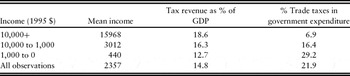
Kubota (Reference Kubota2005) has noted, as have others, that macroeconomic stabilization and trade reforms often go together. However, there is no obvious reason why this should be true. However, Kubota argues that there is a very good reason to expect that trade liberalization and fiscal (in particular tax) reform, which is a form of macroeconomic stabilization, should go together. Taxes on trade form a significant source of revenue for poor developing countries, but not for developed countries. Examining Table 1, it can be seen that trade taxes as a share of government revenue vary inversely with income.

The implication of the above is fairly straight forward. If less-developed countries are dependent upon trade taxes for a substantial share of their revenue, then an immediate conflict arises. A less-developed country that engages in trade reform via tariff reduction or elimination will likely find itself in substantial fiscal difficulty. This may make it extremely difficult, from a fiscal perspective, to engage in trade reform via tariff reduction.
Kubota (Reference Kubota2005) constructs a model in which the collection of taxes on various types of goods has varying costs of collection associated with it. It is assumed that the tradable goods are the least expensive to tax and thus, for poor countries, are always taxed for revenue purposes. Large or sustained increases in revenue requirements necessitate tax reforms. More importantly, trade liberalization should be observed in conjunction with governments diversifying their revenue sources. In the model, trade liberalization is defined as tariff reduction and tax reform is defined as increasing the number of sectors that are taxed. The latter allows the tax rate on other sectors to be reduced, reducing tariff rates since traded goods are always taxed. Kubota empirically tests the implications of the model utilizing a panel dataset with 27 developing countries for the time period 1985–2000. The results indicate that when tax reform occurs, tariff rates tend to fall.
Khattry and Rao (Reference Khattery and Rao2002) have undertaken a similar research path. However, their concern is with the process of globalization with its attendant pressures for external integration via trade liberalization, i.e. tariff reduction. They too argue that, for a number of structural reasons, less-developed countries are heavily dependent on trade taxes for revenue. They argue that, ‘Efforts to liberalize trade will result in revenue losses in most cases, unless the liberalizing countries successfully replace the foregone revenue from trade by revenue from domestic sources’ (p. 1431). Thus trade liberalization, turning outward, requires that the state be able to shift to alternative tax revenue sources.
The above is crucially important in a successful transition to export-oriented growth. Such a strategy requires more than just the reduction of tariffs. Significant investments in physical infrastructure are necessary, especially in the form of transportation and communication systems. In addition, if poor countries are to move up the technological ladder, they must be able, over time, to export increasingly complex goods. For this to occur, significant accumulation of human capital through education must occur. Thus if liberalization via tariff reductions occurs without finding alternative revenue sources, the state will find itself unable to fund the construction of infrastructure and the accumulation of human capital. This implies that a shift to outward-oriented growth faces two obstacles. The first is a short-run problem resulting in a fiscal crisis, a decline in revenue. The second is a longer-term problem stemming from the inability to invest in the infrastructure and human capital that will allow for rapid export growth.
Khattry and Rao conduct an empirical analysis using a panel of 80 developing and industrialized countries for the time period 1970–1998. The results indicate that low-income and upper-middle-income countries (many of which are from Latin America) have experienced declining tax revenues as a result of declining trade taxes (trade liberalization). ‘Reduced state capacity has consequently compromised the ability of the state to pursue development objectives’ (p. 1441).
The analysis of this section can be related to that of the previous section. There two development paths were described which were distinguished by the structure of the agriculture sector. Under a unimodal agricultural sector, productivity growth results in the development of a broad base of income-earning producers. Such a country may begin with a heavy reliance on trade taxes for revenue. However, there is a substantial source of additional potential tax revenue that can be extracted from the rising incomes of a productive unimodal agricultural sector.
One can broaden out this idea a little bit more. Productivity growth in this sector and the broadly based rise in income is likely to be spent by small farmers on relatively simple consumer or household goods. This will likely stimulate the development of domestic producers to supply these products (Hayami and Kawagoe, Reference Hayami and Kawagoe1993). Commercialization and the expansion of non-agricultural incomes will create additional sources of potential revenue for the state.
The ruling elite within such an agrarian structure will have to learn how to tap these revenues sources, these sources of earned income. An institutional structure capable of penetrating the increasingly commercialized production process is necessary and reciprocity will be required if the ruling elite are going to convince producers to pay taxes. If successful, these new sources of revenue allow the ruling elite to pursue an outward-oriented development strategy. The reduction in tariffs, which is required to pursue such a strategy, will not jeopardize the short-run budget and revenues will be available for investment in infrastructure and human capital.
Contrast this with the situation in a nation characterized by a bimodal agricultural sector. In this case, the country initially is significantly dependent on trade taxes for revenue. The difficulty is that there are no alternative sources of revenue that are evolving. Productivity growth in the large, commercialized farm sector is not easily taxed, resulting in dependence on trade taxes. Since new income growth is likely to be highly unequally distributed, much of the increased spending out of that income is likely to be spent on imports. Thus there are no new sources of revenue for the ruling elite to tap into. As a result, any attempt to turn outward will face several major obstacles. First, revenue short-falls will characterize the budget situation. Second, these budget problems will make it very difficult for the state to make the investments necessary to make a successful shift to export-oriented growth.
The next section will illustrate the ideas developed in this and the previous section. It will use East Asia and Latin America as illustrations of the two development paths outlined above. Specifically, East Asia's agricultural sector has been unimodal in nature and broad-based productivity growth did indeed occur. Latin America represents a bimodal economic structure, with large operational sized, commercialized farms and a sector of more subsistence-oriented producers, making up the bulk of producers.
4. East Asia and Latin America
Institutional quality has many dimensions and any general analysis of such quality comparing Latin America and East Asia would require at least a book length manuscript. Thus this paper will restrict itself to the development of institutions concerning land. In East Asia, it will be argued that a unimodal agricultural structure and productivity growth provided conditions under which property rights evolved to protect the small producers who made up the bulk of the system. Alternatively, under Latin America's bimodal structure property rights evolved to protect large commercialized producers at the expense of the bulk of the farming population. The latter's property rights were left undefined.
East Asia's experiences (Japan, South Korea, and Taiwan) of rural development are quite similar for two reasons. First, they are all examples of unimodal agricultural structures. The operational size of farms is relatively small and has been for the last several hundred years. Second, South Korea and Taiwan were colonies of Japan and the commonalities of the colonial experience pervade their agricultural development experience.
Agricultural growth, within a unimodal structure began to take place in the 1600s in Japan. Initially, it was an evolutionary process driven by the trial and error efforts of small farmers. Output per person began to slowly increase (Hanley and Yamamura, Reference Hanley and Yamamura1972). Farmers were investing in new techniques of production and thus there must have been incentives for them to do so. The main threats to farmers being able to keep their productivity increases stemmed from attempts by feudal lords to capture these gains via taxation. Smith (Reference Smith1988) has shown that during this period farmers were able to defend themselves against attempted tax increases. Examining the tax data for a number of villages from 1680 to 1850, he found that neither the assessed yield nor the tax rate applied to assessed yield increased. Thus feudal lords appear to have been unable to capture the increased agricultural surplus, leaving the increased output in the hands of producers.
This seems to have been the result of a dialectical interaction or struggle between producers and feudal lords. Specifically, during this time period there were some 3,000 uprisings or protests against feudal authority. They occurred in every region of Japan (Vlastos, Reference Vlastos1986). The main purpose of these struggles was to oppose higher land taxes and these taxes were the main source of revenue for the feudal elite. Because trade with the outside world was strictly limited, trade taxes were not important sources of revenue. The main impact of these struggles was that the bulk of any increase in output remained in the hands of producers.
The resulting growth and commercialization of the agricultural sector stimulated the development of non-agricultural production and sectors. Traders and merchants arose to serve as intermediaries between suppliers in rural areas and buyers in urban areas through the establishment of networks for buying and selling. The rice market tended to concentrate in Osaka and as this market grew it also developed as a center for trading other commodities and specialization expanded dramatically (Hauser, Reference Hauser1974). The feudal elite attempted to form monopolies with various urban merchants hoping to profit by extracting some of the resulting monopoly profit. However, merchants, both rural and urban based, moved their activities into the rural areas, seeking to escape attempts by the feudal elite to extract revenue. Smith (Reference Smith1973) finds that during the eighteenth century, urban areas in Japan either stagnated or declined as trade and household manufacturing moved into rural areas. Farmers increasingly combined agricultural activities with non-agricultural pursuits.
The feudal government found itself under great pressure stemming from internal and external sources. Externally, foreign powers were attempting to force Japan to make important concessions on trade, etc. There was the threat that Japan would be colonized. Internally, the need for revenue had forced the feudal elite to try and extract additional revenue from agricultural producers and merchants. However, both groups successfully avoided these tax burdens and this seriously weakened the state. It had to earn its income, but there was no reciprocity. The feudal elite did not provide services for revenue.
The feudal government collapsed under the above pressures and a new governmental elite took power and thus began (in 1868) what has come to be known as the Meiji era. The new elite was just as dependent upon the rural sector for its income as was the old feudal elite. As Bird (Reference Bird1977) has shown, from 1868 to 1872 the central government of Japan derived 87% of all its tax revenue from the land tax. If it were to survive, it would have to earn the revenue necessary to modernize. To do so, it must create an institutional structure that would penetrate the countryside and provide services in return for the tax revenue extracted. Something the feudal elite had been unable to do.
One of the initial acts of the new Meiji government was to engage in a reform of the land tax system. First, property rights to land under the feudal regime had never been defined and recognized. Thus farmers were unsure of ownership rights and there was great difficulty renting, buying, and selling land. The new ruling elite terminated feudal rights with respect to land and the new government formally recognized the customary holder as the rightful owner, giving him the authority to sell or rent his land. Thus property rights were created and upheld and enforced. In return for this, the state reformulated the system of land taxation. They converted the tax which had been in kind to a monetary tax. The government calculated the value of land and set an annual tax of 4% of the assessment.
Resistance by farmers to the new tax led the new ruling elite to quickly lower the rate to 3%. The fact that the new tax was to be paid in cash implied that farmers who were not yet involved in market production would have to begin selling some portion of their crop in the market. At the same time, the state established a research and extension system for the agricultural sector. At this time a variety of very productive agricultural techniques were available, but they had not diffused among the bulk of the farming population. Most of these techniques had been developed by farmers through trial and error. The government promoted the spread of these techniques by selecting the best farmers from various regions and having them disseminate the techniques from village to village. Most of these techniques were location specific. Thus an experiment station was established that used relatively simple comparative tests to screen and modify technologies. In addition, research stations were established to develop new, more productive seed varieties (Smethurst, Reference Smethurst1986).
One can see the reciprocity involved between the ruling elite and producers. A land tax payable in cash, not in kind, was imposed on producers. However, resistance to paying the tax was reduced by providing services in return. First property rights were clearly defined and established. Second, producers were provided access to much more productive technologies. The result was a significant improvement in agricultural productivity and a rise in the standard of living of the rural population (Smethurst, Reference Smethurst1986). During this period of prosperity, interestingly enough, peasant unrest in the countryside increased, even as standards of living rose. Between 1920 and 1941, ‘72,027 anti-landlord tenant disputes, involving 488,737 landlords, 1,859,377 tenant farmers, and 1,234,958 cho of land, occurred’ (Smethurst, Reference Smethurst1986: 316). The object of almost all of these disputes was rent reduction and regulation of tenancy conditions. Smethurst (Reference Smethurst1986) shows that it was the relatively more prosperous tenant cultivators who were most likely to involve themselves in anti-landlord activity, not the poorer farmers.
The ruling elite was greatly concerned with this unrest. Although much of its tax revenue now came from taxes on non-agricultural economic activities, the agricultural sector was still extremely important for the survival of the ruling elite. Specifically, agricultural growth along with imports kept the price of rice, the main wage good, low. This sustained the profitability of industrial growth. Thus the government responded immediately to the unrest in a number of ways. It established, in November 1920, the Research Committee on Tenancy System and this committee introduced the Tenancy Conciliation Law in 1924. This provided a mechanism for settling disputes. In addition, the state increasingly strove to convert tenant farmers into owner operators. As a result, 555,000 owner farmer households were created and maintained during the period 1926 to 1945, involving 299,000 acres of land. These figures represented 14.5% of the 1926 population of tenant and part-owner households, and 10.8% of the tenant cultivated acreage (Takigawa, Reference Takigawa1872).
The outcome of the tenant conflicts, in combination with government efforts to deal with them, almost invariably favored the tenant. Between 1920 and 1941, 96% of all tenant disputes resulted either in tenant victory or compromise (Smethurst, Reference Smethurst1986). A number of scholars (Takigawa, Reference Takigawa1972 and Kawagoe, 2000) have concluded that the land reform which occurred in postwar Japan was not the result of an external force, the United States. Instead, it seems that the landlord system had been significantly weakened prior to World War II. So ‘the postwar agricultural land reform was a successor to the main thrust of the prewar agriculture land policy’ (Takigawa, Reference Takigawa1972).
In summary, the interaction between the ruling elite and farm producers led to the further spread and development of landownership rights for the bulk of the farm population, i.e. institutional innovation. Very similar processes seem to have been at work in both South Korea and Taiwan. Both regions were colonies of Japan in the early part of the twentieth century. Both were characterized by a unimodal farm structure based upon small, operational sized farms focused, at least initially, on rice production. The Japanese as colonizers were immediately faced with the financial burdens of empires. Thus the ruling elite's immediate concern was focused on how to extract revenue from these two countries which were fundamentally agricultural in nature. Thus the revenue would have to be earned from the agricultural producers. Once again, the difficulty is that the producers had every incentive to hide production, retreat into subsistence, etc. All of this would greatly limit the revenue possibilities for the Japanese ruling elite. At the same time, land and taxes on production would have to provide the main source of revenue.
In both colonies, there was ambiguity as to property rights. For example, in Taiwan much of the land was still operated under a three-level system of tenancy. This confusing system made it unclear who had ownership rights and this made the buying and selling of land, as well as tax collection, very difficult (Johnston and Kilby, Reference Johnston and Kilby1975). In South Korea, feudal rights with respect to land still predominated, making it unclear as to who had ownership rights, again making tax collection difficult. Thus as an initial step the Japanese ruling elite sought to clarify this situation. First, all agricultural land in the two colonies was surveyed. Second, the individuals who were farming the land, via their own labor or hired labor, were given legal ownership. Taxes were then levied as a percent of assessed value and were to be paid in cash rather than in kind. Thus in return for tax revenue the ruling elite provided clear property rights.
Similar to the Japanese homeland, the Japanese colonial ruling elite also sought to provide technologies which would raise productivity, making tax payment easier. In Taiwan, great efforts were expended in adapting high yielding varieties used in Japan to the physical environment of Taiwan. From 1923 to 1937, agricultural growth rose to an annual rate of 4.1%, with approximately 41% of that output growth due to increases in productivity (Lee and Chen, Reference Lee, Chen, Hayami, Ruttan and Southworth1979). Investment in rural infrastructure as well as in an extensive research and extension system occurred. The standard of living of Taiwanese farmers rose throughout the period.
The same sort of process occurred in Korea. The response of the agricultural sector in this region was much more sluggish with the growth of agricultural production reaching 3% per year only for the period 1930–1939 (Ban, Reference Ban, Hayami, Ruttan and Southworth1979). The more sluggish response of the agricultural sector was the result of a much less well-developed system of irrigation and infrastructure in Korea relative to Taiwan at the time of colonization. Thus after the process of taxation, there seems to have been an actual decline in living standards in the 1920s, which only began to reverse itself in the 1930s.
It was in the 1930s, in Korea, as agricultural expansion began to accelerate, that the number of tenancy disputes began to dramatically increase. Between 1933 and 1939, there were 136,175 disputes, with an annual average of 19,454. These disputes were generally aimed at altering the terms of trade between landlord and tenants. The Japanese ruling elite were still significantly dependent upon tax revenue from agriculture and on the production and export of rice to the Japanese mainland, to augment Japan's domestic supply of rice. Thus, in 1932, they enacted a Tenant Arbitration ordinance and in 1939 Regulations for the Establishment of Owner Farmers. In 1934, the Agricultural Lands Ordinance was passed guaranteeing a tenancy contract of at least three years, allowing tenants to propose rent reduction when crops failed, and automatically renewing the rental contract as long as there were no violations. In addition, the arbitration process was strengthened (Shin, Reference Shin1996).
As a result of these programs, more than 80% of all tenancy disputes led to partial or complete tenant victory. Upon a close examination of the data by Shin (Reference Shin1996), it seems that it was in the commercialized regions of the south where the resulting reductions in rental rates were the largest. Northern, less commercialized regions had fewer disputes.
A similar process also unfolded in Taiwan. There, as in Korea, the Japanese ruling elite was in constant search for revenue to pay the expenses of colonial rule. They were also interested in securing exports of rice to the Japanese mainland. As outlined above, in order to secure revenue and rice, a secure and clear system of property rights was established and efforts were made to adapt the higher yielding rice varieties to the conditions in Taiwan via the establishment of a research and extension system. The initial infrastructure conditions in Taiwan were more advanced than those in Korea, so productivity increases occurred sooner and more rapidly in the former relative to the latter. With prosperity, however, increasing tenant unrest occurred in Taiwan, as in Korea and earlier in Japan itself.
In response to the unrest in Taiwan, which threatened tax revenues and the export of rice to Japan, the Japanese initiated a program to create tenant landlord associations that could serve as a mechanism for settling disputes. By 1935 the government had established 166 of these associations. These programs allowed the Japanese to strengthen the property rights of tenants by fixing the terms of leases and rentals and providing mechanisms by which tenants could buy land (Myers and Saburo, Reference Myers, Saburo, Myers and Peattie1984).
Thus, in East Asia, the landlord system had already been significantly weakened prior to the major land reforms of the postwar period. This weakening was part of a process of evolution of property rights that occurred within unimodal agricultural sectors via a dialectical process involving agricultural producers and governing elites. This occurred as the result of the dependence of the ruling elite upon revenue and the production of the rural sector for their own survival. In this context, the elite had to create structures which penetrated the countryside and provide services in return for revenue. These services included the development of property rights and the provision of more productive technologies.
In comparison to East Asia, Latin America's agricultural structure was and still is bimodal in nature. The ownership of land was and is highly unequal. More importantly for this paper, the operational size of farms was and is highly unequal with a sector of large commercialized farms operating along with a sector of small, more subsistence-oriented farms. The production process in the former is land extensive, utilizing modern technology, and is to some extent mechanized. In the latter, production utilizes limited technologies and is more labor intensive in nature. The origins of this structure seem to date from the colonization of the region by Spain and Portugal. According to Engerman and Sokoloff (Reference Engerman and Sokoloff2002), there were three types of colonies established in the new world. The first type represents those regions which had a comparative advantage in crops, such as sugar, that were subject to significant economies of scale and could be produced by using slave labor. The second type of colony had substantial supplies of native labor and was characterized by the distribution to a privileged minority of claims to large blocks of land resources, and native labor. These two types of colonies were characterized by extreme inequality in the distribution of wealth, land ownership, and the operational size of farms. The third category of colony was not endowed with substantial native labor or with a comparative advantage in the production of sugar and other sorts of plantation crops. Its comparative advantage was in grain production utilizing household sized farms. This was characteristic of much of North America, excluding the southern part of the United States.
Thus Sokoloff and Engerman are arguing that factor endowments in various regions in the America determined the type of colony which developed and the structure of the agrarian sector. North American endowments favored the development of a unimodal structure (excluding the southern portion of the United States). The endowment in Latin America favored the development of colonies based upon bimodal agricultural sectors.
Coatsworth (Reference Coatsworth2005) disagrees with this story. He argues that land ownership in Latin America was not, initially, any more concentrated there than in the thirteen original British colonies of North America. He argues that the origins of the property system, slavery, etc., was the result of the colonial policy carried out by the Spanish and Portuguese. They created the institutions that supported a bimodal agricultural structure. Most likely both factors played a role. That is, factor endowments combined with colonial policy led to the evolution of a bimodal structure.
In such a structure the ruling elite are still faced with a fundamental dilemma of how to extract the resources and revenue necessary to survive and maintain control. The bulk of the rural population farmed small, subsistence-oriented plots. The potential for revenue extraction there was very small. The larger, commercial farms did generate significant revenues. However, these economic elite often formed a substantial part of the political elite. As a result, there was a strong resistance to any sort of land tax on agricultural production. However, a government must be provided, but what would be its revenue source?
In much of Latin America the initial post independence period of the middle of the nineteenth century was fraught with warfare and conflict. When boundary issues were settled the need for revenue for maintaining a nation state drove most ruling elite to tax trade activities. Some taxed exports, but the bulk of the revenue was extracted from taxes on imports. With the end of the period of warfare (after independence), growth in Europe dramatically increased the demand for the primary product and mineral exports of Latin America (Haber, Reference Haber2003). With the generation of export revenue, imports grew rapidly as well and it was the taxation of imports which provided the major source of revenue.
According to the symmetry theorem in trade theory (Lerner, 1934) a uniform tax on imports or exports has the same implications for resource allocation. Specifically, resources flow out of the export sector and into the import competing sector, which is somewhat protected by the use of revenue tariffs (at least in a two-sector model). However, when there is a large non-tradable goods sector much of the resources would also be drawn out of this sector. In addition, part of the cost of the tariff is paid by consumers in general, via paying higher relative prices for import competing goods. Thus taxes on trade, whether levied on exports or imports, provided a source of revenue for the running of the state by the ruling elite while diffusing part of the cost of the tariff on to the rest of society. This reduced the burden on the large, commercial farm sector and placed more of the implicit burden on the rest of society, i.e. poorer groups in the case of Latin America.
Empirical support for the proposition that Latin America relied heavily on trade taxes for revenue purposes is provided by the work of Sokoloff and Zolt (Reference Sokoloff and Zolt2005). They argue that even during the colonial period most revenues seem to have been derived from taxes on the sales of various commodities, in particular taxes on traded goods (customs duties). In the post-independence period, customs revenues became even more important. In the 1870s, Argentina derived 94% of all of its revenue from customs, Brazil 70%, Chile 74%, Columbia 70%, Costa Rica 91%, Mexico 92%, and Peru 96%. It should be pointed out that the national governments of Canada and the US also relied extensively on trade taxes to finance national government revenues (Canada 64% and US 83%). However, in North America local governments played a more important role than in Latin America. The local governments raised most of their revenue from land and property taxes. In Latin America, local and regional governments were much smaller in size and relied on other commodity taxes rather than land or property (Sokoloff and Zolt, Reference Sokoloff and Zolt2005).
In this kind of environment, local and regional governments in North America and their ruling elite earned their revenue via the use of land and property taxes. In return for this revenue, the local and regional elite provided goods and services in return. In particular, these governments made substantial investments in building roads, the provision of local education, and other local infrastructure (Sokoloff and Zolt, Reference Sokoloff and Zolt2005).
In Latin America, by contrast, national, local and regional governments relied upon commodity taxes, customs revenues (trade taxes) in particular (especially the national government). These revenues were extracted without the construction of an extensive institutional system for the extraction of revenue. More importantly, this revenue was generally extracted without much reciprocity, i.e. without providing infrastructure or services in return. As a result, Latin America trailed far behind the North in the provision of primary schooling and the attainment of literacy. ‘Despite enormous wealth, the British colonies elsewhere in the hemisphere are very slow to organize schooling institutions that would serve broad segments of society. Similarly, even the most progressive Latin American countries, such as Argentina and Uruguay, were more than seventy-five years behind the United States and Canada.’ (Sokoloff and Zolt, Reference Sokoloff and Zolt2005: 18).
This pattern seems to be related to the tax system used to extract revenue. Revenues raised via trade taxes did not require effort to collect nor was their resistance upon the part of the taxed, resistance that would lead the ruling elite to provide services for return. This lack of resistance is related to the fact that the tax was indirect in nature and its costs diffused throughout society and was thus hidden from consumers and producers. As a result, groups did not form to resist the tax or to demand services in return for the tax.
In the twentieth century, the patterns outlined above continued to characterize Latin America. From 1900 to 1930, exports grew rapidly, as did imports of manufactured goods. This resulted in increased revenue from tariffs and export taxes which could be used to fund the government operations of the ruling elite. However, with the possible exception of Uruguay, the aggregate tax burdens (tax revenue as a share of GDP) were lower than what would be predicted by looking at GDP levels (Sokoloff and Zolt, Reference Sokoloff and Zolt2005). In addition, up until the 1930s, trade taxes still provided a substantial portion of government revenue. For example, in Argentina trade taxes provided 48% of all tax revenue for 1936, Brazil 54%, Chile 88%, Mexico 42%, and Venezuela 61%. After World War II, these percentages declined, but still remained high (relative to other countries with similar income levels) with Argentina at 8%, Brazil 3%, Columbia 10%, and Mexico 7% (1990 figures). By the 1990s taxes on domestic goods and services provided substantial percentages of total revenue, but individual income taxes remained relatively unimportant.
The heavy reliance of Latin America on trade taxes throughout much of the nineteenth and twentieth centuries alters the traditional interpretation of Latin American trade history. Specifically, the conventional view is that up until the 1930s Latin America followed basically a laissez-faire path and that it was the period of the Great Depression and afterwards that marked a shift to protectionism resulting from effects of import substitution. However, recent scholarship (see Coatsworth and Williamson, Reference Coatsworth and Williamson2004 and Haber, Reference Haber2003) casts doubt on this interpretation, in fact it rejects it altogether. ‘Nineteenth-century Latin America, whether our poor four (Brazil, Columbia, Mexico, Peru), the rich three in the southern core (Argentina, Chile, Uruguay), or even Cuba, already had by far the highest tariffs in the world’ (Coatsworth and Williamson, Reference Coatsworth and Williamson2004: 212). One economic historian has made this point by entitling his essay ‘It Wasn't All Prebisch's Fault.’ Prebisch had argued in the 1950s that Latin America should use tariffs to promote import substitution industrialization and many economists date the beginning of Latin American protectionism to the 1950s, blaming Prebisch's ideas for promoting this strategy. However, in the nineteenth century Latin America was already the most protected region in the world. Protectionism in Latin America was not the result of Prebisch's ideas.
Initially the high tariffs served mainly as a mechanism for raising revenue. However, the protection that they inadvertently provided combined with two other factors to promote the development of domestic manufacturing. The two other factors were distance and the construction of railroads. The distance of Latin America from its main market, Europe, added to the protection that tariffs provided. The construction of internal railroad systems allowed for the creation of a domestic market that could provide the demand for domestically produced manufactured goods (Haber, Reference Haber2003). However, this industry could not survive without protection. ‘This had two important ramifications. First, it meant that virtually none of Latin America's manufactured goods were exported, even to other Latin American markets. Second, it meant that virtually none of it would have existed had it not been for tariff protection.’
Thus taxes on trade, which originally were created to provide revenue, created a manufacturing sector which needed protection to survive and expand. Thus groups of industrialists began to press for changes in the tariff structure. Specifically, they pressed for high tariffs on select groups of goods and low or zero tariffs on raw materials, intermediate, and capital goods. This pattern began to occur in the late nineteenth and early twentieth centuries. Thus governments responded to pressure from the new industrialist groups by modifying the system of tariffs with the goal being to protect domestic manufacturers and maximizing government revenues (Haber, Reference Haber2003).
Thus the pattern of development within the bimodal agrarian structure of Latin America had two main characteristics. First, institutions protecting the property rights of the bulk of the producers failed to develop. Second, as manufacturing developed it did so within an environment which was conducive to the formation of groups of industrialists seeking protection from external competition. There was also a third implication that followed from this model of development. Making a switch to outward-oriented, export driven growth would have required a reduction in tariff protection and a ruling elite capable of providing the public infrastructure necessary to achieve rapid export growth. In Latin America, a reduction in tariffs would have dramatically reduced revenues, preventing investments in public infrastructure. The ruling elites, in order to make the shift to outward-oriented growth needed to have viable alternatives for revenue sources, i.e., taxes on land, income, etc. However, given the bimodal structure of agriculture, there were no politically feasible sources for such revenue. This was not true for the countries of East Asia.
Instead of examining the experiences, in terms of the evolution of taxation, of all the East Asian economies, the focus here will be on Korea (South). The origins of taxation in Korea can be traced to the twelfth and thirteenth centuries. During this time period there were three types of taxes levied on peasants. They were the land tax, poll tax, and house tax with the land tax providing the bulk of the revenue. With the Yi dynasty (1392–1910), the land tax was assessed on the basis of a new system of land grade classification. However, the assessment and collection of revenue was arbitrary and subject to the whims of the ruling feudal elite. However, in the 1890s the Tong'hak rebellion by dissatisfied peasants led to a stipulation, in the newly developed constitution, that all taxes be levied according to law and arbitrary assessment was prohibited. These rules were to be enforced by a new Ministry of Finance (Park, Reference Park1978). Revenues were raised via taxes on trade, but these revenues were small relative to the land tax. Thus the feudal government's attempts to extract revenue led to the development of a new institution.
Korea was formally annexed to Japan in 1910 and a Japanese administration was installed representing a Japanese ruling elite. During the initial years of colonization, the colonial government was heavily subsidized by the Imperial Treasury in Tokyo. However, very quickly the ruling elite set out to attain fiscal independence. This independence was achieved, as discussed earlier, by more effectively utilizing the land tax (converted to a cash tax) and clarifying property rights. Also, as mentioned earlier, significant investment in increasing the productivity of agriculture was made. The broad growth of agriculture and non-agriculture, based on a unimodal agrarian structure, provided new sources of revenue.
Thus new taxes were created through reforms. In 1927, a business tax was introduced and in 1934 a personal income tax was adopted. Independent tax offices were also created to handle the administration of tax assessment and the collection of tax revenue. By the end of the 1930s, there was increased reliance on taxes on personal and business income. By 1936, the income and business tax accounted for 20% of total tax revenues, relative to only 2% in 1917. Land tax revenue fell from 45% in 1917 to 18% in 1936. Customs revenue represented 32% of tax revenue in 1917, fell to 23% in 1936. This continued to rapidly fall until by 1939 such taxes made up only 9.1% of total tax revenue. Thus prior to the postwar period, Korea had already made an important transition in its tax structure. New taxes, in particular business and personal income taxes, had been created, institutionalized, and applied. These taxes were a heavy burden, but as agricultural productivity grew and the related non-agricultural growth accelerated, this increased income provided the stream of new revenue extracted by the state. Thus the ruling elite were not dependent on trade taxes for a significant share of their revenue (Park, Reference Park1978).
After World War II, a new constitution was adopted in 1947 and Syngman Ree was elected as the first president. However, the new regime was rapidly overwhelmed by the onset of the Korean War. To meet the needs of the war there was a drastic increase in all rates of taxation. However, expenditures greatly outpaced revenues. Foreign aid supplemented the resources available to the South Korean elite. Even after the war, the ruling elite were dramatically dependent on aid. For example, in 1958 about 52% of government revenue represented funds made available from foreign aid (Park, Reference Park1978). However, after this the US dramatically reduced this aid. Thus the South Korean ruling elite had to generate additional revenue.
Although this was a significant burden, Korea had, before the war, already made the institutional shift away from trade and land taxes to business and personal income taxes. Thus the foundation for rapid expansion, via export-based growth (outward oriented) had already been laid. In 1961 the government of Myŏn Chang was overthrown by Major General Chung Hee Park. One of the first tasks of the new ruling elite was to reconstruct a tax system capable of raising large amounts of revenue. They sought to simplify the tax structure to ensure voluntary compliance. In addition, the number of personal income tax brackets was increased from three to four and corporate tax rates were dramatically increased. The Office of National tax Administration was established as an independent agency with the emphasis being to improve the efficiency of administration of taxation and the extraction of more revenue. ‘President Park Chung He gave strong personal support to the tax drive and the administrative reform by appointing one of his own trusted assistants to the position of first Commissioner. This event thrust the tax administration authority into a position of prominence unparalleled in Korea's history’ (Park, Reference Park1978: 24).
The drastic reduction in foreign aid meant that the new regime had to find sources of revenue to pay for imports and, if rapid growth was to succeed, investments in infrastructure and education. Thus the new leadership gave significant importance and prominence to the collection of taxes. However, the crucial thing to note is that South Korea had already made the transition from dependence on trade taxes, as a significant source of revenue, to more direct sorts of taxes. Thus, tariff rates could be lowered as a first step in institutionalizing an outward-oriented strategy of development without any dramatic fiscal consequences. The revenue raised by more direct forms of taxation provided the resources necessary to allow significant investment in infrastructure and education, thus providing the foundations for the development of more technologically complex exports.
This experience contrasts strongly with that in Latin America. There the government remained dependent on trade taxes for revenue throughout the nineteenth and much of the twentieth century. Thus as Latin America tried to make the transition to outward-oriented growth they faced fiscal constraints which greatly limited the resources available to the state for investment in education and infrastructure.
There are exceptions to the above scenarios concerning Latin America and East Asia. That is, there were areas in East Asia that had a bimodal agricultural structure (instead of unimodal) and there were areas in Latin America that had a unimodal agricultural sector (rather than bimodal). If the theory developed here is correct, one would expect that the former example would experience a Latin American type growth (in East Asia), while the latter would experience an East Asian type growth (in Latin America). An example of the first is provided by the experience of the Philippines and an example of the second is Costa Rica.
An in-depth analysis of the experienced of these two countries would require separate papers in and of themselves. Thus, these experiences can only be briefly alluded to here. The Spanish colonization of the Philippines established the hacienda system of cultivation in the Central Luzon. These were huge estates similar to those initially established in Latin America (Hayami and Kikuchi, Reference Hayami and Kikuchi1982). Although the hacienda system has slowly disappeared, the distribution of landownership is still extremely unequal and the structure of agriculture appears to be bimodal. The Philippines has found it very difficult to make the shift from an inward- to an outward-oriented development strategy.
Costa Rica appears to be an exception to the typical Latin American growth experiences. Coffee production has historically been the dominant activity in Costa Rica's rural sector. Coffee has generally been produced by small family farms and thus the agricultural sector can be characterized as unimodal. Although it has not achieved East Asian type growth rates, it has steadily grown over a long period of time, the result being a relatively high standard of living (GDP per capita in 2006, $12,000). ‘In a region known for rule by dictators, it is committed to upholding civil liberties and democracy. In a region mired in poverty and inequality, it has reduced inequality and absolute poverty, and it has implemented effective public health, education, and social security policies’ (Shafer, Reference Shafer1994: 184).
5. Summary and conclusions
This paper has argued that the development of the institutional capacity of the state and the ability to shift from inward- to outward-oriented development are related to the structure of the agricultural sector and the way the ruling elite raises revenue. Basically, this paper has differentiated agricultural sectors into two types: unimodal and bimodal. In the latter, the ruling elite is dependent on sources of revenue which do not require a lot of effort to extract nor reciprocity upon the part of the state to promote their citizen's willingness to pay taxes. As a result, institutional quality fails to improve and the foundation for a shift from inward- to outward-oriented development is not created. This was illustrated by the experience of Latin America.
Alternatively, in unimodal agricultural sectors the state must exert significant effort to extract revenue and engage in reciprocity to encourage tax payer compliance. Thus institutional quality improves in an evolutionary way. The foundation for the shift to outward-oriented growth develops. New sources of revenue replace trade taxes, thus allowing a reduction in protection and an allocation of resources to education and social infrastructure. This is illustrated by the experience of East Asia.
There are a number of implications which follow from this analysis. First, the structure of the agricultural sector is an important factor in determining the mode of long-term growth. Broad-based agricultural growth involving the bulk of the rural population, either producing agricultural goods or the non-agricultural goods demanded by prosperous farmers, is a key factor in rapid growth and the ability to turn outward.
Also, it would seem that institutional evolution is an internally driven process, endogenous to the particular society. Importing institutions from the outside with the purpose being to improve the quality of services provided seems likely to fail. Institutional quality evolves through an internal dialectical process, dramatically influenced by the structure of the agricultural sector.
As to Latin America, considerable success in moving away from trade taxes has been achieved via the creation of other forms of indirect tax (mainly taxes on commodities). This has eased fiscal constraints in some regions allowing more outward-oriented strategies. However, Latin America has still not been able to successfully tax income. Thus institutional evolution has been limited and the fiscal constraints to a shift to outward-oriented develop remain important.