1 Introduction
Current typological approaches to voice assimilation in obstruents define two basic patterns: assimilation which is ‘controlled’ by a specific prosodic position such as the syllable onset, and assimilation which, all other things being equal, results in unmarkedness; i.e. voicelessness. This emergence of the unmarked effect arises through the interaction of constraints requiring voicing agreement with constraints banning the marked feature [voice]. Given this, there is a pattern that is predicted never to arise: assimilation to the marked. In other words, when a grammar is given the choice between two competing repairs for a structure with underlyingly different voicing values, both of which result in voicing agreement, it will always select the option that best satisfies markedness demands. Patterns of voice assimilation in favour of marked structures have been considered true gaps; for instance, Baković (Reference Baković1999: 2) notes that ‘there are apparently no languages in which there is assimilation to the marked value [+v] when onset-specific faithfulness is irrelevant’.
This paper aims to enrich the typology of voice-assimilation patterns by presenting a genuine case of the ‘emergence of the marked’ – assimilation that results in obstruent voicing on the surface, even when onset faithfulness is irrelevant. Since this pattern fills a previously unrecognised position in the typology, it raises interesting questions as to how constraints governing voice assimilation are conceptualised. Based on other cases where unmarked structures are irrelevant, it is argued that faithfulness constraints regulating marked structures provide a solution. This proposal is extended to systems where voicing is irrelevant for obstruents, but where aspiration, rather than voicing, is the relevant laryngeal contrast. It is demonstrated that patterns found in these types of languages provide additional evidence for the claims made in this paper – that laryngeal features are privative, and that the most economical way of accounting for laryngeal assimilation is with faithfulness constraints governing insertion and deletion of such features.
The paper is structured as follows: §2 presents a typology of voice assimilation, with an emphasis on which patterns are possible and the theoretical reasons for the prediction that certain patterns are impossible. §3 presents data that fills a gap in the typology, and which forces a revision of the assumptions about the role that markedness plays in voice assimilation. §4 presents two models: one based on a privative conception of [voice], with faithfulness constraints that govern this feature, and one based on a binary conception of [voice], with markedness constraints that penalise each value of [±voice]. A range of evidence is presented in support of the former. §5 presents evidence from systems exploiting a contrast in [spread glottis] to support the privative model, including typological predictions and attested languages. §6 concludes with a brief discussion of the role of markedness in grammar and the language-specific nature of rankings.
2 Voice assimilation: background and assumptions
This section lays out the basic assumptions concerning laryngeal features and the constraints necessary to derive a basic typology of voice assimilation. This work will adopt the viewpoint of Laryngeal Realism, an approach that considers laryngeal representations to be grounded in the phonetic properties and phonological patterns of a given language, rather than being a product of typology or the number of contrasts a language makes. Adopting this approach has a direct impact on how the empirical base is interpreted, including defining which languages make use of a contrast based on [voice], and by extension, which languages exhibit patterns of assimilation based on [voice]. Thus the typological landscape changes with the adoption of Laryngeal Realism. While previous analyses and their resulting typologies, including that of Lombardi (Reference Lombardi1999), have adopted a more traditional view of laryngeal features, the basic optimality-theoretic typology developed by Lombardi will be shown to adequately handle the existing patterns of voice assimilation under the assumptions of Laryngeal Realism. It is this typology that will be extended to account for the emergence of voicing pattern in assimilation.
2.1 Laryngeal Realism
It is important to be clear about the assumptions being made about laryngeal features and contrasts, as these can have ramifications for how laryngeal assimilation is modelled, and can have cascading theoretical effects. The traditional view of laryngeal features will be presented alongside the Laryngeal Realism view.
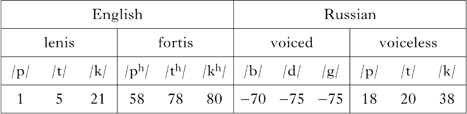
In their cross-linguistic overview of laryngeal states during the production of stops, Lisker & Abramson (Reference Lisker and Abramson1964) illustrate that languages carve up laryngeal contrasts along a voice onset time (VOT) continuum, tending to categorically choose either voicing fully throughout the stop (i.e. prevoicing), a large voicing lag or very little voicing lag. In a privative theory of features, these categorical choices are typically represented with the distinctive features [voice] and [spread glottis] and the absence of a feature (Ø) respectively. Measurements illustrate that the two-way VOT contrast for initial stops in English differs qualitatively from that in other languages, such as Russian. While both languages have a contrastive series of stops, their VOT values fall into different categories. As shown in Table I, the VOT category for the English lenis stops is short-lag, while Russian voiced stops are prevoiced. Likewise, the category for English fortis stops is long-lag, while Russian voiceless stops are short-lag.
VOT values (in ms) for initial stops in English (from Beckman et al. Reference Beckman, Jessen and Ringen2013: 263) and Russian (from Ringen & Kulikov Reference Ringen and Kulikov2012: 278). The symbols used are based on the phonetic values, for ease of comparison across languages.

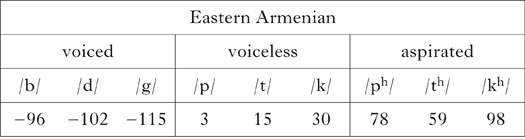
The VOT values in Table I indicate that the lenis series in English is roughly equivalent to the voiceless series in Russian. A language such as Eastern Armenian, which exploits all three types of laryngeal states for stops, is an ideal reference point. As shown in Table II, it has voiced (i.e. prevoiced), voiceless (short-lag) and voiceless aspirated (long-lag) stops.
VOT values (in ms) for initial stops in Eastern Armenian (from Lisker & Abramson Reference Lisker and Abramson1964: 395–396).

Again, the VOT values for the lenis stops of English approximate the voiceless unaspirated stops of Eastern Armenian, while the English fortis stops have values similar to the Armenian voiceless aspirated stops.
The traditional approach to laryngeal contrasts in obstruent systems has assumed an abstract [±voice] category.Footnote 1 On this view, if a language contrasts only two series of obstruents, these will be [+voice] vs. [−voice], or, in privative terms, [voice] vs. no feature specification. The point is that this contrast will be posited no matter where on the VOT continuum these series lie (Keating Reference Keating1984, Kingston & Diehl Reference Kingston and Diehl1994). Thus a language like English, which has short-lag and long-lag stops in initial position, has traditionally been classified as having a contrast in voicing, despite the fact that prevoicing is not necessary in the phonetic implementation of these stops, nor is it categorical. In other words, on this view, all lenis obstruents are considered phonologically [+voice], and all fortis obstruents are […voice].
One assumption that the present work adopts is the stance towards laryngeal features termed Laryngeal Realism (Harris Reference Harris1994, Iverson & Salmons Reference Iverson and Salmons1995, Jessen Reference Jessen1998, Avery & Idsardi Reference Avery and Idsardi2001, Jessen & Ringen Reference Jessen and Ringen2002, Honeybone Reference Honeybone, van Oostendorp and van de Weijer2005, Vaux & Samuels Reference Vaux and Samuels2005, Kager et al. Reference Kager, van der Feest, Fikkert, Kerkhoff, Zamuner, van de Weijer and van der Torre2007, Beckman et al. Reference Beckman, Jessen and Ringen2013; the term is attributed to Honeybone Reference Honeybone, van Oostendorp and van de Weijer2005). While many researchers in this tradition still adhere to fairly abstract distinctive features, the laryngeal oppositions themselves are taken to be more highly articulated than traditionally assumed.Footnote 2 Given a language with a two-way obstruent contrast, if the phonetic realisation of the stops involves prevoicing vs. short-lag voicing, then the resultant feature specification involves [voice]. If, however, the contrast involves short-lag vs. long-lag voicing, then the contrast involves [spread glottis] (where, depending on whether a privative or binary theory is adopted, the short-lag series will be either unspecified, [−voice] or [−spread glottis]). Thus Laryngeal Realism adopts a more transparent relationship between distinctive features as phonological entities and the phonetic substance of those features.
As further support for this approach, in observations of word-initial stops it can be shown that most varieties of English do not exhibit voicing throughout the duration of the closure for lenis stops – i.e. only a portion of the stop is voiced. This is evidenced in Lisker & Abramson's study mentioned above. This behaviour is different from languages with a true voicing contrast, such as Russian, where the phonologically voiced obstruents are prevoiced. In non-initial position, there is also a phonetic difference between languages like Russian and languages like English. Russian intervocalic obstruents are voiced throughout their duration (Ringen & Kulikov Reference Ringen and Kulikov2012), whereas English obstruents in this position are not always categorically voiced; instead, they are subject to passive, or contextual, voicing, which is the result of coarticulation with neighbouring voiced sounds (cf. Kohler Reference Kohler1984, Docherty Reference Docherty1992, Avery Reference Avery1996, Beckman et al. Reference Beckman, Jessen and Ringen2013). As many of these authors argue, active voicing (i.e. consistent voicing throughout the duration of a segment) indicates that the segment in question is fully specified, while passive voicing implies a phonetic coarticulatory effect, not to be confused with phonological specification.
If we concede that languages can contrast [spread] vs. Ø (or even [spread] vs. [voice], as is claimed for Swedish; Beckman et al. Reference Beckman, Helgason, McMurray and Ringen2011), then this warrants a further investigation into the dynamics of [spread] in assimilation and neutralisation contexts. It is important to make this clear, as many of the languages that have been used as examples of voice assimilation (e.g. English) or final devoicing (e.g. German) do not actually employ a contrast based on [voice].
2.2 A basic typology of [voice] assimilation
The typology to be presented here is based on the basic typology and constraints provided by Lombardi (Reference Lombardi1999). Since Lombardi does not adopt a ‘laryngeally realistic’ viewpoint, there are languages in her typology that do not have contrasts based on [voice]. Therefore, the discussion around assimilation will be refined so as to include only languages that exhibit a true voicing contrast, where the contrast is between stops that are prevoiced and some other series (cf. Petrova et al. Reference Petrova, Plapp, Ringen and Szentgyörgyi2006). Despite this, Lombardi's original predictions will be shown to hold.
There have been several approaches to the typology of voice assimilation in obstruents, and although they differ in detail, they share the same basic qualities. Anderson (Reference Anderson and Dinnsen1979) proposes a preliminary typology that includes progressive, regressive and bidirectional assimilation, resulting in one value of [±voice]. Cho (Reference Cho1990a, b) and Lombardi (Reference Lombardi1995, Reference Lombardi1999) elaborate on this basic typology, and exploit an analysis based on a privative conception of [voice]. What results is a typology that allows for assimilation controlled by an onset obstruent (i.e. regressive assimilation, either [voice] or the absence of laryngeal features) and an emergence of the unmarked type of pattern, where agreement in the lack of laryngeal features (i.e. plain voicelessness) surfaces. Lombardi (Reference Lombardi1999) claims that it is the interaction of a number of constraints that results in the predicted surface patterns of assimilation. The first is Agree, which I formulate as in (1) (cf. Lombardi Reference Lombardi1999).Footnote 3
-
(1)


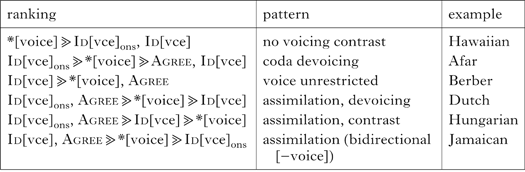
One goal of the present work is to determine whether an analysis based on binary features or privative features is preferable; the definition of Agree can be interpreted under either viewpoint as enforcing agreement in adjacent obstruents. In cases of underlyingly non-agreeing obstruents, the pressure exerted by Agree is in direct conflict with the demands of Ident[voice] and its positional counterpart, Ident[voice]ons. Finally, the markedness constraint *[voice] penalises any occurrence of voiced obstruents. The typology generated by these constraints yields several distinct patterns, each commonly found in languages of the world, as illustrated in Table III (Lombardi Reference Lombardi1999).
Typology of voice assimilation.

Some voice-assimilation patterns resemble the emergence of the unmarked type of phenomena (McCarthy & Prince Reference McCarthy and Prince1994, Baković Reference Baković1999). For instance, the stops of Jamaican Creole (at various points in the acrolectal continuum) have been described as voiced, even to the point of having implosive variants (Devonish & Harry Reference Devonish, Harry and Schneider2008, Gooden & Donnelly Reference Gooden and Donnelly2009). Jamaican Creole also exhibits the same plural allomorphy as most varieties of English, which provides the contexts for voice assimilation: ba[gz] dem ‘bags’, but boo[ks] dem ‘books’. It enforces agreement in voicing between obstruents, and when faced with underlyingly disagreeing obstruents, selects the candidate in which both obstruents are voiceless rather than the one with voiced obstruents. Since voiced obstruents are otherwise legal in the lexicon, the sub-ranking Ident[voice] ⪢ *[voice] must be established, and, since disagreeing forms never surface, Agree ⪢ Ident[voice]. As noted by Lombardi (Reference Lombardi1999) and Baković (Reference Baković1999), it is low-ranking *[voice] which springs into action in order to select between competing agreeing forms (i.e. all voiced or all voiceless), resulting in unmarked voiceless outputs. Importantly, the typology generated by this set of constraints does not predict a pattern of assimilation yielding voiced obstruent pairs. The analytic reason behind this is that, given the options for satisfying Agree, the grammar cannot resort to selecting a marked structure. In other words, there is no mechanism which can favour a marked structure over an unmarked structure, all other things being equal. The formal reason for this is that there is no markedness constraint *[−voice] that could block an unmarked form from surfacing in these contexts. With respect to underlyingly disagreeing adjacent obstruents, Lombardi (Reference Lombardi1999: 287) notes that:
Either kind of assimilation – to voicelessness or to voicing – will change one of the consonants in the cluster, resulting in one IDLAR violation. Thus, the decision must be passed on to *LAR, which decides in favor of the voiceless cluster in both cases. Because IDOnsLar is lowest ranked, there is no constraint that favors one direction of assimilation over another; instead, *LAR favors assimilation to the unmarked state, voicelessness, regardless of direction [emphasis in original].
This prediction will be challenged in §3 below, where new data that bears on the issue is presented, and the undesirable effects of a constraint like *[−voice] will be discussed in §4.1.2.
Another pattern is regressive in nature, with the voicing value of the final segment (typically in the onset of the subsequent syllable) in a cluster determining the value of the preceding segment. A prime example is Hungarian, where agreement is mandatory, and where a stem-final obstruent changes to match the voicing value of the suffix-initial consonant, as illustrated in (2) (from Siptár & Törkenczy Reference Siptár and Törkenczy2000: 200).
-
(2)

What this requires is high-ranking faithfulness to the onset voicing value, alongside high-ranked Agree. In addition, Ident[voice] must dominate *[voice], in order to allow voiced obstruents lexically, giving Agree, Ident[voice]ons ⪢ Ident[voice] ⪢ *[voice]. This ranking ensures that assimilation is regressive.
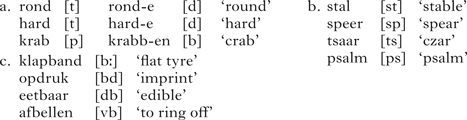
The significance of Ident[voice]ons also lies in a side-effect which it yields in non-assimilative contexts: word-final (or coda) devoicing. Syllable-final neutralisation is the result of the ranking Ident[voice]ons ⪢ *[voice] ⪢ Ident[voice], and is significant because it has been intimately linked with patterns of assimilation (Cho Reference Cho1990b, Lombardi Reference Lombardi1991, Reference Lombardi1995, Reference Lombardi1999, Mascaró Reference Mascaró1995, Wetzels & Mascaró Reference Wetzels and Mascaró2001). The ranking Ident[voice]ons ⪢ *[voice] ⪢ Agree results in a language with only coda devoicing, and no voice assimilation. An example of this pattern is Afar, which according to Bliese (Reference Bliese1981) has voiceless, voiced and aspirated stops (though not across all places of articulation), and exhibits obligatory coda devoicing of obstruents, but which also allows medial stop clusters such as [tg tb tɖ kɖ]. Another example is Mosetén, where according to Sakel (Reference Sakel2004), voiced stops are not found in codas, and voiceless–voiced stop clusters are permitted (e.g. [∫okdjeʔ] ‘chicha’). A well-known case of a language having both final devoicing and voice assimilation is Dutch, as shown in (3) (from Zonneveld Reference Zonneveld, van der Broecke, van Heuven and Zonneveld1983: 298, 303 and Booij Reference Booij1995: 59). Berendsen (Reference Berendsen, Bennis and van Lessen Kloeke1983) and Zonneveld (Reference Zonneveld, van der Broecke, van Heuven and Zonneveld1983) note that, while final obstruent devoicing (3a) and voice assimilation (3b) occur independently, they interact in contexts where one obstruent is in syllable-coda position, with the result that assimilation can override devoicing, yielding voiced obstruents in the otherwise unexpected syllable coda position (3c). This is the effect of high-ranking Ident[voice]ons and Agree (dominating *[voice] and Ident[voice]).
-
(3)
The Dutch patterns of voice assimilation are admittedly much more complex than this, and there is a rich literature dedicated to this issue alone (e.g. Berendsen Reference Berendsen, Bennis and van Lessen Kloeke1983, Zonneveld Reference Zonneveld, van der Broecke, van Heuven and Zonneveld1983, Reference Zonneveld, van de Weijer and van der Torre2007, Booij Reference Booij1995, etc.).Footnote 4 Some of the dynamics involving the past tense affix and its exceptional behaviour will be discussed in §4.1.2.
The typology predicts languages with no voice assimilation at all, where mixed-voice clusters surface intact (by virtue of Ident[voice] dominating markedness). Wetzels & Mascaró (Reference Wetzels and Mascaró2001: 208) cite the example of Berber, which exhibits no coda devoicing ([igmz] ‘cap’), and also exhibits a range of voicing possibilities in clusters, including voiceless–voiced ([akwzar] ‘fig’), and voiced–voiceless ([radsun] ‘they will drink’). The same pattern of allowed disagreement is found in Khasi (Henderson Reference Henderson, Jenner, Thompson and Starosta1976, Reference Henderson1989–90), where clusters exhibit an almost unrestricted distribution, as in (4).
-
(4)

In fact, Henderson claims that Khasi not only allows laryngeal disagreement in obstruent clusters, but actually favours this type of disagreement. Finally, the typology also predicts a pattern where voiced obstruents are banned from the phonemic inventory entirely. Many languages exhibit this pattern, including Hawaiian (Elbert & Pukui Reference Elbert and Pukui1979), which has /p k ʔ h/, where the ranking is *[voice] ⪢ Ident[voice]ons, Ident[voice].
Importantly, a pattern not predicted by this typology is assimilation resulting in surface [voice] on agreeing obstruents, as this pattern is not derivable from the set of constraints employed. The reason for this lies in the nature of the markedness constraint *[voice]: this constraint will penalise structures with [voice], while structures without this feature (i.e. voiceless obstruents) will satisfy the constraint. This mechanism allows the emergence of the unmarked pattern (i.e. emergence of voicelessness), and at the same time rules out the emergence of the marked (i.e. emergence of voicing). As will be illustrated in the next section, this substantive gap is actually manifested in the pattern of voice assimilation in Bangla.
3 Expanding the empirical base: emergence of the marked
Having laid out a basic typology of voice-assimilation patterns, I now consider a case of the emergence of the marked: assimilation resulting in surface [voice] on obstruents. While the emergence of the marked is predicted not to occur with the constraints proposed by Lombardi, this section aims to fill this gap by highlighting patterns of assimilation in Bangla (Indo-Aryan; also known as Bengali).
Bangla contrasts plain voiceless, voiceless aspirated, voiced and voiced aspirated stops (Ferguson & Chowdhury Reference Ferguson and Chowdhury1960), as in (5).
-
(5)

Given these contrasts, the marked distinctive features for the voiced and voiced aspirated stops must be [voice] and [voice, spread] respectively.
As Dan (2012) shows, the preferred syllable for monosyllabic forms is CV, though syllable codas are allowed. While complex onsets and codas are not found in indigenous monosyllabic forms, complex onsets are found in loans from Sanskrit and English, and complex codas in loans from Perso-Arabic. The fact that syllable codas are allowed in the language provides a possible context for voice assimilation in clusters. While there is no syllable-final devoicing in most dialects, there is neutralisation of aspiration in syllable-final position (Chatterji Reference Chatterji1926, Vijayakrishnan Reference Vijayakrishnan, van de Weijer, van Heuven and van der Hulst2003, Dan Reference Dan, Otsuka, Stroh and Urdze2012); cf. alternations such as /labh/ [lab] ‘profit’ vs. /labh-er/ [labher] ‘profit-gen’ (Vijayakrishnan Reference Vijayakrishnan, van de Weijer, van Heuven and van der Hulst2003: 242). Thus any word-medial cases of voice assimilation in obstruent clusters would constitute genuine cases of voice assimilation, and would not be due to other independent constraints on syllable structure.
Bangla exhibits voice assimilation that prohibits mixed voicing clusters. A search of a Bengali–English dictionary (Biswas Reference Biswas2000) indicates that there are no sequences in lexical items with a voiced–voiceless or voiceless–voiced obstruent sequence; Ferguson & Chowdhury (Reference Ferguson and Chowdhury1960) arrive at virtually the same conclusion.Footnote 5 Thompson (Reference Thompson2012: 19–20) provides the list of word-medial clusters (where clustering is least restrictive) in (6), where it can be observed that mixed-voicing obstruents do not occur.
-
(6)

The lexical gaps cited above attest to the high ranking of Agree: since there are no exceptions to this generalisation, the constraint must be undominated. However, since these are lexical patterns, they do not provide much evidence for voicing alternations, nor for the repair strategy employed for underlyingly disagreeing obstruents. Alternations, however, do exist in affixed forms and compounds, and across phrasal boundaries.
Some reports of voice assimilation in the language claim that assimilation is onset-controlled; cf. Hayes & Lahiri (Reference Hayes and Lahiri1991: 82–83) and Kar (Reference Kar2012) (though Kar presents no data from contexts that would support this pattern; i.e. underlying voiced–voiceless contexts). For instance, Hayes & Lahiri note that assimilation is optional, and is regressive, as in (7).
-
(7)

There are, however, conflicting accounts in the literature. Chatterji (Reference Chatterji1926: 450–451) notes that regressive assimilation is found for stops that are homorganic; for those that disagree in place of articulation, there may be slight voicing/devoicing of a stop preceding a voiced/voiceless stop, but categorical assimilation is not found. The data presented in this paper provides evidence for a different pattern. It is important to stress that the data and patterns presented here should not be taken to directly conflict with reports such as Hayes & Lahiri's or Chatterji's; instead, it is likely that the observed patterns are dialectal in nature (in fact, some dialects spoken in Bangladesh exhibit a completely different emergence of the unmarked pattern, with assimilation resulting in voicelessness).Footnote 6
Data from compounds and phrases illustrates the fact that assimilation in the language is the inverse of Jamaican; namely, assimilation is to the marked [voice] value. Observe in (8) cases of disagreeing obstruents with the underlying voiced obstruent following the voiceless (with the result appearing superficially similar to onset control). The Bangla data is from Mandal (Reference Mandal2013), and also supplied by Sam Mandal (personal communication).
-
(8)

Consider next the cases in (9), where the voiced obstruent precedes the voiceless, with the result of assimilation being the same: both obstruents surface as voiced.Footnote 7
-
(9)
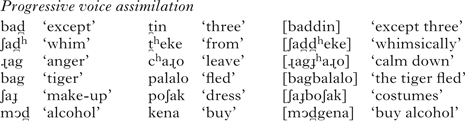
Alternations are also present in affixed forms. (10) illustrates this with examples involving the definite article /-ta/.
-
(10)

In order to probe the potential interactions between adjacent obstruents with respect to laryngeal features, Mandal (ms) recorded two speakers (one male, one female) from the Burdwan district of West Bengal, India, eliciting a series of words that were designed to create the context for voice assimilation. The first set of words consisted of transitive clauses with an affected object in order to induce usage of the definite article /-ta/ (e.g. /bhaluk-ta tɔb-ta bhanglo/ ‘the bear broke the pot’). The nouns used varied in their final consonant (voiceless unaspirated vs. voiced). The suffixes are relatively frequent, and in combination with the nouns provide the context for testing /T-T/ sequences (as a control) and the crucial /D-T/ sequences. The second set of words consisted of first names that likewise varied in their final consonant, and the case suffix /-ke/ was used (/bhuvan arnab-ke khawalo/ ‘Bhuvan fed Arnab’ vs. /bhuvan pratap-ke dekhlo/ ‘Bhuvan saw Pratap’). Finally, the forms in (10) were directly elicited as words in isolation.
Mandal's recordings were independently analysed in this study for voicing by visual inspection of waveforms and spectrograms. Judgements on voicing were confirmed by a phonetician who was unaware of the details of the study, but was made aware that there is a four-way laryngeal contrast in the language. Because of complications with geminates, including a longer closure duration with no clear acoustic or auditory boundaries, only forms disagreeing in place of articulation were considered. For both speakers, all underlying /TT/ pairs surfaced faithfully. For mixed pairs with a /TD/ sequence, all forms surfaced as voiced (2/2 for both the male and female speakers). For the crucial contexts, with a /DT/ sequence, 9/10 of the male speaker's pairs surfaced as [DD] (there was one instance of /bk/ which surfaced faithfully, while the other token underwent progressive assimilation), and 10/11 surfaced as [DD] for the female speaker (where the faithful form was /gt/). Importantly, there were no cases of the underlying /DT/ pairs surfacing as entirely voiceless for either speaker, a result which rules out the onset-control analysis for this particular set of data.
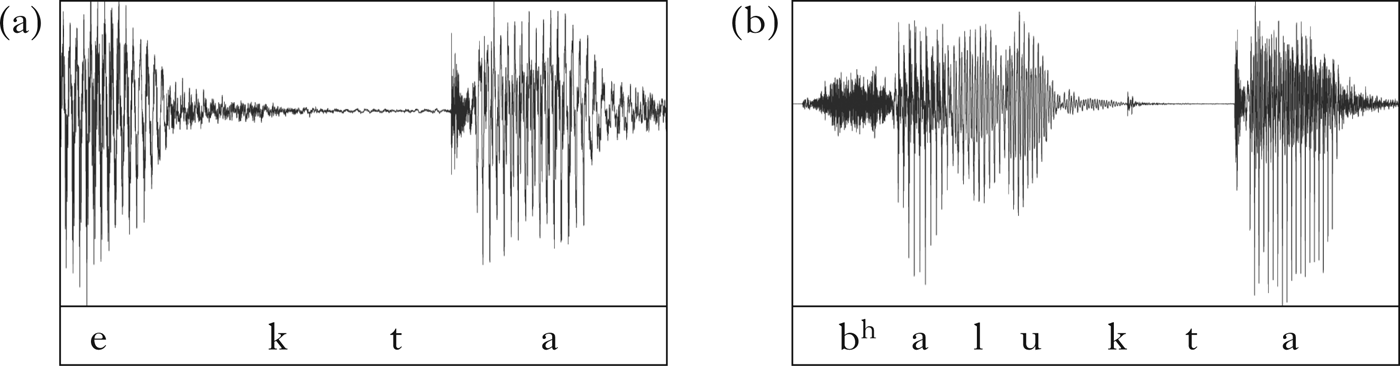
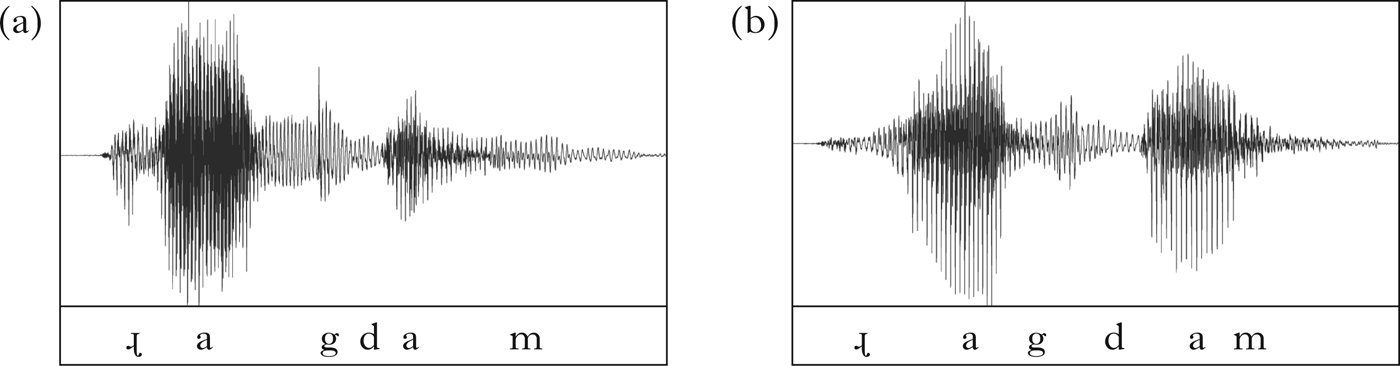
Waveforms from the data in Mandal's study are presented in Figs 1 and 2. Figure 1 exemplifies a voiceless–voiceless sequence, and can be compared with those in Fig. 2, which illustrate the progressive voice assimilation described above. The presence of voicing was identified through a visible voicing bar in the spectrogram, the presence of fundamental frequency and periodicity in the signal, and a lack of high-frequency components during closure.
Waveforms of productions of (a) /ek-ta/ ‘one-def’ (female speaker) and (b) /bhaluk-ta/ ‘bear-def’ (male speaker).

Waveforms of productions of /ɻag-tam/ ‘be angry-1 pl.hab.past’: (a) female speaker; (b) male speaker.

Some speakers apparently maintain clusters that are exceptions to the generalisation above.Footnote 8 For instance, Sam Mandal (personal communication) reports working with a different speaker who never exhibited voice assimilation in intervocalic clusters with /tᶡ/. The existence of such exceptions, however, is supportive of the pattern itself, as they attest to the robustness of the phenomenon (i.e. if it were purely a phonetic effect, exceptional clusters that defy the pattern would be unexpected).
There are two important points to be made regarding this pattern. The first is that faithfulness to voicing specifications exclusive to values in the onset is not relevant to the process of assimilation for these speakers. If this were the case, then the examples in Fig. 2 would yield voiceless outputs as the result of assimilation. The second point centres on the mechanism required to yield assimilation to the voiced. In Lombardi's approach, this pattern cannot be derived. In order to derive this emergence of the marked effect, whereby voiced obstruents are favoured over voiceless ones in assimilative contexts, there are two possible analyses: either adopt a binary feature for voicing and allow markedness constraints based on both of these feature values (i.e. *[+voice] and *[−voice]) to be freely ranked, or maintain a privative conception of voicing and enhance faithfulness constraints such that they regulate insertion and deletion of [voice], resulting in distinct processes. Each of these analyses will be outlined and discussed below.
4 Binary voice vs. voice faithfulness
The Bangla patterns require an analysis that goes beyond the constraint set and typology presented in §2. This section aims to tease apart the implications of the two possible analyses introduced above.
Presenting evidence from voice-assimilation patterns, Wetzels & Mascaró (Reference Wetzels and Mascaró2001) claim that voicing is a binary feature: [±voice] (cf. also Gussmann Reference Gussmann1992 and Rubach Reference Rubach1996 for other arguments from Polish voice assimilation for a binary conception of voice). This claim is to an extent consistent with the two assimilation patterns noted above: emergence of the unmarked, and emergence of the marked. If this were translated into constraints, then languages which exhibit emergence of the unmarked patterns would exploit the ranking *[+voice] ⪢ *[−voice] (consistent with the overall unmarked nature of voiceless obstruents), while languages exhibiting emergence of the marked would be characterised as having the reverse ranking, *[…voice] ⪢ *[+voice]. Thus the Bangla pattern would be modelled as in (11).
-
(11)
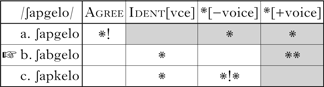
It has been suggested that markedness effects can be encoded in harmonic rankings of markedness constraints (Prince & Smolensky Reference Prince and Smolensky1993). The consequence of the approach above is that a putative fixed ranking *[+voice] ⪢ *[−voice] would be reversed in Bangla. The cross-linguistic implications of this ‘free’ ranking of *[+voice] and *[…voice] will be explored in §4.1.2, where typological aspects of the analysis are discussed.
The alternative approach is to maintain a privative conception of [voice] (following Mester & Itô Reference Mester and Itô1989, Cho Reference Cho1990a, Lombardi Reference Lombardi1991, Reference Lombardi1995, Reference Lombardi1999), and to allow faithfulness constraints to do the work required in accounting for the different assimilation patterns. For instance, if Ident[voice] were replaced with a finer-grained set of constraints regulating the insertion and deletion of [voice], then the same results could in principle be achieved. Baković (Reference Baković1999) proposes Ident[+voice] and Ident[−voice]. Such a proposal regulates input–output mappings that change voiceless to voiced and voiced to voiceless (cf. also Pater Reference Pater, Kager, van der Hulst and Zonneveld1999 for this approach with respect to nasality, and de Lacy Reference de Lacy2006: 254–262 for a similar approach to voice assimilation). This builds an asymmetry into faithfulness constraints; however, the way the asymmetry is implemented in terms of laryngeal features is problematic. Lombardi (Reference Lombardi and Lombardi2001) points out that the biggest problem with Ident with respect to [voice] is that it would not be possible to rule out strategies like epenthesis or deletion to repair coda voicing. More specifically, since featural correspondence relations do not hold between an input segment and an output segment which has been deleted, this would in principle allow the deletion of an output segment as a viable strategy for circumventing the force of Ident. As Lombardi notes, however, coda devoicing is never repaired by epenthesis or deletion (as opposed to codas with place features, etc., which are repaired by these strategies), and she argues that in this context Ident should be replaced by Max and Dep.
As alluded to above, an alternative to Ident would be to adopt Max/Dep constraints, specifically Max[voice] and Dep[voice]. Feature-based correspondence constraints such as these have been proposed generally, and for the feature [voice] by various authors (Lamontagne & Rice Reference Lamontagne, Rice, Beckman, Dickey and Urbanczyk1995, Causley Reference Causley1997, Lombardi Reference Lombardi and Lombardi2001, Zoll Reference Zoll1998, Zhang Reference Zhang2000).Footnote 9 This is the analysis provided by Butska (Reference Butska, Artstein and Holler1998) for Ukrainian voice assimilation and T. Hall (Reference Hall2007) for Meccan Arabic, both to be discussed below (cf. also D. Hall Reference Hall, Blaho, Bye and Krämer2007 for problems related to Max[voice] in the context of Czech voice assimilation). Under this approach, the pressure to preserve underlying [voice] and the pressure for obstruent voice agreement work in tandem, even if this means voice disagreement is repaired by inserting [voice]. This is illustrated in (12) for the Bangla pattern under discussion.
-
(12)
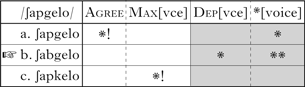
As the tableau illustrates, the ‘assimilation to [voice]’ pattern in Bangla is easily modelled with Max[voice] and Dep[voice]. If Agree and Max[voice] are ranked above Dep[voice], then the emergence of the marked pattern results. Notice also that, since a voicing contrast is present in the language, both Max[voice] and Dep[voice] must dominate *[voice]. This renders *[voice] ineffective in making any decisions with respect to voice assimilation – all of the work is done by the faithfulness constraints.
This proposal is based on ideas involving ‘preservation of the marked’ (de Lacy Reference de Lacy2006), or ‘submergence of the unmarked’ (Rice Reference Rice and de Lacy2007: 84–85). De Lacy (Reference de Lacy2006) claims that there is a pressure for marked structures to be preserved at the expense of unmarked ones. This pressure will only be relevant when preservation is possible, i.e. when there are marked structures in the input to be faithful to. As both de Lacy and Rice illustrate, there are several cases where marked features are preferred over unmarked alternatives, such as assimilation, inventory structures and neutralisation. The proposal advanced here builds on these important ideas, and like de Lacy's approach, provides a highly articulated theory of preservation of the marked.
4.1 Arguments for Max[voice] and Dep[voice]
As noted above, there are two approaches that can be entertained in light of the new assimilation pattern: either the feature [voice] is binary and the constraint *[−voice] must be active (and ranked above *[+voice] in Bangla) or [voice] is a privative feature and the faithfulness constraints regulating the feature are more powerful than undifferentiated Ident[voice]. This paper argues for the latter view, i.e. that there is a single markedness constraint *[voice], accompanied by the faithfulness constraints Max[voice] and Dep[voice]. The evidence for this comes from cases of restricted onset control, where only a single voicing value in the onset triggers assimilation. Corroborating evidence can be found in the typologies that each approach generates: assuming binary [±voice] yields a typology with undesirable qualities (e.g. under- and overgeneration), while the privative [voice] and Max/Dep approach yields a typology that fits very closely to patterns that are found cross-linguistically.
4.1.1 Restricted onset control
Arguments for privative [voice] and the faithfulness constraints that regulate the feature can be found in patterns of assimilation that are restricted to one of either voiced or voiceless in onset-control contexts. A somewhat restricted version of the onset-controlled pattern exhibited by Hungarian above is found in Ukrainian (Cho Reference Cho1990a, Butska Reference Butska, Artstein and Holler1998, Kenstowicz et al. Reference Kenstowicz, Abu-Mansour, Törkenczy and Ploch2003). In Ukrainian, voice assimilation is triggered only when the onset obstruent is voiced, and the result of assimilation is voicing.Footnote 10 Observe the data in (13) (from Butska Reference Butska, Artstein and Holler1998: 66).
-
(13)
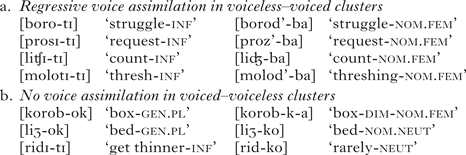
Note that even though voiced stops are licit in codas (as opposed to other Slavic languages such as Polish or Russian, which exhibit coda devoicing), they are not repaired when followed by a voiceless onset, thus violating Agree.Footnote 11 This essentially creates an asymmetry in the onset-control pattern, yielding a subpattern that favours voicing over voicelessness. The Ukrainian pattern can be characterised as satisfying Agree only if this is attained through inserting [voice] in the coda (or through accidental underlying agreement), never through deletion of [voice]. Butska (Reference Butska, Artstein and Holler1998) takes this pattern as evidence that faithfulness constraints other than Ident[voice] are responsible for the patterns that are found in voice assimilation, namely, Max[voice] and Dep[voice] (specifically Max[voice]ons).
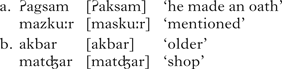
It is conceivable that the opposite pattern – voicelessness spreading in onset-controlled assimilation – would be possible. Meccan Arabic exhibits such a pattern of voice assimilation (Abu-Mansour Reference Abu-Mansour and Eid1996, Kenstowicz et al. Reference Kenstowicz, Abu-Mansour, Törkenczy and Ploch2003, McCarthy Reference McCarthy2003, T. Hall Reference Hall2007), where a voiceless obstruent triggers regressive assimilation (14a), but a voiced obstruent fails to induce assimilation (14b) (Abu-Mansour Reference Abu-Mansour and Eid1996: 217).
-
(14)
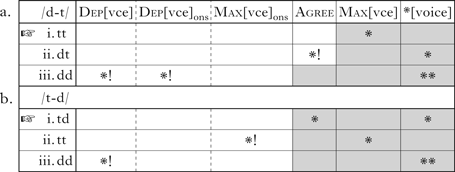
T. Hall (Reference Hall, Blaho, Bye and Krämer2007) arrives at much the same conclusion for Meccan Arabic as Butska does for Ukrainian, such that Max[voice] and Dep[voice] are employed in order to model the general condition of faithfulness to [voice] in onsets, but also because of the fact that [voice] is deleted in codas when forced to by Agree. The Meccan pattern is modelled in (15).
-
(15)
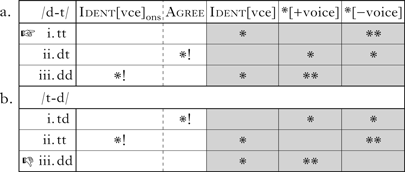
These types of patterns are problematic for the binary theory of [voice]. Employing both markedness constraints *[−voice] and *[+voice] is inadequate to account for the pattern, as shown in (16).
-
(16)
Finally, the adoption of Max/Dep[voice] remains unproblematic for unrestricted onset control, as in Hungarian: this pattern simply relies on the high ranking of Max[voice]ons, Dep[voice]ons and Agree, which must all dominate *[voice], Max[voice] and Dep[voice]. This ensures that the grammar is maximally faithful to onsets (whether they are voiced or voiceless), while at the same time enforcing agreement amongst adjacent obstruents.
4.1.2 Typological implications
In addition to the evidence presented above for privative [voice], there are also typological reasons for adopting this approach. Privative [voice] and the constraints Max/Dep[voice] make correct typological predictions about voice assimilation, whereas *[−voice]/*[+voice] constraints make undesirable predictions. In the following, only languages that exploit the feature [voice] or exhibit no contrast at all will be considered; systems based on [spread glottis] will be discussed in §5.
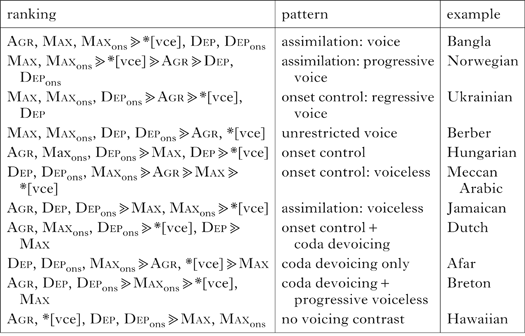
Given the constraints Agree, Max[voice], Max[voice]ons, Dep[voice], Dep[voice]ons and *[voice], a typology of eleven distinct patterns results from the 720 possible rankings.Footnote 12 This typology is presented in Table IV.
Typology generated by Max/Dep[voice].

Note that, in addition to the emergence of the unmarked/marked effects and onset-controlled assimilation, the typology includes languages with progressive assimilation of [voice] and languages with final devoicing plus progressive voiceless assimilation. The former pattern (progressive voicing) is found in Norwegian, as reported by Odden (Reference Odden2005: 237).Footnote 13 In Norwegian, the regular past tense suffix -te exhibits alternations, surfacing as voiced [-də] following voiced consonants (Odden notes that the suffix surfaces as [-tə] in sonorant-final forms, an argument for /-tə/ being the underlying form), as shown in (17).
-
(17)

The same pattern is also found with the Dutch past tense morpheme /-də/, as shown in (18) (from Avery Reference Avery1996: 138).Footnote 14
-
(18)

The latter pattern (devoicing with progressive assimilation to voiceless) occurs as a subset of the patterns found in Breton. For instance, Hall (Reference Hall and Mailhot2009: 3, citing data from Ternes Reference Ternes1970) notes examples such as the following to illustrate this pattern: [peamzek] ‘fifteen’, [daj] ‘day’, [peamzek taj] ‘fifteen days’.
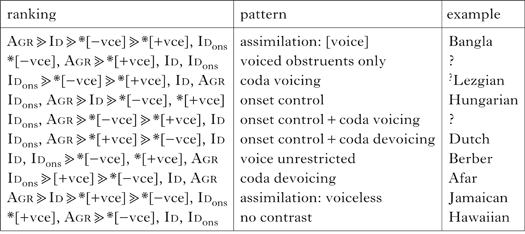
The typology in Table IV can be contrasted with one that emerges from a set of constraints employing the pair of markedness constraints *[+voice] and *[−voice] in addition to Ident[voice], Ident[voice]ons and Agree. As can be seen in Table V, the 120 unique rankings yield ten distinct patterns. While much of this typology overlaps with the typology in Table IV, there are some notable differences.
Typology generated by *[+voice]/*[−voice].

There are three major problems with the typology generated from binary [±voice] constraints: the prediction of languages with coda voicing, the prediction of languages with a voiced-only obstruent inventory (in addition to languages with a voiceless-only inventory) and the existence of patterns that are not generated by the typology, namely, the Ukrainian, Meccan Arabic, Norwegian and Breton patterns discussed above.
The first problem is that the typology predicts languages with coda voicing. There is some debate as to whether any languages actually exhibit this type of voicing. In their overview of laryngeal neutralisation, Iverson & Salmons (Reference Iverson, Salmons, van Oostendorp, Ewen, Hume and Rice2011: 1628) note that ‘neutralization to a phonologically voiced member of an opposition may occur, but appears to be very rare, and controversial’.Footnote 15 Much the same can be said for languages that exhibit a voiced-only obstruent inventory. While many languages make use of only a single series of obstruents, which can vary phonetically between voiced and voiceless, there do not seem to be any cases of a language where phonologically the series is marked exclusively with [voice]. This rings especially true when considering the fact that the typology also predicts a language with only a voiceless series of obstruents. The typology predicts that there are languages with a single series of obstruents that are phonologically voiceless, and languages that exhibit a distinct pattern whereby their single obstruent series is voiced. This state of affairs does not seem to exist.
Finally, the Ukrainian, Meccan Arabic, Breton and Norwegian patterns that were accounted for under the Max/Dep[voice] approach are not generated in the typology based on *[+voice]/*[−voice]. This stems primarily from the symmetrical nature of Ident: since Ident[voice] treats the insertion and deletion of [voice] as the same, this constraint cannot tease apart systems such as those listed above, where it is critical to be able to model assimilation by means of insertion or deletion. Employing Max/Dep[voice], on the other hand, allows the grammar to make these distinctions. In short, the typology in Table IV not only overgenerates undesirable patterns, but also fails to generate existing patterns.
For these reasons, the typological predictions of the binary voice account result in undesirable patterns, while the typology predicted by the privative voice account yields a typology with a relatively good cross-linguistic fit.
5 Extensions to other systems
Up to this point, the focus has been on languages that exploit the feature [voice] for a laryngeal contrast in their obstruent series. This section addresses laryngeal agreement in systems that do not rely on [voice] at all, and instead make use of contrasts based on [spread glottis], such as most varieties of English. Perhaps the most natural outcomes of observing [spread glottis] systems is that the emergence of the marked pattern exists, and that if a system makes use of both [voice] and [spread glottis], the two can interact in contexts of laryngeal assimilation. Thus the voicing typology laid out in §2 has implications that extend naturally into other laryngeal features. While a full typology centred around [spread glottis] similar to the one for [voice] in §2 is beyond the scope of this paper, it generates a subset of predictions that can be tested. The potential extension of the analysis to place assimilation will also be explored.
The first key prediction that the theory makes is an emergence of the marked pattern in languages exploiting the feature [spread]. As discussed in §2.1, Iverson & Salmons (Reference Iverson and Salmons1995) present several arguments for the case that English (along with most other Germanic languages) employs a laryngeal contrast based on privative [spread] in its obstruent system (see also Harris Reference Harris1994, and Houlihan Reference Houlihan and Eckman1977: 236 for an early suggestion along these lines), and that it is the fortis [spread] obstruents that are the marked series.Footnote 16 For instance, they argue that if a privative [spread] is adopted, this naturally accounts for the processes of laryngeal neutralisation of stops following [s] in clusters, and also for the devoicing of post-stop sonorants. This extends to assimilation: assuming lenis /-z/ as the underlying form of the plural (as this is the form that surfaces after sonorants), it can be observed that it assimilates to fortis when following a fortis obstruent; cf. /kæt-z/ [kæts] cats (in the traditional notation) (see Mester & Itô Reference Mester and Itô1989, Lombardi Reference Lombardi1999 and Borowsky Reference Borowsky2000 for further discussion and analyses of this pattern). If [spread] is the marked feature in this system, and if constraints on featural faithfulness are employed, then this naturally captures the patterns in most varieties of English. The relevant constraint here is Max[spread], which prevents deletion of any underlying [spread glottis] specifications, as in (19).
-
(19)
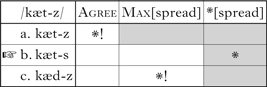
The coupled force of Agree and Max[spread] ensures that when there are laryngeally mixed pairs in the input the optimal output candidate will be one that exhibits laryngeal agreement and also preserves the underlying [spread] specifications.
Another important prediction is the existence of onset control in systems employing [spread]. One example is Ancient Greek, which exhibits a contrast between plain voiceless, voiced and voiceless aspirated stops. In suffixation contexts, the laryngeal feature of the first obstruent must agree with that of the second, and each of the laryngeal features triggers agreement (Kenstowicz Reference Kenstowicz1994: 157). As such, Agree must make demands over all of the available laryngeal features, and the relevant faithfulness constraints here must protect both [voice] and [spread]. Restricted onset control is found in Yorkshire English: bedtime [tt] vs. white book [tb] (Wetzels & Mascaró Reference Wetzels and Mascaró2001, citing Wells Reference Wells1982: 367; the traditional notation is retained).Footnote 17 Just as in Ukrainian, a high-ranking constraint on inserting or deleting [spread] into onsets, alongside a general constraint on deleting [spread], will have the effect of protecting onsets and preventing deletion of [spread], with assimilation being triggered by Agree. So long as Dep[spread] is ranked below Agree, this yields a pattern of regressive [spread] assimilation. Incidentally, the same typological prediction that holds for Ukrainian holds true for Yorkshire English: a typology based on [±spread] will not predict this type of pattern, whereas a typology based on privative [spread], with Max and Dep constraints, will.
It should also be pointed out that there is a pattern missing from the typology. To my knowledge, there is no pattern that forces agreement with an onset plain voiceless stop, but not a voiceless aspirated stop, i.e. /TTh/→[TTh], but /ThT/→[TT], independent of coda neutralisation. This would be parallel to Meccan Arabic in the voice-assimilation typology. At present, there is little explanation for why this pattern is lacking, aside from the possibility that the empirical base (i.e. the existing literature) that is being drawn from is not at the moment rich enough to yield a pattern that is predicted to be relatively uncommon to begin with.
The theory also predicts that multiple marked features can be in competition. While Swedish is used as an example of emergence of the unmarked by Cho (Reference Cho1990a, b) and Lombardi (Reference Lombardi1999), recent work has shown that the laryngeal contrasts in the language are different to those previously reported. While previous work on Swedish assumes a voiced–voiceless contrast, Ringen & Helgason (Reference Ringen and Helgason2004), Petrova et al. (Reference Petrova, Plapp, Ringen and Szentgyörgyi2006), Helgason & Ringen (Reference Helgason and Ringen2008) and Beckman et al. (Reference Beckman, Helgason, McMurray and Ringen2011) analyse it as having a contrast between [voice] and [spread glottis]. Helgason & Ringen (Reference Helgason and Ringen2008) show that in initial prevocalic position, the phonetic contrast in stops is one between prevoicing and postaspiration, and Beckman et al. (Reference Beckman, Helgason, McMurray and Ringen2011) argue that both [spread glottis] and [voice] must be fully specified. Thus Swedish is unique among the languages discussed so far in that its obstruent inventory is characterised by two marked laryngeal features, [voice] and [spread], rather than a marked feature and an unspecified value. In contexts of obstruent clusters, laryngeal assimilation always yields [spread] stops, as in (20).
-
(20)
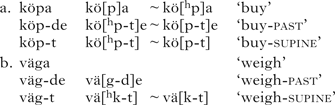
Thus, while Swedish has traditionally been presented as a case involving a [voice] contrast with emergence of voicing in assimilation, it has been shown here that analyses of the language which posit a [voice] vs. [spread] contrast can be easily converted into a theory where Max and Dep regulate feature insertion and deletion. Swedish thus provides an interesting case where the individual [voice] and [spread] typologies overlap.
This programme of research has interesting repercussions for the analysis of other laryngeal contrasts. For instance, in Cushitic there are systems that exist which contrast plain stops with implosives, and often ejectives. As an example, voiced stops and affricates in Oromo induce progressive voicing (Lloret Reference Lloret1995). While ejectives follow the same pattern of progressive assimilation of [constricted glottis], implosives fail to induce the same kind of assimilation. Instead, implosives become voiceless preceding a plain voiceless stop. Ts'amakko (Savà Reference Savà2005) exhibits a pattern where there is generally progressive voice assimilation, but as in Oromo, implosives do not trigger assimilation, and instead devoice before voiceless stops. Ts'amakko differs from Oromo in that these devoiced implosives become ejectives. While the representation of implosive consonants is still debated, it is clear that in these cases there is some evidence for not treating them as specified for [voice] (cf. Lloret Reference Lloret1995), leaving open the question of what their laryngeal specification actually is. There is obviously a need for further research into systems that make use of less common (or less commonly described) laryngeal contrasts, systems that make use of multiple laryngeal contrasts and systems that form unexpected classes from the set of laryngeal features. It can be expected that, once a fuller typology of laryngeal features and laryngeal assimilation is developed, a more nuanced analysis of laryngeal agreement and laryngeal faithfulness will emerge.
Finally, the point should be reiterated that emergence of the marked effects are not in themselves unexpected; instead, they are unexpected under a particular approach to assimilation employing a specific set of ranked constraints. The emergence of the marked is a state of affairs that is actually the norm in the context of place assimilation. A classic example is Catalan nasal place assimilation in (21), where coronals are the targets of assimilation, but never triggers (Mascaró 1976: 61–62, Kiparsky Reference Kiparsky1985: 95).
-
(21)
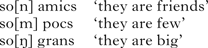
This pattern receives a natural explanation in terms of underspecification: coronals are underspecified for place, and thus not only fail to trigger assimilation, but also undergo it (Kiparsky Reference Kiparsky1985, Avery & Rice Reference Avery and Rice1989, Rice Reference Rice1994). While a full reanalysis of place assimilation will not be attempted here, the predictions of the underspecification analysis can be contrasted with the present proposal. The theory here relies on an assimilation ‘driver’ (Agree), with the repair being determined by the relative ranking of featural faithfulness constraints. The underspecification approach predicts that, all other things being equal, coronal can never trigger assimilation, because coronals are not specified underlyingly for place features. The featural faithfulness approach need not assume underspecified structure, and predicts that in most circumstances (e.g. when there is a ranking such as Agree, Max[dors] ⪢ Max[cor]), marked structure could emerge, as happens when dorsals trigger assimilation, for example. Such an approach also predicts that place assimilation in other languages, for example Sri Lankan Portuguese Creole, labial behaves as the unmarked place rather than coronal (Hume & Tserdanelis Reference Hume and Tserdanelis2002). Hume & Tserdanelis (Reference Hume and Tserdanelis2002) and de Lacy (Reference de Lacy2006) demonstrate that a faithfulness-based account of Sri Lankan Portuguese is possible, and de Lacy shows that several other cases of ‘preservation of the marked’ can be provided in an extensive analysis that captures not only assimilation, but a range of other phenomena as well. Thus the extension of featural faithfulness to place assimilation is a rich area for future research.
6 Conclusion
This paper has presented a previously unrecognised pattern in the voice-assimilation literature: emergence of the marked, i.e. voice assimilation that results in [voice] agreement. Possible analyses of this pattern include freely ranking the markedness constraints *[−voice] and *[+voice] with respect to each other cross-linguistically, or adopting Max/Dep[F] constraints to regulate the insertion or deletion of the feature [voice]. Evidence from onset-control systems demonstrates the need for Max/Dep[voice] instead of binary feature constraints such as *[−voice] and *[+voice]. This position is supported by the typological predictions made by each set of constraints.
An immediate implication of this approach is that marked assimilation patterns can be reconceptualised as faithfulness effects. Instead of resorting to language-specific markedness constraints or rankings, the patterns presented above can be recast as the effects of interacting faithfulness constraints (Hume & Tserdanelis Reference Hume and Tserdanelis2002, Howe & Pulleyblank Reference Howe and Pulleyblank2004, Pulleyblank Reference Pulleyblank2004, de Lacy Reference de Lacy2006). The primary difference between this approach and those of Howe, Pulleyblank and de Lacy lies in the scalar nature of constraint rankings: while their scalar approach demands that faithfulness constraints be arranged in a fixed (or stringent) ranking, the data above indicates that this cannot be the case (cf. Hume & Tserdanelis Reference Hume and Tserdanelis2002 for a similar conclusion). In order to capture the range of patterns presented above, the rankings Max[voice] ⪢ Dep[voice] and Dep[voice] ⪢ Max[voice] must both be permitted by the grammar. This is the only way to allow for assimilation patterns which yield voicing (Max ⪢ Dep) and patterns which yield voicelessness (Dep ⪢ Max).
The end result of the analysis is that the feature responsible for voicing contrasts must be privative [voice], and the constraints responsible for voice-assimilation patterns (in conjunction with *[voice]) are Max[voice] and Dep[voice], which are freely rankable cross-linguistically.