

INTRODUCTION
Fluvial terraces can serve as an ideal recorder of climate change and tectonic movement (Schumm Reference Schumm1977). In order to unravel the formation and external controls on such terraces, precise dating is required to determine the timing of terrace formation (Repka et al. Reference Repka, Anderson and Finkel1997). Generally, however, it is difficult to date the depositional sediments on fluvial terraces in semiarid regions because of the paucity of organic materials for 14C dating in such areas (e.g. the Qilian Mountains, northeastern Tibetan Plateau). The common techniques of 14C and optically stimulated luminescence (OSL) may also be limited by their respective time ranges (Brauer et al. Reference Brauer, Hajdas, Blockley, Bronk Ramsey, Christl, Ivy-Ochs, Moseleye, Nowaczyka, Rasmussenf, Robertsg, Spötle, Staffd and Svensson2014). U/Th dating of carbonate coatings on fluvial deposits can sometimes be used successfully to constrain the timing of fluvial terraces (Kelly et al. Reference Kelly, Black and Rowan2000; Schulte et al. Reference Schulte, Juliá, Burjachs and Hilgers2008); however, the time lag of coating development is difficult to quantify. Fortunately, developments in cosmogenic radionuclide surface exposure dating have overcome these various limitations (Cockburn Reference Cockburn2004).
Sediment-capped alluvial fan surfaces are ideal for exposure dating (Granger et al. Reference Granger, Lifton and Willenbring2013). 10Be and 26Al surface exposure dating has been widely used in defining the timing of fluvial terraces (Hancock et al. Reference Hancock, Anderson, Chadwick and Finkel1999; Bookhagen et al. Reference Bookhagen, Fleitmann, Nishiizumi, Strecker and Thiede2006; Perrineau et al. Reference Perrineau, van Der Woerd, Gaudemer, Liu-Zeng, Pik, Tapponnier, Thuizat and Zheng2011; Rixhon et al. Reference Rixhon, Braucher, Bourlès, Siame, Bovy and Demoulin2011). However, studies on 10Be environmental tracer and exposure dating have lagged behind in China due to a lack of accelerator mass spectrometry (AMS) facilities for routine 10Be measurements. It was not until 2006 that the Xi’an AMS Center acquired a 3MV Tandetron-based multielement (10Be, 14C, 26Al, and 129I) AMS. This AMS facility features excellent 10Be detection sensitivity (up to 10–15), and high precision (better than 1.4% at 10–12 and 1.14% at 10–11, respectively) for 10Be and 26Al (Zhou et al. Reference Zhou, Lu, Wu, Zhao, Huang, Li, Cheng and Xin2007). These instrumental capabilities require complementary chemical processing procedures to meet the needs of surface exposure dating studies of fluvial terraces on a large scale. The key steps to reliable 10Be and 26Al exposure ages include sample collection and preparation (pure quartz extraction, and quantitative Be and Al separation). At present, the international community has developed a standardized sampling method (Gosse and Phillips Reference Gosse and Phillips2001). To extract pure quartz from a rock sample, most procedures are based on the classical method established by Kohl and Nishiizumi (Reference Kohl and Nishiizumi1992). For the separation and extraction of Be and Al, there exist small differences between laboratories (Ivy-Ochs Reference Ivy-Ochs1996; Schnabel et al. Reference Schnabel, Reinhardt, Barrows, Bishop, Davidson, Fifield, Freeman, Kim, Maden and Xu2007; Akçar et al. Reference Akçar, Deline, Ivy-Ochs, Alflmov, Hajdas, Kubik, Christl and Schlüchter2012; Zheng et al. Reference Zheng, Jia, Nie and Kong2014).
This article presents a comprehensive AMS dating method for fluvial terrace samples from arid regions. We evaluate the analytical reliability of our dating results, and apply them to fluvial terraces from the Qilian Shan. We then discuss the relationship between terrace formation and climate change for this site.
SAMPLING AND DEVELOPMENT OF A 10Be-26Al EXPOSURE DATING METHODOLOGY
Sampling
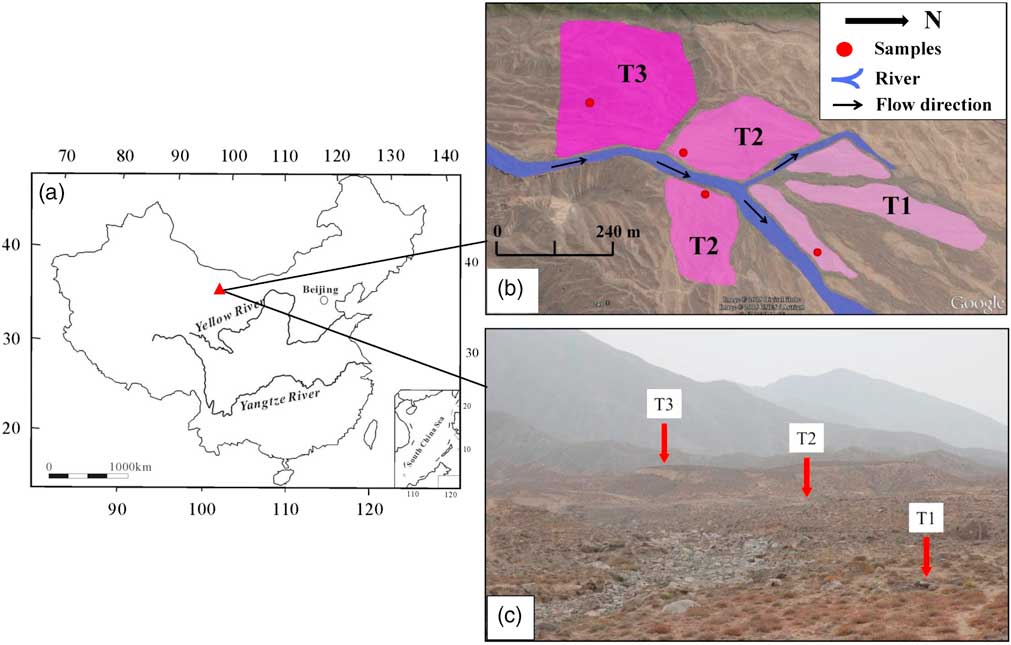
Our sampling focused on the fluvial terraces along the Guanshan River, located in a central portion of the Fodongmiao-Hongyazi fault zone, near Jinfosi, at the northern margin of the Qilian Shan. Three prominent terraces (T1, T2, and T3) were identified in the field (Figure 1). All three of the terraces are strath terraces composed of gravel and silt. The degree of solidification is relatively high in the higher terraces, as compared with the lower ones, while the proportion of boulders is constant. The terraces form well-preserved planar surfaces. Terrace surfaces are covered with sparse vegetation. There are few boulders exposed on the surface and exhibit low roundness. The samples were chosen with regard to the desired target element quartz. Therefore, we mainly collected quartzites, granites, and gneisses from the terraces. We sampled the upper parts of single boulders that were partly embedded in the deposits to avoid the potential problem of transport after the terrace formation. The thickness of each sample was less than 5cm. A GPS unit was used to record sample locations and altitudes (Table 1). Shielding from surrounding mountain slopes and dip angles of the samples sites were measured with a clinometer to determine the topographic shielding factor. Based on the principles above, we collected four boulder samples from the focus site in total (Figure 1). JFS-1-8 was collected from a biotite adamellite boulder on the surface of T1. JFS and JFS-1-3 were sampled from T2. Sample JFS-1-2 came from a granitic rock imbedded in the surface of T3.
(a) Map of China showing the sampling site; (b) Google Earth image of the sampling site identified in (a). T1, T2, and T3 represent terraces 1, 2, and 3, respectively; (c) southwest view of the terraces.

Dating results of Jinfosi terraces using 10Be and 26Al surface exposure ages.

Method
Optimization of the Experimental Procedure
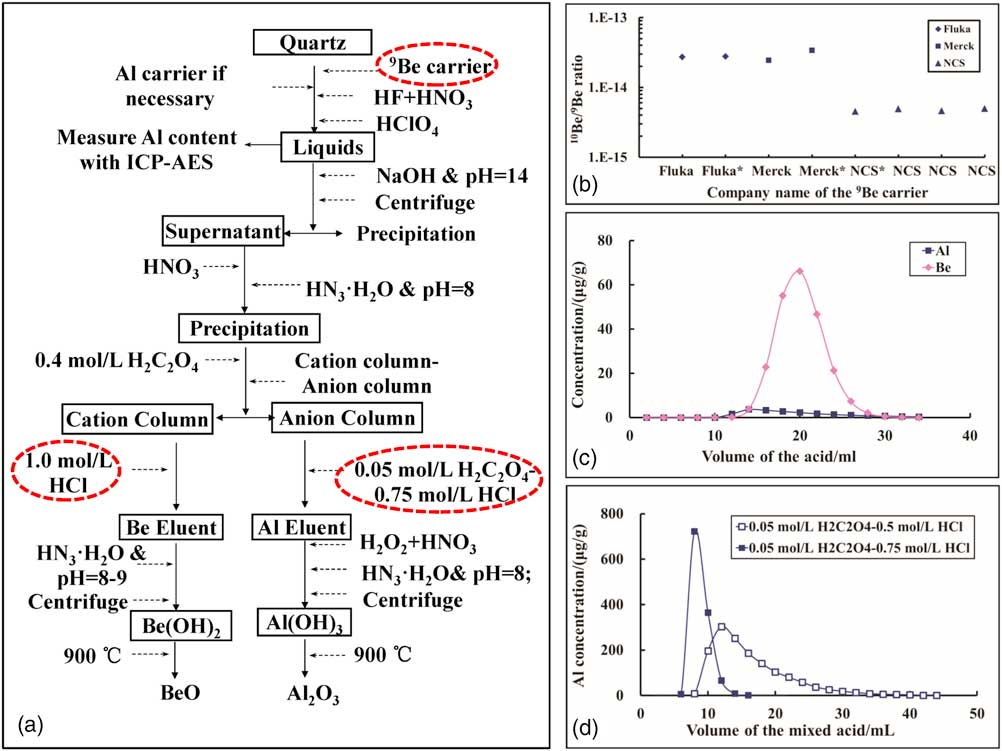
Samples collected from the field were cleaned, dried, and crushed. The 0.25–0.50-mm fractions were isolated using standard testing sieves. Magnetic separation was used to remove magnetic minerals. Then, aluminosilicate minerals, such as feldspar, along with meteoric 10Be were removed by 4–5 iterations of acid leaching at 100°C on a hotdog roller using a mixed solution of dilute HF and HNO3 (Kohl and Nishiizumi Reference Kohl and Nishiizumi1992). Pure quartz samples were completely dissolved with 0.3–0.5 mg 9Be carrier in hydrofluoric acid. Fluorides were removed by perchloric acid fuming. Beryllium and aluminum were separated by cation and anion exchange chromatography, and leached with 1 mol/L HCl and an H2C2O4-HCl acid mixture. Ammonium hydroxide was added to the 10Be and 26Al fractions to precipitate beryllium and aluminum hydroxide gels at pH=8–9 and pH=8, respectively, and the hydroxides were oxidized by ignition at 900°C in quartz crucibles (Figure 2a). The beryllium oxide and aluminum oxide products were mixed with copper powder and pressed into target holders prior to measurement on the AMS.
(a) Experimental procedure of Be and Al extraction from pure quartz; (b) 10Be/9Be ratio of 9Be carriers from different companies (*: data from Zhang et al. Reference Zhang, Zhou, Chang, Zhao, Song and Wu2012); (c) leaching curves of the cation exchange resin column with 1.0 mol/L HCl; (d) leaching curves of the anion exchange resin column with different concentrations of H2C2O4–HCl mixed solutions.

Based on previous results (Zhang et al. Reference Zhang, Zhou, Chang, Zhao, Song and Wu2012), a series of experiments was devised to optimize the separation and recovery of Be and Al. This included the selection of a 9Be carrier and proper acid concentrations for anion and cation exchange (Figure 2a).
In order to test the elution efficiency, we designed a stepwise experiment that included inductively coupled plasma-atomic emission spectrometry (ICP-AES) measurements of Be and Al concentrations in successive solutions. Solutions were eluted from cation and anion exchange resin columns with HCl and H2C2O4–HCl mixtures. The leachate was collected for each step and put into numbered centrifuge bottles. For Be2+ solutions, a concentration of 1 mol/L HCl was found to be relatively ideal (Figure 2c), with a recovery rate more than 98%. However, when using a 0.05mol/L H2C2O4–0.50 mol/L HCl acid mixture to elute Al3+, we observed unacceptably high peak tailing (tailing factor ~2.75) in the leaching profile (Figure 2d). Since the distribution coefficient of Al varies with different mixtures of these two acids, we were able to overcome this shortfall by using a 0.05 mol/L H2C2O4–0.75 mol/L HCl acid mixture. With the higher HCl concentration, the Al elution curve does not show the tailing (Figure 2d) and the recovery rate is more than 80%.
A low 10Be/9Be carrier is critical for the measurement of samples with low 10Be concentrations or small weight. We analyzed several commercial 9Be carriers, using 0.5-mL aliquots. These were produced by Fluka (catalog number: GA19094, lot number: 1318495 51508286), Merck (catalog number: UN3264, lot number: HC825289), and NCS (catalog number: GSB G 62002-90(0402), lot number: 10011832). As shown in Figure 2b, the results can be divided into two groups. The first one (Fluka and Merck carriers) is at the 10–14 level and similar to published data measured at ASTER and Gif (Merchel et al. Reference Merchel, Arnold, Aumaitre, Benedetti, Bourles, Braucher, Alfimov, Freeman, Steier and Wallner2008). The second one (NCS carrier) is found to have a 10Be/9Be ratio of about one magnitude lower than the other two. Thus, we chose the NCS 9Be carrier in our study.
Results and Reliability of the Method
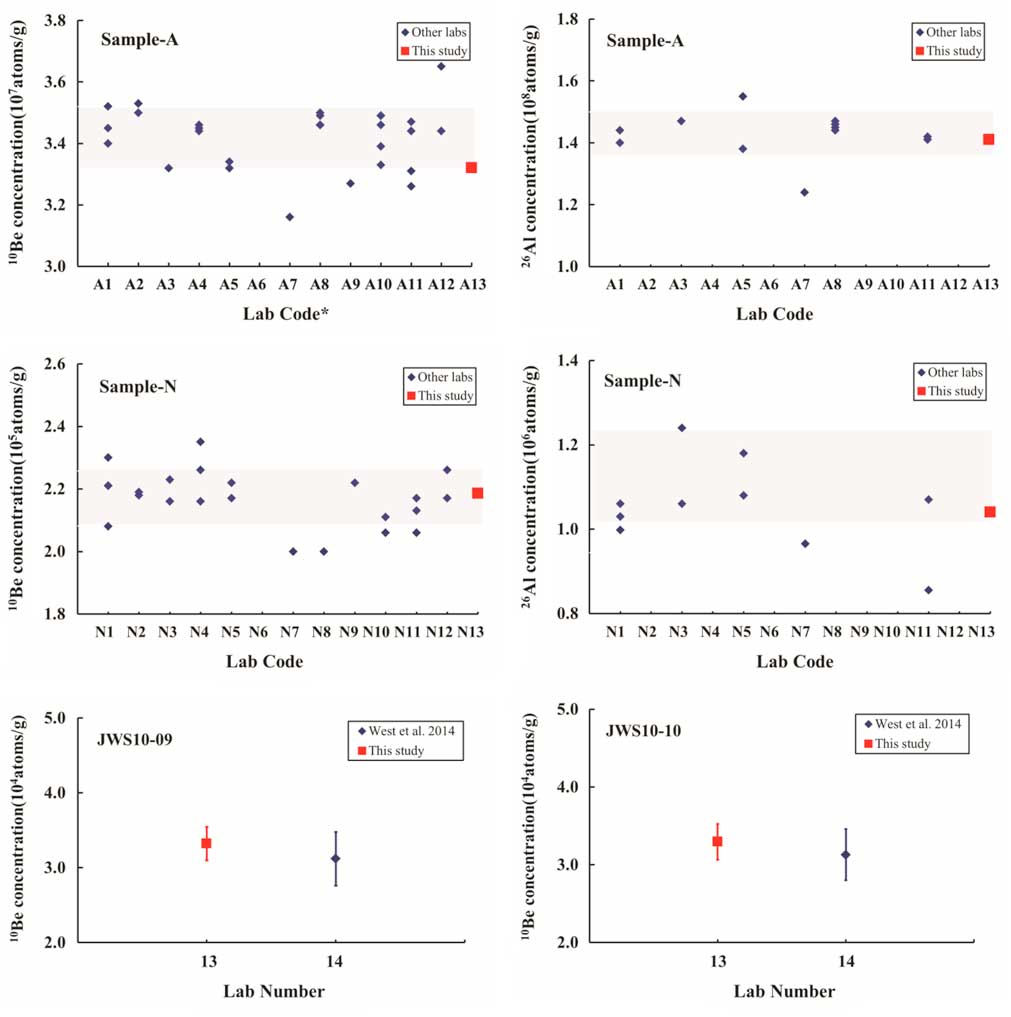
In order to test the reliability of our method, four intercomparison samples (two quartz samples and two sand samples) were analyzed. The quartz samples (Sample A and Sample N) are intercomparison samples from the CRONUS-Earth Project, provided by Dr Tim Jull, University of Arizona. These samples were distributed to several laboratories in the USA, UK, France, Switzerland, Germany, the Netherlands, Sweden, Australia, and Canada (Jull et al. Reference Jull, Scott and Bierman2015). The sand samples (JWS10-09 and JWS10-10) were collected from Minjiang River in 2009 and 2010 by Joshua A West, University of Southern California, Los Angeles (West et al. Reference West, Hetzel, Li, Jin, Zhang, Hilton and Densmore2014).
The respective 10Be and 26Al mean concentrations of Sample A are (3.42 ± 0.10) × 107 atoms/g and (1.43±0.07)×108 atoms/g. The 10Be and 26Al mean concentrations of Sample N are (2.17±0.09)×105 atoms/g and (1.05±0.11)×106 atoms/g, respectively (Jull et al. Reference Jull, Scott and Bierman2015). The 10Be results are compared with those of 12 laboratories, while the 26Al data are compared with the ones provided by six (Sample A) and five (Sample N) laboratories (Figure 3). The mean values of data from the other laboratories are shown at the 1σ level. The results show that the data at the Xi’an AMS Center agree well with the values reported by other labs (Jull et al. Reference Jull, Scott and Bierman2015). The 10Be concentration of JWS10-09 and JWS10-10 are (3.17±0.22)×104 atoms/g and (3.14±0.22)×104 atoms/g, respectively. To account for the fact that the standards used were different from each other, our data were normalized to the same as that of West et al. (Reference West, Hetzel, Li, Jin, Zhang, Hilton and Densmore2014).
Results of the intercomparison samples (West et al. Reference West, Hetzel, Li, Jin, Zhang, Hilton and Densmore2014; Jull et al. Reference Jull, Scott and Bierman2015). Lab code: letter identifies the sample, number identifies the laboratory (13 is this study). The shaded part is the mean value of published data with standard deviation. Only 10Be data are plotted for JWS10-09 and JWS10-10 because 26Al data from Lab 14 were unavailable.

In summary, the previous experimental procedures were optimized for the 9Be carrier chosen and the leaching acid concentrations for the Be and Al extraction with anion and cation exchange resins. The intercomparison experiments verify the sample preparation and AMS protocols applied here.
The next step was to use our methodology to process a set of fluvial terrace samples. The total Al concentrations of dissolved quartz samples from the terraces were quantified by inductively coupled plasma-atomic emission spectrometry (ICP-AES) at the Institute of Earth Environment, Chinese Academy of Sciences, and the 10Be and 26Al concentrations were measured with the 3MV AMS at the Xi’an AMS Center (Zhou et al. Reference Zhou, Lu, Wu, Zhao, Huang, Li, Cheng and Xin2007). The 10Be/9Be ratios of the samples were normalized to the NIST AMS standard SRM-4325 with a nominal value of 10Be/9Be=2.68×10–11 (Nishiizumi et al. Reference Nishiizumi, Imamura, Caffee, Southon, Finkel and McAninch2007). The 26Al/27Al ratios of the samples were normalized to the ICN AMS standard with a nominal value of 26Al/27Al=1.065×10–11 (Nishiizumi et al. Reference Nishiizumi, Imamura, Caffee, Southon, Finkel and McAninch2007).
RESULTS AND DISCUSSION
Dating Results of the Fluvial Terraces
The fluvial-terrace sample results are presented in Table 1. After we measured the 10Be and 26Al concentrations of the samples, we calculated the exposure ages following the formula
 $\qquad \qquad \qquad \qquad \qquad \qquad \quad \qquad t{\equals}{\minus}{1 \over {\lambda {\plus}\mu {\epsilon}}}\ln \left( {1{\minus}{N \over P}\left( {\lambda {\plus}\mu {\epsilon}} \right)} \right)$
where λ is the decay constant (1/yr, λ10Be =4.998×10⁻⁷, λ26Al=9.87×10⁻⁷), μ is the cosmic-ray attenuation coefficient (μ = ρ/L: L = 160 g/cm2 and ρ is the density of the rock), ε is the erosion rate, P is the production rate of the nuclide at the surface (atoms/g/yr), and N is the concentration of the nuclide (atoms/g). To calculate exposure ages, we used a sea-level, high-latitude production rate of 4.76 atoms/g/yr for 10Be and 30.6 atoms/g/yr for 26Al (Balco Reference Balco2008, Reference Balco2009). The production rates were scaled to the location of the sampling site with the scaling scheme of Lal (Reference Lal1991) and Stone (Reference Stone2000). All ages have been calculated assuming no erosion.
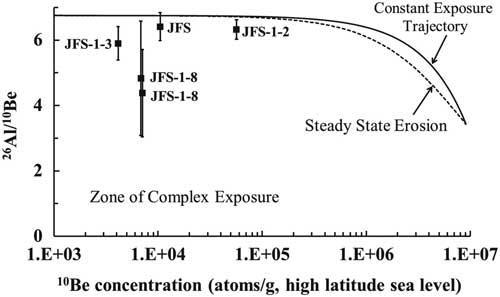
Ages obtained by both 10Be and 26Al are reasonably consistent, but the 26Al ages appear to be systematically younger (Table 1). We plot our results on a standard 26Al/10Be vs. 10Be plot (Figure 4). It shows that JFS and JFS-1-2 are outside but near the steady-state erosion island, while JFS-1-3 lays under the erosion island. The two results of JFS-1-8 are also near the erosion island but with larger uncertainties. In general, we tend to have more confidence in the 10Be ages, as they require only one measurement, 10Be/9Be, while 26Al requires measurement of both 26Al/27Al and Al concentration (van der Woerd et al. Reference van der Woerd, Klinger, Kerry, Tapponnier, Ryerson and Mériaux2006). Therefore, the following discussion is framed around only the 10Be data.
Diagram of the 26Al/10Be ratios vs. 10Be concentrations for Guanshan River samples.

There are significant differences among samples JFS-1-3 and JFS, which were both collected from T2, although the preparation of both samples presented no irregularities. The quality of a surface exposure age determined from a single geomorphic feature is often difficult to assess in the absence of independent geological age constraints (Hetzel et al. Reference Hetzel, Niedermann, Ivy-Ochs, Kubik, Tao and Gao2002). Investigating a series of fluvial terraces has the advantage that the relative age of the terraces is unequivocally determined, i.e. higher terraces are older than lower terraces. In accord with the age of T1 (7.3±1.0 and 7.1±1.1ka), the formation of T2 is best represented by the age of sample JFS. According to Owen et al. (Reference Owen, Spencer, Ma, Barnard, Derbyshier, Finkel, Caffee and Zeng2003), there are two factors that dominate the potential variability in boulder ages in the Qilian Shan: (1) severe weathering and (2) shielding due to the development of a thick organic turf and sporadic deposits of loess. We were particularly careful to sample only from boulders that did not show evidence of significant weathering. However, although the JFS and JFS-1-3 are from the same terrace, collected at different dates, the results are not consistent. We explain that the weathering and burial histories of JFS-1-3 are not clear. The process might result in an underestimated age. Therefore, we reject the dating result of JFS-1-3. For JFS-1-8, we use the average of the two results (7.2±1.0 ka) determined to represent the age of T1.
The ages we determined are abandonment ages, which date to the time when stream incision began. Based on the earlier discussion, we chose the 10Be ages to represent the ages of the terraces. Our chronology suggests that the terraces T1, T2, and T3 were abandoned at 56.4±5.3, 10.7±1.0, and 7.2±1.0 ka, respectively. The calculated 10Be exposure ages shown in Table 1 are consistent with the stratigraphic sequences, that is, decreasing in age from the uppermost terrace to the lowermost terrace. This correspondence supports our use of cosmogenic nuclide exposure dating for the Qilian Shan fluvial terraces.
Comparison with Published Data of the Fluvial Terraces in the Arid Region of China
Our results also show good agreement with published data from fluvial terraces from several arid regions in China (Table 2).
Comparison of the formation age of terraces in arid regions of China.

River Incision Rate
River incision rates can be calculated from the height and age difference between successive terraces (Gu et al. Reference Gu, Xu, Lv, Aldahan and Lal2006). With the small data set we collected here, we can make a preliminary estimate for the incision rate of Guanshan River. Taking the 10Be ages for T3 (56.4±5.3 ka) and T2 (10.7±1.0 ka) and combining them with the elevation difference of 38 m between the two terraces, we calculate an incision rate of about 0.8 mm/yr. Using the lower error limit for T3 (51.1 ka) and a conservative upper age limit for T2 of 11.7 ka gives a maximum incision rate of about 1 mm/yr in the late Pleistocene for Guanshan River, which is in good agreement with that of the Shiyou River (a very close area) (Hetzel et al. Reference Hetzel, Niedermann, Tao, Kubik and Strecker2006). In contrast, the 10Be age of T1 (7.2±1.0 ka), which is located 45 m lower than T2, suggests that during the Holocene the river incised at an average rate of 13 mm/yr. Even if we use the upper error limit of the 10Be age of 11.7 ka for T2 and the lower error limit of the 10Be age of 6.2 ka for T1, the resulting incision rate of 8 mm/yr is still about seven times higher than the maximum rate of about 1 mm/yr for the late Pleistocene. Based on the calculation above, the age of T2 marks the onset a remarkable period of incision of the Guanshan River. Hetzel et al. (Reference Hetzel, Niedermann, Tao, Kubik and Strecker2006) reported that the Shiyou River incision accelerated from (0.8±0.2) mm/yr to 10 mm/yr at 10–15 ka. Our preliminary estimate is similar to theirs, and points to the need for further study to understand the nature of this dramatic increase in incision rate.
Timing of Terrace Formation and Past Climate Change
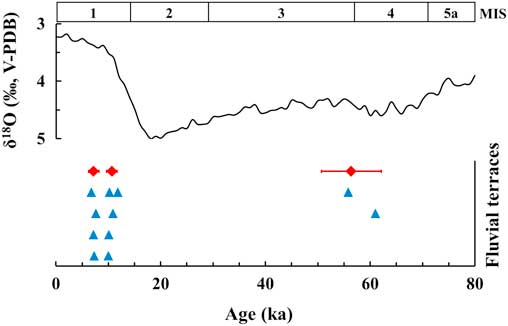
Chen (Reference Chen2003) considered climate change as the key factor that caused the deposition of terraces and subsequent river incision over a large region along the Hexi Corridor. To assess the role of climate in the Qilian Shan, we compare our age data with a record of Marine Isotope Stages (MIS) (Lisiecki and Raymo Reference Lisiecki and Raymo2005) (Figure 5). The age of T3 corresponds with MIS3 (57–29 ka BP). Stage 3 is usually called an interstadial. In the Guliya ice-core record, however, the temperature during stage 3 was higher than today and relatively warm and wet (Yao et al. Reference Yao, Thompson, Shi, Jiao and Zhang1997). The same trend is observed from loess-paleosol sequences on the Loess Plateau (Kuhle Reference Kuhle1998), and from pollen records from the southern margin of the Tibetan Plateau, in Ladakh, India (Bhattacharyya Reference Bhattacharyya1989). Paleolake and paleovegetation studies have also provided evidence for abnormally warm climate at this time. For example, the δ18O and sedimentological records from core TS95 from Tianshuihai Lake, in the Qinghai region of the Tibetan Plateau, also indicate the presence of high lake levels during 59–56ka. Thus, Li et al. (Reference Li, Zhang, Shi and Zhu2008) attributed increased meltwater, due to climate warming, to be the cause of high lake level events during this time.
Comparison of formation age of fluvial terraces with Marine Isotope Stages (Lisiecki and Raymo Reference Lisiecki and Raymo2005). Ages with red diamonds correspond to our 10Be results with 1σ uncertainties. Ages with blue triangles correspond to published data from other fluvial terraces (Lasserre et al. Reference Lasserre, Morel, Gaudemer, Tapponnier, Ryerson, King, Metivier, Kasser, Kashgarian, Liu, Lu and Yuan1999; Mériaux et al. Reference Mériaux, Ryerson and Tapponnier2004, Reference Mériaux, Tapponnier, Ryerson, Xu, King, van der Woerd, Finkel, Li, Caffee, Xu and Chen2005; Hetzel et al. Reference Hetzel, Niedermann, Tao, Kubik and Strecker2006; Yuan et al. Reference Yuan, Champagnac, Ge, Molnar, Zhang, Zheng, Zhang and Liu2011).

The age of T2 corresponds with MIS1. The beginning of MIS1 is marked by significant climatic warming associated with dramatic increases in meltwater as well as rainfall. The increased water flow may be expected to enhance erosion and initiate river incision and hence the formation of T2. The incision of T1 occurs during the Holocene climate optimum, characterized by a warm and wet period between 6–8 ka. Stratigraphic and chronological studies from the Hongshui River section, in the southern portion of the Tengger Desert, have been used to reconstruct paleoclimatic changes during 3–8 ka by Zhang et al. (Reference Zhang, Ma, Li, Pachur and Wuenneman1999). They observe an increase in humidity at this time. Increased precipitation and glacial melting caused increased stream discharge that enhanced fluvial incision and abandonment of the terraces.
In summary, a comparison of high-resolution climate records with age constraints for terrace formation reflects the close relationship between terrace formation and climate change. Apart from tectonic movement, climate change can significantly influence the river incision and terrace formation over a large region.
CONCLUSIONS
The results of four intercomparison samples show that the exposure dating method described here, for the Xi’an AMS Center, are in good agreement with published data, and provide reliable results for cosmogenic exposure age studies. Exposure ages of three fluvial terraces from the Qilian Shan were determined using 10Be and 26Al and are shown to be in good agreement with published data supporting a strong climatic role in the development of the terraces. The methodology described herein can support a wide range of applications in the study of fluvial terrace development in arid regions.
ACKNOWLEDGEMENTS
This work was jointly supported by the Ministry of Science and Technology of China, National Science Foundation of China, and Chinese Academy of Sciences. We especially thank Prof Guanjun Shen for his valuable assistance in chemical treatment; Prof George S Burr for English improvement; Dr Huiping Zhang for assistance in field sampling; Prof Tim Jull, Zhangdong Jin, and Dr Joshua A West for providing the intercomparison samples; and Xiaohu Xiong for assistance in the ICP-AES measurements. We thank the editor and the two reviewers for their constructive comments and suggestions.