


Can international trade help improve the status of workers in developing nations? Specifically, are the labor rights of a given country influenced by the labor rights of its trading partners? In this article, we examine whether such a “California effect,” in which key export markets exert upward pressures on outcomes in producer nations, does indeed exist. We examine how trade serves as a mechanism to diffuse norms and practices pertaining to collective labor rights from importing countries to exporting countries. We report evidence that the labor rights of a country's trading partners, rather than a country's overall openness to trade, is a key determinant of labor rights outcomes. What matters for labor rights is not how much a country trades, but with whom.
The California effect, an idea formulated in the context of environmental issues (Vogel Reference Vogel1995), refers to a process by which economic exchange facilitates an expansion in the scope and stringency of regulatory standards in exporting economies. Rather than engendering regulatory races to the bottom, production for foreign markets with superior standards generates an upward trajectory in standards. This effect has been particularly apparent with respect to the diffusion of vehicle emissions standards across U.S. states (Vogel Reference Vogel1995).Footnote 1 Indeed, Vogel coined the term “California effect” to describe the way in which states with a strong environmental agenda (e.g., California, or Germany in the European context) have been able to facilitate the diffusion of these environmental standards to other jurisdictions.
We examine whether there is something akin to a California effect for labor rights. In doing so, we engage with the broader literature on the role of international economic and sociological networks in the transnational spread of a range of policies, including social security privatization (Brooks Reference Brooks2008; Weyland Reference Weyland2007), financial liberalization (Chweiroth Reference Chweiroth2007; Elkins Guzman, and Simmons Reference Elkins, Guzman and Simmons2006; Simmons and Elkins Reference Simmons and Elkins2004), privatization of state-owned enterprises (Brune, Garrett, and Kogut Reference Brune, Garrett and Kogut2004; Meseguer Reference Meseguer2004), democratic governance (Gleditsch and Ward Reference Gleditsch and Ward2006; Simmons, Dobbin, and Garrett Reference Simmons, Dobbin and Garrett2008), and human rights (Greenhill forthcoming). In this literature, diffusion results from a variety of causal mechanisms, including international economic competition, direct pressure from intergovernmental organizations (IGOs), and learning among policy makers. Our theoretical approach contributes to the broader diffusion literature by focusing on the role of global production networks (or supply chains) as the mechanism for transmitting labor practices from importing to exporting countries.
An important dimension of recent economic integration is the globalization of production networks. Most corporations tend to source a large percentage of their inputs, components, and, in some cases, even finished products, from overseas suppliers. Alongside, multinational corporations have come under pressure from a variety of directions—such as shareholders, nongovernmental organizations (NGOs), and consumers—to ensure ethical conduct and practices within their supply chains (Becker and Sklar Reference Becker and Sklar1999; Prakash and Potoski Reference Prakash and Potoski2007; Spar and LaMure Reference Spar and LaMure2003). For many firms, the threat of political action by activist groups in importing countries concerned about buying goods from countries that suppress labor rights, the ensuing media scrutiny, and the possibility of consumer backlash create strong incentives to pay attention to labor issues abroad. These incentives often exist even when multinational firms use subcontractors, rather than directly owned production facilities, to carry out their overseas operations. For instance, during the past decade, firms in the apparel and footwear industries have faced increasing pressure to disclose their factory locations and to oversee workers' rights in such locations (Bartley Reference Bartley2005). Similar dynamics exist within the carpet industry (Siedman Reference Siedman2007). Moreover, shareholder activism by ethically focused investment funds, as well as large institutional investors such as Calpers, encourages firms to adopt codes of corporate social responsibility whose obligations extend to their overseas subsidiaries and suppliers (O'Rourke Reference O'Rourke2003). By establishing explicit corporate policies unilaterally or via their membership in voluntary labor codes, importing firms seek to ensure that their overseas subsidiaries and subcontractors respect labor rights.
Furthermore, we expect multinationals' attention to labor rights within their supply chains to spill over to local firms as well. There is ample evidence that multinational firms often bring their “best practices” to developing nations, and that because of the sizable externalities multinationals create in host economies, these practices are often adopted throughout the economy (Garcia-Johnson Reference Garcia-Johnson2000; Moran, Graham, and Blomstrom Reference Moran, Graham and Blomstrom2005). In the context of China, Guthrie (Reference Guthrie2006) documents how local suppliers of multinational corporations, as well as local firms that want to join these international production networks, have initiated improvements in working conditions and workers' rights (e.g., instituting formal grievance procedures) at the factory level. These micro-level changes, Guthrie suggests, are supported by macro-level institutional changes such as the establishment of the Labor Arbitration Commission; reformers in China have used globalization as an argument to push through domestic reforms.
Given these dynamics, we predict that countries exporting to destinations with higher levels of labor rights will have incentives to ratchet up their own labor standards. Consequently, instead of observing a race to the bottom in labor standards, we should find a “trading up” in labor standards (Vogel Reference Vogel1995). Of course, the direction of change in labor standards (improvement or deterioration) is dependent on the labor standards in the major export destinations. Presumably, the implications of the California effect would be less sanguine if countries showing disregard for labor rights absorbed the bulk of world exports. Given, though, that a significant proportion of exports from developing countries are currently absorbed by developed countries, and that these countries tend to have stronger labor rights protections, the existing trading context appears to create structural incentives for developing countries to improve labor rights outcomes.
In addition to establishing the existence of a California effect in an area other than environmental practices, our article contributes to the broader debate about the effect of trade on labor rights. Globalization critics assert that trade engenders a race to the bottom: lower labor standards (and, by implication, lower labor costs) provide a competitive advantage to exporting countries. Hence, those countries that want to gain a competitive edge in global export markets will have a strong incentive to refrain from providing legal protections for workers, or to flout those protections in practice (Collinsworth, Goold, and Harvey Reference Collinsworth, Goold and Harvey1994). These critics predict that high levels of trade openness and export dependence will be associated with inferior labor rights, all else being equal.
In contrast, globalization optimists suggest that increased levels of trade will lead to gains in labor rights. Because trade openness is associated with economic growth and development, and because economic development can then spur political reform, openness will ultimately lead to better protection of labor rights. Others would argue that because higher levels of trade contribute to greater opportunities for interaction among states, trade can transmit superior human rights norms generally, and better labor standards specifically. Still others posit that, because foreign direct investors prefer locations with high levels of human capital, all else being equal, and because human capital development is strongly related to the more general protection of workers' rights, foreign direct investment and human rights form a virtuous circle. Developing countries with better human rights practices attract more global production activity, and countries with more global production activity are more likely to experience longer-term improvements in human rights (Blanton and Blanton Reference Blanton and Blanton2007). The globalization optimists therefore predict that, through a variety of mechanisms, higher levels of trade and global production will be associated with superior labor rights.
One could view this debate as simply an empirical one: all else being equal, is a country's level of trade openness associated with better labor rights, worse labor rights, or no real difference in labor rights outcomes? Such a view, however, obscures an important flaw in the extant literature—namely, the incorrect theoretical specification of how trade might impact labor rights. By focusing on a country's aggregate level of trade openness, the existing literature tends to treat all trading relationships (importer–exporter) as the same: only the volume of trade, and not its destination, is taken to matter. But trade relationships are far from homogenous, and given the diversity in labor standards that exist across export destinations, a given exporter may well face conflicting pressures and signals from different importing countries. Some trade relationships may place downward pressures on labor rights, whereas others may motivate improvements. It is not simply how integrated into the global trading system a nation is that matters, but with which countries it trades. Thus, a textured analysis of trade that focuses on bilateral trading relationships is required to correctly specify how trade might affect labor rights in exporting countries. Moreover, the level of trade between pairs of countries might in itself be dependent on existing labor rights, which is an issue we return to later in this article.
This distinction has broader implications for scholarship in political economy and for policy making. Treating “trade globalization” in a disaggregated manner—that is, by carefully accounting for the policies and norms of each country's trading partners instead of only focusing on total volumes of trade—improves our ability to understand the complex relationships between economic globalization and labor rights. In this article, we argue that political scientists should pay close heed to the role of trading networks in transmitting standards, norms, and practices across countries. In doing so, we join the “second image reversed” (Gourevitch Reference Gourevitch1978) scholars in emphasizing the embedded nature of the state and the susceptibility of domestic politics to international influences. As the broader literature on diffusion suggests, although domestic politics and institutions are likely to be very important determinants of various labor-related standards, they most likely do not operate in isolation from external influences.
Moreover, internal and external factors may exert either upward or downward pressure on labor standards. Although we report evidence of a positive relationship between a developing country's labor standards and those of its export destinations, other factors may exert downward pressures on labor standards. Thus, the overall trend in labor standards is determined by the net effect of a variety of domestic and international variables such as changes in the level of economic development, population, and the effect of embeddedness in other types of international networks. We find a positive marginal effect for the bilateral trade-related diffusion variable while observing a slight decline over time in the overall average labor standards of the developing countries. Presumably, the California effect mitigates the downward pressure that other variables may be having on labor standards that, as we argue later in the article, is an important point that critics of economic globalization need to consider.
In the next section, we present our theoretical argument regarding how the California effect dynamic operates in the case of labor rights. Next, we present our model and introduce our empirical approach. Then, we discuss the main results of our empirical analyses. In the final section, we conclude with suggestions for future research.
THE CALIFORNIA EFFECT IN LABOR RIGHTS
The California effect refers to the capacity of importing jurisdictions to affect the laws and practices of exporting jurisdictions. The effect obtains only when a given importer accounts for a sizable share of an exporter's market. Because California represents a large share of the U.S. automobile market, manufacturers located outside California—either in other U.S. states or in foreign countries—have been forced to adapt their production processes in order to ensure that their products will meet California's often higher environmental standards. In most cases, given manufacturers' desires for economies of scale in production, these adaptations have led to improvements in the standards not only of the goods that are destined for the Californian market, but also of all goods manufactured by a given plant, and in some cases, across manufacturing plants focused on a given product.
A similar effect can be seen with respect to the diffusion of environmental standards within Europe. By the 1980s, Germany's automobile industry had adapted to the strict emissions standards required for the export of their cars to the U.S. market (specifically, to the California market, which accounted for half of Germany's total auto exports to the US).Footnote 2 In coalition with Germany's powerful environmental movement, the auto industry began to lobby vigorously for the adoption of similarly strict standards in Germany and elsewhere in the European Community. Having made the necessary changes to their production facilities, German car manufacturers did not want to compete with imported automobiles that fell short of these (somewhat costly) standards. Moreover, given the fact that Germany also represented an important import market for cars produced elsewhere, it too was able to facilitate the adoption of higher environmental standards among car manufacturers located in other European countries (Vogel Reference Vogel1995, Ch. 3). Trade ties therefore enabled the high regulatory standards demanded by one particularly powerful market (the state of California) to be transmitted throughout the rest of the US, and, eventually, to Germany and the rest of Europe.
Scope Conditions
Vogel is careful to point out that the trade-related diffusion of stricter regulatory standards is contingent on a number of specific domestic and international conditions. Three separate factors account for the diffusion of California's stricter environmental standards throughout the US. First, the very large size of the California automobile market gives the state enormous purchasing power. It is therefore able to make demands of its suppliers that would be unimaginable for smaller, less powerful economies. Second, California's success in spreading environmental norms has depended to some extent on its domestic politics. California has a particularly powerful environmental lobby that has been responsible for pushing the state government to adopt high air quality standards in the first place. Another market with a different constellation of political interests and institutions might adopt lower standards, or it might not even address the issue of environmental protection. In such cases, trade-related mechanisms would not result in a ramping up of standards, and could even result in a lowering of standards.
Third, the California effect owes its success in part to the fact that California's vehicle emission limits represent a product standard, and not a process standard. The former refers to the physical features of a good, whereas the latter relates to the manner in which a good is created. Product standards are easier to monitor, either within the domestic economy or at the border. Moreover, product standards have been deemed legitimate grounds for trade protection by international institutions, such as the World Trade Organization (WTO). Product standards therefore can confer a competitive advantage on manufacturers by making it easier for states to discriminate against goods that do not comply with the regulations (Vogel, Reference Vogel1995, 263). However, process standards are more difficult to monitor and enforce, and they have been deemed illegitimate by global trade institutions.
The extent to which we should expect a cross-national California effect to operate within the realm of labor rights depends on the extent to which these three scope conditions are satisfied. With respect to the first condition, the structure of contemporary international trade is such that, on average, countries with higher labor standards absorb the bulk of global exports, especially exports from developing countries. On average (and despite some diversity in standards among developed nations), labor laws and practices in developed nations are superior to those in developing countries, creating a clear possibility for a trade-based upgrading of standards. Given their market power, developed countries should have the capacity to encourage improvements in the labor standards of their trading partners, provided they have the political will to do so.
As required by the second condition, a labor-related California effect requires that workers' rights activists in importing states are sufficiently powerful to motivate importing firms to take notice of the practices of their subsidiaries and subcontractors. These interest groups must have the incentive to spend valuable political capital pressuring consumers or corporations to limit imports from states with poor labor practices, or at least to “name and shame” companies that overlook this issue in their supply chains (Baron Reference Baron2003; Spar and LaMure Reference Spar and LaMure2003). Human and labor rights activists and NGOs have an obvious interest in promoting higher labor standards abroad, but so too do other domestic interest groups such as labor unions that seek to protect domestic manufacturing industries from lower-cost imports. We can therefore expect coalitions to form around a common interest in restricting imports from countries with poor labor standards and to include diverse actors such as human rights groups, labor groups, and even certain industry representatives. Although these groups might not have the political power to push through import restrictions on goods produced using allegedly poor labor practices, they may—through their influence on consumer market dynamics—be able to force importing firms to pay attention to labor practices in their supply chains.Footnote 3
The third issue that emerges from Vogel's discussion is the distinction between product and process standards. Although the California effect may have been successful in transmitting product standards (e.g., auto emissions technologies) from one jurisdiction to another, its ability to successfully transmit process standards faces various legal and practical obstacles. The WTO and its predecessor, the General Agreement on Tariffs and Trade (GATT), do not in general permit discrimination against imports based on process standards, except under the particular circumstances outlined in Article XX. The provisions of Article XX permit discrimination against imports produced using prison labor, but they do not otherwise allow for restrictions related to producers' violations of internationally recognized core labor rights. Indeed, the WTO has tended not to address labor rights issues, in part because of the GATT's legal provisions against doing so and in part because calls for labor rights considerations can serve as a veil for developed country protectionism. Moreover, such discrimination would be very difficult to implement in practice.
Yet, despite the obstacles associated with process-based regulatory upgrading, more recent empirical work suggests that a California effect sometimes operates in the transmission of process-based standards. Prakash and Potoski's (Reference Prakash and Potoski2006) study of the ISO 14001 environmental management (process) standard finds that levels of ISO 14001 adoption among exporting countries is strongly associated with the levels of adoption found among their export destination countries, even when controlling for a number of domestic and international variables. Furthermore, even without direct consumer pressure, firms might be motivated to pay close attention to process standards and the management practices of their supply chains, given their public commitment to following socially responsible policies (Garcia-Johnson Reference Garcia-Johnson2000; Prakash Reference Prakash2000). This suggests that, even in the absence of formal laws restricting the procurement of goods from countries with lax process standards, the desire of companies based in the importing countries to show evidence of a “clean” supply chain to their stakeholders can be sufficient to bring about the adoption of similarly high standards among their export partners. The question we explore is whether such process standard-based dynamics hold in the realm of labor rights as well.
More recent anecdotal evidence highlights the plausibility of a trade-based upgrading of labor standards. A range of multinational corporations, industry associations, and labor rights activists have encouraged the development and implementation of labor codes of conduct. These codes, based in the private sector, may supplement or substitute for labor laws and labor inspections in host economies. In 2003, a World Bank study estimated that 1,000 such codes existed (Smith and Feldman Reference Smith and Feldman2003). These codes vary in scope, stringency, and emphasis; some focus on health and safety issues; others focus on environmental issues; and still others emphasize payment of minimum or living wages. Many of them, however, take the core labor standards promulgated by the International Labor Organization (ILO) in 1998 as a key starting point. The freedom of association and the right to bargain collectively, as well as the elimination of child and forced labor, are therefore central elements. The codes also vary in their provisions for monitoring and enforcement. In more recent years, though, the general trend has been toward monitoring via third-party auditors (which could be private firms such as Ernst and Young or NGOs that work on labor rights issues); increasingly, these auditors are certified or trained by multistakeholder initiatives (representing industry as well as activists), such as the Fair Labor Association (Locke, Qin, and Brause Reference Locke, Qin and Brause2007).
An important feature of many of these codes is that they apply not only to a firm's directly owned facilities abroad, but also to a firm's foreign suppliers. This is particularly important in labor-intensive industries such as footwear and apparel, in which nearly all production is done via independently owned subcontractors. For instance, Nike's list of supplier factories presently includes more than 700 locations, in 47 nations, and employing approximately 700,000 workers.Footnote 4 In contrast, Nike has less than 25,000 direct employees. Nike's behavior vis-à-vis labor rights issues parallels that of many multinationals: in the early to mid-1990s, the company came under scrutiny following various allegations of worker abuses at its supplier factories. After first denying responsibility for these problems, Nike attempted to position itself as an industry leader in the labor rights area, becoming the first firm in its industry to disclose its list of supplier factors (Locke Reference Locke, Schmalenese and Kochan2003, Locke, Qin, and Brause Reference Locke, Qin and Brause2007). In addition, since 1997, Nike's suppliers have been subject to various Nike-administered auditing programs to assess compliance with its corporate code of conduct. Nike now requires that factories supplying inputs (e.g., blank T-shirts) to Nike subcontractors be located in one of the approximately 50 countries on the company's list of approved production locations. Other firms in the industry, including Adidas, have followed Nike's example.
Not surprisingly, there has been a long-running debate about the effectiveness of Nike's monitoring programs, as well as about the impact of corporate codes of conduct in general (Bartley Reference Bartley2005; O'Rourke Reference O'Rourke2003). But there also is evidence that, although many problems in supplier factories and exporting nations remain, Nike's efforts have sometimes produced increased respect for various individual and collective labor rights, particularly in countries where government respect for rule of law exists (Locke, Qin, and Brause Reference Locke, Qin and Brause2007). Similar patterns—in which U.S.-and European-based multinationals use corporate codes of conduct to influence conditions in exporting nations—have occurred in a variety of other industries, including carpets (where NGO Rugmark has worked with suppliers and retailers to limit child labor),Footnote 5 soccer balls, and collegiately licensed apparel.Footnote 6
In addition to changes in exporting country behavior that are promoted by private codes of conduct, some governments of importing jurisdictions have begun to link labor rights with market access. Although the formalization of such linkages, via bilateral and regional trade agreements, has been a fairly recent development, it builds on a longer-standing concern with production processes in exporting nations. In the United States, the linkage between market access and labor rights dates to the 1984 Generalized System of Preferences (GSP) Renewal Act. This act, amending the Trade Act of 1974, included a labor rights clause. Developing nations' eligibility for GSP status (a nonreciprocal set of trade concessions offered by individual developed nations to developing countries) was to be based on, among other criteria, “whether a country was taking steps to afford internationally recognized workers' rights.” These rights were specified to include the freedom of association and the right to organize, as well as individual working conditions (Compa and Vogt Reference Compa and Vogt2001). From 1984 to 2000, the U.S. International Trade Commission conducted approximately 100 labor-related reviews of GSP status, involving 42 countries. During this time, thirteen countries had their GSP preferences suspended, while an additional seventeen were placed on a “temporary extension with continuing review” list. Although GSP-linked trade comprises only a small percentage of U.S. trade, some maintain that such reviews and suspensions have ripple effects: they can signal to other importing nation governments, as well as to multinational corporations (MNCs) and activists, that a given country has difficulty with labor rights (Compa and Vogt Reference Compa and Vogt2001). And, although GSP-related trade is small relative to total U.S. trade, exports to the US often comprise an important segment of a given low-income country's trade.
More recently, U.S. government attention to labor rights issues has manifested itself via the inclusion of a labor side agreement in the North American Free Trade Agreement (NAFTA). In addition, the US-Jordan Free Trade Agreement (2000), the Central American Free Trade Agreement (CAFTA-DR, 2005), and the proposed US-Colombia Free Trade Agreement also contain a range of explicit labor rights provisions. Perhaps most explicitly, the US-Cambodia Trade Agreement on Textiles and Apparel (1999–2004) offered Cambodia additional textile export access to the U.S. market in return for a guarantee that Cambodia's national labor laws would be enforced. Oversight was conducted by ILO monitors in conjunction with the Cambodian garment manufacturers' association, various NGOs, and U.S. buyers of Cambodian apparel.
Cambodia, which depended on textiles and apparel for 80% of its export earnings, used this agreement to attempt to create a niche as a “sweatshop-free” location (Chiu Reference Chiu2007). Although firms' compliance with Cambodia's relatively stringent labor code was not absolute, studies suggest a high level of provision of collective rights as well as individual working conditions (Abrami Reference Abrami2003; Chiu Reference Chiu2007). The program enticed several U.S.-based buyers to increase their imports from Cambodia (Fair Labor Association 2005). Cambodian firms that wanted to sell to U.S. buyers realized that they had to respect workers' rights, and Cambodian workers realized that their firms would be monitored by various external agencies. Again, a domestic preference for labor rights in the import destination (in this case, promoted by U.S. labor unions and labor rights activists, and supported by Congress and the executive) led to tangible improvements in labor rights in an exporting country.
Labor Laws and Labor Practices
Although our theoretical propositions apply to workers' rights generally, our empirical analyses focus on the collective rights of workers. These rights—the freedom of association and the right to bargain collectively—are among the four “core” rights advanced by the ILO in its 1998 Declaration of Fundamental Principles and Rights at Work.Footnote 7 The main conventions related to freedom of association and collective bargaining have been ratified by the vast majority of governments, and the ILO's declaration obligates (albeit with few direct enforcement mechanisms) all members, even nonratifiers, to respect the core labor rights. In addition, standards governing workers' collective rights provide the capacity to achieve more favorable outcomes in terms of wages, benefits, and working conditions (Elliott and Freeman Reference Elliott and Freeman2003). The distinction between collective and individual rights can also be viewed as a distinction between enabling and protective rights (Rodríguez-Garavito Reference Rodríguez-Garavito2005): the former include freedom of association and collective bargaining, and they can facilitate the achievement of improvements in the latter, which include working hours, minimum (and sometimes “living”) wages, and health and safety conditions. Indeed, although collective labor rights may not perfectly predict actual working conditions, there is an established association between greater respect for collective labor rights and improvements in wages and working conditions (Aidt and Tzannaos Reference Aidt and Tzannaos2002; Blanchflower and Bryson Reference Blanchflower, Bryson, Addison and Schnabel2003; Flanagan Reference Flanagan2006; Huber and Stephens Reference Huber and Stephens2001). For instance, several studies report the existence of a “union wage premium” in a range of countries. Other analyses consistently find an association between the use of formal labor market institutions to set wages and the dispersion of earnings (Abouharb and Cingranelli Reference Abouharb and Cingranelli2007; Freeman Reference Freeman2007). And, given that approximately one fourth of the world's nonagricultural workers are members of labor unions—and that still more workers are covered by collective labor agreements—the potential for workers to act collectively is central to current debates regarding the impact of economic globalization on domestic outcomes.
In practical terms, focusing our analyses on workers' collective rights leads us to examine outcomes that set a minimum floor for firms' and governments' behavior. This allows us to avoid the contentious questions of how to define an internationally acceptable level of working hours or wages or of how to assess the potential efficiency consequences of cash (individual) standards. We also avoid many of the difficulties associated with measuring wages, benefits, and working hours in a cross-national context, which is particularly problematic with respect to developing nations (i.e., Daude, Mazza, and Marison Reference Daude, Mazza and Morrison2003; Flanagan Reference Flanagan2006).
In considering collective labor rights outcomes in exporting nations, we address two elements of workers' rights: their legal provision and their practical implementation. Although more recent studies tend to treat the legal and the practical elements within a single dimension (Mosley and Uno Reference Mosley and Uno2007; Neumayer and de Soysa Reference Neumayer and de Soysa2005), we highlight the value of distinguishing the two. Indeed, in empirical terms, many countries that have strong legal protections for collective labor rights exhibit repeated violations of such rights in practice. Problems of compliance with laws are rife, particularly in nations that lack a well-established rule of law or the domestic regulatory capacity to oversee enforcement. Indeed, this domestic lack of regulatory capacity has been one justification for the development of private sector–based codes of conduct and monitoring systems (Bartley Reference Bartley2005). In addition, in theoretical terms, it is important to distinguish between a government's attention to labor legislation and its practical implementation of such rules.
In terms of the California effect, the issue is whether pressures emanating from importing countries bring about changes in an exporting country's on-the-ground respect for collective labor rights, or whether they merely encourage exporting countries to legislate tougher labor laws that they either cannot or will not enforce. In other words, does the California effect extend to tangible improvements in labor rights in exporting countries, or does it only encourage symbolic politics, where governments pass laws enshrining core labor rights, but fail to enforce them?
On the one hand, one could argue that the difficulties involved in monitoring labor rights in foreign jurisdictions make it unlikely that tougher labor standards will be implemented in practice. The fact that labor practices constitute a process standard, as opposed to a product standard, makes monitoring compliance much more difficult. In the case of the environmental standards that form the basis of the California effect, regulators in California can easily determine whether imported vehicles comply with the state's strict emissions standards. But consumers and firms located in the importing countries face severe information asymmetries about labor practices in exporting countries. They will find it difficult to verify claims about good or bad labor practices in exporting countries. Arguably, subsidiaries and contractors located abroad, and under pressure to control labor costs, will recognize and exploit their information advantages. Although exporting countries might enact new laws to assuage pressure groups in importing countries, they will have few incentives to actually enforce them.
On the other hand, consumers and NGOs based in importing countries are likely to recognize their information disadvantages. Because only the exporting countries have the power to actually make improvements in their labor standards, consumers and activists might demand that the firms provide evidence that they are indeed respecting labor rights. By shifting the burden of proof to exporters, labor activists could succeed in forcing the exporting firms to compensate the consumers for their information disadvantages. Consequently, multinational subsidiaries and subcontractors in exporting nations will face pressure from actors higher up in their supply chain to demonstrate their compliance with national labor laws—and, where such laws are lacking, to offer evidence of practices that go beyond domestic legal requirements. This process has operated in several industries such as apparel, forestry, carpets, and coffee, where lead firms have required their suppliers to be certified as meeting international standards. Furthermore, ISO 14001 is a case in point whereby exporters and other firms in the supply chains are called on to demonstrate superior environmental practices (Prakash and Potoski Reference Prakash and Potoski2006). In the case of labor standards, the pressure from importing jurisdictions to improve labor practices falls on exporting firms and their governments, which are keen to encourage exports.Footnote 8
Nevertheless, the actual practices of manufacturers in exporting countries might be less likely to change than will be the formal laws and regulations governing these practices. Presumably, the governments of exporting states that come under pressure—from the ILO, importing governments, or MNCs—to improve their labor practices will seek the often easier and more visible route of enacting new labor laws rather than changing their labor practices in a way that might impose sizable political and economic costs. From the point of view of IGOs, providing technical assistance to improve national labor legislation is much cheaper than providing assistance to ensure compliance in practice. Furthermore, the legal elements of collective labor rights are, in some ways, closer to product than to process standards: activists and MNCs need only look at the content of the legislation, rather than its implementation in supplier factories, to determine compliance. Given these dynamics, we expect the California effect to be stronger in the context of labor laws than labor practices. Last, because changing industrial practices takes time, we also expect any California effect in labor practices to be operative after a greater time lag than a California effect in labor laws.
DATA AND EMPIRICAL MODEL
We model the relationship between each country's collective labor rights outcomes and those of its trading partners using country-year data for 90 developing countries over the period 1986–2002. Countries from Africa, Latin America, the Caribbean, Asia, and the Middle East are included in our sample; we exclude the transition economies of Central and Eastern Europe, as well as those from the former Soviet Union. Omitted country-years from the developing regions are those for which data on one or more independent variables are not available. We focus on developing countries because they tend to have inferior levels of collective labor rights protection relative to developed countries. We do not include developed or post-Communist nations because the factors affecting labor rights outcomes in those countries are quite different from those determining outcomes in low- and middle-income nations (Mosley and Uno Reference Mosley and Uno2007).
If the race to the bottom argument holds, we can expect developed countries to begin to mimic the labor standards of developing countries, especially as economic globalization intensifies. If, however, the California effect holds, developing nations' labor rights outcomes should converge with those of their export partners, for better or worse. Given the structure of trade during our sample period, we would expect to see developing countries mimicking the labor standards of developed countries. Consistent with the latter, throughout the 1986–2002 period, developing countries had a significantly lower average overall labor rights score than did the developed countries, for both laws and practices.
As discussed previously, our assessment of the California effect hypothesis treats separately the de jure and de facto aspects of a country's level of respect for collective labor rights. The first measure, Labor Laws, gives an indication of the extent to which laws have been put in place to safeguard collective labor rights, such as the rights to organize, bargain collectively, and strike. The second measure, Labor Practices, provides an indication of the degree to which labor rights are violated in practice. Both variables are derived from an aggregate measure of collective labor rights employed by Mosley and Uno (Reference Mosley and Uno2007). Importantly, this measure captures the extent to which restrictions are placed on workers' freedom of association and collective bargaining—so-called “collective” labor rights, defined as one of the key elements of internationally accepted core labor standards.
Following Kucera (Reference Kucera2002), Mosley and Uno (Reference Mosley and Uno2007) generated these data by conducting a detailed content analysis of reports on labor standards produced by three separate sources: (1) the U.S. State Department's annual Country Reports on Human Rights Practices, (2) the ILO's Committee of Experts on the Applications of Conventions and Recommendations (CEACR) and the Committee on Freedom of Association (CFA) reports, and (3) the International Confederation of Free Trade Unions' (now part of the International Trade Union Confederation) Annual Survey of Violations of Trade Union Rights.
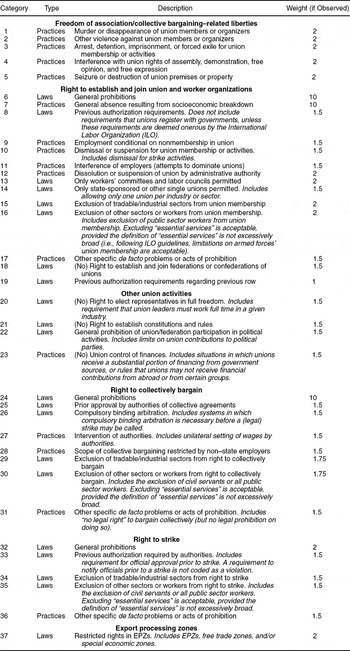
Kucera's (Reference Kucera2002) template records thirty-seven types of violations of labor rights, in six categories: freedom of association and collective bargaining–related liberties, the right to establish and join worker and union organizations, other union activities, the right to bargain collectively, the right to strike, and rights in export processing zones. In each of these broad categories, specific violations include the absence of legal rights, limitations on legal rights, and the violations of legal rights by government agents or employers. The coding scheme assigns a weighting to each type of violation, with more serious violations (e.g., general prohibitions on unions) weighted more heavily than others (e.g., a requirement of previous authorization in order for a union to join a confederation of unions). A full list of these categories and weightings is available in the Appendix. Each country-year in the data set is assigned a score of either zero (no violations) or one (one or more violations) for each of the 37 categories of labor rights violations. For their analyses, Mosley and Uno (Reference Mosley and Uno2007) add together the scores in each of these weighted categories, deriving an aggregate measure of collective labor rights violations for each country-year. Possible scores on the aggregate labor standards indicator, then, range from zero to 76.5. In practice, however, no country exhibits violations in every category of labor rights, and maximum scores are in the mid-30s. It is important to note that the overall measure, as well as the law and practice measures, indicate the total number of categories with violations in a given year, where categories that include more severe violations have greater weights. The measures, however, do not capture the number of violations within each category—for instance, the number of workers dismissed on the basis of union membership—in a given country-year.
The separate Labor Laws and Labor Practices variables were created by disaggregating this 37-point measure into its separate law and practice components (see Table A1 of the Appendix). Typical “law” components of the scale include measures such as whether certain industrial sectors are allowed to impose limits on the right of workers to join unions or to strike (items 16 and 34), or whether workers need government approval in order to engage in collective bargaining in the first place (item 25). In contrast, representative “practice” components of the scale include whether acts of violence are reported to have been carried out against union leaders (items 1 and 2), or whether some firms make employment conditional on nonmembership in a union (item 9). As with Mosley and Uno's (Reference Mosley and Uno2007) overall measure of labor rights, each category of violations is weighted in order to account for its severity.Footnote 9 After disaggregating the overall labor rights scale in this way, our Labor Laws variable ranges from 0 to 28.5, whereas the Labor Practices variable ranges from 0 to 27.5.Footnote 10 We have reversed the scale of both the Labor Laws and Labor Practices variables so that higher values represent greater levels of respect for collective labor rights.
Our key independent variables are weighted averages of the Labor Laws and Labor Practices found among a developing country's export partners. We label these variables Bilateral Trade Context: Laws and Bilateral Trade Context: Practices, respectively. These variables are constructed by taking the average Labor Laws or Labor Practices scores of each country's export destinations, and weighting these by the volume of goods exported to each of these destination countries in that particular year. Countries that export goods primarily to destinations with, for example, high scores on the Labor Practices variable will have high values on the Bilateral Trade Context: Practices variable, whereas those that send most of their exports to countries with poor labor rights performance will have lower scores on that particular variable. These variables capture the notion that it is the specific nature of a country's trade relationships, rather than its overall level of trade openness, that underlie the trade-related causal mechanism for the transmission of labor rights. Data on export volumes at the dyadic level were obtained from the International Monetary Fund's (IMF's) Direction of Trade Statistics database. The calculation of this measure can be represented as follows:
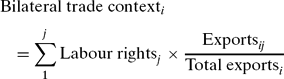
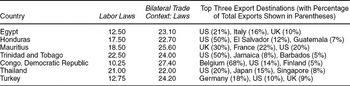
where Bilateral trade contexti refers to the relevant bilateral trade context variable (either Law or Practices), Exportsij represents the volume of exports sent from country i to country j, Labor rightsj refers to the relevant labor rights score (i.e., Labor Laws or Labor Practices) for the destination country j, and Total exportsi represents the total volume of goods exported from country i to all its destinations. If a California effect does indeed operate with respect to labor standards, we should find a positive relationship between each exporting country's Bilateral Trade Context and its labor rights score in subsequent years. A sample of data illustrating typical values of Labor Laws and Bilateral Trade Context: Laws for several of the countries included in our data set is shown in Table 1.
Illustrative Data on Values of Labor Laws and Bilateral Trade Context: Laws Variables for Randomly Selected Sample of Seven Developing Countries in Year 2002

In addition to our measures of Bilateral Trade Context, our model also includes two potentially important indicators of overall economic integration, each of which may influence labor rights in a “race to the bottom” or “climb to the top” dynamic. Total Trade is measured as each country's total imports plus exports as a percentage of its gross domestic product (GDP). This provides a measure of overall dependence on trade, and it represents the most frequently used metric of openness in extant literature.Footnote 11 Including this measure allows us to test directly whether it is overall trade or the bilateral trade context that is more important in the determination of a country's labor rights outcomes. The second measure, FDI Inflows, reports the amounts of new foreign direct investment (FDI) received each year, expressed as a percentage of the country's GDP.Footnote 12 It therefore assesses the effect of directly owned foreign production on labor rights outcomes. This measure tests the specific effect of directly owned foreign production (versus all production for export by foreign or locally owned firms) on labor rights outcomes.Footnote 13
Although Mosley and Uno (Reference Mosley and Uno2007) report a negative relationship between overall levels of trade and labor rights, suggesting that increased dependence on trade causes countries to lower their labor standards in order for their exports to remain competitive in the global economy, Neumayer and de Soysa (Reference Neumayer and de Soysa2006) find the opposite. The relationship between FDI and labor rights is less contested: higher levels of inward FDI appear to be associated with improvements in labor standards. Possible causal mechanisms include the transmission of better labor standards from the parent company, or the ability of investing companies to pressure the host government into improving general levels of respect for the rule of law (see Mosley and Uno, Reference Mosley and Uno2007, 925–6 and references therein).
We also account for the possibility that participation in certain types of trade agreements influences labor standards in developing countries. As discussed previously, Preferential Trade Agreements (PTAs) that govern trading relationships between major economies such as the European Union or the United States and many developing countries often contain a clause emphasizing the parties' commitment to protecting human and/or labor rights. Over time, the inclusion of labor-related provisions in PTAs has increased. A more recent study of the impact of PTAs on countries' levels of respect for physical integrity rights found that PTAs that incorporate human rights conditions can, in fact, lead to improvements in physical integrity rights, but only when the relevant human rights clauses have the potential to be effectively enforced (Hafner-Burton Reference Hafner-Burton2005).
Following Hafner-Burton (Reference Hafner-Burton2005), we construct two dummy variables that indicate whether, in a given year, each country belonged to a PTA that includes either “hard” or “soft” human rights conditions. The variable Hard PTA is coded as “1” for each country-year in which the country belongs to at least one PTA that appears to make the trading relationship contingent on the maintenance of a high level of respect for human rights. It is designed to indicate whether the state is subject to a set of enforceable human rights conditions. The variable Soft PTA, which indicates whether a state belongs to PTAs with unenforceable conditions, is coded as “1” for each year in which the country belongs to at least one PTA that makes reference to human rights in the text of the treaty, but does not appear to make the trading relationship conditional on a minimal human rights standard being upheld. These variables were coded based on a content analysis of the PTA treaties available online from the WTO.Footnote 14
Our models also include a number of controls for domestic-level determinants of labor standards. The Democracy variable reports the Polity2 democracy score for each country-year. This variable is the combined autocracy/democracy measure from the Polity IV database, which takes on values between −10 and +10, representing the most autocratic and the most democratic countries, respectively. Previous studies have found democracy to be positively associated with collective labor rights (Mosley and Uno Reference Mosley and Uno2007; Neumayer and de Soysa Reference Neumayer and de Soysa2006), as well as with improved human rights practices more generally. This is consistent with the idea that more democratic countries can better protect the bargaining rights and rights to free association that constitute collective labor rights. We also include a measure of national income to account for the ways in which differing levels of economic development might affect labor standards. This measure, GDP per capita, is the log of the GDP per capita measure available from the World Development Indicators database.
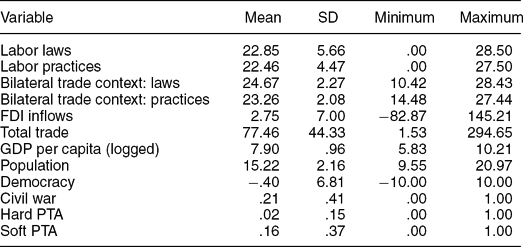
In addition, we introduce a dummy variable to control for the presence of civil war. Human rights violations tend to increase dramatically when governments face serious security threats (Hafner-Burton and Tsutsui Reference Hafner-Burton and Tsutsui2005; Poe, Tate, and Keith Reference Poe, Tate and Keith1999). Data on the occurrence of civil wars were obtained from the UCDP/PRIO Armed Conflict Database.Footnote 15 The original four-point scale measuring civil war intensity has been recoded to create a dummy variable, where a value of “1” indicates the presence of a civil war of an “intermediate” or higher level of intensity. Our models also include measure of the log of population size, which has previously shown a strongly and statistically significant negative relationship with human rights practices (Poe, Tate, and Keith Reference Poe, Tate and Keith1999; Richards, Gelleny, and Sacko Reference Richards, Gelleny and Sacko2001). Presumably, countries with larger populations will have a higher probability of violations occurring in various categories of labor rights, all else being equal. Population data were obtained from the World Development Indicators database. A table of summary statistics for all variables is provided in Table A2 of the Appendix.
RESULTS
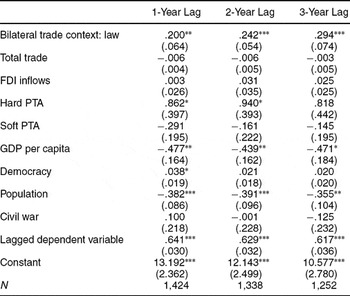
We report the results of our analyses, using ordinary least squares (OLS) regression with a random effects model, in Tables 2 and 3.Footnote 16 We calculate robust standard errors, clustered by country. Because changes in the labor standards of exporting countries can be expected to occur over an extended period of time, we first estimate the models using a one-year time lag for all independent variables. To assess the possibility of varying lag effects, we also reestimate the models with two- and three-year lags between the independent and dependent variables. Our model includes a lagged dependent variable because we expect labor practices in previous years to influence labor practices in subsequent years. Furthermore, the inclusion of lagged dependent variable mitigates the problem of serial correlation.
Effects of Regressing Labor Laws on Bilateral Trade Context: Laws, with Independent Variables Lagged by 1, 2, or 3 Years

FDI, foreign direct investment; PTA, Preferential Trade Agreement; GDP, gross domestic product.
Notes: Robust standard errors are shown in parentheses. Significance levels are indicated as follows: * p < .05, ** p < .01, *** p < .001.
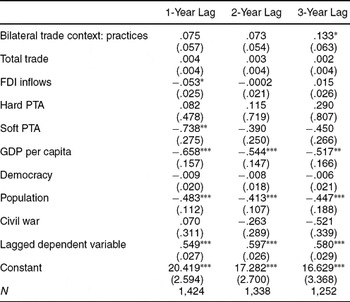
Effects of Regressing Labor Practices on Bilateral Trade Context: Practices, with Independent Variables Lagged by 1, 2, or 3 Years

FDI, foreign direct investment; PTA, Preferential Trade Agreement; GDP, gross domestic product.
Notes: Robust standard errors are shown in parentheses. Significance levels are indicated as follows: * p < .05, ** p < .01, *** p < .001.
Labor Laws
Table 2 reports the results for the Labor Laws dependent variable. Our key independent variable, Bilateral Trade Context: Laws, has a positive and highly statistically significant relationship with collective labor rights in all three models. The positive relationship indicates that high labor standards found among a country's export destinations are associated with improvements in the labor laws of the exporting country in subsequent years. Moreover, the effect of this variable becomes almost 50% larger when the time lag between the independent and dependent variables is increased from one to three years. This provides support for the view that a California effect operates with respect to labor laws: countries that export goods to destinations with greater legal protections of collective labor rights will, over time, come to adopt similar legal protections.Footnote 17
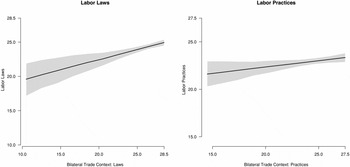
The coefficient for the Bilateral Trade Context: Laws variable presented in the third column of Table 2 suggests that for every unit increase in the average labor standards of a country's export destinations, its own Labor Laws score will increase by approximately .3 units after a three-year lag, all else being equal. This implies a high degree of sensitivity to the labor standards of a country's trading partners, especially when one considers the fact that the Labor Laws variable has a standard deviation of only 2.3 units. The substantive and statistical importance of the Bilateral Trade Context also becomes apparent in Figure 1. The left-hand panel in Figure 1 provides an estimate of the extent to which changes over the observed range of values of Bilateral Trade Context: Laws affects the predicted Labor Laws score of a hypothetical country that has median values for all covariates included in the 3-year lagged model.
Substantive Effects of the Bilateral Trade Context Variables

In contrast to our results for Bilateral Trade Context, the estimated effects of a country's overall dependence on trade (Total Trade) and direct investment (FDI Inflows) are not statistically significant at the 95% confidence level.Footnote 18 This result lends further weight to the argument that aggregate measures of economic globalization such as total trade and total FDI ought to be disaggregated for the purposes of assessing the impact of economic integration on labor rights.
Membership in PTAs with “hard” human rights conditions appears to be associated with greater legal labor rights protections. There exists a positive and statistically significant relationship between the dummy variable indicating whether the state belongs to one or more “hard” PTAs and Labor Laws in subsequent periods. (The p values for the 1-, 2-, and 3-year lagged variables are .030, .017, and .064, respectively). However, we do not see any statistically significant relationship between membership in PTAs with “soft” human rights conditions and Labor Laws in subsequent periods. These results are broadly consistent with Hafner-Burton's (Reference Hafner-Burton2005) study of the relationship between PTA membership and physical integrity rights.
GDP per capita (logged) has a statistically significant negative relationship to collective labor rights. This result is consistent with that of Mosley and Uno (Reference Mosley and Uno2007), suggesting that among the sample of developing countries, those that are richer—and presumably more industrialized—are also the ones that are more likely to generate reports of violations of collective labor rights (but see Neumayer and de Sosya Reference Neumayer and de Soysa2006). The Democracy variable appears to have a positive relationship to Labor Rights in the first model, although this effect is not statistically significant after 2- and 3-year lags. Meanwhile, the dummy variable for the presence of a civil war suggests no statistically significant relationship to collective labor rights.Footnote 19
Labor Practices
When these models are estimated using Labor Practices as the dependent variable instead of Labor Laws, the effect of Bilateral Trade Context is much weaker. As we report in Table 3, the estimated effect is positive in all three models, but is only statistically significant at the .05 level after a 3-year lag. (The p values for the 1-, 2-, and 3-year lags are .188, .173, and .035, respectively). An illustration of the substantive significance of this finding is shown in the right-hand panel of Figure 1.
The effects of the other independent variables are broadly similar, with the two most notable exceptions being the PTA variables. Here, we find no evidence of a statistically significant relationship between membership in “hard” PTAs and Labor Practices, whereas membership in “soft” PTAs shows a negative relationship to Labor Practices that is statistically significant in the first model. One possible interpretation of this seemingly counterintuitive result is that membership in PTAs with enforceable human rights conditions has no statistically discernible effect on countries' labor rights behavior in practice, whereas membership in PTAs with unenforceable human rights conditions merely provides a convenient way for abusive regimes to give the appearance of caring about labor rights. In other words, the negative relationship between Soft PTA membership and labor rights practices could be the result of a selection effect, whereby states with poor human rights records are more likely to choose to sign a PTA with human rights conditions that are ultimately unenforceable (see Hafner-Burton and Tsutsui Reference Hafner-Burton and Tsutsui2005; Hathaway Reference Hathaway2002; Vreeland Reference Vreeland2008). Strategic and misleading signaling via such cheap talk is an interesting area of enquiry for future research.
Taken together, the results for the Labor Laws and Labor Practices models suggest that a California effect operates with respect to the transmission of legal labor rights (de jure rights). Although labor-related outcomes in export destinations create incentives for exporting states to adopt tougher labor laws, the effect of these laws on ground-level outcomes (Labor Practices) are weaker and discernible only after a three-year lag. Thus, making or changing laws may impose fewer political costs than actually enforcing them. This is a consistent with a mechanism of norm diffusion in which supply chain pressure leads exporting governments to pass legislation improving labor rights, but does not force them to immediately take steps to improve labor practices on the factory floor. However, the statistically significant relationship between Bilateral Trade Context: Practices and Labor Practices after a 3-year lag suggests that the pressure on exporters to demonstrate compliance with labor laws, although weaker in magnitude, can eventually bring about real changes in behavior. Symbolic politics gets translated into concrete outcomes in a weaker fashion and only after a lag.
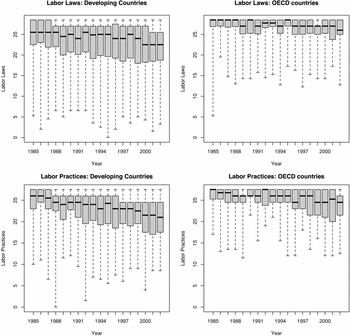
Figure 2 shows the global trend in both Labor Laws and Labor Practices over the 1985–2002 period, and compares the trends observed among the developing countries included in our sample with those of the Organisation for Economic Co-operation and Development (OECD) member states. Although the Labor Laws and Labor Practices of the developing countries are, on average, lower than the corresponding values of the OECD countries, both groups of countries appear to be experiencing a slight decline in labor standards over the duration of the sample period. This general decline is likely to be due in part to the negative effect that increases in GDP per Capita and Population—which have both increased steadily among the developing countries in the sample—have had on labor standards, given their negative coefficient estimates. Given that we report a positive marginal effect for both Bilateral Trade Context variables, exports to countries with higher labor standards should mitigate the overall decline in labor standards.
Trends in Labor Rights

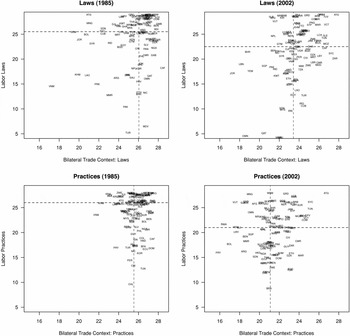
In addition, Figure 3 provides a more detailed picture of the distribution of the Labor Laws/Practices and the Bilateral Trade Context variables for the developing countries at the start and end of our sample period. As the median levels of the two types of labor standards have declined over the period, so too have the median levels of the corresponding Bilateral Trade Context variables. It also reveals that a significant minority of the countries in the sample do in fact export goods to markets that, on average, have lower labor standards than their own. Does this mean that the positive coefficient of the Bilateral Trade Context variables could be indicative of both a California effect and a “race to the bottom”? Although the positive coefficient indicates a general convergence between the labor standards of an exporting country and those of its export destinations—and does not distinguish between upward and downward pressures—we have strong theoretical reasons to believe that the convergence is likely to be the result of upward pressure on labor standards. For the reasons discussed at the beginning of this article, exporting countries will presumably face incentives to pass more stringent labor laws when exporting to countries that themselves have stringent labor laws. But the converse is unlikely to be true. When exporting to countries with less stringent laws, the exporter is unlikely to rewrite its laws (Labor Laws) to make them less consistent with international norms. Written laws tend to be sticky, especially when it comes to sensitive issues such as labor rights. What is more plausible is that, when faced with competitive pressures, exporters may simply choose not to enforce their existing laws (Labor Practices) in an effort to reduce the cost of production (hence, the weaker result for Labor Practices as opposed to Labor Laws).
Labor Rights and Bilateral Trade Context in 1985 and 2002

Robustness Checks
An important alternative explanation for the positive relationship between Bilateral Trade Context and labor standards could be that countries' levels of trade with one another are to some extent conditional on prior levels of respect for labor rights. Although governments might not be able to restrict imports on this basis (given WTO rules), importing firms and consumers might simply refuse to purchase goods from countries with particularly poor labor standards. In this case, we would expect to see a positive relationship between Bilateral Trade Context and labor standards because of a selection effect: countries with high labor standards would tend to import goods from other countries with high labor standards, and countries with poor labor standards would be able to export to countries with similarly low standards.
To test whether this effect is responsible for the observed relationship between Bilateral Trade Context and labor standards, we reestimate the measures of Bilateral Trade Context using a series of instruments for exports. We first estimate export volumes at the dyadic level for 175 countries over the period 1980–1999, using a modified version of the standard gravity model for international trade. The model specification is essentially the same as that used by Rose (Reference Rose2004) in his influential article on the relationship between WTO membership and trade. The only modifications we make are (1) to use the log of exports (instead of total trade) as the dependent variable,Footnote 20 and (2) to drop the dummy variables that indicate whether one or both members of each dyad belong to a free trade agreement, given that such memberships could themselves be dependent on the labor standards of the countries concerned. The model therefore estimates export volumes as a function of
• The product of the distance between the dyad members
• The product of (logged) GDP of the dyad members
• The product of (logged) GDP per capita of the dyad members
• A dummy variable for common language
• A dummy variable for a shared land border
• A count of the number of landlocked countries in the dyad
• A count of the number of island countries in the dyad
• The product of the geographic area of the dyad members
• A dummy variable for a colonial history with the same colonial power
• A dummy variable for a direct colonial relationship
• A dummy variable for situations where both members of the dyad were part of the same state
• A dummy variable for a common currency
• A dummy variable for each year in the series
Presumably, none of the previous variables can be believed to be “caused” by a country's recent labor rights practices. This allows us to estimate predicted values of bilateral exports that we would expect to find in a hypothetical world in which labor rights have no impact on exports. As it turns out, this model manages to account for a large proportion of the variance in exports, with an r square of .61.
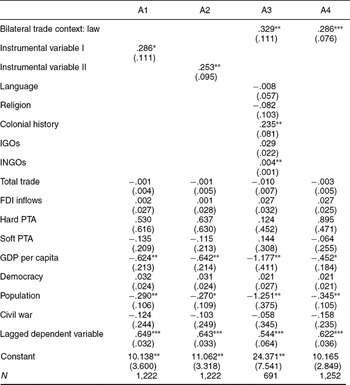
In the next stage, we employ the predicted export volumes from this gravity model to recalculate the bilateral trade context variables. This produces a measure of the average labor laws (or labor practices) found among each country's export destinations, weighted by the predicted levels of exports to each destination, rather than the actual volumes of exports. We then reestimate the regression models using these vectors in place of the Bilateral Trade Context: Laws and Bilateral Trade Context: Practices terms. The estimated effects of the key independent variables turn out to be very similar to those reported in Tables 2 and 3: the Bilateral Trade Context: Laws variable is statistically significant at the .05 level in all three of the time-lagged models, and the Bilateral Trade Context: Practices variable is significant at the .05 level after a 3-year lag.Footnote 21, Footnote 22 On the basis of these tests, we believe that the possibility of reverse causality does not present a serious problem for the interpretation of our results.
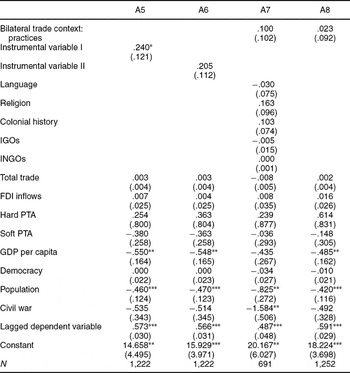
Furthermore, to account for the possibility that labor standards might diffuse among countries as a result of cultural ties (Simmons and Elkins Reference Simmons and Elkins2004), we include controls for (1) the average labor rights score among countries that share a common language, (2) the average labor rights score among countries that share a common religion, and (3) the average labor rights score among countries that share a common colonial history. Data on ties between countries on the basis of shared languages or religions were obtained from the replication data set of Gartzke and Gleditsch,Footnote 23 whereas data on previous colonial relationships were obtained from the Central Intelligence Agency's (CIA's) World Factbook. We also control for each country's level of exposure to global cultural norms (or “world society”) by including a measure of the number of IGOs and international nongovernmental organizations (INGOs) that each state belongs to in each year.Footnote 24 The inclusion of controls for these alternative pathways of norm diffusion has very little effect on the estimated effect of Bilateral Trade Context: Laws. Interestingly, we find that the measure of common colonial ties and the INGO variable show a positive and statistically significant relationship to Labor Laws, suggesting that cultural ties might also play an important role in the transmission of labor rights norms. However, when these variables are included in our model of Labor Practices, the effect of Bilateral Trade Context: Practices is no longer statistically significant in the 3-year lagged model.
Finally, we account for year-specific effects by including a series of dummy variables for each year. The Bilateral Trade Context: Laws variable remains robust to this specification, with p values below .01 in all three lagged models. However, the Bilateral Trade Context: Practices variable does not appear to show a statistically significant relationship once the year effects are accounted for.
CONCLUSION
Domestic policies are often susceptible to international economic influences. The forces of global economic integration, however, affect labor rights in developing countries in ways that are more nuanced than the proponents or opponents of globalization tend to suggest. Our article provides quantitative evidence that labor standards in developing countries are influenced by the labor standards of their exporting destinations, and not by their overall levels of trade openness. Instead of exporters pushing down labor standards of the importing countries as the race to the bottom literature suggests, importers can influence—positively or negatively—the collective labor laws and practices of trade partners. Trade can therefore be considered to provide a conduit for the diffusion of norms and practices regarding labor standards in much the same way that it can be believed to facilitate the diffusion of certain environmental standards.
The finding that a California effect holds with respect to collective labor rights has important theoretical and practical implications. Theoretically, it provides further support for the argument that the California effect is not restricted to regulations governing product standards, but that it can also lead to changes in process standards such as those governing collective labor rights. It also suggests that in the short run, the California effect is more successful at diffusing laws from importing countries to their export partners than it is at changing the actual behavior of firms (or governments) in exporting countries. To a certain extent, this is not surprising, given the frequently observed disconnect between formal law and actual behavior in many different realms of the social world. However, what this does suggest is that although the California effect provides an explanation for how product standards can diffuse from importing countries to exporting countries based on market forces alone, its ability to transmit process standards from one country to another also depends on the capacity and will of governments in the exporting countries to enforce these standards. In addition, ongoing compliance with process standards depends on the extent to which information about the exporting countries' and firms' level of compliance with the standards can be effectively relayed to stakeholders in the importing countries, and, of course, on the extent to which consumers and stakeholders in these countries care about overseas labor standards.
From a practical point of view, our article suggests ways in which international trading relationships can be managed in order to bring about positive change in the labor standards of an exporting country. Provided that developing countries export most of their goods to countries with higher labor standards than their own, we can expect their labor standards to develop in a more positive direction than would otherwise occur if these countries limited their exposure to global markets. This suggests that labor rights activists ought to reconsider some of their arguments for opposing greater levels of economic integration. Enhancing trade ties, rather than restricting trade flows, may be the best hope for improving labor rights in low- and middle-income nations.
Our analyses also suggest some trade-related issues for future research. Along with examining the question of “with whom” each country trades, future work needs to focus on how the California effect may vary across product categories or industrial sectors. Both trade “in what” and trade “with whom” may have important consequences for the relationship between trade and labor rights. Our speculation is that supply chain pressure is likely to vary with the level of brandedness of the traded commodity, a result that is consistent with case study work by economic sociologists (i.e., Bartley Reference Bartley2005; Gereffi and Korzeniewicz Reference Gereffi and Korzeniewicz1994), as well as survey evidence from economists (Elliott and Freeman Reference Elliott and Freeman2003). Arguably, such pressure might also work quite well in primary products, as has been demonstrated by the backlash in importing countries to the labor practices of Shell in Nigeria. As long as consumers can focus their rewards and sanctions on specific brands (including those in primary sectors such as petroleum), exporting firms will have incentives to respond to consumer pressure in the importing country. Another possibility is that variation in the skill intensity of production may generate varying incentives for firms to attract and retain workers—leading to interindustry variation in labor rights outcomes and in trade-related diffusion pressures.
Finally, as some developing countries increasingly play a role in global product markets, the direction of the California effect may change. That is, if export destinations with inferior labor rights outcomes become more important to global trade generally, and to some countries' trade specifically, we might find that an average developing country faces less pressure from its trading partners to ratchet up its labor practices. However, if middle-income developing nations improve their labor practices over time, we might see an increased momentum behind trade-induced improvements in labor rights.
APPENDIX
Labor Standards Coding Template

Source: Adapted from Kucera (Reference Kucera2002). Coding notes from Mosley and Uno (Reference Mosley and Uno2007) are added in italics.
Summary Statistics
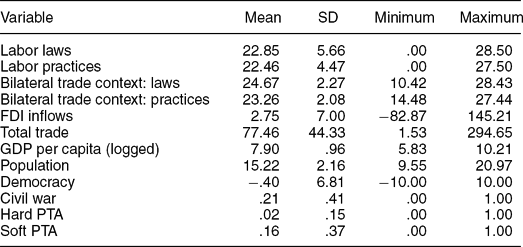
FDI, foreign direct investment; GDP, gross domestic product; PTA, Preferential Trade Agreement.
Additional Robustness Tests for Labor Laws Model

IGO, intergovernmental organization; INGO, international nongovermental organization; FDI, foreign direct investment; PTA, Preferential Trade Agreement; GDP, gross domestic product.
Notes: All independent variables have been lagged by three years. Models A1 and A2 represent the second stage of the two-stage least squares procedure, where Instrumental Variable I refers to the predicted values of Bilateral Trade Context: Laws obtained using the previously described, model and Instrumental Variable II refers to the modified version of that variable obtained by excluding GDP per Capita (see footnote 21). Model A3 includes controls for alternative paths of norm diffusion. Model A4 includes year-specific dummy variables. The estimates of the individual year effects are not shown. Significance levels are indicated as follows: * p < .05, ** p < .01, *** p < .001.
Additional Robustness Tests for Labor Practices Model

IGO, intergovernmental organization; INGO, international nongovernmental organization; FDI, foreign direct investment; PTA, Preferential Trade Agreement; GDP, gross domestic product.
Notes: All independent variables have been lagged by three years. Models A5–A8 represent the Labor Practices equivalents of the Labor Laws models presented in Table A3. Significance levels are indicated as follows: * p < .05, ** p < .01, *** p < .001.



Comments
No Comments have been published for this article.