INTRODUCTION
Outpatients with breast cancer come to seek medical care for their condition in a variety of ways, from being diagnosed during a regular medical examination to recognizing pain or swelling themselves. However, women may be more fearful of the examination itself than the possibility of being diagnosed with breast cancer, leading to the avoidance of medical screening (Consedine et al., Reference Consedine, Magai and Krivoshekova2004). Research on personality characteristics and seeking consultation reveals that people with high anxiety or who believe strongly that cancer cannot be cured often delay medical consultation even if they experience pain and tumor symptoms (Holland, Reference Holland, Holland and Rowland1990a, Reference Holland, Holland and Rowland1990b). Many patients are anxious and fearful not only of the illness or the medical examination, but also of going to the consultation itself.
Most people when diagnosed with cancer are extremely shocked and feel anxious, afraid, confused, and hopeless. They may be unable to sleep or lose their appetite, and their physical condition may deteriorate, creating difficulties in their everyday lives (Massie & Holland, Reference Massie, Holland, Holland and Rowland1990). Approximately 30% to 40% of cancer patients are depressed (Hosaka & Aoki, Reference Hosaka and Aoki1996). This sort of psychological distress negatively influences the quality of life and the recuperation of the patients (Uchitomi et al., Reference Uchitomi, Akechi and Okamura1998; Hann et al., Reference Hann, Winter and Jacobsen1999).
However, there are individual differences in the way cancer patients feel psychological distress. Bardwell et al. (Reference Bardwell, Natarajan and Dimsdale2006) claim that an ambivalent attitude, which includes pessimism and negative emotions, is a risk factor for depression in cancer patients. In a study of breast cancer patients, Iwamitsu et al. (Reference Iwamitsu, Shimoda and Abe2005b) found that patients suppressing negative feelings felt stronger psychological distress than those who did not and that those with high anxiety felt greater distress than those with low anxiety. However, much of the research on the psychological distress of cancer patients is quantitative, with very little adopting a qualitative approach.
The present study employs interviews with outpatient cancer patients seeking their first medical consultation and qualitatively analyzes the substance of the psychological reactions they narrate during that time. Hirota et al. (Reference Hirota, Kida and Aoki1994) argue that many people feel psychological distress during the time between the appearance of noticeable symptoms and the first medical consultation. Therefore, the present study analyzes the chronology of patients’ psychological reactions at three points in time: (1) before the consultation, (2) during the consultation, and (3) other (feelings occurring consistently pre- and postconsultation). This temporal division facilitates analysis of the relationship between “time” and “feelings.”
METHODS
Participants
The participants were 180 people who visited the breast cancer outpatient clinic at Kitasato University Hospital between November 2004 and August 2005. All participants agreed to participate in the study after reading a description of the research. Four of the participants provided very few responses to the interview and were excluded from the analysis. The remaining 176 participants (average age: 50.7 ± 12.4 years) included 39 with terminal breast cancer (average age: 57.3 ± 12.3 years) and 137 with benign breast cancer (average age: 49.9 ± 12.0 years).
Procedure
After the first outpatient consultation was completed, two clinical psychologists carried out the interview, asking the participants to speak freely about their anxieties, worries, thoughts, and feelings up until the medical exam. The research was approved by the ethics board of the Kitasato University Medical Section.
Summary of the Analysis
To examine the chronology of the psychological responses of cancer patients, that is, the relationship between “time” and “feelings,” the emotional content of the interviews was classified according to three points in time: “before consultation,” “during consultation,” and “other (feelings occurring consistently pre- and postconsultation).” A summary content analysis (Mayring, Reference Mayring, Flick, Kardorff and Steinke2004) was carried out on each category. To clarify the differences at each point of time, two researchers coded the contents of the interviews at each of the three points. The codes were then categorized and names were assigned to each category. Next, three different researchers examined the results, and the final categories were determined. The number of appearances and the occurrence rate of each category appeared (including multiple answers) were calculated as percentages for the three points of time.
RESULTS
General Characteristics
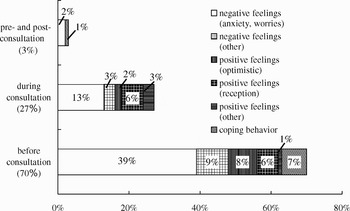
This study used a content analysis of interviews to chronologically examine psychological response of cancer patients seeking medical consultation at three points in time. The interviews were coded using 794 items. Figure 1 presents the occurrence rates for “time” and “feelings” as percentages of the total occurrence rate. An analysis of the all items related to “feelings” at each point of time revealed that 70% (557 items) of the items coded concerned feelings “before consultation,” 27% (217 items) concerned feelings “during consultation,” and 3% (20 items) concerned feelings at “other (feelings occurring consistently pre- and postconsultation).” An examination of the items at all points of time according to feelings revealed that 66% (521 items) of the feelings were negative, 26% (216 items) were positive, and 6% (57 items) dealt with coping behavior. As most of the responses concerned feelings “before examination” and “during examination,” the analysis focuses mainly on these two time points.
The occurrence rates for “time” and “feelings” as percentages of the total occurrence rate.

Feelings and Thoughts “Before Consultation”
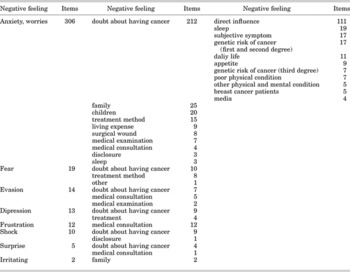
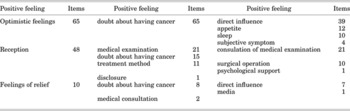
Tables 1 and 2 present the details concerning the occurrence rates of negative and positive feelings before the examination. Negative feelings constituted 48% (381 items) of the results. Of these, 39% (306 items) concerned “anxiety, worries”; 2.4% (19 items) concerned “fear” of surgery and so forth; 1.8% (14 items) concerned “evasion,” such as forgetting being with the family; 1.6% (13 items) concerned “depression,” such as “when I think about things, I feel sad”; and 1.5% (12 items) concerned “uneasiness,” such as “I have to get to the hospital fast.” A closer investigation of the data reveals than within “anxiety, worries,” the largest number of items (27%, 212 items) concerned “doubt about having cancer.” In particular, the largest number (14%, 111 items) concerned the direct influence of “doubt about having cancer” on “anxiety, worries.” This was followed by “anxiety, worries” about “family” (3.15%, 25 items) and “children” (2.5%, 20 items), and “anxiety, worries” concerning the “treatment method,” such as “anxiety when just hearing about the pain of treatment” (2%, 15 items). Answers about the “consultation” concerned items including “other anxiety, worries,” such as “anxiety about which hospital to go to,” as well as “evasion,” such as “I don't even want to be examined,” and “frustration.” However, the occurrence rate for positive feelings was 15% (123 items). These included “optimistic feelings” (8.2%, 65 items), such as “I don't think that much about it” and “no anxiety,” and “reception” (6%, 48 items), such as “I want to be examined and know exactly” and “I want to be treated quickly,” and “feelings of relief” (1.3%, 10 items), such as “I was told it within a normal range and feel relieved.”
Occurrence rate of negative feelings before consultation (381 items)

Occurrence rate of positive feelings before consultation (123 items)

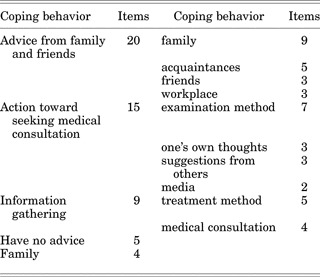
“Coping behavior” constituted 7% (53 items) of the talk, as is shown in Table 3. This included “advice from family and friends” (3%, 20 items), “action toward consultation,” (2%, 15 items) such as “early discovery is good,” and “gathering information” (1.1%, 9 items), such as “looking in books and on the Internet to see which hospital is good.”
Occurrence rate of coping behavior before consultation (53 items)

Thoughts and Feelings “During Consultation”
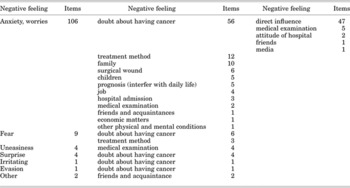
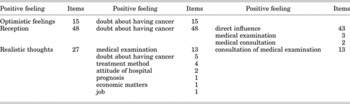
Tables 4 and 5 display in detail the occurrence rates for the negative and positive feelings during consultation. Negative feelings constituted 16% (127 items) of the answers and included talk concerning “anxiety, worries” about cancer (14%, 106 items), “fear” (1.1%, 9 items), such as “I am afraid of the results,” and other feelings (1.5%, 12 answers). A closer inspection reveals that within “anxiety, worries” about cancer, “doubt about cancer” (7%, 56 items) was the greatest, and the direct influence of “doubt about cancer” on “anxiety, worries” was the strongest (6%, 47 items). This was followed by “anxiety, worries” about “treatment methods” (1.5%, 12 items), such as “to what degree my breast will be removed,” and “anxiety, worries” about “family” (1.3%, 10 items). In contrast, positive feelings constituted 11% (90 items) and included “optimistic feelings” (2%, 15 items), “reception” of the present conditions (6%, 48 items), and “realistic thoughts” (3.4%, 27 items), such as “I will at least undergo examination and see what the results are” and “it's good to treat the bad places.”
Occurrence rate of negative feelings during consultation (127 items)

Occurrence rate of positive feelings during consultation (90 items)

DISCUSSION
The purpose of this study was to qualitatively examine the content of the psychological responses in interviews with breast cancer outpatients receiving initial medical consultation. However, the utility of the results is not limited to breast cancer cases and may be relevant to medical examinations for other types of cancer and tumors. Talk about thoughts and feelings during the preconsultation period constituted 70% of the talk. Of this total, approximately two thirds (i.e., the majority of the total talk) concerned negative feelings. Furthermore, an examination of the occurrence rates of negative and positive feelings before consultation reveals that negative feelings were three times more frequent than positive ones. This rate was almost the same at the point during the examination. These qualitative findings are concurrent with Iwamitsu et al.'s (2005a) claim that psychological distress is strong both before and after the initial medical examination.
The content of the narratives collected concerning the preconsultation period revealed the direct influence of “doubt about cancer” on “anxiety, worries.” “Anxiety, worries” concerning “family” and “children,” as well as “anxiety, worries” about the treatment method, such as “anxious at hearing about the pain of treatment” followed in frequency. Similarly, during the examination, “anxiety, worries” about “doubt about cancer” was followed in frequency by “anxiety, worries” about “treatment method” and “family.” “Anxiety, worries” about “family” and “children” both before and during the consultation occurred at a high rate. These results support Matsuki et al.'s (1992) finding that most people, when hospitalized, become worried about their children, spouses, and family. Furthermore, much prior research on “anxiety, worries” and “fear” has shown that patients experience psychological shock concerning treatment (Cohen et al., Reference Cohen, Kahn and Steeves1998) and anxiety about chemotherapy and side effects (Rosman, Reference Rosman2004; Boehmke & Dickerson, Reference Boehmke and Dickerson2005; Bovbjerg et al., Reference Bovbjerg, Montgomery and Raptis2005). Chemotherapy outpatients have also been shown to experience various anxieties and fears (Ito et al., Reference Ito, Takei and Kanou2004). In addition, research has also reported that patients worry about changes in their body image after surgery (Carver et al., Reference Carver, PozoKaderman and Price1998). The present study investigated participants suspected of having breast cancer at the earliest stages of medical consultation. The results show that, although the presence of breast cancer was not yet conclusively decided, the patients seeking consultation already held “anxiety, worries” about changes in their body image after treatment or surgery. Before the consultation, they expressed a variety of negative feelings, including “anxiety, worries,” “fear,” “evasion,” “depression,” “frustration,” and “shock.” At the time of examination, these negative feelings included “fear,” “evasion,” “frustration,” and “surprise.”
The positive feelings expressed before the consultation included “optimistic feelings,” such as “I don't think that much about it” and “no anxiety,” and “reception” toward conditions, such as “I want to be examined and know exactly” and “I want to be treated quickly,” as well as “feelings of relief,” such as “I am relieved since I was told last time the range was normal.” The frequency of “reception” was the same before and during the consultation. However, “optimistic feelings,” such as “I think I'm OK” decreased in the consultation period. In their place, “realistic thinking” emerged, including “be treated and then see the results and think” and “it's good to treat the bad places.” Suzuki and Komatsu (Reference Suzuki and Komatsu2002) found that negative or positive feelings toward cancer are often controlled by the images patients hold. That is, if a family member or friend has died from cancer, patients are more likely to associate cancer with death and anxiety and fears concerning contracting the disease are likely to increase. However, if someone they know is able to recover from cancer, they are more likely to view and accept their own condition calmly. The positive feelings found in the present study are possibly produced by such influences. Boehmke et al. (Reference Boehmke and Dickerson2006) argue that women with a family history of breast cancer, whose mother or grandmother was able to live a long and rich life, are able to face cancer treatment with a positive attitude and self-confidence. They emphasize the importance of maintaining positive thinking toward cancer treatment. Therefore, it is likely that coping with the stress at the time of initial examination depends on family history, personal experience, and psychological characteristics.
Preconsultation Coping Behavior
This study revealed that the patients show realistic coping behavior toward treatment, such as “action toward seeking consultations,” including “advice from family and friends” and “early discovery is good,” as well as “information gathering,” such as “looking in books and on the Internet to see which hospital is good.” Patients showed positive coping strategies, including collecting information themselves. Tromp et al. (Reference Tromp, Brouha and DeLeeuw2004) reported that delays in seeking treatment can be caused by pessimistic attitudes, little pursuit of support, and little positive coping behavior. Receiving advice from others is linked with taking action toward getting treatment, and the present study revealed such a tendency among the participants.
A comparison of the interview content concerning before and during the consultation revealed no great difference in the content of the negative feelings expressed. Although positive feelings of “optimistic feelings,” “reception,” and “feelings of relief” were expressed prior to the consultation, during the consultation “optimistic feelings” decreased, “reception” remained approximately the same, and “realistic thinking” emerged. According to Ueda et al. (Reference Ueda, Seki and Takemura2002), patients beginning to experience the symptoms of cancer can be anxious about whether or not they have the illness. While possessing the negative feeling of doubt, they may hold an optimistic view they do not necessarily have cancer because past examinations revealed no malignancies. However, the present study revealed that optimistic attitudes are more frequent before consultation and that they decrease during consultation as “realistic thinking” appears. These results can be interpreted as revealing a preconsultation situation producing conflicting feelings regarding action toward getting an examination. Thus, conflicting feelings can emerge before consultation, and if the condition of conflict is prolonged, action toward getting treatment may be delayed. Mathews et al. (Reference Mathews, Ridgeway and Warren2002) showed that the frequency of thoughts concerning getting consultation during the 1 week prior to the first examination is more significant than the actual seriousness of the illness for predicting whether patients hold excessive worries about their health after being diagnosed. A similar tendency can be inferred from the present study, as “anxiety, worries,” “evasion,” and “frustration” were revealed in the preconsultation period, which influence whether or not consultation is pursued. Iwamitsu et al. (Reference Iwamitsu, Shimoda and Abe2005a) argued that patients are exposed to stress from the moment they begin to be suspicious of having cancer, placing them in a position of psychological conflict. The results of the present study revealed that patients tend to talk a great deal about the time before consultation until seeking consultation itself. In addition, Matsuki et al. (Reference Matsuki, Miki and Koshimura1992) suggested that reasons for delaying treatment, even if the symptoms are noticeable, include anxiety about knowing the name of the illness and shame about receiving treatment. The present study also found anxiety and worries about being visited while ill, which may also lead to a delay in seeking treatment. Further research is necessary to investigate action toward seeking treatment in order to ensure early discovery of breast cancer.
In conclusion, patients at the time of their first outpatient breast cancer consultation experience negative feelings before the examination, directly influenced by the suspicious of cancer. These include anxiety and worries, fear, evasion, depression, and impatience. In addition, anxiety and worries, fear, evasion, depression, and impatience concerning medical treatment and aftereffects constitute an overwhelming part of the negative feelings. These tendencies do not change at the time of consultation. However, in addition to negative feelings, some people also possess positive feelings, either simultaneously or at a different point in time. Some may shift from negative feelings to positive feelings or vice versa. Furthermore, some people may possess consistent feelings from the point before the examination through the examination itself, whereas others may experience a change in feelings. In addition, many patients tend to talk at length about psychological responses before seeking treatment, understanding the process they went through to come to seek treatment as an important event. Thus, it is important for medical workers to bear in mind the psychological conflicts that patients may undergo before seeking treatment and ensure that sufficient communication takes place.
Further research is necessary to analyze the reasons for seeking or not seeking treatment when the symptoms of illness are apparent and whether these psychological responses are the same before and during treatment. Additional qualitative research is necessary to investigate the feelings and thoughts produced in patients at the time of diagnosis and during the treatment process (until postsurgery and hospital discharge) of malignant cancer.
ACKNOWLEDGMENT
This study was supported by a Grant-in-Aid for Scientific Research (No. 18530543) from the Ministry of Education of Japan.