Fighting Poverty in the US and Europe: A World of Difference. By Alberto Alesina and Edward L. Glaeser. Oxford: Oxford University Press, 2004. 262 pages. $55.00 cloth1
All parenthetical citations in the text refer to the reviewed book.
Alberto Alesina and Edward Glaeser's recent book, Fighting Poverty in the US and Europe, exemplifies the recent incursion of economists into the domains of political science and sociology. In thinking about welfare states, economists have traditionally been interested in their effects on the distribution of income and, above all, their implications for efficiency and growth.2
E.g., Tanzi and Schuknecht 2000.
According to The Economist's laudatory review, Alesina and Glaeser “are doing what the best in their profession do well these days: seeking to explain society not merely with conventional economic tools but with analysis of institutions, geography and social behaviour.”3
The Economist, March 11, 2004.
A companion paper for Brookings presents a “brief formal model” from which several of the arguments in Alesina and Glaeser's book are derived (Alesina, Glaeser, and Sacerdote 2001, 203–208).
For the most part, I shall resist the temptation to complain about Alesina and Glaeser's neglect of the comparative welfare state literature. My essay begins by summarizing the main arguments and evidence presented by Alesina and Glaeser and then engages in a critical discussion of both their approach to comparative social inquiry and the core claims of their account of American exceptionalism in the realm of social policy. I argue that Alesina and Glaeser's quest to nail down “first causes” is something of a distraction and that their use of comparative analysis to bolster their account of American exceptionalism is not entirely consistent. More specifically, Alesina and Glaeser's claim that proportional representation promotes redistribution lacks micro-foundations and their discussion exaggerates both the racial-ethnic homogeneity of European societies and the role of socialist parties in twentieth-century European politics. As the comparative welfare state literature suggests, the absence of socialism alone does not provide a satisfactory explanation of why the U.S. lacks a European-style welfare state. I conclude that greater attention to historical dynamics represents a potentially fruitful way to advance our understanding of cross-national variation in the scope of redistributive social programs.
What Is to Be Explained?
A couple of points of clarification are in order before we delve into Alesina and Glaeser's account of American exceptionalism. To begin with, it should be noted that the title of their book is somewhat misleading, for this is not a book about government policies specifically designed to alleviate poverty. Rather, Alesina and Glaeser are interested in any and all policies that affect the distribution of income. In other words, their objective is to explain why the U.S. government redistributes less than European governments do. The second point is potentially more significant: though Alesina and Glaeser present evidence on the redistributive effects of taxes and income transfers in a handful of countries (21–38), their efforts to test different causal arguments on a cross-national basis rely on government spending on social transfers, expressed in percent of gross domestic product (GDP), as a proxy for redistribution. Thus their empirical analysis actually addresses the question of why the U.S. government spends less on social transfers than European governments do.
Some readers are likely to object to the way Alesina and Glaeser conflate the question of the extent of redistribution with the question of the size of the welfare state. Much of the existing literature emphasizes that redistribution is but one—and possibly not the most important—motivation behind the growth of social spending in advanced industrial countries over the twentieth century. It is commonplace to argue that social programs provide insurance against various social risks and that a wide range of range of social groups—farmers and high-income workers as well as low-income workers—have an interest in this kind of insurance.5
Moene and Wallerstein's 2001 model of social spending posits that demand for insurance actually increases with income. Insurance motives also figure prominently in recent work that emphasizes employers' preferences in the realm of social policy; e.g., Estevez-Abe, Iversen, and Soskice 2001 and Mares 2003.
To my mind, the distinction between insurance and redistribution as separate motives behind public provision of social welfare has often been overdone. All available evidence indicates that low-income workers are more exposed to risk than high-income workers.7
E.g., see Cusack, Iversen, and Rehm 2005.
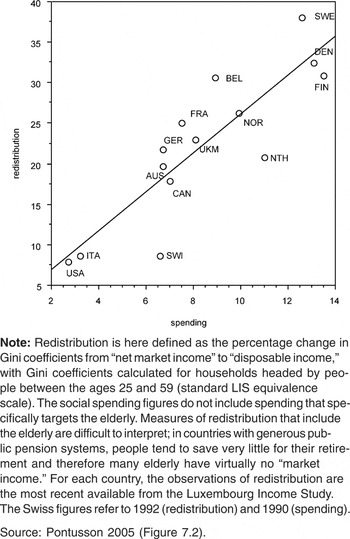
Consistent with the evidence presented in figure 1 Huber and Stephens 2001 (ch. 4) stress the redistributive character of “Christian democratic welfare states.”

Redistributive effects of income transfers in late 1990s versus government spending on income transfers in percent of GDP in 1995.
Alesina and Glaeser's Account of American Exceptionalism
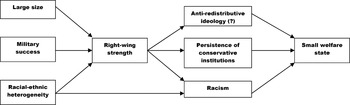
Figure 2 summarizes the core causal claims of Alesina and Glaeser's book in schematic form. Alesina and Glaeser develop this account of American exceptionalism through a process of backward induction. They begin by considering a range of arguments that could conceivably explain cross-national variation in the size of the welfare state. They reject some of these arguments as being irrelevant to the contrast between the U.S. and Europe while they treat others as partial explanations, identifying proximate causes that call for further explanation, at a deeper level of causality.

Alesina and Glaeser's account of American exceptionalism
At the very outset, Alesina and Glaeser reject the relevance of two “economic” explanations of public welfare provision for understanding why the U.S. is different from Europe. The median-voter theorem postulates that demand for redistribution increases with market inequality. By any and all measures, however, the distribution of income before taxes and transfers is more unequal in the U.S. than in any other long-standing member of the Organization for Economic Cooperation and Development (OECD). Similarly, Alesina and Glaeser reject the relevance of international openness. While it is true that the U.S. economy is larger and less exposed to international competition than all European economies, standard macroeconomic measures show that the American economy is also more volatile than European economies. Hence the proposition that openness generates demand for social protection by increasing economic insecurity does not seem relevant to understanding American exceptionalism.9
The openness argument is articulated most forcefully by Rodrik 1997, while the median-voter argument is articulated by, among others, Meltzer and Richard 1981. Needless to say, perhaps, neither Rodrik nor Melter and Richard are specifically concerned with the question of American exceptionalism.
As Alesina and Glaeser note early on, and document at some length in a later chapter, the difference between Europe and the U.S. in the scope of redistribution, measured by social spending, corresponds to sharply different popular views about poverty and opportunities for upward mobility. While 60 percent of EU citizens subscribe to the view that the poor are trapped in poverty, only 29 percent of Americans share this view. Conversely, 60 percent of Americans believe that the poor are lazy, as compared to 26 percent of EU citizens (184). Not surprisingly, Americans who believe that the poor are trapped are much more likely to support public welfare provision than those who believe that the poor are lazy. Alesina and Glaeser also show that the percentage of the population who believe that luck determines income correlates closely with the percentage of GDP devoted to social spending across nineteen OECD countries (187) and, similarly, that beliefs about poverty correlate with the generosity of welfare benefits across states within the U.S. (190).
Popular beliefs about poverty and opportunities for upward mobility might be invoked to explain differences in public policy, but this line of argument obviously raises the question why American attitudes are so different from European attitudes. Alesina and Glaeser argue quite vehemently that these differences do not correspond to objective economic realities (61–68 and again 191–195). Actual differences in income mobility between Europe and the U.S. are much smaller than popular beliefs would lead us to expect. Based on one study comparing income mobility in Germany and the U.S., Alesina and Glaeser suggest that the American poor may, in fact, be more trapped than their European counterparts. Also, low-income households work at least as hard in the U.S. as in most European countries. As for the possibility that popular beliefs are the product of divergent historical experiences, Alesina and Glaeser assert that “most available evidence supports the view that nineteenth-century America was no more and possibly less mobile than twentieth-century America” (65) and cite several studies showing that income mobility in selected American cities was not hugely greater than income mobility in comparable European cities in the nineteenth century.10
It deserves to be noted that all economic historians do not agree with these claims. Ferrie's 2005 analysis of census data indicates that there was much greater occupational and geographic mobility in the U.S. than in the U.K. between 1850 and 1880 and that both forms of mobility have declined in the U.S. since the beginning of the twentieth century.
Alesina and Glaeser thus arrive at the proposition with which most political scientists and sociologists begin, namely that “differences in beliefs about the economy have more to do with politics than with economics” (197). With “the right” serving as a shorthand expression for political actors opposed to redistribution, Alesina and Glaeser proceed to argue that “ideology is more of an effect of the political success of the right than a cause of that success” (185). The “Marxist-inspired” view of the poor as “locked into poverty through no fault of their own” came to prevail in Europe because of “the ability of socialists to dominate political discourse and the schools” (208). In the U.S. as well as Europe, “politicians used rhetoric, symbols and schooling to propagate their own world view… The difference between the United States and Europe is that in Europe, the left won, and then used the tools of power to impose their ideology on the nation” (210–211).
Alesina and Glaeser's discussion of ideology lends itself to two alternative interpretations. Some of this discussion suggests that beliefs about poverty and opportunities for upward mobility are more or less irrelevant to the question of why the U.S. redistributes less than European countries do. Alternatively, Alesina and Glaeser might be read as saying that such beliefs constitute an important causal mechanism linking partisan politics to public policy outcomes. Their ambiguity on this score is difficult to resolve, but it is clear that Alesina and Glaeser assign much greater causal weight to two other proximate causes of American exceptionalism in the realm of social policy: political institutions and racial-ethnic heterogeneity.
Alesina and Glaeser's discussion of political institutions rehearses several conventional arguments. Like many students of American political development, Alesina and Glaeser identify federalism as an obstacle to the expansion of the American welfare state, arguing not only that state-level decision-making restricts the scope for redistribution across states, but also that tax competition represents an important constraint on redistribution within states (89). They also point to the Senate and the judiciary as institutions providing conservative forces opposed to redistribution with political leverage. The emphasis that Alesina and Glaeser put on electoral rules represents a more distinctive feature of their discussion of institutions, motivated first and foremost by the observation that there exists a very strong correlation between the proportionality of the electoral system and levels of social spending across OECD countries (see 86). Bringing the association between proportional representation and social spending to the fore represents an important contribution to the comparative welfare state literature, to which I shall return.
In several passages, Alesina and Glaeser refer to ethnicity, language and religion as divisive forces in the history of the American labor movement, but their main argument about racial-ethnic heterogeneity as a source of American exceptionalism focuses on “racial hatred” as the basis for political mobilization against redistributive policies. The core of this argument is captured by the following observation: “when there are significant numbers of minorities among the poor, then the majority population can be roused against transferring money to people who are different from themselves” (134). In support of this thesis, Alesina and Glaeser demonstrate that there exists a strong correlation between racial fractionalization and social spending across a sample of fifty-three countries (141–142) and also that there exists a strong correlation between blacks as a percentage of the population and the generosity of welfare benefits across American states (147).11
Alesina and Glaeser also report cross-national correlations between ethnic and linguistic fractionalization and welfare spending (142–143). Their fractionalization indices measure the probability that two individuals, drawn at random from the population, will be members of different racial, ethnic, or linguistic groups.
Controlling for levels of economic development, Alesina and Glaeser estimate that the cross-national association between electoral proportionality and social spending accounts for roughly half of the difference between the U.S. and the average spending level in Western Europe (87). A similar analysis regressing spending on racial fractionalization and economic development yields results indicating that racial fractionalization accounts for 40–60 percent of the difference in social spending between the U.S. and Western Europe (145). In short, political institutions and racial heterogeneity matter more or less equally and jointly provide a more or less complete account of why the U.S. redistributes less than Europe, apparently leaving “ideology” with no independent role to play.
In a passage downplaying the role of ideology, Alesina and Glaeser refer to “institutions” and “heterogeneity” as “the root causes of right-wing political success” in the U.S. (185). Elsewhere, however, Alesina and Glaeser argue forcefully that institutions should not be seen as “innate, exogenous first causes.” Instead, institutions should be seen as “flexible” and “ultimately the result of deeper, and perhaps more permanent differences between countries” (95).12
Alesina and Glaeser waffle a bit on exactly how “flexible” institutions are. Their favorite formulation seems to be that institutions are “quite flexible” (132), but they also speak of the “extreme mutability of political institutions” (129). The ambiguity of the terms “flexibility” and “mutability” in this context should also be noted: these terms could be taken to mean that the same institutions can serve different political purposes, but Alesina and Glaeser seem to be concerned with one set of institutional rules being replaced by another, as in the case of reforming electoral systems.
Why, then, did the U.S. end up with political institutions that have been biased against welfare-state expansion? As Alesina and Glaeser point out (97, 219), the institutional structures of nineteenth-century European states were even less hospitable to redistribution, so the real question becomes, why did democratization usher in constitutional change in Europe but not in the U.S.? Alesina and Glaeser's answer to this question is strikingly simple: socialist parties and labor unions were more powerful in Europe than in the U.S. and effectively forced the introduction of proportional representation and other institutional changes in the early part of the twentieth century. In their own words, “the political power of socialist and labor groups in the early part of the twentieth century are [sic] the primary cause of proportional representation in Europe” (107). Leaving aside, for the time being, the accuracy of Alesina and Glaeser's account of the introduction of proportional representation (PR), this clearly amounts to yet another reformulation of the question rather a final answer. The new question becomes, why were labor movements and Left parties more successful in Europe than the U.S.?
Though less adamant, Alesina and Glaeser's brief discussion of the “endogeneity of racial hatred” (177–180) serves to qualify the extent to which racial fractionalization by itself explains the limited scope of redistribution in the U.S. This discussion not only concedes that racist attitudes became much less prevalent in the U.S. over the last quarter of the twentieth century, but stresses that attitudinal changes have been accompanied by behavioral changes, most notably a sharp decline in residential segregation. Noting that this decline of racial segregation followed seven decades of “hardening racial attitudes in northern cities,” Alesina and Glaeser speak of “a relatively fluid process where racist attitudes ebb and flow over time” (178). Why then does racial fractionalization remain closely correlated with lower levels of welfare provision across countries and across American states? Alesina and Glaeser's solution to this puzzle is to argue that heterogeneity creates “the potential for hatred,” but hatred itself is “the outcome of a political equilibrium where politicians supply hate when hatred is a complement to their policies” (179). Again, “right-wing political success” becomes a determinant of racism, which no longer appears terribly different from other forms of ideology. Still, racial heterogeneity remains an important exogenous variable in Alesina and Glaeser's account, altering the probability of success of race-based political appeals.
In Alesina and Glaeser's account, the proximate causes of American exceptionalism in the realm of social policy—political institutions, racial hatred and (perhaps) popular beliefs about opportunities for upward mobility—all lead to the question of why conservatives and market-liberals have dominated American politics while socialists and other progressives have dominated European politics. The brevity and speculative nature of Alesina and Glaeser's treatment of this question is disappointing, given its centrality to the book as a whole. Essentially, Alesina and Glaeser identify three basic reasons for U.S.-European differences in the relative influence of “left-wing” and “right-wing” political forces. First, the geographic size of the U.S. made it impossible to organize an effective nationwide labor movement. In Western Europe, especially the smaller countries, early labor protests were successful in forcing constitutional change “because the seats of power were so close to the masses of industrial workers” (112). The second reason has to do with military conflicts and pertains to the contrast between the U.S. and the larger European countries. In France, Germany, and Italy, Alesina and Glaeser argue, labor movements were only successful in forcing constitutional change in the context of military setbacks (or outright defeats) that undermined the repressive capacities of the state. The fact that the U.S. has never lost a major war or experienced foreign invasion thus looms large in their account of American exceptionalism. Finally, Alesina and Glaeser again invoke racial and ethnic divisions as an explanation of the failure of the labor movement to project political influence at the national level. As illustrated by figure 2, Alesina and Glaeser thus end up with geography, military success, and racial-ethnic heterogeneity as the ultimate causes of American exceptionalism.
How Much Should We Worry about First Causes?
The quest to nail down first causes constitutes an important feature of Alesina and Glaeser's approach to social science. Alesina and Glaeser are not only concerned, as all social scientists should be, with making sure that their explanatory variables are exogenous in the sense of being conceptually and temporally prior to the outcome; they also seek to get to the start of each causal chain, i.e., to identify explanatory variables about which we would not need or want to ask why the cases differ on this variable. Most of us would presumably be satisfied with treating geography—specifically, in this case, country size—as given or “innate,” but it is far less obvious why we should be satisfied with treating racial-ethnic heterogeneity or military success in this fashion. In part, the racial-ethnic makeup of different countries is, of course, a result of their immigration policies. To be sure, we must stop somewhere, to avoid infinite regress, but where to stop becomes a matter of scholarly judgment. So long as the causal argument is not circular, there is considerable room for scholars to make different judgments on this score. By the same token, such judgments need to be explicitly justified.
For the sake of argument, let us agree that country size, military success and racial-ethnic heterogeneity constitute reasonable first causes of American exceptionalism. The question then becomes whether these three variables constitute an exhaustive list of relevant first causes, operating through the balance of political power? Louis Hartz's followers would surely want to add the absence of feudalism to the list.13
Alesina and Glaeser note that European consciousness of social class “was surely abetted by the vestiges of feudalism that still remained in Europe through World War I” (208), but do not cite Hartz's 1955 treatise.
There is undoubtedly some truth to the claims that the large size of the U.S. and the heterogeneity of its population have affected the ability of the American labor movement to influence national politics. However, it is equally clear that country size and racial or ethnic heterogeneity leave a great deal of variation in labor power unexplained from a comparative perspective. Australia is a huge country with a dispersed population and multiple centers of economic and political power, much like the U.S. Yet, as Alex Hicks points out, “across the first four decades of the [twentieth] century, the Australian Labour Party was far and away the most electorally well-supported socialist or labor party in the world, averaging over 43 percent of the vote in 16 elections.”14
Hicks 1999, 98.
Wallerstein 1989 develops this argument.
Most social scientists these days would agree, I think, that explanation involves specifying the causal mechanisms as well as identifying exogenous causal variables. Reading Alesina and Glaeser's book one sometimes has the impression that their quest to nail down first causes gets in the way of building micro foundations for their arguments about electoral systems and race-based political appeals. In the end, it is the intervening variables in Figure 2—conservative political power, institutional design, and racism—and their causal effects that constitute the core of Alesina and Glaeser's account of American exceptionalism. The critical reader should ask, for example, whether she buys their analysis of the relationship between Left power, proportional representation, and redistribution. The question of whether (or how) country size affects labor power does not really further our understanding of the associations among these variables.
Paired Comparison or “Large-N” Comparative Analysis?
Alesina and Glaeser engage in two different types of comparative analysis. On the one hand, they juxtapose the U.S. to Western Europe or, in other words, use a more or less stylized “European experience” as a foil to shed light on the unique features of the American experience. On the other hand, they engage in more broad-based comparative analyses in which the U.S. constitutes but one of many data points and “Europe” dissolves into some 15–20 different data points. The latter type of comparison is meant to complement the former. Quite rightly, Alesina and Glaeser aspire to develop an explanation of American exceptionalism that is consistent with broader patterns of cross-national variation in the extent of redistribution. To overcome the limitations of paired comparison, they also use their “large N” analyses to generate estimates of the relative importance of different variables for explaining the gap between social spending in the U.S. and the average level of social spending in Western Europe.
The combination of different comparative strategies is an attractive yet problematic feature of Fighting Poverty. Students of comparative European politics will be troubled by passages in which Alesina and Glaeser seem to treat “Europe” as if it were country or represented a single historical experience rather than being an abstraction deployed for heuristic purposes. More importantly, the way Alesina and Glaeser deploy large-N comparisons to bolster their account of American exceptionalism is not entirely consistent.
Comparing various measures of macro-economic volatility for the U.S. and the E.U. leads Alesina and Glaeser to reject the idea that welfare-state expansion might be seen as a response to societal demands generated by exposure to the world economy (70). The authors make no further effort to probe the associations between openness, volatility and welfare spending across OECD countries. In this and other instances, the paired comparison of the U.S.and Europe serves as a screening device: no matter how important openness and vulnerability might be from a broader comparative perspective, these variables drop out of Alesina and Glaeser's discussion because they do not shed any light on American exceptionalism vis-à-vis Europe. Elsewhere, Alesina and Glaeser suggest that explanations of American exceptionalism should be evaluated, in part, based on whether or not they also explain variation among European countries. In downplaying the significance of income mobility as a source of American exceptionalism, for example, they observe that “the data within Europe do not seem to suggest a pattern where less mobility is associated with a stronger welfare state” (67).
Alesina and Glaeser never apply the idea that “within-Europe comparison” might be used to assess the relative merits of plausible explanations of why the U.S. is different from Europe to their argument about racial fractionalization. Even a cursory glance at the scatterplot they present in support of the claim that racial fractionalization is a major determinant of cross-national variation in redistribution reveals that “within-Europe comparison” does not support this claim (141). While the European countries included in this scatterplot all have low scores on Alesina and Glaeser's measure of racial fractionalization, they cover a very wide range on their measure of redistribution. In multiple regression, racial fractionalization remains strongly associated with less redistribution when Alesina and Glaeser control for GDP per capita, but it is clear that the results of this analysis depend on the inclusion of some thirty developing (non-OECD) countries.16
Latin American and Caribbean countries account for the majority of these non-OECD countries, but the analysis also includes some Southeast Asian countries. Alesina and Glaeser never provide any explanation of why these particular countries (and not others) are included.
Proportional Representation, Left Power and Redistribution
Alesina and Glaeser's explanation of the close association between proportional representation and the size of the welfare state across OECD countries might usefully be juxtaposed to the explanation proposed by Torben Iversen and David Soskice in a recent paper.17
For Iversen and Soskice, PR promotes redistribution because it favors government by leftist parties or, more precisely, left-of-center coalition governments. The basic intuition of their formal model is as follows. Low-income and middle-income groups have a common interest in the provision of social benefits financed by taxing high-income groups. However, middle-income groups prefer the policies that a party representing high-income groups would pursue (no taxes, no benefits) over the policies that a party representing low-income groups would pursue (taxes on both middle and high-income groups, with benefits restricted to low-income groups). In a majoritarian electoral system, middle-income voters must choose between one party that seeks to form a coalition of low-income and middle-income voters and another party that seeks to form a coalition of high-income and middle-income voters. Given that either party might in fact pursue the preferences of their core constituency once it has been elected, middle-income voters will tend to play it safe and vote for the party of the Right. The logic of coalition formation changes under proportional representation, which allows for one or more parties directly representing the preferences of middle-income groups. Government participation by such parties ensures that Left-of-Center governments do not veer to the Left and thus broaden electoral support for redistributive politics.For Iversen and Soskice, then, the political success of Left parties is a result of PR. For Alesina and Glaeser, by contrast, PR is a result of the success of Left parties and other pro-redistribution political forces, such as unions. In their account, PR was typically imposed by left-wing forces or, in some cases (notably Sweden), introduced by conservatives to preempt left-wing mobilization. At first glance, Alesina and Glaeser's class-power account of the introduction of PR in Western Europe will strike many political scientists as odd or, at a minimum, overly simplistic. In particular, many readers are likely to object that Alesina and Glaeser's rendition of this history (97–107) entirely neglects mobilization by ethnic-regional minorities and elite efforts to accommodate these minorities. On the other hand, most conventional accounts recognize that the introduction of PR was part of the process whereby the suffrage was extended, that working-class mobilization was a crucial component of this process, and that conservatives or liberals (possibly both) looked to PR as a means to mitigate the effects of universal suffrage.18
E.g., see Katzenstein 1985, 150–156.
Whenever electoral reform through PR gained recognition as a practical possibility, the social democrats and socialists tended at first to be in favour of such reform. As the prospect, or achievement, of universal suffrage rendered it increasingly likely that the social democrats would achieve the status of a major or dominant party, it was bourgeois and non-socialist parties which inclined towards a reform of the electoral system, and the social democrats turned against it. The timing of this change in attitude was seldom such as to prevent the reforms from being carried out, and never succeeded in reversing the adoption of a proportional system.19
Carstairs 1980, 215.
As Carstairs and others make clear, universal suffrage and parliamentary government were the primary objectives of European socialists in the first decades of the twentieth century. PR was never an end itself, but rather conceived as a means to gain more power. Moreover, socialists were rarely, if ever, in a position to impose their preferences regarding electoral rules against the wishes of a united front of non-socialist parties. This said, I hasten to point out that Glaeser and Alesina's historical account of the introduction of PR is actually quite nuanced, recognizing strategic behavior by various political actors, and that their argument does not necessarily involve the claim that socialists legislated PR by themselves. The crucial proposition is that PR was more likely to be adopted where unions and socialists were strong. This is certainly a plausible proposition.
Alesina and Glaeser's discussion of proportional representation raises two questions for their overall account of why some governments redistribute more than others. The first question concerns the status of PR as intervening variable in the causal chain that they trace out. If PR can be treated as an institutional design chosen by political actors committed to redistribution, does PR really have a causal role to play? Why would we not attribute greater redistribution directly to the greater influence of left-wing forces in Europe? Put differently, doesn't Alesina and Glaeser's argument amount to saying that the association between PR and redistribution is in fact spurious?
Alesina and Glaeser clearly believe that PR does have a causal role to play, but they are surprisingly vague regarding the causal mechanisms that lead from PR to redistribution. The following passage is the closest they come to articulating a theory about the link between PR and redistribution: “in majoritarian systems characterized by geographically based electoral districts in which each district chooses one representative, the elected government favors spending programs that can be geographically targeted. Proportional electoral systems, in contrast, favor spending on universal programs” (82). So far as I can tell, this is an argument about types of social spending rather than an argument about levels of social spending. There is no obvious reason why the majoritarian bias towards geographic targeting would necessarily produce less spending. And whether geographically targeted spending is less redistributive than “universalistic” spending, including income-differentiated social insurance in the Bismarckian tradition, would seem to be contingent on many factors—in other words, an open question.
The second question raised by Alesina and Glaeser discussion of PR is this: Why did apparently ascendant left-wing political forces choose this type of electoral arrangement? Alesina and Glaeser's answer is interesting (and remarkably consistent with the above quote from Carstairs). Proportional representation, they argue (106),
has generally been the policy of socialists who thought it would strengthen their hand. Presumably, this belief came about because at the moment of constitutional reform, the socialists were still a minority party. Perhaps labor unions knew that they could always count on a core of single issue voters, and these voters would confer success in proportional representation systems.
Along the same lines, Alesina and Glaeser argue that the combination of small electoral districts and geographic concentration of the working class made it possible for the British labor movement to influence politics despite first-past-the-post elections. In the U.K., uniquely, “the labor movement found it relatively easy to ride to power within the established constitution” (112). Again, the proposition that socialists imposed PR does not quite capture Alesina and Glaeser's argument. Rather, PR turns out to be the product of a particular historical conjuncture in which socialists and labor groups had the power to disrupt, but did not yet constitute an electoral majority. This formulation generates a new question: Why didn't continental socialists follow the British example and become advocates of majoritarian elections once they were in a stronger electoral position? One might well argue that electoral rules became increasingly difficult to change over time, but if Alesina and Glaeser were to adopt this line of argument they would need to qualify some of their assertions about the malleability of political institutions.
Is Europe Really So Homogenous?
Alesina and Glaeser are surely right in emphasizing the historical role of racism as an obstacle to progressive politics in the U.S. and I have no reason to contest the proposition that a high degree of racial “fractionalization” was a precondition for racism to assume such an important role. Still, I am inclined to think that Alesina and Glaeser exaggerate the extent to which the European labor movements and welfare states are rooted in social solidarities formed among people with demographic characteristics that enable them see each other as being alike rather than belonging to different racial, ethnic, religious or linguistic groups. Though cognizant of the negative political implications of racial-ethnic heterogeneity, Alesina and Glaeser seem to partake in the American myth of the U.S. as being a uniquely diverse “immigrant nation.”
As far as recent immigration is concerned, the U.S. record is not nearly as distinctive as many Americans seem to believe. According to the OECD, foreign-born inhabitants accounted for about 11 percent of the U.S. population in 2001. This figure is significantly higher than the figures for Finland (3 percent), Denmark (6 percent), Norway (7 percent) and Belgium (8 percent), but the U.S. falls in the same range as Germany (9 percent), France (10 percent), the Netherlands (10 percent), Austria (11 percent) and Sweden (12 percent). By this measure, Australia (23 percent), New Zealand (20 percent), Switzerland (20 percent) and Canada (18 percent) stand out as the “immigrant nations” of the OECD.20
OECD 2004a, 307–308. Note that the cited figures for Belgium, Germany, and Switzerland refer to immigrants (non-citizens) rather than “foreign born.”
What primarily distinguishes the U.S. from Western Europe is not the extent or character of recent immigration, but rather its long history of immigration and, of course, its history of slavery. Alesina and Glaeser emphasize that immigration to Europe is recent and point to the rise of right-wing populism (Le Pen, Haider, and the rest) as an indication that increased heterogeneity may have the same effects on the politics of redistribution in Europe as it has historically had in the U.S. (175–177). In their words, “if the European welfare state gets rolled back in the near future, it is likely that anti-immigrant rhetoric will be used” (166). Changes in the ethnic composition of European societies have undoubtedly played a role in the rise of right-wing populism, but so has mass unemployment and rising economic inequality. The uneven spread of right-wing populism across Europe and its ups and downs within particular countries also deserve to be noted. Most importantly, we ought to keep in mind that immigration to Western Europe has persisted over the last 30–40 years and that much of the impetus behind recent cost-cutting and structural reforms of European welfare states has come from organized business and mainstream conservatives.
Many European countries have a long history of ethnic, regional, linguistic, and religious divisions—in other words, “historic minorities.” One might perhaps argue that race is a particularly salient cleavage because racial minorities look different from the majority, but this argument in too facile. People in general, and perhaps Europeans in particular, seem to be very good at recognizing “difference” and, as Alesina and Glaeser concede, there is no obvious reason why opponents of redistribution could not capitalize on non-racial cleavages that cut across class cleavages. Historically, such cleavages have indeed divided some European labor movements, but the politics of accommodation among different regional/ethnic/religious communities also seem to have contributed to the postwar expansion of some European welfare states.
As Alesina and Glaeser recognize, Belgium is a deeply fractured nation and yet has one of the largest welfare states in Europe. Quite plausibly, Alesina and Glaeser explain this apparent puzzle by pointing out that the Flemish majority has historically been poorer than the Walloon minority (171–172). Consistent with their discussion of the American experience, Alesina and Glaeser's treatment of the Belgian case clarifies that it is not heterogeneity per se that represents an obstacle to redistributive politics but rather the concentration of poverty among ethnic or racial minorities. This strikes me as a very useful clarification, but it raises two general issues for Alesina and Glaeser. First, their effort to demonstrate that social spending correlates with racial and ethnic fractionalization across countries becomes less relevant, since their fractionalization indices do not capture the theoretically important variable.21
Implicitly recognizing this objection, Alesina and Glaeser suggest that racial fractionalization is more salient than ethnic fractionalization because racial groups are more likely to be differentiated by income (140).
Returning to the American case, a recent paper by Woojin Lee and John Roemer proposes a different interpretation of the association between racism and lack of redistribution than that advanced by Alesina and Glaeser.22
As indicated above, Alesina and Glaeser attribute this association to what Lee and Roemer refer to as an “anti-solidarity effect:” voters oppose redistributive transfers to minorities whom they perceive as undeserving. Lee and Roemer argue that the association between racism and lack of redistribution might also be due to what they call a “policy bundle effect.” In this scenario, voters who desire redistribution nevertheless vote for the anti-redistributive party (the Republicans) because they support that party's position on race issues. According to Lee and Roemer's estimations, both effects are in play and matter roughly equally.From a comparative perspective, and particularly from the perspective of Alesina and Glaeser's account of American exceptionalism, the interesting thing about Lee and Roemer's paper is that it suggests that the political consequences of racism are related to electoral rules. Needless to say perhaps, the “policy bundle effect” arises because American voters must choose between one party that is pro-redistribution and also supports racial minorities and another party that is anti-redistribution and opposed to affirmative action and other pro-minority measures. In PR systems, it is possible, at least in principle, to have parties that bundle these issues differently. Indeed, it is not terribly far-fetched to interpret the programs of some right-wing populist politicians in Europe as being pro-redistribution as well as anti-immigrant.
What Do We Learn from the Comparative Welfare State Literature?
In emphasizing redistribution from the rich to the poor as the core activity of modern welfare states and explaining the growth of welfare spending in terms of the influence of labor movements and the political success of socialist parties, Alesina and Glaeser's analysis resembles the class power model of welfare state development advanced by Korpi and other reformist Marxists in the 1970s.23
Korpi 1978, Stephens 1979.
What, then, are some of the insights of the comparative welfare state literature that need to be taken into account in developing a general account of why some governments redistribute more than others? Many recent studies adopt an historical-institutionalist perspective or seek to combine institutionalist and class-power explanations. As we have seen, institutions also play a role in Alesina and Glaeser's discussion, but at least some of their formulations treat institutions as simply temporary arrangements—rules of the political game—chosen by dominant political actors to maintain their power. By contrast, much of the comparative literature emphasizes how institutions shape the preferences and strategies of political actors, the resilience of institutions in the face of globalization and other pressures and, perhaps most importantly, the path-dependent character of institutional change.24
E.g., Immergut 1992, Pierson 2001, Swank 2002.
More specifically, this literature brings out the significance of institutional arrangements associated with tripartite corporatism. Perhaps because their discussion focuses on the U.S. case, Alesina and Glaeser appear to be entirely oblivious to the role of corporatism in the development of modern welfare states. This in turn affects the way that they think about the relationship between labor movements and the welfare state. For Alesina and Glaeser, it seems, labor movements influence the political process either through disruptive behavior (general strikes triggering constitutional reforms) or through electoral mobilization. In the comparative literature focusing on European experiences, unions instead appear as constructive participants in the development and administration of social policy.25
Hicks 1999, Swank 2002, Wilensky 2002.
The comparative literature also brings out the role of other political actors in the postwar development of European welfare states. Many authors emphasize the historical importance of Catholic social doctrine and, in particular, the role of Christian Democratic parties as agents of welfare-state expansion on the continent.26
In a similar vein, Peter Baldwin's revisionist account argues that centrist (non-denominational) parties representing farmers and the urban middle class forced Scandinavian Social Democrats to adopt more ambitious social policies in the 1940s.27 Most recently, several important studies suggest that employers have often welcomed social legislation and played a facilitating role in its implementation.28Swenson, 2002, Mares 2003.
Simply put, the comparative literature teaches us that cross-class alliances played a crucial role in the postwar development of European welfare states. Where labor unions and socialist parties were strong, welfare states assumed more redistributive forms, but European countries developed extensive systems of social welfare provision even in the absence of strong unions and socialist government. The politics of the welfare state are considerably more complex than Alesina and Glaeser would have us believe and the absence of socialism alone does not provide a satisfactory account of American exceptionalism in the realm of social policy.
An Alternative Approach to History
To observe that the determinants of welfare state development are more complex than Alesina and Glaeser's stylized account of American exceptionalism suggests is not a particularly satisfying conclusion. Additional variables must be taken into account, but we still need some kind of theoretical framework that orders these variables and yields specific propositions about how and under what circumstances they matter. For all its limitations, Alesina and Glaeser's book represents an advance on recent quantitative analyses of OECD-wide patterns of social spending in this regard. By way of conclusion, I want to suggest that paying more attention to historical dynamics represents a potentially fruitful way to move the comparative welfare state literature forward.
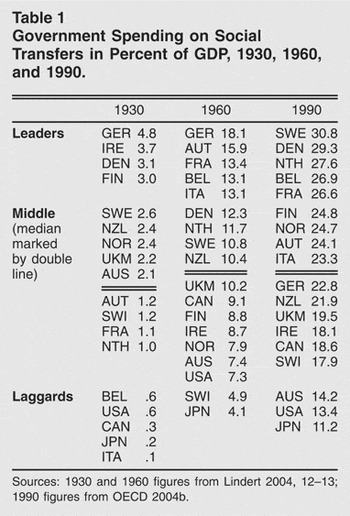
Like many other contributors to the comparative welfare state literature, Alesina and Glaeser explain contemporary differences in public welfare provision across countries in terms of variables that date back to the nineteenth century, if not earlier. By 1920, at the latest, the configuration of demographics, institutions, and political power that explains why the American welfare state is smaller and less redistributive than European welfare states was already in place. This approach may be adequate for the purpose of explaining the exceptional nature of the American case, but it becomes problematic from a broader comparative perspective, for there is a lot of reshuffling of country rankings on the dependent variable that happens in the intervening period. Table 1 illustrates this point by reporting data on government spending on social transfers, in percent of GDP, for 1930, 1960, and 1990.
Government Spending on Social Transfers in Percent of GDP, 1930, 1960, and 1990.

Table 1 suggests a number of interesting comparative observations. Over the course of the twentieth century, Japan stands out as the welfare-state laggard par excellence. The U.S. was a laggard in 1930 and 1990, but less obviously so in 1960. Germany had developed the largest welfare state by 1930 and retained this leadership position in 1960, but the German welfare state grew at a relatively sluggish rate from 1960 to 1990. The conservative or Christian democratic welfare states of continental Europe expanded more rapidly than other welfare states from 1930 to 1960 and held all five top positions in 1960. Over the subsequent 30 years, we observe a marked divergence among continental welfare states: social spending expanded rapidly in France, Belgium, the Netherlands, and Switzerland, but grew relatively slowly in Austria and Italy, as well as Germany. Most notably perhaps, it was not until the 1960s and 1970s that the Nordic countries emerged as leaders in the OECD social spending league.
The trajectories of the Anglo-Saxon countries, characterized as liberal welfare states in the existing literature, is also noteworthy, especially because all but one of these countries (Ireland) had winner-take-all elections throughout the twentieth century (or at least, in the case of New Zealand, through the 1980s). Among the six Anglo-Saxon countries, only Canada and the U.S. were welfare-state laggards in 1930. By a significant margin, social spending exceeded the median for the eighteen countries included in table 1 in Ireland, New Zealand, the U.K., and Australia at this time. The relative decline of the liberal welfare states, considered as a group, began in the period 1930–60 and accelerated in the period 1960–90.
Imagine the same scholar writing an essay on why some governments redistribute more than others in the early 1930s, the early 1960s, and the early 1990s—a social scientist employing methods akin to those of Alesina and Glaeser. It is safe to assume, I think, that three essays would have arrived at quite different conclusions. Changes in the causal dynamics of welfare state development represents a challenge that the welfare state literature has yet to tackle in any sustained way.29
Hicks 1999 comes closet to the approach that I am advocating here.