The Relación de Michoacán has long been the preeminent source for the study of the pre-Hispanic Tarascan state (I cite the 1956 Spanish edition because in my experience it is more accessible in the United States and has the added benefit of facilitating comparison with earlier scholarship. For those who have access, the 2000 edition (Alcalá Reference Alcalá, Ibáñez and Ruiz2000) published by the Colegio de Michoacan should be consulted because of the updated paleography and the numerous studies that accompany the original text. For the Anglophone audience, I also cite the 1970 English translation, although efforts should be made to consult any Spanish edition if possible). Archaeologists (Gorenstein and Pollard Reference Gorenstein and Pollard1983; Michelet Reference Michelet, Calvo and López1988, Reference Michelet and Michelet1989, Reference Michelet1996; Pollard Reference Pollard1982, Reference Pollard2008) have used this document to develop models for the rise of the Tarascan state, and these models are based on readings of the Relación de Michoacán that are “literalist” insofar as they assume that there is some relationship between the actions represented in the document and the events of the “real past.” This paper follows another avenue toward understanding the Tarascan state by analyzing the underlying cultural logic that is manifested in the Relación de Michoacán. Through this analysis, I suggest that this cultural logic reveals the indigenous rationale behind the hierarchical nature of the Tarascan state. This cultural logic is most clearly expressed in the narrative of the priest that relates the history of the royal dynasty, and hierarchy is achieved as the ancestors of the king encompass the totality of the socio-cosmic universe. Finally, the usefulness of such an approach is demonstrated, as an archaeological model of elite interaction within the Tarascan state is developed out of this ethnohistorically based analysis of the cultural logic of hierarchy in the Tarascan state.
THE TARASCAN STATE AND THE RELACIÓN DE MICHOACÁN
The general lack of knowledge concerning the pre-Hispanic Tarascan state represents a significant gap in our understanding of Mesoamerica as a whole. Particularly within the context of the development of states and empires in the Postclassic period, an era that witnessed the greatest interconnections between societies and polities throughout Mesoamerica (Smith and Berdan Reference Smith and Berdan2003), the Tarascan state stands to make significant contributions to topics such as the role of environmental change in the development of state societies (Fisher et al. Reference Fisher, Pollard and Frederick1999; Pollard Reference Pollard1982), the manipulation of identity in state formation (Pollard Reference Pollard, Brumfiel and Fox1994; Pollard and Cahue Reference Pollard and Cahue1999), and the importance of vital economic resources within state economies (Beltrán Reference Beltrán and Lameiras1994; Carrasco Reference Carrasco1986; Healan Reference Healan1997; Pollard Reference Pollard1987, Reference Pollard, Smith and Berdan2003a, Reference Pollard2003b). Unfortunately, the archaeological potential of the Tarascan state has not been widely recognized, and research has grown only incrementally in recent years.
In light of the scant amount of archaeological investigation into the growth and functioning of the Tarascan state, documentary sources from the colonial era have been the dominant source for scholarly inquiry. One document in particular, the Relación de Michoacán, has been preeminent among ethnohistoric sources because of both its richness of information and, unlike in the Basin of Mexico, the lack of a large corpus of accessible Colonial-era documents concerned with the pre-Hispanic past. This fact, combined with the scant systematic archaeological research that has been conducted in the region, has made the Relación de Michoacán integral to the study of the pre-Hispanic Tarascan state.
Based on study of the Relación de Michoacán and the archaeological research that has been done in Tarascan territory, the Tarascan state is believed to have been a more centralized state than its central Mexican counterpart and adversary, the Aztec empire (Gorenstein and Pollard Reference Gorenstein and Pollard1983; Pollard Reference Pollard1993). The Relación de Michoacán records a highly organized bureaucracy believed to have been more centralized than the Aztec system (see also Beltrán Reference Beltrán and Lameiras1994; Brand Reference Brand1971; Carrasco Reference Carrasco1986; Pollard Reference Pollard2003b). Control of land and other resources was regulated from the highest levels of the Tarascan government (Beltrán Reference Beltrán and Lameiras1994; Carrasco Reference Carrasco1986; Pollard Reference Pollard2003b:51). State administrative centers, installations, garrisons, and so on are found dispersed throughout the Tarascan state, conforming to a “territorial” model of empire as defined and utilized by Hassig (Reference Hassig1988) and others (D'Altroy Reference D'Altroy1992; Santley and Alexander Reference Santley, Alexander, Schortman and Urban1992).
The Relación de Michoacan: What It Can Tell Us about the Tarascan State
The Relación de Michoacan is indeed a remarkable document, containing a wealth of information concerning the Tarascan administrative and religious bureaucracies; ethnographic details such as marriage practices, preparations for battle, religious practices, and mortuary rituals; and indigenous impressions of the arrival of the Spaniards and a brief history of the colonial experience until the death of the last indigenous king in a.d. 1530 (on the last see also Krippner-Martínez Reference Krippner-Martínez2001; Scholes and Adams Reference Scholes and Adams1952; Warren Reference Warren1985). In addition, the Relación de Michoacan contains a transcription of a speech that was given every year at one of the “monthly” (20-day period) festivals of the indigenous calendar. This speech constitutes the second part of the Relación de Michoacan. The speech, recounted by a priest whose role it was to remember and tell it at this yearly festival (Kirchhoff Reference Kirchhoff1956:xx), relates the trials and tribulations of the ancestors of the king and how they came to rule over the territory. At the religious festival at which the narrative is recounted, “wrongdoers” are punished for their transgressions against the gods and the state by being sacrificed. The audience is also composed of the lords of the province who have gathered in the capital for the festival. Furthermore, it is said that priests travel throughout the kingdom to relate this same narrative (Relación de Michoacan Reference Kirchhoff1956:11–14). In summary, then, the speech gives a justification, through the proclamation of events said to have occurred in the past, for the rule of the royal dynasty over lesser nobles and the populace at large and, hence, its legitimate authority to punish criminals.
This section of the Relación de Michoacan, which appears to recount how the Tarascan royal dynasty came to power (and therefore how the Tarascan state was formed), has of course garnered much attention from archaeologists and ethnohistorians. The speech tells of a relatively short dynastic sequence, which has been largely corroborated through archaeological means (Cabrera Castro Reference Cabrera Castro1987; Noguera Reference Noguera1931; Pollard Reference Pollard1993, Reference Pollard and Carrasco2001). Kirchhoff (Reference Kirchhoff1956), in an influential essay, essentially takes the narrative at face value, assuming it to be a faithful representation of past events owing to the incredible amount of detail it contains. This amount of detail supposedly could have been produced only by a people that was incredibly historically minded, further evidence that the narrative must represent true events in the past. Writing half a century earlier, Seler (Reference Seler1993[1905]) never openly doubted the historical veracity of the priest's narrative, even as his interests lay in studying the mythical, symbolic, and religious aspects of the narrative and, indeed, the document as a whole.
The description in the Relación de Michoacan of the arrival and subsequent departure of the progenitor of the royal dynasty from the area of Zacapu (see below) influenced the choice of that area as the locus of a large-scale archaeological project by the Centre d'Etudes Mexicaines et Centraméricaines (CEMCA). The leaders of this project have documented archaeological evidence indicating demographic expansion and then contraction in the Early to Middle Postclassic periods in the Zacapu Basin. They largely interpret this as evidence of the arrival of a large population and their subsequent departure toward Lake Patzcuaro (Michelet Reference Michelet, Calvo and López1988, Reference Michelet1996; Michelet et al. Reference Michelet, Pereira, Migeon and Manzanilla2005). In this fashion, they attempt to integrate the archaeological record with the events represented in the Relación de Michoacán, even if this process of “integration” has led them to interpret some aspects of the priest's narrative in some cases as the symbolic skewing, or in other cases as a mischaracterization, of the real events that took place. For example, by recognizing that the peoples who apparently moved into the Zacapu Basin (only to depart a short time later) had all the trappings of “civilized” life, they refute the characterization in the Relación de Michoacán that these peoples were largely hunter-gatherers who were almost completely unfamiliar with agricultural pursuits (Michelet Reference Michelet1996; Michelet et al. Reference Michelet, Pereira, Migeon and Manzanilla2005:150; see below on the evidence for such a characterization contained within the Relación de Michoacán). Furthermore, given the large-scale demographic changes in the Zacapu Basin during the Postclassic period, they believe that this migration clearly involved more than a single lineage, as it is related in the Relación de Michoacan (Michelet et al. Reference Michelet, Pereira, Migeon and Manzanilla2005: 150–151). The work of Espejel Carbajal (Reference Espejel Carbajal and Alcalá2000), which is certainly beneficial as a guide to the places and movements represented in the priest's narrative and deserves mention, is also largely an exercise in attempting to link those places with archaeologically documented sites, thereby attempting to confirm that the narrative contains some degree of historical validity.
Pollard's (Reference Pollard1982; Reference Pollard2008) model for the formation of the Tarascan state is based on a more nuanced interpretation of the priest's speech. This model proposes that the apparently endemic conflict between the populations of certain towns in the vicinity of Lake Patzcuaro that is related in this speech reflects competition over land. Land and the outcome of the battles over it would have been important, as lake levels were rising during the Postclassic period; this fluctuation made land, particularly prime agricultural land, increasingly scarce. Due to the topography of the Lake Patzcuaro Basin, furthermore, this land was becoming differentially scarce. Some areas, and therefore some groups, would have been more affected than others. In Pollard's model, then, it was the differential diminution of highly productive agricultural lands that led to conflict between the groups settled on those lands. In turn, the conflict led ultimately to the consolidation of power by the royal dynasty (the uacusecha, meaning “eagles” in Tarascan/Purhepecha). While Pollard's model may not rely on interpreting the representations in the Relación de Michoacán of past events as literally true, an assumption is made that the frequency of conflict between certain groups would have been remembered in some form or another and thus was recorded in the history of the uacusecha.
While these authors and others recognize that this narrative likely combines both mythical and historically accurate elements, their interpretations rely on the underlying assumption that the latter can be separated from the former, thus producing a history representative of “what really happened” as in the Western tradition (on literalist assumptions, “literal-mindedness,” and their influence on ethnohistory and “history” more generally, see Burke Reference Burke and Ohnuki-Tierney1990; Fogelson Reference Fogelson1974, Reference Fogelson1989; Gillespie Reference Gillespie1989, Reference Gillespie, Kowalski and Kristan-Graham2007; Leach Reference Leach and Ohnuki-Tierney1990). Other works have outlined the structural similarities the Relación de Michoacán shares with other narratives of migrations and resultant political upheaval within Mesoamerica (Arnauld and Michelet Reference Arnauld, Michelet, Breton, Berthe and Lecoin1991; Michelet Reference Michelet and Michelet1989). Such analyses, however, have not fundamentally challenged the assumptions concerning the existence of some historical “truth” that must be excavated out of the events represented in the Relación de Michoacán. Nor have they altered the attempts to integrate this supposed hidden truth with the truth as revealed through archaeology. Such attempts rely on the fundamental assumption that the Relación de Michoacán represents true events, even if they have been incorporated into mythic structures that were fairly widespread in Mesoamerica.
This paper argues in favor of an alternative approach that decodes the “cultural logic” (Fischer Reference Fischer1999) of the speech as a whole and therefore does not rely on dividing the narrative into useful “true” events and less useful “mythical” elements. Nor is such an approach an interpretive endeavor to find the “real” events behind the narrative but, rather, those events that have been skewed, misrepresented, and otherwise corrupted due to the “biases” of the narrator and/or recorder. Because the speech amounted to a testimony on the legitimate authority of the traditional ruling dynasty, it should have also constituted an argument crafted and tailored to the specific circumstances in which the indigenous informants found themselves. An examination of those circumstances will help to understand the context of the document's production and therefore shed light on the intended effect of the document.
The Context of the Production of the Relación de Michoacán
The Relación de Michoacán was written between the years a.d. 1538 and 1541 by Jerónimo de Alcalá, a Franciscan friar (Martínez Baracs Reference Martínez Baracs2005; Stone Reference Stone2004:35; Warren Reference Warren1970–Reference Warren1971). This was a scant 20 years after the arrival of the first Spaniards in the region and the peaceful submission of the last native king (Warren Reference Warren1985). Furthermore, it was only 11 years after that king was charged with conducting pagan religious practices and interfering with the Spaniards' ability to exploit indigenous labor—charges that resulted in his death at the hands of Nuño de Guzmán (Krippner-Martínez Reference Krippner-Martínez2001; Martínez Baracs Reference Martínez Baracs2005; Warren Reference Warren1985). The adopted brother of this last king, Don Pedro Cuinierangari, had been functioning as the indigenous governor of Michoacan since the death of the last king (Martínez Baracs Reference Martínez Baracs2005:298–299). Not properly of the royal dynasty, he was “adopted” as a brother by the king on the arrival of the Spaniards and the confusion and turmoil that ensued (Relación de Michoacán 1956:268, Reference Craine and Reindorp1970:71). Don Pedro is featured prominently in the Relación de Michoacán and was one of the more prominent informants in its production (Krippner-Martínez Reference Krippner-Martínez2001; Martínez Baracs Reference Martínez Baracs2005; Stone Reference Stone2004).
The early Colonial period saw the rapid splintering of the indigenous nobility as the nobles were often forced to choose sides among the various Spanish civil and religious authorities. Vasco de Quiroga, oidor of the Second Audiencia of New Spain (1530–1538) and first bishop of Michoacan (1538–1565), allied himself with members of the indigenous nobility in their fight against the cruel encomendero (Spaniards who were granted the right to the products of a certain parcel of land and to indigenous labor to produce such goods; see Warren Reference Warren1985 on the encomienda system in early Colonial Michoacan) Juan Infante, a fight that spanned decades (Martínez Baracs Reference Martínez Baracs2005). This alliance was tested, however, when Quiroga moved the seat of the bishopric as well as the civil government from Tzintzuntzan, traditional capital of the Tarascan state, to Patzcuaro in 1538, a move that some members of the indigenous nobility opposed (Martínez Baracs Reference Martínez Baracs2005:chap. 6). Spanish interests were hardly monolithic, and the Franciscans appear to have supported these members of the indigenous nobility against Quiroga (Martínez Baracs Reference Martínez Baracs2005:261). Clearly, the production of the Relación de Michoacán and the testimony of the indigenous informants that made this production possible took place in a highly contested political environment. The fact that Tzintzuntzan is referred to as “Mechuacan” or the “Ciudad de Mechuacan,” a title the settlement could no longer claim after Quiroga's move to Patzcuaro, reveals some level of bias in the Relación de Michoacán in favor of the indigenous nobility from the former capital (Martínez Baracs Reference Martínez Baracs2005:305).
It is clear that the indigenous informants, including the priest who related the “history” of the royal dynasty, would have had motivations to make their claims as explicitly as possible and had to customize them to Spanish as well as Tarascan audiences (Stone Reference Stone2004). To that end, the priest's speech as recounted in the Relación de Michoacan, which justifies the rule of the Tarascan royal dynasty, cannot simply be assumed to be a fixed and unaltered text, as Kirchhoff (Reference Kirchhoff1956) claims. Even if the speech was largely untainted by the context of its retelling, the priest should have taken pains to emphasize certain points, genealogical relationships, actions, and so on that may seem minor in the context of the entire speech but must have had some rhetorical purpose. That the priest's narrative is a selective representation of events in the past is indicated by the fact that some events were left out of his speech, only to be included later in the document after they were related by different indigenous elders (the stories concerning Tariacuri's son Tamapucheca and an unnamed daughter [Relación de Michoacán 1956:159–164, Reference Craine and Reindorp1970:225–231]).
Furthermore, the fact that the narrative must have been meaningful to Tarascans as well as to Spaniards indicates that an indigenous form of argumentation and reasoning should be evident (although the document, intended for a Spanish audience as well, was also likely tailored to satisfy Spanish logical entailments of religiosity, law, and privilege; see Stone Reference Stone2004). Whether or not the priest's narrative is largely unaltered from some pre-Hispanic version, clearly it should have been constructed according to an indigenous “cultural logic” (Fischer Reference Fischer1999) employed to defend the position of the indigenous nobility and, in particular, the royal dynasty. We will never know the extent to which the narrative was or was not altered, but the similar functions of the speech in both pre-Hispanic and Colonial contexts—a defense of the legitimacy of the indigenous ruling class—should have necessitated that the speech set forth a logical and well-crafted exposition of exactly why the royal dynasty had (and perhaps, in a.d. 1541, still has) the right to rule.
To that extent, this paper analyzes the Relación de Michoacán to uncover this cultural logic of hierarchy, which is interpreted according to Dumont's (1980) discussion of hierarchy. Analyses of the underlying cultural logic of both “historical” and “mythical” narratives have proved fruitful in investigations into the nature of Aztec (Gillespie Reference Gillespie1989), Inkan (Urton Reference Urton1990), and Hawaiian (Sahlins Reference Sahlins1985) political legitimacy. Specifically, I make use of Sahlins's (Reference Sahlins1981, Reference Sahlins1985) insights into the processual nature of structure and the necessity of understanding the diachronic development of social categories.
DUMONTIAN HIERARCHY AND THE SYNTHESIS OF ELEMENTARY CATEGORIES
To better understand the nature of a certain conception of hierarchy—specifically, one that relates to his own study of the caste system in India—Dumont (Reference Dumont1980) expounds on the importance of “encompassment” as the foundation of hierarchy. It is important to note that Dumontian hierarchy is not related to hierarchy as a rank-order system, as it is commonly conceived in Western terms. Instead, it is founded on “a relation that can succinctly be called ‘the encompassing of the contrary’” (Dumont Reference Dumont1980:239).
Dumont (Reference Dumont1980:239–245) explains that the “encompassment of the contrary” is what produces hierarchy because the element that encompasses another, its contrary or antithesis, is imbued with a higher value. This higher value is attributable to the fact that the category that encompasses the other thus has the ability to signify and represent both categories. It constitutes, in other words, the total field, while the contrary (that which has been encompassed) can only be a part of that field. Dumont gives an example familiar to Westerners—that of the creation of man and woman in biblical Genesis:
God creates Adam first, the undifferentiated man, the prototype of “mankind”. In a second stage, he extracts a different being from this first Adam. In this strange operation, on the one hand, Adam has changed identity; from being undifferentiated, he has become male. On the other hand, a being has appeared who is both a member of the human species and different from the main representative of the species. In his entirety, Adam—or “man” in our language—is two things in one: the representative of the species mankind and the prototype of the male individuals of this species. … This hierarchical relation is, very generally, that between a whole (or a set) and an element of this whole (or set) (Dumont Reference Dumont1980:239–240).
Thus, Adam (“man”) is superior to Eve (“woman”) because he represents the whole of mankind, of which Eve represents only a part (i.e., half).
In his illuminating discussions of the nature of hierarchy in Polynesia, Sahlins (Reference Sahlins1981, Reference Sahlins1985) employs this Dumontian conception of hierarchy in his analyses of Polynesian myth/history and ritual. Through narratives concerned with the past and the rituals of kingship, it is evident that Hawaiian and also Fijian kings possess their authority by virtue of their own encompassing actions as well as those of their ancestors. Sahlins traces the processual development of contrary categories and their encompassment in the person of a “stranger king.” The “stranger king” possesses the right to rule because he subsumes within his person all the categories of his society; he therefore constitutes the social totality while his subjects may only, by definition, constitute parts of the social universe. “[T]he conjunction of chief and people, sea and land, generates a synthetic term, the sovereign power: itself male and female, a combination of celeritas and gravitas” (Sahlins Reference Sahlins1985:99).
This synthesis—by other terms, encompassment—is enacted through ritual as well as recounted in the histories and genealogies of Hawaiian kings. In its Polynesian manifestation, encompassment takes the form of male strangers from beyond the horizon usurping the authority of autochthonous chiefs through the winning of the ruling chief's daughter. Through this victory, the stranger gains legitimate authority and appropriates the land. For this encompassment to achieve its full symbolic import, however, the contrary categories involved must represent the totality of the socio-cosmic universe. Therefore, the characters in these myth-historical dramas take on expanded, paradigmatic significance. They represent what Sahlins calls “elementary categories”:
Notice that in all these genealogies, myths, and rites, … we have to do with cultural categories, abstract but fundamental conceptions, represented in persons. The alleged actions of these persons display the right relations between the categories, a process of their combination and organization. … Just as time and sequence are essential to telling the myth or performing the rite, so too the structure is a generative development of the categories and their relationships. In the event, new and synthetic terms are produced, and elementary categories change their values (Sahlins Reference Sahlins1985:89).
It is the generative development of categories, as told in the history of the Tarascan royal dynasty, that is the key to understanding the nature of hierarchy in the Relación de Michoacán, and it is this narrative to which we now turn.
THE HISTORY OF THE TARASCAN ROYAL DYNASTY
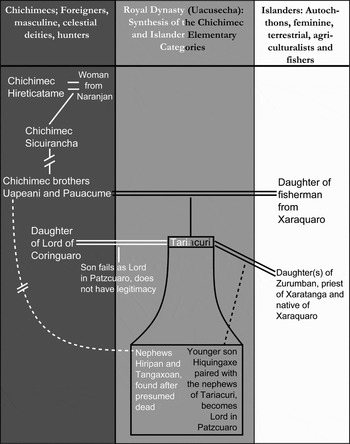
I have only enough space here to outline in the most basic terms the logic that is revealed through the establishment and transformation of elementary categories in the narrative of the priest. Elsewhere (Haskell Reference Haskell2003), I have analyzed the narrative as a whole, however, to demonstrate the manner in which all of the episodes (of which I define and analyze 31) of that narrative, and the transformations that they encode, contribute to the realization of hierarchy as manifested in the Tarascan royal dynasty. It is this production of the uacusecha royal dynasty as a synthetic or encompassing social category, and thus as a hierarchically superior category, that is the ultimate goal of the narrative. In the basic outline presented here, a focus on the marriages recorded in the narrative will, I hope, best illuminate the manner in which hierarchy is first created and then guarded through the course of the narrative. (Figure 1 should help the reader follow the characters involved and their places within the “elementary categories” that are established through the course of the narrative.)
Schematic representation of the genealogy of the Tarascan royal dynasty, locating characters within appropriate “elementary categories.” Two hatch marks through a line of descent indicate the passing of at least one generation between the characters shown. Dashed lines indicate an ambiguous relationship or one in which reproduction occurs without the explicit involvement of a female. The duality embodied by Tariacuri is reproduced as the “triumvirate” of Hiripan, Tangaxoan, and Hiquingaxe.

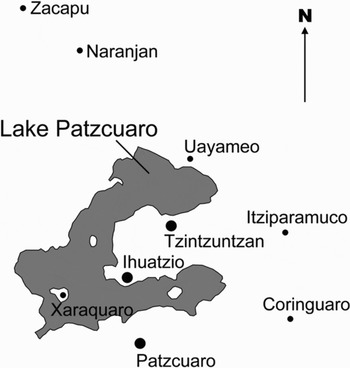
The story begins with Hireticatame arriving at Zacapu, to the north and outside of the Lake Patzcuaro Basin (see Figure 2). Hireticatame's patron deity is Curicaueri, a deity associated with the sun, hunting, and warfare (Corona Núñez Reference Corona Núñez1957:13; Pollard Reference Pollard1991:170). Hireticatame marries a woman from Naranjan, a town also north and outside of the Lake Patzcuaro Basin. The wife's patron deity is named as Uatzoricuare, which means “heat” (Relación de Michoacán 1956:20, Note 5). The union begets a son. Trouble ensues, however, and Hireticatame kills a brother-in-law (in a generic sense; i.e., a man from Naranjan) in a quarrel over a deer he has shot, and he himself soon becomes the victim of a revenge killing (Relación de Michoacán 1956:14–22, Reference Craine and Reindorp1970:103–109).
Map of Lake Patzcuaro and locales mentioned in the text (not to scale).

The similarity of the groups in location and the similarity of their patron deities reveal that they are not complementary opposites. In other words, they are not contraries, and the encompassing of one by the other would accomplish nothing on a socio-cosmic scale. As we will see, a large amount of the social and cosmological world would remain unaffected—un-encompassed, as it were—should this union remain permanent. The failure of the union, however, moves the action of the narrative further so that a proper union, one through which a more totalizing encompassment can be achieved, will be realized.
Spurred on by his father's death, Hireticatame's son moves into the Lake Patzcuaro Basin and settles at Uayameo (Relación de Michoacán 1956:23, Reference Craine and Reindorp1970:110). Generations pass, and it is noteworthy that the protagonists now are explicitly called “Chichimecs” (Relación de Michoacán 1956:24, Reference Craine and Reindorp1970:112). Chichimec is, of course a loaded word and has many meanings, most of which are pejorative. Stone (Reference Stone2004:257–258, Note 14) nicely summarizes the various meanings of the word and importantly highlights the fact that it was borrowed from Nahuatl and imposed by translators (and it was by no means the only example of the imposition of Nahuatl words [Stone Reference Stone2004:28]). Most Mesoamerican scholars are most familiar with the connotation of Chichimecs as semi-nomadic (and thus “uncivilized”) peoples living north of the area of “civilized” Mesoamerica. I would also point out, however, that the Nahua (Texcocan, specifically) historian Fernando de Alva Ixtlilxochitl states that Chichimec means “eagle” (as noted by Kirchhoff Reference Kirchhoff1956:xxv), a point surely not irrelevant, given that members of the royal dynasty referred to themselves as “uacusecha,” or “eagles.”
There is a bad omen (that involving the priests of the goddess Xaratanga turning into snakes [Relación de Michoacán 1956: 23–26, Reference Craine and Reindorp1970:111–113]), and the Chichimecs split into five factions. Four of the factions disperse in various directions. The fifth faction, that of the uacusecha Chichimecs (the ancestors of the king proper), led by the brothers Uapeani and Pauacume, meet a fisherman from the island of Xaraquaro in their travels (Relación de Michoacán 1956:26–27, Reference Craine and Reindorp1970:112–113). In time, the younger brother Pauacume marries the daughter of this fisherman (Relación de Michoacán 1956:31, Reference Craine and Reindorp1970:118).
The “Islanders”—as they are collectively referred to in the Relación de Michoacán, as there are numerous islands in Lake Patzcuaro—represent the contrary of the Chichimecs. The subsistence economy of the Islanders is based on fishing and agriculture, as opposed to the hunting economy of the Chichimecs (illustrated succinctly in the unfamiliarity of each group with the food of the other [Relación de Michoacán 1956:27–28, Reference Craine and Reindorp1970:113–115]). Furthermore, through this marriage the Chichimec brothers gain a modicum of legitimacy, as they are made priests (sacrificers) by the Islanders of Xaraquaro and are given the associated insignia of office as well as the trappings of nobility: the tweezers worn around the neck by priests, bezotes, and earrings (Relación de Michoacán 1956:32, Reference Craine and Reindorp1970:119).
Unlike the marriage between the Chichimecs and the Naranjans, this marriage does unify fundamentally opposed categories that carry significance in all aspects of life. In essence, their unification produces a totality, and it is foretold that the united Chichimecs and Islanders will rule over the land (Relación de Michoacán 1956:29, Reference Craine and Reindorp1970:116). Furthermore, the offspring of this union is the culture hero Tariacuri, who, it is foretold, will be lord (Relación de Michoacán 1956:28, Reference Craine and Reindorp1970:118). He is the one figure most responsible for the creation of the Tarascan state. As the product of a Chichimec father and an Islander mother, he unites the two categories within his person, and, as we shall see, this synthesis is elaborated on to produce a unified Tarascan state.
In the short run, however, the lord of Coringuaro, a town to the east of the Patzcuaro Basin and populated by one of the factions of Chichimecs, intervenes in the affairs of the uacusecha Chichimecs. He ultimately convinces the lord of Xaraquaro to expel the Chichimecs from that island and remove their bezotes and earrings (Relación de Michoacán 1956:32–33, Reference Craine and Reindorp1970:119–120).
After the great uacusecha leader Tariacuri becomes an adult and following some further disputes with the Coringuaros, the lord of Coringuaro proposes that Tariacuri marry his daughter. Tariacuri agrees to the union, but it becomes apparent that this match is ill-fated from the start. Soon after Tariacuri's wife begins to live with him, she commits adultery with her own categorical kinsmen—that is, with men from Coringuaro and a village allied with Coringuaro (Itziparamuco; see Relación de Michoacán 1956:138, Reference Craine and Reindorp1970:207). Tariacuri is distraught and eventually seeks another wife (Relación de Michoacán 1956:64–75, Reference Craine and Reindorp1970:146–156).
If we look at the elementary categories involved, we can understand why this union should fail—that is, why it is not composed of the categories necessary to produce a synthesis of contraries. The Coringuaros are former Chichimecs, having split off from the group following the bad omen mentioned above. Their patron deity is associated with the morning star and is a brother of Curicaueri, the patron deity of the uacusecha Chichimecs (Corona Núñez Reference Corona Núñez1957:32; Pollard Reference Pollard1991:171). Coringuaro is not located within the Lake Patzcuaro Basin but outside (to the east). Thus, both groups are male, outside (in origins, at least, if not also in actuality), celestial, and Chichimecs. In these ways, the two categories are too similar to be contraries; certainly they do not produce the kind of socio-cosmic totality achieved with the union between the Chichimecs and Islanders. Furthermore, the offspring of this union (Curatame) is explicitly said to lack the legitimacy required to rule (Relación de Michoacán 1956:102, Reference Craine and Reindorp1970:177).
In his distress, Tariacuri seeks the help of Zurumban, the chief priest of the goddess Xaratanga, a feminine deity related to agricultural fertility as well as the moon (Corona Núñez Reference Corona Núñez1957:75; Pollard Reference Pollard1991:170). In fact, he was hand picked by that goddess to serve as her priest (Relación de Michoacán 1956:48, Reference Craine and Reindorp1970:133). He is also a native of Xaraquaro, indicating that he is categorically an Islander (Relación de Michoacán 1956:48, Reference Craine and Reindorp1970:133). In this way, he represents femininity and agricultural production. In the interaction between Tariacuri and Zurumban, the latter challenges the former to shoot a hummingbird with an arrow. Tariacuri successfully answers the challenge, and his skill in shooting, in Zurumban's own words, indicates that Tariacuri is “indeed a ‘Chichimeca’ for this bird is not easy to shoot for it is so small” (Relación de Michoacán 1956:76, Reference Craine and Reindorp1970:157).
It is through this feat that Tariacuri gains the daughters of Zurumban in marriage (Relación de Michoacán 1956:74–81, Reference Craine and Reindorp1970:155–161). This union essentially reproduces the union between the Chichimecs and the Islanders of Xaraquaro. It therefore also reproduces the synthesis of contraries represented by the Chichimec and Islander categories. Most importantly, through this marriage the Chichimecs permanently gain the women of the Islanders, as well as their (feminine) wealth, in the form of the dowry of the daughters. Through the permanence of having gained the women and wealth of the Islanders, the uacusecha therefore maintain the ability to reproduce the duality that was heretofore embodied solely by Tariacuri.
This is the final marriage recorded in the priest's narrative. This fact is intriguing, as it reveals the importance of the productivity of the totality that has been produced. For the rest of the narrative, new members of the uacusecha Chichimec lineage are (re)introduced, sometimes in semi-miraculous fashion. Tariacuri's nephews (Hiripan and Tangaxoan) are found alive, despite all indications that they were dead (Relación de Michoacán 1956:91–100, Reference Craine and Reindorp1970:169–175). Tariacuri's younger son (Hiquingaxe) appears out of nowhere; he represents a manifestation in unambiguous form of Tariacuri's Islander half, to be paired with his Chichimec cousins, Tariacuri's nephews (Relación de Michoacán 1956:123–125, Reference Craine and Reindorp1970:195–196). Finally, one of the nephews falls from a tree and is momentarily dead, but he is successfully revived by the other (categorically Chichimec) nephew and Tariacuri's (categorically Islander) son (Relación de Michoacán 1956:144–145, Reference Craine and Reindorp1970:213). These new members reproduce the Chichimec/Islander duality that until now has been subsumed within the person of Tariacuri, and it is this trio of the two nephews and younger son that actually initiates the conquests that create the Tarascan state (with the guidance of Tariacuri). Thus, the royal dynasty, the uacusecha Chichimecs, appear to have the ability to reproduce this duality indefinitely. It should be emphasized that they are able to do so without needing to enter into further marital unions—that is, without the help of outsiders. Furthermore, the wealth and the all-important ability to reproduce itself as a totality that had been gained could be put at risk in other marriages. In this way, the isolationism of the uacusecha Chichimecs has the added benefit of guarding the duality that they have achieved.
On Chichimecs and Hierarchy
Having analyzed, however briefly, the priest's narrative containing the “history” of the royal dynasty, we are now ready to investigate how it produces hierarchy. Through the course of the priest's narrative, the Chichimec ancestors of the king accomplish what Dumont (Reference Dumont1980:239–245) refers to as the encompassing of the contrary: they subsume into their own identity the identity of the Islanders. Their identity as Chichimecs at the beginning of the narrative makes use of actual Chichimecs as uncivilized hunter-gatherers from the north to anchor the identity of the royal dynasty, providing a referent with which all will be familiar. This conflation, combined with the paradigmatic actions of the early ancestors of the king as hunters, constitutes these Chichimecs as one of the elementary categories.
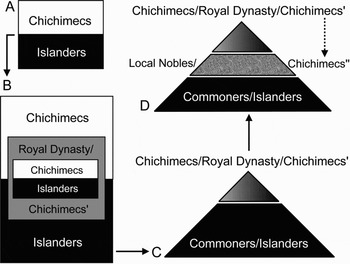
The encompassing of the Islander category by the Chichimecs that is chronicled in the priest's narrative establishes the Chichimecs as the category that takes the higher value in Dumont's terms and produces the synthetic third category—that of the “sovereign,” in Sahlins's (1985:99) phrasing (Figure 3a–3b). This is the logic behind the royal dynasty's claims of Chichimec origins. Due to their paradigmatic associations to actual Chichimecs, they had the ability to encompass their contrary (accomplished through hunting prowess), which is to say that they had the ability to re-create society and place themselves atop it through hunting—that is, warfare instantiated as the hunting of men (the metaphorical links between hunting and war are made explicit at the king's coronation [Relación de Michoacán 1956:53, Reference Craine and Reindorp1970:229]).
The processual development of the Chichimec and Islander categories in the Relación de Michoacán: (a) The initial opposition of Chichimecs and Islanders as elementary categories; (b) the encompassment, demonstrated through marriage and descent, of both categories within the royal dynasty; (c) the resultant hierarchy, as the royal dynasty creates a state society that they rule; (d) the institution of offices of lesser nobility as reproductions of the royal dynasty and, thus, Chichimecs.

In this way, the meanings of the elementary categories are transformed, just as Sahlins predicts. There are now, therefore, multiple Chichimecs. In addition to the Chichimecs as Chichimecs (i.e., the early ancestors of the king who are paradigmatically equivalent to the Chichimecs who exist beyond the boundaries of Mesoamerican civilization), there are now Chichimecs as kings, what I label Chichimecs′ (prime, following the convention in geometry). These are the Chichimecs who have transformed themselves from low-status outsiders into kings through exploits paradigmatic of a Chichimec: hunting and war (Figure 3c). With the advent of hierarchy, established by the encompassing actions of the king's ancestors, the opposition of Chichimec and Islander takes on an additional dimension: kings are Chichimecs, and Islanders are unfit to be lords (Relación de Michoacán 1956:102, Reference Craine and Reindorp1970:177).
The development of the structural opposition between Chichimecs and Islanders continues and builds on the connotations of high status (i.e., “kingliness,” or the possession of legitimate authority) that the Chichimecs have achieved. This further progression manifests itself when we consider the lesser nobility, or those nobles who are not members of the royal dynasty. After the priest concludes his narrative of the history of the royal dynasty, he admonishes the members of the nobility who are before him, derisively calling them Islanders and saying that they are not the Chichimecs that they should be (Relación de Michoacán 1956:154–155, Reference Craine and Reindorp1970:222–223). In this way, the lesser nobility joins the royal dynasty as Chichimecs in their opposition to the commoners, who are Islanders in a metaphorical sense (Figure 3d).
Furthermore, we know that the royal dynasty did enter into marriage relationships with lesser nobles, contrary to the second half of the priest's narrative. Such marriages are described elsewhere in the document (Relación de Michoacán 1956:207–210, Reference Craine and Reindorp1970:36–37), and so they seem to pertain only to the “ethnographic present”—or, at least, they do not put at risk the totality achieved by the royal dynasty “in the past.” These marriages, uniting the lesser nobility with the royal dynasty, further demonstrate the lesser nobility's unity with the royal dynasty and concomitant opposition to the commoners. This development of the structure of similarity and contrast strengthens the necessity that the lesser nobility be identified as Chichimecs, just as the royal dynasty is.
It must be noted, however, that these lesser nobles are not Chichimecs by origin. They also did not themselves accomplish the encompassment that is the basis of hierarchy in Tarascan political ideology. Rather, they are transformed into nobles—or, in other words, they are transformed into Chichimecs (now Chichimecs′′) only through the agency of the royal dynasty, the original Chichimecs of the narrative. They cannot reproduce their status as Chichimecs (Chichimecs″ to be specific) but rely on the royal dynasty to reproduce them as such. This is documented in the description of the death and succession of lords, in which the king has the final say in who should succeed a dead lord to an office of local leadership. Upon the death of the previous lord, his insignia of office or nobility are said to be taken to the king, and once the king has chosen a successor, he sends an emissary to bestow the new lord with the insignia of office or nobility (Relación de Michoacán 1956:202–207, Reference Craine and Reindorp1970:31–35). In this way, the king constitutes lords as Chichimecs, just as his ancestors Hiripan and Tangaxoan instituted the offices of local leadership in the first place (Relación de Michoacán 1956:153, 205, Reference Craine and Reindorp1970:33, 221).
DISCUSSION: IMPLICATIONS FOR THE STUDY OF THE PREHISPANIC TARASCAN STATE
The first implication of the position advocated here is that the priest's narrative must be regarded with caution and that ethnohistorical and archaeological interpretation must be kept separate if we are scientifically to test models derived from either (see Gillespie Reference Gillespie, Kowalski and Kristan-Graham2007). Second, ethnicity in the Relación de Michoacán is a very complicated matter, and the terms Chichimec and Islander draw their symbolic efficacy from their polysemy. Furthermore, identity in the Relación de Michoacán is fluid; it is transposable and mutable. By viewing the priest's narrative as an exposition on the nature of hierarchy in the Tarascan state as produced through a sequence of “events” rather than assuming some relationship, however garbled or “biased,” with “what really happened,” we escape the literalist need to assign linguistic-ethnic affiliations to the groups and characters in the Relación de Michoacán (see Jimenez Moreno Reference Jimenez Moreno1948; Kirchhoff Reference Kirchhoff1956; López Austin Reference López Austin1981; Martínez Baracs Reference Martínez Baracs2005:59, 62; Michelet Reference Michelet, Calvo and López1988; Pollard Reference Pollard, Brumfiel and Fox1994 for attempts at such affiliations). Indeed, to equate the labels “Chichimec” and “Islander” with linguistic-ethnic groups such as Nahua or Tarascan (Purhepecha) is doing these labels a severe disservice by shortchanging them of their full array of meanings.
This position does not mean that the Relación de Michoacán is worthless to archaeologists, however, for the Relación de Michoacán does present a cultural logic that should have been generalized in multiple aspects of indigenous society. The narrative does not create a structure that is merely “good to think” but has no relation to the material world. Rather, it is an attempt—one attempt—to represent, explain, and legitimize in narrative form the social practices that constituted the Tarascan state. The priest's narrative in particular promotes a view in which the royal dynasty, once constituted as a duality, preserves a qualitative difference between it and the lesser nobles of the Tarascan state. Because the royal dynasty has transformed itself into legitimate rulers via its encompassment of elementary categories, the royal dynasty is the origin of legitimate authority. In principle, this origin was mirrored in Tarascan society, as all local leaders derived their authority from the royal dynasty. The royal dynasty conferred “Chichimecness” to these local leaders, but this Chichimecness had as its primary connotation the legitimate authority that originates with the royal dynasty, and therefore was only a secondary or reflected form of Chichimecness as the manifestation of legitimate authority. In this way, the royal dynasty transforms Chichimecness into legitimate authority and subsequently distributes a secondary Chichimecness as a reflection of its own primary Chichimecness to subordinate lords. The royal dynasty preserves a monopoly on Chichimecness in its connotation as the origin of legitimate authority.
Notes Toward a Model for Tarascan Elite Interaction
This structure of transformation and the preservation of difference should have been operating in the material world, as well. Just as there is a tension in the Relación de Michoacán between the royal dynasty separating itself from the rest of society once constituted as a totality and engaging in marriage alliances with lesser lords to ensure their loyalty, so, too, should there have been a fundamental tension in the material world between the drive to consolidate wealth and the need to distribute wealth to those participating in the state administrative system. I propose that one way the Tarascan royal dynasty could have resolved this tension was to reorganize exchange so that separate spheres of exchange were created to both separate and unite the royal dynasty and the lesser nobility.
Such a model necessarily begins with the insights of a burgeoning literature concerning materiality and the impact material objects can have on social personae and its relationship to agency and thus power (on this relationship, see Appadurai Reference Appadurai and Appadurai1986; Barrett Reference Barrett, Dobres and Robb2000; Bourdieu Reference Bourdieu and Nice1977, Reference Bourdieu and Nice1984; Gillespie Reference Gillespie and Robb1999; Mosko Reference Mosko1992; Munn Reference Munn1986; Sahlins Reference Sahlins and Ohnuki-Tierney1990; Strathern Reference Strathern1988). While I do not have the space to discuss the full theoretical implications of this literature, I hope to point out its usefulness to understanding elite interaction within the Tarascan state in light of the structural model of the nobility outlined above.
Anthropologists since the time of Mauss (Reference Mauss1954 [1925]) have recognized that material objects constitute persons as they record, signify, and constitute the social relations that form a social person (also Appadurai Reference Appadurai and Appadurai1986, Gell Reference Gell1998; Joyce Reference Joyce and Wright1996, Reference Joyce2000; McKinnon Reference McKinnon1991; Munn Reference Munn1986; Strathern Reference Strathern1988). In this way, the physical properties, origins, contexts of production or consumption, and culturally constituted values of objects are intimately associated with persons, just as the opposite has been demonstrated (again, going back to Mauss; see also Keane Reference Keane and Miller2005; Kopytoff Reference Kopytoff and Appadurai1986; Miller Reference Miller and Miller2005; Sahlins Reference Sahlins and Ohnuki-Tierney1990; Weiner Reference Weiner1992). Efforts to construct a social persona, therefore, should require material objects that possess some qualities appropriate to the intended effect, keeping in mind that such properties and values are, to varying degrees, subject to manipulation and transformation.
Thus, to construct itself as the sole possessor of Chichimecness in its connotation of the origins of legitimate authority, the royal dynasty should have monopolized foreign luxury goods to demonstrate that legitimate authority. Valuable objects obtained through long-distance exchange were highly sought after in Michoacan, and in Mesoamerica more generally, throughout its history as a recognizable culture area. Highly valued objects such as greenstone, turquoise, brilliant feathers of tropical birds, and precious metals that could only be acquired from beyond the Lake Patzcuaro Basin, and more commonly from areas even farther afield, have been demonstrated to have been important to elites and would-be rulers in Michoacan (see the discussion of elites in central Michoacan prior to the formation of the Tarascan state in Pollard and Cahue Reference Pollard and Cahue1999:275) and Mesoamerica more generally (Blanton and Feinman Reference Blanton and Feinman1984; Smith and Berdan Reference Smith and Berdan2003). The ability to acquire and possess such objects, along with their more inherent properties such as brilliance and color, demonstrated that the owners of such goods were in seemingly fundamental ways different from the rest of the society. To materialize and symbolize the legitimate authority that they claimed to have possessed in metaphorical and symbolic terms, the Tarascan royal dynasty should also have monopolized such valuables to the greatest extent possible.
To preserve this wealth and the identity it helped constitute, in the face of the desire of lesser nobles to acquire similar wealth, the royal dynasty could have created a new style of artifacts that could be given to lower members of the nobility as parts of investiture ceremonies, thus conferring legitimacy on these nobles. Such goods likely included Tarascan-style polychrome vessels (this is essentially the same argument put forth by Pollard and Cahue Reference Pollard and Cahue1999), uniquely Tarascan copper ornaments (on the uniqueness of Tarascan metal objects; see Bray Reference Bray and Mirambell1989), bezotes, and other goods derived from the royal dynasty. The processes of acquiring valuables; consuming, appropriating, and thereby imbuing the self with the value of these goods; and transforming that value through the production of other objects as reflections of that value and the self that has consumed it would thus both unite and divide the royal dynasty and the lesser nobility. The “inherent” value and symbolic qualities that conferred legitimacy was consumed by the royal dynasty, and in this consumption that legitimacy was appropriated by the royal dynasty. The legitimacy of the royal dynasty was then transferred, in a secondary or reflected form, via the Tarascan-style status markers to the lesser nobility.
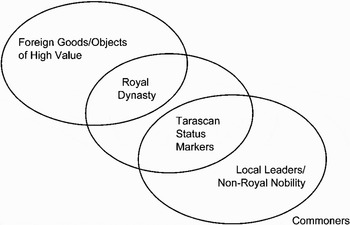
In this way, the world of material things would not simply have mirrored or “materialized” the state ideology in the terms of DeMarrais and colleagues (Reference DeMarrais, Castillo and Earle1996). Rather, these restricted exchange spheres and regimes of production that enabled their separation created the state to the degree that they constituted distinct social spheres, patterns of exchange, and forms of social interactions. To the extent that the two exchange spheres did not intertwine, the circulation of distinct goods among distinct circuits facilitated the precipitation of qualitatively dissimilar social classes out of the multiplicity of social relationships that had existed (Figure 4). This model can be tested via archaeology, because it predicts severely limited distributions of foreign wealth items among the royal dynasty and Tarascan-style status markers exclusively among the nobility as a whole.
Separate exchange spheres within the Tarascan state, in which foreign goods were monopolized by the royal dynasty. In turn, the royal dynasty initiated the production of a distinct style of Tarascan status markers, which were exchanged with the lesser nobility.

This model of the existence of separate exchange spheres has the advantage of incorporating the social structure of the Tarascan state as revealed through the Relación de Michoacán and transposing it to the world of material culture and the differential distributions thereof. It does not rely on possibly erroneous and potentially ethnocentric assumptions regarding the historical accuracy of the priest's narrative. The structure on which the model is based is, of course, possibly an idealized representation of Tarascan society promoted by members of the royal dynasty. The degree to which material flows within the Tarascan state conform to this model should inform us of how things actually worked in the Tarascan state. The pretensions of the royal dynasty have provided a model, but testing the model is where archaeology must take the lead.
CONCLUSION
I have argued that the second part of the Relación de Michoacán—the part that claims to relate the “official history” of the royal dynasty—can most fruitfully be analyzed by revealing the paradigmatic importance of the characters and the logic by which these characters interact and are transformed by that interaction. Their paradigmatic qualities render these characters representatives of “elementary categories” (following Sahlins Reference Sahlins1985:89), or categories that are grounded in all aspects of lived experience, from the mundane to the supernatural. The two most important elementary categories in this “history” are the Chichimecs and the Islanders, and their opposed complementarity is significant because together they subsume the totality of lived experience. The transformation of the uacusecha Chichimec category is achieved through their ability to “encompass” the Islander category (following Dumont Reference Dumont1980:239–245; also Sahlins Reference Sahlins1985:Chapter 3). It is this transformation, and the hierarchy that is its effect (see Dumont Reference Dumont1980:239–245), that provides the logical basis for the legitimacy of the king and the royal dynasty. The explication and proclamation of this transformation is also the fundamental point behind telling the narrative in the first place.
Because the uacusecha Chichimec category has been transformed, so, too, is its relationship with the other categories. Because the Chichimecs are now hierarchically superior, the Islanders (and all others) must now be inferior. The same logic applies to the position of the lower nobility, who are not themselves Chichimecs by origin. Because they are of a high status, however, they must also be Chichimecs in some form. It is this negotiation of Chichimecness and the need of the royal dynasty to share this identity but also maintain some fundamental difference between itself and the lesser nobility that, in my opinion, provides the most fertile grounds for integrating ethnohistoric and archaeological investigations of the Tarascan state (following Gillespie Reference Gillespie, Kowalski and Kristan-Graham2007). Therefore, I have attempted to outline a model for elite interaction based on the tension between an identity that is monopolized and exclusive, on the one hand, but shared and materially distributed, on the other.
RESUMEN
Este artículo contribuye a nuestro entendimiento del Estado tarasco por un análisis de la “lógica cultural” de jerarquía cómo está revelada en la Relación de Michoacán. Basado en los estudios de Dumont y Sahlins, este estudio de la narrativa sobre la historia de los antepasados del rey tarasco, contenido en aquel documento, propone que esa historia legitimizaba el poder de la dinastía real tarasca por la explicación de una concepción de jerarquía basado en una lógica del “abarcamiento”. Aquí analizamos los personajes en la narrativa como ejemplos de “categorías elementales” y las interacciones entre los personajes como indicaciones de la continuidad o la transformación de las categorías que representan. Por las transformaciones, los antepasados del rey—los “chichimecas”— logran el abarcamiento de una categoría opuesta, los “isleños”. Por este proceso de abarcarcamiento, la dinastía real simbolizó una totalidad de los universos humano y sobrenatural, y por eso poseía autoridad legitima. La transformación de la categoría de los “chichimecas” y su connotación nueva de autoridad tenía también implicaciones para la definición de la nobleza menor. La nobleza que no fueron parte de la dinastía real, es decir los caciques de los pueblos, fueron identificados también como “chichimecas” en la tercera parte de la Relación de Michoacán. Por eso, la nobleza menor y la dinastía real son, en cierto modo, lo mismo. Además, se propone un modelo, basado en esta lógica, de la interacción entre los élites en el desarrollo del Estado tarasco. Sugiero que la dinastía real monopolizó bienes de intercambio de larga distancia y por el consumo de estos bienes constituyó su propia identidad como poseedores de autoridad legitima (es decir, como “chichimecas”). Al mismo tiempo, una categoría nueva de marcadores de la nobleza fue producida localmente, y estos marcadores pudieran haber sido distribuidos a la nobleza menor. La distribución de una categoría secundaria de autoridad legítima preservó el monopolio que la dinastía real tenía sobre los bienes más valiosos y de larga distancia. En lo mismo tiempo, una identidad común (como “chichimecas”) fue compartida con la nobleza menor a través de los marcadores producidos localmente, es decir, los símbolos secundarios de autoridad legítima.