INTRODUCTION
A fundamental question in developmental psychology is how infants begin to participate in the social practices of their culture and their language. These shared experiences are realized in forms of joint engagement, where caregivers facilitate symbol learning during goal-oriented interactions (Hobson, Reference Hobson2005; Tomasello, Reference Tomasello, Moore and Dunham1995). Infants improve their joint engagement skills around one year of age, and they begin to produce single words not long after, suggesting the two are intertwined.
At the hub of early infant engagement research is Bakeman and Adamson's (Reference Bakeman and Adamson1984) study of infants' coordination of attention to people and objects. They analyzed infants' attention states (i.e. engagement levels), and showed that triadic joint engagement is the natural culmination of early social development. They proposed six levels of engagement: Unengaged with any specific thing or partner; Onlooking to another person's activity; Object play; Persons interaction, face-to-face or through play; Passive Joint Attention (Passive-JA) between an infant, a partner, and an object, but no attention from infant to partner; and Coordinated Joint Attention (Coordinated-JA) between an infant, a partner, and an object, where infant and partner attend to each other. Various studies have focused on individual types and aspects of joint engagement, and how these relate with vocabulary development in middle-class infants from industrialized societies (Adamson, Bakeman & Deckner, Reference Adamson, Bakeman and Deckner2004; Carpenter, Nagell, Tomasello, Butterworth & Moore Reference Carpenter, Nagell, Tomasello, Butterworth and Moore1998; Mundy & Gomes, Reference Mundy and Gomes1998). However, there are three distinct limitations in such studies.
First, many use semi-structured observation or simulated spontaneous play rather than fully naturalistic observation methods (e.g. Bakeman & Adamson, Reference Bakeman and Adamson1984; Carpenter et al., Reference Carpenter, Nagell, Tomasello, Butterworth and Moore1998; Morales et al., Reference Morales, Mundy, Delgado, Yale, Messinger, Neal and Schwartz2000), which cannot represent the entirety of infant engagement (Eisenbeiss, Reference Eisenbeiss, Blom and Unsworth2010). Such methods create a bias towards engagement involving a target object, which could drastically increase triadic interactions. Semi-structured observation can easily omit time infants spend alone, as well as partners other than caregivers. In many cultures, adult caregivers do not play with their children, so instructing them to simulate play may be unnatural (Abels et al., Reference Abels, Keller, Mohite, Mankodi, Shastri, Bhargava, Jasrai and Lakhani2005; Lieven & Stoll, Reference Lieven and Stoll2013). To overcome these limitations, we relied on daily interactions within the home, and did not offer toys to infants or instructions to parents, thus providing natural observations of infant engagement for analysis.
Second, many studies since Bakeman and Adamson (Reference Bakeman and Adamson1984) have focused on relations between triadic joint engagement and vocabulary (Carpenter et al., Reference Carpenter, Nagell, Tomasello, Butterworth and Moore1998; Morales et al., Reference Morales, Mundy, Delgado, Yale, Messinger, Neal and Schwartz2000; Tomasello & Farrar, Reference Tomasello and Farrar1986). While complex types of engagement may be more beneficial to learning, this does not mean that solitary play or observation, for example, bear no relation to language acquisition and vocabulary development. We believe that a more complete correlational analysis of engagement levels and vocabulary can uncover aspects of social behavior that have been overlooked. Notice that engagement levels are mutually exclusive, but not necessarily independent. Bakeman and Adamson (Reference Bakeman and Adamson1984) showed some distinct patterns in how engagement levels emerged over time, so a broad classification might reveal dependencies between levels when all possible engagements are included.
Third, most studies have been carried out in industrial societies. However, socialization of children and attitudes about child rearing differ greatly across cultures (Greenfield, Reference Greenfield2009; Hoff, Reference Hoff2006; Keller, Reference Keller2012; Schieffelin & Ochs, Reference Schieffelin and Ochs1986). For instance, multi-party interactions are more frequent in non-industrial communities, and infants often have secondary caregivers, including siblings (Brown, Reference Brown, Duranti, Ochs and Schieffelin2011; Gaskins, Reference Gaskins, Enfield and Levinson2006; Harkness, Reference Harkness, Snow and Ferguson1977; Lieven & Stoll, Reference Lieven and Stoll2013; Zukow-Goldring, Reference Zukow-Goldring and Bornstein2002). Families in industrial communities, though, have a more nuclear structure, which may not involve regular exposure to as many communication partners. Furthermore, industrial cultures are usually high on the Human Development Index (HDI), and mothers in high-HDI countries engage in more book reading, story-telling, and object naming and counting, than mothers in low-HDI countries (Bornstein & Putnick, Reference Bornstein and Putnick2012).
In addressing these three limitations, we have categorized infant engagement in more naturalistic observations in non-industrial communities. We have designed an extended categorization of engagement levels based on Bakeman and Adamson (Reference Bakeman and Adamson1984). By implementing a component-based approach to the construction of engagement categories, we extended their categorization by adding two further engagement levels. In our extended categorization, we included goal-oriented behavior as a necessary component of joint engagement. In the present study, we explore the value of this approach by studying correlations between the proportion of time infants spend in different engagement levels and their reported productive vocabulary (from here referred to as ‘vocabulary’), and how these differ in non-industrial rural and urban communities in Mozambique. Our main question is: To what extent can a detailed analysis of infant engagement contribute to our understanding of vocabulary development in natural settings? A second question is: Do correlations between infant engagement and vocabulary size differ between these communities?
In the next section we review how our approach furthers research in the study of infant development. To address our research questions, we first explore how the proportions of infants' engagements differ between the two communities. Second, we investigate infants' vocabulary sizes. Third, we explore relations between the proportions of infants' engagements and vocabulary size. Fourth, we compare our approach with two other approaches to early engagement. Finally, we discuss the results, their implications, and what further steps should be considered.
EXPANDING THE SPECTRUM
Language socialization in non-industrial communities
“Studies of joint attention and early language need to take account for the real-life and often polyadic contexts in which young children interact with others” (Akhtar & Gernsbacher, Reference Akhtar and Gernsbacher2007, p. 200). We agree: we need to study not only how infants interact but also with whom. This is particularly true for non-industrial cultures, where the extended family and unrelated members of the community play a regular role in the daily life and socialization of infants (Lieven, Reference Lieven, Gallaway and Richards1994). However, infant socialization can manifest in different types of interactions in different degrees. For example, Brown (Reference Brown, Duranti, Ochs and Schieffelin2011) showed that infants from Rossel Island in Papua New Guinea were socialized twice as often as infants from a Mayan community. In particular, many studies have found that the amount of child-directed speech is relatively small in many non-industrial cultures (Gaskins, Reference Gaskins, Enfield and Levinson2006; Harkness, Reference Harkness, Snow and Ferguson1977; LeVine et al., Reference LeVine, Dixon, LeVine, Richman, Leiderman, Keefer and Brazelton1994; Rabain-Jamin, Maynard & Greenfield, Reference Rabain-Jamin, Maynard and Greenfield2003; Schieffelin & Ochs, Reference Schieffelin and Ochs1986; Shneidman & Goldin-Meadow, Reference Shneidman and Goldin-Meadow2012). Moreover, the amount of cognitive stimulation infants receive relates to the Human Development Index, which is low for many non-industrial societies (Bornstein & Putnick, Reference Bornstein and Putnick2012).
Such differences in cognitive stimulation could affect how caregivers engage infants, as well as how infants' vocabulary develops (Hart & Risley, Reference Hart and Risley1995). For instance, in industrial societies, face-to-face cognitive stimulation occurs more frequently than in non-industrial societies, where caregivers are more concerned with children's motor development (Bornstein & Putnick, Reference Bornstein and Putnick2012; Keller, Reference Keller2007). So, studies of industrial cultures cannot be generalized to non-industrial societies or historical paradigms. Recent research suggests that there are three more or less prototypical learning environments: urban industrial, urban non-industrial, and rural non-industrial communities (Greenfield, Reference Greenfield2009; Keller, Reference Keller2012). Each environment tends to foster children's development based on the daily lifestyles of these communities. Urban industrial communities foster individual psychological autonomy, focusing on cognitive development. Rural non-industrial communities focus on the development of communal action autonomy that allows children to participate in a subsistence-based lifestyle from early on. Finally, urban non-industrial communities form a hybrid between the other two, focusing on communal psychological autonomy (i.e. on development of cognitive skills and communal responsibilities; Keller, Reference Keller2012). Due to differences across learning environments, children show different developmental trajectories in these prototypical environments (cf. Abels et al., Reference Abels, Keller, Mohite, Mankodi, Shastri, Bhargava, Jasrai and Lakhani2005; Keller, Reference Keller2007, Reference Keller2012). We therefore explore the differences between non-industrial rural and urban communities from Mozambique.
Joint attention and vocabulary development
Although research has focused on aspects of infant engagement and relations to vocabulary, none, to our knowledge, has analyzed correlations between all engagement levels in natural settings and infants' vocabulary development in production. Two studies have come close: Carpenter et al.'s (Reference Carpenter, Nagell, Tomasello, Butterworth and Moore1998) research on joint attention and communicative competence among English-speaking infants from America, and Childers, Vaughan, and Burquest's (Reference Childers, Vaughan and Burquest2007) study of engagement levels and noun versus verb learning in Ngas-speaking children in Nigeria.
Carpenter et al. (1998) analyzed how infants, between 0;9 and 1;3 years old, and their primary caregivers, share, follow, and direct each other's attention. Inspired by the theoretical perspective of Tomasello (Reference Tomasello, Moore and Dunham1995), Carpenter and colleagues expanded Bakeman and Adamson's (Reference Bakeman and Adamson1984) definition of joint attention to include infants' understanding of others as intentional agents with goals, choices of how to attain said goals, and what to attend to in pursuing these goals. But their correlational analysis focused only on triadic engagement with objects and people: Attention Following (cf. Bakeman and Adamson's Passive-JA) and Joint Engagement (i.e. Coordinated-JA). They showed that the age of onset of different skills in joint attention predicted later vocabulary acquisition, and that the frequencies of these skills were correlated with vocabulary size. However, they excluded categories of solitary engagement, as well as social engagement without objects. But omitting some kinds of engagement could distort the analysis. For example, does time spent alone, observing, or interacting without target objects, affect word learning? Children's solitary engagements, such as symbolic play, can have a great impact on their own development (Rabain-Jamin et al., Reference Rabain-Jamin, Maynard and Greenfield2003). Moreover, children who are talked to infrequently may learn from overheard speech (Lieven, Reference Lieven, Gallaway and Richards1994; Schieffelin & Ochs, Reference Schieffelin and Ochs1986). Carpenter et al. (Reference Carpenter, Nagell, Tomasello, Butterworth and Moore1998) also instructed parents to simulate normal play using provided toys, chosen to maximize interest and promote triadic engagement. However, providing toys chosen to elicit interactions manipulates the naturalness of the environment.
Childers et al. (Reference Childers, Vaughan and Burquest2007) provide an example of another semi-structured study, which relied on Bakeman and Adamson's (Reference Bakeman and Adamson1984) six-level engagement categorization for their analysis of engagement distributions (i.e. time spent in each engagement level). However, for correlating those with vocabulary size, they collapsed the engagement categories into three levels: Low-level Attention (Unengaged and Onlooking), Mid-level Attention (Object and Persons), and High-level Attention (Passive-JA and Coordinated-JA). Childers et al., found that only Mid-level Attention correlated with both noun and verb learning, but Mid-level Attention combines Object and Person engagement. This seems inappropriate, since object manipulation does not involve joint engagement, whereas engagement with people is both dyadic and joint. Their results also showed that High-level Attention was more frequent than less complex engagement. Yet mothers had been instructed to simulate play with their children, which could create a bias towards more High-level Attention. Overall, we cannot be sure what affect this had on their observations.
Both Carpenter et al. (Reference Carpenter, Nagell, Tomasello, Butterworth and Moore1998) and Childers et al. (Reference Childers, Vaughan and Burquest2007) used parental checklists to assess the infants' vocabulary sizes. Where Carpenter et al., used the MacArthur-Bates Communicative Development Inventories (henceforth MBCDI; Fenson, Dale, Reznick, Bates, Thal & Pethick, Reference Fenson, Dale, Reznick, Bates, Thal and Pethick1994), Childers et al., constructed an adaptation of the MBCDI. Although the use of parental checklists has been criticized on the grounds of unreliability – parents may overestimate or underestimate their children's vocabulary size (Houston-Price, Mather & Sakkalou, Reference Houston-Price, Mather and Sakkalou2007; Law & Roy, Reference Law and Roy2008) – they are standard for assessing early vocabulary comprehension and production (Bornstein et al., Reference Bornstein, Cote, Maital, Painter, Park, Pascual and Vyt2004; Fernald, Marchman & Weisleder, Reference Fernald, Marchman and Weisleder2012). Moreover, while a parental checklist is not perfect, it is more representative than tokens from selective observations (Pine, Lieven & Rowland, Reference Pine, Lieven and Rowland1996). Since this method has been used in both related studies (i.e. Carpenter et al., Reference Carpenter, Nagell, Tomasello, Butterworth and Moore1998; Childers et al., Reference Childers, Vaughan and Burquest2007), we used it, with caution, to measure vocabulary size.
Analyzing infant engagement by feature-components
The definition of engagement used in this study is the following:
-
Engagement involves the increasingly complex ways individuals interact with and within their environment, namely, interaction with themselves, other individuals, events, and objects (both animate and inanimate). Engagement can manifest through either solitary or joint engagement:
-
Solitary engagement occurs when an individual does not interact with any other individual or group in the environment. The individual may watch others, act with himself alone (in play, for example), or interact with only objects.
-
Joint engagement occurs when an individual interacts with another individual or a group in the environment, and the interaction includes only themselves (social dyadic engagement) or also some target object or event (triadic engagement). At least one individual in the interaction is overtly aware that their focus of attention coincides with that of another individual(s) via verbal and/or non-verbal communication: verbal language, body language, gestures, coordination of eye-gaze, or corresponding behaviors.
-
Engagement, then, is a spectrum of levels that are inter-related yet mutually exclusive. The infant's coordination of attention is generally assumed only from checking a partner's eye-gaze (e.g. Bakeman & Adamson, Reference Bakeman and Adamson1984; Carpenter et al., Reference Carpenter, Nagell, Tomasello, Butterworth and Moore1998; Childers et al., Reference Childers, Vaughan and Burquest2007; Tomasello & Farrar, Reference Tomasello and Farrar1986). We instead broadened this coordination of attention to include all communication, language, and behavior, rather than just eye-gaze. This addition was inspired by Barton and Tomasello's (Reference Barton and Tomasello1991) account of joint action (i.e. joint engagement) as including appropriate responses. Previous research does not often address the issue of goals within engagement levels (but see Carpenter & Liebal, Reference Carpenter, Liebal and Seemann2011; Tomasello, Reference Tomasello, Moore and Dunham1995; Tomasello, Carpenter, Call, Behne & Moll, Reference Tomasello, Carpenter, Call, Behne and Moll2005), possibly because goals are a unique aspect of human engagement, and harder to identify objectively. Carpenter et al. (Reference Carpenter, Nagell, Tomasello, Butterworth and Moore1998) included goal-oriented actions within joint attention in their interpretation of intentional agency, while Carpenter and Liebal (Reference Carpenter, Liebal and Seemann2011) argued that for both partners knowing together requires simultaneous attention (e.g. Hobson, Reference Hobson2005; Tomasello, Reference Tomasello, Moore and Dunham1995), and this sharing in mutual knowledge is what changes parallel attention into joint attention.
By including goals as a component of engagement, we derived two new engagement levels by dividing two of Bakeman and Adamson's (Reference Bakeman and Adamson1984) engagement level categories (see Mastin, Vogt, Schots, & Maes, Reference Mastin, Vogt, Schots and Maes2015, for more details). Within the Onlooking category, we distinguish Observing – where an infant focuses their attention on, and sometimes imitates, another individual's goal-oriented actions with a target object/event – from Onlooking to an individual's presence within the infant's field of vision. From the category of Coordinated-JA, we distinguish Shared-JA – where an infant and partner attend to each other and to a target object, but their goals do not align toward the same outcome, so not allowing for coordination of goal-oriented behavior.
METHODS
Participant and site selection
We selected Mozambique for our field research. To our knowledge, no previous study on first language acquisition has been reported for Mozambique. We chose an understudied and non-industrial community because we expected the proportion of time infants spend in particular engagement levels would differ substantially from industrial middle-class urban families. Moreover, we expected to see differences between non-industrial rural and urban communities (Keller, Reference Keller2012). We therefore selected two field sites: a rural site made up of three adjacent villages just outside the provincial town of Chokwe in Gaza province, about 225 kilometers from the country's capital, Maputo; and an urban site made up of two adjacent residential suburbs in Maputo. The rural and urban communities share some traditions, are both relatively poor, and have low health standards. Daily lifestyle, though, differs considerably: the rural area relies on subsistence farming, whereas the urban areas are market-based.
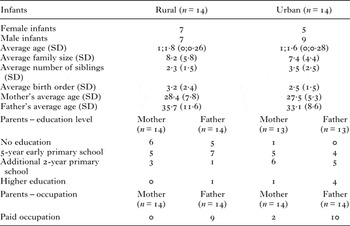
With mediation from two local community organizations, we asked for volunteers with infants between 1;0 and 1;2 at the start of a longitudinal study with three visits (average ages of 1;1, 1;6, and 2;1). We hired and trained four local research assistants (two in each field site) who explained to caregivers in their native language the purpose of the study and our procedures at each visit. The families were informed that our goal was to investigate how Mozambican infants learn their first words. We also explained that this research offered no immediate benefits to the families who volunteered, that their data would be treated confidentially, and that they could withdraw from the study at any time. All participants gave informed consent. In this paper, we present data and results from twenty-eight participants (Table 1), half each in the rural and urban sites.
Demographic information of participants in the study (infants and their parents)

note: Parental education for one urban family is missing.
The participants from the rural community were all native speakers of Changana – a Southern Bantu language spoken in parts of Mozambique and in South Africa, where it is called Tsonga (Lewis, Reference Lewis2009). This was generally the only language spoken in the household. In the urban community, most children are raised bilingually in Portuguese, the official language, and Ronga, another dialect of Tsonga mutually intelligible with Changana. While there is not a significant difference between family sizes, we believe urban participants have a more dynamic social environment due to population density, industry, and technology.
Most rural parents had either no education or only completed the lower levels of education, while all urban parents (except one) had received some education. A nominal logistic regression on education level relating to location and gender revealed a significant effect for location (χ 2(3) = 16·415; p = .001), but not for gender (χ 2(3) = 4·107; p = .250). More urban parents received a higher education level than rural parents. In addition, most rural fathers worked far from home in South Africa or Maputo. Rural mothers worked as subsistence farmers, whereas urban mothers tended to work in domestic service and fathers had local jobs. Based on these differences in education and employment, we judged the urban site to have a higher socio-economic status (SES) than the rural one.
Materials
To measure infants' vocabulary over development, we adapted the short versions of the MBCDI (Fenson, Pethick, Renda, Cox, Dale & Reznick, Reference Fenson, Pethick, Renda, Cox, Dale and Reznick2000) into the three languages of our communities, and administered them in face-to-face interviews, given the level of illiteracy in both communities. Instead of adapting the MBCDI for the three languages (Changana, Tsonga, and Portuguese) separately, we constructed one culturally broad adaptation of the list into Portuguese first and then translated this into the other two languages. Our final adaptation of the MBCDI contained 108 culturally appropriate words (see supplementary online content for a detailed description, available at: <www.journals.cambridge.org/JCL>).
Due to urban bilingualism, we assessed both Portuguese and Ronga simultaneously to assure an accurate comparison. Children in bilingual environments develop language skills similarly to monolingual children when both languages are jointly taken into consideration (Junker & Stockman, Reference Junker and Stockman2002); this measure is known as total conceptual vocabulary (i.e. the union of both vocabularies – L1∪L2; Patterson, Reference Patterson1998).
The vocabulary scores at 1;6 and 2;1 were validated with the type frequencies of words produced in the transcriptions of the infants' speech from the same video fragments analyzed here (see supplementary online content for a detailed description). Table 2 summarizes the results, and gives Spearman correlations between type frequencies and vocabulary sizes.
Spearman correlations between type frequencies of child speech (rows) and expressive MBCDI scores (columns)

notes: a Missing transcription for one urban participant at 2;1 (so n = 13). * p < .05; ** p < .001.
In the urban community, MBCDI scores at 1;6 correlated significantly for type frequencies of the infants' speech at 1;6 (r 14 = 0·668, p = .009) and tended towards significance for 2;1 (r 13 = 0·517, p = .071). The urban 2;1 vocabulary scores revealed positive, but no significant correlations with type frequencies measured at both ages, which may be due to a ceiling effect caused by overestimations of vocabulary at 2;1 (see supplementary online content for a detailed description). In the rural area, the correlations between type frequency at 1;6 and vocabulary were virtually zero at both 1;6 and at 2;1, due to a floor effect in the measured type frequencies in the infants' speech: eleven of fourteen infants had a type frequency lower than 5, which made ranking impossible. Type frequency recorded at 2;1, however, correlated significantly with vocabulary size at 1;6 (r 14 = 0·801, p < .001) and at 2;1 (r 14 = 0·551, p = .041). So rural mothers reported their infants' vocabulary fairly accurately at both 1;6 and 2;1, compared to the speech the infants produced at 2;1.
The 1;1 vocabulary scores were not validated, but analyses indicate that, in the rural area, vocabulary at this age may be underestimated compared to our norming study. So results relating to the 1;1 MBCDI should be interpreted with care, which also holds for MBCDI scores at 2;1 from the urban community.
Procedure
All data were collected during visits to the infants' homes. Since most rural daily activities take place outside in open areas and courtyards, filming occurred mostly outside. We placed our camera on a tripod at a distance of between 5 and 15 meters from the participants, depending on the location of shaded areas from which to make recordings. In the urban area, families live in single-story houses with small courtyards in densely populated suburbs. Due to more confined spaces, urban daily interactions and routines occur inside the home, in the courtyard, and/or in nearby public spaces. Most filming here too occurred outside. Where possible, we followed the same set-up as in the rural area, but in smaller spaces we filmed from 2 to 5 meters away from participants, often by hand.
Video data were collected when infants were on average 1;1, 1;6, and 2;1. The 1;6 data in the urban community were collected two weeks early for logistical reasons, so in effect those infants were 1;5·12 on average. Each family was visited twice during each collection period. At the first visit, we videotaped the infants' interactions with their families to allow everyone to get used to our presence and the filming procedures. During the second visit, we videotaped the infants from 45 up to 75 minutes for data analysis. On all occasions, caregivers and others present were asked to continue with their daily routines as if we were not present, and to not worry about positioning or moving the infant for our benefit. To ensure natural interactions, and not fabricated ones, we gave no other instructions to caregivers or families. After recording during the second visit, assistants administered the adapted MBCDI through face-to-face interviews in the caregivers' native language under the supervision of one of the authors. Since parents are likely to underestimate (Houston-Price et al., Reference Houston-Price, Mather and Sakkalou2007) and overestimate (Law & Roy, Reference Law and Roy2008) their child's receptive vocabulary, we relied only on infants' production vocabulary in our analyses.
Data analysis
Coding ccheme. The videos were coded for approximately 30 minutes (Mean 27:57; SD 01:52) in segments where the infant displayed ‘natural’ behavior (i.e. not sleeping, not off camera, not interacting with or disturbed by the researchers; see supplementary online content for a detailed description). We used the following categories in coding as we annotated the video data (see supplementary online content for a detailed description):
-
1. Unengaged: The infant is present, but not interacting with any person or target. This applies, for instance, to situations when the infant scans the environment or moves about without any apparent goal.
-
2. Onlooking: The infant fixes attention on someone, but makes no effort to engage with that person. This person is neither interacting with a target, nor aware of or responding to the infant's attention.
-
3. Objects: The infant is manipulating or interacting (e.g. playing) with a specific object(s) of their own accord, and does not interact with or attend to any person present.
-
4. Observing: The infant is actively observing an activity by someone else close by, sometimes to the point of imitation. This is related to, but different from the category of Onlooking, because the observed person is actively manipulating a target object/event.
-
5. Persons: The infant is involved in a dyadic event with a communication partner, through touch, ritualized play, or reciprocated speech, but no target is included in the engagement. This category applies to times of breast-feeding as well.
-
6. Passive Joint Attention: The infant and a communication partner share attention to a target, and only one of them is overtly aware that the attention is shared, while the other appears not to be aware of this. A typical situation is when the infant plays with a toy introduced by the mother, and the mother follows the infant's attention with the toy, but the infant appears not to notice the mother.
-
7. Shared Joint Attention: Both the infant and partner attend to the same target, and both infant and partner are aware that the other's attention is focused on each other and the target. However, neither coordinates their attention to create a triadic event involving an alignment of goals and actions.
-
8. Coordinated Joint Attention: The infant and a partner are mutually involved with a target or event. Their attention is aligned, they are both aware of the other's attention, and this alignment of attention is directed towards a goal via mutual interaction.
Following Bakeman and Adamson (Reference Bakeman and Adamson1984), we required a minimum of 2 seconds of fixated attention or interaction for each category of engagement; segments of less than 2 seconds were not differentiated from the surrounding types of interaction. If an infant's point of view could not be ascertained (usually due to technical issues), the engagement was coded as Unknown. The Unknown category was excluded from all analyses. We calculated the proportion of time infants spend in each category by dividing the total duration for that category by the total duration of all engagement levels together within each video (because total duration did not equal exactly 30 minutes).
The two authors each coded half the videos using ELAN (Wittenburg, Brugman, Russel, Klassmann & Sloetjes, Reference Wittenburg, Brugman, Russel, Klassmann and Sloetjes2006). After coding, we selected twenty videos (10 for each author) at random to be cross-coded for reliability. Ten videos were selected from the 1;1 data from the rural site and for each of these we cross-coded an arbitrarily selected 5-minute segment. The other ten videos were selected from the 1;6 data from both sites, and, for these, we selected 10-minute segments for cross-coding. Cohen's kappa was calculated on a 100-msec rate and yielded an overall value of 0·73 (0·62 for the 1;1 data and 0·75 for the 1;6 data). The two coders' agreement for individual engagement levels yielded the following Kappa's: 0·30 for Passive-JA, 0·34 for Shared-JA, 0·57 for Observing, 0·60 for Unengaged, 0·66 for Onlooking, 0·78 for Coordinated-JA, 0·81 for Persons, 0·84 for Objects, and 0·85 for Unknown. For Passive-JA and Shared-JA the agreement is rather low, but we believe this does not affect our overall results much for two reasons. First, Passive-JA and Shared-JA were infrequent (less than 4% in the cross-coded samples), and it is known that Cohen's kappa reports relatively low scores for disagreements when the category in question occurs infrequently, while actual agreement can be fairly high (Feinstein & Cicchetti, Reference Feinstein and Cicchetti1990). Second, these two categories were mostly confused with Objects, Persons, and Coordinated-JA, all with a high kappa.
Comparisons with other studies. We also assessed differences between correlations with vocabulary using our extended classification of engagement levels compared to the categorizations used by Childers et al. (Reference Childers, Vaughan and Burquest2007) and by Carpenter et al. (Reference Carpenter, Nagell, Tomasello, Butterworth and Moore1998). This re-analysis was to assess how informative different engagement level classifications are. To do this, we replicated the ‘adjusted’ tri-level categorization of Childers et al., and the two triadic engagement categories of Carpenter et al., and applied these to our data. For Childers et al., we summed Unengaged, Onlooking, and Observing to create their Low-Level category, Objects and Persons to create their Mid-Level category, and Passive, Shared, and Coordinated-JA to create their High-Level category. For Carpenter et al.'s classification, we summed Shared and Coordinated-JA to construct their category of Joint Engagement, and Observing and Passive-JA to construct their Attention Following.
RESULTS
Engagement level proportions and expressive vocabulary
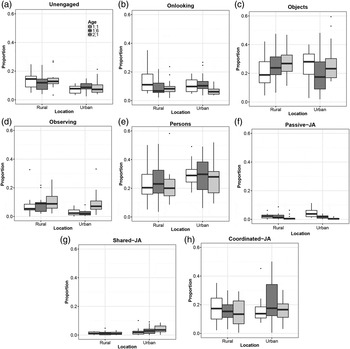
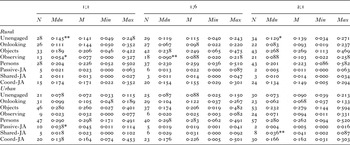
Table 3 provides the descriptive statistics for the occurrences and proportions of engagement levels for both sites; these are presented in graphic form in Figure 1. According to the Wilcoxon rank sum test, infants at 1;1 spent significantly more time Unengaged in the rural area (Mdn = .145) than in the urban area (Mdn = .078, W = 32, p = .003, r = –0·569), and they spent more time Observing (Mdn = .054) than urban infants (Mdn = .023; W = 49·5; p = .027; r = –0·417). The proportions of Observing were also higher in the rural area (Mdn = .090) than in the urban area (Mdn = .020) at 1;6 (W = 25; p < .001, r = –0·630). At 2;1, the rural infants (Mdn = .129) spent more time Unengaged than urban infants (Mdn = .073, W = 48, p = .023, r = –0·430). Urban infants at 1;1 spent more time (Mdn = .038) than rural infants (Mdn = .021) in Passive-JA engagement (W = 54, p = .046, r = –0·378), and at 2;1 they spent more time (Mdn = .036) than rural infants (Mdn = .010) in Shared-JA (W = 32, p = .003, r = –0·569).
Summary statistics for eight engagement levels at three ages for the two locations. The graphs show the medians, upper, and lower quartiles in boxes, and top and bottom 25% in the error bars. The scales on the y-axes are the same for ease of comparison.

Descriptive statistics of infants' engagement levels for ages 1;1, 1;6, and 2;1. The statistics show mean number of occurrences (N), and the median (Mdn), mean (M), minimum (Min), and maximum (Max) values of the proportion of time infants spent in various engagement levels. The results are distinguished between the rural and urban communities.

note: Comparisons across communities are made via Wilcoxon rank sum tests for each engagement level proportion for each collection period – the proportion that is significantly greater is marked in that site (* p < .05; ** p < .01).
Results from the MBCDI parental checklist are given in Table 4. These show that urban infants have substantially larger vocabularies than rural infants. A 2 (location) × 3 (age) ANOVA shows a significant main effect of location: urban infants have a larger vocabulary than rural infants (F(1,78) = 9·349; p < .01) at every collection period. Also there is a main effect of age (F(2,78) = 81·283; p < .001). A post-hoc Tukey analysis showed that the MBCDI scores across the three collection periods – 1;1 vs. 1;6; 1;1 vs. 2;1; 1;6 vs. 2·1 – all differ significantly (p < .001). There was no interaction of age and location (F(2,78) = 0·131; p = .877).
Expressive vocabulary scores (means and standard deviations) for the rural and urban MBCDI at 1;1, 1;6, and 2;1. Total score possible was 108 at each age.

note: Significant differences across sites are indicated * p < .05; ** p < .01.
Correlations with vocabulary
To calculate correlations between the proportions of engagement levels and vocabulary size, we used the Spearman's correlation coefficient, because the data did not reveal a normal distribution. Although multiple regression analysis would be preferable, this was not possible for two reasons. First, the sample size is too small for multiple regression analysis with eight predictors (engagement levels). Second, due to the fact that engagement is part of a spectrum of possibilities, there is a high co-linearity of predictors for engagement levels. Since there is also variation within such a small sample, outliers cannot be removed, and multiple regression analysis cannot take these into account.
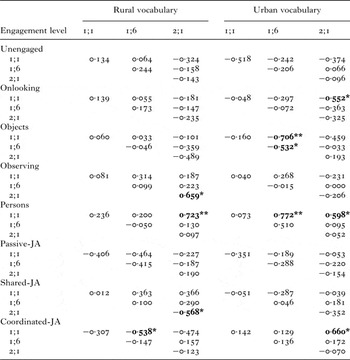
When proportions of engagement levels are correlated with vocabulary at each age, we see some significant correlations (Table 5). In the rural area, there were no correlations between the proportions of engagement level categories at 1;1 and measured vocabulary at 1;1. The proportion of 1;1 Coordinated-JA and 1;6 vocabulary showed a negative correlation (r 14 = –0·538, p = .050), while Persons engagement reveals a strong positive correlation with 2;1 vocabulary (r 14 = 0·723, p = .003). No significant correlations were observed for any 1;6 engagement level with vocabulary at 1;6 or 2;1 in the rural community. Between 2;1 proportions and concurrent vocabulary, Observing was positively correlated with vocabulary (r 14 = 0·659, p = .010), while Shared-JA was negatively correlated (r 14 = –0·568, p = .034).
Spearman's correlations between engagement levels' proportions and vocabulary sizes at all collection periods using the categorization set forth in this paper

note: * p < .05; ** p < .01.
In the urban area, there were also no correlations between 1;1 engagement proportions and concurrent vocabulary. When 1;1 proportions are correlated with 1;6 vocabulary, Objects engagement showed a significant negative correlation (r 14 = –0·706, p = .005), while Persons engagement showed a positive correlation (r 14 = 0·772, p = .001). When 1;1 proportions were correlated with 2;1 vocabulary, Persons engagement remained significant (r 14 = 0·598, p = .024). In addition, Coordinated-JA engagement now positively correlated with vocabulary size (r 14 = 0·660, p = .010). Also, rather than Objects engagement, the data were now negatively correlated for Onlooking (r 14 = –0·552, p = .041) and vocabulary. Correlations between proportions at 1;6 and concurrent vocabulary only showed Objects engagement as negatively correlated (r 14 = –0·532, p < .050). The urban 1;6 and 2;1 engagement proportions showed no significant correlations with 2;1 vocabulary.
Applying other approaches
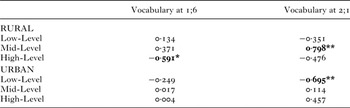
We next show how replicated categorizations from previous research correlate with vocabulary to demonstrate how other approaches, with collapsed categories, yield different results. For this, we present only correlations between the 1;1 engagement level proportions with vocabulary at 1;6 and 2;1. Table 6 presents correlations for the Childers et al. (Reference Childers, Vaughan and Burquest2007) tri-level engagement classification applied to our data.
Spearman's correlations between the proportions of time spent in 1;1 engagement levels and vocabulary size at 1;6 and 2;1 assessed by the Childers et al. (Reference Childers, Vaughan and Burquest2007) categorization

note: Low-Level = Unengaged + Onlooking + Observing; Mid-Level = Objects + Persons; High Level = Passive-JA + Shared-JA + Coordinated-JA. * p < .05; ** p < .01.
Results show that between 1;1 proportions of the tri-level categorization and 1;6 vocabulary, only High-Level engagement in the rural area was negatively correlated (r 14 = –0·591, p = .029), but there were no significant relations in the urban area. Correlations of the same proportions with 2;1 vocabulary were positively correlated with rural Mid-Level engagement (r 14 = 0·798, p < .001), and a significant negative correlation with urban Low-Level engagement (r 14 = –0·695, p = .005).
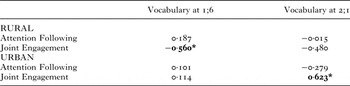
Table 7 provides the results for the Carpenter et al. (Reference Carpenter, Nagell, Tomasello, Butterworth and Moore1998) engagement level classification. They showed that rural Joint Engagement has a significant negative correlation with 1;6 vocabulary (r 14 = –0·560, p = .040), while urban Joint Engagement had a positive correlation with 2;1 vocabulary (r 14 = 0·623, p = .017).
Spearman's correlations between the proportions of time spent in 1;1 engagement levels and vocabulary size at 1;6 and 2;1 assessed for the Carpenter et al. (Reference Carpenter, Nagell, Tomasello, Butterworth and Moore1998) categories

note: Attention Following = Passive-JA + Observing; Joint Engagement = Shared-JA + Coordinated-JA. * p < .05; ** p < .01.
DISCUSSION
Our main research question was: To what extent can an extended, full-spectrum analysis of infant engagement contribute to our understanding of vocabulary development in natural non-industrial settings? In addition, how do the correlations between infant engagement and vocabulary size differ across non-industrial rural and urban communities? To find answers, we first explored how proportions of infants' engagements differ between the two communities. Second, we investigated the vocabulary sizes of the infants. Third, we analyzed the cultural differences in correlations between proportions of infant engagements and vocabulary size. Fourth, we compared our approach to two other approaches.
Differences in infant engagement
In engagement levels, the results in Table 3 show that infants in both communities appear to have a similar distribution for engagement levels, but there are also significant differences between the two communities. In the rural area, infants spent significantly more time in forms of solitary engagement – Unengaged and Observing – than in the urban area, where they spent more time in forms of triadic engagement – Passive-JA and Shared-JA.
Explanations for these differences are based on community lifestyles. The rural area relies on subsistence farming for sustenance and income, whereas the urban area follows a market economy. Due to the greater demands of subsistence lifestyle, mothers often work in the fields, and the entire community is responsible for household and caregiving chores (Greenfield, Reference Greenfield2009; Keller, Reference Keller2012). This was true in our rural community: most fathers worked in South Africa or Maputo and were away for several months at a time, and siblings take care of many household tasks, including caring for infants. As infants are yet unable to participate in the community, and other individuals have daily tasks, this could result in an environment where infants spend more time in solitary engagement (Hoff, Reference Hoff2006; Keller, Reference Keller2012), which would explain the significantly higher rural proportions of Unengaged and Observing.
These findings are also consistent with the view that caregiving in the rural community focuses on developing communal action autonomy (Keller, Reference Keller2012). The fostering of action autonomy presupposes that infants should engage autonomously, which might be triggered by leaving them to act on their own. In particular, the higher proportion of Observing could be the result of this, as it entails that infants attend to other people's activities autonomously. Further research into the motives of caregivers in leaving infants on their own, as well as caregivers' perceptions of their role in infant development, could confirm whether more solitary engagement does actually foster action autonomy.
In a non-industrial urban area, daily life is more focused on individual specialization and intra-community markets, and education levels tend to be higher than in the prototypical rural area (Keller, Reference Keller2012). The socio-demographics of urban areas could explain why the learning environment there focuses on developing communal psychological autonomy (Greenfield, Reference Greenfield2009; Keller, Reference Keller2012), where others actively involve infants in engagements that focus on cognitive development, all the while learning communal responsibilities. Compared to non-industrial rural communities, urban communities are characterized as focusing more on the interests and goals of children in regard to object stimulation, as well as more face-to-face interactions, and so provide more opportunities for triadic joint engagement (Callaghan et al., Reference Callaghan, Moll, Rakoczy, Warneken, Liszkowski, Behne and Tomasello2011; Carpenter & Liebal, Reference Carpenter, Liebal and Seemann2011; Keller, Reference Keller2007). This in turn would account for the significantly higher urban proportions of Passive-JA and Shared-JA. Moreover, the decrease of Passive-JA and increase of Shared-JA over time could be explained by the increased ability of infants to actively engage in joint attention as a result of developing psychological autonomy. At the same time, infants' overall engagement in joint attention remains fairly constant, so any developmental change is probably in quality, not quantity.
This finding differs from Bakeman and Adamson (Reference Bakeman and Adamson1984), and from Childers et al. (Reference Childers, Vaughan and Burquest2007), who found that the amount of time infants spend in all joint attention categories increased over time for the comparable age groups. To a large extent, our difference with Bakeman and Adamson can be explained by the difference in culture, since an industrial community is known to engage infants in more object-oriented interactions. The difference with the Childers et al. study is more likely due to the semi-structured methods used to elicit simulated play and the introduction of novel toys, both of which may have triggered more joint attention than normal. This also applies to Bakeman and Adamson, who also used semi-structured elicitation. As a result, earlier observations may not have yielded a reliable representation of natural interactions (see Mastin et al., Reference Mastin, Vogt, Schots and Maes2015, for an extended discussion).
To summarize our first step, we see that our novel categories Observing and Shared-JA, as well as one category of solitary engagement (Unengaged) and one of joint engagement (Passive-JA), play a substantial role in cross-cultural differences. Now, what relationship, if any, is there between engagement level proportions and vocabulary development? Given the results of earlier studies (Adamson et al., Reference Adamson, Bakeman and Deckner2004; Carpenter et al., Reference Carpenter, Nagell, Tomasello, Butterworth and Moore1998; Childers et al., Reference Childers, Vaughan and Burquest2007; Morales et al., Reference Morales, Mundy, Delgado, Yale, Messinger, Neal and Schwartz2000; Tomasello & Farrar, Reference Tomasello and Farrar1986), urban infants might be expected to gain more from increased interactions relying on joint attention. The higher proportion of Observing in the rural area, on the other hand, may provide infants with more opportunities to learn vocabulary from overheard speech.
Higher expressive vocabulary scores in the urban area
Results from the adapted MBCDI (Table 4) show that vocabulary size in the urban site was larger than for rural infants at all three ages observed. We discuss four possible explanations for this. First, the adaptation of the MBCDI may have been more culturally appropriate for the urban area. However, the adaptation and piloting of the MBCDI took place with local informants in both sites. We took care to choose appropriate terms in both communities, and when we chose words that could be more appropriate in one community this was counterbalanced by other words that would be more appropriate in the other community.
Second, caregivers have been known to both overestimate and underestimate vocabulary (Houston-Price et al., Reference Houston-Price, Mather and Sakkalou2007; Law & Roy, Reference Law and Roy2008). Urban mothers may have overestimated their infants' vocabularies more than rural mothers did. The urban vocabularies at 2;1 are significantly higher than those in our norming sample (see supplementary online content for a detailed description), which suggests that either these mothers overestimate their children's vocabulary or that participation in this research had a beneficial effect on the children's development. Equally, we found that rural mothers may have underestimated their infants' vocabulary at age 1;1. This could be because rural mothers are away from the house a lot, and leave their children in someone else's care. De Houwer, Bornstein & Leach (Reference De Houwer, Bornstein and Leach2005) suggested that, when mothers spend much time away from their child, administrating MBCDIs from multiple reporters might produce a better measure. We observed that some mothers regularly consulted other members of the household during the MBCDI interviews, especially in the rural area, but we did not keep a record of how frequently this occurred. Recall that the validation of the vocabulary with the infants' own speech production yielded good results for the MBCDI scores at 1;6 in both communities, and at 2;1 in the rural community. Since we found no significant correlations with MBCDI scores at 1;1, the rural underestimation for this age group does not affect our findings. The possible overestimation in the urban community at 2;1, however, may affect our results.
Third, it is possible that bilingualism in the urban area caused vocabulary to become overestimated. While infants in bilingual environments tend to have smaller vocabularies for each individual language (Oller & Eilers, Reference Oller and Eilers2002), their total conceptual vocabulary size tends to be the same as that of monolingual infants (Junker & Stockman, Reference Junker and Stockman2002; Patterson, Reference Patterson1998). Since the urban MBCDI adaptation was administered to measure total conceptual vocabulary, bilingualism is unlikely to be relevant.
Finally, the difference could be due to differences in the amounts of language socialization in different communities. A different analysis of the same data, in fact, demonstrated that the mean number of infant-directed utterances is six times higher in the urban community than in the rural one (Vogt, Mastin, & Schots, Reference Vogt, Mastin and Schots2015), and we found similar differences in the amount of infant-directed co-speech gestures (Vogt & Mastin, Reference Vogt, Mastin, Knauff, Pauen, Sebanz and Wachsmuth2013). This could be explained by different socio-demographics in these two environments; slightly higher urban SES level, family size, and both urban parents living at home – all could result in greater amounts of and greater variation in infant-directed speech and gesture (Hoff, Reference Hoff2006). This, in turn, could have a cumulative effect on vocabulary development (Fernald et al., Reference Fernald, Marchman and Weisleder2012; Hart & Risley, Reference Hart and Risley1995; Hoff, Reference Hoff2006).
Although part of the difference in vocabulary may be attributed to one of the first three explanations, we believe that differences in SES and in the rural and urban socio-demographics provide the most likely explanation for the differences in vocabulary size. Moreover, such differences may not only relate to differences in the amount of infant-directed speech (Hart & Risley, Reference Hart and Risley1995), but also in other non-verbal aspects of infant socialization and engagement.
Infant engagement and vocabulary development
For the relation between infant engagement and vocabulary development, our results show differences between sites for the relations of solitary and triadic engagements to infants' vocabulary, and also similarities between sites for the relation of dyadic engagement with vocabulary size (Table 5). There was a positive correlation between the amounts of Observing at 2;1 and infants' vocabulary at 2;1 in the rural environment. Given that engagements in prototypical rural environments generally involve actions displayed for infants to mimic and master (Greenfield, Reference Greenfield2009; Keller, Reference Keller2012; Schieffelin & Ochs, Reference Schieffelin and Ochs1986), it seems appropriate the amount of time infants spend Observing others might relate to word learning. In situations where infant-directed speech and other forms of child-centered socialization are scarce, infants would have to rely more on overheard speech (Akhtar & Gernsbacher, Reference Akhtar and Gernsbacher2007; Lieven, Reference Lieven, Gallaway and Richards1994), although a recent study from a Mayan village suggests that children may not learn much from overheard speech (Shneidman & Goldin-Meadow, Reference Shneidman and Goldin-Meadow2012). When infants focus their attention on the goal-oriented actions of others, there may be some situations where infants could learn from overheard speech. Rather than Onlooking to someone, Observing could provide enough contextual information for infants to infer the meaning of some overheard words. That Observing has a positive correlation in the rural, but not the urban, area could be because at both 1;1 and 1;6 the proportion of time rural infants spent Observing was significantly greater than for urban infants (Table 3). Perhaps Observing is beneficial for word learning when it occurs often, and in the same contexts, throughout development.
In the urban community, all significant relations between solitary engagements and vocabulary are negative. First, the proportions of Objects engagement at 1;1 and 1;6 were negatively related to vocabulary at 1;6. As Objects engagement involves no communication partners, there is little likelihood that the proportion of time spent Onlooking could be beneficial to word learning. Second, the proportion of Onlooking engagement at 1;1 was negatively related to vocabulary at 2;1. Onlooking likewise involved no interaction between an infant and a target or partner, so, unlike Observing, any speaker's behavior provides no clear context in goal-oriented behavior, thus making it hard to infer what an unfamiliar word means. The more time infants spend in solitary engagements, except Observing, the less time they spend interacting with people, and so they will have fewer opportunities to learn novel words.
With respect to joint engagements in the two communities, we found correlations between Persons engagement at 1;1 and vocabulary at 2;1 were positive in both locations. Yet correlations between Coordinated-JA engagement at 1;1 and vocabulary at later ages were negative in the rural community, but positive in the urban community. Why these two patterns? First, in regard to Persons engagement, it may be the case, in non-industrial communities, that social joint engagement interactions (excluding target objects or events) provide infants with culturally salient situations that focus on the fostering of communal responsibilities of the infant. Since non-industrial environments consider communal autonomy to be important, socialization tends to focus on the development of social knowledge and skills, with attention to kinship relations, turn-taking, communal service, interpersonal responsibilities, etc. (Abels et al., Reference Abels, Keller, Mohite, Mankodi, Shastri, Bhargava, Jasrai and Lakhani2005; Greenfield, Reference Greenfield2009; Keller, Reference Keller2012). The acquisition of such knowledge would be better fostered through Persons engagements than through triadic joint attention, especially since during Persons interactions, any information exchanged should relate more to social relations and interpersonal activities than to physical targets within an environment. One difference is that the rural community focuses more on action autonomy, so the development of motoric skills might be considered most important (Keller, Reference Keller2007; Schieffelin & Ochs, Reference Schieffelin and Ochs1986), while the urban community focuses more on the acquisition of turn-taking skills and interpersonal relationships important to achieving psychological autonomy. This nuanced difference is supported in our analysis of the same data with respect to the gestures addressed to infants (Vogt & Mastin, Reference Vogt, Mastin, Knauff, Pauen, Sebanz and Wachsmuth2013).
Second, for Coordinated-JA, there is a negative relation with rural infants' vocabulary, and a positive relation with urban infants' vocabulary. The positive urban relation is not surprising, since urban non-industrial learning environments share characteristics with prototypical industrial urban cultures, such as a preference for object stimulation and child-centered interactions to achieve psychological autonomy (Keller, Reference Keller2012), which could often manifest as Coordinated-JA. Moreover, many studies from industrial communities have shown a positive relation between joint attention and vocabulary development (Adamson et al., Reference Adamson, Bakeman and Deckner2004; Carpenter et al., Reference Carpenter, Nagell, Tomasello, Butterworth and Moore1998; Morales et al., Reference Morales, Mundy, Delgado, Yale, Messinger, Neal and Schwartz2000; Mundy & Gomes, Reference Mundy and Gomes1998; Tomasello & Farrar, Reference Tomasello and Farrar1986). Note, however, that we should treat all positive correlations with urban infants' vocabulary size at 2;1 with care, since mothers may have overestimated their infants' vocabulary. All the other correlations between Coordinated-JA and urban vocabulary are low, so the urban situation in this respect may be close to the rural community.
The fact that rural Coordinated-JA was negatively correlated with vocabulary was unanticipated, given that infants appear to master joint attention skills across cultures around the same age (Callaghan et al., Reference Callaghan, Moll, Rakoczy, Warneken, Liszkowski, Behne and Tomasello2011; Lieven & Stoll, Reference Lieven and Stoll2013; Salomo & Liszkowski, Reference Salomo and Liszkowski2013). Note that, at 2;1, Shared-JA also revealed a negative correlation with vocabulary, but due to its infrequent occurrence and low inter-rater reliability, we will focus our discussion on Coordinated-JA instead. In view of the data analyzed here, we offer two possible explanations. First, if object stimulation is not characteristic of non-industrial rural environments, then language socialization is unlikely to occur during joint attention with objects. To some extent, this is supported by our analysis of infant-directed speech and gestures. Vogt et al. (Reference Vogt, Mastin and Schots2015) found that in both Mozambican communities few objects are labeled in infant-directed speech, and even less so in rural Mozambique, as there is overall six times less speech addressed to infants. In addition, while nearly 60% of the infant-directed gestures in the urban community were accompanied by speech, only 33% were in our rural sample (Vogt & Mastin, Reference Vogt and Mastin2014). Moreover, in about 80% of the rural interactions where speech is accompanied by gestures, the gestures convey information not contained in the speech. These results suggest that rural infants' Coordinated-JA interactions are often silent, but when speech does occur there is little naming of objects, and when caregivers do name objects, they often do not use gestures to provide deictic information that could help acquire the appropriate association. So, the more time infants spend in Coordinated-JA, the fewer opportunities they have to learn from the utterances addressed to them, since infant-directed utterances rarely contain object labels. For urban infants, the larger numbers of infant-directed utterances result in more object labeling, often supported by gestures indicating the target object, thus providing them with more opportunities to learn object labels.
Second, the time infants spent with specific communication partners may play a crucial role in explaining the negative correlation between Coordinated-JA and vocabulary size in the rural community. A deeper exploration into the relation between infant engagement and vocabulary has shown that the amount of time rural infants at 1;1 spent in Passive-JA and Shared-JA with their mothers correlated positively with vocabulary, but that triadic engagements (including Coordinated-JA) with non-caregivers and groups result in negative correlations (Mastin, Reference Mastin2013). Interactions with non-caregivers, then, may not be beneficial. This parallels findings from a study of the Dogon in Mali, where children often have to compete for resources with other household members, especially grandmothers, and this competition is related to a slower growth rate (i.e. stunting), as well as higher infant/child mortality (Strassmann, Reference Strassmann2011). Stunting is a crucial factor in delaying children's cognitive development (Grantham-McGregor, Cheung, Cueto, Glewwe, Richter & Strupp, Reference Grantham-McGregor, Cheung, Cueto, Glewwe, Richter and Strupp2007). The negative correlations in non-caregiver and multi-party interactions could be understood by the complexity of navigating attention between multiple communication partners, a target object, and any verbal utterance(s) addressed to the infant (or not addressed to her). Interestingly, however, the time urban infants spend in Coordinated-JA with multiple communication partners revealed a positive correlation with vocabulary at 2;1. Although cognitively demanding, multi-party interactions could further explain the negative correlation in the rural community.
In sum, the results suggest that Coordinated-JA may not necessarily be the major contributor and scaffold to language acquisition (Akhtar & Gernsbacher, Reference Akhtar and Gernsbacher2007; Mundy & Gomes, Reference Mundy and Gomes1998; Scofield & Behrend, Reference Scofield and Behrend2011), at least not for all cultures. Instead, other types of engagement, such as Observing and Persons engagements, could significantly relate to word learning over early development. Moreover, the shared positive relation with Persons engagement in both communities, and the conflicting significant relation with Coordinated-JA engagement suggest that urban and rural non-industrial communities do, indeed, represent separate, but not mutually exclusive, learning environments (cf. Greenfield, Reference Greenfield2009; Keller, Reference Keller2012). However, we need to bear in mind that these findings are based on an exploratory study and that more structured research is required to investigate the validity and generalizability of these findings.
Other approaches
For the fourth step of our analysis, we discuss the differences in the correlations between vocabulary and proportions of engagement levels obtained in our extended categorization compared to those obtained by applying the less extensive engagement categorizations from Childers et al. (Reference Childers, Vaughan and Burquest2007) and Carpenter et al. (Reference Carpenter, Nagell, Tomasello, Butterworth and Moore1998).
The correlation analyses using the engagement level categorizations of these two studies resulted in three findings that followed a similar trend. First, in Childers et al.'s (2007) tri-level categorization in Table 6, there were no significant correlations between Mid-Level engagement (Objects and Persons) in the urban area and vocabulary at either 1;6 or 2;1. However, in our results in Table 5, both Objects and Persons engagements in the urban area were significantly correlated with vocabulary at 1;6, and Persons engagement continued to be a significant correlate of vocabulary at 2;1. These two categories' results cancel each other out when combined in Childers et al.'s (2007) Mid-Level category, since they have opposite correlations to urban infants' vocabulary. Second, also in Childers et al.'s (2007) tri-level categorization, there were no significant correlations between proportions of urban High-Level engagement from 1;1 with vocabulary at 2;1 (Table 6). However, when correlations are computed using either our own categories or Carpenter et al.'s (1998; cf. Table 7), the significant relation of Coordinated-JA engagement still remains evident. The third difference relates to solitary engagement. The results from both our own categorization, and Childers et al.'s (2007), show that non-joint engagement behaviors (i.e. the Low-Level category that combines Onlooking, Observing and Unengaged) can be negatively correlated to vocabulary, which Carpenter et al. (Reference Carpenter, Nagell, Tomasello, Butterworth and Moore1998) did not analyze. These differences make it clear that our extended categorization reveals correlations that would have been overlooked if our analysis were based on the engagement levels applied in earlier studies. These examples illustrate the complexity of measuring the relations between infant engagement and vocabulary development, and show that analysis of extended engagement level categories is more informative.
CONCLUSIONS
The main research question we addressed was: To what extent can an extended, full-spectrum analysis of infant engagement contribute to our understanding of vocabulary development in natural settings? In brief, our exploration demonstrates that engagements, which often fall outside the scope of research into the relation between (joint) attention and vocabulary development (e.g. Onlooking, Objects, Observing, Persons, and Shared-JA), can have significant correlations to later vocabulary size and therefore demand attention in future investigations. In addition, our study demonstrates the potential role that non-triadic joint engagements (i.e. Persons) may have on vocabulary development. One reason why we found these results was that we observed natural situations without providing any instructions to the participants, as opposed to the semi-structured or experimental methods usually used to study the relations between attention and vocabulary development (Bakeman & Adamson, Reference Bakeman and Adamson1984; Carpenter et al., Reference Carpenter, Nagell, Tomasello, Butterworth and Moore1998; Childers et al., Reference Childers, Vaughan and Burquest2007). The present study, though, only begins to explore the value of this approach. Due to our small samples, use of parental checklists to assess vocabulary size, use of correlations, and use of an understudied cultural setting, this study lacks the power to provide conclusive evidence. Nevertheless, it provides new questions for further study: What exactly is the role of solitary engagement in language development? To what extent can children learn vocabulary by observing others? To what extent do children learn language via dyadic interactions, and what qualities of such interactions relate best to vocabulary development?
The secondary issue we explored here was: How do correlations between infant engagement and vocabulary size vary in non-industrial rural and urban communities? We identified at least two factors that may play a role in Mozambican language acquisition, factors that are neither mutually exclusive nor exhaustive. First, the positive correlations between Persons engagement and vocabulary, and the conflicting correlations between Coordinated-JA and vocabulary, indicate that the rural and urban Mozambican communities represent different, non-industrial, learning environments (Keller, Reference Keller2012). Second, our results suggest that Coordinated-JA may not have to be the primary contributor and scaffold to language acquisition (cf. Akhtar & Gernsbacher, Reference Akhtar and Gernsbacher2007; Mundy & Gomes, Reference Mundy and Gomes1998; Scofield & Behrend, Reference Scofield and Behrend2011). In the Mozambique communities we studied, Persons interactions related best to language learning, reflected in the acquisition of words for kinship relations, and non-nouns (i.e. pronouns or verbs). This is consistent with the division between urban industrial and non-industrial communities that foster the development of communal responsibilities and action autonomy (Keller, Reference Keller2012).
To conclude, a full-spectrum analysis of infant engagement, with naturalistic observations in a variety of (non-industrial) cultures, like the one presented here, has the potential to contribute new insights to the relations between different forms of engagement and infants' early vocabulary development. In particular, the present study suggests that Observing and dyadic Persons engagements may contribute more to vocabulary development than Coordinated Joint Attention in at least some non-industrial communities. But since this study was an exploratory one, we need additional – more structured – research before these conclusions can be generalized.
SUPPLEMENTARY MATERIALS
For supplementary material for this paper, please visit <www.journals.cambridge.org/JCL>.