Introduction
Depressive symptoms are recognized as one of the most prevalent global mental health problems (Huang et al., Reference Huang, Wang, Wang, Liu, Yu, Yan, Yu, Kou, Xu, Lu, Wang, He, Xu, He, Li, Guo, Tian, Xu, Xu, Ma, Wang, Wang, Yan, Wang, Xiao, Zhou, Li, Tan, Zhang, Ma, Li, Ding, Geng, Jia, Shi, Wang, Zhang, Du, Du and Wu2019). The prevalence rates of depressive symptoms were found to be particularly high among older adults with low socioeconomic status (Chen et al., Reference Chen, Wong, Lum, Lou, Ho, Luo and Tong2016). As an important indicator of mental health, depressive symptoms represent a crucial dimension of healthy aging. Older adults with depression were more likely to have chronic diseases (e.g. arthritis and coronary heart diseases) compared with their counterparts (Barley et al., Reference Barley, Murray, Walters and Tylee2011). Furthermore, depressive symptoms could exacerbate social withdrawal and social isolation, which could further have negative effects on physical health (Adams et al., Reference Adams, Leibbrandt and Moon2011; Chan et al., Reference Chan, Pettigrew, Wang, Wang, Albert and Rosenberg2019). While the proportion of Chinese population aged 65 years and older has grown rapidly from around 88 million in 2000 (7%), 118 million in 2010 (8.9%), to 180 million in 2020 (13%) (National Bureau of Statistics of China, 2020), it is important to investigate modifiable risk factors of depressive symptoms in later life, which can provide valuable information for policy and intervention development concerning healthy aging.
Literature has shown a range of factors of depressive symptoms, including but not limited to age, gender, marital status, socioeconomic status, cognitive function, physical health, and family relationships (Bassett and Moore, Reference Bassett and Moore2013; Cao et al., Reference Cao, Li, Zhou and Zhou2015; Lu and Peng, Reference Lu and Peng2019; Qin et al., Reference Qin, Wang and Hsieh2016; Schwarzbach et al., Reference Schwarzbach, Luppa, Forstmeier, Konig and Riedelheller2014; Xie et al., Reference Xie, Ma, Wu, Zhang, Zhang and Tan2021). Many of these individual factors are difficult to change or modify in old age. In China, the family-based aged care system has undergone great transitions, mainly due to demographic changes such as decrease in average family size, urbanization, rural-to-urban migration, change of cultural norms, and family planning policy (Wu et al., Reference Wu, Cohen, Cong, Kim and Peng2021). Consequently, community-based resources could play a compensatory role in sustaining or improving the welfare of older Chinese adults (Burnette et al., Reference Burnette, Ye, Cheng and Ruan2021), especially for those who live in rural areas where rural-to-urban migration is prevalent, and the economy is generally lagged behind the urban areas (National Bureau of Statistics of China, 2020). In particular, community-based social capital (hereafter social capital) and neighborhood environment were found to be two important modifiable determinants of depressive symptoms (Julien et al., Reference Julien, Richard, Gauvin and Kestens2012; Litwin, Reference Litwin2011; Nyqvist et al., Reference Nyqvist, Forsman, Giuntoli and Cattan2012; Yu et al., Reference Yu, Wong and Woo2019). However, the majority of relevant studies failed to examine the associations of social capital, neighborhood environment, and depressive symptoms simultaneously. In addition, there is a lack of studies to examine the potential moderators in the above associations. For example, these associations may vary by older adults’ physical health (Gomez et al., Reference Gomez, Soto-Salazar, Guerrero, Garcia and Parra2019; Lu and Zhang, Reference Lu and Zhang2019). Furthermore, there is a lack of empirical evidence in the contexts of developing countries like China. Therefore, the present study aimed to examine the associations between social capital, neighborhood environment, and depressive symptoms in later life simultaneously and to examine the moderation effects of self-rated health (SRH) on the above associations in the contexts of rural Chinese communities.
Social capital and depressive symptoms
The most commonly adopted conceptualization of social capital in the health research field is based on Putnam’s classic work (Putnam et al., Reference Putnam, Leonardi and Nanetti1993). Putnam defined social capital as “features of social organization, such as trust, norms, and networks, that can improve the efficiency of society by facilitating coordinated actions” (Putnam et al., Reference Putnam, Leonardi and Nanetti1993). Social capital can also be defined from an individualist perspective and be referred to as important social supportive resources from one’s social connections in the communities, where they hold group memberships and share common social norms, culture, and values (Coleman, Reference Coleman1988). The multidimensional construct of social capital can be further categorized as cognitive social capital and structural social capital (Nyqvist et al., Reference Nyqvist, Forsman, Giuntoli and Cattan2012). While the former means an individual’s subjective evaluations in terms of trust and reciprocity among neighbors, and the latter refers to objective indicators such as one’s involvement in social organizations, and participation in volunteering and citizenship activities (Agampodi et al., Reference Agampodi, Agampodi, Glozier and Siribaddana2015).
While cognitive social capital was found to have significant effect on depressive symptoms, research findings of structural social capital and depressive systems are mixed in the literature (Bassett and Moore, Reference Bassett and Moore2013; Cao et al., Reference Cao, Li, Zhou and Zhou2015; Lu and Peng, Reference Lu and Peng2019; Schwarzbach et al., Reference Schwarzbach, Luppa, Forstmeier, Konig and Riedelheller2014). Older adults with relatively high levels of trust and reciprocity in the community were more likely to have lower levels of depressive symptoms (Cao et al., Reference Cao, Li, Zhou and Zhou2015; Lu and Peng, Reference Lu and Peng2019). Social participation, on the other hand, was found to be significantly associated with depressive symptoms in later life in Taiwan, whereas this relationship was not found in Western and other Chinese contexts (Bassett and Moore, Reference Bassett and Moore2013; Cao et al., Reference Cao, Li, Zhou and Zhou2015).
In general, cognitive social capital was found to have a higher effect on depressive symptoms than structural social capital (Lu and Peng, Reference Lu and Peng2019; Nyqvist et al., Reference Nyqvist, Forsman, Giuntoli and Cattan2012). However, it is important to note that social capital is a culturally sensitive and contextually dependent concept. In other words, the application and effects of social capital are specific to a particular social context. While the majority of social capital studies have been conducted in urban areas and Western contexts, the relationship between social capital and depressive symptoms in rural Chinese contexts deserve further investigation.
Neighborhood environment, and depressive symptoms
While social dimension in the communities were reflected by social capital in this study, neighborhood environment is defined as social infrastructure and services in local communities that would play important roles in influencing older adults’ social engagement and fulfilling their daily care and medical needs. Neighborhood environment include community support and health services, transportation, and outdoor spaces and buildings such as road network and public open place (Orpana et al., Reference Orpana, Chawla, Gallagher and Escaravage2016; Steels, Reference Steels2015). Neighborhood environment can be measured from the perspective of individual subjective appraisal (hereafter perceived neighborhood environment) and objective indicators (hereafter objective neighborhood environment). In general, perceived neighborhood environment was a stronger social determinant of depressive symptoms as compared with objective neighborhood environment indicators (Julien et al., Reference Julien, Richard, Gauvin and Kestens2012).
Many studies have examined the association between neighborhood-level socioeconomic status and mental health among older adults (Gerst et al., Reference Gerst, Miranda, Eschbach, Sheffield, Peek and Markides2011; Kim, Reference Kim2008). Furthermore, findings of the relationships between perceived and objective neighborhood environment indicators (e.g. build environment, health care, security, and transportation) and depressive symptoms in later life were mixed (Cramm et al., Reference Cramm, van Dijk and Nieboer2013; Julien et al., Reference Julien, Richard, Gauvin and Kestens2012; Wang et al., Reference Wang, Chen, Shen and Morrow-Howell2018). For example, neighborhood service was found to be significantly associated with well-being among older adults aged 70 years and older in the Netherlands. However, the relationship between neighborhood security and well-being was statistically nonsignificant (Cramm et al., Reference Cramm, van Dijk and Nieboer2013). Based on a nationally representative data, Wang et al. (Reference Wang, Chen, Shen and Morrow-Howell2018) found that indicators of outdoor space and building, housing, and transportation were significantly associated with depressive symptoms among older adults living in rural China, while the access to health center was not a significant factor. Walkability to medical facilities was found to be significantly associated with depressive symptoms in Hong Kong (Chen et al., Reference Chen, Wong, Lum, Lou, Ho, Luo and Tong2016).
While neighborhood environment is directly related to the access to services and amenities, social capital is a key factor to influence the level of service utilization, the diffusion of health knowledge and information, and social involvements among older adults (Julien et al., Reference Julien, Richard, Gauvin and Kestens2012; Nyqvist et al., Reference Nyqvist, Forsman, Giuntoli and Cattan2012). Research on how these two different but interrelated concepts simultaneously affect depressive symptoms would add important empirical evidence for aging policies and interventions.
The moderating role of SRH
SRH refers to an individual’s subjective evaluation of his or her general health status (Idler and Benyamini, Reference Idler and Benyamini1997). It was found to be a powerful determinant of morbidity and mortality in later life, even when sociodemographic characteristics, physical diseases, and psychological factors were controlled (Jylhä, Reference Jylhä2009; Wu et al., Reference Wu, Wang, Zhao, Ma, Wu, Yan and He2013).
Poor SRH is associated with an increased risk of depressive symptoms among older populations (Zhang and Lu, Reference Zhang and Lu2019). Moreover, the relationship between social capital and SRH was well established in the literature (Ehsan et al., Reference Ehsan, Klaas, Bastianen and Spini2019; Koutsogeorgou et al., Reference Koutsogeorgou, Nyqvist, Nygard, Cerniauskaite, Quintas, Raggi and Leonardi2015; Lu and Zhang, Reference Lu and Zhang2019). In particular, the association between cognitive social capital and SRH was stronger than that between structural social capital and SRH (Gilbert et al., Reference Gilbert, Quinn, Goodman, Butler and Wallace2013). Furthermore, recent systematic review and empirical studies identified significant associations between neighborhood environment (e.g. neighborhood security, community-based service) and SRH in the context of East Asia and Latin America (Gomez et al., Reference Gomez, Soto-Salazar, Guerrero, Garcia and Parra2019; Liu et al., Reference Liu, Luo, Haller, Vander Mey and Granberg2018; Yu et al., Reference Yu, Wong and Woo2019).
According to the Ecological Model of Ageing, neighborhood environment and social capital could affect one’s depressive symptoms through person–environment fit (i.e. the balance between neighborhood environment and an individual’s competence) (Lawton and Nahemow, Reference Lawton, Nahemow, Eisdorfer and Lawton1973). In particular, the level of SRH could change one’s subjective appraisal of person–environment fit. This means that older adults with poor SRH might be particularly vulnerable when they live in poor quality neighborhood environment. In other words, their competence and social functioning are determined by their health status to some extent, which make those with poor SRH have more difficulty in achieving the balance between neighborhood environment and one’s competence.
Therefore, in this study, we hypothesize that 1) both social capital and neighborhood environment are associated with depressive symptoms in later life, and 2) SRH moderates these associations.
Methods
Sampling
The data were derived from a community survey “Social Capital and Aging Life-Quality Survey,” which was conducted in late 2019. The data were collected from Dongliao county, Jilin Province. Jilin is located in the northeast part of China, where more than half of local residents live in rural areas by 2018. Furthermore, Dongliao county is located in the rural areas of Liaoyuan. This county has 33,5700 local residents, around 78% of whom have agricultural household registration status. The proportion of older adults aged 60 years and older in this region is higher than national average (21% vs. 17%). The majority of older residents have lived in this region for more than one decade.
We used a quota sampling method to recruit eligible participants: first, a total of 16 villages were randomly selected from Dongliao county (235 villages in total). Second, 30 participants were recruited from each of the selected villages based on the recommendations from local village committees. Since these individuals were familiar with local residents, this was one approach to improve efficiency and response rate for the recruitment. In this study, the sample’s age and gender ratio was consistent with that from the local representative sample based on the national consensus. The study inclusion criteria were as follows: 1) aged 60 years and older; 2) lived in local village more than 6 months in the past 12 months, and 3) had local agricultural household registration status. Trained interviewers conducted face-to-face interviews with the participants either at their homes or at local community centers. The response rate was 90% or higher in all villages.
A total of 482 participants completed the survey questionnaire. In this study, we excluded the participants who did not pass the cognitive screening using the Short Portable Mental Status Questionnaire (SPMSQ; n = 24) (Pfeiffer, Reference Pfeiffer1975), and one case that had missing value on SRH. Since intergenerational relationship was a key factor of depressive symptom, we also excluded those who did not have any adult children (n = 10). The final analytic sample size was 447. Ethics approval was obtained. Informed consent forms were obtained before the data collection.
Measurement
Depressive symptoms
We used the 10-item Center for Epidemiologic Studies Depression Scale to measure the levels of depressive symptoms (Chi and Boey, Reference Chi and Boey1993; Rankin and Galbraith, Reference Rankin and Galbraith1993). This scale assesses depressive moods, positive emotion, and somatic syndromes in the past week. The answers were assessed by a five-point Likert scale, ranging from 0 = less than 1 day, 2 = 3 to 4 days, to 4 = almost every day. A summary score was calculated, with a higher score indicates a higher level of depressive symptoms (Cronbach’s alpha = .845).
Social capital
In this study, both the cognitive and structural dimension of social capital were examined by latent constructs. Although latent constructs cannot be observed directly, they can be examined by a set of observed variables (Kline, Reference Kline2011). We selected the factor indicators from two sources: the integrated questionnaire for social capital from the World Bank, and the Short Social Capital Assessment tool (De Silva et al., Reference De Silva, Huttly, Harpham and Kenward2007; Grootaert et al., Reference Grootaert, Narayan, Jones and Woolcock2004). Regarding cognitive social capital, the participants were asked about the following four items: 1) they trust the majority of village residents; 2) the village residents not only care about their own interests, but also respect others’ benefits; 3) they believe that the local village is a family and they feel a sense of belonging; and 4) the residents in the village community help each other. The answers were assessed by a five-point Likert scale (1 = strongly disagree, 3 = neutral, to 5 = strongly agree).
Four factor indicators were used to examine structural social capital as follows. First, before the data collection, a pilot study was conducted to develop a list of available social organizations in local village communities. The participants were asked to report whether they had the following organization memberships in the past 12 months: political organizations, neighborhood committees, community associations, women’s groups, charity groups, religious groups, sports groups, and professional associations. The answers were assessed by binary variables (0 = no, 1 = yes). A summary score was used to represent the number of organization memberships (range = 0–8). Furthermore, they were asked how frequent they participated in social activities held by the above organizations in the past 12 months (ranging from 1 = never, 3 = several times, to 6 = twice or higher per week; social participation), and whether conducted any volunteering activities in the last month (0 = no, 1 = yes; volunteering). They were also asked whether they had collaborated with other village residents to handle common problems in the community in the past 12 months (0 = no, 1 = yes; citizenship activity).
Perceived neighborhood environment
The participants were asked whether they were satisfied with the following aspects of neighborhood environment: health care, transportation, and security. The responses were assessed by five-point Likert scale, ranging from 0 = very unsatisfied, 2 = fair, to 4 = very satisfied.
Self-rated health (SRH)
The moderator is SRH. The participants were asked to evaluate their health status. The responses were assessed by a five-point Likert scale (0 = very poor, 1 = poor, 2 = fair, 3 = good, and 4 = very good). In order to conduct multiple group analysis, the variable was further recoded as a binary variable (0 = very poor/poor/fair, 1 = good/very good).
Covariates
Age was a continuous variable. Gender, marital status, and educational attainment were measured by binary variables (1 = women, 0 = men; 1 = married, 0 = other marital status; and 1 = primary school education or higher, 0 = illiterate). We calculated the log values of annual household income to represent the participants’ income levels. Number of alive sons and daughters were calculated. Intergenerational relationship was assessed by items from intergenerational solidarity inventory (Mangen et al., Reference Mangen, Bengtson and Landry1988). Furthermore, as discussed above, cognitive function was measured by SPMSQ (Pfeiffer, Reference Pfeiffer1975), with a range from 6 to 10. Number of diseases were assessed by a set of 14 doctor-diagnosed chronic diseases in later life, such as hypertension, cardiovascular diseases, digestive diseases, diabetes, and arthritis. The responses were assessed by binary variables (0 = no, 1 = yes). A summary score was calculated.
Data analysis
There are two analytic procedures in this study. First, we used structural equation modeling (SEM) to test the relationship between cognitive social capital. SEM has two steps: measurement model and structural model. By using confirmatory factor analysis, we examined the measurement model of social capital in rural Chinese contexts. The following fit indexers were adopted to evaluate the model fit: the chi-square test statistic (chi-square estimate should be statistically nonsignificant), comparative fit index (CFI: estimate should be 0.90 or higher),Tucker–Lewis index (TLI: estimate should be 0.90 or higher), root mean square error of approximation (RMSEA: estimates should be 0.05 or lower), and weighted root mean square residual (WRMR: estimate should be lower than 1) (Kline, Reference Kline2011). Two structural models were conducted. In the first model, depressive symptoms were regressed on cognitive social capital and structural social capital, when the covariates were controlled. Furthermore, neighborhood environment was added in the second structural model. Mplus 7 was used (Muthén and Muthén, Reference Muthén and Muthén2012).
Second, multiple group analysis was applied to examine the moderating role of SRH on the relationship between social capital, neighborhood environment, and depressive symptoms. SRH was divided into two health groups: poor SRH group and good SRH group. Multiple group analysis was conducted as follows: first, the measurement model of social capital was tested in different SRH groups. Second, in order to make meaningful group comparisons, we tested the measurement invariance of the latent constructs of social capital between the poor and good SRH groups by holding the factor loadings equal across the groups (Chen et al., Reference Chen, Sousa and West2005). Third, depressive symptoms and covariates were entered in the final structural model. Wald tests were used to examine the moderation effects of SRH on the relationship between social capital, neighborhood environment, and depressive symptoms.
Finally, we used listwise deletion to handle missingness in this study (missing rates of key variables < 5%).
Results
Sample characteristics
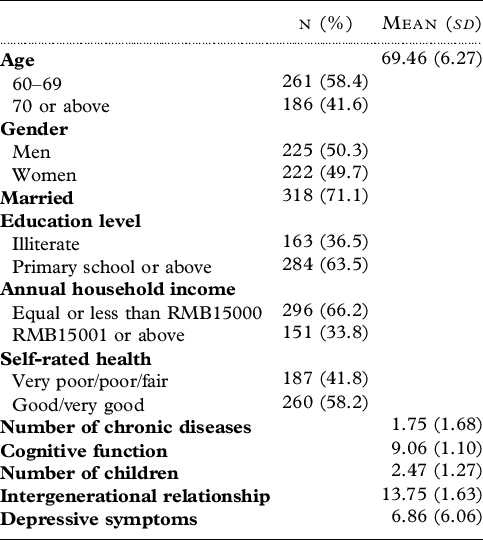
We presented the sample characteristics in Table 1. The mean age of the participants was 69.46 years. Around half of the participants were females. In addition, 71.1% of the participants were married, 36.5% were illiterate, and 33.8% reported that their annual household income was higher than 15,000 RMB. On average, each participant had 1.75 chronic diseases at the time of survey. More than half of the participants rated their health status as good or very good. The average number of adult children was 2.47 (range = 1–9). On average, 77.5% of the participants reported that they had good or very good relationships with their adult children. The mean score of depressive symptoms were 6.86. Only 9.2% of the participants reported that they did not have any of the 10 depressive symptoms in the past 7 days at the time of survey.
Sample characteristics (N = 447)

Notes: 100 RMB = 14.2USD.
Structural equation modeling
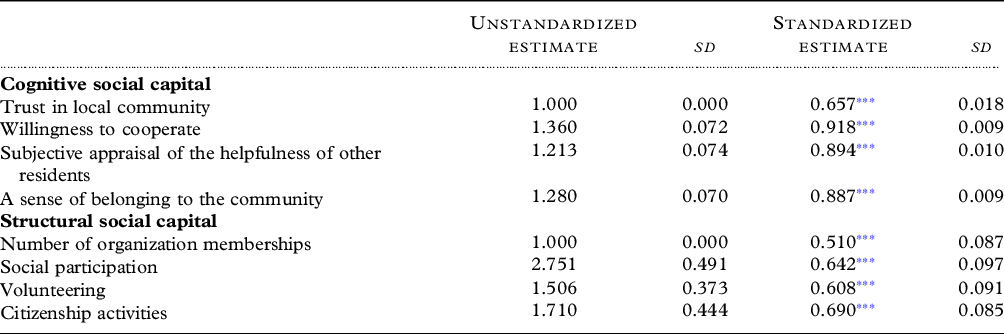
The measurement model of social capital was tested and established first. The estimates of fit index indicated the model adequately fit the data: χ2 (17) = 26.125, p = .0722, RMSEA = 0.035, CFI = 0.989, TLI = 0.982, WRMR = 0.566. The standardized estimates of the factor loadings ranged from 0.510 to 0.690 for structural social capital and from 0.657 to 0.918 for cognitive social capital (see Table 2).
Measurement model of social capital

Notes: This table shows the measurement model of two latent variables (i.e. cognitive social capital and structural social capital). Each latent variable has four factor indicators. All standardized coefficients of the factor loadings were above 0.5;
*** p < .001 (two-tailed).
Furthermore, we conducted two structural models. In the first model, we regressed depressive symptoms on cognitive social capital and structural social capital, when covariates were controlled (χ2 [79] = 100.691, p = .0504, RMSEA = 0.025, CFI = 0.979, TLI = 0.969, WRMR = 0.661). Both cognitive social capital and structural social capital were significantly associated with depressive symptoms (cognitive: β = −.105, p < .01; structural: β = −.175, p < .01).
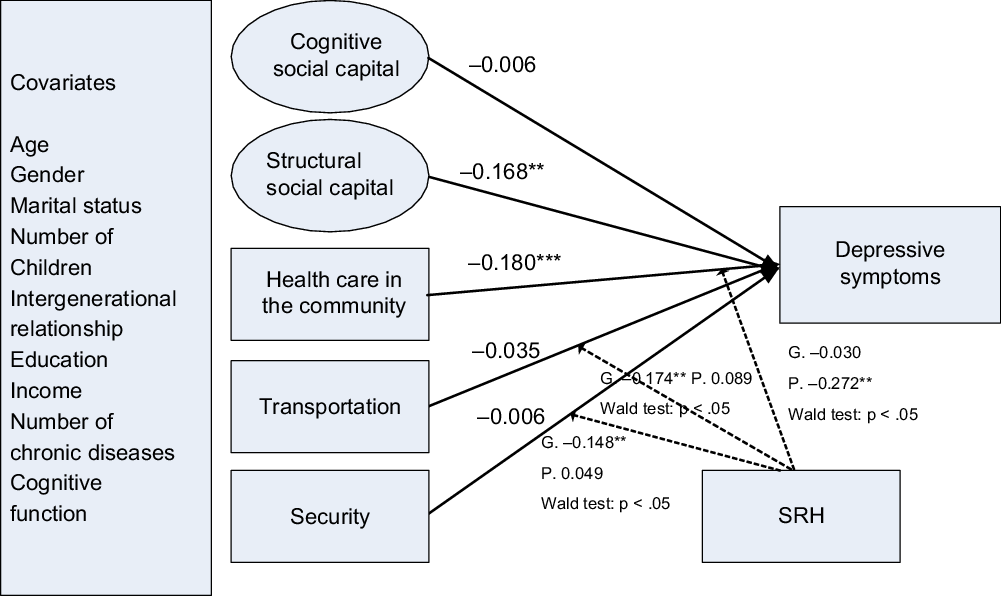
In the second model, depressive symptoms were regressed on the social capital and neighborhood environment, when covariates were controlled (χ2 [105] = 125.800, p = .0814, RMSEA = 0.021, CFI = 0.985, TLI = 0.980, WRMR = 0.773). Cognitive social capital was no longer significantly associated with depressive symptoms (β = −.006, p > .05). Structural social capital was still significantly associated with depressive symptoms (β = −.168, p < .01). Furthermore, older participants’ satisfaction levels with health care in the community were significantly associated with depressive symptoms, while the relationship between the other two perceived neighborhood environment indicators and depressive symptoms were statistically nonsignificant (health care: β = −.180, p < .001; transportation: β =−.035, p > .05; and security: β = −.006, p > .05).
Multiple group analysis
We examined the moderation effects of SRH on the relationship between structural social capital, neighborhood environment, and depressive symptoms. Given that cognitive social capital was not significantly associated with depressive symptoms after adding perceived neighborhood environment in the model, it was excluded in the final multiple group analysis.
In the first step, we tested the measurement model of structural social capital in the poor and good SRH groups separately and then hold the factor loading equal across the two groups. The fit index estimates did not worse significantly and showed good model fit (χ2 [5] = 2.389, p = .7932, RMSEA = 0.000, CFI = 1.000, TLI = 1.036, WRMR = 0.334). Factor loading invariance was established. In the second step, we entered depressive symptoms, perceived neighborhood environment, and covariates in the final structural model. The fit index estimates were below: χ2 (85) = 99.682, p = .1319, RMSEA = 0.028, CFI = 0.946, TLI = 0.911, WRMR = 0.989. The standardized estimates of factor loading ranged from 0.585 to 0.727. This indicates adequate model fit.
Structural social capital was found to be significantly associated with depressive symptoms in both poor and good SRH groups (poor SRH: β = −.197, p < .05; good SRH: β = −.145, p < .05). The above effects were compared between the two SRH groups and the difference was statistically nonsignificant (Wald chi-square [1] = 1.640, p = .2003). Furthermore, the results suggested a significant moderation effect of SRH on the relationship between perceived neighborhood environment and depressive symptoms. Specifically, health care indicator was significantly associated with depressive symptoms in the poor SRH group, but not in the good SRH group (poor SRH group: β = −.272, p < .01; good SRH group: β = −.030, p > .05; Wald chi-square [1] = 5.976, p < .05). Transportation was significantly associated with depressive symptoms in the good SRH group, but not poor SRH group (poor SRH group: β = .089, p > .05; good SRH group: β = −.174, p < .01; Wald chi-square [1] = 4.335, p < .05). Finally, security was significantly associated with depressive symptoms in the good SRH group, but not poor SRH group (poor SRH group: β = .048, p > .05; good SRH group: β = −.148, p < .01; Wald chi-square [1] = 4.188, p < .05). The results are presented in Figure 1.
Final model of social capital, perceived neighborhood environment, and depressive symptoms. Notes: G = good SRH group; P = poor SRH group; significant standardized coefficients are reported. Only significant moderation effects are reported. **p < .01 (two-tailed); ***p < .001 (two-tailed).

We also conducted sensitivity analyses by adding cognitive social capital in the model and used different cutoff point of SRH to divide different SRH groups (e.g. using 1 = poor as the cutoff point). Furthermore, we rerun the model based on the whole sample (i.e. participants who did not pass SPMSQ and those who did not have adult children were included). Finally, given that the respondents were recruited from 16 villages, we conducted additional random-effects regression models by regressing depressive symptoms on social capital and neighborhood environment indicators. The random-effects model produces unbiased standard errors due to clustering (Rabe-Hesketh and Skrondal, Reference Rabe-Hesketh and Skrondal2012; Snijders, Reference Snijders, Leyland and Goldstein2001). The above analyses generated similar results.
Discussion
This study is one of the first attempts to examine the role of social capital and neighborhood environment indicators in influencing depressive symptoms among older adults in rural China. This study not only simultaneously tests the associations between social capital, perceived neighborhood environment, and depressive symptoms in rural Chinese contexts but also adds new knowledge on the moderating role of SRH on these associations. The findings support the two hypotheses, which provide evidence for future development of policy initiatives and intervention design, particularly in terms of mental health in later life.
Consistent with previous studies (Bassett and Moore, Reference Bassett and Moore2013; Burnette et al., Reference Burnette, Ye, Cheng and Ruan2021; Litwin, Reference Litwin2011; Nyqvist et al., Reference Nyqvist, Forsman, Giuntoli and Cattan2012; Schwarzbach et al., Reference Schwarzbach, Luppa, Forstmeier, Konig and Riedelheller2014), this study found that both cognitive social capital and structural social capital were significantly associated with depressive symptoms, when perceived neighborhood environment was not included in the model. Our study showed that social capital had small to medium levels of effects on depressive symptoms (the standardized effect size ranges from 0.1 to 0.3). Further, our study found that structural social capital had a higher effect on depressive symptoms than cognitive social capital among older adults living in rural China. These findings are inconsistent with the previous studies which mainly conducted in Western and urban contexts (Bassett and Moore, Reference Bassett and Moore2013; Burnette et al., Reference Burnette, Ye, Cheng and Ruan2021; Litwin, Reference Litwin2011; Nyqvist et al., Reference Nyqvist, Forsman, Giuntoli and Cattan2012; Schwarzbach et al., Reference Schwarzbach, Luppa, Forstmeier, Konig and Riedelheller2014). This implies that the association between social capital and depressive symptoms in later life could vary across different social contexts. It is likely that structural social capital may reduce depressive symptoms through promoting social participation, information sharing, healthy behavior, and the utilization of home and community-based services. As previously discussed, older rural adults’ socioeconomic status is generally lower than their urban counterparts. This indicates that they rely heavily on public health care system to gain health services and resources. The information and utilization of the above health resources could play a vital role in sustaining both mental and physical health among older adults living in communities with low socioeconomic status.
While previous studies mainly focused on either social capital or neighborhood environment, this study examined the two factors simultaneously and found that the association between cognitive social capital and depressive symptoms became nonsignificant after entering neighborhood environment in the model. This implies that the association between cognitive social capital and depressive symptom could be explained by perceived neighborhood environment (i.e. health care service). Health care needs are one of the most important social needs among older rural residents. To some extent, older residents’ sense of belonging to local villages, for example, can be largely affected by their access to and quality of health care. Even if older residents have high levels of trust and informal reciprocity among neighbors (i.e. high levels of cognitive social capital), they still may not have adequate access to health services that can meet their health needs when they live in a village with poor health care resources. This would further increase their depressive symptom levels.
Rural older adults tend to spend more time in local communities as compared with their younger counterparts. Given that older age is associated with an increased risk of decline in physical health and decrease in social network size, they are particularly vulnerable when they live in a community with poor quality of neighborhood environment (Chen et al., Reference Chen, Wong, Lum, Lou, Ho, Luo and Tong2016). Consistent with previous studies (Cramm et al., Reference Cramm, van Dijk and Nieboer2013; Julien et al., Reference Julien, Richard, Gauvin and Kestens2012; Wang et al., Reference Wang, Chen, Shen and Morrow-Howell2018), perceived neighborhood environment was found to have small to medium levels of effects on depressive symptoms. However, the above associations vary by SRH status. The findings suggested that the association between health care and depressive symptoms was significant among older adults with poor SRH only, while the associations between transportation and security in the community and depressive symptoms were significant among those with good SRH only. Community health care services had the largest effects on depressive symptoms among older rural Chinese adults, especially among those with poor SRH status. Presumably, access to health care at local setting is more important for those with poor health status as they tend to have more health care needs than their healthy counterparts. Furthermore, older residents with relatively good health are more likely to have outdoor activities. Therefore, transportation and community safety might be more important to them.
The findings have the following policy and intervention implications. First, consider including social capital and neighborhood environment measures as a part of the screening tools to identify older adults who are at risk of depression. Second, neighborhood resources and services may play different roles in older adults’ mental health status depending on their level of SRH. Therefore, information of their health status is valuable for the neighborhood design and development in rural communities. Third, social capital interventions in rural Chinese communities should put greater emphasis on promoting structural social capital. Different types of community organizations should be developed to widen older residents’ social connections and combat social isolation. Social workers could also help older adults engage in formal volunteering activities and civil activities to pursue collective interests. These activities would not only generate supportive resources but also enhance meaning in life among older residents. These activities could help reduce depressive symptoms in later life.
The limitations of the study are as follows. First, the data are cross-sectional, which means that we are not able to test causal relationships among social capital, neighborhood environment, and depressive symptoms. Future longitudinal studies are needed to further examine the temporal relationships of social capital, neighborhood environment, and depressive symptoms. Second, the sample is not randomly selected. The findings of this study, therefore, may not be generalizable to the general rural population in China. Third, we only measured neighborhood environment by three subjective indicators. Objective indicators of physical environment such as public open space and road network were not assessed. Future studies are needed to include a more comprehensive measurement of physical, natural, and build environments in neighborhood within rural Chinese contexts. Furthermore, the sample is relatively healthy, because this study only included those who had normal cognition to complete the survey. Finally, given that the socioeconomic status in the 16 selected villages were similar, this study examined the relationship between neighborhood environment and depressive symptoms from an individualist perspective. Community-level and regional-level variables, however, could also have significant influence on the above relationships. Future studies with larger sample sizes could further explore this issue by examining both micro- and macro-level factors in different social contexts.
Conclusion
This study simultaneously tested the associations between social capital, perceived neighborhood environment, and depressive symptoms in later life. Structural social capital, community health care, transportation, and security were found to be significant factors of depressive symptoms in later life. The association between structural social capital and depressive symptoms remained significant in both poor and rich SRH groups. While the association between community health care and depressive symptoms were only significant among poor SRH group, transportation and security were only significant among good SRH group. Future social capital interventions and neighborhood service should not only put great emphasis on developing structural social capital in rural Chinese contexts but also use different strategies to support older adults with different SRH levels.
Conflict of interest
The authors report no conflicts of interest.
Description of author(s)’ roles
Nan Lu planned the study, performed statistical analysis, and wrote and revised the paper. Bei Wu contributed to study planning, paper writing, and paper revision. Yaolin Pei contributed to paper revision. Changmin Peng contributed to literature review and paper revision.
Acknowledgments
This study was supported by a Key Project of National Social Science Foundation of China (Grant No. 19ASH018).