


Religion and ritual practice were core to writing’s early development, in all four world regions where the technology was independently innovated. This book’s guiding premise provides an alternative to existing theoretical models in which political centralization and hierarchization were the primary, if not the only, factors that allowed original scripts to expand in functionality, crystallize as regular systems, and maintain mutual legibility across time, space, and scribal community. Clearly, maintaining a script’s communicative effectiveness requires a baseline complexity of social organization.Footnote 1 Since writing is frequently characterized as “a very direct physical expression of control” over graphic signs and their users, it is unsurprising that political structures are often pinpointed as the basic source of a writing system’s cohesion.Footnote 2 This political model, which will be addressed in Chapter 2, offers a compelling, if incomplete, account of writing’s trajectory in ancient China, Mesopotamia, and Egypt. Yet trying to account for the history of the more recently deciphered Maya hieroglyphic script stretches the model too thin. In contrast, a narrative that centers ritual and religion compellingly accounts for early writing’s development, including its relationship to governance, in all four world regions.
Defining Religion and Ritual
Tracing the development of early writing within religion and ritual practice requires basic agreement on what “religion” is and how it can be identified in the archaeological past. The definition that is widespread in Western society today crystallized in Enlightenment-period Europe as part of a larger social, political, and cultural reaction against the power that (Christian) religious institutions had amassed over society.Footnote 3 Our contemporary understanding of religion, in other words, is a product of attempts to delimit religion’s role in public and private life. Before the Enlightenment, rituals and the relations with gods and ancestors that they negotiated were integral components of society and, when access to them was distributed unequally, a major source of authority. It is only in retrospect that we can isolate features of what we now call “religion” in the ancient past, and doing so requires artificially disentangling them from other spheres of social life with which they were, in fact, intertwined.
The English term derives from Latin religio, which denoted “the careful performance of ritual obligations.”Footnote 4 Inflections of the original Latin root, which explicitly referenced human behavior and display, can be found in some early anthropologists’ understandings, such as Victor Turner’s interpretation of religion as meaning-bearing performance.Footnote 5 Today, however, the word “religion” implicitly – and, in many dictionaries, explicitly – connotes a wider range of values that are drawn largely from Protestant Christianity and include worship of god(s); theology, or an established catalogue of beliefs; institutional hierarchy among practitioners; clear delineation from other spheres of society, such as politics or economics; and a canon of sacred texts or scripture.Footnote 6 The modern-day term thus incorporates more recent assumptions that were absent from the Latin etymology. The same assumptions have shaped many recent theoretical approaches, from Clifford Geertz’s characterization of religion as a symbolic system to Pascal Boyer’s claim that religion is a byproduct of evolutionary adaptation.Footnote 7 Such cognitive or symbolic perspectives emphasize abstract, conceptual aspects of the phenomenon of “religion.” They also tend to be privileged in popular (and, in many cases, academic) understanding of religion today, despite the staying power of other theories such as that of Émile Durkheim, who famously conceptualized religion as a sacred system of thought (beliefs) and action (rites).Footnote 8
Just as the idea of “religion” proves challenging to pin down, similar difficulties arise when searching for a standard definition of its terminological cousin, “ritual.” Some consider ritual a straightforward expression of ideas or beliefs and assign it a relatively passive role in religious practice.Footnote 9 Others attribute to ritual a more active role as a means of creating community, expressing meaning, or catalyzing changes to one’s worldview.Footnote 10 Consistent across these diverse interpretations are two assumptions: first, that ritual is a religious practice, although not every religious practice is a ritual; and second, that ritual is a behavioral phenomenon made visible through real-world performance. The latter idea, which allows that ritual manifests physically and can leave material traces, has been particularly influential in archaeological approaches to religion.Footnote 11 In studying religion in the past, archaeologists heavily emphasize actions over abstract thoughts and beliefs, even as they acknowledge a relationship between the two that manifests in ritual.Footnote 12
Without attempting to formulate a universal definition, I use “religion” here to denote a set of interrelated ideas and practices with which people negotiate relations with one or more other-than-human entities, often gods or ancestors. A religious community, in turn, defines itself through mutual recognition of each other’s participation in a shared tradition, even if not all participants engage equally in it. Membership in a religious community may encompass human and other-than-human beings, the latter differing formally and biologically from living humans but similarly possessing a vital force or essence and, in many cases, personhood.Footnote 13 Originally coined by A. Irving Hallowell to refer to nonhuman persons in Ojibwa society, the descriptor “other-than-human” concisely accounts for the sociality of Maya beings that Western ontological tradition would classify with labels such as “animal,” “plant,” “deceased ancestor,” or “unit of time,” among others.Footnote 14
Members of a religious community share a tradition of related practices and associated ideas. Analogously, a ritual community consists of those who share a common practice and may even conduct it together. Performed to engage “immanent beings” on behalf of oneself or others,Footnote 15 a ritual is a socially and symbolically potent practice that may or may not be religious in conception or consequence.Footnote 16 Thus, a ritual community may be, but is not always, a subset of a religious community. Some cultural traditions define ritual by “special (not-normal) intention-in-action.”Footnote 17 Maya ritual, however, cannot be easily classified as “religious” or “sacred” because it is not inherently distinction from quotidian “work” or “doing.”Footnote 18 Instead, it is an episode in “a continual round of exchanges” that brings together human and other-than-human denizens of the cosmos.Footnote 19 Among the Maya, ritual “restructur[es] and/or transform[s] … inter-relationships between other beings, be they human or non-human and visible or invisible.”Footnote 20
The Practice of Ritual and the Making of Meaning
The argument for religion’s centrality in transmission and maintenance of Classic Maya hieroglyphic writing relies on the basic premise that practice, or the way people do things, is a fundamentally social phenomenon. Practice is learned from others and consists of not only information about what to do and how to do it, but of the “entirety of operational sequences, mental models, appropriate behavior, and involuntary gestures” that the “doing” entails.Footnote 21 Consequently, variability in practice reflects differences in practitioners’ sociocultural background or context. An anthropological approach to practice accounts for not only what but when, where, how, and why someone does something.Footnote 22 Thus, how Classic Maya scribes wrote depended largely on where, when, and with whom they were trained, as well as on their degree of engagement with other scribes. Likewise, ritual practitioners learned about specific rites, how to conduct them, and their underlying meaning from observing and interacting with others who performed them. The accumulated experiences shaped their way of “doing” religion, even if they did not replicate a given practice precisely as they had learned it.
What distinguishes ritual from other culturally salient practices is a contextually dependent understanding of being somehow set apart or “marked for attention,” not anything inherent to the action or event itself.Footnote 23 Ritual therefore can be understood as one category within a larger repertoire of strategic behaviors for navigating a particular cultural-historical context. That category of practice is defined relative to others through a process that Catherine Bell has referred to as ritualization, “a way of acting that differentiates some acts from others.”Footnote 24 Treating ritualization and ritual practice as distinct behavioral phenomena, with the former operating to define the latter, allows us to isolate the multiple scales of meaning that they implicate.
However, I diverge slightly from Bell by differentiating between two processes encompassed within her original understanding of ritualization, namely between the definition of a practice and the practice’s execution. Building on theoretical insights from anthropology and anthropological archaeology,Footnote 25 I use “ritualization” to denote the culturally contextualized “creative act of production” that distinguishes one practice from another.Footnote 26 With “ritual practice,” “ritual,” or “ritualized practice,” in turn, I refer to the doing that is set apart as special or salient relative to others in the same context. Ritual, in short, is the meaning-laden product of ritualization. This semiotic approach accounts for “the ambiguity and instability of beliefs and symbols” inherent in Bell’s original definition of ritualization, even as we distinguish here between the process and the product of meaning-making.Footnote 27
As the practice of creating and defining ritual, ritualization shapes how symbols such as language and writing are deployed and the meanings that they convey in context.Footnote 28 Ritualization creates meaning through culturally contextualized “schemes of privileged opposition” and, by situating that meaning within existing social structures, legitimizes the resulting ritual’s role in society.Footnote 29 Much of ritualization’s significance arises through contrast as a mode of iconicity, which relates things to each other based on perceived (dis)similarity.Footnote 30 Ritual, for its part, is defined over the course of its performance through indexicality, or “a felt quality of causal and spatiotemporal contiguity” with the phenomenon to which it refers.Footnote 31
Ritualization’s semiotic malleability makes ritual practice highly effective for negotiating relations of power. Doing ritual has a symbolic and a material effect that does not dictate but can still shape participants’ beliefs.Footnote 32 Because perception of (dis)continuity or similarity is highly context-dependent, ritual’s meaning – its “sense of being unusual and demanding special attention” – can only be understood in the semiotic environment in which it exists, which is itself cultural-historically embedded.Footnote 33 Ritual confers agentive capacity to negotiate power relations precisely because it depends on social setting. In performing a ritual, practitioners may assert control over or independence from another person, group, or institution; they may bring people together or divide them; or they may empower further action that changes the meaning of the ritual itself.Footnote 34
As subsequent chapters illustrate, Classic Maya ritualization invoked hieroglyphic writing as both an index and an expression of relations between ritual actors, both human and other-than-human. This process drew upon and reinforced a deep association between writing and religion that the Maya had inherited from earlier Mesoamerican traditions. It also implicated writing at all stages of ritual performance. Ethnohistorical accounts suggest that divinatory texts were frequently consulted to determine the appropriate setting for a Classic Maya ritual; historical documentation, in turn, memorialized past events as precedent for present and future practice.Footnote 35 During a ritual, writing was often present in the form of objects with hieroglyphic inscriptions. It was also represented by participants who were trained in the script, some of whom may have worked as professional scribes.Footnote 36 After a ritual’s conclusion, Classic Maya scribes sometimes documented the experience in writing – a process that was itself ritually charged due to the hieroglyphs’ other-than-human origins (see Chapter 3). Subsequent engagement with those records after the fact further extended the performance’s impact well beyond its original scope.
I posit that all stages of hieroglyphic involvement were critical to ritualization among Classic Maya elites, and not just among scribes and religious specialists. However, it was the practice of ritual, not the act of ritualization, that communicated ideas about the world and physical reality through a process that Elizabeth DeMarrais and colleagues characterize as “the materialization of ideology.”Footnote 37 The generative process operates at multiple scales of meaning-making and may be an outcome of ritual practice or a ritual in and of itself, depending on context.Footnote 38 In the former case, ritual creation or manipulation of material reality endows some thing with a meaning that persists even after the performance concludes.Footnote 39 In the latter case, ideology is expressed through a performance that makes certain beliefs about the world physically perceptible to those involved, even if it leaves behind no durable traces.Footnote 40 Either way, as a mode of practice, the materialization of ideology allows us to contextualize ritual within both “the materiality of social phenomena, and the semiotic ideologies that mediate people’s responses to that materiality.”Footnote 41 It also renders ritual visible archaeologically through “distinct markers and the media of its reproduction.”Footnote 42
The model adopted here treats ritualization as a semiotic process that contextually delineates ritual from other cultural practices. As ritualization’s outcome, ritual is a salient way of doing that communicates meaning to its participants and shapes relations among them, in part through material and physical signs. This framework accounts for writing as a special practice set apart from other forms of craft or knowledge production. It also accommodates ritual’s status as a context in which cultural knowledge and modes of practice – in this case, knowledge about the hieroglyphic script and ways of using it – are shaped and shared. Ritualization thus becomes a context for negotiating practice. Ritual, in turn, becomes more than a performance of a predetermined set of behaviors. It is an active site of cultural transmission, a “busy intersection … where a number of distinct social processes intersect” and people, things, places, and ideas interact.Footnote 43
Existing theories of a causal connection between the development of religion and writing tend to draw on traditional definitions of religion as featuring a canon of sacred texts. Indeed, writing traditionally has been an important tool for defining orthodoxy in so-called religions of the book.Footnote 44 Often, the assumption about writing and religion’s diachronic relationship is that the former, as a technology of information storage, fostered the coming together of diverse beliefs and practices into a coherent, definable religious tradition.Footnote 45 Others have argued more cautiously that writing, while it may not have caused religious systematization, did accelerate preexisting tendencies toward “ritual routinization” and “standardization of religious creeds and other ideologies.”Footnote 46 Both approaches share the view that religion by nature tends toward homogenization over time, and that writing has historically been an important factor in this tendency. Neither model applies in the Classic Maya case, though, where we have no evidence of centralization or orthodoxy in a religious tradition that, despite many widespread commonalities, was by its very nature “diversified and fuzzy at the edges.”Footnote 47
In other words, there is no indication that Classic Maya religion was ever administered by a centralized institution, that beliefs or ritual practices were ever codified in formal doctrine, or that a definitive corpus of religious writings was ever compiled. Communities across the lowlands shared many practices and ideas thanks to ongoing contact and exchange, but religion was locally variable throughout precolonial Maya history.Footnote 48 A rough parallel to the interlinked, but non-interdependent relationship between writing and religion in the Classic Maya world may be found in north Africa and the Middle East during the eighth to tenth centuries, under the Umayyad and Abbasid caliphates. There, the scribal ideal encompassed literacy and a more broadly conceived cultural and intellectual refinement known as adab (Arabic أدب).Footnote 49 Within the tradition of adab, which was disseminated through decentralized exchange rather than formalized institutions, written language was a repository for “high culture” and “the legitimizer of public behavior in general” that fostered social cohesion across a highly diverse geographic, cultural, and linguistic landscape.Footnote 50 As surviving texts attest, writers used Classic Maya hieroglyphs to document calendrics, ritual performances, mythology, and other information relevant to religious and ritual practice. However, the goal of these records was not definitive standardization or canonization. They memorialized experiences and ideas without making exclusive claims to authority or proscribing alternative ways of doing religion.
Time, Hieroglyphs, and the Ritual Origins of Divine Kingship
By the early first millennium BCE, people in the Maya lowlands were constructing large-scale monumental architecture and depositing offerings in caches within those structures, both signs that elites at the top of a crystallizing hierarchy were already coopting collective, public ritual.Footnote 51 Preclassic materials are very underrepresented in archaeological excavations relative to finds from the Classic period, and most known Preclassic inscriptions appear on unprovenanced artifacts, so it is important to keep in mind the potential effect of sample or preservation bias. Still, it is notable that almost all Preclassic texts were inscribed on portable objects of the kind typically found in caches, including jadeite ornamental celts and effigy masks.Footnote 52 During the Preclassic period, ritual was established alongside architecture and iconography as a legitimation strategy among those able to control the labor and resources that their production required, and hieroglyphic writing likely became part of this cultural matrix around the same time.Footnote 53
The clearest evidence for religion’s influence on the development of Maya hieroglyphic writing comes from calendrical contexts. Like other Mesoamericans, the Classic Maya tracked time using a series of interlocking cycles with astronomical and ritual significance. The ritual correlates or functions of some periods remain unclear. The 819-day cycle, for instance, was divided into four intervals, each associated with a color, a cardinal direction, and a manifestation of the lightning god K’awiil, but many hieroglyphs used to record it remain undeciphered.Footnote 54 Still, thanks to robust knowledge of Indigenous timekeeping and a regionally shared tradition of denoting numbers using a combination of bars and dots, we can at least interpret calendrical dates from inscriptions in multiple early Mesoamerican scripts, even if those dates cannot always be precisely correlated with the modern calendar.Footnote 55
The calendar could accommodate intervals spanning thousands or even millions of years, but the most basic unit of time was the day.Footnote 56 The day’s centrality is most visible in the 260-day count, the most important cycle for the Classic Maya and the best-attested among all Mesoamerican calendars. Consisting of twenty named days, each paired with a numerical prefix between one and thirteen, the 260-day cycle was and remains the primary calendar for divination and rituals, having been continuously deployed in some Indigenous communities for over two millennia into the present.Footnote 57 It is attested in almost all early Mesoamerican scripts and clearly is very ancient, although we can only hypothesize about its conceptual origins.Footnote 58 The 260-day count also accounts for the earliest archaeologically recovered sample of Maya writing, a mural fragment painted with the day “7 Deer” that was excavated at San Bartolo in the Department of Petén, Guatemala, and dates to the third century BCE.Footnote 59
If the 260-day count was the most culturally central cycle for the Classic Maya, the most important for modern-day epigraphers is the so-called Long Count. The Long Count, which was unique to the Isthmian and Maya scripts,Footnote 60 uses place-value notation to count forward in increasingly large intervals from a primordial starting point in the year 3114 BCE.Footnote 61 Scribes used the Long Count, often in conjunction with the 260-day calendar and the 365-day solar year, to precisely locate dates in linear time and to measure and track infinitely long periods. Today, it allows scholars to correlate Classic Maya dates with the Julian or Gregorian calendar.Footnote 62 Earlier theories overemphasized the calendar’s role in Classic Maya civilization, to the extent that they assumed rulers to have been peaceful astrologer-priests whose skygazing and timekeeping left no time for politicking or warfare.Footnote 63 That hypothesis has long been rejected on the heels of rapid advances in the study of Classic Maya political history since the 1970s.Footnote 64 It is still widely accepted, however, that the origins of Maya hieroglyphs and of writing in Mesoamerica more broadly were closely linked to the calendar and to political power precisely because of both phenomena’s ritual dimensions.Footnote 65
The intersection of time and earthly power is most clearly visible in the institution of divine kingship, which like hieroglyphic writing seems to have originated in the Late Preclassic period.Footnote 66 For the Classic Maya, the king embodied time, metaphorically and literally. The thirteenth day in the 260-day count was called Ajaw; the same lexeme (ajaw “lord”) denoted the basic title for a king and may have been derived from a term for “shouter” or vocalizer.Footnote 67 This lexical and symbolic correspondence between the king and key moments in time found expression in ritual practice. Because of the calendar’s structure, major period-endings in the Long Count system always fell on a day Ajaw. The king celebrated these calendrical milestones with a variety of rituals that often included erecting a sculpted monument, which was not uncommonly inscribed with the commemorated date.Footnote 68 The opening of new calendrical periods were described with the same Classic Mayan positional root (chum “seated”) that also denoted a ruler being installed in office.Footnote 69 By astronomically tracking and ritually acknowledging calendrical milestones, Classic Maya kings legitimated their position atop the political hierarchy, with “the inevitability of temporal sequence buttressing the succession of kingship.”Footnote 70
Writing does not appear to have become widespread in the Maya lowlands until the Early Classic period. Nonetheless, the script was closely associated with royal ritual practice by the Late Preclassic period, when it already was maturing into a coherent system. No context illustrates this phenomenon more beautifully than the complex at San Bartolo known as Las Pinturas. Since its discovery in 2001, it has produced the most robust archaeological and iconographic context for understanding the script’s early development.Footnote 71 In particular, the famous murals in Str. 1, which were painted in the mid-second century BCE, clearly attest to hieroglyphic writing’s intimate ties to mythology and religion. Rendered along the upper portion of four contiguous walls, they record a series of mythological episodes that undergirded Late Preclassic Maya understanding of the political order and its position in the cosmos.Footnote 72
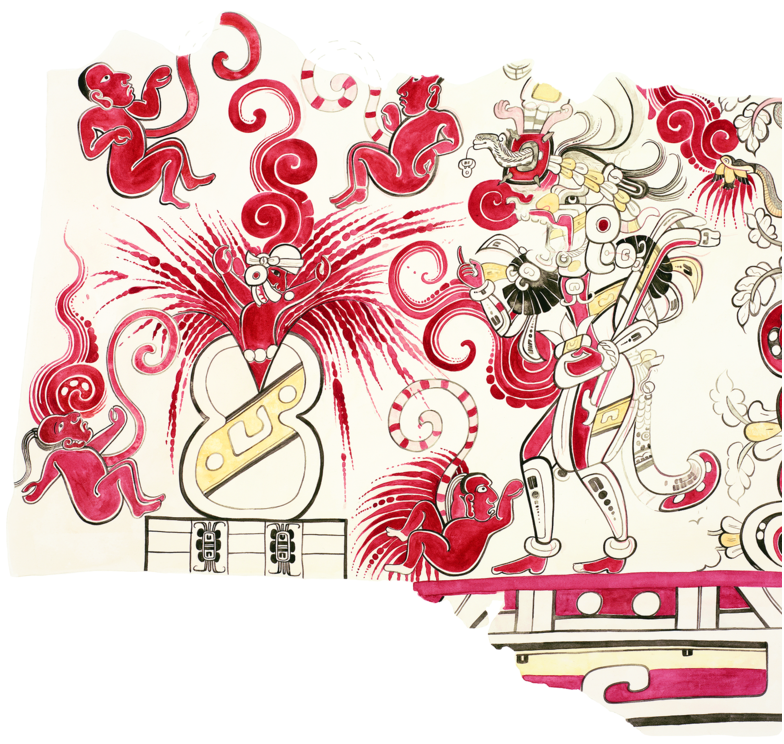
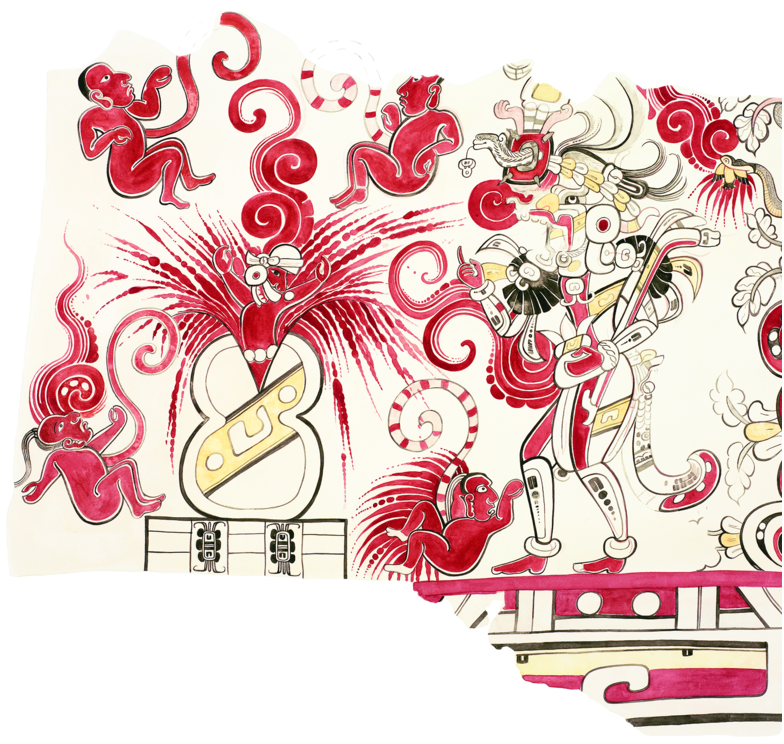
One scene on the north wall, for instance, illustrates five infants around an upright gourd with a clefted top, surrounded by vibrant read swirls and lines representing the life forces of blood and breath (Figure 1.1).Footnote 73 The positioning of the infants, four of whom lie prone around the gourd from which the fifth emerges, mirrors the quadripartite division of the earth with the world tree at its center.Footnote 74 The one rising up from the split gourd is the only member of the quintet adorned with a beaded belt, earspool, and headband, an ornamental combination that in Classic-period iconography is often characteristic of kings.Footnote 75 Images on the west wall of Str. 1, in turn, depict performances of penile bloodletting, animal sacrifice, and incense burning on tripod altars.Footnote 76 Although the protagonists may be mythological, the Late Preclassic practices shown in the San Bartolo murals would become standard components of Classic Maya religion across the lowlands, including the ritual repertoire of dynastic kings.Footnote 77
Detail from the north wall mural in Str. 1 at San Bartolo illustrating four infants surrounding an upright gourd as a fifth emerges from the cleft in its top.
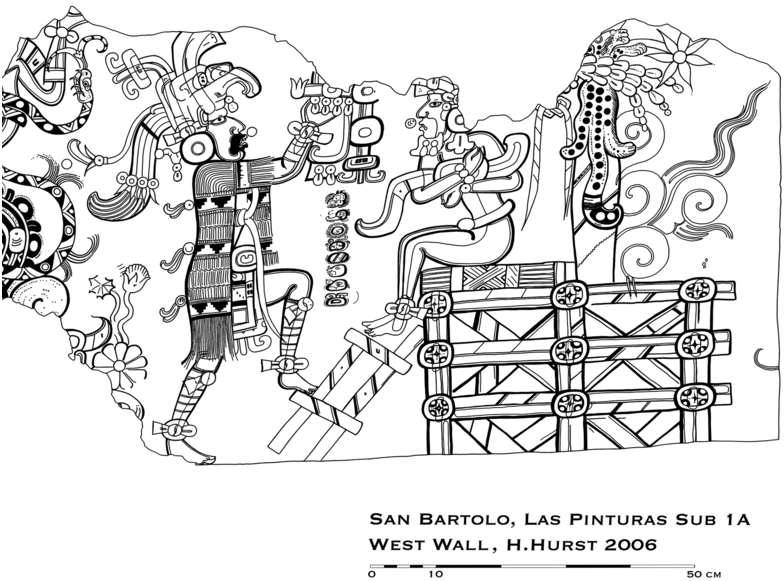
Most relevant for understanding the entanglement of writing and religion in ancient Maya civilization, though, are illustrations of at least two coronations on the west wall (Figure 1.2). In each case, the person of honor sits atop a scaffolded platform, holding across his chest a Preclassic version of the ceremonial bar that so many Classic-period kings and queens would later carry in their monumental portraits.Footnote 78 Although highly fragmented, the scene clearly depicts each seated ruler receiving from a supplicant or attendant an elaborate jewel, much like the one which Classic Maya kings would wear on their foreheads. The k’an (“yellow”) markings along one of the platforms may mark it as “a place of cosmological or dynastic foundation,” based on comparison with later, archaeologically excavated structures.Footnote 79 Two attending figures and at least one person being crowned represent aspects of the Maya Maize god, a character closely associated for centuries with the institution of divine kingship (Figure 1.2).Footnote 80
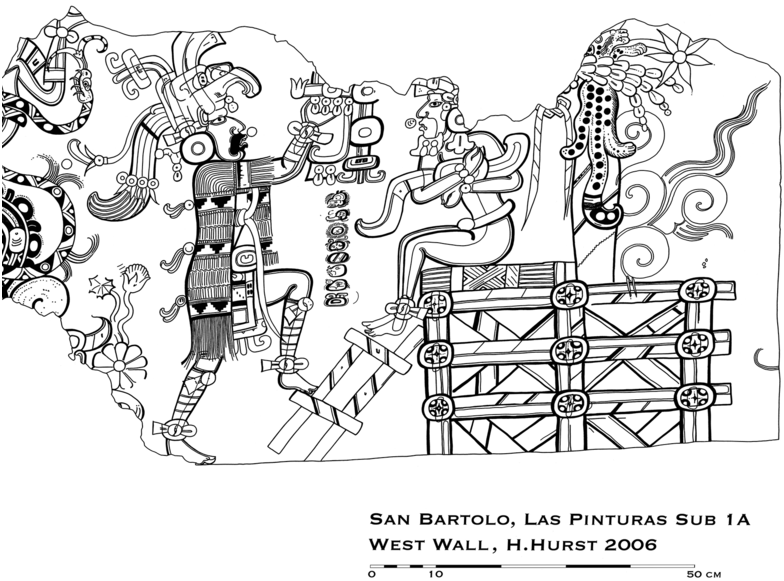
The terse hieroglyphic captions interspersed throughout the San Bartolo murals have not been fully deciphered, though the signs that can be parsed seem to identify individuals and events depicted nearby.Footnote 81 Still, there is no doubt that time plays a role in these scenes. Painted in red and at a larger scale than other signs, in another section of the west wall between the bloodletters and accession scenes, is the hieroglyph for the day Ik’, a word that also means “wind.”Footnote 82 In the 260-day calendar, the day Ik’ was one of the four so-called year bearers that marked the beginning of and thus ruled over the subsequent 365-day solar year.Footnote 83 The quartet of young men dancing nearby may, in fact, represent early anthropomorphic embodiments of the same year bearers.Footnote 84 Other calendrical references, as well as images of sacrifices and world trees distributed across the west wall, locate the dancers and other nearby figures in the four-corned Maya cosmos, with the viewer at its center.Footnote 85 The accession scenes painted on the west wall of San Bartolo Str. 1 may depict primordial events or reconstruct occurrences from a more recent past. In either case, they illustrate a primordial template for dynastic accession that was echoed during the Classic period, in ever-changing but essentially similar form, in many hundreds of records that historical kings later commissioned to document their own enthronements.Footnote 86
As an artistic assemblage, the Str. 1 murals at San Bartolo attest to ritual’s central role in the coalescence of elite governance and the hieroglyphic script in the Late Preclassic Maya lowlands. All three phenomena intersect most obviously in divine kingship, an institution that was firmly established by the Early Classic period.Footnote 87 Although the ruler did not exercise absolute control over hieroglyphic production, the practice and display of writing were core activities of the dynastic court. The semi-divine Classic Maya king or, more rarely, queen served as political leader and as principal mediator of relations with the gods and ancestors, leading rituals on the community’s behalf.Footnote 88 The close personal identification of gods with the king, both as an individual and as the office more generally, is also evident in the frequency with which theonyms were integrated into regnal names.Footnote 89 Power was passed generationally through dynastic succession but remained contingent on local relationships with supporters, including ancestors and deities.Footnote 90
The dynastic ruler’s authority derived from his or her role mediating between the community and the gods and ancestors; this authority was, as a result, highly localized.Footnote 91 Perhaps in part for this reason, no dynasty ever managed to consolidate control over the lowlands. The heterarchical character of Classic Maya politics meant that power was always distributed between multiple polities, precluding regional unification even during periods of peak polarization.Footnote 92 At the height of the Late Classic conflict in the central Petén between the hegemons Tikal and Calakmul, neither rival could secure the upper hand for more than a few generations at a time, and dozens of lesser polities such as Copan, Palenque, and Coba consistently maintained political and cultural autonomy and primacy in regional affairs throughout the Classic period.Footnote 93 Yet even through centuries of political fragmentation and shifting alliances, elites across polities maintained common cultural traditions that included ritual practices and hieroglyphic writing.
Religion, Ritual, and Writing
The proposal put forth here for the co-transmission of ritual and hieroglyphic writing accounts for a tension fundamental to understanding Classic Maya civilization. Ritual practice, like other spheres of cultural and social life, was defined by local and regional heterogeneity. It never coalesced into a single, unified tradition. Similarly, the form and content of scribes’ hieroglyphic texts varied widely along material, chronological, and spatial parameters. At the same time, the hieroglyphic script required ongoing exchange and consensus to remain legible between sites and over generations. Likewise, a king or queen’s ritual performances could only legitimize dynastic authority if they were recognizable to peers, successors, subjects, and gods. In other words, too much variation in writing and ritual practice would diminish the communicative power that made both such salient components of Classic Maya culture and society.
I argue that the interweaving of ritual and hieroglyphic writing mutually facilitated both traditions’ communicative coherence across the Classic Maya lowlands. Although the following chapters will necessarily address what people did and why, I am more concerned with how their actions facilitated knowledge transmission across religious and scribal contexts. Ritual is culturally central to this model, not as a source of the “deep cultural wisdom” or “ultimate values,” but as a participatory phenomenon that brings people together, “as a crossroads where distinct life processes intersect” and interact.Footnote 94 This perspective is appropriate to study of Indigenous contexts because it incorporates a broader understanding of religion and ritual and the roles they play in social life. It also accounts for the diversity in local practice that characterized what we now call Classic Maya religion from its earliest attestations.
Narratives of ancient civilizations have tended to emphasize political unification in explanations of how writing, as a nascent human technology, spread, persisted, and became codified in society. This focus has come at the expense of religion and ritual, with implications for broader theories about the origins of early writing. In arguing for religion’s influence on the ancient origin or development of writing, though, my goal is not to discard the narrative of political centralization. I do not insist that religion was the most important force in the history of early scripts, let alone the only one. Instead, I enlist religion and specifically ritual practice as a lens for exploring how cultural knowledge – in this case, a writing system – is transmitted and maintained over generations. What factors fostered early writing’s coherence as a system in the absence of political unification? How did people in politically fragmented, often conflictive communities maintain common cultural institutions? What, in essence, does a focus on the ritual tell us about the human phenomenon of civilization that we miss by concentrating on the political?
This book’s focus on religion and ritual reflects an approach to culture as voiced and replicative.Footnote 95 In this model, culture is both mono- and dialogical, the result of collective and ongoing “replicative processes through which ‘acquisition’ occurs, and circulation develops” in acts of adoption, response, and adaptation.Footnote 96 The narrative crafted over the succeeding chapters casts religion as a site for interaction and exchange that had meaningful consequences for how the Classic Maya thought about and engaged with their hieroglyphic script. Chapter 2 introduces archaeological and epigraphic evidence for writing’s development in ancient Mesopotamia, Egypt, China, and Mesoamerica, demonstrating that Maya hieroglyphs were not unusual among early scripts in having been closely tied to religion since their inception. At the same time, the Maya lowlands offer a unique context for examining religion and ritual’s role in a writing system’s long-term development precisely because its centuries-long coherence cannot be explained by political unification.

 Open access