The Middle Jurassic documents key events in the morphological and taxonomic diversification of many groups of land vertebrates, including dinosaurs (e.g., Benson et al. Reference Benson2014; Lee et al. Reference Kielan-Jaworowska and Ensom2014; Rauhut et al. Reference Panciroli, Walsh, Fraser, Brusatte and Corfe2016; Benson Reference Barron, Lott and Riding2018), mammals (e.g. Luo Reference Kowallis, Christiansen, Deino, Peterson, Turner, Kunk and Obradovich2007; Close et al. Reference Clark, Ross and Booth2016), squamates (e.g., Jones et al. Reference Ivakhnenko2013; Burbrink et al. Reference Buckland2019) and amphibians (e.g., Roelants et al. Reference Panciroli, Benson and Luo2007; Gao & Shubin Reference Freeman2012; Marjanović & Laurin Reference Luo, Meng, Ji, Liu, Zhang and Neander2014). Middle Jurassic fossils, therefore, provide vital information on the origins of groups that played central roles in Mesozoic terrestrial ecosystems, many of which persist to the present. However, terrestrial vertebrates from the Middle Jurassic are rare globally, being known predominantly from China (e.g., Sullivan et al. Reference Simpson2014; Xu et al. Reference Waldman and Evans2017), Russia (e.g., Averianov et al. Reference Averianov, Lopatin and Krasnolutskii2005, Reference Averianov, Martin, Lopatin, Schultz, Schellhorn, Krasnolutski, Skutschas and Ivantsov2016) and the UK (e.g., Evans & Milner Reference Evans, Milner and Mussett1994; Wills et al. Reference Wakefield2019). Within the UK, English Middle Jurassic units yielded the historically earliest discoveries of dinosaurs, pterosaurs, turtles and Mesozoic mammals (Buckland Reference Blake1824; Blake Reference Benson, Campione, Carrano, Mannion, Sullivan, Upchurch and Evans1863; Delair & Sarjeant Reference Cope, Dufl, Parsons, Torrens, Wimbledon and Wright2002; Anquetin & Claude Reference Anquetin and Claude2008). More recently, extensive screen-washing of sediment bulk samples at localities in Oxfordshire and Gloucestershire has uncovered abundant isolated remains that document a species-rich assemblage of small-bodied vertebrates including amphibians, reptiles and mammals from sites such as Kirtlington (Freeman Reference Foster and Heckert1976, Reference Foster and Lucas1979; Kermack et al. Reference Kermack, Kermack, Lees and Mills1987; Evans Reference Evans, Barrett, Hilton, Butler, Jones, Liang, Parrish, Rayfield, Sigogneau-Russell, Underwood, Barrett and Evans1990, Reference Evans1991a, Reference Evansb, Reference Evans1992, Reference Evans1994, Reference Evans1998; Evans et al. Reference Evans1988, Reference Evans1990; Evans & Milner Reference Evans, Milner and Mussett1994; Gillham Reference Gao and Shubin1994; McGowan Reference Martin-Silverstone, Unwin and Barrett1996; Sigogneau-Russell Reference Riding, Walton and Shaw1998, Reference Roelants, Gower, Wilkinson, Loader, Biju, Guillaume, Moriau and Bossuyt2003a; Gardner et al. Reference Freeman2003; Scheyer & Anquetin Reference Panciroli, Benson and Walsh2008). While much attention has been paid to Middle Jurassic outcrops in England, it is only recently that Scottish localities have undergone dedicated palaeontological study, particularly on the Isle of Skye.
The Kilmaluag Formation (Harris & Hudson Reference Haddoumi, Allain, Meslouh, Metais, Monbaron, Pons, Rage, Vullo, Zouhri and Gheerbrant1980) on the Isle of Skye, part of the Great Estuarine Group, is one of the richest fossiliferous formations for vertebrates in Scotland (Whyte & Ross Reference Sullivan, Wang, Hone, Wang, Xu and Shang2019). Many of the vertebrates currently known from the Kilmaluag Formation belong to species and genera already reported, but previously known only from disarticulated remains obtained by bulk sampling of sediments at English Bathonian localities (e.g., Evans et al. Reference Evans2006; Panciroli et al. Reference Panciroli, Benson and Walsh2018a and references therein). Compared to these the Kilmaluag Formation preserves substantially more complete specimens, including partial and near-complete skeletons that represent some of the oldest salamanders, squamates and crown-group mammals. Due to their significance, outcrops are legally protected as Sites of Special Scientific Interest (SSSIs) and through Scotland's Nature Conservancy Order (NCO), meaning that fossils can only be collected for scientific purposes through permits from Scottish Natural Heritage.
The first fossils from the ‘vertebrate beds’ of the Kilmaluag Formation were discovered in 1971 by Michael Waldman, a teacher at Stowe School (Waldman & Savage Reference Skutschas1972). Waldman and his colleague and mentor, Robert Savage (University of Bristol), and colleagues undertook seven field trips between 1971 and 1982. Further fieldwork was undertaken in the early 2000s by a team from the Natural History Museum, London, National Museums Scotland, University College London and the University of Oxford, under leadership of Susan Evans and Paul Barrett. Since 2010, fieldwork has continued, led by Roger Benson (University of Oxford), Stig Walsh (National Museums Scotland), Richard Butler (University of Birmingham) and Elsa Panciroli (University of Oxford), along with other participants (see Acknowledgements). A wealth of material collected by multiple expeditions has revealed the Kilmaluag Formation as one of the richest vertebrate fossil localities in the UK, and of global significance both in terms of faunal composition and the completeness of specimens.
An overview of the fossil finds from the Kilmaluag Formation was last provided in 2006 (Evans et al. Reference Evans2006). New discoveries since then have considerably expanded our knowledge of this assemblage and its global importance as a site for Middle Jurassic vertebrates. Here, we provide an up-to-date overview of the geology and collections, and discuss potential collection biases caused by the hard-weathering nature and poor reaction to acid of the limestone, which makes it unsuitable for bulk processing. We make comparisons between the Kilmaluag Formation faunal assemblage – particularly mammals, salamanders and squamates – and relevant contemporaneous localities from the UK, Europe, Asia and the US. These comparisons provide international context for the Kilmaluag Formation assemblage, and provide evidence regarding proposed global distribution patterns and macroevolutionary trends in various mammal groups and their close relatives.
Micro-CT scans and high resolution 3D renderings of many of the fossils described in the current work are available at https://www.morphosource.org/Detail/ProjectDetail/Show/project_id/1037.
Institutional abbreviations. NMS = National Museums Scotland, Edinburgh; NHMUK = Natural History Museum, London; CAMSM = Sedgwick Museum of Earth Sciences, University of Cambridge.
1. Geological overview
The Kilmaluag Formation (Harris & Hudson Reference Haddoumi, Allain, Meslouh, Metais, Monbaron, Pons, Rage, Vullo, Zouhri and Gheerbrant1980) is part of the Great Estuarine Group (formerly Great Estuarine Series; Judd Reference Jones, Lucas, Tucker, Watson, Sertich, Foster, Williams, Garbe, Bevitt and Salvemini1878, p. 722), a series of near-shore shallow marine, varied salinity lagoon and freshwater lagoon sediments of Bathonian age (Harris & Hudson Reference Haddoumi, Allain, Meslouh, Metais, Monbaron, Pons, Rage, Vullo, Zouhri and Gheerbrant1980; Andrews Reference Andrews1985; Barron et al. Reference Barrett2012) (Fig. 1). The Great Estuarine Group comprises the Middle Jurassic portion of the Sea of Hebrides Basin and Inner Hebrides Basin: tectonically bound basins with sedimentology that reflects fluctuating sea levels caused by subsidence and uplift (Morton Reference McGowan1987; Mellere & Steel Reference Mateus, Foster and Lucas1996; Hesselbo & Coe Reference Harris and Hudson2000). These Mesozoic sediments are overlain disconformably by Palaeogene basalt (Harris & Hudson Reference Haddoumi, Allain, Meslouh, Metais, Monbaron, Pons, Rage, Vullo, Zouhri and Gheerbrant1980).
The location of surface outcrops of the Kilmaluag Formation and overview of the stratigraphy of the Great Estuarine Group (A). Outcrops N of Elgol (B) and the appearance of bone (black) against the micritic blue-grey limestone (C). Map adapted from Wikimedia Commons. Stratigraphy compiled and adapted from Cohen et al. (Reference Close, Davis, Walsh, Woloniewicz, Friedman and Benson2019), Andrews (Reference Andrews1985) and Barron et al. (Reference Barrett2012).

The Kilmaluag Formation crops out on the Scottish Inner Hebridean islands of Eigg, Skye and Muck, and is approximately 25 m in thickness at the most complete section on the Strathaird Peninsula on Skye (Harris & Hudson Reference Haddoumi, Allain, Meslouh, Metais, Monbaron, Pons, Rage, Vullo, Zouhri and Gheerbrant1980; Morton & Hudson Reference Mellere, Steel, DeBatist and Jacobs1995) (Figs 1, 2). It was formerly known as the Ostracod Limestone, and the base of the formation is defined by the occurrence of ostracod-bearing calcareous mudstones and marls/fissile mudstones (Anderson & Dunham Reference Anderson and Dunham1966; Harris & Hudson Reference Haddoumi, Allain, Meslouh, Metais, Monbaron, Pons, Rage, Vullo, Zouhri and Gheerbrant1980; Andrews Reference Andrews1985; Barron et al. Reference Barrett2012). The Kilmaluag Formation is named for the village of Kilmaluag on the Trotternish Peninsula of Skye, where the type section crops out along the shore of Kilmaluag Bay (Harris & Hudson Reference Haddoumi, Allain, Meslouh, Metais, Monbaron, Pons, Rage, Vullo, Zouhri and Gheerbrant1980). Despite being less extensive than exposures on the Strathaird Peninsula in southern Skye, Kilmaluag was chosen as the locality of the type section as it is accessible and fossiliferous, and the base of the formation can be easily defined to within 3 m (Harris & Hudson Reference Haddoumi, Allain, Meslouh, Metais, Monbaron, Pons, Rage, Vullo, Zouhri and Gheerbrant1980).
Stratigraphy of the Kilmaluag Formation at two main fossil collection sites on the Strathaird Peninsula. Adapted from Andrews (Reference Andrews1985).

The age of the Kilmaluag Formation correlates with the Retrocostatum Zone, and is Late Bathonian in age (Barron et al. Reference Barrett2012), just over 166.1 Ma (Cohen et al. Reference Close, Davis, Walsh, Woloniewicz, Friedman and Benson2019). The similarities in vertebrate faunal composition with that from the Kirtlington Cement Quarry (Forest Marble Formation, see below) in England also support a Late Bathonian age. Unlike other formations within the Great Estuarine Group, the Kilmaluag Formation includes predominantly low-salinity and freshwater facies, especially on the Strathaird Peninsula, as demonstrated by the presence of freshwater ostracods (Darwinula and Theriosynoecum: Wakefield Reference Skutschas1995), shallow freshwater to oligohaline conchostracans (such as Anthronesteria and Pseudograpta: Chen & Hudson Reference Caldwell, Nydam, Palci and Apesteguía1991) and freshwater gastropods (Viviparus: Andrews Reference Andrews1985; Morton & Hudson Reference Mellere, Steel, DeBatist and Jacobs1995; Barron et al. Reference Barrett2012) (Fig. 3).
Invertebrate fossils in the Kilmaluag Formation: (A) Viviparus; (B) ostracods; (C) hybodont shark Acrodus caledonicus NHMUK PV6642 (adapted from Rees & Underwood Reference Panciroli, Benson and Butler2005, fig. 5); (D) unidentified fish fossil in situ. Scale bars = 10 mm (C, D).

The Kilmaluag Formation can be divided into two distinct facies: predominantly siliciclastic facies in northern Skye, including sandstones; and predominantly argillaceous (muddy) limestone facies found on the Strathaird Peninsula in southern Skye, and also in small outcrops on Eigg and Muck, which do not include sandstones (Andrews Reference Andrews1985). Palaeoenvironmental reconstructions of the siliciclastic facies suggest a low-salinity environment of closed lagoons or marginal coastal lakes, fed by small rivers which carried in siliciclastic sediments and plant material (Andrews Reference Andrews1985). Multiple layers of desiccation cracks, and reworked desiccation breccias infilling mud-cracks, suggest periodic drying out followed by wetter periods of lagoon expansion. There are also rippled sandsheets in some beds, with tuning-fork bifurcations indicative of wave generation (Andrews Reference Andrews1985).
The argillaceous limestone facies were depositional rather than diagenetic in origin and contain up to 44 % acid-insoluble residues (Andrews Reference Andrews1985). These beds are locally altered by metamorphism resulting from Palaeogene igneous intrusions (Hesselbo & Coe Reference Harris and Hudson2000). The mud-dominated lower beds, which alternate between muds with high clay content and muddy carbonates with lower clay content, represent a low-salinity to freshwater lagoon environment, which evaporated in drier seasons and expanded in wetter seasons (Andrews Reference Andrews1985). This environmental interpretation is supported by alternating clay-rich muds, and muddy carbonates that are dominated by disarticulated ostracod bioclasts and structureless micrite introclasts (Andrews Reference Andrews1985). Infrequent dolomites probably represent the dolomitisation of precursor carbonates during extreme periods of desiccation (Andrews Reference Andrews1985, p. 1128). This would have exposed mudflats, forming desiccation cracks and flat-pebble conglomerates. The argillaceous facies were fed by meteoric waters, unlike the clastic facies in the N. This interpretation of a low-salinity closed-lagoon environment is supported by a palynoflora that includes Tasminites and Botryoccus (Riding et al. Reference Panciroli, Schultz and Luo1991).
Andrews (Reference Andrews1985) informally divided the Kilmaluag Formation into a series of numbered horizons, with horizons nine and ten near the middle of the sequence, also known as the ‘Vertebrate Beds’. These beds are highly fossiliferous, located on the Strathaird Peninsula, and are thought to represent a predominantly wet climatic phase. These beds alternate between muddy carbonates, hard blue-grey limestones, micrites, wackestones and breccia conglomerates, and appear to be predominantly freshwater (Andrews Reference Andrews1985). The lowest magnesium oxide content is found in these beds, and in some there is smooth millimetre-scale lamination, and some stromatolitic domed laminations, which suggests a shallow sublittoral depositional environment. Vertebrate fossil remains in the Kilmaluag Formation are black in colour, and are scattered throughout.
Breccia beds that overlie the vertebrate beds also yield body and trace fossil material (see below) (Andrews Reference Andrews1985; Marshall Reference Marjanović and Laurin2003) (Fig. 2). The breccia beds comprise three dolomitic, gradationally bound beds combined into one bedset (Marshall Reference Marjanović and Laurin2003). Each bed consists of silty micrite, which becomes brecciated upwards across a desiccation-cracked horizon. The brecciation and mud-cracks are inferred to result from prolonged subaerial exposure and desiccation (Marshall Reference Marjanović and Laurin2003). This evidence, coupled with the lack of fossilised vegetation, suggests these beds represent a barren or sparsely vegetated supralittoral lagoon margin (Marshall Reference Marjanović and Laurin2003).
2. Fossil flora and fauna of the Kilmaluag Formation
2.1. Flora
No in-depth palaeobotanical studies have been made of the plant fossils of the Great Estuarine Group. Floral remains mostly comprise poorly preserved fragments, and only rare small broken pieces of bark and stem occur in the Kilmaluag Formation (Panciroli, pers. obs. 2016). A single palynological study included data from the Kilmaluag Formation in the Trotternish Peninsula of northern Skye as part of a wider analysis of the Jurassic rocks of the Hebrides Basins (Riding et al. Reference Panciroli, Schultz and Luo1991). They took 16 samples from the Isle of Skye, 12 of them from the type section at Port Gobhlaig in Kilmaluag Bay and four at Prince Charles' Point. These samples indicated low palynological diversity dominated by gymnosperm pollen (up to 87 %), with <24 % pteridophyte spores (Riding et al. Reference Panciroli, Schultz and Luo1991, p. 143).
2.2. Invertebrate fossils
The most abundant invertebrate fossils of the Kilmaluag Formation are arthropods, notably ostracods, principally Darwinula and Theriosynoecum (Wakefield Reference Skutschas1995), and the conchostracans Anthronesteria and Pseudograpta (Chen & Hudson Reference Caldwell, Nydam, Palci and Apesteguía1991). There are also molluscs such as the gastropod Viviparus and the bivalve Unio (Harris & Hudson Reference Haddoumi, Allain, Meslouh, Metais, Monbaron, Pons, Rage, Vullo, Zouhri and Gheerbrant1980; Andrews Reference Andrews1985). Trace-fossil burrows attributed to larger decapods are also preserved in the vertebrate beds and breccia beds on the Strathaird Peninsula of southern Skye and are interpreted as dwelling burrows for crabs or shrimps (Marshall Reference Marjanović and Laurin2003).
Only a handful of other invertebrate fossils are known from the Kilmaluag Formation. Insect-bearing strata were discovered by EP in 2017 at an outcrop of Kilmaluag Formation at Lub Score on the Trotternish Peninsula. Subsequently, multiple specimens have been collected and await description (under study by A. Ross). These mainly comprise beetle wing cases that cannot be assigned above ordinal level, but continued collection should yield sufficient data to give some indication of insect faunal diversity in the future.
2.3. Chondrichthyes and Osteichthyes
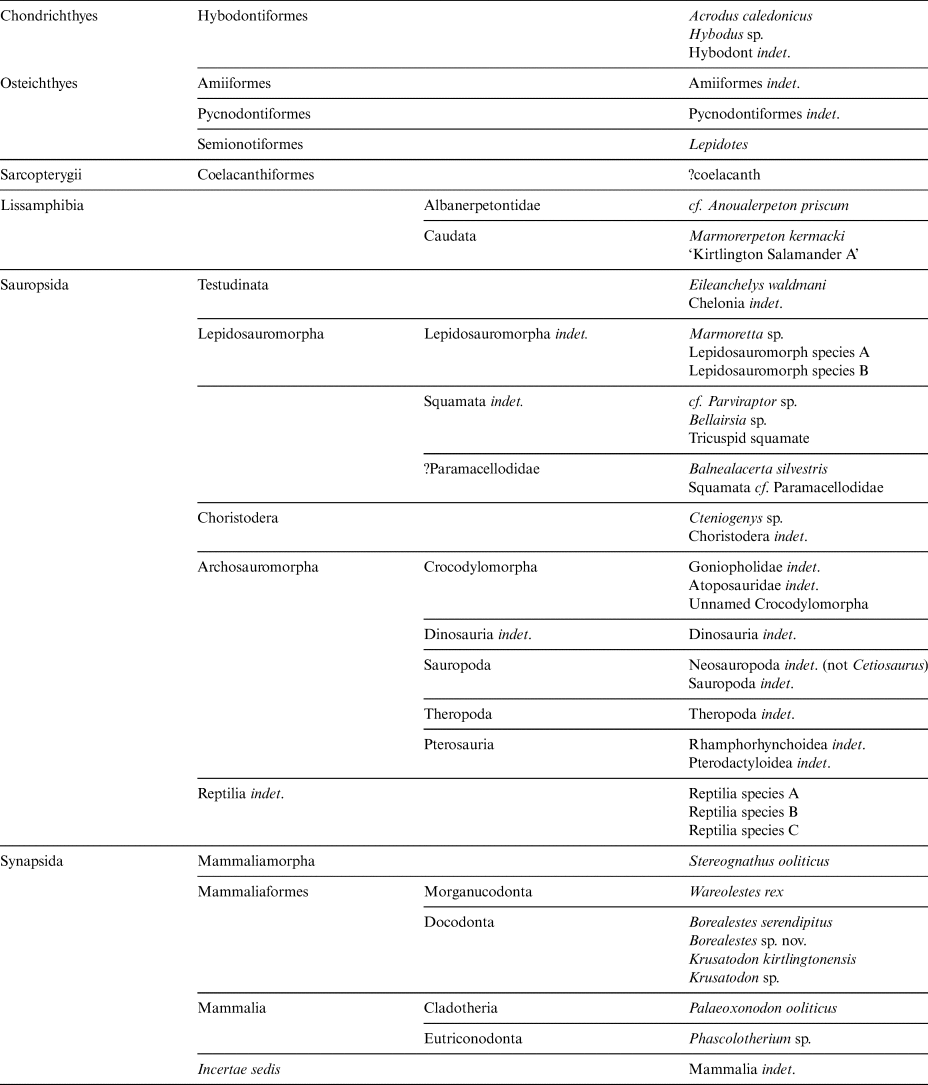
Three chondrichthyan and two osteichthyan taxa have been described from the Kilmaluag Formation to date. The chondrichthyans are hybodont sharks: Acrodus, Hybodus and an indeterminate hybodont (Rees & Underwood Reference Panciroli, Benson and Butler2005; Evans et al. Reference Evans2006). The Acrodus specimens represent new species, and comprise the only non-marine Jurassic occurrences in Europe, and some of the youngest occurrences of this genus known (Rees & Underwood Reference Panciroli, Benson and Butler2005) (Fig. 3). Pycnodont scales are visible at outcrop (Panciroli & Benson, pers. obs. 2019). The semionotiform Lepidotes and an unidentified sarcopterygian (?coelacanth) have previously been recovered (Evans et al. Reference Evans2006), and some partial mandibles belonging to amiiforms were collected recently, but not yet described. All of these are known from isolated scales, teeth and/or tooth fragments. In the last decade of fieldwork more fossil fish have been recovered (e.g., Fig. 3d), including partial associated skeletons that currently await preparation and study.
2.4. Lissamphibia
Two species of salamander and one albanerpetontid are known from the Kilmaluag Formation (Evans & Waldman Reference Evans and Chure1996; Evans et al. Reference Evans2006). The salamanders, Marmorerpeton and (the informally named) ‘Kirtlington salamander A’, were both originally reported on the basis of isolated elements obtained by screen-washing from the Middle Jurassic Forest Marble Formation of Kirtlington, England (Evans et al. Reference Evans1988, Reference Evans2006; Evans & Milner Reference Evans, Milner and Mussett1994). There is currently no evidence of frogs or caecilians from Skye, although frogs have been described from the Kirtlington microvertebrate assemblage (Evans et al. Reference Evans1990).
Marmorerpeton is a relatively large, paedomorphic, aquatic salamander (Evans et al. Reference Evans1988; Evans & Milner Reference Evans, Milner and Mussett1994; Evans & Waldman Reference Evans and Chure1996). Most material is estimated to come from animals 25–30 cm long (Evans et al. Reference Evans1988). One partial skeleton was collected from Skye by Waldman and Savage (reported in Evans & Waldman Reference Evans and Chure1996), but has not yet been described. Recent fieldwork has recovered a second part of the same skeleton, as well as several addition partial skeletons (Fig. 4c–g). Collectively, these specimens include most of the skull and postcrania and they are currently under study (Jones et al. Reference Jones, Anderson, Hipsley, Müller, Evans and Schoch2019) (Fig. 4).
Amphibians. Premaxillae of Albanerpetontidae cf. Anoualerpeton priscum NMS G.2019.34.6 in lingual (A), labial (B), and apical (D) views, Marmorerpeton roofing bone (field number ELGOL.2019.15) in dorsal view (C). Exoccipital of Marmorerpeton (field number ELGOL.2016.019) in rostral view left side reflected to represent the right side (E). Dorsal vertebra of Marmorerpeton (field number ELGOL.2016.024) in rostral view (F) and left lateral view (G). Atlas of ‘Salamander A’ (field number ELGOL.2016.004) in rostral view (H) and left lateral view (I). Dorsal vertebra of ‘Salamander A’ (field number ELGOL.2016.004) shown in rostral (J) and left lateral view (K). Abbreviations: cen = centrum; cot = cotyle; fac = facet; fu.sut.se = fused suture seam; neu.arc = neural arch; not.can = notochordal canal; neu.cre = neural crest; prezyg = presygapophyses; rib.ber = rib bearer; sub.sh = subdental shelf; too = tooth; tr.pro = transverse process. All scale bars = 1 mm.

Accessioned material of Marmorerpeton kermacki includes an association of vertebrae, limb and skull elements (NMS G.1992.47.9), two fused caudal vertebrae (NMS G.1992.47.12), multiple isolated vertebrae (NMS G.1992.47.25, NMS G.1992.47.26 and NMS G.1992.47.27) and a partial ilium (NMS G.1992.47.15; Evans & Waldman Reference Evans and Chure1996, fig. 1b).
The strongly sculptured skull bones, proportions of the atlas, absence of spinal nerve foramina in the atlas (Evans et al. Reference Evans1988) and features of the ilium suggest that Marmorerpeton may be an early karaurid, a group of stem salamanders that are known from the Middle Jurassic to Early Cretaceous of Kyrgyzstan, Kazakhstan and Russia (Ivakhnenko Reference Helmdach1978; Nesov Reference Meng, Grossnickle, Liu, Zhang, Neander, Ji and Luo1988; Nesov et al. Reference Morton1996; Skutschas & Krasnolutskii Reference Sigogneau-Russell2011; Skutschas & Martin Reference Sigogneau-Russell2011; Skutschas Reference Schultz, Bhullar and Luo2013, Reference Seiffert2014a, Reference Sigogneau-Russellb; Skutschas et al. Reference Skutschas and Martin2018). Whether this group is monophyletic or paraphyletic (sharing several plesiomorphic characters) remains to be established. The proportions of exoccipital among the Scottish material (Fig. 4e) most closely resemble those of M. kermacki, one of the two species named from Kirtlington (Evans et al. Reference Evans1988).
A second salamander, referred to informally as ‘Kirtlington Salamander A’ (Evans & Milner Reference Evans, Milner and Mussett1994), is also present at Skye (Evans & Waldman Reference Evans and Chure1996; Evans et al. Reference Evans2006) and is relatively common there, based on recently collected material (Fig. 4h–k). Salamander A was probably smaller than Marmorerpeton (Evans & Milner Reference Evans, Milner and Mussett1994) but was also likely aquatic. Multiple isolated elements of ‘Kirtlington Salamander A’ from Skye – mostly vertebrae – are accessioned at NMS, including NMS G.1992.47.14. To date, the only published image of ‘Kirtlington Salamander A’ is a dorsal vertebra in lateral view (Evans & Waldman Reference Evans and Chure1996, fig. 1a). However, associated skeletons that include skull roof and braincase elements have been found more recently and are currently under study (Jones et al. Reference Jones, Anderson, Hipsley, Müller, Evans and Schoch2019).
Features of the atlas and vertebrae (e.g., absence of spinal nerve foramina, no interglenoid tubercle) suggest that ‘Kirtlington salamander A’ is a stem salamander (Jones et al. Reference Jones, Anderson, Hipsley, Müller, Evans and Schoch2019). It is easily distinguished from Marmorerpeton due to its shorter dorsal vertebrae that have shallow rib bearers, less textured skull bones and wider notochordal canals.
Albanerpetontids are represented by just one specimen, a pair of articulated premaxillae, collected in 2014 (NMS G.2019.34.6) (Fig. 4a, b, d). The specimen shows many similarities with Anoualerpeton priscum, previously known only from the microvertebrate assemblage at Kirtlington (Gardner et al. Reference Freeman2003).
2.5. Lepidosauromorpha
The Kilmaluag Formation has yielded a diversity of lepidosauromorphs (Waldman & Evans Reference Skutschas1994; Evans & Waldman Reference Evans and Chure1996; Evans et al. Reference Evans2006; work in progress), including some of the earliest crown squamates, as well as more basal taxa.
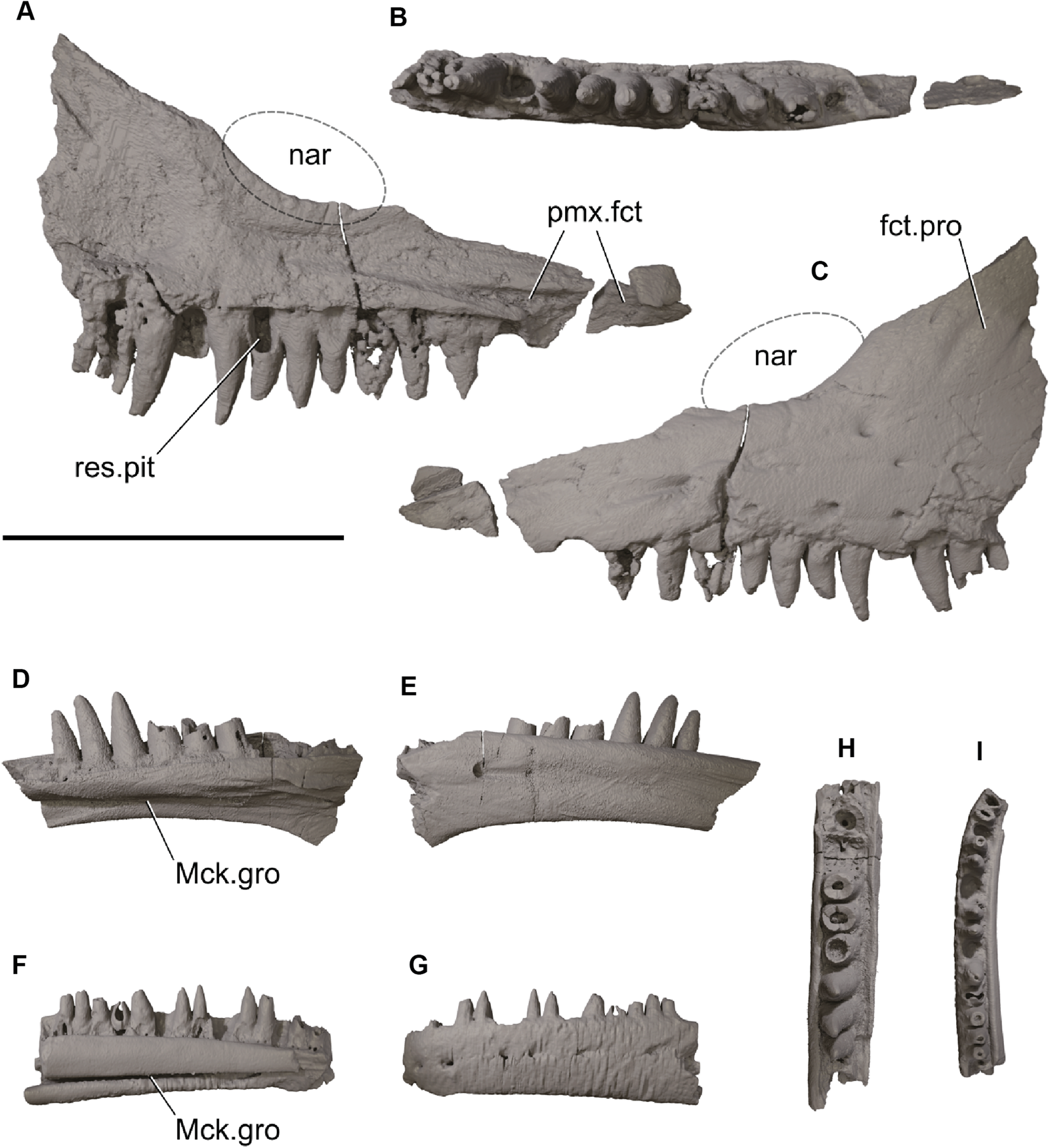
Marmoretta sp. is the most abundant small reptile in the Kilmaluag assemblage, represented by multiple dentaries and maxillae including CAMSM x9991, as well as the partial skeleton NMS G.1992.47.1 (Waldman & Evans Reference Skutschas1994, figs 6–9), and the maxillae NMS G.1992.47.4 (Fig. 5a–c) and NMS G.1992.47.5 (Waldman & Evans Reference Skutschas1994, fig. 5). Marmoretta was originally described from the microvertebrate assemblage at Kirtlington (Evans Reference Evans1991a) and other English Bathonian sites (Evans Reference Evans1992; Evans & Milner Reference Evans, Milner and Mussett1994), and is also known from the Late Jurassic of Portugal (Evans Reference Evans1991a). The partial skeleton NMS G.1992.47.1 remains the most complete specimen of Marmoretta (Evans Reference Evans1991a; Waldman & Evans Reference Skutschas1994). Only the skull and limited aspects of postcranial morphology have been described so far (Waldman & Evans Reference Skutschas1994, figs 6–8). However, micro-computed tomography (CT) scans indicate a more substantially complete and three-dimensionally preserved skeleton, largely covered by matrix that is currently under study.
Lepidosauromorphs from the Kilmaluag Formation: Marmoretta NMS G.1992.47.4 in lingual (A), apical (B) and labial (C) view; Lepidosauromorph ‘species A’ NMS G.2019.34.9 in lingual (D), labial (E) and apical (H) views; and Lepidosauromorph ‘species B’ NMS G.2019.34.13 in lingual (F), labial (G) and apical (I) views. Abbreviations: fct.pro = facial process; nar = naris; res.pit = resorption pit; pmx.fct = premaxilla facet; Mck.gro = Meckelian groove. Scale bar = 5 mm.
Recent fieldwork has substantially extended the number of known lepidosaur fossils from the Kilmaluag Formation, including the collection of more than 20 isolated tooth-bearing elements and several partial or near-complete skeletons. To date, these new specimens represent squamates and stem-group lepidosaurs. No rhynchocephalians are currently known. Rhynchocephalians are also rare in other Middle Jurassic assemblages in the UK: only three incomplete bones were reported previously from Kirtlington Cement Quarry (Evans Reference Evans1992; Evans & Milner Reference Evans, Milner and Mussett1994), despite bulk sampling of large quantities of sediment (Ward Reference Skutschas, Kolchanov, Averianov, Martin, Schellhorn, Kolosov and Vitenko1984) and abundant remains of other lepidosaurs (e.g., Evans Reference Evans1998; Evans & Milner Reference Evans, Milner and Mussett1994).
Two partial dentaries with subpleurodont dental implantation show notable differences from each other and from dentaries of Marmoretta (NMS G.1992.47.1 and referred specimens from Kirtlington; Evans Reference Evans1991a; Waldman & Evans Reference Skutschas1994). Both might represent distinct lepidosauromorph species. Lepidosauromorph ‘species A’, NMS G.2019.34.9 (Fig. 5d, e, h), differs from Marmoretta in having a dentary that is dorsoventrally expanded towards the symphysis, giving the ventral margin a strongly curved outline. Seen in lingual view, the anterior end of the bone has an unusual morphology. The rounded subdental shelf develops a sharp-edged and facetted flange, presumably for articulation with a large splenial. Below this, the expanded ventral margin is also facetted.
Lepidosauromorph ‘species B’, NMS G.2019.34.13, is a partial left dentary recovered in 2015 (Fig. 5f, g, i) with subpleurodont dental implantation, and may represent a distinct taxon from Marmoretta. It differs from Marmoretta in possessing conical teeth with apices that are not recurved (those of Marmoretta are curved apicoposteriorly; Fig. 5a–c). Some teeth have mesiodistally wide bases and others have mesiodistally narrow bases, whereas the teeth of Marmoretta vary only gradually (mesial teeth have narrow bases and are smaller). Neither specimen is currently considered sufficient as the basis for a new species but, nevertheless, these specimens show a potentially larger and as-yet unappreciated diversity of primitive lepidosauromorphs in the assemblage.
Several squamates or stem-squamates have been reported so far, based predominantly on tooth-bearing elements (dentaries and maxillae), as well as isolated vertebrae. Waldman & Evans (Reference Skutschas1994) described two isolated dentaries – the almost complete right and a partial left dentary of what they referred to Paramacellodus sp. (NMS G.1992.47.2; NMS G.1992.47.3; Waldman & Evans Reference Waldman and Evans1994, fig. 4) based on overall similarities of the jaw shape (e.g., orientation of the Meckelian canal, elongated lateral depression) and tooth morphology (chisel-shaped striated tooth tips, posteriorly directed). A similar left dentary was collected in 2016 (NMS G.2019.34.11) (Fig. 6c–e). Furthermore, micro-CT scans of NMS G.1992.47.2 reveal a right frontal, left pterygoid with a single pterygoid tooth row, and abraded right humerus within the matrix. These show additional paramacellodid-like features, including paired frontals of roughly equal anterior and posterior width with an interdigitating median suture (Evans & Chure Reference Evans, Milner and Mussett1998). The frontals differ from those of Paramacellodus in having a more complex median interdigitation, in lacking any obvious interdigitation of the frontoparietal suture and in having a deeper anteroventral descending lamina. However, the absence of osteoderms associated with any of these specimens, or even as isolated elements in the matrix, suggests that these specimens do not belong to Paramacellodus and they are referred here to Squamata cf. Paramacellodidae indet.
Squamates: tricuspid squamate dentary, NMS G.1992.47.125 in lingual (A) and labial (B) views; Squamata cf. Paramacellodidae NMS G.2019.34.11 in lingual (C), labial (D) and apical view (E). Abbreviations: sub.sh = subdental shelf; for = foramen; spl.fac = splenial facet; Mck.gro = Meckelian groove. Scale bar = 1 mm.

An assemblage of tiny skull bones, including a right dentary, partial right maxilla and a partial right prefrontal collected in 2015, is referred to Balnealacerta silvestris (NMS G.2019.34.3) (Fig. 7a–g). This identification is based on detailed similarities of the anterior part of the dentary, including the anterodorsal angulation of the Meckelian groove at the symphysis and the presence of a long ventrolateral muscle scar. Balnealacerta silvestris was originally reported from Kirtlington and referred to Paramacellodidae (Evans Reference Evans1998) based on similarities of the dentary and tooth morphology to those of other paramacellodids. However, no trace of the characteristic oblong osteoderms typical of paramacellodids has been found either at Kirtlington or in the Skye material, raising doubts regarding its paramacellodid affinity.
Squamates from the Kilmaluag Formation: Balnealacerta silvestris NMS G.2019.34.3 dentary and partial maxilla (A), with the dentary in lingual (B), labial (C) and apical (D) views, and maxilla in lingual (E), labial (F) and apical (G) views; Bellairsia gracilis NMS G.2019.34.1 in labial (H, I), lingual (J, K) and apical (L, M) views. Abbreviations: PRF = prefrontal; DEN = dentary; for = foramen; muc.sca = muscle scar; MAX = maxilla; sym = symphysis; res.pit = resorption pit; Mck.gro = Meckelian groove; spl.fac = splenial facet; lin.sh = lingual shelf; nar = naris; fac.pro = facial process; brk = breakage; sub.sh = subdental shelf. Scale bar = 1 mm.

Evans & Waldman (Reference Evans and Chure1996, fig. 4) reported a dentary and parts of other bones scattered on a slab as Scincomorpha indet. (NMS G.1992.47.10). Here, we note strong similarity of that specimen to the holotype of Bellairsia gracilis (NHMUK PV R12678) reported previously from Kirtlington as of the most abundant reptiles in that assemblage (Evans Reference Evans1998). These specimens share a gracile jaw morphology (slender and parallel-sided rather than ‘boat-shaped), open Meckelian groove and small, lingually striated teeth. Therefore, we refer NMS G.1992.47.10 to Bellairsia sp. We also report an incomplete left dentary preserved in two parts (the symphysis and a central portion; NMS G.2019.34.1) (Fig. 7h–m) that shares the slender teeth, relatively simple tooth tips, low subdental shelf and pattern of prearticular and angular faceting with the holotype of Bellairsia from Kirtlington (NHMUK PV R12678). Finally, a near-complete, articulated skeleton, probably referable to Bellairsia, that was collected in 2016 is currently under study.
Evans and Waldman (Reference Evans and Chure1996) reported multiple vertebrae from the Kilmaluag Formation as being similar to subadult specimens of the squamate Parviraptor from the microvertebrate assemblage of Kirtlington. The presence of Parviraptor-like squamates in the Kilmaluag Formation has been confirmed by the discovery of further material, which is currently under study.
Referrals of individual vertebrae to Parviraptor are complicated. Parviraptor estesi was originally reported from the Early Cretaceous Purbeck Group of the UK (Evans Reference Evans1994) and referred to Anguimorpha. Additional species of Parviraptor were subsequently erected based on specimens from the Late Jurassic of North America (Evans Reference Evans1996; Evans & Chure Reference Evans, Milner and Mussett1998) and Portugal (Evans Reference Evans1994, Reference Evans1996), and specimens from the microvertebrate assemblage from the Middle Jurassic of Kirtlington were referred to Parviraptor cf. P. estesi by Evans (Reference Evans1994). Recently, many of these specimens were referred to new genera or new genera and species, and this group was attributed to stem-group snakes (Caldwell et al. Reference Butler and Sigogneau-Russell2015). Here, we confirm the presence of Parviraptor-like specimens from the Kilmaluag Formation of Skye that are under ongoing study.
A new squamate dentary, NMS G.1992.47.125, with weakly tricuspid teeth (Fig. 6a, b) was also found during fieldwork in 2004 and is distinct from other specimens both from Skye and from Kirtlington Cement Quarry (Evans et al. Reference Evans2006). Among the as-yet unidentified squamate material is a gekkotan-like vertebra (G.1992.47.13: Evans et al. Reference Evans2006) and multiple fragmentary specimens that cannot yet be identified.
2.6. Testudinata
Turtle fossils are common in the Kilmaluag Formation on the Strathaird Peninsula, mostly comprising broken non-associated portions of turtle carapace and plastron (e.g., NMS G.1992.47.25; Evans & Waldman Reference Evans and Chure1996; Evans et al. Reference Evans2006), but also some significant associated material (Anquetin et al. Reference Anquetin, Barrett, Jones, Moore-Fay and Evans2009) (Fig. 8a). A new genus and species of stem turtle, Eileanchelys waldmani (Anquetin et al. Reference Anquetin, Barrett, Jones, Moore-Fay and Evans2009; Anquetin Reference Anquetin2010), was named from material recovered during field work in 2004. This material included the holotype partial skull, NMS G.2004.31.15 and the paratypes NMS G.2004.31.16a–f, comprising, in total, at least three associated partial skeletons on the same limestone block. The paratype material includes postcrania and almost complete carapaces. Eileanchelys waldmani represents one of the earliest recorded aquatic turtles, and one of the few known from the Middle Jurassic. Its mixture of plesiomorphic and derived characters make it a key taxon in tracking the morphological evolution of the vomer and basicranium from basalmost to crown-group turtles (Anquetin et al. Reference Anquetin, Barrett, Jones, Moore-Fay and Evans2009).
Reptile fossils from the Kilmaluag Formation: turtle Eileanchelys waldmani NMS G.2004.31.16d (A) (image: J. Anquetin); crocodylomorph osteoderms NHMUK PV R36713 (B) (adapted from Wills et al. Reference Turner and Peterson2014, fig. 4a); sauropod dinosaur tooth NMS G.2004.31.1 (C) (adapted from Barrett Reference Averianov, Martin, Lopatin, Schultz, Schellhorn, Krasnolutski, Skutschas and Ivantsov2006, fig. 1); and a non-pterodactyloid pterosaur collected in 2016 (D) (photo by R. Close). Scale bars = 50 mm (B); 5 mm (C).

2.7. Choristodera
The choristodere Cteniogenys is represented by a partial skull from the Kilmaluag Formation, NMS G.1992.47.11 (Evans & Waldman Reference Evans and Chure1996, fig. 3). Cteniogenys antiquus was originally named on the basis of jaw elements from the Late Jurassic Morrison Formation of North America (Gilmore Reference Gilmore1909, Reference Gilmore1928) and further specimens of Cteniogenys were reported from the Late Jurassic of Portugal (Seiffert Reference Rees and Underwood1973; Cteniogenys reedi). Gilmore and Seiffert interpreted Cteniogenys as a stem-squamate, but analysis of abundant elements from the Middle Jurassic microvertebrate assemblage of Kirtlington showed that Cteniogenys was an early choristodere (Evans Reference Ensom1989, Reference Evans1991b). Some specimens of Cteniogenys sp. from the Kilmaluag assemblage are more complete and include associated sets of elements (e.g., Evans & Waldman Reference Evans and Chure1996, fig. 3). A tiny broken skull of Cteniogenys, NMS G.2019.34.4, from the Kilmaluag assemblage is currently under study.
2.8. Reptilia indet.
Four specimens of uncertain affinity are here referred to as Reptilia ‘species A’ (NMS G.1992.17.124 and NMS G.1992.17.126), Reptilia ‘species B’ (NMS G.2019.34.7) and Reptilia ‘species C’ (NMS G.2019.34.12). These specimens all likely constitute new taxa, but lack synapomorphies that would allow them to be referred to any of the other clades mentioned herein, and are insufficiently well known to provide a basis for new species names.
Reptilia ‘species A’ is known from two near-complete dentaries with subthecodont dental implantation and conical teeth (NMS G.1992.47.124 and NMS G.1992.47.126). These dentaries are unusual in that they become dorsoventrally narrow in their anterior one third, even allowing for breakage. Although the dentition is reminiscent of that of Cteniogenys in general appearance, these dentaries lack the double rows of grooved labial neurovascular foramina that characterise the jaws of choristoderes.
Reptilia ‘species B’ is known from a single left dentary (NMS G.2019.34.7). It is shorter than the dentary of Reptile A, or Cteniogenys, and lacks the marked anterior taper of Reptile A and the double row of neurovascular foramina seen in Cteniogenys.
Reptilia ‘species C’ is based on a remarkably small tooth-bearing portion of dentary, NMS G.2019.34.12, which was discovered in 2016. It has subthecodont dental implantation and differs from Cteniogenys in possessing slightly recurved teeth and lacking the characteristic labial foramina.
2.9. Crocodylomorpha
The first crocodylomorph material described from the Kilmaluag Formation comprised an indeterminate partial postcranial skeleton, NMS G.1992.47.6, belonging to an animal approximately 1 m in length (Evans & Waldman Reference Evans and Chure1996) (Fig. 8b). This includes elements of the right hind limb and scapula, fragments of rib, three dorsal vertebrae and multiple osteoderms. The authors suggested the small size and postcranial morphology of the material was not suggestive of a goniopholid, although goniopholid teeth are common in other Bathonian sites. A crocodylomorph left pubis (NMS G.1992.47.51), some osteoderms (NHMUK PV R36713) and a single goniopholid tooth (NHMUK PV R36713) were described by Wills et al. (Reference Turner and Peterson2014) from the Kilmaluag Formation of the Strathaird Peninsula and comprised the first figured crocodylomorph material from that region. The pubis was collected in 1992, and the osteoderms and tooth in 2006. These specimens are attributed to indeterminate goniopholid neosuchians. Isolated crocodylomorph material is also included in faunal lists (Evans & Milner Reference Evans, Milner and Mussett1994; Evans et al. Reference Evans2006), but not described or figured. Evans et al. (Reference Evans2006) mention atoposaurid material, although it is not figured or described. Atoposaurid teeth are visible at outcrop.
2.10. Pterosauria
Two associated skeletons of pterosaurs are currently under study from the Kilmaluag Formation: one that represents a monofenestratan pterosaur, NHMUK PV R37110 (Martin-Silverstone et al. Reference Martin2018); and one as-yet unprepared specimen that appears to be non-pterodactyloid (Fig. 8d). Several teeth thought to represent pterosaurs have also been identified (Evans et al. Reference Evans2006).
2.11. Dinosauria
Although dinosaur body and ichnofossils are known from other parts of the Great Estuarine Group (see Clark (Reference Chure, Litwin, Hasiotis, Evanoff and Carpenter2018) for overview), very little dinosaur material has been recovered from the Kilmaluag Formation to date. However, the scant material that does exist currently represents the geologically youngest non-avian dinosaur material in Scotland. The trackways of small bipedal tridactyl dinosaurs at Lub Score on the Trotternish Peninsula (Clark et al. Reference Clark2005) possibly represent adult and juvenile theropods, most likely the same ichnospecies. They were found in two distinct stratigraphic layers: a silty mudstone, and a sandstone containing darker organic layers. Both are suggested to represent freshwater depositional settings, but exact correlation with the stratigraphy in other parts of the Isle of Skye has proven problematic (Clark et al. Reference Clark2005).
The only dinosaur body fossil remains reported so far from the Kilmaluag Formation are an isolated sauropod tooth, NMS G 2004.31.1 (Fig. 8c), which represents the first dinosaur tooth described from Scotland (Barrett Reference Averianov, Martin, Lopatin, Schultz, Schellhorn, Krasnolutski, Skutschas and Ivantsov2006), an incomplete taxonomically indeterminate femur, NMS G.2003.31.20, and theropod tooth, NMS G.1992.47.50, all from the Strathaird Peninsula (Wills et al. Reference Turner and Peterson2014). The sauropod tooth comprises a complete crown with partial root, with morphology suggesting it is referable to either a basal eusauropod or basal titanosauriform (Barrett Reference Averianov, Martin, Lopatin, Schultz, Schellhorn, Krasnolutski, Skutschas and Ivantsov2006). Further material that may be attributable to dinosaurs is currently being prepared for further study.
2.12. Mammaliamorpha
The first non-mammalian cynodont from Scotland was found in the Kilmaluag Formation on the Isle of Skye. It was placed in a new species, Stereognathus ‘hebridicus’, based on four isolated postcanines (holotype BRSUG 20572; paratypes BRSUG 20573, BRSUG 20574, BRSUG 20575), which appeared to be larger than the English Stereognathus ooliticus (Waldman & Savage Reference Skutschas1972). Following detailed morphological comparison of specimens assigned to these two species, with the addition of better-preserved specimens recovered from the Kilmaluag Formation since the 1970s, these species were synonymised under S. ooliticus (Panciroli et al. Reference Nesov, Fedorov, Potapov and Golovnyeva2017a) (Fig. 9a, b). Stereognathus ooliticus in the UK is almost entirely represented by isolated postcanine teeth, with only two partial maxillae: one edentulous, and the other the holotype, BGS GSM113834, consisting of three postcanines in a maxillary fragment. Isolated limb bones from English Jurassic sites such as Kirtlington Cement Quarry (Forest Marble Formation) have been assigned to Tritylodontidae (Simpson Reference Schudack, Martin and Krebs1928; Kühne Reference Kermack, Kermack, Lees and Mills1956), but their identification as Stereognathus is unconfirmed.
Mammaliamorphs from the Kilmaluag Formation: Stereognathus ooliticus NMS G.2017.17.2 (A) and NMS G.1992.47.120 (B) (adapted from Panciroli et al. Reference Panciroli, Walsh, Fraser, Brusatte and Corfe2017b, figs 5, 7); Wareolestes rex NMS G.2016.34.1, photographed in matrix (C), digitally segmented in labial view (D) and lingual view (E) (adapted from Panciroli et al. (Reference Panciroli, Benson and Walsh2017a), figs 2, 3); Palaeoxonodon ooliticus NMS G.2016.17.1 in the field (F) (image: R. Close) and combined with NMS G.2017.37.1 (red) in labial (G) and lingual view (H); Palaeoxonodon ooliticus NMS G.1992.47.123 in labial (I) and lingual view (J) (adapted from Panciroli et al. Reference Panciroli, Benson and Walsh2018c, figs 1, 3); Borealestes serendipitus BRSUG 20570 holotype (K), Borealestes serendipitus NMS G.1992.47.121.3 in lingual (L) and labial view (M); Phascolotherium sp. (field number ELGOL2017.023) in labial view (N). Abbreviations: den.con = dentary condyle; mass.foss = masseteric fossa; man.sym = mandibular symphysis; Mck.gro = Meckelian groove. Scale bar = 5 mm, same scale throughout.

The first Mesozoic mammaliaform from Scotland came from the Kilmaluag Formation: the new genus and species of docodont, Borealestes serendipitus (Waldman & Savage Reference Skutschas1972). Only one specimen of Borealestes was described, the holotype partial dentary BRSUG 20570 (Fig. 9k), which bears three premolars and six molars (Waldman & Savage Reference Skutschas1972). Further specimens (BRSUG 20571 and BRSUG 29007) were collected subsequently during fieldwork in the 1970s and 1980s, but were not described until recently (Panciroli et al. Reference Panciroli, Benson and Luo2018c, Reference Panciroli, Benson and Butler2019). Borealestes was the third docodont genus to be named (after Docodon victor (Marsh Reference Luo and Martin1880) and Peraiocynodon inexpectatus (Simpson Reference Schudack, Martin and Krebs1928) – although the latter was synonymised with Docodon (Butler Reference Burbrink, Grazziotin, Pyron, Cundall, Donnellan, Irish, Keogh, Kraus, Murphy, Noonan and Raxworthy1939), only to be resurrected again later (Sigogneau-Russell Reference Roelants, Gower, Wilkinson, Loader, Biju, Guillaume, Moriau and Bossuyt2003a)), and the original diagnosis was not comprehensive. Later authors expanded the diagnosis of B. serendipitus for upper and lower molars, and added a second species (Borealestes mussettae) based on individual molars found at Kirtlington Cement Quarry (Sigogneau-Russell Reference Roelants, Gower, Wilkinson, Loader, Biju, Guillaume, Moriau and Bossuyt2003a; Luo & Martin Reference Luo2007), although their attribution to Borealestes is now being re-evaluated (Panciroi et al. Reference Nesovin press).
Multiple dentaries of Borealestes are now known from the Kilmaluag Formation, including an almost complete dentary NMS G.1992.47.121.3 (Panciroli et al. Reference Panciroli, Benson and Butler2019) (Fig. 9l, m), which belongs to the associated skeleton NMS G.1992.47.121.1 (Panciroli et al. Reference Nesovin press). Most of these specimens were collected in the 1970s, but a new, almost complete dentary was recovered during fieldwork in 2016 (NMS G.2018.27.1), and another associated skeleton was recovered in 2018 belonging to a new species of Borealestes (Panciroli et al. Reference Nesovin press). Together, these specimens have permitted the clarification of the diagnosis of Borealestes (Panciroli et al. (Reference Nesovin press)), and they include some of the most complete crania and postcrania for any Mesozoic mammaliaform from the British Isles.
Further mammaliaform material was recovered and recorded in published faunal lists (Evans & Milner Reference Evans, Milner and Mussett1994; Evans et al. Reference Evans2006), including a molar from the docodont genus Krusatodon. An exceptionally complete skeleton collected in the 1970s is also confirmed as belonging to a docodont (NMS G.1992.47.122.1) and is currently under study by EP.
Recent fieldwork recovered another mammaliaform dentary, belonging to the morganucodontan Wareolestes rex (Panciroli et al. Reference Panciroli, Benson, Fernandez, Butler, Fraser, Luo and Walsh2017b) (Fig. 9c–e). The first crown-group mammal from the Kilmaluag Formation, the cladotherian Palaeoxonodon ooliticus, was also recently described (Close et al. Reference Clark, Ross and Booth2016; Panciroli et al. Reference Morton, Hudson and Taylor2018a) (Fig. 9d). Both taxa were known previously from isolated teeth from the Forest Marble Formation (Freeman Reference Foster and Heckert1976, Reference Foster and Lucas1979; Butler & Sigogneau-Russell Reference Butler and Hooker2016), but the Scottish specimens are more complete, consisting of teeth set within near-complete dentaries.
The specimen of W. rex, NMS G.2016.34.1, is the most complete for this taxon, consisting of two erupted molars and two unerupted premolars in a partial dentary (Panciroli et al. Reference Panciroli, Benson, Fernandez, Butler, Fraser, Luo and Walsh2017b). The in situ molars settle disagreement over the orientation within the tooth row of previously recovered isolated molars from the Forest Marble Formation (thought to be upper molars, but now identified as lowers) (Freeman Reference Foster and Lucas1979; Hahn et al. Reference Haddoumi, Aiméras, Bodergat, Charrière, Mangold and Benshili1991; Butler & Sigogneau-Russell Reference Butler and Hooker2016; Panciroli et al. Reference Panciroli, Benson, Fernandez, Butler, Fraser, Luo and Walsh2017b). Erupting teeth present below the alveolar margin of the dentary suggest a derived tooth replacement pattern for this early diverging mammaliaform.
The nearly complete dentary of P. ooliticus, NMS G. 2015.17.10, includes an incisor, canine, three premolars and five molar teeth in situ within the dentary (Close et al. Reference Clark, Ross and Booth2016) (Fig. 9f–h). A second portion of dentary, NMS G.2017.37.1, includes a portion of the coronoid base that is missing from NMS G. 2015.17.10 (Fig. 9g, h), and provides additional information for phylogenetic analyses, further supporting this genus as a stem cladotherian closely related to Amphitherium (Panciroli et al. Reference Morton, Hudson and Taylor2018a). The morphological variation along the tooth row in NMS G. 2015.17.10 indicates that the morphologies of previously erected cladotherian taxa, P. ooliticus, Palaeoxonodon leesi, Palaeoxonodon freemani and Kennetheridium leesi (Sigogneau-Russell Reference Rougier, Sheth, Carpenter, Appella-Guisafre and Davis2003b), all fall within the range of variation observed in P. ooliticus. Therefore, they are considered to be junior synonyms of P. ooliticus (Close et al. Reference Clark, Ross and Booth2016). Postcranial material from Palaeoxonodon is currently under study by EP.
Postcrania and crania belonging to Phascolotherium have also been recovered (Fig. 9n) and are currently under study by EP.
3. Comparisons to vertebrate faunas from other sites
The vertebrate fauna of the Kilmaluag Formation represents one of the richest Mesozoic vertebrate-bearing sites in the British Isles. Nevertheless, the vertebrate faunal list (Table 1) essentially represents a subset of the species found in the Forest Marble Formation of England (see Supplementary material available at https://doi.org/10.1017/S1755691020000055), with many of the same taxa represented. The Kilmaluag Formation vertebrate fauna also resemble those from other Middle Jurassic localities such as the Anoual Formation (Guelb el Ahmar fauna) in Morocco and Itat Formation in Russia, with broad compositional similarities based on the shared presence of higher taxa. The Kilmaluag assemblage shares fewer taxa in common with those represented in Late Jurassic localities such as the Alcobaça Formation in Portugal, or the Yanliao Biota in China (Supplementary material). We have also included the Purbeck Group in England, which is Latest Jurassic to Early Cretaceous in age.
Updated vertebrate faunal list for the Kilmaluag Formation, Scotland.

In the following, we provide comparisons for broadly contemporaneous and well-sampled vertebrate faunas from different biotas globally, beginning with the coeval Forest Marble Formation, and then looking globally at comparable sites, from the geologically oldest formation included herein (the Itat Formation in Russia) to the geologically youngest (the Purbeck Group) (Fig. 10).
Location and age of the Jurassic and Cretaceous vertebrate assemblages discussed. Scotland is dark grey to the rest of the U.K. (England, Wales, and Northern Ireland). Isle of Man is not shown.

3.1. Forest Marble Formation, England
The Forest Marble Formation of England yields the most similar vertebrate fauna to the Kilmaluag Formation and is thought to be broadly coeval. The Forest Marble Formation is part of the Great Oolite Group (Bathonian), and comprises greenish-grey silicate mudstones with cross-bedded limestone units and channel fills (Barron et al. Reference Barrett2012). It crops out across the southern half of England, but the main localities that have yielded fossil vertebrate fauna are Kirtlington Cement Quarry in Oxfordshire and Watton Cliff in Dorset (Evans Reference Evans1992; Evans & Milner Reference Evans, Milner and Mussett1994) (Fig. 10).
The vertebrate beds at Kirtlington Cement Quarry near the village of Kirtlington in Oxfordshire comprise an unconsolidated brown marl, forming lenses of variable thickness between ooidal limestone (Freeman Reference Foster and Lucas1979). These lenses are now believed to be exhausted at surface exposure (Freeman Reference Foster and Lucas1979). The Forest Marble Formation at Kirtlington represents an estuarine environment, brackish to marine in nature, lying within the Retrocostatum to Discus Zones (possibly the Oppelia aspidoides Zone; Cope et al. Reference Cohen, Harper, Gibbard and Fan1980), making it Late Bathonian in age, although the exact dating is uncertain (Evans & Milner Reference Evans, Milner and Mussett1994; Barron et al. Reference Barrett2012). Kirtlington Cement Quarry was collected intensively in the 1970s and 1980s, with many tonnes of matrix processed for vertebrate fossils, and it is one of the most diverse and productive microvertebrate assemblages in the UK (Evans & Milner Reference Evans, Milner and Mussett1994).
The Kilmaluag Formation assemblage includes a subset of the taxa known from the Forest Marble Formation. Many of the same genera are found in both formations: the fish Hybodus and Lepidotes; the lissamphibian Marmorerpeton; the lepidosauromorph Marmoretta; the squamates Balnealacerta, Bellairsia and Parviraptor; the choristodere Cteniogenys; the mammaliamorph Stereognathus; the mammaliaforms Wareolestes rex, Borealestes and Krusatodon; and the mammalians Phascolotherium and Palaeoxonodon (Table 1; Supplementary material). In addition, similar groups are represented at higher taxonomic levels, such as pycnodont and amiiform fishes, testudinates, goniopholid and atoposaurid crocodylomorphs, and pterosaurs. Although there is evidence of dinosaur material at both sites, most cannot be identified to a higher taxonomic level, particularly in the Kilmaluag Formation, limiting comparisons.
The similarities between these vertebrate assemblages support the hypothesis that they were deposited at approximately the same time. However, there are a few key differences between the Kilmaluag and the Forest Marble formations. Many of the same mammaliamorph and mammaliaform taxa are present in both, with the exception of haramiyids and multituberculates. These are abundant in the Forest Marble Formation – five species to date (Kermack et al. Reference Jones, Hill, Benson and Evans1998; Butler & Hooker Reference Butler, Sigogneau-Russell and Ensom2005) – whereas there are currently none from the Kilmaluag Formation. Rhynchocephalians and anurans are not currently known from the Kilmaluag Formation, but are present in the Forest Marble Formation (Evans Reference Evans1992). These differences may be attributed to the slightly different environments represented by each: the Kilmaluag Formation is predominantly freshwater, rather than brackish or shallow marine. However, the absence of certain taxa from the Kilmaluag Formation may also be the result of differences in collection methods: bulk processing of Forest Marble sediments might have permitted a wider diversity of fauna to be recovered and identified (see section 4).
3.2. Guelb el Ahmar Fauna, Morocco
The Guelb el Ahmar Fauna comes from the Middle Jurassic Anoual Formation, a predominantly continental sequence of ‘red beds’ located on the northeastern rim of the High Atlas Mountains (Haddoumi et al. Reference Gillham2016). The marine upper member of the Anoual Formation is Bathonian (Haddoumi et al. Reference Gardner, Evans and Sigogneau-Russell1998), whereas the lower member represents a floodplain or deltaic depositional environment. Most vertebrate fossils located in a thin bed of dark-brown, partially lignitic marls, and the presence of palynoflora including Callaliasporites constrains the age as no older than Toarcian (Haddoumi et al. Reference Gillham2016).
Both the Guelb el Ahmar Fauna and the Kilmaluag Formation include Lepidotes, albanerpetontids and other lissamphibians, testudinates, lepidosaurs including Parviraptor species, choristoderes, theropods, pterosaurs, crocodylomorphs and cladotherians (see Supplementary material). These broad similarities are also seen in the Itat Formation (see section 3.3). However, the Guelb el Ahmar Fauna is known from very incomplete material, so unlike in the Kilmaluag Formation and other better-known assemblages, most groups are represented by isolated material that cannot be assigned to genus level.
Unlike the Kilmaluag Formation, osteoglossiform, actinistan and dipnoi fish are all known from the Guelb el Ahmar Fauna. Indeterminate rhynchocephalian material is also present, as in the Forest Marble, Alcobaça and Morrison formations. The Guelb el Ahmar Fauna currently lacks several groups represented in the Kilmaluag Formation: hybodont, amiiiform and picnodont fish, sarcopterygians, paramacellodids, sauropod dinosaurs, mammaliamorphs, mammaliaforms and eutriconodont mammalians (Table 1).
The Guelb el Ahmar Fauna is significant in that it represents one of the few Middle Jurassic assemblages from Gondwana – all of the other localities compared here are Laurasian. The similarity between the Kilmaluag Formation assemblage and fauna collected from this southern site is intriguing, as the N of Africa was separated from Europe by the emerging Central Atlantic Sea during the Middle Jurassic (Haddoumi et al. Reference Gillham2016). This indicates a Pangean distribution for many of these groups, and this may be supported by the fauna recovered so far from Middle Jurassic localities in Madagascar (Flynn et al. Reference Flynn, Fox, Parrish, Ranivoharimanana and Wyss2006) and India (Prasad & Manhas Reference Prasad and Manhas2002). However, the partial nature of the material from these sites limits higher taxonomic comparisons.
3.3. Itat Formation, Russia
Pollen from the Upper Member of the Itat Formation includes Cyathiditesminor, Piceapollenites, Eboracia, Quadraeculina and Classopollis, which suggests a Bathonian age for this unit (Averianov et al. Reference Averianov, Lopatin and Krasnolutskii2005), but possibly slightly older than either the Forest Marble or Kilmaluag formations. The Itat Formation comprises a series of fossiliferous clays, sandstones and siltstones representing a fluvial floodplain deposit (Averianov et al. Reference Averianov, Lopatin and Krasnolutskii2005, Reference Averianov, Martin, Lopatin, Schultz, Schellhorn, Krasnolutski, Skutschas and Ivantsov2016). The most productive site is Berezovsk Quarry in western Siberia, Russia (Fig. 10). Vertebrate fossils are found in a fluvial floodplain deposit ~50 m in thickness. The nature of the depositional environment is thought to contribute to the disarticulation and abrasion of specimens (Averianov et al. Reference Averianov, Martin, Lopatin, Schultz, Schellhorn, Krasnolutski, Skutschas and Ivantsov2016).
The chondrichthyan fish Hybodus is the only genus present in both the Kilmaluag and Itat formations. Eodiscoglossus (anuran), which is present in the Forest Marble Formation (but not the Kilmaluag Formation), has also been found in the Itat Formation (Averianov et al. Reference Averianov, Martin, Lopatin, Schultz, Schellhorn, Krasnolutski, Skutschas and Ivantsov2016). However, similar groups are represented in both the Scottish and Russian deposits: salamanders, testudines, scincoid lizards, choristoderes, lepidosauromorphs, goniopholid crocodylomorphs, pterosaurs, tritylodontid mammaliamorphs, docodontan mammaliaforms, and eutriconodont and cladotherian mammalians (see Supplementary material).
A key difference between the Itat and Kilmaluag formations is that the former has yielded multiple haramiyidan taxa (Averianov et al. Reference Averianov, Lopatin, Skutschas, Martynovich, Leshchinskiy, Krasnolutskii and Fayngertz2011, Reference Averianov, Martin, Skutschas, Danilov, Schultz, Schellhorn, Obraztsova, Lopatin, Sytchevskaya, Kuzmin and Krasnolutskii2019), a group that is so far absent from the Kilmaluag Formation, although five haramiyidan species are present in the Forest Marble Formation. The Itat Formation has recently yielded two multituberculates taxa (Averianov et al. Reference Averianov, Martin, Lopatin, Schultz, Schellhorn, Krasnolutskii, Skutschas and Ivantsov2020), but none are present in the Kilmaluag Formation.
3.4. Yanliao Biota, China
The Yanliao Biota takes its name from the Yanliao area in NE China, including parts of Inner Mongolia, and Liaoning and Hebei Provinces, which contains extensive exposures of Middle to Late Jurassic fossiliferous strata (Fig. 10). The term Yanliao Biota is used here following Xu et al. (Reference Xu, Zhou, Sullivan, Wang, Fraser and Sues2016, Reference Waldman and Evans2017) to include the Juilongshan/Haifenggou Formation and Tiaojishan/Lanqi Formation, as well as the ‘Daohugou Biota’ (Sullivan et al. Reference Simpson2014). The strata yielding the Daohugou Biota (including sites at Linglongta, Wubaiding, Mutoudeng, Guancaishan, Nanshimen, Daxishan, Daxigou and Youlugou) are likely to correlate with the Tiaojishan/Lanqi Formation, and possibly the youngest part of the Juilongshan/Haifenggou Formation (Sullivan et al. Reference Simpson2014; Xu et al. Reference Waldman and Evans2017). Some confusion persists over the exact correlations between different outcrops in the Yanliao area. Radiometric dates have provided a wide age range of 146–188 Ma, but a more conservative range is 157 ± 3 Ma (Xu et al. Reference Waldman and Evans2017), making it Bathonian to Oxfordian (Fig. 10). Biostratigraphical correlations support this Middle–Late Jurassic age (Sullivan et al. Reference Simpson2014; Xu et al. Reference Waldman and Evans2017).
The Yanliao Biota comes from a series of sedimentary and volcanic cycles, but despite there being multiple formations over such a large geographic area, the fossil-bearing strata are somewhat similar. These mostly comprise laminated tuffaceous mudstones and shales, yielding exceptionally complete skeletons with soft tissue preservation – resulting in recognition of the sites yielding the Yanliao Biota as a globally significant Lagerstätte (Xu et al. Reference Waldman and Evans2017). The palaeoenvironment varied laterally, but, overall, represents a freshwater ecosystem similar in many ways to that preserved in the Kilmaluag Formation, but it was lacustrine rather than lagoonal, with a humid, warm climate and highly aquiferous soil (Xu et al. Reference Waldman and Evans2017).
No genera are shared between the Yanliao Biota and the Kilmaluag Formation, but there are some similarities in the vertebrate groups represented. Both sites have caudates, pterosaurs and theropod dinosaurs, but all of these groups are represented by much higher diversity in the Yanliao Biota; conversely, squamates have a greater diversity in the Kilmaluag Formation; and docodontan mammaliaforms and eutriconodonts are similar in diversity.
Few fish have been reported from the Yanliao Biota, and fewer groups are recorded in comparison to the Kilmaluag Formation. Testudines and crocodylomorphs are also unknown in the Yanliao Biota currently. Differences in the relative abundance and presence/absence of higher taxa may reflect the continental (non-marine) nature of the Yanliao Biota, although some sampling and publication factors may partly influence their absence from faunal lists.
Similar mammaliaform and mammalian groups are present in the Yanliao Biota and the Kilmaluag, Forest Marble and Itat formations, with multiple docodontans, one or more eutriconodontans and at least one cladotherian (Table 1; Supplementary material). As in the Forest Marble and Itat formations, but unlike the Kilmaluag Formation, the Yanliao Biota includes haramiyidans (e.g., Zhou et al. Reference Waldman and Savage2013; Xu et al. Reference Waldman and Evans2017). Unlike the other formations discussed so far, the Yanliao includes an australosphenidan (Pseudotribos robustus; Luo et al. Reference Kühne2007). The genera represented are also exceptionally ecologically diverse, with specialised swimming (Castorocauda; Ji et al. Reference Hesselbo, Coe, Graham and Ryan2006), digging (Docofossor; Luo et al. Reference Lee, Cau, Naish and Dyke2015) and gliding (Maiopatagium; Meng et al. Reference Mateus, Dinis and Cunha2017) forms. However, this ecomorphological diversity is likely the result of the completeness of the skeletal material known for these animals – their counterparts in other localities globally are often represented by more partial cranial and dental material, which provide limited information about ecomorphology.
3.5. The Alcobaça Formation, Portugal
The Alcobaça Formation is Kimmeridgian in age (Fig. 10), and represents a shallow-marine to brackish deltaic depositional environment (Mateus et al. Reference Martin and Krebs2017). One of the most productive localities of the Alcobaça Formation is the vertebrate-bearing Guimarota Coal Mine, where it is approximately 20 m in thickness, comprising a layer of limestone between two coal seams (Schudack Reference Rasmussen and Callison2000). These seams are composed of alternating marls, and represent a shallow lagoon environment with fluctuating water levels, resulting in changes in salinity that are reflected in the evidence from ostracods and charophytes (Helmdach Reference Hahn, Sigogneau- Russell and Godefroit1971; Schudack Reference Rasmussen and Callison2000).
Several genera are shared between the Alcobaça and Kilmaluag formations: the chondrichthyans Acrodus and Hybodus; the lepidosauromorph Marmoretta; the squamate Parviraptor; and the choristodere Cteniogenys. Similar groups are represented by different genera – for example, albanerpetontids, lissamphibians of uncertain identity, paramacellodids, goniopholid and atoposaurid crocodylomorphs, pterosaurs, docodont mammaliaforms, and cladotherian and eutriconodont mammals are all found in both formations. Scincoids, testudines, crocodylomorphs, pterosaurs, dinosaurs and mammalians are, so far, found in much greater diversity in the Alcobaça Formation. The Alcobaça Formation also includes groups not represented in the Kilmaluag Formation: multiple groups of fishes, anurans, dorsetisaurids, rhynchocephalians, multituberculates and symmetrodonts (Mateus Reference Martin2006). The only groups represented in the Kilmaluag Formation that are not found in the Alcobaça Formation are sarcopterygian fishes, tritylodontids and morganucodontans.
As in most of the other sites compared herein, the Alcobaça Formation has multituberculates – in fact, they represent the most speciose mammal group at this locality, with 12 genera (Martin & Krebs Reference Marshall2000; Martin Reference Marsh2001), whereas the Kilmaluag Formation currently lacks multituberculates, indicating a substantial difference between higher taxa. The lack of haramiyidans in the Alcobaça Formation distinguishes this mammal assemblage from the Forest Marble, Itat and Morrison formations and the Yanliao Biota and Purbeck Group (see Supplementary material).
3.6. Morrison Formation, North America
The Morrison Formation in North America also yields globally significant Jurassic mammal material. Historically, it was one of the first Jurassic fossil localities in the world to be exploited systematically since 1877 (Foster Reference Evans and Waldman2003b; Weishampel et al. Reference Skutschas and Krasnolutskii2004), and a great deal of attention has been given to its dinosaur assemblage. This rock unit extends across an enormous area of the W and central US – with significant outcrops in Arizona, Montana, Wyoming, Utah and Oklahoma – and N into Canada (Turner & Peterson Reference Simpson2004). The Morrison Formation is between 155 and 148 Ma (Kowallis et al. Reference Kermack, Lee, Lees and Mussett1998; Maidment & Muxworthy Reference Luo, Ji and Yuan2019) (Fig. 10), and it largely comprises terrestrial deposits, with a huge range of lithologies including aeolian, fluvial and floodplain sandstones, floodplain/lacustrine mudstones and coal, and wetland and lacustrine carbonates (see Maidment & Muxworthy (Reference Luo, Ji and Yuan2019) for a comprehensive geological overview).
The only genera in common between the Kilmaluag and Morrison formations are the parviraptorid squamates, possible paramacellodids and the choristodere Cteniogenys. However, both formations also yield: amiiform, semionotiform and pycnodont fishes; salamanders; testudinates and scincoids; goniopholid crocodiles; pterosaurs and dinosaurs; and docodont mammaliaforms and eutricondont mammals (Table 1; Supplementary material). In almost all cases, the diversity known from the Morrison Formation is much higher than the Kilmaluag Formation, especially crocodylomorphs, dinosaurs, pterosaurs and mammalians. The Morrison Formation also yields several rhynchocephalian taxa (Gilmore Reference Gilmore1909; Simpson Reference Scheyer and Anquetin1926; Rasmussen & Callison Reference Panciroli, Benson and Walsh1981; Foster Reference Evans, Milner, Fraser and Sues2003a; Jones et al. Reference Ji, Luo, Yuan and Tabrum2018), which are so far unknown in the Kilmaluag Formation. The enormous extent of the Morrison Formation compared to the small locality represented in Scotland by the Kilmaluag Formation undoubtedly contributes to the difference in diversity, as does the longer history of collecting in the Morrison Formation.
There are around 45 species of Mesozoic mammal known from the Morrison Formation, including eutriconodontans, docodonts, multituberculates and cladotherians (Chure et al. Reference Chen and Hudson2006; Supplementary material). Docodonts were among the first taxa to be found and described (Marsh Reference Luo and Martin1880) and, subsequently, five species of the genus Docodon were erected (Marsh Reference Maidment and Muxworthy1887; Simpson Reference Schudack, Martin and Krebs1928; Rougier et al. Reference Panciroli, Benson, Fernandez, Butler, Fraser, Luo and Walsh2015). These have since been synonymised under Docodon victor and Docodon apoxys (Chure et al. Reference Chen and Hudson2006; Schultz et al. Reference Rauhut, Hübner and Lanser2017), which now makes Docodonta the least speciose group of Mesozoic mammals in the Morrison Formation. Nevertheless, the overall mammalian diversity is greater than the other Jurassic formations known globally (Chure et al. Reference Chen and Hudson2006). Like the Kilmaluag Formation, but unlike the Yanliao Biota, Forest Marble and Itat formations, there are currently no haramiyidans known from the Morrison.
3.7. Purbeck Group, England
The Purbeck Group includes the Lulworth and Durlston formations, and is Tithonian to Berriasian in age (Late Jurassic to Early Cretaceous). It crops out in southern England (Fig. 10), and yields one of the most diverse vertebrate assemblages in the Mesozoic of the British Isles. The group comprises a series of interbedded mudstones, limestones and evaporites of marine, brackish and freshwater origin (Westhead & Mather Reference Skutschas and Martin1996).
Although the Purbeck Group is geologically much younger than the Kilmaluag Formation (Ensom Reference Delair and Sarjeant2007), there are some similarities between the vertebrate faunas. Both sequences contain the genera Hybodus and Lepidotes, the squamate Parviraptor, paramacellodids and several other squamate taxa. They also both have semionotiform fish; albanerpetontids, caudates, testudinates, goniopholid crocodylomorphs, pterosaurs, dinosaurs, morganucodontan and docodontan mammaliaforms; and cladotherian and eutricondont mammalians. The sampled diversity of almost all of these shared groups is far greater in the Purbeck Group.
Vertebrates represented in the Purbeck Group that are absent from the Kilmaluag Formation at present include batrachosauridid salamanders, frogs, lacertoid and dorsetisaurid squamates, rhynchocephalians, marine reptiles (plesiosaurs and ichthyosaurs), ornithischian dinosaurs, and multituberculate and symmetrodontan mammals. Groups represented in the Kilmaluag Formation that are absent from the Purbeck Group include pycnodont and sarcopterygian fish, choristoderes and tritylodontid mammaliamorphs.
The mammaliaform orders Docodonta and Morganucodonta are much less speciose in the Purbeck Group than in the Kilmaluag Formation, contrasting with the exceptionally diverse multituberculate and cladotherian mammalians (Kielan-Jaworowska & Ensom Reference Judd1992; Ensom Reference Delair and Sarjeant2007). This pattern is similar to that seen in the Alcobaça and Morrison formations, and may reflect the faunal replacement of earlier diverging orders with more derived mammalian groups. The presence of a possible morganucodontan in the Purbeck Group (Butler et al. Reference Butler2012) is unusual, as they are entirely absent from the geologically older Alcobaça and Morrison formations, and it would represent the youngest-known occurrence of this group.
4. Collection methods and potential biases
The collection approach employed at Kilmaluag Formation site since its discovery in 1971 has focussed on more complete specimens visible at outcrop, with no batch processing of bulk samples. This is partly to ensure minimal impact on the SSSI where this formation crops out, but is also influenced by the nature of the sediments. At Kirtlington Cement Quarry, Forest Marble Formation matrix was processed using a process of wet sieving followed by drying and hand-picking (Freeman Reference Foster and Lucas1979; Evans & Milner Reference Evans, Milner and Mussett1994). More complete associated skeletons would be unlikely to be retrieved using this method. A sample of matrix processed in batches by previous researchers indicated no evidence of associated remains, suggesting possible taphonomic disassociation of specimens. The same method of batch processing has been employed to process Itat Formation sediments at the Berezovsk coal mine (Averianov et al. Reference Averianov, Martin, Lopatin, Schultz, Schellhorn, Krasnolutski, Skutschas and Ivantsov2016), and the Guelb el Ahmar fauna from the Anoual Formation (Haddoumi et al. Reference Gillham2016). Similarly, at Guimarota, the coal lignite sediment of the Alcobaça Formation was dissolved in an alkaline bath and screen-washed (Martin Reference Marsh2001) – although, some more complete specimens were found in lumps of lignite prior to this process (Martin Reference Marsh2005). The Morrison Formation crops out in multiple localities, and these have been both screen-washed and collected by eye (Foster & Lucas Reference Foster2006; Foster & Heckert Reference Foster2011). This ability to bulk process sediments constitutes a key difference between sampling the Kilmaluag Formation and most of the other formations and vertebrate assemblages discussed herein, and limits the quantity of isolated remains that have been recovered from the Kilmalaug Formation compared to other units.
Collection from Yanliao Biota localities is usually through concentrated excavation efforts, without screen-washing, and initial discoveries come often from local farmers spotting fossil material during their work (Xu et al. Reference Xu, Zhou, Sullivan, Wang, Fraser and Sues2016, Reference Waldman and Evans2017). Therefore, a collection bias may exist towards more complete material visible at outcrop.
The hard-weathering nature and poor reaction to acid of the limestones in the vertebrate-rich strata of the Kilmaluag Formation are not suited to bulk processing. This limits the volume of fossil material collected from these outcrops, and introduces collection bias towards more readily visible material – such as bone associations, dentaries containing teeth and single elements – that appear diagnostic at outcrop. Micro-CT scans of collected specimens occasionally reveal isolated dental and skeletal fragments scattered throughout the limestone matrix. These commonly include tritylodontid teeth, salamander vertebrae and fish remains (Benson & Panciroli, pers. obs. 2017). These finds suggest that if the Kilmaluag Formation could be bulk processed it would potentially yield a similarly rich assemblage of incomplete and isolated microvertebrate remains to those of the Forest Marble Formation.
There have been three main periods of collecting from the outcrops of the Kilmaluag Formation along the Strathaird Peninsula. From 1971 to 1982, collecting was carried out over the course of seven field trips by Michael Waldman and Robert Savage (hereafter referred to as: W&S) and their team. In 2004 and 2006, collecting was carried out by SE and Paul Barrett (hereafter referred to as: E&B) and their team. Collecting has been carried out since 2010 by SW, RBJB, EP and RJB and their teams (hereafter referred to as: SRER). There are marked differences in the collections made by each team (Fig. 11): W&S collected substantially more mammaliamorphs and mammaliaforms (42 %), mainly in the form of tritylodontid teeth, whereas E&B collected more fish (37 %), which were predominantly shark teeth. For SRER the largest proportion of finds has been lepidosaurs (21 %), including multiple dentaries and small partial skeletons (Fig. 11). Of all finds made by all teams since 1971, 37 % remain unidentified, usually because they are too fragmentary to assign to any taxonomic group. This figure may reduce in the next decade due to changing collection practices. Although 25 % of specimens collected by SRER are categorised as ‘unknown ID’, many of these possess diagnostic characters and await CT scanning to facilitate identification.
Proportion of each vertebrate group collected by research teams from the Kilmaluag Formation: since the sites discovery in 1971 (A); in the 1970–1980s by Michael Waldman and Robert Savage, W&S (B); in the early 2000s by Susan Evans and Paul Barrett, E&B (C); and since 2010 by the universities of Oxford, Birmingham and NMS, SRER (D). Silhouettes created by EP.

The application of micro-CT scanning as routine by SRER means collecting practices have changed dramatically. Previously, mainly fossils that appeared likely to produce good specimens when observed at outcrop tended to be collected. It is now evident that the much less superficially compelling material exposed along the Strathaird Peninsula can be highly informative once micro-CT scanned. This is particularly true for microvertebrates such as small amphibians, reptiles and mammaliaforms, which may appear unpromising and indistinct, even when observed under magnification.
5. Discussion
The Kilmaluag Formation is currently producing novel insights into the Middle Jurassic vertebrate fauna of the UK. The assemblage appears to constitute a subsample of that found within the Forest Marble Formation, but unlike those from Kirtlington Cement Quarry the specimens from the Kilmaluag Formation are most often preserved in association, preserving more complete morphology. This attribute has already permitted re-evaluation of the anatomy, taxonomy and diversity of various mammal groups (Close et al. Reference Clark, Ross and Booth2016; Panciroli et al. Reference Nesov, Fedorov, Potapov and Golovnyeva2017a, Reference Panciroli, Benson, Fernandez, Butler, Fraser, Luo and Walshb, Reference Morton, Hudson and Taylor2018a, b, Reference Panciroli, Benson and Butler2019) and it is clear from the material currently under study that it will do the same for multiple squamate and lissamphibian clades.
The new skeletal material of Marmorerpeton and ‘Kirtlington salamander A’ from Skye has huge potential for understanding early salamander evolution. These specimens will also be highly valuable for interpreting the taxonomy of isolated salamander material from other Middle Jurassic sites (e.g., Kirtlington). The identification of jaws and vomers remains particularly problematic (Evans et al. Reference Evans1988, Evans and Milner Reference Evans, Milner, Fraser and Sues1994).
The discovery of more complete skeletal material for known taxa has changed our understanding of the diversity of Middle Jurassic vertebrate assemblages in the UK. With more complete dental and skeletal material, it has been possible to clarify the amount of anatomical variation among taxa, resulting in a reduction in species diversity for some taxonomic groups (e.g., Stereognathus and Palaeoxonodon), but increases for others as new taxa are recognised that were not identifiable from less complete material (e.g., Borealestes, new salamander and reptile material).
The outcrops of the Kilmaluag Formation are in areas protected by SSSI and NCO, ensuring that only minimal collecting takes place, and only for scientific research. Due to the mode of fossil preservation and its limestone matrix, data on these fossils can only be obtained thanks to the application of micro-CT scanning as routine by researchers. It is vital that protections remain in place to ensure key specimens are not lost to science through destructive unauthorised collecting.
6. Conclusions
The Kilmaluag Formation contains undoubtedly one of the most important vertebrate assemblages in the world. Although it appears less diverse than either the contemporaneous Forest Marble or Itat formations, the Middle–Late Jurassic Yanliao Biota, the Upper Morrison and Alcobaca formations, or the latest Jurassic–Cretaceous Purbeck Group, this is likely partly a result of restricted outcrop and an inability to bulk process the limestone of the Kilmaluag Formation. Despite this, it contains many similar genera, and adds to our picture of the biogeographical distributions of these groups in the Middle Jurassic. The Kilmaluag Formation appears to comprise a subsample of the taxa known from the Forest Marble Formation, but this subset is represented by more complete material, including partial skeletons. The ongoing protection of the sites where the Kilmaluag Formation crops out is vital. Scientific collection is selective, poses minimal impact and is producing a steady volume of material that promises more information on new and previously poorly represented taxa. Using micro-CT, it is possible to exploit the rare three-dimensional preservation of these fossils. This combination of taxonomic diversity, completeness and three-dimensional preservation makes the Kilmaluag Formation one of the most important sites in the world for understanding Middle Jurassic ecosystems, as well as the anatomy and evolution of multiple major lineages of Mesozoic vertebrates.
7. Supplementary material
Supplementary material is available online at https://doi.org/10.1017/S1755691020000055.
8. Acknowledgements
Our thanks to the John Muir Trust and Scottish Natural Heritage for permission to carry out fieldwork on Skye each year under permit, especially Ally Macaskill, Meryl Carr, Colin MacFadyen, Sarah McGrory and Alex Turner. Our thanks also to the fieldwork teams that have contributed to discoveries over the years, including the original fieldwork teams in the 1970s – notably Michael Waldman, Robert Savage and John Hudson – and latterly Jérémy Anquetin, Paul Barrett, Yves Candela, Vicen Carrió, Neil Clark, Roger Close, Sam Crehan, Rob Felix, Daniel Field, Nick Fraser, Stuart Feerick, Dave Herd, Jason Hilton, Ruben én Contreras Izquierdo, Emrys Jones, Ming-Mei Liang, Jeff Liston, Scott Moore-Fay, Jolyon Parish, Andrew Ross, Emily Rayfield, Brigit Tronrud, Sarah Stewart and Andrzej Wolniewicz, and Matt Fair and Brett Crawford from Research Casting International. We thank Scott Moore-Faye for preparation of specimens, Tom Davies, Ketura Smithson, Ian Butler and Vincent Fernandez for access to CT facilities. We are grateful to Jérémy Anquetin, Paul Barrett and Charles Underwood for permission to use, and for providing, images. Thanks to the Natural Sciences Department at NMS, and especially Nicholas Fraser for his comments that helped to improve this manuscript. We thank our reviewers, Paul Barrett and Pavel Skutschas, for their time providing constructive comments to improve this manuscript for publication. EP was funded initially by a Natural Environment Research Council studentship (NE/L002558/1), then as part of a Leverhulme Trust grant, with additional funding from the Palaeontographical Society and the Inverness Field Club. The fieldwork led by Evans and Barrett in 2004 was funded by the National Geographic Society (grant number 7583-04) and fieldwork since 2010 has been supported by National Museums of Scotland, the John Fell Fund of Oxford University and the National Geographic Society (GEFNE185-16). Current fieldwork and research into Kilmaluag Formation amphibians is funded by a grant to SEE and RBJB from the Leverhulme Trust (grant number RPG-2018-381).