1. Introduction
The study and analysis of pursuit applied to mobile robots has been gaining the attention of the research community, motivated by the increasing popularity of small robots, especially drones. The need for surveillance of civil areas has motivated the application of classical war-like pursuit techniques, see refs. [Reference Lefebvre and Dubot1–Reference Arneberg5]. Nevertheless, using a single agent for pursuit has several limitations, such as when the target has a velocity equal or superior to the pursuer, or a chaotic behavior. A recent alternative to overcome these limitations is the use of multiple pursuers; see refs. [Reference Yulan, Qisong and Pengfei6–Reference Weitzenfeld, Vallesa and Flores9], where it is possible to increase the spatial distribution of the agents to allow for a more fault-tolerant system. However, with an increase in the number of pursuers, the task increases in complexity – as the problem now includes issues such as collision-free navigation, formation control, task, and roles allocation. Many researchers approach this complex task in an approach based on collective hunters in nature refs. [Reference Yulan, Qisong and Pengfei6, Reference Yamaguchi7, Reference Muro, Escobedo, Spector and Coppinger10–Reference Lin and Abaid13].
The algorithms found in the literature can be distributed in four main categories: pursuit, game theory, swarming, and bioinspired group chasing.
1.1. Pursuit
The pursuit–evasion phenomena have been observed in almost all biological relations and have been traditionally analyzed mathematically and applied to modern humans. Since the classical and traditional analyses of Pierre Bourger, in Les courbes de Poursuite (1732), where he describes the interception of merchant’s vessels by pirates ship, many pursuit techniques have been formalized and implemented. Classical guidances laws, such as the Deviated Pursuit Guidance (DPP), the proportional navigation guidance (PNG), and its variations, have been used notably in missile guidance; see refs. [Reference Shneydor14, Reference Nahin15].
These guidance laws have been extensively explored for ground robots; see refs. [Reference Belkhouche and Belkhouche16–Reference Teimoori and Savkin18]. In ref. [Reference Belkhouche and Belkhouche16], the authors explored the use of geometric rules to navigate a single agent toward a target with unknown movements and in the presence of obstacles. They applied two navigation approaches, the velocity pursuit guidance (a special case of PNG) and the DPP methodology. In ref. [Reference Belkhouche, Belkhouche and Rastgoufard17], the authors implemented a controller that keeps a constant line of sight (LOS) from pursuers to the target, using the principle of parallel navigation to ensure, under some conditions, the rendezvous course. Similarly, in ref. [Reference Teimoori and Savkin18], the authors applied a sliding-mode-based control to keep a constant LOS.
In ref. [Reference Allen2], the author applied PP and PNG guidance algorithms into quadcopters for target interception. They compared those techniques against an optimal control trajectory planner, analyzing the time and energy required to achieve the task. However, results are only presented in simulations. In ref. [Reference Arneberg5], the author analyses three missile guidance laws in the case of a partially observable target. They formulate a pursuit–evasion game to determine the guarantees of capture under evasive maneuvers, deriving an optimal controller. However, during the approaching phase, the PP algorithm is used.
The classic guidance navigation approaches have been useful in more applications than the pursuit problem; for example, in ref. [Reference Tan and Kumar19] the authors used the PNG scheme in a drone landing on a moving platform. Their final solution mixed PNG with proportional derivative (PD) algorithms, effectively completing the task with less oscillation and smaller errors than traditional tracking PD. The proportional navigation approach has also been used as guidance law in autonomous racing of drones in ref. [Reference Jung, Hwang, Shin and Shim20]. In that case, the authors adapted the PNG algorithm to handle the decoupled dynamics of the quadrotor.
1.2. Differential games
Recently, the research community has been interested in a more complex version of the pursuit problem, increasing the number of pursuers and evaders. This can be modeled using a differential game, which uses game theory to model conflict in the context of a dynamic system.
In ref. [Reference Huang, Zhang, Ding, StipanoviĆ and Tomlin21], the authors used a differential game formulation for multi-pursuers chasing a single evader. In their approach, each agent minimizes the action area of the evader, which is characterized by the Voronoi cells. Similarly, in ref. [Reference Li, Li, Li, Dou and Wang22], a cost function is proposed and computed based on the relative angle and distance between agents and target. These methodologies guarantee the optimality input for pursuit. However, the large amount of assumptions and precise knowledge needed about the whole system makes it infeasible for application in the real world.
1.3. Multi-agents
The benefits of the group work against the individual alone can be observed in many social behaviors in nature. For example, in ref. [Reference Zafeiris and Vicsek23], the authors completed quantitative analysis of the probability to survive from predators, feeding, reproducing, and living in a group; similarly, they have discussed how hierarchical systems emerge.
In ref. [Reference Stander24], the authors analyzed the cooperative chase with lionesses. Although lions commonly chase alone, they can cooperate – which increases hunting success. The formation of the lions, with center and wings lions, has inspired our approach.
The attempt to use a group of robots to stalk a moving target started early, basing on the extensive multi-agents formation theory, and using a feedback controller to haunt tasks and keep formation; see refs. [Reference Yamaguchi7, Reference Gong, Qi, Xiong, Chen and Huang25, Reference Wang, Qi, Zhang and Zong26].
Although the hunting task can be performed in argued to be completed in all above cases, all of them rely on fixed encirclement points around the target and keeping formation, making the system not so flexible to a dynamical and real-world application. Some improvements to these strategies have been made in refs. [Reference Wu, Cao, Yu, Pang, Zhou and Chen8, Reference Duan, Huang and Yu27], although these propositions do not rely on keeping formation, they require fixed encirclement points around the target.
These points are virtual and global information, which requires, for instance, the centralization of information. Nevertheless, the complexity of these algorithms, which require optimization for path planning, is not scalable (in both cases, only four agents were used) and would be unfeasible to implement in a bigger group.
1.4 Bioinspired group chase
Another relevant field to group pursuit is artificial swarming and flocking. This approach considers each agent as an autonomous entity, following similar rules based on local interaction, resulting in emergent collective behaviors. This methodology is based on theoretical work as in refs. [Reference Reynolds28, Reference Vicsek and Zafeiris29], where the authors proposed complex collectives behaviors, for flocking and herding, starting from simple local rules.
Several works consider the agent-based model to represent multi-agent pursuit; in ref. [Reference Angelani12], the author designed an algorithm based on the Vicsek particle model. In ref. [Reference Lin and Abaid13] the authors modeled a predation system using agents inspired by swarms of bats. In ref. [Reference Saito, Nakamura and Ohira30], the authors studied the emergent behavior of agents with an interaction between pursuers in a discrete environment (two-dimensional square lattice). The simplicity of the model allowed simulations with large numbers of players (e.g.,
 $10e^4$
). In ref. [Reference Janosov, Virágh, Vásárhelyi and Vicsek31], the hunting behavior of agents is studied in a more realistic environment using a framework to simulate a fleet of unmanned aerial vehicles (UAVs) (see ref. [Reference Vásárhelyi, Virágh, Somorjai, Tarcai, Szörényi, Nepusz and Vicsek32]). In this methodology, the interaction of each agent is represented by physical forces in bi- and tri-dimensional space with boundary conditions. The action of each agent is calculated by the sum of different interaction factors: chase, inter-agent repulsion, alignment and, short-range collision. The ‘chase’ factor assumes access to information about the position and velocity vector of the evader, and this allows the agent to predict the future position of the target. Although the work showed a powerful algorithm to analyze realistic pursuit with robots, they have strong assumptions and neglected the limited perception of the robot (often using a camera) and the coupled dynamics between perception and motion (when using drones). Furthermore, results are only validated in simulations.
In ref. [Reference Weitzenfeld, Vallesa and Flores9], the author proposed a model inspired by wolf pack hunting to design a multi-robot application. This involves a hierarchical system containing at least one alpha and one beta agent and a finite state machine that determines the robot’s motion. Nevertheless, the system relies on a fixed formation and fixed roles for the agents reducing the flexibility in a more reactive application. In ref. [Reference Muro, Escobedo, Spector and Coppinger10], they are again inspired by strategies observed in a wolf pack. They observed interaction between agents in a wolf pack which allowed them to encircle the prey and start to attack it. However, the algorithm’s simplicity does not fully capture the complexity of a coordinated pursuit of a faster prey, which requires more sophisticated techniques to track and ambush the target.
1.5. Authors’ contribution
Our approach is a cycling hierarchical agent-based methodology to implement behavior for a group of chasing robots. The bioinspiration lies in allocating dynamically changing roles, and the pursuit itself. The pursuit behavior is given by the deviated pure pursuit (DPP) technique. Furthermore, our approach introduces an alternative to conventional approaches based on attraction–repulsion forces to reduce the recurrent problem of oscillations. In addition, the technique is flexible to the number of pursuers and robust to abrupt changes in the formation. Moreover, the approach has no explicit communication between agents and is closer to individual pursuer agents.
Our approach avoids two common problems in multi-robot cooperation: oscillations and the observation of neighbors. The first is produced by the spring effect caused by the repulsive–attractive forces. This problem is accentuated in real-world applications where delays, loss of data, or long sample times are presented. To account for this, the behavior of our system is not controlled by repulsive–attractive forces. Secondly, we model the observation of neighbors just using bearing-only information, which can be easily obtained from a single camera. This provides a more realistic observation model simplifying transfer to real-world applications.
Finally, we provide a numerical validation with different pursuers and experimental results for three different scenarios.
The paper’s outline is presented as follows. Section 2 introduces the methodology and the dynamics of the agents. In Section 3, the structure of the pursuit control strategy is described. Numerical validations that are done describing the performance of the proposed algorithms are shown in Section 4. Flight tests are carried out to validate the pursuit strategy. Section 5 illustrates the behavior when a drone fleet is pursuing an intruder drone, before concluding in Section 6.
2. Setup and problem statement
The objective of pursuit is that at least one pursuer intercepts the target. We adopt the terminology target to describe the target of the pursuit. This is not a fixed target but has different behaviors described in Section 3. This problem can be stated as follows.
Our multi-agents pursuit–evasion problem involves N pursuers and a single target moving in a horizontal plane. The pursuit takes place inside a bounded workspace W in
 ${\rm I\!R^2}$
. We consider different bounded workspaces in this paper (square and a circle). The final goal for the pursuer team is
 $r_{iT} < R_{cap} $
, that is that at least one of the pursuers has a relative distance (
 $r_{iT}$
) toward the target less than a threshold
 $R_{cap}$
. The target trajectories are described by
 $P_T(t) = [x_T(t),y_T(t)]$
, where (
 $x_T,y_T$
) is its Cartesian coordinates in W. Similarly, the pursuer paths are described as
 $P_{i}(t) = [x_{i}(t),y_{i}(t)]$
, where
 $i \in {1,2, ...\, N}$
.
We aim to validate the approach experimentally in real time; hence, for the safety of our prototypes, the capture radius in final capture of the intruder (target) drone will not be included in this work, that is, the interception of the target will occur just in simulations, in the experimental results, the goal will be to corral the target.
2.1. Agent
The term agent, in this work, is equivalent to the self-propelled particles proposed by Vicsek [Reference Janosov, Virágh, Vásárhelyi and Vicsek31], in the sense that each individual is autonomous and has a limited range of actuation, and they are driven by simplistic rules. We extend this definition to include the definition of an agent by Muro in ref. [Reference Muro, Escobedo, Spector and Coppinger10]. Therefore, we consider that the agents are homogeneous (neither physically differentiation or a static hierarchy) and do not use explicit communication and no explicit cooperation. All agents have a common goal, and they can differentiate between neighbors and target, however, not between individuals.
The aerial drones used in this work are quadcopter vehicles as shown in Fig. 1-left. From the Newton–Euler approach, the mathematical equations for this vehicle can be written as:
 \begin{align}m {\dot{\textbf{v}}} & = {\textbf{F}}+\mathbb{R}^T{\textbf{F}}_{\textbf{g}} \nonumber \\[4pt]{\dot{\boldsymbol{\eta}}} & = \mathbb{B}(\boldsymbol{\eta})\boldsymbol{\Omega} \\[4pt]\mathbb{J}{\dot{\boldsymbol{\Omega}}} & = \boldsymbol{\tau}-{[\boldsymbol{\Omega}}]^{\times}\mathbb{J}\boldsymbol{\Omega}\nonumber\\[-18pt]\nonumber \end{align}
The drone formation (left) mimics the behavior of lionesses hunting in group (center and right).

The bold letters represent vectors.
 ${\textbf{F}}$
denotes the thrusts generated by the motors,
 ${\textbf{F}}_{\textbf{g}}$
is the gravity force.
 $\boldsymbol{\eta}$
represents the vector of Euler angles, and
 $\boldsymbol{\Omega}$
represents the angular velocity in the body frame. m indicates the mass of the drone,
 ${\textbf{v}}= [u \ v \ w]^T$
defines the velocity vector of the aerial robot in the body system, and
 $\mathbb{R}$
describes the rotation matrix generated in the order yaw-pitch-roll.
 $\mathbb{B}(\boldsymbol{\eta})$
represents the matrix that relates the angular velocity and the derivative of the Euler angles.
 $\mathbb{J}$
is the inertia matrix of the drone.
 ${[\boldsymbol{\Omega}}]^{\times}$
represents the skew-symmetric matrix of angular velocity and
 $\boldsymbol{\tau}$
defines the torques applied to the vehicle.
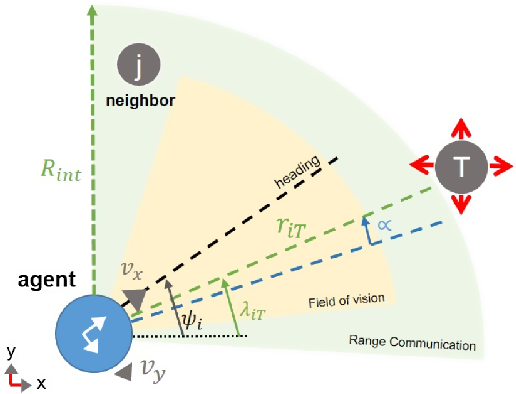
As previously mentioned, we focus on pursuing an intruder drone, assuming it is flying at a constant altitude. We use a nonlinear controller to stabilize the orientation in the axes x,y and the altitude of the aerial vehicles. The desired altitude will be given by the z position of the intruder drone. The remaining states for the agents are
 $\psi$
, x, and y as illustrated in Fig. 2. The goal of this work is not to propose a control regulation for the desired trajectory, but the collective tracking of a mobile target with unknown movements in the
 $x-y$
plane.
Agent performance in the plane x,y. Its perception is limited for a vision field. The longitudinal velocity
 $v_x$
and lateral
 $v_y$
are defined in the body frame.

From Fig. 2, the kinematics of the vehicle are as follows:
 \begin{align}\dot{x}_i = v_i \cos \psi_i, \end{align}
 \begin{align} \dot{y}_i = v_i \sin \psi_i \end{align}
where
 $x_i$
,
 $y_i$
defines the position of the agent in the plane x,y,
 $v_i$
denotes the magnitude of the vector velocity
 ${\textbf{v}}_i=[v_{x_i},v_{y_i}]^T$
in the body frame, and
 $\psi_i$
represents the yaw angle of the agent i to the horizontal axis x. The linear and angular velocities define the control inputs such that
 \begin{align}{\textbf{v}}_i = {\textbf{f}}_{\!i} ,\end{align}
 \begin{align} \dot{\psi}_i = f_{\psi_i} \end{align}
where
 ${\textbf{f}}_{\!i}=[f_{u_i}, \ f_{v_i}]$
signifies the control inputs for the longitudinal and lateral velocities, respectively, and
 $f_{\psi_i} $
introduces the control input for the yaw rate.
This motion constraint has an interesting property while considering the frontal camera as a navigation sensor: the drone will displace only in the direction of the field of vision, tightly coupling the perception to the motion.
For the same reason, this kind of drone motion is commonly observed in first-person-view piloting, where the only information for the pilot is the frontal camera image. In this case, the remote pilot cancels the drone’s lateral drift by combining a roll movement while turning the drones heading (yaw).
2.2. Target
The ultimate advantage of using multi-agents in pursuit is the possibility of cooperative ambushing for intercepting a more agile target. The term “agile” can mean having superior velocity or having more degrees of freedom. We assume both of these hypotheses in our work.
We consider the target will have a velocity up to twice as large as the pursuers. Furthermore, the intruder will not be constrained to non-holonomic Eq. (2) but by a simple particle model, which gives locomotion advantages. This configuration is a well-studied problem in differential games, commonly called “the homicidal chauffeur,” see ref. [Reference Rufus33].
We consider two strategies regarding the target behavior: (1) predefined trajectories and (2) a reactive target. First, the trajectories can be defined off-line, for example, by collecting real-flight data, or using fixed paths, for example, circular or square trajectories. A repulsion model defines the reactive behavior of the target. Each pursuer and the arena border exert a repulsive force towards the target. Details about this repulsive force implementation is given in Subsection 3.5.
2.3. Relative engagement
In this work, the pursuer behavior is given by a modified version of a classical guidance law, DPP. The relative kinematic engagement is a useful way to analyze convergence conditions in a pursuit–evasion problem. The kinematics equation can be deduced from the geometrical engagement of the pursuer-target, as represented in Fig. 2.
From Fig. 2, the LOS connecting the pursuer and target is denoted by
 $r_{iT}$
. The bearing angle, defined between the LOS and the inertial axis-x, is denoted by
 $\lambda_{iT}$
. The vector
 $v_i$
is the velocity in the body frame, and
 $\psi_i$
represents the heading (yaw) of the pursuer i.
As shown in refs. [Reference Shneydor14, Reference Belkhouche, Belkhouche and Rastgoufard34], from the engagement, a relative kinematic model can be obtained. Considering the relative velocity between,
 $ \dot{r}_{iT} = \dot{ P_T} - \dot{ P_i} $
. The relative velocity can be decomposed along (
 $v_{\parallel}$
) and perpendicular (
 $v_{\bot}$
) to the LOS:
 \begin{align}v_{\parallel} &= \dot{r}_{iT} = v_T \cos(\alpha_T) - v_i \cos(\alpha_i),\nonumber\\v_{\bot} &= r_{iT} \dot{\lambda}_{iT} = v_T \sin(\alpha_T) - v_i \sin(\alpha_i).\end{align}
where
 $\alpha_T = \psi_{i} - \lambda_{iT}$
and
 $\alpha_i = \psi_{T} - \lambda_{iT}$
. This equation represents the velocities of target seen by the pursuer along the the LOS.
3. Pursuit strategy
In the following, we introduce our group pursuit strategy. Firstly, we will describe the DPP guidance law, the base method for our proposition. Then, we discuss the hierarchy and the roles in our pursuit methodology, relating them with the different offsets in a DPP. Finally, our group pursuit will be explored, and the details of the implementation, such as collision avoidance, will be given.
3.1. Deviated Pure Pursuit – DPP
As stated in ref. [Reference Shneydor14], the DPP can be seen as a variation of the classical pure pursuit (PP); it can be a result of manufacturing flaws or can be intentionally designed in order to point the agent toward a position ahead of the target, causing a “lead pursuit.” However, if the offset drives the agent toward a position behind the target, it causes a “lag pursuit.”
The basic principle relies in driving the heading error to a constant offset angle
 $(\phi_i - \lambda_{iT}) \rightarrow \alpha_0$
. Considering this principle, the relative kinematics become
 \begin{equation}\begin{aligned}\dot{r}_{iT} = v_T \cos(\alpha_T) - v_i \cos(\alpha_0),\\r_{iT} \dot{\lambda}_{iT} = v_T \sin(\alpha_T) - v_i \sin(\alpha_0).\end{aligned}\end{equation}
The above equations establishes one necessary condition about the offset angle:
 $ |\alpha_0| < \pi/2$
. Nevertheless, under this strategy, the capture cannot be guaranteed for all
 $v_T > v_i$
.
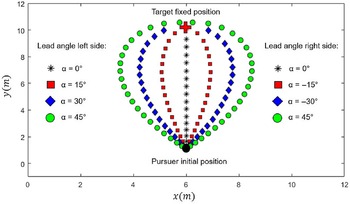
Our work explores the idea that each agent can assume different offset angles; therefore, each agent will have different degrees of “lead” and “lag” pursuit. This will cause spreading of the pursuers around the target, as shown in Fig. 3. In ref. [Reference Shneydor14], an intuitive law to apply the DPP is given as:
 \begin{equation}f_{\psi_i} = -K_{dpp} \left(\psi_i -\lambda_{iT} - \alpha_0 \right)\end{equation}
where
 $K_{dpp}$
defines a positive constant gain.
Paths of deviated pursuit agents according to different angle offsets
 $\alpha$
. The agents begin the trajectory at a fixed position, given by the black dot and keep a constant velocity until reaching the target.

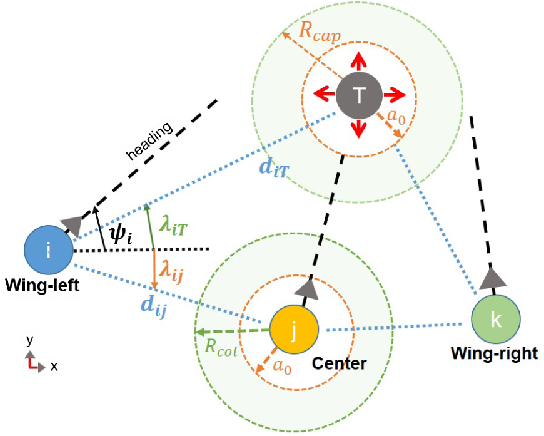
Three agents pursuit an intruder drone playing different roles.

3.2. Hierarchy
Our system has a mixed hierarchical architecture. The homogeneity of the agents means that all agents are physical equals, and no identification is required. We define a hierarchy based on the advantage of information, that is, one agent with better information will lead the group, and this makes a kind of cycling hierarchy. On the other hand, they play a role in differentiation, where each agent can assume different behavior depending only on the current relative position of the pursuer to its neighbors and target.
As shown by Stander, see ref. [Reference Stander24], in natural systems, the central position is commonly related to dominance. In our system, the central agents have a priority in moving and capturing since they have a more direct trajectory toward the target. We differentiate roles based purely on agent positioning and not due to social or biological factors (compared to natural systems). Here, each agent’s trajectory is determined by computing the DPP angle assumed in the pursuit.
In Fig. 4, each agent has a different angle offset; hence, each agent has a different role. The agent i (blue) and agent k (green) have consecutively positive and negative offset; therefore, they do not go in a straight line to target, rather, they ambush it from left and right, respectively. In ref. [Reference Stander24], the author identified this pattern in a group of hunting lionesses and called the agents at the extremities as “wings,” alluding to football players’ roles.
The differentiation in roles has a significant effect on the performance of the pursuit of the target since the “wings”-agents do not follow a straight line to the target but enclose it depending on the offset angle. The roles are defined such that the condition for an agent to be considered the “center” is based on the proximity to the intruder. This allows that an agent very close to the target can execute a terminal attack independently of the position of its neighbors.
3.3. Pursuit control algorithm
The objective of the control scheme is not to control the position of each agent as it is likely to produce oscillations, due to the random and fast movements of the intruder. The control scheme’s goal is to follow a deviate pursuit toward the target, with a given angle offset which will avoid collisions with the neighbors.
The heading of agent i will be controlled by its angular rate related to the pursuit conditions as shown in Fig. 4. Each agent has different offset angles (
 $\alpha$
), causing different trajectories for each agent, aiming to increase the possibility of capturing the intruder using an ambush strategy. Therefore, rewriting (6) for the whole system yields
 \begin{eqnarray}f_{\psi_i} &=& - K_p \left(\lambda_{iT} +\alpha \sum_{j \neq i}^{N}\delta_{i,j} (\xi_i,\xi_j)\right), \end{eqnarray}
 \begin{eqnarray}\delta_{i,j}&=& \left \{ \begin{matrix} -1, & \mbox{if }j\mbox{ is in the left side} \\[5pt] 1, & \mbox{if }j\mbox{ is in right the side} \end{matrix} \right. \notag\end{eqnarray}
 $\delta_{i,j}$
can be obtained from visual information, for this work we computed it by:
 \begin{equation}\delta_{i,j} = \frac{{\textbf{r}}_{ij} \times {\textbf{r}}_{iT} }{\| {\textbf{r}}_{ij} \times {\textbf{r}}_{iT} \|}\end{equation}
where
 ${\textbf{r}}_{ij}= [x_j-x_i, \ y_j-y_i, \ 0]^T $
and
 ${\textbf{r}}_{iT}= [x_T-x_i, \ y_T-y_i, \ 0]^T $
, correspond to the planar vector of the positions for neighbor j and to target T, respectively, in the body coordinates of the pursuer i.
From Fig. 4 and Eq. (3a), we can deduce that the longitudinal control input
 $f_{u_i}$
varies with respect to the magnitude of the desired vector velocity
 ${\textbf{v}}_i$
of the pursuer and also is related with the target and neighbors distances.
Thus, we propose
 \begin{equation}f_{u_i} = u_{\max} \sigma_a \left(\frac{d_{iT}-R_{cap}}{R_{cap}}\right) \left[C_{rep}, C_{wall} \right]_{\min} \end{equation}
where
 $u_{\max}$
is the maximal velocity imposed to the agents,
 $d_{iT}$
defines the distance between agent i, and the target T and
 $R_{cap}$
denotes the radius to capture the intruder.
 $0\leq [C_{rep}, C_{wall} ]_{\min} \leq 1$
is a safety coefficient that regulates the linear velocity of the agent i when approaching to agent j (collision avoidance) or when the agents are close to the limits of the workspace. Similarly, the term
 $\sigma_a(...)$
, with
 $a=1$
, is set to saturate the normalized distance error (
 $\frac{d_{iT}-R_{cap}}{R_{cap}}$
).
The saturation function,
 $\sigma_a(.)$
, can be defined as follows:
 \begin{equation}\sigma_a(x)=\begin{cases}a,& \text{if } x > a\\x,& \text{if } a \geq x \geq -a \\-a,& \text{if } x < -a\end{cases}\end{equation}
Please note that controlling the velocity of the pursuers become relevant mainly when physical integrity of the materials are considered, such as in our experimental validations. However, in the further numerical simulation, where the collision is not a concern, the velocity of the pursuer is set constant.
3.4. Collision avoidance
Most works in artificial flocking use the principle of attraction–repulsion to keep the cohesion of the group. However, those forces might cause oscillatory responses that could allow for an overdamped response of the fleet. As a consequence, this will reduce the velocity response of the agents.
We do not use attraction–repulsion principle between pursuers, but use an attraction factor toward the target, which acts as the point of convergence for all pursuers. For practical safety, a short-range repulsion was implemented; however, this is not responsible for the hunting formation.
There are two terms representing the collision avoidance (
 $C_{rep}$
and
 $\phi_{{rep}_i}$
). The first one acts as a brake coefficient, limiting the velocity input (
 $f_{u_i}$
) to zero. The second imposes a boundary in the lateral velocity, and it will be explained in Section 3.6.
For the longitudinal part, this term can be denoted by:
 \begin{equation}\ C_{rep} = \left[ C_{rep_{i,j}} , C_{rep_{i,k}}, ... \right]_{\min}\end{equation}
 $C_{rep} $
defines a term acting in a small rage and only aims to avoid agents collision. When an agent i detects agent j inside its repulsion area (delimited by the field of vision and a radius
 $r_{rep}$
), it decreases its velocity. The coefficient of repulsion takes the minimum value of the individual repulsion from agent i to all neighbors inside the repulsion area, and it is represented as:
 \begin{equation}\begin{aligned}\ C_{rep_{i,j}} =& \left \{ \begin{matrix} 1, & \mbox{if } d_{ij}<R_{col} + a_0 \\[5pt] \dfrac{ d_{ij} - a_0}{R_{col}}, & \mbox{otherwise} \end{matrix} \right.\end{aligned}\end{equation}
where
 $R_{col}$
means the radius of collision (see Fig. 4) while
 $a_0$
a constant offset. When the agents are moving, the distance
 $d_{ij}$
between agents i and j could be smaller than the radius of collision, then the term
 $a_0$
will impose a distance where the velocity of the agents will be completely null. This term can be defined as the shortest distance possible between two agents.
3.5. Virtual wall
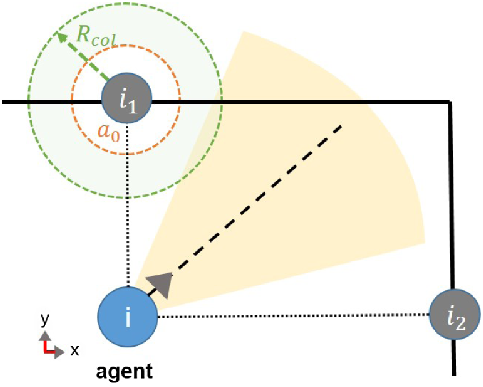
Consider the scenario when the drones’ fleet is approaching the workspace boundary (e.g., surveillance area). We implement a virtual repulsion force when an agent is getting closer to the border of its workspace or even a forbidden area. Along this paper, we consider two shapes for the workspace, square and circular arena.
For designing the virtual forces, we consider a projection of the agent in the border of the workspace; see Fig. 5. Since we have one virtual agent for each agent, the break coefficient
 $C_{wall}$
is computed in the same way of the agent’s collision avoidance.
Virtual wall projected when the drones approaching the border of the square workspace. Virtual agents are projected into the virtual cage.

3.6. Lateral control
We design a controller to eliminate the lateral drift caused by the inertia of the drone. The drift occurs when an agent changes in its heading while moves forward. In addition, this controller also implements a lateral short-range force repulsion between two drones or between the drone and a virtual wall.
This controller is proposed as:
 \begin{equation}\begin{aligned}\ f_{v_i} =& \left \{ \begin{matrix} 0, & \mbox{if } d_{ij}<R_{col} \\[5pt] \delta_{ij} \dfrac{R_{col}-d_{ij}}{R_{col}}, & \mbox{otherwise} \end{matrix} \right.\end{aligned}\end{equation}
where
 $\phi_{{rep}_i}=\frac{R_{col}-d_{ij}}{R_{col}}$
. The lateral velocity increases linearly when the neighbors invade the collision radius (
 $d_{ij}<R_{col}$
). The function
 $\delta_{ij}$
was defined in (Eq. (8)) and gives the direction of the velocity in the opposite side of the collision.
4. Simulations
In order to analyze our proposition, we implemented the framework in MATLAB. The agents were modeled as a particle with constant velocity and moving in a 2D plane. We use a bounded circular workspace for these simulations. The sample period (Te) in simulations is
 $0.01$
s. For simulation purposes, the crosses (red) represent the path of the target, while the path of the pursuers is illustrated by the diamond (blue), the asterisk (black), the circle (green), and the square (yellow). The black arrows denote the final heading (yaw) of each pursuer. The stop condition in the simulation is that the target is in a distance less than the capture radius
 $R_{cap} = 0.3$
m of at least one agent. Three scenarios are considered:
-
• Fixed target and three pursuers, to illustrate the formation pattern in a simple case;
-
• Escape trajectories, varying number of agents, to show the flexibility of the strategy;
-
• Swarm of pursuers, to show our approach of these properties to deal with scalability issues, involving large amount of agents.
Finally, we analyze the effect of the angle offset in the capture rate and on the effect on collisions between pursuer.
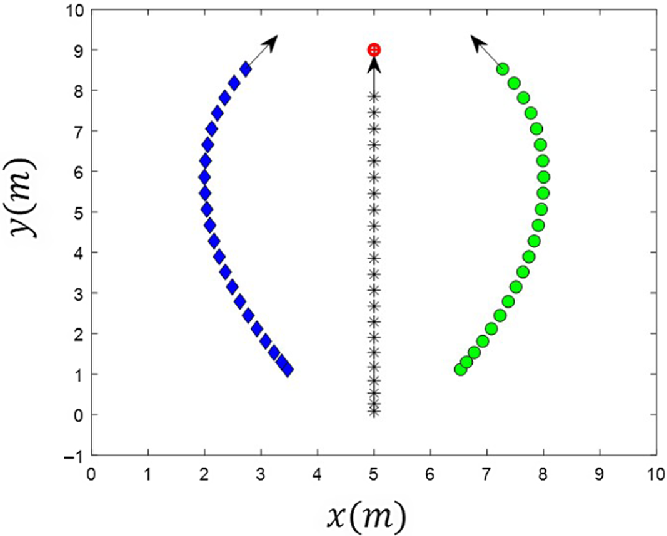
4.1. Fixed target
The first simulation is where the target remains in a fixed position. Figure 6 shows that the patterns of the pursuers drones is similar to the trajectories executed by a group of hunter animals.
Trajectories generated for three agents and a fixed target. The pursuers start in the bottom of the square and they pursuit the target with constant velocity. The deviation offset (
 $\alpha_0$
) for this pursuit is 30 degrees.

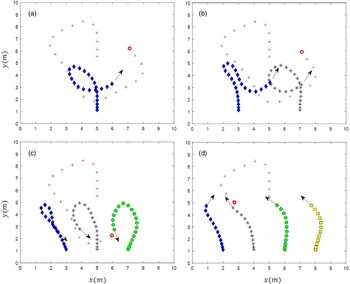
Snapshots for pursuits with different numbers of agents (1, 2, 3, and 4). The target in all cases does an escape trajectory based in repulsion forces, with velocity of two times bigger than the pursuers, that is,
 $ {\textbf{v}}_{\textbf{T}}=2 {\textbf{v}}_{\textbf{i}}$
. The end of the target trajectories is signalized by the red circles.

4.2. Escape trajectories
Due to this strategy’s flexibility and decentralized nature, it can be easily transferred between environments with a different amount of agents. Several simulations were carried out with different numbers of pursuers (1,2,3 and 4), see Fig. 7. For these simulations, the intruder velocity was set to 10 m/s and for the pursuers 5 m/s (half of the target speed). For visualization’s sake, the maximum time for simulation was limited to 4 s. In addition, in this scenario, we propose reactive escape behavior for the target. The behavior is described in Section 2.2, and all the pursuers and the borders exert a repulsive force toward the target.
From Fig. 7, in the two firsts cases (A and B), the target was not caught until the end of simulations. However, in the two lasts cases (C and D), the target was successfully intercepted before the limit of time, and this shows the importance of the increasing number of pursuers in the success of the chase. In addition, in Fig. 7, the velocity of the agents is implicitly indicated in the diagram. The positions of agents are shown at a constant time stamp; therefore, the sparser the trajectory of an agent, the faster it is. In Fig. 7(a), for example, we can see that the target (red cross) has superior to the single pursuer (blue diamond).
4.3. Swarm
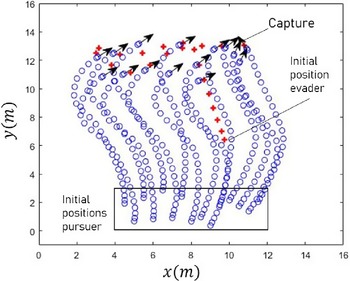
Although collective hunting is usually employed to small groups of pursuers; our algorithm can easily be applied to larger groups of agents. In the following simulation (Fig. 8), we illustrate the pursuit behavior applied to a group of 15 pursuers. The agents demonstrate an emergent flocking pattern, where each agent computes independent trajectories following the target with no information of the neighbors distance.
Case of 15 pursuers and an intruder. The pursuers intercept the target early in their trajectory.

4.4. Effect of the offset angle on the capture
This quantitative evaluation aims to assess the effect of the angle offset (
 $\alpha_0$
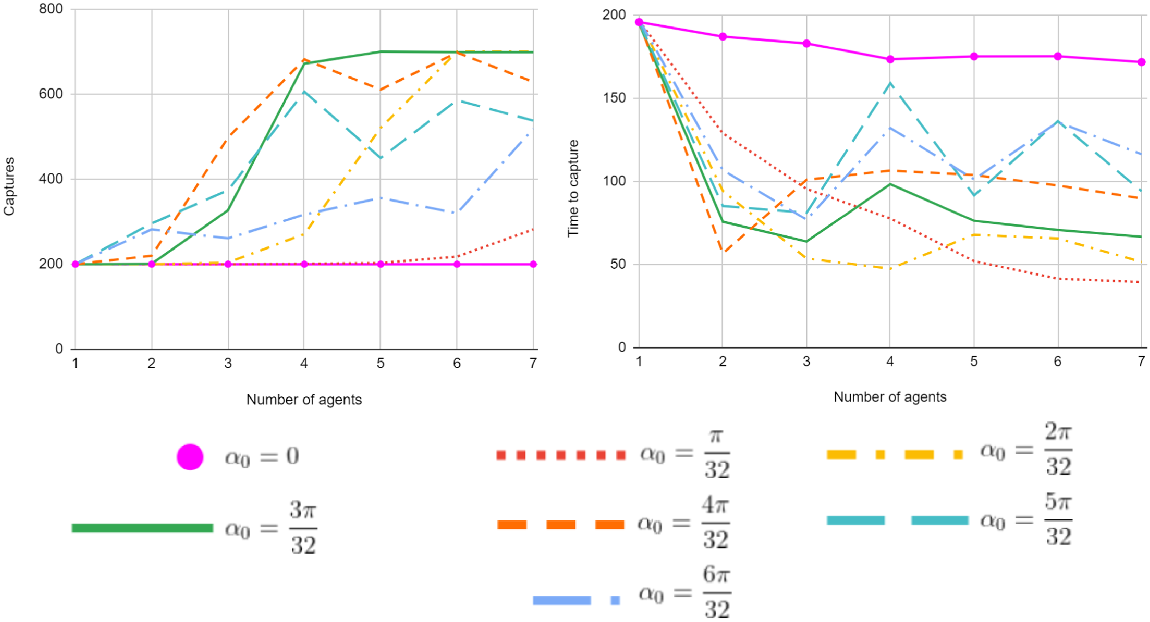
) on the total number of successful captures. To this end, we subject our strategy to a group pursuit benchmark, previously proposed in ref. [Reference De Souza, Newbury, Cosgun, Castillo, Vidolov and KuliĆ35]. This benchmark consists of a circular bounded arena. We tested different angle offset values, incrementally from
 $\pi/32$
, measuring the number of captures, as indicated in Fig. 9.
Effects of the offset value in the pursuit.

For each benchmark evaluation, 700 pursuit episodes are completed, with a variable target relative velocity,
 $v_T/v_i = {0.8, 1.0,..., 2}$
. More details about the benchmark implementation is given in ref. [Reference De Souza, Newbury, Cosgun, Castillo, Vidolov and KuliĆ35].
Figure 9-left shows the number of captures as function of the amount of pursuers. Figure 9-right represents the average time taken to capture.
The first value (
 $\alpha_0 = 0$
) is equivalent to the classic PP, where all agents point to the target’s current position. However, applying this configuration, the cooperative behavior does not emerge; therefore, the total catches remain practically the same during all the numbers of agents.
Therefore, with the smallest increment of offset (
 $\alpha_0 = \pi/32$
), the size of the group has an affect on the total amount of captures. The number of captures tends to increase, culminating in a cumulative total of 4233 (76%) catches for an offset of
 $\pi/8$
. For an angles offset of
 $\alpha_0 = 3\pi/32$
, our approached completed all captures during the benchmark for five pursuers onward; therefore, this is as an effective strategy for chasing a faster target.
For angle offsets larger than
 $\pi/8$
, the capture’s performance tends to decay. This is due to the fact that large offset values result in very open trajectories toward the target, allowing the target to escape between two pursues.
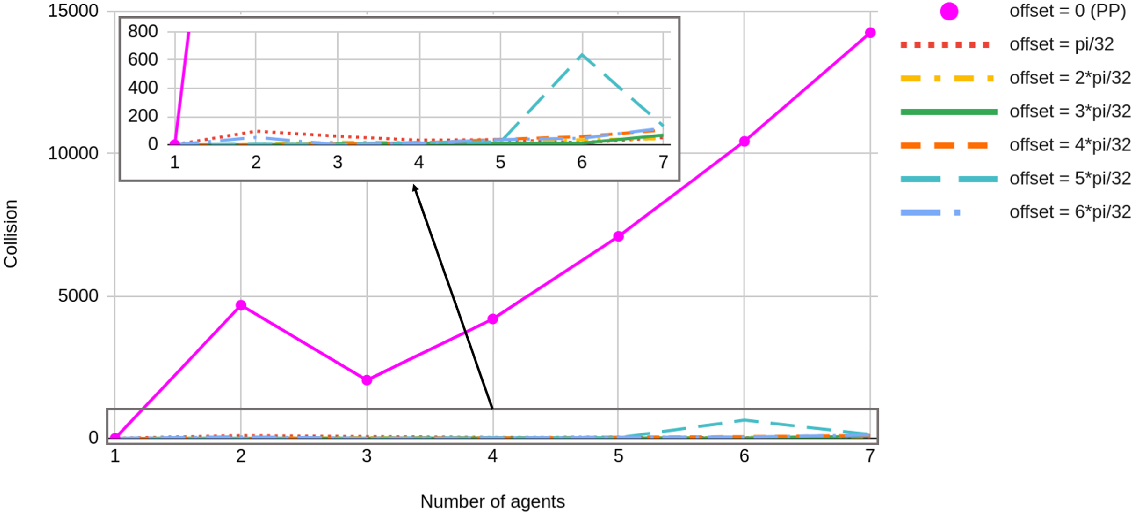
4.5. Effect of the offset angle on the collision
We use the same benchmark, to analyze the amount of collisions between two pursuers, that is,
 $r_{ij}<R_{col}$
, where the collision radius
 $R_{col}$
is equal to
 $0.15$
m. The graph on Fig. 10 clearly illustrates the effect of the offset on collision avoidance. For
 $\alpha_0=0$
, collisions tend to grow exponentially, reaching values up to 395 times higher than using
 $\alpha_0 = 3 \pi/32$
.
Effect of the offset value (
 $\alpha_0$
) on the collision between pursuers.

5. Experimental validation
The proposed pursuit algorithm was also validated in a real-world experiments. We use quadcopter Parrots – AR Drone 2 for aerial robots. We used Framework libre AirFootnote 1 an open source framework which provides a low-level connection to the drones. Opti-Track was used for motion capture to locate each agent. For experimental validation and security reasons, the final capture does not occur here; instead, the pursuers must stop at a security distance of
 $d = 1$
m. The drones operate in a 6 m
 $\times$
6 m square workspace.
5.1. Drone control
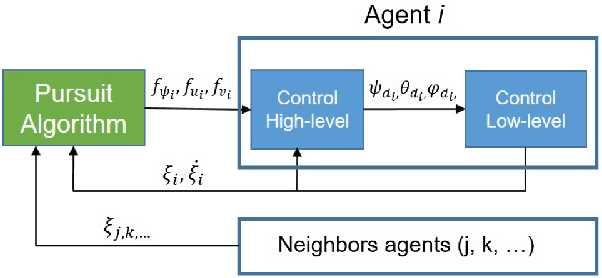
In our application, the control of the quadcopters is divided into two levels, as illustrated in Fig. 11. The lowest level is the control for stabilizing the drone in orientation and altitude. The higher level is responsible for controlling the pursuers (
 $f_{\psi i}$
,
 $f_{u i}$
,
 $f_{v i}$
) in desired angles (
 $\theta_{i_d}$
,
 $\phi_{i_d}$
and
 $\psi_{i_d}$
). The pursuit algorithm (the green box) is responsible for the “flocking intelligence” for each individual. Each agent can perceive the environment (neighbors, obstacles, and target) and gives to the the lower levels the velocities references (
 $f_{\psi i}$
,
 $f_{u i}$
,
 $f_{v i}$
).
Schema for the control levels for a given agent i.

Therefore, from (1) and using the PD controller in the altitude and the orientation,Footnote 2 it follows that,
 $w_i \rightarrow 0$
,
 $z_{B_i} \rightarrow z_{B_{i_d}}$
,
 $\dot \eta_i \rightarrow 0$
, and
 $\eta_i \rightarrow \eta_{i_d}$
, where
 $z_{B_{i_d}}$
defines the desired altitude of the aerial vehicle i and
 $\eta_{i_d}$
represents its desired orientation. Choosing
 $ \eta_{i_d}=0$
the aerial vehicle is stabilized at hover. The goal is the capture of the target drone, thus from (1) and without loss of generality for x and y (in the body frame), it follows that
 \begin{eqnarray}\dot u_i & \approx& - g \sin \theta_i \notag \\\dot v_i & \approx& g \cos\theta_i \sin\phi_i \notag\end{eqnarray}
The prototype has an embedded controller for the attitude; thus,
 $\eta$
is small enough such that
 $\cos \Xi_i\approx 1$
and
 $\sin \Xi_i \approx \Xi_i$
, being
 $\Xi_i$
a generic angle representing
 $\theta_i$
and
 $\phi_i$
:
 \begin{eqnarray} u_i = \dot x_{i_B} & \ \ \ \ \ \ \ \ & v_i = \dot y_{i_B} \notag \\\dot u_i \approx -g \theta_i & \ \ \ \ \ \ \ \ & \dot v_i \approx g \phi_i \notag\end{eqnarray}
where
 $x_{i_B}$
and
 $y_{i_B}$
are the position coordinates in the body frame. From (3a) and (13), it follows that the following stabilize the lateral dynamics:
 \begin{equation} \dot v_i = - k_{v_i} v_i - f_{v_i} \end{equation}
where
 $k_{v_i}$
denotes a positive gain. Notice from (13) that
 $f_{v_i}$
defines a position lateral feedback for avoiding the obstacles. Thus, it is easy to deduce the desired roll angle as:
 \begin{equation}\phi_{i_d} = - k_{\dot y_i} v - k_{y_i} f_{v_i} \end{equation}
where
 $k_{\dot y_i}= \frac{k_{v_i}}{g}$
and
 $k_{y_i}= \frac{1}{g}$
. Similarly, from (3a) and (9), it follows that
 \begin{equation} \dot u_i = - k_{u_i} (u_i - f_{u_i}) \end{equation}
with
 $k_{u_i}$
denotes a positive gain. Notice here that
 $f_{u_i}$
defines the desired velocity of the agent i that will vary with respect the position of the target T. Therefore,
 \begin{equation}\theta_{d_i} = k_{\dot x_i} e_{u_i} \end{equation}
where
 $k_{\dot x_i}= \frac{k_{u_i}}{g}$
and
 $e_{u_i}=u_i - f_{u_i}$
. From (3b) and (7), it follows that
 \begin{equation}\dot \psi_i = - K_p e_{\psi_i} \end{equation}
where
 $ e_{\psi_i}= \psi_i - \psi_{i_d}$
.
All control laws and pursuit algorithms are computed on-board each agent, and the ground station only analyzes the states and retakes the control in manual mode in emergency cases. For improving experimental validation, a Kalman filter was implemented to estimate states in cases where the agent does not receive the data; see ref. [Reference De Souza, Castillo, Lozano and Vidolov36].
Lateral control takes great importance in real-world experiments, as lateral drifts appear when the agents avoid obstacles which does not happen in simulation.
5.2. Experimental evaluation
Two scenarios are proposed to validate the pursuit algorithms.
-
1. The intruder drone remains in a fixed position, and three pursuers drones track it.
-
2. The target, moving with random movements given by a user, is tracked for three pursuers aerial drones.
5.3. Three pursuers and one static target
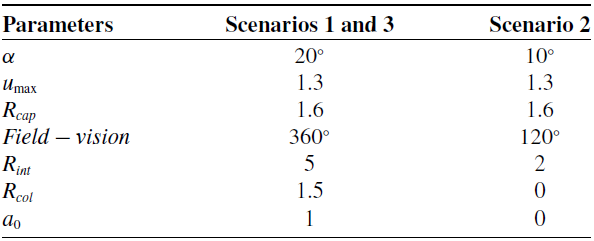
The target is placed in the ground at a distance of 6 m from the pursuers. The pursuers are placed in an initial triangular formation with a distance of approximately 2 m from their closest neighbors. This experiment aims to reproduce the pattern presented in simulation (see Fig. 6). The parameters used in this experiment are presented in Table I.
Control parameters used in the real-time scenarios

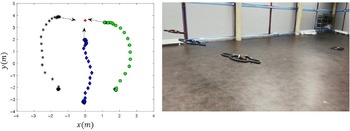
Figure 12 shows the real-world result for this scenario. The agents take on a similar strategy compared to the hunting pattern described in Figs. 1 and 6. However, the irregularities observed in the pursuer’s trajectories are caused by the airflow produced by the proximity of the drones and the absence of position control.
Real-time performance when three aerial drones pursuit a fixed target. The first image (left) shows the displacement of the drones in the flight arena. The second one is a picture of the experiment.

Real-time performance when three aerial drones pursuit an aerial intruder drone with random movements.

5.4. Three pursuers and one faster intruder
An operator manually controls the target, trying to get away from the three pursuers’ drones. The goal for the pursuers is to track the target, limiting their distances to the target to ensure no collisions. In addition, to further ensure the safety of our drones, the target flies at a different altitude. We choose
 $z_d=0.8$
m for the intruder and
 $z_{d_i}=1.7$
m to the pursuers. The parameters for this flight are also shown in Table I.
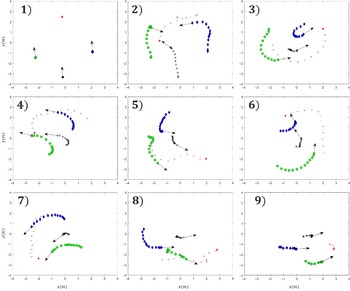
In Fig. 13, some snapshots are shown which illustrate the real-world performance of the drones pursuing the faster target. The figure is composed of nine snapshots taken at an interval of
 $2.75$
s. For each snapshot, the position of each agent was plotted ten times, with a sample time of
 $0.275$
s. The larger velocity of the target (2 m/s) is highlighted by the distance traveled by it in each snapshot.
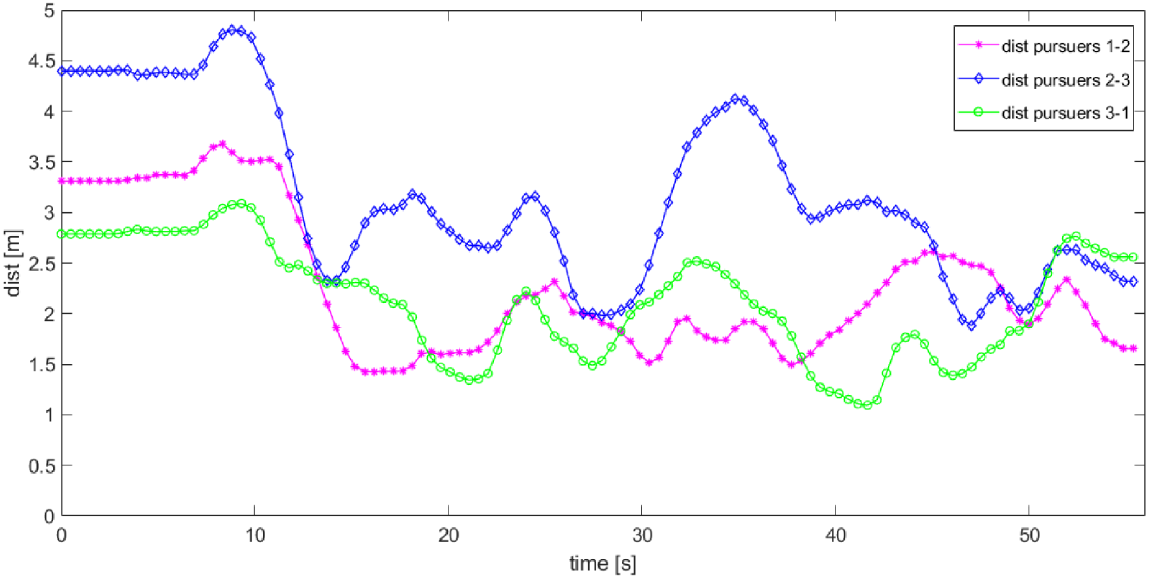
The collision avoidance property was implemented in the pursuers and can be seen in Fig. 14, where the inter-distances are plotted as a function of time. The minimum distance between two pursuers throughout the episode was approximately 1 m. However, since the target was piloted manually, there were no guarantees of a collision-free trajectory.
Inter-distance between pursuers during the experimental test.

Observe from these figures that the cooperative hunting pattern emerged during these real-world experiments. Even facing a complex pursuit with a faster reactive target, the pursuer’s drones could track and intercept the futures movements of the target. No formation is intended to be kept, instead, the drones re-arrange between themselves in other to corral the intruder. The roles of positioning (center, left-, and right-wings) are constantly changing as a function of the relative position of the fleet to the target.
Moreover, taking into account the size of the virtual arena (6 m
 $\times$
6 m) and the presence of four drones flying inside, this approach has demonstrated a robust, practical performance with respects to the disturbances produced by the airflow of the aerial vehicles.
The flight tests can be seen on https://youtu.be/g2dODbd6ZLA.
6. Conclusion
A decentralized strategy for cooperative group pursuit against a single intruder has been proposed and validated in this work. Our approach, inspired by lionesses’ hunting behavior, applies the geometrical rules of DPP to generate different trajectories for each agent. This strategy avoids using attractive and repulsive forces for pattern formation, which occasionally results in the system’s oscillations.
Numerical simulations were carried out to demonstrate the efficiency of the proposed chase strategy. The effect of the angle offset was analyzed quantitatively through a pursuit benchmark. We observed the emergence of the behavior of collective pursuit through two main metrics, the increase in the number of target’s capture and the decrease in the amount of collision between pursuers. Furthermore, a proof of concept with real drones is shown, where we could verify the pursuit behavior in a real-world experiment with three pursuers and one target.
This preliminary work focused mainly on the formalization of our algorithm and the qualitative description of the emerging behavior. However, our proposal also proved to be effective in capturing a faster target, as shown by the group pursuit benchmark described in Section 4. Furthermore, our proposal requires very minimal assumptions; the pursuit algorithm, disregarding the safety layer of collision avoidance, requires only relative bearing angle information in relation to the target and neighbors. This minimalism of implementation puts our algorithm in a very advantageous position compared to the previous ones, such as in refs. [Reference Muro, Escobedo, Spector and Coppinger10, Reference Angelani12, Reference Lin and Abaid13], which requires more information from the target and neighbors, such as position or speed in global coordinates.
We believe that a more in-depth theoretical analysis of the collision-free phenomenon observed in this work is also interesting and reaffirmed from simulations in the pursuit benchmark.
Although these first experimental results indicate the viability of this algorithm, several areas must be improved to obtain a fleet of autonomous chasing drones. The first one is perception. Pursuers must be able to extract the bearing angle information using only the embedded sensors, which are commonly the front camera and the Lidar. However, using a camera-type sensor with limited FOV arouses the interest of another field of investigation, the effect of limited visual sense on collective behavior. Recently, works, as in ref. [Reference Soria, Schiano and Floreano37], have been dedicated to evaluate the impact of this nonlinearity in the observation, which could improve our work results.
Acknowledgment
We thank Rhys Newbury (Monash University – Melbourne, Australia) for the valuable effort on the full text revision.
Authors’ Contributions
C. de Souza Jr. : conceptualization, research, validation, writing – original draft, and software.
P. Castillo : conceptualization, formal analysis, research, validation, writing – review and editing, project administration, and supervision.
B. Vidolov : research, conceptualization, methodology, and supervision.
Financial Support
This research is supported by the Ministère de l’Education Nationale, de l’Enseignement Supèrieur et de la Recherche, and National Network of Robotics Platforms (ROBOTEX), from France.
Conflicts of Interest
None.
Ethical Considerations
This study does not contain any studies with human participants or animals performed by any of the authors.