Introduction
Macrocyclic lactones are a class of veterinary medicinal product that are used globally to control parasites affecting livestock (Lumaret et al. Reference Lumaret, Errouissi, Floate, Römbke and Wardhaugh2012). Macrocyclic lactones include both avermectins (e.g., ivermectin) and milbemycins (e.g., moxidectin), both of which are largely excreted as parent compound in the dung of the treated animal (McKellar and Gokbulut Reference McKellar and Gokbulut2012; Prichard et al. Reference Prichard, Ménez and Lespine2012). Faecal residues of macrocyclic lactones adversely affect dung beetles (Coleoptera: Geotrupidae and Scarabaeidae: Scarabaeinae and Aphodiinae) in different ways (Kadiri et al. Reference Kadiri, Lumaret and Janati-Idrissi1999; Suarez et al. Reference Suárez, Lifschitz, Sallovitz and Lanusse2009; Lumaret et al. Reference Lumaret, Errouissi, Floate, Römbke and Wardhaugh2012; Jacobs and Scholtz Reference Jacobs and Scholtz2015).
Residues of ivermectin can decrease olfaction and locomotion (Verdú et al. Reference Verdú, Cortez, Ortiz, González-Rodríguez, Martinez-Pinna and Lumaret2015), disrupt reproduction physiology (Martinez et al. Reference Martínez, Lumaret, Ortiz-Zayas and Kadiri2017), decrease larval development, and kill both larval and adult stages (Wardhaugh and Rodriguez-Menendez Reference Wardhaugh and Rodriguez-Menendez1988; Wardhaugh et al. Reference Wardhaugh, Mahon, Axelsen, Rowland and Wanjura1993; Kruger and Scholtz, Reference Krüger and Scholtz1997; Iwasa et al. Reference Iwasa, Maruo, Ueda and Yamashita2007). The fertility of Euoniticellus intermedius (Reiche) (Coleoptera: Scarabaeidae: Scarabaeinae) females is modified by the presence of ivermectin in dung, even at low concentrations equivalent to those measured in the dung pats of cattle treated four weeks earlier (Martínez et al. Reference Martínez, Lumaret, Ortiz-Zayas and Kadiri2017). At such concentrations, the mortality of offspring is low, but not zero.
Similarly, moxidectin residues are toxic to dung beetle larvae (Doherty et al. Reference Doherty, Stewart, Cobb and Keiran1994), albeit less so than are residues of ivermectin (Floate Reference Floate2006; Hempel et al. Reference Hempel, Scheffczyk, Schallnass, Lumaret, Alvinerie and Römbke2006). In a way similar to ivermectin, moxidectin is excreted in dung for more than 28 days after administration, with 22% of the moxidectin residues still in the form of the parent drug (Zulalian et al. Reference Zulalian, Stout, daCunha, Garces and Miller1994).
By affecting dung beetles, faecal residues of macrocyclic lactones indirectly affect the ecological services that they provide. These services include the facilitation of dung removal, microbial ammonification and nitrification processes, herbage growth, and the disruption of pats to reduce their suitability as breeding sites for nematode and insect pests affecting livestock (Nichols et al. Reference Nichols, Spector, Louzada, Larsen, Amezquita and Favila2008; Beynon et al. Reference Beynon, Wainwright and Christie2015; Lopez-Collado et al. Reference Lopez-Collado, Cruz-Rosales, Vilaboa-Arroniz, Martínez and Gonzalez-Hernandez2017; Nervo et al. Reference Nervo, Caprio, Celi, Lonati, Lombardi and Falsone2017). Faeces represent a transient food resource, the competition between dung beetle species can be strong. Competition is reduced by three general types of reproductive behaviours that have different implications for dung degradation. Roller species make balls of dung, roll them away from the food source, and bury them in the soil; tunnellers dig tunnels and construct nest chambers below the dung pile; and dwellers live freely in the droppings (Halffter and Edmonds Reference Halffter and Edmonds1982). Tunnellers and dwellers are similarly efficient for most functions, with differences based on the spatial and temporal scales over which the functions operated (Nervo et al. Reference Nervo, Caprio, Celi, Lonati, Lombardi and Falsone2017). The key behavioural trait of tunnelling dung beetles is to excavate underground tunnels and provide dung for their offspring in the form of brood masses. The female lays an egg in a cavity within the individual brood mass that nourishes the larva when it hatches (Halffter and Edmonds Reference Halffter and Edmonds1982). After laying one egg, the female makes another brood mass and so on, with a mechanism that allows the adjustment of the frequency of oviposition to the production of nesting masses. In the case of a slowdown in the production of nest masses, or if ivermectin is present in the dung at a sufficient concentration, vitellogenesis (yolk synthesis) can be interrupted, with oocyte reabsorption and reduction of the female fertility (Martinez et al. Reference Martínez, Lumaret, Ortiz-Zayas and Kadiri2017).
Two species of dung beetles have received a special attention from researchers to test the toxicity of ivermectin and moxidectin: the dweller Agrilinus constans (Duftschmid) (reported in older literature as Aphodius constans) (Coleoptera: Scarabaeidae: Aphodiinae) (Errouissi et al. Reference Errouissi, Alvinerie, Galtier, Kerboeuf and Lumaret2001; Hempel et al. Reference Hempel, Scheffczyk, Schallnass, Lumaret, Alvinerie and Römbke2006; Römbke et al. Reference Römbke, Hempel, Scheffczyk, Schallnass, Alvinerie and Lumaret2007) and the tunneller E. intermedius (Fincher Reference Fincher1992; Krüger and Scholtz Reference Krüger and Scholtz1997; Cruz Rosales et al. Reference Cruz Rosales, Martínez, López-Collado, Vargas-Mendoza, González-Hernández and Fajersson2012). Differences in reproductive physiology may affect the response of dung beetles to faecal residues of macrocyclic lactones. Female Scarabaeinae have one ovary with one ovariole. In contrast, female Aphodiinae have two ovaries, each with multiple ovarioles. As a result, the lifetime fecundity of the latter group may typically exceed 100 eggs (Cambefort and Hanski Reference Cambefort and Hanski1991). In addition, the ovarian development of A. constans is sequential. Thus, the fecundity of adults exposed to macrocyclic-lactone residues could be affected even if adults are subsequently fed dung without macrocyclic-lactone residues. Eggs usually develop singly in separate ovarioles, and a typical female would contain several mature eggs, as well as other eggs at various stages of development, as observed in the related species Agrilinus ater (De Geer) (Gittings and Giller Reference Gittings and Giller1997). Agrilinus constans females lay their eggs singly in small cavities in parts of the dung where the moisture is optimal (60–70%) (Lumaret Reference Lumaret1975, Reference Lumaret1995). To date, no cases of oocyte resorption have been reported in non-nesting dung beetles. It is possible that such a mechanism occurs only in dung beetle species that provision a nest with brood masses, insofar as the eggs are produced in small numbers from a single ovariole. This suspension of egg production is probably less important in species that have not developed parental care and synchronously produce several eggs in several ovarioles (Martinez Reference Martínez2001).
Most laboratory and field studies have documented the direct lethal effects of faecal residues of macrocyclic lactones to dung-breeding insects (Wardhaugh et al. Reference Wardhaugh, Mahon, Axelsen, Rowland and Wanjura1993; Wratten et al. Reference Wratten, Mead-Briggs, Gettinby, Ericsson and Baggott1993; Strong et al. Reference Strong, Wall, Woolford and Djeddour1996; Lumaret et al. Reference Lumaret, Errouissi, Floate, Römbke and Wardhaugh2012), and why the reduction of dung-breeding insects is undesirable. Few studies have examined the effects of sublethal exposure to macrocyclic-lactone residues. In E. intermedius, the morphology of the ovary was altered by low concentrations of ivermectin (10 μg ivermectin/kg dung fresh weight), before the fecundity was significantly affected with exposition to higher concentrations. Ivermectin decreased the tone of the ovary muscles, and the oocytes progression in the single ovariole slowed down and even stopped, with possible resorption (Martinez et al. Reference Martínez, Lumaret, Ortiz-Zayas and Kadiri2017). Therefore, it was necessary to verify whether their offspring that survived after they were exposed to low ivermectin concentration during their entire larval development had their fertility affected. Similarly, very little is known about the effects of chronic exposure to moxidectin on adult fertility. When A. constans beetles are active, the females move freely between the dung pats regardless dung was toxic or not. So they may expose themselves and their offspring to a possible toxicity and a possible reduction of their fecundity, as in the case of E. intermedius when exposed to ivermectin. This point needs to be considered, insofar the toxicity of moxidectin is considered less important, and the number of ovarioles is different between Scarabaeinae and Aphodiinae.
The present paper combines two independent studies done to assess the effect of sublethal macrocyclic lactones exposure on the fecundity of the dung beetles E. intermedius and A. constans. These two species are easily obtained or reared, have been examined in previous studies and represent, respectively, a tunneller and a dweller. Our first study was a test using ivermectin and E. intermedius to assess trans-generational effects (egg-to-adult exposure to residues on fecundity). We aimed to determine whether the fertility of E. intermedius was affected by exposure to ivermectin during larval development. The second study was a test using moxidectin and A. constans to assess within-generation effects (chronic adult exposure to residues). We aimed to determine whether the fertility of A. constans was affected by previous adult exposure to moxidectin.
Materials and methods
Trans-generational effects of ivermectin to Euoniticellus intermedius
Laboratory rearing
Adult beetles (the F0 generation) collected in the field near La Laguna, Veracruz, Mexico (18°58'19''N, 96°4'51''W; 42 m) were used to establish a laboratory colony. The colony was maintained on fresh dung collected from cattle that had not been treated with ivermectin or any other veterinary medicinal product for six months before dung collection. The dung was collected fresh from the field and frozen at −18 °C both to kill insects that might have colonised dung in the field and to allow for long-term storage. Before its use, dung was thawed and mixed mechanically for 10 minutes to homogenise the moisture (83%), pH (pH=8), and nitrogen content. All the experiments were conducted in an insectary at 27.5±1 °C, 71.0±6.7% relative humidity and 14:10 light:dark photoperiod. The beetles were placed in plastic terraria (57×30×37 cm) half filled with moist, sterilised sandy soil and supplied with cattle dung ad libitum. The soil was moistened to a crumbly but compact consistency favourable for nesting and moisture was maintained at a constant level throughout the reproductive period.
Bioassays
The tests were performed with technical grade ivermectin (CAS-number: 70288-86-7) with a purity of ⩾90% ivermectin B1a and ⩽5% ivermectin B1b (Batch number: MKBS6097V; Sigma-18898). Since ivermectin is poorly soluble in water, it was first dissolved in acetone (CAS-number: 1567-89-1; Sigma purity>99.8%) to obtain the desired concentration (10 µg ivermectin/kg dung, fresh weight). That concentration was chosen on the basis of the results obtained for this species by Martinez et al. (Reference Martínez, Lumaret, Ortiz-Zayas and Kadiri2017). This threshold value corresponded to the no observed effect concentration at which no significant effect was detected on female fecundity. This value corresponded also to the lowest observed effect concentration at which an effect on larval mortality was detected. The acetone/ivermectin solution was then thoroughly mixed into the cattle dung (spiked dung), and left for at least eight hours at 25 °C to allow the acetone (10 mL/kg dung fresh weight) to evaporate. Acetone control (dung without ivermectin) was similarly prepared to feed control beetles.
First bioassay
We first tested the effect of direct exposure to ivermectin on female fecundity using newly emerged F1 adults obtained from the laboratory colony. Six days post-emergence, one pair of beetles (1♂, 1♀) were placed in plastic containers (1 L, 140 mm high, 100 mm diameter) with sterile soil to a depth of 10 cm and different types of dung; i.e., water control (eight replicate containers), acetone control (eight replicates), and ivermectin (16 replicates).
Beetles were fed ad libitum with fresh dung replaced three times per week. After 10 days of exposure, the F1 adults were removed and containers held for the emergence of their offspring (F2 adults). The offspring from each pair were counted in the controls and ivermectin treatments. The F2 adults were separated by sex for use in the second bioassay.
Second bioassay
To test for the indirect effect of residue exposure on fecundity across generations, three types of crosses were performed using F2 adults; i.e., control (water) ♂×control (acetone) ♀ (17 pairs); control (water) ♀×control (acetone) ♂ (17 pairs), and ivermectin ♂×ivermectin ♀ (34 pairs). Beetles were fed three times per week with uncontaminated dung; i.e., without ivermectin. Beetles were removed after 10 days and containers held for the emergence of their offspring (F3 adults). Then the offspring from each pair were counted.
Within-generational effects of moxidectin to Agrilinus constans
Study species and laboratory rearing
Agrilinus constans breeding was commenced with newly emerged beetles (generation F0) collected at a farm located about 30 km north of Montpellier (southern France, 43°48'7''N, 3°43'36''E, 245 m). Transparent plastic containers (42×26×15 cm) covered with gauze (mesh size: 200 µm) were used for adult beetles and larvae. A mixture of sand, vermiculite K3 and commercial garden soil in equal proportions was added to the boxes to a depth of two cm. The breeding containers were maintained in an insectary at 18±2 °C and 16:8 light:dark photoperiod. The dung used for breeding and testing (78% moisture) was collected at the same farm from cattle fed mainly with grass and hay, and which had not been treated with any veterinary medicinal products in the previous three months.
Bioassays
The tests were performed with moxidectin (CAS-number: 113507-06-5) with a purity of 98.0% moxidectin (batch number: AN0504-94 Fort Dodge Company). The experiment was conducted in two steps, using the same individuals of the F0 generation for the two runs.
During the first step, A. constans adults were allowed to oviposit during a three-week period in fresh dung formed into pats (800 g each) containing moxidectin at different concentrations or without moxidectin (control). Because moxidectin is nearly insoluble in water (0.51 mg moxidectin/L water) and very soluble in polar organic solvents, acetone was used as the solvent to incorporate moxidectin in dung in the current experiments. Moxidectin was added to five separate portions of the dung in the amounts necessary to achieve five different concentrations (C1 to C5), and then homogeneously mixed through the dung. Afterwards, the solvent was allowed to evaporate for at least eight hours. Beetles were then exposed to one of these five (C1 to C5) moxidectin concentrations, namely 0.32, 1.00, 3.20, 10.00, and 32.00 mg moxidectin/kg dung dry weight, which corresponded to 0.070, 0.219, 0.700, 2.188, and 7.000 mg moxidectin/kg dung fresh weight. The selection of these values was realistic. It corresponded to concentrations for which information was already available. The C1 to C3 concentrations were in the range of moxidectin residue levels found in cattle dung during the first month following a pour-on application of moxidectin (Steel Reference Steel1998). In the present work, the C3 concentration (3.20 mg/kg dung (dry weight)) corresponded to the no observed effect concentration value of moxidectin determined for A. constans (Hempel et al. Reference Hempel, Scheffczyk, Schallnass, Lumaret, Alvinerie and Römbke2006). The C4 and C5 values were multiples of order 10 of C2 and C3 concentrations. During this first step, dung pats without moxidectin were used for comparisons (water and solvent controls). For each of the five concentrations and the two controls, eight containers, each containing 20 adults of both sexes were prepared, resulting in a total of 56 containers and 1120 adults. Three weeks after being introduced, the surviving adults were removed from the boxes. Their eggs and larvae were allowed to remain in the dung until the larvae moved deeper into the soil substrate and pupated, after which new adults (F1 generation) were counted.
In the second step, we used those individuals of the F0 generation that survived after the first step. They were separated according to their previous exposition (five moxidectin concentrations and the two controls) and transferred into new containers containing 800 g of uncontaminated fresh dung to continue egg production for a further three-week period, regardless of the concentration to which they had been previously exposed. Given the mortality of a part of the adults in the first step, only four containers of 20 adults were established for each treatment, resulting in a total of 28 containers and 560 adults. After this three-week period, all F0 beetles were removed and the new adults of the F1 generation were counted.
Statistical analyses
The significance level for the parametrics tests (one-sided) was P⩽0.05. In the experiment performed to test the containers trans-generational effect of ivermectin, the comparison between controls (dung without ivermectin) was performed with a Shapiro–Wilk test to verify the normality of data distribution, in association with a Levene test and a Student’s t-test for homogeneous variance (Levene Reference Levene1960; Shapiro and Wilk Reference Shapiro and Wilk1965; Williams Reference Williams1971). With the Shapiro–Wilk test, the null hypothesis is verified that a sample x1, … , xn comes from a normally distributed population. The null hypothesis is rejected if the calculated value W is too small. A one-way analysis of variance on ranks was run to complete the comparison between treatments. In the same way, to test the intra-generational effect of moxidectin, a pair-wise comparison of water and solvent controls was performed with a Student’s t-test for homogeneous variance, with α=0.05 (two-sided), and with P(t)=probability of sample t for H0: µ1=µ2. The normality of data distribution was tested with a Shapiro–Wilk test, in association with a Levene test to verify the homogeneity of the variance of data. The critical effect and threshold concentrations were calculated at the end of the experiment. In the case of non-homogeneous variance, a Welch’s t-test was used in association with Bonferroni–Holm adjustment to calculate the no observed effect concentration and lowest observed effect concentration values. The effective concentration (ECx) and lethal concentration values with 95% confidence limits were assessed with probit analysis by using linear maximum likelihood regression (Finney Reference Finney1971). The EC50 is the concentration of a drug at which 50% of the maximum effect is produced. The statistical analyses were conducted with the Toxrat software version 3.2.1 (ToxRat Solutions 2015).
Results
Trans-generational effects of ivermectin to Euoniticellus intermedius
First bioassay (F1 generation)
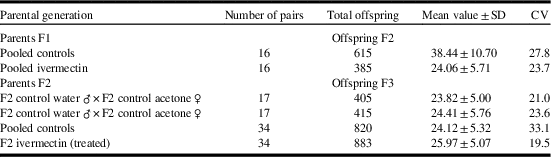
Pairs of F1 adults reared on control (water) and control (acetone) dung produced the same number of F2 adults (H=0.276, P(H)=0.599); i.e., 38.6±12.4 and 38.2±9.6, respectively. The data were pooled (average of 38.4±10.7, n=16 pairs) and compared to the number of offspring produced by females in the presence of 10 µg ivermectin/kg dung (average of 24.1±5.7, n=16 pairs). Adults fed on control dung produced significantly more F2 adult offspring than did adults fed on ivermectin dung (Student’s t-test: P(t)<0.001, P(F)=0.010; Kruskal–Wallis H-test: H=11.893, P(H)=0.001).
Second bioassay (F2 generation)
The mean number of offspring produced by E. intermedius F2 females that developed in the absence of ivermectin (beetles issued from F2 controls in the first bioassay, with two crossbreeding modalities) was 23.8±5.0 and 24.4±5.6, respectively (Table 1). The two control series were not significantly different (average of 24.1±5.3; n=34 pairs) and were subsequently pooled (Kruskal–Wallis H=0.096; P(H)=0.757). The mean number of offspring produced by females that developed in dung with ivermectin was 26.0±5.1 (34 pairs) (Table 1). No significant difference was detected in the average number of offspring produced by pairs of F2 adults reared with versus without exposure to ivermectin residues (H=0.007; P(H)=0.931); i.e., exposure to ivermectin at a concentration of 10 μg ivermectin/kg dung) during larval development did not affect adult fecundity.
Production of adult offspring of Euoniticellus intermedius that developed in dung containing ivermectin (treated) or without ivermectin (controls).

SD, standard deviation; CV, coefficient of variation (%).
Within-generational effect of moxidectin to Agrilinus constans
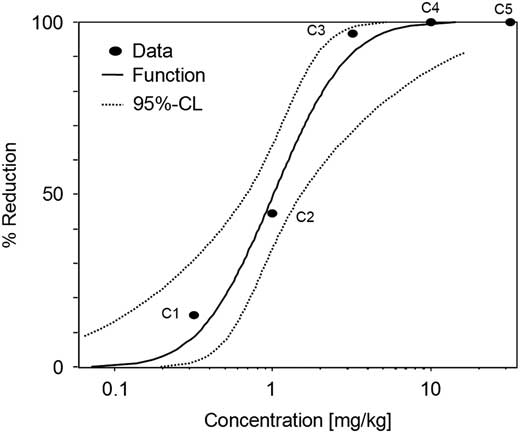
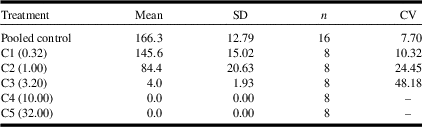
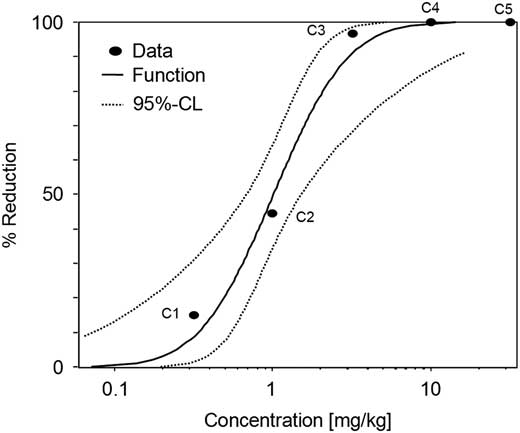
Table 2 gives the number of offspring of A. constans for the five moxidectin concentrations in the experimental dung. A pair-wise comparison of the two controls (water and solvent) with the Student’s t-test procedure showed no significant difference (P(t)=0.824; P(F)=0.436) between them. They were therefore pooled and compared with the other treatments. Multiple, sequentially-rejective comparisons of treatments with pooled controls with the Welch’s t-test and Bonferroni–Holm adjustment, showed that the number of offspring was significantly different from the pooled control for moxidectin concentrations of 0.320 mg moxidectin/kg dung (P(t)=0.003), and 1.000 and 3.200 mg moxidectin/kg dung (P(t)<0.001, for both concentrations). The variance of the average number of offspring per replicate was significantly higher for the C2 concentration. A probit analysis conducted with maximum likelihood regression gave the ECx of the test item (moxidectin) and their 95% limits (Table 3 and Fig. 1). The calculated EC50 corresponded to 0.958 mg moxidectin/kg dung dry weight (equivalent to 0.210 mg moxidectin/kg fresh weight). The threshold concentration for offspring number after 21 days was lower than 0.320 mg moxidectin/kg dung (dry weight) (=0.070 mg moxidectin/kg dung fresh weight), with a lowest observed effect concentration value ⩽0.320 mg moxidectin/kg dung (dry weight).
Concentration-effect curve showing the influence of moxidectin (mg moxidectin/kg dung dry weight) on the offspring number of Agrilinus constans after a 21-day exposure period of adults. Y-axis: % reduction of survival of A. constans larvae; x-axis: concentration of moxidectin. 95%-CL, 95%- confidence limits.
Mean number of offspring produced by Agrilinus constans adults (10 ♀ and 10 ♂ in each container) for control and five moxidectin concentrations (C1 to C5) in dung (mg moxidectin/kg dung dry weight).

Mean, arithmetic mean; SD, standard deviation; n, number of replicates (=containers); CV, coefficient of variation (%).
Probit analysis: effective moxidectin concentrations (ECx) and the 95%-confidence limits (in mg moxidectin/kg dung dry weight) for Agrilinus constans progeny.

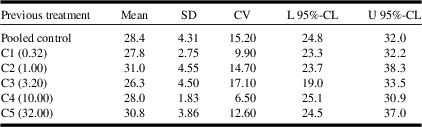
When all the A. constans adults were removed from moxidectin-contaminated dung and reared in uncontaminated dung, they continued to lay eggs without any delay, regardless of the moxidectin concentration to which they had been exposed previously. After three weeks, these beetles were removed, and six weeks later, the adults of the new generation were counted (Table 4) and all the treatments were compared two by two. A comparison of treatments with the pooled control using the Student’s t-test procedure (Williams Reference Williams1971) (with α=0.05), showed that there was no significant difference between them. The previous exposure of adults to moxidectin for three weeks did not significantly affect their egg-laying effort or the surviving of their offspring in uncontamined dung. These results were obtained regardless of the concentration to which beetles were previously exposed, even when the adults were exposed to high moxidectin concentrations (C4 and C5) that earlier killed all the offspring.
Number of offspring produced by Agrilinus constans adults (10 ♀ and 10 ♂ in each container) previously exposed to moxidectin at five concentrations (C1 to C5) (in mg moxidectin/kg dry weight) during a three-week period.

Mean, arithmetic mean; SD, standard deviation; CV, coefficient of variation (%); L 95%-CL and U 95%-CL, lower and upper 95%-confidence limits.
Discussion
The unintended, negative effects of veterinary medicinal products that are later released into the environment have been the subject of many studies, while strategies have been developed to address their potential risks (Adler et al. Reference Adler, Bachmann and Römbke2013) and integrate environmental risk into the benefit-risk assessment (Chapman et al. Reference Chapman, Porsch, Vidaurre, Backhaus, Sinclair, Jones and Boxall2017). Within the last 25 years, most studies have assessed the direct effects of parasiticides on dung organisms, both in the laboratory and in the field (Wardhaugh and Rodriguez-Menendez Reference Wardhaugh and Rodriguez-Menendez1988; Wardhaugh et al. Reference Wardhaugh, Mahon, Axelsen, Rowland and Wanjura1993; Krüger and Scholtz Reference Krüger and Scholtz1997; Floate and Fox Reference Floate and Fox1999; Lumaret and Errouissi Reference Lumaret and Errouissi2002; Boxall et al. Reference Boxall, Fogg, Baird, Lewis, Telfer and Kolpin2006; Floate Reference Floate2006; Iwasa et al. Reference Iwasa, Maruo, Ueda and Yamashita2007; Lumaret et al. Reference Lumaret, Errouissi, Floate, Römbke and Wardhaugh2012; Martínez et al. Reference Martínez, Lumaret, Ortiz-Zayas and Kadiri2017). Because veterinary medicinal products have significant effects on adult fertility and/or the mortality of adults and/or their offspring, various models have been developed to minimise the harm to dung beetle populations. Some models have shown a rapid extinction of dung beetles after successive treatments of animals (Wardhaugh et al. Reference Wardhaugh, Longstaff and Lacey1998). However, the trans-generational and within-generational effects (delayed effects) of veterinary medicinal products to dung beetles have not often been considered. Further, the resilience of species has often been neglected, with the exception of some recent studies (Manning et al. Reference Manning, Beynon and Lewis2017).
Our study focussed on two species that represent distinct biological models amongst dung beetles, a tunneller that shapes individual brood masses to feed larvae until they become adults (E. intermedius), and a non-nesting beetle (A. constans) that lay eggs in dung without any protection, the larvae being exposed to predation and environmental hazards. In the field, these beetles may be in contact with toxic residues of veterinary medicinal products administered to domesticated ungulates to control gastrointestinal nematodes. This is the case for ivermectin and moxidectin, which are excreted in dung mainly as the parent (unchanged) drug. In cattle, at least 98% of ivermectin is excreted in faeces (Halley et al. Reference Halley, Nessel and Lu1989), with peak level occurring on day 2 after administration, and 62% of the drug recovered in the faeces within seven days (Steel Reference Steel1993). Ivermectin continues to be excreted for several weeks thereafter (González Canga et al. Reference González Canga, Prieto, Liébana, Martínez, Vega and Vieitez2009). Herd et al. (Reference Herd, Sams and Ashcraft1996) reported faecal ivermectin concentrations of 18.5 mg/kg dung (dry weight) two days after the treatment of cows and 0.04 mg/kg (dry weight) at 28 days. Similarly, after a peak during the second day after administration, the faecal excretion of moxidectin continues for more than 28 days (Zulalian et al. Reference Zulalian, Stout, daCunha, Garces and Miller1994).
It was important to clarify whether the fertility of beetles that survived after exposure to low doses of ivermectin during larval development is affected. If it is, a reduced reproductive capacity could further accelerate declines in tunneller populations. Indeed at the level of individuals, low doses of ivermectin can already cause sensory and locomotor disorders in dung beetles (Verdú et al. Reference Verdú, Cortez, Ortiz, González-Rodríguez, Martinez-Pinna and Lumaret2015) and a disruption of their reproductive physiology (Martínez et al. Reference Martínez, Lumaret, Ortiz-Zayas and Kadiri2017). Furthermore, conventional use of ivermectin apparently disrupts ecosystem function by affecting species richness, abundance and biomass, the parameters of assemblage diversity being significantly lower in areas with conventional ivermectin-treated livestock than in environmentally similar areas in which livestock are not treated with veterinary medical products (organic farming) (Verdú et al. Reference Verdú, Lobo, Sánchez-Piñero, Gallego, Numa and Lumaret2018).
Our results (Table 1) clearly showed that the presence of ivermectin at low concentration in dung (10 μg ivermectin/kg dung fresh weight) significantly reduced the number of E. intermedius offspring. However, there was no observed effect on the fertility of the progeny in the following generation, despite the exposure of both sexes to ivermectin during their larval stages. This result is important when considering the long-term impact of livestock treatments, as the decline in dung beetle populations may be slower than predicted by some models (Wardhaugh et al. Reference Wardhaugh, Longstaff and Lacey1998). Martinez et al. (Reference Martínez, Lumaret, Ortiz-Zayas and Kadiri2017) showed that there was a 30% decrease (EC30) in brood mass production by E. intermedius after exposure to 115.9 μg ivermectin/kg dung (fresh weight), whereas the calculated lethal concentration (LC50) value for larvae was 85.5 μg ivermectin/kg dung (fresh weight). In the present study, we deliberately considered the effects of a dose that was equivalent to the residues found one month after the treatment of livestock, since it had already been established by Martinez et al. (Reference Martínez, Lumaret, Ortiz-Zayas and Kadiri2017) that this concentration still has physiological effects on the functioning of the ovary and the reproduction. Manning et al. (Reference Manning, Beynon and Lewis2017) showed that 125 parts per billion ivermectin in dung (fresh weight) did not affect adult the survival of Teuchestes fossor (Linnaeus) (Coleoptera: Scarabaeidae: Aphodiinae), but in this experiment the beetles were collected directly in the field, without information on the age of individuals. The age of beetles is important to be considered because newly emerged adults are more sensitive to ivermectin than mature individuals. Newly emerged Copris hispanus Linnaeus (Coleoptera: Scarabaeidae: Scarabaeinae) suffered 90% mortality in dung dropped on days 2 and 3 after the treatment of cattle (intramuscular injection of 200 µg ivermectin/kg body weight) and 27.5% mortality in dung of day 16, compared with no mortality observed among mature beetles exposed to similar concentrations (Wardhaugh and Rodriguez-Menendez Reference Wardhaugh and Rodriguez-Menendez1988).
In the experiment with A. constans, the production of adult offspring was not significantly affected by the presence of moxidectin in dung. Offspring production continued, even when the moxidectin concentration was sufficient to prevent the development of offspring (⩾10 mg moxidectin/kg dung dry weight) (Table 2). When three weeks later these females were transferred to dung without moxidectin, they continued to oviposite with a frequency similar to the control. In control (absence of moxidectin in dung during two successive three-week periods), the mean number of offspring produced by 20 beetles (10 ♀ and 10 ♂) fell from 162.9±11.2 to 28.4±4.3 offspring between the first and second periods, respectively (Tables 2 and 4). This means that after a high offspring production during the first three-week period, the production declined drastically even if the beetles were not exposed to moxidectin. Within this six-week period, each female produced only 19 offspring on average, provided environmental conditions were favourable: i.e., the absence of moxidectin in dung and an optimum dung moisture. However, the total number of eggs laid by a female could be slightly higher, considering possible embryonic mortality. After females colonised a dung pat, they could stay inside for several days or even weeks, by depositing their eggs deeper and deeper, following the most suitable level of moisture in the pat (Lumaret Reference Lumaret1995). In the present study, the dung, which contained moxidectin, remained as suitable as control regardless of the concentration. Moxidectin in dung pats did not prevent the reproductive effort by females (contrary to what was observed with E. intermedius in the presence of ivermectin; see Martinez et al. (Reference Martínez, Lumaret, Ortiz-Zayas and Kadiri2017)), even though the number of viable descendants was lower, or even zero, in comparison with the control (Table 2). Under field conditions, during the period they oviposit, the females switch dung pats as soon as moisture conditions become inappropriate. Then the future of their offspring depends on when the females colonise the dung pats with regard to the date of treatment of animals, which determines the concentration of moxidectin they will find.
The concentration of residues of macrocyclic lactones in the dung is not constant after topical or injectable applications. After a peak of excretion in the first few days after the treatment, often at the end of the second week, the concentration decreases and falls below a threshold that corresponds to the highest mortality of larvae, the excretion continuing to gradually decline in the dung for another two or three weeks. Our study focussed on this second period, when the concentration of residues in dung allowed the survival of an increasing number of dung beetle larvae with increasing time post-treatment. During the decline in concentration after the initial (highest) concentration, the ongoing risk for the dung-dwelling fauna gradually decreases. Because all the adult beetles in the same population are not necessarily searching for fresh dung pats at exactly the same time, only those active in the first few days or weeks following the treatment would be at highest risk, with the possible elimination of their offspring. Depending on their needs, the other individuals could later exploit fresh dung pats with veterinary medicinal products concentrations lower than at the peak of elimination. The amount of moxidectin excreted in dung depends on the dose administered to treated animals. Iwasa et al. (Reference Iwasa, Suzuki and Maruyama2008) reported that, after a pour-on (=topical) application to cattle of 500 µg moxidectin/kg body weight, the maximum concentration in the faeces varied, at three days after the treatment, from 950 to 490 µg moxidectin/kg fresh dung, with a marked decline at seven days, with no moxidectin detected at 21 or 28 days. In another study, cattle steers were dosed subcutaneously at 200 µg moxidectin/kg body weight (Fort Dodge Animal Health 2001), and the concentration of moxidectin residues in the faeces peaked at 349 µg/kg dung (fresh weight) on day 2 after treatment and then fell to 267, 197, 168, 79, 69, and 41 µg/kg on days 3, 4, 5, 14, 17, and 28, respectively. These values are relatively low in comparison with normal husbandry conditions as the animals generally receive a pour-on application of 500 µg moxidectin/kg body weight. In our study, a significant reduction in the number of A. constans offspring was recorded at the lowest concentration used (320 µg moxidectin/kg dung dry weight, corresponding to 70 µg/kg fresh weight), a value similar to concentrations measured in the dung of animals treated 13–14 days earlier with a subcutaneous injection of 200 µg moxidectin/kg body weight (Fort Dodge Animal Health 2001). The reduction in the number of offspring would be expected to be even greater for concentrations recorded in the days immediately following the treatment, based on a 50% reduction in the number of offspring at EC50=210 µg moxidectin/kg dung fresh weight, which corresponds to the excretion level measured at 4–5 days post-treatment. The moxidectin concentrations in the dung used by Iwasa et al. (Reference Iwasa, Suzuki and Maruyama2008) and Fort Dodge Animal Health (2001) were different because the animals had been treated via different modes of administration (pour-on versus subcutaneous injection, respectively). In the experiment reported by Iwasa et al. (Reference Iwasa, Suzuki and Maruyama2008), the animals received a moxidectin dose similar to that currently recommended to farmers. The peak of excretion measured at three days (950–490 µg moxidectin/kg fresh dung) would correspond to a 50–95% reduction in the number of A. constans offspring in the present study. Our results show that the moxidectin quantities excreted by cattle would lead to a significant reduction in the number of offspring during the first two weeks post-treatment, but without a total elimination, even at the peak level of excretion. The highest concentrations used in the present study (C4 and C5), which resulted in the mortality of all the offspring, were higher than the values measured in the dung of animals treated at a recommended dosage.
Conclusion
Our results show that exposure to macrocyclic-lactone residues can have different effects, varying with chemical and dung beetle species. Sublethal exposure of E. intermedius during development to low concentrations of ivermectin in dung did not affect subsequent production of adult offspring. Larvae of A. constans exhibited different levels of mortality in dung with different concentration of moxidectin. However, the fecundity of A. constans adults that had fed in this dung was not affected when subsequently provided with dung without moxidectin residues. These findings further strengthen concerns that repeated use of macrocyclic lactones on livestock can have both direct and indirect effects on dung beetle populations causing a degradation of ecosystem services (Manning et al. Reference Manning, Beynon and Lewis2017; Verdú et al. Reference Verdú, Lobo, Sánchez-Piñero, Gallego, Numa and Lumaret2018).
Acknowledgements
This work is part of the project “Effect of habitat disturbance and restoration on the ecological function, diversity, and physiology of dung beetles” funded by a grant (Ciencia Básica 000000000257894) from Consejo Nacional de Ciencia y Tecnología-Inecol (Mexico) for the years 2016–2018 under the responsibility of Daniel González Tockman. The authors thank Gregory T. Sullivan (University of Queensland, Australia) for his comments and English corrections that helped to improve the text, and Ricardo Madrigal Chavero (Instituto de Ecología A. C. Xalapa, Mexico) for his technical support in the field. The authors also thank the two anonymous referees and Kevin Floate whose pertinent comments helped to significantly improve the manuscript.