In contrast to the voluminous research on serving members of the military and veterans, the prevalence of posttraumatic stress disorder (PTSD) has been rarely assessed in large samples of police officers. As well as the importance of understanding the mental health needs of this group of public servants, the high and sustained levels of exposure to traumatic events make the police a key group who can contribute to understanding the effects of trauma. Excluding studies of highly selected groups, officers responding to major incidents or treatment-seeking samples, studies to date have included at most a few hundred officers and have found PTSD rates in the range 7–32% (Asmundson & Stapleton, Reference Asmundson and Stapleton2008; Carlier, Lamberts, & Gersons, Reference Carlier, Lamberts and Gersons1997; Chopko & Schwartz, Reference Chopko and Schwartz2012; Hartley, Violanti, Sarkisian, Andrew, & Burchfiel, Reference Hartley, Violanti, Sarkisian, Andrew and Burchfiel2013; Robinson, Sigman, & Wilson, Reference Robinson, Sigman and Wilson1997; Skogstad et al., Reference Skogstad, Skorstad, Lie, Conradi, Heir and Weisaeth2013; Soames, Reference Soames2018; Stephens & Miller, Reference Stephens and Miller1998). The wide variety of different types of trauma exposure, and the different roles involved in contemporary policing, mandate larger and more comprehensive studies.
The release of the 11th revision of the International Classification of Diseases (ICD-11) introduced for the first time a formal distinction between the diagnoses of PTSD and complex PTSD (CPTSD) (World Health Organization, 2018). In ICD-11, PTSD is a condition that is diagnosed from impairment in functioning and the presence of three core elements: re-experiencing the traumatic event(s) in the present, deliberate avoidance and a continuing sense of threat. Compared to DSM-5 (American Psychiatric Association, 2013), this symptom profile is deliberately narrow and attempts to identify elements that distinguish it from other diagnoses. Although these symptoms must occur following a traumatic event, there is no formal definition of what such an event consists of, other than as an extremely threatening or horrific event or series of events.
In the trauma literature, CPTSD has previously been defined as a severe disorder arising from exposure to repeated or chronic traumatic stress (Courtois & Ford, Reference Courtois and Ford2013; Herman, Reference Herman1992). The concept of CPTSD was designed to capture many of the varied post-traumatic presentations that can arise following more extreme forms of exposure, particularly in childhood, and is closely associated with the diagnosis of ‘disorders of extreme stress not otherwise specified’ (DESNOS), which was included in the Appendix to DSM-IV (American Psychiatric Association, 2000). The DESNOS diagnosis has been operationalised using 48 possible symptoms (Pelcovitz et al., Reference Pelcovitz, van der Kolk, Roth, Mandel, Kaplan and Resick1997) but there has been no formal requirement that the classic re-experiencing, avoidance and numbing, or threat/arousal symptoms associated with PTSD be present.
In ICD-11, by contrast, repeated or chronic trauma is a risk factor, not a requirement for CPTSD. The diagnosis requires that in addition to the three core elements that make up PTSD, the person reports evidence of disturbances in affect regulation, negative self-concept and difficulties in relationships (Maercker et al., Reference Maercker, Brewin, Bryant, Cloitre, van Ommeren, Jones and Reed2013). Evidence collected on four continents supports the proposed factor structure of PTSD and CPTSD as well as the distinction between them. Childhood physical or sexual abuse, particularly within the family, is more strongly related to CPTSD than PTSD, and CPTSD is also associated with higher levels of psychiatric burden than PTSD, including greater depression and dissociation (Brewin, Reference Brewin2019). Initial findings suggest that the prevalence of PTSD and CPTSD combined is slightly lower than the prevalence of PTSD as measured in the DSM-5, and that comorbidity with depression is lower (Brewin et al., Reference Brewin, Cloitre, Hyland, Shevlin, Maercker, Bryant and Reed2017).
The distinction between PTSD and CPTSD should be particularly relevant to highly trauma-exposed groups such as police officers. First, recommendations to mental health services indicate that, relative to PTSD, additional treatment sessions are likely to be required for CPTSD (National Institute of Health and Care Excellence, 2018). It is therefore very important to have reliable estimates of the prevalence of these two conditions to plan health provision within the emergency services. Second, whereas general population surveys have to date reported an equal or greater prevalence of PTSD than CPTSD (Brewin, Reference Brewin2019), studies conducted in trauma-exposed samples have reported more CPTSD than PTSD (Karatzias et al., Reference Karatzias, Hyland, Bradley, Cloitre, Roberts, Bisson and Shevlin2019; Vallières et al., Reference Vallières, Ceannt, Daccache, Abou Daher, Sleiman, Gilmore and Hyland2018). In addition to the expected excess of trauma-related disorders among members of the emergency services, there should be more CPTSD than PTSD in chronically exposed groups such as the police, increasing with years of service.
The limited sample size of previous studies has also made it difficult to determine whether specific forms of traumatic exposure account for unique variance in PTSD among police officers. In addition to witnessing death and serious injury, officers may be exposed to violent assault and sexual harassment. Other incidents such as abuse, threats and attempts at humiliation are not typically regarded as traumatic within DSM-5 but, if repeated over a period of months or years, could cumulatively create the experience of a high level of threat that is required for PTSD and CPTSD in ICD-11. Consistent with this, there is evidence that stressors such as repeated bullying are associated with the onset of PTSD (Nielsen, Tangen, Idsoe, Matthiesen, & Mageroy, Reference Nielsen, Tangen, Idsoe, Matthiesen and Mageroy2015).
In addition to these well-recognised forms of exposure, recent developments in policing, such as the need to monitor websites involving online grooming of minors or disseminating images of beheadings, correspond to a new type of repeated exposure that was recognised for the first time in DSM-5 (American Psychiatric Association, 2013): ‘A4. Experiencing repeated or extreme exposure to aversive details of the traumatic event (e.g. first responders collecting human remains or police officers repeatedly exposed to details of child abuse). NOTE: Criterion A4 does not apply to exposure through electronic media, TV, movies, or pictures, unless this exposure is work related’ (p. 271). The association between this type of repeated exposure to distressing visual materials, or the equivalent exposure to traumatic auditory material (e.g. via call-handling), and PTSD prevalence has not yet been empirically tested.
A final issue concerns the existence of associations between demographic factors and PTSD that may be different among police officers than among the general population. Although women usually report greater rates of PTSD than men (Brewin, Andrews, & Valentine, Reference Brewin, Andrews and Valentine2000), these findings are based primarily on non-occupational forms of exposure (with the exception of military deployment and combat missions). In contrast, mixed results have been obtained in police samples (Beagley, Peterson, Strasshofer, & Galovski, Reference Beagley, Peterson, Strasshofer and Galovski2018). It is important to determine whether gender differences exist and whether they are related to differences in the amount of traumatic exposure experienced by male and female officers. The theoretical and empirical link between repeated or chronic trauma and CPTSD suggests that higher rates of CPTSD will be found in officers who have more years of service. We considered this to be a more important variable than age, which is not a specific risk factor for PTSD (Brewin et al., Reference Brewin, Andrews and Valentine2000). Finally, lower social status has been associated with higher rates of PTSD (Brewin et al., Reference Brewin, Andrews and Valentine2000), suggesting that there will be an excess of PTSD and CPTSD among the lower ranks of police officers.
This article reports the findings of a large survey of UK police officers that assessed their exposure to various types of extreme stress, including abuse, threats, physical violence, sexual harassment and repeated encounters with traumatic visual and auditory materials, as well as the 1-month prevalence of PTSD v. CPTSD. We investigate gender differences in trauma exposure and in these disorders, and the effects of rank and years of service. Finally, we describe whether specific types of occupational exposure to stress and trauma are uniquely associated with PTSD or CPTSD, and whether these effects are relatively stronger in male or female officers.
Method
Participants
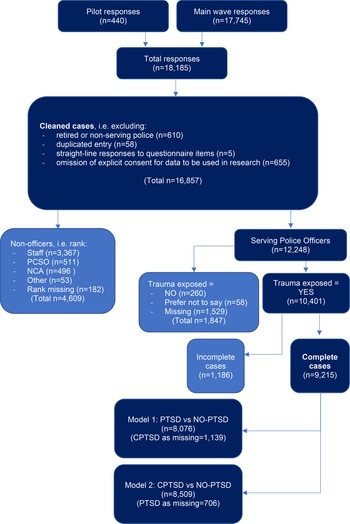
An online survey was hosted between 15 October and 16 December 2018 on the website of Police Care UK, a registered charity concerned with the physical and psychological welfare of former and serving police officers and staff, volunteers, and their families. The ‘Policing: The Job & The Life’ survey, advertised as covering issues about trauma management, wellbeing and working conditions, was disseminated via social media and official communication channels within established UK policing networks. An attempt was made to minimise selection bias by neutrality in the advertising of the survey on social media and by omitting specific mention of mental health. The survey was targeted at the population of currently employed UK Police Force officers and staff of all ranks, including community support officers and special constables. As shown in Fig. 1, a raw total of 18 185 respondents from the 43 territorial police services of England and Wales as well as from Police Scotland, Police Service of Northern Ireland, British Transport Police and the National Crime Agency took part in the research. After removal of retired or non-serving police, reported age outside 18–70 years old, reported length of service over 50 years, difference between years of service and age below likely limits (<16), duplicated entry, straight-line responses to questionnaire items and omission of explicit consent for data to be used in research, the final sample was 16 857. Due to the sampling methods, it is not possible to calculate a response rate, but the eventual sample equates to 7% of all UK police officers and staff as informed by official statisticsFootnote †Footnote 1.
Case selection flowchart. PCSO, police community support officer; NCA, National Crime Agency.

For comparison with previous surveys, the present report uses a base sample of 12 248 serving police officers. It includes patrol and office-based staff but excludes support staff in exclusively administrative roles as well as volunteer community support officers. Representation of police ranks was consistent with UK Home Office records. Government statistics indicate that 93.4% of officers are whiteFootnote 2 and ethnicity was not included as a variable in the study. The study was approved by the Sociology Research Ethics Committee of the University of Cambridge, UK.
Measures
Officers were asked a general trauma exposure question (‘In your work with the police, have you ever experienced events which were to some extent traumatic?’) and, if they said Yes, about the time of the most disturbing event. Three questions enquired about the frequency of exposure to different kinds of event: traumatic incidents (e.g. involving fatality, serious injury, children, etc.), traumatic visual material (e.g. graphic forensic imagery, online child sexual exploitation, etc.) and traumatic auditory material (e.g. emergency call handling, radio communication). These were answered on 7-point scales ranging from 1 (‘never’) to 7 (‘all of the time’). Five further questions enquired about specific exposure at work to verbal abuse, threats or humiliating behaviours in the last month, and to physical violence or sexual harassment in the previous 12 months. The timeframes were selected to reflect the likely differing prevalence of these experiences. These were answered on dichotomous yes/no scales.
Officers answering Yes to the general trauma exposure question completed the International Trauma Questionnaire (ITQ) (Cloitre et al., Reference Cloitre, Shevlin, Brewin, Bisson, Roberts, Maercker and Hyland2018) in relation to their most troubling experience. The ITQ consists of two items measuring each of the three core elements of PTSD and the three additional core elements of CPTSD, as well as six items measuring functional impairment. Each item refers to the past month and is measured on a 5-point scale ranging from 0 ‘Not at all’ to 4 ‘Extremely’. A score of 2 ‘Moderately’ is required for an item to count towards diagnosis. The measure is psychometrically robust, and its ability to distinguish between PTSD and CPTSD has been established using confirmatory factor analysis and latent profile analysis (Cloitre et al., Reference Cloitre, Shevlin, Brewin, Bisson, Roberts, Maercker and Hyland2018; Ho et al., Reference Ho, Hyland, Shevlin, Chien, Inoue, Yang and Karatzias2020; Owczarek et al., Reference Owczarek, Ben-Ezra, Karatzias, Hyland, Vallières and Shevlin2019; Tian et al., Reference Tian, Wu, Wang, Zhang, Yu and Zhao2020). A PTSD diagnosis required endorsement of at least one item measuring each of the three core features plus functional impairment. Officers additionally endorsing at least one item measuring each of the three core CPTSD features plus functional impairment were assigned a CPTSD diagnosis.
Other questions in the survey were concerned with the specific nature of the worst traumatic event, or with wellbeing and working conditions, and are not analysed here.
Statistical analysis
Data enabling us to assess the representativeness of our sample were only available for England and Wales. Unadjusted prevalence figures for PTSD and CPTSD among our respondents from England and Wales were recalculated weighting the sample for the distribution of gender, age and rank in the entire England and Wales force as determined by Home Office figures1. We used a ‘raking’ technique whereby the sampling weights are iteratively adjusted until the marginal values of the selected variables converge with the known population totals. The prevalence of PTSD increased from 7.71% to 7.97% and the prevalence of CPTSD increased from 12.79% to 13.01%. A sensitivity analysis yielded no significant differences with the regression results obtained from the corresponding unweighted dataset. In order to have comparable data from the entire UK, unadjusted estimates are used in the analyses. Further sensitivity checks investigated whether rates of PTSD were affected by the response rate of a particular police service or by whether responders completed the survey early or late, but these factors had a minimal effect on the results.
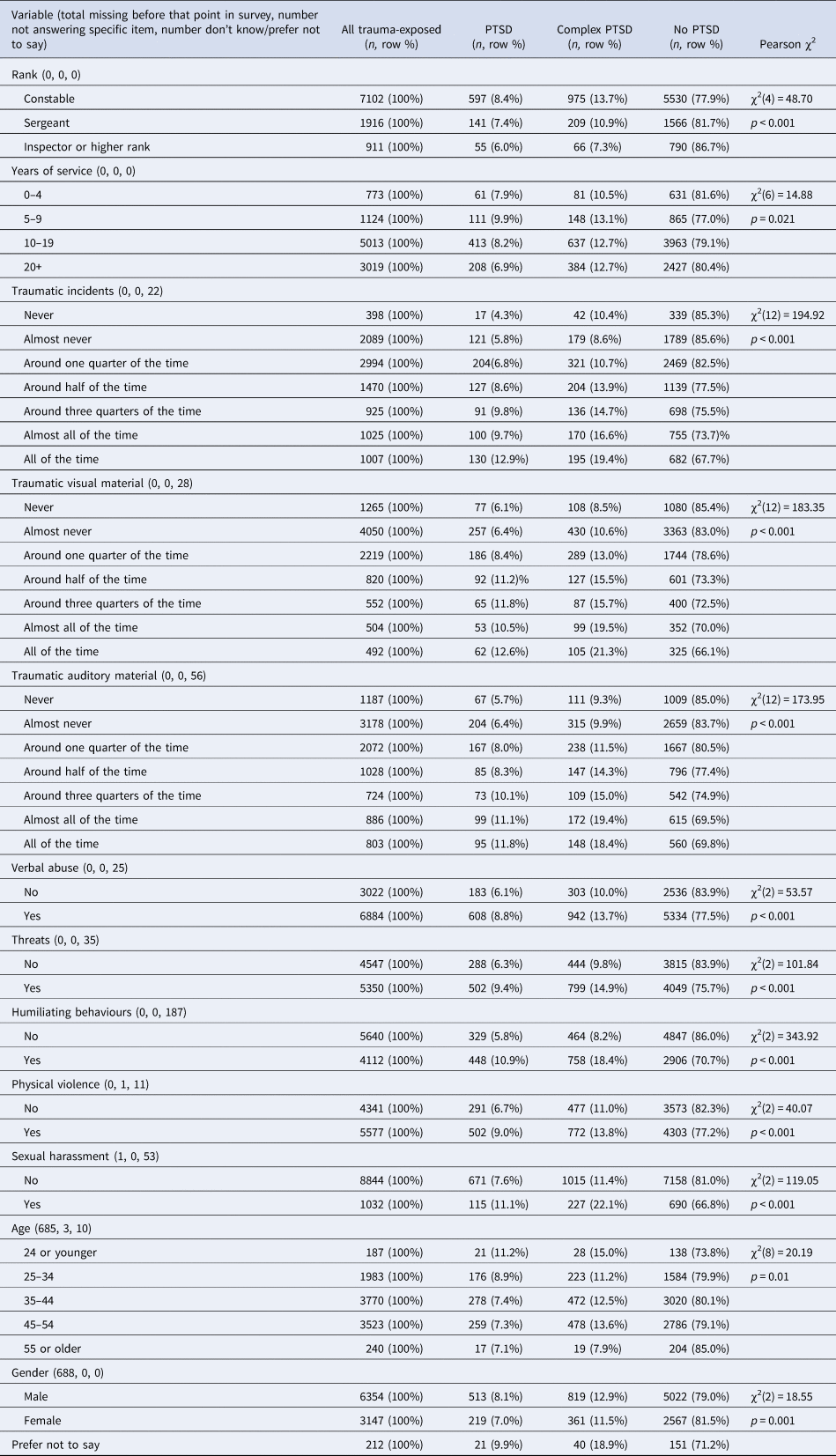
The structure of the survey meant that participants not completing a given page could not progress to later questions. Thus the number of missing values increased cumulatively throughout the survey and depended on the position of the item in the survey. Symptom items occurred mid-survey. As a result, values on any specific item could be missing for three reasons: The respondent had already exited the survey through failing to answer a previous question, they specifically declined to answer that question, or they gave a don't know/prefer not to say response to the specific question. Table 1 reports these three missing value sources for each of the predictor variables in the study. The table shows that the great majority of missing values were associated with age and gender which came right at the end of the survey and consequently suffered from earlier drop-out.
Demographic characteristics and trauma exposure by PTSD and CPTSD status
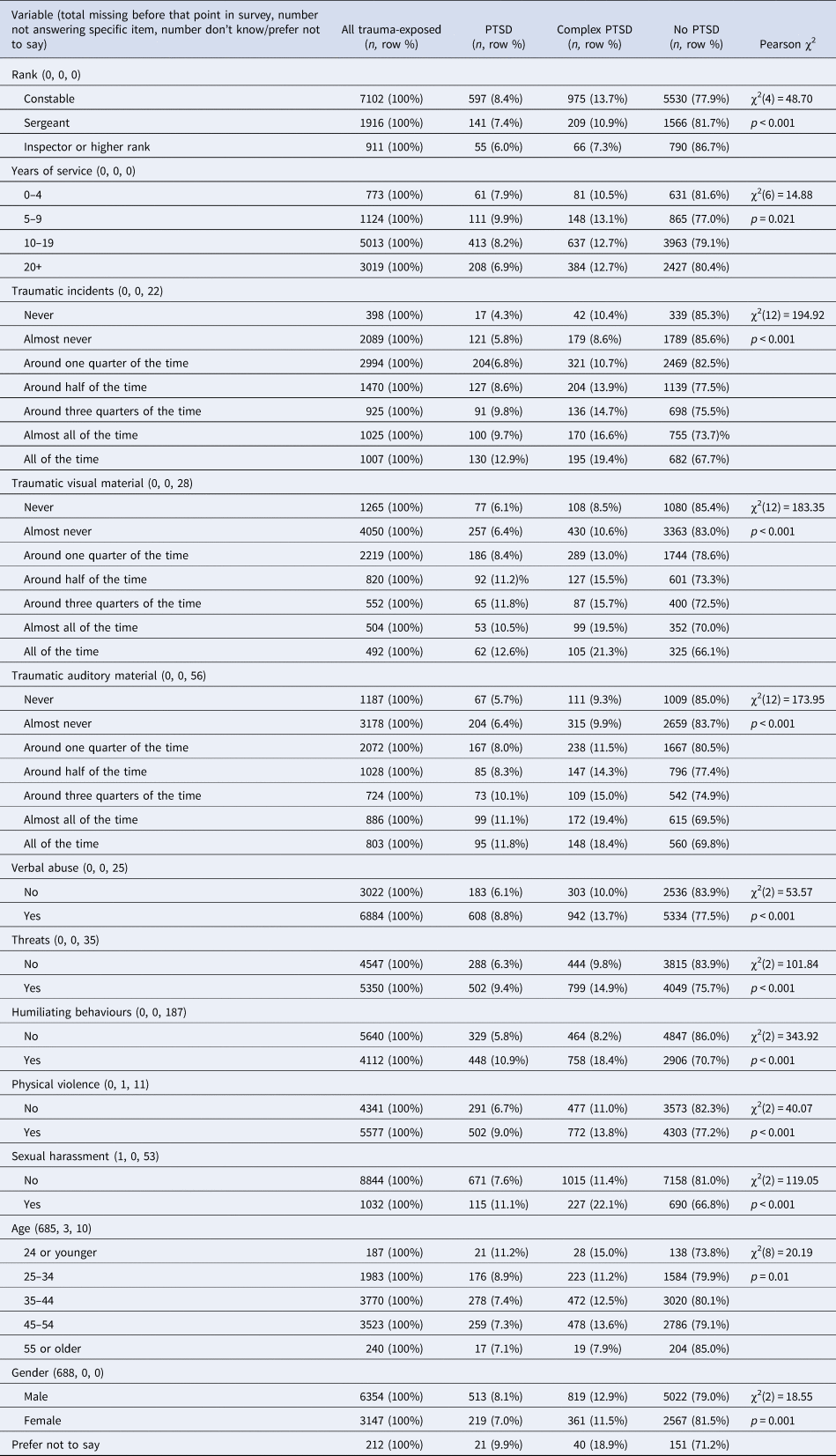
The distribution of demographic variables and trauma exposure between those meeting criteria for PTSD or CPTSD relative to those receiving no PTSD diagnosis were compared individually using χ2 tests. In order to determine which were unique predictors of disorder when controlling for all other variables, demographic characteristics and indices of trauma exposure were then simultaneously entered into multiple logistic regressions. All variables were entered with one exception. As age and length of service were very highly correlated (r = 0.78, p < 0.001), and the main focus of the study was on length of service, age was dropped from the regression analyses. Three separate regressions predicted (a) PTSD v. no PTSD, (b) CPTSD v. no PTSD and (c) PTSD v. CPTSD. A set of interaction terms further explored whether any individual type of exposure was more strongly associated with PTSD among male than among female officers (or vice versa).
Multiple imputation is sometimes appropriate to compensate for missing values. However, it is recommended that values should only be imputed for predictors and not for dependent variables (von Hippel, Reference von Hippel2007). The only remaining predictor with a significant number of missing values (n = 688) was gender. We opted to run the multivariate analyses with and without gender to investigate whether its inclusion affected the results.
Results
As shown in Fig. 1, 12.5% of the base sample had discontinued their participation in the survey by the time they were asked whether they had encountered events that were to some extent traumatic. The great majority of the remainder (n = 10 401) agreed that they had. The modal time of occurrence of the most troubling event was 1–5 years previously (35.6% of respondents). The trauma-exposed group had a mean age of 41.1 years (s.d. 8.1 years) and a mean length of service of 15.8 years (s.d. 7.4 years).
The available subset of respondents who had not exited the survey at an earlier point or specifically declined to answer the symptom questions was 9929. Of these, 8.0% were diagnosed with PTSD, 12.6% with CPTSD and the remaining 79.4% did not meet criteria for either disorder. Table 1 describes the demographic characteristics and exposure to trauma in these three groups, as well as in the total sample. The variables are listed in order of their appearance in the survey, and the table reports the number and nature of any missing values. All variables were associated with an altered likelihood of PTSD, CPTSD and no PTSD.
Given the importance both of trauma exposure and gender, we next compared the experiences of men and women officers. Men reported being more often exposed to verbal abuse, χ2(1) = 58.12, p < 0.001, threats, χ2(1) = 235.00, p < 0.001, humiliating behaviours, χ2(1) = 34.76, p < 0.001, and physical violence, χ2(1) = 243.12, p < 0.001, whereas women reported being exposed to more frequent traumatic incidents, χ2(6) = 55.16, p < 0.001, traumatic visual exposure, χ2(6) = 49.28, p < 0.001, and sexual harassment, χ2(1) = 354.72, p < 0.001. There were no reported gender differences in exposure to traumatic auditory material, χ2(6) = 5.30, p > 0.50.
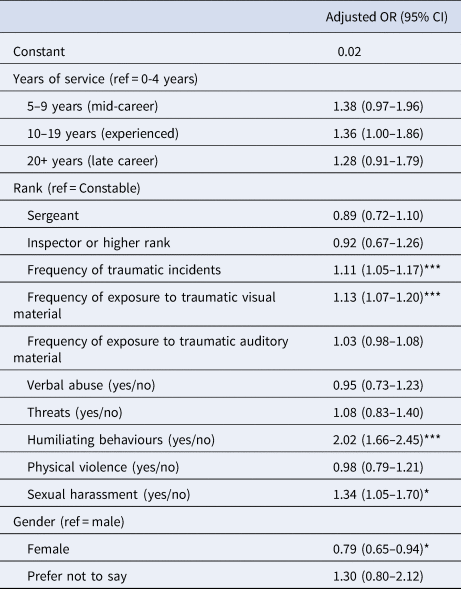
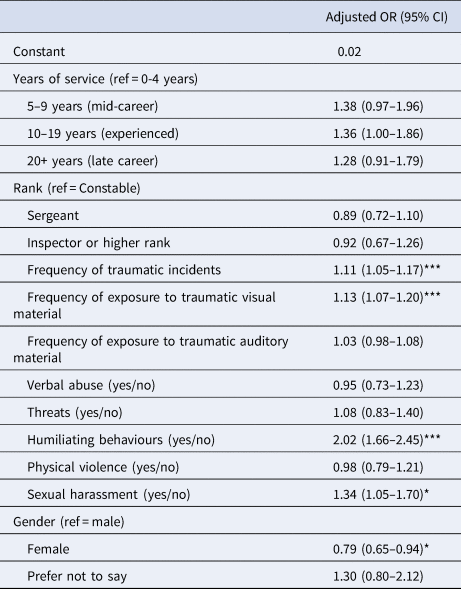
Prior to conducting the logistic regressions, we confirmed there was little evidence of multi-collinearity. The omission of age as a variable was supported by finding that there were no independent effects of age when controlling for years of service. Outlier assessment found a small number of cases with standardised residuals lying outside ±2.58 s.d., but none were beyond ±3 and they represented no more than 0.17% of the analysed sample. Frequency of traumatic incidents and of exposure to traumatic visual and auditory material were treated as continuous variables in all analyses. When we assessed all variables as predictors of PTSD v. no PTSD, the overall model was highly significant, χ2(15) = 210.40, p < 0.001, Nagelkerke R 2 = 0.06. As shown in Table 2, significant predictors of PTSD included higher frequency of exposure to traumatic incidents and traumatic visual material, exposure to humiliating behaviours and sexual harassment, and male gender. Interactions of gender with the different forms of exposure were tested separately in a second step but none were significant and they are excluded from the model reported here. When we excluded gender from the regression, the results remained the same except that the OR for the effect of sexual harassment decreased from 1.34 to 1.25 and was no longer significant.
Variables predicting PTSD v. no PTSD in simultaneous logistic regression
OR, odds ratio; CI, confidence interval; ref, reference category.
*p < 0.05; **p < 0.01; ***p < 0.001.
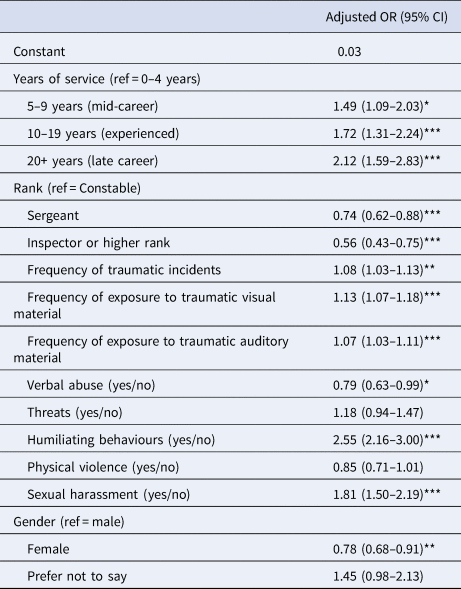
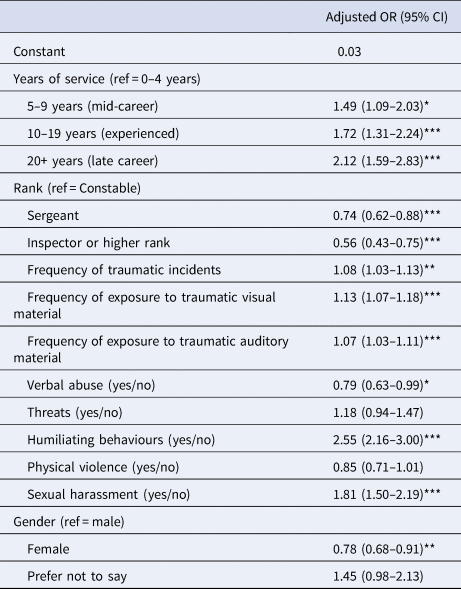
When predicting CPTSD v. no PTSD, the overall model was highly significant, χ2(15) = 487.11, p < 0.001, Nagelkerke R 2 = 0.10. As shown in Table 3, significant predictors of CPTSD included more years of service, lowest rank (constable), exposure to more traumatic incidents and to more traumatic visual and auditory material, exposure to humiliating behaviours and sexual harassment, and male gender. Exposure to verbal abuse had a slight opposite effect. Interactions of gender with the different forms of exposure were tested separately in a second step, but none were significant and they are excluded from the model reported here. When we excluded gender from the regression, the pattern of results did not change.
Variables predicting CPTSD v. no PTSD in simultaneous logistic regression
OR, odds ratio; CI, confidence interval; ref, reference category.
*p < 0.05; **p < 0.01; ***p < 0.001.
A final logistic regression assessed the predictors of PTSD v. CPTSD. The overall model was significant, χ2(15) = 25.53, p = 0.043, Nagelkerke R 2 = 0.02. Individual predictors were: 20+ years of service’ experience compared to the reference category of 0–4 years, OR 1.66 (CI 1.09–2.54), p = 0.019, rank of inspector or above compared to the lowest rank, OR 0.61 (CI 0.41–0.92), p = 0.017, exposure to humiliating behaviours, OR 1.28 (CI 1.01–1.62), p = 0.040, and sexual harassment, OR 1.32 (CI 1.00–1.74), p = 0.048. When we excluded gender from the regression, the pattern of results did not change.
Discussion
The prevalence of mental ill health within the emergency services is likely to fluctuate over time due to changes in working practices and responsibilities, staffing levels, and societal developments that may impact on recruitment and the relationship between public and police. Such factors may also differentially impact police officers working in specific geographical areas or who undertake specific sorts of duty. With these caveats in mind, the current study provides the most comprehensive assessment of PTSD prevalence that has yet been reported among police officers. The combined prevalence of PTSD and CPTSD (20.6%) is high compared to the international average of 14.2% reported in a recent meta-analysis (Syed et al., Reference Syed, Ashwick, Schlosser, Jones, Rowe and Billings2020) although it falls well within the range identified by previous studies.
The 1-month prevalence obtained is noticeably higher than in nationally representative population studies using ICD-11: In the USA, rates of 3.4% (PTSD) and 3.5% (CPTSD) were reported (Cloitre et al., Reference Cloitre, Hyland, Bisson, Brewin, Roberts, Karatzias and Shevlin2019); in Israel, rates were 9.0% (PTSD) and 2.6% (CPTSD) (Ben-Ezra et al., Reference Ben-Ezra, Karatzias, Hyland, Brewin, Cloitre, Bisson and Shevlin2018); in Germany, rates were 1.5% (PTSD) and 0.5% (CPTSD) (Maercker, Hecker, Augsburger, & Kliem, Reference Maercker, Hecker, Augsburger and Kliem2018). More importantly, we found the excess of CPTSD in police officers predicted by its theoretical basis in exposure to chronic and repeated stress.
Although all variables were associated with a differential likelihood of PTSD, CPTSD or not PTSD in bivariate analyses, consistent with previous research on traumatic exposure (Violanti et al., Reference Violanti, Charles, McCanlies, Hartley, Baughman, Andrew and Burchfiel2017), there were unique demographic and exposure-based predictors of the two conditions. For PTSD and CPTSD, these included male gender and a high frequency of everyday exposure to traumatic events and visual material. Exposure to verbal abuse, threats, physical violence or traumatic auditory material did not appear to confer unique additional risk, perhaps because these experiences were commonplace or regarded as an expected part of the job.
In contrast, exposure to humiliating behaviours in the past month and to sexual harassment in the past year were unique predictors. The impact of humiliating behaviours may reflect the well-documented association between PTSD and shame (Lopez-Castro, Saraiya, Zumberg-Smith, & Dambreville, Reference Lopez-Castro, Saraiya, Zumberg-Smith and Dambreville2019). Importantly, shame was found in one study to predict the development of PTSD over and above levels of initial symptoms, suggesting that such experiences continue to be toxic for months after they have occurred (Andrews, Brewin, Rose, & Kirk, Reference Andrews, Brewin, Rose and Kirk2000). One mechanism that could account for this is rumination, which is a predictor of PTSD symptoms such as intrusive memories both in naturalistic (Michael, Halligan, Clark, & Ehlers, Reference Michael, Halligan, Clark and Ehlers2007) and experimental (Ball & Brewin, Reference Ball and Brewin2012) studies. Sexual harassment, although sometimes not considered to be a traumatic stressor that meets criteria for a DSM PTSD diagnosis, has been shown to be more prevalent in traditionally male organisations (Sbraga & O'Donohue, Reference Sbraga and O'Donohue2000). It is strongly associated with PTSD symptoms (Avina & O'Donohue, Reference Avina and O'Donohue2002), including in military samples (Wolfe et al., Reference Wolfe, Sharkansky, Read, Dawson, Martin and Ouimette1998). This may also be because of its potential to induce shame (Yoon, Funk, & Kropf, Reference Yoon, Funk and Kropf2010).
Unique predictors that differentiated CPTSD from PTSD were greater years of experience, lowest rank, and exposure to humiliating behaviours and sexual harassment. The implication is that within police samples, there are relatively few specific categories of traumatic exposure that determine which disorder develops. The data support a cumulative burden model in which increasing years of continual exposure gradually reduce resistance. This pattern of developing PTSD gradually rather than in response to a single overwhelming event has frequently been noted, for example, in the literature on delayed-onset PTSD (Andrews, Brewin, Stewart, Philpott, & Hejdenberg, Reference Andrews, Brewin, Stewart, Philpott and Hejdenberg2009). A number of biological mechanisms, for example, sensitisation and kindling, have been put forward to account for this process (Post, Weiss, Smith, Li, & McCann, Reference Post, Weiss, Smith, Li and McCann1997; Yehuda, Reference Yehuda1997). Given that CPTSD may increase the probability of retirement or medical discharge, it is possible that the effect of length of service is an underestimate. Our findings suggest that particular care should be taken to assess long-serving officers who have not been promoted for cumulative levels of trauma exposure and PTSD symptoms, as well as to monitor officers who have felt humiliated or sexually harassed.
There are a number of other occupational health implications for police forces. CPTSD is a newly defined condition and there are as yet no clinical trials evaluating interventions for its treatment. However, the NICE Guideline indicates that CPTSD may require longer and more intensive treatment than PTSD. The presence of sometimes severe difficulties in emotion regulation means that in some cases, a phase-based approach to trauma treatment may be desirable in which these problems are addressed at the outset so that the person is better able to tolerate a specific focus on the traumatic events. One example is skills training in affect and interpersonal regulation (STAIR) (Cloitre et al., Reference Cloitre, Stovall-McClough, Nooner, Zorbas, Cherry, Jackson and Petkova2010). More generally health provision for CPTSD is likely to need a flexible, multi-modular approach that for some individuals will go beyond standard trauma-focussed treatment (Karatzias & Cloitre, Reference Karatzias and Cloitre2019). Assessing the local prevalence of PTSD and CPTSD, and their relative frequency in different branches of police work, will be important for planning such interventions.
The primary limitation of the study was the unknown response rate which enjoins caution about the overall prevalence rates of trauma exposure and PTSD that were obtained. However, representativeness checks on the England and Wales data suggested prevalence rates were, if anything, slightly underestimated, and sensitivity checks did not indicate that the response rate of a particular police service was associated with prevalence. It should also be noted that the mental health content of the survey was not advertised and the prevalence rate of PTSD fell well within previous estimates. There is less reason to be cautious about the effects of any selection bias on relative levels of PTSD and CPTSD, or on the associations with most of the risk factors that were documented. Other limitations include the difficulty in measuring the intensity of the different forms of trauma exposure with so many separate potential incidents, and the absence of measures of other types of traumatic stress and prior individual susceptibility to disorder.
Unusually, male officers were more at risk of PTSD and CPTSD, reflecting previous heterogeneity in gender differences for this disorder among police samples (Beagley et al., Reference Beagley, Peterson, Strasshofer and Galovski2018). Our data suggested that this was partly due to a greater exposure to humiliating behaviours, one of the most toxic forms of experience. However, our reliance on self-report measures may have introduced some bias, and may have accounted for the particularly strong effect size associated with this variable. This is an important topic for further exploration. It also cannot be ruled out that there may have been selection biases operating either with entry to the survey or at various career stages.
These limitations notwithstanding, the survey provides the most comprehensive estimate to date of levels of PTSD within police officers, and is the first to assess ICD-11 diagnoses in an occupational group. It is also the first to validate the inclusion of repeated indirect exposure to traumatic material in an occupational context within DSM-5 Criterion A. The distinction between PTSD and CPTSD introduced by ICD-11 was shown to be relevant to this highly trauma-exposed group, and it has important implications for mental health planning within the emergency services more generally.
Acknowledgements
The research was supported by a grant from Police Care UK to the University of Cambridge.
Conflict of interest
None to declare.
Ethical standards
The authors assert that all procedures contributing to this work comply with the ethical standards of the relevant national and institutional committees on human experimentation and with the Helsinki Declaration of 1975, as revised in 2008.