Introduction
The family Cryptogonimidae Ward, 1917 (Digenea: Trematoda) includes a number of flukes parasitizing the gut and pyloric caeca of poikilothermic vertebrates, including fish, reptiles and amphibians (Miller & Cribb, Reference Miller, Cribb, Bray, Gibson and Jones2008b). The genus name Timoniella was proposed by Rebecq (Reference Rebecq1960) for Timoniella atherinae Rebecq, 1960 based on metacercariae from big-scale sand-smelt (Atherina boyeri Risso, 1810) in the Mediterranean Sea. Later, these metacercariae were synonymized with Timoniella praeterita (Looss, 1901), which is now the type species for the genus (Maillard, Reference Maillard1974). In all, eight species are now known for the genus, with three being described from European marine/brackish-water fish: Timoniella balthica (Reimer et al., 1996), Timoniella imbutiforme (Molin, 1859) and T. praeterita (Brooks, Reference Brooks1980; Miller & Cribb, Reference Miller, Cribb, Bray, Gibson and Jones2008b). Adult T. praeterita are known only from European seabass (Dicentrarchus labrax (L., 1758)) occurring off the Mediterranean coasts of Egypt, France and Italy, the Adriatic Sea, the Norwegian North Sea and the Atlantic coast of Great Britain (Looss, Reference Looss1901; Nicoll, Reference Nicoll1915; Maillard, Reference Maillard1974; Sterud, Reference Sterud2002; Radujković & Šundić, Reference Radujković and Šundić2014), although T. praeterita metacercariae have also been found on the sand-smelt A. boyeri and gilthead seabream Sparus aurata L., 1758 (Maillard, Reference Maillard1974; Maillard et al., Reference Maillard, Lambert and Raibaut1980). Timoniella imbutiforme is a widely distributed species, known from D. labrax, the European flounder (Platichthyes flesus L., 1758) and the broad-nosed pipefish (Syngnathus typhle L., 1758) in the Mediterranean Sea (Molin, Reference Molin1859; Looss, Reference Looss1901; Maillard, Reference Maillard1973; Bartoli & Gibson, Reference Bartoli and Gibson2007; Culurgioni et al., Reference Culurgioni, Sabatini, De Murtas, Mattiucci and Figus2014), the Atlantic coast of Europe, the North Sea off Norway and the coast of England (Johnstone, Reference Johnstone1906; Nicoll, Reference Nicoll1915; McDowall & James, Reference McDowall and James1988; El-Darsh & Whitfield, Reference El-Darsh and Whitfield1999; Sterud, Reference Sterud2002). It is also known from the common dentex (Dentex dentex L., 1758) in the Adriatic Sea (Marengo et al., Reference Marengo, Durieux, Marchand and Francour2014; Radujković & Šundić, Reference Radujković and Šundić2014), while T. imbutiforme metacercariae are known from Pomatoschistus spp., the black goby (Gobius niger L., 1758), A. boyeri, the Mediterranean banded killifish (Aphanius fasciatus Valenciennes, 1821), P. flesus, the common dab (Limanda limanda L., 1758) and the common sole (Solea solea L., 1758) (Maillard, Reference Maillard1973; Køie, Reference Køie1983; El-Darsh & Whitfield, Reference El-Darsh and Whitfield2000; Malek, Reference Malek2004; Culurgioni et al., Reference Culurgioni, Sabatini, De Murtas, Mattiucci and Figus2014). Adults have been registered from S. typhle in the Black Sea and P. flesus in the Gulf of Odessa and the Sea of Azov (Chernyshenko, Reference Chernyshenko1949; Domnich & Sarabeev, Reference Domnich and Sarabeev2000), while metacercariae are often registered on gobiid species from the same localities, and from Sevastopol Bay and lagoons of the north-western Black Sea (Naydenova, Reference Naydenova1974; Domnich & Sarabeev, Reference Domnich and Sarabeev2000; Kvach, Reference Kvach2005, Reference Kvach2010; Kvach & Oğuz, Reference Kvach and Oğuz2009; Krasnovyd et al., Reference Krasnovyd, Kvach and Drobiniak2012). Finally, adult T. balthica have been found on S. typhle from the Salzhaff Lagoon in the Baltic Sea (Reimer et al., Reference Reimer, Hildebrand, Scharberth and Walter1996), while metacercariae have been recorded on many small fishes, including the three-spined stickleback (Gasterosteus aculeatus L., 1758), the nine-spined stickleback (Pungitius pungitius L., 1758), S. typhle, the viviparous eelpout (Zoarces viviparus L., 1758), and gobiids and gobionellids (Reimer et al., Reference Reimer, Hildebrand, Scharberth and Walter1996; Zander et al., Reference Zander, Reimer and Barz1999, Reference Zander, Koçoglu, Skroblies and Strohbach2002; Zander, Reference Zander2001, Reference Zander2003; Zander & Reimer, Reference Zander and Reimer2002; Kvach & Winkler, Reference Kvach and Winkler2011). This relatively newly described species (T. balthica) is morphologically very similar to T. imbutiforme from the Black Sea, which also uses the same definitive host, i.e. S. typhle.
The Black and Baltic seas are both large brackish waterbodies with salinity ranging around 18‰ in the Black Sea and 6–8‰ in the Baltic Sea (Zenkevich, Reference Zenkevich1963; Dethier, Reference Dethier1992). Forming part of the Mediterranean region, the Black Sea is characterized by the presence of both relict Boreo-Atlantic and Ponto-Caspian faunas, in addition to Mediterranean species (Zaitsev & Mamaev, Reference Zaitsev and Mamaev1997; Zaitsev, Reference Zaitsev1998). Cryptogonimids inhabiting the Black Sea are mainly of Mediterranean origin; for example, Anisocoelium capitellatum Rudolphi, 1819, Anisocladium fallax Rudolphi, 1819 and A. gracilis Looss, 1901 are all common parasites of the stargazer (Uranoscopus scaber L., 1758) throughout the Mediterranean basin, including the Black Sea (Bartoli & Gibson, Reference Bartoli and Gibson2000). Metadena pauli Vlasenko, 1931 was originally described from fish of the Black Sea, although it has since also been recorded in fish species from the eastern and western Mediterranean Sea (Sey, Reference Sey1970; Naydenova, Reference Naydenova1974; Fischthal, Reference Fischthal1980; Bartoli & Bray, Reference Bartoli and Bray1987; Bartoli & Gibson, Reference Bartoli and Gibson1995). On the other hand, Aphallus tubarium Rudolphi, 1819, a common species found on many fish in the Mediterranean Sea, has only been recorded in S. typhle in the Black Sea (Korniychuk & Gaevskaya, Reference Korniychuk and Gaevskaya2004). Aphalloides coelomicola Dollfus et al., 1957 is the only Boreal–Atlantic species, its distribution covering both the Mediterranean basin and northern Europe (Kvach et al., Reference Kvach, Bryjová, Sasal and Winkler2017).
Due to the overall similarity of the Black and Baltic seas as habitat, and the similarity of representatives of Timoniella found within them, the status of these taxa remains unclear. Hence, the aim of this work was to undertake a morphological and genetic comparison of Timoniella spp. from different geographical regions (the Baltic, Black and Mediterranean seas) in order to clarify the taxonomic status of the Black Sea and Baltic Sea populations.
Materials and methods
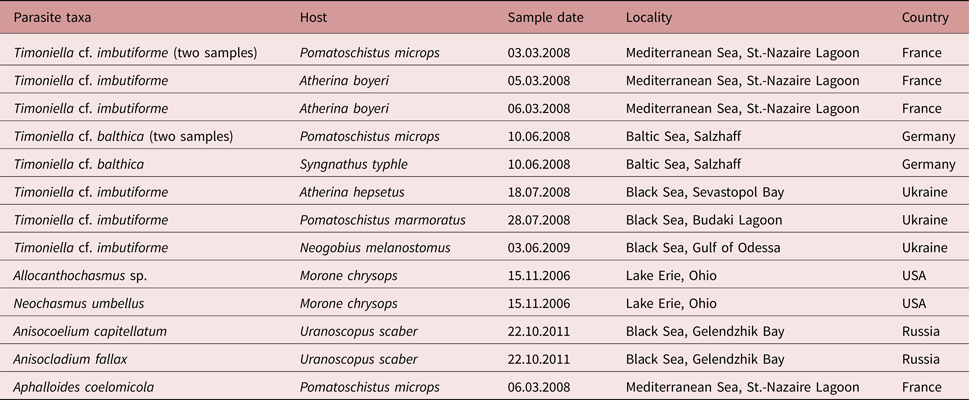
Adults and metacercariae of Timoniella spp. were sampled from different localities in the Mediterranean Sea (Saint-Nazaire Lagoon, France), the Black Sea (Budaki Lagoon, Sevastopol Bay and the Gulf of Odessa, Ukraine) and the Baltic Sea (Salzhaff, Germany) (site details are provided in table 1). Examples of each parasite were fixed in pure 96% ethanol for molecular study and hot 4% formaldehyde for morphological study (Cribb & Bray, Reference Cribb and Bray2010). Formaldehyde-preserved worms were then stained with iron acetic carmine, dehydrated in ethanol of increasing concentration and mounted in Canada balsam as permanent slides (Georgiev et al., Reference Georgiev, Biserkov and Genov1986). All metacercariae were identified based on the number of spines in the oral sucker crown (Maillard, Reference Maillard1973; Reimer et al., Reference Reimer, Hildebrand, Scharberth and Walter1996).
Samples used for genetic analysis of Timoniella spp.

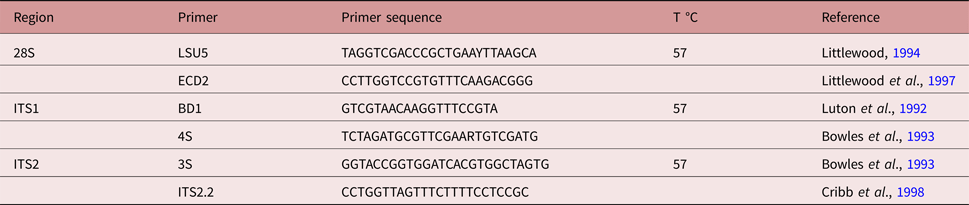
DNA was extracted from individual worms using the JetQuick kit (Genomed, Löhne, Germany), while the KAPA2G Robust HotStart PCR Kit (Kapabiosystems, Wilmington, Massachusetts, USA) was used to amplify the internal transcribed spacer-1–internal transcribed spacer-2–28S rDNA (ITS1–ITS2–28S rDNA) nuclear genomic region (primers and annealing temperatures are detailed in table 2). Sanger sequencing of polymerase chain reaction (PCR) products was performed commercially at GATC Biotech (Konstanz, Germany), with sequences edited and aligned using Geneious 9.0.5 (Kearse et al., Reference Kearse, Moir, Wilson, Stones-Havas, Cheung, Sturrock, Buxton, Cooper, Markowitz, Duran, Thierer, Ashton, Mentjies and Drummond2012). Bayesian phylogenetic reconstruction was based on concatenated ITS1–ITS2–28S sequences of ten newly sequenced Timoniella individuals (table 1). This represents the first sequencing of the ITS1–ITS2–28S region in morphologically identified Timoniella spp. Samples of five other cryptogonimid species from our own samples (see table 1) were used as an outgroup. Also included in the outgroup were sequences for Acanthostomum burminis Bhalerao, 1926 (KC489791; Jayawardena et al., Reference Jayawardena, Tkach, Navaratne, Amerasinghe and Rajakaruna2013), Siphoderina jactus Miller & Cribb, Reference Miller, Cribb, Bray, Gibson and Jones2008b (EU571263) and Siphoderina poulini Miller & Cribb, 2008 (EU571267; Miller & Cribb, Reference Miller and Cribb2008a). Acanthostomum burminis is presently considered a sister lineage to the remaining cryptogonimids. PartitionFinder 1.0.1 (Lanfear et al., Reference Lanfear, Calcott, Ho and Guindon2012) detected all three regions (ITS1, ITS2, 28S) as forming a single partition, indicating GTR+G as the most suitable substitution model to use. Hence, Bayesian analysis of evolutionary relationships using a single partition with GTR+G model priors was performed in MrBayes 3.2.1 (Ronquist & Huelsenbeck, Reference Ronquist and Huelsenbeck2003), as implemented in Geneious 9.0.5.
DNA sites and primers used for genetic sequencing of Timoniella spp. (T °C = annealing temperature).

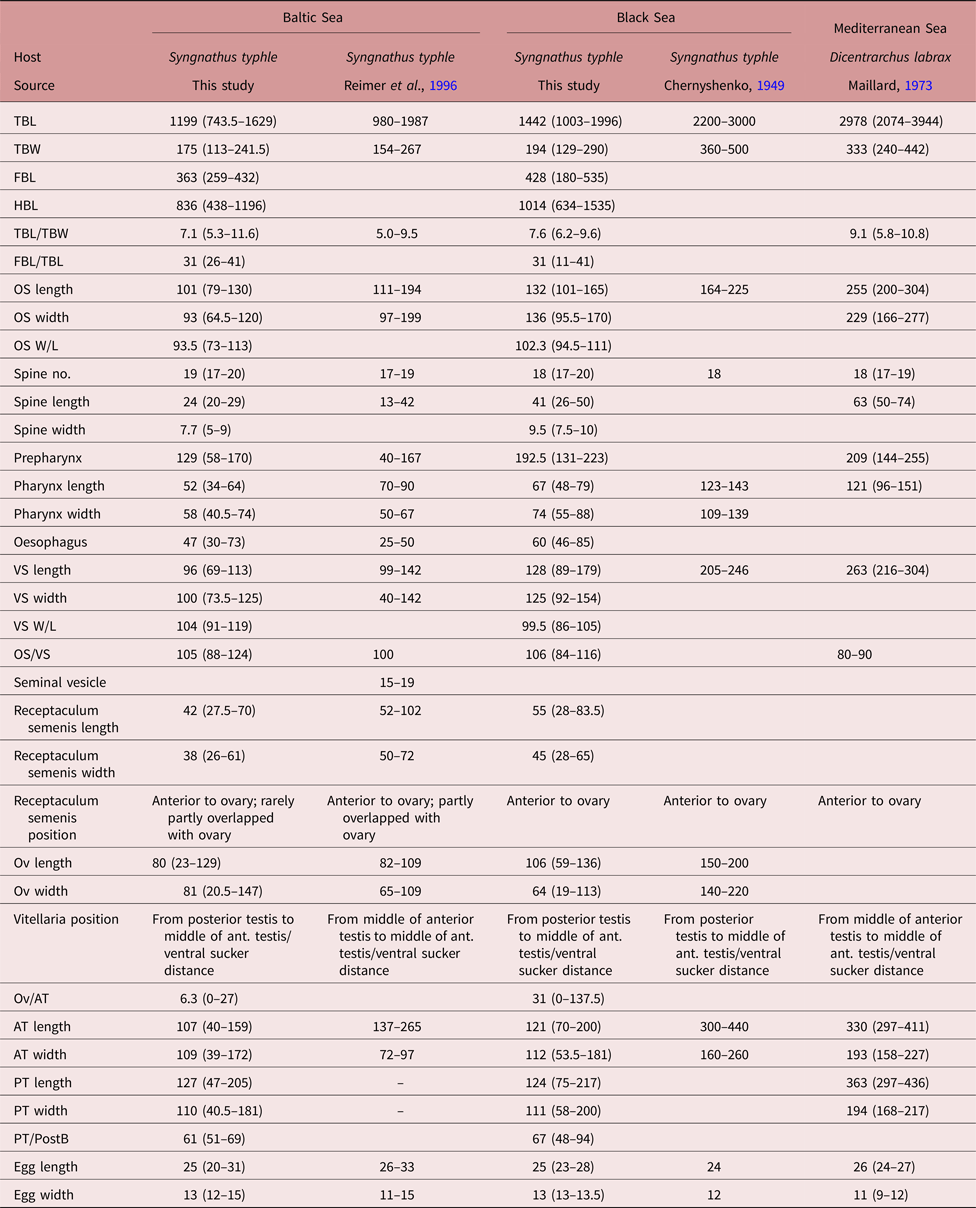
Morphological and morphometric parameters used for differentiating adult Timoniella imbutiforme sampled from different regions (see ‘Materials and methods’ for an explanation of the abbreviations used).

Descriptions of adult Timoniella were used for the morphological study (Chernyshenko, Reference Chernyshenko1949; Maillard, Reference Maillard1973; Reimer et al., Reference Reimer, Hildebrand, Scharberth and Walter1996). Measurements were made of total body length (TBL), total body width (TBW), forebody length (FBL) and hindbody length (HBL), with all parameters measured in micrometres. TBW was taken as maximum body width for all further calculations. FBL was measured as distance from the anterior extremity to the anterior margin of the ventral sucker, while HBL was measured from the anterior margin of the ventral sucker to the posterior end of the body. FBL was calculated as the percentage of TBL. We also measured the length and width of the oral (OS) and ventral (VS) suckers, the pharynx, the seminal receptacle, the ovary (Ov), the anterior (AT) and posterior (PT) testes, and the egg, along with the length of the prepharynx and oesophagus, the distance from the ovary to the anterior testis (Ov/AT), and distance from the posterior testis to the posterior end of the body (PT/PostB). The number of spines in the oral-sucker spine crown was calculated, as was the length and width of a single spine. Finally, ratios of TBL to TBW (TBL/TBW), OS width to length (OS W/L), VS width to length (VS W/L), and OS to VS length (OS/VS) were calculated as a percentage.
Results
Phylogenetic analysis
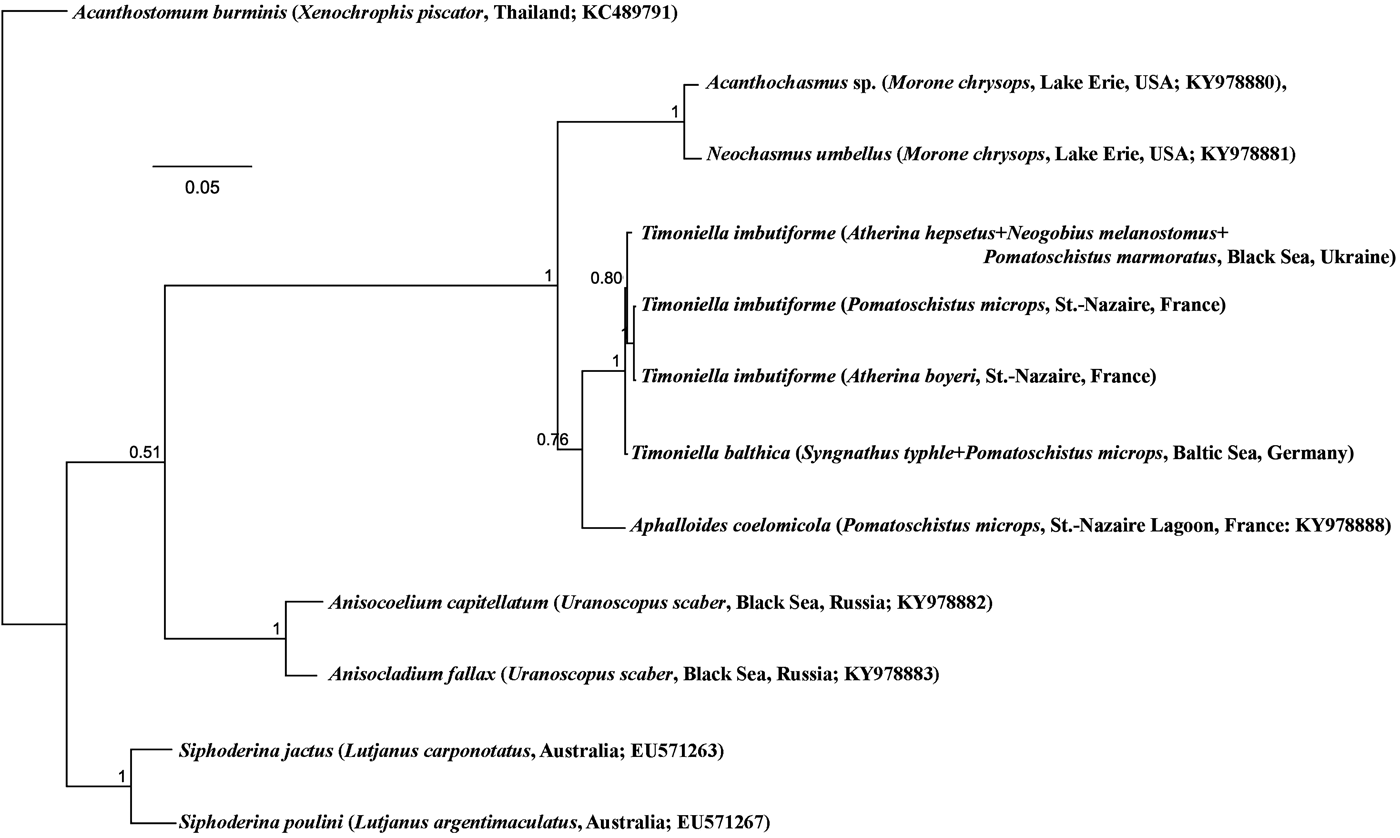
Bayesian phylogenetic reconstruction based on the ITS1–ITS2–28S genomic region indicated a highly supported monophyletic group encompassing four cryptogonimid genera in two pairs (posterior probability PP = 1.00); with Acanthochasmus as a highly supported sister genus to Neochasmus (PP = 1.00), and slightly lower support (PP = 0.79) for a sister relationship between Timoniella and Aphalloides (fig. 1). The genus Timoniella was monophyletic and included all samples from France, Germany and Ukraine (PP = 1.0). Timoniella worm sequences from different hosts showed little variability and no clear structure caused by host fish species.
Cryptogonimid phylogenetic tree based on Timoniella sp. ITS–28S rDNA sequences.

Morphological study
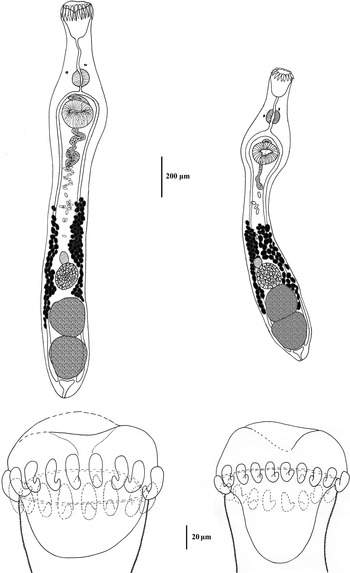
There was no morphological difference between worms sampled from different regions (table 3, fig. 2), although morphometric parameters within each region showed high variability. As a result, there is some overlap between regions and with data from previous work, including the original descriptions (see table 3; Chernyshenko, Reference Chernyshenko1949; Maillard, Reference Maillard1973; Reimer et al., Reference Reimer, Hildebrand, Scharberth and Walter1996). Based on this morphological study, we provide a re-description of T. imbutiforme below.
Timoniella imbutiforme ex. Syngnathus typhle, overviews (above) and spine crowns (below); (left) from Budaki Lagoon, Ukraine; (right) from Salzhaff.

Taxonomic summary
Family Cryptogonimidae Ward, 1917.
Genus Timoniella Rebeqc, 1960.
Timoniella imbutiforme (Molin, 1859) Brooks, 1980 (fig. 2).
Synonyms. Distomum imbutiforme Molin, 1859; Anoikostoma imbutiforme (Molin, 1859) Stossich, 1899; Acanthochasmus imbutiformis (Molin, 1859) Looss, 1901; Echinostomum imbutiforme (Molin, 1859) Johnstone, 1906; Acanthostomum imbutiforme (Molin, 1859) Gohar, 1934; Acanthostomum balthicum Reimer et al., 1996; Timoniella balthica (Reimer et al., 1996) Miller & Cribb, 2008.
Type host. Dicentrarchus labrax (L., 1758) (Actinopterygii: Moronidae).
Other hosts. Syngnathus typhle L., 1758, Syngnathus abaster Risso, 1826 (Actinopterygii: Syngnathidae), Dentex dentex (L., 1758) (Actinopterygii: Sparidae), Platichthys flesus L., 1758 (Actinopterygii: Pleuronectidae); metacercariae in Atherina boyeri Risso, 1810 (Actinopterygii: Atherinidae), Neogobius melanostomus (Pallas, 1814) (Actinopterygii: Gobiidae), Pomatoschistus marmoratus (Risso, 1810), Pomatoschistus microps (Krøyer, 1838) (Actinopterygii: Gobionellidae), and many other brackish-water fish species.
Type locality. Mediterranean Sea near Egypt.
Other localities. Gulf of Leon, Nile delta, Adriatic Sea, Black Sea, Sea of Azov, North Sea, Themes delta, Øresund, south-western Baltic Sea.
Site in host. Intestine.
Voucher material. C-616 (Helminthological collection of the Institute of Parasitology of the Academy of Sciences of the Czech Republic, České Budějovice, Czech Republic).
Representative sequence. MF491832–MF491865 (NCBI GenBank).
Description
Body elongate, 743.5–3944 in length. Forebody usually shorter than hindbody, 22–50% of total body length. Maximum body width in forebody, 113–500, at the level of ventral sucker. Ratio between body length and width 5.3–11.6. Tegument covered with small spines. Two brown eyespots at level of pharynx.
Oral sucker terminal, funnel-shaped, 79–304 × 65–277. Oral sucker with crown of 17–20 spines, 13–78 × 5–10. In specimens fixed in hot formalin, oral sucker partly everted and spines curved. Ventral sucker same size as acetabulum, almost round, sometimes prolonged laterally, 69–179 × 40–154 (sometimes up to 205–304). Ratio of oral/ventral sucker length is 80–124%.
Prepharynx 40–255 long, usually winding. Pharynx muscular, elongate–oval, 34–151 × 40–139. Oesophagus commonly shorter than prepharynx, 30–85. Intestinal bifurcation in central forebody, anterior to ventral sucker. Caeca terminate blindly close to posterior extremity. Excretory pore terminal, excretory vesicle Y-shaped.
Genital pore located immediately anterior to ventral sucker. Gonotyle small, simple, located anterior to ventral sucker, associated with ventral sucker. Seminal vesicle tubular, posterior to ventral sucker.
Gonads in posterior hindbody. Testes two, oval, tandem, close to posterior extremity of body. Post-testicular distance about 51–94, measured from last one. Testes of similar size with high variability, 40–436 × 39–227. Ovary entire, globular, 80–200 × 64–220, anterior to testes, contiguous with, or up to about 27–137 from, anterior testes. Seminal receptacle obliquely anterior to ovary, sometimes overlapping, thick-walled, oval to circular, 28–102 × 26–65. Follicular vitellarium in two lateral groups, from posterior testis (rarely from middle of anterior testis) to middle of distance between anterior testis and ventral sucker. Eggs small, elongate–oval, with some variability in size, 20–33 × 9–15, yellowish-brown, not embryonated.
Discussion
Based on the results of this study, we propose T. balthica as a junior synonym of T. imbutiforme, making this the second Boreal–Atlantic cryptogonimid species registered in the Black Sea fauna. The other species, A. coelomicola, was originally described from Mediterranean annual gobies, Pomatoschistus spp., and another species, Aphalloides timmi Reimer, 1970, from the same host in the Baltic Sea (Dollfus et al., Reference Dollfus, Chabaud and Golvan1957; Reimer, Reference Reimer1970). Kvach et al. (Reference Kvach, Bryjová, Sasal and Winkler2017) later considered these two taxa as the same species, A. coelomicola. The sister relationship of Timoniella and Aphalloides was also confirmed by Kvach et al. (Reference Kvach, Bryjová, Sasal and Winkler2017), suggesting that both species probably form part of the Boreal–Atlantic relict fauna of the Black and Baltic seas, dating from the Upper Miocene.
Unlike A. coelomicola, whose life cycle is strongly synchronized with that of Pomatoschistus spp. (Pampoulie et al., Reference Pampoulie, Lambert, Rosecchi, Crivelli, Bouchereaut and Morand2000), the T. imbutiforme life cycle includes different definitive and secondary intermediate hosts, with D. labrax previously described as the main definitive host and Pomatoschistus spp. as the main second intermediate host (Maillard, Reference Maillard1973). In the Black and Baltic seas, however, S. typhle is the main definitive host (Chernyshenko, Reference Chernyshenko1949; Reimer et al., Reference Reimer, Hildebrand, Scharberth and Walter1996), although Pomatoschistus spp. remains the main secondary intermediate host (Reimer et al., Reference Reimer, Hildebrand, Scharberth and Walter1996; Zander et al., Reference Zander, Reimer and Barz1999, Reference Zander, Koçoglu, Skroblies and Strohbach2002; Zander & Reimer, Reference Zander and Reimer2002; Kvach, Reference Kvach2005, Reference Kvach2010; Krasnovyd et al., Reference Krasnovyd, Kvach and Drobiniak2012). Small fish such as Pomatoschistus spp. are important dietary items of S. typhle (Oliveira et al., Reference Oliveira, Erzini and Gonçalves2007). Both main definitive hosts (D. labrax and S. typhle) are widely distributed along European coasts, stretching from the North Sea off Norway to the Mediterranean and Black seas in the south (note that D. labrax is absent from the Baltic Sea) (Dawson, Reference Dawson, Whitehead, Bauchot, Hureau, Nielsen and Tortonese1986; Smith, Reference Smith, Quero, Hureau, Karrer, Post and Saldanha1990). While the main definitive hosts have a Boreal–Atlantic distribution, the first intermediate host of the parasite, mud snails of the Hydrobia group (Maillard, Reference Maillard1973; Reimer et al., Reference Reimer, Hildebrand, Scharberth and Walter1996), are part of a group of European lagoon species distributed throughout the Boreal zone (Barnes, Reference Barnes1989).
Our analysis confirms two European species within the genus Timoniella: T. imbutiforme and T. praeterita. Both representatives appear to be Boreal–Atlantic species, with T. imbutiforme having the wider range. Taking into account the absence of T. praeterita in the Black Sea, we suggest that T. imbutiforme is of older origin, representing a Boreal relict within the Black Sea fauna. The maritae and metacercariae of these two species can be distinguished by the termination of the intestinal caeca and the oral sucker armature (see Brooks, Reference Brooks1980). We provide (below) a new key for the identification of Timoniella.
According to Brooks (Reference Brooks1980) the genus was previously considered a representative of the subfamily Acanthostominae. The Acanthostominae, with Acanthostomum Looss, 1899 as its type genus, includes both fish and reptile parasites. Based on our own data, A. burminis, a parasite of the Asiatic water snake, Xenochrophis piscator Schneider, 1799, was found to lie far from the fish parasites (see fig. 1). As such, we consider adult cryptogonimid parasites of fish to constitute a common monophyletic group, while reptile parasites should be considered as a separate group.
Key for the identification of Timoniella (modified from Brooks, Reference Brooks1980).

Acknowledgements
We thank Dr Kevin Roche (Institute of Vertebrate Biology, Czech Academy of Sciences) for proof reading the English text.
Financial support
The study received financial support from the European Centre of Ichthyoparasitology – Centre of Excellence, Grant Agency of the Czech Republic Project No. P505/12/G112.
Conflict of interest
None.