1. Introduction.
The verbal ablaut systems of German and Dutch have been the subject of various diachronic as well as contrastive studies (see, for example, Born 1985, Dammel 2003, Durrell 2001, Hempen 1988). However, one remarkable phenomenon has escaped the researchers’ notice so far: the analogical extension of the ablaut pattern o PRETERITE = o PAST PARTICIPLE of class II to other strong verbs, as shown in 1. In Dutch, this analogy affected many more verbs than in German.
- (1)
a.

b.

Thus, in both languages a new and relatively stable class emerged by analogy through the convergence of several strong verbs which all share the pattern x-o-o (the x stands for nearly any vowel in the infinitive). Although this is not an ablaut class in the traditional sense, it is appropriate to use the term EIGHTH ABLAUT CLASS given that its emergence can be compared to that of class VII that became a “collection bin” for formerly reduplicating verbs in North West Germanic. Postulating a new eighth ablaut class is, therefore, just as warranted as the traditional seventh class.
This article aims at illustrating and comparing the diachronic emergence of the eighth ablaut class in German and Dutch, and at detecting the reasons for the partially different developments in the respective languages (section 2). The main goal is to show that this analogy is the result of a regularization due to low token frequencies that yielded a simplified two-vowel alternation pattern, as in German ‘milk’ melken–molk–gemolken (=ABB) instead of the regular melken–malk–gemolken (=ABC), or Dutch ‘pull’ trekken–trok–getrokken (=ABB) instead of the regular trekken–trak–trāken–getreken (=ABB’A) (sections 3 and 4). A brief excursion into English, where the analogy with class II hardly gained ground, rounds off the work thematically (section 5).
2. The Eighth Ablaut Class in German and Dutch.
2.1. The Stock of X-O-O-Verbs.
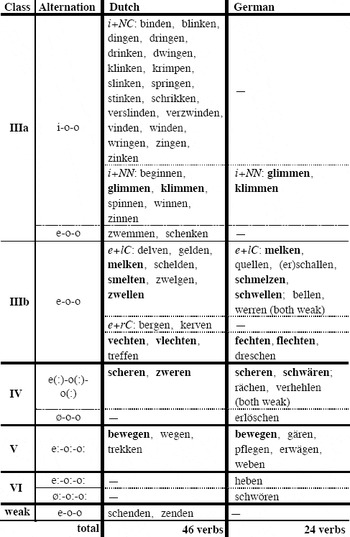
The analogical extension of x-o-o and thus the emergence of the eighth ablaut class took place mainly in the periods of Early New High German (late fourteenth to eighteenth centuries) and Middle Dutch (late fourteenth to seventeenth centuries), respectively.Footnote 1Table 1 provides an over-view of the complete stock of German and Dutch verbs that acquired x-o-o analogically. They are arranged by their historical (ablaut) class and according to vowel alternation.
Stock of x-o-o-verbs in Dutch and German.

The direct comparison between German and Dutch reveals many similarities (see verbs in bold in table 1) as well as remarkable differences. First, almost twice as many verbs in Dutch compared with German joined the pattern x-o-o analogically: 46 versus 24. Second, the verbs that make up this new eighth ablaut class are derived almost exclusively from a single class in Dutch (88% are originally class III verbs). In contrast, in German the new class contains verbs from series III–VI in more or less equal measure (core stock: IIIb–V; see table 1). The different extent to which the analogy spread, and also the different verbs involved in this process are undoubtedly due to specific language-internal developments, namely, the ablaut leveling in the preterite of class III (see section 2.2).
2.2. Ablaut Leveling in the Preterite of Class III Verbs.
The differences between Dutch and German reported below are mainly due to different ablaut leveling directions within the preterite of class III verbs. As examples 2a and 3a show, in German the a of the singular was extended to the plural, probably supported interparadigmatically by classes IV and V which already had a preterite in a (for instance, nahm ‘took’, gab ‘gave’; see Hempen 1988:273). In Dutch, however, the o had already been inherent to the plural and was thus generalized in the whole preterite under the influence of the o in the past participle, as shown in 2b and 3b (see Hempen 1988:287f.).
- (2)
a.
b.
- (3)
a.
b.
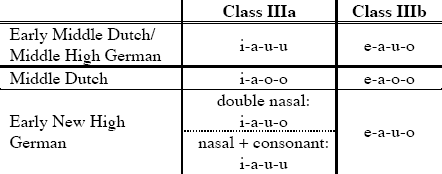
Thus, the eighth ablaut class in Dutch results in essence from the ablaut leveling process in the preterite of class III. As examples 2 and 3 indicate, the conditions for generalizing the o in the preterite, and hence adopting x-o-o, were much more favorable in Dutch than in German. Table 2 illustrates in more detail to what extent the lowering u > o affected the vowel alternations of classes IIIa and b in Middle Dutch and Early New High German.
Development of the vowel alternations of classes IIIa and IIIb in Dutch and German.
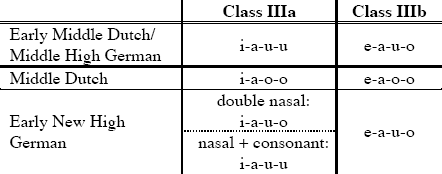
In Early New High German, the u was most consistently lowered before double nasals, thus affecting only the verbs of class IIIa with stem-final double nasal. However, even here, only the past participles underwent a change, for example, gesunnen P.P. > gesonnen P.P.. Here, the lowered forms with o were interparadigmatically supported by the large number of strong participles ablauting in o. The plural preterite forms, in contrast, lacked such interparadigmatic support, thus sunnen PL.PRET.. The lowering left no traces in the conjugation of class IIIb verbs and verbs with stem-final nasal+consonant of class IIIa, however, as in wurfen PL.PRET. or gefunden P.P. (see Dammers et al. 1988:363–419).
In contrast to German, the (Early) Middle Dutch lowering u > o applied more consistently, and thus affected the past participles of class IIIa (for instance, gebunden > gebonden), as well as the plural preterites of classes IIIa/b (for instance, bunden > bonden or wurpen > worpen; see van Bree 1987:207–219, van Loey 1966:67–85). Hence, the o gained stability in both paradigm positions, the past participle and the preterite plural of Middle Dutch class III verbs. This sound change provided the basis for the ablaut leveling direction within the preterite, and with that the leveling in favor of x-o-o: the generalization of the plural forms (see also 2b and 3b). Consequently, all verbs of class III joined the eighth ablaut class in Dutch (see Hempen 1988:287f.). In German, however, this process was limited to low-frequency verbs such as glimmen ‘glow’, melken ‘milk’, or gären ‘ferment’.
3. The Role of Token Frequencies.
3.1. German.
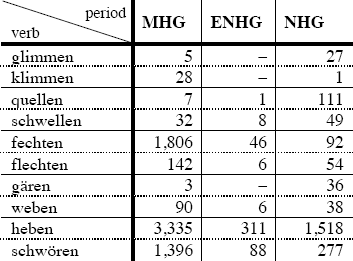
A closer look at the German x-o-o-verbs listed in table 1 reveals that they do not belong to the core vocabulary (anymore), and consequently, the frequency of their use has decreased. This is supported by the frequency counts presented in table 3. As the selected examples show, from Middle High German on, the members of class VIII either were already relatively rare in MHG (for example, glimmen, klimmen, gären) or lost their former frequency during the period between MHG and NHG (for example, fechten, heben, schwören).
Token frequencies of selected eighth ablaut class verbs.Footnote 2
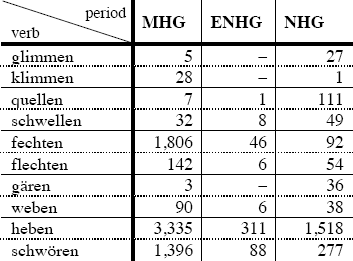
Thus, low frequency of use correlates with the pattern change to x-o-o (see Nübling & Dammel 2004:197), and this, again, happens alongside the loss of strong class properties. Most of these verbs developed weak variants early on in Early New High German, for example, webte–gewebt alongside wob–gewoben. In the case of bellen ‘bark’, schwären ‘fester’, verhehlen ‘dissemble’, and verwirren ‘confound’, the eighth ablaut class has been an intermediate stage towards the weak conjugation. They adapted their ablaut pattern to x-o-o before becoming weak, for instance, bellen: ball–gebollen → boll–gebollen > bellte–gebellt.
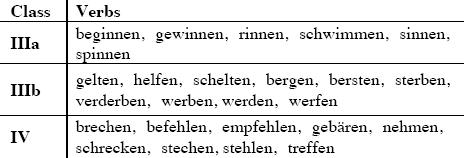
This correlation between low frequency and the adoption of x-o-o is supported by the fact that strong verbs with higher token frequency were only temporarily attracted by x-o-o in Early New High German (table 4; see Dammers et al. 1988:356–419).
Verbs of classes III and IV temporarily affected by x-o-o.

These 25 verbs that originate from series III and IV have always exhibited high frequency of occurrence, particularly as compared to the members of class VIII. Compare, for instance, the frequency of occurrence of gelten, helfen, nehmen, and treffen in table 5, which are far beyond 1,000 tokens each (shaded cells).
Token frequencies of gelten, helfen, nehmen, and treffen.

Consequently, such verbs have developed a more distinctive three-vowel alternation pattern, for instance, helfen–half–geholfen. Thus, it can be argued that only low-frequency strong verbs changed over to the eighth ablaut class in German.
Furthermore, the correlation between low frequency and simplification of the ablaut alternation to x-o-o is also confirmed by tendencies in present-day German. Even today less frequent strong verbs are attracted to x-o-o, for instance, rinnen ‘flow’, schwimmen ‘swim’, sinnen ‘brood’, and spinnen ‘spin’. Their frequency of use in Modern German ranges from only 36 tokens in the case of sinnen to a maximum of 1,457 tokens in the case of schwimmen (see table 6).
Token frequencies of sinnen, rinnen, spinnen, schwimmen, beginnen, and gewinnen.

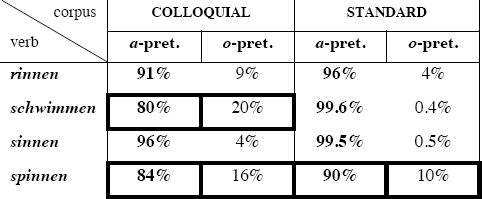
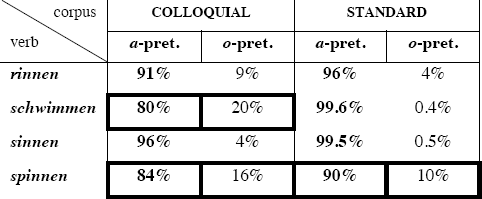
Research based on internet corpora of contemporary German shows that, at least in colloquial language, these four verbs display analogical preterite forms with o alongside regular forms with a (for example, schwomm alongside schwamm). As table 7 shows, o-preterites are quite often attested for schwimmen (20%) and spinnen (16%). In the latter case, they even account for 10% in the standard language. Frequent verbs such as beginnen and gewinnen (13,052 and 19,816 tokens, respectively, see table 6) do not have any analogical forms at all.
Percentage of analogical o-preterites in colloquial and standard German.Footnote 3
3.2. Dutch.
In Dutch, token frequencies have also played an important role: frequency of occurrence exerted an influence on whether the analogy process was accelerated or slowed down. Thus, less frequent verbs of class III acquired x-o-o earlier than verbs of higher token frequency. For instance, wringen ‘wring’ or schelden ‘scold’ acquired x-o-o earlier than binden or gelden.
Moreover, token frequencies have played a key part in the development of a group of class IIIb verbs that deviated from the regular course of the leveling process described in section 2.2: helpen, (be)derven, sterven, werpen, werven, and zwerven (de Vriendt 1965:59–62, van den Toorn et al. 1997:305f., 401f., Hempen 1988:289f.). These five verbs form their preterite with ie [i:]—by analogy with class VII—instead of regularly o, thus yielding a more differentiated, three-vowel alternation, as shown in 4.
- (4)
a.
B.
Hempen (1988:289) ascribes the borrowing of ie in the preterite of these verbs to the loss of ablaut contrast between the present tense forms with e and the preterite singular forms with e. The latter results from the sound change a > e before r+labial/velar, as in warp > werp ‘threw’ (see also 4b). Given the syncretism of the present and preterite plural endings, the tense distinction would have collapsed completely if the e of the singular had been generalized (see Hempen 1988:288), as in wij/uw/zij werpen ‘we/you/they throw/threw’ “PRES.PL.=PRET.PL.”. However, generalizing the plural o would have guaranteed the ablaut opposition between present and preterite just as well as the new preterite forms with ie, for instance, werpen PRES≠ +worp/en PRET.
However, there are problems with Hempen's analysis. First, it does not explain why helpen participated in the analogy even though its preterite was never affected by the sound change of a > e. Second, the verbs bergen and kerven did not re-form their preterites by analogy with class VII, despite exhibiting the conditioning environment r+labial/velar of the tense leveling sound change.
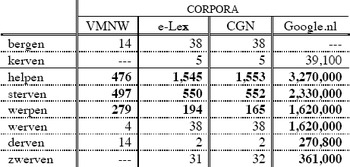
In my opinion, it is not the loss of tense distinction caused by the sound shift that triggered the analogical borrowing of the ie-preterites and thus the differentiation of their ablaut pattern, but rather the high token frequency of these verbs, as shown in table 8.Footnote 4 The verbs helpen, sterven, werpen, and werven are each recorded over a million times at Google.nl (between 1,620,000 and 3,270,000 tokens). In contrast, kerven ‘notch’ is recorded only 39,100 times. Less-frequent class IIIb verbs, such as kerven, bergen, melken, or zwellen, underwent the regular development of the ablaut leveling process in class III, and thus followed the same path as their German counterparts, that is, they conformed to the simplified pattern x-o-o (see also table 1).
Token frequencies of the verbs of class IIIb with e+rC, and helpen.Footnote 5

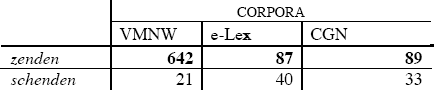
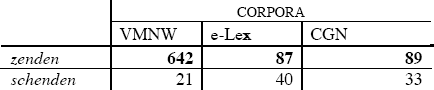
The fact that the weak “Rückumlaut” verb zenden ‘send’ joined the eighth ablaut class can also be explained in terms of token frequencies (see van den Toorn et al. 1997:104).
(5)
In this particular case, it was the relatively high token frequency that “strengthened” this weak verb in Middle Dutch (see table 9). The less frequent “Rückumlaut” verb schenden joined zenden by analogy, probably because of structural similarity.
Token frequencies of zenden and schenden.
Finally, another five verbs stemming from series IV and V acquired x-o-o: scheren ‘shave’ and zweren ‘fester’ (class IV), as well as bewegen ‘move’, wegen ‘weigh’ and trekken ‘pull’ (class V) (see Hempen 1988: 285). Compare 6a and 6b.
- (6)
a.
b.
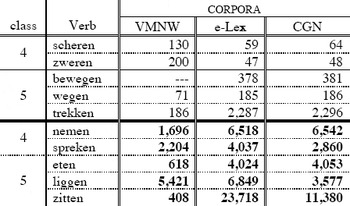
As table 10 illustrates, their frequency does not exceed 400 tokens except for trekken. Here, the relatively low frequency triggered the pattern change to x-o-o. Only high-frequency verbs such as spreken ‘speak’, nemen ‘take’, or liggen ‘lie’ have preserved two different preterite stem-vowels and thus retained a highly-differentiated four-vowel alternation type, compare nemen–nam–naamen–genomen (=ABB’C). Here, the tokens have far more than 1,000 occurrences each (see table 10).
Token frequencies of scheren, zweren, bewegen, wegen, trekken compared to nemen, spreken, eten, liggen, and zitten.

4. The Eighth Ablaut Class and Morphological Theories.
4.1. Morphological Economy.
As shown in section 3, frequency of use determines whether morphological complexity is reduced (adoption of x-o-o), preserved (three-/four-vowel alternations), or even created (Dutch ie-preterites).
These results are consistent with the claims of Morphological Economy Theory (see, for example, Werner 1987, 1989; Fenk-Oczlon 1990), whereby high-frequency items exhibit a high degree of compression in inflection and, in the extreme case, even suppletion (as in to be: I am–it is–we are–I was). Hence, these idiosyncratic and highly irregular word forms have to be learnt by rote, which definitely increases the memorizing load. However, this price can easily be paid since high frequency of use strengthens memory representations and, consequently, the accessibility of these forms. The advantages are shortness of expression and hence low articulatory effort, and distinctiveness of forms (see Nübling 2000:254–256).
Thus, increasing or high token frequencies promote irregularities (as has been the case with German haben ‘have’: OHG habēn INF–habēta PRET → NHG haben INF–hatte PRET), but they also make irregular items resistant to regularizations (see Ronneberger-Sibold 1988:455–459). However, irregularities are eliminated under decreasing and low frequencies (see Fenk-Oczlon 1990:48f.). Accordingly, many low-frequency strong verbs have shifted and keep shifting to the regular weak conjugation, hence losing stem alternations and replacing modulatory codings (ablaut) by additive ones (dental suffix), for instance, German küren: koren → kürten ‘chose’.
4.2. The Eighth Ablaut Class as the Result of a Regularization.
However, regularizations do not necessarily lead to a class change from strong to weak. They can also involve an ablaut pattern change such as the adoption of x-o-o. Strong verbs that conform to the x-o-o pattern have thus reduced their original ablaut pattern to a two-vowel alternation, and, at the same time, to one single stem vowel in the past tense forms (preterite+past participle). These changes have strengthened the opposition between present and past, as shown in 7.
- (7)
a.
b.
Marking the preterite and past participle uniformly with o lowers the memorizing costs, and this holds particularly for less-frequent items (see Dammel 2003:57, Dammers et al. 1988:273f., Nübling & Dammel 2004: 197).
Moreover, it is well attested that high type frequency also has a stabilizing effect on lexical items besides token frequency (see Bybee 2007:9). Hence, low-frequency strong verbs can still remain strong by conforming to an ablaut pattern used by many other verbs such as “o PRET =o P.P.” of class II, which comprised roughly 45 verbs in Middle Dutch and in Middle High German (see Hempen 1988:191–231, Dammel 2003:57).
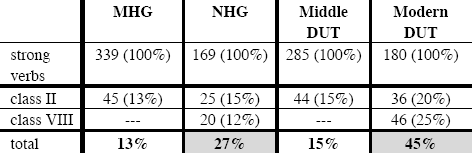
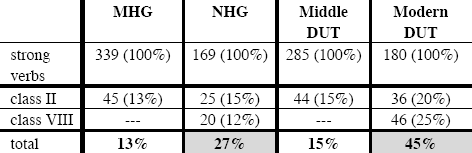
Thus, the verbs of class VIII did not only join the type-frequent pattern of class II by adopting x-o-o, but they also contributed to its extension. In German, class II has doubled from 13% to 27%, while in Dutch it has even trebled from 15% to 45% (see table 11).
Percentage extension of the x-o-o pattern in German and Dutch.
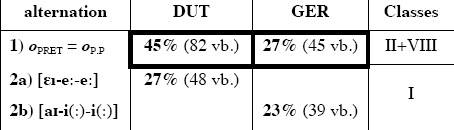
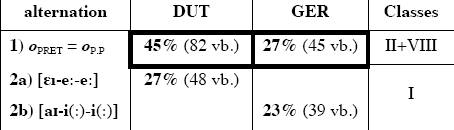
In addition, the pattern “o PRET=o P.P.” has developed into the dominant vowel alternation in the ablaut systems of German and Dutch (see table 12). In German, “o PRET=o P.P.” accounts for 27% of all strong verbs (classes II+VIII), closely followed by [aɪ-i(:)-i(:)] with 23%, originating from class I (for instance, greifen–griff–gegriffen). In Dutch, “o PRET=o P.P.” comes out ahead with 45%, followed by [εı-e:-e:] with “only” 27% (for instance, grijpen–greep–gegrepen), also stemming from class I.
Predominance of x-o-o in the Dutch and German ablaut system.
4.3. A “Collection Bin” for “Weakened” Strong Verbs.
The German eighth ablaut class comprises about 20 low-frequency strong verbs that have remained strong by conforming analogically to the type-frequent and simplified ablaut pattern of class II. Thus, besides the general tendency of strong verbs to become weak, there is another regularization path: the adoption of x-o-o. In some cases, this specific regularization strategy of low-frequency strong verbs can just be a stepping stone to the weak class, that is, an intermediate stage of regularization, as is the case with bellen or rächen. However, the eighth ablaut class currently constitutes a rather stable “terminal stop” of the regularization process for roughly 20 verbs, which has persisted since Early New High German. Furthermore, it still attracts new members in Modern German (such as schwimmen or spinnen).
4.4. A Stabilizer for the Strong Conjugation Class.
Unlike in German, the extension of x-o-o in Dutch has not helped single verbs to remain strong but has rather stabilized the macro-class of strong verbs as a whole. As a consequence of this pattern extension, mainly resulting from the ablaut leveling in class III, the alternation type ABB has been strengthened to such great extent that it has become the “norm” for strong verbs in Modern Dutch: 72% of all strong verbs follow this pattern, while the remaining 28% are allotted to four alternation types (ABC, ABA, ABB’A, ABB’C). A uniform past tense expression (preterite+past participle) is a movement towards the regular tense formation of weak verbs, the only difference being that weak verbs use an additive coding (dental suffix), whereas strong verbs exhibit modulation (ablaut).
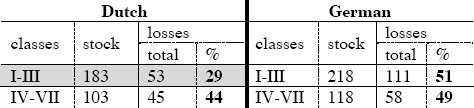
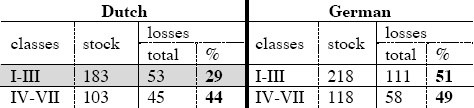
Hence, the macro-class of Dutch strong verbs has been stabilized insofar as the strong conjugation suffered fewer losses—by verbs either becoming weak or dying out—than in German (see table 13, based on Hempen 1988:191–231). Thus, the verbs that developed the ABB-type in Modern Dutch (< classes I–III) lost only 29% (shaded row). The verbs of classes IV–VII lost, in turn, almost twice as much (44%). In German, however, many more strong verbs were lost, and this was not linked to a particular ablaut series (51% and 49%).
Percentage of losses across the ablaut classes from Middle DUT > Modern DUT and MHG > NHG.
5. Dutch Between German and English?
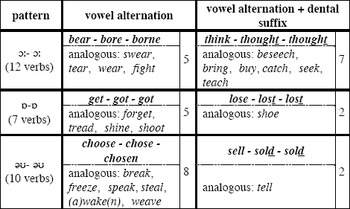
It has often been pointed out that Dutch holds an intermediate position between German and English, for example, with respect to grammatical gender or plural allomorphy (see van Haeringen 1956, Hüning 2003). However, does this hold for the specific case of analogy outlined above? A closer look at Modern English reveals that a total of 29 irregular verbs also have a preterite and past participle alternating in o, as shown in table 14. However, the realization of this o-pattern is fragmented into three sub-patterns: /ɔː- ɔː/ (as in bear), /ɒ-ɒ/ (as in, get), and /əʊ- əʊ/ (as in choose). In Dutch and German, in contrast, x-o-o only differs in quantity (as in DUT bond ‘bound’ versus bood ‘bid’), and is thus much more homogeneous. Whereas x-o-o and vowel alternations in general are restricted to strong verbs in Dutch and German, the English x-o-o-pattern comprises both verbs exhibiting exclusively strong class features such as bear or get, and verbs that combine strong class features (vowel alternation/ablaut) with weak ones (dental suffix) such as think or sell (see table 14).Footnote 6
English verbs with x-o-o (see Quirk 2004:105–114).

In contrast to Dutch and German, where class II served as a basis with its pattern spreading analogically to other strong verbs, the x-o-o-pattern in English is to a large extent the result of sound shifts, as in several former “Rückumlaut” verbs such as sell, tell, buy, seek, teach, think, beseech, catch.Footnote 7 Only six verbs joined x-o-o exclusively by analogy, that is, their preterite/past participle never had an o: wear, get, forget, tread, speak, and weave, mostly stemming from class V. In the remaining cases, x-o-o resulted from either the singular o displacing the plural preterite and past participle forms (as in shine), or—more frequently—from the past participle o replacing the preterite forms (as in bear, break, choose). However, class II seems to have hardly influenced these leveling processes, as it offered neither a uniform nor a type-frequent pattern to serve as an analogical model. Unlike Dutch and German, class II is comprised of only 12 verbs in Middle English. Out of the ten class II verbs that remained irregular/strong in Modern English, almost every one developed its own pattern (see Mossé 1991:70, Algeo & Pyles 2005:170–176, Lounsbury 1897:301–434). Consider the following examples:
(8)
- (9)
a.
b.
- (10)
a.
b.
(11)
(12)
(13)
The most striking difference between Dutch and German on the one hand and English on the other hand is that the extension of the x-o-o-pattern constitutes a frequency-driven regularization process in the ablaut systems of Dutch and German, which affected low-frequency verbs in the first place. In English, however, x-o-o resulted, to a large extent, from sound changes. Moreover, it is too heterogeneous to be considered a regularization strategy or a “collection bin” for weakened strong verbs. For the same reason, it is unlikely that it has stabilized the strong conjugation as a whole. Thus, Dutch and German go hand in hand with respect to the emergence of the eighth ablaut class, but they part ways with English.