Introduction
The concept and potential implications of a premature death of an older person are under-recognised and misunderstood by society (Commission on Dignity in Care for Older People (CDCOP) 2012; Organisation for Economic Cooperation and Development (OECD) 2011). It is easier for the community to consider most deaths of older people and especially those in an aged care setting inevitable, rather than actively seeking to identify preventable factors. Clinical, forensic and public health practitioners need to redress this gap to prepare society better for a future where an increasing proportion of the population are vulnerable older people (Parliamentary and Health Service Ombudsman (PHSO) 2011; Productivity Commission (PC) 2011; United States House of Representatives (USHR) 2001).
The standard metrics currently used to understand premature deaths, such as mortality registration and classification, have been public health and epidemiological tools for centuries (Moriyama, Loy and Robb-Smith Reference Moriyama, Loy and Robb-Smith2011). These descriptive and statistical measures are relied on to formulate public health priorities, policy and allocation of resources. Reliable and valid information is paramount for achieving the optimal public health goals and efficient use of available resources. However, in comparison to children and adults, there is a paucity of information about the nature, proportion, preventability and costs of premature deaths of older people (CDCOP 2012; OECD and European Union 2013; PHSO 2011; PC 2011; USHR 2001). Government and non-government reports, as well as published literature, are largely concerned with the economic and social impacts of premature mortality; and the trends, causes and strategies to reduce the burden, for persons that are at ages below 70 years, excluding older cohorts (Australian Bureau of Statistics 2006; Australian Institute of Health and Welfare (AIHW) 2010; Norheim et al. Reference Norheim, Jha, Admasu, Godal, Hum, Kruk, Gómez-Dantés, Mathers, Pan, Sepulveda, Suraweera, Verguet, Woldemariam, Yamey, Jamison and Peto2015; Weerasinghe, Yusuf and Parr Reference Weerasinghe, Yusuf and Parr2009).
Across most regions of the world the older population is growing faster than the total population (United Nations (UN) 2001). The population who are 60 years or older are projected to increase threefold to 2 billion by 2050 (United Nations Department of Economic and Social Affairs 2013), and the ‘oldest old’ – those 80 years and older – to increase fivefold reaching 379 million (UN 2001).
Accurate cause of death is essential for understanding how many older people have premature, preventable deaths, with implications for aged care services, health-care expenditure, quality and safety, and human rights (Kennedy et al. Reference Kennedy, Ibrahim, Bugeja and Ranson2014). If deaths in frail, old people are inaccurately classified as ‘natural’, and any contributing modifiable factors not identified, avoidable mortality cannot be highlighted and addressed, as in the Mid Staffordshire NHS Trust scandal in the United Kingdom, which disproportionately affected older patients.
The aim of this paper is to: (a) provide discourse on the limitations and challenges to the use of the concepts ‘premature’ and ‘preventable’ deaths, focusing on the setting of a nursing home; and (b) propose the use of a novel classification system of the causes of death that is more sophisticated and reflects the demographic reality of our ageing population. The focus of this discussion is nursing homes in developed nations because the setting generates an identifiable at-risk population; a physical location and the system of nursing home care in these regions has clear oversight, providing opportunity for implementing change in practice.
Older people and death
Older people are not a homogeneous cohort. They comprise two broad and vastly different groups. The majority are community-dwelling and healthy people, with a smaller group of vulnerable older people permanently living and accepting care in nursing homes (AIHW 2015). Whilst community-dwelling older people may require assistance with self-care and functioning, a large proportion of nursing home residents are widowed, experience severe or profound core physical and mental activity limitations, and are no longer able to live at home due to diminishing self-care, movement and communication (AIHW 2007).
In Australia, nearly 80 per cent of nursing home residents died after an average length of stay of 34.5 months, and length of stay correlated with mortality (AIHW 2015). Most die from natural causes with a small number who die from external causes such as falls, choking and complications of clinical care (Ibrahim et al. Reference Ibrahim, Murphy, Bugeja and Ranson2015). The risks of death vary considerably depending on cognitive and functional impairment, poor physical mobility, need for intense nursing, decreased ability to engage in social activities, advancing age, male sex, co-morbidities (Aneshensel et al. Reference Aneshensel, Pearlin, Levy-Storms and Schuler2000; van Dijk et al. Reference van Dijk, Mehr, Ooms, Madsen, Petroski, Frijters, Pot and Ribbe2005), their immediate environment and quality of care provided.
Death resulting from ‘natural causes’ is an accepted category attributed to disease rather than external forces (e.g. trauma), but has not been explicitly defined (Roberts, Gorodkin and Benbow Reference Roberts, Gorodkin and Benbow2000). Its corollary, external causes death, is defined by the World Health Organization (WHO 2006) as ‘any death that resulted directly or indirectly from environmental events or circumstances that caused injury, poisoning and other adverse events’.
This dichotomy assumes that the contribution of external factors can be separated out from a person's medical condition or general physical state. This is particularly problematic in older individuals who may suffer from chronic disease and have limited physiological reserve when it comes to responding to the effects of trauma or complex therapies. In addition, when subject to sub-optimal care, the progression of their pre-existing medical conditions may be accelerated, hastening their death. A death without an obvious external cause is not necessarily natural and inevitable in an older, frail person. Oemichen and Meissner (Reference Oemichen and Meissner2000) suggest abandoning this natural/external cause dichotomy, and instead classifying cause of death as ‘treatable’, ‘non-treated’ or ‘unsuccessfully treated’. This approach may better classify deaths in older people and especially those residing in nursing homes, and this in turn would identify gaps in the delivery and quality of care.
Premature death
The concept of a ‘premature death’ in an older person has attracted little attention internationally as evidenced by the exclusion of people over age 70 years from premature death classifications (OECD 2011); the very notion that ‘prematurity’ means ‘before one's time’; and that in some jurisdictions medical practitioners may record cause of death as ‘old age’ (Meadows Reference Meadows2007). For the medical practitioner, the challenge is to recognise the potential for a premature death to occur at any age and not simply categorise a death as being from natural causes by virtue of it having occurred at an extreme age.
Life expectancy appears to be a major influencing factor. The death of a 30-year-old, well below the normal modern life expectancy for a community, is prima facie premature. While advanced age increases the likelihood of death, a death occurring in a person who has lived beyond the average life expectancy for a community does not necessarily mean the death was not premature.
In most advanced jurisdictions it is the treating medical practitioner who in effect investigates the death of their patients by completing the death certificate. Determining premature deaths is a complex matter with legislation usually in place to ensure that particular deaths, including deaths from violence, non-natural causes or deaths that are otherwise ‘premature’ are reportable to an independent investigator such as a Coroner, judicial officer, police or medical examiner. Compliance with the International Classification of Diseases (ICD) standards and diagnosing deaths correctly is critical for the accurate recording of a death and for producing reliable mortality statistics to guide planning and policy direction.
Accurate coding and correct selection of the underlying cause of death according to ICD-10 is faced with problems, such as coder qualifications, training and compliance. Furthermore, the coding does not address the issues around whether a person chose to accept a risk that led to harm; e.g. a patient with Parkinson's Disease, known to be at risk of falling, chooses to walk without assistance, trips, falls, striking their head and suffering a subdural haematoma.
Attempts to quantify which deaths are ‘premature’ may include a medical practitioner judging whether it is likely that a person will die within 6–12 months (Keon-Cohen Reference Keon-Cohen2013). This leads to an implicit notion that, as an older person might be ‘expected’ to die sooner than this, their death is not premature and therefore may not need to be independently investigated. The substantive understanding of a specific case requires detailed death investigation as exemplified by the coroner or medical examiner process. However, the coroner investigates only a very small proportion of the deaths of older people. Therefore, the general mortality statistics about older people, collected by bodies such as the Australian Bureau of Statistics, are broad, lacking specific details. The issue is more complex for the vulnerable older people in nursing homes. If a resident is transferred to hospital and subsequently dies, the circumstances of the nature and location of the incident may be overlooked. Also, the identification of nursing home residents may be problematic in different countries.
Preventable death
A preventable death occurs due to an act or omission or other factors that can be separated out from the patient's medical conditions or general state, and which directly or indirectly brought about their demise (Dubois and Brook Reference Dubois and Brook1988). Some critics see this as too narrow a concept of preventability, instead proposing that the patient and their overall care be assessed (Sorinola, Weerasinghe and Brown Reference Sorinola, Weerasinghe and Brown2012).
Mortality reviews may underestimate preventable deaths in the older population where clinical complexity and frailty combine, as it is more difficult for reviewers to identify which specific modifiable factors contributed to death. Clinical complexity and reduced life expectancy have been noted as making reviewers less likely to determine a death was preventable (Hogan et al. Reference Hogan, Healey, Neale, Thomson, Vincent and Black2012), despite high degrees of preventability of adverse events associated with increasing age (Wilson et al. Reference Wilson, Runciman, Gibberd, Harrison, Newby and Hamilton1995).
Understanding the difference between premature and preventable
Three general aspects bear on whether and how a death should be investigated: Is it due to the progression of a medical condition (natural)? Is it expected given the person's overall condition and their disease (premature)? Is it only attributable to the medical condition(s) and the person's overall condition and not amenable to other factors (preventable)? These interrelated concepts provide a framework that can be applied to all people, irrespective of age.
Preventable and premature deaths are distinct but related categories. Preventable implies ‘avoidable in the circumstances’ (WHO 2009). There is an implicit assumption that premature deaths are preventable (Romeder and McWhinnie Reference Romeder and McWhinnie1977), since they would not have occurred but for the sub-optimal standard of care that the person received (Tobias Reference Tobias2010).
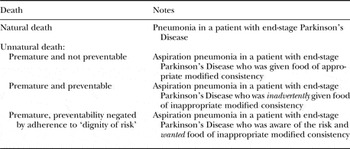
Prematurity invokes notions of age and life expectancy, generating bias against investigating deaths in older persons. With ‘preventability’, this is complicated by the medical complexity in older persons who suffer from degenerative conditions and chronic diseases. As a result, in older age groups, determining the disease sequence in a cause of death, and so accurately classifying it, can be problematic. Nevertheless, though it might be harder to assess how different factors contributed to a patient's injury or death, a clear error or failure to follow accepted practice may still be identifiable. Table 1 outlines scenarios that illustrate preventability and prematurity.
Case scenarios

Dignity of risk principle
Another factor to consider is that respecting an individual's choice, i.e. ‘dignity of risk’, may change the determination of whether a death is preventable or premature (Ibrahim and Davis Reference Ibrahim and Davis2013). This is particularly pertinent to older people living in nursing homes, where their quality of life is often paramount and takes precedence over interventions that promote longevity. For example, older persons with swallowing disorders who choose to eat food of natural rather than of modified consistency are at increased risk of choking. Given that this choice is truly informed, how then is a death from asphyxia in such circumstances to be categorised or judged? It is clearly premature, and potentially preventable, but seems to have been a risk accepted by the resident in exchange for a better quality of life. This ‘dignity of risk’ aspect is more prevalent in the older, frail patients living in nursing homes and must be included in any determination around the circumstances of a death. An obviously informed autonomous action such as this lacks one aspect of preventability, insofar as a prevention strategy may not be implementable. The ‘preventable death’ category should not be applied to cases where patient autonomy directly overrides prevention strategies. However, this determination requires vigilance and should not be accepted without question. A ‘preventable death’ may still occur because staff are reckless, or provide sub-optimal care and then use the older person's dignity of risk choice as ‘a shield’ – to avoid their professional obligations and responsibilities. This highlights the challenges ahead as there will be differences of opinion about duty of care, provision of care and any modifications that arise by respecting dignity of risk.
A way forward
Unlike hospitals and private homes, nursing homes present broader psycho-social risks to residents that create the need for close monitoring of the quality of clinical care (Courtney et al. Reference Courtney, O'Reilly, Edwards and Hassall2009). Significant gaps in the clinical care of this vulnerable older population have been reported in the United Kingdom (PHSO 2011), the United States of America (USHR 2001) and Australia (PC 2011).
Challenging the status quo is the first step. Recognising that excluding older people from premature and preventable mortality reviews, premised on advanced age (Daly, Mason and Goldacre Reference Daly, Mason and Goldacre2000), is inconsistent with the increasing global life expectancy. The presence of multiple serious medical conditions that contribute to death is a reason for including, rather than excluding, older people. In particular, because older people are at increased risk of dying from external causes (Sari, Cracknell and Sheldon Reference Sari, Cracknell and Sheldon2008), such as trauma and complications of clinical care, physical frailty, co-morbidities and complex drug regimens. The need for care co-ordination increases their overall vulnerability (McMillan and Hubbard Reference McMillan and Hubbard2012).
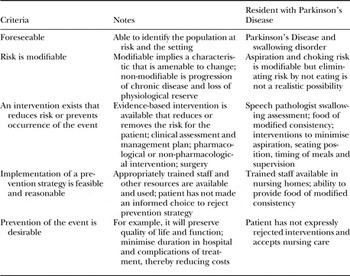
A higher index of suspicion for investigation into the preventable factors around the death of an older person in a nursing home is warranted. Patients 65 years and older had the highest rates of adverse events deaths (Wilson et al. Reference Wilson, Runciman, Gibberd, Harrison, Newby and Hamilton1995) and an equivalent or greater rate of preventable death (Sari, Cracknell and Sheldon Reference Sari, Cracknell and Sheldon2008). This necessitates a system which is transparent and a more nuanced classification of death, such as categories of ‘treated’ and ‘un-treated’, as well as ‘untreatable’ deaths (Oemichen and Meissner Reference Oemichen and Meissner2000). This would cover situations which most align with a truly ‘natural death’, such as where an older person's death was inevitable and not amenable to medical intervention (Table 2). This type of classification could also assist doctors in determining the cause of death in an older person and perhaps be included as part of their basic training.
An approach for considering a preventable death

The introduction of a more nuanced classification of deaths in older people would permit improved assessment of the quality of care provided, including identification of health or life care practices that are unsafe or deleterious. Identified gaps can be addressed, and more generally, minimum standards set for such services. Reviews of deaths in older persons have found that there are discrete and recognisable factors that are strongly associated with subsequent mortality, including dyspnoea, nutrition and physical function (Thomas, Cooney and Fried Reference Thomas, Cooney and Fried2013), providing a basis for proactive management.
A significant proportion of health-care resources is spent in the last year of life (Keon-Cohen Reference Keon-Cohen2013); an inevitable result of the complexities of end-of-life care, but potentially a result of the effect of sub-optimal management. Understanding the causes of death in older people better informs appropriate strategies and policies are in place to ensure this money is appropriately spent.
The proposed classification relies on efficient funding and infrastructure of public health, aged care, legal and health services. Inter-regional differences in these aspects may make adoption of the classification challenging. However, in resource-rich countries such as Australia the challenge is less likely to be economic and more likely to be cultural. The proposed approach will require a shift in attitudes and resourcing as it does make the task of more nuanced death certification more complex and time consuming.
This task is much easier to achieve if aged and health-care professionals understand the wishes and needs of their older patients when they are alive. That is, providing the care to ensure the wellbeing of an older patient, balancing their level of functioning, within the environmental and contextual factors in which they live (WHO 2015).
Conclusion
How people are treated during the final stage of life is important: with fewer years to live, the quality of life becomes more important. Developed nations continue to raise concerns about the current state, and need for improvement, of the care of older persons in nursing homes (USHR 2001).
Impediments to identifying premature and preventable deaths arise from: the lack of a formal notion or definition of ‘natural causes’; difficulties in applying dichotomous classifications of natural/unnatural causes of death, particularly in an older population; and the failure to address the changes in demographics, knowledge and expectations of a contemporary ageing society.
A number of assumptions are open to challenge, particularly the use of arbitrary chronological age limits for death investigations and mortality reviews. Failing to acknowledge that premature, preventable deaths happen in the vulnerable older population, particularly in the context of aged care services, leads to a reduced lifespan and a poorer quality of life. In turn, end-of-life health-care costs increase through attempting to redress the incident that led to the subsequent preventable death, and a paucity of information about the actual incident that led to the death.
Research comparing the frequency and determinants of death between nursing home residents and older people living in the community is also required as there is a paucity of information on these different groups of older people.
Accepting that preventable, premature deaths may happen to older people and adopting a classification of ‘treated’, ‘un-treated’ and ‘untreatable’ is a novel approach that has considerable benefits for the health and life care of older persons. First, it removes confusion about causes of death and provides less ambiguous data. Second, it contributes to substantive public health benefits, including prevention of harm and rational use of limited resources. Third, accurate mortality data identify gaps in care, and highlight where improvements may be needed and whether services provided are ‘fit for purpose’. Fourth, it recognises human rights and the dignity of persons, by ensuring quality of care and quality of life is maintained, irrespective of age or morbidity.
Acknowledgements
J.E.I. as the senior author contributed to the conception and development of the ideas, drafting and critical revision of article draft and final approval. T.H. contributed to the development, drafting and critical revision of the article draft and final approval. M.W. contributed to the extensive revision, re-drafting and critical revision of the article and final approval. L.B. and D.R. contributed to the conception, critical revision of the article draft and final approval. The authors declare no conflict of interest. Funding support is not applicable. The views expressed are those of the authors only and do not represent the Department of Forensic Medicine, Monash University, Victorian Institute of Forensic Medicine, Coroners Court of Victoria or Ballarat Health Service.