Internalizing and externalizing problems in young children have been found to be relatively stable and predictive of later maladaptive outcomes (Bayer, Hastings, Sanson, Ukomunne, & Rubin, Reference Hastings, Nuselovici, Utendale, Coutya, McShane and Sullivan2010; Keenan, Shaw, Delliquadri, Giovannelli, & Walsh, Reference Keenan, Shaw, Delliquadri, Giovannelli and Walsh1998; Mathiesen, Sanson, Stoolmiller, & Karevold, Reference Mathiesen, Sanson, Stoolmiller and Karevold2009; Smith, Calkins, Keane, Anastopoulos, & Shelton, Reference Smith, Calkins, Keane, Anastopoulos and Shelton2004). It is therefore important to understand risk processes early in life, particularly the factors that relate to early manifestations of these problems at various points in early childhood. Increasingly, psychobiological models of risk have been developed to explain how biological propensities toward maladaptive behavior contribute to and interact with the effects of environmental stressors (e.g., socioeconomic adversity, nonoptimal caregiving environments) in predicting negative outcomes. The allostatic load model (McEwen & Stellar, Reference McEwen and Stellar1993) has been particularly informative in specifying the additive effects of multiple biological processes that contribute to risk. Although the relation between specific aspects of biology and specific environmental stressors has been examined in predicting maladaptive outcomes, the unique and interactive contributions of allostatic and environmental load remain understudied. Moreover, research on allostatic load has infrequently focused on the toddler period. This is unfortunate, given that this developmental period involves the early emergence of risk for internalizing and externalizing problems, sensitivity of biological development to early experiences, and potentially more malleability of behavior (Brownell & Kopp, Reference Brownell and Kopp2007; Buss & Goldsmith, Reference Buss, Goldsmith, Brownell and Kopp2007). The current investigation contributes to this growing body of literature by specifically focusing on allostatic and environmental load in the toddler period and their subsequent prediction to internalizing and externalizing problems.
Psychobiological Models of Risk and Allostatic Load
Increasingly, it has been acknowledged that children's underlying biology has important relations to their adjustment and adaptive functioning. Biological responses, both in reactivity and the regulation of that reactivity, have been conceptualized as the body's response to stress or challenge. Past research has demonstrated the importance of considering biology in predicting both internalizing and externalizing problems.
Psychobiological models of risk
Perhaps the most well-established psychobiological model of risk for internalizing problems is Kagan's temperamental types of inhibited and uninhibited children (Kagan, Reference Kagan1994; Kagan, Reznick, Clarke, Snidman, & Garcia-Coll, Reference Kagan, Reznick, Clarke, Snidman and Garcia-Coll1984). Infants and toddlers identified as temperamentally fearful or behaviorally inhibited demonstrate fear and hesitation in the presence of novelty. Inhibited children have been shown to be at risk for a host of anxiety-spectrum internalizing difficulties, especially social withdrawal and anxiety symptoms (Biederman et al., Reference Biederman, Hirshfield-Becker, Rosenbaum, Herot, Friedman and Snidman2001; Fox, Henderson, Rubin, Calkins, & Schmidt, Reference Fox, Henderson, Rubin, Calkins and Schmidt2001; Kagan, Reznick, Snidman, Gibbons, & Johnson, Reference Kagan, Reznick, Snidman, Gibbons and Johnson1988; Kagan, Snidman, Zentner, & Peterson, Reference Kagan, Snidman, Zentner and Peterson1999).
Compared to their uninhibited peers, inhibited children are believed to possess a unique biological profile that biases their behavior toward avoidance and withdrawal. Kagan (Reference Kagan1994) proposed that inhibited children have an overactive amygdala that has a low threshold for arousal in the presence of novelty; this amygdalar response has subsequently been shown in adults who were classified as inhibited as toddlers (Schwartz, Wright, Shin, Kagan, & Rauch, Reference Schwartz, Wright, Shin, Kagan and Rauch2003). The effects of this activation are evidenced by indices of stress reactivity and regulation of various physiological systems. Specifically, inhibited children have been shown to have greater cortisol reactivity, higher and less variable heart rate (i.e., respiratory sinus arrhythmia [RSA], vagal tone), right frontal EEG asymmetry, and augmented startle responses (Fox et al., Reference Fox, Henderson, Rubin, Calkins and Schmidt2001; Kagan et al., Reference Kagan, Reznick, Clarke, Snidman and Garcia-Coll1984; Schmidt & Fox, Reference Schmidt and Fox1998; Talge, Donzella, & Gunnar, Reference Talge, Donzella and Gunnar2008). For example, Kagan's first cohort of behaviorally inhibited children displayed increased morning cortisol at home and increased cortisol reactivity in the laboratory (Kagan, Reznick, & Snidman, Reference Kagan, Reznick and Snidman1987). In another sample, children who had been classified as behaviorally inhibited as toddlers showed higher morning cortisol at age 4 (Schmidt, Fox, Rubin, & Sternberg, Reference Schmidt, Fox, Rubin and Sternberg1997). Although findings related to cortisol are somewhat mixed across the literature, children who display early inhibition tend to have higher cortisol levels when indicators suggest they are at risk for internalizing problems (Essex, Klein, Slattery, Goldsmith, & Kalin, Reference Essex, Klein, Slattery, Goldsmith and Kalin2010; Nachmias, Gunnar, Mangelsdorf, Parritz, & Buss, Reference Nachmias, Gunnar, Mangelsdorf, Parritz and Buss1996). Cardiac measures have also received much attention in the development of internalizing problems. Inhibited toddlers have also been shown to display higher and less variable heart rates (Kagan et al., Reference Kagan, Reznick, Clarke, Snidman and Garcia-Coll1984). When faced with challenge, children at risk for internalizing problems compared to other children may have deficits in their physiological responses to stress, as indexed by RSA (Hastings, Nuselovici, et al., Reference Hastings, Nuselovici, Utendale, Coutya, McShane and Sullivan2008; Hastings, Sullivan, et al., Reference Hastings, Sullivan, McShane, Coplan, Utendale and Vyncke2008).
Within the broader literature on early externalizing problems, a psychobiological model of risk indicates that individual differences in physiological reactivity and regulatory responses related to frustration are particularly predictive of disruptive behavior and negative social interactions. Cortisol reactivity to stress has been shown to predict externalizing problems (Davies, Sturge-Apple, Cicchetti, & Cummings, Reference Davies, Sturge-Apple, Cicchetti and Cummings2007). In preschool-age children in particular, high reactive levels of cortisol were associated with aggression as reported by parents and teachers (Gunnar, Tout, deHaan, Pierce, & Stansbury, Reference Gunnar, Tout, deHaan, Pierce and Stansbury1997) and observations in the classroom (Tout, de Haan, Kipp Campbell, & Gunnar, Reference Tout, de Haan, Kipp Campbell and Gunnar1998; Hart, Gunnar, & Cicchetti, Reference Hart, Gunnar and Cicchetti1995). There are also studies finding a flattening of cortisol associated with aggression, possible due to elevated afternoon levels (Dettling, Gunnar, Donzella, Reference Dettling, Gunnar and Donzella1999). One example comes from children who are thought to be at risk for externalizing problems because they display context-inappropriate anger. Compared to other children, children who displayed context-inappropriate anger had unique profiles of diurnal cortisol activity: they showed lower morning cortisol levels and flatter slopes of cortisol change across the day (Locke, Davidson, Kalin, & Goldsmith, Reference Locke, Davidson, Kalin and Goldsmith2009). There have also been numerous studies linking RSA and vagal tone to externalizing behaviors such that children who fail to show a decrease in RSA (i.e., RSA suppression), an indicator of vagal tone and of regulation (Porges, Doussard-Roosevelt, & Maiti, Reference Porges, Doussard-Roosevelt and Maiti1994), in response to stress, appear to be at increased risk for the development and maintenance of disruptive behavior problems across childhood (Beauchaine, Reference Beauchaine2001; Calkins, Graziano, & Keane, Reference Calkins, Graziano and Keane2007; Degnan, Calkins, Keane, & Hill-Soderlund, Reference Degnan, Calkins, Keane and Hill-Soderlund2008).
Although not as integrated into the above theoretical models of risk, several other biological indicators of stress warrant attention. For example, sleep is receiving increased attention as an important influence on children's adjustment (Dahl, Reference Dahl1996). Lack of sleep has been conceptualized as a biological stress to the body (Weissbluth, Reference Weissbluth, Kohnstamm, Bates and Rothbart1989) and so may be a general risk factor for maladjustment. Sleep quality has been linked to broad indices of adjustment and both internalizing and externalizing problems specifically (Bates, Viken, Alexander, Beyers, & Stockton, Reference Bates, Viken, Alexander, Beyers and Stockton2002; El-Sheikh, Hinnant, Kelly, & Erath, Reference El-Sheikh, Hinnant, Kelly and Erath2010; Goodnight, Bates, Staples, Pettit, & Dodge, Reference Goodnight, Bates, Staples, Pettit and Dodge2007; Sadeh et al., Reference Sadeh, McGuire, Sachs, Seifer, Tremblay and Civita1995). Of special importance for the current investigation is the finding that sleep has been specifically linked to both problem domains in toddlers (Seifer, Sameroff, Dickstein, Hayden, & Schiller, Reference Seifer, Sameroff, Dickstein, Hayden and Schiller1996). A second example of a potentially significant biological marker of physiological risk is children's birth weight. It is well established that low birth weight, especially in relation to certain environmental contexts, puts children at risk for a host of negative outcomes, including internalizing and externalizing problems later in childhood (Bohnert & Breslau, Reference Bohnert and Breslau2008; Hack et al., Reference Hack, Taylor, Schluchter, Andreias, Drotar and Klein2009; Spittle et al., Reference Spittle, Treyvaud, Doyle, Roberts, Lee and Inder2009).
Despite converging evidence for the role of biology in predisposing children to internalizing and externalizing problems, the overall pattern of findings is somewhat mixed, and there has been contrasting evidence for each biological measure presented above. Null relations have sometimes been found between biological markers for risk (i.e., individual measures of cortisol reactivity, heart rate measures, sleep, and birth weight), and internalizing and externalizing problems (Lavigne et al., Reference Lavigne, Arend, Rosenbaum, Smith, Weissbluth and Binns1999; Spittle et al., Reference Spittle, Treyvaud, Doyle, Roberts, Lee and Inder2009). This mixed pattern of results highlights the importance of considering the effect of an accumulation of biological or physiological stressors on development rather than adopting a singular focus on one measure. In fact, it has been suggested that stress to an individual's overall physiology is difficult to summarize with focus on single measures (Lupien et al., Reference Lupien, Ouellet-Morin, Hupbach, Tu, Buss, Walker, Cicchetti and Cohen2006).
Allostatic load
As reviewed above, much of the previous work on psychobiological models of risk has focused on individual indices of biological reactivity or regulation. Alternatively, the concept of allostatic load has been proposed to explain how chronic stress negatively affects the body's physiological systems that are charged with maintaining homeostasis, resulting in risk for poor outcomes (McEwen & Stellar, Reference McEwen and Stellar1993). Allostasis is the body's modulation of its various vital systems in response to stress (Sterling & Eyer, Reference Sterling, Eyer, Fisher and Reason1988). This modulation is inherently adaptive—it allows mobilization of resources when a threat or danger (e.g., an acute stressor) is present in the environment, and also enables regulation of this physiological response when the danger has passed. Although the activation of these systems helps the body achieve homeostasis in the moment, with chronic activation of the stress response systems, the body pays a price for achievement of this balance in the wear and tear on these systems. The accumulation of this wear and tear is termed allostatic load (McEwen & Stellar, Reference McEwen and Stellar1993). This model suggests that individuals in highly stressful environments will be more likely to accumulate these biological consequences because their various physiological systems will be prompted more frequently to prepare for and then recover from challenge. An allostatic load model differs from other psychobiological models of risk, such as those reviewed above, in that multiple indicators of physiology (typically a sum) representing biological risk are used instead of individual parameters of the stress response in isolation.
Children certainly display individual differences in responses to stress and therefore in susceptibility to allostatic load. Responses that engage these multiple physiological systems will contribute to allostatic load. Children who have a low threshold for response, whether it be having an overactive fear response or having a low frustration tolerance, would be likely to strain these systems. This strain can alter children's physiology (e.g., cortisol production, heart rate), which cycles back to maintain a lowered threshold for response (Lupien et al., Reference Lupien, Ouellet-Morin, Hupbach, Tu, Buss, Walker, Cicchetti and Cohen2006). That is, the set point at which a physiological response is enacted actually changes for children who chronically experience and react to stress. Children with higher allostatic load would therefore likely display greater reactivity to and poorer regulation of emotions and behavior, resulting in maladaptive responses to the environment. As children develop, the cyclical nature of allostatic load could lead to more maladaptive responses, leading to greater strain on the physiological systems, leading to even more pronounced adjustment problems.
Although the allostatic load model has infrequently been employed to understand the development of early emerging internalizing and externalizing problems, the use of cumulative indices of biological risk for maladaptation is supported for each of these dimensions. For example, although few studies with children at risk for internalizing problems because of their fearful temperament have employed composites of multiple biological measures, they have been theoretically integrated into a complete understanding of the body's response to an overactive amygdala (Fox et al., Reference Fox, Henderson, Rubin, Calkins and Schmidt2001). In the case of externalizing problems, studies assessing more than one physiological parameter have been able to identify profiles of individuals who were currently or had previously been diagnosed with a psychological disorder in the externalizing domain (Lupien et al., Reference Lupien, Ouellet-Morin, Hupbach, Tu, Buss, Walker, Cicchetti and Cohen2006). Infants classified as having an avoidant attachment style to their caregivers, a risk for later externalizing pathology, have been shown to have high reactivity on several indices of physiological reactivity and regulation, consistent with high allostatic load (Hill-Soderlund et al., Reference Hill-Soderlund, Mills-Koonce, Propper, Calkins, Granger and Moore2008). Given that the first few years of life may represent a sensitive period for the development of some of these stress responses (e.g., Gunnar & Donzella, Reference Gunnar and Donzella2002), examination of an allostatic model in toddlerhood is warranted.
Models of Interaction Between Biology and Environment
As mentioned, allostatic load appears to be positively related to environmental adversity, particularly low socioeconomic status and the caregiving environment (Lupien et al., Reference Lupien, Ouellet-Morin, Hupbach, Tu, Buss, Walker, Cicchetti and Cohen2006). In addition, there has been a wealth of evidence that individual biological indices of risk interact with the environment to predict children's outcomes. Consistent with diathesis-stress models, much of this research suggests that children's biological predispositions to behave in a particular way (i.e., the diathesis) predict negative outcomes more strongly or only in the presence of particular environmental conditions (i.e., the stress). Socioeconomic adversity, family climate, and parenting practices have been identified as important aspects of the environment that moderate the prediction from biological risk to children's adjustment. For example, infants and toddlers with inhibited temperament and/or its associated physiological markers appear to be more prone to internalizing problems given more negative caregiving environments, more controlling and overprotective parenting styles, and socioeconomic adversity, whereas supportive environments may promote resilience against these outcomes (Bayer et al., Reference Bayer, Hastings, Sanson, Ukoumunne and Rubin2010; Coplan, Arbeau, & Armer, Reference Coplan, Arbeau and Armer2008; Degnan & Fox, Reference Degnan and Fox2007; El-Sheikh et al., Reference El-Sheikh, Hinnant, Kelly and Erath2010; Kiel & Buss, Reference Kiel and Buss2010; Rubin, Burgess, & Hastings, Reference Rubin, Burgess and Hastings2002). Children who display poor physiological regulation of anger and frustration are more likely to develop externalizing problems in the contexts of socioeconomic adversity and harsh and inconsistent parenting (Flouri, Tzavidis, & Kallis, Reference Flouri, Tzavidis and Constantinos2010; Scaramella, Neppl, Ontai, & Conger, Reference Scaramella, Neppl, Ontai and Conger2008). Like the cumulative model used for allostatic load, a cumulative environmental risk index may be useful in predicting risk for future problems. For example, Evans (Reference Evans2003) demonstrated that a cumulative environmental risk composite comprising socioeconomic information as well as aspects of the home environment related to an allostatic load index. A similar composite has been used to index environmental adversity as a moderator of the relation between biological reactivity and socioemotional problems (Obradović, Bush, Stamperdahl, Adler, & Boyce, Reference Obradović, Bush, Stamperdahl, Adler and Boyce2010). Whether the cumulative environmental risks that children experience interact with cumulative allostatic load to predict future internalizing and externalizing problems in early childhood remains unknown.
An alternative but complementary conceptualization of the joint roles of physiological stress reactivity and the environment in the development of maladjustment are theories of differential susceptibility to environmental input (Belsky, Bakermans-Kranenburg, & van IJzendoorn, Reference Belsky, Bakermans-Kranenburg and van IJzendoorn2007; Belsky, Hsieh, & Crnic, Reference Belsky, Hsieh and Crnic1998) such as Boyce and Ellis's (2005) biological sensitivity to context model. These approaches propose that the development of heightened stress reactivity has an adaptive function in both highly adverse and highly supportive environments. In highly stressful environments, high levels of physiological reactivity increase an individual's vigilance and preparation for challenge. Similar to what would be expected from the allostatic load model, then, this reactivity and requirement to balance the reactivity would therefore be expected to be related to psychological maladjustment. Unique to the biological sensitivity to context theory, however, is the notion that heightened stress reactivity in highly supportive environments would prepare an individual to take advantage of all available resources, therefore predicting fewer signs of maladjustment. This curvilinear relation between stress reactivity and quality of environment has been supported empirically with school-aged children (Ellis, Essex, & Boyce, Reference Ellis, Essex and Boyce2005). Failure to take into account the interaction between biological and environmental risk may explain some of the previously cited inconsistencies in the relation between physiological indices and socioemotional outcomes. Evidence is accumulating for the utility of this approach in understanding the relation between biological reactivity and both internalizing problems (Yap et al., Reference Yap, Whittle, Yucel, Sheeber, Pantelis and Simmons2008) and externalizing problems (Obradović et al., Reference Obradović, Bush, Stamperdahl, Adler and Boyce2010).
The Present Investigation
Very few studies using composites of multiple measures of physiological stress, consistent with allostatic load, have examined the relation between biological risk and maladjustment in the context of environmental risk. We argue that understanding this relation is especially crucial during early childhood, when these processes may be initially unfolding. The current investigation comprised two studies, each designed to address this gap.
We had two primary goals in this investigation. The goal of Study 1 was to determine whether, in a low-risk population of typically developing children, an accumulation of environmental and allostatic load (e.g., physiological) stressors would predict externalizing and internalizing problem behavior concurrently and 3 years later. The goal of Study 2 was to replicate the findings of Study 1 and investigate these associations in a sample composed of children characterized as high in fearfulness upon entry to the study (~50% of sample) compared to an unselected group of toddlers low and average in fearfulness. Based on evidence from psychobiological models of risk and the more comprehensive models of allostatic load and biological sensitivity to context, we hypothesized that cumulative indices of biological and environmental risk would interact to predict both internalizing and externalizing problems across early childhood. We expected that increased allostatic load would be more strongly related to internalizing and externalizing problems as environmental risk increased in two studies with complementary strengths: Study 1 examined relations between risk indices and maladjustment, both concurrently as well as longitudinally across early childhood, from toddlerhood to kindergarten; Study 2 expanded upon both the allostatic load and environmental risk composites to include more varied indices of each type of risk and assessed relations across a short-term longitudinal study.
Study 1 Method
Participants
One hundred eleven 2-year-olds (M = 24.05 months; 55% male) and their caregivers from a small midwestern city and the surrounding rural county were recruited into a longitudinal study of emotion development using public birth announcements. The sample was predominantly middle class (M Hollingshead = 48.84; SD = 10.55; range = 17–66) and non-Hispanic Caucasian (90.1% Caucasian, non-Hispanic; 3.6% African American; 3.6% Hispanic; 1.8% Asian American; 0.09% Indian American). Participating families were composed primarily of married parents (<2% divorced or single parent families at age 2, this increased to 6% by the time children began kindergarten).
Procedure
Age 2 assessment
Mothers and fathers provided information about themselves (e.g., trait inhibition, negative affectivity), and mothers provided additional information about their families and the participating child via questionnaires. A demographics and background questionnaire designed for this study assessed family characteristics (i.e., Hollingshead index information, marital status) as well as child characteristics that were of interest (i.e., birth weight and sleep habits).
Laboratory and home cortisol samples were collected from children. At age 2, children were brought into the laboratory for a visit made up of several short episodes all designed to be novel (e.g., playing with a clown, a conversation with a stranger). We collected cortisol samples from children at three time points during the laboratory visit: upon arrival to the laboratory (baseline; 75% collected), 20 min into the visit (peak; 79% collected), and 20 min after leaving the laboratory (recovery, this sample was mailed back with the home cortisol: 43% collected). Parents were given cotton dental rolls to take home and were instructed to collect six cortisol samples from children at three times on 2 consecutive days (i.e., within an hour of waking in the morning, between 8:00 and 9:00 a.m., in the afternoon between the hours of 3:00 and 4:00 p.m., and in the evening between 7:00 and 8:00 p.m.). Parents were asked to collect the samples before children ate meals, to report any medications or illnesses that might affect the samples, and to note the exact time of collection before mailing the samples back to the laboratory. Useable morning home cortisol samples were returned for 61 children on each day and evening cortisol samples were returned for 59 and 63 children on days 1 and 2. Afternoon home cortisol samples are not considered further in this article.
Age 3, 4, and 5 assessments of problem behaviors
Each year after the age 2 laboratory visit, parents received a packet of questionnaires to complete (at age 5 families also returned to the laboratory, but that visit is not discussed further in this article). Of interest in this study were measures that included scales for internalizing and externalizing behavior problems at each age during childhood.
Stimuli and measures
Age 2 measures
As part of the environmental risk variable, parental inhibition was assessed using the Behavioral Inhibition Scale (BIS; from the Behavioral Inhibition and Activation Scales; Carver & White, Reference Carver and White1994). Ninety-six fathers (86%) and 110 mothers (99%) completed this measure. The BIS is designed to assess the extent to which a person is inhibited to trying or experiencing new things. This scale comprises the average of six items that reflect worry, fear, and nervousness in response to common situations (e.g., “I feel pretty worried or upset when I think or know someone is angry with me.”). Published internal consistency for the BIS is α = 0.74, and our sample showed comparable consistency at α = 0.77 for mothers and α = 0.77 for fathers.
We assessed parental negative affect using the Positive and Negative Affectivity Scale (PANAS; Watson, Clark, & Tellegen, Reference Watson, Clark and Tellegen1988). One hundred seven fathers (96%) and 108 mothers (97%) completed the PANAS when children were 2 years old. The negative affect component of this scale is the average of 10 items referencing the extent to which the parent has experienced negative emotions like “irritable,” “ashamed,” and, “afraid” in general. Published Cronbach alphas for the negative affect subscale range from 0.87 to 0.94 (e.g., Laurent et al., Reference Laurent, Catanzaro, Joiner, Rudolph, Potter and Lambert1999) and in our sample were α = 0.93 for mothers and α = 0.93 for fathers.
Mothers also completed several measures relating to their child's problem behaviors. The Infant Toddler Social and Emotional Assessment (ITSEA; Carter, Briggs-Gowan, Jones, & Little, Reference Carter, Briggs-Gowan, Jones and Little2003) was the focus of this study. This measure consists of 166 items about social–emotional and behavioral problems that parents rate on a 3-point scale (0 = not true/rarely, 1 = somewhat or sometimes true, 2 = very true or often true) regarding children's behavior during the past month. The internalizing composite was created by averaging 30 items from four subscales: general anxiety (10 items), separation anxiety (6 items), depression/withdrawal (9 items), and inhibition to novelty (5 items). Published alphas for the internalizing scales range from 0.71 to 0.77, with the overall internalizing composite α = 0.80. The externalizing composite was created by averaging 24 items from three subscales: activity/impulsivity (6 items), aggression/defiance (12 items), and peer aggression (6 items). Published alphas for subscales in this composite range from 0.73 to 0.79, with the overall composite α = 0.87. The ITSEA scales in our sample showed good internal consistency for internalizing (α = 0.79) and externalizing behaviors (α = 0.85).
Determination of age 2 cortisol
Cortisol was collected from children in the laboratory and at home by having them chew on braided cotton dental rolls until thoroughly saturated. To encourage compliance, children were allowed to mouth the cotton roll after dipping it into sugar crystals. In the laboratory, trained research assistants collected samples, secured the cotton rolls in airtight, sealed conical tubes, kept them cold until the end of the visit, and froze them at −50°F until they were shipped for assay. For collection at home, parents were instructed to cut off the moistened portion of the dental roll, place it in the tube, seal it, and refrigerate the samples until the final one was taken on the second day (Clements & Parker, Reference Clements and Parker1998; van Ryzin, Chatham, Kryzner, Kertes, & Gunnar, Reference van Ryzin, Chatham, Kryzer, Kertes and Gunnar2009). Parents then mailed the samples and information about time of collection, medication, and any child illness back to the lab, where samples were deep frozen until sent for assay. Laboratory and home saliva samples were transported on ice to the Behavioral Endocrinology Laboratory at Penn State University, where they were stored frozen at −80°C until assayed (Salimetrics, State College, PA). On the day of cortisol assay, samples were centrifuged at 3000 rpm for 15 min to remove mucins. Samples were assayed for salivary cortisol using an enzyme immunoassay US FDA (510), cleared for use as an in vitro diagnostic measure of adrenal function (Salimetrics). The test used 25 µl of saliva, had a range of sensitivity from 0.007 to 3.0 µg/dl, and had average intra- and interassay coefficients of variation of less than 5% and 10%, respectively.
Laboratory visits took place in mornings, afternoons, or evenings, so to account for time of day in cortisol analyses we extracted the residuals from an analysis in which we regressed the baseline cortisol value on time of day. We then computed residualized change scores representing each child's reactivity to the laboratory visit by regressing peak cortisol (the second laboratory sample) on the baseline residuals that accounted for time of day. Thus, the lab reactivity value represented the change in cortisol, controlling for initial (baseline) levels and time of day. The morning and evening home cortisol values on both days (afternoon values are not considered further in this study) were corrected for time of day by regressing each value on the sampling time and extracting the residuals. The two morning values were averaged, and the evening values were averaged. The residualized change score from morning to evening was calculated by regressing evening on morning and extracting the standardized residuals from the analysis, and this variable was used to represent diurnal change in cortisol over the course of the day.
Age 3 measures
When children were 3 years old, parents again completed the ITSEA. In the current sample, the scale reliability for the internalizing composite was very good (α = 0.87). Internal consistency for the externalizing composite was also good (α = 0.83). The age 3 measure of problem behaviors (ITSEA) was completed by 69 families (62% of the initial sample).
Age 4 measures
At age 4, parents completed the Child Behavior Checklist (CBCL, age 1.5 to 5 years version; Achenbach & Ruffle, Reference Achenbach and Ruffle2000) consisting of 120 items describing behavior or emotional problems children had experienced during the past 6 months. Parents rated each item on a 3-point scale (0 = not true/rarely, 1 = somewhat or sometimes true, 2 = very true or often true). The CBCL internalizing composite was calculated as the mean of 32 items. The technical publication for this measure reports the internal consistencies for the internalizing and externalizing subscales range from α values of 0.66 to 0.89. CBCL externalizing was calculated as the mean of 34 items. Internal consistency for the current sample was very good for both internalizing (α = 0.87) and externalizing (α = 0.93). The age 4 measure (CBCL) was completed by 65 families (59% of the initial sample).
Age 5 measures
When children were 5 years old, parents completed another packet of questionnaires in the fall of the kindergarten year. The present study focuses on one of these questionnaires with subscales concerning problem behaviors, the MacArthur Health Behavior Questionnaire (HBQ; Armstrong & Goldstein, Reference Armstrong and Goldstein2003; Essex et al., 2002). The HBQ consists of 172 items that parents rate on a 3-point scale (0 = rarely applies, 1 = somewhat applies, or 2 = certainly applies) about children's behavior during the past 6 months. The internalizing scale from this measure has a published internal consistency α = 0.79 for parent report, and the externalizing scale is reported as α = 0.82. In our sample, internal consistency for internalizing was α = 0.66 and for externalizing was α = 0.85. Eighty-four families (76% of the initial sample) completed the HBQ at age 5.
Allostatic and environmental load indices
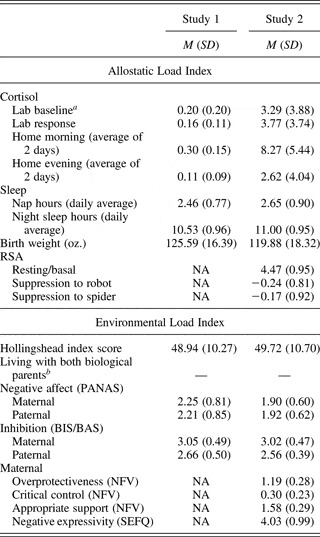
We created two load indices for physiological and environmental stressors assessed when children were 2 years old. Keeping with classical models that cast allostatic burden as a cumulative number of risks or stressors, we characterized each physiological and environmental stressor as being present or absent for each child, based on a median split (with the exception of one environmental risk factor, whether the child lived with both biological parents. This was a risk factor only for children who did not). Descriptive statistics for each stressor are provided in Table 1. There were five physiological stressors included in the allostatic load index: low birth weight (median = 124 oz., range = 91–185 oz.), short average nap time (median = 2.51 hr, range = 0–4 hr), short average nightly sleep time (median = 10.51 hr, range = 8–13 hr), high cortisol laboratory reactivity to novel episodes (median = 0.05, range = −2.23–2.62), and flat home diurnal cortisol slope over the day (median = −0.11, range = −1.14–3.04). Children could have up to five allostatic stressors (M = 2.48, SD = 1.11; range = 0–5).
Load index components and descriptive statistics for Study 1 (n = 112) and Study 2 (n = 125)

Note: PANAS, Positive and Negative Affectivity Scale; BIS/BAS, Behavioral Inhibition and Activation Scales; NFV, New Friend Vignettes; SEFQ, Self-Expressiveness in the Family Questionnaire.
aRaw cortisol values are presented here. Variables in text and used in the analysis are standardized residuals that account for time of day (residualized change scores). Study 1 raw cortisol values are in micrograms for deciliter (µg/dl) and in Study 2 are in nanomoles per liter (nmol/l).
bIn Study 1, 1.8% of children (n = 2) did not live with both biological parents (because of divorce, separation, or widowhood). In Study 2, 3.2% of children (n = 4) did not live with both biological parents.
The environmental load index comprised six stressors: not living with both biological parents (n = 2; 1.8%), low Hollingshead index score (median = 51, range = 17–66), high maternal negative affect (median = 2.1, range = 1.00–4.80), high paternal negative affect (median = 2.05, range = 1.00–4.70), high maternal inhibition (median = 3.0, range = 1.43–4.00), and high paternal inhibition (median = 2.71, range = 1.29–4.00). Thus, children could have up to six environmental stressors (M = 2.63, SD = 1.31, range = 0–6). For descriptive purposes, we also computed a cumulative load index by adding the total number of allostatic and environmental stressors that children had (Table 2).
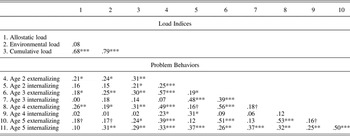
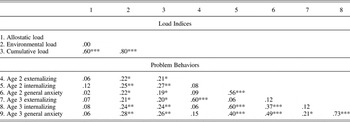
Correlations among load indices and concurrent and longitudinal problem behaviors in Study 1 (n = 112)

Note: Age 2 and age 3 problem behaviors are as the Infant Toddler Social and Emotional Assessment. Age 4 problem behaviors are as reported on the Child Behavior Checklist. Age 5 problem behaviors are as reported on the MacArthur Health Behavior Questionnaire.
†p < .10. *p < .05. **p < .01. ***p < .001.
Study 1 Results
Preliminary analyses
Study attrition
Between age 2 and the start of the kindergarten year, 26 complete families were lost to attrition. We compared families who dropped out of the study to those who remained enrolled on key study variables at age 2 (i.e., load index variables, externalizing, and internalizing), and found no significant differences on any variable (ts < 1.28, ns).
Analysis of missing data
As is increasingly recognized by developmental scientists, using listwise deletion to exclude participants without complete longitudinal data is problematic (i.e., it has been shown to bias parameter estimates and unnecessarily limits power to detect effects; Howell, Reference Howell, Outhwaite and Turner2007; Jeličić, Phelps & Lerner, Reference Jeličić, Phelps and Lerner2009; Widaman, Reference Widaman2006). The allostatic and environmental load indices are counts of the number of risk factors from this set of stressors each child has. This way of conceptualizing the accumulation of risk as an additive burden is consistent with classic allostatic load theory, but it also requires complete data on each of the load index components in order to accurately reflect cumulative load for each child. For these mathematical and theoretical reasons, we chose to impute missing data for each of the allostatic and environmental load stressors and problem behaviors at ages 2, 3, 4, and 5. We applied the Missing Value Analysis in SPSS to the data to assess the pattern of missing data, Little's missing completely at random (MCAR), χ2 = 593.34, p = .40, suggesting that missing data for each visit were likely missing at random (MAR). We therefore imputed missing data using the expectation/maximization algorithm as has been recommended for longitudinal analyses that meet the MAR assumptions (Howell, Reference Howell, Outhwaite and Turner2007).
Gender differences
We explored potential gender differences in allostatic load and environmental stress variables, and problem behaviors (i.e., externalizing and internalizing) at each wave of data collection. No gender differences emerged (ts < 1.77, ns). We did not examine gender further.
Predicting problem behavior from 24-month load indices
Bivariate correlations among the allostatic, environmental, and cumulative load indices with problem behaviors at each time point are presented in Table 2. Each index correlated positively with externalizing at each time point (i.e., concurrent associations at age 2 and later assessments at ages 3, 4, and 5), such that a larger number of stressors predicted more of each problem behavior. The load indices also correlated positively with internalizing at age 5, and cumulative load correlated with internalizing at ages 2 and 5.
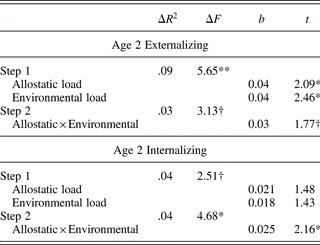
Two regression models were conducted to explore the concurrent associations between load indices and externalizing and internalizing at age 2. The allostatic load and environmental load indices were entered in Step 1, and the interaction of their centered terms was entered in Step 2. Model summary statistics for these regressions are presented in Table 3.
Regression models predicting externalizing and internalizing at age 2 in Study 1

Note: Interaction terms are the product of centered allostatic and environmental load indices.
†p < .10. *p < .05. **p < .01.
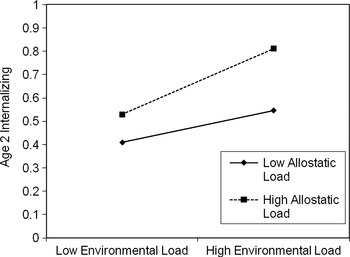
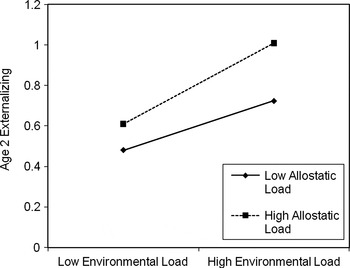
The model predicting concurrent (age 2) externalizing behavior was significant, showing effects of allostatic load, environmental load, and their interaction relating to higher levels of externalizing problems. This interaction is depicted in Figure 1 and shows that, at high levels of both allostatic load and environmental load, externalizing problems are especially pronounced. The model predicting age 2 internalizing showed no effect of allostatic load or environmental load, but a significant interaction of the two indices, such that high levels of both allostatic and environmental load were associated with higher levels of internalizing (Figure 2).
The interaction of allostatic and environmental load indices predicting age 2 (concurrent) externalizing problems in Study 1.

The interaction of allostatic and environmental load indices predicting age 2 (concurrent) internalizing problems in Study 1.

Extreme groups approach
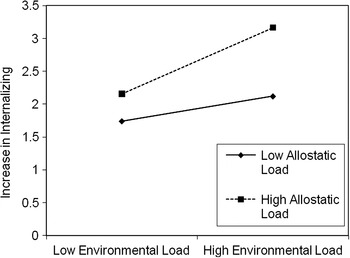
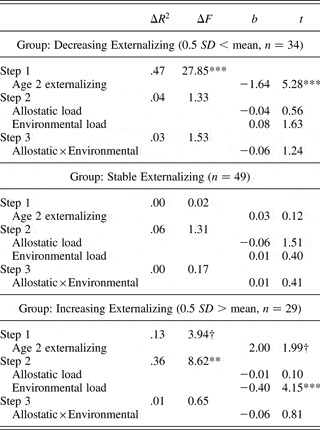
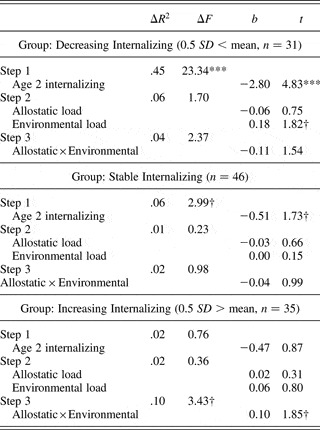
Given this pattern of relations and the relative low-risk nature of this sample, we created extreme groups. We were interested in examining longitudinal associations to investigate whether allostatic and environmental load predicted behavior differently for children who showed less of the behavior over time, stayed stable, or showed more of the behavior. We did this by standardizing the age 2 and age 5 externalizing and internalizing scores and calculating the difference between them. Extreme groups were created based on change: the highest group represented children who were increasing in the problem behavior more than 0.5 SD above the mean change. The middle group represented children whose problem behaviors remained approximately stable between ages 2 and 5, and the lowest group comprised the children whose problem behaviors decreased, having scores that fell below 0.5 SD below the mean change. Separate regressions were conducted within each group to examine the relation between the load indices and externalizing or internalizing problem behavior, and the model summary statistics for these analyses are reported in Table 4 (externalizing) and Table 5 (internalizing). We expected allostatic and environmental load to predict problem behavior for children in the top quartile, but not in the other groups. Results supported this expectation. The models examining externalizing showed no effects of allostatic or environmental load for the children who showed less externalizing or who stayed relatively stable. The model for the group of children who showed more externalizing, however, showed an effect of environmental load such that more load was associated with less of an increase in externalizing within this extreme group of children.Footnote 1 The models examining internalizing, similarly, showed no relation of allostatic load or environmental load to increases in internalizing for children who were in the decreasing or stable groups. For the children who increased the most, however, the interaction of allostatic and environmental load predicted internalizing. This is shown in Figure 3. Children with high levels of both allostatic and environmental load showed the largest increases in internalizing from ages 2 to 5.
The interaction of allostatic load and environmental load indices predicting change in Internalizing from age 2 to 5 for extreme group representing the top quartile of increasing internalizing in Study 1.

Extreme groups approach: Regression models predicting change in externalizing from age 2 to 5 in Study 1

Note: Interaction terms are the product of centered allostatic and environmental load indices.
†p < .10. **p < .01. ***p < .001.
Extreme groups approach: Regression models predicting change in internalizing from age 2 to 5 in Study 1

Note: Interaction terms are the product of centered allostatic and environmental load indices.
†p < .10. ***p < .001.
Study 1 Discussion
Results from this first study suggested that an accumulation of allostatic and environmental stressors, even in this sample of extremely low-risk children, was predictive of notable externalizing and internalizing problems at age 2 and when extreme groups were created based on longitudinal change in problem behavior. Although the models examining the concurrent associations between load indices and problem behavior suggest an important relation between allostatic and environmental load and both externalizing and internalizing problem behaviors, our extreme groups approach suggested that the load indices were more predictive of internalizing problems that continued to increase over the next 3 years.
In Study 2, we explored this further with a second sample of children, half of whom were selected to be highly fearful, and half of whom were unselected for any fearfulness or risk. Building on the findings from the first study, we assessed heart rate variability and calculated RSA when children were 2 years old, to better characterize a profile of allostatic load. Low levels of basal RSA and failure to suppress RSA in two novel contexts were included as allostatic load stressors. Study 2 also added additional environmental load stressors in the form of parental negative expressivity, overprotectiveness, critical control, and lack of appropriate support.
Study 2 Method
Participants
One hundred twenty-five 2-year-old children (M = 24.43, SD = 0.47, 50.4% male) and their caregivers were recruited into a longitudinal study of emotion development from a small eastern town and surrounding counties. Similar to Study 1, the sample was predominantly middle class (M Hollingshead index = 49.72, SD = 10.70) and non-Hispanic Caucasian (90.4% Non-Hispanic Caucasian; 6.4% Asian American; 1.6% American Indian; 0.8% Hispanic; 0.8% African American). Approximately half of the children in this sample (n = 64; 51%) were identified as being at high risk for fearfulness (high fear targets) via screening procedures carried out when children were 18 months of age. Participating families were largely two-parent households (97% married) with dual incomes (67%).
Procedure
18-Month screening
We oversampled for fearful children in order to enroll an adequate number of high fear target children into the larger longitudinal study. Based on parent report on two questionnaires (i.e., ITSEA, and a wariness questionnaire designed for the study), we identified 64 children as high-fear targets because they scored at least 1 SD above the mean (established on the first 100 screened children) for items on the Wariness Questionaire concerning out of context or dysregulated fear, internalizing, or anxiety-related scales from the ITSEA. The other half of the sample (n = 61) was unselected for fearfulness.
Age 2 assessment
As with Study 1, mothers and fathers provided information about themselves (e.g., trait inhibition, negative affectivity), and mothers provided additional information about themselves (e.g., attitudes toward child's emotions) their families (e.g., demographic characteristics, emotion expressiveness within the family), and the participating child (e.g., birth weight, sleep habits, problem behavior) via questionnaires.
Laboratory and home cortisol samples were again collected from children at age 2. Similar to Study 1, children were brought into the laboratory for a visit made up of several short episodes all designed to be novel (e.g., playing with a clown, a conversation with a stranger). We collected cortisol samples from children at three time points during the laboratory visit: upon arrival to the laboratory (baseline; 79% collected), 20 min in to the visit (peak; 91% collected), and 20 min after leaving the laboratory (recovery, this sample was mailed back with the home cortisol and is not considered further in this article: 83% collected). Parents were given sorbettes to take home, and were instructed to collect six cortisol samples from children at three times on 2 consecutive days (i.e., within an hour of waking in the morning, between 8:00 and 9:00 a.m., in the afternoon between the hours of 3:00 and 4:00 p.m., and in the evening between 7:00 and 8:00 p.m.). Parents were asked to collect the samples before children ate meals, to report any medications or illnesses that might affect the samples, and to note the exact time of collection before mailing the samples back to the laboratory. Parents returned useable morning samples for 93 and 88 children on days 1 and 2, respectively, and useable evening samples for 80 and 67 children on days 1 and 2. Afternoon samples are not described further in this study.
At the age 2 laboratory visit, cardiovascular ECG data were also collected during three episodes that are the focus of this article: baseline, spider, and robot. Episodes used in the study were drawn and modified from the toddler and preschool versions of the Laboratory Temperament Assessment Battery (Buss & Goldsmith, Reference Buss and Goldsmith2000; Goldsmith, Reilly, Lemery, Longley, & Prescott, Reference Goldsmith, Reilly, Lemery, Longley and Prescott1994) and other commonly used laboratory procedures. In the baseline episode, electrodes were placed on children's torsos and backs to collect an ECG signal. Once connected, an ambulatory PDA acquisition device (housed in a child-sized backpack) wirelessly transmitted the ECG signal to the collection computer in the control room. ECG data was visually inspected by an experimenter to ensure proper collection before the baseline episode began. This episode consisted of the child sitting quietly for 5 min while reading books or coloring.
The other two episodes, spider and robot, were designed to be novel and mildly threatening. Initially in both episodes the toddler was seated in the mother's lap, but could move around the room once the episode began. The spider episode, taken from the Laboratory Temperament Assessment Battery procedure, began with the toddler and mother seated in a chair opposite a remote controlled spider (a fuzzy toy spider mounted on a remote controlled vehicle operated by an experimenter out of sight in the control room). After a brief period of inactivity, the spider moved slowly toward the chair, stopped in the middle, and then retreated. On the second approach the spider moved the entire distance across the room, paused and then retreated. The episode lasted approximately 1 min before an experimenter entered and asked the child if s/he wanted to come and touch the spider.
The robot episode was modified from procedures used in previous studies of fear and novelty (Nachmias et al., Reference Nachmias, Gunnar, Mangelsdorf, Parritz and Buss1996). The toddler and mother sat in a chair facing a platform containing a robot (approximately 10 in. high). After a brief period of inactivity, the robot (again controlled by an experimenter out of sight in the control room) began moving around the platform emitting noises and flashing lights. The robot was active for 1 min and then stopped. The experimenter entered the room and asked the child if s/he would like to come up and touch the robot. This request was made up to three times before the experimenter said, “It's just a funny toy robot.”
Age 3 assessment
When children were 3 years old, parents again completed a packet of questionnaires including the ITSEA (Carter et al., Reference Carter, Briggs-Gowan, Jones and Little2003). The internalizing and externalizing composite scales were again of interest, as well as the general anxiety subscale from the internalizing composite.
Stimuli and measures
Age 2 measures
Several measures used in Study 1 were again used to assess parent and child characteristics in Study 2 and are described in detail above. Parental inhibition was assessed using the BIS. One-hundred eighteen fathers (94% of the initial sample) and 124 mothers (99% of the initial sample) completed this measure. This scale again showed good internal consistency (α = 0.68 for mothers and α = 0.76 for fathers). Parental negative affect was assessed using the 10-item negative affect scale from the PANAS-X (Watson & Clark, Reference Watson, Clark, Ekman and Davison1994). One-hundred seventeen fathers (94% of the initial sample) and 124 mothers (99% of the initial sample) completed this measure. Internal consistency for the negative affect subscale was α = 0.87 for mothers and α = 0.89 for fathers in the current sample.
Two additional measures designed to assess parent characteristics that would be indicative of the child's home environment were added to the age 2 assessment in Study 2. The first of these new measures was the New Friends Vignettes (McShane & Hastings, Reference McShane and Hastings2009), which is designed to assess parenting behaviors relevant to children's internalizing and anxiety problems. Mothers read two hypothetical vignettes describing a child's hesitant interaction with other children, and then report how likely they would be (on a 3-point scale in which 0 = never, 1 = maybe, and 2 = definitely would) to react to the situations by endorsing a series of 18 items describing possible verbal responses or 18 possible actions they might take. Three subscales from this measure were of interest: appropriate support (comprising the mean of 12 items tapping supportive thoughts and vocalizations like, “I would hold my daughter's hand and walk toward [other child].”); overprotectiveness (comprising the mean of 12 items like “Say, ‘you’re ok, mommy is right here with you.’”); and critical control (comprising 12 items such as “I would move my daughter so that she was standing in front of me.”). Each of these has good internal consistency according to the published report, and the alpha values for this sample were good: α = 0.79 for appropriate support, α = 0.73 for overprotectiveness, and α = 0.72 for critical control. A total of 110 mothers (88% of the initial sample) completed this measure.
The second new measure was the Self-Expressiveness in the Family Questionnaire (Halberstadt, Cassidy, Stifter, Parke, & Fox, Reference Halberstadt, Cassidy, Stifter, Parke and Fox1995). The negative expressivity subscale, comprising the mean of 17 items such as “Expressing anger at someone else's carelessness” and “quarreling with a family member,” represents the extent to which negativity is expressed in the family context. This scale has good internal consistency according to published reports (α = 0.85), and the scale reliability for mother report in the current sample was similarly good (α = 0.88). A total of 112 mothers (90% of the initial sample) completed this measure.
Parents again completed the ITSEA. Of interest were the externalizing, internalizing, and general anxiety subscales (general anxiety is included in the internalizing composite) of this measure. The general anxiety scale is the average of 12 items such as “Seems nervous, tense, or fearful” and “Wakes up from scary dreams or nightmares.” The general anxiety scale shows good internal consistency according to the technical report at α = 0.71 (α = 0.50 for the current sample). The other ITSEA scales showed good internal consistency; for internalizing α = 0.82, and externalizing behaviors α = 0.83. All 125 families (100%) completed this measure when children were 2 years old.
Determination of age 2 cortisol
Laboratory and home cortisol procedures for collection were identical to those reported in Study 1, with two exceptions: the cortisol sampling device was changed from dental rolls to Sorbettes to increase compliance among young children, and cortisol was shipped to University of Trier (Trier, Germany) for assay. In Germany, cortisol samples were assayed in duplicate using a fluorescence immunoassay with fluorometric endpoint detection. Intra- and interassay coefficient of variances were less than 5% and 10%, respectively. Laboratory visits again took place in mornings, afternoons, or evenings, so to account for time of day in cortisol analyses we extracted the residuals from an analysis in which we regressed the baseline cortisol value on time of day. We then computed residualized change scores representing each child's reactivity to the laboratory visit (described in Study 1). The morning and evening home cortisol values on both days were corrected for time of day, time points were averaged across days, and residualized change scores reflecting diurnal change in cortisol over the course of the day were computed as in Study 1.
Age 2 cardiovascular recording
Measures of cardiac output were collected using the Mindware Wi-Fi ACQ software, Version 1.0 (Mindware Technologies, LTD, Westerville, OH) during several laboratory episodes, of which the baseline, spider, and robot episodes are of interest here. RSA analyses were performed offline using Mindware Heart Rate Variability version 2.51. The ECG signal was sampled at a rate of 500 ms and band-pass filtered at 40 and 250 Hz. The editing program identified IBIs and detected physiologically improbable intervals based on the overall distribution using a validated algorithm (Berntson, Quigley, Jang, & Boysen, Reference Berntson, Quigley, Jang and Boysen1990). Using the Mindware Heart Rate Variability program, data were detrended using a first-order polynomial to remove the mean and any linear trends, cosine tapered, and submitted to Fast Fourier Transform. RSA was defined as the natural log integral of the very high frequency 0.24- to 1.04-Hz power band and calculated in 30-s epochs. All data were visually inspected for artifact identification and were reliably edited by three trained scorers (the second author and two research assistants). Interrater reliability was calculated on 25% of the files, and was good (agreement = 86%). To be considered a reliable match, final RSA values for each 30-s epoch from two scorers had to be within 0.1 of one another. Baseline and task RSA values were calculated by averaging across the 30-s epochs. RSA suppression (a physiological index of emotion regulation) to the Spider and Robot tasks was calculated by regressing the task RSA value on baseline RSA and extracting the standardized residuals (i.e., creating a residualized change score) for spider and robot episodes separately. Ninety-six children (77%) had useable data for baseline, 91 children (73%) for robot, and 85 children (68%) for spider.
Age 3 measures
When children were 3 years old, parents again completed the ITSEA. We were interested in the externalizing, internalizing, and general anxiety subscales. In the current sample, the scale reliabilities for the internalizing composite (α = 0.84) and for the externalizing composite (α = 0.83) were very good. Internal consistency was acceptable (α = 0.50) for the general anxiety scale. The age 3 measure of problem behaviors (ITSEA) was completed by 101 families (81% of the initial sample).
Allostatic and environmental load indices
As with Study 1, we created separate load indices for physiological and environmental stressors, assessed at age 2. We again characterized each physiological and environmental stressor as being present or absent for each child, based on a median split (with the exception of whether the child lived with both biological parents, which was an environmental risk factor only for children who did not). Descriptive statistics for each stressor are presented in Table 1. Eight physiological stressors were included in the allostatic load index: low birth weight (median = 120 oz., range = 33–157 oz.), short average nap time (median = 3.00, range = 0–4.5 hr), short average nightly sleep time (median = 11.00, range = 9–14 hr), high cortisol laboratory reactivity to novel episodes (median = 0.03, range = −2.94–2.73), flatter home diurnal cortisol slope over the day (median = −0.08, range = −2.51–7.05), low basal RSA (median = 4.46, range = 1.53–7.56), low RSA suppression to the spider episode (median = −0.11, range = −2.73–2.07), and low RSA suppression to the robot episode (median = −0.25, range = −3.06–2.36). Children could have as many as eight allostatic stressors (M = 3.84, SD = 1.35; range = 1.00–6.00) in Study 2.
The environmental load index comprised 10 stressors: not living with both biological parents (n = 4; 3.2%), low Hollingshead index score (median = 52, range = 21–66), high maternal negative affect (median = 1.80, range = 1.00–3.50), high paternal negative affect (median = 1.80, range = 1.00–3.90), high maternal inhibition (median = 3.00, range = 1.86–4.00), high paternal inhibition (median = 2.57, range = 1.43–3.57), high maternal overprotectiveness (median = 1.17, range = 0.50–2.00), high maternal critical control (median = 0.27, range = 0.00–1.17), low maternal appropriate support (median = 1.58, range = 0.75–2.00), and high negative expressivity of emotion in the family (median = 3.94, range = 1.94–6.53). Thus children could have up to 10 environmental stressors in Study 2 (M = 4.30, SD = 1.80; range = 1.00–8.00). Again, we computed a cumulative load index for descriptive purposes by adding the total number of allostatic and environmental stressors that children had.
Study 2 Results
Overview
This section is organized into three parts. First, we describe preliminary analyses to examine study attrition, our treatment of missing data, and potential gender differences in key variables. Second, we attempt to replicate Study 1's findings by predicting greater externalizing problems from increasing allostatic and environmental burden. Third, we investigate the potential role of child fearfulness as a moderator of the relation between load indices and other problem behavior (i.e., internalizing and general anxiety).
Preliminary analyses
Study attrition and missing data
Twenty-four of the 125 families who participated in the age 2 portion of the study (i.e., the lab visit and accompanying questionnaires) did not participate in the age 3 follow-up (i.e., a packet of questionnaires mailed to parents). As in Study 1, we compared families who did not participate in the age 3 wave of the ongoing longitudinal study to those who did participate on key study variables from age 2 (i.e., load index variables, externalizing, internalizing, and general anxiety), and found no significant differences on any variable (ts < 1.66, ns).
For the same reasons explained in Study 1 (i.e., statistical and theoretical considerations highlighting the importance of imputing missing longitudinal data), we opted to impute missing data for each of the allostatic and environmental load index components, as well as the age 2 and age 3 problem behaviors (i.e., ITSEA externalizing, internalizing, and general anxiety scales). The analysis of the pattern of missing data suggested that missing data for each assessment were potentially MCAR, Little's MCAR χ2 = 621.26, p = .27. We again imputed missing data using the EM algorithm because our data met the MAR assumptions (Howell, Reference Howell, Outhwaite and Turner2007).
Gender differences
We explored potential gender differences in allostatic load and environmental stress variables, problem behaviors (i.e., externalizing and internalizing) at each assessment, and health outcomes at 42 months of age. Only one gender difference emerged, showing that girls had higher scores on internalizing problems at age 2 than did boys, t (123) = 1.98, p = .05. No other differences reached significance, and because gender was not a focus of this paper, we did not examine this in subsequent analyses.
Predicting problem behavior from 24-month load indices
Table 6 depicts bivariate correlations among allostatic, environmental, and cumulative load indices, and problem behavior at ages 2 and 3. Similar to Study 1, the environmental and cumulative indices correlated positively with all of the problem behaviors. In contrast with Study 1, however, the allostatic load index did not correlate with any of the outcomes.
Correlations among load indices and concurrent and age 3 problem behaviors in Study 2 (n = 125)

*p < .05. **p < .01. ***p < .001.
Predicting concurrent externalizing and internalizing problems
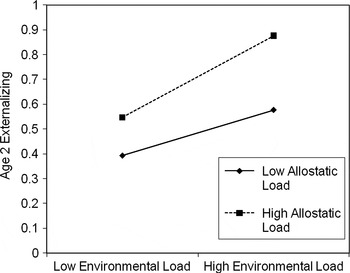
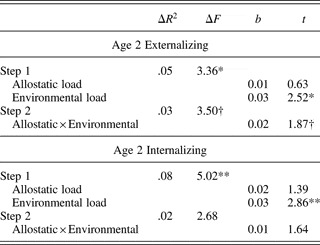
We conducted two regressions predicting age 2 externalizing and internalizing behavior. In the first step of each model, we entered the allostatic and environmental load indices. In the second step, we entered the product of the centered load indices. Table 7 presents the regression model statistics for these analyses. The model predicting concurrent (age 2) externalizing behavior showed a significant effect of environmental load. This was qualified by a trend–level interaction of allostatic and environmental load suggesting that greater externalizing was associated with having high levels of both allostatic and environmental burden (Figure 4).
The interaction of allostatic and environmental load indices predicting age 2 externalizing problems in Study 2.

Regression models predicting age 2 externalizing and internalizing in Study 2

Note: Interaction terms are the product of centered allostatic and environmental load indices.
†p < .10. *p < .05. **p < .01.
The second model, predicting age 2 internalizing, revealed only an effect of environmental load such that more environmental burden was associated with greater internalizing problems. The interaction was not significant. Thus, we partially replicated the results from Study 1 examining age 2 externalizing and internalizing from the load indices in a second sample of children, half of whom were selected for inclusion in the study because they were highly fearful and potentially at risk for anxiety problems later in childhood.
Predicting general anxiety at age 3
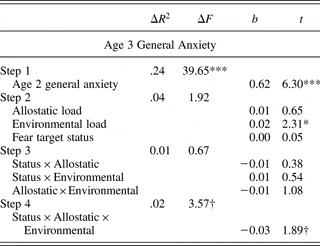
Because we deliberately selected half the participants in Study 2 to be high in fearfulness, we anticipated the robust associations between load indices and internalizing and general anxiety we found, even though this was in contrast to the associations detected in the unselected sample of children from Study 1 (e.g., fewer relations to internalizing were detected in Study 1; Table 6). Results from both studies suggest that cumulative load relates to greater externalizing problems for all children (regardless of fearfulness), but we expected child fearfulness to interact with allostatic and environmental load to predict internalizing—specifically, general anxiety problems. To investigate this assumption, we ran a regression model predicting age 3 general anxiety problems. This was structured as follows: age 2 general anxiety was controlled in the first step. The allostatic and environmental load indices and fearfulness status (i.e., child was selected or unselected for fearfulness) were entered in the second step. All two-way interactions (Status × Allostatic Load, Status × Environmental Load, and Allostatic × Environmental Load) were entered in Step 2, and the three-way interaction of Status × Allostatic × Environmental was entered in Step 3. Table 8 presents regression model statistics for this analysis examining age 3 general anxiety.
Regression model predicting general anxiety at age 3 in Study 2

†p < .10. *p < .05. ***p < .001.
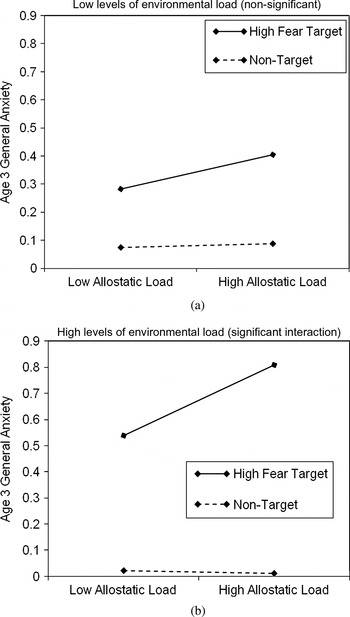
The model predicting age 3 general anxiety (controlling for age 2 levels) showed an effect of environmental load (more burden predicted more general anxiety), but this was subsumed by a three-way interaction of status, allostatic, and environmental load. We probed this interaction at values one standard deviation above and below the mean level of environmental load and examined the two-way interaction of fear status and allostatic load at each level. This approach indicated that the two-way interaction was significant at high (Figure 5b; β = 0.17, t = 1.72, p < .10) but not low (Figure 5a; β = 0.07, t = 1.40, ns) levels of environmental load. As can be seen in Figure 5, at high levels of environmental load, fearful children with high levels of allostatic load had more general anxiety problems than unselected children or fearful children with lower levels of allostatic load. In contrast, the unselected children showed comparable general anxiety levels regardless of allostatic load. Thus, for high fear status children only, high levels of environmental and allostatic load at age 2 predicted higher levels of anxiety a year later.
Three-way interaction of allostatic load, environmental load, and fear status predicting age 3 general anxiety in Study 2.

Study 2 Discussion
The results from Study 2 partially replicated the link between the allostatic and environmental load indices and concurrent externalizing and internalizing behavior problems we detected in Study 1. We found that cumulative load and environmental load were concurrently associated with externalizing and internalizing problems; however, allostatic load alone was not. In addition, we explored the possibility that child fearfulness would interact with load indices to predict anxiety outcomes. We found support for this expectation, as fear status was an important predictor of age 3 general anxiety problems, interacting with allostatic and environmental load indices to predict greater anxiety for the fearful children who had high levels of allostatic and environmental load. Taken together, the results from this study support the initial relation between cumulative burden and externalizing and internalizing problems we identified in Study 1, and extend this by demonstrating the importance of considering child fearfulness as a contributing factor to problem behavior.
General Discussion
Across two studies we demonstrated that increased allostatic load related to internalizing and externalizing problems as environmental risk also increased. Study 1 showed that these associations were present in toddlerhood and three years later, as children began kindergarten. Study 2, in addition, showed that fearfulness was an important predictor of age 3 general anxiety problems, interacting with allostatic and environmental load indices to predict greater anxiety among the fearful children who had high levels of allostatic and environmental load. Taken together, findings provide support for an index of risk for internalizing characterized by the interaction of accumulated biological and environmental stressors, and demonstrate the importance of considering individual differences in temperament as well as environmental context in applying models of allostatic load to developmental change in early childhood.
Allostatic load and psychobiological models of risk
Our findings are consistent with psychobiological models of risk that exist in the broader literature on developmental psychopathology, and provide new insight into risk in early childhood. Traditional conceptualizations of allostatic load suggest that an accumulation of physiological challenges or patterns of reactivity that chronically activate children's stress response systems would carry significant consequences for long-term functioning. Findings from this investigation support this assumption by showing links to later precursors of psychopathology. Moreover, we illustrate that the accumulation of stressors in toddlerhood can predict internalizing problem behavior 1, 2, and 3 years after this initial assessment, well into childhood. Our findings contribute to the literature and suggest that these maladaptive patterns of stress response to environmental challenge are already established by the time children are 2 years old. Thus, allostatic load is likely to contribute to physical health as established in previous work and, as we demonstrate here, mental health adjustment difficulties throughout childhood and into adolescence. Results from the present investigation highlight the importance of understanding the developmental origins and processes of stress responding for developmental psychopathological outcomes.
Our findings do not, however, simply indicate that more cumulative stress in toddlerhood predicts more global problem behavior later in childhood. Instead, in both studies the longitudinal associations were specific to internalizing problems—whether we examined this in an unselected sample of low-risk children (Study 1) or with highly fearful children (Study 2). Although we linked the interactive effects of allostatic and environmental load to concurrent externalizing problems in both studies, this did not predict later externalizing problems in either study. The fact that our assessments of allostatic and environmental load related to internalizing but not externalizing can be explained by other models of risk that draw more heavily on individual differences and environmental factors that the classic allostatic load models do not incorporate: a temperamental model of individual differences, and the Boyce and Ellis (Reference Boyce and Ellis2005) model of biological sensitivity to context.
A temperamental model of individual differences is particularly relevant because of its focus on using biological markers to help explain differences in children's observable behavior. Temperamentally fearful children display more fear and hesitation than their nonfearful counterparts (e.g., Kagan, Reference Kagan1994; Kagan et al., Reference Kagan, Reznick, Clarke, Snidman and Garcia-Coll1984). This is potentially explained by biological differences in reactivity between fearful and nonfearful children, including patterns of brain response to novel stimuli, greater cortisol reactivity, and higher and less variable heart rate (Fox et al., Reference Fox, Henderson, Rubin, Calkins and Schmidt2001; Kagan et al., Reference Kagan, Reznick, Clarke, Snidman and Garcia-Coll1984; Schmidt & Fox, Reference Schmidt and Fox1998; Schwartz et al., Reference Schwartz, Wright, Shin, Kagan and Rauch2003; Talge et al., Reference Talge, Donzella and Gunnar2008). These differences arise in part because fearful children experience and react to stress at lower thresholds than are necessary to initiate a stress response among nonfearful children. This approach further suggests that these children who chronically activate their stress response system may end up at risk for a wide range of internalizing problems, including anxiety (Biederman et al., Reference Biederman, Hirshfield-Becker, Rosenbaum, Herot, Friedman and Snidman2001; Fox et al., Reference Fox, Henderson, Rubin, Calkins and Schmidt2001; Kagan et al., Reference Kagan, Reznick, Snidman, Gibbons and Johnson1988, Reference Kagan, Snidman, Zentner and Peterson1999). Of note, fearful children are not at increased risk for externalizing problems as they move through childhood, which suggests that externalizing may be better explained by some mechanism other than individual differences in stress reactivity. Our results are consistent with this perspective, as fearfulness appears to represent a particular profile of biological reactivity. Furthermore, in our second study, we showed that highly fearful children who experienced a high level of both allostatic and environmental load had higher levels of anxiety than other children.
A second framework that helps account for our pattern of results in this investigation is Boyce and Ellis's (2005) idea of biological sensitivity to context, one of several models stemming from Belsky's differential sensitivity hypothesis (Belsky et al., Reference Belsky, Hsieh and Crnic1998, Reference Belsky, Bakermans-Kranenburg and van IJzendoorn2007). One novel contribution made by the present studies is our inclusion of the interactive effects of physiological reactivity (i.e., the allostatic load index) and the environmental context of development. Our findings in both studies were consistent with the biological sensitivity model—we found relations between the interaction of allostatic and environmental load predicting concurrent externalizing and internalizing, later internalizing in both studies, and later general anxiety in Study 2 (Obradović et al., Reference Obradović, Bush, Stamperdahl, Adler and Boyce2010; Yap et al., Reference Yap, Whittle, Yucel, Sheeber, Pantelis and Simmons2008). Biological reactivity, indexed by the allostatic load measure, predicted internalizing outcomes for the fearful children, but this was only true when a high level of environmental stress was also present, illustrating the importance of environmental context. We did not find that fearful children with a high level of allostatic load also evinced anxiety problems at low levels of environmental stress. This fits with the tenets of this model and suggests that children with a biological predisposition to experience and react to stress in a particular way may be protected from later anxiety and internalizing problems if they are in a supportive environment. Thus, our findings add new support to this model of risk that has been linked to socioemotional problems in older children (Ellis et al., Reference Ellis, Essex and Boyce2005), and extend it to risk for internalizing among very young children.
The approach and findings we report here can be broadly situated within a developmental psychopathology framework (e.g., Cicchetti & Toth, Reference Cicchetti and Toth2009). Characteristic of this approach is a methodological incorporation of multiple levels of analysis to view a social problem from as many angles as possible and identify viable intervention or prevention pathways (e.g., Cicchetti & Toth, Reference Cicchetti and Toth2009). Treating allostatic (e.g., biological) and environmental (e.g., psychological) stressors as separate but related constructs in this investigation allowed us to examine the interplay of these two domains of functioning that are often examined in isolation. This approach led to new insight about the interrelation of two classes of stressors in very young children's development of internalizing problems. Our findings highlight the dire necessity for researchers to study multiple domains of functioning at the same time to gain a clearer overall picture of the nature of a phenomenon.
Limitations and Future Directions
Several caveats in interpreting our findings must be mentioned. First, we created two indices of stress that were based on classic allostatic load models (e.g., McEwen & Stellar, Reference McEwen and Stellar1993) and reflected the accumulation of multiple risks. We included physiological indicators of risk in the allostatic load index, but we did not have access to comprehensive biological information from children in our samples. The original conceptualization of allostatic load was applied to physical health outcomes, and to fully test this classic model with toddlers, we would have needed to obtain detailed health functioning information at age 2 (e.g., immune functioning, physical fitness) as well as long-term health outcomes (e.g., chronic ailments, postpubescent body mass index) to assess the physical health ramifications of the age 2 stress indices. Despite this, our findings provide much-needed justification for such longitudinal, comprehensive work to be conducted, and we believe our results are especially compelling because of the relatively low environmental risk for disorder present in each of our samples.
We also acknowledge as a limitation the amount of attrition present in Study 1. Over the course of the longitudinal study, 26 families (23% of the total sample) dropped out, mostly because of relocation. Retention of participants over multiple assessments is a notable challenge for all longitudinal studies, and ours was no exception. We believe that our decision to impute missing data in order to preserve accurate parameter estimates helps offset the major drawbacks of attrition (i.e., biased estimation of parameters and standard errors that could inflate the chance of making a type I error), but we recognize this as a methodological constraint in our investigation.
Similarly, the longitudinal investigation from which Study 2 was drawn is not yet completed. The ongoing nature of this project limited the scope of temporal prediction so that our findings focused on outcomes only 1 year later than the initial assessment. It is especially compelling, however, that we found such strong associations between allostatic load, environmental context, and anxiety among fearful children who were only 3 years old. Future research must strive to unpack the specific developmental mechanisms that explain how early stress relates to later problems and psychopathology, perhaps by examining this developmental pathway in protracted longitudinal studies following children from birth (or better yet, beginning with prenatal assessment) until adolescence or beyond. Again, we feel that despite these limitations, the present studies provide the requisite first step toward identification and understanding of a new model of risk for internalizing in early childhood.
Keeping with the ultimate goal of a developmental psychopathological approach, we believe the present investigation to be suggestive of several promising avenues for future work with important practical implications. Because environmental and biological processes work in tandem to shape development in childhood, one approach to intervening on behalf of at-risk children would be to reduce the environmental stress experienced during toddlerhood. Allostatic load was not an independent predictor of internalizing problems, but when coupled with high environmental load, children manifested negative outcomes. Thus, the most promising avenues for intervention and prevention work would be to target children's environment for amelioration, specifically, the parents. Helping parents learn coping strategies to manage their own and their children's stress could be tremendously influential for developmental trajectories in early childhood. For example, providing information about different effective emotion regulation techniques could help alleviate parents’ negative feelings, the expression of these negative feelings in the home, and possibly attenuate overprotective or critical behavior. Early intervention to improve the family environment, in which toddlers spend most of their time, is a promising path to prevention. Future work must elucidate the mechanisms underlying the development of internalizing problems across biological and psychological domains of functioning (cf. Cicchetti & Gunnar, Reference Cicchetti and Gunnar2008). As our understanding of developmental mechanisms becomes clearer, more effective interventions can be designed, and findings from these interventions will shed further light on processes underlying the development of psychopathology (Rutter & Sroufe, Reference Rutter and Sroufe2000). The findings reported here represent the requisite first step in translating basic research questions into eventual social policy prescriptions.
Conclusion
Since the concept of allostatic load was first introduced nearly two decades ago (McEwen & Stellar, Reference McEwen and Stellar1993), a flurry of research has demonstrated the utility of examining stress response biomarkers as indicators of a person's risk for negative health outcomes. Until very recently, however, the core idea from this model, which is the accumulation of stressors as an index of risk, was not routinely drawn on to frame studies of development and developmental psychopathology. The two studies we report here incorporated this classic approach to conceptualizing physiological risk, and also examined the inherent risk in the environment that would interact with allostatic load and individual differences in fearfulness to predict problems. We showed that more allostatic load in contexts of greater environmental stress predicted increasing internalizing (but not externalizing) problems across childhood, and for highly fearful children, higher levels of anxiety. This investigation represents one of the first explorations of such a model in toddlers and young children, and highlights the importance of understanding individual differences in patterns of stress reactivity and environmental challenge early in development to predict and ultimately design interventions targeted to prevent onset of psychopathology in later childhood and adolescence.