


Although it is well known that regular engagement in moderate-intensity physical activity, such as walking, can contribute to healthy ageing( Reference Paterson, Jones and Rice 1 , Reference Vogel, Brechat and Lepretre 2 ), a large percentage of elders are insufficiently active( Reference Sims, Hill and Davidson 3 ). These low levels of activity have been in part attributed to unfavourable neighbourhood environmental characteristics( Reference Michael, Beard and Choi 4 – Reference Van Cauwenberg, De Bourdeaudhuij and De Meester 6 ). The identification of attributes of the neighbourhood built environment related to walking can help shape policies and interventions aimed at promoting an active lifestyle across the lifespan. This is especially the case for walking for transportation, which has shown sharper declines across time than recreational walking( Reference Lumsdon and Mitchell 7 ), and can considerably contribute to the overall habitual patterns of physical activity in populations( Reference Cole, Leslie and Bauman 8 ).
Research on environmental correlates of walking for transportation in elders has been limited in quantity, geographical locations, appropriateness of measures( Reference Van Cauwenberg, De Bourdeaudhuij and De Meester 6 ) and geographical specificity( Reference Giles-Corti, Timperio and Bull 9 ). According to a recent review, only six studies reported on neighbourhood characteristics related to walking for transportation( Reference Van Cauwenberg, De Bourdeaudhuij and De Meester 6 ). They found some evidence that land-use mix, residential density, access to commercial destinations and services( Reference Shigematsu, Sallis and Conway 10 ), access to public transport( Reference Su, Schmöcker and Bell 11 ), street connectivity and crime-related safety( Reference Borst, de Vries and Graham 12 ) may facilitate regular walking for utilitarian purposes in elders. Yet these findings are based on a handful of studies conducted in relatively homogeneous Western environments, which makes it difficult to draw conclusions relevant to elders living in other geographical locations( Reference Van Cauwenberg, De Bourdeaudhuij and De Meester 6 ).
None of the above studies was conducted in Asia. Asian ultra-dense metropolises present unique environmental characteristics (e.g. crowdedness, pollution and an efficient public transport network) that may directly or interactively affect the walking behaviour of elders in yet undocumented ways( Reference Cerin, Sit and Cheung 13 ). The information gained from studying Asian metropolises not only has local relevance. It can clarify dose–response relationships between environmental attributes and transport-related walking at the higher end of the urban density spectrum and thus inform policies and interventions globally. Given that virtually all studies on the environment–walking relationships in older adults have been conducted in relatively low-density areas with relatively low variability in environmental factors, they cannot provide information on the potential effects of high levels of urban density and destination mix on walking behaviour.
Studies on environmental correlates of walking also need to be geographically specific( Reference Giles-Corti, Timperio and Bull 9 ). Since walking occurs within and outside one's neighbourhood of residence, a thorough investigation of the potential effects of the neighbourhood environment on walking behaviour ought to consider where walking for a specific purpose occurs. Yet, to our knowledge, only three studies have examined walking location and purpose( Reference Christian, Bull and Middleton 14 – Reference Van Dyck, Cardon and Deforche 16 ), none of which were conducted in older adults. Geographical specificity is bound to be particularly important within an Asian urban context where the compactness of the built environment and a developed and affordable public transport network provide those living in less-walkable neighbourhoods with easy access to walkable areas. Under such circumstances, ignoring where walking for specific purposes occurs may result in the erroneous conclusion that the neighbourhood environment does not affect walking. In reality, favourable neighbourhood characteristics may be positively associated with within-neighbourhood walking, while, in the presence of a good public-transportation network, unfavourable neighbourhood characteristics may be positively associated with outside-neighbourhood walking.
The need for a high level of specificity extends also to the identification of sociodemographic moderators of the relationships between environmental attributes and walking for specific purposes( Reference Van Cauwenberg, De Bourdeaudhuij and De Meester 6 ). For example, associations of neighbourhood attributes with walking were found to differ by gender( Reference Berke, Ackermann and Lin 17 ) and age( Reference Shigematsu, Sallis and Conway 10 ). When planning environmental interventions aimed to facilitate walking, it is important to ensure that these interventions address the needs of the most vulnerable inactive groups (e.g. older elders and less educated). The relative lack of significant environment–walking relationships observed in the limited number of published studies could be partly attributable to sociodemographic differentials in effects( Reference Van Cauwenberg, De Bourdeaudhuij and De Meester 6 ).
To address the research gaps outlined above, we examined associations of perceived environmental attributes with overall and neighbourhood-specific walking for transport in a representative sample of Chinese-speaking elders residing in Hong Kong, an ultra-dense Chinese metropolis. In doing so, we used validated exposure and outcome measures adapted for the target population( Reference Cerin, Sit and Cheung 13 , Reference Cerin, Barnett and Sit 18 , Reference Cerin, Barnett and Cheung 19 ). Both frequency and total minutes of transport-related walking were examined since the level of access and diversity of destinations in a neighbourhood may have greater effects on frequency than duration of transport-related walking. In fact, destination-rich neighbourhoods may require shorter walking trips than those with poorer access to destinations. Additionally, respondents may be more accurate in reporting walking frequency than duration( Reference Cerin, Barnett and Sit 18 , Reference Cerin, Barnett and Cheung 19 ), which would then result in attenuated relationships of total minutes of walking with perceived environmental attributes due to greater measurement error. We hypothesized that measures of perceived availability of destinations (i.e. diversity of destinations, access to shops, access to public transport)( Reference Shigematsu, Sallis and Conway 10 – Reference Borst, de Vries and Graham 12 , Reference Saelens and Handy 20 ), accessibility of destinations (e.g. pedestrian infrastructure)( Reference Shigematsu, Sallis and Conway 10 , Reference Borst, de Vries and Graham 12 , Reference Saelens and Handy 20 ), aspects pertaining to personal safety (e.g. presence of people and safety from crime)( Reference Saelens and Handy 20 – Reference Henderson and Ainsworth 22 ) and availability of places for sitting( Reference Henderson and Ainsworth 22 – Reference Sawchuk, Russo and Bogart 24 ) would be positively related to walking for transportation. Perceived residential density, crowdedness and traffic load were expected to show a curvilinear, inverted-J relationship with walking for transport. This is because, although such characteristics often typify areas rich in destinations supportive of utilitarian walking( Reference Cerin, Saelens and Sallis 25 , Reference Cerin, Leslie and Owen 26 ), the discomfort and risks of falls associated with extreme levels of density may potentially act as a deterrent to walking in elders( Reference Shumway-Cook, Patla and Stewart 27 ). We expected the above associations to be stronger with within-neighbourhood than overall measures of walking, with the exception of access to public transport which is especially relevant for walking undertaken outside the neighbourhood. Apart from exploring the main effects of perceived environmental attributes with walking for transport, we also examined whether these effects vary across genders( Reference Berke, Ackermann and Lin 17 ), age groups( Reference Shigematsu, Sallis and Conway 10 ) and educational attainment( Reference Cerin, Leslie and du Toit 28 ), as previous studies suggested such moderating effects. We hypothesized that stronger associations of walking measures and perceived environmental attributes would be observed in older elders since they tend to be less mobile and, thus, likely more dependent on the local environment. As the moderating effects of gender and educational attainment may differ across cultures and prior findings were based on Western populations, no specific hypotheses were formulated in this regard.
Methods
Participants
The present study used data on a sample of 484 Hong Kong elders (response rate: 78 %) recruited from membership lists of four out of eighteen Hong Kong Elderly Health Centres (EHC) representing catchment areas of low and high transport-related walkability stratified by low and high socio-economic status (SES). The SES level of EHC catchment areas was operationalized using census data on median monthly household income and percentage of owner-occupiers. Transport-related walkability was established using Census and Centamap (www.centamap.com) data on household, intersection and commercial/service destination densities( Reference Cerin, Sit and Cheung 13 ). The EHC were first ranked by the SES of their catchment area. Low- and high-SES EHC (defined as such based on median split) were then separately ranked by the walkability of their catchment area (based on the three indicators mentioned above). The EHC with the bottom and top scores on walkability were selected from the low- and high-SES lists of EHC to represent the following strata: high walkable/low SES; high walkable/high SES; low walkable/low SES; and low walkable/high SES. The EHC were established by the Department of Health of the Hong Kong Special Administrative Region to provide membership-based comprehensive primary care services to residents aged ≥65 years. They have ∼38 500 members, who are representative of the general Hong Kong population( Reference Schooling, Lam and Li 29 ). Details about the sampling procedure have been provided elsewhere( Reference Cerin, Sit and Cheung 13 ). The sample's sociodemographic characteristics are presented in Table 1.
Descriptive statistics for sociodemographic characteristics, perceived environmental attributes and walking for transport: Chinese-speaking elders (n 484), Hong Kong SAR, China

IQR, interquartile range; NWQ-CS, Neighbourhood Walking Questionnaire – Chinese version for Seniors; IPAQ-LC, Chinese version of the International Physical Activity Questionnaire – Long Form.
†All perceived environmental attributes except for Residential density and Land-use mix – diversity were assessed using a 4-point Likert scale. Land-use mix – diversity was assessed by the perceived walking proximity from home to a list of destinations, with responses ranging from 1–5 min (5) to >30 min (1) walking distance. Residential density items used a 5-point scale with ratings weighted relative to the average residential density that a specific item represents(13).
Measures
Perceived neighbourhood environmental characteristics postulated to be related to walking were assessed using the Neighbourhood Environment Walkability Scale for Chinese Seniors (NEWS-CS)( Reference Cerin, Sit and Cheung 13 ), a validated questionnaire adapted for Chinese elders and based on the Neighborhood Environment Walkability Scale( Reference Cerin, Saelens and Sallis 25 , Reference Saelens, Sallis and Black 30 ). For the purpose of the present study, we used subscales assessing: perceived availability of destinations (land-use mix – diversity, land-use mix – access to shops, access to public transport); features related to accessibility and pedestrian infrastructure (street connectivity, infrastructure for walking, indoor places for walking, physical barriers to walking, easy access of residential entrance (e.g. presence of lift that can be used)); density (residential density (estimated based on the reported types of buildings in the neighbourhood) and crowdedness (crowded streets)); personal safety (presence of people and crime); traffic load; and availability of sitting facilities (e.g. benches).
Weekly frequency and total minutes of transport-related walking within the neighbourhood (in a usual week) were assessed via the Neighbourhood Walking Questionnaire – Chinese version for Seniors (NWQ-CS)( Reference Cerin, Barnett and Sit 18 ), adapted from the Neighbourhood Physical Activity Questionnaire( Reference Giles-Corti, Timperio and Cutt 31 ). Participants reported the frequency and duration (total minutes per week) of walking for transport undertaken within their neighbourhood (defined as an area up to a 15 min walk from home). Last 7 d weekly frequency (number of days) and minutes of walking for transport, irrespective of location, were assessed using the Chinese version of the International Physical Activity Questionnaire – Long Form (IPAQ-LC)( Reference Macfarlane, Chan and Cerin 32 ). The IPAQ-LC has been validated in Hong Kong elders, showing repeatability and validity similar to those of international studies( Reference Cerin, Barnett and Cheung 19 ).
Procedure
The study was conducted according to the guidelines laid down in the Declaration of Helsinki and all procedures involving human subjects were approved by the ethics committees of the participating institutions. Eight street blocks with at least twenty-five residing EHC members were randomly selected without replacement in each of four EHC catchment areas. Approximately fifteen participants aged ≥65 years, with no diagnosed cognitive impairment and able to walk unassisted, were recruited from each selected block via an invitation letter followed up by a telephone call. They took part in a face-to-face interviewer-administered survey after providing written informed consent. The survey included the above-mentioned questionnaires. Participants were offered grocery vouchers as participation incentives after the successful completion of the interview.
Data analysis
Descriptive statistics were computed for all variables. Given that all outcome variables were positively skewed, generalized additive mixed models (GAMM) with negative binomial and logarithmic link functions were used to estimate the strength and shape of the associations of perceived environmental attributes with weekly frequency and minutes of walking for transport( Reference Wood 33 ). Random intercepts were specified to account for clustering in the data, i.e. the fact that respondents were sampled from selected street blocks. All continuous variables were centred around their mean before including them in the regression models. A first set of models estimated the relationships of sociodemographic characteristics with the outcome variables. A second set of models estimated the dose–response relationships of single perceived environmental attributes with the outcomes, adjusting for sociodemographic covariates. Two-way interaction effects of gender, age and educational attainment by environmental variables were assessed in a third set of models. All perceived environmental attributes that yielded main and/or interaction effects significant at a 0·05 probability level were included in multiple-predictor models of weekly frequency and minutes of transport-related walking. The absolute values of bivariate correlations between environmental variables ranged from 0·01 to 0·52 (average r = 0·19). Hence, multicollinearity was not a problem. All variables and interaction terms that remained significant were retained in final sets of main and main plus interaction effect models, respectively. All analyses were conducted in R( 34 ) using the package ‘mgcv’( Reference Wood 33 ).
Results
Levels of walking and sociodemographic correlates
High levels of transportation-related walking, perceived residential density, land-use mix – diversity, access to shops and public transport, infrastructure for walking, street connectivity and presence of people, and low levels of crime, were reported. No gender differences were observed in transport-related walking, while respondents with higher educational attainment tended to report 37 % (95 % CI 18 %, 52 %) lower frequency and 29 % (95 % CI 11 %, 43 %) fewer weekly minutes of within-neighbourhood walking than their less educated counterparts. They also reported 22 % (95 % CI 8 %, 35 %) lower overall amounts of transport-related walking. Compared with younger elders, older elders (aged ≥75 years) engaged 8 % (95 % CI 3 %, 12 %) and 36 % (95 % CI 17 %, 50 %) less frequently in within-neighbourhood and overall transport-related walking, respectively. They also engaged in 15 % (95 % CI 0 %, 30 %) and 56 % (95 % CI 42 %, 67 %) fewer weekly minutes of within-neighbourhood and overall transport-related walking, respectively.
Associations of perceived environmental attributes with transport-related walking
The single-predictor GAMM revealed significant positive linear associations of frequency and/or weekly minutes of within-neighbourhood walking for transport with perceived land-use mix – diversity (defined as the average perceived proximity of diverse destinations), access to shops, physical barriers to and infrastructure for walking, crowdedness, traffic and road hazards, easy access of residential entrances and sitting facilities in the neighbourhood (Table 2). Measures of overall transport-related walking were positively but more weakly associated with the same set of perceived attributes, with the exception of physical barriers to walking and traffic and road hazards. They were also positively related to perceived access to public transport and dwelling density. The multiple-predictor models yielded fewer significant effects, which are presented in Table 3. Access to shops, crowdedness, easy access of residential entrance, infrastructure for walking and presence of sitting facilities were positively related to both overall and within-neighbourhood walking. Access to public transport was independently positively related to overall but not within-neighbourhood walking, while the opposite was true for land-use mix – diversity and physical barriers to walking. More significant associations were found with measures of frequency than total weekly minutes of walking.
Associations of perceived environmental attributes with walking for transport (main-effect models with single environmental predictors): Chinese-speaking elders (n 484), Hong Kong SAR, China
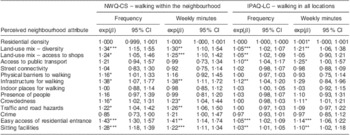
NWQ-CS, Neighbourhood Walking Questionnaire – Chinese version for Seniors; IPAQ-LC, Chinese version of the International Physical Activity Questionnaire – Long Form; exp(β), antilogarithm of regression coefficient; 95 % CI, antilogarithms of the 95 % CI of the regression coefficient.
The antilogarithms of the regression coefficients represent the proportional increase (if exp(β) > 1·00) or decrease (if exp(β) < 1·00) in average weekly minutes or frequency of transport-related walking associated with a unit increase in a perceived environmental attribute.
*P < 0.05, **P < 0·01, ***P < 0.001.
Associations of perceived environmental attributes with walking for transport (main-effects multiple-environmental-predictor models): Chinese-speaking elders (n 484), Hong Kong SAR, China
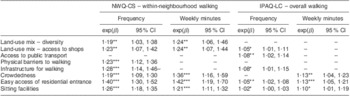
NWQ-CS, Neighbourhood Walking Questionnaire – Chinese version for Seniors; IPAQ-LC, Chinese version of the International Physical Activity Questionnaire – Long Form; exp(β), antilogarithm of regression coefficient; 95 % CI, antilogarithms of the 95 % CI of the regression coefficient.
The antilogarithms of the regression coefficients represent the proportional increase (if exp(β) > 1·00) or decrease (if exp(β) < 1·00) in average weekly minutes or frequency of transport-related walking associated with a unit increase in a perceived environmental attribute.
*P < 0·05, **P < 0·01, ***P < 0·001.
Sociodemographic moderators
Significant interaction effects of gender and age, but not educational attainment, were found. While crime did not show a significant association in men, a unit increase in perceived crime was predictive of a 37 % (95 % CI 10 %, 70 %) higher amount of walking in women. A unit increase in perceived sitting facilities in the neighbourhood was predictive of 34 % (95 % CI 19 %, 50 %) higher frequency of within-neighbourhood walking in men, but only 18 % (95 % CI 9 %, 27 %) in women. Younger elders (aged 65–74 years) showed no significant relationship of within-neighbourhood walking with the perceived presence of sitting facilities and land-use mix – diversity. However, in older elders (≥75 years), a unit increase in land-use mix – diversity corresponded to 47 % (95 % CI 16 %, 87 %) and 46 % (95 % CI 7 %, 100 %) higher frequency and weekly minutes of within-neighbourhood walking, respectively. The effect of perceived sitting facilities in this age group amounted to 51 % more weekly minutes of walking for a unit increase on the respective scale.
Discussion
We examined associations of perceived neighbourhood environment characteristics with measures of transport-related walking in a representative sample of Chinese older residents of Hong Kong, an ultra-dense Asian metropolis. The present study is the first such one to be conducted in an Asian urban context, to use measures of overall and within-neighbourhood walking for transport, and to employ outcome and environmental exposure measures specifically adapted for and/or validated in the target population( Reference Cerin, Sit and Cheung 13 , Reference Cerin, Barnett and Sit 18 , Reference Cerin, Barnett and Cheung 19 ).
Levels of transport-related walking
As observed in an earlier study on mainland Chinese elders( Reference Deng, Macfarlane and Thomas 35 ), Hong Kong elders reported much higher average levels of walking for transport than their Western counterparts( Reference Van Cauwenberg, De Bourdeaudhuij and De Meester 6 , Reference Mendes de Leon, Cagney and Bienias 21 ), exceeding the total minimum weekly recommended amounts of health-enhancing physical activity by 2·8 times( Reference Paterson, Jones and Rice 1 , Reference Vogel, Brechat and Lepretre 2 ). Walking within the neighbourhood alone contributed (on average) to the participants fully meeting the physical activity guidelines of 150 weekly minutes of moderate-intensity activity. Average ratings of perceived residential density, land-use mix – diversity, infrastructure for walking, access to shops and public transport and street connectivity were substantially higher in the present study compared with those reported in Western countries using versions of the same instrument( Reference Shigematsu, Sallis and Conway 10 , Reference Cerin, Saelens and Sallis 25 , Reference Cerin, Leslie and Owen 26 ). This indicates that the provision of environments characterized by these environmental attributes may help ageing populations maintain an active lifestyle and involvement in their community, both of which are important for health( Reference Vogel, Brechat and Lepretre 2 ). Although cultural factors may also be responsible for the observed levels of walking, they are unlikely to be the only contributor as we also found significant associations between transport-related walking and perceived neighbourhood characteristics.
Correlates of transport-related walking
Access to shops, infrastructure for walking, presence of sitting facilities in the neighbourhood and easy access to the residential entrance were perceived neighbourhood attributes positively associated with both overall and within-neighbourhood walking for transportation, highlighting their potential importance for the maintenance of an active lifestyle in elders. While several studies have identified shop accessibility as a correlate of walking in elders, reports on micro-scale aspects of the environment such as sitting facilities (benches) and access to residential entrance are rare( Reference Van Cauwenberg, De Bourdeaudhuij and De Meester 6 ). Some high-rise residential buildings in lower-SES neighbourhoods of Hong Kong do not have lifts, while others have lifts which are often out of order. The lack of functioning lifts and elevators in a predominantly high-rise urban environment poses serious accessibility problems to elders, which, as the present study suggests, may contribute to a significant reduction in walking for transport and increased isolation. The presence of benches in the neighbourhood makes it possible for elders to have a rest during their utilitarian trips and may also serve as meeting points, which have been recently identified as environmental facilitators of walking in other cultures( Reference Henderson and Ainsworth 22 – Reference Sawchuk, Russo and Bogart 24 ).
Land-use mix – diversity was positively related to within-neighbourhood but not overall transport-related walking. As hypothesized, several other perceived neighbourhood characteristics showed stronger relationships with within-neighbourhood than overall transport-related walking. Within the examined settings, it appears that elders may be able to compensate for the lack of access to diverse types of services in their neighbourhood by visiting, and walking in, other neighbourhoods where these services are available. In contrast, access to public transport was associated with overall but not within-neighbourhood walking. An affordable and well-developed public transportation network may make it possible for residents to overcome the lack of services and destinations within their neighbourhoods by providing easy access to other more-destination-rich neighbourhoods.
In line with previous findings( Reference Cerin, Saelens and Sallis 25 , Reference Cerin, Leslie and Owen 26 ), environmental characteristics hypothesized to show an inverted-J relationship with transport-related walking (traffic load, crowdedness and residential density) were instead positively linearly associated with it in at least one of the single-predictor models. Thus, high levels of perceived density and traffic may not act as deterrents of utilitarian walking in Hong Kong elders. This could be due to the fact that areas with higher density of affordable commercial destinations are accompanied by proportionally higher levels of residential density, and human and vehicular traffic volumes( Reference Cerin, Saelens and Sallis 25 , Reference Cerin, Leslie and Owen 26 ). Unexpectedly, aspects of perceived personal safety (presence of people and crime in the neighbourhood) were unrelated to walking for transport, possibly due to the restricted variability of scores on these two scales.
It is noteworthy that, as hypothesized, fewer perceived environmental attributes were related to total amount (weekly minutes) than frequency of walking. In the present study, this is likely to be due to differences in measurement error( Reference Cerin, Barnett and Sit 18 , Reference Cerin, Barnett and Cheung 19 ) rather than differential effects of the neighbourhood environment on the two dimensions of walking. In fact, contrary to what was hypothesized, the magnitude of the association of total minutes of walking with perceived access to services was similar to, rather than weaker than, that with frequency of walking.
Sociodemographic correlates and moderators
As observed in previous studies( Reference Frank, Kerr and Rosenberg 5 , Reference Ogilvie, Mitchell and Mutrie 36 ), we found that educational attainment and age were negatively related, while gender was unrelated, to walking for transport. The first finding is of no public health concern because individuals with higher education tend to replace transport-related with recreational walking or other forms of leisure-time physical activity( Reference Mendes de Leon, Cagney and Bienias 21 , Reference Cerin and Leslie 37 , Reference Cerin, Leslie and Owen 38 ). This is, however, not the case for age, which is negatively associated with walking for all purposes( Reference Mendes de Leon, Cagney and Bienias 21 , Reference de Melo, Menec and Porter 39 ). The present study indicates that the provision of sitting facilities and neighbourhoods with mixed land use may help reduce age-group differences in levels of walking, i.e. slow down the decline in transport-related walking across time.
Finally, a few moderating effects of gender were observed. Perceived crime was positively associated with neighbourhood-based walking in women but not in men, which might be due to women's tendency to experience higher levels of risk of threat and fear of crime( Reference Smith and Torstensson 40 ). With respect to gender difference in effects of sitting facilities, it should be noted that such facilities are prevalent in tiny parks within the old-core, high-density but low-quality residential areas of Hong Kong, where elderly men and blue-collar middle-aged men commonly engage in passive recreational activities (chess, gambling and chatting)( Reference Lo and Jim 23 ).
Study limitations
The present study has several limitations. These include the cross-sectional nature of the study; the exclusive reliance on self-report measures; the use of an arbitrary definition of neighbourhood primarily based on studies conducted on Western adults( Reference Cerin, Saelens and Sallis 25 , Reference Saelens, Sallis and Black 30 , Reference Giles-Corti, Timperio and Cutt 31 ); and the lack of assessment of current health status and car ownership. With regard to the last two potential limitations, it should be noted that car ownership in Hong Kong is very low (<35 % of adult residents) and respondents’ eligibility was assessed based on their (good) health status (ability to walk unassisted). As far as the reliance on self-reports is concerned, the fact that associations were observed for only a limited number of neighbourhood characteristics indicates that they are at least in part due to environmental influences on walking behaviour rather than solely due to greater environmental awareness in regular walkers. Finally, in line with previous studies using the original versions of the scales gauging perceived neighbourhood attributes and within-neighbourhood walking( Reference Cerin, Saelens and Sallis 25 , Reference Saelens, Sallis and Black 30 , Reference Giles-Corti, Timperio and Cutt 31 ), we defined neighbourhood as an area up to a 15 min walk from home, which in adults would correspond to a radius of ∼1 km. As it has been suggested that adults commonly perceive their neighbourhood to be an area within 400 m from home( Reference Smith, Gidlow and Davey 41 ) and this area in elders may be even smaller, the definition used in the current study might have been suboptimal. The definition of neighbourhood and its impact on the environment–walking relationships in various populations remain important issues to be explored in future studies.
Yet, using a standard neighbourhood definition employed in previous studies has some advantages. It can assist the evaluation of the potential impact of environmental interventions on different age groups. It is also necessary for the estimation of environment–walking dose–response relationships using data from multiple geographical locations varying in levels of exposure (e.g. residential density).
Conclusions
The present study revealed that Chinese Hong Kong elders report very high levels of walking for transport that exceed the total minimum recommended amounts of health-enhancing physical activity. The high prevalence of walking may be in part attributed to a highly walkable environment typified by mixed land use, easy access to diverse services and a developed public transport network. Easy access to one's residential entrance and shops, a good pedestrian infrastructure and the provision of sitting facilities in the neighbourhood appear to be particularly important promoters of walking for transport in elders. It might be possible to overcome the negative effects of lack of destinations in the neighbourhood through the provision of an affordable public transport network. Local government and private agencies should invest in the creation of affordable public transport routes linking destination-poor with destination-rich areas especially in neighbourhoods with a high percentage of elders. Governmental financial incentives to build sitting facilities and local grocery shops in all neighbourhoods may help elders maintain an active lifestyle and social engagement. Future investigations using objective measures of the neighbourhood environment and walking should verify the veracity of the findings observed herein.
Acknowledgements
Source of funding: This work was supported by grant no. 04060671 from the Health and Health Service Research Fund (Food and Health Bureau, Hong Kong SAR), for which the authors are grateful. Conflicts of interest: The authors have no conflict of interest to declare. Authors’ contribution: The study was conceived and planned by E.C., M.-C.C. and W.-M.C. E.C., C.H.P.S., J.M.J., M.-C.C. and W.-M.C. contributed to the data collection and study coordination. The analysis was conducted by E.C. and A.B. The final submission was written by E.C. and A.B. with significant contributions to the various drafts by all other co-authors. Acknowledgements: The authors thank the staff of the Elderly Health Centres for their assistance which made it possible to successfully complete this project.



