

Introduction
In 1935 Heinrich Sowa published an edition of an anonymous Latin music-theory treatise, which he titled De musica et de transformatione specialiter, thereby calling attention to one of the treatise's most noteworthy subjects.Footnote 1 He dated the treatise around 1075 and placed its origins in the circle of intellectuals that had formed around Hermannus Contractus (1013–54), a monk of the island monastery of Reichenau in Lake Constance. Beginning in the late twentieth century, thanks in part to Harold Powers's article ‘Mode’ in the New Grove Dictionary,Footnote 2 the treatise has attracted renewed interest as one of several that transmit and elaborate Guido's doctrine of transposition. That doctrine differed from the usual one by introducing alongside the familiar concept of transposition the secondary concept of transformation. In transposition chants are displaced upward by the interval of a fifth to their respective affines (affinales, sociales). In transformation the interval of displacement is a fourth, and the chant's system, or background scale, is altered by the substitution of b♭ for b♮. The transformation causes chants seated on G to sound protus, chants seated on the pitch a to sound deuterus, and chants seated on b♭ to sound tritus.Footnote 3
For scholars wishing to study the theory of transformation, Sowa's Musica is one of the most important sources, yet for all its importance, it has remained unavailable except in his less than perfect edition. Sowa omitted an entire section of the text, an annotated list of antiphons for the Mass and Office arranged by mode and differentia, on the grounds that it was, in his judgement, tedious and riddled with copyist's errors.Footnote 4 The edition itself contains some twenty editorial errors, most having negligible effect on the sense, but a few causing real confusion (e.g. reading perueniendo for preueniendo, sonet for soluet, postest for potest, and undecim for both ix and xii). In consideration of these defects and of the treatise's importance, a new edition along with translation into a modern language seems warranted.
The treatise's unique source is a manuscript currently conserved in the Leipzig University Library and bearing the signature 1492. It is roughly of quarto size, measuring 29.8×21.8 cm, and contains in addition to the treatise itself others by Boethius, Hucbald, Pseudo-Bernelinus, Bern of Reichenau, Pseudo-Odo and several other anonymous authors. The part of the manuscript containing Sowa's Musica is signed by the scribe, Theodoricus Henczoldus of the monastery of Altzelle in Saxony, and dated 1438.Footnote 5
The date and provenance of the treatise itself are more problematic. Part of Sowa's argument depends on the tacit assumption that the treatise is by the same author or from the same school as the work immediately preceding it in the manuscript, a libellus tonarius.Footnote 6 The libellus employs a kind of interval notation devised by Hermannus Contractus (e, s, t, d, Δ for equaliter, semitone, tone, diatessaron and diapente), ruling out a date before the mid-eleventh century, and its laboured description of the notes and intervals of antiphonal psalmody seems to place it before the twelfth century, when musical notation on a four-line stave gradually made such descriptions redundant. Paul Merkley, on the other hand, finds Sowa's arguments unconvincing and sees no reason to date the libellus earlier than the manuscript that transmits it.Footnote 7 As to a south German provenance, Sowa finds evidence of it in the inclusion of two antiphons for St Gallus and St Othmar, patrons of the Swiss monastery of St Gall, and Huglo, citing antiphons for St Denis, St Januarius and St Nicholas, is inclined to narrow down the work's provenance to the monastery of Reichenau.Footnote 8
Whatever the arguments may be for the date and provenance of the libellus tonarius, it is not at all clear that they apply to the anonymous Musica that follows it. The libellus ends with a formal conclusion, and the Musica, which follows immediately,Footnote 9 is in a different prose style and employs a different vocabulary of technical terms. Whereas the libellus uses the term subiugalis for plagal sixty-one times (it uses plagis only once), the Musica uses plagis, appropriately inflected, twenty times and subiugalis not at all. Whereas the libellus uses the term socialis eleven times, that word is entirely absent from the Musica, which prefers the term affinis (six occurrences). Most strikingly, the libellus makes liberal use of the Greek scale names (mese, lichanos, ypate, etc.), while such terminology is not found in the Musica, except for a single parenthetical reference employing the word lichanosipaton. Finally, the libellus's distinctive interval notation is absent from the Musica.
In the absence of a firm connection with the preceding libellus tonarius, attempts to date the Musica must rely on affinities with a wider circle of theoretical sources. The first and most explicit is Guido's Micrologus. The Musica cites Guido by name and employs several close or exact quotations of his work. These provide a terminus post quem of c. 1030. In addition the text exhibits several verbal and conceptual affinities with the Musica of Aribo, written between 1069 and 1078, probably at Freising,Footnote 10 and with the anonymous Quaestiones in musica, formerly attributed to Rudolf of Saint Truiden, written c. 1100.Footnote 11 Most astonishingly, one quarter of the text of the Musica, comprising approximately 800 of its 3,500 words, is in verbatim or near verbatim agreement with corresponding passages in the anonymous Commentarius in Micrologum,Footnote 12 which Smits van Waesberghe has dated c. 1070–1100 and assigned a Liégeoise provenance.Footnote 13
While the numerous word-for-word similarities are striking, the Musica in Leipzig 1492 also shares with the Commentarius, the Quaestiones, and Aribo's Musica significant similarities of underlying doctrine. One of those doctrines concerns the species of the diatessaron. The idea that each species of fourth, identified by the position of the semitone (TST, STT or TTS), should belong to the same numeric class as its associated mode seems to have emerged from the group of theorists who studied with Bern of Reichenau (d. 1048) and transmitted his teaching. In chapter 5 of his Prologus in tonarium, Bern, following an older theoretical tradition, exemplifies the three species of diatessaron as D–G, E–a and G–c. But in the next chapter,Footnote 14 he explicitly identifies the three species as components of the protus, deuterus and tritus modal octaves, where they span the pitch-classes A–D, B–E and C–F. While Bern concedes that the tetrardus modal octave must include a diatessaron of the first species (D–G), one of his emendators has excused the anomaly by interpolating the comment that that fourth consists purely of the form of the first species (‘constat … ex forma primae speciei’) and not of its true nature.Footnote 15
Bern's pupil, Hermannus Contractus, solved this problem by asserting that the species of fourth are determined not only by their internal form, but also by the notes of the scale that they span. Since the notes framing the characteristic fourth of the tetrardus modes are the fourth notes of their respective tetrachords (D of the graves and G of the finales or d of the superiores and g of the excellentes), that fourth should be considered as belonging to a fourth species, its formal identity with the first species notwithstanding.Footnote 16
The Musica in Leipzig 1492 recapitulates Bern's emended theory with minor elaboration. It affirms that there are only three species of fourth, calling them natural when they span the notes of the matching numeric class, the first species spanning the first note of the graves to the first note of the finales, and so forth from A–D to C–F. It refers to fourths spanning other scale steps as not naturalis, but formalis, using a variant of the expression ex forma found in Bern's emended text. It does not, however, adopt Hermannus's acceptance of D–G as a fourth species.
The Commentarius in Micrologum, which follows the Musica's doctrine of species closely, seems nevertheless to accept Hermannus's adjustment, if only summarily.Footnote 17 The doctrine is fully elaborated, however, in the Musica of Aribo and the anonymous Quaestiones in musica.Footnote 18 The place of Sowa's Musica in the diffusion of this doctrine suggests that its author was familiar with Bern's teaching, as emended, but had not yet assimilated Hermannus's novel transformation of it, as Aribo and the author of the Quaestiones had done. That would tend to place the writing of the Musica earlier than those two treatises, perhaps in the third quarter of the eleventh century, or in the hands of an author unwilling to agree to every detail of Hermannus's teaching.
The other deep affinity between the Musica and the other treatises in its circle concerns the doctrine of transposition and transformation. Here the Musica's strongest affinity is with the Commentarius and the Quaestiones, which explore the doctrine's ramifications in considerable detail. Most striking of all is the similarity between the Musica and the Quaestiones on the subject of transposition ex parte and ex toto, a consequence of the doctrine of transposition that Guido had not anticipated.Footnote 19
Returning finally to the Musica of Hermannus Contractus, careful readers of the anonymous Musica in Leipzig 1492 will detect certain signs that the two treatises, if not exactly dependent on each other, were written in the same scholarly milieu. Both define the octave as the compound of the fourth and the fifth. Both make the same connection between low or heavy voices and large or thick letters (A to G), and between high voices and sharply drawn letters (a to g). Both make the explicit claim that fourths are natural when seated in the tetrachord of the graves and merely formal elsewhere, while fifths are natural when seated in the tetrachord of the finales and formal elsewhere.Footnote 20 While affinities like these are easily explained as the result of a common tradition, the emphasis that they receive in both treatises suggests a common agenda and possibly a close relation in time and place of origin.
On balance the evidence seems to favour the conclusion that the Musica was written at the same time as the Commentarius and the Quaestiones, in the last quarter of the eleventh century, when Guido's doctrine of transposition and transformation was a topic of current concern. Still, its various casual affinities with Hermannus's text, and even its failure to adopt Hermannus's most provocative doctrine – perhaps because it was not yet settled knowledge – tend to favour an earlier date. In the light of these reasons, the more cautious choice would be to place the Musica in the last quarter of the eleventh century, but an earlier date in the third quarter of the century cannot be ruled out.
Besides transposition, transformation and the species of consonance, the anonymous Musica treats several other subjects considered important to the education of the medieval singer, most of which in one way or another are elaborations on the first thirteen chapters of Guido's Micrologus. These include the inferior, or contingent status of b♭, alphabetic notation in general, the modal qualities (modi vocum) of all the notes of the heptatonic octave, the dependence of all the notes of each chant on its final, the authentic and plagal modal ranges, and a practical description of the psalm tones. Egregiously omitted is any reference to the monochord (in all probability included in the treatise's now lost opening section).
Embedded within the treatise are two short tonaries, evidently intended for practical instruction.Footnote 21 The first is a short tonary of Office antiphons divided in hierarchical recession by mode, differentia and starting pitch. Thirty-nine cases are presented altogether, each illustrated with a single incipit referring to a chant that the reader is presumed to know or which he can find in an antiphonary. The tonary would be complete were it not for the anomalous absence of examples for the five differentiae of the first mode, of which only the basic version is given. This is followed by a second short tonary of introit antiphons. Here several examples are given for each differentia, and they are not subdivided by starting pitch. The total number in the second tonary is 132.
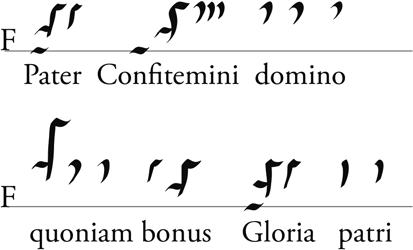
The fifteenth-century copyist was probably working from a source in which the second tonary was annotated with musical notation, for he has provided space for it between the lines in the headings of all the modes except the sixth. Yet musical notation, some neumatic, some alphabetic, has been entered only for modes 1 and 2 (see Figure 1).Footnote 22 On grounds of its sloppiness and fragmentary nature, it is fair to conclude that the scribe struggled with it and eventually gave up. Nevertheless, the two tonaries do bear witness to modal assignments and their subdivisions and may be used along with other tonaries, especially those of Bern and Frutolf of MichelsbergFootnote 23 and the anonymous libellus tonarius in Leipzig 1492, to assess the uniformity and diversity of the south German repertory in the late eleventh century.
Fragment with neumes from the introduction to mode 1

Notes to the edition and translation
The edition preserves the original orthography to the extent compatible with consistency. Thus, ci for ti in words like transposicio is maintained, as is e for the classical diphthong ae. The doublet u/v is transcribed u in lower case and V in upper, following the scribe's preferred, though not consistent, practice. The manuscript employs the familiar Guidonian letters (gamma, A to G, a to g, aa and ♮♮), but does not reliably distinguish between modern upper and lower case. The correct forms have been supplied by the editor. Roman numerals are spelled out. Punctuation, capitalisation and division into paragraphs are editorial.
The treatise presents the first tonary as a prose text, citing the liturgical incipits in the normal course of the running prose. The transcription retains that format. The second tonary, though in the guise of running prose, is actually a series of lists. These have been transcribed in outline format with one incipit to the line.
The word chorda, literally ‘string’, is used without exception to refer to the steps of the scale and has been translated as ‘step’. Vox, vocis, unless referring explicitly to the human voice, has the simple meaning of a musical note or pitch and has been translated ‘note’. It does not imply a hexachordal context or a solmisation syllable, as it does in later theoretical writing. Tonus, when meaning ‘whole tone’ or ‘psalm tone’, is unambiguous and has been translated accordingly. When the reference is to the eight ecclesiastical modes, tonus and modus are both translated ‘mode’ in acknowledgement of the author's apparent indifference. The sole exception is where the author has made an explicit distinction between the four Byzantine modal pairs, which he calls toni, and their eight Western derivatives, which he calls modi. In that case ‘tone’ and ‘mode’ have been used.
The treatise refers to the first terminal variety of each psalm tone as its principalis sonus, reserving the term differentia for additional varieties, numbering the second variety as the first differentia.Footnote 24 To best capture the intended sense, principalis sonus has been translated ‘basic version’. Commonly called differentiae, the subdivisions of the modes, including the basic version, refer both to the terminal varieties of the psalm tones (the saeculorum amen formulas) and to the classes of antiphonal chants assigned to them. Thus, when the text gives the starting pitch of the basic version or one of its differentiae, the clear intent is to refer to the first note of antiphons assigned to that variety.
The notes are keyed by sentence number. Parallel passages are referred to as follows: Mic., followed by the chapter and line number, for Guidonis Aretini Micrologus, ed. J. Smits van Waesberghe (American Institute of Musicology, 1955); Com., followed by the page and line number, for Commentarius anonymus in Micrologum Guidonis Aretini, in Expositiones in Micrologum Guidonis Aretini, ed. J. Smits van Waesberghe (Amsterdam, 1957); Quaes., followed by the page and question number, for Die Quaestiones in Musica: Ein Choraltraktat des zentralen Mittelalters und ihr mutmaßlicher Verfasser Rudolf von St. Trond, ed. R. Steglich (1911; repr. Wiesbaden, 1970); and Ari., followed by the page and line number, for Aribonis De Musica, ed. J. Smits van Waesberghe (Rome, 1951).
Text
[Alphabetic notation]
1[fol. 94] Grecam litteram ideo moderni maluerunt ponere quam Latinam, ut Greci per hoc innuantur huius artis auctores, et ideo uelut a peritissimis inuenta plus ametur. 2Gamma a modernis adiunctum est quia maluerunt habundare quam deficere, quia nisi illud esset, plagalis protus plagalem deposicionem per diapente non haberet. 3Litteras uocat liber has figuras non quod sint iter legendi hic sed persimile, quia ita certum iter prebent cantui sicut littera leccioni, uel quia eedem figure sunt hic que ibi, licet non idem figurent hic quod ibi.
4Sciendum est quod ipse auctor, ex ipsis figuris musicis uim uocum quocumque modo exprimens, uocum grauium figuras grossiores, acutarum uero fecit subtiliores, ex hoc quodammodo innuens grossiori et ponderosiori uoce graues sonos esse proferendos, acutos uero subtiliori et acuciori uoce esse exaltandos. 5Alcior sonus respectu grauis acutus esse dicitur persimile, quia sicut acutum quodlibet magis penetrat aerem quam grauis, quia et longius auditur et clarius.
6Notandum quod b ♮ [column break] uicine appositum unum rotundatum est et aliud quadratum, ut quia quod rotundum et uolubile est, minus stabile et fixum est. 7Ipsum b rotundum non iam fixum et dignum in natura artis ostendatur, quia non est regulare sed usurpatiuum necessitate illa quia F non haberet concordiam per diatesseron cum superioribus nisi per b molle. 8♮ uero quadratum est, ut quia quod quadrum est, et fixum et stabile est. 9Ipsum ♮ quadratum fixum in natura artis et permanens ostendatur.
10Quod superacutarum figuras duplicatas et geminatas ponit, illas duplo repetitas ostendit. 11Voces enim ecclesie ter dicte duplo sunt repetite.
[The confusion caused by b♭]
12Nisi caute sciat discernere aliquis, b mollis uidetur facere ipsi cantui quandam confusionem, quia facit eum dici confusum. 13Persimile, quia sicut non posset discerni uinum ab aqua si simul funderetur et misceretur, similiter non posset discerni sepe cuius modi sit cantus per errorem b mollis qui apponitur. 14Et non solum facit confusionem dubietatis, ut ignoretur cui magis possit attribui, sed eciam transformacionem, quia transformat eum in alterum modum, ut magis uideatur formam tenere modi illius cuius non est quam illius cuius est, sicut in illa antiphona Vrbs fortitudinis. 15Primam distinccionem facit esse proti, cum tamen sit tetrardi. 16[fol. 94v] Ita transformat dico ut G soluet prothum, id est, sonando representet, quia per b mollem habet intensionem prothi. 17Facit eciam ut a sonet deuterum, cum ipsa b mollis sonet, id est sonando representet, tritum.
[The species of the diatessaron]
18Notandum quod species diatesseron alia naturalis, alia formalis. 19Naturalis est cum a tetracordo grauium originaliter sumitur, quia prima species eius ex prima grauium et prima finalium. 20Secunda species eius colligitur ex secunda grauium et secunda finalium, et sic de ceteris per ordinem. 21Formalis est quando aliunde undecumque sumitur, quia formam et similitudinem retinet naturalis. 22Queritur uero quare species diatesseron et diapente has a grauibus, has a finalibus originem ducere dicamus. 23Vbi recte respondetur quod ibi naturaliter sumantur ubi se per ordinem secuntur, quod non alibi fieri uidemus. 24Si enim primam speciem diapente a prima grauium colligamus, secundam, que constat ex semitonio et tribus tonis, non inueniemus. 25Si uero primam et secundam speciem diatesseron a prima et secunda finalium colligamus, terciam in ordine non habebimus, quia tres toni sunt continui; b enim non est regulare, quod dicitur molle a qua naturaliter aliquid fiat.
[The species of the diapente]
26Diapente alia constans tono et semitonio et ditono, alia ex semitonio et (a) tribus tonis, uel ex tribus tonis et semitonio, alia ex ditono et [column break] semitonio et tono. 27Quarta contraria est prime, et tercia secunde. 28Quarum similiter alia naturalis est, alia formalis; naturaliter enim oriuntur a finalium tetracordo: prima species a prima finali in primam acutarum, et sic deinceps per ordinem. 29Formaliter enim aliunde sumitur, ut dictum est superius.
[The species of the diapason]
30Sicut septem sunt discrimina uocum, sic septem sunt species dyapason ab ipsis septem discriminibus per ordinem nascentes, ut ab A graui in a acutam, a B in ♮, et cetere eodem modo per ordinem. 31Sed quinta eius species a secunda finalium et quinta acutarum est, uidelicet ex secunda specie diatesseron superius et secunda specie diapente inferius, et sic de reliquis. 32Diffinitur autem hoc modo: diapason est consonancia in qua constituenda iunguntur diatesseron et diapente.
[The modal finals by nature and by affinity]
33Primus modus sunt A et D, sed D per naturam, A per affinitatem, et de ceteris similiter dicatur, quod uel natura uel affinitate per eandem posicionem tonorum enim uoces sunt unius modi usque ad G, que sola uox nullam affinem habuit utroque modo scilicet remissione et intensione.
34Sciendum est quod cum a ♮ c sint finales, tamen in tetracordo finalium non accipiuntur, quia licet per affinitatem, tamen per naturam non sunt finales, nisi a D in G, secundis de causis: et quia ibi finales ordine sequuntur se, quod alibi non fit; et quia D primus modus legittimam [fol. 95] descensionem plagalis sui habet sub se per diapente, quod alibi non haberet, si A naturaliter primus esset. 35Ideo D naturaliter est finalis, quia perfeccionem habet regule naturalis.
36Notandum quod equiuoce scilicet affines a ♮ c idcirco naturalibus finalibus D [E] F sunt attribute ideo quia eiusmodi sunt. 37Et si non utroque latere, alio tamen sunt similes, uel propter deficienciam ditoni, ut uides in graduali responsorio Hec; uel propter deficienciam semitonii, ut patet in introitu Exaudi domine; uel propter acucionem cantus. 38Quando tamen acuitur ut ad finalem naturalem redire non possit, sibi scilicet in affini uel gemina, ut in responsorio Terribilis, uel simplici transposicione terminetur, uel propter dulcedinem modulacionis que fit ex uocum uariacione, uel ideo modernis id placuit ne inopes sue artis (s) uiderentur.
[What it means to ascend and descend]
39Sciendum est quod cum ptongi quilibet a naturali loco non moueantur, seu inferioribus seu superioribus iungantur uocibus, quomodo descendere, deponi, remitti, inflecti ad inferiora, ascendere uero, eleuari, intendi ad superiora dicantur, cum a suis sedibus penitus immobiles esse uideantur. 40Ad quod dicendum quia neque deponuntur neque eleuantur, ita ut a loco moueantur, sed deponi dicuntur quando cum inferioribus consonant, eleuari autem quando cum superioribus, id est acutis, concinunt.
[The number and names of the modes and their division into plagals and authentics]
41Quod nos dicimus modum, hoc Greci [column break] tropum, id est conuersionem uocant, quia quocumque modo uarius et dubius est cantus, si proprie ad finem reducitur, mirum in modum totus mox in naturam eius conuertitur; quod nisi seruetur, eciam bene compositus, deformatur. 42Quod uero nos primum hoc ipsi prothum, secundum deuterum, tercium tritum, quartum tetrardum uocant, ab ipsis finalibus nomen toti cantui dantes, ut hunc uocent prothum, illum deuterum, et cetera.
43Sciendum est quod antiqui quatuor tonos tantum habebant: primum, secundum, tercium, quartum. 44Quorum cum finales essent que eciam modo sunt finales D E F G, unusquisque illorum sub sua finali per quatuor graues cordas descendit. 45Supra finalem uero per septem chordas ascendit. 46Septem uero superiores et quatuor inferiores cum finali duodecim sunt corde. 47Itaque cum unusquisque de supradictis quatuor tonis graues et acutas ascendendo et descendendo obtineret cordas, quidam uero cantus proprie acutas, quidam uero naturaliter graues possideat chordas. 48Quidam autem musice artis auctores, quid horum melius sit considerantes, unumquemque de supradictis quatuor tonis in duos modos diuiserunt, de primo primum et secundum facientes, de secundo tercium et quartum, de tercio quintum et sextum, de quarto septimum et octauum. 49Primo, tercio, quinto, septimo nomen imponentes, [fol. 95v] principales uocauerunt. 50Secundo, quarto, sexto, octauo nomen plagalis dantes, collaterales nuncupauerunt. 51Qua separacione facta, cantus possidentes graues chordas plagalibus, id est collateralibus dederunt; id est, secundi uel quarti uel sexti uel octaui toni esse dixerunt. 52Acutas uero autentis, id est principalibus tribuerunt, hac eos disponentes racione, ut quantum autentus a suo plagali uincitur in grauibus, tamen plagalis a suo autento superetur in acutis, quod in ascensu et descensu cuiusque toni patere potest diligenter intuenti.
[The ambitus of the modes]
53Primus a D usque ad d ascendendo naturaliter porrigitur, a D uero usque C descendendo remittitur; est tamen cum ad f acutum extenditur, ad A uero graue remittitur. 54Secundus uero ad Γ usque descendit, ascendit uero ad a, interdum tamen usque ad c. 55Tercius a finali suo tono descendit usque ad D, ascendit usque ad e acutum; est tamen cum ad C descendit a finali ditono. 56Quartus usque A deponitur sub se, supra se ad ♮ porrigitur; est eciam cum ad d intenditur. 57Quintus autem usque ad f acutum ascendit; non autem descendit sub fine, deest enim tonus. 58Omnis autem autentus tono a fine descendit. 59Hic uero, quia non habuit tonum, caruit descensione; [column break] est tamen cum ad a[a] superacutam ascendit. 60Sextus tonus descendit usque C, ascendit usque ad c acutum; est tamen cum ad e acutam ascendit. 61Septimus uero ascendit usque ad g acutum, ad F uero usque descendit; est tamen cum ad ♮[♮] superacutam intenditur. 62Octauus uero usque ad C descendit, ascendit usque ad acutum d; est tamen cum ad f acutum intenditur.
63Manifestum est quod plagalis uincat autentum suum, quisque uero autentus superet suum plagalem, ille in tribus grauibus, hic uero in tribus acutis. 64Si quis igitur supradicta consideret, omnis tonus ascendendo et descendendo nouem cordas regulariter obtinet preter quintum et sextum, quibus deest uox inferius et ideo non habent nouem cordas. 65Quintus tamen aliquando descendit, non preueniendo ad cordam scilicet lichanosipaton, que assignatur per D. 66Cantus sexti toni aliquando cantatur in acutis ita ut non descendit ultra G et finitur in c acuta. 67Primi eciam aliquando cantatur in acutis, qui non descendens ultra G, finitur in a.
[The Saeculorum amen and intonation formulae]
68Preterea sciendum est quod seculorum amen omnis autentici incipit in quinta corda superius a finali ipsius. 69Plagalium uero, qui sunt secundus et quartus, sextus et octauus, seculorum amen incipit uel in tercia [fol. 96] uel in quarta corda superius a finali. 70Secundi et sexti seculorum amen incipit in tercia superius a fine; quarti et octaui incipit in quarta. 71Autenti sunt primus, tercius, quintus, et septimus. 72Sciendum est quod psalmus autenti prothi et psalmus autenti triti et plage triti in F incipiunt. 73Psalmus plage prothi in C, psalmus autenti deuteri et plage tetrardi in G incipiunt. 74Et psalmus plage deuteri in E, et psalmus autenti tetrardi in ♮ incipiunt.
75Sed et hoc diligentissime notandum est quod primus et sextus tonus [in] incepcione similes sunt et in medio. 76Item secundus et tercius et octauus similes sunt in incepcione et in medio sed non in eisdem cordarum sedibus; sed tercius in incepcione tantum, in medio nulli similis est. 77Quartus, quintus, et septimus, dissimilibus cordarum sedibus, in medio tantum similes sunt. 78Quisquis ista studiose notauerit satis honeste proficiet; uerumtamen quicumque hec notare dissimulauerit, mirum est si quem unquam psalmum regulariter ualet incipere.
[Initial notes and the endings of internal phrases]
79In plagis quidem minime licet principia cantuum uel fines distinccionum ad quintas intendere, cum ad quartas perraro soleat euenire. 80In autentis uero preter deuterum eadem principia uel fines distinccionum minime licet ad sextas intendere. 81Plage autem proti uel triti ad tercias intendunt, et plage, siquidem deuteri uel tetrardi, ad quartas intendunt.
[The First Tonary: Office Antiphons]
82Primus tonus, Grece auten- [column break] tus prothus, quinque differencias habet. 83Cuius principalis sonus in D et in F et a: et [in] F ut antiphona Apertis thesauris, in a ut antiphona Adiutor.
84Secundus tonus, Grece plaga prothi, differencia caret. 85Huius principalis sonus in C et in D et in F: in C ut antiphona Ait Petrus, in D ut antiphona Iuste et pie, in F ut antiphona Auxilium meum.
86Autentus deuterus, hoc est tercius tonus, tres differencias habet. 87Cuius principalis sonus in E tantum inchoat, ut antiphona Adherebat. 88Prima [differencia] in G ut antiphona Domine probasti; secunda in G et ut antiphona Auferte ista; tercia ru[r]ssus in G et in c: in G ut antiphona Accipiens Symeon, in c ut antiphona Viuo ego.
89Quartus tonus, Grece plaga deuteri, quinque differencias habet. 90Cuius principalis sonus in E et in G inchoat: in E ut antiphona Auro uirginum, in G ut antiphona Nos scientes. 91Prima differencia rursus in E et in G: in E ut antiphona Fidelia, in G ut antiphona In mandatis. 92Secunda in D tantum ut antiphona Rubum quem uiderat; tercia in D rursus ut in antiphona Ante thorum patet. 93Reliquas eiusdem differencie antiphonas in a scito transformari, et quarta in C tantum ut antiphona Angelus. 94Quinta in G et in a: in G ut antiphona O mors, in a ut antiphona Nisi diligenter.
95Quintus tonus, id est Grece autentus tritus, unam differenciam habet. 96Cuius principalis sonus in F tantum [fol. 96v] ut antiphona Adhuc multa. 97Differencia in a et in c: in a ut antiphona Adueniente Petro, in c ut antiphona Eleuamini porte.
98Sextus tonus, Grece plagis triti, unam differenciam habet. 99Cuius principalis sonus in F cantum suum inchoat et in D: in F ut antiphona Adorate dominum, in D ut antiphona Si ego. 100Differencia in F ut antiphona Ben[e]dixit filiis.
101Septimus tonus, Grece autentus tetrardus, quatuor differencias habet. 102Cuius principalis sonus in G tantum inchoat cantum ut in antiphona Apparuit caro. 103Prima differencia in G ut antiphona Accipite spiritum sanctum; secunda rurssus in G ut antiphona Angelus ad pastores; tercia in ♮ ut Dixit dominus, in c ut antiphona Auertantur; quarta in d ut antiphona Anulo suo.
104Octauus tonus, Grece plagis tetrardi, quatuor differencias habet. 105Cuius principalis sonus cantum suum in C et in D, in G et in a inchoat: in C ut Stabunt iusti, in D ut antiphona Dixit dominus mulieri, in G ut antiphona Ecclesie sancte, in a ut antiphona Ab oriente. 106Prima differencia in E et in F: in E ut antiphona Bonum est, in F ut antiphona Domine iste; secunda in c ut antiphona Aqua quam; tercia rurssus in c ut antiphona Cogitauerunt impii; quarta enormis est.
107Principalis sonus, qui siue autenticus sit uel plagalis, a finali suo in quem regulariter finit incipit. 108Principia cantuum in omnibus illorum uocibus esse possunt que secundum sex consonancias cum finali uoce conueniunt. 109Si quas aliter inueneris, ex reperta raritate cognosceris quod auctoritate presumpta, non autem sunt regule firmitate reperta.
[The Second Tonary: Introits]
110Quisquis officiorum tonos celerrime uelit agnoscere, in hoc opusculo officia singulis tonis competencia cum psalmis et seculorum amen subscripta [column break] reperire poterit. 111Sed primo quasdam particulas de sancta trinitate compositas pro singulorum psalmis tonorum cum ipsis psalmis et Gloria patri ponemus. 112Ad ultimum uero alias quasdam particulas omnium nomina tonorum symphoniasque continentes imprimemus, ut his bis septenis particulis habitis, per has omnium incepciones psalmorum, per illas uero singulorum (sicut supra diximus) nomina tonorum et seculorum amen symphonias cognoscere ualeamus hoc modo:
113(F Ga) Pater (a) [in]. (F Ga a a a) Confitemini (a a a) domino (ac a a) quoniam (a Ga) bonus. (F Ga a) Gloria (a a) patri. (aaca/ EFED) Seculorum (aca/ D) amen. Primus (♮) ut Exurge.
(D) Gaudete in domino
(D) Memento
Etenim sederunt
(D) Exurge quare
(D) Redime me domine
(F) Ego autem cum iusticia
(F) Ego autem in domino
(a) Exaudi domine in a transponitur
(D) Factus est dominus
(D) Iustus es domine
(D) Da pacem [fol. 97]
(D) Statuit ei dominus
(F) Me expectauerunt
(D) Iustus ut palma
(D) De uentre
114Iste introitus, quamuis primo sit tono asscriptus, tamen est secundi toni. 115Sed hic sciendum est, quia multociens prenotantur huic tono et aliis autentis propter euphoniam cantus qui secundum regulam plagales iudicantur, ut De uentre, et introitus Inclina domine; et plagalibus qui secundum regulam autentici iudicantur, ut O sapiencia, O Christi pietas, (D) Laudate pueri, (D) Iustus non conturbabitur, (D) Dicit dominus sermonem, (F) Dominus secus mare.
116Primus tonus duas habet differencias. (aacaG) Seculorum (EFED) amen (CDF).
(C) Rorate
(C) Inclina domine
(C) Suscepimus
(C) Gaudeamus
(F) Exclamauerunt
117(aaaGF) Seculorum (FGa) amen.
Lex domini
Meditacio cordis
Scio cui credidi
Sapienciam sanctorum
Salus autem iustorum
118Secundus tonus nullam differenciam habet. (CDF) Filio. (CDF) Deus (FFFFF) iudicium (FEFG) tuum. (CDF) Gloria (FF) patri (F) et (FFF) filio. (FGFDFF) Seculorum (CDF) amen. (DFGFD) Secundus (F) ut (FCDFD) Ecce.
(A) Veni et ostende
(D) Dominus dixit
(D) Ex ore
(A) Ecce aduenit
(D) Fac mecum
(A) Letetur cor querencium
Sicientes uenite
Cibauit eos
Dominus illuminacio
Dominus fortitudo
Vultum tuum
Clamauerunt iusti
Venite adoremus
Multe tribulaciones
Michi autem
Terribilis est
119Tercius tonus incipit Filius. Iubilate deo omnis terra. Gloria patri et filio. Seculorum amen. [column break] Tercius ut Vocem.
Liberator meus
Deus dum egredieris
120Tercius tonus unam habet differenciam. Seculorum amen.
Ego autem sicut
Dum clamarem
Confessio et pulchritudo
Tibi dixit
In deo laudabo
Ego clamaui
Dum sanctificatus
Miserere michi domine
Omnia que fecisti
In nomine domini
Vocem iocunditatis
Repleatur os
Karitas dei
Si iniquitates
Sancti tui domine
Ecce oculi
Loquetur dominus
Hunc scio
Timete dominum
Dispersit dedit
Cognoui domine
Benedicite domino
121Quartus tonus nullam habet differenciam. In patre. Domine probasti me. Gloria patri. Seculorum amen. Quartus ut Resurrexit.
Prope esto domine
Omnis terra
Sicut oculi
Reminiscere
De necessitatibus meis
Salus populi
Deus in nomine tuo
Iudica me deus
Iudica domine
Nos autem [fol. 97v]
Resurrexi
Eduxit eos dominus
Misericordia domini
Exaudiuit de templo
Exaudi domine uocem
Accipite iocunditatem
Protector noster
In uoluntate tua
Sacerdotes tui domine
Intret in conspectu
Dicit dominus Petro
Benedicite domino
122Quintus tonus incipit Spiritus. Deus in nomine tuo saluum me fac. Gloria patri et filio et spiritui sancto. Euouae. Quintus ut Ecce deus.
Ecce deus adiuuat
Exaudi deus oracionem
Miserere michi domine
Deus in loco sancto
123Quintus tonus unam differenciam habet. Seculorum amen.
Circumdederunt me
Domine refugium
Verba mea auribus
Letare ierusalem
Domine in tua misericordia
124Sextus tonus nullam habet differenciam. Sanctus ab. Bonum est confiteri domino. Gloria patri et filio et spiritui sancto. Euouae. Sextus ut In medio.
In medio ecclesie
Hodie scietis
Esto michi
Quasimodo geniti
Cantate domino in a transponitur propter semitonii deficienciam
Omnes gentes
Respice in me
Exultate deo adiutori nostro
Sacerdotes dei benedicite
Iusti epulentur
125Septimus tonus nullam differenciam habet. [column break] Utroque. Qui regis israel intende. Gloria patri et filio et spiritui sancto. Euouae amen. Septimus ut Populus.
Populus syon
Adorate deum
Audiuit dominus
Ne derelinquas me
Deus in adiutorium
Oculi mei semper
Expecta dominum
Aqua sapiencie
Venite benedicti
In uirtute tua
Protexisti me
Ne timeas Zacharia
Iudicant sancti
Probasti domine
Gloria et honore
126Octauus tonus incipit Procedens. Vias tuas domine notas fac michi. Gloria patri et filio et spiritui sancto. Euouae. Octauus ut Ad te.
Dilexisti iusticiam
In excelso throno
Inuocauit me
Victricem manum
Iubilate deo
127Octauus unam differenciam habet. Euouae. D.
Ad te leuaui
Lux fulgebit
Dum medium
Domine ne longe
Introduxit uos dominus
[Transformation and transposition]
128Quia sunt plerique simplices musice artis nimirum ignari, qui inter transformacionem et transposicionem nichil distare prorsus [fol. 98] existimant, caritati eorum satisfacere cupiens, in quo distent ab inuicem dicere Caritate Magistra compellor.
129Quid sit transformacio? 130Non enim parum hec duo distant ab inuicem, quia sicut beatus Wido testatur, transformacio est quando G sonat prothum, a sonat deuterum, cum ipsa b molli, que sonat tritum. 131Hanc transformacionem facit scilicet quando aliquis cantus transformatur in uoces alterius modi quam est: in G uidelicet, que est septimi et octaui modi, ut uides in antiphona Angelus domini nunciauit; et cantus deuteri in a, ut monstrat antiphona tercii toni Dum complerentur; et cantus tercii [i.e. triti] in b molli, sicut docet antiphona quinti toni Vox clamantis in deserto.
132Quid sit transposicio? 133Transposicio autem est quando cantus uel propter deficienciam semitonii, ut patet in introitu autenti prothi Exaudi domine, uel propter deficientem ditoni, sicut uides in graduali responsorio Hec dies, in a affini prothi transponitur. 134Idem profecto de plagalium quod de autentorum transposicione et transformacione, Widonis auctoritate et usualium, id est, cottidianorum cantuum attestacione, sentimus, scilicet plagas cum suis autentis in eodem loco transponendas simul et transformandas.
135Habita itaque inter transposicionem et transformacionem compendiosa [column break] quidem sed satis utili distancia, opere precium duxi primo quot modis transformacio, deinde quot transposicio fiat intimare. 136Transformacio igitur quatuor modis fieri debere uidetur, quia alia fit ex necessitate, alia prorsus nulla, alia quando cantus ibidem sumit exordium ubi finitur, alia quando alio quolibet loco cantus incipitur. 137De his, si placet, exempla ponemus.
[The four kinds of transformation]
138Transformacio igitur ex necessitate fit quando cantus nec in naturali finali regulari tramite finiri, nec in equiuoca transponi potest, ut uerbi gracia patet in antiphona quarti toni Apud dominum. 139In huiusmodi autem transformacionibus b mollem non solum dicam nullam confusionem facere, immo maximam tollere, quia si huiusmodi transformacione adiumento b mollis non fieret, quibuslibet minus in hac arte peritis magnum cantus iste dubietatis errorem incuteret. 140Alia secunda autem transformacio nulla prorsus necessitate fit, quando cantus et in naturali finali regulari cursu finiri, et in affini transponi potest, sicut in autenti prothi patet antiphona Angelus domini nunciauit. 141In hac autem transformacione et in huic similibus dicam e conuerso b [fol. 98v] mollem maximam mihi meique similibus confusionem incutere, cum cantum istum, autento protho naturaliter ascribendum, in literam septimi et octaui modi, in G uidelicet, quasi regulariter transformat. 142Alia tercia autem transformacio est quando cantus ibidem sumit exordium ubi finitur, sicut in prescripta autenti prothi patet antiphona Angelus domini. 143Alia quarta transformacio est [quando] alio quolibet loco cantus incipitur, ut patet in antiphona quarti toni Apud dominum.
[The two kinds of transposition]
144Sicut superius quid sit transformacio, quid transposicio, et quibus modis transformacio fieri uideatur ostendimus, sic nimirum quibus modis transposicio fiat ignaris ostendere nobis uidetur absurdum. 145Duobus itaque modis fit transposicio. 146In aliquibus quippe cantibus necessario plage prothi, deuteri, triti finiuntur in a ♮ c, ascendentes illuc gemina transposicione: uel ex toto transposita a finali legitima in affinem, ut Hec dies quam fecit dominus in a ex toto transponitur, ut in a toto canitur; uel transposicione in parte, ut cum cantus finalem in legitimam finiri deberet et circa eam aliquamdiu uersatus fuisset, et ad finem se transferret per lasciuiam et ibi finiatur, ut Terribilis est locus iste. [Explicit]
Translation
[Alphabetic notation]
1The moderns have preferred to put a Greek letter [there], rather than a Latin one, in order to suggest by this means that Greeks are the authors of this art, and so that it may be better appreciated, as if it were invented by the very learned. 2And they have added gamma, because they would rather have too much than too little, for unless gamma be present, the plagal of the protus would not have the plagal descent of a fifth [below the final]. 3The book calls these figures letters, not because they are a path to reading, but quite similarly, because they provide a dependable path to singing, just as letters do for reading, and because they are the same figures here as they are there, although they do not signify the same things here as they do there.
4It should be known that the same author, expressing with these particular musical figures the force of the notes in whatever way possible, has made the figures for low notes thicker, but the ones for high notes thinner, thereby implying in a certain way that low sounds are to be produced by a thicker and more ponderous voice, whereas high sounds are to be elevated with a more slender and sharper voice. 5A high sound in comparison to a low is said to be very like something sharp, because just as anything sharp, it penetrates the air more than something heavy and is heard at greater distance and more clearly.
6It should be noted that the b placed immediately next to ♮ is the one that is rounded, and that the other is squared, because that which is rounded and voluble is less stable and fixed. 7Round b in particular may be shown to be no longer fixed and worthy in the nature of the art, for it does not follow the rules but abuses them out of necessity, because F does not have the concord of a fourth with the superior [notes] except by [employing] b♭. 8But ♮ is squared because what is square is both fixed and stable, 9and square ♮ itself may be shown to be fixed in the nature of the art and long lasting.
10In setting down the figures of the superacutae as doubles, or twins, he shows them to be doubled twice. 11For ecclesiastical acclamations said three times are [said to be] repeated twice.
[The confusion caused by b♭]
12Unless one knows how to carefully distinguish [one b from the other], b♭ will seem to impose upon the chant itself a certain commingling and cause it to be called confused. 13Likewise, just as wine cannot be distinguished from water if they are poured together and mixed, so also it is often not possible to distinguish the mode to which a chant belongs because of the error of the b♭ that is appended to it. 14And not only does it cause a muddle of doubt, so that one does not know [the mode] to which the chant could be better attributed, but it actually causes a transformation, because it transforms the chant into another mode, so that it seems to keep the form of the mode to which it does not belong more than the one to which it does. [This happens] in the antiphon Urbs fortitudinis, 15which causes its first phrase to be protus, though the chant is still of the tetrardus [mode]. 16Accordingly, I say, it transforms [the phrase] so that G fulfils [the role of] the protus; that is, it represents it by sounding [as such], because with b♭ it has the ascent of the protus. 17Furthermore, it causes a to sound the deuterus, while b♭ itself sounds – that is, by sounding represents – the tritus.
[The species of the diatessaron]
18It should be noted that some species of the diatessaron are natural and some are formal. 19The species is natural when it is begun originally from the tetrachord of the graves, because the first species of diatessaron is from the first of the graves to the first of the finals. 20Its second species is constructed from the second of the graves to the second of the finals. And so on for the rest in order. 21It is formal when it is begun in any other place whatever, because it retains the form and likeness of the natural [species]. 22But it is sometimes asked why we say that these species of diatessaron and diapente originate as they do, the former from the graves, the latter from the finals. 23And in that case the proper answer is that they are begun naturally in the place where they follow each other in order, which we do not see occurring in any other place. 24For if we construct the first species of diapente from the first of the graves, we will not find the second [species], which consists of a semitone and three tones. 25Indeed if we construct the first and second species of diatessaron from the first and second of the finals, we will not obtain the third [species] in order, because [there] three whole tones are continuous, and [emendation with] ♭ is not regular, because we call ‘lax’ (molle) anything that is made from something else naturally [i.e. derived from it loosely].
[The species of the diapente]
26[There is] one diapente consisting of a tone, a semitone and a ditone, another of a semitone and three tones, another of three tones and a semitone, and another of a ditone, a semitone and a tone. 27In descending, the fourth species has the order of the first [TSTT], and the third species has the order of the second [STTT]. 28Of these, likewise, some are natural and others formal. For they arise naturally from the tetrachord of the finals: the first species from the first of the finals to the first of the acutae and so on in order. 29But when the species is formal [rather than natural], it is begun from a different place, as has already been mentioned above.
[The species of the diapason]
30As there are seven distinctions of pitch class (discrimina uocum), so there are seven species of diapason. They arise in order from the same seven distinctions, as from low A to high a, from B to ♮, and so forth in the same way in order. 31But the fifth species is from the second of the finals to the fifth of the acutae, comprising the second species of diatessaron above [i.e. ♮ c d e] and the second species of diapente below [i.e. E F G a ♮], and so forth for the rest. 32And the diapason is defined in this way: it is the consonance constituted when the diatessaron and the diapente are joined together.
[The modal finals by nature and by affinity]
33A and D are the first mode, but D by nature, A by affinity. And the rest may be described in a similar way, because whether by nature or by affinity, by having the same position in the [surrounding] tones, the respective [pairs of] notes [B and E, C and F] will be of one mode until G, which alone has no affinis [matching it] in both ways, that is, ascending and descending.
34It should be known that while a ♮ c may be finals, they are not accepted in the tetrachord of finals, because, although notes may be finals by affinity, yet they are not finals by nature if they do not occur between D and G, for the following reasons: because [in their proper tetrachord] the finals follow each other in order, which cannot be done elsewhere, and because on D the first mode has below itself the legitimate descent of a fifth proper to its plagal, which it would not have if the first mode were naturally on A. 35D is therefore the natural final, because it has the perfection of natural rule.
36It should be noted that the equivalent [notes], namely, the affines a ♮ c, have been assigned to the natural finals D E F because they are of those modes. 37And if they are not similar [to the finals] on both sides, either because of the lack of a ditone, as you see in the gradual Hec [dies], or the lack of a semitone, as is plain to see in the introit Exaudi domine, or because of the highness of the chant, they are similar on at least one side. 38However, when the range of the chant is so high that it cannot return to the natural final, [it ends], of course, on its affinis or twin, as in the responsory Terribilis, or is terminated by simple transposition either because of the sweetness of the melody (modulationis) brought about by varying the notes, or because it pleases the moderns, who wish not to seem deficient in their art.
[What it means to ascend and descend]
39Since any [fixed] pitches (phthongi) whatever, whether connected to lower or higher notes, are not [really] moved from their natural places, it should be known in what sense they are said to descend, be lowered, set back and bent downward or indeed to ascend, be elevated, and raised higher, when they are seen to be utterly immovable from their seats. 40On this point it needs to be said that they are not actually lowered or raised so as to be moved from their places, but are said to be lowered when they sound in harmonious accord with lower notes, and to be raised when they sound harmoniously with higher ones, that is, with the acutae.
[The number and names of the modes and their division into plagals and authentics]
41What we call modus the Greeks call tropus, that is, conversio, because however variable and ambiguous the chant may be, if it is properly led back [to the final] at the end, in a marvellous way the whole [chant] is immediately converted back to its [true] nature. For that reason, unless [the final] is preserved, the chant will be deformed, even if it is well composed. 42In fact, what we call first, second, third and fourth, they call protus, deuterus, tritus and tetrardus, giving to the whole chant the name derived from the final itself, so that they call this one protus, that one deuterus, and so forth.
43It should be known that the ancients used to have only four tones, [called] first, second, third and fourth. 44And since the finals of those tones were D E F G, as they are even now, each of them descended below its final through four low steps, 45but ascended above the final through seven. 46In fact, the seven superior steps and four inferior steps together with the final make twelve steps altogether. 47Accordingly, since each of the aforementioned tones, by ascending and descending, comprised low and high steps, any particular chant might properly possess high steps, and another might naturally possess low steps. 48But certain authors of the art of music, considering which of these is better [for high and low psalmody], have divided the aforementioned four tones into two modes apiece, deriving the first and second from the first, the third and fourth from the second, the fifth and sixth from the third, and the seventh and eighth from the fourth. 49And conferring names upon the first, third, fifth and seventh, they have called them the principals. 50And giving the name of plagal to the second, fourth, sixth and eighth, they have called them the collaterals. 51In making this separation, they have given the chants occupying the low steps to the plagals, or collaterals; that is, they have said that they are of the second, fourth, sixth and eighth modes. 52But the high chants they have attributed to the authentics, or principals, disposing them there for this reason: that regardless of how much the authentic is surpassed by its plagal in low [steps], the plagal may still be surpassed by its authentic in high ones, which in the ascent and descent of each mode can be obvious to him who considers it diligently.
[The ambitus of the modes]
53The first [mode] ascending is stretched naturally from D to d and descending is relaxed from D to C, yet is [legitimate] even when it is extended to high f and relaxed to low A. 54The second [mode] descends all the way to Γ and ascends to a, sometimes even to c. 55The third [mode] descends by a tone below the final to D and ascends to high e, yet is [legitimate] even when it descends by a ditone below the final to C. 56The fourth [mode] is lowered below itself to A and is extended above itself to ♮. 57The fifth [mode], however, ascends to high f but does not descend below the final, for the whole-tone is lacking. 58[Ordinarily] every authentic descends by a whole-tone below the final, 59but this one, because it does not have a whole-tone [in that place], lacks the descent. Still, it is [legitimate] even when it ascends to superacute aa. 60The sixth [mode] descends to C and ascends to high c, yet is [legitimate] even when it ascends to high e. 61The seventh [mode], however, ascends to high g and descends to F, yet is [legitimate] even when it is extended to superacute ♮♮. 62But the eighth [mode] descends to C and ascends to high d, yet is [legitimate] even when it is extended to high f.
63It is plain to see that the plagal may surpass its authentic and that each authentic may surpass its plagal, the former by three inferior steps, the latter by three superior ones. 64Therefore, if anyone should consider the facts stated above, [it will be clear that] every mode in ascent and descent regularly comprises nine steps, except for the fifth and sixth [modes], which lack the inferior note [i.e. the whole-tone below F and C respectively] and therefore do not have nine steps. 65The fifth [mode] does sometimes go further, descending to, but not surpassing, the step called lichanos hypaton, signified by D. 66Chants of the sixth mode sometimes are sung higher, so that they do not descend below G and end on high c. 67And chants of the first [mode] are sometimes sung higher, not descending below G and ending on a.
[The Saeculorum amen and intonation formulae]
68Besides these things, it should be known that the Saeculorum amen of every authentic [mode] begins on the fifth step above its final. 69But the Saeculorum amen of the plagal [modes], that is, the second, fourth, sixth and eighth, begins either on the third or fourth step above the final. 70The Saeculorum amen of the second and sixth [modes] begins on the third above the final, that of the fourth and eighth [modes] on the fourth above the final. 71The authentic [modes] are the first, third, fifth and seventh. 72It should be known that the psalms of the authentic of the protus, the authentic of the tritus, and the plagal of the tritus [i.e. their intonation formulae] begin on F. 73The psalm of the plagal of the protus begins on C, the psalms of the authentic of the deuterus and the plagal of the tetrardus on G, 74the psalm of the plagal of the deuterus on E, and the psalm of the authentic of the tetrardus on ♮.
75And it should also be most carefully noted that the first and the sixth psalm tones are similar in the beginning and middle. 76Next, the second, third and eighth, though not on the same steps of the scale, are similar in the beginning and middle, except that the third is similar to the others only in the beginning, not in the middle. 77The fourth, fifth and seventh psalm tones are on different steps of the scale, and are similar only in the middle. 78Whoever takes note of these matters zealously will make sufficient and honourable progress. But if anyone pretends to take note of them, it will be a miracle if he is ever able to intone a psalm correctly.
[Initial notes and the endings of internal phrases]
79In the plagal [modes], to be sure, the initial note of chants and the endings of internal phrases are hardly ever permitted to rise as high as the fifth [step], though they are accustomed very rarely to occur on the fourth. 80But in the authentic [modes], except the deuterus, it is hardly ever permitted that those same beginnings and endings rise as high as the sixth [step]. 81But [in] the plagals of the protus and tritus [those notes] rise to the third [step], and if they are of the deuterus or tetrardus, to the fourth.
[The First Tonary: Office Antiphons]
82The first mode, in Greek the protus authentic, has five differentiae. 83Its basic version begins on D, F or a: on F as the antiphon Apertis thesauris; on a as the antiphon Adiutor.
84The second mode, in Greek the plagal of the protus, lacks a differentia. 85Its basic version begins on C, D or F: on C as the antiphon Ait Petrus; on D as the antiphon Iuste et pie; on F as the antiphon Auxilium meum.
86The deuterus authentic, that is, the third mode, has three differentiae. 87Its basic version begins only on E, as the antiphon Adherebat. 88The first [differentia] begins on G, as the antiphon Domine probasti; the second also on G, as the antiphon Auferte ista; and the third once again on G or on c: on G as the antiphon Accipiens Symeon, and on c as the antiphon Viuo ego.
89The fourth mode, in Greek the plagal of the deuterus, has five differentiae. 90Its basic version begins on E or on G: on E as the antiphon Auro uirginum, on G as the antiphon Nos scientes. 91The first differentia begins, again, on E or on G: on E as the antiphon Fidelia, on G as the antiphon In mandatis. 92The second begins only on D, as the antiphon Rubum quem uiderat, and the third, once again, begins on D, as the antiphon Ante thorum patet. 93Be aware that the remaining antiphons of the same differentia are transformed on a. The fourth differentia begins only on C, as the antiphon Angelus [domini astitit], 94and the fifth begins on G or on a: on G as the antiphon O mors, on a as the antiphon Nisi diligenter.
95The fifth mode, in Greek the tritus authentic, has one differentia. 96Its basic version begins only on F, as the antiphon Adhuc multa. 97The differentia begins on a or on c: on a as the antiphon Adueniente Petro, on c as the antiphon Eleuamini porte.
98The sixth mode, in Greek the plagal of the tritus, has one differentia. 99Its basic version begins its singing on F or D: on F as the antiphon Adorate Dominum, on D as the antiphon Si ego. 100Its differentia begins on F, as the antiphon Benedixit filiis.
101The seventh mode, in Greek the tetrardus authentic, has four differentiae. 102Its basic version begins the singing only on G, as the antiphon Apparuit caro. 103The first differentia begins on G, as the antiphon Accipite spiritum sanctum; the second again on G, as the antiphon Angelus ad pastores; the third on ♮, as the antiphon Dixit dominus [domino], or on c, as the antiphon Auertantur, and the fourth on d, as the antiphon Anulo suo.
104The eighth mode, in Greek the plagal of the tetrardus, has four differentiae. 105Its basic version begins its singing on C, D, G, or a: on C as Stabunt iusti, on D as the antiphon Dixit dominus mulieri, on G as the antiphon Ecclesie sancte, on a as the antiphon Ab oriente. 106The first differentia begins on E or on F: on E as the antiphon Bonum est, on F as the antiphon Domine iste; the second begins on c, as the antiphon Aqua quam; the third again on c, as the antiphon Cogitauerunt impii; and the fourth is irregular.
107The basic version, be it authentic or plagal, takes its beginning from the final, on which it regularly ends. 108Beginnings of chants can be on all of the notes that are concordant with the final as measured by the six melodic intervals. 109If you should discover any in some other way, you would realise from the rarity of such findings that although of presumed authority, they have not been obtained through well-established rule.
[The Second Tonary: Introits]
110Anyone who wants to acquire a very quick understanding of the modes of the worship services (officiorum) will be able to find written below in this little work the offices distributed by mode along with the psalm [tones] and the Saeculorum amen. 111But first we will set down certain little formulae composed on the Holy Trinity for [the intonation of] each mode's psalm tone along with the psalm tone itself and the Gloria patri. 112Finally we will list certain other short fragments comprising the names of all the modes and their intervals, so that with the notes of the double octave at our fingertips, we shall be able to recognise through the former list the beginnings of all the psalms, and through the latter list the names of the individual modes (as described above) and the intervals of the Saeculorum amen, as follows:
113(F Ga) Pater (a) [in]. (F Ga a a a) Confitemini (a a a) domino (ac a a) quoniam (a Ga) bonus. (F Ga a) Gloria (a a) patri. (aaca/ EFED) Seculorum (aca/ D) amen. The first [mode is sung] (♮) as Exurge.
(D) Gaudete in domino
(D) Memento
Etenim sederunt
(D) Exurge quare
(D) Redime me domine
(F) Ego autem cum iusticia
(F) Ego autem in domino
(a) Exaudi domine (transposed to a)
(D) Factus est dominus
(D) Iustus es domine
(D) Da pacem
(D) Statuit ei dominus
(F) Me expectauerunt
(D) Iustus ut palma
(D) De uentre
114This introit, although it is ascribed to the first mode, is actually of the second. 115But it should be known that chants that by rule are judged to be plagal are often designated as belonging to this mode and the other authentics for the sake of euphony – chants such as De uentre and the introit Inclina domine. And others, which are judged by rule to be authentic, are assigned to the plagals, such as O sapiencia, O Christi pietas, (D) Laudate pueri, (D) Iustus non conturbabitur, (D) Dicit dominus sermonem, and (F) Dominus secus mare.
116The first mode has two differentiae. (aacaG) Seculorum (EFED) amen (CDF).
(C) Rorate
(C) Inclina domine
(C) Suscepimus
(C) Gaudeamus
(F) Exclamauerunt
117(aaaGF) Seculorum (FGa) amen.
Lex domini
Meditacio cordis
Scio cui credidi
Sapienciam sanctorum
Salus autem iustorum
118The second mode has no differentia. (CDF) Filio. (CDF) Deus (FFFFF) iudicium (FEFG) tuum. (CDF) Gloria (FF) patri (F) et (FFF) filio. (FGFDFF) Seculorum (CDF) amen. (DFGFD) The second [mode is sung] (F) as (FCDFD) Ecce.
(A) Veni et ostende
(D) Dominus dixit
(D) Ex ore
(A) Ecce aduenit
(D) Fac mecum
(A) Letetur cor querencium
Sicientes uenite
Cibauit eos
Dominus illuminacio
Dominus fortitudo
Vultum tuum
Clamauerunt iusti
Venite adoremus
Multe tribulaciones
Michi autem
Terribilis est
119The third mode begins Filius. Iubilate deo omnis terra. Gloria patri et filio. Seculorum amen. The third [mode is sung] as Vocem.
Liberator meus
Deus dum egredieris
120The third mode has one differentia. Seculorum amen.
Ego autem sicut
Dum clamarem
Confessio et pulchritudo
Tibi dixit
In deo laudabo
Ego clamaui
Dum sanctificatus
Miserere michi domine
Omnia que fecisti
In nomine domini
Vocem iocunditatis
Repleatur os
Karitas dei
Si iniquitates
Sancti tui domine
Ecce oculi
Loquetur dominus
Hunc scio
Timete dominum
Dispersit dedit
Cognoui domine
Benedicite domino
121The fourth mode has no differentia. In patre. Domine probasti me. Gloria patri. Seculorum amen. The fourth [mode is sung] as Resurrexit.
Prope esto domine
Omnis terra
Sicut oculi
Reminiscere
De necessitatibus meis
Salus populi
Deus in nomine tuo
Iudica me deus
Iudica domine
Nos autem
Resurrexi
Eduxit eos dominus
Misericordia domini
Exaudiuit de templo
Exaudi domine uocem
Accipite iocunditatem
Protector noster
In uoluntate tua
Sacerdotes tui domine
Intret in conspectu
Dicit dominus Petro
Benedicite domino
122The fifth mode begins Spiritus. Deus in nomine tuo saluum me fac. Gloria patri et filio et spiritui sancto. Euouae. The fifth [mode is sung] as Ecce deus.
Ecce deus adiuuat
Exaudi deus oracionem
Miserere michi domine.
Deus in loco sancto
123The fifth mode has one differentia. Seculorum amen.
Circumdederunt me
Domine refugium
Verba mea auribus
Letare ierusalem
Domine in tua misericordia
124The sixth mode has no differentia. Sanctus ab. Bonum est confiteri domino. Gloria patri et filio et spiritui sancto. Euouae. The sixth [mode is sung] as In medio.
In medio ecclesie
Hodie scietis
Esto michi
Quasimodo geniti
Cantate domino (transposed to a on account of the lack of a semitone)
Omnes gentes
Respice in me
Exultate deo adiutori nostro
Sacerdotes dei benedicite
Iusti epulentur
125The seventh mode has no differentia. Utroque. Qui regis israel intende. Gloria patri et filio et spiritui sancto. Euouae amen. The seventh [mode is sung] as Populus.
Populus syon
Adorate deum
Audiuit dominus
Ne derelinquas me
Deus in adiutorium
Oculi mei semper
Expecta dominum
Aqua sapiencie
Venite benedicti
In uirtute tua
Protexisti me
Ne timeas Zacharia
Iudicant sancti
Probasti domine
Gloria et honore
126The eighth mode begins Procedens. Vias tuas domine notas fac michi. Gloria patri et filio et spiritui sancto. Euouae. The eighth [mode is sung] as Ad te.
Dilexisti iusticiam
In excelso throno
Inuocauit me
Victricem manum
Iubilate deo
127The eighth mode has one differentia. Euouae. D.
Ad te leuaui
Lux fulgebit
Dum medium
Domine ne longe
Introduxit uos dominus
[Transformation and transposition]
128Because there are very many simple persons doubtless ignorant of the art of music, who suppose that there is absolutely no difference between transformation and transposition, desiring to repay their kindness, I am compelled by Lady Charity to state in what way they differ from each other.
129What is transformation? 130These two things differ from each other by no small amount, for as blessed Guido testifies, transformation is when G sounds protus and a sounds deuterus, along with b♭ itself, which sounds tritus. 131Any chant makes this transformation, of course, when it transforms itself into the notes of a mode other than its own, as is evident on G, which is of the seventh and eighth modes, as you see in the [protus] antiphon Angelus domini nunciauit; and in chants of the deuterus on a, as the antiphon of the third mode Dum complerentur shows; and in chants of the tritus on b♭, as the antiphon of the fifth mode Vox clamantis in deserto teaches.
132And what is transposition? 133Transposition is when the chant is transposed to a, the affinis of the protus, either because of the lack of a semitone, as is plain to see in the protus authentic introit Exaudi domine, or because of the lack of a ditone, as you see in the gradual Hec dies. 134Indeed, by Guido's authority and the evidence of the customary daily chants, we think the same of the transposition and transformation of the plagal modes as we do of the authentics – namely, that the plagal chants are to be transposed and transformed on the same steps of the scale as their authentics.
135And so, having maintained a concise but sufficiently useful distinction between transposition and transformation, I have taken the trouble to calculate first for transformation, then for transposition, in how many ways each is made to reveal itself. 136It seems, therefore, that transformation ought to be made in four ways, for some are made out of necessity, others for none at all, others when the chant takes its beginning in the place where it ends, and others when the chant begins in any other place. 137Of these, if it please the reader, we will set down some examples.
[The four kinds of transformation]
138Transformation for necessity is made when the chant is neither able to be concluded on the natural final, by the regular course, nor to be transposed to the equivalent note [i.e. the affinis], as is plain to see, for example, in the antiphon of the fourth mode Apud dominum. 139But I would say that the b♭ in transformations of this kind not only causes no confusion, but actually removes it entirely, for if it should not be made with a transformation of this kind, with the help of b♭, this chant would inflict doubt and uncertainty upon anyone less learned in this art. 140The second kind of transformation is made for no necessity at all, when a chant is able to be concluded on its natural final by the regular course, and can [also] be transposed to the affinis, as is plain to see in the protus authentic antiphon Angelus domini nunciauit. 141On the contrary, I say that b♭ in this transformation and ones similar to it strikes me and others like me with the greatest confusion, because it displaces this chant, which by nature ought to be assigned to the protus authentic, onto the letter of the seventh and eighth modes, onto G, that is, as if [required] by a rule. 142The third kind of transformation is when the chant takes its beginning in the same place in which it ends, as in the aforementioned antiphon of the protus authentic, Angelus domini. 143The fourth kind is when it begins in some other place, as can be plainly seen in the antiphon of the fourth mode Apud dominum.
[The two kinds of transposition]
144Just as we have shown above what transformation is, what transposition is, and in what ways transformation is seen to be made, so it is no wonder that it seems senseless to us to [have to] show to the ignorant how transposition is made. 145Accordingly, transposition is made in two ways. 146For in some chants the plagals of the protus, deuterus and tritus are concluded by necessity on a, ♮ and c, ascending there by two kinds of transposition: either transposition as a whole from the lawful final to the affinis, as Hec dies quam fecit dominus is transposed as a whole to a so that it is sung as a whole on a, or transposition in part, as when the chant should be concluded on the lawful final and has circulated around it for some time, [yet] at the end transfers itself capriciously [to the affinis] and concludes there, as Terribilis est locus iste. (Explicit)
APPENDIX Alphabetical Index of Liturgical Incipits
First tonary: Office antiphons indexed to mode, differentia and starting pitch. (0 after the first dot stands for the basic version, 1 for the first differentia, etc.)
Second tonary: Introit antiphons indexed to mode, differentia and starting pitch (when given)
Musical references sorted by location in the text