Cheeses made using milk from more than one animal species are common in Mediterranean countries. It is difficult to maintain a uniform composition of cheeses made from a mixture of ewe and cow milk throughout the year, because of the fact that ewe milk production shows a maximum in spring and suffers a marked decline during the second half of the year. Cheeses might be frozen in spring, the period of maximum production, and thawed as convenient in summer and autumn, but freezing of cheese usually brings about texture-related defects (Alichanidis et al. Reference Alichanidis, Polychroniadou, Tzanetakis and Vafopoulou1981; Fontecha et al. Reference Fontecha, Peláez, Juárez and Martín-Hernández1994; Alvarenga et al. Reference Alvarenga, Canada and Sousa2011).
As an alternative to freezing of cheese, curd made from pasteurized ewe milk (PEM) may be frozen and, some months later, thawed and mixed with fresh curd from pasteurized cow milk (PCM) for Hispánico cheese manufacture (Picon et al. Reference Picon, Alonso, Gaya, Fernández-García, Rodríguez, De Paz and Nuñez2010). Experimental cheese thus made showed textural and sensory characteristics similar to those of control cheese manufactured from a mixture of PCM and PEM. Also, curd made from raw ewe milk (REM) was pressurized before frozen storage, in an attempt to maintain the activity of milk enzymes and to allow for a certain survival of milk microbiota (Alonso et al. Reference Alonso, Picon, Gaya, Fernández-García and Nuñez2011). However, when mixed with fresh PCM curd to manufacture Hispánico cheese, the residual enzymatic activity and the surviving bacteria in pressurized REM curd did not suffice to enhance cheese flavour intensity.
The more pronounced flavour generally reported for raw milk cheeses than for pasteurized milk cheeses of the same variety has been explained by the fact that pasteurization inactivates native milk enzymes and kills most of the raw milk microbiota, hindering the formation of flavour compounds (Gómez et al. Reference Gómez, Garde, Gaya, Medina and Nuñez1997; Grappin & Beuvier, Reference Grappin and Beuvier1997; Fernández-García et al. Reference Fernández-García, Carbonell and Nuñez2002; Gaya et al. Reference Gaya, Sánchez, Fernández-García and Nuñez2005). In this regard, addition of raw milk to pasteurized milk in the manufacture of Cheddar cheese has been reported to increase the concentrations of free amino acids (FAA), free fatty acids (FFA) and esters, and to enhance aroma intensity and perceived maturity (Rehman et al. Reference Rehman, Banks, Brechany, Muir, McSweeney and Fox2000a, Reference Rehman, McSweeney, Banks, Brechany, Muir and Foxb).
In order to solve the shortage of ewe milk in summer and autumn, while concomitantly enhancing Hispánico cheese flavour intensity, curd made from REM was stored frozen for four months and, after thawing, mixed with fresh curd from PCM for the manufacture of Hispánico cheese. The objective of the present work was to investigate the changes induced in cheese characteristics by the use of frozen REM curd. The commercial-type cheese made from a mixture of PCM and PEM in the same proportion served as control. In addition, frozen curd from PEM was also used for cheese manufacture, to elucidate if the changes in cheese characteristics were caused by the use of frozen ewe milk curd, independently of the heat treatment of milk.
Materials and methods
Curd and cheese manufacture
Milk used in experiments was obtained from local farms. Milk chemical composition was analysed using a MilkoScan Minor (Foss Electric A/S, Hillerød, Denmark), and bacterial counts determined as described below.
Raw ewe milk (REM) curd was manufactured in two trials, each on a different day, as previously described (Picon et al. Reference Picon, Alonso, Gaya, Fernández-García, Rodríguez, De Paz and Nuñez2010). The starter culture used was Choozit MA 4001 (Danisco, Sassenage, France) consisting in Lactococcus lactis ssp. lactis, Lc. lactis ssp. cremoris, Lc. lactis ssp. lactis biovar diacetylactis and Streptococcus thermophilus strains. Pasteurized ewe milk (PEM) curd was made on the same days using the same starter culture, from milk treated at 75 °C for 15 s. Curds were slightly pressed in the vat, cut into blocks (20 × 10 × 5 cm), vacuum packed in plastic film bags, cooled in an ice-water mixture, and frozen as previously described (Picon et al. Reference Picon, Alonso, Gaya, Fernández-García, Rodríguez, De Paz and Nuñez2010).
Experimental Hispánico cheeses were made in two trials carried out on different days, using the same starter culture as for curd manufacture. Each trial consisted in three vats. In the first vat, frozen curd obtained from 16 l REM was added to the fresh curd obtained from 64 l PCM, before the PCM whey was drained out. In the second vat, frozen curd obtained from 16 l PEM was added to the fresh curd obtained from 64 l PCM before draining out the whey. Control cheeses were made in a third vat from a mixture of 64 l PCM and 16 l PEM. Five cheeses (approximately 2 kg in weight, after pressing) were obtained per vat. Salting and ripening were as previously described (Picon et al. Reference Picon, Alonso, Gaya, Fernández-García, Rodríguez, De Paz and Nuñez2010).
Microbiological and chemical analysis
Total viable counts and lactic acid bacteria (LAB) were enumerated as described by Garde et al. (Reference Garde, Tomillo, Gaya, Medina and Nuñez2002), and staphylococci, Gram-negative bacteria and coliforms according to Arqués et al. (Reference Arqués, Garde, Gaya, Medina and Nuñez2006). Aminopeptidase activity, pH and dry matter content were determined as indicated by Garde et al. (Reference Garde, Tomillo, Gaya, Medina and Nuñez2002), and esterase activity according to Ávila et al. (Reference Ávila, Calzada, Garde and Nuñez2007).
Hydrophilic and hydrophobic peptides, as well as free amino acids (FAA), were analysed by reverse-phase high performance liquid chromatography (RP-HPLC) and quantified according to Garde et al. (Reference Garde, Tomillo, Gaya, Medina and Nuñez2002). Overall proteolysis was determined by the o-phthaldialdehyde (OPA) test as described by Garde et al. (Reference Garde, Tomillo, Gaya, Medina and Nuñez2002).
Acetic, propionic and free fatty acids (FFA) were determined by gas-chromatography (GC) according to Fernández-García et al. (Reference Fernández-García, Carbonell, Calzada and Nuñez2006), and volatile compounds by GC coupled to a mass spectrometer as described by Fernández-García et al. (Reference Fernández-García, Carbonell and Nuñez2002).
Textural, sensory and statistical analysis
Textural characteristics were determined by uniaxial compression testing as described by Picon et al. (Reference Picon, Alonso, Gaya, Fernández-García, Rodríguez, De Paz and Nuñez2010). Flavour intensity and quality of cheeses were evaluated by a 15-member trained panel (Nuñez et al. Reference Nuñez, Guillén, Rodríguez-Marín, Marcilla, Gaya and Medina1991) and, in addition, five flavour attributes were scored according to Picon et al. (Reference Picon, Alonso, Gaya, Fernández-García, Rodríguez, De Paz and Nuñez2010).
Analytical determinations, excepting those otherwise indicated, were carried out in duplicate. Statistical treatment of data consisted in analysis of variance, with type of cheese and days of ripening as main effects, and comparison of means by Tukey's test, with the significance assigned at P < 0·05, both performed as described by Picon et al. (Reference Picon, Alonso, Gaya, Fernández-García, Rodríguez, De Paz and Nuñez2010).
Results and discussion
Microorganisms and enzymatic activity in curds
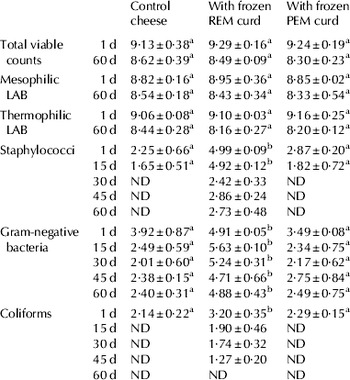
No significant (P < 0·05) differences in total viable counts or in LAB counts were found between REM and PEM curds, because of the predominance of starter LAB in the curd microbiota. However, staphylococci, Gram-negative bacteria and coliforms were at significantly (P < 0·05) higher levels in REM curd (4·60, 3·38 and 1·74 log10 cfu/g respectively) than in PEM curd (1·37, 2·30 and less than 1 log10 cfu/g, respectively).
Experimental curds, made from fresh PCM curd mixed with frozen REM or PEM curd, and control curd, made from PCM and PEM, showed similar total viable counts and LAB counts, with differences not exceeding 0·2 log10 cfu/g. However, staphylococci, Gram-negative bacteria and coliforms reached significantly (P < 0·05) higher levels in the experimental curd containing REM curd (4·91, 5·02 and 3·19 log10 cfu/g, respectively) than in the experimental curd containing PEM curd (2·82, 2·87 and 2·20 log10 cfu/g, respectively) or in the control curd (2·57, 2·71 and 1·94 log10 cfu/g, respectively), because of the higher bacterial contamination of REM curd.
Aminopeptidase activity on Leu-p-NA and Lys-p-NA as substrates reached significantly (P < 0·05) higher values in the experimental curd containing REM curd (7·93 and 7·76 nmol p-nitroaniline per min per g, respectively) than in the experimental curd containing PEM curd (1·76 and 1·58 nmol p-nitroaniline per min per g, respectively) and in the control curd (2·80 and 2·92 nmol p-nitroaniline per min per g, respectively), because of the inactivation of milk enzymes by pasteurization (Grappin & Beuvier, Reference Grappin and Beuvier1997). Similarly, esterase activity reached levels of 1·33, 0·95, and 1·12 pmol of α-naphtol/min per g in the experimental curd containing REM curd, the experimental curd containing PEM curd and the control curd. The experimental curd containing PEM curd showed lower enzymatic activity than control curd, which may be explained by the leakage of enzymes in whey during PEM curd thawing or by changes in the enzymatic activities of starter LAB caused by freezing (Casla et al. Reference Casla, Fontecha, Gómez and Peláez1995).
Microorganisms and enzymatic activity in cheeses
Total viable counts and LAB counts did not differ significantly between cheeses throughout cheese ripening. Mesophilic and thermophilic LAB counts suffered a slight decline, below 1 log10 cfu/g, from day 1 to day 60 (Table 1). Counts of staphylococci, Gram-negative bacteria and coliforms were significantly (P < 0·05) higher in the REM curd cheese than in the rest, a consequence of the high bacterial contamination of REM curd. These contaminants, mostly coming from raw milk, were able to multiply in curd and young cheese even after the injury caused by freezing, and to survive in REM curd cheese throughout ripening, in spite of its low pH values, which kept below 5·00 during the second month (Table 2). Staphylococci were detected from day 30 onwards only in the REM curd cheese, while Gram-negative bacteria persisted in all cheeses until day 60, and coliforms were detected from day 15 onwards only in the REM curd cheese (Table 1).
Microbial counts during ripening of control cheese, made from a mixture (80 : 20) of pasteurized cow and ewe milk, and experimental cheeses, made by mixing (80 : 20) fresh curd from pasteurized cow milk with frozen curd from raw (REM) or pasteurized (PEM) ewe milk

Mean ± SD of duplicate determinations (log10 cfu/g) in two cheese-making trials. ND, not detected
Means in the same row with different superscripts differ significantly (P < 0·05)
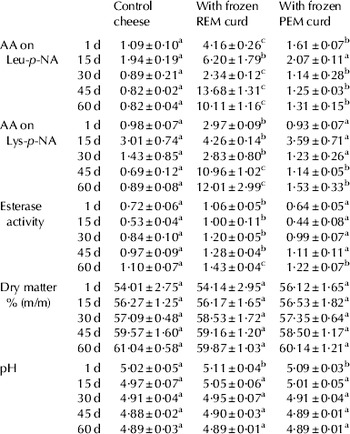
Aminopeptidase activity (AA), esterase activity, dry matter content and pH value during ripening of control cheese, made from a mixture (80 : 20) of pasteurized cow and ewe milk, and experimental cheeses, made by mixing (80 : 20) fresh curd from pasteurized cow milk with frozen curd from raw (REM) or pasteurized (PEM) ewe milk

Mean ± SD of duplicate (enzymatic activities) or triplicate (dry matter, pH) determinations in two cheese-making trials
Aminopeptidase activity is expressed as nmol of p-nitroaniline released per min per g of cheese, and esterase activity as pmol of α-naphtol released per min per g of cheese
Means in the same row with different superscripts differ significantly (P < 0·05)
Aminopeptidase activity was at significantly (P < 0·05) higher levels on day 1 in the REM curd cheese than in the rest (Table 2). Activity increased considerably from day 1 to day 60 (by 2·4 or 4·0 times, depending on the substrate) in this cheese, while in the other cheeses it increased slightly from day 1 to day 15 and declined afterwards. The higher aminopeptidase activity found for the REM curd cheese seems mostly due to REM native enzymes, with a minor contribution attributable to contaminating bacteria because of their low counts, under 6 log10 cfu/g.
Esterase activity also reached significantly (P < 0·05) higher values in the REM curd cheese than in the rest (Table 2). Differences between cheeses were less marked than for aminopeptidase activity, presumably because most of the increase in esterase activity derived from the lysis of starter LAB, which were the same and at similar levels in all the cheeses.
Dry matter content increased gradually during ripening (Table 2), with no significant differences between cheeses, in agreement with previous results (Picon et al. Reference Picon, Alonso, Gaya, Fernández-García, Rodríguez, De Paz and Nuñez2010). Freezing affects cheese microstructure, and the structural changes in casein micelles may influence moisture retention (Alichanidis et al. Reference Alichanidis, Polychroniadou, Tzanetakis and Vafopoulou1981). This did not seem to be the case for our experimental cheeses, probably because only the ewe milk curd, which represented 20% of the total curd, was frozen. Cheese pH values, which were higher (P < 0·05) in experimental cheeses than in control cheese on day 1, did not differ significantly afterwards (Table 2).
Proteolysis
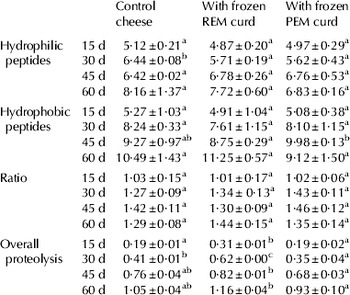
Minor differences for the levels of hydrophilic and hydrophobic peptides and their ratio were found between cheeses (Table 3). Higher levels of hydrophilic peptides had been reported for REM Manchego cheeses than for PEM cheeses (Gaya et al. Reference Gaya, Sánchez, Fernández-García and Nuñez2005). However, the proportion of REM curd in the experimental cheese in the present work was only 20%, and the same starter culture was used for the manufacture of all curds and cheeses, facts which contribute to explain the similar peptide levels. The hydrophobic peptides:hydrophilic peptides ratio correlates well with cheese bitterness (Gómez et al. Reference Gómez, Garde, Gaya, Medina and Nuñez1997). In the present work, it ranged from 1·29 to 1·44 in 60-day-old cheeses while ratios as low as 0·44–0·52 had been recorded for Hispánico cheeses in a previous study (Picon et al. Reference Picon, Alonso, Gaya, Fernández-García, Rodríguez, De Paz and Nuñez2010). The use of a starter culture containing different Lactococcus strains would explain this result, since the specificity for caseins and the formation of hydrophobic peptides by lactococci are strain-dependent traits (Morales et al. Reference Morales, Fernández-García, Gaya, Medina and Nuñez2001).
Hydrophilic and hydrophobic peptides, hydrophobic peptides: hydrophilic peptides ratio, and overall proteolysis during ripening of control cheese, made from a mixture (80 : 20) of pasteurized cow and ewe milk, and experimental cheeses, made by mixing (80 : 20) fresh curd from pasteurized cow milk with frozen curd from raw (REM) or pasteurized (PEM) ewe milk

Mean ± SD of duplicate determinations in two cheese-making trials
Peptides (determined at 280 nm) are expressed as units of chromatogram area per mg of cheese DM, and overall proteolysis as absorbance at 340 nm
Means in the same row with different superscripts differ significantly (P < 0·05)
Overall proteolysis (OPA test) values were significantly (P < 0·05) higher in the REM curd cheese than in the rest (Table 3), most probably because of its high aminopeptidase activity. The higher OPA test values found in the present work with respect to those of a previous study (Picon et al. Reference Picon, Alonso, Gaya, Fernández-García, Rodríguez, De Paz and Nuñez2010) can also be due to the different starter culture.
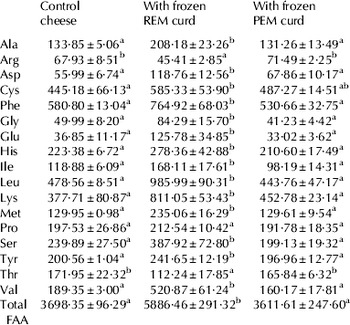
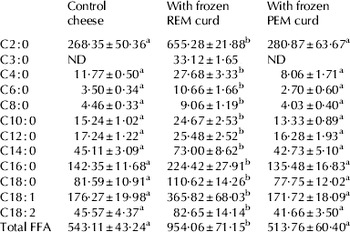
Total FAA concentration on day 30 was 3628 mg/kg of cheese DM for REM curd cheese, a significantly (P < 0·05) higher concentration than the 2397 and 2626 mg/kg found for PEM curd cheese and control cheese, respectively (data not shown). On day 60, total FAA concentration in REM curd cheese was also significantly (P < 0·05) higher than in the rest (Table 4). The same starter cultures were used for the manufacture of all curds and cheeses. Therefore, raw milk enzymes, and to a lesser degree raw milk microbiota, seem to be responsible for the higher FAA concentrations in REM curd cheese. This result is in agreement with the higher concentrations of FAA reported for REM Manchego cheeses in comparison to PEM cheeses (Gaya et al. Reference Gaya, Sánchez, Fernández-García and Nuñez2005).
Free amino acids after 60 d of ripening in control cheese, made from a mixture (80 : 20) of pasteurized cow and ewe milk, and experimental cheeses, made by mixing (80 : 20) fresh curd from pasteurized cow milk with frozen curd from raw (REM) or pasteurized (PEM) ewe milk

Mean ± SD of duplicate determinations in two cheese-making trials
Amino acids are expressed as mg per kg of cheese DM
Means in the same row with different superscripts differ significantly (P < 0·05)
Free fatty acids and volatile compounds
Acetic acid concentration on day 30 was significantly (P < 0·05) higher in the REM curd cheese, 671 mg/kg, than in control cheese, 375 mg/kg, and in the PEM curd cheese, 390 mg/kg (data not shown). Differences between cheeses persisted on day 60 (Table 5). The higher acetic acid content of the REM curd cheese may be explained by the more complex metabolism of raw milk microbiota (McSweeney et al. Reference McSweeney, Fox, Lucey, Jordan and Cogan1993; Morales et al. Reference Morales, Fernández-García, Gaya and Nuñez2003). Acetic acid concentration declined from day 30 to day 60, in particular in control cheese and in the PEM curd cheese, probably because of ester formation. Propionic acid, which may also derive from the metabolism of raw milk microbiota, was not detected on day 30 in any of the cheeses, and on day 60 only in the REM curd cheese (Table 5).
Acetic acid, propionic acid, and free fatty acids (FFA) after 60 d of ripening in control Hispánico cheese, made from a mixture (80 : 20) of pasteurized cow and ewe milk, and experimental cheeses, made by mixing (80 : 20) fresh curd from pasteurized cow milk with frozen curd from raw (REM) or pasteurized (PEM) ewe milk

Mean ± SD of duplicate determinations in two cheese-making trials
Free fatty acids are expressed as mg per kg of cheese. ND, not detected
Means in the same row with different superscripts differ significantly (P < 0·05)
Total FFA reached a concentration of 1237 mg/kg on day 30 in the REM curd cheese, higher (P < 0·05) than in control cheese, 559 mg/kg, and in the PEM curd cheese, 538 mg/kg (data not shown). Significant differences between the REM curd cheese and the rest persisted until the end of ripening. On day 60, total FFA concentration had declined considerably in REM curd cheese (Table 5), a result also ascribable to ester formation.
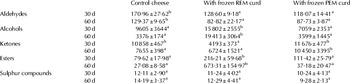
The 68 compounds found in the volatile fraction of cheeses comprised 8 aldehydes, 17 alcohols, 8 ketones, 8 esters, 2 sulphur compounds, 7 hydrocarbons, 8 benzene compounds and 10 miscellaneous compounds. Six compounds (2-propenal, 2-heptanol, 2-nonanol, 2-cyclohexanol, propyl acetate, and propyl butanoate) were detected only in the REM curd cheese. Concentrations of 26 compounds on day 30, and of 28 compounds on day 60, showed significant (P < 0·05) differences between cheeses. Total aldehyde concentration was significantly (P < 0·05) higher in control cheese than in the experimental cheeses (Table 6), with acetaldehyde, the major aldehyde in all cheeses, as responsible for this difference. Total alcohol concentration reached its maximum values (P < 0·05) in the REM curd cheese (Table 6), with ethanol, the major alcohol in all cheeses, and, to a lesser degree, 1-propanol, 2-propanol and 3-methyl-butanol, as the main contributors. Total ketone concentration was higher (P < 0·05) in the PEM curd cheese followed by control cheese (Table 6), a result attributable to 2,3-butanedione and 3-hydroxy-2-butanone, the major ketones in all cheeses. Total esters reached their maximum level (P < 0·05) in the REM curd cheese (Table 6), because of its high concentration of ethyl acetate, propyl acetate and propyl butanoate. No significant differences between cheeses were found for sulphur compounds (Table 6).
Concentrations of the main groups of volatile compounds after 30 and 60 d of ripening in control Hispánico cheese, made from a mixture (80 : 20) of pasteurized cow and ewe milk, and experimental cheeses, made by mixing (80 : 20) fresh curd from pasteurized cow milk with frozen curd from raw (REM) or pasteurized (PEM) ewe milk

Mean ± SD of duplicate determinations in two cheese-making trials
Concentrations of volatile compounds are expressed as relative abundance to the internal standard. Means in the same row with different superscripts differ significantly (P < 0·05)
Freezing of the curd, which alters LAB enzymatic activities (Casla et al. Reference Casla, Fontecha, Gómez and Peláez1995), might have affected the formation of volatile compounds. However, the main factor responsible for the differences observed in the profile of volatile compounds seems to be the use of REM curd in cheese manufacture. Raw milk microbiota (McSweeney et al. Reference McSweeney, Fox, Lucey, Jordan and Cogan1993) and, to a lower extent, the activity of milk enzymes in REM curd, would explain those differences. Wild LAB strains (Gaya et al. Reference Gaya, Babín, Medina and Nuñez1999; Morales et al. Reference Morales, Fernández-García, Gaya and Nuñez2003) and Gram-negative bacteria such as Pseudomonas and Enterobacteriaceae (Morales et al. Reference Morales, Feliú, Fernández-García and Nuñez2004, Reference Morales, Fernández-García and Nuñez2005) present in REM are capable of producing different volatile compounds, or different amounts of volatile compounds, than LAB included in commercial starter cultures, thus conferring particular characteristics to raw milk cheeses. The higher levels of alcohols and esters in REM curd cheeses, and their lower levels of aldehydes and ketones, are in agreement with the respective concentrations of these groups of volatile compounds in Cheddar (Rehman et al. Reference Rehman, Banks, Brechany, Muir, McSweeney and Fox2000a) and Manchego cheeses (Fernández-García et al. Reference Fernández-García, Carbonell and Nuñez2002) made from raw and pasteurized milk.
Textural and sensory characteristics
Fracturability, firmness and elasticity generally reached similar values in experimental and control cheeses (data not shown). This result can be explained by the fact that dry matter content, a variable greatly influencing cheese texture, did not differ significantly between control and experimental cheeses. The gradual increase recorded for the three textural parameters throughout ripening can be associated with moisture loss.
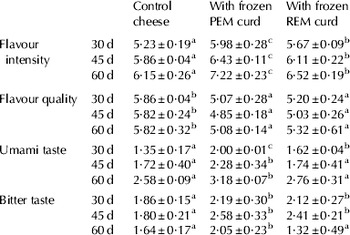
On the one hand, REM curd cheese showed the highest (P < 0·05) flavour intensity scores at all sampling times, followed by PEM curd cheese (Table 7). The higher concentrations of FAA, FFA, alcohols and esters in REM curd cheese can explain its more pronounced flavour, while ketones, due to their higher concentration in PEM cheese, appear as the only group of compounds responsible for enhancing its flavour intensity. On the other hand, the highest flavour quality scores were recorded for control cheese, probably due to its higher concentrations of carbonyl compounds. Flavour and aroma compounds generated by REM microbiota and enzymes apparently resulted in a more potent flavour profile, which was not evaluated positively by panellists. According to Fernández-García et al. (Reference Fernández-García, Carbonell and Nuñez2002), an equilibrated amount of diacetyl, branched-chain alcohols and esters seemed to result in a better acceptance of REM Manchego cheeses, but an excess of any of those compounds caused a decrease in flavour quality. When Cheddar cheese was manufactured from raw milk, pasteurized milk, or blends containing 1, 5 or 10% raw milk and ripened for 2 months, the cheeses made from pasteurized milk or from the blend containing 1% raw milk received the highest flavour score, whereas after 4 months of ripening the cheese made from the blend containing 1% raw milk was awarded the highest flavour score, followed by cheeses made from the other two blends (Rehman et al. Reference Rehman, McSweeney, Banks, Brechany, Muir and Fox2000b). In the present work, we observed that the use of 20% frozen REM curd in cheese manufacture negatively influenced flavour quality, and that the effect of 20% frozen PEM curd was similar (Table 7). An unbalanced profile of flavour compounds seems the most plausible explanation for the lower flavour quality of experimental cheeses, which in the particular case of PEM curd cheese appears as ascribable to its ketone levels. Flavour intensity increased during ripening in all cheeses, while flavour quality remained fairly constant. Umami taste reached the highest (P < 0·05) scores in REM curd cheese, a result in agreement with its high FAA concentration. Differences in bitterness scores were less marked, the lowest values being generally found for control cheese.
Sensory characteristics during ripening of control Hispánico cheese, made from a mixture (80 : 20) of pasteurized cow and ewe milk, and experimental cheeses, made by mixing (80 : 20) fresh curd from pasteurized cow milk with frozen curd from raw (REM) or pasteurized (PEM) ewe milk

Mean ± SD of two cheese-making experiments, evaluated by 15 trained panellists on a 0–10 point scale
Means in the same row with different superscripts differ significantly (P < 0·05)
Conclusions
The REM curd cheese showed higher counts of staphylococci, Gram-negative bacteria and coliforms throughout ripening than control cheese and PEM curd cheese. The concentrations of FAA, FFA and some volatile compounds, namely alcohols and esters, were higher in the REM curd cheese than in the rest, and were plausibly involved in its more pronounced flavour intensity. However, REM curd cheese and PEM curd cheese obtained lower flavour quality scores than control cheese, most probably because of an unbalance in the levels of flavour-related compounds. The use of frozen REM curd in cheese manufacture appears as a feasible procedure to surmount the seasonality in ewe milk production while enhancing cheese flavour intensity. However, risks inherent to the presence of undesirable microbial contaminants, including the possibility of a negative effect on cheese flavour quality, must be taken into consideration.
The authors acknowledge funding by project AGL 2004-06051 (Spanish Ministry of Science and Innovation), and thank Buenaventura Rodríguez and Máximo de Paz for their valuable technical assistance. R. Alonso was supported by an INIA predoctoral fellowship.