INTRODUCTION
Standard sweetcorn (Zea mays L.), grown in temperate areas, is homozygous for the mutant sugary1 (su1) gene, while what is known as super-sweet maize is homozygous for shrunken2 (sh2) (Tracy Reference Tracy1997, Reference Tracy and Hallauer2001). Super-sweet hybrids have a longer-post harvest life and, therefore, maintain their eating quality longer after harvest than standard sweet hybrids (Marshall & Tracy Reference Marshall, Tracy, White and Johnson2003). However, diverse studies have shown that super-sweet hybrids and inbreds have lower proportions of emergence and lower early seedling vigour, particularly in cold conditions, than standard sweet hybrids or inbreds (Douglass et al. Reference Douglass, Juvik and Splittstoesser1993; Azanza et al. Reference Azanza, Bar-Zur and Juvik1996; Hassell et al. Reference Hassell, Dufault and Phillips2003), but, because the mutants in these studies are not located in the same genetic background, the effects of the mutants and the genetic background are confounded. Young et al. (Reference Young, Juvik and Demason1997) and Zan & Brewbaker (Reference Zan and Brewbaker1999), using isogenic lines and hybrids, have shown that the mutant su1 have, effectively, a positive effect on emergence when compared to sh2, both under optimum conditions in the field and under cold conditions in a chamber. However, the conclusions of those two studies cannot be generalized to situations where seeds and seedlings are suffering from cold in the field, given the low correlation between data from optimum and cold conditions or between data from cold tests and from field experiments (Waters & Blanchette Reference Waters and Blanchette1983; Ordas et al. Reference Ordas, Padilla, Malvar, Ordas, Rodriguez and Revilla2006), but see Ali et al. (Reference Ali, Naylor and Matthews2006). The genetic background also plays an important role in the emergence and early seedling vigour of super-sweet maize, as indicated by a successful breeding programme for improving these traits (Tracy & Juvik Reference Tracy and Juvik1988).
In areas with cool and humid springs and relatively short summers such as, for instance, Atlantic Europe, Canada and some areas of the US Corn Belt, the cultivation of super-sweet maize hybrids is limited by their reduced emergence and poor early seedling vigour. Breeding standard sweetcorn for adaptation to early sowing or to cold conditions has been successful by using the same methods as for the other types of maize (Tracy Reference Tracy and Hallauer2001; Revilla et al. Reference Revilla, Butron, Cartea, Malvar, Ordas, Ashraf and Harris2005).
With standard sweetcorn the works of Hotchkiss et al. (Reference Hotchkiss, Revilla and Tracy1997) and Revilla et al. (Reference Revilla, Butron, Cartea, Malvar, Ordas, Ashraf and Harris2005), demonstrating the existence of sources of adaptation to cold conditions, and the genetic study of Revilla et al. (Reference Revilla, Hotchkiss and Tracy2003), showing the significance of the general combining ability (GCA) for cold tolerance traits, indicate that favourable genes for adaptation are present in the genetic background of standard sweetcorn. Adapted standard sweetcorn could be useful for improving the adaptation of super-sweet maize if the genes that confer adaptation when combined with su1 are also favourable when combined with sh2. On the other hand, if the favourable genes for adaptation have different effects when combined with su1 than when combined with sh2, the knowledge of the cold tolerance of the standard sweetcorn genotypes cannot be useful for improving super-sweet maize and the conversion of su1 genotypes to sh2 will give unpredictable results. As pointed out by Monneveux et al. (Reference Monneveux, Sanchez and Tiessen2008), the choice of parental lines is critical in the further development of tolerant hybrids. Therefore, the objective of the present work is, by means of near-isogenic inbred lines, to determine if the replacement of su1 by sh2 alters the combining abilities of sweetcorn inbreds for adaptation to planting under cold conditions.
MATERIALS AND METHODS
The near-isogenic set of sugary1 and shrunken2 inbred lines 101t, C23, C40, Ia453 and P39 (Soberalske & Andrew Reference Soberalske and Andrew1978) were used. The five su1 and sh2 inbreds were crossed in two independent diallel designs without reciprocals in 2004, in Pontevedra (42°24′N, 8°38′W, 20 m asl), northwestern Spain. The crosses of the two diallels were made in the same experimental field and the rows with the su1 inbreds were placed adjacent to the rows with the sh2 inbreds. The seed of the two diallels was harvested, cleaned and stored under the same conditions. To evaluate the adaptation to cold conditions of the genotypes, a cold chamber with controlled temperature conditions was used. In addition, the genotypes were evaluated in early sowings in the field.
The 20 m3 cold chamber had three shelves, 0·5 m apart. Conditions were set at 14 h with light (provided by seven very high output (VHO) fluorescent lamps with a photosynthetic photon flux (PPF) of 228 μmol/m2/s) at 14°C, and 10 h without light at 8°C. Both diallel sets (su1 and sh2) were evaluated in two adjacent experiments, each experiment following a randomized complete block design with three replications (one replication on each shelf). In the growth chamber, the evaluation was carried out for a period of 30 days. Genotypes were planted in 21 litre trays filled with 12 litres of sterilized and watered peat (Gramoflor GmbH & Co. KG, Vechta, Germany). Sowing depth was 20 mm and seeds were planted in rows spaced 50 mm apart with 20 mm between seeds. All trays were watered again with 2·5 litres of water 20 days after planting, which was enough to keep the plants turgid. Adaptation to cold conditions was assessed by the proportion of emergence and an early seedling vigour score. The estimation of early seedling vigour takes into account size, colour and canopy development approximately 1 month after planting, using a scale from 1 (weak plants) to 9 (vigorous plants), where 5 represents the average plant development of the experiment, following Revilla et al. (Reference Revilla, Butron, Malvar and Ordas1999).
Planting of the hybrids and inbred parents in the field was made in two sites at Pontevedra. In each site, the su1 and the sh2 diallels were evaluated in adjacent experiments bordered by several rows of su1 or sh2 plants, depending on the mutant carried by the genotypes. This design was chosen because it allows for better separation of mutants and makes pollen contamination (which, given the recessive nature of the mutants, would affect some of the traits, particularly grain moisture) more difficult. The dates of planting were 12 and 18 May 2005, for the experiments in the first and second site, respectively. Prior to sowing, the field had pH=5·3 and 75 g organic matter/kg at the first site and pH=6·4 and 61 g organic matter/kg at the second site. During the 10 days following sowing, the first site received 198 litres of rain/m2 with maximum temperatures of 17–20°C and minimum temperatures of 6–12°C, while the second site received 12 litres of rain/m2, with maximum temperatures of 19–25°C and minimum temperatures of 6–10°C. The field experiments followed a randomized complete block design with three replications. Each plot consisted of two rows with 17 plants per row. Plants were spaced 0·21 m apart and rows were 0·80 m apart, corresponding to a density of c. 60 000 plants/ha. Hills were over-planted and thinned after emergence to achieve the desired plant density. The traits measured were: proportion of emergence, early seedling vigour (visual scale from 1 to 9, as previously explained), plant height, days to silking, grain moisture (g/kg), ear length, ear rows and ear visual appearance (visual scale from 1 to 9, where 1 was the score of the poorest ears, 5 was the score of the average ears in the trial and 9 was the score of excellent ears). The scores were assessed following the usual criteria of the fresh market as stated by Marshall & Tracy (Reference Marshall, Tracy, White and Johnson2003).
Analyses of variance were performed for each trait using PROC MIXED of SAS (SAS Institute 2005). Sources of variation included experiments, replications within experiments, mutants (su1 and sh2), genotypes (the inbred lines 101t, C23, C40, Ia453 and P39) and the appropriate interactions. All sources of variation, except mutants, genotypes and their interaction, were considered random. When differences between hybrids were significant, general and specific combining ability (GCA and SCA, respectively) analyses were made according to Model I, Method 4 of Griffing (Reference Griffing1956) for su1 and sh2 hybrids, separately. The analyses of the diallel designs followed the methods described by Zhang et al. (Reference Zhang, Kang and Lamkey2005).
RESULTS
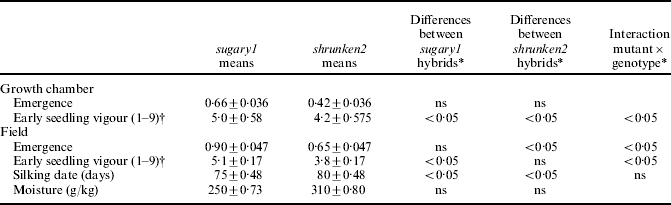
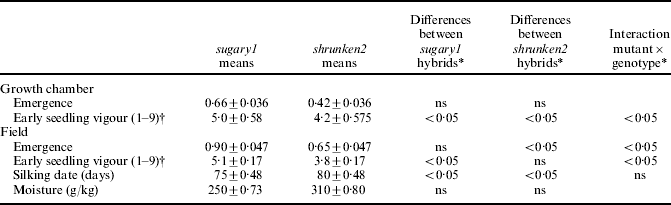
Super-sweet maize hybrids had, on average, 25% lower emergence than the standard sweetcorn hybrids both in the laboratory cold test and in early field plantings (Table 1). Early seedling vigour was also negatively affected in the sh2 hybrids compared to the su1, but not in the laboratory cold test. The sh2 hybrids had higher kernel moisture at harvest.
Means±s.e. of sugary1 and shrunken2 hybrids for several traits from two diallels of su1 and sh2 inbred lines of sweetcorn grown in a cold chamber and in early sowing at the field
* ns, not significantly different from zero, according to an F test (for details see Materials and Methods).
† Visual scale for early seedling vigour from 1 (weak plants) to 9 (vigorous plants).
There were significant differences between the standard sweetcorn hybrids and between the super-sweet maize hybrids in their early vigour evaluated in cold chamber and silking date (Table 1). However, there were no significant differences between the standard sweetcorn hybrids and between the super-sweet maize hybrids for emergence evaluated in the cold chamber and grain moisture. In the early planting, there were significant differences in emergence between sh2 hybrids, but not between su1 hybrids. The opposite was true for early seedling vigour. For these traits and also for early seedling vigour evaluated in the cold chamber, there was a significant mutant×genotype interaction (Table 1). The Spearman correlation coefficients (r s) for these traits between the su1 hybrids and the same hybrids converted to sh2 were not significant (0·03<r s<0·31 and 0·45<P<0·94).
There was no significant mutant×genotype interaction for silking date (Table 1) and no significant correlation between the su1 hybrids and the same hybrids converted to sh2 (r s=0·58 and P=0·08). For other traits not directly related to adaptation such as plant height, ear visual appearance, ear length and row number, there were no significant differences between the su1 and the sh2 hybrids and there was no mutant×genotype interaction (data not shown).
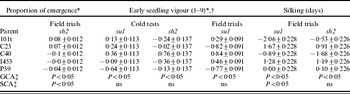
Analysis of the diallels for early vigour in the cold chamber showed that although GCA was significant in both diallels, the estimates of GCA of each version of the same inbred were different (Table 2). The estimates of GCA for silking date of each version of the same inbred were relatively similar.
GCAs±s.d. for several traits related to adaptation evaluated in early planting and cold test for the parents of two diallels of su1 and sh2 inbred lines of sweetcorn

* For those cases where the differences between hybrids were not significant, the GCA of the parents and the mean squares associated with GCA and SCA were not calculated because they also were not significant.
† Visual scale for early seedling vigour from 1 (weak plants) to 9 (vigorous plants).
‡ ns, not significant mean squares associated with GCA and SCA in the analysis of Model I, Method 4 of Griffing (Reference Griffing1956).
DISCUSSION
Emergence and early seedling vigour are affected by genetic factors, both at planting and during seed production (Tracy Reference Tracy and Hallauer2001). The present data confirm the negative effect of the sh2 allele on germination and early seedling vigour in cold conditions compared to the su1 allele (Zan & Brewbaker Reference Zan and Brewbaker1999). Because sh2 confers longer eating quality after harvest than su1, other genes that increase the adaptation of the genotypes when they are in combination with sh2, without decreasing the longer eating quality after harvest of the super-sweet hybrids are of interest. There were significant differences in emergence, early seedling vigour and silking date between the standard sweetcorn hybrids and between the super-sweet maize hybrids when they were evaluated in the cold chamber or by early planting. Therefore, in the expression of these traits, genes other than su1 and sh2 might play an important role. However, genes other than su1 and sh2 do not seem to play an important role for grain moisture, at least in the inbreds used in the present study, given that significant differences between hybrids within each mutant were not detected.
In general, differences between hybrids depend on the GCA and SCA of the parental lines. In turn, GCA and SCA depend on the additive and dominance effects of the genes whose alleles varied between the parental lines of the hybrids and on epistatic effects. In both the su1 and the sh2 diallels, the genes that have different alleles in the parental lines of the hybrids are the same because of its isogenic nature. Thus, in the absence of epistasis or interactions during seed production, similar differences would be expected between hybrids, with similar mean squares associated with GCA and SCA, and similar GCA values of the parental lines in both diallels. In the absence of epistasis, a positive correlation would also be expected between the su1 hybrids and the same hybrids converted to sh2, and no mutant×genotype interaction. In the present data, the differences between hybrids, the mutant×genotype interactions, the correlations between versions of the hybrids and the values of GCA suggest that epistatic interactions between the su1 and sh2 and other genes might be important for traits related to adaptation as emergence or early vigour. Zan & Brewbaker (Reference Zan and Brewbaker1999) also found significant differences in emergence between super-sweet hybrids, but no significant differences between standard sweet hybrids in the analysis of two diallels with isogenic hybrids for su1 and sh2. Revilla et al. (Reference Revilla, Malvar, Abuin, Ordas, Soengas and Ordas2000, Reference Revilla, Malvar, Rodriguez, Butron, Ordas and Ordas2006) found that the seed viability (a trait related to germination) of each mutant depends on the genetic background. From a practical point of view, the present results indicate that the knowledge of the cold tolerance of the standard sweetcorn genotypes cannot be useful for improving super-sweet maize and that the conversion of su1 genotypes to sh2 will give unpredictable results, independently of the adaptation of the su1 genotypes.
The lack of significant mutant×genotype interaction in silking date suggests that epistasis of su1 and sh2 with other genes is not important. There is also a positive relationship between the su1 hybrids and the same hybrids converted to sh2. Alonso Ferro et al. (Reference Alonso Ferro, Malvar, Revilla, Ordas, Castro and Moreno-Gonzalez2008) have also found that epistatic effects are not important for agronomic and quality traits in hard endosperm maize. Thus, the present data suggest the earliest su1 hybrids tend also to be the earliest when converted to sh2. Furthermore, because the estimates of GCA for silking date of each version of the same inbred were relatively similar, the knowledge of the GCA of the su1 inbreds could be useful to improve the sh2 inbreds. Early flowering genotypes have several advantages. It is possible to adapt the growing cycle of the plant to more favourable climatic conditions either during the earlier stages or during maturation, which is particularly critical in areas with cool and humid springs and relatively short summers. In addition, by reducing the days to silking, the moisture at harvest can be reduced (Ordas et al. Reference Ordas, Santiago, Malvar and Vales1996). This is advantageous because seed drying is costly and time-consuming (Tracy Reference Tracy and Hallauer2001). Finally, with earlier genotypes it is possible to spread the harvesting season to meet consumer demand.
The traits not directly related to adaptation (plant height, ear visual appearance, ear length and row .number) are not expected to change when the su1 inbreds are converted to sh2 because there were no differences between the su1 and the sh2 hybrids and there was no mutant×genotype interaction.
The main conclusion from the present work is that, for most of the traits related to adaptation, the estimates of GCA of each version of the same inbred were different, probably due to epistasis, making the knowledge of the GCA of the su1 inbreds of no use for improving the sh2 inbreds. However, for silking date, the estimates of GCA of each version of the same inbred were similar. Therefore, to widen the genetic base of the super-sweet germplasm for adaptation, it is proposed to convert the earliest su1 inbreds to sh2; the choice of su1 inbreds to convert could be made without consideration of other characteristics such as emergence or early vigour in laboratory cold tests or early field plantings.