



1. Introduction
OB supergiants are hot, luminous, and evolved massive stars
 $(M\gt8M_{\odot})$
that possess strong winds that expel matter from the surface of the star. These outflows are launched due to the high radiative acceleration of free electrons and the so-called “line-driving” (Lucy and Solomon Reference Lucy and Solomon1970; Castor et al. Reference Castor, Abbott and Klein1975), which overtakes the force of gravity, causing the atmosphere to expand beyond the bounds of the photosphere.
Line-driving suggests that the momentum driving the winds of massive stars is transferred via spectral lines. Therefore, the metal content of a star Z plays an important role in determining the properties of the winds (Abbott Reference Abbott1982). This stems from the complex atomic structure of metals, which leads to a large number of line transitions in their ions.
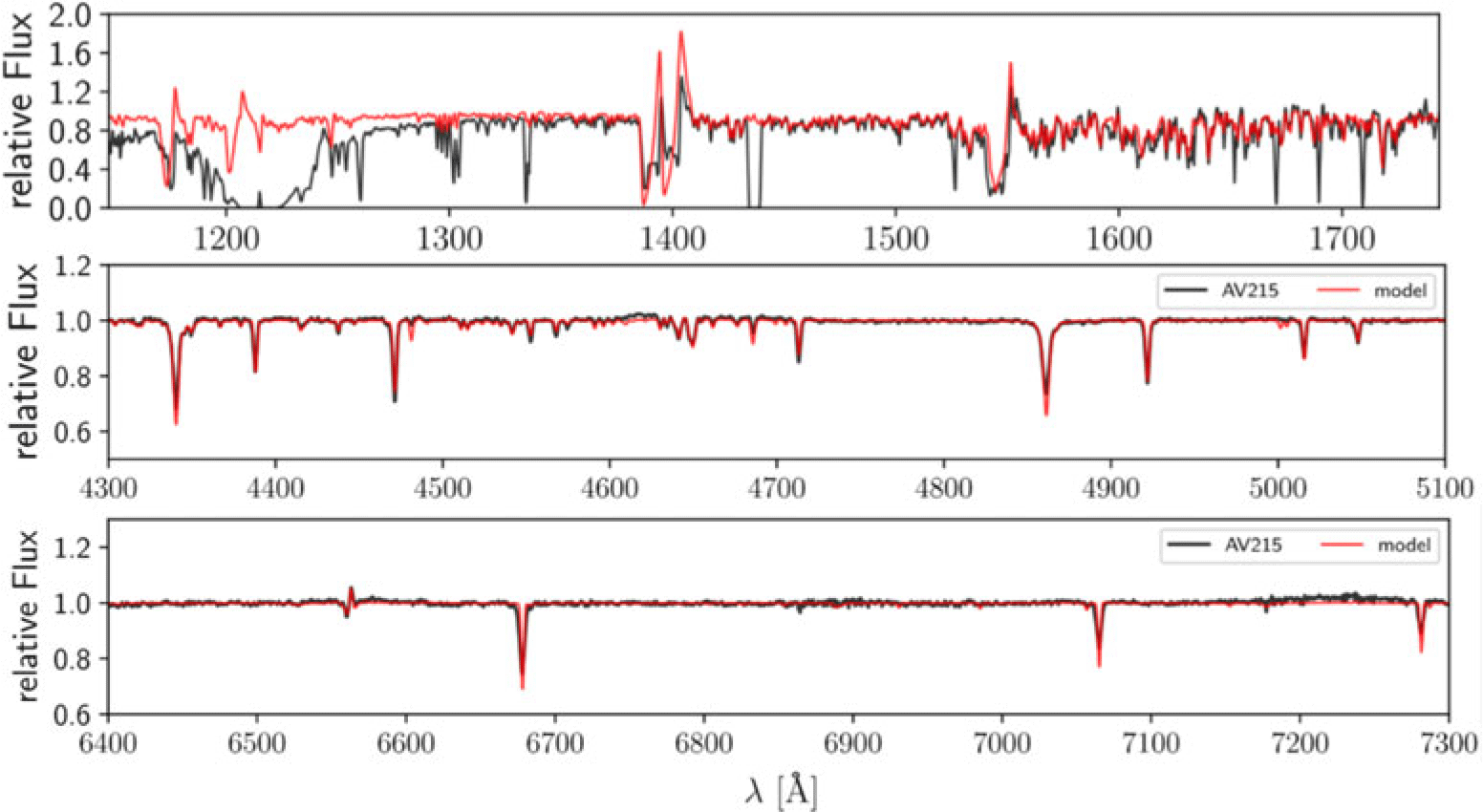
To investigate the effect of Z on wind properties, we derive stellar and wind properties of our SMC and LMC samples that span the same spectral-type range. We employ the 1D non-local thermal equilibrium radiative transfer model CMFGEN (Hillier Reference Hillier1990; Hillier and Miller Reference Hillier and Miller1998, see Fig. 1) in our analysis. We used CMFGEN in a grid-based and a subsequent fine-tuned UV and optical spectroscopic fitting procedure that allowed us to determine the stellar and wind parameters of each star (Alkousa et al. Reference Alkousa, Crowther and Bestenlehner2025). We then explore the dependence of mass loss and wind velocity on metallicity by comparing the derived parameters of the SMC sample to those of the LMC counterpart.
UV and optical fit of AzV 215. The observed spectrum is presented by the black solid line, and the preferred model is the red solid line.

Figure 1 Long description
Panel A: A line graph displays relative flux versus wavelength (λ) in angstroms (A) ranging from 1100 to 1800. The black line represents the observed spectrum, and the red line represents the model. The graph shows fluctuations in relative flux with notable peaks and troughs. Panel B: Another line graph shows relative flux versus wavelength (λ) in angstroms (A) ranging from 4300 to 5100. The black line represents the observed spectrum, and the red line represents the model. The graph shows several distinct absorption lines. Panel C: A third line graph displays relative flux versus wavelength (λ) in angstroms (A) ranging from 6400 to 7300. The black line represents the observed spectrum, and the red line represents the model. The graph shows fewer fluctuations compared to the other panels, with a few notable absorption lines.
2. Sample
The ultraviolet data used in this study are a subsample of the Hubble Space Telescope Ultraviolet Legacy Library of Young Stars as Essential Standards ULLYSES (Vink et al. Reference Vink, Mehner and Crowther2023; Roman-Duval et al. Reference Roman-Duval, Fischer and Fullerton2025). The optical spectroscopy is extracted from the XShootU complementary library of moderate resolution optical and NIR spectroscopy (Sana et al. Reference Sana, Tramper and Abdul-Masih2024). Additionally, we use high-resolution optical Magellan/MIKE data to extract the rotation properties of a subsample of our stars and consider the variability of H
 $\alpha$
.
We selected 20 SMC and 16 LMC late-O and B supergiants from the ULLYSES sample. Our sample spans a wide range of spectral types, from O9 to B8. For each spectral-type bin, we include one of each of the luminosity classes Ia
 $^+$
, Ia, Iab, and Ib.
3. Results
By obtaining satisfactory fits to the UV and optical spectra, we derive stellar properties that are consistent with a sample of evolved supergiants. We find that most of our stars sit between the zero-age main sequence (ZAMS) and the terminal age main sequence (TAMS). According to the rotating evolutionary models of Brott et al. (Reference Brott, de Mink and Cantiello2011), the position of some stars on the Hertzsprung-Russell diagram (HRD) suggests that they are post-TAMS stars. We find that all stars in our sample show an enhanced helium mass fraction at the expense of hydrogen and CNO-processed abundances compared to baseline SMC and LMC abundances.
We obtain evolutionary masses
 $M_{\rm evo}$
and ages from an updated Bayesian inference technique similar to BONNSAI (Schneider et al. Reference Schneider, Langer and de Koter2014), applied to SMC and LMC rotating evolutionary models from Brott et al. (Reference Brott, de Mink and Cantiello2011). We find a significant discrepancy between the
 $M_{\rm evo}$
and the spectroscopically determined mass
 $M_{\rm spec}$
in 40% of the SMC sample and 25% of the LMC sample
 $(M_{\rm evo} \gt M_{\rm spec})$
.
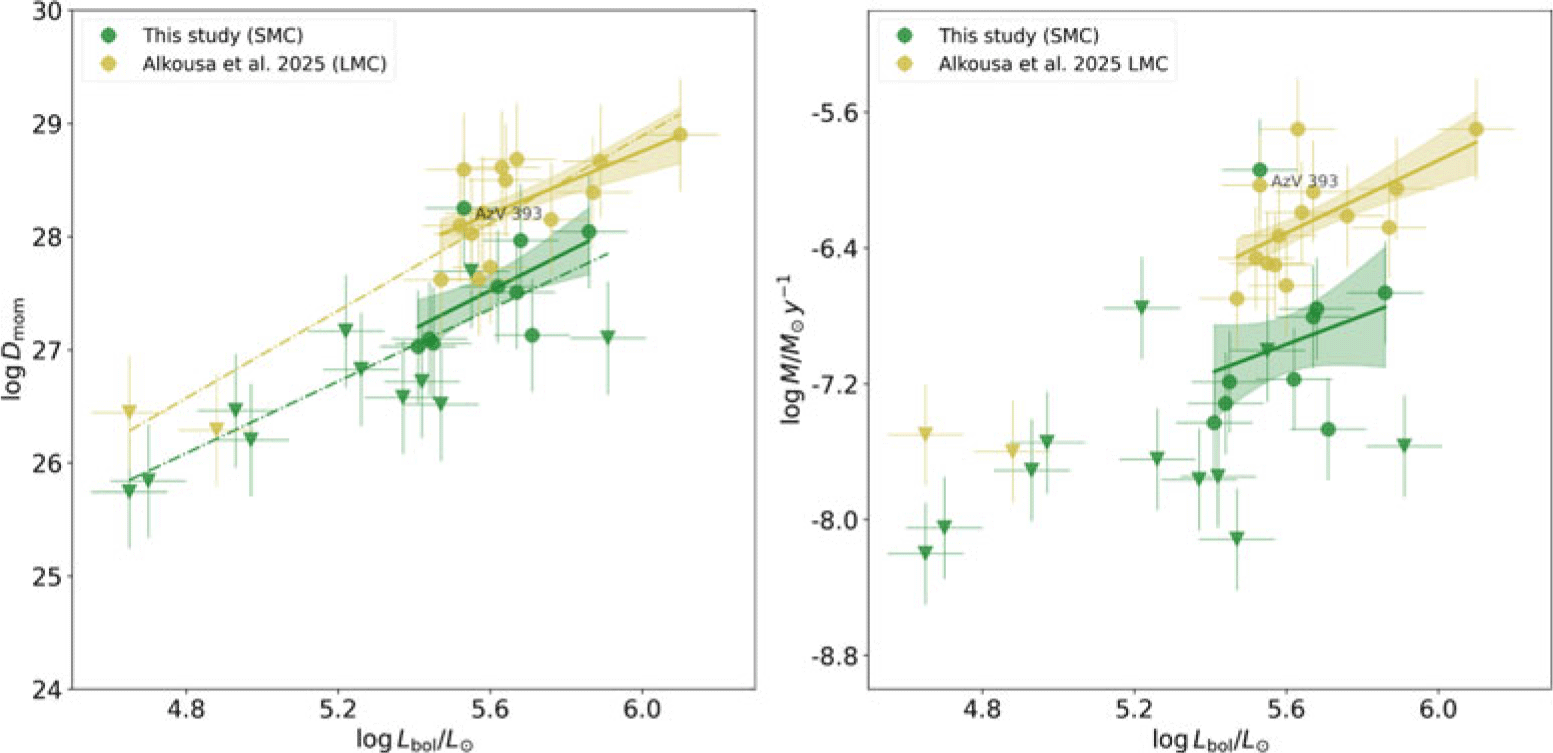
By comparing the results from the SMC and LMC samples, we find a clear Z-dependence in the modified wind momentum, which is shown in Fig. 2. Following the formulation of Krtička and Kubát (Reference Krtička and Kubát2018), we derive a Z-dependent momentum-luminosity relation of the form
 \begin{equation} \log{D_{\rm mom}} = (1.16-0.75\log{\frac{Z}{Z_{\odot}}}) \log{\frac{L_{\rm bol}}{10^{6}L_{\odot}}} + 1.38 \log{\frac{Z}{Z_{\odot}}} + 29.17.\end{equation}
We also find a clear Z-dependence in mass-loss rates (see the right panel of Fig. 2), but do not find a similar Z-dependence in the terminal wind velocities.
Left panel: Modified wind momentum vs. luminosity. Right panel: Mass-loss rate vs. luminosity. Circles indicate stars with reliable wind parameters from H
 $\alpha$
emission and UV P Cygni profiles. Triangles indicate stars that lack wind diagnostics and therefore have less reliable wind parameters

We find that the derived mass-loss rates of SMC supergiants exceeding the Humphreys-Davidson limit,
 $\log{(L_{\rm bol}/L_{\odot})} = 5.5$
(Davies et al. Reference Davies, Crowther and Beasor2018), are insufficient to remove their hydrogen-rich outer envelopes. Consequently, the substantial proportion of apparently single WR stars observed in the SMC (Shenar et al. Reference Shenar, Gilkis, Vink, Sana and Sander2020) cannot be reconciled with the classical single-star evolutionary scenario, unless these supergiants are capable of expelling an extraordinary amount of mass within their remaining lifetime. This implies that an intermediate luminous blue variable phase, characterised by extreme episodic outbursts and enhanced mass loss, may be required for such stars to evolve into the WR stage.
Acknowledgments
TA would like to thank the Science and Technology Facilities Council (STFC) for financial support through the STFC scholarship ST/X508743/1.
 α


