1. Introduction
In the summer of 2010, soundscape and acoustic communication scholars gathered in Koli, Finland to attend a conference on Ideologies and Ethics in Uses and Abuses of Sound. When delegates scrutinised the term ‘soundscape’ and its uses, a very clear consensus emerged: it is impossible to discuss the interpretation and researching of the acoustic environment without appropriate terminology. They agreed on the necessity not only of introducing people to the term soundscape, but also of making them aware of sound as part of their daily lives and culture.
Consciousness of environmental sounds affects the way in which individuals and communities construct their surroundings. People living within a soundscape not only interpret what they hear but also construct their acoustic environments according what they are doing – whether or not they are paying conscious attention to it. This holds true for news media as well: it seldom pays attention to environmental sounds unless they become a disturbing problem within the soundscape. People therefore have a reactive relationship with disturbing sounds when the relationship could be a proactive one: an understanding of the importance of sounds in everyday life and the cultural meanings related to them helps one to act so that specific elements of the soundscape (i.e. noise) will not become dominant.
Pascal Amphoux, a Swiss-French researcher of the sonic environment, states that politicians and urban planners tend to diagnose the bad qualities – diagnostiquer le mal – and combat them by building noise barriers and insulating people from noise. He proposes the opposite: one should try to diagnose the good qualities – diagnostiquer le bien – in order to investigate and promote favourable urban sound space conditions (Amphoux Reference Amphoux1993: 6; Hellström Reference Hellström2003: 11).
Possible inconveniences and problems in the sonic environment could be avoided by paying more heightened attention to the importance of sounds as a source of wellbeing for individuals and the community, instead of concentrating on sound only as disturbance and unwanted noise (Uimonen Reference Uimonen2008: 15).
With this point in mind, the article proposes a recorded listening walk method applicable to the research of acoustic communication, in soundscape courses and lessons and in encouraging people to pay attention to their sonic environments with the help of recording equipment. The theoretical background of the work is based on the ideas of sound anthropologists and composers about soundscape perception: research should be carried out not just on sound but also in sound, making something out of sound and not just writing about it. This is supported by the idea that people engaged in recording become more involved with or absorbed in the sonic environment than they are in their daily lives. If community members are asked to record and edit sounds, they are also asked to listen to their environments in more detail. This practice enables researchers to document and edit sounds in cooperation with those who live within the soundscape being studied (Feld and Brenneis Reference Feld and Brenneis2004: 437).
In practice, this research can be achieved using the Internet and affordable recording technology. The recorded listening walk method encompasses not only the recording of sounds, but also editing and discussion. The desired result is not a hi-fi recording but the act of recording itself: listening to environmental sounds and documenting the thoughts they evoke. The method has possible merit as a tool for environmental planning – as the communication scholar Andra McCartney (forthcoming) puts it, ‘If someone plans [sound] walks in their own neighbourhood, this can facilitate a focus on local concerns and politics’.
The paper starts with an explanation of the theory of acoustic communication, on which I base my proposals, and the concepts of soundscape competence and acoustemology. Next, I concentrate on the relationship between recording and listening to the acoustic environment before introducing the methods relevant to this study. After presenting the detailed research questions, I evaluate the success of my application of the theoretical framework of acoustic communication and to empirical research.
2. Acoustic communication and acoustemological approach
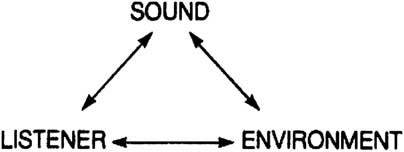
Acoustic communication is concerned with the exchange of sonic information and the cognitive processes that enable it to be understood. The approach concentrates on the triangular relationship between sound, listener and environment. Accordingly, acoustic community stands for ‘any soundscape in which acoustic information plays a pervasive role in the lives of the inhabitants (no matter how the commonality of such people is understood)’ (Truax Reference Truax2001a: 11–12). Those living within an acoustic community not only receive sonic information passively but also construct a soundscape through their activities. The model for acoustic communication shows how sound, listener and environment are interactive and intertwined (Figure 1).
The mediating relationship of listener to environment through sound (Truax Reference Truax2001a: 12).

Quantitative sonic measurement was invented in the 1920s (Thompson Reference Thompson2002: 148) to provide data for the analysis of acoustic environments. However, the meanings attached to sounds are as old as humanity, so qualitative aspects of sounds must be included in the research. Although some of the everyday sounds go unnoticed, sounds always mean something to their listeners; always have and always will. Research into acoustic communication therefore concentrates not only on the physical and acoustical properties of environmental sounds but also on social and cultural contexts.
Soundscape competence, according to the professor of acoustic communication Barry Truax, is ‘tacit knowledge that people have about the structure of environmental sounds, knowledge that manifests itself in behaviour that interprets such sound and acts upon it’ (Truax Reference Truax2001a: 57–8). Soundscape competence allows us to understand environmental sounds as meaningful. Drawing on this, the geographer Christopher Smith distinguishes between general and specific soundscape competences in his research on neighbourhoods of the City of Vancouver, with the former referring to general knowledge of the residential area and the latter to special knowledge and the meanings of certain sounds. Both competences were used by the residents (Smith Reference Smith1993: 401–2).
The theory of acoustic communication strongly resonates with sound anthropologist Steven Feld's notions of the relationship connecting sound, place and listening. Feld uses the term acoustemology (Reference Feld1996: 97) to refer to an exploration of the sonic sensibilities – how sound sensations, experiences and memories construct place. According to Feld, ‘the experience of place potentially can always be grounded in an acoustic dimension’. When the model of acoustic communication includes the communal and personal relationship to soundscape, Feld stresses that experience and memories are related to sounds and places.
Urban planners and scholars of sound research Jean-François Augoyard and Henri Torgue consider that, when examining the relationship between urban sounds and spaces, one should pay attention to the fact that no sound event can be isolated from the spatial and temporal conditions of its physical signal propagation. They also assert that sound is shaped subjectively by the auditory capacity, attitude, psychology and culture of the listener. There is no such thing as a universal approach to listening; every individual, every group and every culture listens in its own way (Augoyard and Torgue Reference Augoyard and Torgue2008: 4).
According to Feld, soundscape should be recorded and analysed in collaboration with the members of the community under study (Feld and Brenneis Reference Feld and Brenneis2004: 467). He also contemplated the role of the recording technology in recording events, and highlights the unique auditory capabilities of humans compared to the equipment used for electroacoustical documentation. ‘Microphones are to ears what camera lenses are to eyes, reductive technological devices that imitate human sensory apparatus by performing specific ranges of limited function from which perceivers then recreate fuller perceptual cues’ (Feld Reference Feld1994: 282).
This idea concurs with Le Corbusier's notions about the differences between photography and drawing: ‘The camera is a tool for idlers, who use a machine to do their seeing for them. To draw oneself, to trace the lines, handle the volumes, organise the surface… all this means first to look, and then to observe and finally perhaps to discover’ (Kortan Reference Kortan2005: 28).
During a recording event, recordists observe sounds analytically, instead of interpreting and reacting to them in their everyday surroundings: instead of hearing, the recordist is listening. The difference between these two ways of relating to the sonic environment is that ‘hearing can be regarded as a somewhat passive ability that seems to work with or without conscious effort’ unlike listening, which ‘implies an active role involving different level of attention’ (see Truax Reference Truax2001a: 18).
To make a recording lasting just a few minutes requires that the recordist remains silent while sounds are listened to and documented. The Canadian soundscape composer Hildegard Westerkamp has stated that encouraging people to record also encourages them to listen, as recordists are more intensely involved in the everyday sonic environment (Westerkamp Reference Westerkamp1996).
As stated, the study of acoustic communication researches the way in which acoustic information is interpreted and understood by soundscape-competent individuals and communities. Epistemologically, this is closely related to acoustemology, the study of the way in which the meanings attached to sounds are used to construct a sense of place. Accordingly, local knowledge about cultural and social meanings related to sounds should be taken into consideration in research. One method for doing this is the listening/sound walk.
3. Listening walks as research tools
Teaching programmes of soundscape studies and acoustic ecology were established in 1973, with the introduction of communication studies in the Faculty of Interdisciplinary Studies at Simon Fraser University Communication Department, Vancouver, Canada. This department also gave birth to the Word Soundscape Project (WSP), initiated by composer R. Murray Schafer. This employed a maxim parallel to Amphoux's idea about the sonic environment – that people pay attention to sounds only when they have become somewhat disturbing; they do not take the more positive and culturally significant aspects of soundscape into consideration. The ideas of diverse sonic environments were brought out of academia by many different paths, including recordings of endangered and historical soundscapes in Canada and in Europe, publications and radio programmes, as well as soundscape courses. The WSP also introduced multidisciplinary research methodology, including sound/listening walks (Truax Reference Truax2001b: 11; Uimonen Reference Uimonen2005).
According to the soundscape composer and WSP member Hildegard Westerkamp, a ‘soundwalk is any excursion whose purpose is listening to the environment. It is exposing our ears to every sound around us no matter where we are’ (Westerkamp Reference Westerkamp1974: 18–19). Soundwalk can also refer to guided walks with special attention to certain sounds or during which participants are actively encouraged to make sounds (Wagstaff Reference Wagstaff2002; McCartney forthcoming).
Different soundwalks and the ways they have been accomplished are introduced by Andra McCartney in her comprehensive article ‘Soundwalking: Creating Moving Environmental Sound Narratives’ (forthcoming). Soundwalk artists’ intentions may be aesthetic, didactic, ecological, political, communicative or any combination of these. The soundwalks can be carried out in many ways, depending on the availability or lack of equipment. Radio programmes, recording equipment, blindfolds, on-site music, the Internet, installations and so on have all been put to use, as in Kathy Kennedy's (Reference Kennedy2010: 204) soundwalk, where low-volume radio receivers were used to heighten the listening experience.
The participatory and the pedagogical applications of the soundwalks introduced in McCartney's article pave the way for the recorded listening walk method. In research they were first utilised by the WSP research team. Schafer considers listening walks quite literally as a walk with the focus on listening. In 1975, he was leading the WSP research Five Village Soundscapes in Europe. Twenty-five years later, the Finnish Acoustic Environments in Change (AEinC) research team visited the same places. Methods of quantitative sound research were combined with qualitative methods, and their application to the evaluation of the villages’ sonic environments including listening walks (Schafer Reference Schafer1977; Uimonen Reference Uimonen2002: 25; Järviluoma, Kytö, Truax, Uimonen and Vikman Reference Järviluoma, Kytö, Truax, Uimonen and Vikman2009).
The listening walks taken by the researchers of the Five Village Soundscapes and AEinC teams were used in analytical listening and systematic classification of the environmental sounds. The classification consisted of ten categories: motor traffic, human traffic (e.g. footsteps, bikes), voices, indoor human activity, outdoor human activity, domestic animals, electroacoustic sounds, signals (non-regular), other transportation sounds (brakes, doors, ignition, etc.), and planes (Schafer Reference Schafer1977: 28).
Another interpretation of the listening walk, which contributes methodologically to this article by coupling the interviews and environmental recordings, has been presented by Jean-François Augoyard. His research method Qualitative listening in motion combines environmental recording and walking with interviews. The interviewer and interviewee walk along a given route chosen by the latter. The interviewee picks up sounds with the microphone on the extension arm and comments to the interviewer on what he or she is listening to and recording. The walk has also been used for AEinC research into sound-related memories and sounds of the past in Lesconil, a French fishing village (Uimonen Reference Uimonen2002: 28; Järviluoma et al. Reference Järviluoma, Kytö, Truax, Uimonen and Vikman2009: 176; McCartney forthcoming).
4. The construction of an electroacoustic community
Electroacoustic technology has profoundly changed the soundscape, the individual practice of listening and the social uses of music (see also Truax Reference Truax2001a). Past examples of the latter included young people's use of cassette recorders and compilation cassette tapes in distributing music since the 1970s and sharing mobile phone ring tones in the 1990s. Sounds once only communicated acoustically, like football chants and cheers, are now disseminated over the Internet, making them available not only to those in the stadium, but also to the users of the social media (Kytö Reference Kytö2011) and thus supporting the electroacoustic construction of the acoustic community.
Electroacoustic technology has been used in environmental sound analysis and in encouraging the community members to pay attention and to understand their acoustic communities. The idea of combining the Internet with soundwalks has already been put into practice on various projects. The British Educational Communication Technology Association did so in 2003, when students and teachers designed and performed soundwalks in their school area inspired by soundwalk recordings available on the Internet (McCartney forthcoming).
Another way to combine the Internet and people's participation is to create sound maps. Discussion on the World Forum for Acoustic Ecology mailing list revealed that many initiatives, such as the Urban Sound Ecology (USE) research documenting soundscapes of Canadian cities Toronto and Vancouver, The Montreal Sound Map (MSP) project and UK Soundmap (UKS) encouraged people to contribute recordings to their sites. Particularly germane to this article is Community Sound [E]scapes (CSE) at the University of Guelph, Canada. The project aims to examine place, community and sound, and to discover ways in which communities could be better understood through environmental recordings (CSE 2011; MSP 2011; USE 2011; UKS 2011).
As Steven Feld has pointed out, the sonic environments should be recorded and researched with soundscape-competent people. The writing competition One Hundred Finnish Soundscapes (Sata suomalaista äänimaisemaa 2010) was carried out with this in mind in 2004–6, when people were asked to describe personally or communally important soundscapes within Finland's geographical borders. Nearly 800 unique descriptions were submitted and later documented in collaboration with the writers and published in a book with a CD called Sata suomalaista äänimaisemaa consisting of descriptions of soundscapes and scientific articles analysing the material gathered. (Järviluoma, Koivumäki, Kytö and Uimonen Reference Järviluoma, Koivumäki, Kytö and Uimonen2006.)
This participatory project was continued in the western Finland region, population 484,000. Unlike One Hundred Finnish Soundscapes (Sata suomalaista äänimaisemaa 2010), the Pirkanmaa Soundscapes (Pirkanmaan äänimaisemat 2009) compilation was not planned for research purposes, so it cannot be considered as qualitative research per se. However, the homepage of the project shows quite clearly how the actual compilation and display of the material were carried out – and later utilised in executing the recorded listening walk method.
The Pirkanmaa Soundscapes website was created on a free-of-charge platform provided by Google Blogger. During the compilation – and in some cases after its completion – the material was put on display on the website, including sounds, photographs, interviews, maps of the documented areas and the written descriptions dealing with the sonic environments and the documentation process. The site moreover provided an opportunity for any reader to make comments on the content.
The recordists’ descriptions confirm Westerkamp's notion that to encourage people to record is to encourage them to listen. Hanna-Mari Suutari, student of sound design and the project worker for Pirkanmaan Soundscapes, documented the area of Pälkäne, a municipality of 7,000 inhabitants in south-eastern Pirkanmaa in Finland. The soundscape was composed of different signals, nature and work-related sounds. The service station consisted of the clanking and pneumatic sounds of the tools with the radio in the background. The peaceful atmosphere of the autumnal beach was described in detail, as well as the sounds of the grocery store. The café's lunch hour and the sports field descriptions were supported by the recordings and interviews with the locals. Photographs and the maps were used in visualising the places documented.
Accurate documentation reveals the layered soundscape, such as the meaningful foreground signals and the electroacoustic technology that the members of the acoustic community use to mould their sonic environments. The written description of the local shop's refrigerator is also a description of the soundscape competence. For the writer, the humming sound of the fridge represents the keynote sound, whereas for the salesperson its meaning was constructed in relation to her professional skills, the sound indicating that the groceries were properly stored. As the description proves, the competence of the soundscape is bound to the sounds of the specific soundscape and the ability of the listeners to interpret and act upon them.
5. Soundscape recordings and questionnaires as a method
The first recorded listening walks, at the University of Tampere, Finland, were experimental. One took place on 20 April 2010 on an introductory course on acoustic communication in the Department of Music Anthropology; others on the summer university course European Soundscapes on 10 and 11 June 2010 (Uimonen Reference Uimonen2010). Seven female and four male ethnomusicology/musicology students or teachers of music and visual arts, age range 21 to 51, participated. Some of the material was displayed on the Pirkanmaa Soundscapes blog with the course participants’ approval.
During the April and June courses, I sought answers to the following research questions:
• How can digital recorders be used in soundscape education?
• How do the participants relate to the soundscape while recording?
• Would the participants want to change something in the soundscape?
• Does the mode of listening change while recording the soundscape, and if so, how?
During the listening walk, participants documented sound events and soundscapes, indoors and outdoors, at the University of Tampere, and in the suburb of Nekala on local school premises. All recordings were made while stationary rather than when moving (see also McCartney forthcoming), using Roland Edirol R-09 -WAVE/MP3 digital recorders with built-in stereo microphones. These were chosen for their portability and ease of use and because recordings were easily monitored after the listening walks by connecting the recorders to loudspeakers – there was no need to copy the sound files on the computer.
The participants were instructed to supply their names, place of recording, date and time to recording. Instead of recording single sound events, they were asked to record the sound event and its relation to other sound events or soundscape, thus encouraging them to pay attention to the position of the sound in the soundscape. They were asked to search for sounds that they found pleasant and unpleasant, making two- to five-minute samples. Although dividing the diverse soundscapes into pleasant and unpleasant sounds is a simplification of a complex process, the intention was to get the first-time recordists acquainted more easily with listening walks.
The recordists wore headphones throughout the recording event in order to avoid careless documentation and to help them concentrate on both the event itself and the sounds they were documenting. When the listening walk was over, the informants were asked to complete a questionnaire with the following questions:
1. Name and age? Do you want your name displayed on the Pirkanmaa Soundscapes website?
2. What sounds do you consider pleasant in the environment?
3. What sounds do you consider unpleasant in the environment?
4. Is there anything you would like to change in the soundscape?
5. Is there anything you would like to remain the same in the soundscape?
6. Please compare the recording event with your everyday listening.
7. Do you have any general comments?
At the University of Tampere, the pleasant sounds were the sounds and voices of people indoors and outdoors and the sounds of the university gym. Wind and birdsong were mentioned as well, with ‘gentle spring breeze’ and ‘summer holiday’ as the meanings connected to these sounds. In Nekala, birdsong reminded listeners of their childhood summers and summer cottages. One recordist was reminded by the ‘soothing low rumble’ of the lawnmower of summer evenings and the smell of grass of childhood summers. The acoustic environment was aestheticised and approached in musicological terms as well when the sounds of nature, the hum of traffic and the singing of the birds were interpreted as a musical composition.
Human activities also contributed to the unpleasant sounds at the University of Tampere, even those essential for keeping the university running. Especially disturbing was the sound of clashing dishes combined with the background hum of the restaurant kitchen; the ‘huge, piercing and sudden sound’ was hurting the recordist's ears. The circular saw of the construction was tolerated because it ran only intermittently. In Nekala, the disturbing sounds were the machines of the cement factory in the neighbourhood, the signals of reversing lorries, and the constant, loud hum of the vending machine. Although work-related sounds of the factory were considered unpleasant there were some interesting sounds as well, such as ‘the sounds of the excavator, the background hum, and the rhythmic sound of the sand’. In general, the intermittently disturbing work-related sounds were better tolerated than constant ones.
At the University of Tampere, better sound insulation and better acoustics in the restaurant were suggested as desirable changes. In general, the recordists wanted to get rid of the hums and buzzes and retain the sounds of human interaction. The quiet areas were considered pleasant but scarce.
Some of the comments on recording an event compared to everyday listening at the University of Tampere were as follows:
• ‘You tend to listen in a more analytical way.’
• ‘You seldom listen in everyday situations.’
• ‘The mode of listening is more analytical than everyday listening.’
• ‘After this kind of task, you walk in your everyday surroundings with your ears open.’
• ‘The recording is a very simple thing to do with rec/stop buttons. However, it is important to record the sonic environment since the recording reveals so many different things.’
The answers in Nekala paralleled those at the University of Tampere. The recordists were eager to search for different kinds of sounds, and, according to the participants at the University of Tampere, ‘You tend to notice small things that can have a big effect [on the environment]’ and ‘your presuppositions of silent and noisy places do not necessarily hold true’. The recording device's ease of use was praised as well.
6. Conclusion
Research on acoustic communication and soundscapes examines environmental sounds in a physical and cultural context, including an investigation into the way that sound, listener and environment inter-relate. Analytical listening during the listening walks not only makes research into qualitative aspects of soundscape possible but also helps encourage people to pay attention to their sonic environments. Combining the listening walks with soundscape recordings connects the research to a pedagogical continuum present in acoustic communication studies ever since it was founded in the early 1970s.
The pilot study presented here concentrated on how the individual recordists experienced their soundscapes, whether they wanted to change their sonic environments and how the recording event changed their modes of listening. The methods applied were soundscape recordings and the completion of a questionnaire after the recording sessions. The recording event itself was considered a pleasant experience. This should be emphasised, since this pleasantness could be utilised in grassroots acoustic design to improve the everyday sonic environment. This is implied by the fact that some suggestions for improvement were presented by the recordists in this pilot study.
The research reinforced the theories of acoustemology and soundscape competence. As stated before, sound sensations, experiences and memories construct place, and this experience can be based on an acoustic dimension. This works the other way round as well. The sounds of certain places evoke memories connected to the history of the life of the listener. Not only the birdsong but also the stereotypically disturbing sound of the lawnmower (described here as a ‘soothing low rumble’) carried personally meaningful – perhaps even nostalgic – memories related to childhood summers.
Specific soundscape competence was absent from the results, although the research was carried out in the recordists’ daily environment at the university. However, a special way to relate to the sonic environment was to apply musicological terminology to the sounds of nature, traffic, birdsong or the other everyday sounds of the environment.
As Augoyard and Torgue (Reference Augoyard and Torgue2008) suggest, sound is shaped subjectively by the auditory capacity, attitude, psychology and culture of the listener. This pilot research also shows that interpretation of soundscape is affected not only by these factors, but also how individuals have been educated or how they have educated themselves to listen to and interpret sounds – musical or other – and how they apply this competence to environmental sounds (see also Uimonen Reference Uimonen2005: 107).
This study suggested conclusions about the viability of the recorded listening walk method and its applications for further research. When developing the method, attention should be paid to more detailed instructions for recording sessions, editing sounds, and discussion concerning them. The topics might include analysis of soundscape dealing with issues such as background and foreground sounds, rhythms and tempos in the soundscape, the history of the particular soundscape, or issues related to soundscape control (Schafer Reference Schafer1977; McCartney forthcoming).
During the recordings, special care should be taken when using headphones, to guard against possible loud sounds in the area. The effects of recording while moving have not been studied here, but may well contribute to the method. By documenting the verbal description of the recording event and the questionnaire answers, and by including the edit as well as the raw recording, studies can be made into optimal soundscape construction for both listener and community.
It should be pointed out, however, that the recorded listening walk is more about studying the meanings of environmental sounds than it is about researching the physiological perception of sound. Because of the physical differences in ears and head shapes, listening is very individual and thus difficult to study outside a laboratory environment (Jauhiainen Reference Jauhiainen1995: 149). In addition, the daily experience of a soundscape is not equivalent to mono or binaural recording. This could be advanced using the in-ear microphones. If recordings are to be evaluated and compared with each other, the equipment would need to be calibrated and the sound source defined in a detailed way (see ISO/TS 15566 2003: 10). Soundscape evaluation in the future needs to pay attention to other environmental aspects such as general tidiness, to see if they have an effect on soundscape experience.
As well as grassroots acoustic design, the method might be applied to the evaluation of residential areas with or by the residents. Environmental psychologists have already done some work in this field by combining residents’ diaries with interviews made while strolling with them in their favourite places (Korpela Reference Korpela2001: 124–5). Another advantage of developing new applications is that that research can be carried out with relatively modest equipment such as portable digital recorders and a pair of active loudspeakers.
The recorded listening walk might provide a method for researchers to form an overall picture of particular place and for participants to learn about their environments. This will be scrutinised in more detail on the project Soundscapes and Cultural Sustainability, where villagers of Dollar (Scotland) and Cembra (Italy) of the Five Village Soundscape research will be encouraged to document and discuss the past, present and possible future soundscapes in their villages (SoCS 2011). The procedure consists of field recordings and evaluating the environmental sounds, and sharing both of them with the rest of the community and with another European village via the project's website.