Introduction
One of the most profound conservation challenges facing humanity in the twenty-first century is deciding which species to protect (Wilson & Law Reference Wilson and Law2016). Accelerated declines in global biodiversity coupled with insufficient conservation budgets incite an urgent need to prioritize species for protection (Bottrill et al. Reference Bottrill, Joseph, Carwardine, Bode, Cook, Game and Grantham2008, Collen Reference Collen2015). Anthropogenic pressures, including overexploitation of species (Maxwell et al. Reference Maxwell, Fuller, Brooks and Watson2016), habitat fragmentation (Tilman et al. Reference Tilman, Clark, Williams, Kimmel, Polasky and Packer2017) and climate change (Poloczanska et al. Reference Poloczanska, Brown, Sydeman, Kiessling, Schoeman and Moore2013), continue to drive biodiversity loss worldwide. Current human-induced extinction rates are c. 1000 times higher than natural rates (Pimm et al. Reference Pimm, Jenkins, Abell, Brooks, Gittleman and Joppa2014) with 15–37% of Earth’s species potentially ‘committed to extinction’ by 2050 (Thomas et al. Reference Thomas, Cameron, Green, Bakkenes, Beaumont and Collingham2004, p. 145). Although conservation-orientated institutions often prioritize threatened species (Drummond et al. Reference Drummond, Wilson, Meijaard, Watts, Dennis, Christy and Possingham2010), some conservation scientists argue that characteristics other than extinction risk must be considered when setting conservation priorities (Marris Reference Marris2007). Suggested ranking criteria include species attributes such as ecological importance (e.g., keystone species, such as sea turtles; Valls et al. Reference Valls, Coll and Christensen2015), evolutionary distinctiveness (e.g., species-poor clades, such as the Salvador worm salamander (Oedipina salvadorensis); Isaac et al. Reference Isaac, Turvey, Collen, Waterman and Baillie2007), likelihood of persistence (e.g., social or legislative conditions exist to enable conservation action; Bottrill et al. Reference Bottrill, Joseph, Carwardine, Bode, Cook, Game and Grantham2008), economic value (e.g., species with high-value parts, such as sharks; McClenachan et al. Reference McClenachan, Cooper and Dulvy2016) and public appeal (e.g., species used as pets, such as parrots; Rodríguez et al. Reference Rodríguez, Rojas-Suárez and Sharpe2004).
Understanding how the general public prioritizes species is important because the fate of wildlife conservation interventions largely depends on public support (Czech et al. Reference Czech, Krausman and Borkhataria1998, Martín-López et al. Reference Martín-López, Montes, Ramírez and Benayas2009, Teel & Manfredo Reference Teel and Manfredo2010). Governments around the Earth claim authority over wildlife species under the public trust doctrine, where the trustee (e.g., the state) is responsible for managing the trust (e.g., wildlife) in the best interest of the trust beneficiary (i.e., the public) who holds title to the trust (Sax Reference Sax1969, Horner Reference Horner2000, Peterson et al. Reference Peterson, Peterson and Peterson2016). In nominally democratic countries, publicly elected government officials are tasked with formulating and implementing wildlife policies that best serve society’s interests (Smith Reference Smith2011). Often, however, conservation agendas are set from afar by international non-governmental organizations (NGOs) and distant scientists, which may not align with the priorities of on-the-ground government agencies and other local groups (Smith et al. Reference Smith, Veríssimo, Leader-Williams, Cowling and Knight2009). The disregard for local people’s perceptions of a species in conservation planning can result in ineffective conservation interventions due to a lack of public support or unanticipated public resistance (Kaltenborn et al. Reference Kaltenborn, Bjerke, Nyahongo and Williams2006).
Recent studies suggest that people have species-specific preferences, where they favour one species more than others (Schlegel & Rupf Reference Schlegel and Rupf2010, Ballouard et al. Reference Ballouard, Brischoux and Bonnet2011, Frew et al. Reference Frew, Peterson and Stevenson2017). For example, the general public largely prefers mammals and birds to invertebrates and reptiles (Czech et al. Reference Czech, Krausman and Borkhataria1998), but there can be considerable within-taxa variability (Crawford & Andrews Reference Crawford and Andrews2016). Perceived charisma and attractiveness of a species are considered key characteristics that shape positive public perceptions (Lorimer Reference Lorimer2007, Small Reference Small2011), whereas species that elicit fear or disgust tend to be viewed more negatively (Bjerke et al. Reference Bjerke, Kaltenborn and Thrane2001, Rakison Reference Rakison2009). People’s attitudes towards species are also influenced by context (e.g., culture and religion) and familiarity (e.g., interactions), so preferences often differ regionally and between people with different experiences of wildlife (Ressurreição et al. Reference Ressurreição, Gibbons, Kaiser, Dentinho, Zarzycki and Bentley2012, Macdonald et al. Reference Macdonald, Burnham, Hinks, Dickman, Malhi and Macdonald2015). For example, rural residents who live in close proximity to wildlife and are more susceptible to wildlife-related impacts are more likely to have negative attitudes towards wildlife and are less likely to support their conservation than urban residents (Karlsson & Sjöström Reference Karlsson and Sjöström2007, Liordos et al. Reference Liordos, Kontsiotis, Anastasiadou and Karavasias2017).
One of the fundamental tenets of conservation science is to protect biodiversity and the environment for future generations (Weiss Reference Weiss1990, Meine et al. Reference Meine, Soulé and Noss2006). Interestingly, however, studies on wildlife preferences of the public focus almost exclusively on adults, with little consideration given to the perspectives of youth and the species they would like to protect. Understanding youth priorities for species conservation is an ethical imperative because they will bear the burden of the future consequences of conservation actions taken today. Furthermore, youth perspectives towards species may also be important because they shape their parents’ environmental attitudes and behaviours (Damerell et al. Reference Damerell, Howe and Milner-Gulland2013), including ideologically charged environmental issues (e.g., climate change; Lawson et al. Reference Lawson, Stevenson, Peterson, Carrier, Strnad and Seekamp2019). This highlights the need to both better understand youth preferences for species-based conservation and evaluate how environmental education initiatives impact these preferences (Larson et al. Reference Larson, Castleberry and Green2010). These insights could shed light on ways to encourage public support for conservation among future generations as well as current ones, as children may shape adults’ perceptions. This need is particularly acute in low-income biodiversity hotspots where conservation is critical (e.g., rare species are present) and can be contentious (e.g., increased poaching pressure; Harrison et al. Reference Harrison, Sreekar, Brodie, Brook, Luskin and O’Kelly2016).
We conducted a survey of school youth to assess their wildlife preferences and prioritization of species attributes for conservation at Bahía de Jiquilisco in El Salvador. This area provides a useful case study in that most of the world’s threatened species are found in biodiversity hotspots in low-income regions, such as El Salvador, where the juxtaposition between high biological diversity and low economic wealth poses complex problems that intertwine the fates of biodiversity conservation and human well-being. We provide the first evaluation of youth wildlife preferences in a low-income region of Central America and of how they rank species attributes for conservation.
Background
El Salvador is situated entirely within the Mesoamerican biodiversity hotspot, which hosts c. 7% of global biodiversity and where >300 of the region’s endemic species are threatened, including at least 100 critically endangered species (Myers et al. Reference Myers, Mittermeier, Mittermeier, da Fonseca and Kent2000, Mittermeier et al. Reference Mittermeier, Turner, Larsen, Brooks, Gascon, Zachos and Habel2011). Concurrently, El Salvador is the smallest (21 041 km2) and most densely populated (316 people/km2) country in the mainland Americas, with 42% of its population living in poverty (ECLAC 2016).
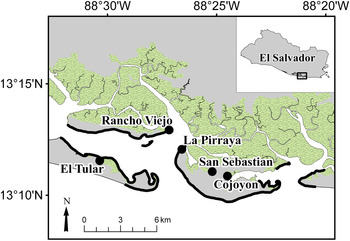
Bahía de Jiquilisco is located in the Department of Usulután on the south-central coast of El Salvador and is a National Conservation Area, RAMSAR wetland and UNESCO Biosphere Reserve (Fig. 1). High poverty levels are common to Bahía de Jiquilisco, with most households lacking potable water and waste collection services, discontinuing education at middle school level and earning US$164 per month (ICAPO 2012). The exploitation of wild natural resources, such as fishing, mollusc extraction and sea turtle egg collection, is an important source of income for impoverished residents. Nearly 100% of sea turtle eggs are collected by local residents at Bahía de Jiquilisco as a livelihood resource and are sold either legally to local NGOs for protection in hatcheries or illegally to local markets for consumption (Vásquez et al. Reference Vásquez, Liles, Lopez, Mariona and Segovia2008). Because Salvadoran law prohibits the sale of sea turtle products for purposes other than conservation (República de El Salvador 2009), direct payments for conservation (flat rate = $2.50 per dozen eggs) provide an alternative economic incentive to sale for consumption that complies with statutory requirements and thus have gained acceptance among coastal communities over the last decade.
Locations of hawksbill nesting beaches (black lines) and survey areas (black circles) at Bahía de Jiquilisco, El Salvador, 2016.

Bahía de Jiquilisco hosts the most important remaining rookery of critically endangered hawksbill turtles (Eretmochelys imbricata) in the eastern Pacific Ocean. Fewer than 700 adult female hawksbills nest along 15 000 km of Latin American coastline, with 40% of all nesting activity occurring at Bahía de Jiquilisco (Gaos et al. Reference Gaos, Liles, Gadea, Peña de Niz, Vallejo and Darquea2017). Prior to 2007, so few hawksbills were encountered in the eastern Pacific that they were considered virtually extirpated in the region (Cornelius Reference Cornelius and Bjorndal1982, Seminoff et al. Reference Seminoff, Nichols, Resendiz and Brooks2003). During 2007–2008, researchers identified three remaining hawksbill nesting sites in El Salvador (Vásquez & Liles Reference Vásquez and Liles2008), which served as a catalyst point for renewed hope of hawksbill recovery in the eastern Pacific and facilitated the formation of the Eastern Pacific Hawksbill Initiative in 2008 (ICAPO in Spanish; Gaos et al. Reference Gaos, Abreu-Grobois, Alfaro-Shigueto, Amorocho, Arauz and Baquero2010).
ICAPO was formally established in El Salvador by a group of 25 sea turtle specialists from 8 countries in the eastern Pacific to promote the recovery of hawksbills in the region through sharing information, raising awareness, forming alliances, conducting research and initiating conservation (ICAPO 2008). Since 2008, ICAPO in El Salvador has spearheaded locally driven research and conservation of hawksbills and their habitat, as well as developing and carrying out educational activities for youth in partnership with local schools at Bahía de Jiquilisco. Educational activities and materials largely emphasize natural history, species interactions and the importance of protecting terrestrial and marine environments.
Materials and methods
We hypothesized that youth would prefer native species or taxa to non-native species. We based our hypothesis on previous studies demonstrating that children establish relationships with animals through interaction (Kellert Reference Kellert, Kahn and Kellert2002, Aguirre & Orihuela Reference Aguirre and Orihuela2010); native species – including aquatic species such as fish and crabs – play a central role in the lives of people living in less developed, rural areas on the coast (Shapiro et al. Reference Shapiro, Peterson, Stevenson, Frew and Langerhans2017). Second, we hypothesized that participants in ICAPO’s environmental education activities would rank declining species and ecologically important species as more important than those who have not participated in ICAPO’s activities. This hypothesis was grounded in ICAPO’s activities focusing primarily on sea turtles, which serve as examples of species with rapidly declining populations, species that fulfil important ecological roles and species that have significant economic impacts. ICAPO’s activities include Hawksbill Festival and Turtle Day in local schools, short presentations, hands-on activities and interactive games. Third, we hypothesized that boys would rank use for hunting or fishing as a more important attribute for conservation than girls. This hypothesis emerged from previous studies suggesting a gender-based divergence in views towards nature in adults, where males tend to perceive nature through a more economic, utilitarian and dominionistic lens (Kellert & Westervelt Reference Kellert and Westervelt1984, Stern et al. Reference Stern, Dietz and Kalof1993), whereas females are more aware of the relationships found in nature and concerned with the consequences of humans’ actions on the environment (Stern et al. Reference Stern, Dietz and Kalof1993, Zelezny et al. Reference Zelezny, Chua and Aldrich2000).
Sampling
In July 2016, we surveyed 128 youth between the ages of 7 and 20 years at the local schools (3rd–11th grade) of the five primary human settlements located within hawksbill nesting habitats (Fig. 1), which corresponds to c. 40% of all students aged 7–20 years who live in these areas: San Sebastián (n = 25; 28.4% of total), Cojoyón (n = 6; 20.0% of total), Rancho Viejo (n = 16; 41.0% of total), El Tular (n = 16; 37.2% of total) and La Pirraya (n = 65; 61.3% of total) (Fig. 1). The average distance between settlements was 5.4 km (SD = 2.89), with San Sebastián and Cojoyón nearest (0.6 km) and El Tular and Cojoyón farthest (9.9 km).
Prior to distributing the questionnaire, students were told the purpose of the study, that their participation was entirely voluntary, that they should not put their names on the questionnaire and that they could raise their hands with any questions. One questionnaire was given to each student, which they completed on an individual basis. All participating youth completed the questionnaire in under 30 minutes.
Within our dataset, the average age was 13 years (SD = 3.1; 7 years: n = 2; 8 years: n = 4; 9 years: n = 10; 10 years: n = 12; 11 years: n = 17; 12 years: n = 14; 13 years: n = 15; 14 years: n = 10; 15 years: n = 15; 16 years: n = 7; 17 years: n = 6; 18 years: n = 9; 19 years: n = 4; 20 years: n = 2), gender was balanced (55% female), a third of students had captured wild animals to eat or sell (34%), nearly three-quarters of students had fishing experience (72%) and most students had participated in ICAPO’s activities at least once (88%). This project was approved by the University of Texas at El Paso Institutional Review Board (IRB #1676085).
Questionnaire design
To measure youth wild animal preferences, we adapted and translated into Spanish questions from a survey by Shapiro et al. (Reference Shapiro, Erickson, Peterson, Frew, Stevenson and Langerhans2016) that asked students to rank species attributes based on their importance in prioritizing species conservation. Students were told that ‘all animals that live in nature are wild animals’ [underlining included in original], and were then asked, ‘What are your five favourite kinds of wild animals in the world? Please put them in order with your most favourite first. If you don’t know the name for five, then list as many as you can’ [underlining included in original]. The second question asked, ‘What are your five favourite kinds of wild animals that live in El Salvador? Remember to put your most favourite first. If you don’t know the name for five then list as many as you can’ [underlining included in original]. The third question asked, ‘There are many things to think about when deciding which types of wild animals to protect and help first. Please place your ranking beside each kind of wild animal from 1 (should be protected first) to 5 (should be protected last)’. The five species attributes listed below this question were: wild animals that only occur in El Salvador; wild animals that people can hunt and fish for; wild animals whose numbers are going down fast; wild animals that I see around my home; and wild animals that are important in nature. The fourth question asked how many years the student had participated in ICAPO’s activities including this year. We also asked each student four additional questions: (1) Have you ever captured wild animals to eat or sell? (2) Have you ever been fishing? (3) Are you a boy or a girl? (4) How old are you?
Analysis
For youth wildlife preferences, we assigned each species listed by students to 1 of 26 taxonomic categories. A single species received its own category if it occurred in at least 10% of surveys for favourite species overall and favourite species in El Salvador (Shapiro et al. Reference Shapiro, Peterson, Stevenson, Frew and Langerhans2017). For all other species, we used relevant taxonomic categories (e.g., amphibian). We assigned a score of ‘1’ to each species listed by the child and ‘0’ for all species not listed.
We formulated ordinal logistic regression models using five predictor variables (participation in ICAPO’s activities, previous hunting experience, previous fishing experience, gender and age) to explain prioritization of the five species attributes (response variables: only occur in El Salvador, can hunt and fish for, numbers going down fast, see around the home and important in nature) by youth at Bahía de Jiquilisco. We evaluated the strength of association between each predictor variable and attribute prioritization by calculating the odds ratio. Odds ratios <1 and >1 indicate that a predictor is associated with lower and higher odds of an outcome, respectively. For odds ratios <1, we calculated their inverse proportion to facilitate interpretation. We used Nagelkerke R2 values to assess the predictive capacity of the model to explain variation in the prioritization of species attributes.
Summary statistics are expressed as means ± 2 SE. We computed all analyses using JMP Pro 12.0.0 (SAS Institute, Cary, NC, USA), with α levels of 0.10 and 0.05 where relevant.
Results
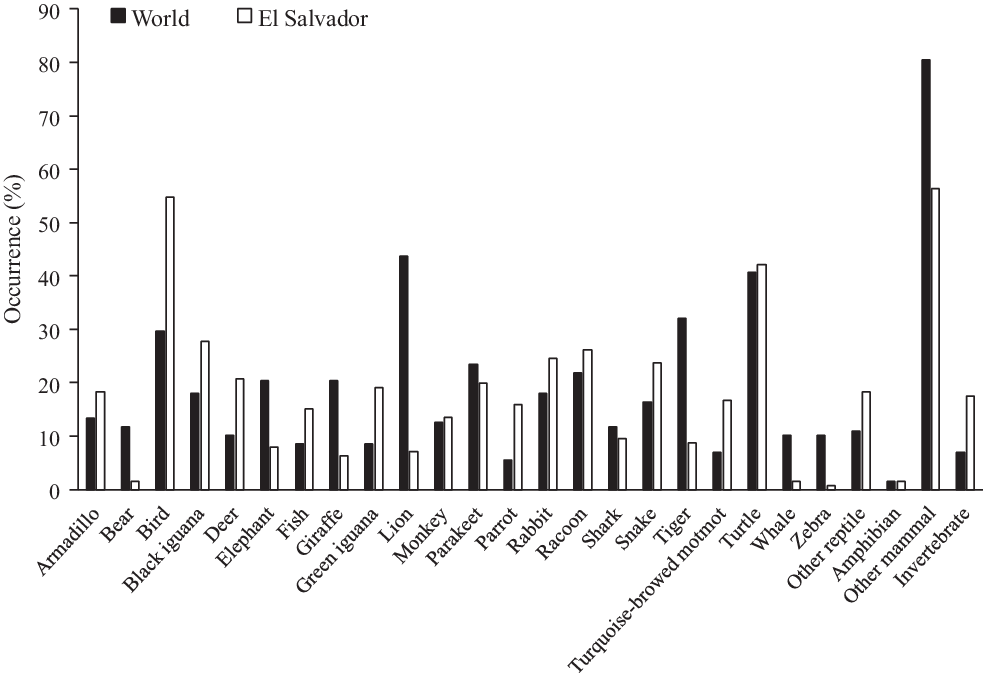
Youth preferences for species and taxonomic categories found in the world and in El Salvador were strongest for ‘other mammal’, lion and turtle, and for ‘other mammal’, bird and turtle, respectively (Fig. 2). Students showed little difference in preferences between overall favourite species and favourite Salvadoran species: wild aquatic species (20.3% vs 22.8%), wild terrestrial species (74.7% vs 69.6%) and domestic species (5.1% vs 7.6%), respectively. Greater differences emerged in preferences for mammals (61.7% world vs 40.9% El Salvador) and birds (13.3% world vs 22.7% El Salvador). For species and taxonomic groups found anywhere on Earth, youth listed species also native to El Salvador (64.2%) more than species from other places (35.8%), and turtle, parakeet and raccoon were the most commonly listed overall favourites from El Salvador, whereas lion, tiger and giraffe/elephant were the most common overall favourites not native to El Salvador (Fig. 2).
Percentage occurrence of youth wildlife preferences for 26 taxonomic categories found in the world (black bars) and in El Salvador (white bars) at Bahía de Jiquilisco, El Salvador, 2016.

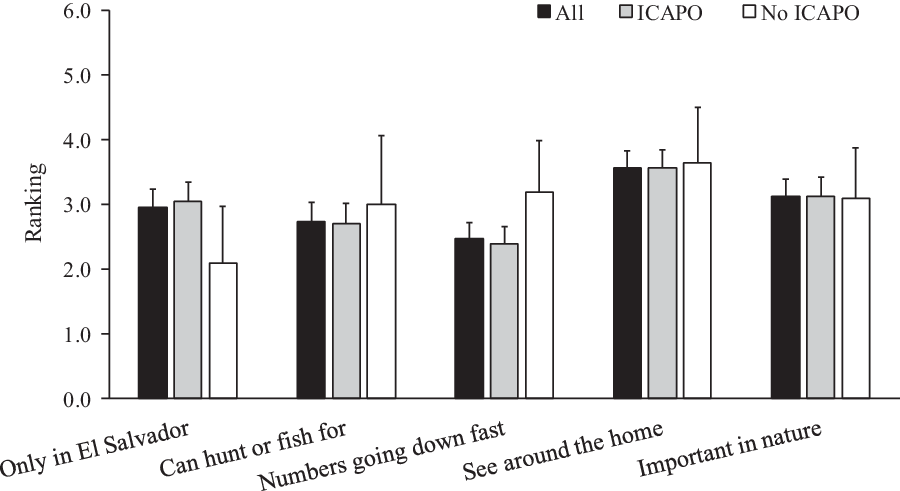
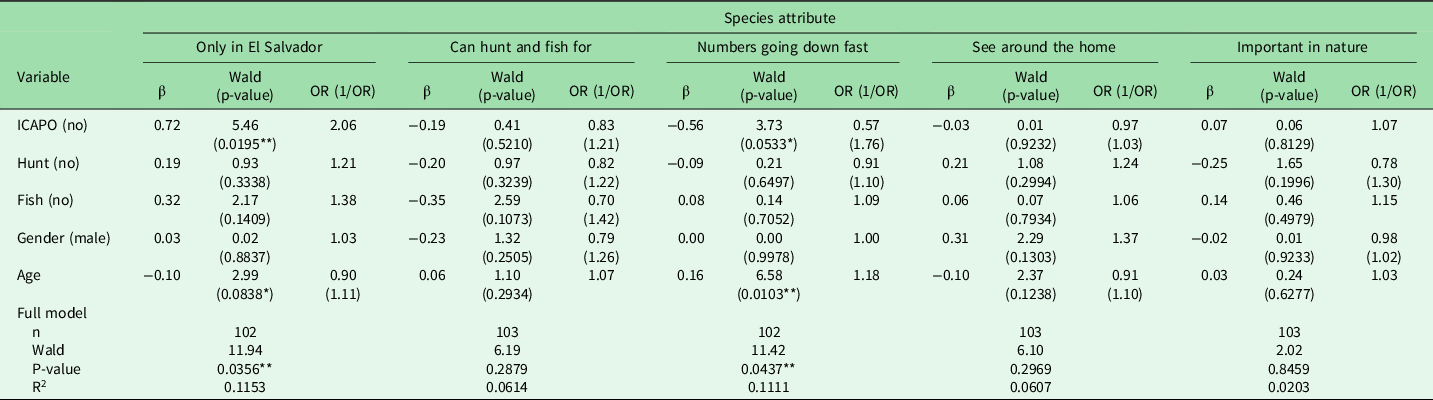
Rankings for prioritizing wildlife for conservation differed significantly among species attributes (χ2 = 34.20, df = 4, p < 0.0001), with students tending to rank rapid population decline as the most important attribute (mean rank = 2.47 ± 0.25, where 1 was the most important and 5 was the least important), being able to hunt and fish for species as the second most important (2.73 ± 0.29) and other attributes as less important (Fig. 3). Ordinal logistic regression analyses demonstrated that participation in ICAPO’s environmental education activities and age were significant predictors of how youth prioritized endemism and rapid population decline (Table 1). Previous hunting experience, previous fishing experience and gender were not significant predictors of any attribute ranking. Youth who had not participated in ICAPO’s activities had 2.06 higher odds of prioritizing endemism than those that had participated, whereas youth who had participated in ICAPO’s activities had 1.76 higher odds of prioritizing rapid population decline than non-participants (Fig. 3). For each 1-year increase in age, youth had 1.11 lower odds of prioritizing endemism and had 1.18 higher odds of prioritizing population decline (Table 1).
Ranking of species attributes across all youth (black bars), youth that participated in the Eastern Pacific Hawksbill Initiative’s (ICAPO) environmental education activities (grey bars) and youth that never participated in ICAPO’s activities (white bars) at Bahía de Jiquilisco, El Salvador, 2016. Means ± 2 SEs depicted. Ranking ranged from 1 = most important to 5 = least important.

Ordinal logistic regression models for the ranking of five species attributes by youth in Bahía de Jiquilisco, El Salvador.

*p < 0.1, **p < 0.05.
β = logistic regression coefficient; Wald = Wald statistic; OR = odds ratio; 1/OR = inverse of odds ratio <1; ICAPO = Eastern Pacific Hawksbill Initiative; R2 = Nagelkerke R2.
Discussion
The tendency of youth in Bahía de Jiquilisco to list Salvadoran species most among favourite species matches our a priori hypothesis that they would prefer native species or taxa over non-native species, which was based on previous research that children establish relationships with animals through interaction and direct observation in daily life (Chawla Reference Chawla2007, Colléony et al. Reference Colléony, Clayton, Couvet, Saint Jalme and Prévot2017). This can be particularly true in coastal areas with acute poverty, where employment opportunities are scarce and the livelihoods of impoverished residents invariably depend on natural resources from their local environment (Hutton & Leader-Williams Reference Hutton and Leader-Williams2003, UNEP 2014), including fish, birds, reptiles and mammals (González-Marín et al. Reference González-Marín, Moreno-Casasola, Castro-Luna and Castillo2017, Roldán-Clará et al. Reference Roldán-Clará, López-Medellín, Leyva, Calderón de la Barca and Espejel2017, Vezina et al. Reference Vezina, Ranaivoson, Razafimanahaka, Andriafidison, Andrianirina and Ahamady2020).
In many coastal communities in El Salvador, local residents consider sea turtle eggs to be an important economic resource, but their connection to turtles transcends a simple transactional relationship, which also is rooted in respect, appreciation and tradition (Liles et al. Reference Liles, Chavarría, Altamirano, Yañez, Urteaga, Gaos, Feldpausch-Parker, Bergea, Peterson and Raitio2016). The fact that the youth in Bahía de Jiquilisco listed turtles among their favourite species may be indicative of this deeper connection. This is also consistent with other studies that demonstrate that people tend to show greater affinity and affection for turtles and tortoises – contrary to negative attitudes towards reptiles generally, including crocodilians (Czech et al. Reference Czech, Krausman and Borkhataria1998, Kaltenborn et al. Reference Kaltenborn, Bjerke, Nyahongo and Williams2006, Schlegel & Rupf Reference Schlegel and Rupf2010) – likely because they are common pets, not venomous and positively depicted in media (Woods Reference Woods2000, Prokop & Tunnicliffe Reference Prokop and Tunnicliffe2010). Similarly to turtles, youth preference for ‘other mammal’ and birds may also be influenced by experiences with common pets, such as dogs, cats and parrots, and how these animals are portrayed in the media (Dydynski & Mäekivi Reference Dydynski and Mäekivi2018). Interestingly, however, fish ranked low on the list of youth preferences, despite their ubiquity and importance in daily activities at Bahía de Jiquilisco. We suspect that this may reflect, at least in part, a greater preference for affect-related characteristics, such as the charisma of an animal (Colléony et al. Reference Colléony, Clayton, Couvet, Saint Jalme and Prévot2017).
The youth in Bahía de Jiquilisco listed turtles among their favourite species far more often than children and youth in areas with relatively large sea turtle populations, such as the Bahamas (Shapiro et al. Reference Shapiro, Peterson, Stevenson, Frew and Langerhans2017). This finding may be explained by the high percentage of our sample that participated in ICAPO’s activities, whose programming focused on hawksbill turtle conservation, and supports other research that demonstrates pedagogical hands-on activities improve students’ knowledge and attitudes towards biodiversity, especially reptiles and amphibians (Ballouard et al. Reference Ballouard, Provost, Barré and Bonnet2012, Sousa et al. Reference Sousa, Quintino, Palhas, Rodrigues and Teixeira2016). As a charismatic, local species, turtles in this context likely fill two roles that have been linked to conservation support. Previous studies demonstrate that the use of charismatic species as flagships can effectively engender public support for wildlife conservation and that learning about locally relevant species can improve people’s knowledge, attitudes and behaviours towards wildlife (Veríssimo et al. Reference Veríssimo, Fraser, Girão, Campos, Smith and MacMillan2014, Macdonald et al. Reference Macdonald, Burnham, Hinks, Dickman, Malhi and Macdonald2015, Liordos et al. Reference Liordos, Kontsiotis, Anastasiadou and Karavasias2017).
The tendency for Bahía de Jiquilisco youth to prioritize species with declining populations and value for hunting and fishing highlights the potential value of direct payments for conservation. Specifically, hawksbill turtles are a critically endangered species that, at the same time, are highly coveted by impoverished local residents for the economic value of their eggs (Liles et al. Reference Liles, Peterson, Lincoln, Seminoff, Gaos and Peterson2015). The purchase of hawksbill eggs from local residents by conservation programmes for protection simultaneously addresses Salvadoran youth’s top-ranked attributes for protection: species in rapid decline and species used in hunting and fishing. This process benefits both humans and hawksbills, where local residents with few employment opportunities receive economic relief from the sale of hawksbill eggs for conservation, and the hatchlings produced from the eggs that are protected in hatcheries contribute to hawksbill population recovery. Undoubtedly, market-based approaches in conservation can be polarizing (e.g., Sandbrook et al. Reference Sandbrook, Fisher, Holmes, Luque-Lora and Keane2019). However, under certain circumstances, direct payments for conservation can be a socially just strategy that recognizes human need and can alter historically marginalized people’s position in the conservation milieu. By selling turtle eggs for protection, these local residents become part of the conservation effort, which opens up possibilities that can transcend neoliberal economics and facilitate meaningful participation in conservation decision-making (Liles et al. Reference Liles, Peterson, Lincoln, Seminoff, Gaos and Peterson2015).
Youth who participated in ICAPO’s educational activities ranked declining species as a more important species attribute compared to non-participants, which partly supported our hypothesis that participants would rank declining species and ecologically important species as more important than those who had not participated. Prioritization of population decline by youth is likely indicative of the programme’s focus on the critically endangered hawksbill turtle. Experiential learning with wildlife has been shown to enhance environmental awareness among participants, which can subsequently carry over into their attitudes and actions (Reynolds et al. Reference Reynolds, Salamander and Wilson2018).
Contrary to our expectation, however, the odds of youth prioritizing ecologically important species were not significantly higher for youth that had participated in ICAPO’s activities than those that had not participated (Table 1). This finding could be attributed to the frequency with which youth participated in environmental education activities. For example, Sharp (Reference Sharp2010) found significant differences between first-time and repeat visitors to a US National Park in their attitudes towards invasive species, where repeat visitors who were exposed to multiple interpretive programmes and several interactions with park rangers showed greater support than first-time visitors for the need to control some wildlife in order to help conserve the natural ecosystem. Because repeated exposure to unfamiliar or complex environmental concepts can foster improved understanding in children (White et al. Reference White, Eberstein and Scott2018) and adults (Cox & Gaston Reference Cox and Gaston2015), increasing the frequency and length of ICAPO’s environmental education activities could enhance youth understanding of, and attitudes towards, species that are ecologically important (Chawla & Cushing Reference Chawla and Cushing2007).
Regional gender-based family roles may explain why we did not detect relationships between gender and conservation importance attributed to hunted and fished species. This was not consistent with our hypothesis that boys would rank use for hunting or fishing as a more important attribute for conservation than girls, nor with previous findings in other regions where adult males exhibited more dominionistic and utilitarian views towards wildlife than females (Kellert & Berry Reference Kellert and Berry1987, Vaske et al. Reference Vaske, Jacobs and Sijtsma2011). Because women and girls are socialized from an early age to be caretakers of the family in areas where hunting and fishing is a utilitarian livelihood strategy, such as in Bahía de Jiquilisco, it is possible that gender-based roles in the family contributed to girls in this study ascribing greater conservation importance to hunted and fished species than was the case in other studies where boys valued those species more than girls (Shapiro et al. Reference Shapiro, Erickson, Peterson, Frew, Stevenson and Langerhans2016, Reference Shapiro, Peterson, Stevenson, Frew and Langerhans2017). This may be particularly true because collecting sea turtle eggs, trapping crabs and extracting molluscs may relate more to familial food provisioning than other forms of paid labour (Magalhães et al. Reference Magalhães, Marinho da Costa, da Silva and Carneiro Pereira2007, Carney Reference Carney2017, Aye et al. Reference Aye, Wen, Marin, Thapa and Tun2019). Additional research into the factors that influence gender-based differences in youth wildlife value orientations could address related hypotheses. For instance, in high-income regions, where most similar research occurs, gender socialization related to wildlife may be driven more by electronic media and books emphasizing aesthetic and humanistic orientations towards wildlife, whereas in regions with subsistence livelihoods, the exigencies of surviving may emphasize a utilitarian valuation of wildlife, even among children.
The tendency for younger individuals to prioritize endemism could be attributed to a place-based connection to the world, cultivated by daily interactions with their surroundings and the endemic species that inhabit them (Shapiro et al. Reference Shapiro, Erickson, Peterson, Frew, Stevenson and Langerhans2016). Older youth giving higher priority to the protection of species in rapid decline is consistent with previous studies that suggest age is positively correlated with environmental knowledge and pro-environmental attitudes among youth (Kellert & Westervelt Reference Kellert and Westervelt1984, Kahn Reference Kahn1999, Casaló & Escario Reference Casaló and Escario2018). Because the over-utilization of wildlife species for subsistence has contributed to the decline of some populations in Bahía de Jiquilisco, including fish, iguanas and sea turtles, children may increasingly prioritize declining species as they get older and will be increasingly able to link declining species abundance to declining yields and utilization. Indeed, in 2012, ICAPO initiated a conservation tourism programme focused on increasing the non-extractive value of wildlife by training and employing local youth as tour guides and population monitoring assistants. For these reasons, environmental education may be a critical tool to help current and future generations of coastal communities understand that species conservation is directly tied to their livelihoods.
Because people’s attitudes towards species often differ regionally and based on personal experience (Macdonald et al. Reference Macdonald, Burnham, Hinks, Dickman, Malhi and Macdonald2015), additional research would benefit from sampling youth from different age groups and across gradients of urbanization and socioeconomic status in multiple countries. Understanding youth preferences may facilitate more effective harmonization of priorities for wildlife conservation and improved human well-being, which can be essential to protecting species in biodiversity hotspots of low-income regions (Hutton & Leader-Williams Reference Hutton and Leader-Williams2003, Sodhi et al. Reference Sodhi, Brooks, Pin Koh, Acciaioli, Erb and Khee-Jin Tan2006, Green et al. Reference Green, Fisher, Green, Makero, Platts and Robert2018). Whereas ideological biases among adults can hinder the effectiveness of education efforts (Stevenson et al. Reference Stevenson, Peterson, Bondell, Moore and Carrier2014), environmental education may successfully promote the increased prioritization of imperilled species among youth.
Acknowledgements
We thank the directors, teachers and students from local schools who participated in the study. We are grateful to Sofía Chavarría, Melissa Valle, Ani Henríquez, Neftaly Sánchez, Iris Chavarría, Mauricio Bolaños, Cesar Linares, Mauricio Melara and Carlos Vallecampos for assistance with facilitating and conducting the surveys.
Financial support
None.
Conflict of interest
None.
Ethical standards
None.