

Introduction
Three-fifths of US states regulate primary election participation through party registration. Citizens register with the Democratic, Republican, or minor parties or remain unaffiliated. This choice determines which party primary they may vote in with “closed” primaries requiring voters to register with a party to participate in its primary. However, 12 “semi-closed” states also allow unaffiliated voters to vote in the primaries of either major party.
States with party registration instituted this system to prevent primary crossover voting (Ware Reference Ware2002). Yet closed and semi-closed states rely on a critical assumption to deter it: a voter’s party registration matches their party identification. This may not be true and, under some circumstances, a mismatch is widespread in the electorate (Arrington and Grofman Reference Arrington and Grofman1999; Key Reference Key1949; Thornburg Reference Thornburg2018; Reference Thornburg2019).
Some instances of this mismatch (termed “hidden partisanship”) are instrumental and driven by a lack of interparty competition. There is evidence that voters who live in states with closed primaries and identify with the minority party strategically register with the strong party in order to gain access to its primary elections and select the nominees of the party favored to win the general election (Arrington and Grofman Reference Arrington and Grofman1999; Key Reference Key1949).
If this is the case, then semi-closed primaries, where unaffiliated voters may choose to vote in either the Democratic or Republican primary, represent a more attractive prospect still for instrumental hidden partisanship. In states with semi-closed primaries, voters who identify with the electorally weaker of the major parties in a state but remain unaffiliated gain access to the primary of the stronger party and preserve access to their own party’s primary. Voters identifying with the weak party in semi-closed states should remain unaffiliated.
The greater instrumental utility of unaffiliated registration in semi-closed primaries should lead states that implement semi-closed laws to increase the share of registrants that is unaffiliated. To establish causality, I use the opening of Arizona and North Carolina’s primary elections to unaffiliated voters as comparative case studies. Using the synthetic control method (Abadie, Diamond, and Hainmueller Reference Abadie, Diamond and Hainmueller2010), I generate a counterfactual version of the treated states that did not open its primary elections. Compared to this synthetic control, the proportion of both states’ electorate that is unaffiliated significantly increased in the decade after the implementation of semi-closed primaries there. The ratios of partisan registrants to identifiers also decreased, supporting the notion of hidden partisanship, especially Democrats in Republican Arizona.
I model the decision to register with a political party or remain unaffiliated. The model predicts that we observe hidden partisanship in uncompetitive states among voters identifying with the minority party in the electorate and that unaffiliated hidden partisanship by partisans in semi-closed states will be the most common pattern observed. Using the 2018 Cooperative Congressional Election Study (CCES), I examine Democrats, Republicans, and independents in semi-closed and closed primary states. I confirm that (1) hidden partisanship is most commonly observed in semi-closed states and (2) the probability of hidden partisanship grows as a voter’s party becomes weaker in the state. There is weak evidence for such hidden partisanship in states with closed primaries with the exception of independents, who register with the stronger party in the state.
Unaffiliated voters in semi-closed states also know that they may vote in either the Democratic or Republican primaries and take advantage of this choice. Voters respond to the partisanship of their state in deciding which primary to participate in. Unaffiliated primary voters in blue states are most likely to vote in the Democratic primary, and likewise with the Republican primary in red states. This includes a significant minority of unaffiliated partisans who engage in crossover voting in states where they do not identify with the stronger party. These individuals participate in the primary most likely to yield the eventual officeholders, consistent with an instrumental motive.
While primary elections may have been opened to unaffiliated voters in hopes of bringing independents into the partisan ranks, they lead to strategic behavior by partisans. Most of the literature on primary crossover voting finds it to be rare and inconsistent. Among unaffiliated partisans in politically unfriendly semi-closed primary states, crossover voting is more common. The findings highlight the neglected role that institutions and political context play in motivating strategic behavior in party registration and primary voting.
Background and theory
Hidden partisanship is the phenomenon where a voter’s party registration fails to match their party self-identification (Arrington and Grofman Reference Arrington and Grofman1999). This can include partisans registered with a different party than the one with which they identify or who remain unaffiliated. It can also include independents registered with a political party. The literature identifies several mechanisms that may result in this hidden partisanship.
Some hidden partisanship is “unintentional.” Thornburg (Reference Thornburg2018) uses local changes of address and the subsequent required re-registration to show that many voters in Oklahoma would switch party registration from the Democratic Party if they could. The author theorizes that the realignment of the state from Democratic to Republican has “stranded” many individuals registered with the Democratic Party who now identify as Republican. Similarly, Thornburg (Reference Thornburg2019) finds that in counties that have realigned and are located in states where it is difficult to change party registration, there is greater difference between presidential vote share and aggregate party registration, indicating voters located in these counties may be registered with one party but identify with (or at least vote for) a different one. These studies suggest that this unintentional hidden partisanship is most prevalent where a partisan realignment has occurred. In such places, more people are registered with the weakening party than now identify with it.
Hidden partisanship may also be due to “social pressure.” Voters living in areas dominated by one party while they identify with the minority party might conceivably register with the dominant party out of this pressure. Ansolabehere and Hersh (Reference Ansolabehere and Hersh2012) and Bell and Buchanan (Reference Bell and Buchanan1966) show that voters may misreport their party registration compared to validated measures. Bell and Buchanan (Reference Bell and Buchanan1966) theorize this misreport is due to the greater prestige of some party registration statuses and the role social pressure plays. Social pressure hidden partisanship should exist where one party is in the clear majority and a voter self-identifies with the weaker party. It should take the form of a voter registering with the dominant party as opposed to the weak party.
Hidden partisanship may also be due to instrumental factors. In such a case, primary crossover voting drives hidden partisanship. The general consensus in the literature is that crossover voting – choosing to vote in a primary where the voter does not identify with the party – is rare in the aggregate nationwide (Norrander Reference Norrander and Boatright2018). However, evidence also shows that the rate of crossing over is not consistent across elections and responsive to context. Reported rates of primary crossover voting vary widely in ways corresponding to election-specific factors (Alvarez and Nagler Reference Alvarez and Nagler1997; Reference Alvarez, Nagler, Cain and Gerber2002; Burden and Jones Reference Burden, Jones, Bowler, Blais and Grofman2009). For example, Burden and Jones (Reference Burden, Jones, Bowler, Blais and Grofman2009) find the percentage of the primary electorate composed of crossover voters ranges from 18% to 49% (including independents) among a number of studies and contests.
One type of instrumental hidden partisanship may be related to “maximizing options.” The literature on primary turnout shows that voters are more likely to vote in a primary that is competitive compared to one that is uncompetitive or uncontested (Ezra Reference Ezra2001; Jewell Reference Jewell1977; Kenney Reference Kenney1983; Kenney and Rice Reference Kenney and Rice1986). With this in mind, voters might register in ways that afford the freedom to switch party primaries to the contest that is most competitive, such as remaining unaffiliated in semi-closed states.
Another form of instrumental hidden partisanship – and the focus of this paper – is driven by “impact voting.” In examining the California blanket primary in 1998, Alvarez and Nagler (Reference Alvarez, Nagler, Cain and Gerber2002) find drastically different rates of primary crossover voting across state legislative districts. In this study, the highest rates of crossover voting among partisans were in districts where one party held a clear advantage and the general election race was perceived to be safe. The crossover behavior here by identifiers with the electorally weak party accords with strategic attempts to maximize the impact of one’s vote. Confirming this, Weaver (Reference Weaver2015) finds rates of crossover voting among Democrats were highest in Republican areas of the state during the North Carolina 2010 primary elections. Among related research on primary turnout, the partisan balance of a state (Ezra Reference Ezra2001; Jewell Reference Jewell1977; Kenney Reference Kenney1983, Reference Kenney1986; Kenney and Rice Reference Kenney and Rice1986) drives turnout. Hanks and Grofman (Reference Hanks and Grofman1998) examine primary turnout in the one-party South, where primary election turnout relative to general election turnout increased with competitive primary races and low levels of interparty competition. Taken together with the research on primary crossover voting, these studies show that voters gravitate toward primaries where the winner of the primary will be likely to win the general election.
Impact voting hidden partisanship follows naturally from this. Key (Reference Key1949) observed an extreme case in the Solid South in an era where the Democrat was usually the foregone winner of the general election. In North Carolina, Republicans registered as Democrats because the Republican nominees were sure to lose the general election, making participation in the Republican primary of little instrumental value. Arrington and Grofman (Reference Arrington and Grofman1999) confirm this by examining party registration totals in North Carolina localities versus the actual support that parties receive at the ballot box. Fewer individuals register with the electorally weak party relative to its actual electoral support. The authors conclude that voters identifying with the less competitive party choose not to register with it. This suggests that the local political context in an electorate – specifically the level of interparty competition there – drives the party a voter registers with. Voters should, all else equal, assume registration statuses that grant access to the other party’s primary election when the voter’s own party is not competitive in the general election and participation in its primary is of little instrumental value.
Because these four forms of hidden partisanship are driven by different behavioral mechanisms, we should observe different patterns with each. Unintentional hidden partisanship is due to the barriers in place to changing party registration. It should therefore be the least responsive to changes in electoral institutions, competitiveness of primaries, or levels of interparty competition and should lag changes in aggregate party identification, such as electoral realignments. Maximizing options hidden partisanship is instrumental and responds to changes in electoral institutions. Voters engaging in this form of hidden partisanship desire the freedom to choose between the parties and will gravitate toward the party primary that is most competitive. Voters maximizing options will register as unaffiliated in semi-closed primary states and do so regardless of the level of interparty competition (i.e., whether their party is strong or weak). They are not necessarily motivated by the futility of voting in their own party primary if they are in the minority (except insofar as the dominant party’s primaries are usually more competitive) so much as which intraparty contest is most competitive. Impact voting hidden partisanship, in contrast, is affected by which party is dominant in the electorate. These voters register as unaffiliated or with the other major party where their own party is weak to gain access to the dominant party’s primary. Among these voters, we should observe significant amounts of crossover voting where their party is weak. Finally, social pressure hidden partisanship is prevalent where a voter believes there are social or professional consequences from registering with their own political party. This should also occur where a voter’s party is weak in the electorate. Social pressure hidden partisanship is distinguished from impact voting in that the latter is characterized by crossover voting, while the former is not.
Finally, among the purposeful forms of hidden partisanship (those which are not unintentional), it is certainly possible more than one mechanism affects a particular individual. Voters maximizing options may also engage in impact voting or be affected by social pressure. Especially among the instrumental motives, it is conceivable that voters who gravitate toward the most competitive primary to best “spend” their vote will also gravitate toward the primary of the party most likely to yield the eventual general election winner.
At the same time, other factors drive the decision to register (or not) with a party. Large numbers of voters in semi-closed states register with the parties, even though it is not necessary to do so and registering with a party actually restricts the voter to just one party primary rather than granting a choice of primary. Therefore, a psychic benefit to party registration also exists. Thornburg (Reference Thornburg2014) calls the act of registering with a party a “constitutive norm,” validating an individual’s party identification through official recognition. Constitutive norms serve as “the very actions that lead others to recognize an actor as having a particular identity” (Abdelal et al. Reference Abdelal, Herrera, Johnston and McDermott2006, 697). Thus, these norms signal to the individual and others engaging in them that they are members of a group. In examining the concept of what it means to be “American,” Schildkraut (Reference Schildkraut2007) finds that official status as an American citizen is among the most important signifiers of identity as an American. Similarly, research has found that individuals who are “formal” members of a group relate to the group differently, holding a weaker sense of autonomy but a notably stronger sense of differentiation from others (Sheldon and Bettencourt Reference Sheldon and Bettencourt2002). Other research also indicates that the act of registering with a political party reinforces an individual’s party identification (Burden and Greene Reference Burden and Greene2000; Finkel and Scarrow Reference Finkel and Scarrow1985; Gerber, Huber, and Washington Reference Gerber, Huber and Washington2009).
Other plausible non-instrumental factors influencing an individual’s choice of party registration exist. Gerber et al. (Reference Gerber, Huber, Biggers and Hendry2017) suggest that many voters hold exclusionary beliefs about who should vote in primary elections which may discourage hidden partisanship. They find 44% of individuals they surveyed believed that partisans should not engage in crossover voting and 23% believed independents should not participate in primary elections. Thus, a strong social norm exists for individuals to register with their own party, discouraging partisans from registering with the other party or remaining unaffiliated. These exclusionary beliefs increase with the strength of partisanship, perhaps leading to greater resistance to hidden partisanship from strong partisans compared to weak partisans or leaners.
The results from Gerber et al. (Reference Gerber, Huber, Biggers and Hendry2017) as well as research on constitutive norms suggest that we should observe different psychic benefits among different party registration states. For a partisan, especially a strong one, registration with one’s own party provides the greatest psychic benefit, first because this serves to validate a voter’s existing party identification as well as because it does not violate an individuals’s exclusionary beliefs about participation in another party’s primary election. Registration with the other major party provides the smallest psychic benefit as this directly contradicts an individual’s partisan identity and may violate social norms.
Model of party registration
Based on this prior research, I present a simple model of party registration here.
A voter, i, identifies with a political party in a state with party registration. They must decide which party registration state to select from
 $ j\in \left\{D,R,I\right\} $
(i.e., Democratic, Republican, or unaffiliated). Without loss of generality, i supports the Democratic Party. Their decision is based primarily on two forms of utility: psychic utility and instrumental utility – the latter driven here by impact voting. Psychic utility represents the perceived psychological and expressive benefit from their party registration state, j. Instrumental utility describes the utility derived by i from the access to the primaries in choosing the eventual office holders. The overall utility has the following function:
 $$ {U}_{ij}\left({s}_i,{p}_j,{\mathbf{d}}_i\right)={s}_i{r}_j+\left(1-{s}_i\right){v}_j+{p}_j+{\mathbf{b}}_j\cdot {\mathbf{d}}_i+{\varepsilon}_{ij}. $$
Here,
 $ {s}_i $
is an indicator, equaling 1 if an individual is a strong partisan and 0 otherwise.
 $ {r}_j $
and
 $ {v}_j $
, respectively, are values giving the psychic benefit from state j, which is assumed to differ between those with strong and weak partisanship. Without loss of generality, for Democratic i, we assume that
 $ {r}_D>{r}_I>{r}_R $
and
 $ {v}_D>{v}_I>{v}_R $
and set
 $ {r}_R=0 $
and
 $ {v}_R=0 $
. In addition, we assume that
 $ {r}_D>{v}_D $
and
 $ {r}_D-{r}_I>{v}_D-{v}_I $
.
 $ {p}_j $
is an expression of the value of primary access provided by j. For
 $ j\in \left\{D,R\right\} $
,
 $ {p}_j $
equals the proportion of partisans in the electorate identifying with the party. It is assumed that
 $ {p}_D=1-{p}_R $
. In a closed primary state,
 $ {p}_I=0 $
. In a semi-closed primary state,
 $ {p}_I=1 $
. In addition,
 $ {\mathbf{d}}_i $
is a vector of individual characteristics multiplied by vector of coefficients
 $ {\mathbf{b}}_j $
.
 $ {\varepsilon}_{ij} $
is a random disturbance term taking on a type-I extreme value distribution.
Due to the distribution of the random disturbance term, the probability that i chooses j,
 $ {\rho}_{ij} $
can be expressed as
 $$ {\rho}_{ij}\left({s}_i,{p}_j,{\mathbf{d}}_i\right)=\frac{e^{s_i{r}_j+\left(1-{s}_i\right){v}_j+{p}_j+{\mathbf{b}}_j\cdot {\mathbf{d}}_i}}{\sum_j{e}^{s_i{r}_j+\left(1-{s}_i\right){v}_j+{p}_j+{\mathbf{b}}_j\cdot {\mathbf{d}}_i}}. $$
Previous literature suggests that as the Democratic Party becomes less competitive in
 $ i $
’s electorate, registering as a Republican or remaining unaffiliated will become a more attractive prospect. Taking the derivative of
 $ {\rho}_{iD} $
with respect to
 $ {p}_R $
, we obtain
 $$ \frac{\partial {\rho}_{iD}}{\partial {p}_R}={\rho}_{iD}^2-{\rho}_{iD}-{\rho}_{iD}{\rho}_{iR}. $$
This derivative will always be negative, indicating that the probability of registering as a Democrat decreases as the Republican Party grows stronger in their electorate. It also follows:
 $$ \frac{\partial {\rho}_{iR}}{\partial {p}_R}={\rho}_{iR}-{\rho}_{iR}^2+{\rho}_{iD}{\rho}_{iR} $$
and
 $$ \frac{\partial {\rho}_{iI}}{\partial {p}_R}={\rho}_{iD}{\rho}_{iI}-{\rho}_{iR}{\rho}_{iI}. $$
It is clear that
 $ {\rho}_{iR} $
is strictly increasing with
 $ {p}_R $
as expected. For the probability of remaining unaffiliated (in either closed or semi-closed states), as long as
 $ {\rho}_{iD}>{\rho}_{iR} $
, the probability is increasing with respect to
 $ {p}_R $
. This is likely given the important psychic role that party registration plays (especially registering with one’s own party) as well as the social norms in place discouraging strategic registration.
Finally, because
 $ {p}_I>{p}_R $
in all cases in semi-closed primary states as well as the fact that
 $ {r}_I>{r}_R $
and
 $ {v}_I>{v}_R $
,
 $ {\rho}_{iI}>{\rho}_{iR} $
in semi-closed states in all semi-closed situations.
The effect of semi-closed primaries on hidden partisanship
Based on the foregoing model, I distinguish semi-closed from closed primaries using three criteria: (1) semi-closed primary states allow voters who are unaffiliated on primary election day to participate in party primaries while closed primary states do not; (2) semi-closed primary states give unaffiliated voters access to the primaries of both major parties (rather than just one); and (3) individuals registered with a political party on primary election day may only vote in that party’s contest in both closed and semi-closed statesFootnote 1. In essence, semi-closed states provide greater instrumental utility to unaffiliated voters on primary election day compared to unaffiliated voters in closed primary states or voters registered with a political party in either closed or semi-closed states. In the former case, an unaffiliated voter in a semi-closed primary state accesses both major party primaries compared to an unaffiliated voter in a closed primary state who may not participate in any party primary. An unaffiliated voter in a semi-closed state also has greater choice compared to an individual registered with a political party; the option to choose either party primary exists compared to just one party’s contest for those registered with a party.
If registration with a political party is not simply a declaration of one’s party identification or independence but instead a decision informed by the instrumental utility this choice provides in selecting one’s representatives, then we should see differences in aggregate registration counts among states with different primary election laws. A larger portion of the electorate in semi-closed primary states will be unaffiliated compared to states with closed primaries.
Table 1 lists the mean state percentage of registered voters in party registration states who were unaffiliated at the time of the 2018 general election. Closed primary states are distinguished from states with semi-closed primaries. Averages are not weighted by state population and include all registered voters in the state. States used in this paper’s analysis and the coding for them are in Table 2. The table includes the year a state became fully semi-closed where applicable.
Unaffiliated registration in closed and semi-closed primary states

Party registration states with closed or semi-closed primaries

Abbreviations: D, Democratic; C, competitive; R, Republican.
The large difference between the means in Table 1 suggests a greater tendency to register as unaffiliated in semi-closed states as opposed to closed primary states. However, this does not by itself show a causal relationship, nor does it indicate hidden partisanship. Observational studies purporting to demonstrate a causal effect of electoral institutions on political behavior may suffer from endogeneity as the behavior of the electorate drives implementation of election laws (Hanmer Reference Hanmer2009). Semi-closed primaries may not lead to hidden partisanship and registration as an unaffiliated voter, especially given that some elected policymakers implement semi-closed primaries in hopes of increasing independent support for their party (Madden Reference Madden1986; Sinclair Reference Sinclair2013). Norrander (Reference Norrander1989) also shows that wide variation exists in independent identification among the states. We should not assume every state has the same proportion of its electorate identifying as independents (and therefore the same proportion remaining unaffiliated by default). With the possibility that unaffiliated voters drive semi-closed primary laws rather than the other way around, we need more sophisticated methods of establishing causality.
I use the introduction of semi-closed primary elections in Arizona and North Carolina as quasi-experiments. Starting in 2000, unaffiliated registrants residing in Arizona on primary election day could vote in either the Democratic or Republican non-presidential primary elections. And in North Carolina, following a change to state law, the Republican Party opened its primary to unaffiliated voters in 1988 with the Democratic Party following suit in 1995.
This test of the causal effect of election laws on hidden partisanship is intended to separate unintentional from other forms of hidden partisanship and show that one of the others is at work with semi-closed primaries. Unintentional hidden partisanship results from the stickiness and slow change of party registration in the aggregate. If it drives hidden partisanship, a change in electoral rules should not greatly affect the aggregate party registration of a state. In contrast, social pressure, maximizing options, and impact voting hidden partisanship emphasize responsiveness to the partisan context and/or electoral rules in place. With these three types of hidden partisanship, voters purposely avoid registering with their own party, either out of social pressure or to gain access to other primary options. If the introduction of semi-closed primaries in these two states led to the share of the electorate that is unaffiliated to increase, then the evidence will support the presence of one of these three types of hidden partisanship.
Furthermore, I theorize much of the effect of semi-closed primary laws on hidden partisanship is due to a desire to engage in impact voting. However, this form of hidden partisanship is observationally equivalent to social pressure hidden partisanship in terms of aggregate party registration. Both forms of hidden partisanship are most prevalent among supporters of the less competitive party in a state. If either of these forms of hidden partisanship is present, I expect that the ratio of registered Democrats to Democratic identifiers to exhibit a greater decrease compared to the ratio of registered Republicans to Republican identifiers with the introduction of semi-closed primaries in Arizona. While Arizona has become more competitive politically in recent years, at the time of the introduction of semi-closed primaries, it was considered strongly Republican and has remained Republican-leaning well into the twenty-first century. Thus, more Democrats in Arizona should engage in hidden partisanship. I also evaluate the Democratic and Republican registrant/identifier ratios in North Carolina, though predictions are less straightforward with that state.
Methods exist for causal inference of a policy change that is not randomly assigned. In Arizona and North Carolina, the decision was a result of conscious changing of the laws. Because of the fundamental problem of causal inference (Imbens and Rubin Reference Imbens and Rubin2015), we are unable to simultaneously observe these two states post-treatment both with and without the ability of unaffiliated voters to vote in primary elections. Thus, we are not able to conclusively determine whether a difference between closed states and the two treated states post-introduction of semi-closed primaries is due to the causal effect of election laws on the latter.
I employ the synthetic control method. Synthetic control methods work well for comparing the effect of a policy treatment or other intervention in a single aggregate unit to other units that did not receive the treatment (Abadie, Diamond, and Hainmueller Reference Abadie, Diamond and Hainmueller2010). In this case, the synthetic control method generates composite “counterfactual states” against which to compare the treated states before and after the implementation of semi-closed primaries observed in Arizona and North Carolina (Abadie, Diamond, and Hainmueller Reference Abadie, Diamond and Hainmueller2010; Abadie and Gardeazabal Reference Abadie and Gardeazabal2003). The weighted average of the pool of closed primary states forms the synthetic control, with weights assigned to each member of the pool ranging between zero and one and summing to one. The weights are chosen such that relevant characteristics of Arizona and North Carolina pre-treatment are most closely approximated by the synthetic control.
If
 $ {\mathbf{X}}_{\mathbf{1}} $
comprises a
 $ \left(k\times 1\right) $
vector of relevant pre-intervention characteristics for Arizona (North Carolina), and
 $ {\mathbf{X}}_{\mathbf{0}} $
is a
 $ \left(k\times J\right) $
matrix containing the values of these characteristics for the pool of
 $ J $
closed primary states, then the vector of weights chosen,
 $ {\mathbf{W}}^{\ast} $
, minimizes
 $$ \sum \limits_{m=1}^k{v}_m{\left({\mathbf{X}}_{\mathbf{1m}}-{\mathbf{X}}_{\mathbf{0m}}\mathbf{W}\right)}^2. $$
Here,
 $ {v}_m $
is a weight assigned to the
 $ m $
th variable (characteristic of the states). A number of methods exist for determining the variable weights (
 $ {v}_m $
); in this case, I choose weights based on their ability to predict the dependent variable during the pretreatment period. The choice of
 $ {v}_m $
minimizes the mean-squared prediction error (MSPE) for the dependent variable of the treatment and control states for the time period of 1980 to the election year before semi-closed primaries were fully implemented in each states’ analysis.
The choice of predictor variables is particularly important for creating an accurate counterfactual state. Norrander (Reference Norrander1989) examines the wide variation in independent/unaffiliated registration and identification among states and identifies characteristics affecting independence among voters. In particular, the analysis cites state location in the South, state political competitiveness, turnout of the electorate, and the strength of the party system as predicting independent/unaffiliated registration. I use seven predictor variables, measuring these characteristics of the state and the lagged dependent variable. For presence in the South, I include a dummy variable (including Kentucky and Oklahoma, which exhibit similar party registration patterns to other southern states). To measure the strength of the state’s party system, I use the two variables Morehouse and Jewell (Reference Morehouse and Jewell2005) created, measuring the weakness of the state’s parties by the divisiveness of gubernatorial nominations and the ability of parties to formally endorse candidates. Both of these variables are measured on a three-point scale with larger numbers indicating a weaker state party system or less ability to endorse. To measure the degree of political competition, I use the 10-year average folded Ranney Index for each state and year and the 10-year average Ranney Index for each state and year (Klarner Reference Klarner2013). Larger values of the folded Ranney Index indicate more competition and larger values of the Ranney Index indicate a more Democratic state. For each year, I also include the two-year average of both the percentage of the citizen voting age population that is registered and that voted in that election. In addition, I follow the recommendation of Abadie, Diamond, and Hainmueller (Reference Abadie, Diamond and Hainmueller2010) and include the lagged value of the dependent variable as a predictor.
I initially examine the proportion of the registered voters in each state not affiliated with a major political party as my dependent variable, covering the time period from 1980 to 2010 on even (election) years. I separately compare Arizona and North Carolina to all states maintaining closed primaries over this period with the exception of Nebraska for which suitable data are not available. There is no reason to expect spillover effects among voters when registering as unaffiliated. I match from 1980 to 1998 in the case of Arizona and from 1980 to 1994 in the case of North Carolina. Table 3 displays descriptive statistics for Arizona and North Carolina, the mean of the pool of control states and their synthetic controls as well as values of
 $ {v}_m $
in each case.
Predictor variable values and weights

A comparison of the synthetic control to the treated states in question shows a good match on covariates compared to the unweighted pool of controls, especially for variables weighted heavily in determining unaffiliated registration (
 $ {v}_m $
). The composition of the composite control states is given in Table 4.
State weights for synthetic control

With these weights composing the synthetic Arizona and North Carolina, the top two plots of Figure 1 show the proportion of the electorate in the treated states and their synthetic controls that is composed of unaffiliated voters over the time period measured. The unaffiliated proportion in the synthetic controls approximate the actual Arizona and North Carolina from 1980 through the implementation of semi-closed primaries, indicating their suitability as a counterfactual. However, after the introduction of semi-closed primaries in the two states, treatment and control diverge. The proportion of voters who are unaffiliated increases significantly in Arizona and North Carolina over the next decade. The bottom two plots of Figure 1 show the gap between treatment and control for Arizona and North Carolina and further demonstrate divergence. It is important to recall that in the case of North Carolina, the Republican Party actually opened its primary to unaffiliated voters in 1988, seven years prior to the Democratic Party and thus prior to the shift of the state to semi-closed under the definition of this paper. The growth of North Carolina’s unaffiliated population relative to the state’s synthetic control in the period 1988 to 1994 may thus be due to the Republicans’ earlier shift.
Comparison of treated states and synthetic controls.

Besides a purely visual comparison of the treated states and their synthetic controls, Abadie, Diamond, and Hainmueller (Reference Abadie, Diamond and Hainmueller2015) recommend an analysis of the post-/pre-treatment MSPE ratio for the treated units. If the introduction of semi-closed primaries does indeed increase the proportion of the electorate that is unaffiliated post-treatment, then we should witness a divergence between the treated states and their synthetic controls after the implementation of the rules change. On the other hand, prior to the implementation of the semi-closed rules, the synthetic control and treated state should closely match each other. The gap between treated state and synthetic control is measured as the MSPE. Therefore, the ratio of the MSPE post-treatment to the MSPE pre-treatment gives an intuitive measurement of both synthetic control fit prior to treatment and effect of the treatment. I also follow Abadie, Diamond, and Hainmueller (Reference Abadie, Diamond and Hainmueller2015)’s recommendation to conduct a placebo test on donor states. I generate a synthetic control for each closed donor state and compute the post-/pre-treatment MSPE ratio for each one, comparing the closed states to Arizona and North Carolina.
Figure 2 shows that the post/pre MSPE ratio is large for both Arizona and North Carolina compared to the closed “control” states in the placebo tests. The only placebo states that exceed Arizona or North Carolina is Florida in the case of North Carolina. While I do not have a conclusive reason why the proportion of unaffiliated registrants increased significantly in Florida around 1995, Norrander (Reference Norrander1989) in the analysis of unaffiliated/independents in states finds uncompetitive southern states in 1989 to differ significantly from the rest of the country in unaffiliated registration. Florida, as a “rim South” state growing more competitive may have been witnessing a surge in unaffiliated registration as they transitioned from one-party governance.
Post-/pre-treatment MSPE for treated states.

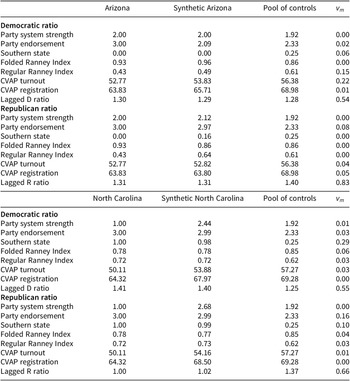
I have shown that two states significantly increased their proportion of unaffiliated voters compared to synthetic controls after they implemented semi-closed primary elections. This is consistent with social pressure, maximizing options, and impact voting hidden partisanship. However, my theory that hidden partisanship is driven by impact voting also predicts that in politically uncompetitive states, a greater proportion of identifiers with the weaker party will register as unaffiliated because of the instrumental utility this status provides in accessing the primary of the stronger partyFootnote 2. I test this theory on both Arizona and North Carolina with my dependent variables being the ratio of registered Democrats (Republicans) to Democratic (Republican) identifiers in the state. I utilize the measures of aggregate state party identification from Enns and Koch (Reference Enns and Koch2013) which are available from 1980 to 2010 and average these measures of party ID from the previous three election years. These state party identification measures utilize multilevel regression with poststratification (MRP) and survey aggregation to create estimates of party identification for each state in every year during this time span.
I predict that in Arizona, the ratio of registered Democrats to Democratic identifiers should decrease after the implementation of semi-closed primary elections there compared to the Republican ratio, as a greater proportion of Democrats chose to register unaffiliated in what was a strongly Republican state. My predictions for North Carolina are less clear and complicated by three factors: First, the North Carolina Republican Party opened its primary to unaffiliated voters in 1988, seven years before the Democrats. This gradual roll-out of semi-closed primaries in the state may complicate an easy analysis of hidden partisanship. Second, North Carolina, like many southern states, displayed a significant degree of segmented partisanship with its voters supporting Republicans at the federal level and Democrats at the state and local level (Wekkin Reference Wekkin1991). Finally, the period from 1980 to 2010 was one of significant realignment while the state moved from fully Democratic to competitive. Table 5 displays descriptive statistics for the Democratic and Republican ratios of registrants to identifiers in Arizona and North Carolina, including the treatment states, pools of controls, and synthetic controls. Table 6 shows the weights assigned to each of the donor states forming the synthetic controls in the comparisons of ratios.
Predictor variable values and weights

State weights for synthetic control.

Figure 3 shows the path and gap plots for the Democratic and Republican ratios in Arizona and Figure 4 shows these plots for North Carolina. Examining Figure 3 shows support for the hypothesis that the Democratic ratio of registrants to identifiers showed a greater decrease relative to the Republican ratio after the implementation of semi-closed primaries in Arizona. The Democratic ratio decreases consistently from 2000 to 2010, indicating that the ratio of registered Democrats to self-identified Democrats went down over this time period compared to the synthetic control. Fewer Democrats were registered with their party relative to those identifying as Democrats in Arizona after the implementation of semi-closed primaries in the state – consistent with social pressure or impact voting hidden partisanship. While the ratio decreases for Republicans as well, the gap between Arizona and the synthetic control is smaller in that case.
Comparison of Arizona and synthetic controls.

Comparison of North Carolina and synthetic controls.

Figure 5 quantifies the difference between Democratic and Republican ratios in Arizona. The post-/pre-treatment MSPE plots show that the MSPE for the Democratic ratio post-implementation of semi-closed primaries is over 50 times the MSPE for the Democratic ratio pre-implementation of semi-closed primaries. This indicates strong matching to the synthetic control prior to 2000 and a major divergence from the control afterward. In contrast, the Republican ratio is smaller, indicating a much less clear treatment effect and divergence from the synthetic control after unaffiliated voters were able to vote in the semi-closed primaries of the state.
Post-/pre-treatment MSPE for Arizona.

As expected, the picture is less clear for North Carolina in Figure 4. While the Democratic and Republican registrant-to-identifier ratios decreased after the opening of primaries to unaffiliated voters, the magnitude of the change is much smaller than in Arizona. In other words, after both Democrats and Republicans opened their primaries to unaffiliated voters, fewer individuals registered as Democrats (Republicans) relative to Democratic (Republican) identification in the state. Figure 6 shows that North Carolina Democratic and Republican post-/pre-treatment MSPE ratios are both high but less so than Florida and Kentucky.
Post-/pre-treatment MSPE for North Carolina.

Overall, the analysis of aggregate party registration data from Arizona and North Carolina supports the social pressure, maximizing options, and impact voting theories of hidden partisanship. Implementation of semi-closed primaries in both states clearly leads to a large increase in the proportion of the electorate that chooses to register as unaffiliated, as shown in Figures 1 and 2. The large post-/pre-treatment MSPE ratio for both states indicates a good fit between the synthetic control and treated states prior to the treatment followed by a major divergence (in the expected direction) after the unaffiliated are able to vote in both Democratic and Republican primaries. In addition, in the clearly Republican state of Arizona, there is strong evidence that the ratio of Democratic registrants to identifiers decreases more relative to the ratio of Republican registrants to identifiers after the implementation of semi-closed primaries in 2000. The latter finding is in keeping with an impact voting motive for registering as unaffiliated in semi-closed primary states. At this point in my analysis, I also cannot rule out social pressure as a motive either.
Patterns of hidden partisanship in semi-closed primary states
In states with semi-closed primary elections, voters are more likely to be unaffiliated with a political party compared to closed primary states. A comparison of Arizona and North Carolina’s implementation of semi-closed primaries to synthetic counterfactuals shows this causal relationship. In comparison with the synthetic control, the treated states’ introduction of semi-closed primaries significantly increased the proportion of unaffiliated voters in the state. To many voters, unaffiliated registration, which promises the ability to access the other party’s primary as well as one’s own, is a more attractive prospect than registration with a political party. Evidence also points to this sort of hidden partisanship being most prevalent among identifiers with the weaker party in the electorate where one party dominates, consistent with impact voting or social pressure theories of hidden partisanship.
The theory of this paper postulates that voters choose to remain unaffiliated in semi-closed primaries to gain access to the strong party’s primary elections (i.e., impact voting hidden partisanship). By itself, the fact that semi-closed primaries lead to a greater number of unaffiliated voters does not necessarily show this. For example, semi-closed rules might instead allow the growing number of independents to express their true identity as unaffiliated rather than be required to register with a party in order to vote in primary elections. Evaluating the impact of voting explanation for semi-closed hidden partisanship requires analysis of individual-level information, such as a voter’s party identification. At this point in the analysis, I cannot yet rule out observationally equivalent social pressure explanations.
Aside from Key (Reference Key1949), previous studies of hidden partisanship in the literature (Arrington and Grofman Reference Arrington and Grofman1999) utilize ecological inference of aggregate registration and vote shares. However, large-N datasets exist that measure the relevant variables among individual voters and contain sufficient statistical power to examine patterns of party registration at sub-national levels. Given the well-documented issues with the ecological fallacy, I directly test the formal model of party registration at the individual level.
I hypothesize that in keeping with the instrumental motivation for engaging in hidden partisanship, clear patterns will be evident in its occurrence. First, building on the results from the previous section, I predict that the probability of hidden partisanship increases as a voter’s party grows less competitive within their state. Registering with the opposite party (in closed primary states) or remaining unaffiliated (in semi-closed primary states) which grants access to the majority party’s primary elections become increasingly attractive options in such states. I also predict that hidden partisanship is more common in semi-closed primary states compared to closed primary states and remaining unaffiliated in semi-closed states is the most common form of hidden partisanship. The greater instrumental and psychic benefit from remaining unaffiliated compared to registering with the other major party make this form of hidden partisanship the most attractive.
To evaluate these hypotheses it is necessary to use an individual-level dataset measuring both a voter’s party identification and party registration. My theory predicts that hidden partisanship will be most common among the rarest voters: its prevalence increases as a voter’s party shrinks in the electorate. Thus, an adequate test of the theory requires a sufficient sample of identifiers with the electorally weak party in a state. I utilize the 2018 CCES. The CCES survey uses a matched random sample of members from an opt-in panel managed by YouGov Polimetrix. It is administered in two waves; the first takes place in September of the election year with a post-election wave occurring in November (Schaffner and Ansolabehere Reference Schaffner and Ansolabehere2018). The study measures a variety of political attitudes and demographic characteristics in a sample that regularly exceeds 50,000 respondents. It also measures party registration. The 2018 survey validates party registration using voter files from the Catalist data service.
In this analysis, party registration is the dependent variable. I measure it as a nominal variable taking on three values: unaffiliated/independent, Democratic, and Republican. The option of voters to affiliate with third-parties and which parties receive recognition is idiosyncratic to individual states and only 1.4% of the 2018 sample in party registration states registered with a third-party. Thus, I exclude these individuals from the analysis. I exclude individuals registered as “independent” if they were registered with the Independent Party but not if this was the state’s signifier of unaffiliated status.
Table 7 shows weighted crosstabs for the 2018 CCES among Democrats, Republicans and independents (including leaners with partisans). I include both percentages and raw numbers in parentheses. I distinguish between closed and semi-closed states and the partisanship of the state they reside in. To estimate the latter, I coded states as safe Republican if greater than 55% of the partisan identifiers in the state were Republican and safe Democratic if greater than 55% of partisan identifiers were Democrats with other states labeled “competitive.” These categorizations are found in the rightmost column of Table 2. I determined the partisan composition of these states via MRP on the 2018 CCES sample (Gelman and Little Reference Gelman and Little1997). The hierarchical models in the MRP procedure estimate the probability of respondents identifying or leaning Democratic or Republican based on individual characteristics (race, gender, age, political interest, and education). The intercepts of these models vary by state through random effects. Following the convention of Hill (Reference Hill2015), I use the CCES poststratification weights in the MRP procedure. Details of the hierarchical models and estimates of state partisanship are available in the Supplementary Material.
Hidden partisanship among active registrants, 2018 CCES

Percentages are % of party identification group with indicated party registration.
I include leaners with partisans because of the documented effect of party registration on an individual’s party identification (Burden and Greene Reference Burden and Greene2000; Finkel and Scarrow Reference Finkel and Scarrow1985; Gerber, Huber, and Washington Reference Gerber, Huber and Washington2009; Thornburg Reference Thornburg2014). Individuals registered as unaffiliated may identify as independent because of their party registration. Thus, excluding independent leaners from partisans provides an inaccurate estimate of hidden partisanship because some individuals may only identify as independent because of their choice to remain unaffiliated.
Table 7 confirms that the most common form of hidden partisanship among partisans is among Republicans in semi-closed safe Democratic states and among Democrats in semi-closed safe Republican states. Among self-identified Democrats living in semi-closed, safe Republican states, only about 60% of active registrants are actually registered with the Democratic Party. Among self-identified Republicans in semi-closed safe Democratic states, 55% of active registrants are registered with the Republican Party. Hidden partisanship is less prevalent in semi-closed states where a voter’s party is strong. The effect of semi-closed primaries on unaffiliated registration is conditional on partisanship and political competition.
While the percentage of unaffiliated self-identified Democrats does not increase much moving from strongly Democratic semi-closed states to strongly Republican ones, the percentage of these voters registered with the Republican Party increases significantly. It is important to note that all of the semi-closed strongly Republican states (Idaho, Kansas, and Utah) change party registration of unaffiliated primary voters to registration with the party whose primary they voted in (voters are free to switch back later). It is thus possible that many of the Democrats registered with the Republican Party in these states recently participated in the GOP primary and have not yet switched back to unaffiliated.
It is hard to discern patterns of hidden partisanship in closed primary states. Even in the most Democratic closed primary states, at most 10% of Republicans register with the Democratic Party; likewise Democrats in Republican states.
I model the party registration of Democrats, Republicans, and independents in closed and semi-closed primary states as well. I perform this analysis separately on Democrats and Republicans (leaners included) as well as “pure” independents and separately for all three groups in semi-closed and closed primary states.
I control for whether the respondent self-identified as Black or Hispanic, the respondent’s college education, their gender, strong partisanship (where applicable), high interest in news and politics, and their age divided by 100. Because some states transitioned to semi-closed primaries relatively recently, I include in the semi-closed models the number of years the state has been semi-closed divided by 100. Finally, my primary independent variable of interest is
 $ {p}_j $
, instrumental utility. This variable is alternative specific, taking on a value of 0 or 1, respectively, for the unaffiliated alternative in closed and semi-closed primary states. For the Democratic and Republican alternatives, the variable equals the proportion of the state’s partisans that identified or leaned with the respective party. I once again estimate the proportion of Democratic and Republican supporters in each state using MRP. Because the
 $ {p}_D $
gives the proportion of Democrats and Republicans identifying with the Democratic Party,
 $ {p}_R=1-{p}_D $
.
The multinomial logit model includes robust standard errors clustered on state. The reference category is registration with a voter’s own party and the comparison groups are unaffiliated and registration with the opposite party. The estimates for Democrats, Republicans, and independents in semi-closed states are shown in Table 8 and for closed states in Table 9. Figure 7 plots the predicted probabilities of party registration for all six models as
 $ {p}_D $
changes.
Party registration for active registrants in semi-closed states, 2018 CCES

*** p < 0.001.
** p < 0.01.
* p < 0.05.
† p < 0.1.
Party registration for active registrants in closed states, 2018 CCES

*** p < 0.001.
** p < 0.01.
* p < 0.05.
† p < 0.1.
Party registration among actively registered voters in semi-closed and closed states.

Our chief concern is the variables coding for instrumental and psychic utility. The instrumental utility variable is statistically and substantively significant in the Democratic and Republican semi-closed models. As Figure 7 makes clear, the probability of hidden partisanship is highest among Republicans and Democrats in semi-closed primary states, when a voter’s party is electorally weak in a state. This supports the theory of impact voting hidden partisanship. However, it does not yet discount social pressure as an explanation either.
The plots also confirm that hidden partisanship is most frequently observed in semi-closed primary states with individuals remaining unaffiliated. Strong partisans are also less likely to engage in hidden partisanship compared to weak partisans or independent leaners.
Semi-closed primaries and crossover voting
Unaffiliated registration in semi-closed states is a popular choice among partisans who live where their own party is uncompetitive. This behavior accords with impact voting hidden partisanship: a desire to engage in impact crossover voting by participating in the primary of the party whose candidates are most likely to win the general election (Alvarez and Nagler Reference Alvarez, Nagler, Cain and Gerber2002). Do these individuals use semi-closed primary laws to engage in crossover voting? While unaffiliated registration in semi-closed states provides greater instrumental utility than any other option where party registration exists, there are other reasons why a voter might remain unaffiliated in a semi-closed state. Voters might wish to avoid campaign contact from political parties but continue voting in primaries. Or they might be concerned that registration with the electorally weak party in a state will carry social or professional consequences (i.e., social pressure hidden partisanship) but wish to still preserve access to primary elections.
The only way to determine whether unaffiliated hidden partisanship in semi-closed states is impact voting rather than due to social pressure is to measure primary participation. I examine the party of the primary that voters choose and evaluate whether it is consistent with impact voting. In-depth analysis of crossover voting, such as comparison to rates among closed primary states and changes in the composition of primary electorates, is beyond the scope of this paper. I simply test whether unaffiliated voters in semi-closed states choose the party primary offering greater instrumental utility and whether unaffiliated partisans are willing to engage in crossover voting to do so. I predict that in blue states, a greater proportion of unaffiliated voters will vote in the Democratic primary, irrespective of their own party, compared with red states where the Republican primary will be most attractive.
I again use the 2018 CCES, this time to measure primary turnout and party of the primary. The 2018 CCES measures primary party turnout in two ways. The survey asks for self-reported party of primary voted. The CCES also includes voter file data (in the states where it is available) validating the party of the primary the voter participated in. An additional voter file validation is conducted for all semi-closed states of whether the voter participated in the primary (but does not report the party). I construct two measures of primary turnout from these data. My self-reported measure examines individuals in semi-closed primary states who self-reported voting in the Democratic or Republican primary in response to the survey and have validated turnout. The validated measure uses the recorded party voted from the voter file. Two of the semi-closed primary states (North Carolina and Utah) did not have statewide Democratic and Republican primaries in 2018, meaning not all voters in these states had a choice between the parties. These states are excluded from analysis.
Both measures of party primary turnout have strengths and weaknesses. The self-reported measure includes respondents in all states and was asked of all participants. However, given the norms that exist against crossover voting (Gerber et al. Reference Gerber, Huber, Biggers and Hendry2017), it may have reliability problems and understate crossover voting. The validated measure avoids issues with self-reported voting but four semi-closed states do not record primary party in the voter file, leaving analysis of just six semi-closed states. For the sake of thoroughness, both measures are reported here.
Table 10 reports weighted self-reported and validated party of primary among those unaffiliated voters in semi-closed states who participated in the 2018 primary elections. I include percentages as well as raw numbers in parentheses. Voters are divided into “Safe Republican,” “Competitive,” and “Safe Democratic” states as in the previous section. We observe patterns of partisan and independent crossover voting consistent with impact voting: the share of voters voting in the Democratic primary is higher among all groups in Democratic states compared to Republican states. This pattern holds for validated party as well, although no safe Republican states are available with the validated party primary turnout measure.
Party of primary voted among unaffiliated voters, 2018 CCES

Percentages are % of party identification group voting in indicated primary.
I model the decision to vote in the Democratic or Republican primary among semi-closed unaffiliated primary participants using logistic regression models including robust standard errors clustered at the state level. The models include unaffiliated voters in semi-closed primary states who voted in the Democratic or Republican primaries in 2018 according to the self-reported and validated party of primary measures. My primary variable of interest is the proportion of the two-party identifier share in the state that is Democratic. I predict that an increase in this share and a corresponding increase in the Democratic partisanship of the state will be associated with greater levels of voting in the Democratic primary among all unaffiliated voters in semi-closed states. I include dummy variables for Democratic or Republican identification (or leaning) and interaction terms for the Democratic partisanship share with Democratic and Republican identification. As before, I also control for whether the voter is Black or Hispanic, their age, whether they are female, college education, self-reported ideological distance from the Democratic and Republican parties, and high interest in news and politics. Table 11 shows the model estimates.
Democratic primary voting among unaffiliated semi-closed voters, 2018 CCES

*** p < 0.001.
** p < 0.01.
* p < 0.05.
† p < 0.1.
Figure 8 plots the probability of voting in the 2018 Democratic primary among unaffiliated members of all three groups of voters located in semi-closed primary states. For both self-reported and validated measures of Democrats and Republicans, increasing Democratic partisanship of the state leads voters to vote in the Democratic primary. Among unaffiliated partisans in semi-closed primary states, this means the probability of engaging in primary crossover voting is high when residing in a state where the voter identifies with the weak party (a blue state for Republicans and a red state for Democrats).
Participation in Democratic primary among validated unaffiliated primary voters in semi-closed states.

Unaffiliated voters in semi-closed states gravitate toward the party primary that, all things equal, is most likely to yield the general election winners. This is consistent with the impact voting observed by Alvarez and Nagler (Reference Alvarez, Nagler, Cain and Gerber2002) as well as the evidence from Key (Reference Key1949) and Arrington and Grofman (Reference Arrington and Grofman1999). This supports the impact voting theory of hidden partisanship. While low levels of primary crossover voting are generally reported nationwide, in this particular circumstance, significant numbers of unaffiliated partisans in the most politically unfriendly states cross over into the other party’s primary.
Discussion
The hidden partisanship Key (Reference Key1949) and Arrington and Grofman (Reference Arrington and Grofman1999) observed reflects a desire for voters to maximize the instrumental utility of their primary vote. In states where a voter’s own party is uncompetitive, the general election result may be a foregone loss for that party. There is little instrumental value from nominating candidates who are certain to lose the general election. Therefore in states with party registration, registering with a voter’s own party where it is uncompetitive provides little utility in affecting who eventually comes to represent a voter. In a closed primary state, affiliating with the stronger party provides the greatest amount of instrumental utility to the voter.
However, semi-closed primaries offer a better option for the voter whose party is not competitive. Voters registering as unaffiliated access both party primaries, enabling them to select the dominant party’s nominees and presumptive representatives. The option remains to vote in one’s own party primaries as well. In essence, unaffiliated registration in a semi-closed primary state transforms the election into an open primary.
The attractiveness of the unaffiliated option leads to larger numbers of registrants remaining unaffiliated for this primary access. The increase in unaffiliated registration after Arizona and North Carolina implemented semi-closed primaries has been large in those states, even during a time period when unaffiliated registration has been increasing among all states (McGhee and Krimm Reference McGhee and Krimm2009). While large numbers of unaffiliated voters drive the decision to institute semi-closed primaries in some cases, it is also clear that the rules change affects the behavior of voters as well.
The attractiveness of unaffiliated registration varies across the electorate in semi-closed states. While all voters are more likely to register as unaffiliated in semi-closed states than in closed states, partisans’ willingness to do so depends on the political conditions where they live. Democrats and Republicans (and independent leaners) register as unaffiliated in semi-closed states where their own party is electorally weak. This difference from closed primary states shows that the option to vote in either party primary afforded to unaffiliated voters is more attractive to individuals who expect their own party’s nominees to lose in the general election. Semi-closed primaries, therefore, facilitate impact crossover voting. These patterns are confirmed using CCES survey data and partially confirmed with aggregate registration totals after the opening of Republican Arizona’s primaries to unaffiliated voters.
Weaver (Reference Weaver2015), examining North Carolina after the institution of semi-closed primaries, shows that crossover voting takes place where a voter’s own party is electorally weak. I also show that among unaffiliated voters in semi-closed states, state partisanship affects the decision of whether or not to cross over. In Democratic states, unaffiliated voters participate in the Democratic primary; likewise with Republican states. This includes a minority of unaffiliated Democrats in red states and Republicans in blue states who engage in crossover voting.
These findings inform a longstanding debate on how primary election rules affect the composition and representativeness of primary electorates (Gerber and Morton Reference Gerber and Morton1998; Kanthak and Morton Reference Kanthak, Morton, Galderisi, Ezra and Lyons2001; McGhee et al. Reference McGhee, Masket, Shor, Rogers and McCarty2014; Norrander and Wendland Reference Norrander and Wendland2016). However, the question of whether hidden partisanship in semi-closed primaries leads to changes in the composition of primary electorates is beyond the scope of this paper. It is possible that the effect of this phenomenon will be inherently limited. Because impact voting hidden partisanship and primary crossover voting are only attractive where one party is weak and the other is strong, the number of partisans identifying with the weak party and crossing over will by definition be limited in number. Future research should explore the effect of primary crossover voting on the composition of electorates in semi-closed and other forms of primary.
These findings are of interest to any scholar who uses party registration as a proxy for party identification. Because voter files provide large, easily obtainable datasets including demographic information and geographic location of individuals, they are increasingly utilized in political behavior research. In particular, much of the research dealing with geographic sorting has used party registration data to demonstrate geographic clustering of like-minded partisans (Carlson and Gimpel Reference Carlson and Gimpel2019; Martin and Webster Reference Martin and Webster2020; Sussell Reference Sussell2013). The fact voters strategically engage in hidden partisanship where their own party is uncompetitive may lead analysis of party registration data to overstate geographic sorting.
The findings in this paper strongly suggest instrumental and strategic behavior regarding primary elections. It is nonetheless easy to overstate the case. The synthetic control analysis of North Carolina shows that unaffiliated registration increased after the state’s parties opened their primaries to unaffiliated voters. However, it does not clearly show the ratio of Democratic nor Republican registrants to identifiers declined after this relative to the synthetic control. The North Carolina case is complicated by the fact the state gradually opened its primaries to the unaffiliated, the segmented partisanship of the state, as well as the realignment the state underwent. Nonetheless, these results should be interpreted with caution.
The patterns I observe suggest impact voting but do not necessarily rule out maximizing options either. Key (Reference Key1949) famously noted that in the one-party South, where the general election was perfunctory, competition had shifted to the Democratic primary and the latter was “in reality the election” (p. 407). Key’s observations and common sense suggest that where interparty competition is low, intraparty competition may be high. Therefore, voters seeking competitive primaries to cross over into may also find them where their own party is weak. For the present study, I simply do not have enough information about primary competitiveness up and down the ballot in 2018 to control for this factor. Even if it were so, instrumental hidden partisanship based on maximizing options is also an interesting finding and warrants further study in the future.
Also, while clear patterns are evident in crossover voting and hidden partisanship, the majority of partisans in semi-closed states register with their own political party, even where it makes instrumental sense to remain unaffiliated (i.e., where one’s party is electorally weak). And even among unaffiliated partisans in semi-closed states, crossover voting is still not the norm. Instrumental party registration in closed primary states is also much less common than Key (Reference Key1949) or Arrington and Grofman (Reference Arrington and Grofman1999) found. It is possible that the lower levels of closed primary hidden partisanship observed here compared to previous studies may be due to the greater political polarization that now exists between the parties. Research on the rise of affective partisanship finds that party identification now has an emotional component to it rather than just a policy one (Iyengar et al. Reference Iyengar, Lelkes, Levendusky, Malhotra and Westwood2019).
Instrumental hidden partisanship is consistent with impact crossover voting–casting a ballot for the most preferred candidate of the other party and thus having an effect on who comes to hold office. Rather than creating mischief or attempting to sabotage the other party, this form of crossover voting involves a serious consideration of which candidate seeking the other party’s nomination is most attractive to the voter. As American voters increasingly exhibit negative feelings for candidates of the other party, they may eventually stop crossing over during the primary. The present study and others (Gerber et al. Reference Gerber, Huber, Biggers and Hendry2017) show that strong partisans are less likely to engage in hidden partisanship and/or crossover voting and thus the strengthening of party identification in America may dampen hidden partisanship. On the other hand, waning levels of local interparty competition across the country (Drutman Reference Drutman2020) place a growing number of Americans in a position where impact crossover voting may be their best chance to determine their elected representatives.
Overall, the results presented in this paper show the responsiveness of voters to electoral institutions in an instrumental manner. Where a registration option provides greater instrumental utility in selecting the next officeholder, many voters respond by selecting this option. Party registration is an unusual electoral feature as it is an official government record of an informal attitude. Registrants must state their political preferences honestly for the restriction to work as intended. If voters do not state such preferences, as shown here, then semi-closed election laws are limited in effectiveness.
Supplementary material
To view supplementary material for this article, please visit https://doi.org/10.1017/spq.2022.26.
Data availability statement
Replication materials are available on SPPQ Dataverse at https://doi.org/10.15139/S3/M3NXWH (Thornburg Reference Thornburg2022).
Acknowledgments
I thank the editors and anonymous reviewers for their helpful comments. I also thank Mike P. McDonald for helping to develop this idea, Bernie Grofman for helpful comments, Eric McGhee for aggregate party registration data, and Brandy Horne for library assistance. All errors are my own.
Funding statement
The author received no financial support for the research, authorship, and/or publication of this article.
Conflict of interest
The author declared no potential conflicts of interest with respect to the research, authorship, and/or publication of this article.
Author Biography
Matthew P. Thornburg is an Associate Professor of Political Science in the Department of History, Political Science, and Philosophy at University of South Carolina Aiken.