INTRODUCTION
Traditionally, control of gastrointestinal (GI) nematode infections is undertaken using anthelmintic drugs (chemotherapy), with better results being obtained when this approach is integrated with proper grazing management. However, in the last two to three decades there has been over-dependency and even misuse of the chemotherapeutic approach, with consequent emergence and spread of anthelmintic resistance (Prichard Reference Prichard1994; Lans & Brown Reference Lans and Brown1998). This is especially true among major nematode species of small ruminants. Apart from anthelmintic resistance, poor availability and unaffordable cost of synthetic anthelmintic drugs, particularly to resource-poor farmers in the developing countries, have compounded the problem (Hammond et al. Reference Hammond, Fielding and Bishop1997). Moreover, there is a growing concern over drug residues in the food chain and the environment. A search for novel anthelmintics that are both more sustainable and environmentally friendly is potentially a valuable approach to the control of parasitic infections. Exploitation of natural products such as the use of plants with anthelmintic activity could be one such alternative. Plant anthelmintics have been known and used in many parts of the world but more research to validate their use, especially in veterinary medicine, is needed. Forages rich in condensed tannins (CT) have been found to improve general performance of parasitized sheep through reduced worm burdens (Niezen et al. Reference Niezen, Waghorn, Waghorn and Charleston1993, Reference Niezen, Robertson, Waghorn and Charleston1998). Furthermore, studies have shown that dietary inclusion of CT via quebracho extract (QT) can significantly reduce egg output and worm burdens of the temperate sheep infected with bankrupt worm (Trichostrongylus colubriformis) (Athanasiadou et al. Reference Athanasiadou, Kyriazakis, Jackson and Coop2000; Butter et al. Reference Butter, Dawson, Wakelin and Buttery2000). Other studies (Athanasiadou et al. Reference Athanasiadou, Kyriazakis, Jackson and Coop2001; Max et al. Reference Max, Wakelin, Craigon, Kassuku, Kimambo, Mtenga and Buttery2005a) showed that QT was toxic to various nematodes in vitro and as an oral drench (Max et al. Reference Max, Wakelin, Dawson, Kimambo, Kassuku, Mtenga, Craigon and Buttery2005b), and that QT was effective at reducing both faecal egg counts (FEC) and worm burdens of temperate sheep infected with wire worm (Haemonchus contortus). Animal trials using tannin-rich diets such as Acacia nilotica and Acacia karoo (Kahiya et al. Reference Kahiya, Mukaratirwa and Thamsborg2003), Sericea lespedeza (Shaik et al. Reference Shaik, Terrill, Miller, Kouakou, Kannan, Kaplan, Burke and Mosjidis2006) and Acacia polyacantha (Max et al. Reference Max, Kimambo, Kassuku, Mtenga and Buttery2007) have all indicated varying anthelmintic effects in sheep and goats. In vitro studies have also shown that wattle tannin (WT) is toxic to GI nematodes originating from mice and also from goats (Max et al. Reference Max, Wakelin, Craigon, Kassuku, Kimambo, Mtenga and Buttery2005a). Reports on the use of commercial tannin preparations for the purpose of controlling nematode infections in tropical small ruminants are scarce. Paolini et al. (Reference Paolini, Bergeaud, Duranton-Grisez, Prevot, Dorchies and Hoste2003) observed a significant decrease in in utero fecundity of H. contortus following oral administration of QT to experimentally infected goats. The purpose of the current study was to investigate the effect of WT (a commercial tannin preparation for the leather industry which is readily available in Tanzania) administered as drench, on FEC and worm burdens of tropical goats and sheep during experimental and natural worm infections.
MATERIALS AND METHODS
Study site and tannins
The studies were carried out at Sokoine University of Agriculture (6°48′S – 37°36′E; 500 m asl) in the town of Morogoro, Tanzania. The WT preparation used is a complex mixture of phenolic compounds in which CT predominate and it is extracted from the bark of the tropical tree Acacia mearnsii. The tannin was supplied as a single batch by the Wattle Tannin Company Ltd, Tanzania. According to the manufacturer, the WT powder contains approximately 700 g CT/kg DM. Oral drenches were prepared by dissolving one part of WT in approximately two parts of lukewarm water to make a known volume of final solution.
Preparation of infective stage larvae
Faeces from a naturally infested goat were cultured by a standard Baermann technique (Urquhart et al. Reference Urquhart, Armour, Duncan, Dunn and Jennings1987) to give infective stage larvae (L3), which were suspended in distilled water and kept in culture tubes at 4°C until needed. The larvae were identified under a microscope using keys of Hansen & Perry (Reference Hansen and Perry1994) to establish proportions of various nematode species per unit volume of suspension. Four nematode genera were identified as Haemonchus (0·76), Oesophagostomum (0·16), Trichostrongylus (0·06) and Cooperia (0·02).
Expt 1: Effect of WT drench on FEC and worm burdens of experimentally infested goats
Small East African (SEA) goats were purchased from small-scale keepers living around the study area. Thirty-six entire bucks aged between 12 and 14 months and weighing 14±2·2 kg were used. They were housed in individual wooden pens with raised floors. The goats were offered ad libitum rice straw (treated with urea and sprayed with molasses), as a daily allowance and supplemented with 150 g/day of maize bran-based concentrate (750 g maize bran/kg, 240 g cotton seed cake/kg and 10 g minerals/kg; Super Macklik®, (NaCl, Ca, P, Mg, Zn, Mn, Fe, Se, Co, I and Mo), Coopers, Kenya Ltd). Due to endemic coccidiosis in the trial area, a coccidiostat (Trisulmix® (sulfamethasone-trimethoprime), Coophavet, France) was given regularly as a prophylaxis. Once in the experimental house, the animals received a single oral dose of broad-spectrum anthelmintic (Valbazen® (Albendazole), Novartis East Africa Ltd, Kenya) to clear any worm infections because of their previous exposure to larvae-infested pastures. Albendazole was chosen because a faecal egg count reduction test (FECRT) had showed it to be effective at the University farm (Kassuku, personal communication). The goats were allowed to acclimatize to the experimental conditions for 2 weeks before oral administration of a single dose of the mixed nematode larvae at a rate of 2000 larvae per 20 kg body weight. Worm eggs in the faeces were counted using the McMaster method (Urquhart et al. Reference Urquhart, Armour, Duncan, Dunn and Jennings1987) and monitored regularly from day 16 post-infection (p.i.) to the end of the trial. On day 29 p.i., the goats were blocked according to faecal egg numbers into low, moderate and high eggs per gram (EPG) fresh faeces blocks. Equal number of animals from each block were then assigned randomly into three groups (n=12). One group (LWT) received low and one (HWT) high doses of WT (1·2 or 2·4 g/kg body weight per day, respectively); the third group (control) received a placebo drench (i.e. water). The two WT levels were used in order to find out any dose–response effects/relationship. The goats were drenched for 3 consecutive days from day 30 to day 32 and 10 days later (i.e. on day 42 p.i.) they were humanely slaughtered and intestinal worm burdens were estimated. In all trials, faecal materials were visually examined for the presence of mucus, colour change and consistency before and after the drench administration; these parameters were compared using a scale of six scores. A portion of each faecal sample used for FEC determination was taken and oven-dried overnight to estimate the dry matter (DM) content. The faecal DM data were used as an indicator of diarrhoea and in the calculations to express FEC in dry faeces basis since tannins tend to increase the faecal water content. Unlike in Expt 2, feed consumption in this experiment was visually estimated.
Expt 2: Effect of WT drench on FEC and worm burdens of experimentally infested sheep
Thirty growing Black Head Persian (BHP) rams (12–14 months of age and weighing 19±2·1 kg) were used. They were sourced from a ranch in West Kilimanjaro, Northern Tanzania. The sheep were housed in individual wooden pens with raised floors and dewormed using broad-spectrum anthelmintic (Valbazen®) as described for goats in Expt 1. The animals were offered ad libitum a mixture of chopped Chloris gayana and Brachiaria brizantha hay and supplemented with 120 g/day of the maize-bran-based concentrate. Prophylaxis against coccidiosis and regular control of ectoparasites were done as for the goat trial. Following acclimatization, 28 rams were given a single oral dose of mixed larvae at 1500 larvae per 20 kg body weight. Two rams were left as an uninfected control that would help to monitor any extraneous source of worm infestation. FEC were monitored and on day 29 p.i. the animals were blocked as for Expt 1 and assigned into two equal groups (n=14). For 3 consecutive days, i.e. from day 30 to day 32, animals in one group (treated) received tannin drench at 1·5 g WT/kg body weight per day. This dose was lower than the maximum dose of 2·4 g WT/kg that was offered to goats because a pilot study had indicated that sheep were unable to tolerate higher dosage. The remaining group (control) was given a placebo drench (i.e. water). In this trial, feed consumption/intake was indirectly measured by comparing the amount of daily feed offered to the amount left in that particular day for each animal. All 28 sheep were humanely slaughtered 10 days later (day 42) and intestinal worm burdens estimated.
Expt 3: Effect of WT drench on FEC of a flock of naturally infested sheep
A flock of 34 BHP sheep (21±6·5 kg bodyweight; aged between 10 months and 5 years), grazing freely on native communal pastures, was used. The sheep were allowed to graze for 6–7 h daily with free access to drinking water, and in the evening they were sheltered in two large dip-litter pens with concrete floor. They were offered 120 g/day of the maize-bran-based concentrate as supplement. FEC were measured three times within a period of 16 days. The data were used to block the flock according to egg numbers before they were randomly allocated into two groups (n=17), i.e. treated and control. Starting from day 16 of the experiment, the treated group received the WT oral drench at 1·0 g WT/kg bodyweight for 3 consecutive days, while the control group was given a placebo drench (i.e. water). This WT dose was further reduced from the 1·5 g WT/kg, which was offered in Expt 2, because in that trial some sheep gave diarrhoeic faeces and had markedly reduced feed intake. Both groups continued to graze together, although in the evenings they were kept in separate pens. FEC were monitored regularly throughout the experimental period. Animals in Expt 3 were not slaughtered for worm burden estimation.
Worm counting technique
Worm burdens were estimated as described by Dawson et al. (Reference Dawson, Buttery, Jenkins, Wood and Gill1999). A few modifications were made to the method since tropical small ruminants are smaller than their temperate counterparts and therefore have less GI content. For that reason, all contents in abomasum, small and large intestine were preserved for worm burden estimation. At slaughter, the entire portion of the GI tract from omaso-abomasal junction to the rectum was ligatured and removed. Additional ligatures were applied at the abomaso-duodenal, ileo-caecal and distal rectum (approximately 150 mm from the anus) to separate the three regions. The abomasal contents were emptied into a 200 mm diameter test sieve (140 μm mesh) and the tissue was turned inside out and washed back to the test sieve using lukewarm saline (8·5 g/l sodium chloride solution). To reduce the fine debris in the contents, a stream of tap water was allowed to pass through for 2 min. The retained material was transferred to a 1·2-litre plastic bowl and re-suspended in saline to a final volume of 500 ml. The resulting suspension was fixed by adding 50 ml formaldehyde aqueous solution (37 g/l) and then stored at room temperature. The abomasal tissue was immediately placed in another bowl with 500 ml lukewarm saline and incubated at 38–40°C for 4 h to make an abomasal digest that was fixed as before using 50 ml formaldehyde aqueous solution (37 g/l). Longitudinal incisions were made through the entire length of the small and large intestines to release all the contents; the latter were processed separately and preserved in a similar manner as described for the abomasum. The worm burdens were estimated by simply counting all worms in each formalized sample. Briefly, a sample was transferred to a test sieve and washed under running tap water to remove the formaldehyde. The retained material was re-suspended in tap water and small aliquots of the resulting suspension were placed on a dark coloured tray for worm counting using a stereo microscope.
DATA ANALYSIS
The data were analysed using a statistical package, GenStat Release 6.1 (2004). The FEC were square root transformed to normalize the data prior to analysis. The FEC and faecal DM content data were analysed as a completely randomized experiment using one-way analysis of variance (ANOVA) for repeated measures where individual animals were used as blocks. The effect of the drench on FEC and faecal water content was measured using data taken a day after the onset of treatment to the day of slaughter inclusively. Where results are presented as a percentage change in egg counts, these are based on the back-transformed means from the analyses of the square root transformed data. The worm counts data were subjected to one-way ANOVA.
RESULTS
Experiment 1
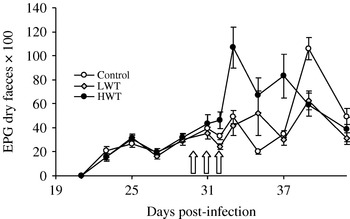
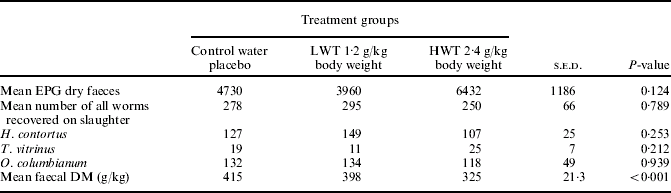
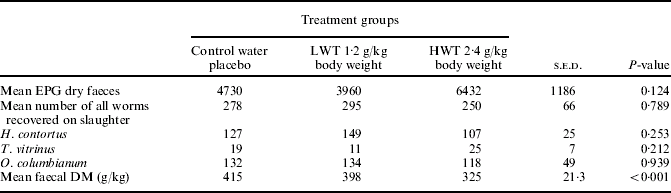
Administration of WT as drench to goats with mixed nematode infection at low or high dose did not reduce (P>0·05) FEC. The faecal egg profiles (Fig. 1) showed irregular fluctuations, which involved all groups 24 h after the onset of the drenching exercise. The amplitude of fluctuations reached a peak on day 39 but subsided to pre-drench values towards the end of the trial (day 42). Similarly, the WT drench did not cause any significant reduction (P>0·05) in worm burdens of the three nematodes (H. contortus, O. columbianum or T. vitrinus) that were recovered post-mortem. There was also a significant increase in faecal water and mucus content, particularly in animals drenched with the high dose (group HWT). Faecal DM content of animals in group HWT (325 g/kg faeces) remained lower (P<0·001) than that in group LWT (398 g/kg faeces) and control (415 g/kg faeces) from day 31 to day 37 p.i. (Table 1). Both feed consumption (these empirical observations were quantified in Expt 2) and faecal consistency improved steadily after the drench was stopped. Post-mortem visual examination of the GI tract 9 days after the last WT dose revealed no mucosal lesions or changes that could be associated with the wattle extract drench.
FEC (mean and standard deviation×0·2) of SEA goats receiving low and high doses WT drench during experimental infestation with mixed nematodes (Expt 1). The three arrows indicate the days of drench administration. (EPG, eggs per gram.)

Effect of WT drench on FEC, worm burdens (mean total number of worms recovered on slaughter) and faecal DM content of SEA goats during experimental infection with mixed intestinal nematodes (Expt 1)
Experiment 2
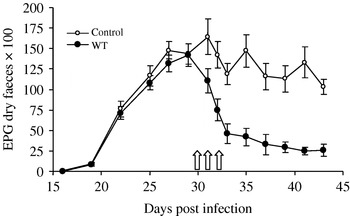
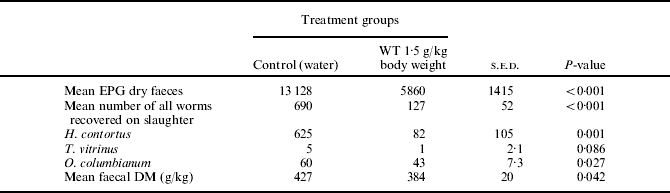
The effect of WT drench on FEC and worm burdens of the BHP sheep during experimental mixed nematode infestation is shown in Fig. 2 and Table 2. The FEC of sheep drenched with WT solution was significantly (P<0·001) reduced; the effect was observed within 24 h of the first dose and remained low to the day of slaughter (day 42). Comparison of FEC between the drenched and control group on the day of slaughter showed a reduction of 75%. The effect of the drench on worm burdens was also significant (P<0·001); the populations of Haemonchus, Trichostrongylus and Oesophagostomum were reduced by 87, 71 and 28%, respectively (Table 2). No Cooperia sp. worms were recovered. The WT drench induced a noticeable but transient loss of appetite; feed consumption on day 33 dropped to as low as 0·1 of that recorded on day 30 before returning back to normal by day 36.
FEC (mean and standard deviation×0·2) of BHP sheep receiving WT drench, during experimental infection with mixed nematodes (Expt 2). The three arrows indicate the days of drench administration.

Effect of WT drench on FEC, worm burdens (mean number of worms recovered on slaughter) and faecal DM content of BHP sheep during experimental infection with mixed intestinal nematodes (Expt 2)
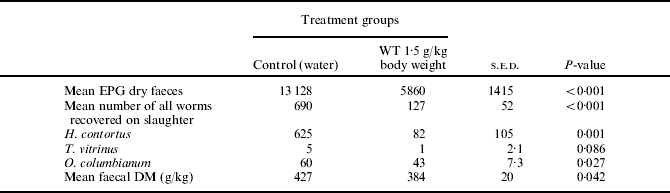
As with the goats, the WT drench also caused a significant increase in faecal water and mucus content. Faecal DM content of animals in the WT-drenched group (384 g/kg) was significantly lower (P<0·05) than that in the control group (427 g/kg) from day 31 to day 37 p.i.
Experiment 3
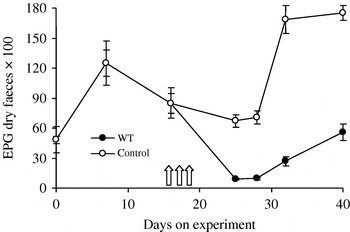
The effect of WT drench on FEC of the BHP sheep during the naturally acquired nematode infestation is shown in Fig. 3. The drench significantly (P<0·001) reduced FEC of the sheep from the mean value of 8500 EPG dry faeces before treatment to below 900 EPG 2 weeks later. Comparison of egg count values between the treated and control groups on day 32 (i.e. 16 days after the first WT dose) showed a reduction of 84%. The FEC of the control group remained high and that of the tannin-drenched group started to rise gradually after day 32 until the trial was terminated on day 40. As with the experimental infestation trial, the WT drench induced a transient drop in feed intake (as observed during grazing) and an increase in faecal water content (seen as loose to diarrhoeic faeces), which lasted for 2–3 days after the drench was stopped.
FEC (mean and standard deviation×0·2) of BHP sheep receiving WT drench, during a naturally acquired nematode infection. The three arrows indicate the days of drench administration (Expt 3).

DISCUSSION
Several field and in-station studies have demonstrated substantial anthelmintic activity of tanniniferous fodder and tannin preparations in small ruminants (Niezen et al. Reference Niezen, Waghorn, Waghorn and Charleston1993, Reference Niezen, Robertson, Waghorn and Charleston1998; Butter et al. Reference Butter, Dawson, Wakelin and Buttery2000, Reference Butter, Dawson, Wakelin and Buttery2001; Athanasiadou et al. Reference Athanasiadou, Kyriazakis, Jackson and Coop2001; Min et al. Reference Min, Pomroy, Hart and Sahlu2004; Max et al. Reference Max, Wakelin, Dawson, Kimambo, Kassuku, Mtenga, Craigon and Buttery2005b; Shaik et al. Reference Shaik, Terrill, Miller, Kouakou, Kannan, Kaplan, Burke and Mosjidis2006; Cenci et al. Reference Cenci, Louvandini, McManus, Dell Porto, Costa, Araujo, Minho and Abdalla2007). The current study, which investigated the effect of WT drenches on the tropical sheep and goats, clearly demonstrated that the drench was able to reduce both FEC and worm burden in sheep but not in goats, although both hosts were infected with the same species of nematodes and were raised in an identical environment. Earlier studies (Max et al. Reference Max, Wakelin, Craigon, Kassuku, Kimambo, Mtenga and Buttery2005a) had shown that QT, an extract from the tropical tree Schinopsis balasae, was toxic to various nematodes in vitro and as an oral drench (Max et al. Reference Max, Wakelin, Dawson, Kimambo, Kassuku, Mtenga, Craigon and Buttery2005b). Furthermore, the in vitro studies had also shown that WT, an industrial preparation from another tropical tree A. mearnsii, is toxic to GI nematodes originating from mice and also from goats (Max et al. Reference Max, Wakelin, Craigon, Kassuku, Kimambo, Mtenga and Buttery2005a). Whilst the current observations would suggest an existence of species difference between the two hosts, other studies have demonstrated different findings. For instance, Paolini et al. (Reference Paolini, Bergeaud, Duranton-Grisez, Prevot, Dorchies and Hoste2003) observed significant reduction in FEC but not worm numbers following oral administration of QT in goats. It was further shown that this FEC reduction was due to a negative effect of the quebracho tannin on female worm fecundity. Studies on the effect of WT (A. mearnsii) drenches in small ruminants are scanty and therefore comparing findings among studies that used different types of tannins could be misleading. The current findings in sheep are comparable/similar to those of Cenci et al. (Reference Cenci, Louvandini, McManus, Dell Porto, Costa, Araujo, Minho and Abdalla2007), who demonstrated an anthelmintic effect (in terms of reduction in both FEC and worm numbers) of powdered A. mearnsii bark administered orally to sheep. One explanation for a possible existence of species difference between sheep and goats could be the contrasting ability of the two hosts in dealing with the tannins in their GI tract. Goats, deer and antelopes are among several browsing animal species that can neutralize some of the dietary tannins by producing tannin-binding saliva (Mehansho et al. Reference Mehansho, Hagerman, Clements, Butler, Roger and Carlson1983); this mechanism is lacking or poorly developed in other species including sheep, cattle and hamsters (Austin et al. Reference Austin, Suchar, Robbins and Hagerman1989). It has also been suggested that goats are more adapted than sheep to resist the detrimental effects of CT because of microbial tanninase enzymes in their rumen (Narjisse et al. Reference Narjisse, Elhonsali and Olsen1995; Perez-Maldonado & Norton Reference Perez-Maldonado and Norton1996). Goats are also known to harbour tannin-tolerant bacteria in their rumen; for example Streptococcus caprinus has been isolated from feral (Brooker et al. Reference Brooker, O'Donovan, Skene, Clarke, Blackall and Muslera1994) and SEA goats (Odenyo & Osuji Reference Odenyo and Osuji1998). S. caprinus was shown to grow in media containing at least 2·5% w/v tannic acid or CT and able to degrade mimosine, tannic acid–protein complexes as well as hydrolysable tannins (Brooker et al. Reference Brooker, O'Donovan, Skene, Clarke, Blackall and Muslera1994). With these mechanisms in action, it is possible that some of the bioactive tannins administered to goats were neutralized or inactivated before they could reach or act on the nematodes. However, since administration of the WT drench induced physiological gut changes (increased water and mucus content) in both hosts, it is logical to assume that the goat's neutralizing ability could not have been sufficient to act on all of the administered tannins but probably on those that appear to be bioactive against the nematodes.
Induction of a hostile gut environment such as irritation and diarrhoea (Lorimer et al. Reference Lorimer, Perry, Foster, Burgess, Douch, Hamilton and Donaghy1996) is also suggested as a mechanism that underlies the anthelmintic activity of some ethno-botanical preparations. The anthelmintic property of tannins has also been associated with physiological changes they cause in the host's gut (Athanasiadou et al. Reference Athanasiadou, Kyriazakis, Jackson and Coop2000). However, the current data did not indicate such an association. This is because the WT drench induced a similar degree of gut changes in both hosts, suggesting that the observed activity in sheep was probably due to a direct toxic effect of tannins rather than just physiological gut changes.
The significant reduction in FEC following administration of WT to a flock of sheep during a naturally acquired worm infestation (Expt 3) further indicated the anthelmintic activity of WT drench in sheep. The current dose of 1·0 g WT/kg bodyweight for 3 consecutive days helped to keep the FEC below 3000 EPG dry faeces for nearly 3 weeks. This was interesting because infections in the same flock had shown strong signs of resistance (data not shown) to oral drenches of levamisole and albendazole. Comparison of the present findings with those from other studies evaluating the use of plants or plant extracts as anthelmintics indicates that WT drenches can give a satisfactory outcome, at least in sheep. Evaluation of Albizia anthelmintica (Githiori et al. Reference Githiori, Höglund, Waller and Baker2003) and other plants used by pastoralists as dewormers (Githiori et al. Reference Githiori, Höglund, Waller and Baker2004) against H. contortus of sheep showed that, although in some cases there were reductions in FEC and worm burdens, these reductions were judged not to be biologically significant. Recently, there has been a steady increase in reports indicating the beneficial effects of tannins and tanniniferous plants to sheep and goats during GI nematode parasitism (Min et al. Reference Min, Pomroy, Hart and Sahlu2004; Ramirez-Restrepo et al. Reference Ramirez-Restrepo, Barry, Lopez-Villalobos, Kemp and McNabb2004; Hounzangbe et al. Reference Hounzangbe-Adote, Zinsou, Hounpke, Moutairou and Hoste2005; Tzamaloukas et al. Reference Tzamaloukas, Athanasiadou, Kyriazakis, Jackson and Coop2005; Shaik et al. Reference Shaik, Terrill, Miller, Kouakou, Kannan, Kaplan, Burke and Mosjidis2006). Although these studies used tanniniferous fodder, which at any time could not have exposed the experimental animals to concentrations of CT as high as in the present study, positive results were still reported in both sheep and goats. This implies that the concentration of CT alone is not a determining factor but probably the presence of other bioactive factors that could be lacking in the extracted tannin preparations. The presence of additional bioactive factors, which interact or compete with tannins, has been put forward as one of the reasons for variability of results from various animal studies (Hoste et al. Reference Hoste, Jackson, Athanasiadou, Thamsborg and Hoskin2006). The administered dosage also appears to influence the outcome; for instance, Hounzangbe et al. (Reference Hounzangbe-Adote, Zinsou, Hounpke, Moutairou and Hoste2005) found that repeated consumption of small amounts of Fagara leaves (Zanthoxylum zanthoxyloides) was more effective than a single 3-day administration in reducing FEC in sheep. Therefore, it would be imperative to conduct a survey of locally available tanniniferous browse and use them as supplements to infested hosts and observe their effect on FEC, worm burdens as well as general growth performance.
Generally, it is not suggested that tannins should replace the use of synthetic anthelmintics but their moderate anthelmintic activity has a significant epidemiological implication in pasture larval contamination. Moreover, being cheap and readily available, such drenches could be used in combination with other husbandry techniques designed to reduce the impact of parasites to supplement the use of expensive drugs in controlling nematode infections of livestock owned by resource-constrained farmers in the developing countries. Further trials are required to validate the use of WT drenches under the field conditions not only in the sheep but also in other grazing livestock known to lack the tannin neutralization mechanisms e.g. calves.
This study was funded by the United Kingdom's Department of International Development (DFID) for the benefit of developing countries. The views expressed are not necessarily those of DFID.